




Abstract
By focusing on the recently established diplomatic relations between Israel and the UAE in the aftermath of the 2020 Abraham Peace Accords, this paper critically assesses the emerging narratives of peace and tolerance underpinning the tourism promotional material circulating in the Israeli media between September 2020 (in the aftermath of the Abraham Accords) and August 2023 (before the outbreak of the Israel-Hamas war in October 2023). The study employs a variant of critical discourse analysis known as Cultural Critical Discourse Analysis (CCDA) to unravel the cultural nuances embedded within this discourse. Based on this analysis, a dynamic model is presented to highlight two discourse strategies—cosmopolitanism and softening—underpinning the emerging discourse. Overall, this article represents a significant contribution in this specific moment of crisis as it aims to propel peace discourses through tourism in a region characterised by political instability.
Introduction
Within a broader recognition of the political power of tourism in shaping relations, perceptions, and stereotypes about people and places, since the end of the Second World War, tourism has often appeared in political agendas as one of the initiatives to foster peace among and within countries (Pedersen, 2020). The 1980 UNWTO Manila Declaration (United Nations World Tourism Organization [UNWTO], 1980, p. 1) conceived tourism as “a vital force for world peace” due to its presumed function to “provide the moral and intellectual basis for international understanding and interdependence.” This stance has been reiterated over the years by other organisations through several different initiatives. In 1986, the International Institute for Peace through Tourism (IIPT), a not-for-profit organisation, was established with a vision of travel and tourism becoming the world’s first global peace industry and the belief that every traveller is potentially an “Ambassador for Peace” (International Institute for Peace through Tourism [IIPT], 2023).
Within academia, the nexus between tourism and peace has also been amply acknowledged and interrogated, with a growing number of publications starting to emerge in the literature since the 1980s (Brown, 1989; D’Amore, 1988). A conspicuous body of knowledge has unveiled the complex nature of the tourism-peace nexus, namely a multifaceted concept/process that intersects multiple interrelated political and socio-economic phenomena beyond tourism (e.g., conflict, war, violence, justice, poverty, power, ethnicity, globalisation, multiculturalism, neo/post-colonialism, and social inequality, among others) across different fields of inquiry (e.g., tourism, peace studies, political science, and sociology) (Higgins-Desbiolles et al., 2022). The complexity of the topic is confirmed by the various debates on the relationship between tourism and peace found in the literature (D’Amore, 1988; Litvin, 1998).
Among them, a particularly controversial debate refers to the causal relationship between tourism and peace. In this regard, whether tourism should be conceived as a potential catalyst for peace or a mere causal product of a peaceful environment has remained a subject of dispute since the 1980s. Specifically, scholars like D’Amore (1988, p. 23) have supported the stance of “tourism as a catalyst for peace” by reiterating that international travel “is not only a precondition for additional trade in goods and services, particularly with newly emerging trading partners, but also a foundation on which to build improved relationships toward the goal of world peace and prosperity.” From this angle, D’Amore (1988) conceives tourism as a form of “track-two diplomacy,” namely a type of relations that supplements official diplomatic ties. In contrast, Litvin (1998, p. 63) questions the causal relation between tourism and peace by counter-arguing that although a correlation exists between the two, tourism should be regarded “as a beneficiary, and not a cause, of peace.”
Even those commentators who have accepted the role of tourism in promoting stability have questioned whether tourism only contributes to reducing conflict (negative peace) or actively builds the foundations for eradicating structural violence (positive peace) (Causevic & Lynch, 2011). There have also been debates about the specific types of tourism potentially contributing to peace, with some commentators like Hassan (1975) arguing that organised mass tourism mainly acts to reinforce stereotypes that may exacerbate conflict rather than induce harmony. Lately, by reflecting upon the intersections between peace, justice and sustainability, Higgins-Desbiolles et al. (2022) have noted that despite the multiple links established by public and private organisations between tourism and peace over the last fifty years, the tourism-peace nexus appears relatively weak (2030 Agenda for Sustainable Development).
Specifically, while Goal 16 of the Agenda, entitled “Peace, Justice and Strong Institutions,” aims to “promote peaceful and inclusive societies for sustainable development, provide access to justice for all, and build effective, accountable, and inclusive institutions at all levels,” it does not directly address tourism as an agent for peace and silences any potential link between peace, justice and tourism. By doing so, the 2030 Agenda for Sustainable Development does not reflect the conspicuous debates about the tourism-peace nexus contemplated by some tourism scholars and practitioners. Instead, tourism (especially mentioned in SDGs 8, 12, & 14) is mainly framed as a business disentangled from its social and environmental opportunities. Drawing upon Hall critique of the Agenda, Higgins-Desbiolles et al. (2022, p. 337) point out that “there is an unwillingness on the part of some tourism proponents to engage with tourism in its broader context and address the relationship between tourism and wider injustices, inequities and exclusions as well as dynamics of unsustainable growth and development.” However, the authors still emphasise the importance of SDG 16 in prompting essential inquiries regarding tourism, peace and sustainability (Higgins-Desbiolles et al., 2022).
Against this background, where discussions about the tourism-peace nexus remain inconclusive and opportunities to better understand it are missed by tourism scholars and practitioners, one may question whether and how the myriad of existing empirical studies produced by tourism scholars could advance a macro-level understanding of the link between tourism and peace. However, it is also imperative to recognise that a more comprehensive understanding of this link must maintain the specific micro-level contextual circumstances and dynamic local relations in which conflict, peace, and tourism arise (Farmaki, 2017). Based on these premises, by focusing on the context of the recently established diplomatic relations between Israel and the UAE due to the 2020 Abraham Peace Accords, this paper critically assesses the emerging narratives of peace and tolerance underpinning the tourism promotional material circulating in the Israeli media.
The Abraham Peace Accords were officially signed on September 15, 2020, to normalise political relations between Israel, the United Arab Emirates (UAE), and Bahrein. In addition to a central Declaration that contemplates the important role of the accords in maintaining and strengthening peace in the Middle East and around the world, the accords include a specific annexe in which tourism is addressed explicitly as a “critical component of economic development and of developing closer people-to-people and cultural ties” (Abraham Accords Peace Agreement, 2020, annexe p. 1; US Department of State, 2020). The Abraham Accords initiated a significant period of Israeli interest in the UAE. Since 2020, the Abraham Accords have contributed to considerable commercial and social exchanges between Israel and the UAE, including increasing tourist mobilities. This has led to a surge in Israeli visits to the country within a short timeframe (Yoked, 2022). However, on October 7, 2023, a war erupted between Israel and Palestinian militants in Gaza due to a terrorist attack on Israel. The ensuing chain of warfare attacks has resulted in an armed conflict between Israel and the militia in Gaza, giving rise to heated debates about responsibilities and solutions among nations and members of the international community. While this episode (at the time this article is produced) does not directly affect the previously established Abraham Accords between Israel and the UAE, it has led to travel warnings issued from Israeli authorities to Israeli citizens planning to travel in the region and internationally.
Despite this, the Peace Accords produced new narratives about Israeli and Emirati travellers alongside new social discourse about the two countries/destinations through print and social media publications. To focus on these emerging narratives and the discourse strategies behind them is imperative as individuals make sense of their “realities” through the stories they tell and hear (Smith & Sparkes, 2006). From a broader sociological perspective, Gubrium and Holstein (2009, p. 7) claim that collective and individual narratives mirror social structures as “individual accounts add up to something more than biographical particulars, namely, stories of social worlds on their own terms.” Moreover, previous studies have emphasised the role of textual and visual narratives in shaping geographic (Gregory, 1994) and touristic imagination (Salazar, 2012) of places and people. From this perspective, narratives contribute to producing socially constructed images of destinations based on fantasies and imaginaries (Shmuel & Cohen, 2020). More specifically, this article aims to answer the following research questions: “What are the discourses within the tourism-peace nexus that emerged about the UAE in the Israeli media in the aftermath of the 2020 Abraham Accords? What are the dominant discourse strategies constructed through and underpinning these discourses?”
This unique case focuses on two countries whose formal political and diplomatic relations have not been affected by forms of direct conflict but by broader geo-political power structures resulting from the Israeli-Palestinian conflict. As such, the Israel-UAE case diverges from other existing studies, which have tended to focus on the tourism-peace nexus in ethnically diverse post-conflict societies or societies still at war (Causevic & Lynch, 2011; S. S. Kim et al., 2007), thus examining the contribution of tourism to peace and stability in the context of direct conflict. Since Israel and the UAE have only recently established formal bilateral political and commercial agreements, a question arises as to how the growing tourist flows between the two countries and the discourses emerging in the respective media about the two destinations could contribute to shaping perceptions of the Other.
Whether and how the current scenario will reshape the discourses of peace and tolerance that emerged in Israel and the UAE between September 2020 and August 2023 is an aspect that deserves additional attention in the future as events continue to unfold. Despite this, without overlooking the unequal power structures and conflicts underpinning tourist practices and exchanges (Higgins-Desbiolles et al., 2022) and recognising that peace is a fluid process in which conflict and stability constantly coexist in a dialogical connection (Shepherd, 2022), we believe that this article represents a significant contribution in this specific moment of crisis as it aims to propel peace discourses through tourism in a region characterised by political instability. Overall, this work is informed by the belief that peace discourses need to be heard and promoted in moments of conflict and crisis like the current one. As such, the paper contributes to the existing body of knowledge by unpacking how touristic discursive practices circulating in the media—and their underlying strategies—shape individual and collective imaginaries of a specific destination and specifically promote peace and tolerance between countries.
Literature Review
The Tourism-Peace Nexus
A substantial body of knowledge has theoretically and empirically supported the idea that tourism is an agent for peace-building and political stability. Among the most influencing scholars advocating for the social power of tourism, D’Amore (1988, p. 23) claimed that “international travel can play a role in promoting understanding and trust among people of different cultures […], a foundation on which to build improved relationships toward the goal of world peace and prosperity.” Several empirical studies have sustained this idea. For example, Y. K. Kim and Crompton (1990) assessed the role of tourism in reunification efforts in the Korean Peninsula and discussed the opportunities for peace through travel-related cultural exchanges. Their work redefined tourism as a form of diplomacy (track-two diplomacy) supporting the official diplomatic initiatives initiated by the two governments (track-one diplomacy). Likewise, other studies have reconfirmed tourism’s potential role in building peace or aspects of it (Cho, 2007; S. S. Kim et al., 2007). Notably, Becken and Carmignani (2016) developed a model testing and confirming the hypothesis that increasing tourist arrivals positively affects a country’s stability.
However, Litvin (1998) examined the often-stated claim of tourism as the world’s peace industry and stated: “There is no contention to the belief that tourism flourishes in an environment of peace; clearly there exists a co-relation between successful tourism and the absence of war, terrorism, and internal strife. But does tourism create peace, or does peace generate tourism?” (p. 63). Likewise, Pedersen (2020) critiqued the three assumptions behind tourism and peace formulated by Tomljenović (2010). According to Tomljenović (2010), (a) tourism puts people in contact with one another; (b) contact fosters harmonious relations; and (c) improved interpersonal or inter-group relations will reduce tensions even at the broadest societal and international levels. However, Pedersen (2020) points out that while the first assumption is valid, it needs to consider the depth and meanings of cross-cultural contact. While travelling does facilitate encounters among different cultures, often, these encounters tend to be ephemeral and shallow, especially in the context of mass tourism (see Ritzer & Liska, 1997).
Furthermore, questions arise around the assumption that improved interpersonal or inter-group relations could reduce tensions at the broadest societal and international levels. Cho (2007) found that while the Mt. Gumgang tourism development initiative, which was expected to foster peace in the Korean Peninsula, partially led to social and economic integration, it still hasn’t produced the political effects sought at a macro level. Notably, although studies on post-conflict areas have not disregarded the positive effect of tourism on reconciliation efforts (Causevic & Lynch, 2011), they have also reiterated its role in reproducing opportunities for conflictual relations and hostilities among ethnic groups/nations (Farmaki, 2017).
Overall, the relationship between tourism and peace needs to be situated within a complex dynamic scenario (see Causevic & Lynch, 2011 on “phoenix tourism” as a process) where various interconnected components and actors must be considered, including the general context (the social, economic, and political causes of the conflict alongside the background of these causes) and the specific tourism context (the power structures, actors, sectors, and forms of tourism characterising a specific locale) (Farmaki, 2017). Within the context of this paper, we view the specific discourses, and their underpinning discursive strategies—employed to produce and promote tourist spaces and people—as essential aspects to consider within the complex dynamic scenario portrayed by Causevic & Lynch (2011) to frame the tourism-peace nexus. More specifically, this work assumes that peacebuilding discursive practices, which are often infused by assumptions and assertions about the positive role of tourism in reducing conflict, play a crucial role in shaping public perceptions of destinations as “peaceful.”
Tourism, Peace and the Touristic Imagination
The tourism literature has discussed the social construction of places, people and objects through tourism. Scholars have mobilised various interrelated concepts to explain how tourism produces realities by shaping perceptions and beliefs about cultures. These concepts include tourist imaginaries (Salazar, 2012), touristic imagery (Adams, 2004), metaphors (Belhassen, 2020), narratives (Tucker & Shelton, 2018), and myth (Selwyn, 1996), among others. In assessing the power structures underlying touristic representations, Adams (2004) contends that texts, photos and videos play a decisive role in shaping not only visitors’ expectations but also locals’ identities. From this perspective, promotional material transforms local people and places into exotic and seductive tourist objects to be consumed by selected tourist gazes (Salazar, 2012). Throughout this process of social fabrication of destinations, selected cultural items are accentuated and embedded coherently into specific narratives while problematic subjects and objects are omitted or revisited (Tucker & Sheldon, 2018). As such, touristic imaginaries are shaped by dominant political forces and power relations that often misappropriate and subjugate locals’ voices and cultures (Hollinshead, 1999). Notably, such constructions are not neutral and static but are constantly reconstructed and renegotiated dynamically by complex networks of tourism stakeholders, which include local and global entrepreneurs, anthropologists, locals and tourists (Salazar, 2012).
Lately, Shmuel and Cohen (2020) revisited Gregory’s (1994) notion of geographical imagination to examine the concept of touristic imagination. Their work reiterates that tourists tend to frame people and places through spatiotemporal and socio-cultural binary categories (past/present, urban/rural, modern/traditional, man/woman, tourist/local, indigenous/non-indigenous) that construct and reproduce the Other through (post/neo-)colonial, gendered, racial, and ethnic-based power structures (Bandyopadhyay & Morais, 2005; Echtner & Prasad, 2003; Wijesinghe et al., 2020). There have been many discussions on how these fabricated scripts and narratives impact (mostly negatively) local communities and destinations by producing stereotypical perceptions and prejudices (d’Hauteserre, 2011). Notably, this paper examines how images and discourses of destinations/people/objects, socially shaped through touristic production and consumption, affect international relations (possibly positively by contributing to peace and tolerance), a point that has received less attention in the literature.
Recently, Çokişler and Çokişler (2023) discussed the place and role of tourism in discourses of peace from the perspective of four central international relations theories, namely neorealism, neoliberalism, constructivism, and critical theory. In exploring the tenets of the four theories, which emanate from different ontological stances on how international political structures are conceived and which forces may shape them, they have concluded that “the arguments about how tourism can promote peace largely agree with the arguments of constructivism as the constructivist theory suggests, it is possible to use tourism to break down the current hostile environment” (Çokişler & Çokişler, 2023, p. 8). Based on this stance, discourses circulating in the media may shift the touristic imagination of peoples and places perceived as conflictual to more peaceful and tolerant socially constructed images. From a Foucauldian perspective, the shifts in touristic imagination propelled by the media can be better understood if the mutual relationship between power and knowledge in discourse is acknowledged. More specifically, Foucault (1972) contends that discourse and discursive strategies are not mere linguistic practices producing neutral knowledge about a topic; rather, they are complex systems of practices, institutions and social relations constructing forms of knowledge that both reflect and (re)produce decentralised and fluid power structures. From this angle, as sites of power production and contestation, discourses of peace and tolerance about the UAE in Israeli media represent essential analysis frames to critically explore the dynamic diplomatic relations between the two countries in this specific historical moment.
Overall, from a theoretical perspective, this paper mobilises political and international relations theories alongside constructivist approaches to tourism to explore discourses and discursive strategies of peace about the UAE circulating in the Israeli media.
Context of the Study: The Relations Between the UAE and Israel in the Aftermath of the Abraham Peace Accord
The Abraham Peace Accords were officially signed on September 15th, 2020, to normalise political relations between Israel, the United Arab Emirates (UAE), and Bahrein. The accords include a central Declaration that “recognise [s] the importance of maintaining and strengthening peace in the Middle East and around the world based on mutual understanding and coexistence, as well as respect for human dignity and freedom, including religious freedom” (US Department of State, 2020). The primary declaration encompasses different aspects, including promoting interfaith and intercultural dialogue, recognising human dignity irrespective of race, faith and ethnicity, and supporting scientific, artistic and commercial activities under a vision of peace and prosperity. Alongside the primary declaration, specific agreements concerning the relations between Israel and the other interested parties (the UAE and Bahrein initially, followed by Morocco and Sudan) were signed. The separate agreement between Israel and the UAE, besides reaffirming the establishment of a new era of peace and friendly relations, also indicates the specific micro-level sectors of cooperation regarded as crucial to strengthening a culture of peace at a macro level, which also includes “tourism, culture and sport.” From this perspective, the accords established new discursive practices, including new tourist discursive practices that contributed to producing and shaping new images about the two countries, their people and tourist spaces.
Various initiatives to promote tourist activities between the two countries are also contemplated, including “joint tourism projects and packages between tourist operators” and “reciprocal study tours in order to increase knowledge in the development, management and marketing of heritage, cultural and rural tourism with a view to diversifying and deepening touristic links between them” (Abraham Accords Peace Agreement, 2020, annexe p. 1; US Department of State, 2020). According to Shepherd (2022), the Abraham Accords (and the emphasis placed on the centrality of Abraham as a uniting figure for Christians, Muslims, and Jews) can be conceived as an example of a “unifying approach to peacebuilding through tourism,” where tourism represents an opportunity to highlight similarities or “unifying points” between conflicting sites, which in turn may foster cross-cultural understanding.
Despite the limitations to mobility imposed by the Covid-19 pandemic, the peace agreement boosted tourist flows between the two countries. According to the 2022 Annual Report published by the Abraham Accords Peace Institute (Abraham Accords Peace Institute, 2022), the number of Israeli tourists visiting the UAE increased from virtually 0 in 2019 to 268,000 in 2022, while 1,600 people travelled from the UAE to Israel in 2022. However, the experiences, perceptions and behaviour patterns of Israeli tourists visiting the UAE still need to be explored. Moreover, little is known about the potential role of the emerging discourses of peace and tolerance in the media in shaping people’s touristic imagination.
Methodology
This study employs a qualitative and quotative methodology to analyse travel articles and news pieces about the UAE published in the Israeli media between September 2020 (the aftermath of the Abraham Accords) and August 2023 (before the war between Israel and Hamas started in October 2023). The dataset was collected between November 2022 to August 2023. The primary author is an Israeli scholar with prior research experience in the areas of geographical and touristic imagination, as well as the discourse of peace and tolerance among Israeli tourists in other Middle Eastern countries (Shmuel & Cohen, 2020). This background allows her to offer a dual perspective on the subjects addressed in the paper. Conversely, the second author is a non-Israeli scholar unaffiliated with Israel. Together, the team engaged in comprehensive discussions to uphold transparency and consistency. We believe that the team’s composition offers both emic and etic viewpoints.
To examine the texts included in the research, a variant of critical discourse analysis known as Cultural Critical Discourse Analysis (CCDA) was mobilised (Gavriely-Nuri, 2006, 2015). The study’s dataset encompasses 102 online articles in Hebrew, taken from major Israeli Internet news outlets, including Globes, Haaretz, Mako, and Ynet, which cover a diverse array of subjects. Specific news websites, such as “Ynet,” function as the digital editions of daily printed newspapers like “Yedioth Ahronoth” (For further insights into Israeli media, see Madmoni-Gerber, 2009). Consequently, these sources deliver timely and comprehensive coverage of political developments within the State of Israel, particularly in the realm of politics, including issues like the Abraham Accords and their subsequent implications. Furthermore, each of these websites features dedicated sections focused on tourism, travel, and leisure activities. Another set of Israeli media outlets selected comprises specialized websites catering to specific interest groups, such as hikers and nature enthusiasts (e.g., Masa Acher), as well as independent travel vlogs like touristit.co.il and hatayelet.com. The articles, originally in Hebrew, were translated by the first author of the study, as she is a Hebrew native speaker, with the support of a professional translator and editor, who played a pivotal role in insuring the trustworthiness of the content and context. The articles underwent content analysis (Mayring, 2004) according to which they were mapped, sorted and classified into “discourse clusters.” The “discourse clusters” were composed of repeated narratives that stood out from the texts and were connected at the end of the process to discourse strategies (Gavriely-Nuri, 2015). Beyond the content analysis, the texts were analysed and sorted according to other indicators such as time, geographical space, keywords, the type of article and the media source from which it was drawn.
From a practical point of view, quotes, paragraphs and even entire articles found suitable for the study were copied into one file in Word format. This file (totalling over 132,000 words) made it possible to cross-reference information, search for code words, code the information according to both content indicators (for example, discourse clusters, narratives, code words), and technical indicators (for example, dates, places, type of source). Uploading all the texts to one file also assisted in searching for specific words, for example, words identified colloquially as representations of Jewish elements (e.g., “synagogue,” “kosher,” “kippah,” “Hebrew”), Muslim-Arabic elements (e.g., “mosque,” muezzin,” “chastity,” “Arabic”), or elements related to the relations between the parties (e.g., “peace,” “tolerance,” “cooperation”), to check the frequency and context of their appearance in the texts.
The team conducted both quantitative and qualitative analyses, examining the frequency of words and terms in the texts. Subsequently, we engaged in discussions aligning these findings with relevant literature and the study’s objectives. For instance, “Las Vegas” was referenced 20 times across various sources such as Haaretz, Themarker, Ynet, Mako and Globes. Similarly, “New York” appeared 27 times in publications like Ynet, Themarker, Haaretz, and Calcalist. Additionally, international figures like David Beckham, Richard Branson and Brad Pitt were mentioned several times across texts from Themarker, Haaretz, Maariv and Ynet. These discussions delved into contextual nuances and connections, exploring their implications for global characteristics and the broader narrative they contributed to, reflecting upon the UAE from a comprehensive standpoint.
The central research approach used in this study is Cultural Critical Discourse Analysis, or CCDA. This approach, which derives from CDA (Critical Discourse Analysis), views social discourse as representing patterns of social behaviour (Fairclough et al., 2013). The unique premise of the approach ascribes the discourse to complex contexts. A basic postulation of CCDA, adopted here as a central research approach, is that a text only has meaning in a specific cultural context (Gavriely-Nuri, 2017). CCDA aims to decipher the cultural codes embedded in the discourse (Gavriely-Nuri, 2006, 2015). It enriches the research that connects discourse and culture, and specifically the triple connection of discourse, culture, and critical analysis (Gavriely-Nuri, 2012). In this study, CCDA analysis was employed to unveil the dominant discourse strategies constructed through narratives. Gavriely-Nuri (2017, p. 144) defines “discourse strategy” as any discourse manoeuvre designed to influence the target audience and advance the speaker’s political objectives (see also Carvalho, 2005, 2008; Romano & Porto, 2016). Narratives, which form the building blocks of discourse strategies, play a critical role in communication by enabling individuals to ascribe significance to events. Additionally, the potency of narratives lies in their ability to serve as a medium for conveying messages and ideologies while mirroring and shaping social relational frameworks (Poppi et al., 2018).
Findings
Overall, the analysis of the Israeli media unveils the emergence of a central discourse of peace and tolerance around the UAE. Indeed, the Hebrew word Sovlanut (which translates to “tolerance” in English and stands for three things: bearing the thing that must be endured, nurturing it to the point where its existence is possible, and “holding something inside”; see Tippelskirch, 2007, p. 120) often appears in the texts examined. This central discourse of tolerance is composed of a plethora of diverse narratives that tend to picture the UAE positively, mainly as an inviting, culturally diverse, captivating and welcoming destination. Specifically, the various narratives collectively reflect (and at the same time produce and shape) two specific discourse strategies, which can be labelled as “cosmopolitanism” and “softening.” In the text below, these two discourse strategies and their underpinning narratives are presented and critically assessed in relation to their contributing role to peace and tolerance.
Discourse Strategy 1: Cosmopolitanism
The first discourse strategy identified in the text is “cosmopolitanism.” The term “cosmopolitan,” originating from the Greek word kosmopolitês meaning “citizen of the world,” embodies the concept that all individuals, irrespective of their political affiliations, belong to or can be part of a unified global community. This community is envisioned to be nurtured through various means, such as shared markets or cultural expressions (Kleingeld, 2016). Its objective, in this paper, is to depict the United Arab Emirates as a cosmopolitan, affluent and contemporary cultural centre. It aims to present Israeli readers with an image of a modern country. The strategy of cosmopolitanism is present in several different narratives, which can be grouped into three sub-categories: “narratives of global perspectives,” “narratives of familiarity,” and “narratives of culture.”
Narratives of Global Perspectives
These narratives emphasise the extensive range of tourist offerings available in the country, including remarkable modern architecture, distinctive museums, international galleries, luxurious hotels and an array of captivating attractions. Additionally, these elements are compared or associated with other prominent destinations worldwide. In one of the articles, for example, Dubai was described in the following manner: (…) Dubai feels like a combination of Las Vegas, a showy and attractive city that suddenly strikes in the heart of a desert (…), and New York, with its impressive and powerful skyline and its radiating power. The courteousness, good manners, and politeness of the locals are largely reminiscent of London (…). (Idan Vinitsky, December 16th, 2020)
A series of “narratives of global perspective” evokes the discourse strategy of cosmopolitanism by referring to three groups of internationally renowned tourist sites. Firstly, sites with a global context are constructed in the United Arab Emirates as replicas of iconic destinations, aiming to resemble the original place for tourists. It appears that these places are socially constructed based on existing monuments or locations. Examples include sites inspired by or emulating the Taj Mahal in India, the Louvre in Paris, and the Bellagio Fountain in Las Vegas. Secondly, references and associations are made between sites and attractions in the United Arab Emirates and other renowned global destinations. For example: “Al Yaqoub Tower (…) which is reminiscent of the Big Ben tower in London, and the Marina 101 tower (…) whose top is reminiscent of the Chrysler Building of New York” (Naama Riba, August 16th, 2020), and the large Dubai Frame, which is mentioned as “…perhaps the local version of the Parisian Arc de Triomphe” (Masa Acher Online, 2020). Thirdly, the texts mention projects that foster global interactions and activities, such as Dubai Global Connect (DGC), a large-scale B2B wholesale market offering unique goods from around the world, the Global Village in Dubai and Expo Dubai.
Furthermore, the “global perspective” is further reinforced by linking internationally renowned celebrities to these sites. Some individuals have been acknowledged for acquiring luxury apartments in Dubai, including David Beckham, a former professional footballer, the billionaire entrepreneur Richard Branson, and the Hollywood actor and film producer Brad Pitt. Others are characterised as being enamoured with the place, frequently visiting the UEA’s tourist sites. In the example below, a connection is made between the peace agreement between Israel and the United Arab Emirates, the depiction of the country as a “dream” destination, and the association with international celebrities.
This weekend, a peace agreement was unexpectedly signed with the United Arab Emirates, widely regarded as one of the world’s most stunning countries, comprising seven exceptionally prestigious principalities. This destination offers the epitome of a dream vacation, uniquely blending futuristic cityscapes and advanced innovations with pristine beachfront, vibrant nightlife, desert landscapes, Mediterranean ambience, and antique markets just like in the tales of One Thousand and One Nights and Disney’s Aladdin. Over the years, this sought-after destination has captivated the hearts of numerous celebrities from across the globe, including reality TV star Kim Kardashian West, pop icons Katy Perry, Ne-Yo and Eve, actress Natalie Emmanuel from Game of Thrones, the Hilton sisters Paris and Nicky, supermodel Adriana Lima, actress Eva Longoria, and many more who fell in love with this place. (Daniella Capelouto, August 16th, 2020)
In numerous instances, the cities and landmarks of the United Arab Emirates were widely acclaimed, often surpassing the original references. For instance, Dubai has been described as “Orlando on steroids” (Tzach Yoked, September 7th, 2022), and the presidential palace Qasr Al Watan in Abu Dhabi has been lauded as “a complex that makes Capitol Hill seem pale and the White House look much less white and certainly not too impressive” (Tzach Yoked, September 7th, 2022).
The construction of global perspectives within the discourse surrounding tourist experiences in Dubai holds significant implications for shaping the perceptions and expectations of Israeli tourists. By portraying the UAE as a contemporary, affluent, and culturally rich destination, these narratives present the country as a global melting pot that offers a diverse array of experiences reminiscent of renowned destinations worldwide. This cosmopolitan appeal of the UAE, characterised by its modern architecture, international influence, and cross-cultural interactions, is likely to attract Israeli tourists seeking novel and immersive travel experiences. Moreover, the association of celebrities with UAE landmarks further enhances its allure, adding an element of luxury and glamour that resonates with Israeli tourists. Overall, the portrayal of the destination as vibrant and cosmopolitan within the narratives of global perspectives fosters a sense of connection to a unified global community, ultimately influencing the tourist imagination of Israeli travellers and encouraging them to consider the UAE as a desirable destination for their future travels.
Evidence of Dubai’s cosmopolitan, utopian and global attributes, positioning it as a prominent symbol of these qualities, is apparent in the following advertisement targeting Israeli investors interested in the city: “Dubai’s urban planning has garnered widespread acclaim as an extraordinary achievement, characterised by its futuristic skyline and remarkable architectural wonders. The city’s ambitious vision for urban development is equally notable, aiming to realize a utopian ideal of a modern and cosmopolitan metropolis” (Dubai Real Estate, 2023).
Narratives of Familiarity
Occasionally, Israeli tourism or news articles provide narratives that help readers establish a connection and find familiarity with the United Arab Emirates, thereby shifting their perception of the country as more Western and less Arab. For instance, Dubai is described as the “non-stop Tel Aviv” (Limor Sde-Chen Zadok, October 19th, 2022), implying a vibrant and dynamic atmosphere reminiscent of Israel’s bustling city. Furthermore, the Al-Sif Market in Dubai is likened to the atmospheric streets of Jaffa or Acre, as if transported from a period film of a bygone era (Yifat Rosenberg, March 24th, 2022). The texts sometimes portray the UAE as a success story even more remarkable than Israel. An Emirati Jewish businessman is quoted as saying: So, if you too have asked yourselves what makes the United Arab Emirates the object of desire for the ordinary Israeli tourist when Eilat and the Dead Sea await them here, near home, with open arms? And why do successful Tel Aviv businessmen prefer to do business in Dubai and hand over their wealth to ‘foreign hands’? The answer is simple: We look at them and dream about ourselves. What we could have been. (Naum Koen, December 25th, 2020)
Familiarity is also evoked by the increasing knowledge of—and openness to—aspects and practices of Jewish culture. Some Jewish characteristics that can be found in the UAE include a growing Jewish community, the establishment of a school for learning Talmud (the most central and influential books in the world of Jewish law), the opening of a kosher catering service, the construction of a mikveh (a reservoir of water in which immersion provides purification from various states of impurity) and the hosting of Jewish weddings and celebrations. The country’s attitude towards Jews appears to be welcoming and accommodating, with Jews being able to walk around wearing kippahs and tassels without fear of discrimination.
Providing kosher food may increase Israelis’ familiarity while visiting the UAE. Less than a month after the Abraham Accords were signed on September 15th, 2020, an Israeli newspaper reported the adjustments made in the UAE in preparation for Israeli tourists that observe the limitations of kosher food. On October 21st, 2020, an article by Doron Peskin (2020) stated: Hotels in Abu Dhabi will soon be certified to serve kosher food, after the Department of Culture and Tourism launched a kosher certification process in the capital’s hotels. An agreement with the Emirates Agency for Kosher Certification provides Abu Dhabi’s hotel industry with access to free certification services for a period of 12 months, starting immediately. In order to obtain kosher certification, the food and beverage complexes in hotels must designate a special area in the kitchen for preparing kosher food according to Jewish kosher rules, the local media reported. The hotels will be required to indicate on their menus which dishes are kosher (…) Now, with the implementation of a new and free certification system, other hotels across Abu Dhabi are expected to follow suit.
The availability of kosher food in the UAE can enhance Israeli tourists’ sense of being desirable guests as well as draw Jewish visitors from other countries who follow kosher dietary laws. From a practical standpoint, offering kosher food simplifies the travel experience for observant Israeli visitors, eliminating the need for extensive preparation and reducing complications related to their food consumption.
The construction of the country’s first synagogue also enhances Israeli visitors’ familiarity. In this respect, the Israeli press reports about the “The Abrahamic Family House” as a significant historical landmark. The house is a complex in Abu Dhabi that encompasses a mosque, a church, and the first synagogue in the capital. It was officially inaugurated in February 2023 and serves as a centre for the three Abrahamic faiths: Islam, Christianity, and Judaism. Moshe Ben Maimon Synagogue is the first in the UAE and was designed to face Jerusalem. The opening of the Abraham Family House is a significant development for Israeli tourism in Abu Dhabi, as it provides a place of worship and cultural exchange for Jewish visitors and promotes interfaith dialogue and understanding in the region. Interestingly, while most articles agreed that the complex aims to foster cultural understanding and serves as a beacon of unity among the communities representing the Abrahamic faiths (see, for example, Ofra Lax, December 4th, 2020; Limor Sde-Chen Zadok, October 19th, 2022; Itamar Eichner, October 13th, 2022; Josh Aronson, February 20th, 2023; Naama Riba, March 14th, 2023), others were more sceptical about it and referred to the site as a “Utopian and imaginary reality” (for example, Ayana Barak, March 6th, 2023). The Israeli admiration of the UAE’s attitude towards kosher food and the opening of a synagogue for the benefit of local and visiting Jews is reflected in the words of Dr Moran Zga (a specialist in the geopolitics of the Gulf countries): “It is amazing, there has never been a Muslim country that was so committed to Judaism” (Ofra Lax, December 4th, 2020).
The texts also demonstrate the UAE’s profound knowledge of—and respect for—the Jewish nation’s extensive history, including antisemitic persecution but mostly the tragic events of the Jewish Holocaust and (as a result) the establishment of the State of Israel. Furthermore, they indicate that the UAE is actively participating in Holocaust education, memorialisation and remembrance through various initiatives and events. One of the most profound initiatives is the establishment of a Holocaust Museum located inside the Meeting of Civilizations Museum in Dubai, considered to be the first and only Holocaust Museum in the Arab and the entire Islamic world: This matter [of remembering and commemorating the Holocaust] is very important to us because education about the Holocaust and its horrors is the best antidote to ignorance,” says Ahmed Obeid Al-Mansoori, founder of the Holocaust Museum in Dubai. (…) the Holocaust is a significant part of human history, and [he] believes that everyone should know and learn about the Holocaust of the Jewish people to prevent similar atrocities in the future (…) The Emiratis are proud to be tolerant and very proud of this decision and openness. (Ksenia Svetlova, July 22nd, 2021)
The Holocaust Museum is not just a passive monument for remembering and commemorating the Holocaust. It takes an active part in educating UAE citizens and residents (as well as visitors and tourists) by initiating events like lectures and workshops with Holocaust survivors. Initiatives are also coproduced with various international institutions and bodies. For example, a lecture was given by Eve Kugler, 91, who came to tell her story to Muslim children in Dubai, describing how she witnessed Kristallnacht as a little girl. The articles also prominently report on joint participation in events commemorating the Holocaust.
Narratives of Culture
The articles prominently focus on “cultural” aspects, portraying the UAE as a thriving cultural hub. They cover various facets of the local and global cultural scene, such as art, architecture, museums, traditions, festivals and more. Moreover, they emphasise the diligent efforts undertaken to foster cultural understanding and appreciation. By offering glimpses into the diverse cultural experiences and attractions offered to visitors across the country, the texts underscore the harmonious merging of traditional Arab culture with contemporary influences.
Despite the UAE’s alignment with moderate Islam and its distinctive population composition, where 85–90% are foreigners, it can still be perceived negatively by Israeli Jews due to its Arab-Islamic identity. The average Jewish-Israeli citizen has limited exposure to the local Arab 1 culture, although the Arab population in Israel constitutes about a fifth of all the country’s residents. This status quo is partly due to historical and political circumstances, which have contributed to keeping Israeli urban and rural settlements segregated. Furthermore, the tense security situation in Israel due to the Israeli–Palestinian conflict often shapes the perception of “Arabs” and “Arab culture” among parts of the Jewish-Israeli population through stereotypical lenses of fear and hatred. As a result, it is not rare to witness expressions of negative feelings, disdain and resistance coming from Israeli Jews towards anything associated with “Arabness,” sometimes even dismissing Arab culture as “non-culture.” This mindset does not favour countries identified as “Arab” as potential tourist destinations for Israelis. Therefore, there is a need to reconcile the initial preconceptions regarding “Arab countries” and “Arabs,” which are sometimes linked to “Islam” and “terrorism,” with the desire to present the UAE as an inviting, culturally diverse, captivating and welcoming destination.
Discourse Strategy 2: Softening
The second discourse strategy evident in the articles is “softening.” This strategy targets explicitly (intentionally or not) elements that may be sensitive for Jewish-Israeli citizens, approaching them from a romantic-exotic, exciting and non-threatening perspective. Through a “softening” approach, the articles aim to transform the perception of these elements from complex or problematic to exciting and non-threatening. The texts suggest compelling cases, practices and interpretations in which tourists can expect an enriching, educational, enjoyable and even corrective cultural experience by engaging with such elements. These elements can include Islamic representations, such as mosques, prayers, behaviours, rules; and aspects of Arab culture, such as language, traditional clothing, music and more.
Narratives on Mosques
Mosques, the primary places of prayer for Muslim believers, hold significant symbolic and religious importance within the Muslim faith. In Jewish law, a debate exists regarding whether Jews are permitted to enter mosques (Shapiro, 1993). While some Halachic rulings 2 allow Jews to enter mosques, others refute this possibility (Shapiro, 1993). Nonetheless, most Israeli Jews have limited contact with mosques in their daily lives due to two primary reasons. Firstly, even if they do not adhere strictly to Jewish Halachic rulings and choose a secular lifestyle, they have minimal exposure to mosques within Israel. Geographically, the number of mosques in areas with a Jewish majority is meagre, most located in Arab or mixed settlements. Consequently, mosques are not physically present in their surroundings, making them less accessible. Likely, the lack of mosques near Jewish residential centres effectively conceals the presence of Muslim symbols not just from the physical surroundings but also from the consciousness of Jewish-Israeli citizens. Secondly, as mentioned before, certain Halacha rulings within specific schools of Judaism prohibit Jews from entering mosques (Shapiro, 1993).
This issue alone has the potential to be a significant catalyst for developing diverse perspectives and interpretations regarding the visibility, functioning and purpose of mosques and to affect those believers’ geographical imagination subjectively. Furthermore, it is worth mentioning that the educational and cultural tracking of the Jewish population in Israel predominantly focuses inwardly. Although there are occasional instances of cultural, educational, and other collaborations between Jews and Arabs in the country, their occurrence is relatively scarce, and their influence is not significant. Consequently, the cultural landscape in Israel does not actively promote exposure and interaction between communities, which further contributes to a distance and gap between these groups.
In contrast to the indifference or antagonism often displayed by Israeli Jews towards mosques as religious and cultural elements, Israeli travel articles and news reports depict mosques in the UAE in a different light. The general tone in these articles portrays famous mosques, such as the Sheikh Zayed Grand Mosque and the Blue Mosque in Abu Dhabi, as captivating, enriching, and exciting tourist attractions: (…) The great Sheikh Zayed Mosque is in the centre of the city. A rare and beautiful building that looks as if it is taken from a movie about Arabian Nights or at least a version of Aladdin. Over thirty acres of minarets, domes, arches, crystal chandeliers, stone pillars decorated with gold ornaments, and a marble floor so shiny it seems as if 15 years after the mosque’s opening, no sole has stepped on it. One of the largest, most impressive, and most magnificent mosques in the Arab world, surrounded by fountains and tall palm trees in a jaw-dropping combination that even the cynical visitor will have trouble remaining indifferent to. (Tzach Yoked, September 7th, 2022)
Raising the mosques’ images and “softening” perceptions regarding them are implemented through several approaches reflected in the Israeli texts. First, mosques are juxtaposed in the texts with other elements, presenting them as legitimate places to visit that diversify or complement the overall experience. For example: “The city [Sharjah] has several interesting museums (…), beautiful mosques and markets that are worth visiting” (Masa Acher Online, 2020). On a macro level, the texts present mosques as part of an overall cultural and touristic concept and less as a religious experience: “Abu Dhabi (…) is considered a more “cultural” city, with a multitude of spectacular mosques (…) Among the main tourist sites in the country (…) Sheikh Ziad Mosque” (Aviv Batson, August 16th, 2020).
Occasionally, mosques are described as contrasting elements, adding interest and diversification that enrich touristic activities: “Science-fiction style skyscrapers stand next to the mosques and wind towers of Old Dubai.” At other times, they are portrayed as complementary sites within the broader cultural atmosphere (e.g., “The ancient mosques and countless markets”).
Secondly, the portrayal of the mosques in the texts employs a multiplicity of positive, captivating, and inspiring adjectives (e.g., “beautiful mosques,” “magnificent mosques,” and “one of the most spectacular mosques in the world”). A third approach involves highlighting and publicising visits of prominent Israeli figures to mosques as part of their visit to the United Arab Emirates. Including mosques in their formal visits conveys overt or subtle messages of legitimacy, portraying mosques as unifying rather than divisive elements. A notable example of such visits occurred when Meir Ben Shabbat, the head of the Israeli National Security Council, visited the Sheikh Zayed Mosque in Abu Dhabi in 2020.
Narratives on Muezzin
One significant aspect that characterises mosques is the muezzin’s call, summoning the faithful to prayer, even during the early morning hours. Unfortunately, many Jewish residents in Israel do not exhibit tolerance towards these calls and have even attempted to take action against them. In 2011, several members affiliated with right-wing parties introduced a bill in the Israeli Parliament (Knesset). The bill was titled “Bill for the Prevention of Hazards (Amendment—Prohibition of the Use of Public Address Systems in Houses of Worship).” The accompanying explanation for the bill stated: “Hundreds of thousands of citizens in Israel, residing in the Galilee, Negev, Jerusalem, and various areas in the country’s centre, routinely and daily suffer from noise caused by the muezzin’s calls in mosques… [The law] proposes prohibiting public address systems in places of worship for summoning worshippers or conveying religious or national messages.” (Fuchs et al., 2015, p. 57).
The recitation of the muezzin and the sounds of prayers emanating from mosques are integral parts of everyday life in the UAE. As a result, they are frequently mentioned in Israeli press articles. However, unlike the impatience observed on Israeli streets, these references are characterised by a positive, inclusive, and even enthusiastic tone, devoid of defiance or complaints. The texts consistently depict the muezzin’s call as entirely accepted and integrated into the fabric of life, accompanying tourists without exerting control or disrupting their travel routines. As an illustration, an Israeli tourist was quoted expressing her astonishment at listening to “the muezzin’s prayer that suddenly resonated from the airport loudspeakers” and remarked how “on our way to the gold market, we were accompanied by the evening prayer emanating from the loudspeakers” (Rotem Bar Cohen, May 5th, 2021). It is further noted that the muezzin’s calls are described as “echoing,” “beautiful,” “enveloping” and “powerful,” forming an authentic part of the visitor’s experience of the place.
In some cases, the texts go to the extent of disconnecting the subject of the muezzin from its Muslim context or downplaying its religious significance. The following quote exemplifies this approach: “It is uncommon to encounter men with pointed beards in the streets, stumble upon religious books in the stalls, or hear the voice of the muezzin” (Jacky Hugi, October 30th, 2020).
Narratives on Dressing
Similarly to the inclusive and positive portrayal of mosques, prayers and muezzin calls, the texts also reference local dress codes and the importance of adhering to modesty guidelines. However, there is a notable absence of explicit explanations regarding the Emirati rules of traditional clothing as an independent topic. In cases where such references are made, they often focus on the cultural significance or clarify that traditional clothing may be adopted by individuals leading a predominantly Western lifestyle: The traditional clothing devoutly preserved in the Emirates is not explicitly related to religion (…) but rather to maintaining the tradition of fathers and mothers, a cultural matter. Women have removed the niqab, the face covering. (Ofra Lax, December 4th, 2020)
The texts repeatedly emphasise that the rules of modesty are more relaxed for tourists, creating a noticeable difference in dress code between Emirati women and foreign visitors (Limor Sde-Chen Zadok, October 19th, 2022). However, there is a clear distinction between pools and beaches, where swimsuits and short clothing are acceptable, and public spaces such as streets, shopping centres and mosques, where “women are required to avoid shorts and tank tops—in some places there are explicit signs indicating this. In mosques, men are also required to cover their bare knees and shoulders” (Masa Acher Online, 2020).
Discussion
The findings highlight the central discourses of peace and tolerance circulating in the Israeli media. As Figure 1 shows, a general discourse of peace and tolerance is part of a system in which various components interact and are interrelated dynamically. In the model, Israelis’ geographical touristic imagination of the UAE as a place of peace and tolerance is shaped by discourses of peace and tolerance produced by—and circulated in—the media. These discourses are built out of multiple narratives, collectively reflecting and shaping two specific discourse strategies: “cosmopolitanism” and “softening.” Specifically, in the case of cosmopolitanism, our findings highlight three narratives (global perspectives, familiarity, and culture) that produce and shape this discourse strategy. Similarly, for softening, this discourse strategy results from various narratives on mosques, muezzin and dressing. Importantly, it must be emphasised that each discourse strategy can be propelled intentionally or unconsciously, representing the purpose or main point that a discourse seeks to convey.
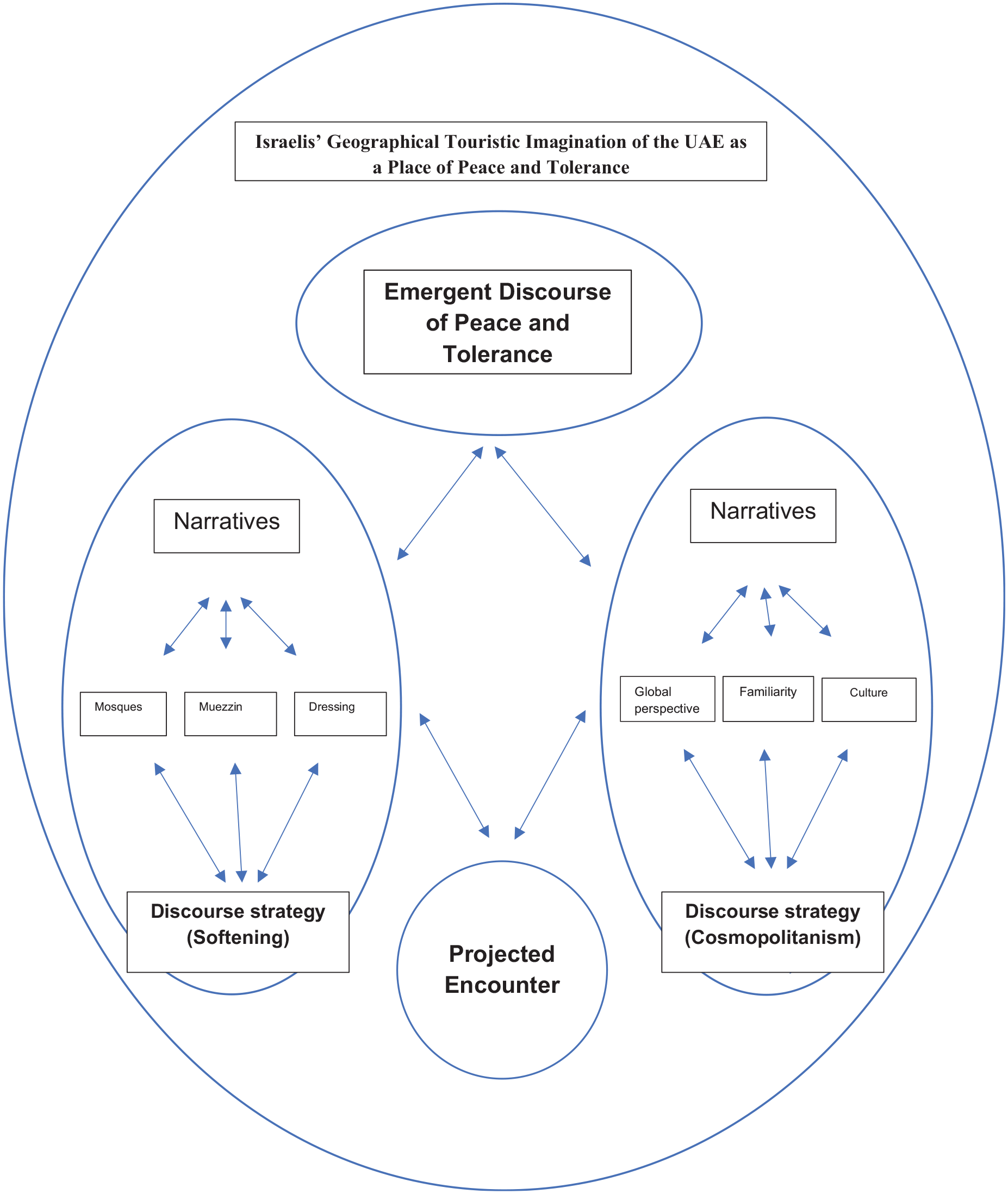
Israelis’ geographical touristic imagination of the UAE as a place of peace and tolerance.
As Figure 1 highlights, discourse strategies play an active role in shaping Israelis’ geographical imagination of the UAE, which in turn may affect how they positively “imagine” a possible future encounter with the Other (the “projected encounter” in Figure 1) when they will visit the UAE. Despite this, in political theory, constructivist stances contemplate the idea that “the world of international relations is not fixed like the natural world, a world which exists independently of human action and cognition …. [but] is still a system whose rules are made and reproduced by human practices” (Guzzini, 2000, p. 155). In other words, constructivist theory regards nations and international relations as constituted and constantly (re)produced by a dynamic system of perceptions, beliefs, stereotypes, and discursive and social practices shaped by—and concurrently producing and reiterating—power structures (Theys, 2017). Notably, Adler (2002) emphasises the fluid nature of perceived international political relations, which are not fixed but are part of crystallised power structures in continuous becoming. From this perspective, the touristic imagination of a destination produced by tourism promotional material can be constantly (re)shaped by various political phenomena and occurrences. As such, the presented model and its components should be conceived as highly fluid since narratives of peace and their related discourse strategies may change in the aftermath of new political structures and relations.
Overall, the model presented in Figure 1 illustrates that the discourses of peace and tolerance in the Israeli media play a role in positively shaping Israelis’ touristic imagination of the UAE, thus producing positive perceptions about a projected future encounter in the country and, possibly, motivating more Israelis to visit the new destination. However, whether and how this process may lead to broader political and international implications affecting the relations between the two countries remains debatable. Cho (2007, p. 560) contends that “tourism as technical cooperation could result in cooperation in other areas such as politics and the military.” Despite this, it needs to be emphasised that the full potential of tourism in contributing to peace cannot transcend other contextual aspects, such as the level of commitment shown by the interested countries and, at a macro-geopolitical level, the influence that other countries may have on the interested countries (Cho, 2007).
Conclusion
This paper critically assessed the social discourse of peace and tolerance about the UAE circulating in the Israeli media between 2020 (in the aftermath of the Abraham Peace Accords) and August 2023 (before the outbreak of the current Israel-Hamas war in October 2023). The Abraham Accords initiated a significant period of Israeli interest in the UAE from September 2020 to August 2023. This led to a surge in visits to the country within a short timeframe. However, on October 7, 2023, a war erupted between Israel and Palestinian militants in Gaza due to a terrorist attack. This tragic event shifted the Israeli media discourse on the UAE from peace and tolerance to travel warnings, initially advising against travel to Arab countries and later issuing a general warning to travel abroad only for essential purposes due to rising antisemitism globally. Our analysis indicates a discernible level of maturity in the political and social relations between the two countries. However, it is imperative to recognize that these relations remain fragile and fluid, particularly given the current political landscape in the region.
Based on an analysis of the narratives produced and diffused by the media to share information about the UAE and promote the country to potential Israeli tourists in this specific timeframe (September 2020–August 2023), the dynamic model presented in this paper still holds significance. Notably, the model emphasises the active role of narratives (including touristic narratives) in positively affecting Israelis’ geographical touristic imagination of the UAE as a place of peace and tolerance. Such positive images and imaginaries may encourage Israelis to visit the UAE and shape positively projected future encounters with Emiratis, especially in a post-war scenario. In a similar context, changes in geographical and touristic imaginations, as reflected in the media discourse, are evident in the Israeli discourse about Turkey from 2000 to 2014 (Shmuel & Cohen, 2020). Specifically, Shmuel and Cohen’s (2020) study demonstrated that the discourse surrounding Turkey fluctuated in tandem with the political and diplomatic relationships between the two countries. These shifts can happen swiftly, affecting the perceptions and discourse.
Several critical points arise from this argument, including the suggestion that the relationship between countries is primarily driven by economic interests, an assertion that holds some truth. Peace agreements often have financial and marketing dimensions consistent with the capitalist nature of contemporary society. For example, marketers can capitalize this newfound sense of unity and cooperation by launching cross-cultural marketing campaigns that promote inclusivity and diversity. By aligning their brand values with the broader social narrative of peace and reconciliation, they can resonate with consumers on a deeper level, leading to increased brand loyalty and market share. However, this paper refuses to reduce the Abraham Accords to mere economic operations as it is situated within a lens that interprets and reflects upon social realities beyond the economy. As such, the paper recognises the interconnectedness of both economic and social aspects in paving the way for peace.
Conceptually, the analysis of the presented narratives does not allow us to speculate on a direct link between touristic discourses of peace and the establishment or consolidation of peaceful relations between countries. Indeed, as already discussed earlier, establishing a direct link between touristic discourses and peace requires embracing a functionalist approach to tourism, which goes beyond the analysis conducted for this study. Nevertheless, the central argument of this study is that changing discourse directly impacts the individual and collective imagination. The model developed from the analysis adds to our understanding of the tourism-peace nexus by emphasising the role of touristic discourses of peace and tolerance in shaping positive imaginaries of people and places and facilitating relations in cross-cultural encounters. For countries whose diplomatic relations (and knowledge of the Other) are at a beginning stage, such as Israel and the UAE, fostering positive images and encounters of the Other represents an initial important step to (re)build relations between people that did not exist before (or that existed within politically driven negative stereotypical images). In this respect, our model provides an opportunity to reflect upon the role of Israelis’ positive touristic imagination of the UAE, as shaped by the narratives in the media, in challenging negative/conflictual stereotypes propelled by the political events predating the Abraham Peace Accords. From this angle, touristic narratives of peace and tolerance contribute to questioning earlier stereotypes and provide alternative new images that, while lacking the power to erase previous negative images, positively compliment the repertoire of existing images and imaginaries. More positive images represent a first step, among others, to reduce conflict.
From a practical angle, our analysis provides relevant information to expand the existing tourist flows from Israel to the UAE. Tourism marketers could refer to the current narratives about the UAE identified in our analysis (namely, narratives about global perspective, familiarity, culture, mosques, muezzin, and dressing) and elaborate them in greater detail to further shape Israelis’ positive imaginaries of the UAE. Moreover, by becoming aware of the discourse strategies underpinning them, namely cosmopolitanism and softening, additional narratives could be produced to support and enlarge these strategies.
Despite the abovementioned implications, more research is needed to explore whether and how touristic narratives of peace and tolerance could lead to better relations among people and, eventually, more peaceful interactions among countries. More specifically, additional empirical studies are necessary to understand whether and how narratives affect perceptions and touristic imagination of people and places. For example, a future study could explore Israeli tourists’ geographical imagination of the UAE before and after exposure to touristic narratives or travelling to the UAE. Also, a study mirroring the one conducted for this paper could explore Emiratis’ touristic imagination of Israel alongside perceptions and images of Israel in the UAE. Future longitudinal studies could empirically explore whether and how stronger relations between Israel and the UAE can be attributed to increased tourist flows between the two countries, which could shed additional light on the nexus between tourism and peace. Future research could focus on additional aspects capable of strengthening the tourism peace nexus. Among them, food could be one of the items to explore. Finally, new studies should focus on post-conflict tourism and how it could promote hope, a construct that may be viewed as a catalyst of peace-seeking attitudes rather than an agent guaranteeing future peace. As discourses remain fluid and ever-changing, there exists an expectation and belief that discourses of peace and tolerance will resurface in the post-conflict period.
Footnotes
Declaration of Conflicting Interests
The author(s) declared no potential conflicts of interest with respect to the research, authorship, and/or publication of this article.
Funding
The author(s) disclosed receipt of the following financial support for the research, authorship, and/or publication of this article: The authors would like to express their heartfelt gratitude to the Zayed University, UAE, and the Provost’s Research Fellowship Award—R22161 for their generous support, which made this research possible. Additionally, Dr. Irit Shmuel extends her appreciation to the Department of Marketing, Retail, and Tourism at Manchester Metropolitan University for their warm hospitality and invaluable support during her Visiting Research Fellowship in February 2023, which significantly enriched the research process.
