




Abstract
Tourism and event organizers implement green innovation to mitigate the negative environmental impacts they cause. However, how to effectively communicate these green innovations to online communities remains a challenge. Drawing on message framing and construal level theories, we collected 503 tweets and used an exploratory sequential mixed-methods approach to analyze the textual data. First, we conducted abductive coding analysis, identifying two novel framing forms, innovative and value chain framings. Second, using negative binomial regressions, we found that input-value (vs. output-value) framing is often used but decreases online engagement. Moreover, proximal (vs. distal) framing is less used but enhances online engagement. Third, we explored the moderating effect of green innovation, revealing that innovative and proximal framings are more effective for green organizational innovation, whereas emotional framing is more effective for green service innovation. This study offers novel insights on how to strategically communicate green innovation to event online communities.
Introduction
Over the past decade, sports mega events have come under intense global scrutiny because of their negative environmental impacts, such as high levels of greenhouse gas emissions and excessive waste generation (Chen et al., 2021; Scott et al., 2023). These negative environmental impacts mainly affect local communities, who often lack negotiating power against event organizers (Giulianotti et al., 2015). However, local environmental protests can attract shared concern and support from online communities through social media. For example, residents of a small Tahitian village initiated an environmental protest against the establishment of a new aluminum judging tower on their reef for the Paris 2024 Summer Olympics and received more than 250,000 supporters from online communities (Tuuhia, 2023). For example, Rome, Hamburg, and Budapest revoked their bids to host these mega events, partly due to criticism that public investment resulted in unused and dilapidated infrastructure built solely for mega events (Somin, 2017). As a consequence, environmental protests related to sports mega events threaten not only the reputation and legitimacy, but also the business survival and continuous operation of these events (Demuijnck & Fasterling, 2016).
To mitigate negative environmental impacts and associated problems, sports mega event organizers (hereafter referred to as “organizers”) have implemented a variety of innovative measures. For example, the Beijing 2022 Winter Olympics used hydrogen-powered vehicles to transport visitors, and the Tokyo 2020 Summer Olympics introduced medals made from recycled electronics. Such measures are conceptualized as green innovations, which are designed and implemented to lessen the negative environmental impacts of sports mega events (Qin et al., 2023). Once implemented, green innovations provide benefits such as cost savings, better environmental performance, and improved green reputations for organizers and destinations (Satta et al., 2019; Sharma et al., 2020). Communicating these green innovations helps organizers to earn and maintain their social license to operate in hosting mega events (Demuijnck & Fasterling, 2016).
However, organizers face a key challenge of effectively communicating their green innovations to communities that are engaged online but will not have physical participation in the event. Existing research has found that online communities are often skeptical about why organizers implement green innovation (Du et al., 2010; Ettinger et al., 2021). Some community groups accuse organizers of greenwashing, that is, overcommunicating sustainability for the purpose of self-promotion (Laing & Frost, 2010). Other organizers are accused of greenhushing, that is, undercommunicating sustainability efforts to avoid negative feedback (Ettinger et al., 2021; Font et al., 2017). Some organizers consider that greenhushing is necessary to avoid disturbing the consumer’s hedonistic experiences (Font et al., 2017; Werner et al., 2019); however, greenhushing can bring reputational damage if organizers are perceived to be less environmentally friendly than they actually are (Kim & Lyon, 2015). Our knowledge about how to avoid greenwashing and greenhushing, and instead communicate green innovation appropriately and effectively to sports mega event communities is currently insufficient.
Research on event communication has largely collected data from on-site attendees, with existing studies exploring how organizers communicate sustainability information to attendees (Mair & Laing, 2013; Wong et al., 2021; X. Zhang et al., 2020, 2021), and how attendees perceive and co-create the value of green events (Werner et al., 2019; Wong et al., 2015). However, online event communities, which are another important and growing type of event consumers, are less explored in the literature. Understanding online communities in sports mega events is important for two reasons. First, compared with on-site visitors, online communities tend to be more critical of sustainability communication because they are empowered by the digital technologies and experience less information asymmetry (Bergh et al., 2019; Liao et al., 2024). Online communities have easy access to different sources of information, allowing them to scrutinize and evaluate organizer’s information through instant discussion and feedback with a broader range of community members. The reduced information asymmetry amplifies their criticism and influences public perception of the event’s green innovation efforts (Kharouf et al., 2020; S. Wang & Lehto, 2020). Second, the size of online communities grows dramatically through social media (Kharouf et al., 2020; Lee et al., 2021). COVID-19 accelerated the creation of fully online or hybrid physical–digital events and reinforced the growth in online event communities. For example, the Tokyo 2020 Summer Olympics, held without any on-site attendees, reached 6.1 billion digital engagements on Olympic social media channels (IOC, 2022). Given that online communities are more critical and larger in size compared to on-site attendees, tourism and event organizers need a better understanding of how to communicate with their online communities effectively.
Previous studies have examined sustainability communication through one-way channels, such as event websites (Frost & Laing, 2013) and mass media (Ma & Kirilenko, 2020). However, social media enables two-way communication on a global scale (Ji et al., 2018; Scholl-Grissemann et al., 2020), which can shape the meaning, reputation, and business return of an event (Du et al., 2010; Kharouf et al., 2020; Simons, 2019). Event scholars have used social media data to evaluate the engagement of online communities with local events (Lee et al., 2021) and their perceptions of sports mega events such as the Sochi 2014 Winter Olympics (Kirilenko & Stepchenkova, 2017). However, research has not yet addressed how organizers can best communicate green innovations to online communities through social media.
One theoretical approach to understanding online communication of green innovations is message framing theory (Bortree et al., 2013; Font et al., 2017; X. Zhang et al., 2021). The term “framing” in this context refers to the selective presentation of some attributes of perceived reality (Entman, 1993). Framing messages with certain attributes makes a particular issue more salient, noticeable, and memorable to recipients of the message, thereby influencing recipients’ attitudes and behaviors (Chong & Druckman, 2007). To explain which types of framing are more effective and why, construal level theory conceptualizes the way individuals mentally interpret objects and events based on attendees’ level of abstraction, that is, their psychological distance from the object or event (Trope & Liberman, 2010). Individuals tend to prioritize a more concrete and detailed way of thinking (Huang et al., 2021; B. Zhang et al., 2019). By integrating message framing and construal level theory, organizations can strategically frame messages to enhance persuasiveness, minimize consumer skepticism, and generate favorable attributions (Bortree et al., 2013; Ji et al., 2018). However, the effectiveness of message framing varies with context, and it is unclear how different framings support or hinder green innovation communication (X. Zhang et al., 2020).
Accordingly, this research aims to explore which message framings support organizers to effectively communicate green innovations to their online communities. Drawing on message framing theory and construal level theory, this paper presents an exploratory sequential mixed-methods approach using social media textual data collected from X/Twitter. Initially, we identify the specific types of message framings and green innovation from organizers. Then, we evaluate the effect of different message framings communicating the different types of green innovation on online community engagement.
Literature Review
Mega Events and Online Communities
Mega events are “one-time events of an international scale organized by a special ‘authority’ yielding extremely high levels of impacts (economic, tourism, infrastructure, etc.) for the host community because of the event’s significance and/or size” (Byers et al., 2012, p. 103). Mega events stimulate tourism and destination development by providing various resources, such as intensive global media coverage and significant political and economic support for new or upgraded infrastructure, that would otherwise take years or even decades to materialize (Chen et al., 2021; Duignan et al., 2019). While not all mega events are sporting events (e.g., World Expos are non-sporting mega events), most of the world’s largest events revolve around sports, such as soccer and rugby world cups, Olympic Games, and the Commonwealth Games.
In recent years, mega events have found their social license to operate is threatened by their negative environmental impacts. Social license to operate, defined as community acceptance or approval of an organization’s operations, is important to ensure business survival and continuous operations (Demuijnck & Fasterling, 2016). Negative environmental impacts of sports mega events include air and water pollution, high volumes of litter and waste, and overuse of scarce resources such as energy and water. These can manifest in short-term effects on host destinations (i.e., predominantly felt shortly before, during, or after the event) or long-lasting legacies for host destinations (Holmes et al., 2015). Event legacies include “all planned and unplanned, positive and negative, tangible and intangible structures created for and by a sport event that remain longer than the event itself” (Preuss, 2007, p. 208). While a legacy can be positive, in many cases, mega event legacies are negative and have left many “white elephants” (i.e., unused and dilapidated infrastructure built for mega events) in their wake (Duignan et al., 2019). In addition, many people and groups criticize the large amounts of greenhouse gas emissions created by mega events (Chen et al., 2021; Scott et al., 2023), with a large proportion caused by transporting goods and attendees to and from the event destination (Collins et al., 2009).
Mega events have a large range of communities and stakeholders, including participants, on-site visitors (or spectators), organizers, local governments, the media, and local residents (Holmes et al., 2015). Although there is advanced knowledge about communicating with on-site visitors (Wong et al., 2021; X. Zhang et al., 2020, 2021), our understanding of communicating with online communities related to mega events is less developed. An online event community is “a diverse and dynamic community around shared meanings and symbols consisting of a complementary structure of event practices and online practices” (Simons, 2019, p. 149). Examples of such online communities are social and fan communities (e.g., that gather and communicate via X/Twitter, Facebook, and Instagram). Online communities represent only one part of the potential audience for green innovation messages from event organizers. For example, online communities are often more critical than on-site visitors because they have more immediate access to information and can compare online messages quicker than on-site attendees. Existing research explains that online communities suffer less from information asymmetry with the use of digital communication technologies (Bergh et al., 2019; Liao et al., 2024; S. Wang & Lehto, 2020). Thus, having a better understanding of communication in the influencing factors in the organization-public relationship building, focusing on online communities can help organizers to better communicate green innovation messages and protect themselves against reputational damage, ultimately strengthening their social license to operate (Demuijnck & Fasterling, 2016; Muskat, 2014).
Message Framing Theory and Construal Level Theory in the Tourism and Events Literature
Message framing theory suggests that frames are embedded within and manifest in a text—with or without the presence of certain keywords (Entman, 1993). Framing refers to the way in which attributes of a particular reality are presented. Message framings generally use selected keywords to make certain attributes more salient, noticeable, and memorable to message recipients (Chong & Druckman, 2007). Strategically framed messages can influence consumers’ perceptions and create favorable attitudes toward organizations (Bortree et al., 2013; Ji et al., 2018). Message framing theory is appropriate to apply in the context of the instant, real-time communication channels used in social media because in this context users have less time and cognitive resources to process information and can therefore process only the most salient information (DiRusso & Myrick, 2021). For example, message framing theory has been shown to effectively explain communication on X/Twitter (e.g., Moernaut et al., 2022; Xiong et al., 2019). In practice, the only factor that organizations can fully control on social media is how their content is framed (Valenzuela et al., 2017), which means that message framing is essential for effective communication between organizations and their online communities.
Our research aim is to understand which message framings support organizers best in communicating green innovations to online communities. We reviewed the literature applying message framing theory to tourism and events and identified five major framings (see Table 1). However, the effectiveness of message framing remains uncertain. Some studies have found that emotional (vs. rational) framing is more effective in generating likes and retweets (e.g., Pino et al., 2019) and in influencing consumer behavior (Hardeman et al., 2017). However, other scholars found no significant difference between rational and emotional framing in sustainable tourism context (e.g., Wehrli et al., 2017). Furthermore, some studies suggest that gain (vs. loss) framing is more effective in the context of providing upcycling information (X. Zhang et al., 2021) to tourists with higher travel intentions (Liu & Mair, 2023), while others have found that loss (vs. gain) framing is more effective in recycling behavior when paired with specific messages (e.g., Grazzini et al., 2018). These studies suggest that the effectiveness of message framing is highly context dependent and thus warrants further research.
Message Framing in Tourism and Events Literature.
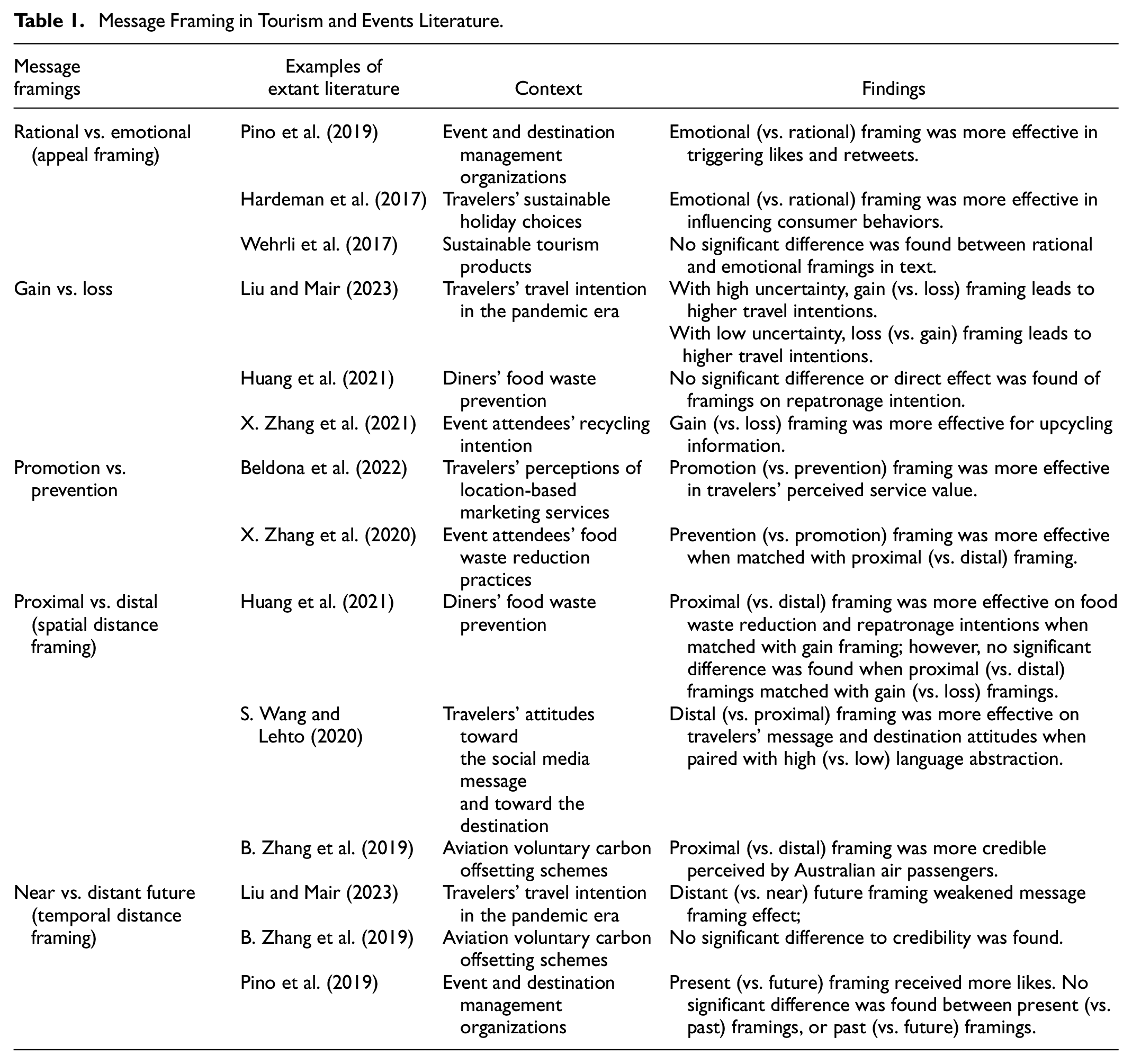
To explain the effectiveness of certain types of framings, research has drawn on construal level theory (Huang et al., 2021; B. Zhang et al., 2019; X. Zhang et al., 2020, 2021). Construal level theory categorizes construal levels (abstract perceptions) of objects and events as low level to high level (less or more abstract) and across dimensions (e.g., temporal, spatial, and social distance) (Trope & Liberman, 2010). Based on construal level theory, a message can be framed as having low- or high-level construal: the former is marked by a short-term focus with concrete, detailed representations, while the latter is more abstract and generalized, targeting long-term goals. In the context of tourism and events, research suggests that visitors have low-level construal because they are in a state of psychological proximity, with immediate concerns and reactions being the focus of goal setting (Park et al., 2022; B. Zhang et al., 2019; X. Zhang et al., 2020). Tourism and event studies also find that tourists and visitors are less motivated by high-level construal in relation to pro-environmental issues (Huang et al., 2021; X. Zhang et al., 2021). This study explores framing in online communities, aiming to understand how organizers communicate green innovations to their online communities; thus, we propose subsequent hypotheses.
Hypotheses Development
Appeal framing refers to messages that have a rational or emotional emphasis (Font et al., 2017). Rational framing refers to messages that provide detailed factual information to recipients’ cognitive cues to influence their perceptions (Gursoy et al., 2022). Emotional framing refers to messages designed to shape recipients’ information processing and evoke positive or negative emotions (DiRusso & Myrick, 2021).
To date, there is no conclusive evidence for the effectiveness of rational and emotional framing in communicating sustainability and green innovation. Some studies suggest that rational framing is effective because its factual and objective information helps to reduce consumer skepticism about organizations’ pro-environmental efforts (Font et al., 2017; Gursoy et al., 2022). However, emotional messaging may also be effective in communicating sustainability and green innovation. That is, studies have found that emotional framing elicits a positive response from recipients, because it uses adjectives to describe a memorable and lively experience (Hardeman et al., 2017; Wehrli et al., 2017). For instance, when examining diaspora festivals, Gedecho et al. (2023) identify positive emotions (e.g., happiness, pride, feeling at home, and not feeling lonely) before, during, and after the visiting experience. Similarly, Su et al. (2023) conducted online experiments and found that external crisis events trigger tourists to feel sympathy and forgiveness. These event studies suggest that emotions are an important characteristic of event experiences, which may mean that emotional framing could be more effective for event organizers to communicate information about sustainability and green innovation to their online communities. In the case of communicating green innovation, emotional framing can help recipients envision and perceive the benefits of green innovations that may otherwise be too novel or implicit to be observed or experienced (Stieglitz & Dang-Xuan, 2013; Wehrli et al., 2017). For example, emotional framing has been found to trigger climate change advocacy behaviors (Nabi et al., 2018), leading to more likes and retweets on tourism and event organizers (Pino et al., 2019). Therefore, we hypothesize the following:
Hypothesis 1a: When communicating green innovations, emotional (vs. rational) framing is more likely to elicit online communities’ engagement as measured through likes, retweets, and replies.
Value chain framing describes messages that emphasize either input or output values of organization’s behaviors (Bortree et al., 2013). Input-value framing emphasizes the inputs of green innovation such as the involvement and resource commitment organizations have devoted to green innovation, as well as the long-term durability of green innovation projects (Du et al., 2010). Output-value framing emphasizes the outputs of green innovation, which are often positive outcomes such as fewer pollutants and a better-quality environment (Huang et al., 2021).
Organizations tend to use input-value framing because they want to demonstrate the resources and work, they have devoted to their sustainable practices (Du et al., 2010) and thus differentiate themselves from competitors (Kucukusta et al., 2019). However, the problem with input-value framing is that if organizations overemphasize their green innovation efforts, consumers may consider it greenwashing and become skeptical or even negative about the organization (Schmeltz, 2012). Moreover, some message recipients may not care much about organizational investments and efforts because they are more interested in personal gains and benefits (Font et al., 2017; S. Wang & Lehto, 2020). Thus, the emphasis that output-value framing places on the positive outcomes of green innovations may be more effective than input-value framing in triggering message recipients’ engagement (Liu & Mair, 2023). In an experimental study, Park et al. (2022) found that a positive and specific outcome (e.g., double recycling rate to 95%) increases event visitors’ commitment to recycling. Therefore, we hypothesize the following:
Hypothesis 2: When communicating green innovations, input-value (vs. output-value) framing is less likely to elicit online communities’ engagement as measured through likes retweets, and replies.
Spatial distance framing messages differentiate in the subjective perception that something is proximal or distal from the self (Trope & Liberman, 2010). In the context of this study, proximal framing signals that the connection between green innovation and recipients is perceived to be closer and more relevant (S. Wang & Lehto, 2020) and distal framing signals that that this connection is more distant, less relevant, and therefore more abstract (Huang et al., 2021).
According to construal level theory (Trope & Liberman, 2010), proximal (vs. distal) framing is more effective in communication because recipients perceive a higher degree of closeness and relevance of the message to themselves (Font et al., 2017; S. Wang & Lehto, 2020; B. Zhang et al., 2019). For example, Blose et al. (2015) designed experiments with hotel guests and found that proximal (vs. distal) framing is particularly effective in encouraging first-time travelers to reuse linen in hotels. In a study of a music festival, Skandalis et al. (2024) found that event visitors have extraordinary experiences despite the event existing within the proximal environment of their everyday life. B. Zhang et al. (2019) suggest that proximal (vs. distal) framing is more effective in spreading aviation voluntary carbon offsetting schemes because proximal framing appears more credible. In line with these studies, we propose the following hypothesis:
Hypothesis 3: When communicating green innovations, proximal (vs. distal) framing is more likely to elicit online communities’ engagement as measured through likes, retweets, and replies.
Temporal distance framing messages evoke or include subjective perceptions of the distance between the past, present, and future (Trope & Liberman, 2010). Past framing emphasizes activities and successes in the past, where the past is often constructed in a nostalgic and positive way (Makri & Schlegelmilch, 2017). Present framing reports on activities that are happening now and focuses attention on current reality (Trope & Liberman, 2010). Future framing includes expectations, plans, and long-term goals, thereby reflecting an active attitude toward future potential outcomes (Qin et al., 2023).
Construal level theory suggests that recipients relate most strongly to present messages because they feel closer and more imminent (Trope & Liberman, 2010). Following this theory, most studies suggest that a present framing is more persuasive when recipients are beginning to worry about the risks they may face (Bortree et al., 2013; Liu & Mair, 2023; B. Zhang et al., 2019). For environmental issues, future framing has been found to make recipients less concerned about negative environmental impacts because such issues relate to the distant future and have no direct effect in the present (Ji et al., 2018). In an examination of event and destination management organizations, Pino et al. (2019) suggested that future (vs. present) framing triggered fewer likes from social media users. Hence, we propose the following:
Hypothesis 4a: When communicating green innovations, future (vs. present) framing is less likely to elicit online communities’ engagement as measured through likes, retweets, and replies.
In terms of the comparison between past and present framings, some research suggested that there is no significant difference between the effect of past and present framings on social media engagement (e.g., Pino et al., 2019). However, past framing has the potential to evoke a perception of nostalgia and a sense of belonging in recipients (Makri & Schlegelmilch, 2017). Nostalgia is a strong and positive emotion toward an idealized past (Barnwell et al., 2023). For example, Gedecho et al. (2023) indicate that diaspora festival visitors may experience nostalgia in recalling past times and wonderful memories. These studies suggest that past (vs. present) framing may be more effective when recipients are seeking a potential escape from current problems (Barnwell et al., 2023). Therefore, we hypothesize the following:
Hypothesis 4b: When communicating green innovations, past (vs. present) framing is more likely to elicit online communities’ engagement as measured through likes, retweets, and replies.
Methodology
Sampling and Data Collection
We chose X/Twitter as our data source because it is one of the most widely used and publicly accessible social media platforms in the world (Kucukusta et al., 2019). Furthermore, existing studies suggest that organizations prefer to disseminate information on X rather than on other social media such as Facebook and YouTube (Cox, 2016; Valenzuela et al., 2017). We selected 14 sports mega events, including Summer Olympic Games, Winter Olympic Games, FIFA World Cups, Commonwealth Games, and Asian Games. These sports mega events attract a very large number of online visitors and significantly impact their host destinations, including environmentally (Holmes et al., 2015). We selected sports mega events from 2010 onward because messages related to these events have only been available since 2009.
We collected textual data from tweets posted by the organizers of these sports mega events (e.g., International Olympic Committee, and the FIFA Council) and those published by the national organizing committees (e.g., Tokyo 2022, and Russia 2018). We used keyword searches to identify and gather official tweets. Tweets were considered relevant if they contained two types of keywords: (1) environment-related keywords, including “green,” “eco-*,” “sustainab*,” “environment*,” “recycle*,” “reus*,” “reduc*,” etc.; (2) innovation-related keywords, such as “innovat*,” “tech*,” “develop*,” “improv*,” and “advanc*.” These keywords were selected based on previous theoretical discussions (Cheng & Shiu, 2012; Qin et al., 2023; Sharma et al., 2020). Note that “*” is a wildcard character representing a set of keywords with a specific prefix. For example, the keyword “sustainab*” includes both “sustainable” and “sustainability.”
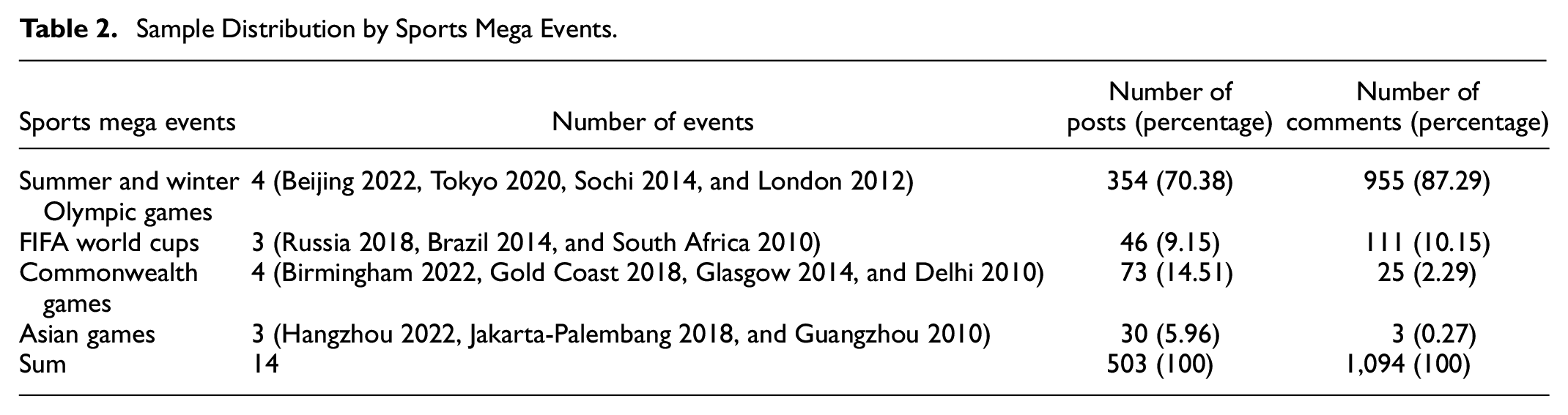
Using these keywords, we collected a total of 518 tweets in March 2022. Two of the co-authors then manually reviewed these tweets to filter out tweets that contained the keywords but were irrelevant to the research topic. As a result, 15 irrelevant tweets were removed, leaving 503 valid tweets for further analysis. Table 2 summarizes the distribution of the collected tweets. Green innovation is a relatively new field of online content creation for mega event organizers, who traditionally tweet about their athletes’ achievements and celebrations; thus, the sample size may appear relatively limited. However, 503 tweets are considered sufficient for this research because the volume of data is similar to that of existing tourism research that also has relatively small sample sizes (e.g., 541 tweets in Nicolau et al., 2020; 876 tweets in X. Wang et al., 2023; and 328 tweets in Dillette et al., 2019). Note also that we collected tweets from organizers’ official accounts, not from the general public, which also limited the available sample.
Sample Distribution by Sports Mega Events.
Data Analysis
In the Phase I qualitative analysis, we checked to ensure that the message framings proposed in the literature were present in the sample before statistically analyzing the data. We used qualitative abductive coding, which “aims to provide new theoretical insights through a recursive and iterative process of double-fitting data and theories” (Timmermans & Tavory, 2012, p. 179) to identify message framings and green innovations in tweets published by organizers.
We generated a codebook (Vila-Henninger et al., 2022) for the analysis, initially adopting message framings from existing literature (Hardeman et al., 2017; Pino et al., 2019; Wehrli et al., 2017) and then seeking any new framings present in the data. We also categorized green innovation into three types: green organizational, product, and service innovation. Definitions and examples of our coding schemes can be found in Appendix coding schemes.
All tweets were initially coded by the leading author. Another co-author then coded a recommended random subset (10%) of the total tweets to check the intercode reliability (MacPhail et al., 2016). A high level of intercoder agreement was achieved (84.8%), above the recommended threshold of 80% (Gisev et al., 2013). Differences were discussed among the authors to refine the code definitions and to identify the keywords for each framing.
For the quantitative analysis of the study, we found our dependent variables—Like, Retweet, and Reply—showed overdispersion and excess zeros (from 11.33% to 40.76% of the total sample). Therefore, we used negative binomial (NB) regression and zero-inflated negative binomial (ZINB) regression to examine the effectiveness of message framings in online communities. NB regression is used when data have non-equal means and overdispersion (Lambert, 1992). ZINB, a modified version of NB regression, extends to the situation where data has excess zeros (Hall & Zhang, 2004). In ZINB regression, the data are considered a mixture of two populations: zero and non-zero observations. Each population applies to two separate models. The zero observation is applied with the logic model, which estimates the likelihood of the occurrence of zero observations. The non-zero observation is applied with the NB model, which models the overdispersion of count data (Hall & Zhang, 2004; Lambert, 1992). To decide whether the NB or ZINB model better fit the data, we employed Akaike’s information criterion (AIC) and Vuong’s (1989) test to compare the results.
In Phase II, we used the total sample (N = 503) to test the hypotheses. In Phase III, we further conducted an exploratory analysis on two subsets of samples—green organizational innovation (n = 330) and green service innovation (n = 137)—to explore the potential moderating effect of green innovation types. The sample sizes of these two groups exceeded the minimum recommended size for ZINB models, which is suggested to be larger than 50 (Perumean-Chaney et al., 2013), or at least 10 times the number of the hypothesized relationships with the dependent variables (in our case, larger than 80; Hair et al., 2011). We did not conduct regressions on green product innovation because the limited data (n = 37) were not sufficient to produce robust results. No collinearity issues were found among the variables because all the variance inflation factor values (≤1.230) were consistently below the recommended threshold (<10) (Kline, 2015).
Results
Phase I: Findings from Qualitative Abductive Analysis
Three major findings emerged from our qualitative phase: (1) organizers used innovative and value chain framing, which has not been captured in previous tourism and events literature; (2) the message framings proposed from the literature were present in the sample; and (3) three types of green innovation were identified in sports mega events. Table 3 presents the coding results and the distribution of those tweets.
Coding Results of Sports Mega Event Organizers’ Tweets.
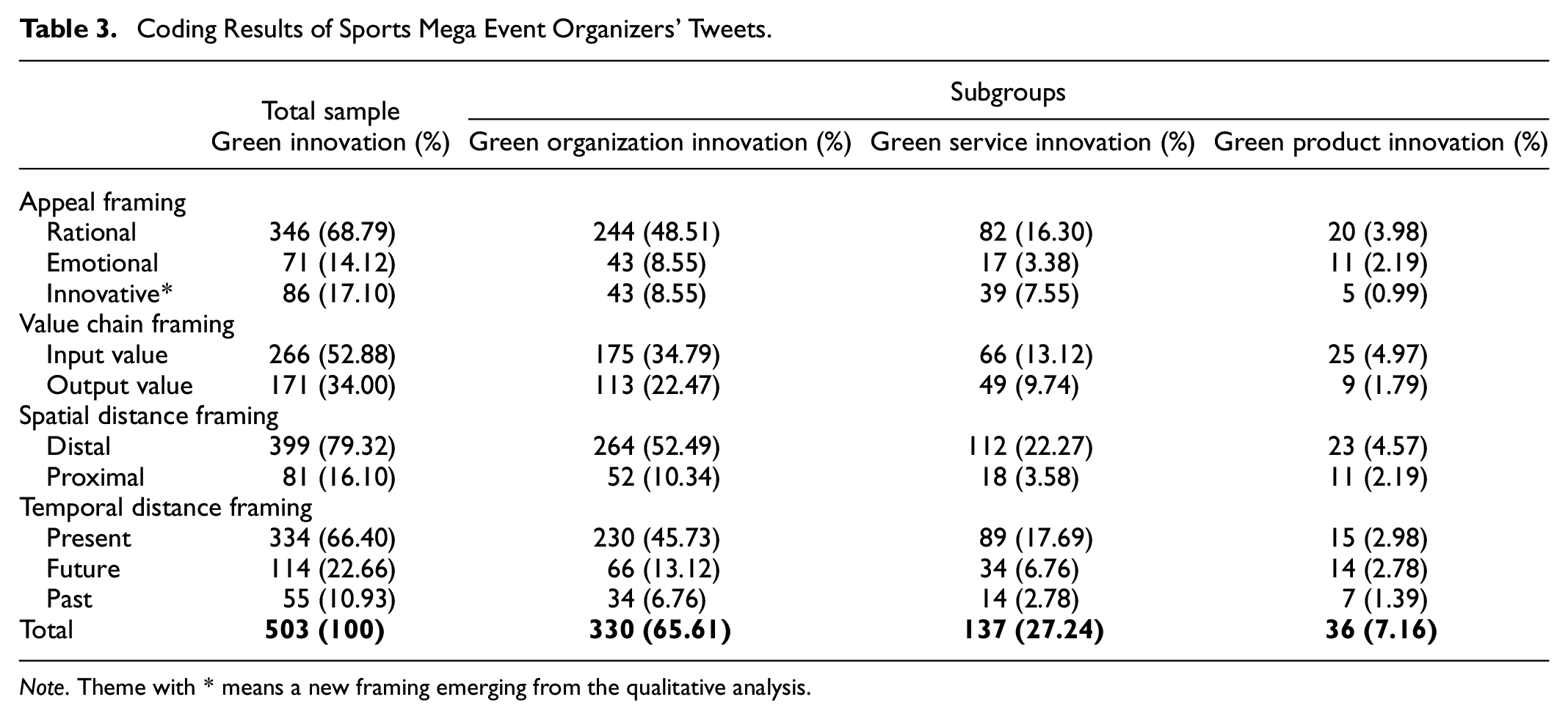
Note. Theme with * means a new framing emerging from the qualitative analysis.
A new type of appeal—innovative framing—emerged from the data, which has not been discussed in the extant literature. The data suggests that innovative framing refer to the emphasis in a message on the novelty of green innovation, which triggers recipients’ curiosity and to react to the message. Given that Hardeman et al. (2017) suggest that “the message appeal should fit with the product type” (p. 485), we consider innovative framing to be particularly relevant in this study. Innovative framing has thus far not been investigated in tourism or event’s literature yet had previously been found in message framing in the energy context, that is, communicating on biofuel (Moon et al., 2016). It is interesting to note that in the tweets we analyzed, organizers used innovative framing (17.10%) more often than they used emotional framing (14.12%). Examples of the innovative framings include statements such is “[this event] will be greener, more sustainable and more advanced than ever before,” and “this will be the first time that [the event] will use its immense global platform to display innovative solutions to drive sustainable change.” The identification of this new type of framing prompted us to add the following hypothesis to be tested during the quantitative phase of the study:
Hypothesis 1b: When communicating green innovation, innovative (vs. rational) framing is more likely to elicit online communities’ engagement as measured through likes, retweets, and replies.
Additionally, we found that organizers use value chain framings differently from the dominant theoretical discussions. That is, prior studies have generally focused on value from a consumer perspective. For example, extant literature predominantly discussed gain versus loss framings, which focuses on consumers and what benefits they can gain or lose (Huang et al., 2021; Liu & Mair, 2023; Ropret Homar & Knežević Cvelbar, 2024). Similarly, promotion versus prevention framings concern benefits that can be promoted to consumers, or risks that can be prevented by consumers (Beldona et al., 2022; X. Zhang et al., 2020). However, in our study, some organizers emphasized the value of the input (e.g., resources and workload) they had invested in green innovation (52.88%). For example, “seven billion euros is being invested into sustainable long-term infrastructure projects.” Other organizers emphasized the value of the output they had achieved (e.g., better environments and communities) as a result of their green innovation (34%). For example, “[we] make our cities and communities healthier, more active and more sustainable.” For all three types of green innovation, the most used framings in our sample were rational framing (68.79%), input-value framing (52.88%), distal framing (79.32%), and present framing (66.40%).
Another finding in our qualitative analysis was that there are three types of green innovation in sports mega events, with green organizational innovation being the most used innovation (65.61%). This type of green innovation refers to the capabilities and commitment of organizations to implement new forms of management approaches, which can manifest as green training programs and learning techniques for employees, and employee team building for environmental issues (Cheng & Shiu, 2012). Green service innovation (27.24%) refers to the improvement of existing services or the introduction of new services to reduce the environmental damage caused by the organization (Carlborg et al., 2014). For example, mega events can result in improved transport service systems by ensuring energy efficiency and the use of renewable energy. Finally, green product innovation, which refers to the creation of entirely new environmentally friendly products or making significant improvements to existing products (Cheng & Shiu, 2012), was the least cited type of green innovation in our study. Examples of green product innovation at sports mega events include creations such as eco-designed medals, torches, or athlete uniforms. Based on these qualitative findings, we propose a research model for further quantitative analysis (Figure 1).
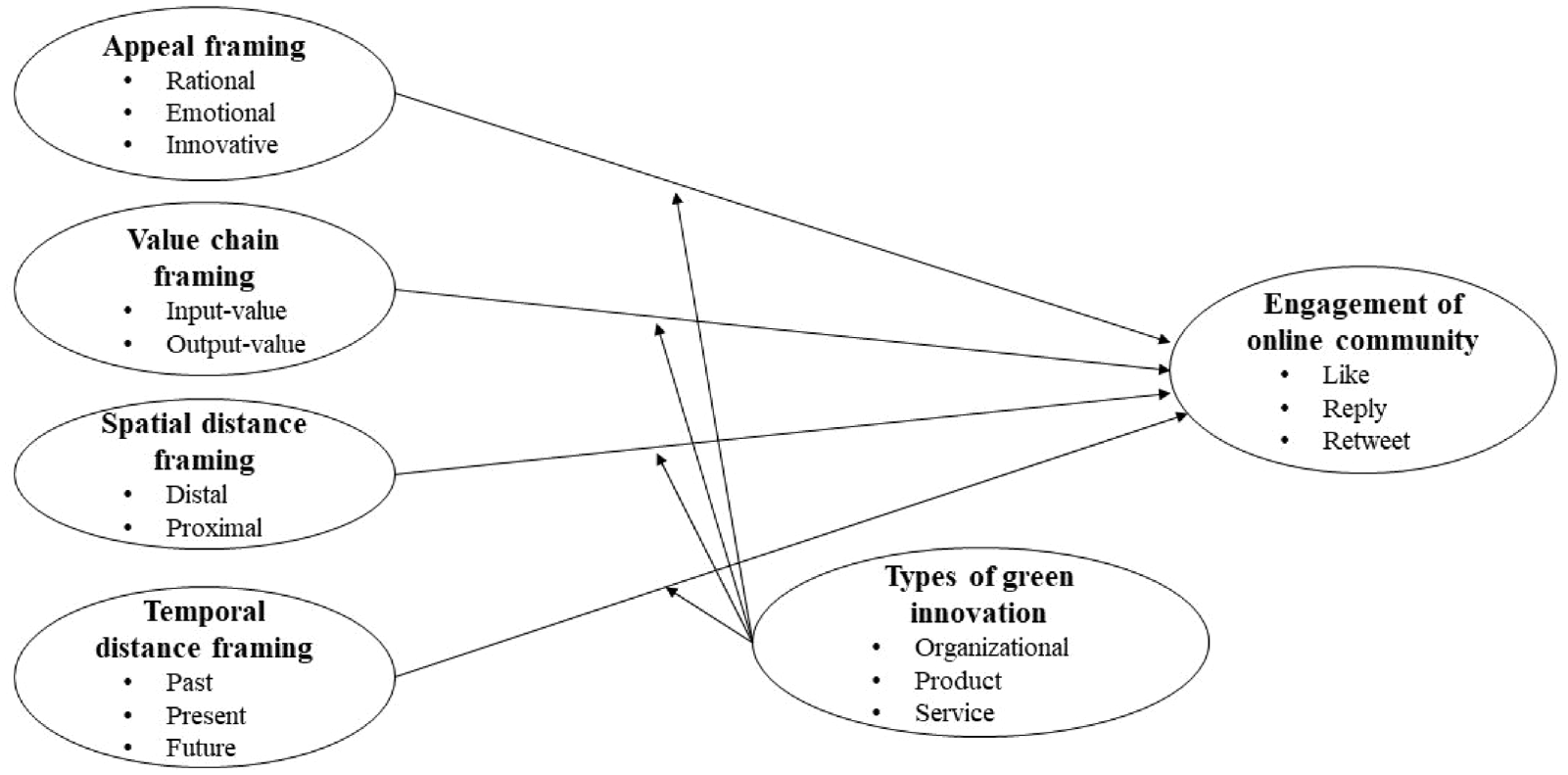
Proposed research model for phases II and III.
Phase II: Hypothesis Testing Results of Quantitative Analysis
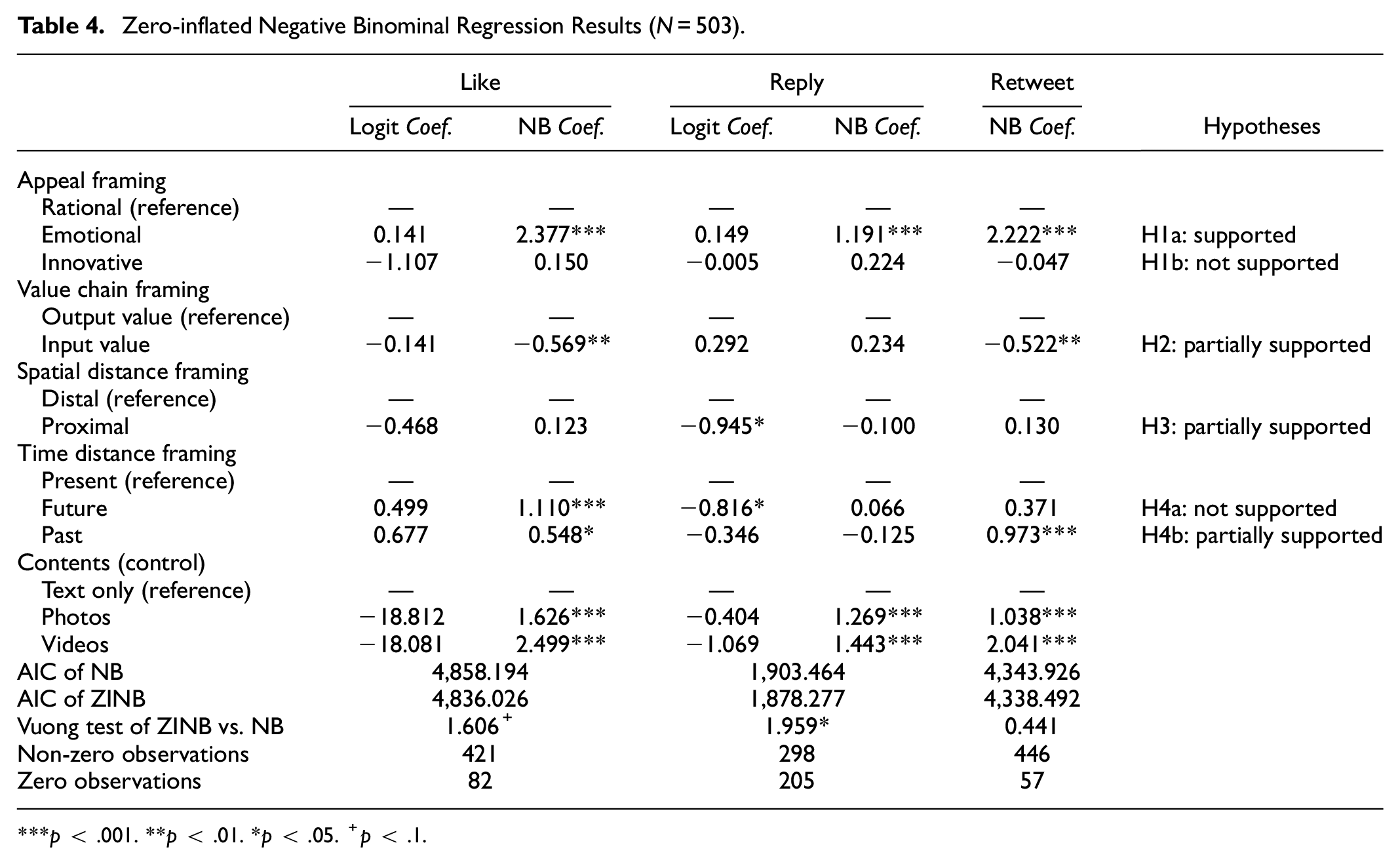
Table 4 presents the results of the NB and ZINB regressions for the variables Like, Retweet, and Reply. For all three dependent variables, the AIC values of the ZINB regression are smaller than those of the NB. Meanwhile, the corresponding Vuong test shows a significant level of 10% and 5% for Like and Reply, respectively. These results indicate that the ZINB (vs. NB) regressions are a better fit for Like and Reply (Vuong, 1989). Accordingly, we report the results of the ZINB regression for Like and Reply, and the NB regression for Retweet.
Zero-inflated Negative Binominal Regression Results (N = 503).
p < .001. **p < .01. *p < .05. +p < .1.
For appeal framings, the results show that emotional (vs. rational) framing has a positive and significant relationship with Like (β = 2.377, p < .001), Retweet (β = 2.222, p < .001), and Reply (β = 1.191, p < .001), which supports hypothesis 1a. However, innovative (vs. rational) framing does not have a significant relationship with Like, Retweet, or Reply, which means that hypothesis 1b is not supported.
For value chain framings, the results of the regression models reveal that input-value (vs. output-value) framing is significantly and negatively related to Like (β = −0.569, p < .01) and Retweet (β = −0.522, p < .01). This means that the more the input-value framing is used, the fewer likes and retweets the organizer receives from online communities. However, no significant result was found for Reply. These results provide partial support for hypothesis 2.
For spatial distance framings, we find that proximal (vs. distal) framing significantly reduces the likelihood of non-replies by a factor of 38.87% ( = exp (−0.945), p < .05). This provides partial support for hypothesis 3, suggesting that proximal framing makes online communities less likely to be non-responsive. However, no significant levels were found for the other dependent variables.
For temporal distance framings, we found that future (vs. present) framing has a higher probability of eliciting Like (β = 1.110, p < .001). In addition, future (vs. present) framing significantly reduces the likelihood of non-replies by a factor of 44.22% ( = exp (−0.816), p < .05). These results imply that future framing is effective in eliciting likes from online communities and makes these communities less likely to engage in non-reply. These results do not support hypothesis 4a; rather, they suggest that future (vs. present) framing has a positive association with online community engagement.
Past (vs. present) framing has a more positive and significant probability of eliciting Like (β = 0.548, p < .05), which means that online communities are more likely to express favorable attitudes when past framing is used. This means hypothesis 4b is partially supported. However, no significant relationships were found with the other dependent variables.
In summary, the regression results support the effectiveness of emotional (vs. rational) framing and future (vs. present) framing in eliciting likes, retweets, and replies from online communities. Partial support was also found for the ineffectiveness of input-value (vs. output-value) framing on likes and retweets. Similarly, partial support is provided for the effectiveness of proximal (vs. distal) framing on non-replies and past (vs. present) framing on likes.
Phase III: Exploratory Results from Quantitative Analysis
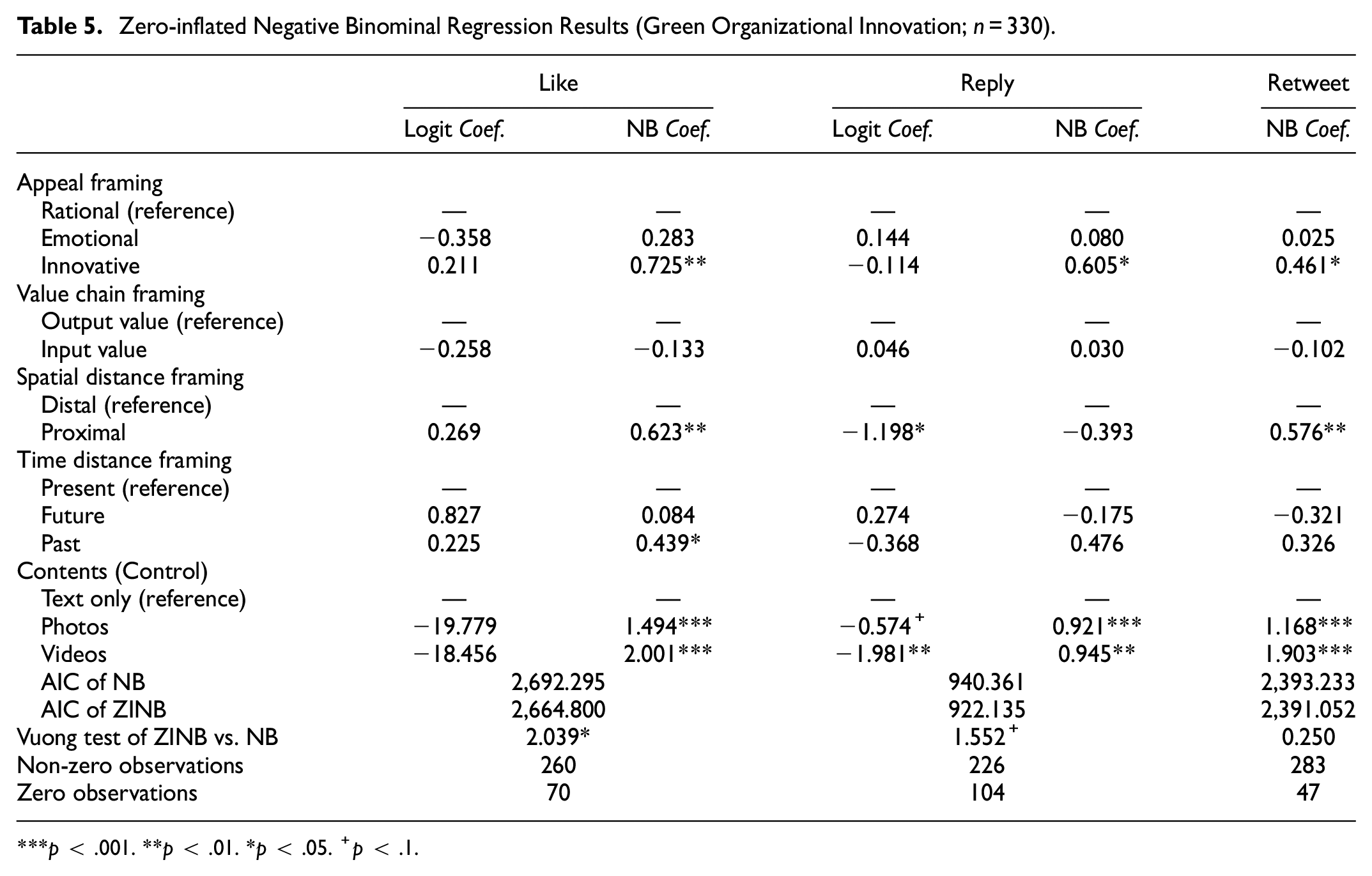
We further explored the potential moderating role of green innovation in the relationship between the effect of message framings on online community engagements (likes, retweets, and replies). Table 5 summarizes the regression results for the sample of green organizational innovation (n = 330). It is interesting to find that innovative (vs. rational) framing is more likely to elicit Like (β = 0.725, p < .01) and Retweet (β = 0.461, p < .05). This implies that innovative framing is particularly effective in communicating green organizational innovations to online communities. In addition, the effectiveness of proximal (vs. distal) framing is again confirmed to trigger more Like (β = 0.623, p < .01) and Retweet (β = 0.576, p < .05). Proximal (vs. distal) framing also significantly reduces the probability of non-Reply by a factor of 30.18% ( = exp (−1.198), p < .05). Similarly, the effectiveness of past (vs. present) framing also increases Like (β = 0.439, p < .05). Overall, these results suggest that innovative, proximal, and past framing are effective in engaging online communities when communicating green organizational innovation.
Zero-inflated Negative Binominal Regression Results (Green Organizational Innovation; n = 330).
p < .001. **p < .01. *p < .05. +p < .1.
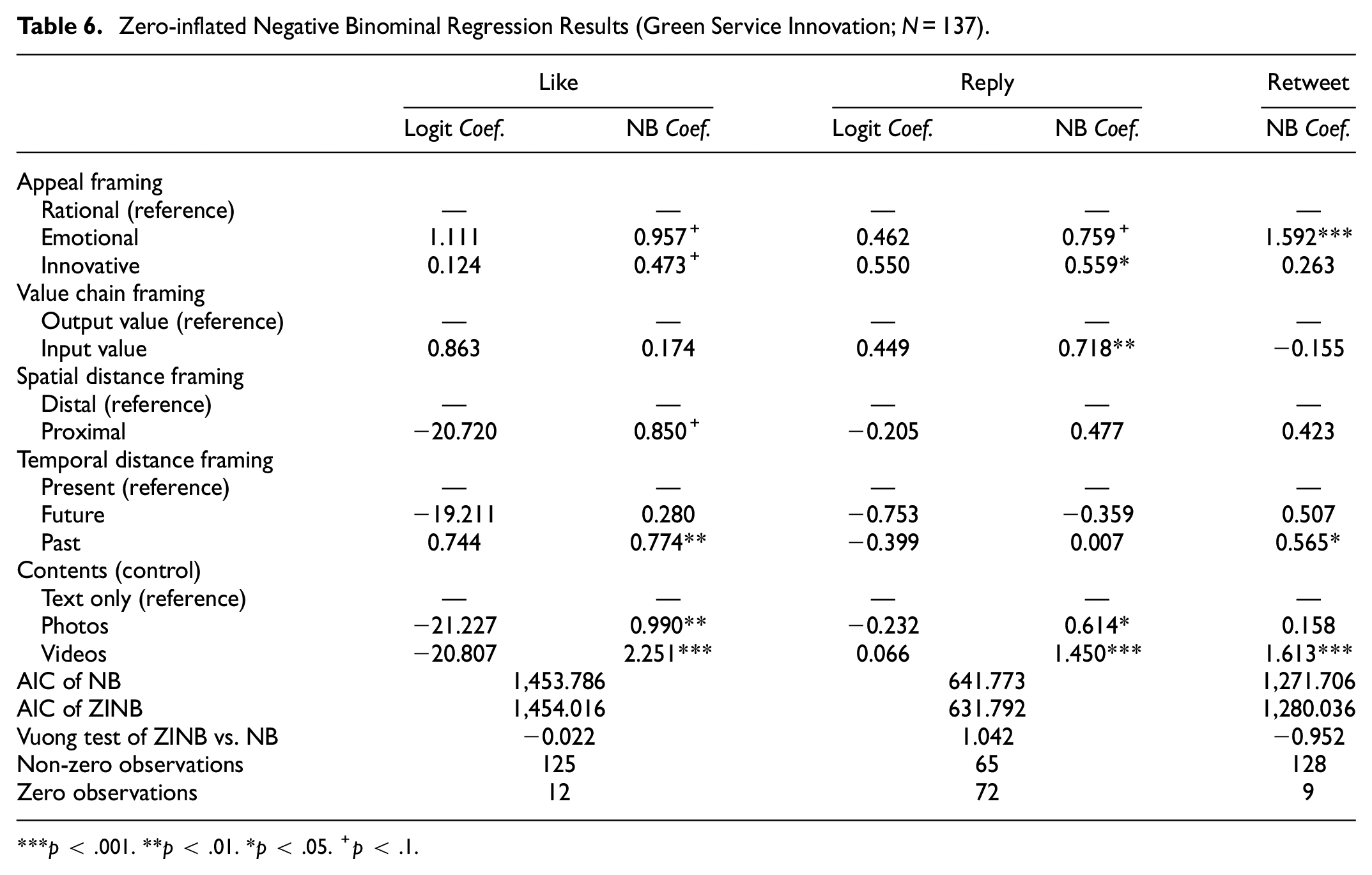
Table 6 presents the regression results for the sample of green service innovations (n = 137). In considering the appeal framings, emotional (vs. rational) framing was found to significantly trigger Retweet (β = 1.592, p < .001), while innovative (vs. rational) framing significantly triggered Reply (β = 0.559, p < .05). Interestingly, input-value (vs. output-value) framing positively and significantly triggered Reply (β = 0.718, p < .01). Furthermore, past (vs. present) framing has a significant and positive association with Like (β = 0.774, p < .01) and Retweet (β = 0.565, p < .05). These results suggest that organizers should emphasize emotion, novelty, input value, and past behaviors when communicating green service innovations to their online communities.
Zero-inflated Negative Binominal Regression Results (Green Service Innovation; N = 137).
p < .001. **p < .01. *p < .05. +p < .1.
Discussion
Event organizers have begun to implement green innovations to reduce the negative environmental effects of the events they hold (Qin et al., 2023; Satta et al., 2019; Sharma et al., 2020). However, organizers often find communicating about sustainability challenging and are often accused of greenwashing, which may lead to organizational greenhushing merely to avoid negative feedback (Ettinger et al., 2021; Font et al., 2017; Laing & Frost, 2010). Research indicates that both greenwashing and greenhushing can bring reputational damage to the organizations (Kim & Lyon, 2015). Organizations merit better knowledge about how to effectively communicate green innovation, especially with online communities, who are often more critical due to their intangible, diverse characteristics (Kharouf et al., 2020; Simons, 2019). To better understand how to effectively communicate green innovation with online communities, we examined the textual content of organizers and how their online communities reacted to their messaging. Our research yields novel insights and interesting results that shed light on effective strategies for fostering online engagement relating to the sustainable practices of organizers.
First, our results reveal a novel form of framing: innovation appeal framing. A great deal of prior tourism research has focused on two types of appeal framings: rational and emotional (Chien et al., 2012; Font et al., 2017; Gursoy et al., 2022; Nabi et al., 2018; Pino et al., 2019; Wehrli et al., 2017). Our study extends such research and demonstrates that innovative appeal framing offers an alternative option for effective communication with online communities. As previous research has argued, the message appeal should align with the product type (Hardeman et al., 2017; Moon et al., 2016), and so we argue that an innovative appeal that highlights novel attributes of the innovation can trigger recipients’ curiosity for new information and knowledge. We found that innovative framing is used more often than emotional framing by organizers and is particularly effective for communicating green organizational innovation to online communities. This may be because green organizational innovation is an internal management approach and thereby less visible to online communities without psychical attendances. Thus, using innovative framing to communicate explicitly about the green innovation in which an organization has been engaged is more useful in fostering engagement among online communities.
Second, our results reveal that value chain framing is used by organizers to communicate content related to the input value of their green innovation. Adopting an organizational perspective to understand value chain framing, we complement previous tourism research that has focused on the consumer perspective; for example, studies examining gain versus loss framing (Liu & Mair, 2023; Ropret Homar & Knežević Cvelbar, 2024) and promotion versus prevention framing (Beldona et al., 2022; X. Zhang et al., 2020). We demonstrated that input values are typically used to communicate the financial investments, efforts and workload, and long-term commitments of the organization. Interestingly, we found that that input-value (vs. output-value) framing is less engaging for online event communities because it triggers relatively few likes and retweets. This possibly indicates that overemphasizing organizers own inputs may cause consumer skepticism. That is, organizers “showing off” their hard work might lead to suspicion about their motives and may mean that consumers begin to suspect that the organization is implementing green innovations for extrinsic motives (e.g., profit) rather than for genuine and intrinsic environmental concerns (Kim & Lyon, 2015; Schmeltz, 2012; B. Zhang et al., 2019). Therefore, our results also highlight a counterproductive relationship between input-value framing and online community engagement.
Third, as construal level theory suggests, event organizers used present framing more often than future and past framing. However, we found an interesting result that online communities engaged more in future framing communication, as revealed through a higher number of likes and replies for this type of framing. These results differ from our hypothesis and conventional knowledge of construal level theory (Bortree et al., 2013; Ji et al., 2018; Pino et al., 2019).
We propose two explanations to clarify the effectiveness of future framing. Our focus on green innovation (i.e., the positive changes) is different from the focus of previous studies, which have mainly discussed communicating environmental risks and negative impacts on the environment (e.g., Bortree et al., 2013; Pino et al., 2019; B. Zhang et al., 2019). The tweets in our study were often published before the events took place, indicating that green innovation (i.e., the positive changes) would be implemented during the event to address negative environmental impacts. In addition, individuals have affective forecasting ability (Karl et al., 2021), which means online community members are capable of mentally envisioning themselves in forthcoming events and anticipating the emotions they would experience. This implies that future framing provides a foreseeable future to online communities (Qin et al., 2023), possibly enhancing their engagement with green innovation communication. Therefore, our study suggests that future framing is more appropriate for sports mega events to communicate green innovation with online communities.
Fourth, our study provided some initial evidence about the moderating effect of green innovation on the relationship between message framings and online communities’ engagement. We found that green organizational innovation merits different message framings than does green service innovation because message framing theory indicates that framings should fit with and highlight the salient attributes of each product (Entman, 1993; Hardeman et al., 2017). For green organizational innovation, innovative and proximal framings were more effective. We consider that this is because internal management advancements are less observable to external stakeholders, which means that innovative framing allows organizers to highlight the groundbreaking, unique, and positive aspects of their green organizational innovation and proximal framing provides concrete representations, aiding online community members to envision the internal changes, thereby enhancing the organizer’s trust and credibility (Blose et al., 2015; Font et al., 2017; B. Zhang et al., 2019). For green service innovation, emotional framing was more effective, probably because emotions are embedded in the interactive nature of service experiences. Compared with rational framing, emotional framing is more likely to elicit the recipient’s belief in a lively and memorable experience with green service innovation (Hardeman et al., 2017; Nabi et al., 2018; Wehrli et al., 2017). We encourage future research to delve deeper into various types of green innovations and explore how they may moderate the effectiveness of message framings in sustainability communication.
Theoretical Implications
This paper offers several important theoretical implications for sustainable tourism and green event literature. First, the study advances knowledge on sustainability communication by exploring effective strategies for communicating green innovation for tourism and event organizers. To our best knowledge, this is one of the first studies to extend the message framing and construal level theories to increase understanding of how tourism and event organizers communicate green innovation. While prior studies have applied message framing theory in sustainability communication, tourism and event studies have mainly focused on reducing tourists’ unsustainable practices (Huang et al., 2021; B. Zhang et al., 2019; X. Zhang et al., 2020), and promoting tourists’ pro-environmental behaviors (Hardeman et al., 2017; X. Zhang et al., 2021). However, tourism and event organizers often face accusations of greenwashing (Kim & Lyon, 2015; Laing & Frost, 2010) and greenhushing (Ettinger et al., 2021; Font et al., 2017), which implies extant knowledge is insufficient on how to effectively communicate green innovation. Thus, this study adopted message framing and construal level theories to enhance understanding of how tourism and event organizers can communicate green innovation appropriately and effectively to online communities.
Second, our study addresses online communities of sports mega events, which is an underexplored consumer group in this context. That is, prior tourism studies have mainly examined how organizers communicate sustainability information to on-site visitors (Font et al., 2017; Mair & Laing, 2013; Wong et al., 2021; X. Zhang et al., 2020, 2021). Online communities of sports mega events have received less scholarly attention, but they are more critical of sustainability communication, because online communities are more empowered by information technology and suffer less from information asymmetry (Bergh et al., 2019; Liao et al., 2024). Thus, this study considered message framing and construal level theories to demonstrate that how social media messages are framed influences both the perceptions and engagement behaviors of online event communities. Thus, we extend the knowledge of strategic communication beyond on-site visitors to online communities (Kharouf et al., 2020; Simons, 2019) and furthermore, provide novel insights into best practice in communicating green innovation to online communities.
Third, despite the wide applications of message framing and construal level theories (Moernaut et al., 2022; Wong et al., 2021; Xiong et al., 2019; X. Zhang et al., 2020, 2021), our study employs an exploratory sequential mixed-methods approach to capture the novelty and complexity of framing strategies in the sustainable tourism and event context. We identify two types of framing strategies, innovative and value chain framings, which have not been documented in the previous literature. Moreover, our empirical results demonstrate the effectiveness of innovative (vs. rational) and output-value (vs. input-value) framing in communicating green organizational innovation to online communities. In addition, we explore the potential moderating effect of green innovation, revealing different framing strategies for green organizational and service innovation. Our study opens new avenues for future research to understand the intricacies of organizational communication strategies.
Practical Implications
We offer ideas on effective message framings that support organizers to best communicate their green innovations to their online communities. First, organizers should employ innovative framing to highlight the novel characteristics of their sustainable practices and spark the interest and curiosity of online communities. Examples of innovative framing use explicit terms (e.g., “first-time ever,” “groundbreaking,” “pioneering a new era”) to demonstrate their novel appeal.
Second, to reduce consumer skepticism about why tourism and event organizers implement green innovation, organizers should refrain from using input-value framing. Instead, utilizing output-value framing can enhance engagement from the online community. For instance, tourism and event organizers can use output-value framing to emphasize the positive outcomes of green innovation, such as improved environments, economic savings and growth, enhanced reputation, and competitiveness.
Third, organizers should use future framing to construct a socially desirable and predictable future. For example, organizers can describe the implementation and potential outcomes of green innovation using the future tense. This is particularly pertinent before events occur, allowing communities to develop clearer expectations about imminent developments.
Fourth, organizers should adjust their framing strategies depending on the type of green innovation. Green organizational innovation is better communicated using innovative and proximal framings, for example, “Did you know this is the first-time ever project in…?” and “Would you like to join us in this groundbreaking project?” For green service innovation, it is more effective to use emotional framings that express explicit emotions (e.g., the usage of terms, such as “proud,” “exciting,” and “amazing”).
Limitations and Recommendations for Future Research
This study has limitations that can inspire future research. To begin with, we collected and analyzed only textual data and highlighted that text messages are often used to communicate green innovations. Future research may explore the role of photos and videos in message framings and sustainability communication, including how visual stimuli, color, stories, and multimodal features influence the emotions of message recipients. The main results of this research are based on X/Twitter data only. We recommend that future studies integrate data from multiple sources such as Facebook, Instagram, and Weibo to extend this study. Finally, our analysis did not investigate demographic differences among online community members. Demographics may influence online community members’ responses to different message framings. Therefore, future research could seek to ascertain whether demographic differences in the online community influence the effectiveness of message framings.
Conclusion
This study investigates how sports mega event organizers can better communicate green innovations to online communities via social media. This is important because without the ability to communicate their environmental efforts, mega event organizers risk an online backlash relating to the negative environmental impacts of their events, which in turn threatens their social license to operate (Demuijnck & Fasterling, 2016; Giulianotti et al., 2015; Scott et al., 2023). To address this, we employed an exploratory sequential mixed-methods approach to investigate which message framings support organizers to effectively communicate green innovations to their online communities. Our results suggest that strategically framed messages posted on social media influence the perceptions and engagement behaviors of online event communities (Ji et al., 2018; Kucukusta et al., 2019; Scholl-Grissemann et al., 2020).
Supplemental Material
sj-docx-1-jtr-10.1177_00472875241260327 – Supplemental material for Communicating Green Innovation to Online Communities
Supplemental material, sj-docx-1-jtr-10.1177_00472875241260327 for Communicating Green Innovation to Online Communities by Xiangru Qin, Birgit Muskat, Haiyang Xia, Judith Mair and Gang Li in Journal of Travel Research
Footnotes
Acknowledgements
Xiangru Qin was supported by an ANU University Research Scholarship; Haiyang Xia was supported by an Australian Government Research Training Program (RTP) Scholarship.
Declaration of Conflicting Interests
The author(s) declared no potential conflicts of interest with respect to the research, authorship, and/or publication of this article.
Funding
The author(s) received no financial support for the research, authorship, and/or publication of this article.

Supplemental Material
Supplemental material for this article is available online.
Author Biographies
References
Supplementary Material
Please find the following supplemental material available below.
For Open Access articles published under a Creative Commons License, all supplemental material carries the same license as the article it is associated with.
For non-Open Access articles published, all supplemental material carries a non-exclusive license, and permission requests for re-use of supplemental material or any part of supplemental material shall be sent directly to the copyright owner as specified in the copyright notice associated with the article.
