




Abstract
This study investigates the impact of information framing (negative vs. positive) on the adoption of virtual reality (VR) tourism applications amidst various crisis events such as pandemics, natural disasters, political unrest, or terrorism. Using three experiments, we found that negatively framed information increases travel anxiety and the adoption of VR tourism more than positive framing, a pattern consistent across different crisis events. Travel anxiety, rather than perceived risk, was identified as the mediator in the relationship between information framing and VR tourism adoption. These insights are valuable for tourism marketers, policymakers, VR technology developers, and destination management organizations. They highlight the need for strategic information management during crises to influence traveler decisions and the potential of VR tourism as a tool for enhancing crisis resilience. These results also contribute to a deeper understanding of the dynamics between information framing, travel anxiety, and perceived risk in shaping tourism preferences and choices.
Keywords
Introduction
Natural calamities, infectious diseases, terrorism, and wars are just some global events that have adversely impacted the travel and tourism industry (D. Zheng et al., 2021). The unpredictability of such unprecedented events can trigger travel anxiety and result in enduring adverse effects on the travel and tourism sector (Fennell, 2017; Yang & Nair, 2014). Travel anxiety is a subjective emotion comprising the discomfort, fear, panic, stress, or nervousness that travelers experience when exposed to an actual or a possible risk (Reisinger & Mavondo, 2005). Travelers who are unfamiliar with their travel destinations often depend on secondary sources such as online news, popular media, and social media posts for information (Kapuściński & Richards, 2016). Consequently, the news media is frequently noted as a primary source for shaping travelers’ perceptions of risks, crises, and hazards, especially when it comes to tourist destinations (Chew & Jahari, 2014).
Although the news media provides crucial information in a timely manner, there is a widespread belief that it tends to report hazardous events in an overly pessimistic manner, which can lead to a distorted understanding of the safety level at the locations in which they occur (Chew & Jahari, 2014; Thirumaran et al., 2021). This phenomenon is closely linked to the concept of valence framing, where the same information can be presented either negatively or positively, influencing individuals’ perceptions and reactions (Gonzalez et al., 2005). When travelers receive negative information, it can evoke feelings of uncertainty and raise concerns regarding the safety and security of their intended destination. This, in turn, can increase their anxiety about traveling (Thirumaran et al., 2021). It can also contribute to fear of terrorism, crime, and natural disasters, which can further exacerbate travel anxiety and have a long-term adverse effect on travelers (Shin et al., 2023; Yang & Nair, 2014).
Previous research has recognized the travel and tourism industry’s lack of preparation and poor reaction to crises (Wang & Ritchie, 2012). The unpredictability of hazardous events is a common cause of travel anxiety among travelers planning a trip and can be attributed to the spread of negative information or misinformation by the media (Yang & Nair, 2014). The role of valence framing becomes particularly significant here as it directly influences how such negative information is perceived and processed by travelers. For example, in 2003, the outbreak of SARS curtailed the number of outbound trips by more than eight million in the subsequent year (World Tourism Organization (WTO), 2004). The terrorist attacks in the US on September 11 had a notable effect on the airline and hotel sectors, resulting in a decrease in hotel reservations of over 50% and reduced passenger traffic (Floyd et al., 2004; Goodrich, 2002). Also, in 2013, fears arising from the Ebola epidemic reduced the number of tourists in Ebola-free countries, and even after 2016, the number of international arrivals in Western Africa remained below 50% compared to pre-Ebola numbers (World Travel & Tourism Council (WTTC), 2018). Most recently, the travel and tourism industry faced disruption by the spread of COVID-19. However, despite the curtailment of COVID-19-related travel restrictions, the recovery of the travel and tourism industry has been slow due to misinformation and fear caused by various sources in the news and social media (Leung et al., 2023; D. Zheng et al., 2021). These examples indicate how valence framing in the context of presenting travel-related information can either exacerbate or alleviate travel anxiety, depending on whether the framing is negative or positive.
Prior studies emphasize that the way information related to threats is framed and presented in the media can be crucial in determining its impact on individuals’ perception of risk and anxiety (Hughes et al., 2006; Otterbring et al., 2021). Researchers have further observed that media reports of hazardous events (e.g., a pandemic health crisis) often overemphasize certain aspects while ignoring others (Woods, 2007). The reporting of COVID-19 pandemic-related news, for example, had a clear bias toward framing information negatively (Liu et al., 2023; Şengel et al., 2023; Thirumaran et al., 2021). The concept of valence framing thus becomes integral to understanding the dynamics of how information is framed in the media as well as the impact such framing has on travel anxiety and travelers’ subsequent responses. Previous research in travel and tourism has observed that information framing significantly impacts travelers’ intentions to book hotels (Sparks & Browning, 2011), erodes trust in hotel websites (Sparks & Browning, 2011), and lowers the attractiveness of a destination (Min et al., 2013). However, while looming uncertainty and societal risks (regarding pandemics, natural disasters, wars, etc.) are understood as drivers of travel anxiety, the impact of valence framing (negative vs. positive) on travel anxiety has been ignored in the extant literature (Kapuściński & Richards, 2016; Williams et al., 2022). Therefore, this study aims to bridge this gap by manipulating valence framing (positive vs. negative) and measuring its impact on travel anxiety and subsequent tourism-related responses among travelers.
In recent literature, scholars have observed that travel restrictions such as border closures, isolation, and social distancing significantly impact in-situ travel (Skard et al., 2021; Talwar et al., 2022), pushing travelers to explore alternative means to satisfy their wanderlust, such as virtual reality (VR) travel and tourism (Gursoy et al., 2022; M. J. Kim et al., 2020; Talwar et al., 2022). VR travel creates a virtual, three-dimensional (3D) simulated environment that offers authentic, realistic, and immersive experiences, allowing tourists to travel and experience a destination of their choice from the comfort of their living room (Manchanda & Deb, 2022; Talwar et al., 2022). It is argued that VR travel and tourism can alleviate travel anxiety (O. Lee & Oh, 2007) and revolutionize the travel and tourism experience (Berger et al., 2007; Gretzel & Fesenmaier, 2003; Guttentag, 2010; Huang et al., 2013). VR travel and tourism witnessed an exponential rise in popularity during the COVID-19 pandemic, and scholars have noted various reasons behind this sharp increase, including convenience (Herrmann, 2020; Leung et al., 2023), novelty (H. Lee et al., 2020), risk aversion (Serra & Leong, 2020), and association with pro-environmental behavior and sustainability (Schiopu et al., 2021).
The internet keyword search “VR tours” witnessed an increase of more than 400% in the first month of the lockdown in March 2020 (Skard et al., 2021). While travel has normalized to pre-pandemic levels, the popularity of VR travel and tourism applications is growing faster than expected (Gursoy et al., 2022; Li et al., 2022; Sigala, 2020). Some studies argue that VR travel and tourism applications provide a new and convenient mode of travel and argue that risk aversion is a key motive for subscribing to VR travel (Filep et al., 2024) while others have pointed to pro-environmental behavior and sustainability as the key motives for subscribing to VR travel (Talwar et al., 2022). Still, to the best of our knowledge, previous studies have overlooked the influence of travel-related anxiety on the inclination to embrace VR travel and tourism applications (Cai et al., 2021).
To this end, the present research aims to understand travelers’ responses to travel anxiety by manipulating valence framing. The study design is motivated by two key research questions:
We combine research on framing effects (Levin et al., 2002) with theories about the negativity bias (Rozin & Royzman, 2001) and the notion that “bad is stronger than good” (Baumeister et al., 2001) as our conceptual lens to better understand the empirical results. The articles by Baumeister et al. (2001) and Rozin and Royzman (2001) provide two influential frameworks from psychological science with overlapping content, developed independently around the same time by different scholars.
Taken together, this research makes three primary contributions. First, we identify valence framing as a key predictor of travel anxiety and provide empirical support for the negativity bias and related streams of theorizing in predicting human judgment and decision-making in the context of travel anxiety. Second, we observe that travelers consider VR travel and tourism a safer alternative to in-situ tourism when they are struck by anxiety. Third, we augment the literature on risk perception within travel and tourism choices (Korstanje, 2009; Yang & Nair, 2014). Therefore, the present work enhances our understanding of travel anxiety and the decision-making processes of tourists while also making a substantial contribution to the expanding body of literature concerning VR travel and tourism.
We structure our work in five sections. Following the current introduction, we review the extant literature and formulate a series of hypotheses. Next, we outline the methodology and discuss our three studies, after which we discuss the main findings and key contributions of our research. Lastly, we conclude by acknowledging some limitations of our work, which may act as directions for future research.
Literature Review and Hypotheses Development
The Negativity Bias in Travel and Tourism Studies
The negativity bias is the phenomenon whereby negative occurrences and data have a more powerful influence on an individual’s cognition, emotions, and conduct compared to neutral or positive events and information (Rozin & Royzman, 2001). According to this theoretical lens, the human brain has evolved to be more sensitive to negative stimuli, such as threats or danger, as a means of survival (Baumeister et al., 2001). This sensitivity to negative information can result in a heightened focus on the negative aspects of a situation, leading to a negative perception of the world, negative emotions, and behaviors congruent with such negativity (Vaish et al., 2008). In comparison, people tend to be less sensitive to positive stimuli. Therefore, it is natural for people to pay greater attention and give greater weightage to negative compared to positive information (Baumeister et al., 2001; Ito et al., 1998; Vaish et al., 2008). While positive stimuli are also processed by the brain, they tend to have a less immediate and less intense impact on an individual’s psychological and behavioral responses. People naturally pay more attention and give more weight to negative information (Baumeister et al., 2001; Ito et al., 1998; Vaish et al., 2008).
Figure 1 visually represents the negativity bias, illustrating the dominant pathway of negative stimuli through bold lines, which indicate their strong and direct effect on perception, emotion, cognition, and behavior. On the other hand, the pathway of positive stimuli is represented with a continuous but less pronounced line, reflecting their subtler impact on the same cognitive, emotional, and behavioral processes. This visual distinction aims to convey the differential impact of negative (vs. positive) stimuli as per the negativity bias while acknowledging that both types of stimuli contribute to the overall cognitive processing within the brain.
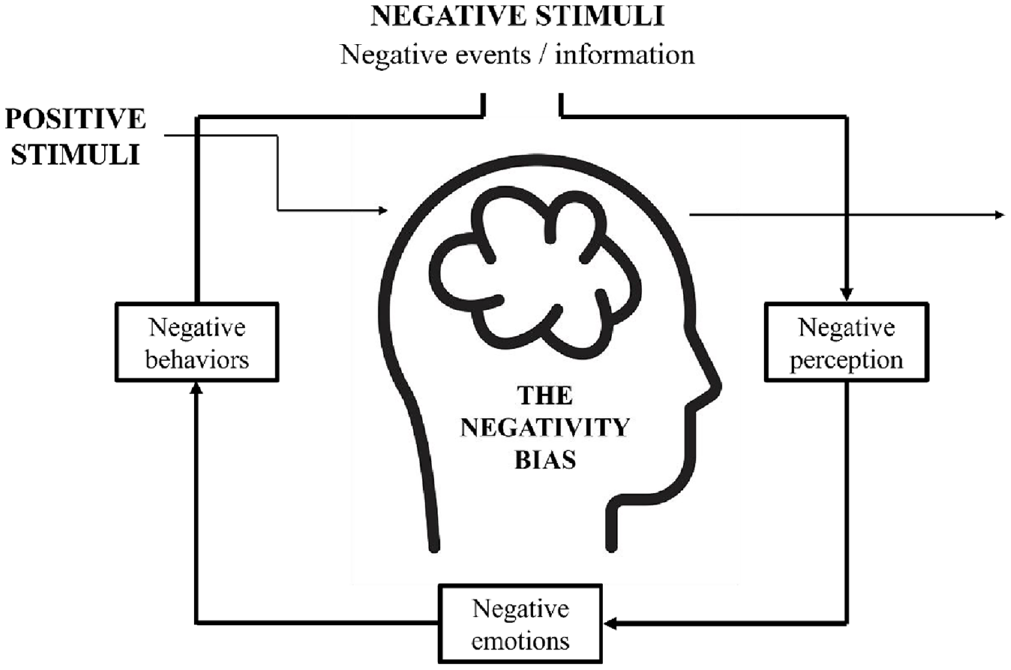
The negativity bias.
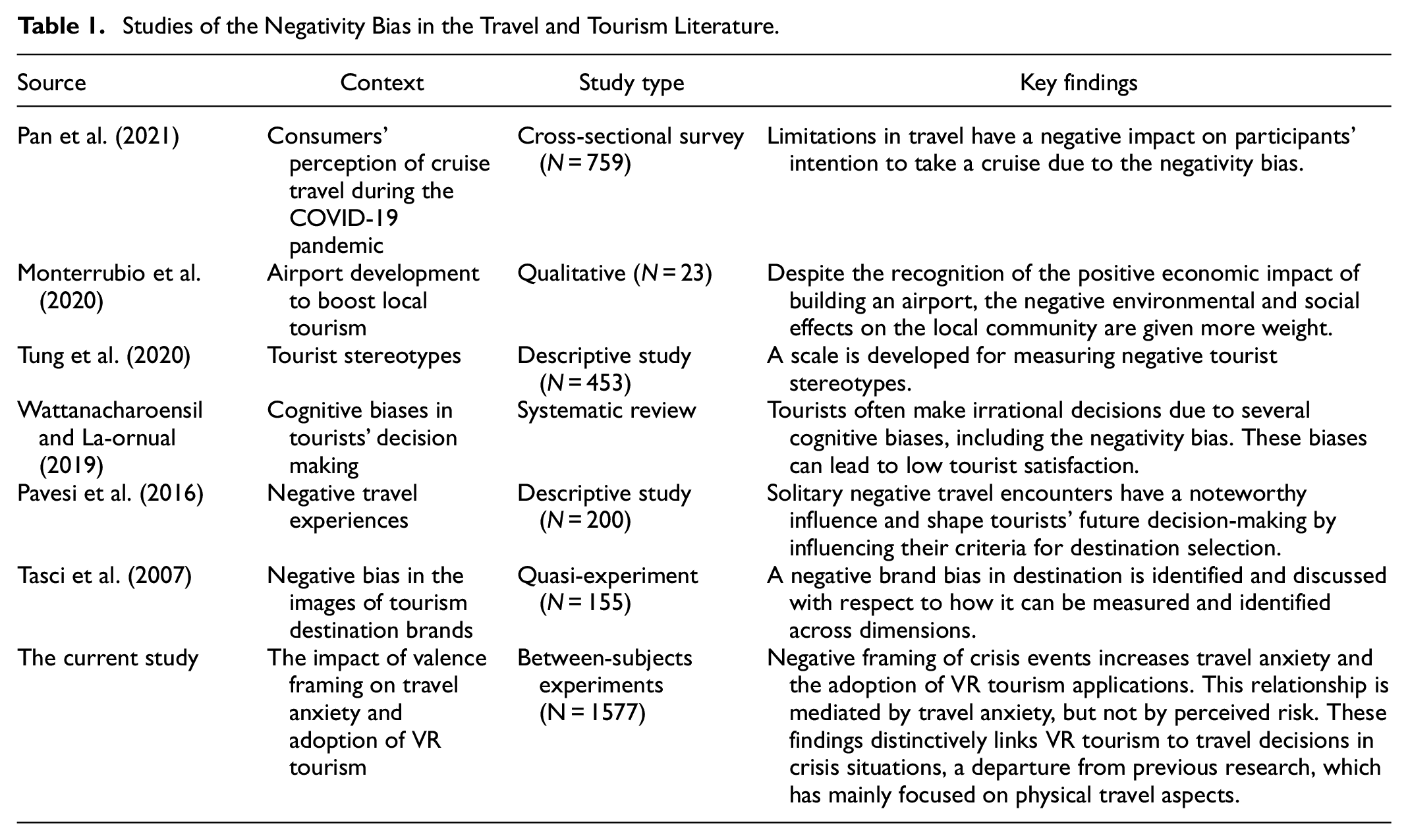
The negativity bias has been widely studied in psychology and has been linked to a variety of mental health outcomes, such as depression, anxiety, and stress (Tung et al., 2020). However, only a limited number of studies have investigated the general thesis of this overarching framework in the travel and tourism context, although some notable exceptions should be acknowledged (Pavesi et al., 2016; Tung et al., 2020; Wattanacharoensil & La-ornual, 2019). For example, Pan et al. (2021) found support for the negativity bias in the context of cruise travel recovery strategies. Likewise, according to Monterrubio et al. (2020), city residents believe that the negative consequences of building an airport, such as environmental and social impacts, are more significant than the benefits it would bring in terms of increasing tourism in the city. Table 1 provides a summary of the limited existing studies that have explored the negativity bias within the context of travel and tourism.
Studies of the Negativity Bias in the Travel and Tourism Literature.
The negativity bias is relevant in settings associated with travel anxiety because it suggests that travelers may focus more on potential negative outcomes (e.g., flight delays, lost luggage, etc.) when making travel plans, leading to higher levels of anxiety (Alam et al., 2023). If negative information about things like flight disruptions or lost luggage is presented in a way that highlights these issues, it can activate a traveler’s anxiety levels through the negativity bias, leading to heightened worry about the trip (Cain et al., 2024). However, if the same information is framed in a manner that downplays the negative aspects and focuses instead on the positive outcomes (such as a temporary inconvenience with a fast solution), it can counterbalance the negativity bias and decrease travel anxiety.
Framing Effects in Travel and Tourism Contexts
Information framing, also referred to as framing in communication research (Chong & Druckman, 2007), postulates that any occurrence can be presented from different perspectives, which in turn will create different attitudes and opinions about the phenomenon under consideration (Kapuściński & Richards, 2016; Thirumaran et al., 2021). Prior framing literature can be classified into two broad categories based on framing effects: valence framing (Gonzalez et al., 2005) and emphasis framing (De Vreese, 2005), as shown in Figure 2. Valence framing research investigates how two opposite words or phrases that are positively (vs. negatively) framed to be logically equivalent (e.g., “20% fat” vs. “80% fat-free”) receive different reactions from people (Gonzalez et al., 2005). On the other hand, emphasis framing in communication highlights specific aspects of a situation while downplaying others, shaping audience perception; for example, a news report on a natural disaster might emphasize the destruction caused (“Severe hurricane devastates coast”) or focus on recovery efforts (“Community unites to rebuild after hurricane”; De Vreese, 2005).
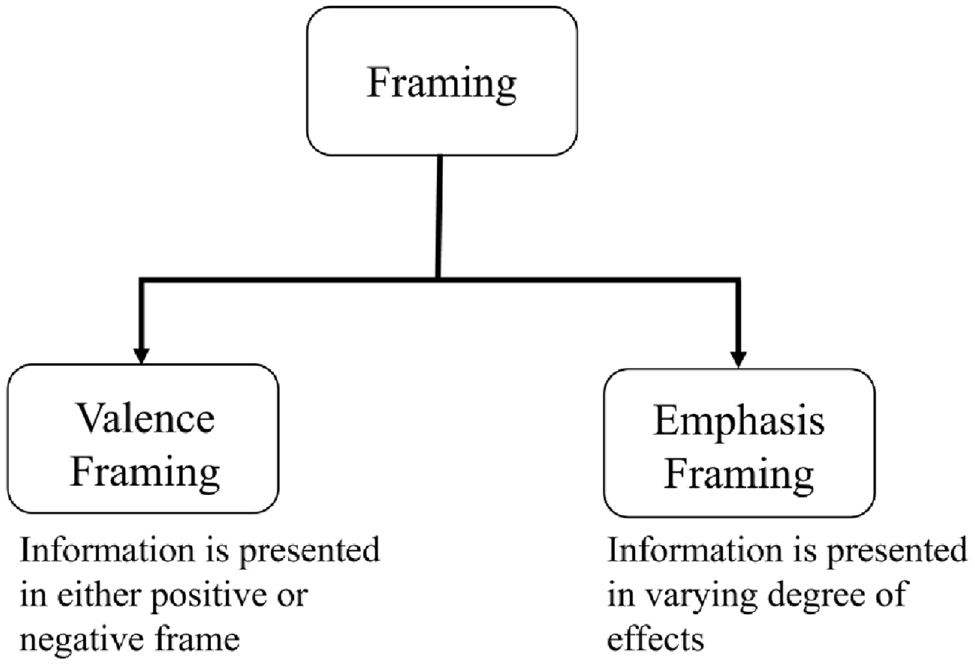
Types of information framing.
Valence framing has been used in travel and tourism research to evaluate the differences in the attitude of travelers toward certain stimuli, such as environmental protection messages (S. B. Kim & Kim, 2014) and linen reuse in hotels (Blose et al., 2015). While the valence framing approach can be used to measure the impact of opposite wording to communicate the same message, emphasis framing is applied in more complex issues, such as terrorism risks (Sniderman & Theriault, 2004). In the current research, we opt for valence framing over emphasis framing for its direct applicability in examining how the positive or negative presentation of information affects travel anxiety and the adoption of VR tourism applications, aligning with our theoretical focus on the negativity bias as well as our empirical emphasis on emotional responses and decision-making in travel and tourism contexts.
Kapuściński and Richards (2016) found that in reporting on crises such as terrorism risks or political instabilities, the framing significantly influences tourists’ perceived risk. The authors reported a higher perceived risk in a negative (risk-amplifying) frame compared to a positive (risk-attenuating) frame. Similarly, Ogbodo et al. (2020) analyzed news reports of COVID-19 and observed a negativity bias in reporting virus spread, which resulted in fear and panic among the general public. In response to such negatively framed media reports, travelers have increasingly turned to alternative information sources, such as social media, to validate and counterbalance these narratives. During the COVID-19 pandemic, for instance, many travelers used social media platforms to share their firsthand experiences, often providing perspectives that contrasted with mainstream media portrayals. This phenomenon underscores the growing importance of direct, real-time communication between potential travelers and those on location, calling for a deeper understanding of conditions and risks that may differ from media representations.
Travel and tourism are highly sensitive to events that cause concern about the safety and security of travelers (Zhang et al., 2021). The occurrence of unfavorable events or crises such as cyclones, pandemics, terrorist attacks, wars, and similar disasters triggers travel anxiety and adversely affects the demand for travel and tourism services (Ajogbeje et al., 2017; D. Zheng et al., 2021). While crisis events pose a potential threat to the travel and tourism economy, crisis communication can significantly impact the attitudes and behavior of travelers (Cheng et al., 2016; Möller et al., 2018; Zhang et al., 2021).
The negativity bias in valence framing can trigger travelers to take preventive measures because it emphasizes the potential negative outcomes of a situation, which can cause a heightened sense of fear or anxiety (Van der Meer & Tolsma, 2014). For example, if travelers are presented with information about a destination that focuses on the potential dangers or risks (e.g., crime rates, health hazards, etc.), they may be more likely to take preventive measures, such as researching crime prevention strategies or purchasing travel insurance, to reduce their anxiety and protect themselves (Eguren et al., 2021). On the other hand, if the same information is framed in a positive manner, highlighting the attractive aspects of the destination, the traveler may be less likely to feel the need to take preventive measures (Coombs, 2006). Furthermore, in the context of VR travel, negative framing of information about real-world travel risks can lead to an increased inclination toward virtual tourism as a safer alternative (Talwar et al., 2022). This is particularly relevant in situations where physical travel is perceived as risky or anxiety-inducing. The shift toward VR tourism in this scenario is driven not only by the avoidance of perceived physical risks but also by the unique immersive experiences offered by VR (Manchanda & Deb, 2022; Skard et al., 2021), which can serve as a compelling substitute for actual travel experiences (Gursoy et al., 2022; M. J. Kim et al., 2020). This tendency is amplified by the current technological advancements in VR, making it a more accessible and appealing option for tourists seeking to explore destinations without the associated risks (Leung et al., 2023; Talwar et al., 2022; S. Zheng et al., 2023). Therefore, valence framing plays an important role not only in shaping travelers’ opinions but also in the adoption of precautionary measures and the inclination toward alternative forms of tourism, such as VR travel and tourism. This is arguably even more salient in the context of crisis communication, where negatively framed information about travel destinations can significantly sway travelers’ decisions toward virtual alternatives (Coombs, 2006; Van der Meer & Tolsma, 2014). Thus, we hypothesize:
Travel Anxiety in Travel and Tourism Contexts
Anxiety is a psychological construct that describes the emotional state of individuals caused by feelings of worry, nervousness, or fear (Sylvers et al., 2011). Other emotions associated with anxiety include feeling apprehensive, disturbed, panicked, stressed, and uncomfortable (McIntyre & Roggenbuck, 1998). Anxiety can also be described as a condition of restlessness or overstimulation (Löfgren, 2008). Psychological literature operationalizes anxiety as a feeling of awkwardness, frustration, or fear of negative consequences that occurs when people are exposed to a potential risk (Hullett & Witte, 2001; Nicolau et al., 2023; Reisinger & Mavondo, 2005). Cisler et al. (2009) define anxiety as a preparatory response individuals exhibit to a situation that they may perceive as threatening. Öhman (2008) suggests that anxiety arises under situations that are threatening to individuals who lack effective coping mechanisms. Goolaup and Nunkoo (2023) propose that liminality can also cause anxiety among individuals. It is further argued that anxiety can prompt individuals to act in a response to maintain safety and well-being (Lang et al., 2000).
The topic of travel anxiety has received significant attention within the literature on travel and tourism (Talwar et al., 2022; Zenker et al., 2021). Travel anxiety occurs when people anticipate or experience a fear of the unknown and/or a fear of leaving home temporarily to travel to a risky environment (Cai & McKenna, 2023; Talwar et al., 2022; Zenker et al., 2021). Prior research has indicated that travel anxiety can be triggered by spatial factors or social stimuli (Zenker et al., 2021). Public spaces, events, or mass gatherings, such as concerts, and confined environments inside a bus or an aircraft can all trigger travel anxiety (Zenker et al., 2021). Similarly, social stimuli such as fear of contracting infectious viruses or getting caught in a terrorist attack or a war situation are also associated with travel anxiety (Asmundson & Taylor, 2020; Korstanje, 2009).
When travel anxiety is heightened, it creates a state of psychological discomfort associated with physical travel (Cai & McKenna, 2023; Zenker et al., 2021). This discomfort can stem from fears of health risks, safety concerns, or uncertainty about travel conditions. In response, travelers are more likely to be attracted to VR travel options, which offer the experience of travel without the associated risks (Nanni & Ulqinaku, 2021; Ulqinaku & Sarial-Abi, 2021). VR travel provides a controlled environment where people can explore destinations from the safety and comfort of their homes, significantly reducing the anxiety linked to uncertainty and potential threats in physical travel (Aldossary & McLean, 2022; Talwar et al., 2022).
Accordingly, to avoid travel anxiety, people explore alternatives that are safer, such as VR travel (Ulqinaku & Sarial-Abi, 2021) and webcam travel (Jarratt, 2021). The recent COVID-19 pandemic caused extreme health and social risks, and travelers were deprived of travel due to social distancing, lockdowns, and border closures (Zenker & Kock, 2020). Studies have reported that social-distancing measures not only induced travel anxiety among people but also resulted in behavioral modifications with a sudden surge in the adoption of VR travel and tourism applications (Aldossary & McLean, 2022; Nanni & Ulqinaku, 2021; Talwar et al., 2022). Drawing on these theoretical arguments, our third hypothesis posits that travel-related anxiety triggered by events such as pandemics or societal risks such as war or terrorism may encourage the acceptance of VR travel and tourism applications. Thus, we propose the following hypothesis:
Perceived Risk in Travel and Tourism
Perceived risk, as defined by the Macquarie Concise Dictionary (1999), refers to being exposed to the potential of experiencing a loss or suffering an injury. Similarly, Priest (1990) described it as the likelihood of losing something that holds value. While the concept of risk has gained the attention of travel and tourism researchers (Korstanje, 2009), most literature on risk studies in travel and tourism contexts has focused on subjective risk or perceived risk (Reisinger & Mavondo, 2005). Quintal et al. (2010) found problems with the conceptualization of perceived risk in travel and tourism research and argued that prior literature had used perceived risk, uncertainty, worry, fear, and anxiety interchangeably. Perceived risk predicts known uncertainties, while pre-vacation travel risk perception merely reflects anxiety, as there are no direct stimuli that are necessary components of the perceived risk concept (Korstanje, 2009; Williams et al., 2022). Therefore, previous studies measuring risk perception prior to the actual travel have limitations in terms of the measure of perceived risk (Simpson & Siguaw, 2008). When the perceived risk associated with traveling is heightened, particularly in contexts such as pandemics, natural disasters, or political crises, travelers may seek alternatives that minimize such risk perceptions (Li et al., 2022). VR travel and tourism applications provide a risk-free virtual experience, enabling people to explore destinations without physical exposure to perceived dangers (Li et al., 2022). This appeal of VR travel becomes particularly pronounced when traditional travel is associated with high levels of perceived risk, driving a shift toward virtual tourism as a safer alternative (Korstanje, 2009; Simpson & Siguaw, 2008; Williams et al., 2022). We posit that information about crisis situations should result in higher levels of perceived risk, with perceived risk also predicting the adoption of VR travel and tourism applications. Accordingly, we model perceived risk as another potential mediator in the relationship between valence framing and travelers’ adoption of VR travel and tourism applications. Formally stated, we anticipate the following:
Methodology
To examine our stated research hypotheses, we conducted three studies (see Table 2). Study 1 focused on experimentally determining the impact of valence framing on the adoption of VR travel and tourism applications and the mediating role of travel anxiety. Study 2 aimed to confirm the main effect on VR travel and tourism adoption, as observed in Study 1, while simultaneously examining the role of travel anxiety and perceived risk in mediating these effects. Finally, Study 3 sought to further validate the findings from our initial studies in contexts beyond the pandemic, such as scenarios involving other types of crisis events (see Figure 3). This approach allowed us to explore whether the relationship between valence framing, travel anxiety, and VR tourism adoption observed in the context of a pandemic holds true in different crisis situations. Doing so enhances the generalizability and external validity of our results, as called for by several scholars (Loebnitz et al., 2022; Lynch, 1999; Winer, 1999).
Research Framework.
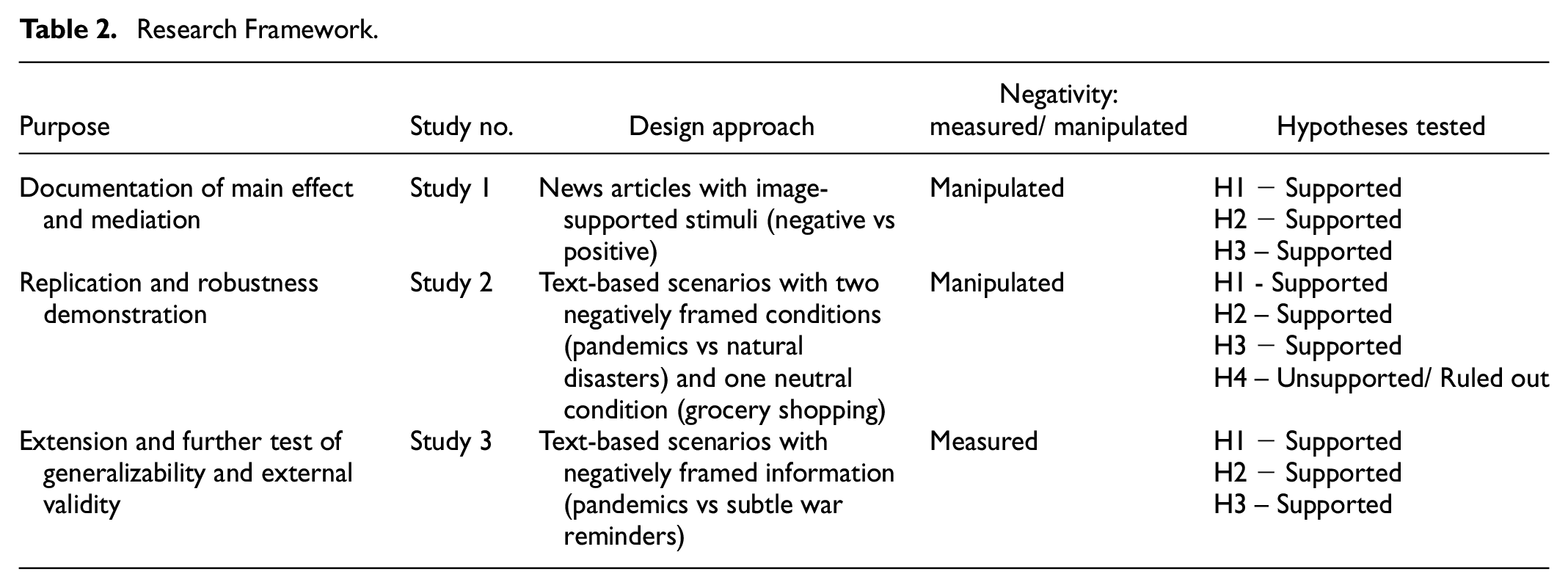
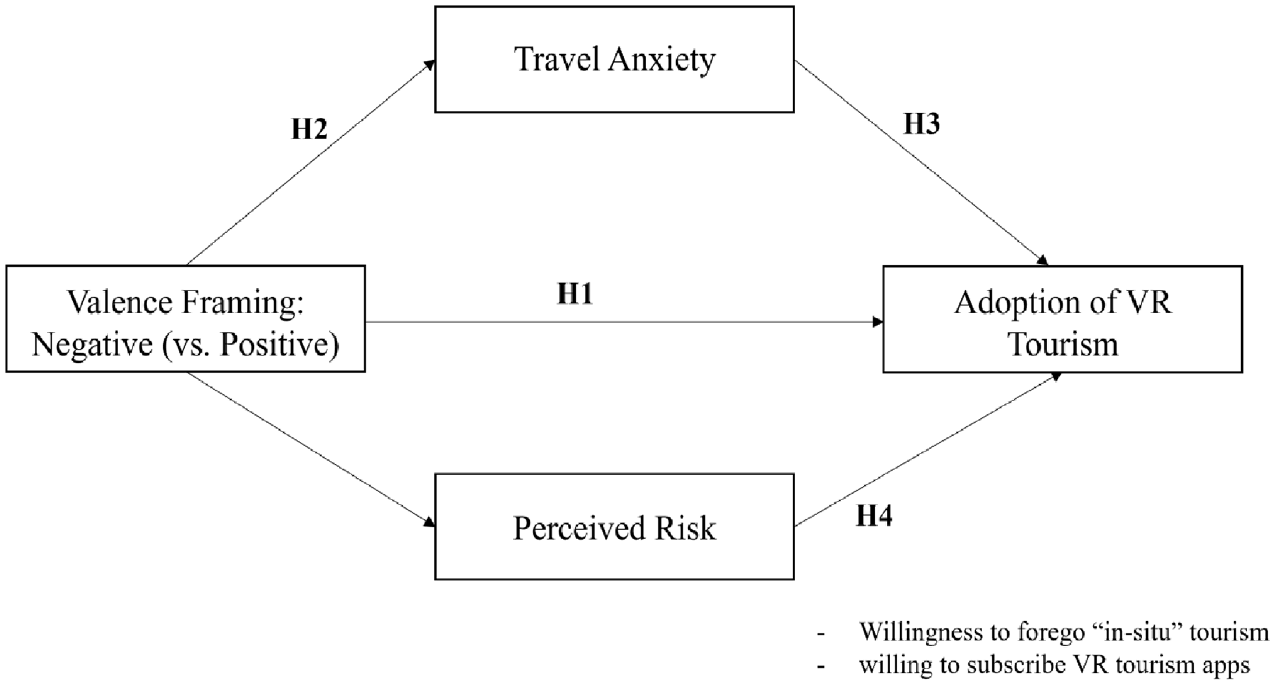
Research framework.
Study 1
Design and Participants
A total of 389 participants (196 male, 187 female, and 6 other; Mage = 32 years) recruited from the Prolific platform took part in a single-factor between-subjects experiment in which we manipulated the framing of pandemic-related information (positive vs. negative). Prolific is an online platform that researchers use to recruit paid participants for their studies and experiments; it provides a diverse pool of participants and quality data collection features (Zickar & Keith, 2023). The sample size was determined to have a statistical power exceeding 0.95 to detect the typical effect size in marketing, consumer behavior, and psychological science (i.e., d = 0.40; Eisend, 2015; Funder & Ozer, 2019; Gignac & Szodorai, 2016) assuming a conventional alpha level of α = .05. Participants were randomly assigned to one of the two experimental conditions and read a real news article with corresponding pictorial content about the COVID-19 pandemic, with the article either communicating positive information (e.g., hope) or negative information (e.g., fear), 1 reflecting similar framing manipulations that have been extensively used in prior related literature (e.g., Bizer et al., 2011; Gamliel & Peer, 2006). We opted for real news articles to boost realism and hence enhance the ecological validity of the study (Cialdini, 2009; Gidlöf et al., 2021; Morales et al., 2017).
Procedures and Measures
Participants completed the four-item travel anxiety scale (Zenker et al., 2021), which included items such as “COVID-19 makes me worry a lot about my normal ways of traveling” and “I do not feel safe traveling due to COVID-19.” The participants provided responses on a seven-point Likert scale ranging from 1 (strongly disagree) to 7 (strongly agree), with the items averaged to create a composite travel anxiety index (α = .93). Factor analysis in this and all subsequent studies only revealed one factor with an eigenvalue above 1 and no cross-loadings greater than .30, attesting to the original unidimensional structure of the scale and ensuring construct validity; see the Appendix for details. As our focal outcome, participants indicated their adoption intentions of VR travel and tourism applications through two items (i.e., “I am willing to give up the pleasure of traditional tourist travel and opt for VR travel through the use of virtual reality” and “I am willing to subscribe to National Geographic Explore VR”). To address issues related to common method bias, we employed a 9-point Likert scale with responses ranging from 1 (strongly disagree) to 9 (strongly agree) to minimize shared scale characteristics (Gasiorowska et al., 2022). We created a composite index of VR travel and tourism by averaging participants’ responses on these two items (α = .70).
To address the impact of outliers, we removed eight cases that scored more than two standard deviations from the group mean on our VR travel and tourism index. The study followed the same approach as several other framing studies, where participants were presented with objectively different information without being asked about their perceptions of it. In such cases, the inclusion of manipulation checks is commonly perceived as redundant (e.g., O’Keefe, 2003; Perdue & Summers, 1986).
Results
We conducted two independent samples t-tests to examine our predictions that information framed negatively (vs. positively) would increase participants’ travel anxiety (H1) and their adoption of VR travel and tourism (H2). The results provided evidence in favor of H1, as participants in the negative framing condition (Mnegative = 4.75, SD = 1.62) demonstrated significantly greater levels of travel anxiety compared to those in the positive framing condition (Mpositive = 4.25, SD = 1.82; t(379) = 2.81, p = .005). Consistent with H2, participants in the negative framing condition (Mnegative = 4.54, SD = 2.30) also exhibited significantly greater adoption of VR travel and tourism than those in the positive framing condition (Mpositive = 4.02, SD = 2.16; t(379) = 2.29, p = .022).
Although the t-test does not require the data to be normally distributed (Lumley et al., 2002), we supplemented the above main analyses with their non-parametric alternatives, given that the data were not normally distributed according to two Kolmogorov-Smirnov tests (ps < 0.001; grand means: Mtravel anxiety: 4.50, SD = 1.74; Madoption intentions: 4.27, SD = 2.24; skewness: −0.46 [travel anxiety]; 0.25 [adoption intentions]; kurtosis: −0.72 [travel anxiety]; −0.96 [adoption intentions]). Providing further support for H1 and H2, the results of two Mann-Whitney U-tests indicated that participants in the negative framing (Mdnnegative = 5.0) reported significantly higher levels of travel anxiety compared to those in the positive framing condition (Mdnpositive = 4.5; Z = 2.64, p = .008). Additionally, participants in the negative framing condition (Mdnnegative = 4.5) showed higher adoption intentions of VR travel and tourism applications than participants in the positive framing condition (Mdnpositive = 4.0; Z = 2.19, p = .029). These findings validate the robustness of our results.
To examine whether the impact of negatively (vs. positively) framed information on participants’ adoption intentions of VR travel and tourism applications would be indirect through their amplified travel anxiety (H3), we performed a simple mediation model (PROCESS Model 4) using standardized coefficients. The predictor variable was valence framing (positive = 0; negative = 1), the mediator variable was the index of travel anxiety (continuous), and the outcome variable was the index of participants’ intentions to adopt VR travel and tourism applications (continuous).
Consistent with the t-test results, the negative framing condition positively predicted participants’ travel anxiety (β = .29, t = 2.80, p = .005) as well as their intentions to adopt VR travel and tourism applications (β = .23, t = 2.29, p = .022). Moreover, participants’ travel anxiety significantly predicted their intentions to adopt VR travel and tourism applications (β = .28, t = 5.65, p < .001). Importantly, the effect of negative (vs. positive) framing on participants’ intentions to adopt VR travel and tourism applications became non-significant (β = .15, t = 1.56, p = .121) when travel anxiety was added to the model, thus indicating that mediation was at play. A bootstrap procedure with a sample size of 5,000 revealed that the conditional indirect effect of participants’ travel anxiety was statistically significant (95% CI for partially standardized indirect effect = [0.02; 0.15]). As such, travel anxiety mediated the impact of negatively (vs. positively) framed information on participants’ adoption intentions of VR travel and tourism applications, consistent with H3.
Discussion
In Study 1, we found support for H1-H3. However, despite our usage of a common framing manipulation, a critic might still argue that Study 1 lacked a proper manipulation check. Moreover, the study only contrasted negative information with positive information, so it cannot be explicitly concluded that the negative framing condition increased participants’ travel anxiety and their adoption indentions of VR travel and tourism applications. Rather, it could have been the positive framing that decreased participants’ ratings on these measures. Finally, it is unclear through this study alone whether the obtained effects only emerge when participants are directly exposed to pandemic-related information or, alternatively, whether any event that induces negative affect, defined as “a general dimension of subjective distress and unpleasurable engagement that subsumes a variety of aversive mood states, including anger, contempt, disgust, guilt, fear, and nervousness” (Watson et al., 1988, p. 1063), may be sufficient to sway participants’ responses on our key measures. Study 2 sought to remedy these limitations while simultaneously testing the generalizability of our results.
Study 2
Design and Participants
We enrolled 599 participants from the Prolific platform (298 male, 295 female, and 6 other; Mage = 30 years) to take part in a single-factor between-subjects experiment, which included two negatively framed conditions (COVID-19 vs. natural disasters) and one neutral condition (grocery shopping). This enabled us to test (a) whether the results from Study 1 would also emerge if negative framing is contrasted with neutral rather than positive framing, thus constituting a more conservative test of our theorizing, and (b) whether the findings would emerge only in the negative framing condition linked directly to the pandemic or, rather, whether any message with negative valence (such as that induced through thinking about natural disasters) would be sufficient for our effects to emerge. As in Study 1, the size of our sample allowed us to detect mean differences between conditions equivalent to d = 0.40 with a statistical power exceeding 0.95, assuming a conventional alpha level of 0.05 (Cohen, 2013). Consequently, Study 2 represents yet another high-powered test of our hypotheses.
Procedures and Measures
The participants were assigned randomly to one of three experimental conditions and were given instructions to envision themselves in one of three scenarios: being in the middle of the COVID-19 pandemic (negative), experiencing a natural disaster (negative), or engaging in their regular grocery shopping routine (control). They were then asked to vividly visualize their assigned scenario and write three sentences describing the emotions they would feel (see the Appendix for the full scenarios). We selected natural disasters and grocery shopping as contrasting scenarios, given that such situations have been used extensively in prior literature (e.g., Kastenmüller et al., 2013; Larsen & Ketelaar, 1991; Ostinelli et al., 2014; Rucker & Galinsky, 2008; Vinnell et al., 2023; Wildschut et al., 2006). Unlike Study 1, which used image-supported stimuli, Study 2 was solely text-based to maximize internal validity (Arsenovic et al., 2023; Elbæk et al., 2022).
After completing the scenarios and the associated instructions, participants responded to the five negative affect items (i.e., afraid, nervous, upset, ashamed, and hostile) from the abbreviated version of the positive affect and negative affect schedule (PANAS; Thompson, 2007). Responses were provided on a 7-point Likert scale from 1 (strongly disagree) to 7 (strongly agree). These items were averaged to create a manipulation check index of negative affect (α = .86), given that negatively framed information typically results in more negative affect than positive or neutral information (Baek & Yoon, 2017; Shen & Dillard, 2007; Xu, 2019). Moreover, participants replied to the same items and through the same response formats as those used to measure travel anxiety (α = .93) and adoption intentions of VR travel and tourism applications (α = .69) in Study 1. In addition, to exclude the possibility that our mediation from Study 1 could have occurred simply due to risk-related aspects, participants indicated the perceived risk associated with their assigned scenario through three items: “Traveling during a pandemic is risky (from a health/safety perspective)””; “Traveling for recreational activities during the pandemic is risky””; “Traveling during a pandemic poses a social risk.” The items were rated on a 7-point Likert scale from 1 (strongly disagree) to 7 (strongly agree) and were combined to create a composite risk index (α = .93). After applying the same outlier criterion utilized in Study 1, five participants were excluded from the analysis.
Manipulation Check and Results
As the two negatively framed conditions (i.e., COVID-19 vs. natural disasters) did not differ from one another, either on the manipulation check or the dependent variable, we combined these two conditions into a joint negative condition to facilitate parsimonious analyses, consistent with common conventions (e.g., Griskevicius et al., 2009). Next, we tested whether participants in this joint negative framing condition differed from those in the neutral (control) condition on our manipulation check as well as each of our key variables through a series of independent samples t-tests.
Regarding the manipulation check, participants in the joint negative framing condition (Mnegative = 3.88, SD = 1.29) reported significantly higher levels of negative affect compared to those in the neutral condition (Mcontrol = 1.77, SD = 1.06; t(592) = 18.91, p < .001). Thus, the manipulation was successful as both the COVID-19 condition and the natural disaster condition induced significantly more negative affect than the grocery shopping condition.
Results
With regard to the outcomes on the primary variables, significantly higher scores on travel anxiety were demonstrated by participants in the joint negative framing condition (Mnegative = 4.56, SD = 1.81 versus Mcontrol = 3.82, SD = 1.84; t(592) = 4.46, p < .001). Similarly, the scores pertaining to perceived risk (Mnegative = 5.27, SD = 1.60 vs. Mcontrol = 4.78, SD = 1.66; (t(592) = 3.32, p < .001), and adoption intentions of VR travel and tourism applications were significantly higher in the joint negative framing condition (Mnegative = 4.29, SD = 2.43 vs. Mcontrol = 3.74, SD = 2.15; (t(592) = 2.59, p = .010). These results provide further support for H1 and H2 but suggest that perceived risk may be an alternative process through which our results may also operate.
Similar to Study 1, we complemented the primary analyses above with their non-parametric equivalents due to the data not being normally distributed, as indicated by three Kolmogorov-Smirnov tests (ps < 0.001; grand means: Mtravel anxiety: 4.35, SD = 1.85; Mperceived risk: 5.13, SD = 1.63; Madoption intentions: 4.14, SD = 2.36; Skewness: −0.32 [travel anxiety]; −0.87 [perceived risk]; 0.31 [adoption intentions]; kurtosis: −1.02 [travel anxiety]; 0.03 [perceived risk]; -1.00 [adoption intentions]). Further supporting H1, the negative framing condition yielded significantly higher levels of travel anxiety (Mdnnegative = 5.0) compared to the control condition (Mdncontrol = 4.0), as evidenced by a Mann-Whitney U-test (Z = 4.39, p < .001). Similarly, and consistent with H2, the negative framing condition resulted in higher adoption intentions of VR travel and tourism applications (Mdnnegative = 4.0) than the control condition (Mdncontrol = 3.5; Z = 2.28, p = .023). Moreover, the negative (vs. control) condition generated higher levels of perceived risk (Mdnnegative = 5.67 vs. Mdncontrol = 5.0; Z = 3.59, p < .001). As in Study 1, these findings highlight that our results are not contingent on the specific statistical test selected, as all our main findings are robust across parametric and non-parametric tests.
To rule out the alternative account of perceived risk as a competing driver to our results (H4), we conducted the same simple mediation analysis with standardized coefficients as previously reported in Study 1 (PROCESS Model 4) but with perceived risk added as a second parallel mediator. Thus, the framing condition (neutral = 0; negative = 1) was the predictor, the index of travel anxiety (continuous) served as the first mediator, the risk index (continuous) served as the second mediator, and the index of participants’ intentions to adopt VR travel and tourism applications (continuous) acted the outcome variable.
Mirroring the results above, the framing condition positively predicted participants’ travel anxiety (β = .40, t = 4.46, p < .001), perceived risk (β = .30, t = 3.32, p < .001), and intentions to adopt VR travel and tourism applications (β = .23, t = 2.59, p = .010). Therefore, participants in the neutral (control) condition scored lower on each of these variables compared to participants in the joint negative framing condition. Moreover, participants’ travel anxiety significantly predicted intentions to adopt VR travel and tourism applications (β = .26, t = 3.98, p < .001), whereas perceived risk did not (β = .05, t = 0.83, p = .409). Our standardized coefficients mean that the link between travel anxiety and intention to adopt VR travel and tourism applications is more than five times as strong as the relationship between participants’ perceived risk and their VR travel and tourism intentions to adopt such applications.
Notably, the impact of negative (vs. neutral) framing on participants’ intentions to adopt VR travel and tourism applications became non-significant (β = .12, t = 1.32, p = .189) when travel anxiety and perceived risk were included in the model, suggesting potential mediation. In line with this finding and the outcomes of Study 1, a bootstrap procedure involving a sample size of 5,000 confirmed that the conditional indirect effect through participants’ travel anxiety was significant (95% CI for partially standardized indirect effect = [0.04; 0.18]). In contrast, the indirect effect through participants’ perceived risk was non-significant (H4) and much weaker than that of travel anxiety (95% CI for partially standardized indirect effect = [−0.02; 0.06]), suggesting that travel anxiety rather than perceived risk is the main driver of our results. Thus, in line with H3, travel anxiety but not perceived risk acts as the primary mediator for the relationship between negative (vs. neutral) framing (vs. the control) and participants’ adoption intentions of VR travel and tourism applications.
Discussion
In sum, Study 2 conceptually replicates and extends the results from Study 1 using a purely text-based scenario instead of an image-supported news article, thus complementing the ecologically valid findings from our initial study with increased rigor and control. Moreover, Study 2 revealed that the negatively framed information does not necessarily need to be specifically about COVID-19 to induce increased levels of travel anxiety. Rather, any disastrous event that induces a negative affect seems to be sufficient to amplify participants’ travel anxiety, with positive downstream effects on adoption intentions of VR travel and tourism applications. Yet, it remains unclear whether these results only hold when negative affect is experimentally induced or, alternatively, whether our results also will emerge when negative affect is measured rather than manipulated. Study 3 aimed to address this possibility.
Study 3
Design and Participants
We recruited 589 participants from the Prolific platform (289 male, 296 female, and 4 other; Mage = 36 years) 2 to take part in a single-factor between-subjects experiment in which we manipulated whether participants received explicit information about the COVID-19 pandemic or, rather, more generic information referring to “the current societal situation.” Although the study was designed as an experiment, we did not expect any significant differences between these conditions. Rather, we included both conditions to provide further evidence for the thesis that any societal event that induces a negative affect—irrespective of whether it is related to pandemic aspects or not—influences participants’ travel anxiety, with downstream effects on their adoption intentions of VR travel and tourism applications. Moreover, we recruited a sufficiently large sample to be able to confidently conclude that no notable differences existed between these conditions, either in terms of negative affect or our focal dependent variable. Indeed, we were capable of detecting effects as small as d = 0.30 between conditions with a statistical power of 0.95, considering our sample size and the regular alpha level of α = .05. This implies that if no significant differences were observed between conditions, it would provide meaningful insights rather than being attributed solely to low statistical power. Our idea was that, in the absence of significant differences between our two conditions, we would treat them as a joint negative framing condition. We would then examine whether differences in measured negative affect within this condition could be linked to variations in travel anxiety and the adoption of VR travel and tourism. As such, unlike Studies 1 and 2, in which we manipulated negative affect by exposing participants to information that differed in the extent to which it was negatively framed, our final study sought to demonstrate that our findings also apply when negative affect is measured rather than experimentally induced. Doing so would strengthen the confidence in our results, as it would imply that our findings cannot simply be attributed to one specific design choice (i.e., whether our predictor is measured or manipulated). Rather, in the case of supported hypotheses in this final study, we would considerably extend the generalizability of our results across samples, settings, and study paradigms.
Procedures and Measures
In contrast to Studies 1 and 2, Study 3 was conducted when most pandemic lockdowns had been fully relaxed, in early March 2022. Importantly, the study took place only weeks after Russia had invaded Ukraine, which meant that another widely publicized societal event assumed to induce negative affect was highly salient at the time of data collection. Therefore, we used this naturally occurring event in the other experimental condition in which we made no mention of the pandemic but rather instructed participants to reply to the items while considering “the current societal situation.” We made this design choice as it would constitute an even more conservative and subtle test of our theorizing.
Participants replied to the same items, with the same scale formats as in Study 2 to measure negative affect (α = .88), travel anxiety (α = .92), and adoption intentions of VR travel and tourism applications (Cronbach’s α = .69). The only notable difference was related to the instructions that participants received when replying to these items. Thus, as the pandemic was perceived to be largely an event of the past at the time of this data collection, participants in the pandemic condition were asked to indicate how they thought that the pandemic would influence their future travel responses and emotions when replying to the items used to measure negative affect, travel anxiety, and adoption intentions of VR travel and tourism applications. Participants in the other experimental condition replied to the same items but with no mention of the pandemic. Instead, they were instructed to indicate how they thought that the current societal situation would influence their future travel responses and emotions when replying to the same items. Following the same outlier criterion used in Studies 1 and 2, we excluded 21 participants.
Results
As expected, participants did not differ from one another across conditions, either in negative affect or adoption intentions of VR travel and tourism applications. Therefore, as originally planned, we combined these conditions into a joint negative framing condition, after which we proceeded with a mediation model (PROCESS Model 4) to test whether measured rather than manipulated negative affect within this joint negative framing condition was positively associated with travel anxiety and whether such anxiety, in turn, was positively linked to participants’ adoption intentions of VR travel and tourism applications. Negative affect (continuous; M = 2.99, SD = 1.24; skewness: 0.26; kurtosis: −0.78) was the predictor, the index of travel anxiety (continuous; M = 3.79, SD = 1.67; skewness: 0.03; kurtosis: −0.89) served as the mediator, and the index of participants’ intentions to adopt VR travel and tourism applications (continuous; M = 3.40, SD = 1.96; skewness: 0.49; kurtosis: −0.81) acted the outcome variable. Of note, three Kolmogorov-Smirnov tests revealed that the data pertaining to these variables were not normally distributed (all ps < 0.001); however, as regression-based analyses (including those conducted in PROCESS) are robust to nonnormal errors in estimation (Hayes & Montoya, 2017), we retained our original analytic approach.
Consistent with H1, the results revealed that negative affect positively predicted participants’ travel anxiety (β = .40, t = 10.48, p < .001). In partial support of H2, negative affect also predicted participants’ intentions to adopt VR travel and tourism applications (β = .08, t = 1.88, p = .061) although the p-value was slightly above conventional levels of statistical significance. Moreover, participants’ travel anxiety predicted intentions to adopt VR travel and tourism applications (β = .22, t = 4.87, p < .001). Importantly, the influence of negative affect on participants’ intentions to adopt VR travel and tourism applications became highly non-significant (β = −.01, t = −0.21, p = .832) when travel anxiety was added to the model, thus indicating that mediation was at play. Indeed, a bootstrap analysis with a sample size of 5,000 indicated that the indirect effect through participants’ travel anxiety was statistically significant (95% CI for the partially standardized indirect effect = [0.04, 0.10]). Thus, consistent with H3 and the results of Studies 1 and 2, travel anxiety mediated the impact of negative affect induced through the negative framing conditions on participants’ adoption intentions of VR travel and tourism applications.
Discussion
In Study 3, we found additional support for the idea that any societal occurrence that results in negative affect, whether it is associated with the COVID-19 pandemic or not, can impact participants’ travel anxiety. This observation further highlights the pervasiveness of the impact that negative framing can have on individuals’ affective responses and decision-making processes in travel contexts. The findings of Studies 2 and 3 extend beyond the COVID-19 pandemic, encompassing a range of societal events that might evoke negative affect, such as geopolitical tensions and natural disasters. This extension is critical as it demonstrates that the influence of negative framing on travel anxiety and subsequent key outcomes, such as the adoption of VR travel and tourism applications, is not limited to pandemic-related scenarios but is a more general phenomenon. Taken together, these findings add further confidence to our conceptualization and suggest that our results are robust across settings and study paradigms, with our focal effects holding both when negative affect is measured and manipulated. As such, Study 3 deepens our understanding of the dynamics between valence framing, affective responses, and individuals’ adoption intentions in the travel and tourism sector.
General Discussion
The findings from the current research indicate that when information is negatively framed, participants experience higher levels of travel anxiety and show a stronger urge to adopt VR travel and tourism applications. Moreover, travel anxiety plays a mediating role in linking the impact of negative information framing to the adoption of VR travel and tourism applications. Together, this research contributes to theories on valence framing, the negativity bias, travel anxiety, and virtual tourism, providing insights into the association between valence framing, travel anxiety, perceived risk, and intentions to adopt virtual travel and tourism applications. The current work also contributes methodologically by employing diverse experimental designs across studies, involving manipulations of valence framing to examine its effects on travel anxiety and adoption intentions of VR travel and tourism applications. The varied contexts of negative events, ranging from pandemics to political crises, enhance the generalizability of our obtained results while simultaneously offering a broader set of practical implications that are not restricted to one specific type of crisis event. The fact that our results hold regardless of whether we measure or manipulate our focal predictor, combined with our large and diverse samples, should underscore the robustness and broad applicability of our findings.
In Study 1, we examined our predictions that negatively (vs. positively) framed information would increase participants’ travel anxiety and their adoption intentions of VR travel and tourism applications. The results showed that significantly higher levels of travel anxiety were reported by participants in the negative framing condition compared to those in the positive framing condition. Moreover, significantly greater adoption intentions of VR travel and tourism applications were observed in the group exposed to negative framing compared to the positive framing group. Importantly, travel anxiety was identified as the underlying psychological mechanism driving the effect of valence framing (negative vs. positive) on VR travel and tourism adoption intentions.
Studies 2 and 3 conceptually replicated and extended the results from Study 1 using purely text-based scenarios instead of the image-supported approach used in Study 1. Moreover, these studies revealed that the negatively framed information does not necessarily need to be specifically about public health crises linked to pandemics to induce increased levels of travel anxiety. Rather, any disastrous event that induces a negative affect—such as catastrophes linked to an ongoing war or a natural disaster—was sufficient to amplify participants’ travel anxiety, with positive downstream effects on the intention to adopt VR travel and tourism applications.
Theoretical Contributions
The results reported herein make significant contributions to the streams of research focusing on valence framing, the negativity bias, travel anxiety, and virtual travel and tourism. Specifically, the findings strengthen the theoretical understanding of the associations between valence framing, travel anxiety, perceived risk, and individuals’ adoption intentions of virtual travel and tourism applications. Broadly, the current research claims three major theoretical contributions. First, the experiments establish that travel anxiety is contingent on valence framing, such that negative information has a greater influence compared to positive information across a variety of crisis situations, including COVID-19, wars, and natural disasters (Kapuściński & Richards, 2016; Thirumaran et al., 2021). This is in line with the central tenets of the negativity bias (Rozin & Royzman, 2001); the empirical evidence from our studies reinforces the notion that people tend to pay more attention to and be more strongly affected by negative information (Baumeister et al., 2001).
Second, the current research empirically establishes anxiety and perceived risk as two constructs with different predictive validity in forecasting important travel-related responses. In the prior literature, these terms have often been used interchangeably, leading to a lack of clarity in understanding their unique roles in influencing travel behavior (Williams et al., 2022). By empirically differentiating these constructs, this research contributes by accurately reflecting the psychological processes underlying tourists’ decision-making (C. Zheng et al., 2022). Specifically, recognizing travel anxiety as a distinct emotional response to perceived threats or negative information allows for a deeper understanding of immediate, affect-driven reactions among travelers. This distinction is crucial because it highlights the emotional aspect of decision-making in tourism, which can be directly influenced by how information is presented and framed. Similarly, by describing perceived risk as a separate construct that typically involves a more cognitive and evaluative process, our work enhances our understanding of how travelers assess and respond to potential hazards or uncertainties in a more deliberate manner. This distinction is particularly important in the context of crisis management and communication within the tourism sector, where the effectiveness of strategies may hinge on understanding these different psychological processes (C. Zheng et al., 2022). Indeed, our studies demonstrate that travel anxiety has a significant mediating role in shaping individuals’ intentions to adopt VR travel and tourism applications following manipulations of valence framing, whereas perceived risk does not meaningfully mediate the impact of such information framing on the adoption of VR travel and tourism applications.
Finally, we validate the findings of O. O. Lee and Oh (2007) by observing that VR travel and tourism have the potential to alleviate travel anxiety. These findings are in line with the arguments advanced by Talwar et al. (2022), who posited that in a situation that triggers travel anxiety, travelers might not only forego in-situ travel but may also seek alternative means to fulfill their travel-related needs (Gursoy et al., 2022; M. J. Kim et al., 2020).
Regarding methodological contributions, our three studies designed to manipulate (Studies 1 and 2) or measure (Study 3) the effect of negative framing on travel anxiety and VR travel and tourism adoption contribute to the utility of experimental methods by painting a more complete picture of travelers’ behavior. This is important because scholars have called for more experimental approaches in the travel and tourism literature, which is heavily dominated by survey research and cross-sectional designs (Kapuściński & Richards, 2016).
Managerial Implications
The results of the current work hold practical implications for stakeholders in the travel and tourism industry. First, our findings highlight the importance of valence framing in affecting travel anxiety, indicating that the way information is framed and communicated can have a significant impact on travelers. Specifically, our results suggest that valence framing can affect people’s travel behavior and decision-making. Therefore, industry stakeholders can strategically—and in an ethically defensible way—present negative information, including events such as natural disasters, infectious diseases, or terror attacks, to boost the adoption of VR travel and tourism.
Second, this research indicates that the negativity bias can be reduced by framing information positively rather than negatively. For example, negative information framed positively (e.g., “COVID vaccines show promising results in the latest study”) can reduce the impact of the negativity bias compared to similar information framed negatively (e.g., “Only moderate success in COVID vaccine efficacy”), thereby reducing tourists’ travel anxiety.
Third, our studies suggest that travelers have become more aware of virtual travel and tourism and are more likely to adopt virtual travel and tourism applications when faced with travel anxiety. Virtual travel and tourism applications can help reduce travel anxiety by offering travelers a virtual preview of their trip, allowing them to experience the destination, culture, accommodation, and surroundings before the actual physical travel. This can help to reduce the stress and uncertainty associated with travel, and the immersive experience can further reduce anxiety. Hence, virtual travel and tourism applications can be a valuable tool in boosting the confidence of travelers and overcoming travel-related anxiety.
Limitations and Future Research
Like any other scientific inquiry, this research also possesses certain limitations that should be acknowledged. First, all studies were conducted in English, which may limit the generalizability of the findings to non-English speaking populations (Elbæk et al., 2023; Henrich et al., 2010; Muthukrishna et al., 2020). Future studies may consider using other languages to collect more diverse responses. Second, to gain a more comprehensive understanding of travelers’ experiences, qualitative (Heinonen, 2023) or mixed-method approaches (Magrizos et al., 2021) could be used to collect data from alternative sources, such as travel agencies. Third, contextual factors such as service complexity (Mikolon et al., 2015) may moderate travel anxiety. Therefore, conducting multi-setting and multinational studies may provide valuable insights. Fourth, while our primary focus has been on understanding the impact of valence framing in the context of crisis events such as pandemics, wars, and natural disasters, we recognize the importance of considering the potential adverse effects associated with VR travel. These include aversive aspects such as dizziness, headache, and motion sickness (Fiocco et al., 2021; Y. M. Kim & Rhiu, 2021), which could also influence the adoption of VR travel and tourism applications. Although a detailed exploration of these effects was beyond the scope of the current research, future studies should investigate the balance between the benefits and potential drawbacks of VR travel, particularly in relation to these sources of discomfort.
By understanding the role of the negativity bias and valence framing, individuals and travel companies can work to reduce travel anxiety by presenting information in a way that emphasizes positive aspects and minimizes negativity. During the recent global health crisis and the accompanying travel restrictions, many people felt anxious about traveling and were looking for alternative ways to experience new destinations. Virtual travel and tourism applications allow users to explore new places and experiences from the safety of their own homes, reducing their anxiety about traveling. In addition, virtual travel and tourism applications can offer a more controlled and predictable travel experience, which can also help to mitigate anxiety. For example, virtual tours and 360-degree images can provide a more immersive experience, while virtual travel guides can help users plan their trips and minimize uncertainty. Therefore, by offering a safer and more predictable travel experience, virtual travel and tourism applications can appeal to individuals who are feeling anxious about traditional travel, which may lead to greater adoption of these virtual services. Future studies should also seek to understand whether and how VR tourism can be used to reduce anxiety among vulnerable consumers who may not be able to engage in physical travel due to health and mobility issues.
Footnotes
Appendix,Factor Analyses Studies 1–3 and Scenarios Study 2
Acknowledgements
None.
Declaration of Conflicting Interests
The author(s) declared no potential conflicts of interest with respect to the research, authorship, and/or publication of this article.
Funding
The author(s) received no financial support for the research, authorship, and/or publication of this article.
