




Abstract
Due to the increasing popularity of remote work, digital nomadism has become a growing trend. Given that digital nomads can stay in destinations longer, their contacts with residents become more dynamic, including numerous social conflicts. By drawing on realistic group conflict theory and social identity complexity, this paper investigates how the negative consequences of social conflicts can be mitigated to strengthen the digital nomads’ identification with the destination and increase revisit intention. Using a multi-national sample of 307 digital nomads from four popular destinations, we find that the negative consequences of social conflicts can be alleviated by stronger cooperative contact through which residents provide instrumental support to digital nomads. Moreover, we find that through enhanced identification and cooperative contact with residents, digital nomads also develop a localized identity that threatens their nomadic identity and thus reduces revisit intention. The study provides insights for practitioners on effectively catering to this segment of travelers.
Keywords
Introduction
Nowadays, the traditional demarcation between work and leisure started blurring with a growing remote working trend (Rainoldi et al., 2022). Increased well-being, income, and technological advances have led people to embrace the digital nomad lifestyle (Hannonen, 2020). In parallel, recent COVID-19 has paved the way for this lifestyle, and the tourism industry has ridden the wave of this trend, making the destination offering more in line with the work and leisure needs of digital nomads (Almeida & Belezas, 2022; Cook, 2023). Digital nomads are “a rapidly emerging class of highly mobile professionals, whose work is location independent. Digital nomads can work while traveling on a (semi)permanent basis, forming a new mobile lifestyle” (Hannonen, 2020, p. 246). Statistics and reports indicate the growing importance of this segment. For instance, according to some forecasts, there are approximately 35 million digital nomads worldwide, most of them staying from 1 to 3 months in given destinations, visiting 5 to 10 countries a year, and mostly belonging to the millennial generation (Thinkremote, 2023). In such a context, the digital nomads are unique ambassadors who demonstrate that the boundaries between tourism and mobility are becoming obsolete, nuancing a dedicated assessment from practitioners and scholars (Cook, 2020).
Residents are essential constituents and contribute with offerings that satisfy digital nomads’ work-related (Green, 2020) and leisure-related needs (Yuen Thompson, 2018). However, the literature on digital nomads is still emerging (Chevtaeva et al., 2023; Hannonen et al., 2023), and there is a dearth of evidence on their role in the traditional tourist ecosystem, especially regarding their relationships with residents. Extant travel literature often uses the lens of social conflicts to investigate the relationship dynamics between residents and travelers (Yang et al., 2013). Evidence shows that conflicts with residents can ruin a traveler’s experience with a destination and consequently lower revisit intentions and satisfaction (Tsaur et al., 2018). In parallel, insights from urban mobility literature (Franquesa, 2011; López-Gay et al., 2021; Moscardo et al., 2013) show that the advent of long-term travelers (affluent transnational migrants and sojourners) promotes gentrification through which the public space is occupied and housing prices soar. Most recent anecdotal evidence bluntly corroborates this trend from the perspective of digital nomads, increasingly swarming popular tourist destinations (Askew, 2023). Consequently, the presence of digital nomads triggers prejudice toward them, resulting in unfriendly behavior from locals and frequent social conflicts (Milano et al., 2023). While there is strong evidence on what drives social conflict in traditional resident-traveler interactions (Fan, 2023; Yang et al., 2013), in this paper, we aim to offer a more comprehensive framework for how conflicts in resident-digital nomad exchanges might be resolved, an inquiry that attracted less attention in the literature (Agyeiwaah & Bangwayo-Skeete, 2022).
To address this gap in the literature, we draw on realistic group conflict theory and social identity complexity to further understand how social conflicts reflect on digital nomad’s revisiting intentions. We use a unique sample collected from four popular destinations that attract many digital nomads: Bali, Thailand, Sri Lanka, and Mexico. Realistic group conflict theory states that conflicts are inevitable when social categorizations emerge in intergroup interactions (Sherif & Sherif, 1979). We focus on the digital nomad’s identification with the destination and instrumental support from the residents as conflict resolution mechanisms that encourage intergroup contact and thus alleviate the negative consequences of conflict.
Our study brings the following contributions to the literature. First, we follow arguments from realistic group conflict theory that negative consequences of conflicts can be alleviated if both parties assume a common goal (Jackson, 1993). Here, we focus on intergroup contact in which digital nomads receive instrumental support from residents. We reveal that receiving instrumental support from residents can lessen the negative effect of social conflicts on digital nomads’ identification with their destination and revisit intention. Second, digital nomads deviate from archetypal tourists by being open to embracing localized identity (de Loryn, 2022; Hannonen et al., 2023). Hence, we extend our inquiry with the common in-group identity model; we show that the strong identification with host country destinations contributes to digital nomads’ re-categorization tendencies and indirectly alleviates the adverse effects that social conflict might have on digital nomads’ revisit intentions. Third, given the context, we showcase that digital nomads can switch between local and nomadic identities. We build our arguments around social identity complexity (Roccas & Brewer, 2002), which indicates that digital nomads might hold multiple identities and deploy the desired one that fulfills their needs for optimal distinctiveness, that is, identifying with or differentiating from the rest of the digital nomad cohort when needed. Specifically, we find evidence that highly identified and integrated digital nomads might feel threatened to sacrifice their nomadic for localized identity and thus show lower revisit intention. Understanding the social impacts can help destination managers and tourism professionals devise preemptive measures to counteract conflicts arising in resident-traveler encounters. This becomes increasingly important in the segment of digital nomads prone to revisiting destinations that successfully meet their work and leisure needs. Thus, it becomes a source of increased destination revenues, particularly during off-peak season.
Conceptual Development
Digital Nomads
The concept of digital nomads has drawn scholars’ attention in diverse social sciences fields. As a result, there is an inconsistent view and many conceptual angles in defining digital nomads. The conceptual origins of digital nomads are rooted as early as the mid-90s when the term was first used in academic literature (Makimoto & Manners, 1997), and by now, digital nomads have been acknowledged from a wide array of scholarly perspectives (Hannonen, 2020). As a result, digital nomads are defined through work (Cook, 2023), tourism and leisure (Hall et al., 2019), lifestyle (Reichenberger, 2018), and other contextual lenses. Digital nomads often serve as an umbrella term for various location-independent IT entrepreneurs and individuals in areas other than IT, such as well-being, coaching, teaching, and artisanship (Cook, 2023). Their inherent commonality is that they do their work remotely with the help of IT and are part of the gig economy (Yuen Thompson, 2018). Kannisto (2018) talks about a broader group of “global nomads” who travel and relocate to detach from particular locations and show anti-capitalist tendencies. Global nomads defined here differ from digital nomads since the former have abandoned working to travel extensively and propagate their anti-consumption views and values (Cai & McKenna, 2023).
The precise statistics and numbers that would reveal the size of the digital nomad segment are mainly missing and have traditionally relied on labor statistics on freelancers, which do not consider how many are location-independent (e.g., State of Independence in America: Annual Research Report). For these reasons, Kannisto (2016) frames them as lifestyle migrants since they seek destinations that best fit their needs, which incorporate balancing leisure and work. In support of this notion, digital nomads generally choose popular tourist spots and look for destinations that offer them convenience and reliable infrastructure to conduct everyday business for extended periods (Hall et al., 2019). Consequently, combining work with leisure is the most convenient and amalgamated frame to position digital nomads (Aufschnaiter et al., 2021; Uriely, 2001). Although literature places digital nomads under the same roof as other types of nomadic and lifestyle traveler groups, such as backpackers and flashpackers (Green, 2020), their identity is shaped both by formal (work) and informal (travel and leisure) aspects, thus making them unique (Cohen et al., 2015; Hannonen, 2020; Richards, 2015).
In this study, we rely on literature that has explored digital nomadism through lifestyle and travel lenses, which become the salient source for their identity construction (for an overview, see Hannonen et al., 2023). Consequently, this stream of literature positions digital nomads between migrants and tourists since they possess characteristics of both segments (Hannonen, 2020). Unlike other segments of travelers and migrating groups, digital nomads set off to explore new destinations throughout their lifetime, staying for a finite time in each of them (Cook, 2022; Hensellek & Puchala, 2021; Williamson, 2022). Hence, this makes their travel trajectory more fluid than migrants and sojourners. Compared to archetypal tourists, digital nomads tend to visit destinations for more extended periods and many times in a shorter time frame. For these reasons, it is not surprising that scholars made a bold critique that existing tourism models and frameworks might not be sufficient to explain the behavioral trajectory of extremely mobile lifestyle travelers (MacRae, 2016). Due to their prolonged stay in the destination, they might enter exchanges with residents more frequently than archetypal tourists (de Loryn, 2022). The concept of conflict has been introduced to understand the intergroup dynamics better and was widely used to understand the broader impacts of resident-traveler exchanges (Coser, 1956; Tsaur et al., 2018; Yang et al., 2013). In the next chapter, we review the pertinent literature that addresses conflicts in resident-traveler exchanges.
Conflicts in Traveler-Resident Interactions
Conflicts between travelers and residents have been the focus of travel and tourism researchers for decades (Reisinger & Turner, 1997). The literature has investigated different triggers for conflicts, such as over-tourism (Cheung & Li, 2019), overcapacity (Kim & Kang, 2020), localized inflation, pressure on housing prices, and devastation of the public in favor of tourism infrastructure (Kruczek et al., 2022) and overt behavior (Monterrubio, 2016). Generally, sources of conflict are not a priori violent but include disputes between travelers and residents in different settings (e.g., lodging, tours, and sightseeing) (Al Haija, 2011).
In tourist destinations, residents are involved in providing experiences, so inherently, their perspective becomes an inevitable input that shapes tourism exchanges. Residents are, by their role, active agents, and their response to tourism represents a benchmark on tourism’s overarching social impact (Vargas-Sanchez et al., 2011). In other words, conflicts arise when tourism development deviates from what residents expect (Ahadian, 2013). Prendergast et al.’s (2016) study informs that occasional visitors and travelers can negatively impact the locals’ perspective on tourism activities because of violating the local norms and their quality of life. Consequently, the influx of tourists can change the landscape of local communities and thus endanger their traditions and everyday habits, inevitably leading to social conflicts (Yang et al., 2013).
As a specific form of conflict, social conflicts occur due to different views, goals, and values that actors bring into the tourism exchange relationships (Deery et al., 2012; Tsaur et al., 2018). Concu and Atzeni (2012) note that a mismatch between tourist and resident preferences and expectations leads to social conflicts. Hence, social conflicts are usually nurtured in areas with juxtaposed interests from two groups, that is, when residents’ well-being is confronted with touristic commercial exploitation (Ye et al., 2014). In terms of outcomes, tourism conflicts impact higher costs (which in turn negatively affects the support for tourism development in communities with low economic dependence on tourism) and negatively impact overall benefits (Teng, 2019).
Although literature dominantly investigates the conflicts between residents and archetypal tourists (Tsaur et al., 2018), there is evidence that tensions can occur between residents and lifestyle travelers who aim to stay for more extended periods. For instance, a study by Agyeiwaah and Bangwayo-Skeete (2022) shows that when backpackers behave in a way that is less aligned with community norms and expectations, conflicts ought to emerge. Franquesa (2011) finds that conflicts are common between immobile locals and “cosmopolitans” who are affluent and mobile sojourners. Similarly, Moscardo et al. (2013) use a new mobility paradigm to describe “amenity migrants” who are affluent and tend to enter into conflicts with long-term residents due to different values and views on the role of public space. A study by Park et al. (2019) offers empirical evidence that uncovers vast differences in attitudes between long-term and seasonal residents regarding community development initiatives. McElroy (2020) investigates how the advent of global nomads led to the erasure of traditional ethnic groups that belonged to specific geographical spaces (Cluj, Romania) and became a possible source of tensions between locals and digital nomads. Hall et al. (2019) argue that tensions and conflicts with digital nomads might occur because of increased unethical and unstainable behaviors in the destination.
Theoretically, it is natural to observe digital nomad-resident conflicts through a social categorization lens (Tajfel, 1981). Williamson et al. (2022) conclude that digital nomads are putting effort into engaging with the local community. However, residents always view them as out-group due to the finite nature of their stay (Su et al., 2023). Social categorization (“us vs. them”) (Kwong & Li, 2020; Sinkovics & Penz, 2009) provides a robust theoretical background to view digital nomad-resident interactions through intergroup conflict. To this end, Ward and Berno (2011) have utilized integrated threat theory and contact hypothesis that can be applied to better understand conflicts arising in tourism exchanges. However, the limitation of their approach is that it merely explains the conflict per se with little prescription on what needs to be done to lessen the adverse effects of conflict. For these reasons, we turn to realistic group conflict theory, which offers grounded theoretical explanations of intergroup conflicts and normative prescriptions for resolving them (Jackson, 1993).
Theoretical Framework
Up to now, social categorization has proven to be a most fruitful theoretical frame to observe and explain interactions between different social groups and intergroup relations (Tajfel et al., 1971) and was successfully applied in travel and tourism research (Reisinger & Turner, 2003; Su et al., 2023; Ye et al., 2014). By expanding on social categorization, realistic group conflict theory analyzes intergroup relations regarding potential conflicts (Levine & Campbell, 1972). The initial theoretical assumptions of realistic group conflict theory were defined by Sherif & Sherif (1953) and were based on intergroup relations as a critical object of observation. Realistic group conflict theory states that conflicts arise due to power and resource imbalances between competing social groups (Johnson, 1972). The basic premise of realistic group conflict theory is that one group’s gain is the other group’s loss, resulting in threat perception. Eventually, this occurrence paves the way for intergroup prejudice, emphasizing in-group solidarity and out-group prejudice (Jackson, 1993). The prejudice and derogation of an out-group are inevitable outcomes of conflict since the out-group is perceived as a threat (Sherif & Sherif, 1979). The threat from the out-group can be real (objectified) or imagined and lead to conflict (Monterrubio, 2016; Ward & Berno, 2011). Realistic group conflict theory represents a practical, theoretical toolbox for explaining intergroup contacts, but it has been scarcely used to describe resident-traveler relationships (Sinkovics & Penz, 2009).
The value-added of realistic group conflict theory is that it also offers prescriptions for conflict resolution. Conflict resolution can occur by attaining superordinate goals that become a compelling and motivational factor for both groups (Jackson, 1993). For instance, the groups can interact, cooperate, and work together toward shared outcomes. Similarly, Allport (1954) explains this mechanism through his contact hypothesis, which reflects on the positive effects of intergroup contacts by minimizing stereotypes groups hold about each other. Intergroup contact induces liking and favorable feelings between the groups, thus clearing the boundaries brought about by conflict (Pizam et al., 2000; Saguy et al., 2011). Lifestyle travelers who visit destinations for more extended periods might need more information than archetypal tourists and thus would need to engage in contact with residents more often. Residents are a source of local knowledge, and they can provide instrumental support to digital nomads through valuable information regarding institutions, language, cultural norms, and potential consumption options (Ong & Ward, 2005). Besides being a mechanism for achieving greater socio-cultural adaptation and integration (Berry et al., 2006), cooperation through instrumental support would enhance intergroup harmony.
However, some psychological literature questions whether intergroup contact and cooperation can attenuate the conflict itself without proper conditions being met (for instance, see Amir, 1976). As Pettigrew and Tropp (2006, p. 766) conclude, “the process underlying contact’s ability to reduce prejudice involves the tendency for familiarity to breed liking.” Henceforth, we argue that an additional way to attenuate the categorization and division between groups, which are the most potent triggers for conflict, is through the common in-group identity model (Dovidio et al., 1993). The common in-group identity model itself does not question the initial categorization of groups but offers re-categorization that would enable the homogenization of in-group and out-group members, leading to more stable and positive interactions. The common in-group identity model has been acknowledged as a mechanism that would contribute to resolving intergroup disputes and conflicts (Gaertner et al., 1993). According to the common in-group identity model, one group can work on clearing the boundaries set against other social groups by attaining the identity of the other group (Gaertner & Dovidio, 2000). The common in-group identity model espouses that social categorizations might be spontaneous and triggered by familiarity or likening but controllable (Dovidio et al., 1993). In this case, through more robust identification with the host country destination, digital nomads might re-categorize themselves as locals, eventually assuming the “local’s point of view,” thus alleviating the adverse effects of social conflict.
Inherently, the strong identification with the destination and increased contact with residents would lead digital nomads toward developing a localized identity (de Loryn, 2022; Hannonen et al., 2023). At this point, digital nomads can extend their social identity repertoire and avoid overly relying on one category of social identification (Brewer et al., 2013; Forehand et al., 2021). Social identity complexity was introduced by Roccas and Brewer (2002) to illuminate the scope of multiple in-group identities the individual might hold. Every individual has various social group memberships and thus can pursue optimal distinctiveness and balance between identification and differentiation when desired (Kang & Bodenhausen, 2015). By trying to satisfy this excluding motivation, people identify with a social group to mitigate the effects of social seclusion and, at the same time, offer options to make them exclusive enough to provide a sense of distinctiveness (Moon & Sung, 2015). We argue that digital nomads fit this category when they pursue identification and integration tendencies and, besides their nomadic, start to develop their localized identity.
Hence, our study utilizes realistic group conflict theory to test how the social conflict between digital nomads and residents influences the digital nomad’s intention to revisit the destination. We further complement realistic group conflict theory and discuss the theoretical mechanisms that could help prevent the adverse effects of conflict through the common in-group identity model and the intergroup contact hypothesis. We envision the digital nomad’s identification with the destination as an effort to achieve a common in-group identity. In contrast, instrumental support from locals is a superordinate goal that brings digital nomads and residents to work together. These effects combined contribute to greater social identity complexity among digital nomads. Our research model is depicted in Figure 1.
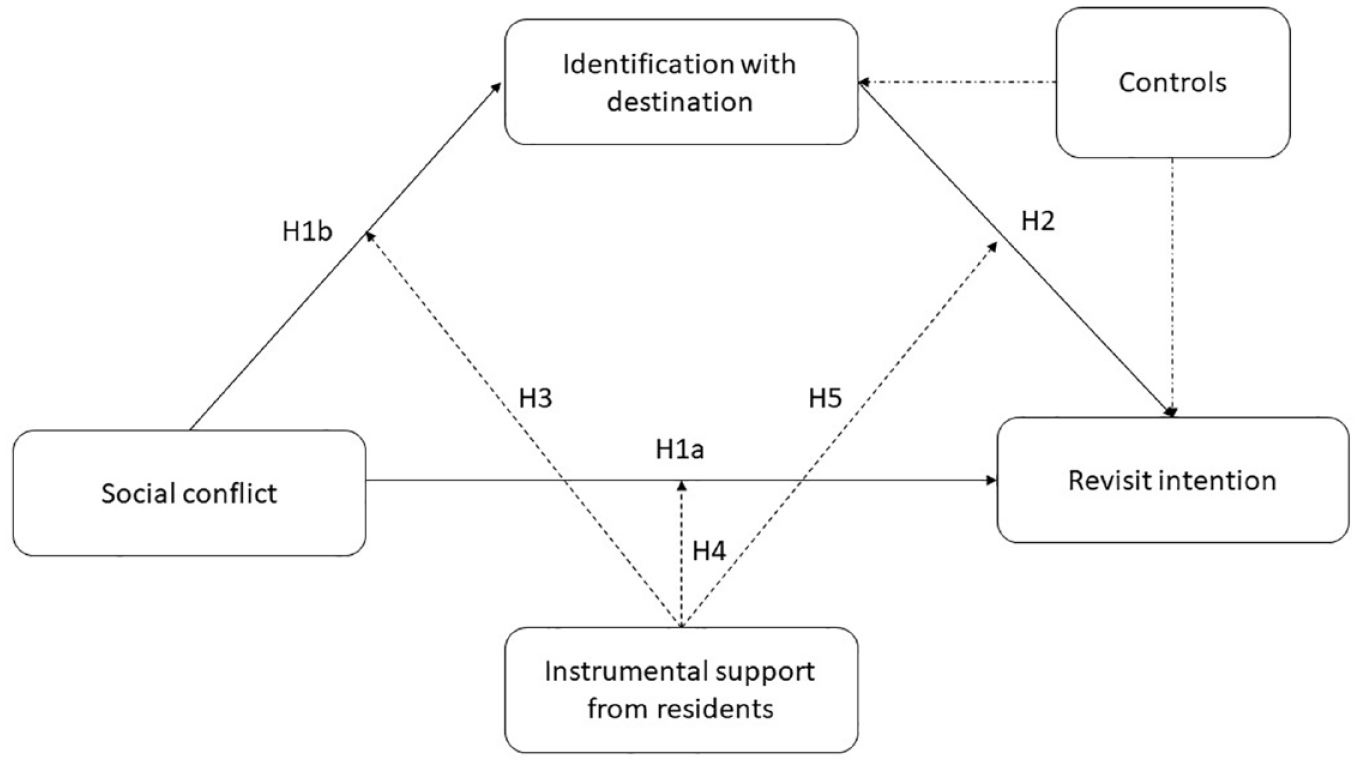
Research model.
Research Hypotheses
Impact of Conflicts on Identification and Revisit Intention
Resident-traveler exchanges are viewed through an interactional lens. When these interactions are positive, the tourists are more likely to hold positive attitudes toward the destination and vice versa (Tse & Tung, 2022b). Studies inform that, due to perceived distance, residents might form negative feelings and attitudes toward tourists (Thyne et al., 2022). Hence, the overarching basis for social conflict is built around social categorization tendencies, drawing more vital in-group identification and stronger negative stereotyping and prejudice toward out-group members (Chen et al., 2013).
Regarding its impact, Tsaur et al. (2018) reveal that conflict negatively affects behavioral intention to revisit the destination. However, due to short temporal intervals, traditional resident-archetypal tourist interactions are mostly short-lived (Sinkovics & Penz, 2009), which might not fit the context of digital nomads who are likely to stay longer. This makes digital nomads more alike to other sojourning groups, which are shown to undergo an identification process within the host country (Bardhi et al., 2012). Hence, during prolonged stays, the conflicts can also trigger digital nomad’s tendencies toward identification with the destination. When conflict emerges, it inevitably reflects on the negative destination image and affects the host country, thus lowering the identification tendencies (Zenker et al., 2017). Based on the tenets of realistic group conflict theory, we posit that because of social conflict between residents and digital nomads, intragroup homogenization and intergroup tensions would prevail (Jackson, 1993). In case of negative stereotypes of residents toward digital nomads, the latter would find less incentive to identify with and revisit the destination. Hence, we hypothesize:
H1. The greater social conflict between digital nomads and residents leads to digital nomads' a) lower identification with the destination and b) lower revisit intention.
Mediating Effect of Identification With Local Destination
People who stay for a more extended period in a destination often start to confront incongruences due to cultural and other differences (Miocevic & Zdravkovic, 2020), and this contextual salience can trigger the attainment of a new social identity that is more aligned with the new setting (Bardhi et al., 2012). To this end, Kannisto’s (2016) study and a more recent study by Hannonen et al. (2023) show that some digital nomads strive to identify with the local community, thus showing efforts to attain a common in-group identity. In such a situation, old in-group favoritism becomes ambiguous when individuals pursue new social identities (Torelli et al., 2017). According to common in-group identity model, attenuating group categorization representation results in lower intergroup bias (Dovidio et al., 1993). This is achieved by re-categorizing one’s identity through attaining a common in-group identity (Dovidio et al., 2017) and helps lessen the adverse effects of conflict with residents.
Drawing from common in-group identity model, we argue that digital nomads who assume local identity create a more favorable stance toward out-groups, in this case, the residents. The mainstream tourism literature shows that affective identification with host country destinations might attenuate the adverse effects of conflict on revisit intention (Kumar & Kaushik, 2017). Hence, a digital nomad’s strong identification with the host country’s destination can mitigate the adverse effects of conflict on revisit intentions. Thus, we hypothesize:
H2. Digital nomad’s identification with their destination positively mediates the link between social conflict and revisit intention.
Moderating Effect of Social Support From Locals
Due to their extended stay in the destination, lifestyle travelers such as digital nomads might have more possibilities to engage with residents than archetypal tourists (Luo et al., 2015). While interacting with residents, tourists and other travelers can obtain valuable knowledge and information about their destination (Fan, 2023; Miocevic & Zdravkovic, 2020). Travelers often need informational support when traveling to distant countries (Karagöz et al., 2021). The findings from the sojourner literature show that instrumental support is of utmost importance for sojourners’ effective adaptation to the host country (Bender et al., 2019; Ong & Ward, 2005). For instance, based on the study of expatriates, Miocevic and Zdravkovic (2020) found that to adapt locally, expatriates must proactively interact with the host country community. Leong and Ward (2000) find that sojourners might not necessarily witness adverse outcomes; they can more easily alleviate potential conflicts by having dual identities. Since digital nomads are prone to stay longer than archetypal tourists, they might benefit from additional support from residents in finding their way around. In this case, the digital nomads build social capital with residents through which they obtain instrumental support that helps them better adjust to host country destinations (Hall et al., 2019).
Studies show that conflicts motivate individuals to avoid joint action with out-group members (Hasan-Aslih et al., 2020). However, we posit that more interpersonal contact with residents leads to more positive outcomes during digital nomads’ stay (Ward & Berno, 2011). The underlying assumption is that not all residents have negative attitudes, and some are willing to help travelers during their stay (Tse & Tung, 2022a; Tung, 2019). Although social conflict and instrumental support share the same background originating from intergroup relations theories, they are two separate mechanisms. For instance, digital nomads might have a fruitful cooperative relationship with residents in one social context (e.g., a landlord who provides accommodation and gives excellent tips on restaurants, beaches, and other amenities) but have conflicts in other social contexts (e.g., taxi drivers who are ripping off foreigners).
According to realistic group conflict theory, we argue that cooperative contact between digital nomads and residents represents a form of superordinate goal. In this process, digital nomads get acquainted more with local customs, norms, and culture, whereas residents, through such support, contribute to digital nomads’ socio-cultural adaptation, which eventually leads to more harmonious co-existence (de Loryn, 2022; Hannonen et al., 2023; Kannisto, 2018). Enhanced intergroup contact through instrumental support reduces conflict (Yu & Lee, 2014), which eventually increases the digital nomad’s identification with the destination (Waßmuth & Edinger-Schons, 2018) and facilitates revisit intention (Meng & Han, 2018). Hence, we hypothesize:
H3. Instrumental support from residents weakens the negative effect of social conflict on identification with the host country’s destination
H4. Instrumental support from residents weakens the negative effect of social conflict on revisit intention
By leveraging intergroup contact, digital nomads can resolve social conflicts more efficiently, contributing to stronger bonding with the destination and increased revisit intention. However, while place identification and integration might benefit traditional migrating groups (Berry et al., 2006), their interaction is far more complex and could create identity tensions within digital nomads (Ward, 2008). Digital nomads represent a distinct social group often labeled a tribe where individuals bond based on interests, rituals, and lifestyle (von Zumbusch & Lalicic, 2020). Anecdotal evidence indicates that digital nomads are more likely to isolate themselves (Echarri, 2023), dominantly socialize with people who share their lifestyles, and avoid unnecessary contact with the local community (Korpela, 2020). In this case, digital nomads usually hang around co-working and co-living areas and interact intensely with other digital nomads (Chevtaeva, 2021; Chevtaeva & Denizci-Guillet, 2021; Cook, 2020). Hence, these co-working and co-living spaces act as a platform for enhancing digital nomads’ group belonging and identity (Hensellek & Puchala, 2021). However, digital nomads with strong identification tendencies with destination and integration through securing strong instrumental support from residents would enhance their localized identity. As a result, these digital nomads would confirm additional in-group membership and have higher social identity complexity. As a form of social identity complexity, compartmentalization envisions interplay between old and newly attained social identities since the individual starts identifying with different social groups (Amiot et al., 2007). Having multiple identities enables an individual to make context-dependent switches between identities depending on the goals the individual wants to achieve.
Hence, a newly acquired localized identity might create tensions with their digital nomad identity. Studies show that consumption choices might act as identity signals among sojourners (Miocevic & Mikulic, 2023) through which they can manifest optimal distinctiveness tendencies (Miocevic et al., 2022a, 2022b) and balance between their localized or nomadic identity. Digital nomads are known to live according to the principle of private and professional freedom (Reichenberger, 2018), and repeating visits to the same destination might signal that they have abandoned exploratory globetrotting. Henceforth, according to social identity complexity, highly identified and integrated digital nomads will be less inclined to engage in behavior threatening their nomadic identity. For these reasons, the digital nomads’ intention to revisit will be lower among digital nomads who strongly identify with their destination and find it easy to receive instrumental support from residents. Similarly, we contend that instrumental support from residents significantly weakens the mediating effect of identification on revisit intention.
H5. Instrumental support from residents weakens the positive effect of identification on revisit intention.
H6. Instrumental support from residents moderates the indirect relationship between social conflict and revisit intention (through identification). Specifically, the indirect effect will be weaker under high instrumental support from residents.
Method
Research Context and Sampling
To test the hypotheses, we conducted primary research using a cross-sectional design. Our main instrument for collecting primary data was a highly structured questionnaire consisting of mostly closed-ended questions in the form of Likert scales. The questionnaire was developed in English, considered the lingua franca in digital nomad’s private and business activities (Yuen Thompson, 2018). This research was conducted with an etic approach to investigating cross-cultural phenomena (Douglas & Craig, 2006). The etic tradition emphasizes that a universal approach to cross-cultural research is possible, as well as the generalization of the results of such research (Berry, 1989). Literature defines digital nomads as a highly mobile globetrotting cohort (Kannisto, 2016), a tribe (von Zumbusch & Lalicic, 2020) which contributes to framing them as a superordinate social group based on lifestyle and similar interests (Visconti et al., 2014). Since most resident-traveler encounters reside on group categorization (Thyne et al., 2006), the questions about conflicts with residents are universal to digital nomads as a group. Hence, using the etic approach in our case is primarily justified.
We used non-random purposive sampling, which represents a very effective means of reaching the digital nomad population (Atanasova & Eckhardt, 2021; Chevtaeva & Denizci-Guillet, 2021; Rainoldi et al., 2022). The data was collected through four digital nomad groups on a popular social media network. These digital nomad groups attracted members visiting four destinations of interest: Bali, Mexico, Sri Lanka, and Thailand. We chose these countries since they represent one of the most attractive destinations for digital nomads today, and three of them (Mexico, Bali, and Thailand) fully aligned their policies to focus more on attracting digital nomads by introducing digital nomad visa schemes. Besides having a warm climate and rich tourist amenities, these countries also gradually became hotspots for digital nomads, and they adapted their offers to match the needs of the digital nomad segment (e.g., the introduction of many co-living and co-working places) (Cook, 2023; Green, 2020; MacRae, 2016; Müller, 2016; Orel, 2021; Yuen Thompson, 2018).
The survey questionnaire was created with the Qualtrics platform and disseminated within the social media groups of interest. Before the actual implementation of the project, the survey questionnaire was presented, together with the research objectives, to the administrators of the social media groups mentioned above. After eliminating several questions marked as controversial regarding privacy, the revised questionnaire was posted in social media groups. We used an “opt-in” online survey where respondents could voluntarily access the survey. The respondents went through two screening questions before filling in the key survey questions. The first question was about whether they identify as a digital nomad (i.e., working remotely from a country other than their country of origin), and the second question was about whether they understand the English language, both spoken and written, given that the survey is in English. Respondents who answered “Yes” to both preliminary questions could proceed to answer the central questions in the questionnaire.
Overall, 307 respondents answered the survey, while incomplete responses were removed. On average, the digital nomads in the sample spent 14 months in the destination, and their nomadic tenure was an average of 4.5 years. The demographic characteristics of respondents’ gender, age, current location, and nationality are presented in Tables 1 and 2. Compared to existing statistics on digital nomad demographics, we concur that our sample is representative of the digital nomad population regarding age and nationality (e.g., Nomadlist, 2023).
Sample Characteristics.
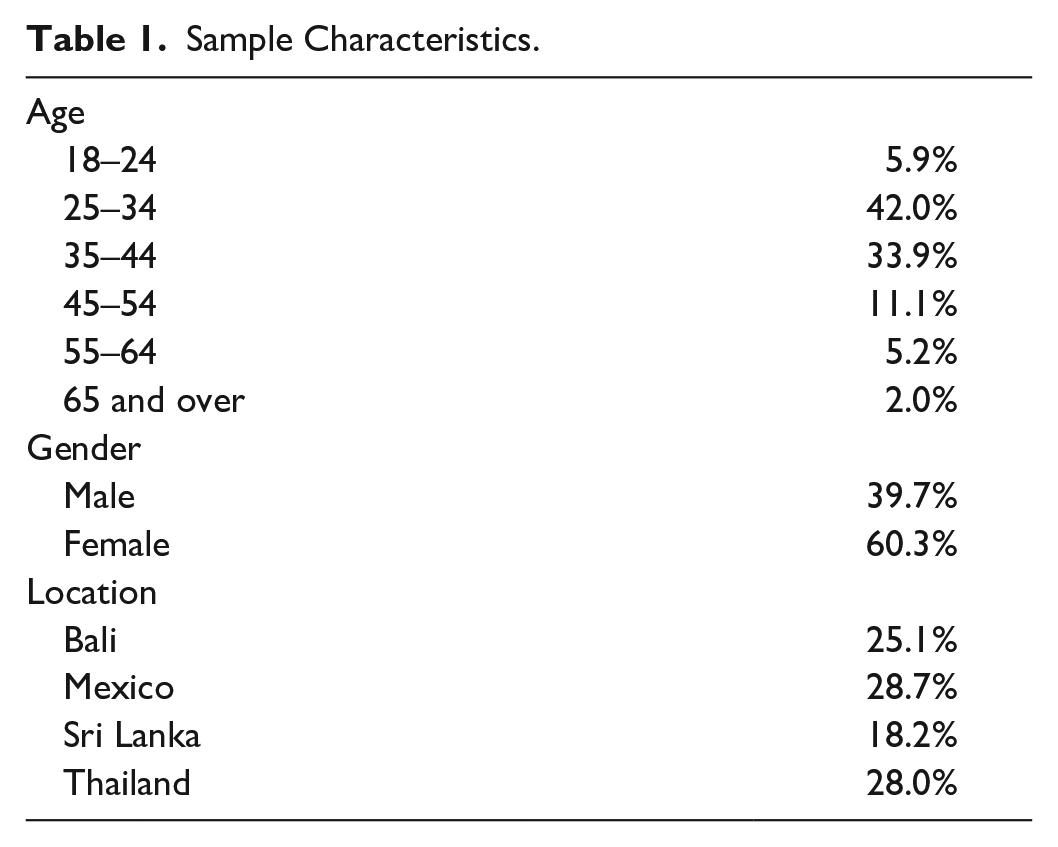
Respondent’s Country of Origin.
Measurement Operationalization
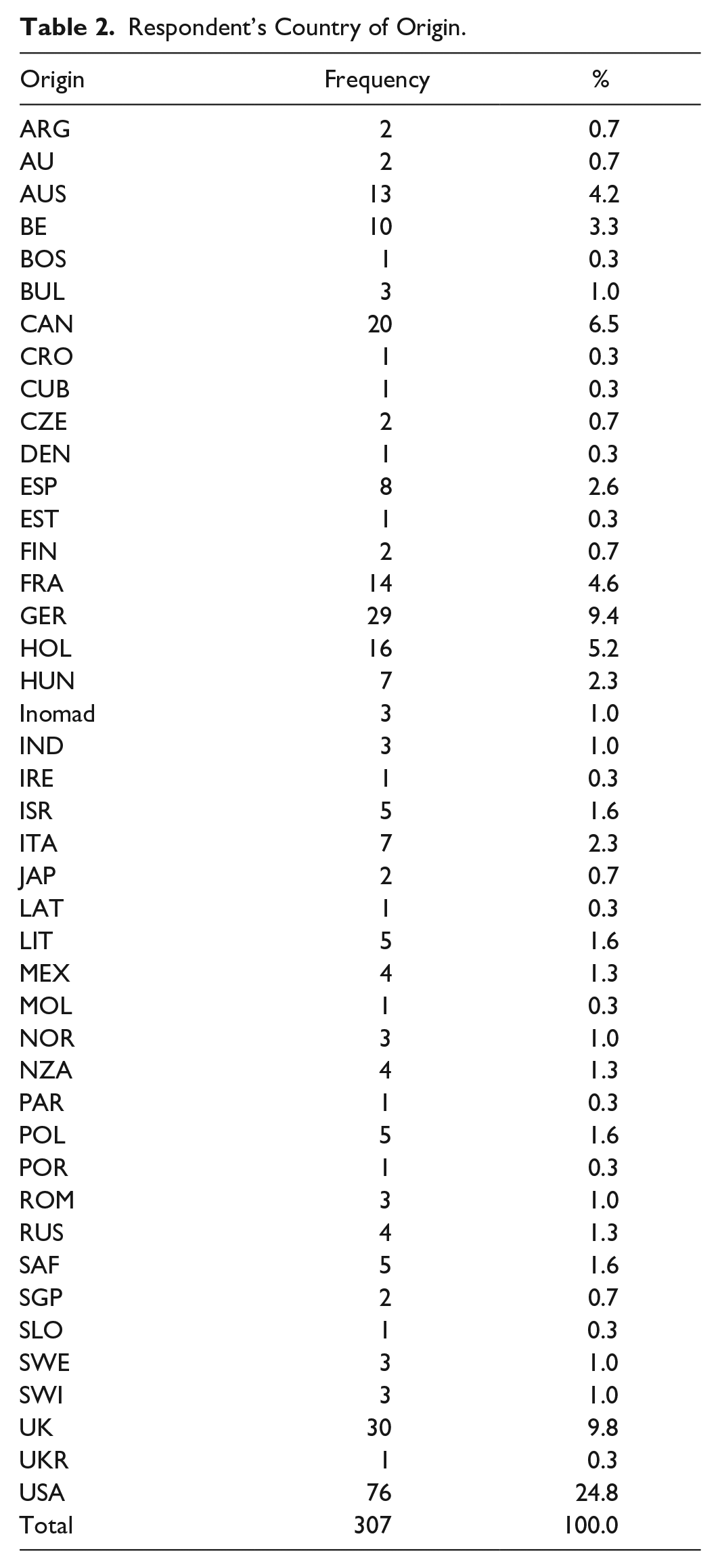
The measurement scales for this research were taken from the prior studies within the tourism and cross-cultural psychology literature. To measure social conflict, we adopted the scale from the study by Tsaur et al. (2018), which measures the perception of the digital nomad relationship they have with residents of the destination. The measurement scale contains items that measure whether residents have a bad opinion of digital nomads and treat them badly and discriminatingly. Construct identification with the destination is adapted from research by Hultman et al. (2015). It contains items that measure the degree to which the digital nomads are identified and connected with the destination and the extent to which the destination fits them. The instrumental support scale was adapted from the study of Ong and Ward (2005) and manifested through the provision of the necessary information, helping with institutions and regulatory issues, helping with communication and language problems, explaining the tenets of local norms and culture, and informing about local choices and options. The revisit intention scale captured recommendations (to friends, family, and other digital nomads) and intention to revisit and was adapted from Qu et al. (2011). To make the research more credible and robust, we controlled for various effects that may have an impact on the dependent variables in our model, namely the number of visits to the destination (total number of visits), total nomad tenure (number of years the person has been traveling as digital nomad), age (age groups), cultural distance (based on Kogut and Singh’s (1988) index), and passport strength (data collected from Henley & Partners’ Official Passport Index Ranking).
Given that our research relies exclusively on cross-sectional data from a survey instrument, the results may be subject to common method variance (CMV). First, we informed the respondents that there were no wrong or correct answers, and the respondents were guaranteed confidentiality and anonymity. Second, we used different measurement scales with different anchors. Third, the constructs and corresponding items/questions were scattered to prevent respondents from making any prior mental connections between the constructs. Fourth, our model is highly complex and includes interactions that minimize the occurrence of CMV. In addition to preliminary precautions, we also took some post-hoc analytical steps to ensure that CMV did not influence the results of our study. First, we conducted a comprehensive confirmatory factor analysis (CFA) marker variable test (Cooper et al., 2020; Williams et al., 2010). We chose a 3-item construct that measured digital nomads' attitudes toward working remotely (Grant et al., 2019). Based on the theoretical inspection, we found no meaningful connection between marker and substantive constructs in our model. We first compared our baseline model with the constrained (Method-C) model and did not find a significant difference between them (∆χ2 = 2.31, ∆df = 1, p = .12), suggesting that there is no shared CMV between the indicators of the substantive variables and the latent marker variable. Furthermore, we compared our unconstrained model (Method-U) with the restricted model (Method-R) in which substantive factor correlations are constrained to their values extracted from the baseline model (Williams et al., 2010). The results indicate the insignificant difference between the two models (∆χ2 = 0.07, ∆df = 6, p = 1.00), suggesting that CMV does not represent a threat in skewing relationships between the constructs in our model.
We also added items from the original Marlow-Crowne scale to our questionnaire to ensure our results were not subject to social desirability bias. We used four questions from Marlow-Crowne’s original scale (questions 4, 16, 15, and 30) and created a composite score by averaging the total sum of socially desirable answers. We correlated the composite score with our key variables. The findings indicate no significant correlation between the social desirability index and our substantive constructs in the research model (see Table 4).
Findings
Measurement Model
We assessed our measurement model using confirmatory factor analysis (CFA) in the statistical package SPSS AMOS v.23. Our CFA solution consisted of four constructs: social conflict, identification with destination, instrumental support from residents, and revisiting intention. In Table 3, we provide measurement model properties, which include the factor loadings, composite reliability (CR), and the average variance extracted (AVE) where applicable. All factor loadings are above 0.60 except the third item in the social conflict scale, which was removed due to validity concerns. After removing the concerned item, the factor loadings ranged from 0.60 to 0.89, CRs were above 0.70 (ranging from 0.76 to 0.86), and AVEs were above 0.50 (ranging from 0.51 to 0.68). Eventually, we find support for the constructs’ reliability and convergent validity. To test for discriminant validity, we used two conventions. We first checked that there are no significant cross-loadings among key constructs existed. Afterward, we assessed discriminant validity using Fornell and Larcker’s (1981) criterion. We checked whether the square root of the average variance extracted in each construct exceeds the correlations with other constructs (see Table 4). We checked for multicollinearity by inspecting each independent variable’s variance inflation factor (VIF). Results indicate that VIF values were below the recommended thresholds. The measurement model had an excellent fit to our data, according to Hu and Bentler’s (1999) recommendations: χ2(df) = 94.950 (69), p = .02, CMIN/DF = 1.376, CFI = 0.985; Tucker-Lewis index = 0.980; standardized RMR = 0.041, RMSEA = 0.035, LO 90 = 0.022, HI 90 = 0.069; PClOSE = 0.937 > 0.05.
Item Battery and Measurement Properties.
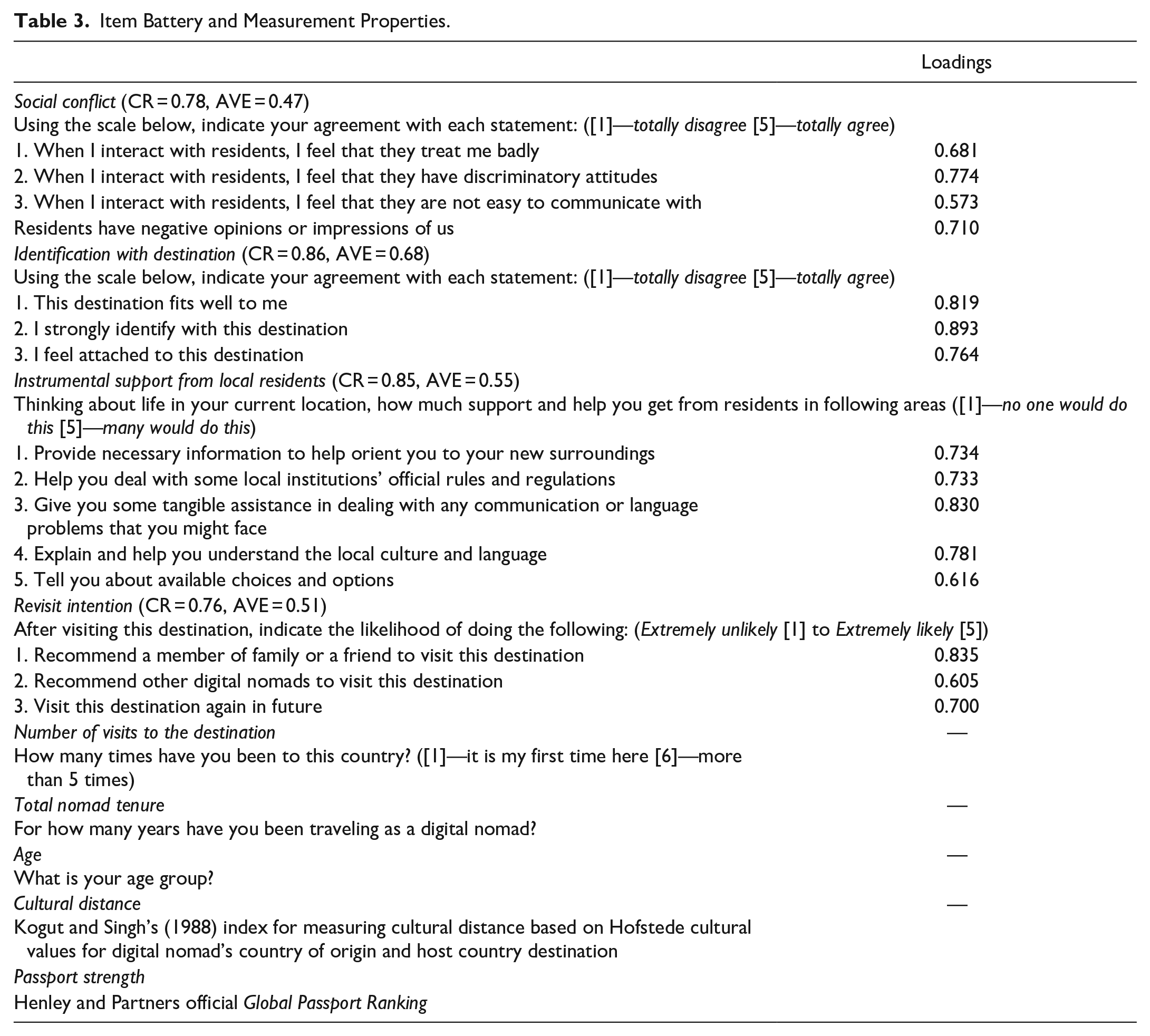
Correlation Matrix.
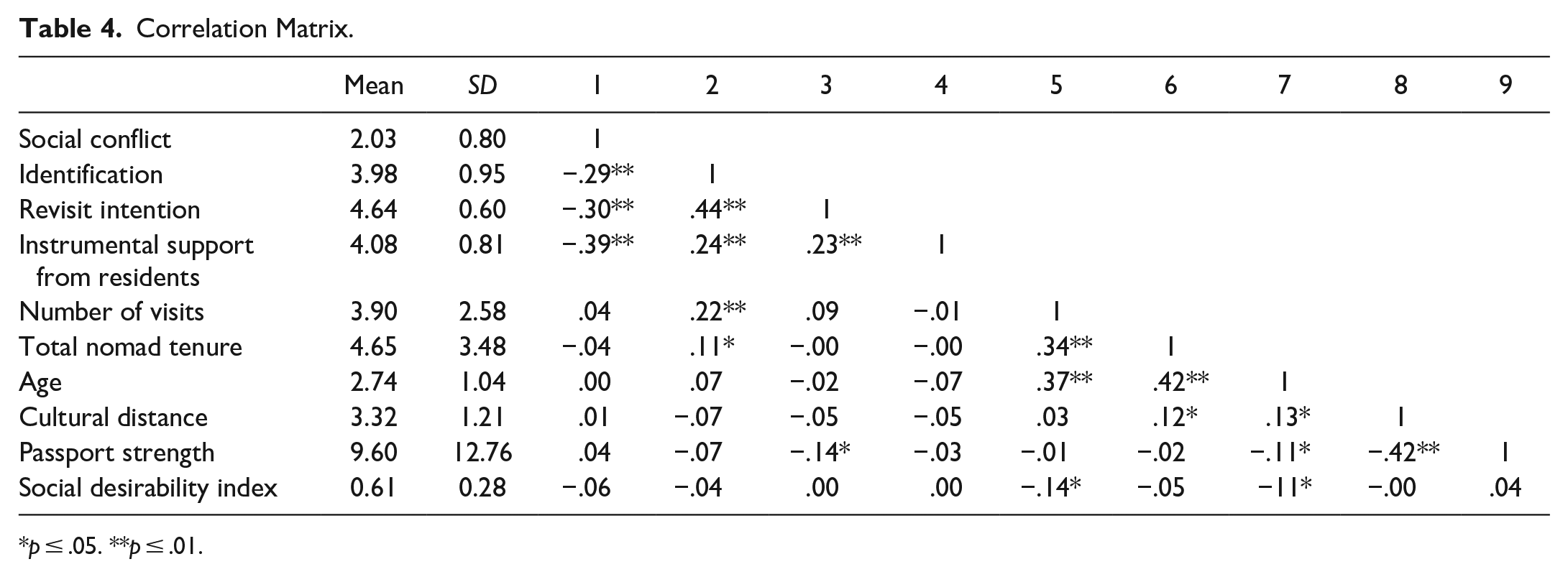
p ≤ .05. **p ≤ .01.
Model Analysis
To test our hypotheses, we utilized SPSS PROCESS extension v4.1 with 10,000 bootstrap resamples to test the research hypotheses (Hayes, 2017). We used model 59 (moderated mediation), which best represents the nomological network of relationships we investigate in our study. This moderated mediation model comprises social conflict (CONF) as the independent variable, identification with the destination (IDN) as the mediator, instrumental support from residents (INST_SUPP) as the moderator, and revisit intention as the outcome variable. The model aims to capture the direct effect of CONF on RI and the indirect effect through the mediation of IDN. According to our theoretical framework, we also envision that the INST_SUPP moderates relationships in our mediation model.
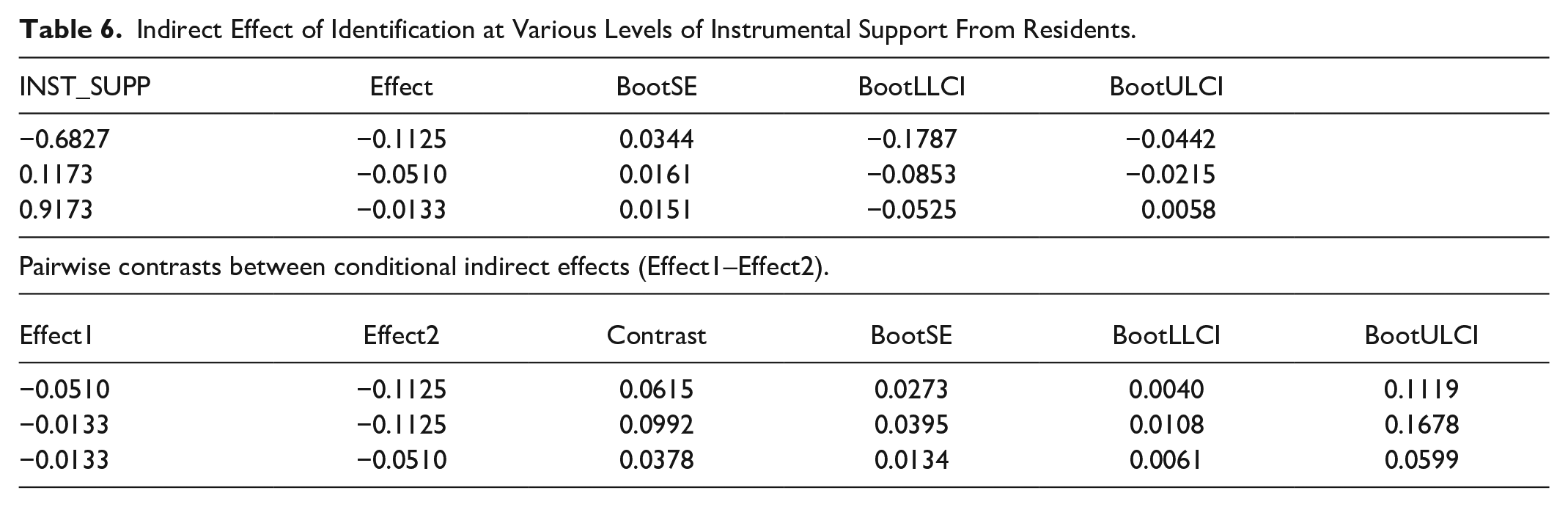
Our findings (see Table 5) indicate that social conflict has a negative and significant influence on identification with the destination (β = −.29, p < .001; LLCI = −.42, ULCI = −.16) and revisit intention (β = −.09, p < .05; LLCI = −.27, ULCI = −.01). This leads to acceptance of H1a and H1b. Moreover, we find that identification with the destination positively mediates the link between social conflict and revisit intention since the indirect effect is significant (β = −.11, p < .01; LLCI = −.18, ULCI = −.04), supporting us to accept H2. Moreover, we find that higher levels of instrumental support from residents can attenuate the negative effect of social conflicts on identification (β = .18, p < .05; LLCI = 0.03, ULCI = 0.32) and revisit intention (β = .11, p < .05; LLCI = 0.01, ULCI = 0.21) leading to acceptance of H3 and H4. Ultimately, the moderating effect of instrumental support from residents on the identification-revisit intention link is significant and negative (β = −.10, p < .01; LLCI = −0.18, ULCI = −0.02), supporting the prediction from H5. In H6, we test whether moderated mediation (conditional indirect effect of identification with destination at various levels of instrumental support from residents) is present and significant. However, in Process Model 59, the indirect effect is a non-linear function of the moderator; therefore, the index of moderated mediation cannot be calculated (Hayes, 2017), so alternative tests for checking for moderated mediation must be implemented. Hence, we decided to run pairwise contrasts between indirect conditional effects. Since confidence intervals (LLCI and ULCI) in pairwise contrasts are all significant and do not contain zero, we conclude that there is a moderated mediation, which leads us to accept H6 (see Table 6).
Results of the Moderated Regression Model.
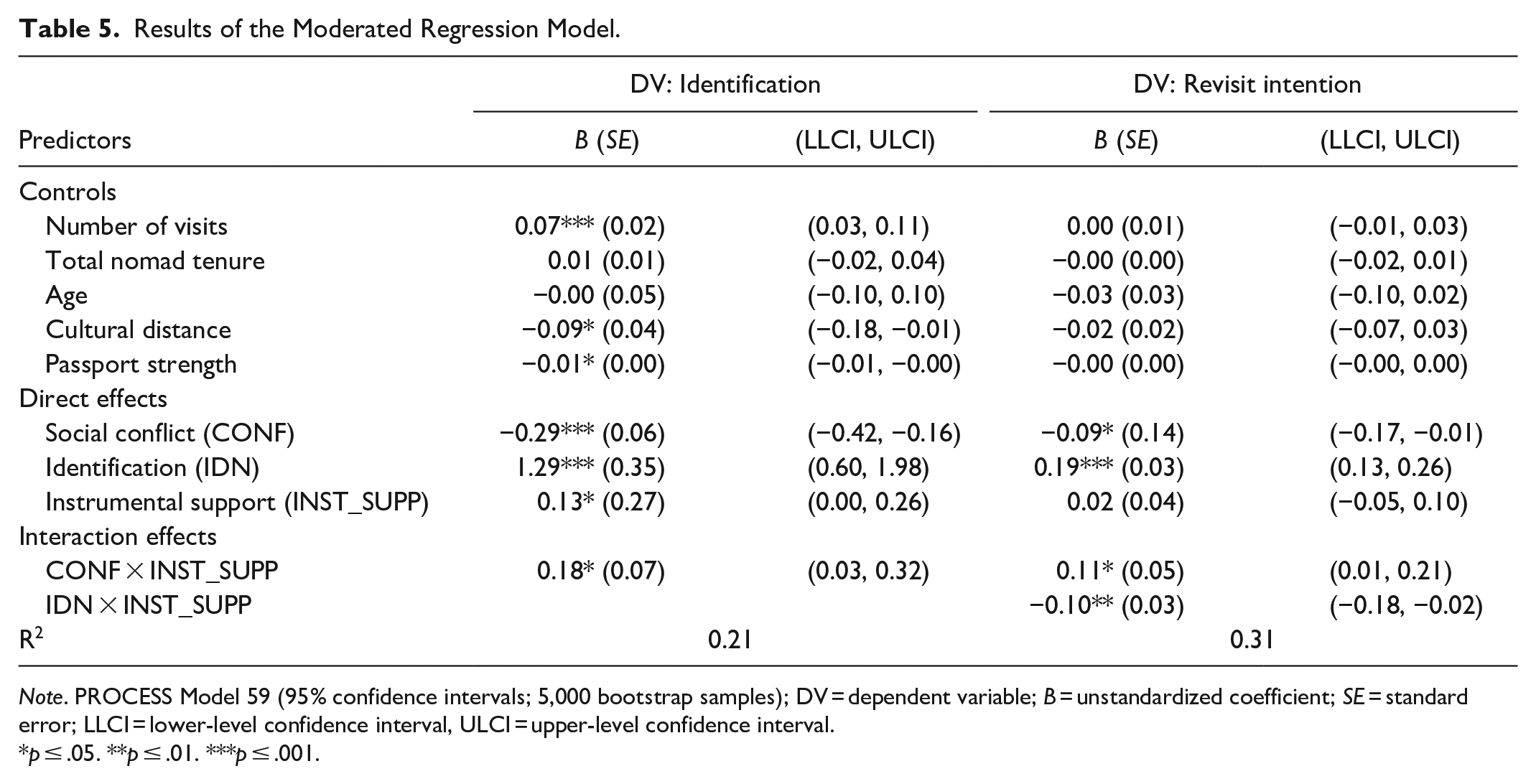
Note. PROCESS Model 59 (95% confidence intervals; 5,000 bootstrap samples); DV = dependent variable; B = unstandardized coefficient; SE = standard error; LLCI = lower-level confidence interval, ULCI = upper-level confidence interval.
p ≤ .05. **p ≤ .01. ***p ≤ .001.
Indirect Effect of Identification at Various Levels of Instrumental Support From Residents.
Regarding the effect of control variables, there is a significant influence of the number of visits to the destination (β = .07, p < .001; LLCI = 0.03, ULCI = 0.11), cultural distance (β = −.09, p < .05; LLCI = −0.18, ULCI = −0.02) and passport strength (β = −.01, p < .05; LLCI = −0.01, ULCI = −0.00) on identification with the destination. Overall model statistics with responding indices can be found in Table 5. The responding plots for interaction effects produced by SPSS Process v4.1 syntax can be found in Figures 2 to 4, respectively.
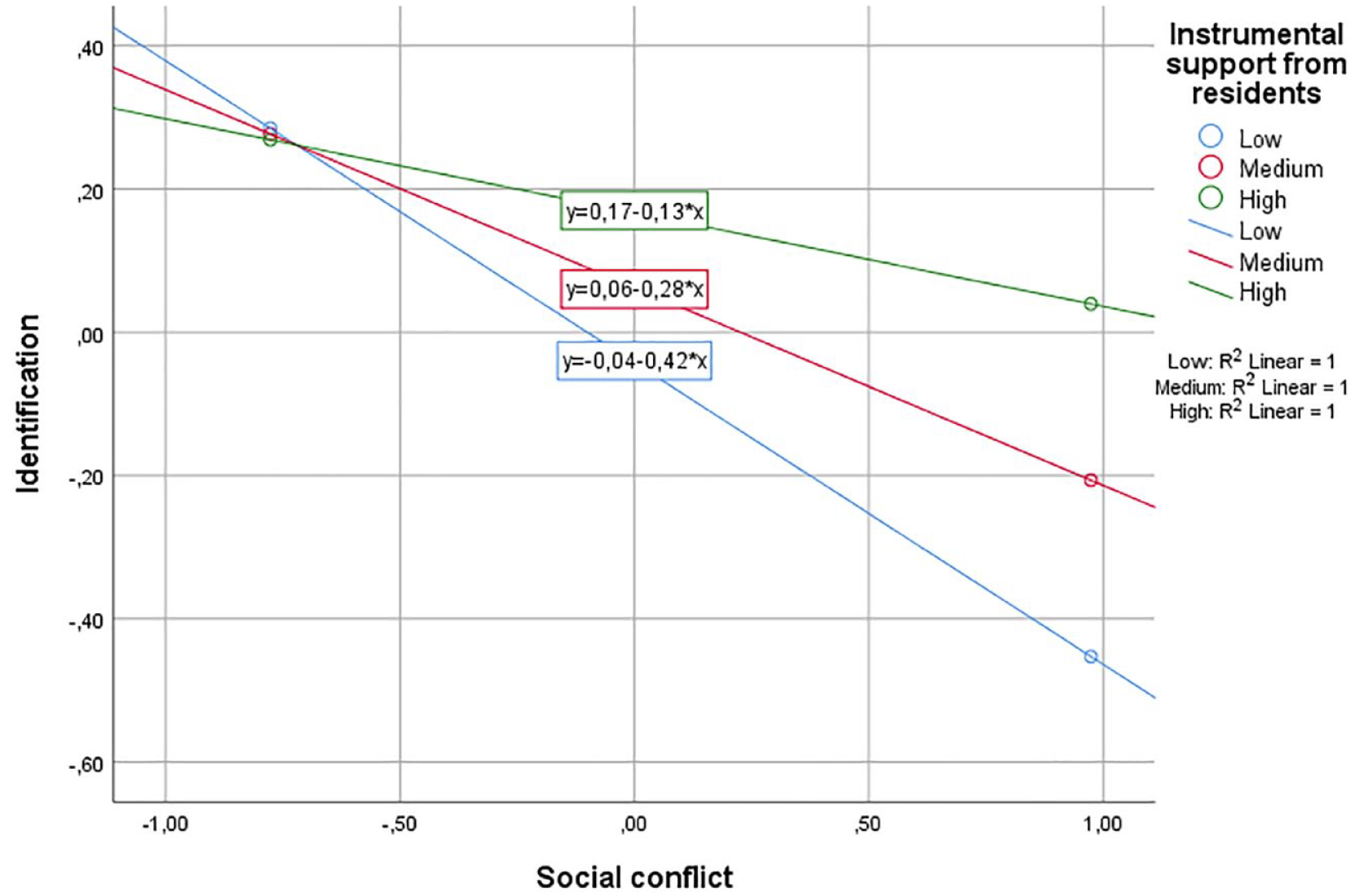
The moderating effect of instrumental support from residents on the relationship between social conflict and identification.
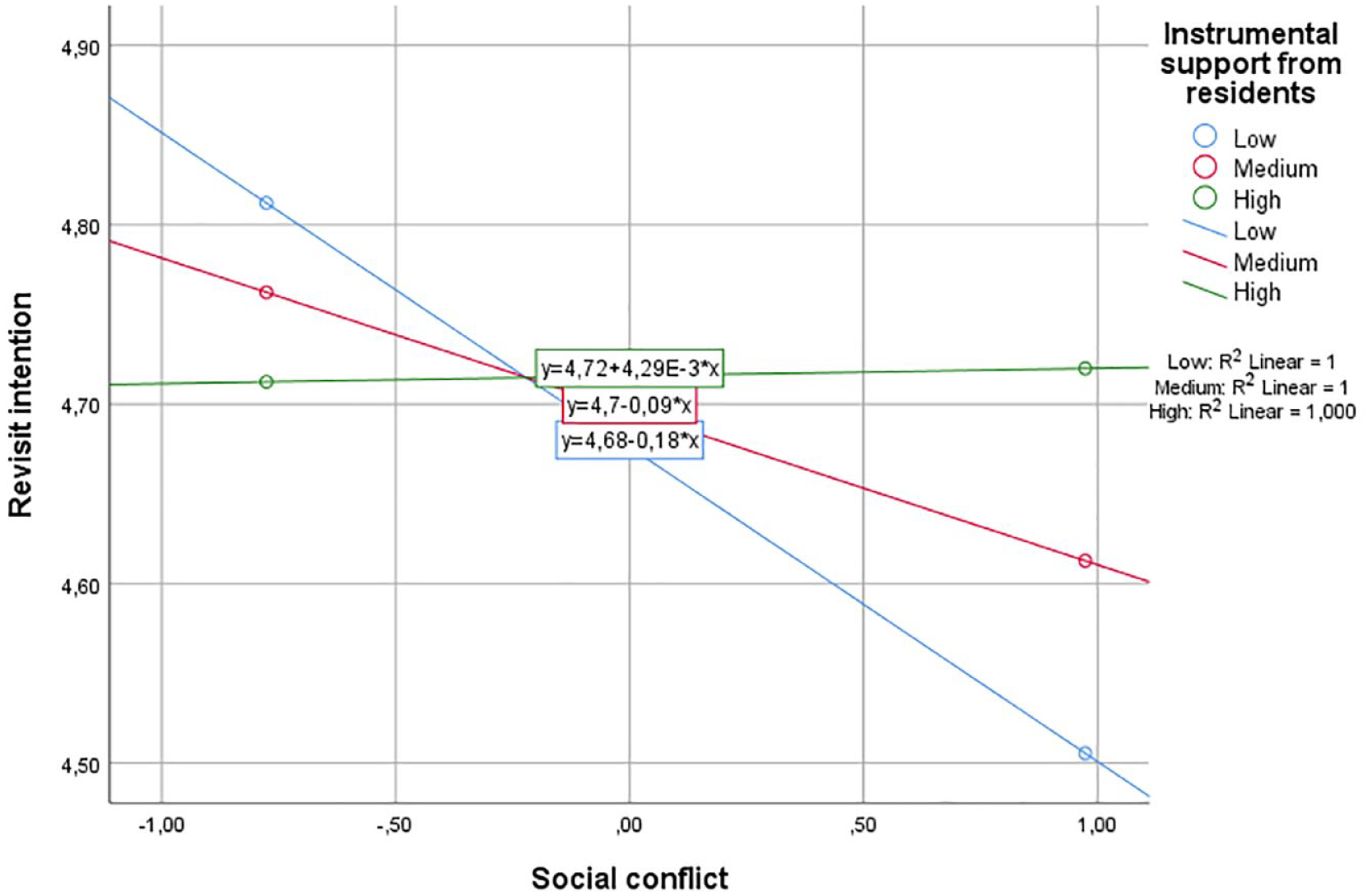
The moderating effect of instrumental support from residents on the relationship between social conflict and revisit intention.
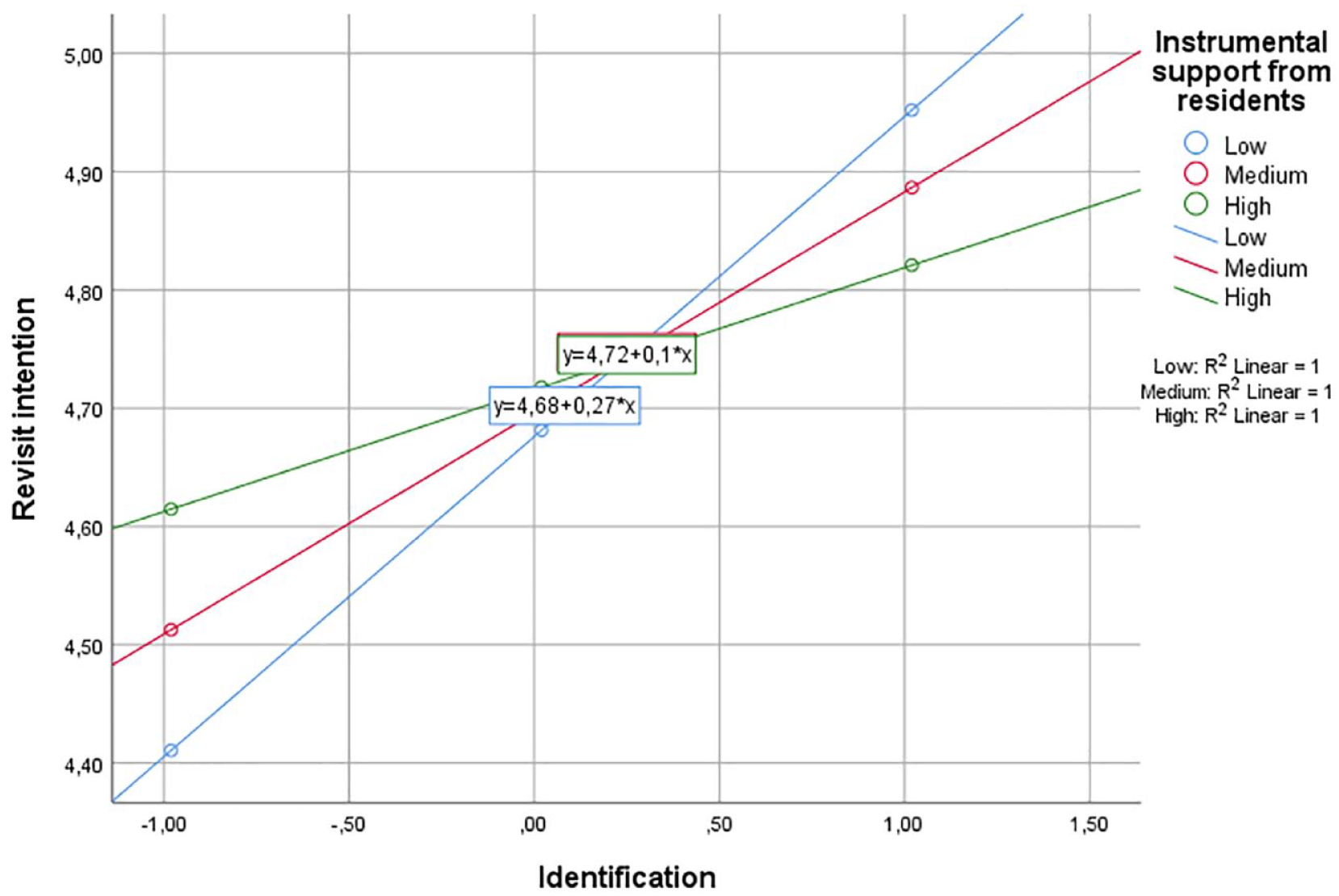
The moderating effect of instrumental support from residents on the relationship between identification and revisit intention.
Post-Hoc Robustness Tests
By acknowledging their tribal associations (de Loryn, 2022), we took for granted that all digital nomads are affiliating with this group (Chevtaeva, 2021; Chevtaeva & Denizci-Guillet, 2021; Cook, 2020). However, this assumption might be far-fetched since not all digital nomads might be strongly interacting and identifying with the rest of this community. To account more precisely for potential tensions between different digital nomad identities, we enriched our model with another moderator in the H5 link—instrumental support received from other digital nomads. The underlying assumption is that digital nomads who score high on receiving support from digital nomads exhibit stronger affiliation and belongingness to this community. The items cover all areas of instrumental support like the ones provisioned by residents (see Table 3), but refer to digital nomads. As a result, we have redone our analysis using SPSS Process Model 70, which accounts for the three-way interaction between the mediator and dependent variable. Our results show that three-way interaction shows a negative and significant effect (β = −.11, p < .01; LLCI = −0.19, ULCI = −0.04), meaning that among digital nomads who receive a high level of instrumental support from their peers, the hypothesized relationship in H5 becomes stronger (higher identification and instrumental support from locals contribute less to revisit intentions).
Interestingly, the original effect from H5 diminishes for digital nomads who receive little support from their peers. In that case, the revisit intentions are mainly driven by strong identification (note that the difference between the slopes becomes insignificant). We showcase interaction plots produced by SPSS Process v4.1 syntax in Figure 5. This post-hoc analysis further supports our theoretical assumption based on social identity complexity that digital nomads make context-specific identity switches based on the strength of their interactions with residents and other digital nomads.
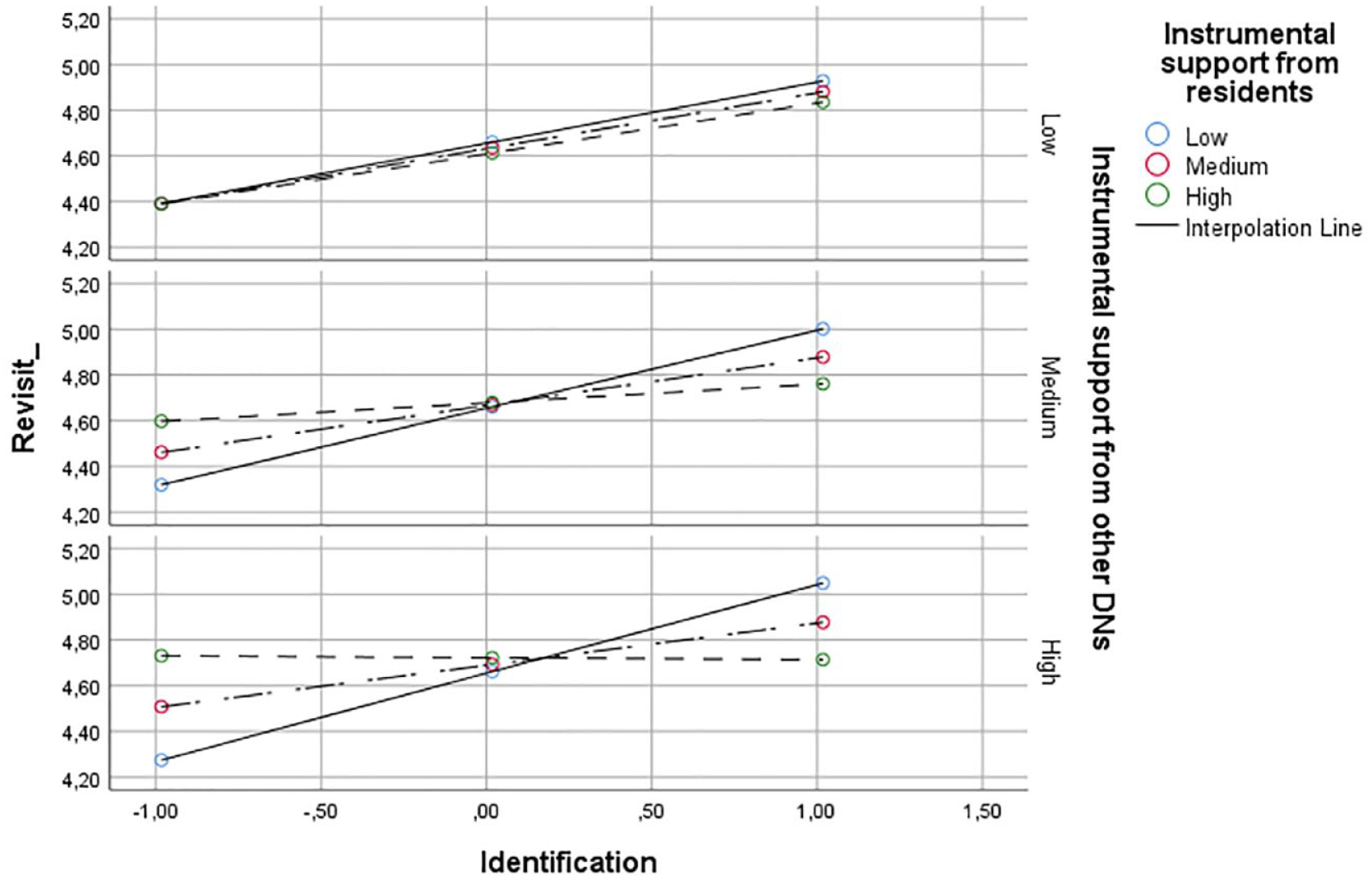
Three-way interaction between identification, instrumental support from residents, and instrumental support from other digital nomads.
Discussion
So far, the tourism literature has looked dominantly into exchanges occurring in resident-archetypal tourist relationships. However, only a tiny portion of the literature has focused on lifestyle travelers who stay for a more extended period in destinations and might be tempted to undergo identity change and integrate more deeply within the host country community, which eventually reshapes their attitudes and behaviors (Bardhi et al., 2012; Hannonen et al., 2023). The new mobility paradigm has challenged travel and tourism’s predetermined and static nature by shedding light on new forms of travelers who practice extreme mobilities and nomadic lifestyles (Kannisto, 2016). Digital nomads are illustrative examples of such segments. However, literature remains relatively silent about how digital nomads interact with residents and how this reflects on their identity-building and revisit intentions.
The resident-traveler exchanges based on intergroup contact can produce varied outcomes, from positive attitudes toward out-groups to more negative effects such as tensions, hostility, and conflict (Fan et al., 2017). In our study, we focused on social conflict as an inevitable outcome of exchanges occurring between digital nomads and residents through the lens of social categorization. Our study concentrates on social conflict through realistic group conflict theory, which accounts for mechanisms that can alleviate its negative consequences so that digital nomads do not lose interest in revisiting destinations in the future. Our study shows that social conflicts can erode the potential value of the destination by reducing the digital nomad’s identification with it and thereby reducing the revisit intentions. These findings align with mainstream tourism research that shows the same trajectory in the sample of archetypal tourists (Tsaur et al., 2018). However, our study goes one step beyond. It shows that many of the negative consequences can be mitigated if there are efforts to establish a common identity between opposing social groups. Here, our study echoes previous research on sojourner adaptation (Miocevic & Zdravkovic, 2020; Leong & Ward, 2000) as well as tourism (Rasmi et al., 2014), emphasizing that digital nomad identification efforts can be of great help in reducing the negative consequences of social conflicts on the revisit intention.
Based on the realistic group conflict theory, we hypothesized that by adopting cooperative contact between digital nomads and residents, it is possible to mitigate further the negative consequences caused by social conflict. Instrumental support provided by residents to digital nomads has proven to be a cooperative mechanism through which the adverse effects of social conflict are significantly reduced (Jackson, 1993). Instrumental support becomes an extremely viable source of help for travelers who stay longer by helping them navigate the local environment more easily. Here, the results of our research are in line with studies conducted in the field of sojourners (Miocevic & Zdravkovic, 2020; Ong & Ward, 2005) and tourists (Fan, 2023; Joo et al., 2018; Stylidis, 2022), where it was shown that increased contact with locals enables better adaptation, positive images and greater openness to the options that the host country destination provides.
Our study shows that identification with destination conditionally mediates the relationship between social conflict and revisit intention. Digital nomads scoring high on identification and receiving instrumental support from residents show decreasing intention to revisit the destination. This, at first, counterintuitive insight can be explained through social identity complexity, suggesting that digital nomads might possess multiple identities and deploy them as they see fit, given the context (Roccas & Brewer, 2002). The potential commonalities can blur the lines between the groups. This is especially evident in tourism exchanges where identifying one group with another cannot erase the boundaries between them (Tajfel & Turner, 1979; Tung, 2019). Our study’s findings align with sojourner literature, showing that individuals balance the need for assimilation and differentiation within the in-group based on the context (Miocevic et al., 2022a, 2022b). When their identification with the host destination is too emphasized, this endangers their original identity. Consequently, they pursue choices that make them different from the rest of the in-group members (Peltokorpi & Pudelko, 2021). Another explanation is tied to the argument that many digital nomads become less inclined to tie themselves to specific destinations since they nurture unique lifestyles built on freedom (Reichenberger, 2018), and through various mediums (such as co-work and co-living places), they meet other digital nomads who share the same nomadic lifestyle and identity (Mancinelli, 2020). Our data reveals that digital nomads are sensitive to their identity. When coupled, strong integration (through contact) and identification with the destination endangers their nomadic identity, forcing them to switch trajectories by lowering revisit intention. Our findings can also be explained in light of previous insights that consider digital nomads to be authenticity and novelty seekers (Chevtaeva & Denizci-Guillet, 2021; Green, 2020; Kannisto, 2018). In this case, our findings corroborate that overly identified and integrated digital nomads might see less novelty and authenticity in such destinations, eventually lowering their future return intentions. However, post hoc analysis also shows that digital nomads who strongly identify with the destination would be more inclined to return if they had less contact with residents and more contact with other digital nomads. Hence, our findings align with conceptual insights showing that digital nomads control their travel plans, meaning they would not be inclined to commit to a single destination in the longer term (Cook, 2023). We also provide empirical substantiation to previously conceptual arguments that digital nomads tend to witness tensions with multiple identities, such as localized and nomadic ones (Cohen et al., 2015). In other words, these tensions reflect digital nomads’ trade-offs between globetrotting and being attached to a particular destination through repeated visits.
Conclusion
Theoretical Implications
Our study brings contributions to at least three theoretical domains. First, we enrich the knowledge of traveler-resident exchanges and tourism intergroup contacts (Fan, 2023; Luo et al., 2015; Ward & Berno, 2011) by focusing on socialization dynamics painted with conflict and symbiotic situations. Here, we contribute by using realistic group conflict theory and extending it with insights from the common in-group identity model and intergroup contact literature to reveal how to lessen the negative consequences of social conflicts that would eventually foster digital nomads’ revisit intentions. However, our study informs that resolving social conflicts through intergroup contact and re-categorization might prove less effective due to digital nomads’ social identity complexity.
Second, we extend the literature on digital nomads, which is still in its infancy, diversified, and multidisciplinary. We uncover how relations and contact with residents reflect their intentions, behaviors, and identity projects in host country destinations. Allegiances with different social groups and identities do not disrupt cohesion but enable digital nomads to navigate the nomadic routes and routines more effectively (Aufschnaiter et al., 2021; Hannonen et al., 2023). So far, there has been minimal research on the role of multiple categorizations resulting from intergroup contact (Dovidio et al., 2017), especially in travel research. Previous research has dominantly focused on trade-offs that globally mobile individuals make regarding identities (Bardhi et al., 2012; Miocevic et al., 2022b), neglecting the potential interplay between them. Our inquiry in this study shows promise since we reveal that digital nomads possess fluid identities positioned between extreme nomadism and full integration in the host country community. Consequently, our study goes beyond previous research that focused on digital nomads frequenting co-living and co-working areas and thus being more exposed to like-minded people. In our sampling, we were able to recruit digital nomads who were also prone to engage in contact with residents, which enabled a more natural setting to inspect the social identity complexity occurring within this segment.
Third, our study also contributes to consumer culture research (Atanasova & Eckhardt, 2021; Bardhi et al., 2012) due to our focus on digital nomads who represent a case of highly mobile global travelers who frequently make cross-cultural transitions and become exposed to different cultural settings. Nevertheless, with the assistance of the etic approach, our insights respond to the recent call by consumer culture scholars (Sharifonnasabi et al., 2020) to focus on emerging superordinate groups who are not primarily bound by political, cultural, and geographical anchors but other sources of identity inferences.
Managerial Implications
Our study offers prescriptions for resolving resident-digital nomad social conflicts and provides practical implications for destination management companies in attracting and retaining digital nomad travelers. Conflicts are common in the daily life of digital nomads when they encounter host country residents in different everyday situations, such as dealing with institutions and bureaucracy, shopping in local markets, and attending social events. Our study findings suggest that establishing a common identity would safeguard digital nomads’ loyalty to their destination during conflicts. Destination managers could use this input to envision their strategy to reach this segment. For instance, destination management companies might introduce specific advertising campaigns aimed at digital nomads using affective appeals outlining the attachment and fit between their needs and the destination’s properties. Examples are the recent campaign “Live and work anywhere” by the Tourism Authority Thailand and Bali’s Ministry of Tourism in cooperation with Airbnb. The campaigns focus on the allure of Bali and Thailand as perfect destinations for digital nomads.
Our study reveals that destination managers would benefit significantly by institutionalizing instrumental support to mitigate the adverse effects of conflict on identification and subsequent revisit intentions. Destination managers might envision a one-stop shop that would cater to the needs of digital nomads. This would mean broadening the array of provisioned information, such as how to deal with bureaucratic issues, the rules of social gatherings and cultural norms, language assistance, legal assistance, and various products and service offerings. While successful destination management solutions for archetypal tourists exist (e.g., tourist information points and visitor centers), a similar concept could be rolled out for digital nomads and other lifestyle travelers who stay longer.
An ultimate question to which destination management companies and other tourism-related stakeholders want to know the answer would be how to increase destination revisiting and recommendations. Digital nomads’ identification with the destination results in much easier adaptation to the host country, lowers social conflict, and directly leads to revisiting intention. However, the simultaneous interplay of identification and instrumental support from residents requires some caution from decision-makers. Therefore, among digital nomads who strongly identify with the host destination, close affiliation with the digital nomad community safeguards their nomadic identity by 1) increasing revisit intention when there are no tensions between nomadic and localized identity (social identity complexity is low) and 2) decreasing revisit intention when there are tensions between nomadic and localized identity (social identity complexity is high). Hence, nurturing a nomadic identity does not necessarily mean a lower interest in revisiting. The destination managers could exploit this by provisioning co-living and co-working places designated explicitly for digital nomads. While this might be seen as counterproductive by creating seclusion, destination managers might focus more on balancing digital nomads’ interaction with other digital nomads and locals through various events. For instance, the tech community in Split (Croatia), a popular digital nomad destination, regularly organizes “Locals’n’nomads” meetups. In such a case, the dominant in-group association might be replaced with a more favorable stance toward the out-group. However, it would also ensure that digital nomads feel free from the locale, which would threaten their identity and discourage their revisit intentions.
Limitations and Suggestions for Further Research
Although our study brings valuable contributions to several streams of academic literature, some limitations must be acknowledged. First, future studies should focus on geographical areas other than the four countries investigated in this study. These destinations are also popular tourist destinations and thus trigger revisit intention. The findings of this study may be reinforced by testing them in countries that are not such popular tourist destinations but still attract a significant number of digital nomads.
Second, our study reveals the conditions under which digital nomads would likely revisit specific destinations. However, long-term travelers are also prone to undergo life adjustments in the host country, especially by altering their consumption practices. We encourage future researchers to focus more on consumption options chosen by digital nomads, such as within-country travel, visits to natural and cultural heritage sites, buying at local farmer markets, the propensity to purchase local foods and brands, visiting local restaurants, and using local apps.
Third, our research focused on the intensity of digital nomads’ contact with residents and other digital nomads. However, these intensities may be limited and may only sometimes correspond to digital nomads’ desired level of communication. We suggest that future research consider this phenomenon and determine how integration discrepancies can affect the desire to return and the tendency to consume products offered by the destination.
Fourth, a compelling area of future research could be digital nomads’ motivations for travel. We believe it would be too optimistic to assume that all digital nomads are driven by cosmopolitan tendencies and motivated to explore other countries, cultures, and customs. It might be possible that a significant number of digital nomads travel to escape unwanted relationships, contacts, and countries. It can be assumed that these motives further shape their affective responses and, ultimately, their behavior in the host country, for example, willingness to interact with residents.
Finally, more insight is needed into the theoretical mechanisms that could explain how digital nomads build localized identities and consequently entrench themselves as residents. While our study offers some guidance on this front through identification and integration tendencies, future studies could account for digital nomads’ relationships with their country of origin. Since early insights suggest that nomadic groups can be prone to disidentify with their home country (Cook, 2022), much more evidence is needed to see how digital nomads’ stance toward their cultural in-group shapes their subsequent nomadic behavior abroad. Moreover, this becomes important, especially when considering the strength of the digital nomad’s passport, which could make their disidentification tendencies pragmatic and opportunistic (Kannisto, 2016). Future studies could deep dive into this established juxtaposition in the digital nomad universe - between pragmatism and freedom to travel.
Footnotes
Declaration of Conflicting Interests
The author declared no potential conflicts of interest with respect to the research, authorship, and/or publication of this article.
Funding
The author received no financial support for the research, authorship, and/or publication of this article.
