




Abstract
Tourists are flooded with advertising messages, including destination-attribute-based or user-imagery-based pictures, to persuade them to visit the destination. While research emphasizes destination choice to result from tourist-destination congruity, examining the influence different pictures have on tourist decision-making is of increasing interest. Therefore, this study sought to investigate the efficacy of destination-attribute-based versus user-imagery-based ad stimuli to influence the tourist-destination congruity and predict a person’s likelihood of choosing the destination. Results from a quantitative study of 496 young Slovenians show that a higher degree of ideal and ideal social tourist-destination congruence would lower one’s perceived purchase risk and yield positive attitudes toward the ad with a destination-attribute-based picture as opposed to the ad with a user-imagery-based picture. Implications for destination marketing are discussed, such as evaluating a typical destination visitor when one is included in the advertising and when one is not.
Introduction
Tourism destinations represent “a unique environment and stimulation apart from those ordinary shopping settings” (Oh et al., 2004, p. 109) as they are the place where tourist consumption happens and also the object of consumption per se (Bærenholdt et al., 2004; Šegota, 2018; Urry & Larsen, 2011). However, despite the literature providing a better understanding of tourist behavior and debating the numerous factors influencing destination choice, many researchers still acknowledge that specific gaps must be addressed (Blichfeldt, 2007; Byun & Jang, 2018; Sirgy & Su, 2000).
One of the gaps extends to the influence of visual elements of destination advertising on the destination selection process (Bilim & Yüksel, 2008; Jenkins, 2003). According to Meenaghan (1995), destination advertising has higher power in addressing consumers and raising awareness about a tourism destination, primarily if its message is delivered visually. It can also provide information to consumers about the type of person who visits the destination and how a tourism destination is supposed to be consumed (Keller, 2003; Sirgy & Su, 2000). Percy and Elliott (2009) explained that visual advertising messages could establish a relationship between a viewer and an image by enabling a viewer to imagine themselves “as either part of what is shown in the picture, or outside observing what is there” (p. 296). These suggestions bring us to the concept of self-congruity, which has been extensively researched in marketing and tourism. The concept of self-congruity suggests that consumer behavior is influenced by the degree of matching various dimensions of one’s self to a typical user of the object of consumption (Sirgy, 1985). In tourism, self-congruity relies upon eliciting assessments of how congruent one’s self is with a typical destination visitor (Hung & Petrick, 2011; Sirgy, 2014; Sirgy et al., 1997). The latter relates to what Percy and Elliott (2009) suggested: a viewer-destination relationship established on the viewer’s imagination of what is shown in the picture. The approach of employing the congruity theory has proven to be valuable in underpinning different aspects of tourist behavior in the destination selection process (Ahn et al., 2013; Boksberger et al., 2011; Hung & Petrick, 2012; Sirgy, 2014) but has not yet adequately answered the question of the extent to which destination advertising shapes the tourist-destination congruity. Hung and Petrick (2011, 2012) criticize the self-congruity studies in tourism by pointing to how study participants envisioned a typical destination visitor but did not provide sufficient evidence of how images of a typical destination visitor shape tourist-destination congruity. Indeed, a typical destination visitor, as envisioned by tourists, is only part of user imagery (Kamin, 2013); there is also a typical destination visitor that is portrayed in destination advertising (Phau & Lau, 2000), which may or may not coincide with the envisioned one. In this sense, Hung and Petrick (2011) and Sirgy and Su (2000) note that the research on the relationship between one’s self-image and the image of a typical destination visitor has been isolated from the influence of advertising and other marketing communication tools.
Retained image of a destination will partially shape the expectations of returning tourists, while for potential new tourists, a decision to visit a destination will be in significant part influenced by a range of sources (Butler, 2017) and, in most cases, by advertising (Percy & Elliott, 2009). The decisions are, in practice, often taken due to financial considerations. The photo of the attraction is a dozen times cheaper than the photo with tourists that has to be cast and directed. Hence, destination management organizations and other tourism and hospitality businesses rely on images of distinctive landscapes when advertising and promoting destinations. Many authors (Bilim & Yüksel, 2008; Butler, 2017; Park & John, 2012) accept the suggestion that the power of attracting consumers is based on the destination’s attributes and that the likelihood of satisfying experiences is also shaped by the more appealing pictures of the destination. Johar and Sirgy (1991) argue that choosing a practical appeal is one of the critical strategic decisions in marketing communication, which leads to marketing segmentation, brand-positioning or unique-selling-proposition decisions. According to Johar and Sirgy (1991), these decisions influence communication tactics reflected in central advertising messages. Thus, visual advertising messages that elicit different consumer responses and consequently influence a range of tactical communication decisions by advertisers are determined by pictures and their power to attract consumers. This implies another critical question about destination advertising, which has not been adequately addressed in the tourism literature: which visual messages have a higher power of attraction: destination-attribute-based or user-imagery-based pictures?
Therefore, this paper examines differences in destination-attribute-based versus user-imagery-based ad stimuli influencing tourist-destination congruity. The self-congruity theory has been used as a theoretical foundation to test to which degree the two specific visual stimuli help establish the match between tourists and a destination and influence tourist decision-making. Hence, after identifying the most frequently used destination-attribute-based and user-imagery-based pictures in promoting the Croatian Island of Pag, we surveyed a significant segment of its visitors, that is, young Slovenian tourists, to examine differences in the formation of tourist-destination congruity and effectiveness in influencing their destination selection process.
Literature Review
The Self-Congruity Theory in Tourism
The self-congruity theory informs tourism studies on how a match between a tourist and a destination has been established. Sirgy (2014, p. 64) defines self-congruity as “a process of matching (some dimensions of) a tourist’s self-concept with the destination visitor image” and further explains that “the greater the match between self-concept and the destination visitor image, the greater the likelihood that tourists feel motivated to travel to that destination” (Sirgy, 2014). Furthermore, Sirgy and Su (2000) and Sirgy (2014) distinguish between four dimensions of self—actual, ideal, social, and ideal social, and consequently between four different congruities. The first two congruities are related to reinforcing consumer needs to behave in ways helping them maintain internal consistency (i.e., how I see myself), while the latter two help in maintaining external consistency (i.e., how I think others see me) (Mulyanegara & Tsarenko, 2009; Sirgy, 1985). For actual self-congruity, the most important is the fit between how tourists see themselves (how they think of themselves of who they are) and the image of a destination visitor. On the other hand, ideal self-congruity reflects a match between how tourists would like to see themselves and the image of a destination visitor. Similarly, for ideal social self-congruity, it is the “ideal” of how tourists would like to be seen by others and matching this to a destination visitor that is at the core of this self dimension, while social self-congruity is based on a fit between how one believes others see them in association with the image of a destination visitor (Hosany & Martin, 2012; Sirgy, 2014; Sirgy, 1985).
It is essential to state that these four dimensions originate from a pioneering study by Grubb and Grathwohl (1967), which examined the interrelatedness of the self-concept, symbolism, and consumer behavior. Grubb and Grathwohl (1967) discussed how consumers alienate their decision-making with symbolic values of brands and products and their multiple selves. However, Malhotra’s (1981) study is considered pioneering in operationalizing the self-congruity concept by providing the self-congruity scale. The scale comprised 15 bipolar adjectives to determine the congruity between oneself and a handful of brands. By computing and comparing the highest score for each adjective, it was suggested that the higher the score, the higher the congruity. Consequently, those consumers with higher congruity would exhibit more favorable attitudes toward a brand and a higher likelihood of buying a product (Malhotra, 1981).
In tourism studies, Chon (1992) introduced the concept and, contrary to Malhotra, proposed to measure self-congruity directly using a five-question Likert-type scale. His investigation resulted in “self-image/destination image congruity” that was argued to increase tourist satisfaction after visiting the destination (Chon, 1992). Since then, a growing body of research has emerged exploring the relationship between self-congruity and tourist behavior. Initial studies, such as those of Litvin and Goh (2002) and Ekinci and Riley (2003), surveyed self-congruity in tourism and hospitality settings using both Malhotra’s (1981) and Chon’s (1992) scales only to demonstrate that self-congruity positively influenced behavioral intentions regardless of the scale used. Malhotra’s (1981) scale, suggested to show more robust and richer results, was used in a few studies explaining people’s intentions to visit rural destinations (Kastenholz, 2004), loyalty to cruises (Hung & Petrick, 2011), and other travelers (Beerli et al., 2007).
However, Chon’s (1992) scale swiftly became a “norm” among tourism scholars, with most studies using either a 5- or 7-point Likert-type scale to measure self-congruity directly (Sop, 2020). Moreover, the congruity has been predominately examined using scenario directives with no reference to destination advertising (e.g., respondents were asked to imagine a destination visitor before responding to questions on self-congruity), leaving the role of advertising in the formation of tourist-destination congruity unexplored. More specifically, over the last two decades, nearly all self-congruity studies have elicited respondents’ assessment of how congruent their self-images are with a destination image based on respondents’ imagination of the typical destination visitor (e.g., Ahn et al., 2013; Chua et al., 2019; Fu et al., 2017; Hung & Petrick, 2012; Joo et al., 2020; Moons et al., 2020). This is as if the researchers treated the relationship between oneself and a destination as isolated from the influence of advertising and any other form of communication about the destination. Since conducting this study, two studies were an exemption to this observation. Yoon and Kim (2016) used fictitious ads containing a brand and spokespersons to evaluate source credibility’s effect in coffeehouse advertising. Similarly, Xu (Rinka) and Pratt (2018) used images featuring endorsers of destinations to predict Chinese Gen Y’s travel satisfaction and destination loyalty. Both studies showed that matching the brand/destination images with their target consumers’ image will yield positive ad attitudes and travel or purchase intentions.
Destination Advertising and Its Role in the Tourist-Destination Congruity
Advertising is “a paid, mediated form of communication from an identifiable source, designed to persuade the receiver to take some action, now or in the future” (Richards & Curran, 2002, p. 74). However, according to Jančič (2013), this definition neglects the creativity of the design and the exchange process between a consumer and a marketer as two essential elements of advertising. Hence, he offers a new definition stating that advertising is a “planned, paid form of creative (mass) communication from an identifiable source, designed to engage marketers and consumers in an exchange process by conveying fulfilled promises” (Jančič, 2013, p. 27).
In tourism, the exchange core consists of a tourist and a destination, representing the place and the object of consumption. Hence, it is vital for destination advertising to communicate fulfilled promises, yet even more critical for tourists with no prior knowledge or experience with the destination. Destination advertising not only helps in conveying the message from an advertiser to a tourist, but it also aims to: (1) generate awareness about the ad among the target audience, (2) generate awareness of the destination as a place to visit, (3) create a positive image of the destination, (4) motivate consumers to think of traveling shortly, and (5) stimulate actual visit to the destination (Siegel & Ziff-Levine, 1990). Many authors (Bilim & Yüksel, 2008; Byun & Jang, 2018; Hsu et al., 2010) note that an individual’s response to the destination is highly associated with its advertising. An individual’s response to advertising, and consequently to the destination, depends on the message delivered by a code and, more importantly, how it is decoded.
Pictures as Visual Links Between Tourists and Destinations
In advertising, the content of the message is usually coded as “a structured text that includes visual and linguistic elements as carefully chosen symbols intended to convey the message’s meaning” (Kamin, 2013, p. 109). Visual ads represent a medium with great emphasis on the picture’s role in conveying a message that can range from concrete and realistic to highly abstract and metaphorical (Clow & Baack, 2007). Numerous authors (Clow & Baack, 2007; Percy & Elliott, 2009; Rossiter & Percy, 1980) suggested that consumers prefer pictures over words, which makes pictures one of the most critical elements of the advertising message (Ang & Lim, 2006). Similarly, Debevec and Romeo (1992) argued that visual stimuli are more memorable and dominant than verbal stimuli when viewers process information in ads. Visual messages tend to grab most of the attention and stimulate the ad’s audience’s learning process (Percy & Elliott, 2009; Smith & Kosslyn, 2007). According to Myers (1994), pictures can automatically engage people in the message, implying their superiority over words. Even more so, Rossiter (1988) demonstrated that the average time spent looking at a magazine ad is 1.65 s, of which 70% is directed to a picture.
Urry and Larsen (2011) observe that advertising impacts tourists by mobilizing and triggering their desires and fantasies by offering seductive and palpable imageries accepted as realities. Bower (1970) says that advertising is based on associative learning, where viewers are aided by carefully selected pictures showing how products or services are being used, rather than leaving it up to viewers to form their own opinion on how they should be used. Hence, the issues of what to say and how to say it are much more involving than what might appear when creating the advertising message content. That is, if the message is made more accessible for its target audience to process and understand it, the more likely is that desired communication effect will be achieved (Percy & Elliott, 2009). To effectively deliver the message through pictures and avoid any possible misinterpretations or argumentation, advertisers are careful and thorough in selecting photos, which requires an in-depth understanding of the object of consumption and the target audience (Ang & Lim, 2006; Kamin, 2013). In tourism, associative learning can be enhanced by using pictures that portray a typical visitor to the tourist destination and the destination’s experiences and activities. These could stimulate viewers to associate a destination with positive emotions and tangible experiences, making the advertising message highly persuasive (Bilim & Yüksel, 2008; Park & John, 2012).
Phau and Lau (2000) distinguish between two different but related elements of user imagery: a typical representative and an idealized representative. The typical representative could be envisioned by a viewer—in this case, it only exists in people’s minds, it can be different from person to person, and an advertising message can stimulate people to think of it. On the other hand, an idealized representative is portrayed in the ad, representing a typical visitor to a destination as envisioned by the advertiser. The latter is based on the advertiser’s understanding of the object of consumption and the target audience. This opens some space for a potential clash in user imagery in people’s minds, as an idealized representative might only resemble a typical representative to a certain extent. Kamin (2013) says that if an idealized representative is used in establishing a more significant match between a message and a viewer, it will succeed only if there is a substantial resemblance between the typical and idealized representative.
The Self-Congruity Theory and Destination Advertising: Exploring the Missing Links
The self-congruity theory posits a necessary foundation for destination advertising; however, current studies provide minimal empirical evidence of interconnecting the two research areas. As previously discussed, most self-congruity studies in tourism treated the tourist-destination congruity as a relationship exclusive of destination advertising and its possibility to influence one’s decision-making. For destination advertising, decoding the message is the second important element affecting an individual’s response to an ad and what is advertised. A handful of studies (Bilim & Yüksel, 2008; Brezovec, 2001; Byun & Jang, 2018; Park et al., 2013) have examined different responses to destination advertising; however, there is minimal evidence on how a match between a tourist and a destination is affected by pictures used in destination advertising (Yoon & Kim, 2016). Moreover, destination advertising may or may not include a typical destination representative. If portrayed, it is an idealized representative of visitors envisioned by destination managers. If not shown, it is a typical representative envisioned by tourists. Nevertheless, destination advertising has to feature at least one destination attribute to reference the destination. The latter informs who visits the destination and thus helps develop user imagery: “tourists are likely to make inferences about the visitors of a destination as a direct function of the destination’s advertising messages” (Sirgy & Su, 2000, p. 342).
Our study fills this research gap by choosing an approach that differs from previous studies. First, we treated the tourist-destination congruity as strongly influenced by pictures used in destination advertising. That is, how people would like to see themselves (i.e., ideal self) and how they would like for others to see them (i.e., ideal social self) will be influenced both by an ad in which an idealized tourist is portrayed and an ad which elicits envisioning a typical tourist with specific destination attributes (see also the following Methods section). With this in mind, we hypothesize the following:
H1: Ideal tourist-destination congruity is established for the ad with a destination-attribute-based picture (1a) and the ad with a user-imagery-based picture (1b).
H2: Ideal social tourist-destination congruity is established for the ad with a destination-attribute-based picture (2a) and the ad with a user-imagery-based picture (2b).
The general assumption is that the more tourists believe that a destination resembles how they would like to perceive themselves, the higher the likelihood they will choose the destination for their next holiday (Sirgy, 2014; Sirgy & Su, 2000). However, Ahn et al. (2013) stated that the tourist-destination congruity based on destination attributes was a more significant predictor of one’s behavior. On the contrary, Hung and Petrick (2011) state that the tourist-destination congruity based on destination attributes has less power to affect one’s behavior than the tourist-destination congruity based on user imagery. Drawing from many studies using celebrity endorsers as ad stimuli to test the congruence (Kim et al., 2013; Lazarevic, 2012; Misra & Beatty, 1990; Xu (Rinka) & Pratt, 2018; Yoon & Kim, 2016), we will stipulate that higher degree of congruence based in the ad with user-imagery-based picture would be more effective in decreasing the perceived risk of destination choice than the ad with the destination-attribute-based picture. Moreover, tourists’ ability to match their dimensions of self with a tourism destination is fundamental for the effectiveness of destination advertising (Hung & Petrick, 2011). The attitudes toward the ad or promotion were suggested as a powerful explanatory construct to measure the efficacy in advertising-focused studies (Close et al., 2009; Sallam & Wahid, 2012; Xu (Rinka) & Pratt, 2018; Yoon & Kim, 2016). Hence, we propose that the destination-attribute-based and user-imagery-based tourist congruity would have different effects on tourists’ perceived risk of destination choice and attitude toward the ad. We predict that with the inclusion of idealized tourists in the ad, the perceived risk of destination choice would decrease, and tourists would exhibit more positive attitudes toward the ad. Hence, we propose the following hypotheses:
H3: Ideal (3a) and ideal social (3b) tourist-destination congruity will significantly decrease the perceived risk of destination choice when the ad features a user-imagery-based picture than a destination-attribute-based picture.
H4: Ideal (4a) and ideal social (4b) tourist-destination congruity will positively affect the attitude toward the ad when the ad features a user-imagery-based picture than a destination-attribute-based picture.
Method
Development of Stimuli and Measurement Instrument
We performed a content analysis of existing online advertising messages to create two distinctive ad stimuli. First, we selected the Croatian Island of Pag and its target audience comprising of Slovenians aged 18 to 35 to be our research target. The tourism product of Pag is very specific—the sun and sea tourism, accompanied by entertainment for young people. Moreover, the island is trendy among young Slovenians, and its tourism offer is advertised by Collegium Mondial Travel, a travel agency specializing in youth tourism. Hence, the first step was to perform a content analysis of Collegium’s advertising messages about the Island of Pag. Following Kaid and Wadsworth’s (1989) suggestion, a summated content analysis was performed on 1,925 pictures used for advertising the destination by the agency. The results revealed that almost all Collegium communication channels greatly rely on user-imagery-based pictures to emphasize visitors to the destination (i.e., idealized tourists). The latter is portrayed as an individual dancing and having fun with friends, dressed appropriately for summer (i.e., light clothes, swimwear, and beachwear), and spending time at a beach, a party place, or a boat. Conversely, destination attributes include the famous beach Zrće, sailing boats, the blue sea, and the party place known as the Papaya Beach Club.
The content analysis results yielded ten pictures of Pag: five portraying destination attributes and five depicting idealized visitors. Then we asked six representatives of the target population, two representatives of the Collegium company and six tourism researchers to evaluate the pictures and indicate which two most distinctively represent the Island of Pag. Such an approach helped reduce the researcher bias that would otherwise be embedded in selecting pictures and developing the measurement instrument (Lapenta, 2011; Sigstad & Garrels, 2021). Finally, two distinctive pictures were incorporated into the questionnaire: a picture of a beach representing the destination-attribute-based ad stimuli and a picture of young people having fun on a boat representing the user-imagery-based ad stimuli (see Appendix).
The measurement instrument comprised scales used to measure self-congruity, attitude toward the ad and the purchase risk, all measured on a 5-point Likert scale (1 = strongly disagree to 5 = strongly agree). Self-congruity was measured using the gap-scoring formula and focused on how respondents would like to see themselves (i.e., ideal self-congruity) and how they would like to be seen by others (i.e., ideal social self-congruity). An adapted version of Hieronimus’ (2003) 10-item personality attributes was used, which Boksberger et al. (2011) found to be reliable in measuring self-congruity via the gap-scoring formula. The latter yields a richer understanding of how respondents evaluate themselves and a destination (Boksberger et al., 2011; Ekinci & Riley, 2003) and can potentially reveal personality attributes that should be used in marketing communication messages. The attitude toward the ad (three items) was adopted from Close et al. (2009), while the perceived risk of purchase (four items) was adopted from Dean and Biswas (2001). The rationale for choosing these two studies is that both rely on visual stimuli. Additionally, we collected demographic information (age, gender, education, employment status, and marital status).
Before conducting the primary data collection, a pilot test of the generated survey items was performed. It was executed by talking to six young Slovenians of different demographics regarding age, gender, education, and employment status from the target population. These talks were based on understanding the generated survey items translated and back-translated from English to Slovene. The pilot test helped refine the list of generated items since participants were asked to identify the difficult-to-understand or confusing items. However, there were no significant suggestions concerning the measurement instrument; thus, it was proposed as definite for the primary data collection.
Data Collection and Sample Description
The research design employed a repeated-measures approach using an online questionnaire (see Appendix 1), with respondents being approached on social media platforms and online forums. Initially, they were asked to use the 10-item personality attribute scale to describe their ideal and ideal social self. Then they were shown the destination-attribute-based picture and were asked to think about the kind of person who typically visits the destination in the picture to assess their ideal and ideal social self on the same 10-item personality attribute scale. Also, they were asked to express their perceived risk of choosing such a destination for their next holiday and their attitude toward the ad. Afterwards, they were shown the user-imagery-based picture and asked to carefully look at the portrayed destination visitors to assess their ideal and ideal social self on the same 10-item personality attribute scale. Again, they were asked to express their perceived risk of choosing such a destination for their next holiday and their attitude toward the ad. Therefore, we ensured that all respondents were first asked to evaluate themselves on a 10-item personality attribute scale, then showed the destination-attribute-based picture followed by the user-imagery-based picture. Our research design did not allow for an order change to avoid the so-called starting-point bias (Gibson et al., 2014), which was shown to influence responses depending on the frame of reference provided.
The data were collected from 4 June to 9 July 2015, with the final number of returned and usable surveys of 496. Overall, the sample was slightly more male (51.5%) than female (48.4%), with an average age of 27. Most respondents were unmarried; therefore, they were either single (49.4%) or in a relationship with or without a status of domestic partnership (39.9%). The sample was mainly well educated, with 51.2% having obtained a higher education degree (bachelor’s, master’s, or PhD) and 47.4% having finished high school, including college or technical school. Additionally, the sample generally reported that they were employed (44.6%) or a student (43.3%), with some unemployed (11.1%) or homemakers (1.0%).
Results and Discussion
Pictures and Their Role in the Formation of Tourist-Destination Congruity
Following previous studies (i.e., Boksberger et al., 2011; Johar & Sirgy, 1991; Kressmann et al., 2006; Sirgy et al., 1997; Sirgy, 1982), the tourist-destination congruity scores were computed using Equation 1, which uses absolute distance scores between each personality attribute (for both pictures) and its corresponding evaluation of the ideal and ideal social self.

Legend:
TDk = tourist-destination congruity scores
DPik = destination rating along personality attribute i for respondent k
SIik = self-image (ideal or ideal social) rating along personality attribute i for respondent k
n = number of personality attributes (n = 10)
i = personality attribute i (i = 1…n)
Source: Kressmann et al. (2006).
Scores were averaged across all personality attributes for each respondent. Following the approach of Boksberger et al. (2011), we set the threshold for the tourist-destination congruity at the value of 1.0. This approach ensured that positive or negative scale ends were viewed as the same, whereas the change from the negative to the positive side was not accepted. In Table 1, we present the results of the reported match between two dimensions of the self and the destination-attribute-based and user-imagery-based pictures.
Descriptive Values of the Extent of Congruity Measures.
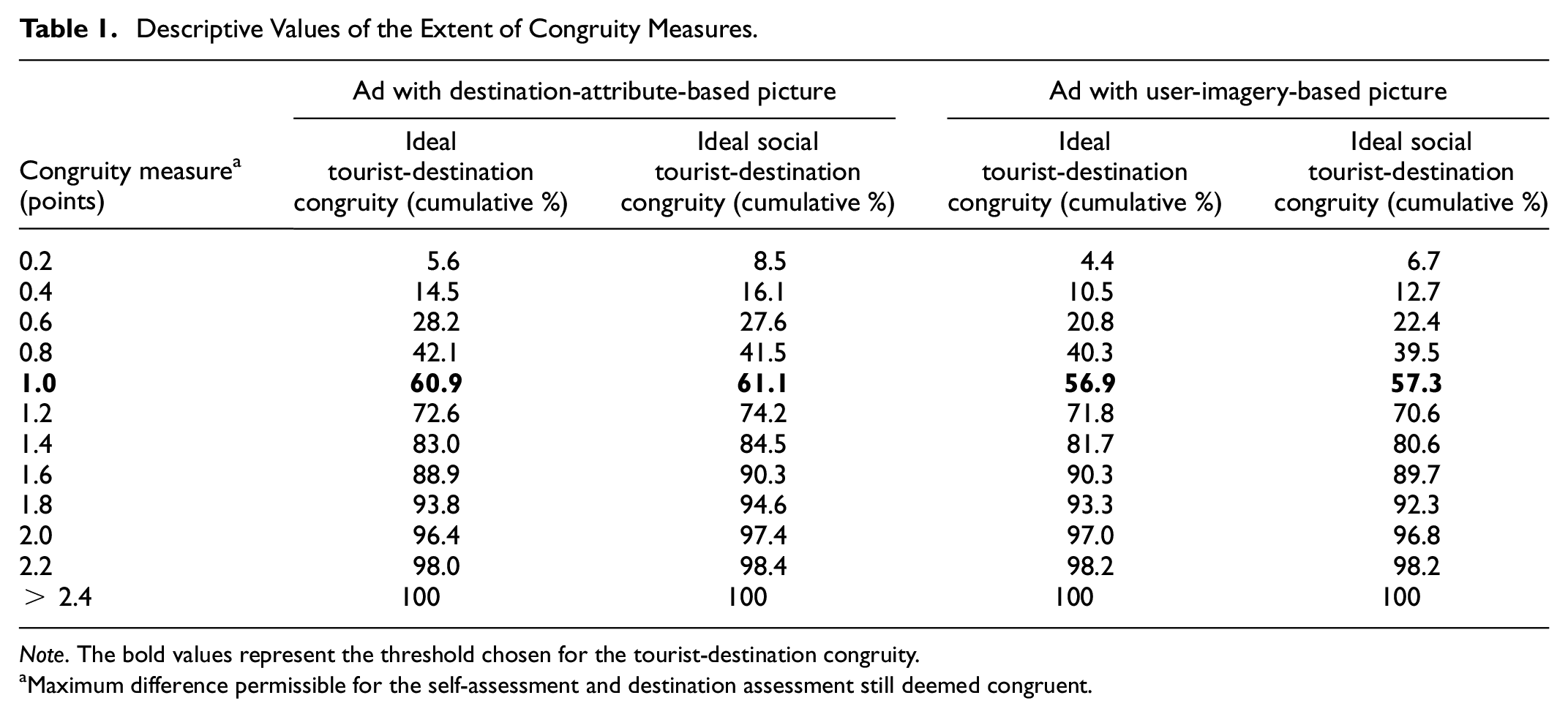
Note. The bold values represent the threshold chosen for the tourist-destination congruity.
Maximum difference permissible for the self-assessment and destination assessment still deemed congruent.
The results confirm hypotheses H1a and H1b that the ideal tourist-destination congruity is established for the ad with a destination-attribute-based picture (60.9% congruity reported at the threshold value of 1.0) and the ad with user-imagery-based picture (56.9% congruity reported at the threshold value of 1.0). Moreover, the findings also support hypotheses H2a and H2b, which proposed that the ideal social tourist-destination congruity is established for both the ad with destination-attribute-based picture (61.1% congruity at the threshold value of 1.0) and the ad with user-imagery-based picture (57.3% congruity at the threshold value of 1.0). These findings align with the research of Boksberger et al. (2011), who found that 58% of people matched their personality to that of a typical cruising tourist. However, when further examining how many respondents established congruity with both ads, our results show that there is a total of 224 respondents (45.2% of the sample) that reported on high ideal tourist-destination congruity and 229 respondents (46% of the sample) that reported on high ideal social tourist-destination congruity.
Sirgy and Su’s (2000) observation that tourists can make inferences about the visitors to a destination was confirmed using our research design. When our respondents were exposed to a picture with destination attributes and were asked to imagine its typical visitor, they had no problem evaluating the imagined visitor on a 10-item personality attribute scale. Like Urry and Larsen’s (2011) observation, our findings demonstrate advertising’s ability to mobilize and trigger tourists’ fantasies, regardless of whether a typical destination representative is included in the picture. These findings generally show that destination advertising affects tourist-destination congruity and should be included in future self-congruity studies in tourism.
The AD-Elicited Tourist-Destination Congruity and Its Role in Tourist Behavior
Hypotheses 3 and 4 were tested using the two groups exhibiting high ideal and high ideal social congruency. Focusing only on those highly congruent with both ads enabled us to run a set of paired t-tests to understand better the effect of tourist-destination congruity on the perceived risk and attitude toward the ad based on differing pictures. Moreover, we followed Rosenthal’s (1991, p. 19) Equation 2 to convert the t-value to r-value, as the latter is widely understood and frequently used statistic for effect sizes (Field & Hole, 2003, p. 166). This transformation helped us better understand to which extent the results would be substantive, if significant.

Legend:
r = effect size
t = t-statistic
df = degrees of freedom (df = n–1)
Source: Rosenthal (1991, p. 19).
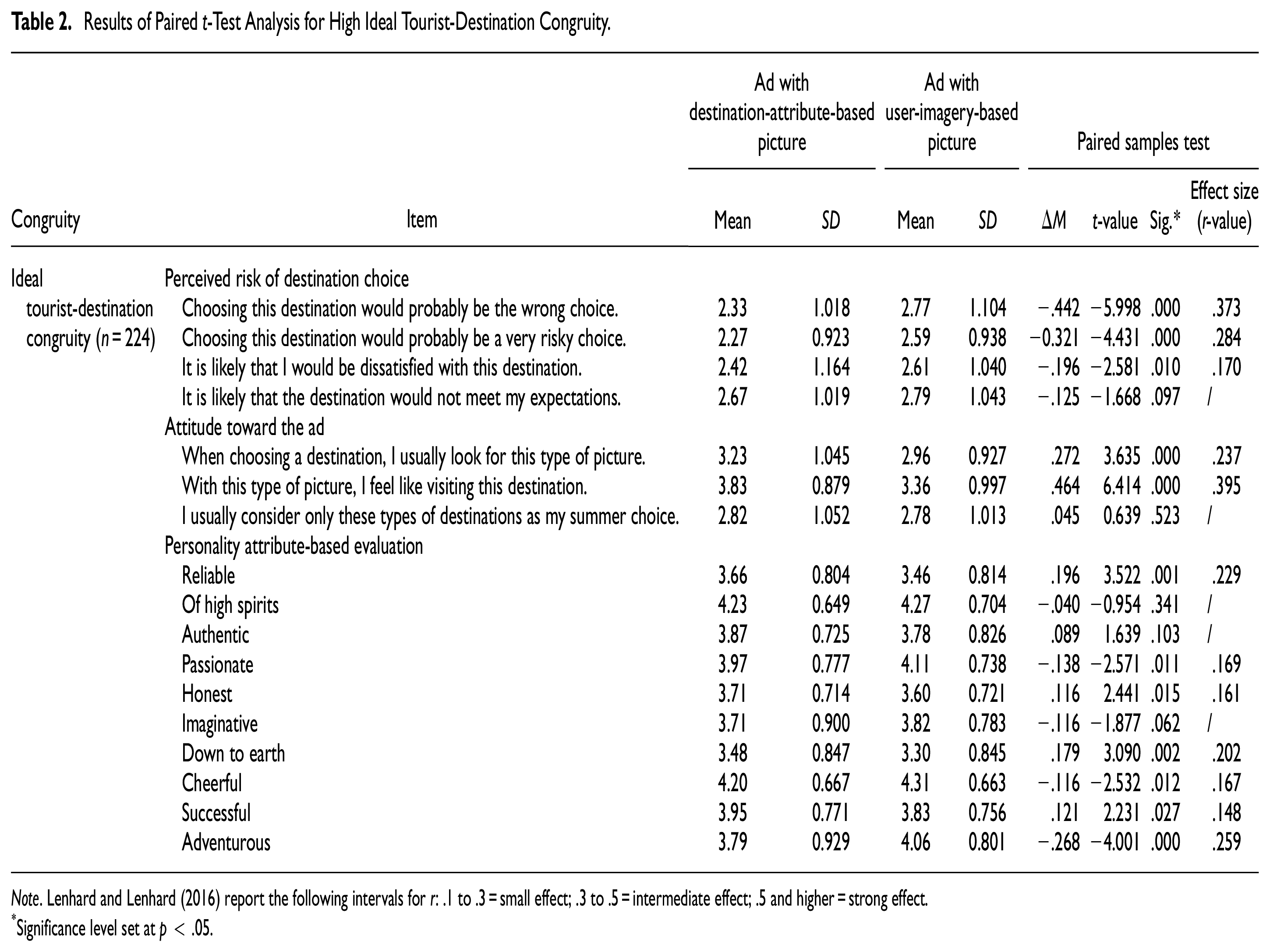
The results of paired t-tests used for testing the hypotheses related to differences in perceived risk of purchase and attitude toward ads for a group exhibiting high ideal tourist-destination congruity (H3a and H4a, respectively) are presented in Table 2.
Results of Paired t-Test Analysis for High Ideal Tourist-Destination Congruity.
Note. Lenhard and Lenhard (2016) report the following intervals for r: .1 to .3 = small effect; .3 to .5 = intermediate effect; .5 and higher = strong effect.
Significance level set at p < .05.
The findings show that using destination-attribute-based pictures and thus leaving the respondents to match how they would like to see themselves by freely imagining what a typical tourist to the destination would look like produces a significantly lesser risk of wrong and risky destination choice than when using user-imagery-based pictures. Our results show that the destination choices would be risky and wrong when people rely on the ad with a user-imagery-based picture. Similarly, the same ad is likely to result in dissatisfaction. The effect size results reveal that the first two findings are substantial in real terms, contrary to statistically significant but relatively unimportant findings on dissatisfaction due to the small effect size.
Moreover, the results show that the ad with a destination-attribute-based picture elicits significantly more positive attitudes than a user-imagery-based picture. More specifically, when respondents were left to match how they would like to see themselves by freely imagining what a typical tourist to the destination would look like instead of being shown the idealized tourist, their wish to visit the destination was significantly higher. The effect size is intermediate, revealing that this finding is substantial. Moreover, another significant result suggests that when decision-making evolves around choosing a destination, highly congruent tourists would likely look for ads with destination-attribute-based pictures.
To further understand why these results contradict our hypotheses (H3a and H4a, respectively), we ran a paired t-test on all 10-item personality attributes. The findings suggested idealized tourists (i.e., a user-imagery-based picture) were more significantly evaluated as passionate, cheerful, and adventurous (see Table 2). On the other hand, typical tourists, whom respondents had to imagine after exposure to the ad with a destination-attribute-based picture, were more significantly evaluated as reliable, honest, down to earth, and successful. By observing ranked means of how respondents would like to see themselves, we found honesty (M = 4.34, SD = 0.740), reliability (M = 4.28, SD = 0.647), and success (M = 4.21, SD = 0.747) among top attributes, corresponding to the same qualities used to establish tourist-destination congruity for the ad with a destination-attribute-based picture.
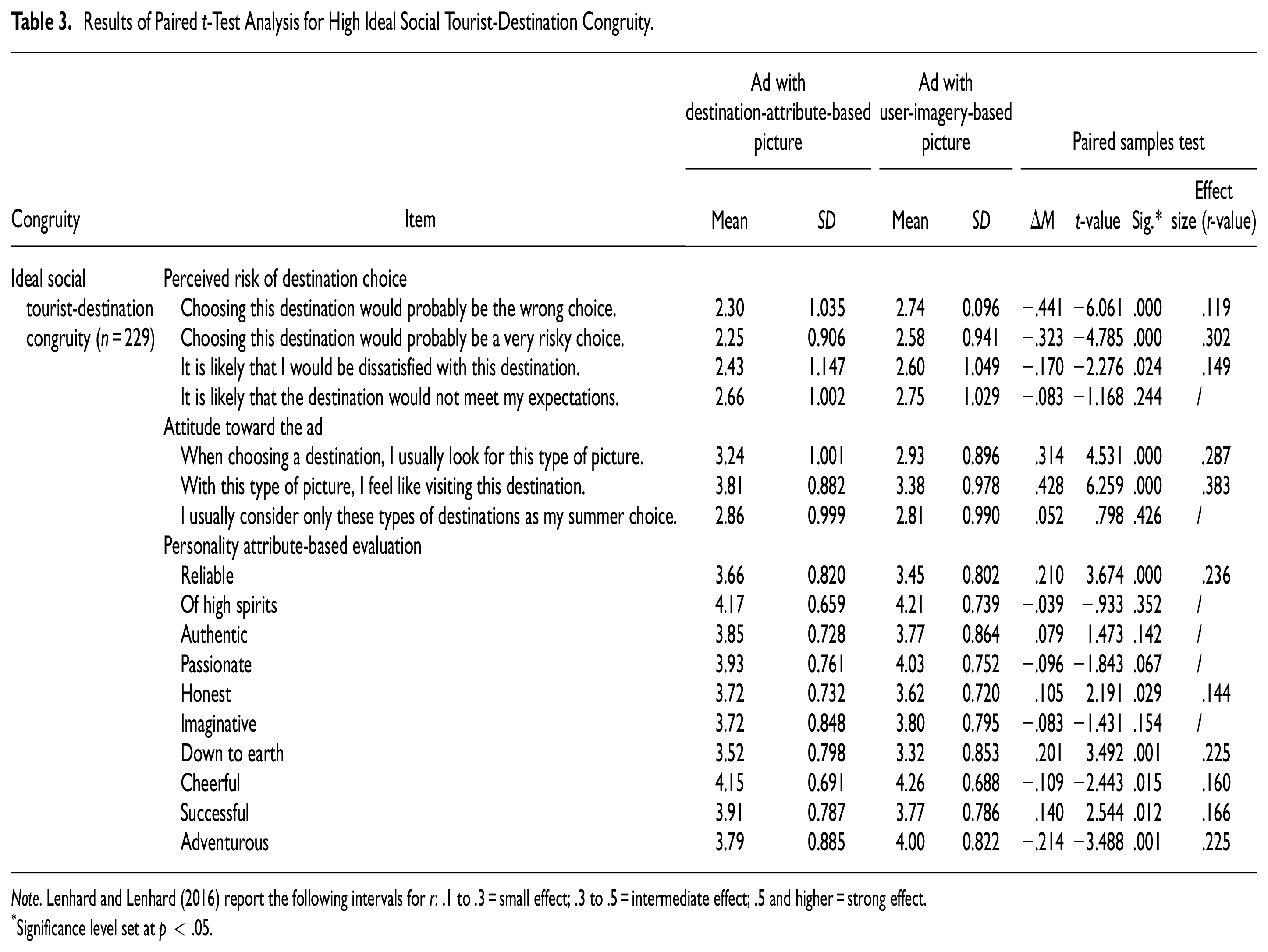
Furthermore, we performed paired t-tests to examine whether a higher degree of ideal social congruity, formed based on the ad with a user-imagery-based picture, would diminish perceived risk and yield positive attitudes toward the ad (hypotheses H3b and H4b, respectively). The results of the performed t-tests are presented in Table 3.
Results of Paired t-Test Analysis for High Ideal Social Tourist-Destination Congruity.
Note. Lenhard and Lenhard (2016) report the following intervals for r: .1 to .3 = small effect; .3 to .5 = intermediate effect; .5 and higher = strong effect.
Significance level set at p < .05.
The findings show that using destination-attribute-based pictures in advertising and thus leaving the respondents to match how they would like to be seen by others by freely imagining what a typical tourist to the destination would look like produces significantly less risky decisions and even diminishes the fear of wrong destination choice. Moreover, the ad with a user-imagery-based picture made respondents think they would probably be more dissatisfied with the destination. In real terms, the finding of one making a significantly riskier decision by choosing a destination, as shown in the ad with a user-imagery-based picture, is substantive due to an intermediate effect size, while other significant findings are trivial due to small effect sizes.
The results show that the ad with a destination-attribute-based picture elicits significantly more positive attitudes than a user-imagery-based picture. More specifically, when respondents were left to match how they would like to be seen by others by freely imagining what a typical tourist would look like, their desire to visit the destination was higher. Moreover, they would likely look for ads with destination-attribute-based pictures when deciding which destination to choose for their next holiday. The findings are significant, with effect sizes being small to intermediate. However, they do not support our hypotheses (H3b and H4b, respectively). Repeating the same procedure as previously, we run a set of paired t-tests to understand better whether there is a potential clash in user imagery. The findings reveal that the idealized tourists portrayed in the ad with a user-imagery-based picture were evaluated as cheerful and adventurous. In contrast, the typical tourists were considered reliable, honest, down-to-earth, and successful. Being honest (M = 4.42, SD = 0.634) and reliable (M = 4.37, SD = 0.660) are two personality attributes that top the list of how respondents would like to be seen by others.
At first glance, our results do not appear to support our hypotheses (H3 and H4) that a higher degree of ideal and ideal social tourist-destination congruence would lower one’s perceived risk of purchase and yield positive attitudes for the ad with a user-imagery-based picture as opposed to the ad with destination-attribute-based picture. However, the present results are consistent with the findings of Sirgy and Su (2000) and Ahn et al. (2013). They suggested that the tourist-destination congruity formed based on destination attributes was shown to affect one’s behavior more significantly than the congruity formed based on user imagery, as indicated by Hung and Petrick (2011).
Moreover, the above findings show that the elements of user imagery need significant consideration when destination marketers wish to align one’s ideal and ideal social self with a typical destination visitor when one is included in the advertisement. With advertising aiming at persuading more tourists to visit the destination (Kim et al., 2014), well-thought alignment of the idealized tourist with the self-image of a target population plays a pivotal role in maximizing advertising effects (Phau & Lau, 2000). However, our findings reveal that the idealized tourist from the ad with a user-imagery-based picture only resembled a typical tourist to a certain extent, which opened space for a potential clash in user imagery. On the contrary, when respondents were asked to imagine the typical tourist using stimuli from the ad with a destination-attribute-based picture, the personality attributes of the imagined tourist topped the list of their ideal and ideal social self. Therefore, for destination advertising to be effective, ads with user-imagery-based pictures must demonstrate a substantial resemblance to the target audience (Kamin, 2013). This study shows that advertising that presents tourists with tangible benefits in the form of destination attributes will undoubtedly significantly affect tourists’ decision-making (Yoon & Kim, 2016). This is because characteristics such as honesty, reliability, and success may be more challenging to portray in the advertisements for summer holidays than being adventurous, cheerful, and passionate.
Conclusion
This study is informed by the congruity theory, which to this point, predominately neglected the role of advertising in the tourism literature (Bilim & Yüksel, 2008; Hung & Petrick, 2011; Jenkins, 2003; Yoon & Kim, 2016). Results showed that individuals develop a high match between their ideal and ideal social self and destination advertising. Moreover, findings also demonstrated that destination advertising affected tourism-related behavior by diminishing the perceived risk of destination choice and yielding positive attitudes toward ads. Such results testify that congruity studies in tourism have long neglected the role of destination advertising and that future studies should consider the latter as an essential enabler of tourist-destination congruity.
Based on the ad-elicited tourist-destination congruity, we distinguished between the ideal and ideal social congruity and between low and highly congruent groups. Furthermore, the study demonstrated that if tourists feel that destination advertising represents how they would like to see themselves and how they would like to be seen by others, they will more likely choose that destination for their summer holiday. These findings also suggest that the communication between advertisers and target audiences would be more effective when ads with user-imagery-based pictures substantially resemble the latter. Finally, the results give destination managers tools for more effective communication with the target audience because they imply advertising messages’ design, creation, and transmission.
Moreover, it is crucial to carefully select how the destination will be depicted through idealized tourists to establish a greater match between potential tourists and the destination. The results showed that matching tourists with destinations could be intensified if personality attributes, as conveyed in user-imagery-based pictures, are similar to those of the tourists. Moreover, if tourists match how they would like to see themselves and how they would like to be seen by others to user imagery, they will feel it would be less risky to choose the destination for their next trip. These results are significant when destination managers target those without prior experience with the destination. If potential visitors would feel like the visual advertising message matches how they would like to be seen by others or how they would like to see themselves, it is more likely that they would be interested in the destination. However, the findings suggest that visual advertising messages should include pictures that feature both destination attributes and typical visitors. Such a combination could increase awareness among individuals who feel that a user-imagery-based picture does not adequately portray how they would like to spend their holidays.
This study is not without limitations, which we wish to discuss as suggestions for future research. Firstly, we used Hieronimus’ (2003) 10-item personality scale, which Boksberger et al. (2011) applied when testing for congruity of cruising passengers. This scale was much less extensive than scales from, for example, Aaker (1997), Ekinci and Hosany (2006), and Malhotra (1981). Therefore, our study might have suffered from the loss of specific personality attributes that would help explain the tourist-destination congruity. Hence, it would be beneficial to replicate the research and see whether the results would be different or richer using other personality scales. Secondly, we focused only on assessing two out of four self-congruity dimensions, thus disregarding actual and social self-congruity. These were predominately used in explaining tourist behavior (Hung & Petrick, 2011, 2012). Maybe the results would differ for the perceived risk of destination choice and attitude toward the ad if these two types were included in the study. Therefore, we suggest that future studies have all four congruity dimensions. Thirdly, the ads included only pictures; hence, we disregarded the influence of the advertisement’s copy. The copy’s inclusion might result in different findings. Also, the pictures only showed a sun and sea destination, disregarding other destinations and tourist activities. Future studies should also explore different contexts, such as other outdoor activities in urban, rural, and winter destinations (e.g., sightseeing, cycling, skiing) and those specific to a culture or health-dominated destinations (e.g., visiting a museum or spa activities). Fourth, we limited ourselves in generalizability and cross-culture comparison by focusing only on young Slovenians aged 18 to 35. As such, we limited the perspective of this study to a small segment. Future studies should explore other segments (e.g., families, business travelers, solo travelers), different age groups (i.e., senior travelers), and geographical locations (e.g., travelers from Asia, the Americas, Africa, and other European countries). Lastly, our results uncovered a congruity measurement bias, which was also observed by Boksberger et al. (2011): the congruity measurement based on the gap-scoring formula can profoundly affect the percentage of reported congruity, that is, the percentage of those deemed as highly congruent and those deemed as low congruent. To corroborate, in case we would choose to report on the results using a less-strict threshold than the value of 1.0, the percentage of those highly congruent members could increase up to 80% or even 90% (in the case of the threshold at value 1.4 and 1.6, respectively). In contrast, a stricter threshold at the value 0.4 would result in more dispersed groups of those developing higher tourist-destination congruity, ranging from 10.5% to 12.7% for the ad with user-imagery-based picture, ranging from 14.5% to 16.1% for the ad with destination-attribute-based picture. This observation leaves more room for other studies to report congruency using the gap-scoring formula.
The above results allow marketing managers to influence the destination selection process by incorporating destination-attribute-based and user-imagery-based pictures in advertisements. To maximize the effectiveness of destination advertising, marketing managers should develop pictures in which a typical representative of the destination visitor will resemble the potential tourist as much as possible to establish greater tourist-destination congruency.
Supplemental Material
sj-doc-1-jtr-10.1177_00472875231168621 – Supplemental material for Exploring the Role of Advertising in the Context of Tourist-Destination Congruity
Supplemental material, sj-doc-1-jtr-10.1177_00472875231168621 for Exploring the Role of Advertising in the Context of Tourist-Destination Congruity by Tina Šegota in Journal of Travel Research
Footnotes
Acknowledgements
The author wishes to thank professors Zlatko Jančič and Mihael Kline from the Faculty of Social Sciences at the University of Ljubljana in Slovenia for their support.
Declaration of Conflicting Interests
The author declared no potential conflicts of interest with respect to the research, authorship, and/or publication of this article.
Funding
The author received no financial support for the research, authorship, and/or publication of this article.

Supplemental Material
Supplemental material for this article is available online.
Author Biography
References
Supplementary Material
Please find the following supplemental material available below.
For Open Access articles published under a Creative Commons License, all supplemental material carries the same license as the article it is associated with.
For non-Open Access articles published, all supplemental material carries a non-exclusive license, and permission requests for re-use of supplemental material or any part of supplemental material shall be sent directly to the copyright owner as specified in the copyright notice associated with the article.
