




Abstract
In this paper, the theoretical framework of the Stereotype Content Model (SCM) was applied in the context of a host country promoting its tourism to new or underdeveloped markets. The host country’s perceived Warmth, Competence and Status were each relevant to an understanding of the attitude toward the country itself and as a tourism destination. However, in both instances, the influence of perceived Status was found to be direct and not, as existing SCM theory suggests, via Competence. The findings support Status being a primary dimension of human perception alongside Warmth and Competence within SCM theory. Warmth evaluations also dominated the prediction of Tourism Attitude but not Country Attitude, again contrary to established thinking. The influence on Tourism Attitude of both Uncertainty Avoidance and Individualism/Collectivism were moderated by the perceived Warmth and Status of the host country. Thus, the SCM requires adaptation to the context of tourism in underdeveloped markets.
Keywords
Introduction
Potential tourists can be influenced by the intangible or affective associations they have of a potential destination or “host” country; for example, whether they see that country as welcoming or prestigious (C. C. Chen et al., 2013; De Nisco et al., 2017; Elliot & Papadopoulos, 2016; Lindblom et al., 2018). While the COVID-19 pandemic has had a substantial effect on both tourism and investment in the sector, countries have continued to spend large amounts on promoting their attractions as tourism destinations (World Travel and Tourism Council, 2021). One problem for practitioners is how to approach the issue of building affective associations with the host country within markets with a limited history of travel to that country. In the empirical work that follows, the focus is on the host country of Canada and how it is seen by potential travelers in three countries in South America, Argentina, Chile and Ecuador, from which Canada has historically received few tourists.
Generally, in any consumer market, managers often concentrate on their main existing customers at the expense of those in underdeveloped or new markets. But the logic of doing so, based on the belief that a minority of users will continue to account for the majority of revenue, has been challenged as short sighted (Sharp & Romaniuk, 2016) because growth can often be obtained by opening up new or previously underdeveloped markets. Consequently, many marketers have chosen to do so in search of expansion (Sinha & Sheth, 2018). The same may be happening in the marketing of tourism. Toward the end of the pandemic, the logic of concentrating more on developing markets has been championed, as growth in their prosperity has led to a greater interest in international tourism (European Commission, 2022). In the tourism literature, research has mainly concentrated on how developing countries can build their own tourism industries (e.g., Ageeva & Foroudi, 2019; Sasidharan et al., 2002) rather than on how such markets can become sources of tourists for developed nations. There are some existing studies on how individual developing country markets might be segmented (e.g., Jin & Wang, 2016), but few insights are available on how to address such markets holistically.
Here our focus is on how tourism from developing countries to a distant developed country can be increased via the promotion of affective imagery. One question in this context is which aspects of a country’s intangible imagery should be emphasized when communicating to potential travelers to influence how they perceive the potential host country overall and as a tourism destination, particularly given that many in the target audience would have little knowledge of the host country as a destination. Measures of affective country imagery suggest the construct has multiple dimensionality. For example, Rojas-Méndez et al. (2013) have identified seven and d’Astous and Boujbel (2007) six dimensions of country affective image. Few clearly overlap, implying that both researchers and managers should consider many image dimensions, which is difficult from a practical perspective. Indeed, there is no theoretical or practical limit to the dimensions which might be or become relevant, as marketers are constantly finding new ways to extend the appeal of their brands, and there is no guarantee that every dimension identified in prior work will be valid in all contexts.
In contrast, the Stereotype Content Model (SCM) of impression formation argues that there are a limited number of dimensions that are generally relevant to the context of attitude formation when individuals have limited prior knowledge of the target (Cuddy et al., 2008; Davies et al., 2018; Kervyn et al., 2022). The SCM has been used in the context of the stereotyping of tourists from specific countries (Tung et al., 2020) and to explain travel intentions to familiar destinations (Davies et al., 2018; Micevski et al., 2021). But the model and its associated tenets have not been validated in the context where it could be most useful, that of a host country and new or underdeveloped markets. The SCM could be relevant here because it concerns how people form their initial impressions of any entity with humanistic associations, including a country (Kervyn et al., 2022). Its potential practical value is based on the idea of the primacy of just two or three image dimensions, since these are, the theory argues, used automatically by all humans when first assessing someone or something they are unfamiliar with. Our aim is to build upon existing work that has applied SCM thinking to tourism issues (Davies et al., 2018; Kervyn et al., 2022; Micevski et al., 2021; Tung et al., 2020) and assess its potential relevance to the expansion of previously new or underdeveloped international markets by a host country. We also aim to test aspects of SCM theory that prior work has not fully considered within such a commercial context. The intended contribution to the literature is to extend our understanding of when and why the SCM can be applied to tourism marketing and what adaptations to the original model might be needed when doing so.
Specifically, we will illustrate that the three aspects of country imagery the SCM considers—Warmth (e.g., how hospitable and sociable a country might appear), Competence (how enterprising and determined it might appear) and Status (how elegant and sophisticated it might appear)—can each be relevant to understanding the attitude toward the country, both overall and as a tourism destination. We will show that the original SCM thinking may need adaptation, as a country’s perceived Status can directly influence both attitude toward the host country and toward visiting it, and not via Competence, as previous thinking contends (Cuddy et al., 2008). Furthermore, we will argue that Warmth judgments do not necessarily hold the primacy that work within the context of human-to-human interaction claims (Cuddy et al., 2013). Finally, we will show the additional benefits of developing both Warmth and Status associations because of their moderation of the negative effects of two personal dimensions—Uncertainty Avoidance and Individualism/Collectivism—that prior work has shown to influence attitudes toward tourism (Matzler et al., 2016).
First, we will review the literature which has applied the SCM or its extensions to how commercial entities are perceived and derive several hypotheses. These will then be tested in a study of the appeal of Canada as a country and as a tourism destination in the South American market. We will then discuss how our findings might be used to develop SCM thinking. Finally, we will discuss how our work supports the value of the SCM to tourism marketing in general.
Literature Review and Hypotheses
Prior research has demonstrated a strong relationship between the image of a country and consumer attitudes and behavior toward it (Govers et al., 2007; Magnusson et al., 2019; Tasci & Gartner, 2007). Here we adopt and test both the framework as developed by Davies et al. (2018) from the original SCM (Cuddy et al., 2008, 2009; Fiske, 2018) and its application to how branded entities are perceived (Kervyn et al., 2012, 2022).
The original SCM (Fiske et al., 2002) theorized, in the context of human-to-human interaction, that early humans needed to recognize certain traits in others upon initial contact (e.g., their Warmth and Competence) to maximize their own chances of survival. Consequently, that same predisposition to assess others became genetically programed into modern humans and is used by them automatically to assess other humans and groups of humans without realizing why. Warmth represents the perception of a stranger’s intent to either harm or help, while Competence represents the perception of the stranger’s capacity to act on that perceived intention. Empirical evidence demonstrates that the dimensions of Warmth and Competence are relativity stable across cultures (Cuddy et al., 2009; Fiske, 2011). In the original theory, judgments of the others’ Status (their prestige and standing in society) are also argued as relevant but only to inform the Competence evaluation (those with higher Status being assumed to be more competent).
The SCM has been extended and widely used to help explain attitudes and behavior toward entities other than humans (Kervyn et al., 2012, 2022), including both organizations (Aaker et al., 2010) and nations (Cuddy et al., 2009; Halkias et al., 2016). Such work argues that Warmth and Competence judgments are applicable to these contexts because both organizations and countries have strong humanistic associations. There is a growing interest in applying the SCM both to understand destination image (Shen et al., 2019) and in guiding tourism management and marketing (Micevski et al., 2021; Tung et al., 2020).
The SCM is specifically relevant in the context of influencing tourism from countries where there is no or a limited history and experience of travel to the host country for several reasons. First, the SCM emphasizes the initial judgments that individuals make (in this case, when the individual has no experience of the country they are being asked to consider). Second, there is the potential impact of how the individual wishes to be seen within their social group. The SCM suggests that since we are conscious of ourselves being evaluated by others in terms of our own Warmth, Competence and Status, it follows that we will need to learn what allows us to signal such attributes to others and to do so positively (Huber et al., 2018). When doing so, we can use branded entities, including our chosen tourism destinations, to manage our personal image (Huang et al., 2017). Consequently, we evaluate tourism destinations in terms of their congruence with how we wish to be seen (Huber et al., 2018). When doing so, more costly signals are more effective (Connelly et al., 2011). As international tourism can be a relatively expensive purchase, the destinations we choose to visit can then be expected to influence how we expect to be seen and how we see ourselves (Huang et al., 2017).
Initial Warmth and Competence judgments are often stereotypical judgments made, for example, by assuming the new entity is similar to one which is known to the individual. One implication from SCM thinking for those marketing destinations is that, since Warmth, Competence and Status judgments are made automatically upon first contact, tourism entities (including countries) need to ensure that they provide information which allows the individual to make such evaluations and to do so positively (Davies et al., 2018) so as to avoid any negative stereotyping. However, does the image of a country’s Warmth, Competence and Status actually influence such judgments? As the image of a country has been found to influence attitude toward both the country and to it as a tourism destination (Magnusson et al., 2019) we hypothesize:
Should each of the three dimensions within the SCM prove to be positively and significantly related to both outcomes in the presence of the other two and among citizens of countries with no tradition of tourism to the host country, then the core of SCM thinking would be shown to be relevant to that context.
Next, there is a need to test and possibly to adapt aspects of the original SCM thinking when it is applied to settings other than human-to-human interactions (Davies et al., 2018). One issue that requires examination in applying the SCM to contexts such as tourism is the role of any Status evaluations of the tourism destination. The relevance of Status or prestige to vacation travel has been highlighted in prior work (L.-H. Chen et al., 2021; Riley, 1995), as involvement in high-Status tourism can enhance the self-perceptions of the traveler (Seo et al., 2021). Countries may seek to enhance their prestige in the world for many other reasons (Wood, 2014) and prestige/Status is widely recognized in measures of brand image (Davies et al., 2018). However, it is unclear whether an image for prestige/Status can be expected to influence attitudes toward a country and toward tourism to that country directly or indirectly by enhancing perceived Competence in initial evaluations.
The original SCM recognizes Status, but only as an antecedent to judgments of human Competence (Fiske et al., 2002). In other words, it holds that judgments of the relative Competence of an individual or a group are based substantially on judgments of their relative Status. Davies et al. (2018), however, argue that Status should be put on the same level as Warmth and Competence in their extended version of the SCM when applied to branded entities, including countries. They argue that recognizing the Status of potential significant others, for example, would have been a survivalist asset (see also Turke & Betzig, 1985; von Rueden & Jaeggi, 2016) and demonstrate empirically that Status evaluations make a contribution to predicting attitudes toward a country which are independent of Competence. In summation, the original SCM sees Status associations as contributing to any overall evaluation but only via Competence—that is, mediated by Competence—while others see its contribution to an overall evaluation as being direct. If the influence is direct, then practitioners must consider promoting Status associations. If its effect is mediated by Competence, then it may be better to promote Competence associations directly without promoting Status. Following the original SCM thinking that the role of Status judgments is to inform Competence evaluations (Fiske et al., 2002), we then propose to test whether:
The alternative view is that Status evaluations will make their own independent and direct contribution to the evaluation of a nation and its tourism. Promoting Status associations would then be inherently useful, and not just to help promote Competence evaluations.
A second issue is that SCM theorists argue for the pre-eminence of Warmth judgments, as they appear to be made first and are consequently more important in the context of human judgments than Competence judgments and, by inference, Status judgments (Cuddy et al., 2013). Warmth judgments are considered more important from an evolutionary perspective because having a keen understanding of a person’s Competence is not as relevant if you already know that they mean you no harm (Fiske et al., 2007). If Status evaluations are only relevant to an assessment of Competence (Fiske et al., 2002), Warmth evaluations will also have primacy over Status evaluations. The data analysis of Davies et al. (2018) suggests this generalization may not apply within a business-to-human context. However, there are contrary views suggesting the predominance of Warmth evaluations in research on consumer purchasing, including tourism. Motsi and Park (2020), for example, have suggested that it is more likely that people will visit countries where locals are perceived as amicable and trustworthy (measures of Warmth), and that the Warmth dimension alone is adequate to promote tourism. H. Lee et al. (2020) found that evaluations of a country’s Competence and Warmth positively affect purchase intentions for products from that country, but that the more significant influence stems from that country’s Warmth associations. Kull et al. (2021) discovered that Warmth-based messaging was more influential than Competence-based messaging for a new travel brand. Taking the view from Cuddy et al. (2013) that Warmth evaluations dominate overall evaluation in the current context implies:
If H3 holds, then promoting Warmth associations to new markets should take priority.
Indirect Effects on Tourism Attitude
Thus far, we have mainly considered the direct effects of the three aspects of country imagery derived from the SCM on Tourism Attitude. However, country image can also have indirect and beneficial effects by moderating the influence of other factors that might reduce tourism intentions. Prior work has recognized the relevance of culturally related variables in explaining different attitudes toward countries and tourism (Lindblom et al., 2018; Pan, 2019). To test for any indirect effects from country imagery, we considered two dimensions of an individual’s personal characteristics that have been particularly associated with tourism in prior studies: the Uncertainty Avoidance and Individualism/Collectivism of the potential traveler (Khan & Fatma, 2021; Matzler et al., 2016; Meng, 2010; Moreno et al., 2013; Sabiote et al., 2013). First, we explain and hypothesize from earlier studies why and how both can influence Tourism Attitude. Then, we draw upon existing literature and theory to hypothesize how specific aspects of country image influence such outcomes. By doing so, we aim to develop SCM theory. We also use direct measures of respondents’ Uncertainty Avoidance and Individualism/Collectivism (rather than infer these from country-level data).
Uncertainty Avoidance is defined as the level of stress that an individual or society exhibits in response to an unknown future (Hofstede, 2001, 2011). Individuals with high Uncertainty Avoidance have a greater need for structure (Doney et al., 1998). Low Uncertainty Avoidance promotes a belief that individuals influence their own lives, while high Uncertainty Avoidance is associated with the belief that individuals are vulnerable to external forces (Hofstede, 2001).
Matzler et al. (2016) suggested that Uncertainty Avoidance correlates positively with tourism intentions, although their study considered avoidance as a country-level variable. Our explanation at the individual level is that international tourism represents a structured experience, subject to rules and regulations, such as the need for a visa, the likelihood of organized group travel and of visiting specific locations, the need to book flights and travel ahead of time and generally the need to plan ahead. Those individuals with high Uncertainty Avoidance typically like rules, laws, and regulations (Hofstede, 2001). The Uncertainty Avoidance of the individual can then be expected—both based on theory and limited prior work (Matzler et al., 2016)—to be relevant to the tourism intentions of that person and for that effect to be positive, implying:
Those marketing countries need to be conscious of such attitudes and, if H4 holds, consider how to use their marketing to reduce the effects of low Uncertainty Avoidance to attract those who do not value being organized and who dislike adhering to rules and schedules. Less structured holidays, such as living with a remote tribe (Stasch, 2014) or backpacking (Wantono & McKercher, 2020), might appeal to those who value informality and who are more comfortable with uncertainty. On the other hand, marketers could appeal to those who value structure by promoting “package” holidays which can reduce potential travelers fears (H. J. Lee & Wilkins, 2017) because they offer greater security and protection (Major & McLeay, 2013). Alternatively, and more relevant to our work, a country can promote those aspects of its imagery that might reduce the effects of low Uncertainty Avoidance by promoting the Warmth of the host country. Warmth as an attribute is associated with being willing to help, and with cooperation, kindness and morality (Kervyn et al., 2015). Consequently, increasing the perception of a country’s Warmth should reduce the adverse effects of low Uncertainty Avoidance on international Tourism Attitudes. We thus propose:
Collectivism and Individualism can be seen as opposing characteristics. Individualistic cultures typically emphasize the need for people to take care of themselves, with an emphasis on independence, individual initiative and achievement. In collectivist cultures, there is likely to be a stronger connection between the person and their extended family and the greater society. The emphasis there is on interdependence, group success and belonging (Hofstede, 2001, 2011). Prior work has shown a more positive attitude among collectivist cultures toward group travel (Meng, 2010) and toward international tourism in general (Matzler et al., 2016). On the other hand, Individualism has been associated with a “new type” of tourism (Voase, 2007), such as the type we mentioned earlier of living with a remote tribe (Stasch, 2014). Individualism and Uncertainty Avoidance have been found to correlate (Jang et al., 2018), with individualists showing a preference for less, rather than more, structure. Mainstream international tourism would be regarded as a more collectivist than individualist activity (Meng, 2010), with individualists preferring experiences that they themselves can create. Consequently, from theory and prior work, we postulate:
If H6 holds, those marketing tourism should consider how to promote more positive attitudes among individualists. Individualism has been shown to interact with brand image in determining outcomes (Frank et al., 2015) and can moderate the effect of brand imagery on tourism intentions (Matzler et al., 2016). However, individualists have been found to be attracted to luxury, that is, higher Status brands, as they allow them to display their individuality (Bian & Forsythe, 2012). Consequently, we can expect that the higher the Status of a destination country, the more attractive it may be to the individualist. So, promoting that aspect of a country’s image can be expected to sway those with such characteristics toward that country as a destination. Potentially, the Status or prestige of the host country can then be expected to act as a moderator of the expected negative relationship between Individualism/Collectivism and tourism intention (H6). Consequently, we propose:
Methodology
Empirical Context
The context of promoting tourism to Canada (as a host country) in South America (an underdeveloped market for international tourism outside of the region) represented an opportunity to test our hypotheses. Tourism is a major source of income for Canada, but its visitor numbers are dominated by those from the USA, who provide 78% of the total (Statistics Canada, 2021a). Visitors from South America represent less than 1.5% of all travelers (author’s calculations from Statistics Canada, 2021b) and the country has not focussed on markets further south than the USA other than Mexico (Destination Canada, 2022). Individuals in South American markets are thus likely to be particularly influenced by any stereotypical perceptions they might have of Canada’s Warmth, Competence and Status.
Data Collection
To reduce the possibility of extraneous influences, due for example to media comments about Canada in one market, data were collected in three different South American countries several months apart. We selected three countries that together represent only 0.33% of the tourists received by Canada: Argentina (0.14%), Chile (0.15%) and Ecuador (0.04%) (UN World Tourism Organization, 2020). As these countries become more affluent, international tourism can be expected to expand (European Commission, 2022), making them more attractive as markets for host countries such as Canada. One issue is how best to communicate with potential tourists in such markets.
Three measures were adapted from Rojas-Méndez et al. (2013): overall attitude toward Canada (four items) and attitude toward tourism to Canada (five items), each evaluated using five-point Likert scale items ranging from “1 = strongly disagree” to “5 = strongly agree”. Country brand image traits (five items for each of the tree dimensions) were evaluated on the same five-point scale. A five-item measure of individual Uncertainty Avoidance and a six-item measure of Individualism/ Collectivism were taken from Yoo et al. (2011) and each assessed using a five-point Likert scale from “strongly disagree” to “strongly agree.” Measures of respondent age, gender and education were included as potential control variables, as each has proven relevant to tourism in previous work (Li et al., 2020) together with prior experience of visiting Canada. All questions were in Spanish (scale items are provided in English in the Appendix).
The sampling strategy was to focus on younger, more educated and affluent respondents (those more likely to become involved in foreign travel). Due to the difficulty of access, the same respondent-driven approach was adopted (Heckathorn & Cameron, 2017) for each market. Part-time students studying for an MBA at a university in each country were asked to recruit their contacts to the study. Responses with high levels of missing values were excluded from the analysis, as were responses from those (few) who had visited Canada. The final sample consisted of 593 respondents: 198 from Chile, 181 from Argentina and 214 from Ecuador. Forty-eight percent of the sample were male, 71% were aged between 18 and 35 and 69% had achieved an undergraduate degree or higher. (This compares with 38% of adults being aged 18–35 across the three countries and 18.5% having university degrees (author calculations from published sources, e.g., UNESCO (2022)).
Cronbach’s alpha and Composite Reliability (CR) were used to assess each individual scale together with Average Variance Extracted (AVE). All measures met the criteria for Cronbach’s alpha and CR. The AVEs for Uncertainty Avoidance and collectivism were below the expected figure of 0.5 (Fornell & Larcker, 1981) but comparable with those in the original paper (Yoo et al., 2011) and thus acceptable in the context of high values for CR (Fornell & Larcker, 1981).
Findings
The Stereotype Content Model
The ability of the perceived Warmth, Competence and Status of the country to predict respondents’ overall attitude toward it was tested using hierarchical regression. We first controlled for age, gender and education, before testing the three image dimensions’ abilities to predict the same dependent variable (Table 1).
Models to Predict Country Attitude (Final Adjusted R 2 = 0.301).
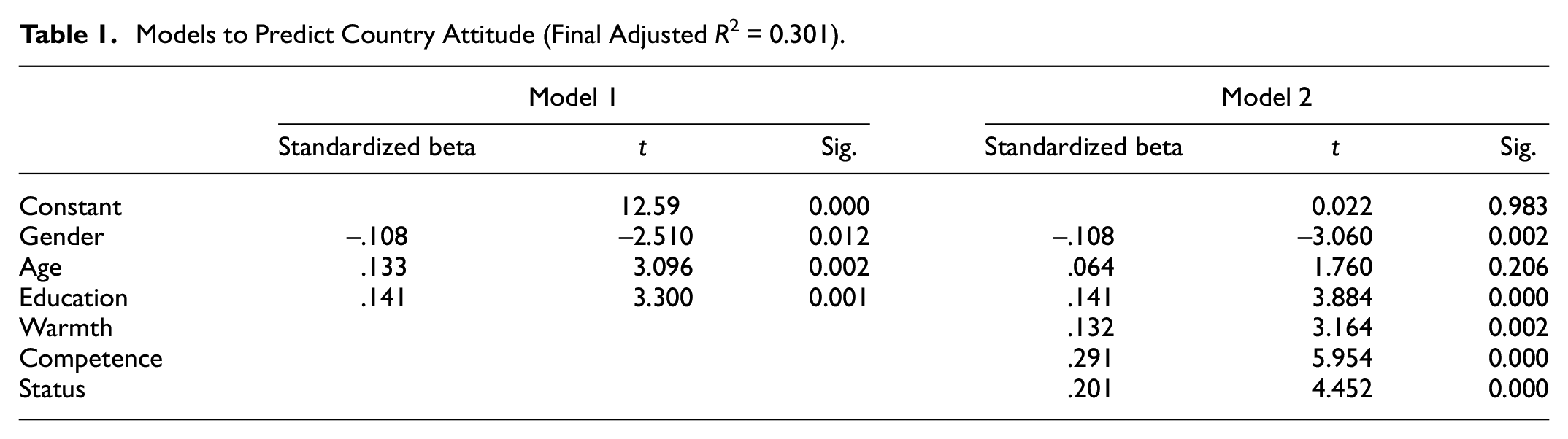
All three dimensions of country image made a significant contribution to the explanation of Country Attitude. The strongest came from Competence, the weakest from Warmth. Very similar results emerged if no control variables were included.
Somewhat different results emerged when attitude toward tourism to Canada was the dependent variable (Table 2). Warmth was now the most influential of the three image variables and, while each made significant independent contributions to predicting tourism intention, those from Competence were relatively low. Very similar findings were obtained if the three control variables were excluded.
Models to Predict Tourism Attitude (Final Adjusted R 2 = 0.24).
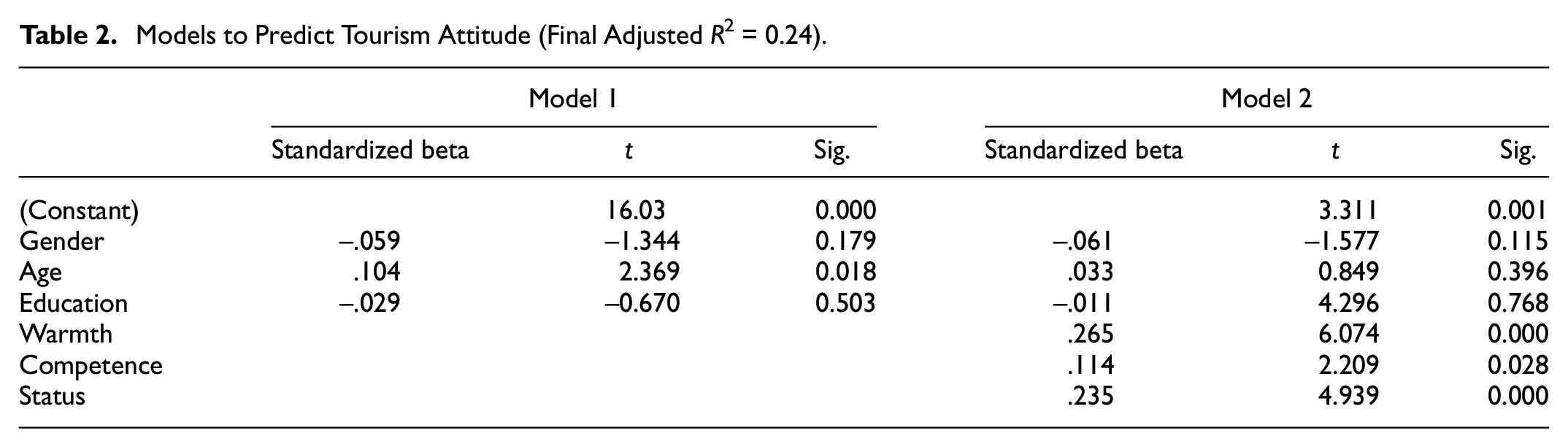
Hypothesis 1, that all three of the image factors will, independently, contribute to predict attitudes toward a nation and toward tourism, was thus fully supported. The generalization that Warmth judgments will predominate in explaining outcomes (H3) was not supported.
Hypothesis 2 concerns the influence of Status evaluations and whether they can be considered to be independent of Competence evaluations, or, because they are used to inform the latter, that their contribution in explaining outcomes (in our context, attitudes toward a country and tourism) is mediated by Competence judgments. To test H2, PROCESS model 4 (Hayes, 2018) was used. Status correlated significantly with both overall attitude toward Canada (see above) and Competence (r = .57, p < .001). When the mediating effect of Competence on the first relationship was tested, there was a significant but partial mediation effect (p < .05; the direct effect of Status on overall attitude remained significant). However, the R 2 figure dropped when the effect of Competence was added, suggesting that this extra complexity did not add significantly to an understanding of the variation in nation image.
To confirm this, a structural equation path model was built, where each of the three image dimensions were allowed to influence Country Attitude directly. The data fitted the model well (Chi2/df = 2.8, CFI = 0.93, RMSEA = 0.054, Hoelter 0.01 = 286). The direct link from Status to Country Attitude was then replaced by a link from Status to Competence. The new model was also a good fit to the data (Chi2/df = 3.2, CFI = 0.915, RMSEA = 0.059, Hoelter 0.01 = 256). However, as the increase in Chi2 from 414.85 to 470.30 with an additional degree of freedom is significant at p < .005, it represents a significant decline in fit to the data. The prediction of the outcome was very similar (Squared Multiple Correlation = .325 vs. .320) but was again better for the original model.
The process was repeated to predict attitude toward tourism. There was a significant correlation between attitude toward tourism and Status (r = .386, p < .001) and between Status and Competence (r = .66, p < .001). However, the impact of Competence on attitude to tourism was not significant when Competence was used as a mediator between Status and attitude to tourism (p = .054). In other words, the influence of Status on attitude to tourism was clearly direct and not mediated by Competence. There was then no support for H2, which states that the effect of Status on either attitude toward a country or its tourism is fully mediated by Competence, and only very limited support for any mediation effect. There was, however, further support for H1, which states that each of the three dimensions can make its own independent influence on both attitudes.
The Effect of Cultural Variables
H4 proposed that Uncertainty Avoidance will correlate positively with attitude toward tourism in a country, and it did so significantly (r = .195, p < .001), in line with prior work where country-level measures of culture were used (Matzler et al., 2016). This implies that those who do not value structure, rules and certainty will have a less positive opinion about, and less positive Tourism Attitude toward, a country; H4 was thus supported. H5 suggests that this influence could be reduced by promoting an image of Warmth for the host country, as Warmth perceptions could be expected to moderate the relationship between Uncertainty Avoidance and specifically Tourism Attitude. This potential effect was tested with PROCESS using the moderation test model 1 within the Hayes macro (Hayes, 2018) and was found to be significant (Table 3), supporting H5.
Moderation of the Effect of Uncertainty Avoidance on Tourism Attitude by Warmth (R 2 = 0.20).
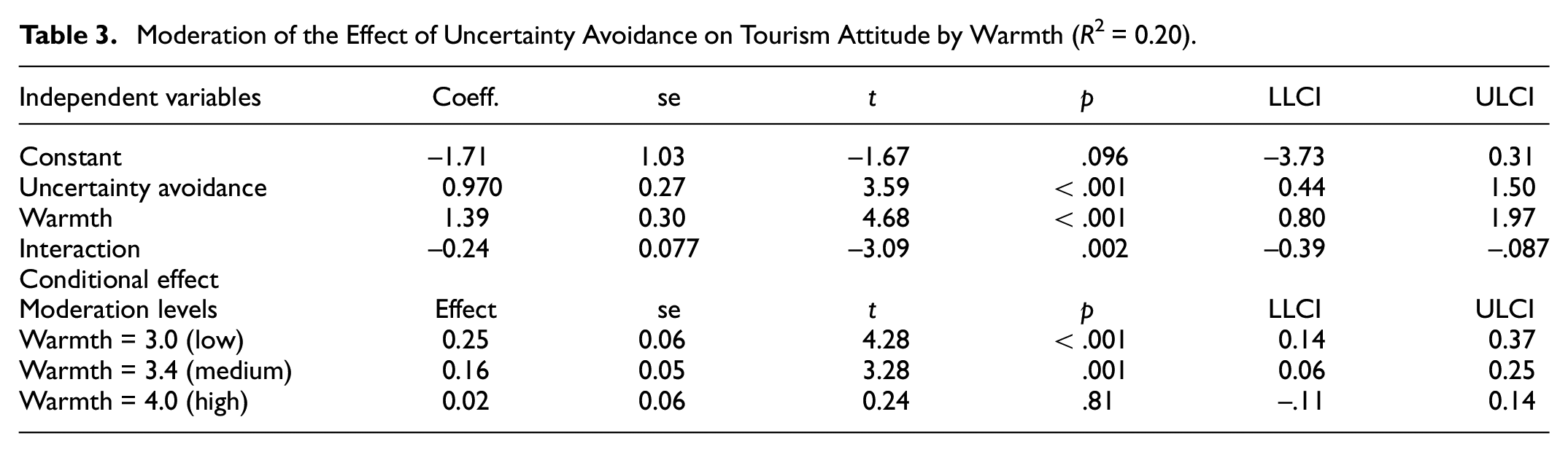
The relationship is shown graphically in Figure 1. As the figure illustrates, while the relationship between Uncertainty Avoidance and Tourism Attitude is overall positive, when the country is perceived to have high Warmth (e.g., cheerful, hospitable) this relationship disappears and attitudes toward tourism remains high and positive irrespective of the individual’s level of Uncertainty Avoidance (the top line in Figure 1). However, when Warmth is medium or low, any increase in Uncertainty Avoidance will cause an increase in Tourism Attitude. Similar results were found when any of the control variables were included. Consequently, increasing the perception of a country’s Warmth should reduce the negative influence of low Uncertainty Avoidance on Tourism Attitude.
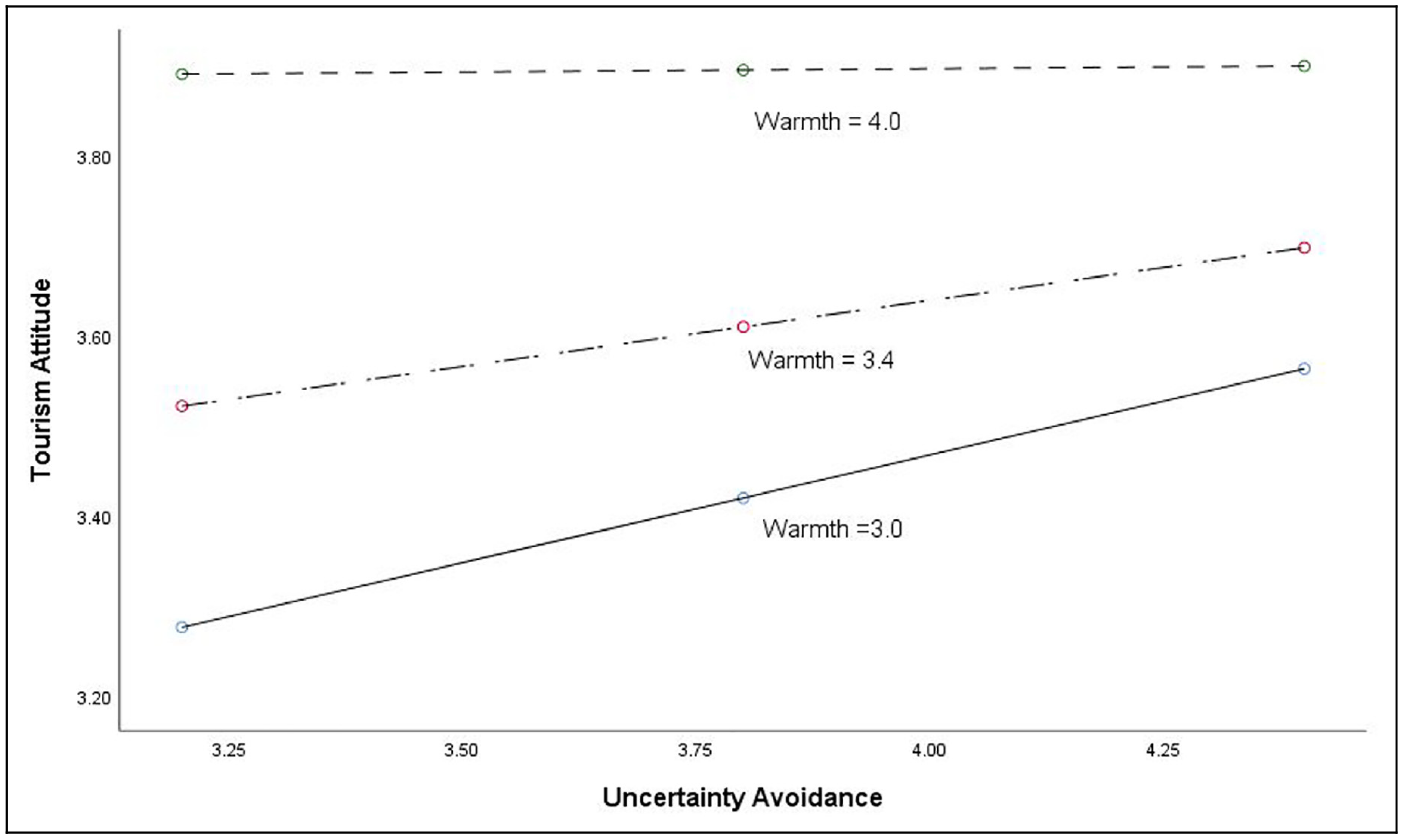
The moderating influence of Warmth on Uncertainty Avoidance–Tourism Attitude.
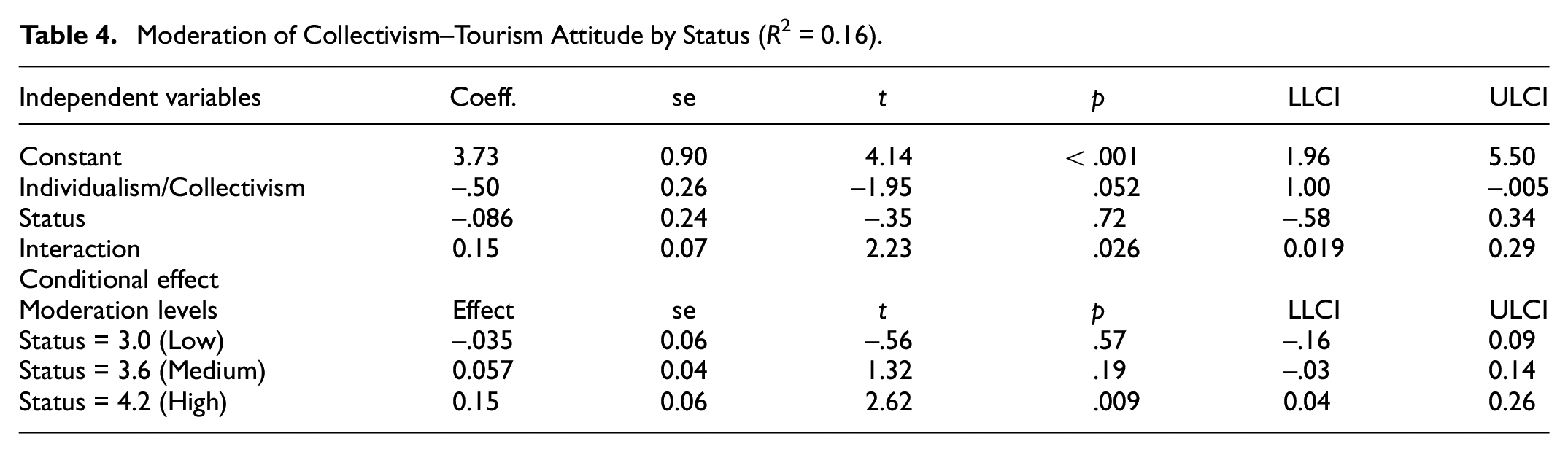
Individualism/Collectivism was also hypothesized to be a potentially negative trait when predicting international tourism (H6). However, no significant correlation was found between Individualism/Collectivism and Tourism Attitude (r = .064, p = .136). The same results held for the data from each country. Nevertheless, whether Canada’s perceived Status might influence this relationship was tested. In the presence of Status as a moderator when there was only a marginally significant relationship (p = .052) between Individualism/Collectivism and Tourism Attitude (Table 4), Status significantly moderated this relationship (p = .026). H6 and H7 were thus both supported. The relationships are shown graphically in Figure 2.
Moderation of Collectivism–Tourism Attitude by Status (R 2 = 0.16).
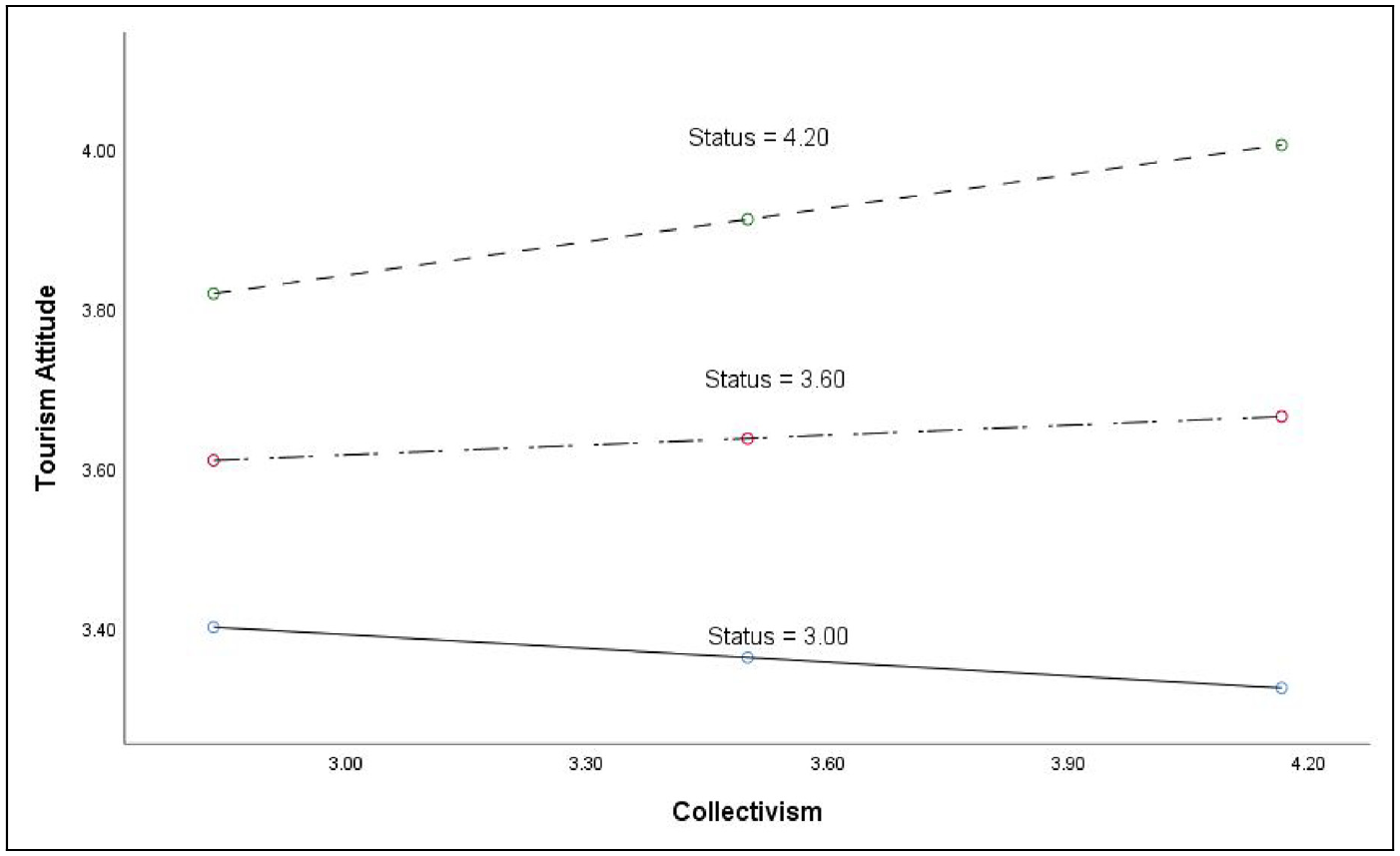
The moderating influence of Status on Individualism/Collectivism–Tourism Attitude.
When the Status of the country was perceived as high (xä = 4.2), Individualism/Collectivism was significantly and positively related to Tourism Attitude (p = .009), but at lower values of Status than xä = 4.2 there was no such relationship. It follows that collectivists will only perceive tourism more positively than individualists when the perceived Status of the country is high. Somewhat surprisingly, increasing the perceived Status of the country improved Tourism Attitude for both those high and low on the Individualism/Collectivism scale. Both H6 and H7 were thus supported but not quite in the way expected.
Discussion and Conclusion
The Stereotype Content Model offers a theoretical basis for their being two or three affective dimensions of how humans perceive other humans (Cuddy et al., 2008; Fiske, 2018) and how humans perceive branded entities (Aaker et al., 2010; Cuddy et al., 2009; Halkias et al., 2016; Kervyn et al., 2012, 2022), particularly upon initial contact. It offers a straightforward framework for researchers and practitioners to use when measuring and understanding such perceptions (Kervyn et al., 2012, 2022). It is compatible with the concept of brand personality (Davies et al., 2018), one of the leading approaches to brand image measurement. It is also particularly relevant to a context where individuals are forming their impressions. However, applying theory derived from human-to-human interaction to the different context of human-to-brand interaction can be expected to have its challenges. One reason to expect differences is because organizations and managers learn how to make individual criteria more or less salient through their marketing (Connelly et al., 2011).
Our intended theoretical contribution is to the application and adaption of SCM thinking to the context of a destination country and potential inbound tourists from a new or developing market. Drawing from prior work (Davies et al., 2018; Kervyn et al., 2022), whether each of the three affective associations—Warmth, Competence and Status—made independent contributions to attitudes toward the host country and toward tourism to it was tested. There was evidence that Warmth, Competence and Status evaluations can be regarded as universally relevant in this context, supporting the extended model of Davies et al. (2018) but countering that of Fiske (2018) and others who argue the relevance of merely Warmth and Competence. Two ideas that are central to the original SCM and the context of how humans perceive other humans or groups of humans were then tested: first, that Status evaluations are used only to inform Competence evaluations when individuals form their initial judgments (Fiske, 2018). The analyses show no support for Competence evaluations fully mediating the effect of perceived Status on Tourism Attitude and Country Attitude. Status made its own independent contribution to an understanding of both attitude toward country and tourism in the presence of Warmth and Competence. This strongly suggests that Status should be seen as a variable of interest in its own right when evaluating the perceptions of those relatively new to an offering—in this case, a country they have not visited. Thus, building Status associations can be expected to promote positive attitudes toward a country and to tourism there not just because they promote an image of Competence. Countering a poor image for Competence by promoting Status associations appears unlikely to be very effective. Instead, Status associations should be promoted to new and underdeveloped markets, as they can be inherently beneficial.
The second tenet of the original SCM tested was the relative role of Warmth. This did indeed provide the most positive explanation of attitude toward tourism but not toward the country, where it was the least effective. Taken together with prior work that has found similar results (Davies et al., 2018) in the context of established markets for both services and tourism, the generalization that Warmth evaluations can be expected to dominate the explanation of outcomes in the context of human-to-brand relationships appears unsafe.
Our main theoretical conclusion is that it could be dangerous to extend all elements of the original SCM to the context of promoting tourism to underdeveloped markets. The idea that Warmth and Competence are universal dimensions of social perception (Cuddy et al., 2008) is neither disputed nor contested by our work. Both were significant in predicting two main outcome variables. However, while we still believe that they represent an excellent starting point for the analysis of the consequences of brand imagery, we would argue that they are not unique as core dimensions, and that perceived Status has the potential to be equivalent in importance in the context of a country’s image and its role in influencing initial attitudes toward tourism. It is evident from this and prior work on country and service image (Davies et al., 2018) that while Status judgments may help inform those of Competence, the two should be seen as more independent than dependent in their effect.
Second, the idea that Warmth judgments dominate overall evaluations (Cuddy et al., 2013) needs revisiting in the context of branded entities. It could be misleading to assume that, when marketing a country and its tourism, potential customers need to be convinced as to the Warmth of the country first and foremost. There is a danger that the value of building Status associations could be ignored when influencing first impressions, as it can have it own direct effect on both attitude toward a country and toward tourism there, as well as act to moderate any effects of Individualism/Collectivism on Tourism Attitude.
The roles of image factors in mitigating the negative effects of both Individualism/Collectivism and Uncertainty Avoidance have not been noted previously. Here high ratings for Warmth meant that the negative effects from Uncertainty Avoidance on evaluations for tourism could be eliminated. High ratings for Status meant that both individualists and collectivists reported similar levels of tourism intention. Both findings also help explain how and why the two image factors of country Warmth and Status work in the context of promoting tourism.
In this study, individual measures of the cultural variables were used. In one case, similar results were obtained to those in previous work which used secondary data measures of the same variables at a country level. In another somewhat different results emerged. This should be cause for concern, as much prior work has relied on secondary data and on universal measures.
Managerial Implications
Managers responsible for promoting country imagery to new or underdeveloped markets will likely be interested in the idea of the SCM being extended to include Status as a starting point to ensure that relevant messaging is used. The three image dimensions predicted substantial amounts of variance in both attitude toward the host country and to tourism. Based on our findings, building an image for all three dimensions would appear to be beneficial. Our results revealed how negative effects of two aspects of culture frequently associated with tourism, Uncertainty Avoidance, and Individualism/Collectivism, can be mitigated by promoting an image for a country for both Warmth and Status. Interestingly, the two cultural variables correlated significantly, suggesting they can be used as the basis for segmentation and for targeting those who need convincing.
Drawing from SCM thinking and its application to human-to-brand interactions (Davies et al., 2018), we would argue that communicating a country’s Warmth, Competence and Status should be thought of as highly important, particularly in the early stages of image building, as humans are programed to make such evaluations (Fiske et al., 2002) and will use whatever information they have if marketers fail to provide it. Prior work suggests that any initial stereotype formed when individuals feel they need to evaluate a country in the context of tourism will be replaced once they gain experience (Jaffe & Nebenzahl, 2006). There are many dimensions of country imagery which can be relevant to consider at this stage (d’Astous & Boujbel, 2007; Rojas-Méndez et al., 2013).
Our work concerns the imagery of a host country and its effect on inbound tourism. The image of the nation will also be relevant to companies operating within that country’s tourism sector. The image of hotels and airlines that might be associated with the host nation, for example, can be expected to be influenced by the image of the host nation due to the same spillover effect as from country image to attitude toward tourism. Though our focus was on emerging country markets, our work is relevant to developed countries or segments of the population within existing countries where potential tourists have not considered a particular host country.
Our empirical focus was on Canada, whose policies toward South America include being a member of the Organization of American States, the Inter-American Development Bank, the Pan American Health Organization and the Pacific Alliance. It has free trade agreements with Chile, Peru and Colombia. However, tourism from each market to Canada was comparatively low even before the pandemic. Furthermore, prior studies suggest that South America is not a priority market (Hudson & Ritchie, 2009). There has been criticism of Canada’s approach to country branding including the politicization of the branding process (Nimijean, 2018). It would be interesting to undertake a longitudinal study of how Canada is seen in such markets and its effects on tourism once the current pandemic is over.
Limitations and Further Research
Our hypotheses were tested with only one host country and in three developing countries as examples of markets with little tradition of tourism to the host market. However, our thinking was tested using two dependent variables. Furthermore, where hypotheses are derived based on theory, a combination of this and statistically significant data lends support to the generalizability of the findings. Where hypotheses are not supported, then it might be inferred that the theory behind them is inadequate (Popper, 1963) at least in the context considered. Further work is needed to continue to explore the application of the SCM within tourism marketing in both this and other contexts.
Our sample of respondents was not intended to be representative of the three countries nor of any individual country. The aim was to sample individuals in the same region who had no experience of traveling to Canada but who were potential travelers. When control variables for country were included in the two initial regressions the findings were similar and indeed the significance of Competence strengthened when predicting tourism attitude. In predicting country attitude education and gender were both significant (Table 1) and while removing demographic controls did not change the significance of the three image variables in either regression, the significance of each could vary when similar regressions were made with sub-groups of respondents. It should not then be assumed that Warmth, Competence and Status associations will each be valid in predicting attitudes among specific groups.
Our use of an individual measure of the two cultural variables is not unique, but the advantages to be gained by researchers who can survey respondents ahead of using secondary data should be emphasized. How the three dimensions should be promoted was not considered here. Further work is needed to complement existing insights (e.g., Motsi & Park, 2020) as to how this can be achieved, either through what is said in any communication or by featuring specific tangible aspects of the host country (Bui et al., 2022; Zhang et al., 2018).
Footnotes
Appendix
Cronbach’s alpha = 0.79; Composite Reliability (CR) = 0.86; AVE = 0.55
Cronbach’s alpha = .77; CR = 0.85; AVE = 0.52
Cronbach’s alpha = .75; CR = 0.84; AVE = 0.51
It is important to closely follow instructions and procedures
Rules/regulations are important because they inform me of what is expected of me
Standardized work procedures are helpful
Instructions for operations are important
It is important to have instructions spelled out in detail so that I always know what I’m expected to do
Cronbach’s alpha = .68; CR = 0.80; AVE = 0.44
Individuals should sacrifice self-interest for the group that they belong to
Group welfare is more important than individual rewards
Individuals should stick with the group even through difficulties
Individuals should pursue their goals after considering the welfare of the group
Group loyalty should be encouraged even if individual goals suffer
Group success is more important than individual success
Cronbach’s alpha = .69; CR = 0.80; AVE = 0.40
In general, I like Canada
I think that Canada is a model country
I admire Canada
I have a very good image of Canada
Cronbach’s alpha = .84; CR = 0.86; AVE = 0.56
A trip to Canada would be a lot of fun
Canada is a very popular place with travellers
I would recommend other people to go to Canada
Canada is a place one has dreamed of visiting
I would like to visit Canada
Cronbach’s alpha = .80; CR = 0.86; AVE = 0.68
Declaration of Conflicting Interests
The author(s) declared no potential conflicts of interest with respect to the research, authorship, and/or publication of this article.
Funding
The author(s) received no financial support for the research, authorship, and/or publication of this article.
