




Abstract
Although there is much discussion of what makes travel experiences memorable there is less on how remembering those experiences together then makes us feel and act. This empirical paper builds upon recent conceptual work in shared emotional memory, and explores the processes through which memories are negotiated and how these then affect our attitudes and behavioral intentions. Using an innovative qualitative methodology, we analyze individual and shared memories from six pairs of festival tourists. The findings highlight how wellbeing increases, through a shared reality and sense of belonging, as we negotiate an agreed memory of a past experience. The agreed memory is formed through negotiation, attunement, and emotional synchrony. This desire to agree and the wellbeing benefits that accrue strongly influence attitudes, behavioral intentions, and word-of-mouth. There are important implications for tourism practitioners in the design of experiences and in post-trip marketing activities informed by and influencing consumer memory sharing.
Keywords
Introduction
In this paper we seek to provide empirical evidence relating to the process of memory malleability in shared experiences (Wood, 2020). Many tourist experiences are social in nature, and are designed and consumed with the purpose of creating memories (Bergs et al., 2020). The value of memories lies in sharing these later with others who were there, as well as those who were not (Wood & Kenyon, 2018; Wood & Kinnunen, 2020). The sharing of memories extends the pleasure of the experience recreating the emotions at the time and creating new emotions in the act of sharing. This joy in memories has undoubtedly become more important when new experiences are limited, as in times of restricted movement (Kinnunen & Honkanen, 2021).
The process of memory sharing is little explored within tourism research where the focus has been more upon memorable experiences (e.g., Bergs et al., 2020; Fan et al., 2022; Ye et al., 2021). The importance of memory is acknowledged but little has been done to follow how memories alter after the experience (Kim et al., 2022a), and there remains little empirical work that focuses on how memory sharing influences future attitudes and behaviors, areas of great importance to tourism marketers.
In their systematic review of tourism memorable experience, Hosseini et al. (2021) found few studies using qualitative approaches and taking a customer-centered approach. They also identified little that considered the post-trip sharing of memories with significant others and/or those who had shared the experience. Furthermore, there was no identification of studies that considered the sharing of experience in memories as an experience in itself, generating new emotions and memories. It appears therefore that tourism scholars may have neglected this important post-visit phase in understanding the lasting and changing effects of the tourist’s experience.
This work has implications for the study of tourism experiences with a greater recognition of the time dynamic taking the experience beyond in-the-moment and into the realm of ever-changing memory. This is important for the design and development of the experience and the post-experience journey, and, in marketing, has implications for word-of-mouth, loyalty, attitude, and behavioral intention. More broadly this study contributes to understanding how social needs are met through a negotiation of shared memories (Collins, 2004; Wood, 2020).
The context for this research is festival tourism as this provides a memorable touristic experience, being away from home for one night or more, out of the ordinary, and social. We are looking particularly at pairs of friends, family members or partners who experienced a festival together enabling us to compare their individual memory narratives with their shared ones. Based on the theorization in Wood (2020) and Wagner et al.’s (2021) findings we would expect to see differences between the two individual memory narratives and some convergence of these differences in the shared memory conversation.
We seek to explore how individual memories alter as they are shared, observing the process through which this happens and the implied purpose of the resulting “agreed” memory (Baumeister & Leary, 1995; Edelson et al., 2011). Understanding tourist memory shaping, and sharing from this perspective allows for an often overlooked emphasis on the sociality of both the experience, and the forming and reforming of memories post-trip.
Our aim is,
• to identify and explain the process of memory adaptation amongst peers sharing a past tourism experience, and to explore the implications of this for tourism marketing.
This is broken down into four main objectives:
• To discover the extent to which shared memories differ from individual memories.
• To explain the process through which any memory revision occurs.
• To explore the reasons for synchronizing a memory narrative.
• To consider the implications of memory negotiation for tourist experience design and marketing.
Literature Review
In this paper we are interested in the concept of negotiated or synchronized memories and the processes through which these occur (Wood, 2020). We take the view that memory is not individually created, but jointly constructed and “manifested as a set of practical, cognitive, and affective attitudes which prolong past experiences in the present” (Jedlowski, 2001, p. 31).
This has resonance for tourism experiences which are expected to create memories that are shared with others. The prolonging of the past in the present through “social memory” is therefore of importance to tourism scholars and practitioners alike. We cannot fully understand the tourism experience without understanding how these shared versions of the experience are created post-trip through the formation of shared memories. We also need to better understand how this social memory influences and forms current attitudes, and consequently has a significant influence on future behavioral choices.
Taking an interdisciplinary approach this review begins by considering the latest work in the area of memory negotiation within the fields of psychology, social psychology, and sociology. Current tourism research is then reviewed within the light of findings within these wider fields. The section concludes with a conceptual framework which guides our own study.
Memory Negotiation Within the Broader Disciplines
The formation and purpose of memory has long been an important field of research within psychology and latterly within neuro-psychology. The effect of others upon this process, and therefore the “negotiation” aspect of memory, is a more recent development, and draws upon socio-psychology and sociological perspectives on shared memory. Here we discuss the recent findings in this area.
Wagner et al. (2021) explore the process of memory negotiation by investigating the formation of audience-consistent shared-reality accounts. Their empirical study concludes that biassed memories are easily and quickly created to fit a desired shared reality and that this happens partly through audience tuning.
They find that we are very willing to create false, or less than accurate, memories in order to fit in with the person we are sharing the memories with, the “communication partner.” This is not deliberate, manipulative, or mendacious but results from a desire to fit in with the audience, to form a shared reality. This is particularly interesting in that the “biassed” memories result from the desired outcome rather than vice versa. An adapted memory is formed in response to the audience, enabling a shared reality to then exist.
Neuroscience has also recently shed more light on this process with the identification of an area of the brain that appears to be active in negotiating a shared neural code (the Default Mode Network). It is through this negotiated shared neural code that we establish shared meaning, shared narratives, shared communities, and our social networks (Yeshurun et al., 2021). This recent discovery is a major step in identifying where memory negotiation takes place (in terms of neural processes) and its purpose. The Default Mode Network enables our memories to be shaped by, and shape those of others, through social interaction.
Yeshurun et al.’s (2021) findings support Wagner et al. (2021) in that there is little conscious duplicity put into telling a memory that is different from the one remembered. Our brains are shaped (biassed memories formed) by our interactions with others.
This shaping is explored by Shamay-Tsoory et al. (2019) in their study of the different mechanisms of social alignment concluding that these are linked with “motor synchrony, emotional alignment, and conformity influencing one another in a reciprocal manner” (p. 174). As our study considers memory of experience rather than the experience itself, motor synchrony is of less interest. However, we recognize the importance of emotional alignment and aspects of memory conformity. Shamay-Tsoory et al. (2019, p. 174) refer to this process as the “prototype feedback-loop” which identifies misalignment, and “corrects” this through these aspects of social interaction.
Social interaction, and in particular the interpersonal context, are seen as of key importance in constructing memories of past experiences (Wagner et al., 2021). Wagner et al. (2021) call the process audience tuning motivated by the desire to create a shared reality. It is of interest that a driver for creating biassed memories is not actually a desire for the facts/truth but for an agreed version of these, that is, in order to create a shared reality then memory bias is required. One of the major motivations for this shared reality creation is a desire to be socially connected with the audience (Echterhoff & Higgins, 2021).
In terms of conversations recalling the past, it seems the story told to an audience partner becomes the one that is believed by the teller, as they believe it is believed by the receiver (Higgins et al., 2021). The fact it is believed by the receiver makes the teller believe it is the truth, that is, “sharing-is-believing.” The version of events that is shared is believed by the sharer regardless of the reality. Thus, we create our own narratives and in sharing these they become the reality that we believe in. This has implications for post-trip marketing, and the encouragement of particular narratives, and the opportunities to share these.
Congleton and Rajaram (2014) explore this phenomenon from a neuroscience perspective, finding that shared representations of events align the organization of the memory itself. Their work suggests that participants who share a memory possess the similar cues needed to reconstruct it. This longer lasting change to the organization of memory differs for those who collaborate less in that the memory is shared/agreed at the moment of collaboration but the shared structure dissipates over time. They suggest that “intimates” are therefore more likely to create shared structures of memories as well as the memories themselves as they “collaborate” more frequently and for longer. Similarly, Hirst and Echterhoff (2012) argue that if the memory sharing is limited to a single exchange it is less likely to affect what is remembered than multiple exchanges. They also argue that such small group conversations can extrapolate out to wider society and on to collective memory. The opportunities for this to happen have been greatly extended through social media use.
Of particular interest to our own research is the influence of shared memories on individual memories. The memory is not just of the moment, shared at the time with others, but remains the individual memory after sharing, that is, a new individual memory is formed due to sharing. Shared cues become important in triggering the memory structure and content, and seem to overwrite the previous individual cues (Congleton & Rajaram, 2014). This, in some ways, differs from Wertsch and Roediger’s (2008) view that collective remembering can be conceptualized as more of a reconstructive process (e.g., Bartlett, 1932) rather than the retrieval or reactivation of a shared body of knowledge. They argue that, with each sharing, the memory is collectively reconstructed rather than recalled from previously formed shared cues.
Having considered the motivations behind shared memory formation and the processes involved, we also need to consider the effects of shared memory on attitudes and behaviors. It is well recognized in consumer behavior theory that memory influences and is influenced by attitudes, and that this has a profound effect on the consumer decision-making process (Eagly et al., 1999; Sanbonmatsu & Fazio, 1990; Van Kerckhove et al., 2011). Memory and attitudes have been less well studied from a social perspective. Here we consider the social formation of memory and its influence on attitude formation and behavioral intentions. Wyer and Albarracin’s (2005) overview of memory, beliefs, and attitudes would suggest that any social alignment of memory will also influence activities that are known to be affected by memory, including the formation of consumer beliefs and attitudes. Others have also evidenced the importance of memory bias in word-of-mouth narratives with memory sharing clearly having an important influence on WoM process and influence (Delgadillo & Escalas, 2004). In sharing these created memory narratives both the teller’s and listener’s beliefs, and attitudes are formed.
Tourism Research and Memory Negotiation
The post-experience phase of recollection (Clawson & Knetsch, 1966), or reflection (Aho, 2001), has long been an integral part of recreation/tourism experience models. Memory sharing is considered to enrich the tourism experience, create expectations for new ones, and trigger future intentions. Fennell (2009) emphasizes that the relationship between anticipated, on-site experience, and recollections is important, particularly since Rozin (1999) argued that most pleasure comes from anticipation or memories, not from the actual on-site experience.
There has also been recent research around tourist memory, in particular the relationship between experience and memory and, consequently, work that supports the development of memorable tourism experiences. For example, Kim et al. (2022a) found that tourism memory influences revisit intention and word-of-mouth, developing the Tourism Memory Characteristics Scale (TMCS). The scale is useful for autobiographical tourism memory capture but was not used for our own research where the focus was on sharing memories with others. In their more recent study, Kim et al. (2022b) found strong links between memory, mood, and behavioral intention, although they focus on individuals rather than shared experience memories.
In one of the few studies exploring memory sharing G. B. Yu et al. (2021, p. 1687) found that “posttrip experience sharing boosts the positive spillover effect of leisure travel satisfaction on tourists’ subjective well-being.” This implies that memory sharing extends the pleasure of the experience, and therefore explains part of the motivation for sharing. This builds upon Tugade and Fredrickson’s (2004) work finding that subjective wellbeing was enhanced by sharing memories of positive leisure experiences. G. B. Yu et al. (2021) also highlight how sharing “reinterpretations”of leisure experience strengthens social bonds. Their use of the word “reinterpretation” hints at the need to co-create a memory to suit the listener, the mood, and the need to feel good about the narrative.
These studies are useful in that they evidence that post-trip sharing enhances satisfaction and increases feelings of wellbeing. This reflects the wider literature on the need to create a shared reality through socialization but does not shed light on the process through which this happens. G. B. Yu et al. (2021) see this happening on an individual basis through non-direct sharing for example, social media, email, phone. Our research seeks to discover if this process is enhanced when the sharing takes place directly with others who also had the experience. This recognizes the social element of the experience and the recreation of this in remembering together, often face-to-face, with someone who was also there. We would argue that the wellbeing and attitudinal effect of this type of sharing is likely to be stronger than through social media especially when an agreed memory narrative emerges.
Memory and wellbeing is a theme that is picked up by several other tourism scholars. For example, Shaw et al.’s (2008, p. 24) study of family vacations focused on the stated long-term family goal of “creating memories that would enhance family cohesion and construct and support a positive sense of family.” Memory making is therefore a strong motivator that implies that the memories need to be shared within the family at a later time in order to extend the experience, and reaffirm the family cohesion. Jepson et al. (2019) make a similar point in their study of memorable experiences on vacation and family togetherness.
Memory tourism (e.g., Marschall, 2012, 2015), although often focused on nostalgic trips to places with strong memories, also has relevance here. The memories formed, created, agreed after a tourism experience create a motivation to return to that experience, to relive it, to feel those remembered emotions again, and to share that with others (who were there before, and to show others who were not). An experience that creates strong personal memories therefore becomes a potential memory tourism product. Festivals fit this category as the memorable moments tend to be social, emotionally charged, and extraordinary as opposed to say the awe felt at nature (Buckley, 2022). Awe is a powerful and memorable emotion but not one that is necessarily shared at the time or shareable afterward.
Positive memories are often deliberately recalled to create positive moods and alleviate negative moods (Kim et al., 2022b). Remembering these together is likely to emphasize this effect resulting in positive moods for the sharers. This is further enhanced by the perceived synchrony of emotions or at least the perception of a shared reality (Páez et al., 2015; Wood, 2020). The positive moods resulting from positive emotional memories have a profound effect on behavioral intentions (Kim et al., 2022b; Wood & Kinnunen, 2020). Focusing on the negatives is likely to be more difficult when sharing, therefore creating opportunities to share extends the occasions on which positive memories are formed, negative memories forgotten, and moods lifted. Also of importance is that, in sharing often vividly remembered negative tourism experiences, a positive experience can result, and a newly agreed positive memory forms through an alternative shared reality.
Farmaki (2021) also reminds us of the importance of forgetfulness within tourism memory research. What is forgotten and why tells us much about the experience. Although her study explored the forgetting of crises, it also makes us reflect on what is forgotten by our participants, or at least what was not chosen as a story to share. Hirst and Echterhoff (2012) also discuss the phenomena of socially shared retrieval induced forgetting (SS-RIF). In that what you hear others remembering makes you forget the aspects not remembered by them. For example, after a vacation in Cancun one partner talks to the other about the memory of margaritas on the beach at sunset, in hearing this memory the other partner forgets the dropping of an ice cream on the same beach. We gain further insights into what appears to be forgotten by being able to compare the two individual memories of a shared experience alongside the memory negotiation observed in the shared conversation.
Conceptual Framework
The above studies provide rich avenues of research for our study pointing to both aspects of the process and purpose of shared memory negotiation. Terminology is important here, in that if we talk about negotiation it suggests a toing and froing until the agreed narrative is decided upon, and both are happy. Memory synchrony suggests this happens more intuitively, and is based on synchronizing emotions rather than narratives. Shared memory merely suggests one agreed version and little alteration of the individual’s memory, for example, “we agree that this is the memory we will share together but it has not changed what I remember.” Some or all of these may be happening as friends and family share their memories in the months or years after their travel experience.
Audience tuning also has much to add to our understanding of this process in that relating a version of memory to please the audience can result in that memory becoming believed by the teller. Coalescing of memories implies a longer-term process that happens gradually as the individual memories are shared again and again. Whereas, a shared reality suggests wider social attunement but one that requires agreement on remembered events and feelings.
These terms clearly relate more to the process but allude also to the purpose. Previous research suggests that the purpose or goal of this refining of memories in sharing is to feel at one with others, to be part of a social group, to experience belonging, togetherness, and acceptance (Wood, 2020; G. B. Yu et al., 2021). All of these are important factors in overall wellbeing which we see as a potential outcome of the process. Other outcomes of interest to marketers are behavioral intentions, future choices, actions, and attitudes. Word-of-mouth is often more convincing if it emanates from a couple or group rather than an individual; behavioral choices will also be influenced by the agreement on the past, for example, “we had a great time let’s do it again.” It is likely, therefore, that it is not just the memory that is negotiated but also attitudes to the experience, plans for the future, and how “we” will talk about it to others.
Methods
In order to create an empirical study into the complex phenomena, conceptualized by Wood (2020), and discussed above, creative data gathering methods are needed. We are not interested in the reality of the experience but how it is remembered, and the narratives formed around those memories. As these narratives are often formed through the influence of significant others, we chose to focus on pairs who had experienced festival tourism together. A method was needed that would allow us to gain a window into both individual and shared memories, and to “witness” the process of sharing and negotiation. We chose a qualitative and in-depth method designing the methodology in a humanist way in that taking part was enjoyable and potentially beneficial to our participants.
Self-Recorded Conversations
Data was gathered using a novel method of self-recorded conversations (Kinnunen et al., 2022) that offers a non-intrusive, participant-led process without the presence of the researcher. Firstly, we recruited participants who had stayed at any music festival for one or more nights with someone else. They were asked to recruit their festival companion for the research. After they both gave their consent for the study, they were asked to produce three recordings: recordings of their individual memories of that particular festival, and after that, a shared recording where they talked together about their memories. Each participant received an incentive worth 20GBP after completing the tasks (funded by the authors’ institution).
Couple or pair interview methods have proven to be useful, especially if the participants know each other as they tend to ask each other questions that the researcher might not have thought of, and their conversation can reveal interesting power issues (Anantamongkolkul et al., 2019; Mavhandu-Mudzusi, 2018). However, in previous studies, these interviews have been conducted in the presence of the researcher. Audio diaries or self-interviews, on the other hand, do not have a researcher present but are monologs, not conversations (e.g., Keightley et al., 2012).
Our participants chose the place, time, and communication method freely (face-to-face, by phone, Google meet etc.), and were encouraged to use different props (program leaflets, photos, videos, music, messages of the time) to help their reminiscence. Received recordings demonstrated how the data collection method produced self-perpetuating, flow-like, emotionally charged narratives, occasionally including intimate moments that people normally share only with their closest friends. Our pairs forgot the imagined researcher fairly quickly, and started to talk openly and freely. They clearly enjoyed reminiscing about their trips to festivals, particularly since the data collection was done at the time of Covid-19 restrictions.
Emailed instructions were deliberately unstructured to facilitate the use of Interpretative Phenomenological Analysis. For the individual recordings (appr. 15 min), we asked the participants to “record yourself talking about your most vivid memory from a festival you attended with friends or family. Tell us about the festival, who you were with, what you remember, how you felt, how remembering now makes you feel, how you like to remember this, who you share with etc.” For the shared recording (appr. 1 hr) the only instruction was to chat about the festival, and how it felt to reminisce about it.
The major challenge in the use of self-recorded conversations was the recruitment of participants since only 1% of people contacted completed the tasks. However, the richness of data, both in happenings and emotions, easily outweighed the extra effort needed for recruitment.
Sample
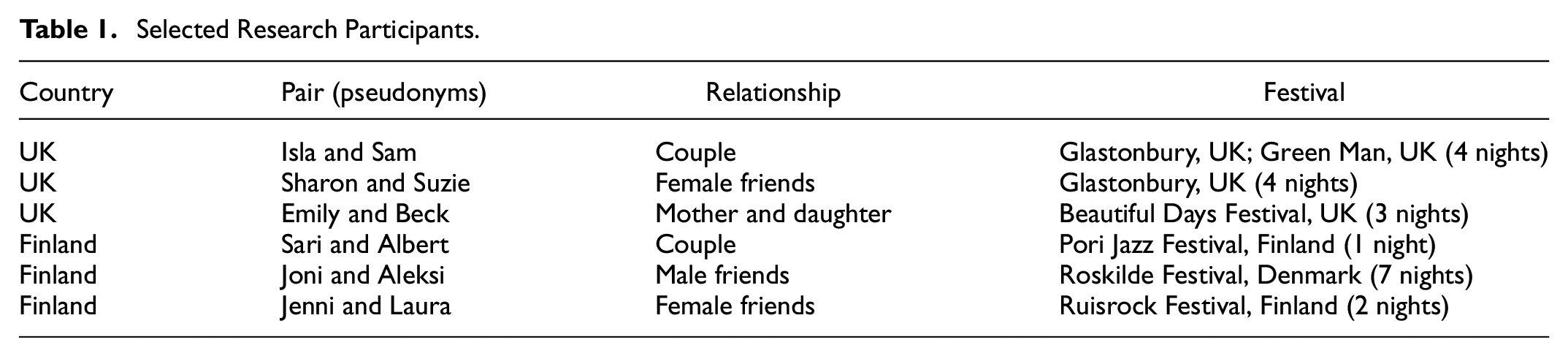
Research participants were recruited from the United Kingdom and Finland. These countries were chosen as they both have established festival tourism sectors. We had access to a database of festival-goers obtained from earlier survey research in these two countries, consisting of survey respondents who had opted-in to being contacted to take part in further research. Over 1,000 people were invited by email to take part. Altogether 13 pairs were willing to undertake the three recordings, and met the criteria of having attended together and stayed one or more nights. In order to do justice to the richness and depth of the narratives, and in line with IPA, we focus on six couples here (Table 1). The six were purposively selected based on the fullness of the recordings and to provide a mix of relationship pairs (couples, friends, family). The data presented here includes 18 recordings and over 16 hr of audio data in total. These recordings were transcribed verbatim, including audible reactions like laughter, sighs, chuckles. Both transcripts and recordings were used in the analysis phase looking for occasions where memories changed, merged, became agreed, and how that made the sharers feel.
Selected Research Participants.
Analysis
Interpretative Phenomenological Analysis (IPA) “is concerned with the detailed examination of personal lived experience, the meaning of experience to participants and how participants make sense of that experience” (Smith, 2011, p. 9). The method was developed as guidance to explore and analyze research data more thoroughly than thematic analysis, although sharing similar grounds for thought (Moss, 2018, p. 101).
IPA was chosen for the analysis of this study as it fits well with our approach enabling a deeper understanding of meaningful, memorable, and emotional experiences. It was essential to share both the experience (as it happened or was thought to have happened), and the emotions related to it. These emotions were recreated when engaged in remembering individually and together. Looking for convergences and divergences is an essential part of IPA (Smith et al., 2021), and also the focal point of memory negotiation.
The analysis process followed is adapted from Smith et al. (2021):
Listening to each couple’s individual and shared recordings, taking notes on the stories that emerged, and any differences appearing between individual and shared memories, and then reading carefully through the transcripts again looking for stories that differ.
Marking stories that differ: What types of differences were there? Was the agreed shared memory either party’s individual one? Or was the agreed version a new one that came up in the shared conversation? This required several rounds of re-reading the corresponding transcripts.
Moving from descriptive to interpretative, revisiting the transcripts again: What might be the reasons behind the agreed version? Was either party dominant or more powerful? Did either party withdraw their version and if so, why? Defining major (super-ordinate) and minor (sub-ordinate) components (Hale et al., 2008).
Listening again to the audio-recordings of these excerpts, concentrating on what kinds of emotions were recreated as the outcome was negotiated in the shared conversation. Adding the emotional aspect (if not obvious in the transcripts) to the interpretation. This version of “live coding” (Parameswaran et al., 2020, p. 630) “is beneficial in preserving the voice of the participant.” This was particularly important in our study as no researcher was present during the recording.
Reliability was maintained through cross-researcher interpretation. Each transcript was read, and notes made, independently by two researchers from the team. They then met to cross-check their interpretation and analysis.
Analysis steps 1 and 4 were done in the original language by a native Finnish or English researcher. The Finnish stories that were chosen for interpretation and comparison, were translated into English. Thus, all three researchers were able to do the interpretation and comparison work (steps 3 and 5), employing investigator triangulation (Denzin, 1978) for this part of analysis.
Besides the hermeneutic circle in the analysis, it should be noted that this also occurred in the process of data generation. Participants immersed themselves twice into the same experience. Thus, there was a triple hermeneutic as three people were trying to make sense of the same experience: two participants and the researcher (see also Smith et al., 2021).
In regard to saturation, the method itself does not suggest any strict definition for saturation since “data saturation is not generally a goal of the IPA approach, rather it is intended that full and rich personal accounts are obtained from the sample used, and concepts and commonalities explored across the sample” (Hale et al., 2008, p. 91). The number of cases (six pairs) was suitable for the purposes of an idiographic approach. Acquiring sufficient data was based upon the researchers’ judgment of validity and robustness. The research assured its data as valid by drawing on the established criteria of Lincoln (1995), and Lincoln and Guba (2000) in which they adjusted the focus from empirical replicability to assessing trustworthiness. This approach has underpinned previous research into festival experience using IPA (Moss, 2018; Moss et al., 2020). To add a further degree of robustness and assurance of validity, and to avoid criticisms of it lacking a process of checks (Morse et al., 2002), this research also utilized Yardley’s (2015, p. 108) four key criteria which are: “sensitivity to context”; “commitment and rigor”; “coherence and transparency” and “impact and importance.”
Findings
In line with IPA, here we present six stories from the data. We have maintained the voice and tone of our participants, and have edited the transcripts only in the interests of succinctness. The stories told have been selected as they demonstrate differences between the individual and the shared memories and, in the sharing, we gain a window into the negotiation process.
Each story is presented firstly as the two individual versions and then as told in conversation. We have added commentary to each where appropriate, making the analysis process more transparent.
In the story "I Told You That I Love You" (Table 2), although Sari and Albert had laughed about the burgers many times, this is the first time they remember the “I love you” moment together. For 2 years Sari hasn’t known if Albert heard her.
Sari and Albert (FI): I Told You That I Love You..
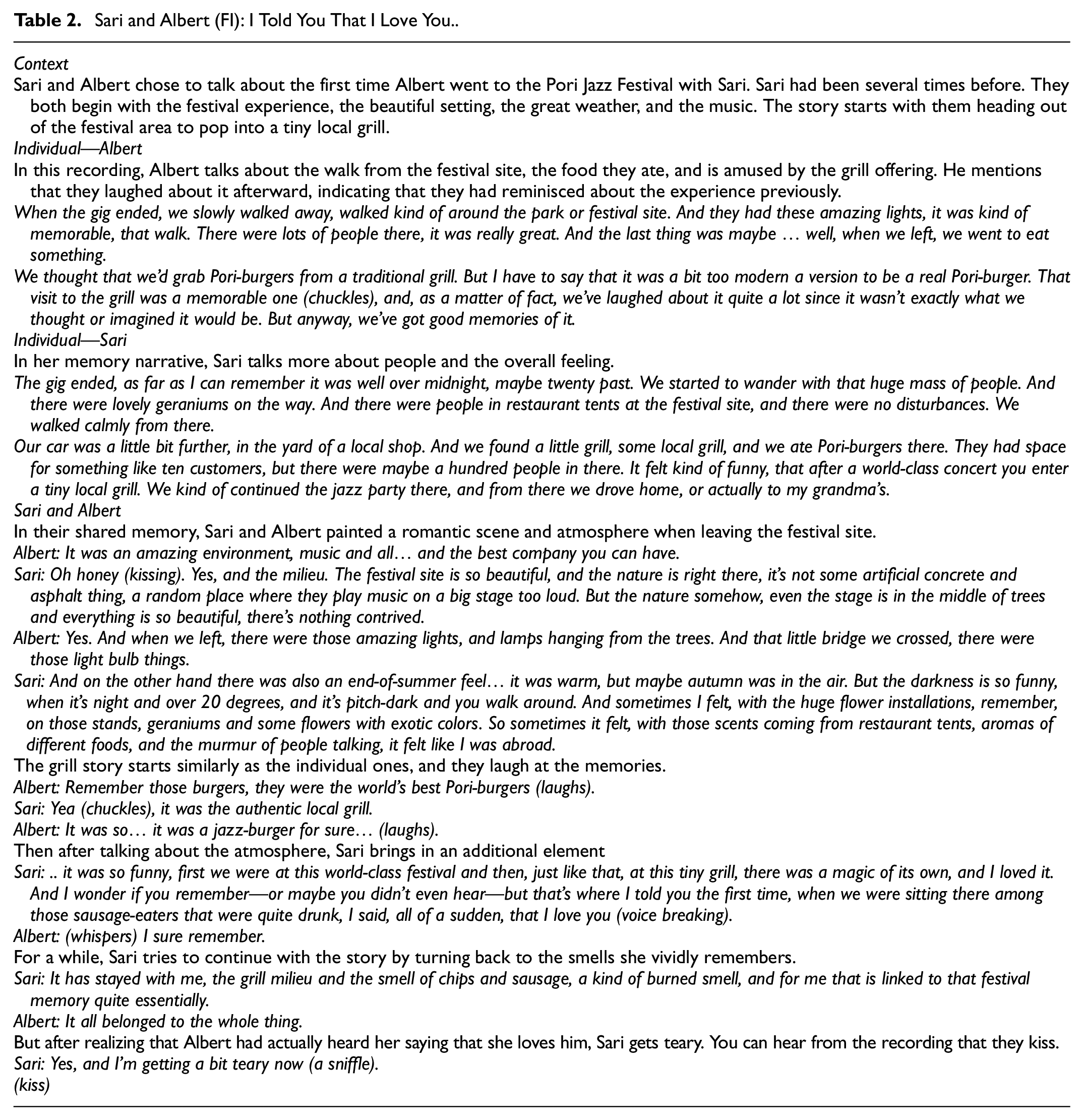
To express what was said in a low voice by the grill required this shared reminiscence where the couple went through the whole festival experience in one session. The shared conversation produced a feeling of security since the researcher was not there, just the two people who trusted and loved each other. This facilitated the flow of emotions and experiences.
At the end of memory sharing, Sari stresses how enjoyable “remembering like this is” (just two of them, in a quiet, relaxed, and intimate atmosphere) and “somehow this brings us closer.” You can hear from the way they speak to each other that the memories are charged with emotions of love and affection, emotions that reemerge more powerfully as they remember.
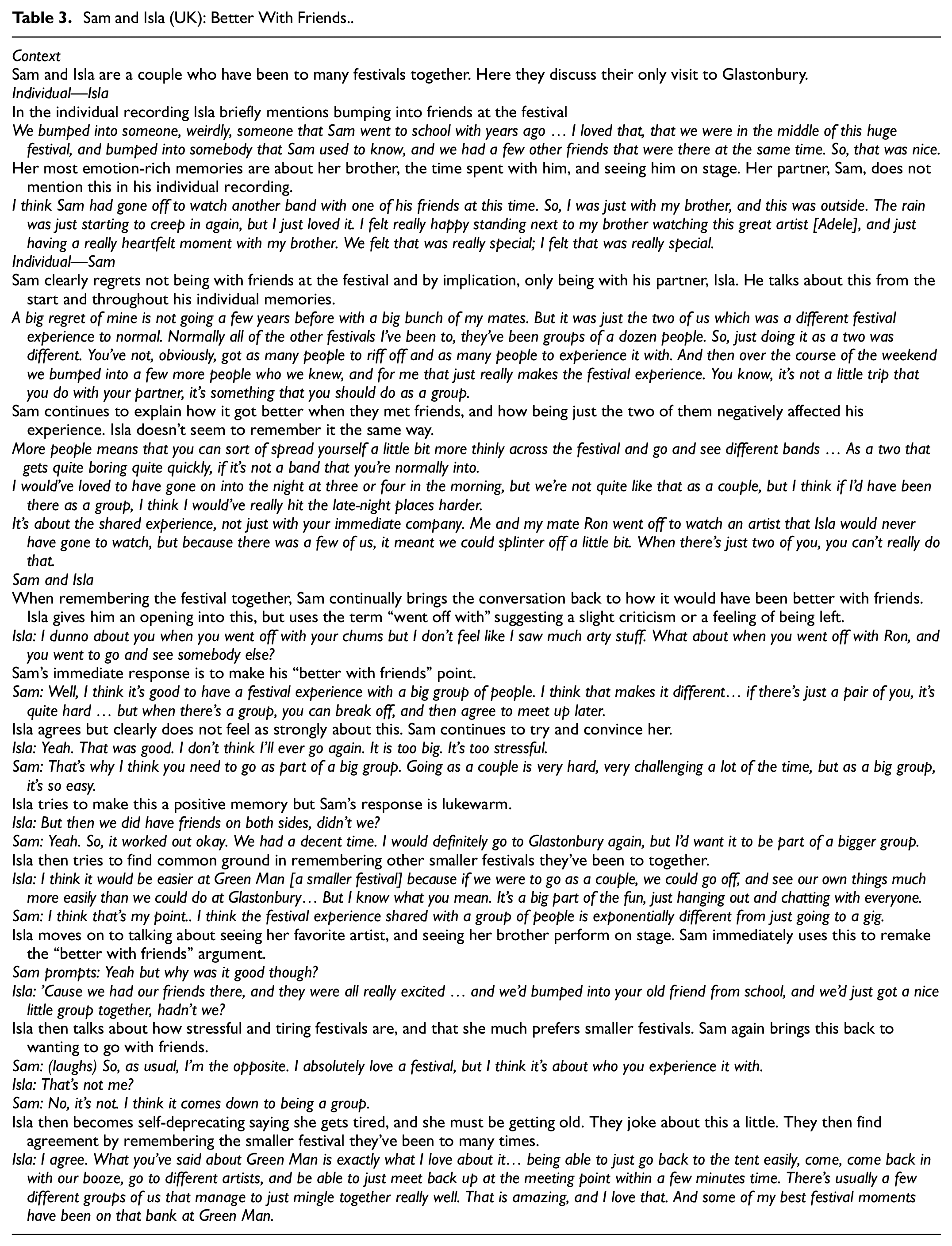
In Sam and Isla’s story "Better With Friends" (Table 3), the negotiation results in an agreed and strengthened attitude to festivals in general, and to the one they’ve been to several times before. They agree explicitly on its desirable attributes, and confirm their intention to visit again. Individually Sam makes it clear he would return to Glastonbury (but with a group of friends), and Isla makes it clear that she’d prefer not to revisit.
Sam and Isla (UK): Better With Friends..
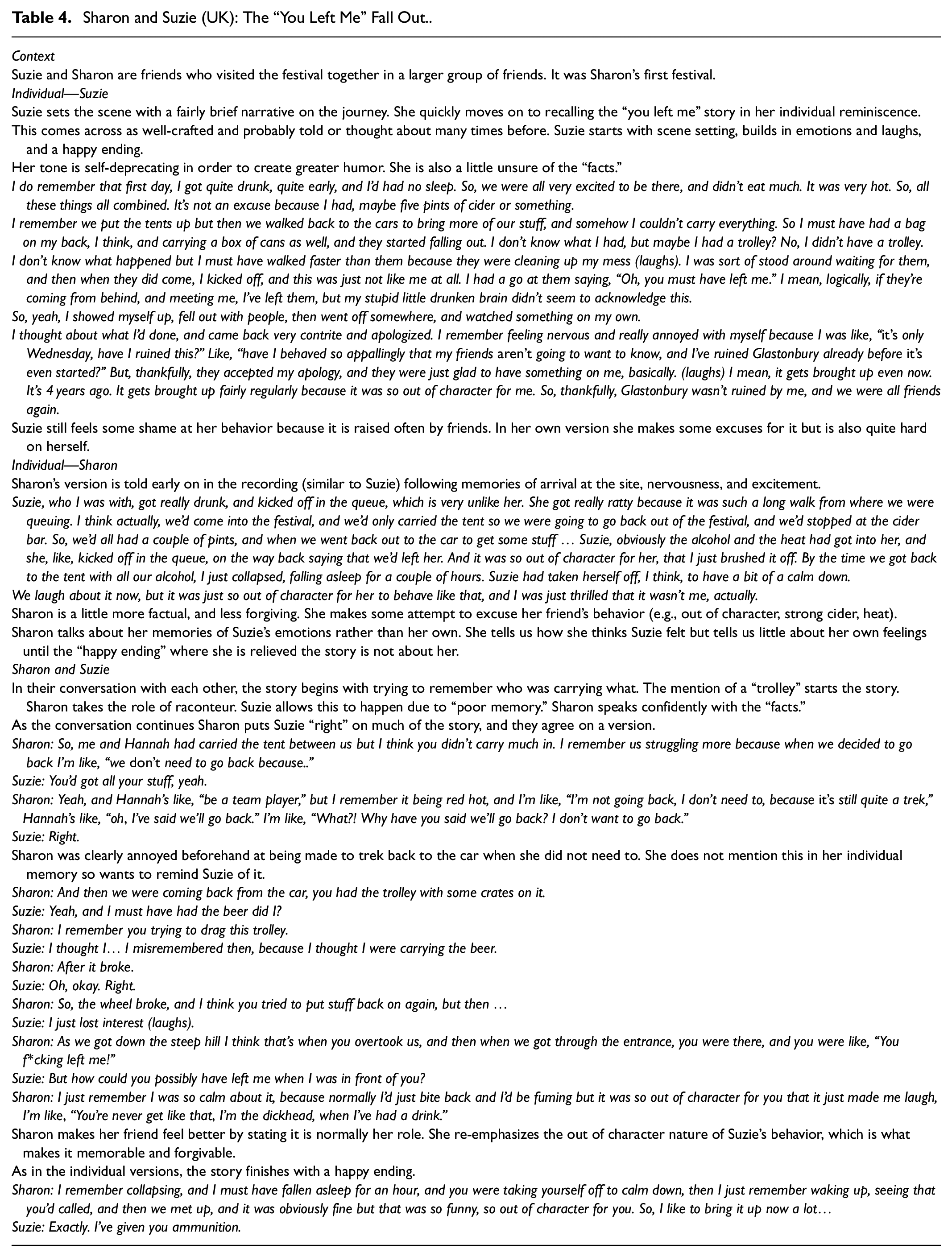
In Sharon and Suzie’s "The ’You Left Me’ Fall Out" story (Table 4), Sharon talks far more about her own feelings in the conversation with Suzie. Suzie laughs with each short interjection in what has become Sharon’s story. Agreement emerges on how they now feel about the story, and on how they felt at the time. The retelling of it helps make positive what was a negative experience at the time for both in different ways (Suzie felt guilt, and still does to some extent; Sharon felt anger and forgiveness). The story has now become something they can laugh about, enjoy, and share.
Sharon and Suzie (UK): The “You Left Me” Fall Out..
Both Aleksi and Joni are highly amused by the story “Oh F*ck, a Mojito Bus!” (Table 5). They blame it on tiredness plus the fact that they had been awake (and drinking) the whole trip from Finland through Sweden to Denmark.
Aleksi and Joni (FI): Oh F*ck, a Mojito Bus!..
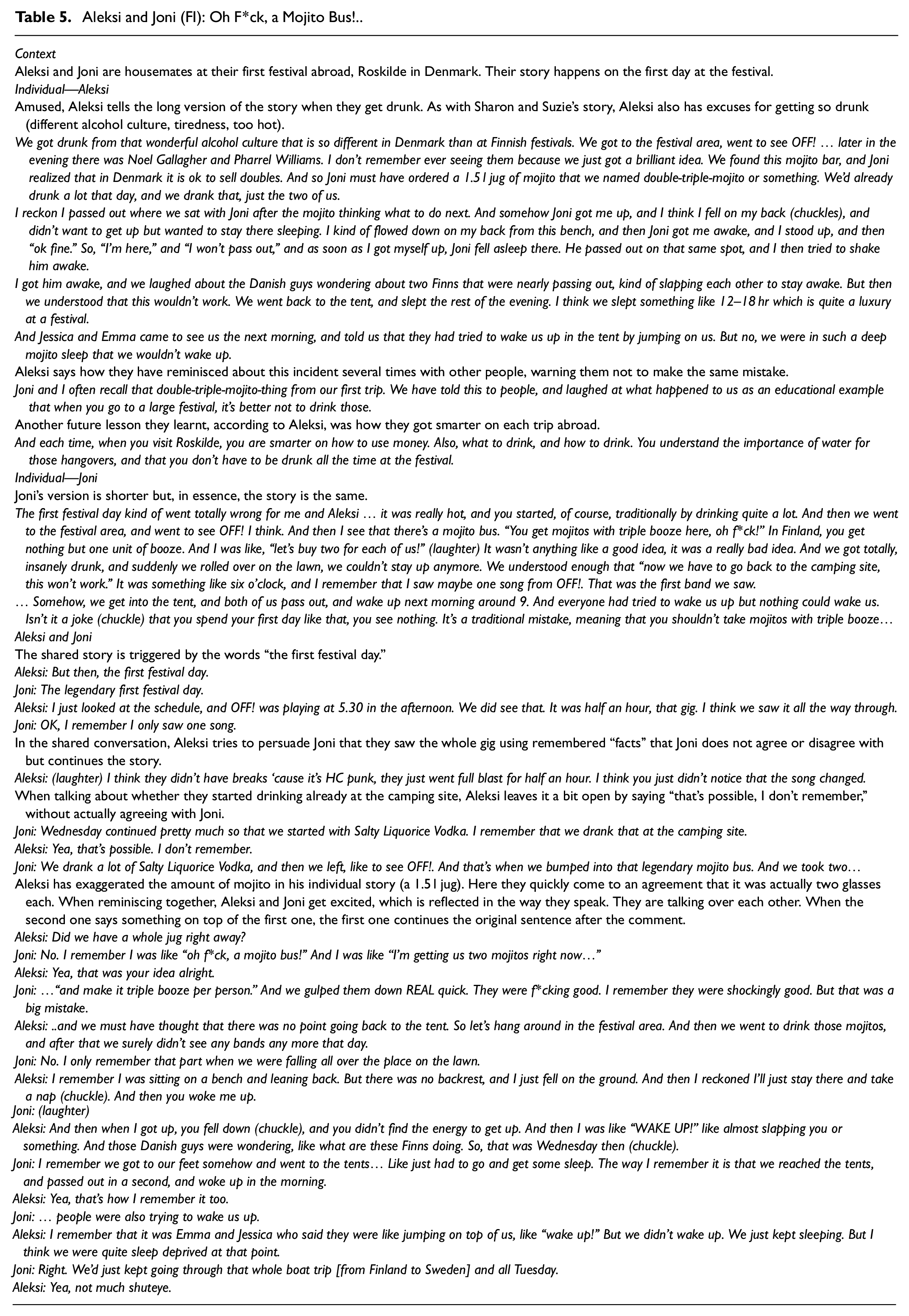
The individual and shared memories appear to be the same except for small differences in details. They have recalled this anecdote several times together and with other people as well which might be the reason for a highly similar recollection. It’s clearly a story that they enjoy reminiscing about.
The dance tent story of Beck and Emily (Table 6) shows their differing memories of the same moment at the festival. One which the mother returns to in the shared conversation as a way of bonding with her daughter, and the creation of a funny anecdote for future sharing. Unfortunately, the daughter does not react in the way that is expected although individually she has very fond memories of the festival and her family being there.
Beck and Emily (UK): Dance Tent..
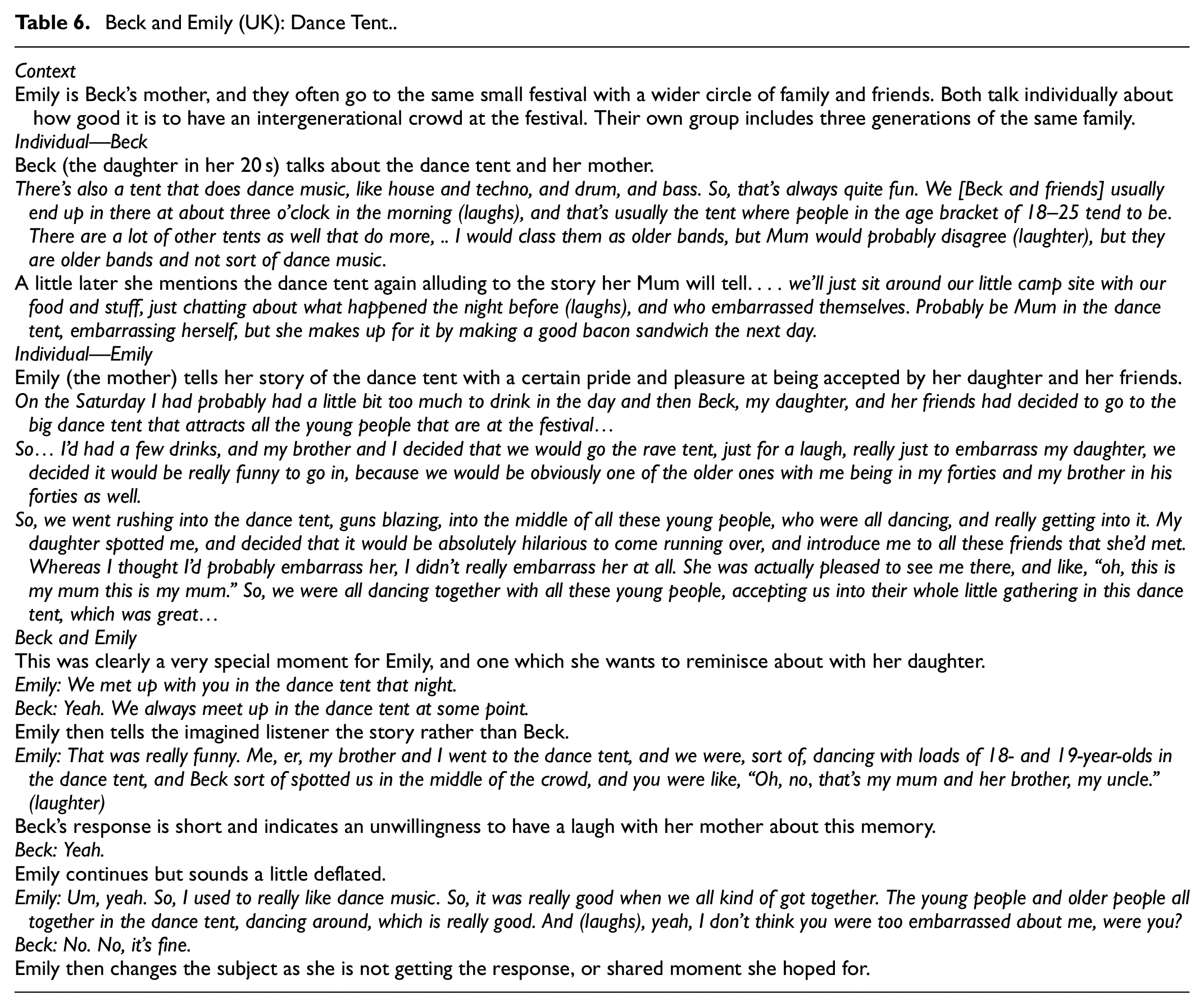
From the audio recording, elements of mood and relationship power can be sensed in this dialog.
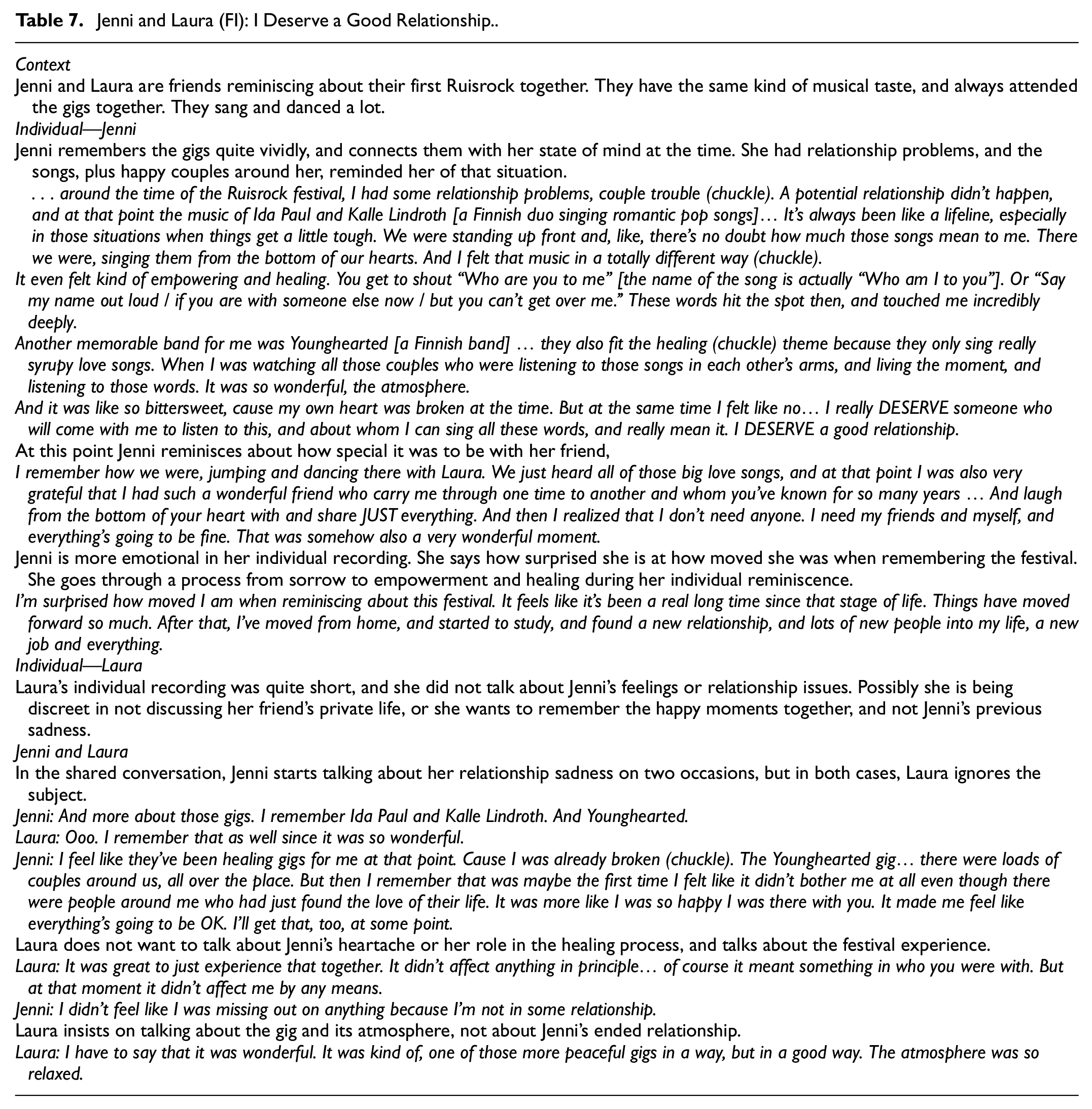
In the “I Deserve a Good Relationship” story (Table 7), both in her individual recording and in the shared one, Laura was adapting to the audience by controlling the content—not only in this story but in others as well. For example, she had planned beforehand what she would say in her very short individual recording. Then in the shared one, she refuses to talk about Jenni’s relationship problem. Probably the imagined presence of the researcher triggered her to control the content more than she might have done if the two of them had been talking casually.
Jenni and Laura (FI): I Deserve a Good Relationship..
Discussion
Although we had expected to be able to discuss the process, purpose, and outcomes of memory negotiation as separate phenomena, what we found is far more complex and interconnected. With this in mind, the discussion is structured around our four objectives drawing together the six cases alongside the literature review under each heading.
The Extent to Which Shared Memories Differ From Individual Memories
Though our participants had quite often the same experiences and memories, many differences were revealed in the individual recordings. These often also came up in the conversations, and here we could witness the negotiation, influence, and resulting agreement (or not) take place. In some cases, agreement was “surface” level with some masking or attunement, in others we could see a determination to really agree, and create a shared reality (Wagner et al., 2021).
We might assume that as our participants all have relatively close relationships with their conversation partner, there is likely to have been many other opportunities to share these memories (Congleton & Rajaram, 2014). However, some of the conversations suggest this might not have happened as there are still areas of contention, debate, and surprise.
The individual memories were markedly different from the shared ones. This is not necessarily in the overall content but in the way the narrative was structured, the emphasis, the tone, and the emotional content. In some cases, this was also seen in the variation in the stories chosen to recall. We can assume, based on Congleton and Rajaram’s (2014) study, that an altered individual memory might, in some cases, develop from the negotiation and agreement we saw taking place in these conversations.
Although, we cannot evidence that sharing memories influences individual memories (since the individual memories were collected before the shared ones), it could be seen that those who said that they had talked about certain incidents several times after the festival, had quite similar individual memories (e.g., Joni and Aleksi). This would fit with Yeshurun et al.’s (2021) argument that our brains are shaped by sharing memories through the negotiation of a shared neural code.
The Process Through Which Any Memory Revision Occurs
In the joint recordings we saw examples of audience attunement (e.g., Sharon and Suzie), negotiation (e.g., Isla and Sam), and synchrony (e.g., Sari and Albert).
Audience attunement is likely to be quite different with a deeper knowledge of the other than with a stranger. However, we cannot assume that they are already attuned, and we see this developing in several of the conversations. Wagner et al. (2021) emphasize the importance of interpersonal context in audience tuning, and Echterhoff and Higgins (2021) see a major motivator for shared reality creation as the need to be socially connected to the audience. We see aspects of attunement with Sam and Isla, Joni and Aleksi, and with Sharon and Suzie. The lovers, Albert and Sari, would appear to be attuned to each other’s memories yet we still see this strengthened by a sharing of a new memory from the festival. The attunement does not happen with Beck and Emily, which affects the wellbeing effects of the reminiscence, and although Laura may feel attuned to Jenni, her unwillingness to discuss how Jenni felt at the time suggests some misalignment.
In Isla and Sam’s toing and froing about the festival experience and “friends”—they share until they can agree. The negotiated agreed memory is that big festivals can be fun (if better weather and more friends) but that their memories of the smaller festivals encapsulate what is best about festival tourism, and most strongly affect their attitudes and behavioral intentions—“we might go to Glastonbury again but we’ll definitely go to Green Man again with friends.” Here we see further evidence for Higgins et al.’s (2021) view that if the narrative we share is believed (agreed with) by the other person, it becomes the reality we believe in. Sharing is believing, and attitudes are formed based on this believed narrative. This story also illustrates Shamay-Tsoory et al.’s (2019) correcting of emotional memory misalignment through a feedback loop.
Much of the memory synchrony appears to rely on emotional alignment in that it depends upon agreeing on how we feel about it rather than the facts of the memory (e.g., Sharon and Suzie, Sam and Isla) (Shamay-Tsoory et al., 2019). When this emotional alignment does not take place, as with Beck and Emily, and Laura and Jenni, there appears to be a lost opportunity to feel good about the memory, and to feel good when remembering. This relates well to the previous research on the wellbeing benefits of perceived emotional synchrony (Páez et al., 2015; Wood, 2020). Our pairs did not have to feel the same, but they did have to believe that they felt the same for the reminiscence to increase their wellbeing.
The Benefits of Synchronising a Memory Narrative
No matter what the route, the resulting shared memories undoubtedly had an impact on our participants’ wellbeing (Echterhoff & Higgins, 2021). For most, this came from a feeling of belonging with the other, of reawakened emotions and often, more simply, from having a laugh about a shared moment. A lack of agreement left one or the other feeling uncomfortable as we saw with Beck and Emily, and at stages with Sam and Isla.
When reflecting on how the reminiscence felt, participants stressed how empowering or liberating it was to go back to the festival memories particularly at the time of Covid-19 restrictions when they were forced to avoid face-to-face social contacts. “Oh no! Now I really started to miss Ruisrock (chuckle) and normal everyday life” (Jenni). Advancing the work within tourism on positive memory sharing (Kim et al., 2022b; Tugade & Fredrickson, 2004; G. B. Yu et al., 2021), our participants show that even sharing negative memories can enhance wellbeing. They feel good/better for being able to discuss unpleasant memories for example in the “you left me fall out”; “mojito hangovers,” and “not being with friends” stories. Sometimes the wellbeing results from assuaging guilt, from creating a shared moment of laughter, or from recognizing that something has been learnt.
We see this in the mother and daughter dance tent dialog where the mother attempts to remember a possibly embarrassing moment as an amusing anecdote to laugh about together. Agreement is not achieved here which may indicate the effect of mood and/or the importance of power and influence in the relationship. At this point of sharing the daughter has the power. We know, from the individual recordings, that she remembers her mother in the dance tent, and that she loves going to the festival as a family but, at this point of sharing, she’s unwilling to join in and share a remembered moment with her mother.
Our conversation method enabled us to also see the wellbeing benefits of simply talking. As Koudenburg et al. (2017) found, wellbeing and a sense of belonging can emerge from just having the conversation regardless of what the conversation is about. We witnessed our pairs using conversation as the tool through which shared realities were formed, and, in particular, how shared memories were formed.
The wellbeing that appears to result from shared memories is grounded in feelings of acceptance and belonging within the created shared reality (Kim et al., 2022b; Wood & Kinnunen, 2020). In our pairs we saw this take place in several ways. For Albert and Sari it was by cementing existing strong ties. Suzie and Sharon, and Joni and Aleksi used the shared memory to reaffirm their friendship. Sam and Isla worked out differences of opinion so that they could move on to planning their next trip together.
Shared discussions showed a tendency to form a shared reality. They also created new memories as Laura illustrated: “Somehow it [individual recording] was more difficult. Now when we talked together, I noticed I got vibes from you all the time. All the time more and more things coming to mind.” In the shared reminiscence the pairs re-lived the festival atmosphere and experience, and it made the memories clearer and more detailed but also more reconstructed (Wertsch & Roediger, 2008).
The shared conversation produced a feeling of security since the researcher was not there, just the two persons who trusted each other. This facilitated the flow of emotions and experiences, particularly in the shared conversation. The strong bond that pairs might have had was strengthened further through the shared conversation and remembering shared experiences together.
We see evidence of memories being made to fit with the person the memories are being shared with, for example, Isla is “made” to remember what fun it was being with friends when watching the headliner. This reflects Wagner et al.’s (2021) conclusion that biassed memories result from the desire for a shared reality. Isla does not remember that she felt the festival would have been better with friends until she makes her memories fit Sam’s. At the same time Sam convinces himself of his memory narrative as it is gradually accepted by Isla (Higgins et al., 2021).
Conflict avoidance also emerged as an important factor in memory negotiation. Arguing about the “true” chain of events is something that might have started but then abruptly ended with statements like “it’s possible” or “might have been” even though the individual memory was different. One interpretation is that the pair does not want to jeopardize a pleasant festival memory or enjoyable reminiscence session by arguing about something irrelevant. Instead, they form new memories that they can both agree upon. Again, it would be interesting to know if this is then the memory they individually hold on to (Congleton & Rajaram, 2014).
The move toward avoidance often happened after other persuasion had failed. We saw this persuasion in the use of “evidence” to substantiate one version of events. This side-stepped confrontation with a friend or partner per se, by bringing in more impersonal arguments. For example, several pairs frequently turned to their smartphones to show photos, videos, or messaging from the time. For Sam and Isla, Sam led Isla along a memory path that included her having fun with friends. These were not memories she shared in her individual recording but ones that helped form an agreement. Switching to talk about a festival they both enjoyed also avoided the potential “better with friends” conflict. Sharon and Suzie remember a moment of conflict but have already found a way to frame the memory so that the conflict at the time is now remembered as amusing, forgiven, and understood.
This was also seen in the omission of certain memories (Farmaki, 2021). For example, Jenni talks individually about how they met a boy who was interested in Laura. Laura does not mention this at all in her recording even though it seems that all three of them spent time together at the festival, talking and dancing. In their shared conversation, Jenni starts to talk about this, but Laura changes the subject. She clearly does not feel comfortable to share this story with the audience (imagined researchers). She wants to control the shared content by changing the subject and concentrating on other aspects of the festival. This opportunity to rework sometimes uncomfortable moments is undoubtedly an important factor in the wellbeing effect of negotiating agreed memories.
The Implications of Memory Negotiation for Tourist Experience Design and Marketing
Tourism marketers, and particularly festival marketers, have tended to focus on creating and marketing the experience with less emphasis on customer relationship building and post-trip campaigns. In other sectors it has long been recognized that consumers are buying memories and that these are as much the “product” as the experience itself (Shaw et al., 2008; Q. Yu et al., 2021). Understanding how memories are formed, shared, and changed is therefore vital for the design and marketing of the memorable experience and for post-experience campaigns that leverage the memories and generate loyalty, positive word-of-mouth, and repeat purchase (Eagly et al., 1999; Sanbonmatsu & Fazio, 1990; Van Kerckhove et al., 2011).
In several examples we saw the formation of beliefs and attitudes taking place as social alignment was achieved through agreed memories (Wyer & Albarracin, 2005). For example, in the Mojito bus story both friends agree on future behaviors in relation to drinking, and also state how they will tell others to avoid double measures, and not get too drunk too soon. In Sam and Isla’s story we see them agree on what makes festival tourism fun, and, therefore, on their intention to attend the smaller festival in the future.
Although many of the memories refer to the extraordinary elements of experience, we also acknowledge Goolaup and Nunkoo’s (2022) concept of “synstructure” within their experiences. The ordinary, remembered routines form just as important a role within the overall experience, and are remembered fondly, indeed the act of repeatedly sharing the memory often creates synstructure from extraordinary experiences (Bhattacharjee & Mogilner, 2014). Both anti-structure and structure combine positively in the shared memories (Sterchele, 2020; Turner, 2017). Repetition via memory and via repeat visit is also an important creator of structure in what would be anti-structure elements, for example Sam talks fondly of the routine of “forming the camp,” Sharon and Suzie create order from a chaotic moment through repeating and agreeing on the story. This also has implications for how extraordinary tourism experiences are marketed, highlighting the routine, or more importantly the creation of traditions, as well as experiencing the new and the different (Arnould & Price, 1993; Neuhofer et al., 2020). Campaigns that illustrate both elements would therefore be more successful in marketing anticipated memories (Fennell, 2009).
The desire to reconstruct memory to create a shared reality, to feel belonging, and to gain a sense of wellbeing was clearly evidenced in our pairs (Wood, 2020). The complex processes through which this happens highlights the importance of these post-trip experiences for tourism marketers (Aho, 2001; Clawson & Knetsch, 1966). This is where bad memories can become good, where the story that will be further shared is agreed, where lasting attitudes are formed, and where behavioral intentions can be concretized. Influencing these post-trip moments is therefore an important challenge that needs to be addressed by marketers.
Conclusions and Recommendations
The findings illustrate how memories merge, are negotiated, attuned, and altered to fit the needs of the teller and/or the listener. The outcome, and motivator for this is to achieve a shared reality within which we feel a sense of wellbeing (Shaw et al., 2008). Memories enable this shared reality to be built regardless of the “truth” of the remembered experience (Higgins et al., 2021). The memory becomes a tool through which social attunement, belonging, and acceptance can be achieved (G. B. Yu et al., 2021). This undoubtedly leads to feelings of wellbeing but the wellbeing also develops from the reminiscence process itself (Aho, 2001; Clawson & Knetsch, 1966).
Remembering a trip away with someone you shared the experience with undoubtedly enhances this process. The visit or vacation is undertaken in order to create memories that can be shared with friends, family, other group members (Jepson et al., 2019; Shaw et al., 2008). There are many opportunities therefore to recall events or feelings that were out of the ordinary, or at least different from everyday life. Good or bad, these memorable moments provide the building blocks for a “coming together” in remembering.
We saw memory sharing being used to avoid or reduce conflict, to change attitudes, to create new emotion-rich moments, and to plan for the future. The memory negotiation process was highly influenced by the strength of emotions felt at the time and in remembering. Much of the synchrony emerged from a coming together in how our participants felt rather than purely in the factual aspects of the memory. There was clearly much enjoyment in feeling those emotions again and in the new emotional experiences shared as they remembered the past (Páez et al., 2015; Wood, 2020). More difficult emotions were adeptly navigated away from, with participants finding areas of agreement and positivity.
A further overarching aspect that we saw in many of our pairs was the role of power and influence. In some conversations we saw memories being used to assert power in the relationship or in the insistence on a dominant narrative. An interesting avenue for future research would be a better understanding of the power and influence status of “collaborators,” and the influence of that on shared memory and hence word-of-mouth (Delgadillo & Escalas, 2004).
From a tourism marketing perspective our findings show that we need to create memorable experiences but also design them so that the memories are easily shared and shareable (Tugade & Fredrickson, 2004). In doing so value is added through new emotion-rich episodes extending the experience felt far beyond the moment (Wood, 2020). This might be through developing platforms and opportunities for this to happen for those who traveled together, the people they met along the way, with others who had similar experiences. Such opportunities will improve positive word-of-mouth but also influence attitudes and future behaviors (Eagly et al., 1999; Sanbonmatsu & Fazio, 1990; Van Kerckhove et al., 2011; Wyer & Albarracin, 2005).
It also seems that opportunities for reminiscence can encourage the changing of negative experiences into positive memories. This also suggests that post-trip surveys need to be undertaken longitudinally. Asking the week after might elicit a bad memory whereas a year after, through sharing, the story has become valuable and therefore positive.
Although we have focused here on extraordinary experiences (other than the everyday) we also saw evidence of shared memories being used to create repeated traditions, or synstructure, and through this greater belonging. This may be through simply repeating the memory sharing or in planning a similar future experience. This has implications for future research which explores the ordinary versus the extraordinary in terms of shared memory value and influence (Bhattacharjee & Mogilner, 2014; Neuhofer et al., 2020).
Our findings have led to many other avenues that require further understanding. Firstly, repeating the process but adding a longitudinal element would discover if individual memories a year later remained as they had been, or were now retold as the shared memory. A longitudinal study could also track how the shared story spread between and beyond close friends and family, and the role in memory reconstruction. This would provide further understanding of how collective memory is formed (Hirst & Echterhoff, 2012). A further extension of this research might also contrast memory sharing in conversation with memory sharing via social media, and to explore memory sharing in larger groups.
Secondly, as our two locations are culturally similar (in terms of festival tourism), we did not set out to explore cultural differences. Follow-up studies in non-similar cultures would therefore add a depth of understanding of how culturally bound the desire to agree a memory might be and the outcomes of this.
Although wellbeing appears to be the greatest benefit achieved from agreeing a memory, we saw many instances of conflict avoidance and resolution. This would be an interesting avenue of future focused research in this area, and might encompass the roles, power, and influence of the sharers. This would have implications for marketing and in particular word-of-mouth influence.
Having designed an innovative methodology for our study, we are very cognizant of the limitations that future research using a similar approach might address. One potential issue was that in forcing or triggering memories and the sharing of these we created unnatural situations for our participants. In fact we felt that some of the wellbeing benefits came from a forced reminiscence that we might not normally make time for. With this in mind, the method could be used as an intervention both for marketing and wellbeing purposes. If we can create sharing time, then both will benefit.
Footnotes
Declaration of Conflicting Interests
The author(s) declared no potential conflicts of interest with respect to the research, authorship, and/or publication of this article.
Funding
The author(s) received no financial support for the research, authorship, and/or publication of this article.
