




Abstract
Informed by a cyberfeminist standpoint, this paper explores the role of cyberworlds and virtual tourism in providing less constrained and more liberating traveling experiences for women. More specifically, through interviews with a group of Iranian women traveling in a virtual world known as vTime, this work discusses whether and how virtual tourist experiences allow women to overcome their travel-related constraints and pave the way to forms of self-determination and emancipation. In contrast, several feminists hold utopian and dystopian views regarding the benefits of the Internet and technology for women’s empowerment, and the findings of our study point to a rather complex and less encouraging scenario. Virtual tourism in cyberspace allows Iranian women to overcome constraints affecting their traveling experiences. Nevertheless, it is far from a liberating experience as women’s self-expression and activities are restricted and limited by patriarchy-driven concerns about surveillance, legal consequences, harassment, social stigma, and western dominance.
Keywords
Introduction
Drawing upon leisure and travel constraints theory (Crawford & Godbey, 1987; Crawford et al., 1991; Hudson & Gilbert, 2000; Nyaupane & Andereck, 2008), gendered studies in tourism have specifically discussed the multiple intrapersonal, interpersonal, and structural barriers that women have to face before, during and after traveling (see Jordan & Aitchison, 2008; Tavakoli & Mura, 2021; Wilson & Little, 2005, 2008; Yang et al., 2018). Nonetheless, women have not stopped traveling. Instead, they have often engaged in forms of resistance to partially negotiate or overcome the limitations imposed upon them (Wilson & Little, 2005). Among the several types of resistance documented in the literature, there has been increasing interest in the role of technology and the Internet in emancipating women from the patriarchal constraints they have traditionally been subject to (Koo, 2020; McAdam et al., 2020). More specifically, it has been contended that the Internet may help women to overcome some gendered prejudices, mostly due to the relative anonymity granted to women in cyberspace (Koo, 2016; Plant, 1997; Sreberny, 2015). In this regard, the plethora of feminist theories exploring the role of digital culture on women’s experiences and constraints has been referred to as “cyberfeminism” (Daniels, 2009; Flanagan & Booth, 2002; Tazi & Oumlil, 2020).
Despite encompassing a range of often discordant theories, in general, “cyberfeminism” supports “the belief that women should take control of and appropriate the use of cybertechnologies in an attempt to empower [themselves]” (Gajjala & Mamidipudi, 1999, p. 9). Indeed, cyberfeminists view the Internet as a tool that gives women a voice to question and challenge patriarchal power (Gur-Ze’ev, 1999), which in turn leads to more opportunities for empowerment (D. Haraway, 1991). Cyberfeminism is also concerned with the role of virtual reality (VR) in promoting change in women’s realities in general and tourist realities in particular(D. A. Guttentag, 2010). Rubin (2018) describes VR as a computer-generated three-dimensional (3D) environment where users can experience real-life sensorial stimulations. Furthermore, social VR worlds provide a social ecosystem where people can communicate, connect, and socialize in a rather immersive and embodied way. Due to these unique features, VR experiences often create a context that allows users to break down barriers and experience higher levels of perceived freedom.
Some scholars, such as Huang et al. (2016) and Tavakoli and Mura (2015), have focused on tourists’ experiences in the non-immersive virtual world of “Second Life.” Others, like Cheong (1995), D. A. Guttentag (2010), D. Guttentag (2020), and Perry Hobson and Williams (1995), have provided conceptual analyses of VR and discussed its implications and applications for the tourism sector. However, there is a relative paucity of empirical and theory-based research about user behavior in immersive 3D tourism virtual worlds (Huang et al., 2016; Yung & Khoo-Lattimore, 2019). The existing theoretical studies have generally concentrated on determining users’ probability of embracing VR long-term and their behavior and usage (see Huang et al., 2013, 2016). However, previous research has often ignored the gendered nature of technology and the gendered power structures underpinning virtual experiences. As such, less is known about how gender (and other identity markers intersecting genders, such as nationality, ethnicity, class, sexuality, and age) influence and inform experiences of virtual tourism spaces. With few exceptions (Tavakoli, 2016; Tavakoli & Mura, 2015), the role of virtual tourism in questioning gender-based stereotypes and barriers has been largely ignored. As such, this paper aims to explore the role of cyberworlds and virtual tourism in providing less constrained and more liberating traveling experiences for women. More specifically, this work explores the patterns of behavior and identity expressions of a group of Iranian women during their virtual journeys in the immersive social virtual world of vTime. It attempts to understand whether and how virtual tourist experiences allow women to overcome their travel-related constraints and pave the way to forms of self-determination and emancipation.
Overall, this study contributes to tourism knowledge by casting additional light on the potential emancipatory role of virtual reality and virtual tourism for women. Conceptually, it advances our understanding and application of cyberfeminist theory, which tourism scholars have relatively neglected. From a managerial perspective, a better understanding of Iranian women’s perceptions of virtual tourism could lead to more effective and tailor-made tourism marketing and management strategies for this specific segment of the market.
Literature Review
Cyberfeminism
Cyberfeminism refers to a range of theories (Daniels, 2009) that encompass a multitude of theoretical stances concerning women’s experiences of digital culture (Flanagan & Booth, 2002).
According to Gajjala (2003), some cyberfeminists have lauded the Internet as a means to enforce equality and resist repressive gendered systems, while others criticize the idea. The term “Cyberfeminism” was simultaneously coined by British cultural theorist Sadie Plant and the Australian art collective VNS Matrix, both of whom were indebted to Donna Haraway’s influential article, “A Manifesto for Cyborgs” (Fernandez & Wilding, 2002). When it was first introduced in the early 1990s, cyberfeminism propelled the idea that cyberworlds and the Internet are ostensibly male-dominated technological contexts (Tuzcu, 2016). Earlier, during the 1980s, feminists had already interpreted technoscience as a domain primarily associated with masculinity (Wajcman, 2010), created by and for men (Adam, 1997). Indeed, it was argued that online experiences mainly mirrored societal gendered inequalities produced offline (Duffy & Pruchniewska, 2017; Martinez Dy et al., 2018). For example, radical feminists pointed to men’s use of the Internet to exploit women from developing countries by soliciting prostitution and engaging in cybersex and pornography (Rosser, 2005).
For liberal feminism, the solution to gendered inequalities in cyberworlds was to encourage more women to get involved in science and technology-related matters. Although partially valid, this solution framed the issue of women’s inequalities in technology as a lack of equal access to education and employment. However, it did not contemplate broader questions concerning women’s engagement in technoscience and its institutions (Wajcman, 2007). Socialist feminists, such as Wajcman (2010), believe that the problem lies not only in men’s monopoly of technology but also in how gender is embedded in technology itself. As such, one of the earliest battles undertaken by cyberfeminists focused on unveiling the socially constructed privileged link between technology and masculinity (Wajcman, 2010). They contended that society had constructed men as technologically proficient and women as technically incompetent (Cockburn, 1983).
Against this background, feminist approaches in the 1990s supported the possible positive roles of information and communication technologies (ICTs) in empowering women and transforming gender relations (Kirkup et al., 2000). In this respect, while most cyberfeminists did not deny that there are processes that tend to exclude women, they also documented the increasing presence of women in virtual worlds as skilled cybercitizens. As Hawthorne and Klein (1999, p. 2) acknowledged, “firstly, there are differences in power between women and men specifically in the digital discourse; and secondly, CyberFeminists want to change that situation.”
Theoretically, cyberfeminism is influenced by D. J. Haraway’s (1985) figure of the cyborg, a synchronized human-machine being. In contrast to the use of the cyborg in mainstream science fiction as an illustration of hardened masculinity (Elm & Sundén, 2009), Haraway employs the metaphor of the “cyborg” to refer to a technological “post-gender” creature representing the postmodern utopia of a world without gender or genesis. In this respect, she takes a utopian view of the Internet by conceiving it as a space for rethinking gendered societal conventions, patriarchy, and different forms of sexual and gendered relationships.
D. J. Haraway (1985) and Plant (1997) have received criticism for their perspectives and arguments. Plant has been criticized for essentializing the relationship between women and technology—in making the Internet a basically “female” technology and excluding women who do not belong to the inner circle of white, Western, middle-class, highly theoretical cyberfeminists (Wakeford, 1997). Furthermore, some feminists consider early cyberfeminist stances as apolitical (Paasonen, 2005). For example, Wajcman (2004) has claimed that cyberfeminists assign too much agency to new technologies and not enough to feminist politics. More specifically, while she recognizes the importance of cyberfeminist theories, she also points to the need to embrace a more sober and realistic appraisal of women’s relationship with digital technologies (Wajcman, 2007). Likewise, Gurumurthy (2004) argues that technology will not necessarily transform gender inequality or automatically empower women as these changes depend on society’s power relations. For example, sexual predators have taken advantage of the relative anonymity on offer in cyberspaces to make them uncomfortable and unsafe environments for women (Wajcman, 2007). Just as in the offline world, these factors affect women’s online agencies and put at risk their chances of achieving digital equality (Milford, 2015).
Overall, according to Wajcman (2010), technology is neither inherently patriarchal nor unambiguously liberating. Technology is deemed to be a sociotechnical product from a constructivist viewpoint, blending as it does a network of people, cultural meanings, artifacts, organizations, and knowledge bases (Law & Hassard, 1999; MacKenzie & Wajcman, 1999). As such, a balance between “emancipatory metaphors” and “the material realities of a technology’s production and use” is imperative (Wajcman, 2004, p. 122).
Iranian Women’s Struggles for Equality
Iranian women fought for the equality and their collective socio-political empowerment go back to the early 20th century, at a time when Iran was experiencing significant socio-economic changes (Tohidi, 2017). A push for democratic reforms alongside a general movement against dictatorship inspired these changes. In more than a 100 years of history of collective activism, Iranian women secured remarkable achievements in education and, to some extent, in economic productivity and socio-political participation (Tohidi, 2017). However, after the Iranian Revolution of 1979, Iranian women confronted an authoritarian Islamic regime that imposed forced veiling, gender segregation, and widespread surveillance, as well as revoking the prerevolutionary laws that favored women (Bayat, 2007). Women’s place, it was argued, was not public but private, not out in the streets but inside the home (Milani, 2011). Milani (2011) argues that a fair distribution of space is the cause and consequence of an equitable distribution of rights, liberties, and privileges. The denial of freedom of movement restricts a woman’s bodily expression, inhabits her verbal self-expression, and frames her representation. The state’s gender ideology became grounded on a culture of patriarchy, reinforced (and ostensibly justified) by a patriarchal interpretation of Islam’s holy sources (Barlow & Akbarzadeh, 2008). By resorting to Islamic Shari’ah and Iranian traditions, Iranian women were unfairly treated by the Islamic state (Mohammadi, 2007).
Many feminist advocates have argued that the new laws and practices discriminate against women by subjecting them to higher risks of violence, insecurity, and humiliation (Tohidi, 2017). Consequently, voices demanding an end to such discriminatory laws have been rising both inside and outside the country (Shirazi, 2012). One of the traditional forms of resistance has been represented by the creation of movements, which have been active in organizing seminars, conferences, educational workshops, and public meetings to inform the public about women’s rights and the changes needed (Ardalan, 2013). Examples of these initiatives include the “One Million Signatures,” “Anti-Stoning,” “Open Stadium,” and “Anti-Execution” campaigns. According to Bayat (2007), these campaigns have acted as a springboard for women to discuss and negotiate patriarchal power in public.
However, unlike women in democracies, organized collective action and campaigning by Iranian women are thwarted by repressive state measures and the unsympathetic attitudes of ordinary men (Bayat, 2007). Local authorities have also regarded women’s activism as harmful due to its strong link with Western values and its potential to challenge the regime (Tohidi, 2002). Not surprisingly, there have been several instances in which members of these collectives were ostracized, questioned, and even imprisoned (Tohidi, 2017).
Cyberfeminism in Iran
Within the rather risky context of traditional activism in Iran, Iranian women’s understanding and use of cyberspace as a platform to convey feminist ideas, raise gender awareness, and promote gender equality has increased sensibly (Shojaee, 2016). In an interview with Women’s eNews, Iranian activist Parvin Ardalan stated: “Every print magazine for women we had was closed. So, we created a new world for ourselves in cyberspace. . .Women in Iran are calling for freedom and equality. We want to show the world that we are not alone” (Soguel, 2010). Notably, the Internet has opened up a channel for international communication for Iranian women and feminists, allowing them to interact and share ideas with other women’s movements worldwide. They can report the prejudice and oppression they face daily, which would otherwise remain virtually hidden from the rest of the world (Shojaee, 2016).
Cyberspace has also propelled the notion of social and political campaigning to women who had never previously considered activism and inspired a new, younger generation. This is evidenced by their presence in photos, videos, and articles posted on social networking sites, blogs, and video-sharing sites (Batmanghelichi & Mouri, 2017). The Internet has given Iranian women a platform for a peaceful protest against the religious and moral restrictions placed upon them and propagated by state-run mass media companies (Faris & Rahimi, 2015).
An example of a cyberfeminist initiative is represented by the “My Stealthy Freedom” campaign (Azadi-ye Yavashaki Zanan), created in 2014 by the exiled Iranian female journalist and activist Masih Alinejad. Alinejad describes the campaign’s main aim as “to have autonomy over their [women] bodies, to be free to wear – or not wear – a head covering” (Alinejad, 2018). This page is a platform for Iranian women to share photos of themselves unveiled in defiance of the Islamic dress code, which they are obliged by law to follow. While it came to light on Facebook, the campaign’s seeds had germinated since the enforcement of the hijab (Koo, 2016). According to Sedghi (2007), this campaign exemplifies how Iranian women have tried to challenge and redefine the state’s mandates, not through street protests but through quiet acts of rebellion. Social media gave a voice to women who had, for many years, remained unheard.
Another example of cyberfeminism is offered by a video (produced in Iran) entitled “Happy we are from Tehran,” which was posted on YouTube in March 2014. The video featured six young Iranian men and women dancing to “Happy” by Pharrell Williams, who had encouraged people around the world to record themselves dancing to the song in celebration of the UN’s International Day of Happiness. Many aspects of the video, including people dancing, generally high-spirited behavior, and women performing without the hijab, challenged local cultural norms and legal boundaries on behavior in public spaces (Nooshin, 2017). As the singing and dancing contravened Islamic laws of gender segregation, all of the performers were subsequently arrested on a charge of undermining “public chastity.” The punishment was 3 years in prison and several lashings, which led to the hashtag #freehappyiranian on Twitter and the “free Happy Iranian” page on Facebook, both of which supported freeing and pardoning the young participants (Lenze et al., 2017). Criticism of the criminalization of expressions of happiness on social media grew as a result of this incident (Koo, 2016).
On Twitter, the “Open Stadiums” campaign offered a cyberfeminist initiative that attempted to overturn the ban on Iranian women attending football matches (Hoodfar, 2012). After the revolution, aligned with the expanding policy of gender segregation, a generation of women was banned from attending sports events in the public sphere. The religious leaders argue that the mixing of men and women “is religiously forbidden” (haram), and Islam does not permit women to see men who are not fully covered as it might stimulate women’s sexual desires (Afzali, 2015; Hoodfar, 2012). However, Afzali (2015) and Hoodfar (2012) have argued that the potential political danger of such huge public gatherings being used to contest the state’s ideology and legal boundaries is more clearly significant.
Iranian Female Travelers’ Restrictions and Virtual Tourism
Since religion influences all spheres and activities of an individual in Muslim countries, whether at home or away, Islamic dogmas affect Iranian women’s tourist behavior and choices before, during, and after the holiday experience (Jafari & Scott, 2014). Previous studies on Iranian women and tourism have shown that their leisure and travel activities are tied to sociocultural and religious rules, which are intertwined and difficult to conceive separately (Arab-Moghaddam et al., 2007; Shahvali et al., 2016). Moreover, differences in beliefs, perceived and commanded social norms, and lifestyles embraced by Iranian women produce differences in travel patterns and how travel constraints are negotiated (Tavakoli & Mura, 2017).
Although mobility within Iran is free and not subject to any legal restriction (for both men and women), women experience constraints in travel and leisure experiences as they are required to constantly exhibit “appropriate female behavior” as decreed by Islamic laws and urf. Thus, women are perceived to be more constrained in their leisure activities (including travel) than men based on gender-based role expectations (Arab-Moghaddam et al., 2007). However, as defined by Jackson (1988), the constraints influencing women’s travel behavior are not necessarily obstacles preventing participation. Instead, they represent barriers that might diminish women’s opportunities to travel or reduce their satisfaction during a trip. In general, as Tavakoli and Mura (2021) stated, Muslim women’s behavior could be constrained by factors acting at different levels, from micro (individual or family-related) to macro dimensions (linked to national and international limitations). At an individual level, it has been found that Iranian women’s travel opportunities may be constrained by lack of time, financial difficulties, lack of travel companions, and gender-based family responsibilities and expectations (Arab-Moghaddam et al., 2007; Shahvali et al., 2016).
Moreover, the compulsory wearing of the hijab and gender segregation in public spaces severely affect women’s freedom to travel for leisure. In this regard, since the Iranian Revolution, beaches have not been places of relaxation for Iranian women, who usually observe men and children enjoying themselves while they remain clothed on the shore. Alternatively, they must seek out sections of the beach that have been designated explicitly for female swimmers.
Within Iran, requirements regarding dress codes vary between destinations. Smaller towns in rural areas, such as Yazd in central Iran, operate stricter policies than Tehran, the more forward-thinking capital. Cultural clashes may occur when female tourists travel to different, unfamiliar parts of Iran. Some religious leaders view tourism as something to be avoided for fear of spreading immorality, and therefore anti-tourism movements have sprung up in some of the smaller towns in the mountainous regions (Tavakoli & Mura, 2017). Regarding accommodation, strict policies permit single women, unmarried couples, and mixed-gender groups to stay in hotel rooms. This situation has created a barrier to domestic travel and mobility for single women, who prefer traveling with their peers or as solo travelers (Seyfi & Hall, 2019).
To travel abroad, women and girls need permission from their guardians, namely the father or husband, depending on their marital status (Seyfi et al., 2019; Tavakoli, 2016). Single women over 18 (unmarried, divorced, widowed) do not need anyone’s permission to obtain a passport. However, when a family relationship dispute arises, women’s travel freedom may be jeopardized as guardians or spouses have the right to ban women from leaving the country even if a passport has been previously released. In addition, many Muslim communities continue to insist that women’s clothes and behavior should be dictated by their guardians even overseas (Tavakoli & Mura, 2017).
Within this scenario, cyberspaces and online platforms provide a context for Iranian women to voice the barriers they have to face as travelers (Tomlin, 2010). Social media platforms, for example, have been widely used by Iranian women to document their travel experiences and reassert their right to move freely for leisure and tourist purposes. The study of Nikjoo et al. (2021), for example, reveals that sharing photos and experiences on Instagram represents one of the ways whereby Iranian solo female travelers can share and overcome travel-related fears and resist gendered stereotypes. Among the various gender-based challenges, issues related to women’s control over their life and the ability to choose freely without a man’s permission were frequently mentioned in the posts (Nikjoo et al., 2021).
Besides social media, more immersive forms of virtual tourism may also represent opportunities for women to overcome travel constraints (Tavakoli & Mura, 2015). Virtual Tourism (VT) has been regarded by some authors as an “example of the promise of high technology to enhance travel opportunities by redefining what constitutes travel” (Nakamura, 1995, p. 184). As an inexpensive and safe way of experiencing realistic simulations of destinations through technological gadgets (Cheong, 1995), several scholars have expressed the potential of VR to remove travel barriers (D. A. Guttentag, 2010; Perry Hobson & Williams, 1995). Indeed, in virtual spaces, destinations are designed to resemble real places accessible to everyone.
Virtual destinations can be visited anytime, with less risk, cost, and hassle than physical travel (D. A. Guttentag, 2010). In immersive environments, netizens usually present themselves through avatars, virtual embodied representations of their selves (Bell, 2008; D. A. Guttentag, 2010). To Bugeja (2008), “avatars symbolize the self. They represent our deepest wishes, aspirations, virtues, and, yes, vices” (p. 19). Avatars can navigate cyberspaces and sometimes pick up, manipulate, and even create objects. They can interact with other avatars, voice opinions, express emotions, and engage in protests (Plunkett, 2011). They can even practice sexual activities. As such, virtual tourism transforms tourists from passive observers to active participants (Williams & Hobson, 1995). As travelers behave and communicate much as they would in the real world, a relatively authentic experience may be produced (Mura et al., 2017).
Tavakoli and Mura (2015), for example, studied how a group of Iranian women behaved as virtual tourists in specific cyberspace destinations in Second Life. The study indicated that Iranian women seemed to behave more hedonistically than in their corporeal travels. Second Life provides a context in which religious values, and those governments that coercively impose religious values on their citizens, are critically discussed, (re)interpreted, and sometimes challenged. As most respondents highlighted, it is a place that allows Muslim women to embrace “personal religions,” namely religions based on a reinterpretation and amalgamation of both Islamic dogmas and personal beliefs concerning what is right or wrong. However, in her auto-netnographic study in Second Life, Tavakoli (2016) also emphasizes the role of norms and religious values internalized during her life in Iran in partially shaping her patterns of tourist behavior in cyberspace. As such, to what extent and how cyberspace and virtual tourism provide an entire “liberating” environment for female travelers remains a subject of debate.
Methodology
By striving to understand the virtual tourism experiences of Iranian women, this study is conducted from an explicitly cyberfeminist perspective. Epistemologically, feminism supports the belief that the process of knowledge production is situated, subjective, and open to new interpretative perspectives (Ramazanoglu, 1992). As such, we regard interpretivism as the best paradigm to explore the participants’ experiences. In general, feminist theories, including cyberfeminism, focus on the life experiences of individuals rather than specific phenomena occurring in women’s lives. Methodologically, this study employs netnography as the main research approach. Netnography, also called cyberethnography (Demuth & Mey, 2015; Rybas & Gajjala, 2007) or virtual ethnography (Hine, 2000), is a novel adaptation of traditional ethnography used to study and understand online cultures and communities interpretively (Kozinets, 2010; Myers, 2013). This approach has been relatively neglected by tourism scholars (Mkono & Markwell, 2014; Tavakoli & Mura, 2018), particularly in 3D virtual environments (Tavakoli & Wijesinghe, 2019). Moreover, previous studies on virtual tourism were mainly conducted in non-immersive virtual environments (e.g., Mura et al., 2017; Tavakoli & Mura, 2015). The reason for selecting netnography is threefold. Firstly, this study tries to understand the participants’ experience in cyberspace from a cyberfeminist perspective, which is the main aim of netnography. Secondly, people’s actual and virtual behaviors are interconnected and inseparable from their beliefs and other cultural aspects of their lives. Finally, netnographic studies are important as they allow authors and participants to co-create meanings and reflect upon virtual experiences.
Study Platform
vTime, a popular immersive virtual reality world, was chosen as the field of study for this research. It has 20 destinations to choose from, including rivers, observation decks, and space stations. Each environment has 360° sounds as well as various animals and/or objects moving around. It allows anyone, anywhere, to meet, chat, and share with new people, friends and family in real-time inside stunning virtual places, such as beaches, rocks on crystalline rivers, and Arctic expeditions (including visiting a polar bear island). In vTime, seeing and navigating the environment is no longer controlled by a mouse or keyboard but by one’s head movements through a headset, which adds an extra level of immersion and makes the user experience very realistic. Moreover, communication in vTime occurs through a microphone, while a text option is also available.
In March 2018, the first and second authors made a vTime account and created a personalized avatar to be familiarized themselves with the cyberculture of the environment, known as cultural entrée, according to Kozinets et al. (2014). During this observation time, the researchers had a chance to meet people from different countries and have a cultural exchange. The participants were invited to experience vTime. They were observed during the experience and interviewed afterward. Three main criteria were employed to select the participants, namely (a) being an Iranian woman who was born between 1963 and 1980 in Iran, (b) having little or no experience with virtual reality technology, and (c) living in Malaysia (the current place of residence of the authors).
Participant Selection
The reasons for this selection were twofold. Firstly, the rationale behind the choice of Iranian women lies in the epistemological beliefs of the authors, who conceive the process of knowledge production as situated, subjective, and open to new interpretative perspectives (Ramazanoglu, 1992). Moreover, the authors value the role of positionality and reflexive thought in participatory research through encouraging researchers to situate themselves and their biographies in the text (Margaret Fonow & Cook, 2005; Ramazanoglu & Holland, 2002). The first author of this work is an Iranian woman who was born in 1970 in a middle-class family in Iran. She was residing in Malaysia at the time this study was conducted. She has faced many constraints with traveling due to the political and sociocultural context in which she was raised. The second author is also an Iranian female tourism scholar who, over the last 10 years, has been researching Iranian women’s travel behavior alongside the role of technology in alleviating travel constraints. She has also experienced some of the travel restrictions mentioned above. The third author is a non-Iranian/Western male scholar whose research focuses on gendered identities in tourism.
The second reason behind the participant selection criteria was that the authors sought to select a group of Iranian women who experience constraints inside and outside Iran. Since ethnography is an essential part of netnography, the researchers needed to have a prolonged engagement with the participants in actual and virtual life. Therefore, they needed to be in the same geographical space (in this case, Malaysia). Moreover, the researchers provided the VR gadget to ensure consistency of the equipment used, as different devices would influence the quality of the experience. Additionally, they observed participants’ behavior while using the gadget. Purposive and snowball sampling were the two techniques adopted to recruit the participants through an invitation being posted to the Telegram group of Iranian women living in Malaysia. The first author has been a member of this group since 2017. Snowball sampling was suitable for this group of participants as a bond of trust exists between them. Before sending out the invitation, the university’s ethical committee approved the research procedure and questions. Moreover, the participants were informed about the research objectives through an information sheet, and each participant signed a consent form.
Participants’ Profile
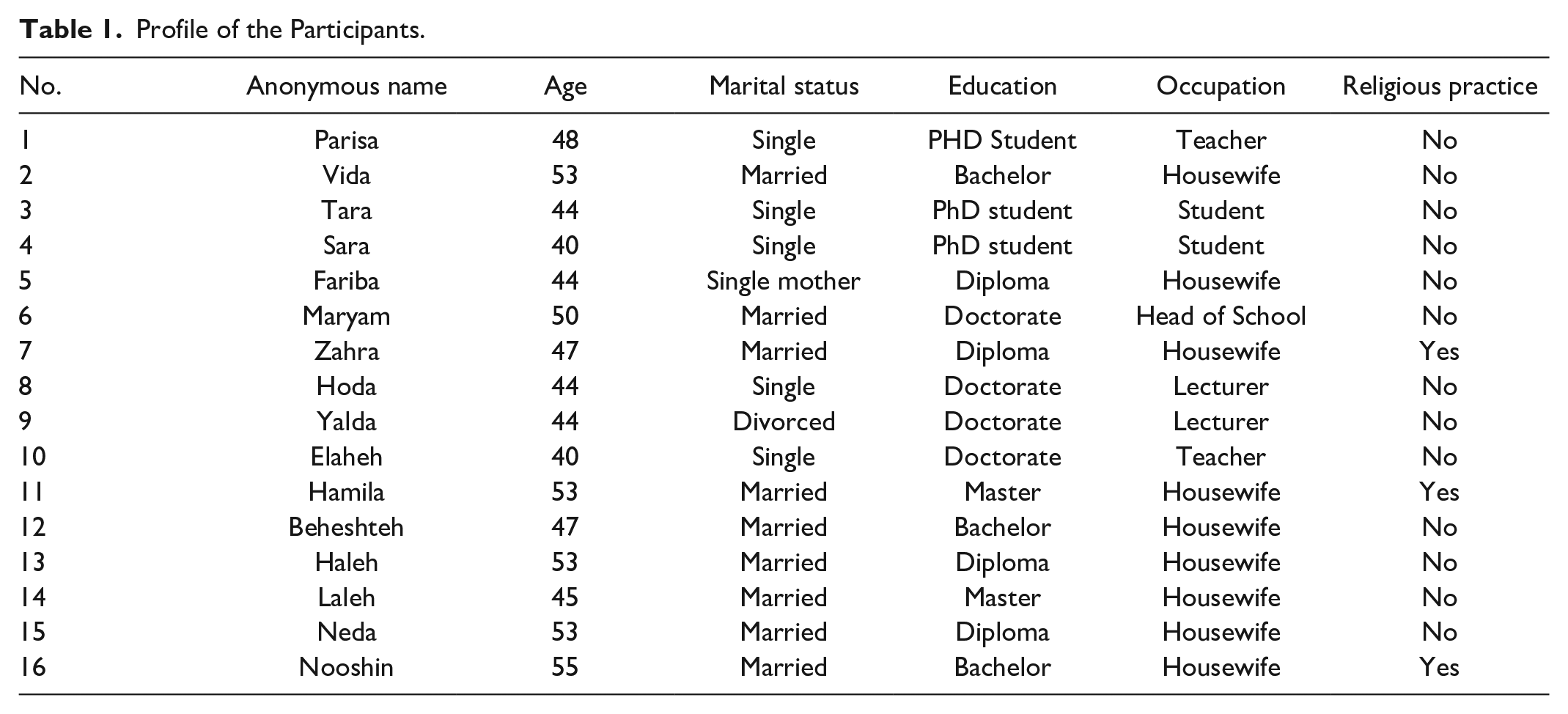
Sixteen Iranian women aged between 39 and 55 participated in the study. Their marital statuses vary, with nine being married, two divorced, and five single. All were born and raised in Iran in a middle socio-economic class with moderate Muslim families rooted in Iranian culture and committed to Islamic religious principles (Table 1). However, at the time of the interviews, their lifestyles were more akin to Western and modern lifestyles, evident from how they dressed and talked (based on the researcher’s observation) and their shared experiences. Concerning the religious beliefs of the 16 participants, they range from practicing Muslim to secular. Most of them did not practice Islam and religion was not too (or not at all) important to them. In terms of education, most women in this study were highly educated. Twelve completed bachelor’s or postgraduate degrees, three have diplomas, and one dropped out of high school. Most of them were exposed to the post-revolution Islamic educational system, which was influenced by Islamic ideology.
Profile of the Participants.
Empirical Material Collection
In feminist research, Jayaratne (1983) asserts that semi-structured and unstructured interviews are methods widely used as they convey a more profound feeling for or more emotional closeness to the persons studied. The interviews were conducted after the participants were handed a headset and experienced a VR tour in vTime. During the VR tour experience, the researcher took on the role of tour guide to help virtual surfers resolve any questions or problems. After ensuring they had fully learned how to operate in the virtual destinations, the researcher asked the participants to move away from her when they wanted to communicate with other avatars. In this way, their privacy was respected, and it allowed them to feel more comfortable in their conversations. Approximately, the VR tour experience and the interviews lasted between 2 and 3 hours for each participant. Seven interviews were conducted between late February and mid-March 2020, before Malaysia’s Covid-19 Movement Control Order (MCO). The rest were conducted in June 2020 during the Recovery MCO.
Data Analysis Process
All interviews were digitally recorded in Farsi and transcribed into English using Silverman’s (1993) transcribing system. Using the same language as the participants enabled the researcher to translate their exact word choice, which sometimes represents class and educational background and specific meanings (Abbas, 2013). The interviews continued until a point of theoretical saturation was reached. This entails continually bringing new participants into the study until the data set is complete, as indicated by data replication or redundancy (Bowen, 2008). During the data analysis process, it became clear that after 16 interviews, no new codes were generated to address the research questions.
Inductive thematic analysis was used to assess the empirical material. This form of thematic analysis is data-driven. The thematic analysis enabled the researchers to identify and explore the women’s narrations and perceptions around their travel experiences in virtual destinations. Arguably, it is the most useful analysis to capture the complexities of meaning within textual data sets (Guest et al., 2012).
At the initial stage of analysis, the principal researcher familiarized herself with the data, listened to the audio recordings of the interviews and read the transcripts along with the field notes several times to ensure that she could make sense of the data. The transcriptions’ relevant words, phrases, and sections were highlighted for coding in different colors, a process that continued in subsequent phases. After gaining familiarity with the data, the specific dataset segments were coded, so they had meaning relevant to or captured something interesting about the research questions. To this end, the researcher used open coding, meaning that the codes were developed and adapted as the coding process continued rather than simply sticking to preset codes. The documents were reviewed multiple times to ensure that no relevant data was missed.
Since a feminist method that involved the researchers’ personal and intimate relationship with the data was chosen, and to ensure that the researcher could stay close to the data, no software program was used in the analysis. The researchers wanted to discover the words and the social meaning behind them. They wanted to capture the arrangement of words, the tone, and the emotions, as well as wanting to hear the silence. After the data coding was finished, similar codes were categorized to form potential themes.
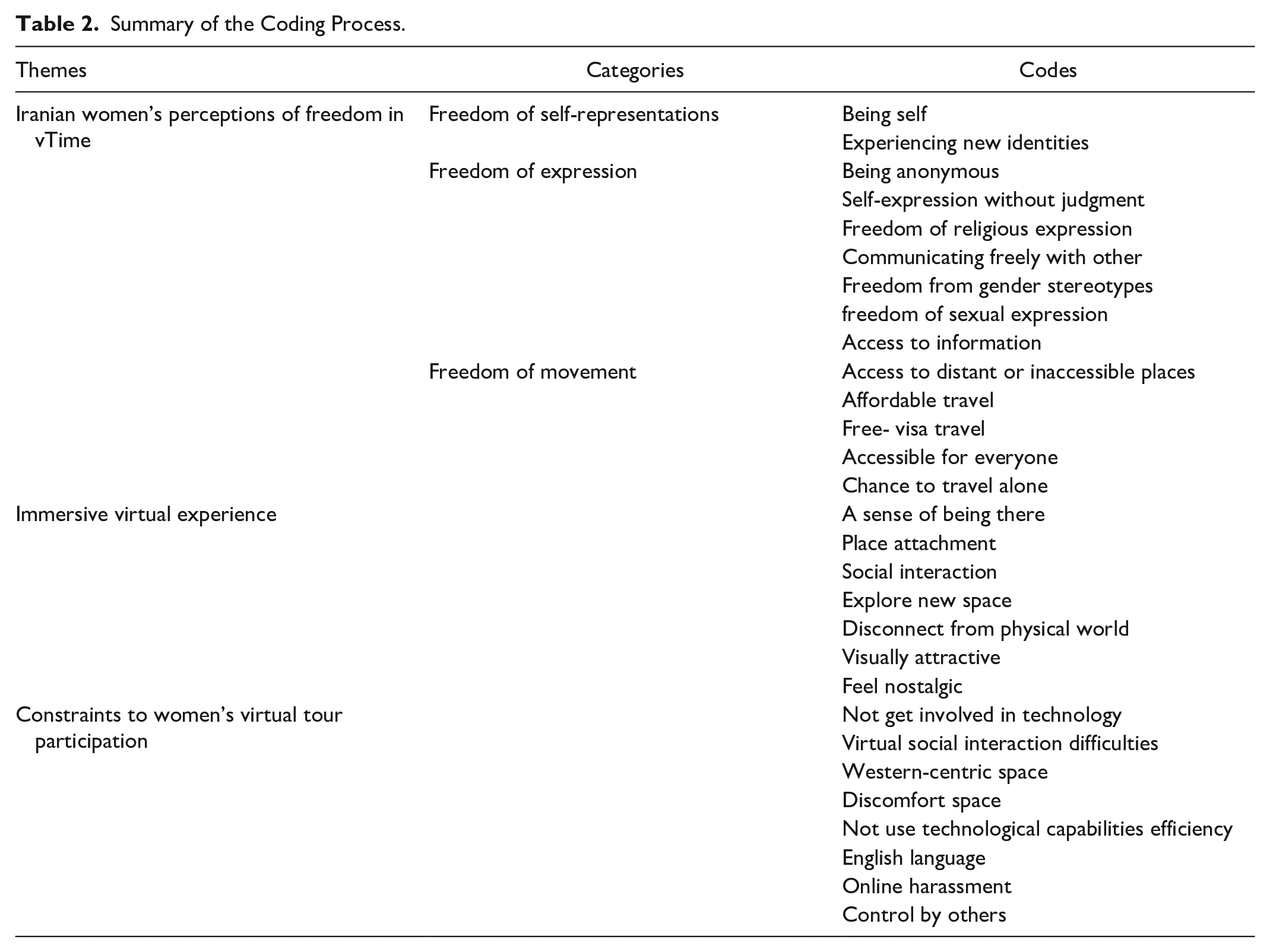
The analysis revealed three main themes: Iranian women’s perceptions of freedom in vTime, women’s immersive virtual environment, and constraints to women’s virtual tour participation. Table 2 offers a summary of the coding process.
Summary of the Coding Process.
This qualitative study emphasizes the importance of trustworthiness in assessing the quality of research (Morse et al., 2002). Based on Jennings (2010), the researchers strived to achieve trustworthiness in the collection of empirical data and the process of interpretation. Therefore, credibility, transferability, and dependability were used to increase trustworthiness. Prolonged engagement, member checking, peer review, and researcher reflexivity were the strategies adopted to achieve credibility. The researchers interacted with the participant before (through the Telegram channel) and after (meeting up and gathering) the interviews. This prolonged engagement established a solid relationship of trust and friendship between researchers and participants. Moreover, after the analysis, one of the researchers shared the findings with the participants. The purpose of doing member checks is to control the obliteration and biases of inquirers during the analysis and interpretation of the results (Anney, 2014).
It is often impossible to show evidence that the findings and conclusions can be applied to any other population or context (Shenton, 2004). It is a common belief among naturalistic investigators that even traditional generalizability is impossible to achieve, as the results always relate specifically to the situations in which they were observed (Erlandson et al., 1993). However, the findings of this study might be transferable to other women living in Muslim-majority countries who may be experiencing the same constraints to travel. Moreover, dependability can be demonstrated through an audit trail, where others can examine the inquirer’s documentation of data, methods, and decisions that led to the findings (Tobin & Begley, 2004).
Findings
Iranian Women Traveling in vTime—An Immersive Realistic Experience
While the participants were familiar with Web 2.0 social networking sites, they were generally less exposed to more immersive cyberspaces. As such, this study allowed women to visit more immersive VR destinations (beyond Web 2.0) on vTime. The observations of the avatar construction process showed that most of the participants spent a significant amount of time selecting their avatar and immersed themselves in customizing it. They were excited to create avatars as it gave them a sense of preparation for the trip. The majority of participants tried to create a natural, unexaggerated avatar that resembled their physical appearance. Some participants explained their reason in this way: I want to travel. I want it [avatar] to look like myself. I love myself. (Beheshteh, married, 47). I wanted to be myself. I liked to see myself there. (Nooshin, married, 55). I customize my avatar the way I usually dress. (Laleh, married, 45)
The phrase “I wanted to be myself” indicates that the women were not interested in being virtually embodied in “the other.” They didn’t select a random sum of physical features; instead, they customized their avatars to more or less reflect themselves. The participants’ avatar appearance indicates how Iranian women desire to present themselves in tourism destinations when they are somewhat freed from the pressure of a patriarchal society. However, those with avatars similar to themselves experienced better identification and self-awareness and increased their presence and enjoyment.
Most women presented themselves with a name that was the same or similar to their real name because they liked it and it had positive connotations. Only one woman introduced herself by a completely different name. She stated: My name is a religious name that my father chose. I do not like it, so I want to introduce myself by a name I love in the virtual world. (Sara, single, 40)
Regarding naming, virtual identity allows a person to adopt different labels other than his or her name in the physical world. Names and identities are closely related and difficult to separate. For Sara, the taking on of a new name means the construction of a new self.
After selecting their avatars, the participants were invited to travel online and visit virtual tourist destinations. As virtual tourists traveling in cyberspace, almost all the participants became fully immersed in the VR experience, with some reporting feeling “like being there” or “outside the real world”: When I wore the headset and entered the virtual space, I had no connection with the outside world. I was ultimately in there. (Sara, single, 40) When I wore the headset, I was like, wow! It was interesting. I could look around 360 degrees, up and down. When I was at the destinations, I felt I was there. I disconnected entirely from the outside; I could not see or hear anything from the world outside. (Parisa, single, 44) I felt I was there, immersed in the virtual space. But since I am a multitasking woman, I still had a connection with the outside world too. (Maryam, married, 50) I felt I was there. VR affects a person’s brain and perception. Although I knew I was sitting at home, I moved my head and looked around to explore the destination. It meant I felt myself in a new place. (Neda, married, 53)
The recorded comments and observations seem to highlight a very immersive experience for women, who could “feel” destinations and describe details of the cyberspaces visited. In some instances, virtual journeys triggered memories of previous experiences in the physical world: Once I entered into vTime, I saw myself in a library room. There were all the things that I like so much, such as a bookcase, fireplace and décor, and an Iranian carpet. It made me feel nostalgic. (Vida, married, 53) Some of the spaces looked very real, like that balcony in Paris. It reminded me of my trip to Rome. I had experienced exactly such an atmosphere in Rome, and it reminded me of my trip. I can say that the spaces were close to reality. (Neda, married, 53) The fish in the river reminds me of camping along a river in Iran and my father who was fishing. (Hamila, married, 53)
A few of the participants created an emotional bond with the virtual destinations. For example, when Beheshteh was in the paradise resort, she described her observations and feelings as follows: Here is wonderful. The mountains and the sea are here together. If I could move in here, I would love to walk all along this beach with my husband and go to the top of that rock, and then I would like to go inside that cottage on the beach. … The sand on this beach is such that when you walk, your shoes are full of sand. Now I can feel them between my toes. I am feeling the salty taste of water. (Beheshteh, married, 47)
The findings showed that when the participants were immersed in the virtual destinations and experienced a sense of presence, they were engaged in a process of mental imagery. These mental images invoked sensory engagement so that they could not only “see” what is not physically present, but they also experienced “test” and “touch.” The feelings and emotions associated with women’s virtual experiences may bear a close relationship with how the women perceive a sense of place.
Importantly, most of the women interviewed regarded the possibility to meet and communicate with other people worldwide through their avatars as one of the most attractive features of VR tours: The possibility of communicating with people around the world was the best feature of this virtual tour. (Maryam, married, 50) On my trips, I like to communicate with people. It is important to me. This virtual tour provided the possibility to connect with people around the world. I think it was a unique aspect of this virtual travel. (Elaheh, single, 40)
Also, the possibility of communicating and engaging with other people within virtual destinations strengthen the feelings of authenticity. In such experiences, people feel that they themselves are much more authentic and more freely self-expressed than in everyday life, not because they find the toured objects are authentic but simply because they are engaging in non-ordinary activities, free from the constraints of daily routine. Overall, the participants commented on the rather realistic nature of their virtual journeys. For many of them, traveling on vTime represented an experience “beyond expectations.”
Iranian Women’s Perceptions of Freedom in vTime
Compared to corporeal travel, some interviewees felt higher levels of freedom in approaching other virtual travelers and expressing their thoughts, opinions, and emotions without fear of judgment or blame. One woman, for example, perceived virtual tours as a context in which she felt more comfortable expressing her religious identity and beliefs: In the virtual world, I can create an avatar and choose a name. My avatar is different from my actual appearance. This anonymity gives me the freedom to express myself, so here, if somebody asks me about my religious beliefs, I tell the truth. In the physical world, I hesitate to tell the truth. (Parisa, single, 48)
Some of the interviewees referred to an enhanced sense of freedom from gendered stereotypes: VR tours are suitable for women who like to communicate with others and express their emotions and opinions without judgment. This virtual tour is a great platform to talk freely to others without hesitation. In some situations, in the physical world, it is hard to express my feelings, emotions and opinions. In our society, we live under control, dos and don’ts. Hence, we behave in a way that we do not like. (Maryam, married, 50) You know in our society when you talk or laugh with a man, definitely you will be judged in a negative way. However, in virtual space, you can communicate with everybody without the fear of judgment. (Parisa, single, 48)
One woman also felt comfortable enough to talk about sex with a man she met in a virtual paradise resort: In this virtual space, my sense of femininity was high. I was comfortable communicating with people. For example, when I was with a man, I asked him about sex. I asked him if I were next to you what would you do?! While in the real world, I would not ask such a question of a male tourist sitting next to me. I liked to know how they do sex! How they are in a relationship, how are their emotions? (Yalda, divorced, 44)
In Iranian society, women are strongly discouraged from expressing ideas or patterns of behavior related to sex or sexual freedom. In a patriarchal culture where open discussions about sex are taboo, a modest woman is expected not to initiate sexual relationships. Not surprisingly, then, some participants regarded the VR tour as an opportunity for “online flirting” and learning about sexual behavior in other cultures.
As vTime provides a range of virtual destinations, the participants were able to visit places that they cannot easily access in real life: The Arctic and Space were two places that I have not traveled to because they are expensive and are not easily accessible for everyone. . .this virtual trip was exciting and somewhat satisfying. (Neda, married, 53) I want to go places that I have never been to before. I am willing to go to places underwater or in the sky. I am not interested in places on earth anymore! (Hamila, married, 53)
One of the women saw virtual tours as an opportunity to bypass the sanctions Iranians had to bear at the time. As Iranians face many barriers to international travel, Vida was excited at the thought of visa-free travel: By taking virtual reality tours, I can see places that may be impossible for me to visit in the physical world. My daughter lives in the U.S, and I cannot visit her because of her visa situation. Hence, sometimes I explore her place on Google Earth. I see the streets and shops around her house. I feel good when I know where she is living. . .today; after the VR tour experience, I found it would be great to see her place through such virtual reality tours and talk with her at the same time. I will feel that I am there. (Vida, married, 53)
When asked to compare their real-life/corporeal journeys and virtual travel experiences, most of the participants perceived the latter as having a higher potential for freedom and interactive learning: I know that when some Iranian women travel abroad, they feel more freedom. Overseas, they can take off their hijab, change their clothes, and do the things they like. Hence, I believe that they can experience freedom and pleasure in such virtual destinations too. (Tara, single, 44) Many Iranian women who travel overseas change their clothes and behavior. I think such virtual travels help them to learn to be themselves: here it does not matter what you wear, where you come from, what the color of your skin, hair or eyes are. Things that matter in the real world are not important here. No one is judged on their appearance. (Hoda, single, 44) I think such virtual spaces provide the opportunity to women who live in religious, traditional or patriarchal societies or families. They can get more freedom. In some families, women and girls are not allowed to travel alone. However, in virtual life, there are not any limitations and barriers so they can take virtual tours alone and experience new things without somebody controlling them. They can be anyone they want to be and can do whatever they want. (Parisa, single, 48)
In the patriarchal society of Iran, women must adopt their imposed identities and roles to be accepted by their culture and society. They must obey rules of conduct about sexuality, clothing, and public appearance. Such predefined norms limit women’s freedom to act according to their own will and force them to conform to social expectations and judgments. Arguably, while the Iranian women interviewed and observed admitted to still preferring corporeal travel over virtual tourism experiences, they recognized the latter as a possible alternative way to experience tourist destinations without constraints and with higher levels of freedom and autonomy. Iranian women felt “closer to themselves” within the virtual destinations and perceived the connections made with others in virtual spaces as being more authentic, as they are stripped of the traditional social norms and values that govern their behavior in the physical world.
Iranian Women in Cyberspace—Free From Constraints?
Despite being described as a relatively free and somehow liberating environment, not all participants’ virtual tourism experiences were perceived as totally free from constraints. Some women, for example, were not able to easily socialize with others while traveling online. In this regard, approximately half of the interviewees reported preferring to stay quiet when meeting other virtual travelers on vTime. Hamila, for example, expressed little desire to communicate in virtual environments with people she did not know, especially if they were men: All the people on my friends’ list on Facebook or Instagram are my real friends, and I know them. That is why it was difficult for me to communicate with people in virtual destinations. (Hamila, married, 53)
While some constraints, like the one expressed by Hamila, were clearly related to gendered relations and socially constructed male and female roles in Iranian society, others encompassed broader societal issues. One of the interviewees, for example, felt intimidated and somehow restricted by the dominance of Western culture and the English language in virtual worlds, which, according to her, jeopardize Iranian women’s experiences and opportunities in cyber-destinations: There is a Western culture in the virtual world. Not all women are comfortable in such an environment. … It should be noted that not all women can speak English. So, women who know English benefit more from virtual worlds. (Vida, married, 53)
The interviews and observations revealed that issues related to Western-centrism and gendered power structures in virtual destinations intersect. Since the conversations occurred through avatars with human-like appearances in real-time, some women, particularly homemakers, felt uncomfortable being in an unfamiliar space with foreign (Western) men. Due to low self-confidence and poor communication skills, some participants were not able to start a conversation or lead a discussion. As such, this resulted in embarrassment, discomfort, and fear.
Some women also expressed their concerns about harassment in virtual spaces. For example, while one woman was interested in making virtual friends, she did not communicate with anyone during her virtual journey due to her previous harassment experiences on social media. She explained: Once I was in a [Western] chat room, talking to a man. At the very beginning of our conversation, he asked how old you are? Do you like sex? How could he ask me such things when we had not yet hung out and were not yet friends? I am not too fond of such behavior. (Laleh, married, 45).
Indeed, cases of female avatars being harassed or sexually assaulted are common in virtual tourist destinations. The absence of online socio-legal protection and the inability to solve the root causes of oppression forced some women to find alternative ways to protect themselves, such as using male avatars or private accounts. In this respect, women pointed to similarities between the strategies used to protect themselves and their bodies in cyberspace (e.g., the use of private accounts or avatars that conceal their gendered identity) and those employed in real life (e.g., the avoidance of high-risk public spaces at night).
Another issue the participants pointed out is that access to and use of technology does not necessarily lead to women’s empowerment and sustainable positive changes in women’s lives. For example, two participants believed that Iranian women might not take advantage of VR tourism opportunities effectively: Unfortunately, some Iranian women do not get involved in technology. They see it as being for a specific generation or for men. Even women who have a phone make limited use of its capabilities. (Elaheh, single, 44) Telegram is the most popular messenger in Iran. Women do not get the best benefit from it as a technical tool; they have also seen it as a space that helps relieve them from life realities. They escape from their real life and immerse themselves there. However, this way may prevent them from taking real action to change their lives. They escape from reality temporarily. (Maryam, married, 50)
Most interviewees indicated that they are passive Internet users, trying to stay in the background and acting as a lurker. Hence, in the virtual world, they may continue to behave as they do in the physical world. They do not express their “real selves” freely.
Overall, although cyberworlds provide contexts to experience higher levels of control and safety, they do not allow women to overcome the patriarchal ideologies underpinning most of their constraints.
Discussion
One of the main themes emerging from the interviews and observations concerns the role of cyberspace and virtual tourism in providing a context for less constraining experiences for Iranian women. There were instances where being and traveling online offered women an opportunity to overcome some of the travel restrictions they have to negotiate in their real lives. This was also due to the possibility of (re)presenting themselves through anonymous avatars, which were perceived as more suitable to protect themselves from possible dangers. Importantly, even when participants opted for female avatars, they tried to reassert their right to bodily autonomy and free choice in self-representation by creating both “veiled” and “unveiled” selves.
Being “veiled” or “unveiled” represents the most visible and easily identifiable corporeal marker of religiosity or secularity. However, in Iran, the hijab has become a political issue between competing political ideologies rather than a matter of personal choice for Muslim women (Koo & Han, 2018). Since 1979, the hijab has been increasingly seen as a symbol of opposition to Western ideology, secularism, and political Islamism (Koo & Han, 2018). However, the imposition of the mandatory wearing of the hijab reveals a deep desire to define gender boundaries between the sexes within Iran (Milani, 1992). Milani (1992, p. 5) argues that the veil not only separates the world of men and women but also creates hierarchies across this divide. The veil gives “power,” “control,” “visibility,” and “mobility” to one social category at the expense of the other. The solid political message and the significance of social identity manifested through oppressive dress code regulations and the use of the hijab have made women disguise their true selves in their social surroundings (Koo, 2016). However, over the past 43 years, Iranian women have demanded their body autonomy by indirect resistance to the compulsory hijab. They have engaged in “misveiling” in public or “unveiling” in digital spaces and outside Iran.
Tavakoli and Mura (2015) found that Iranian women’s representations in Second Life through their avatars do not always conform to Islamic “veiling ideals.” Likewise, the fact that some of our study’s participants decided to consciously disregard the mandatory hijab when choosing their avatars’ characteristics indicates a sort of resistance to oppression. Furthermore, being behind an anonymous avatar in a Web 3.0 immersive context gave women an enhanced sense of freedom compared to social media platforms. While representations of selves on social media are seen as extensions of real selves, avatars in immersive cyberspaces provide a better opportunity for disembodiment. This leads to opportunities for “experimenting” with new bodily selves and identities without deviating excessively from socially acquired notions of Islamic femininity.
Besides providing an opportunity for challenging the rules of “veiling,” the participants perceived virtual tourism experiences as contexts in which opposition to “governmental culture” could be voiced, a point also emphasized by Ebrahimi and Salaverría (2015) in discussing the role of Web 2.0 digital platforms (e.g., Facebook) on political activism. In a review of cover photos and profile pictures posted on Facebook, Ebrahimi and Salaverría (2015) found that many Iranian women forget to self-censor the content that they publish, regardless of the possible reprisals they may face from family or employers.
Despite the multiple instances where virtual tourism was conceived as a less constrained and more emancipatory context, there were also patterns of behavior or discussions highlighting the limitations and risks of online activism in VR spaces. In this regard, several Iranian women participating in our study were concerned about disclosing their identities in cyberspace. As such, they often constructed and employed avatars that concealed their real identities due to the fear of possible negative legal consequences and societal judgment. As authorities rely on the concept of “panopticon,” namely the idea that individuals are aware that their movements are being watched even though they do not know by whom, society effectively begins to govern and police itself, with people taking an interest in the bodies, gestures, and behaviors of others (Koo & Han, 2018). To a certain extent, women were aware that despite providing opportunities for relatively free choices, cyberspace also exposes them to higher scrutiny from a wider audience. In this respect, our study’s findings are not aligned with the rather utopian image of cyberspaces as totally safe spaces (Figueroa, 2021).
Moreover, with regard to communication patterns and freedom of expression in virtual tourist destinations, the participants of our study did not always show a pronounced willingness to express their opinions with other avatars openly. This seems to be in contrast to existing research on Web 2.0 platforms, which refers to cyberspaces as contexts allowing Iranian women to express their political and social concerns freely (Ebrahimi & Salaverría, 2015; Koo, 2016; Sreberny & Khiabany, 2010). In our specific case, while cyberspace offered increased perceived freedom, it was not seen as an unequivocally liberating space. In this respect, the Internet could be described as “a new horizon for dialogue, self-expression, and dissident voices for those unable to express their concerns in a controlled society under the theocratic rule” (Nouraie-Simon, 2005, p. 62). Yet, virtual tourism is far from being a liberating experience for women as self-expression and activities are restricted and limited by patriarchy-driven concerns about surveillance, legal consequences, harassment, and social stigma.
Also, due to the dominance of Western culture in virtual destinations, the majority of the participants perceived immersive destinations as uncomfortable. They avoided attracting attention by not talking to or being visible to others in virtual destinations. Virtual worlds, as suggested by Wajcman (2010), are not neutral or value-free; instead, social relations (including gender relations) are embedded within them, and they are inherently social creations that cannot be separated from their contexts of design or use. Issues of online inequality are rooted in socio-political contexts that impact the construction of cyberspatial environments on a cultural level, where narrative discourses of patriarchal, colonial, and capitalist progress are routinely furthered within these constructions (Milford, 2015). These discourses can restrict women’s online agency, potentially undermining their equal participation in virtual social worlds.
Gajjala and Mamidipudi (2002) argues that the specific cultural settings in which the design of new technologies is situated can be at odds with the local community needs and everyday practices of the people we attempt to “empower.” Thus, rather than merely attempting to transfer advanced technologies that are situated in a Westernized and masculinized world, a redesign of new technological environments is required in order to create enabling relationships between the use of the technology and the everyday lives of women and men within various communities (Gajjala & Mamidipudi, 2002). However, it is essential that women must play a central role in determining and creating technological innovation (Wajcman, 2007). This is about more than just the technology itself; it relates closely to how and for whom our world is designed.
Conclusion
Informed by a cyberfeminist standpoint, this paper has explored the virtual tourist experiences of a group of Iranian women with the intent to cast light on the role of cyberspace in providing opportunities for self-determination and emancipation. By analyzing women’s experiences during their virtual journeys, this work has attempted to understand whether and how virtual tourism could provide less constrained and more liberating tourist experiences for Iranian women. In contrast, several feminists hold utopian and dystopian views regarding the benefits of the Internet and technology in paving the way for the empowerment of women (Gajjala & Mamidipudi, 1999). The findings of our study point to a rather complex and less encouraging scenario. Virtual tourism in cyberspace allows Iranian women to overcome some constraints affecting their traveling experiences. Nevertheless, the seduction of thinking of virtual tourism as a cyber utopia belies the reality of daily lived experiences inside and outside of cyberspace (Brophy, 2010).
Conceptually, the empirical material presented in this study advances our understanding of cyberfeminist theory in general and its applications to tourism-related gender issues. The gender-based restrictions women experience while traveling online problematize cyberfeminist utopian ideas concerning the liberating power of the Internet and cyberspace. However, virtual tourist experiences offer women opportunities for emancipation and oppose gendered power structures and inequalities. As VR travel experiences are socially constructed out of gendered societies, they inherently carry patriarchal structures and male (Western) ideologies. From this perspective, employing a cyberfeminist theoretical lens becomes important to unveil and question the patriarchal ideals permeating technology, the Internet, and society in general.
This is particularly true for countries like Iran, where the Internet and virtual spaces are regulated by ideologies that do not favor women. Overall, our analysis adds to the broader knowledge concerning Iranian women’s travel experiences and how they are affected by gender, culture, and religion. It highlights the difficulties and complexities of Iranian women traveling in Islamic theocratic environments and provides insights into their constraints to travel and leisure. In complementing Western-centric perspectives, which often dominate gender discourse in tourism, this study presents alternative gendered realities affecting women in Iran.
This study also offers practical implications for the tourism industry. Indeed, studying Muslim women’s virtual identity and behavior on social media and in immersive virtual destinations provides rich data to better understand this specific target market’s desires, expectations, and challenges. In this respect, tourism stakeholders and businesses could use virtual tourist experiences to offer new products and services (or update existing ones) based on the specific needs of female Muslim travelers. Since VR represents a resourceful destination marketing tool for the tourism industry, it could be used to increase interest in tourist attractions and destinations by triggering emotional responses from potential consumers. An immersive experience can stimulate potential tourists’ senses and arouse interest in destinations by emotionally immersing them in realistic simulations. Although the participants of this study were not interested in replacing their corporeal journeys with virtual travel, they believed that immersive VR technology could complement corporeal travel in certain circumstances. For example, virtual tourism could satisfy tourists’ need for travel experiences during crises and outbreaks and potentially increase the resilience of travel destinations. Moreover, after Covid, offline mobilities and encounters may increase; therefore, it is likely that virtual tourism may strengthen women’s opportunities to explore destinations and voice their concerns.
Furthermore, due to reduced fertility and increased life expectancy, the elderly population of Iran is expected to grow significantly by 2050 (Afshar et al., 2016). As senior citizens are often restricted in movement and physical activity, they may be unable to take part in cultural and leisure activities. As such, they may be at risk of social exclusion. This is particularly true for women, who represent a vulnerable segment of the population (Nadri et al., 2016). Since the participants of this study (Gen × women) reported high levels of immersion, positive attitudes, and intense emotional responses, VR tourism could effectively address the future social issues affecting female senior citizens.
While the findings of this study provide both practical and theoretical contributions to tourism, more research is required into gendered experiences of technology. Future studies, for example, could focus on the virtual tourist experiences of different groups of women (e.g., non-Muslim, non-Iranian, black women) to understand whether and how cyberspace could provide opportunities for resistance to gender roles. More research is also needed to explore the virtual experiences of men, as their role in reproducing gendered power structures and patriarchal ideologies should not transcend cyberfeminist agendas.
Footnotes
Declaration of Conflicting Interests
The author(s) declared no potential conflicts of interest with respect to the research, authorship, and/or publication of this article.
Funding
The author(s) disclosed receipt of the following financial support for the research, authorship, and/or publication of this article: The work on which this paper is based was funded by a Flagship project from Taylor’s University (project code TUFR/2017/004/02).
