




Abstract
Despite having received considerable academic attention, existing brand personality (BP) scales are difficult to generalize and likely need further development. The aim of this study was to design a novel method for constructing context driven-BP categories through the use of a multi-disciplinary approach and advances in personality studies in psychology and natural language processing. Based on a textual analysis that relies on devising hypotheses of psycholexical representation and the distributed representation of words, the aforementioned method was employed to explore World Heritage Site (WHS) personalities using information from all 1,121 UNESCO World Heritage Sites (WHSs) and 9,920 user-generated reviews on TripAdvisor. The study identified a 192-item WHS personality dictionary organized into five clusters: Exceptionality; Attractiveness; Identification; Responsibility; and Prominence. These categories could be employed to measure other tourism attractions. The results show that UNESCO strongly associates WHSs with the attributes of Attractiveness and Identification.
Introduction
Aaker’s (1997) five-category brand personality (BP) scale is the most widely used model in marketing research and destination personality (DP) studies. The five categories are: Sincerity, Excitement, Competence, Sophistication, and Ruggedness. However, it has been argued that the scale cannot be applied to all brands (Davies et al., 2018). DP studies that have applied Aaker’s model agree that a generalized personality scale cannot be used for destinations, since they are public assets with tangible and intangible features that differ from those of products (Ekinci & Hosany, 2006; Kumar & Nayak, 2018; Murphy et al., 2007). Aaker’s (1997) categories are also derived from cross-products (Austin et al., 2003), making them more complicated to replicate for destinations (Skinner, 1970).
Aaker (1997) used psycholexical theory to construct the BP scale that ascribed human personality categories to brands, especially the Big Five. Allport and Odbert (1936) had posited that natural language encodes a person’s unique personality characteristics using different adjectives and nouns. Psychology scholars subsequently analyzed thousands of words and identified five human personality categories, which became known as the Big Five: Agreeableness, Extroversion, Conscientiousness, Emotional Stability, and Openness (Goldberg, 1992). Marketing academics subsequently attempted to apply the Big Five to constructing a BP scale for brands (Davies et al., 2018; Geuens et al., 2009; KoK & Md Noor, 2015), or to apply the Big Five personality categories to measuring brands (Bosnjak et al., 2007; Caprara et al., 2001; Milas & Mlačić, 2007).
However, several scholars (Carvalho et al., 2021; Rojas-Méndez et al., 2019) found that psycholexical theory is unreliable when establishing BP scales, arguing that it had little basis in theory (Davies et al., 2018). While the psycholexical approach provides five common categories (Goldberg, 1992), replicating Aaker’s categories in different contexts (Caprara et al., 2001) or cultures (Rojas-Méndez et al., 2019) has been found to be difficult. Caprara et al. (2001) were among the first to point out that the context of brands was missing and that adjectives should be viewed in a cultural context that confers different meanings on them. Some of Aaker’s categories have since been recategorized (Davies et al., 2018). Although psychologists agree that the Big Five are robust personality categories for describing a person, it has been suggested that the existing BP construct does not fully capture the intangible meanings of a brand or product category (Austin et al., 2003).
A perceived gap exists between academics (e.g., psychologists) and practitioners when using BP. Demangeot and Broderick (2012) criticized the use of the Big Five to underpin BP, stating that psychologists’ primary aim is to represent the characteristics of individuals rather than consider each individual’s characteristics; practitioners aim, on the other hand, to establish scales that measure the individual characteristics of each brand. Several other theories have been proposed to explain the BP construct. For example, Lee (2009) applied consumer perspectives and contexts, interpreting BP according to consumption symbolism theory. Davies et al. (2018) found that signaling theory, based on human perception, is more appropriate for brands. Ye et al. (2020) proposed a new method, based on the human values theory, to measure BP. However, these different approaches have yet to be applied.
This study focuses on a marketing-oriented approach to defining the personality categories of World Heritage Sites (WHSs). To safeguard WHSs, UNESCO has urged countries to ratify the 1972 Convention Concerning the Protection of the World Cultural and Natural Heritage (UNESCO, 2019). WHSs are seen as catalysts that attract visitors (Buckley et al., 2020; Yang et al., 2019). Indeed, the literature shows a strong correlation between WHS numbers and tourism development (Su & Lin, 2014). Furthermore, countries try to include as many sites as possible on the WHS list, since this is seen as increasing their international pride and recognition (Frey & Steiner, 2011; Gao & Su, 2019; Hosseini et al., 2021). The central concept of protecting WHSs (UNESCO, 2019) thus shifted toward promoting them as tourism destinations.
Tourism destinations are highly competitive, forcing marketers to focus more on the intangibles of tourism destinations in their promotion strategies, since these are not easily substituted (Kumar & Nayak, 2018). Before the Covid-19 pandemic, academics had been stressing the significance of the WHS brand, defining outstanding universal values (OUVs) intangibly linked to WHSs (Yang et al., 2019). Tourist destinations with many WHSs can therefore increase their visitor numbers (Poria et al., 2011a, 2011b; Wang et al., 2015). Several attractions together have been found to enhance the overall image of a tourist destination (Liu et al., 2017). When a group of WHSs is promoted together, Mariani and Guizzardi (2020) found that the overall visitor evaluation of the destination is more positive.
Although many studies have focused on the effects of WHSs on destination choice (Kirilenko et al., 2019), there are still gaps in the research into visitor perceptions of WHSs and their potential influence on destination preferences (Adie et al., 2018; Poria et al., 2011a, 2011b). Studies by Ekinci and Hosany (2006) found that attractions directly contribute to defining overall DP categories. Although a lot of research has been carried out into identifying DP categories at the macro-level (Zhang, Huang et al., 2019), there is still a lack of research on the intangible meanings of attractions such as WHSs at the micro-level (Carvalho et al., 2021).
WHSs represent a good sample of tourist attractions, as the WHS list includes outstanding sites worldwide chosen by UNESCO experts (Buckley, 2018). A description of all WHSs is publicly available online (UNESCO, 2020). This study is the first to identify WHS personality categories from digital text data. Brands are perceived as cultural icons because their attributes are constructed in relation to individual beliefs and values (Aaker et al., 2001; Matzler et al., 2016). This may explain why it has been difficult to replicate Aaker’s BP categories when measuring DP in different cultural contexts (Davies et al., 2018). This study presents a mechanism by which academics and marketers can define BP categories from text data, in contrast to traditional empirical BP methods that use questionnaires. The potential benefit of this approach is the possibility of extracting personality categories from a large sample. This would ensure that items related to the brand’s cultural context are considered. Analyzing big text data requires identifying BP dictionaries that contain categories relevant to specific domains, as opposed to predefined dictionaries like Pitt et al. (2007) that limit the inclusion of culturally specific brand categories.
An analysis of extensive text related to brands, however, may offer opportunities beyond the existing lexical approach. It may allow for the identification of personality categories and differentiation between brands using the same data. The way BP categories are applied in traditional research is oriented toward exploring visitors’ feelings toward destinations and to creating positive visitor emotions (Zhang, Huang et al., 2019). The lexical approach, on the other hand, uses dictionary categories as ways of differentiating between destinations, based on comprehensive text data analysis (Pitt et al., 2007; Rojas-Méndez & Hine, 2017), revealing incremental competitive advantages between destinations. Although the BP dictionary is more useful for the latter approach to analyzing extensive text, methods for identifying specific brand categories using the dictionary are still required (Hassan et al., 2021; Saeed et al., 2022). Developing WHS dictionary categories from relevant digital text sources, such as visitor reviews on Tripadvisor, may enhance the way WHS BP is analyzed. Digital visitor reviews have proven to be a useful source for tourism market research.
Social media offers visitors the opportunity to share their experiences (Yoo et al., 2009) and it is widely acknowledged that visitor reviews on digital platforms have a considerable impact on visitor decisions (Fang et al., 2016). Tourism academics have provided different approaches to help destination managers better analyze this digital data (De Ascaniis & Gretzel, 2013). An example is Sentimental Analysis, where visitors’ feelings (positive, negative, or neutral) toward a particular destination were analyzed by text mining and machine learning (Kirilenko et al., 2018). De Ascaniis and Gretzel (2013) presented an Argumentative Analysis that measures support for a personal opinion about attractions or destinations. These authors perceived the argumentative structure of online reviews as going beyond measuring emotions, as in the case of Sentimental Analysis. This study aims to provide a parallel approach to analyzing digital reviews of WHSs. According to Fang et al. (2016), further research is needed on the analysis of digital visitor reviews of tourism attractions.
To the best of our knowledge, this study is the first to apply text mining, an unsupervised learning approach that helps reveal hidden themes (Denny & Spirling, 2018), to identifying WHS personality categories. The aim was to extract WHS items from texts and classify them based on their contextual similarity (Mikolov et al., 2013). To this end, natural language processing (NLP), and several text-mining preprocessing features and pre-trained language models (Devlin et al., 2019) were employed to generate and classify WHS items, while personality dictionaries that rely on the psycholexical hypothesis in psychology studies (Goldberg, 1992) were used to validate the WHS items as personality items.
Literature Review
Brand Personality Measurements and Criticisms
As the literature since 1919 confirms, consumers like to bestow personal attributes on objects; the concept of BP is based on this (Gilmore, 1919). Over the years, BP has developed from a simple method to include more sophisticated empirical approaches within marketing studies. Initially, research into the symbolic meaning of retail and products led to the use of the term “personality” in this context. However, this primary research was perceived as lacking robust methodological validations and reliability (Aaker & Fournier, 1995). Aaker (1997) defined the first BP scale, describing it as both reliable and generalizable. This innovative approach triggered a stream of interest in BP studies. However, the scale is now perceived as having several empirical limitations (Davies et al., 2018). These can be divided into two categories: (1) a conceptual ambiguity between BP, brand identity (Azoulay & Kapferer, 2003) and destination image (Zhang, Huang et al., 2019); and (2) a lack of generalizability (Davies et al., 2018).
Aaker (1997, p. 347) defined BP as “the set of human characteristics associated with a brand,” a definition that has conceptual overlaps. In 2003, Azoulay and Kapferer argued that the term “characteristic” allows socio-demographic traits to be identified, and that Aaker’s definition therefore places customer-perceived characteristics alongside supplier-proposed features. These authors claimed that, rather than personality, the scale measured aspects of brand identity, redefining BP as “the set of human personality traits that are both applicable to and relevant for brands” (Azoulay & Kapferer, 2003, p. 151). Some academics consequently limited their studies to only include behavioral traits (Geuens et al., 2009; Rojas-Méndez et al., 2019). In 2018, Davies et al. stated that BP categories from prior studies were not affected by demographic characteristics, and that including sociodemographic characteristics in a BP scale is thus of marginal importance. Further confusion has arisen regarding BP and destination image, since both concepts measure the intangible associations of brands (Ekinci & Hosany, 2006). Most tourism studies perceive these two concepts as distinct, but related (Hosany et al., 2007; Murphy et al., 2007; Zhang, Huang et al., 2019).
Factors that limit the generalizability of Aaker’s BP scale are posited to be the size of brands or product categories (Austin et al., 2003), cultural context (Rojas-Méndez et al., 2019), and validity criteria (Rauschnabel et al., 2016). Although Austin et al. (2003) found that the scale failed to measure individual brands or product categories, most studies apply the BP scale to several brands or categories (Davies et al., 2018). Personalities that have been identified include those pertaining to countries and nations (Rojas-Méndez et al., 2019), cities (Demirbag Kaplan et al., 2010), destinations (Kumar & Nayak, 2018), organizations (Davies et al., 2018), stores (D’Astous & Lévesque, 2003), sports clubs (Heere, 2010), and universities (Venable et al., 2005).
Research has also emphasized the importance of cultural context when BP categories are not fully replicated in other brand cultures (Aguirre-Rodriguez, 2014). It is claimed that brands can be viewed as cultural icons due to their ability to communicate cultural meaning, derived from their abstract qualities. These are referred to as BP attributes (Aaker et al., 2001; Aguirre-Rodriguez, 2014; Matzler et al., 2016). Thus, the attributes of brand structures are perceived differently according to cultural differences (Gondim Mariutti & de Moura Engracia Giraldi, 2020; Roy & Banerjee, 2021), because consumers have different needs and are affected by specific cultures (Aguirre-Rodriguez, 2014). However, brands may share universal categories and some cultural-specific categories (Aaker et al., 2001). It has been postulated that when determining the personality categories of nations (Rojas-Méndez et al., 2019) and destinations (Kumar & Nayak, 2018), BP categories should relate to a specific culture.
The BP concept has been extended to destinations, and academics have recognized that the symbolic associations with destinations that comprise DP categories exert an influence on visitor behavior variables (Eisend & Stokburger-Sauer, 2013). In explaining this, previous studies have agreed that visitors prefer brands whose personality attributes match their own (Boksberger et al., 2011; Luna-Cortés et al., 2019; Sirgy, 1986). For example, academics have found that the greater the correlation between the visitor’s personality and the perceived BP category, the more likely there will be an increase in the visitor’s intentions to purchase (Stokburger-Sauer, 2011), return or recommend (Bekk et al., 2016; Papadimitriou et al., 2015; Usakli & Baloglu, 2011; Ye et al., 2020). Such findings have encouraged academics to investigate the latent meanings associated with destinations and to provide new methods for differentiating among them according to symbolic associations. Ekinci and Hosany (2006) stated that DP is BP as applied to destinations. Since then, BP categories have been perceived as viable for predicting and moderating visitor preferences regarding destinations (Zhang, Huang et al., 2019).
Another limitation to the generalizability of Aaker’s BP scale is that in subsequent BP scales, emerging items are determined through respondent ratings and a brand’s context (Rauschnabel et al., 2016). Items obtaining a non-satisfactory score in a confirmatory factor analysis, which is used to check the validity of the construct (Churchill, 1979), are usually removed. Lee and Kim (2018) and Tsiotsou (2012) emphasized that this reduction leads to validity issues in several BP scales, while Davies et al. (2018) criticized Geuens et al. (2009) for restricting their scale to very few items because of these reduction techniques. Lieven (2017) proposed an approach that correlates the meaning of synonyms to generating items and does not require re-processing due to problematic items. Pitt et al. (2007) introduced the lexical approach in parallel with empirical methods, providing BP dictionary categories and using text-mining features as viable tools for measuring the personality of countries’ tourism websites. This has also been subject to criticism, however (Hassan et al., 2021; Papania et al., 2008).
The Text Mining Approach to Brand Personality
Although text mining and BP analysis using online textual data have proven useful in DP analysis (Pitt et al., 2007; Rojas-Méndez & Hine, 2017), they require further work. Text mining adopts two main approaches: the first uses content analysis in BP studies, the aim being to encode a specific corpus based on pre-defined personality categories; the second analyzes themes in the text, such as topic modeling, but without any previously defined categories (Fischer et al., 2020). This entails the use of computational approaches and algorithms to measure the between-words or the similarity of documents (Devlin et al., 2019); words are analyzed based on their appropriateness for describing human-like brands (Fischer et al., 2020). Although theme analysis is not used in BP studies, content analysis is employed in BP lexical approaches via Pitt et al.’s (2007) categories dictionary.
Pitt et al. (2007) constructed an 833-item BP dictionary of synonyms (hereafter, the Pitt dictionary) to restructure Aaker’s 42-item five personality categories. They used this dictionary to measure the personalities of tourism websites. Researchers measured their target BP using the Pitt dictionary but failed to discover new items relevant to a specific subject of study (Hassan et al., 2021; Papania et al., 2008; Rutter et al., 2019). Rojas-Méndez and Hine (2017) recognized the importance of content validity when building a BP dictionary, and customized a dictionary to fit their study context. To expand the credibility of ways of measuring personality, studies that have applied Pitt et al.’s (2007) BP lexical methods have included a high percentage of items from the Pitt dictionary, rather than customizing personality items from original data (Churchill, 1979).
In the second text mining approach, topic modeling fundamentally relies on the contextual correlation of words, and the word embedding technique is used to visualize the distributed representation of words in a numerical format, technically known as vectors (Mikolov et al., 2013). This approach has become an integral part of complex modern NLP tasks such as sentimental analysis, topic modeling, and document classification (Bakarov, 2018). Despite being perceived as the most advanced computational technique for carrying out text analysis (Fischer et al., 2020), word embedding is still in its infancy in human psychology studies (Fischer et al., 2020). In this study, the word embedding developed from Rubenstein and Goodenough’s (1965) distributed representation of a word hypothesis, and further developed in ongoing studies (Devlin et al., 2019; Mikolov et al., 2013; Wu et al., 2020), are considered a useful component within an alternative approach to defining the personality categories of WHSs.
As mentioned earlier, researchers have applied BP approaches to tourism destinations to understand the elements of DP better. DP and visitor perceptions can be inferred from multiple sources, including interactions with citizens, hotel employees, restaurants, destination attractions, and items associated with brand user imagery, which is defined as a set of human characteristics associated with prototypical users of a brand (Aaker, 1997; Hayes et al., 2008). Typical visitor data, such as age and social status, can be used to describe a destination’s personality (Azoulay & Kapferer, 2003). Indirect data including pricing, advertising, and product category associations (Ekinci & Hosany, 2006) can also be used. Fournier (1998) defined the brand as a partner, based on how it is viewed by the consumer. Consumers may assign meaning to brands based on actions such as promotion and pricing. Visitors may infer WHS personality traits from their experience of WHSs (Aaker & Fournier, 1995). WHSs can directly contribute to defining DP (Ekinci & Hosany, 2006) and help position destinations better (Kirilenko et al., 2019).
World Heritage Sites and Tourism Marketing Perspectives
Tourism practitioners perceive WH as unique tourism branding. It has been suggested this boosts a destination’s attractiveness (Buckley, 2018; Ryan & Silvanto, 2009). Research indicates that WH has a mixed effect on tourism promotion (Yang et al., 2019), since studies measuring visitor influence and awareness of the WH brand (Adie et al., 2018; King & Halpenny, 2014; Palau-Saumell et al., 2013) differ in their conclusions (Ribaudo & Figini, 2017). WH has also become conceptually ambiguous, as the implications of WH marketing are only mentioned in general terms in the literature (Yang et al., 2019). WHSs differ in terms of their iconic status, how well-known they are, how accessible they are and if they are located in rural areas, for example Buckley et al. (2020). The effects of WH status may also vary depending on the type (natural, cultural, or mixed) and size of the site, and the year it became a WHS (Huang et al., 2012). Yang et al. (2019) reported that the target sample (international or domestic visitors), the analytical methods applied (Poria et al., 2011a, 2011b), and the country’s objectives may affect a site’s WH prominence. It is therefore difficult to generalize the effects of WH status on tourism (Ribaudo & Figini, 2017; Yang et al., 2019).
A deeper understanding of intangible associations with WH status likely adds value to WHSs (Poria et al., 2013). The perception of authenticity and integrity adds economic value and protection (Kim et al., 2018; Nian et al., 2019). Visitors accept higher entrance fees because of the intangible attributes of WHSs (Wuepper, 2017). However, few studies have explored visitor knowledge in this regard. A robust, comprehensive and generic analysis of how visitors perceive WH, particularly their post-visit experience, is lacking (Adie et al., 2018; Baral et al., 2017; Kim et al., 2018; Nian et al., 2019; Poria et al., 2013; Wang et al., 2015).
Some studies have used expert opinion to measure visitors’ perceptions of authenticity in WHSs (Wang et al., 2015), referring to items such as distinction, uniqueness, impact, legacy, value, and allure (Baral et al., 2017; Kim et al., 2018; Nian et al., 2019). In contrast, Poria et al. (2013) suggested items favored by the visitors themselves, such as WHSs being famous, authentic, must-sees, and expensive. Most of these studies have confirmed that the greater the authenticity perceived by visitors, the more they will protect and value WHSs. Most previous studies have investigated the authenticity of WHSs, although UNESCO WH experts attribute several other concepts to them, such as integrity, protection and management, and ensuring that WHSs have OUVs (UNESCO, 2019).
This study has two aims. The first aim is to define the mechanisms by which WHS personality categories are constructed, given the fact that brands have cultural meanings and require a way of creating their personality categories. The second aim is to show how the personality categories of WHSs are perceived differently by experts and visitors to WHSs, since it has been suggested that personality categories may be perceived differently by those who communicate the symbolic meaning of brands and the receivers of those messages (Ranfagni et al., 2016). The experts are those responsible for preparing nominations for WH status. This allows for a comparison of how attributes are ascribed to WHSs by experts on the “sender side” and visitors on the “receiver side” (Ranfagni et al., 2016). Rauschnabel et al. (2016) claimed that most BP studies use only limited sources when compiling items, while Heere (2010) and Schade et al. (2014) considered the absence of expert items in previous studies to be neglectful. Marketers can effectively promote and position WHSs according to well-defined intangible associations by combining the items used by UNESCO experts to characterize WHSs with the items used by visitors. This study is the first to analyze those attributes that experts ascribe to WHSs together with words that visitors attribute to WHSs.
Methodology
This article presents a new technique for identifying the personality categories of WHSs in three phases: (1) item generation; (2) item refinement; and (3) word embedding and clustering. Tripadvisor and the online UNESCO WH Center were used to construct BP categories for WHSs. Unlike traditional BP methods, this study analyzed WH personality through digital texts rather than questionnaires, which usually have few participants answering hypothetical questions, rather than being based on experience (Aaker, 1997). Aaker’s (1997) study demonstrated that not all items taken from direct sources pertain to brand culture, as some derive from the Big Five and previous marketing studies, imposing several limitations on that study (Austin et al., 2003). This study analyzed 1,400,247,000 words describing WHSs, providing further data about WH cultural meanings. As Figure 1 shows, the BP Word Embedding Model applies text-mining and machine learning in three phases.
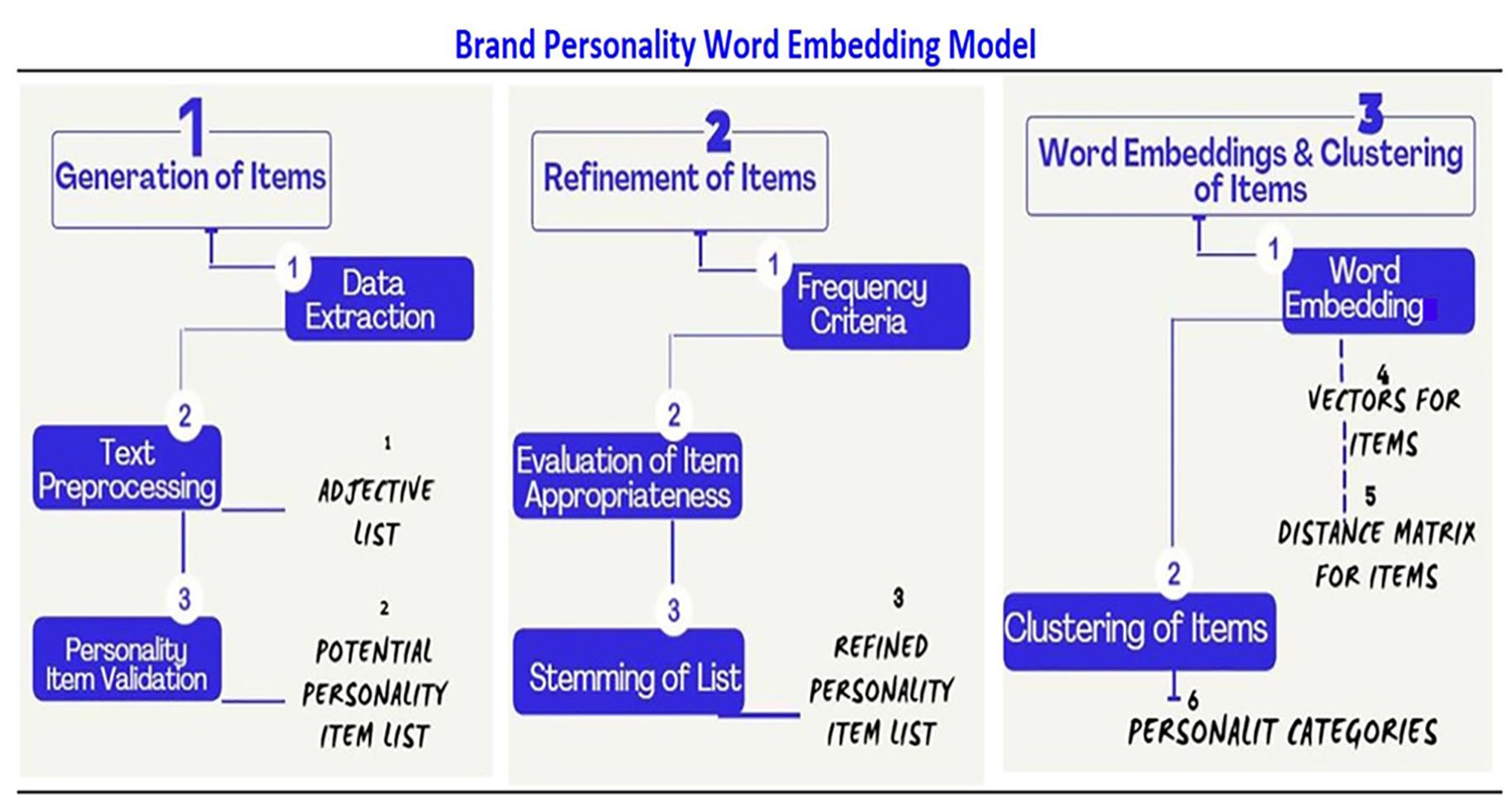
Brand personality word embedding model.
Item generation
Data extraction
To define the personality of WHSs, textual data from Tripadvisor (https://www.Tripadvisor.com/
The research procedure was as follows: in May 2020, texts describing 1,121 WHSs from the UNESCO WH Center website, (hereafter, the UNESCO corpus), and 9,920 Tripadvisor reviews of WHSs in seven countries (hereafter, the Tripadvisor corpus) were extracted (codes are available from the authors). Hogan (1991) defined personality in two ways: “what I say about myself” and the second “what others say about me.” The UNESCO corpus was what experts say about WHSs. In total, three text files were prepared: the whole text as an individual unit of analysis (the WH brand); filtered texts about WHSs from the seven countries in the Tripadvisor reviews; and clusters defined as personality categories.
The third file includes WH personality categories generated by the word embedding and clustering approach. These categories are used to measure WH personality distribution in the text file of the six UNESCO labels. The purpose of this analysis is to interpret the meaning of the WH personality categories—that is the clusters—in relation to their distribution across the six UNESCO concepts. This technique has previously been employed by Curiskis et al. (2020) to interpret clusters in relation to predefined concepts.
Tripadvisor reviews—Hogan’s “what others say about me”—were extracted for 261 cultural WHSs. This study was limited to cultural WHSs, as they dominate the WH list: of the 1,121 sites listed at the time, 869 (77.5%) were cultural (UNESCO, 2020). The sample was limited to reviews written in English, although visitors were from many countries, reducing segment bias. Visitor reviews were collected for China (37), India (30), and Japan (19), representing 32% of all WHSs in the Asia and Pacific region. User-generated reviews were obtained for 175 WHSs in Europe, representing 33% of the total: France (39), Germany (44), Italy (50), and Spain (42). These seven countries had the highest number of sites in the Asia and Pacific region (23%), and Europe (47.19%), and represented 70.19% of the total WH list. The reviews were of 23.28% of the total WH list of sites and 30% of all WH cultural sites.
Responsibility for promoting WHSs is delegated by UNESCO to the host countries. There is a perceived correlation between visitor awareness of WHSs and each individual country’s economic capability and willingness to raise visitor awareness of WHSs (Adie, 2017). The percentages may show how actively the countries promote their WHSs (Wang et al., 2015; Wuepper & Patry, 2017). The original aim was to collect data from four countries in each region, but most of the WHSs in Iran were not on Tripadvisor. Reviews specific to WHSs were therefore collected from seven countries, since the main objective was to collect as many reviews relevant to WH personality as possible.
User-generated reviews were extracted by identifying the WHSs on Tripadvisor, since many official names of WHSs are not clearly labeled on Tripadvisor. For example, the cathedral, the Real Alcázar and the Archivo General de Indias in Seville, which are one WHS, have three different Tripadvisor pages. A total of 402 Tripadvisor pages were identified for 261 WHSs. The keyword search engine and English language filter were used on Tripadvisor to search for the words “World Heritage,” yielding 9,920 individual reviews. A total of 1,400,247,000 words were extracted from the user-generated Tripadvisor reviews (452,270 words) and expert texts from the UNESCO WH Center (947,977 words).
Text mining preprocessing
To reduce the complexity of the texts and to conduct further analysis, text-mining preprocessing—an essential tool in text analysis (Denny & Spirling, 2018)—was employed to reduce the complexity of the data files, to perform dictionary analysis, such as measuring the distribution of personality categories, and to define the descriptors attributed to WH. Several preprocessing features—called nodes—were employed to identify linguistic features (Denny & Spirling, 2018; Grimmer & Stewart, 2013) using Knime Analytics Software 4.1.2. These were:
Punctuation, Numbers, and Stop words: a built-in list in the Knime software that includes most irrelevant words, such as nouns and pronouns, and removes those that were unlikely to provide meaning.
Case Convertors: this study’s analysis of digital textual data was based on matches between WH category items or dictionary items and the text files that were prepared for the study. It was essential to employ case convertors to all files, WH categories and dictionaries for accuracy of frequency. This ensured that all the texts had the same upper and lower case format.
Stemming and Lemmatization: reduced the WH personality category items to a more manageable set of items by truncating them to their origin.
Part of Speech (POS): assigned grammar types to each word throughout the entire data file.
Dictionary Tagging Filters: enabled the filtering of all adjectives from the data file after the POS had been defined. This node defined the match between psychology dictionaries and the entire adjective list.
Frequencies Filters: allowed frequencies of each adjective to be counted in entire documents, and filtered the WH personality items according to their frequencies.
Personality item validation
The traditional approach of consulting psychologists or language experts was used for item validation (Geuens et al., 2009). The adjectives list was matched to personality items in psychology and BP studies used for this purpose, following the method employed by Fischer et al. (2020). This study added WHS-relevant personality lists from BP studies. Allport and Odbert (1936) scanned thousands of adjectives to select the best stable personality items to describe a person, resulting in a list of 17,954 personality descriptors (hereafter, the Allport List). The Allport List has been described as the longest established and most comprehensive personality list in English (Azoulay & Kapferer, 2003; Fischer et al., 2020). Moreover, 2,800 items were taken from Norman (1967), who refined and structured items on the Allport List. Furthermore, Goldberg (1982) provided 1,710 personality items, which Fischer et al. (2020) deemed to be more appropriate for their study, as they did not include appearance or physical characteristics. Later, Saucier (1997) provided a 500-item list that captures the most commonly used personality items, including appearance and physical items.
The following items were used from BP studies: 42 items from Aaker (1997), as they are the most widely used; 12 items from Ekinci and Hosany (2006), the first scholars to apply Aaker’s (1997) BP scale to destinations; 38 items from D’Astous and Boujbel (2007), who applied the BP scale to countries; Pitt et al.’s (2007) 833 items; 209 items from Rojas-Méndez et al. (2013) and Rojas-Méndez and Hine (2016), who measured nation brands and country tourism websites; 78 items from Demirbag Kaplan et al. (2010), who measured place personality; 23 items from Kumar and Nayak (2018), who measured Indian DP; and 33 items from Zhang, Huang et al. (2019), who measured urban DP. The four psychology lists were merged. The result was two lists: after removing redundant items, the list of BP studies included 1,080 personality items (BP dictionaries), while the four psychology studies lists included 18,337 items (psycholexical dictionaries).
Following Davies et al. (2018), Grohmann (2009), and Aaker (1997), who agreed to include social and demographic characteristics in BP categories, the personality of WHSs was defined as “the set of personality characteristics associated with WHSs as ascribed by UNESCO experts and as perceived by visitors.” Knime was used to compare the adjective list with the personality dictionaries, thus obtaining a list of Potential Personality Items.
Refining the Items
One of the aims of the study was to reduce the number of potential personality items and ensure that the list would retain meaningful items relevant to the overall WH brand. For the selection of the most relevant items from the potential personality list, these three criteria were applied: (1) frequency criteria; (2) stemmed lists; and (3) evaluation of item appropriateness.
Applying the text-mining frequency criteria, items would be considered if they averaged between 0.01 and 0.05 of the processed text (Denny & Spirling, 2018; Wiedemann, 2018). LIWC software was used, as it includes a psychological process analysis known as “category analysis.” This transforms the whole potential personality list into a dictionary, where each item is perceived as an individual category. Based on the frequencies of each category (item) extracted from the UNESCO and Tripadvisor corpora, LIWC was used to conduct a separate category analysis, analyzing items with at least 0.01 and a minimum of five appearances in each corpus. By reducing the list of potential personality items, a frequency criterion made the process more manageable, and reduced the number of items that required stemming, which can help reduce a complex list with words with the same root, and evaluating.
Schade et al. (2014) suggested evaluating the appropriateness of items used for constructing robust BP categories by eliminating words that do not contribute to the meaning of the brand. Before applying the frequency criteria, the potential personality list included words signifying colors, shapes, directions, or locations. However, these are attributed to specific elements at a particular WH site and not the overall WH brand. They should therefore be eliminated, as was the case with Ranfagni et al. (2016). Most of these words come from Allport and Odbert’s (1936) list of adjectives, with items being classified into four categories: Personal Traits; Temporary State; Social Evaluations; and Metaphorical and Doubtful. The last category produced most of the irrelevant keywords in need of evaluation.
Word Embedding and Item Clustering
In the traditional BP approach, many significant brand traits may be eliminated under the criteria of psychometric methodologies, which Rauschnabel et al. (2016) and Lieven (2017) considered problematic. An alternative approach to categorizing the items was adopted in this study sample, based on their correlated meaning, which can be defined by means of word-embedding methods using pre-trained language models (Devlin et al., 2019), which are widely employed in text and topic categorization (Curiskis et al., 2020). This study used customized programing codes (available from the authors) to extract scores for word similarity, construct a features matrix calculating the similarity distance between each pair of WH items, and test the pre-trained language models’ ability to define the best similarity scores. Defining the similarity distance matrix allowed the WH personality items to be clustered using K-means methods (Saxena et al., 2017).
Word embedding was used to cluster WH personality items into meaningful groups. This method has been commonly used in neural network language models such as Word2Vec (Mikolov et al., 2013), GloVe (Pennington et al., 2014), and Fasttext (Bojanowski et al., 2017). It is used for the vector representation of words in a numerical format (Mikolov et al., 2013). These vectors are real-value representations of words that can capture lexical semantics, such as word similarity and predictions; for example, vector Spain—vector Barcelona + vector Germany = close vector to Berlin (Mikolov et al., 2013). From the previous example, similarity scores can be obtained based on the distance between the two words in a specific context, known as cosine similarity, where the score refers to the distance of the similarity between words (Mikolov et al., 2013). Semantic similarity accuracy can thus be investigated by exploring the closest words to a specific target word resulting from the cosine similarity score. Word embedding therefore enables the computer to identify words with homogeneous features. Vectors enable existing mathematical methods to be used to study the distance in similarity between words (Devlin et al., 2019). By these means, Vectors of Items were obtained and a Distance Matrix of Vectors was generated.
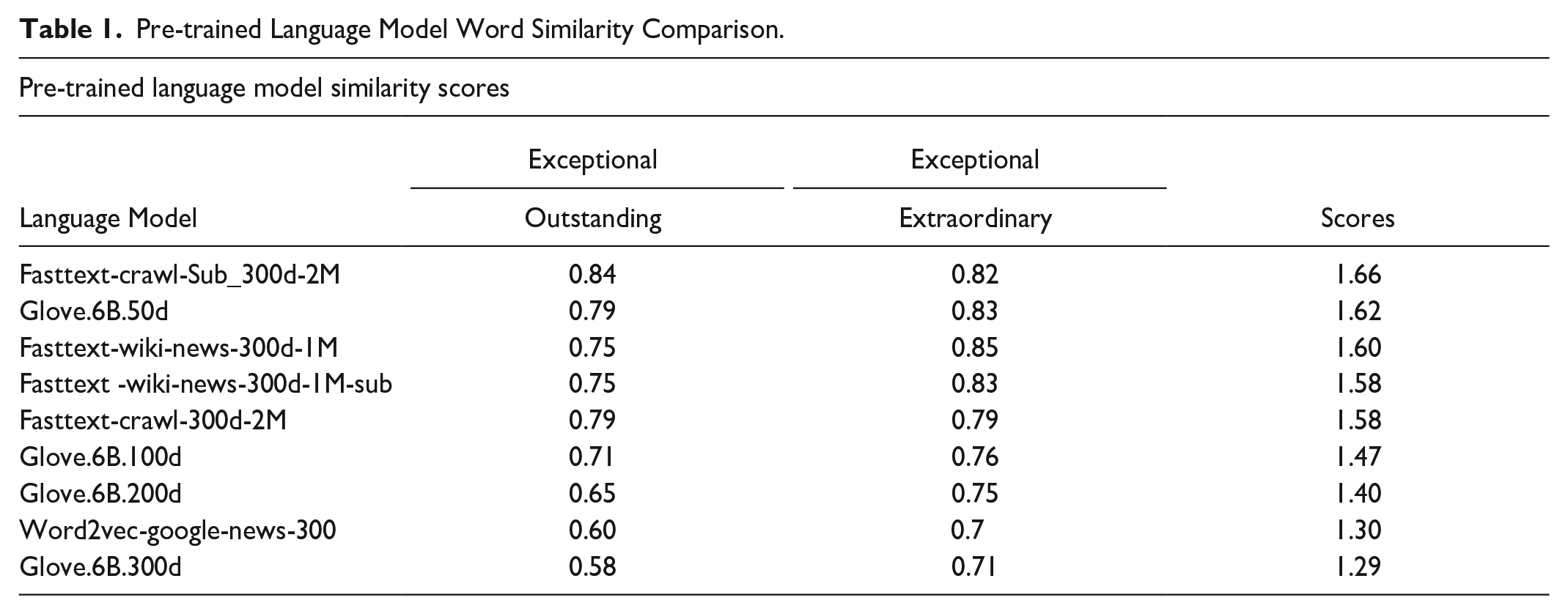
The accuracy of cosine similarity depends on the amount and quality of data, the size of the vectors, and the training algorithms (Mikolov et al., 2013). The Fasttext crawl-300d-2M-subword model was used. Similarity scores between “exceptional” and “extraordinary” and “exceptional” and “outstanding” were obtained. The sum of the similarity scores obtained for both sets of words was calculated to define the best language model (Table 1) (codes are available from the authors). Fasttext crawl-300d-2M-subword, which is pre-trained on two million words (Bojanowski et al., 2017), provided the best similarity scores for 192 items. These scores were then used to cluster those items. K-means clustering algorithms were preferred for word embedding (Curiskis et al., 2020; Sia et al., 2020). In the K-means algorithm, the top words in each cluster depend on the distance to the cluster center (Sia et al., 2020). Clustering the 192 items allowed the Personality Categories to be extracted.
Pre-trained Language Model Word Similarity Comparison.
Analysis of the Results
The results are discussed with reference to the BP word embedding model, including item generation, item refining, word-embedding and item grouping, as well as the analysis of the UNESCO and Tripadvisor corpora for WHS perceptions.
Generation of Items
The UNESCO and Tripadvisor corpora were used separately to select the most salient personality items attributed to WH as a whole, as the frequency criterion was applied when refining items. This meant that items with a high frequency could be included for both corpora. Two sets of adjective lists were compiled: one for all of the adjectives included in each of the UNESCO (7,257) and Tripadvisor (5,296) corpora. Based on matches between the adjective lists and the personality dictionaries, the following items were validated as personality items: 1,256 items from the Tripadvisor adjective list overlapped with the dictionaries, and 1,255 from the UNESCO adjective list. When the potential personality item lists obtained from the UNESCO and Tripadvisor corpora were compared, 600 items were found to be unique to UNESCO and 572 to Tripadvisor, while 718 items overlapped between the two lists.
Refining the Items
The respective lists of 1,256 (Tripadvisor) and 1,255 (UNESCO) potential personality items were filtered to provide a more manageable list. To this end, criteria were applied in relation to frequency, stemming, and appropriateness. For the frequency criteria, LIWC was used to convert the potential personality item lists into two dictionaries (one Tripadvisor, one UNESCO), where each item was treated as a category in each dictionary. Category analysis was then performed on both corpora individually to obtain the relative frequencies of items after text pre-processing. A list of 269 items was thus selected, with a minimum of 0.01% and five frequencies from UNESCO (156) and Tripadvisor (113). These items were combined in one list, where 43 items overlapped between both corpora, 113 items were unique to UNESCO, and 70 to Tripadvisor. After removing redundant items, a list of 226 items that fulfilled the frequency criteria was obtained. The terms “protective” (frequency 78) and “protected” (frequency 306) occurred in the stemming, both with the same root word, “protect.” Of the two, “protected” was retained.
The evaluation of the appropriateness of items aimed to ensure that the remaining items in the WH personality categories contributed to overall WH brand meaning. These 226 items were compared to the metaphorical and doubtful category in the Allport dictionary. When evaluating the appropriateness of items, 33 items were removed. Only words related to WHSs in general were kept, such as “protected,” “unchanged,” and “preserved.” Caprara et al. (2001), Azoulay and Kapferer (2003), and Ranfagni et al. (2016) were followed for eliminating items. These authors demonstrated that not all human personality items can describe brands, for example those relating to neurotic fatigue (Aaker, 1997), since items with ambiguous meanings are not applicable to describing brands (Rauschnabel et al., 2016; Schade et al., 2014). Aaker (1997) only considered positive items in the construction of personality categories, since the ultimate goal is to enhance a brand’s competitive advantages.
Items that were removed included words such as “closed” and “open,” which may refer to a specific WH site’s opening and closing times, words like “sound,” which have no clear meaning, and word forms like “ranging” or “following.” These types of words are extremely frequent when stemming is performed during a dictionary analysis, which can affect cluster distributions. Other words may have referred to an individual WHS or an element within a WHS, such as a specific design, such as “orthodox,” or shape, such as “circular.” These types of words were not perceived as being appropriate for inclusion in the overall WH personality items. However, words like “protected” were kept, because they referred to the primary objectives of the WH concept, and “protection” is included in the title of the 1972 WH Convention. Words such as “unchanged” and “preserved” are used to describe the concepts of integrity and authenticity (UNESCO, 2019). All three authors agreed on the eliminated items. Following refinement of the items, a list of 192 items remained describing the overall WH brand.
To compile the most efficient personality dictionary, the 192 item list was compared with psychology and BP dictionaries. It was observed that 92.20% (177 items) were in the Allport dictionary and a further 5.20% (10 items after removing redundant items listed in Allport) in the other three psychology dictionaries. the four psychology dictionaries contained 97.6% of the items. It was explored that 85 of the 192 items were matched in BP studies, 80 of these overlapping with psychology dictionaries, thus adding 2.6%. “Contemporary” (86 frequencies) came from Aaker (1997) and Kumar and Nayak (2018), and four other words from Pitt et al. (2007): “industrial” (186), “pristine” (44), “recent” (106), and “typical” (91). Because 97.6% of the items were in the psychology dictionaries, it can be suggested that this method constitutes a straightforward way of validating personality items (Fischer et al., 2020). This is particularly true when analyzing BP categories from digital textual data, because in digital text analysis more items may require validation than those emerging from the use of the traditional empirical approach using survey questionnaires.
Word Embedding and Item Clustering
The list of 192 items was grouped into categorical clusters using Fasttext crawl-300d-2M-subword. The items were then assigned a cosine similarity score to determine their similarity distances, before the similarity distance scores were arranged in a feature matrix. K-means cluster methods were then employed to cluster the items based on their scores as arranged in the feature matrix. Lastly, the clusters were interpreted according to how often they appeared in the six UNESCO concepts.
Clustering methods and validation
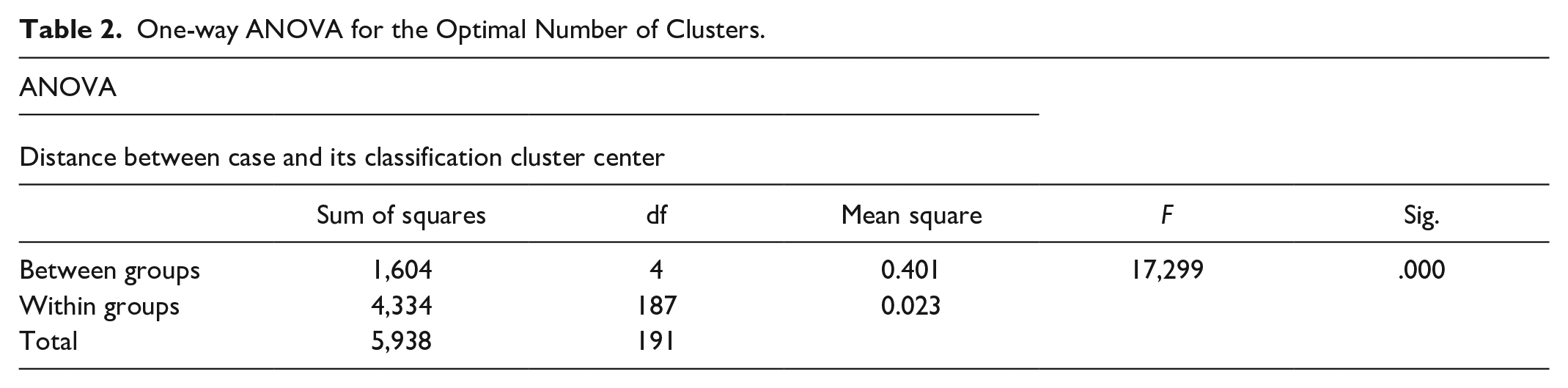
K-means clustering was used as it gives the best performance for word vectors (Curiskis et al., 2020; Hamodi et al., 2020). The quality of the clusters, perceived as being more accurate in determining the optimal number of clusters, was confirmed using internal criteria (Patibandla & Veeranjaneyulu, 2018; Saxena et al., 2017). These measure inter-cluster separation, which is the distance between clusters, and intra-cluster homogeneity, which is the distance between items in the clusters, known as compactness and separation (Saxena et al., 2017). The Sum of Squared Errors (SSE) is the index that is most often used for validating clustering (Saxena et al., 2017). The values and percentage changes in SSE from K-means clustering methods were compared with the separation of overall clusters, homogeneity and size of items within each cluster (Thinsungnoen et al., 2015). Five was found to be the optimal cluster number of the 192 items, according to these internal criteria (Saxena et al., 2017); this method was also applied by Rojas-Méndez et al. (2019). More specifically, the sum of square distances to the nearest cluster center was 0.023 (inertia), meaning that the distance of the items within the “intra-cluster-compactness” cluster was homogenous. Significant differences were found between the five overall clusters (inter-cluster separation), as shown by one-way ANOVA F(4,187) = 17, 29, p < .005. Finally, the number of items within the cluster was between 35 and 45 (Table 2).
One-way ANOVA for the Optimal Number of Clusters.
Interpreting the clusters
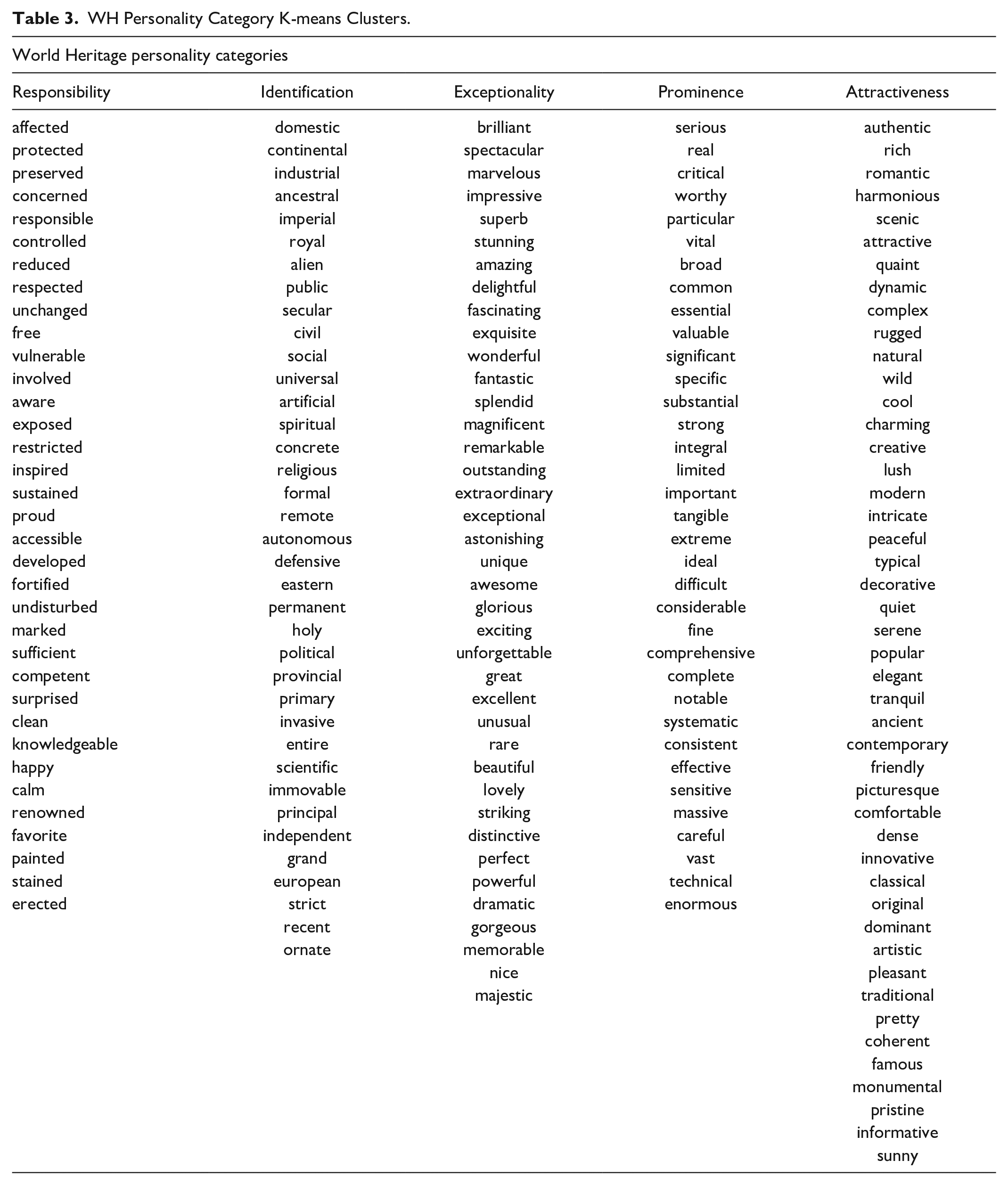
The five clusters were interpreted in two ways. First, the homogeneity of items within the clusters was able to be identified from the distance between each cluster item and the cluster centroid (Curiskis et al., 2020). The shorter the distance to the centroid, the more significant the meaning of the items to the cluster. Table 3 shows the distance of the 192 items from the centroid, which helps interpret the clusters and give them titles. Secondly, the text arranged according to the six UNESCO labels was used to run a category analysis, where each cluster was perceived as a category to define the frequencies of the five clusters in relation to these six labels. A confusion matrix (Table 4) was generated, which was useful for interpreting the clusters according to the labels (Bakarov, 2018; Curiskis et al., 2020). To this end, the six UNESCO labels text was split into six files. A dictionary analysis was performed using Antword-Pro software to obtain the confusion matrix. The resulting five clusters attributed to WHSs were: Responsibility, Identification, Exceptionality, Prominence, and Attractiveness.
WH Personality Category K-means Clusters.
Confusion Matrix for the New K-clusters and UNESCO Concepts for WHS.
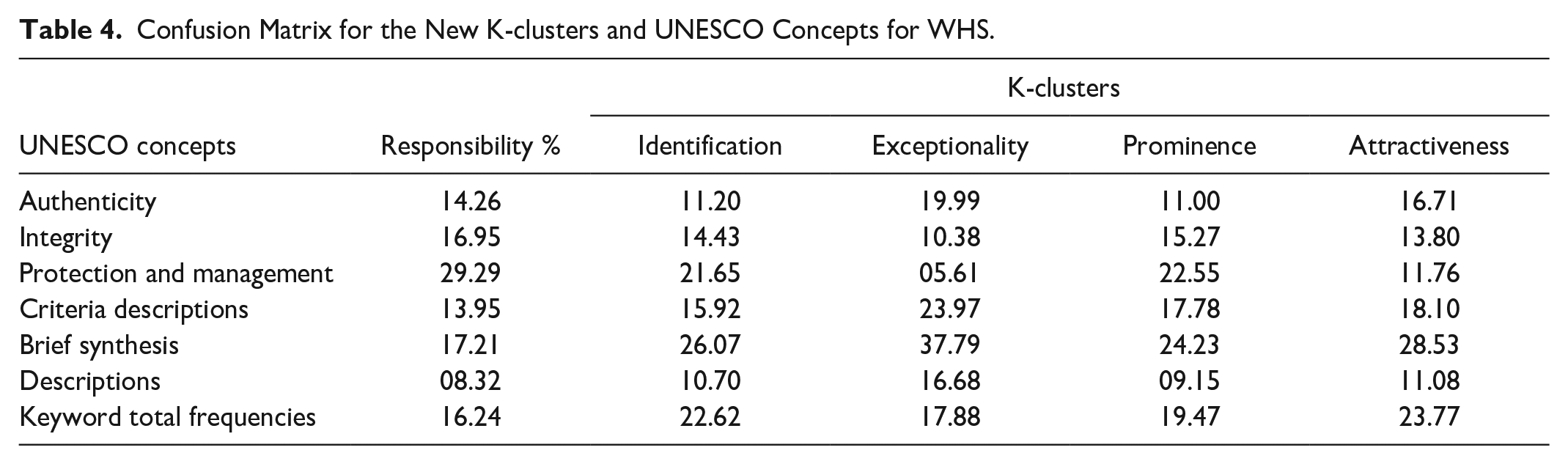
Table 4 presents the meanings of the clusters derived from the confusion matrix. (1)
Correspondence analysis (CA) is used widely in BP lexical studies (Rojas-Méndez & Hine, 2017). In this study, it was used to gain a deeper understanding of relationship patterns between the six UNESCO labels and the five WH personality categories, specifically as a tool for visualizing this relationship in a two category space (Greenacre, 2017). The significance test confirmed a relationship between the UNESCO labels and the WH personality categories: p > .05, with good quality representation, given that accumulative inertia accounted for 98% of the first two categories. Figure 2 shows that the categories Prominence, Responsibility, and Identification agree closely with the concepts of Authenticity, Integrity, and Protection and Management. The graph also shows that the corpora items Description and Brief Synthesis are related. Description, Brief Synthesis, and Criteria Description all comply with Exceptionality and Attractiveness. To a certain extent, the five WH personality categories capture the main ideas behind the concepts of the UNESCO labels and can be used for several other managerial operations.
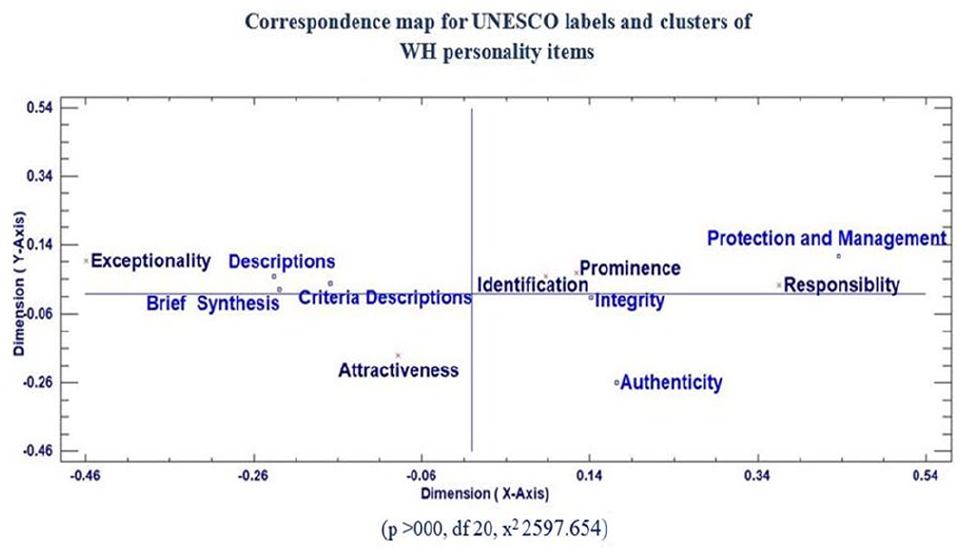
Correspondence map for UNESCO labels and clusters of WH personality items.
Personality Category Distribution of all 1,121 UNESCO World Heritage Sites
The overall WH personality category distributions were measured for all 1,121 WHSs, using the UNESCO corpus. These WHSs are distributed among 167 countries and classified into six regions (UNESCO, 2020). Measuring the UNESCO WHSs in such a comprehensive way increases the knowledge of both academics and professionals of all types of WHSs (cultural, natural, and mixed; countries and regions). These personality distributions also reflect all the concepts behind WH through the six labels describing each WHS. Figure 3 shows that the distribution of WHSs across the five personality categories was moderate, with no extreme outliers. Attractiveness (23.90%) and Identification (22.68%) were found to be categories with the widest distribution, followed by Exceptionality (18.37%). The least common categories were Prominence (19.41%) and Responsibility (16.14%). These five personality categories can thus be applied to measuring WHSs or similar attractions as micro-elements of tourism destinations.
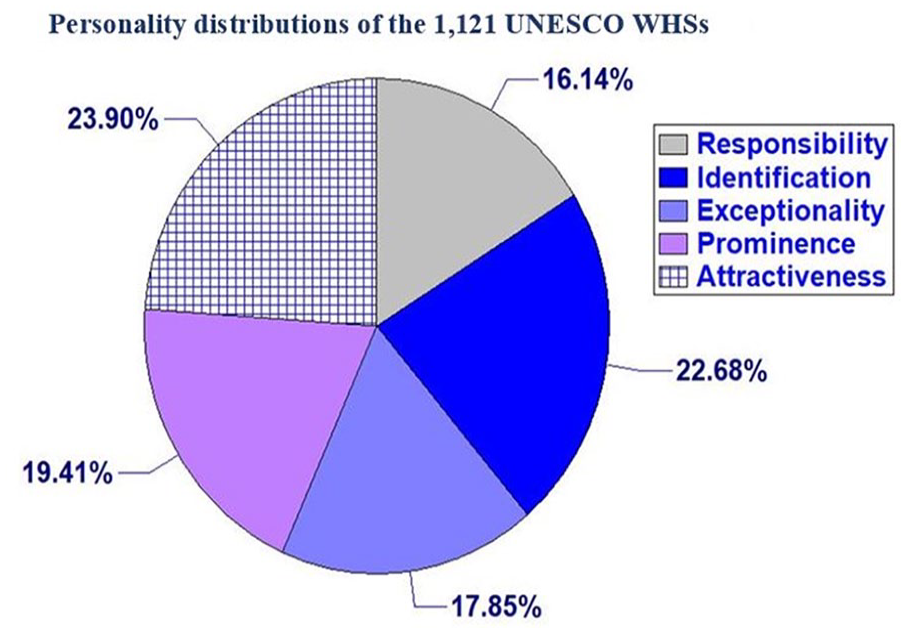
Personality distributions of the 1,121 UNESCO WHSs.
A Comparison of WHS Personality Distribution Between Visitor and Expert Attributions
It may be possible to further improve the way WH is promoted by comparing the descriptions provided by UNESCO experts and the opinions of visitors to WHSs. Figure 4 shows the comparative distribution of WH personality categories between the UNESCO and Tripadvisor corpora. Tripadvisor visitors attributed Exceptionality to 55.59% of WHSs, indicating that they valued WHSs’ OUVs. The category with the second highest distribution was Attractiveness (21.84%), which refers to the high value visitors award to the authenticity of WHSs. Responsibility (9.24%), Identification (6.9%), and Prominence (6.42%) were rarely expressed by visitors. In contrast, Figure 4 shows that the WH personality categories from UNESCO experts were distributed evenly: Identification (24.36%) and Attractiveness (24.21% ), Exceptionality (18.37%), Prominence (17.63%), and Responsibility (15.4%).
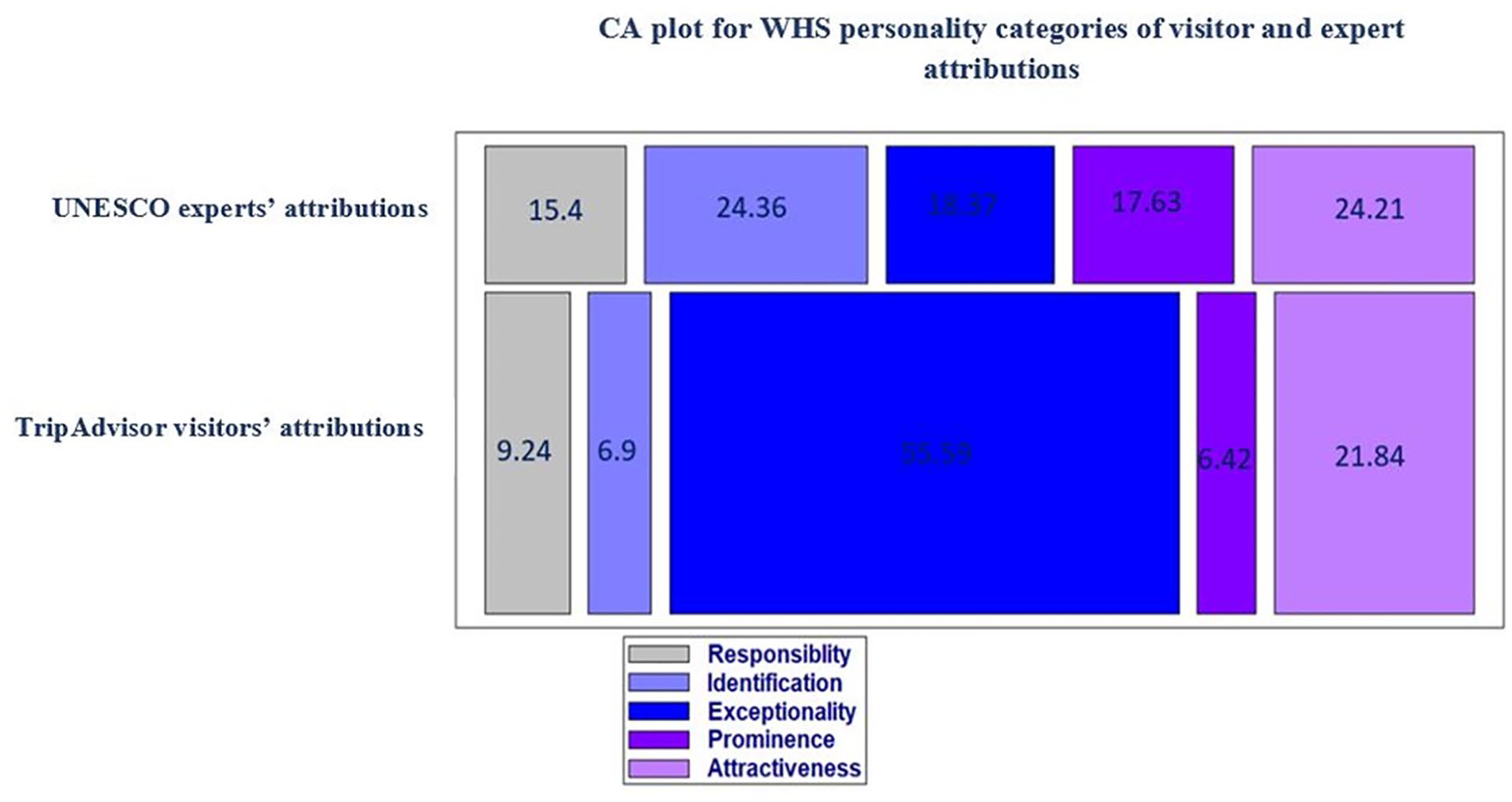
CA plot for WHS personality categories of visitor and expert attributions.
Figure 5 shows the CA map, which also confirms that visitors and experts perceive WHSs differently. Whereas visitors largely attributed Exceptionality and Attractiveness to WHSs, the experts described them using the items Identification and Attractiveness, followed by Exceptionality. The category with the third highest attribution among the experts, Exceptionality, was distributed moderately widely in the UNESCO corpora, both in the subsample of the seven countries (18.37%) and throughout the entire corpora (17.85%). This category was the most favored by visitors (55.59%). Although the categories Prominence and Responsibility were fairly well represented in both of the UNESCO samples (7 and 167 countries), the same was not true of visitors’ perceptions. These two categories therefore appear near the UNESCO experts’ attributions but far from the Tripadvisor visitors’ attributions in Figure 5. To emphasize this fact, Figure 4 shows that the sample of reviews from Tripadvisor is larger than that of the UNESCO expert seven-country subsample. However, it is worth noting that even if this study had compared the Tripadvisor data to those of all WHSs in all countries, instead of using filtered data for the seven countries from UNESCO, there would probably have only been a minimal change in the findings. The personality category distributions in the seven countries (Figure 4) are very similar to the personality distributions for the data related to all 1,121 WHSs (Figure 3).
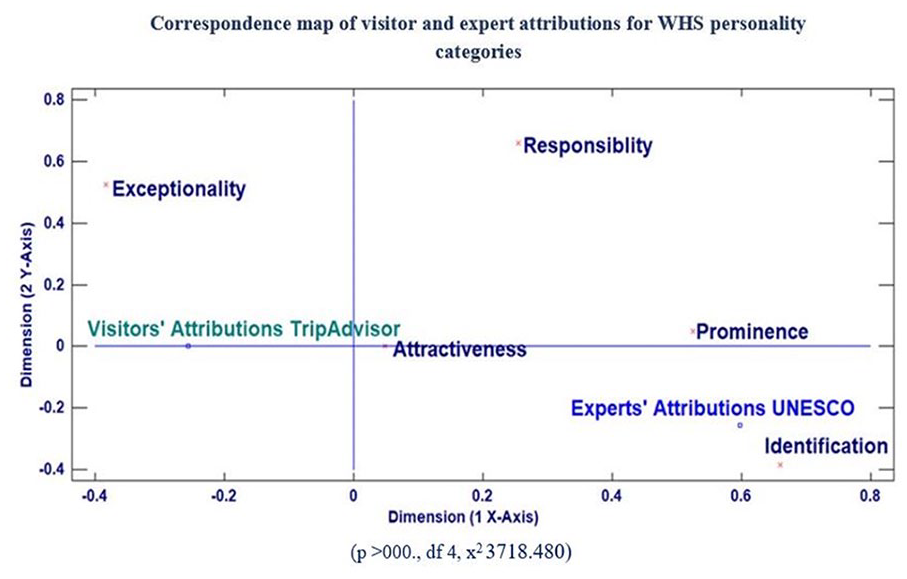
Correspondence map of visitor and expert attributions for WHS personality categories.
Discussion and Conclusions
Brand Personality Contributions
Aaker (1997) BP scale has attracted significant attention from academics, despite its limitations. Academics have pointed out the shortcomings of the scale for predicting visitor behavior, showing that its five categories are insufficient for measuring DP. They have called for further work to be done (Ekinci & Hosany, 2006; Kumar & Nayak, 2018; Murphy et al., 2007). Even though several meta-bibliometric analyses (Carvalho et al., 2021; Radler, 2018; Vinyals-Mirabent & Koch, 2020) have shown that the literature on tourist behavior considered both the direct and indirect effects of BP (Saeed et al., 2022; Zhang, Huang et al., 2019), few updated DP scales have been constructed (Kumar & Nayak, 2018; Saeed et al., 2022; Ye et al., 2020). This may be due to the traditional limited empirical approaches used to capture the cultural context of DP (Davies et al., 2018). The research approach of this study, which considered that WH categories pertain to their specific brand culture, would indicate that different destination elements can be aggregated and analyzed for the purpose of exploring overall DP, which may facilitate the construction of specific cultural personality categories for future tourism behavior studies.
This study concurs with several others (Carvalho et al., 2021; Demangeot & Broderick, 2012; Lee, 2009; Rojas-Méndez et al., 2019; Ye et al., 2020) in asserting that the BP concept still needs further development, and the employment of various approaches to underpin its construct. This study developed a three step approach to constructing WHS personality categories, aimed at overcoming the differences between the goals of academics, who want to create a general BP scale, and practitioners, who need to establish their own BP categories: generating items; refining items; and word embedding and clustering items. WH personality categories were constructed from multiple sources based on item generation, as the most widely available scale (Aaker, 1997) may not fully capture brand associations. This argument is consistent with other studies (Heere, 2010; Rauschnabel et al., 2016; Schade et al., 2014). There are items which are unique to the UNESCO corpus and to the Tripadvisor corpus. It was deemed that an analysis of how the target audience (visitors) perceived messages compared to the intended meaning from senders (UNESCO experts) may not be adequate if item generation was restricted to only one side. This was also an important consideration when defining the items, as it allowed for the inclusion of cultural context, and an understanding of the difference in the perceptions between visitors and UNESCO experts.
In this study, personality dictionaries available from psychology and BP studies were used to validate WH personality items. The use of psychology dictionaries alone was enough to provide a fast and easy approach to validating items. These dictionaries make it easier for practitioners to validate items, avoiding the need to address at least three psychologists or language professionals, and making the process less time-consuming compared to traditional BP approaches (Geuens et al., 2009). The four psychology dictionaries consulted covered 97.6% of the WH items. However, attention must be paid to the fourth category of the Allport dictionary, namely “Metaphorical and Doubtful,” which includes words that need to be evaluated for appropriateness.
Different cluster results were obtained when different pre-trained language models were used to define word similarities. This helped with the analysis of the cosine similarity score for the 192 items from the most commonly used pre-trained language models, and with comparison of the scores. In this study, Fasttext was found to be the most suitable pre-trained language model for items related to WHSs, in line with Faathima Fayaza and Ranathunga (2020). If an author’s own language model cannot be generated following the language model construction criteria designed by Mikolov et al. (2013), such as the amount and quality of data, it is recommended that the scores obtained from various pre-trained language models be compared prior to clustering, since the score may affect the numbers of optimal clusters and their goodness of fit.
World Heritage Contributions
The effectiveness of WH as a tourism brand, such as its ability to boost tourism development or visitor numbers, is debatable, according to a significant body of studies (Buckley et al., 2020; Poria et al., 2011a, 2011b, 2013; Ribaudo & Figini, 2017; Yang et al., 2019). Poria et al. (2011a, 2011b) proposed that one way to understand WH’s effectiveness is by analyzing the impact of its brand equity, such as how it affects visitors’ intentions to visit and willingness to pay higher fees. Academics acknowledged that understanding visitors’ perception of WHSs may contribute to boosting its influence on visitor emotions, such as visitor loyalty, and the perceived quality of WHSs (Palau-Saumell et al., 2013; Poria et al., 2011a, 2011b). Lacher et al. (2013) explored how understanding visitor perceptions of heritage sites could provide insights into how they influence destination preferences. In this regard, Poria et al. (2011a, 2011b) argued that the term “Heritage,” is missing from the WHS designation criteria established by UNESCO experts, since visitor perception was not taken into consideration. In line with these previous studies, this study’s aim was to examine the perception of WHSs and identify the most frequent intangible meanings associated with the WH brand, by extending the BP concept to WH studies.
The new method applied in this study helped define five personality categories attributable to all 1,121 WHSs. These attributions are a reflection of the 192 item personality category dictionary, selected from 12,526 (7,257 from the UNESCO corpus and 5,269 from the Tripadvisor corpus) unique adjectives occurring 116,818 times (UNESCO: 69,741; Tripadvisor: 47,077). UNESCO experts attributed items to WHSs in the categories Attractiveness (23.9%), Identification (22.68%), Prominence (19.41%), and Responsibility (16.14%). However, in the seven-country subsample from the UNESCO corpus, the distribution of the items mentioned by the experts was the same as for all 1,121 WHSs in 167 countries. In contrast, the distribution of 9,920 visitor-generated reviews relating to the same seven countries notably differed: visitors attributed the categories Exceptionality (55.59%) and Attractiveness (21.84%) to WHSs more frequently, while Responsibility (9.24%), Identification (6.90%), and Prominence (6.42%) were mentioned less frequently.
Most of the items in the Exceptionality category described by visitors concurred with the Sophistication category on Aaker’s scale. The high occurrence of Exceptionality is consistent with a study by Hassan et al. (2021), which concluded that visitors strongly attribute the Sophistication category to WHSs in European countries. In her BP model, Aaker (1997) described the items in the Sophistication category as being more related to the extrinsic features of brands, such as “elegant,” “beautiful,” and “brilliant,” which visitors may consider desirable, but not necessary. These items are mostly used by advertising agencies such as Mercedes and BMW to promote sophisticated brands (Aaker, 1997), confirming that visitors perceive WH as a top brand, as pointed out in several WH studies (Buckley, 2004, 2018; Ryan & Silvanto, 2014; Yang et al., 2019). The five WH personality categories this study defined included items attributed to all the UNESCO WHS concepts.
In contrast to previous WH studies, which have focused on exploring the concept of Authenticity, this study investigated the other concepts related to WHSs described in the six UNESCO labels (Kim et al., 2018; Nian et al., 2019; Poria et al., 2013; Wang et al., 2015). The results show that Authenticity items were expressed in the category Attractiveness (21.84%), with frequent items such as “original,” “typical,” “authentic,” and “traditional.” The Criteria Descriptions and Brief Synthesis were found to be attributed to items relating to Exceptionality, such as “outstanding,” “unique,” “exceptional,” and “remarkable,” which were also valued by visitors (55.59%). This shows that visitors appreciate items associated with Authenticity and Criteria Description concepts, which are also associated with the OUVS of WHSs in reviews.
In contrast with the above, the concepts of Integrity and Protection and Management were most frequently described with items in the Responsibility category, such as “protected,” “preserved,” “vulnerable,” “responsible,” and “developed,” while the findings show that visitors rarely referred to the category of Responsibility (9.24%). Identification (6.90%) and Prominence (6.42%) were attributed with only moderate percentages (Table 4) in the Brief Synthesis and Protection and Management text files, and these categories were infrequent in visitors’ reviews of WHSs. This would suggest that UNESCO experts should further analyze the way in which visitors perceive intangible WH meanings (Poria et al., 2011a, 2011b, 2015).
Empirical Implications
A new model for identifying and measuring the personality of WHSs has been developed in this study, thus enhancing the distributed representation of a word hypothesis, available language models, and advances in NLP (text mining) and big data analysis. This study’s methods may help to measure the personality of product categories, seen as a limitation in the available BP scales (Austin et al., 2003; Davies et al., 2018), since they facilitate the construction of WH personality categories by extracting items from WH context and culture. It is thought that these methods may be more effective in measuring DP using BP scales that were constructed in different contexts, rather than the specific destination context, as each destination is unique (Kumar & Nayak, 2018; Skinner, 1970).
This study’s methods offer a new technique for defining BP categories, extracted for the first time entirely from digital texts. The generation and refinement of WH personality were customized to ensure that cultural context was included when collecting and selecting the most frequent items. Compared with traditional BP methods (Aaker, 1997), firstly, the identification of WH personality items was customized from the entire corpus of digital texts and secondly, the word-embedding technique was adopted for the first time to categorize items and assist in defining the similarity between WH personality items. The use of this technique and the available language models helped categorize items based on their correlated similarities, driven by the contextual representation of words (Mikolov et al., 2013). In general, this research adds a new approach that broadens the understanding of the practical implications for BP in marketing.
Practical Implications
These methods enable academics and managers to identify and analyze BP using extensive digital textual data. In the brand creation process, managers can collect digital texts related to brands in the same product category and study the textual data for better brand positioning (Pitt et al., 2007). Specifically, the use of WH personality categories may assist destination managers and UNESCO experts to design a WH BP strategy to boost the position of WHSs (Pitt et al., 2007; Rojas-Méndez et al., 2019). For example, by grouping several WHSs together, destination managers can monitor the WH personality distributions that visitors attribute to their WHSs in their digital materials and other digital sources for competitors’ WHSs of different sizes, such as destinations or countries.
This study confirms that cultural context affects BP identification, meaning that the influence of particular WH categories may vary depending on the target visitor (Rojas-Méndez et al., 2019). When addressing visitors, destination managers can thus customize the promotional content, considering that a visitor’s post-experience is found to be more oriented to the categories of Exceptionality and Attractiveness. Rojas-Méndez et al. (2019) grouped visitor segments for destinations according to personality categories and ascertained that specific visitor segments are more drawn to specific personality categories. Understanding WH visitor types based on their personality categories in a similar study may thus assist in better positioning WHSs. This study showed that UNESCO experts and visitors have different perspectives of WHSs. As a result, experts should consider how various UNESCO concepts relate to WH categories as reported in this study (Table 4) when developing a different WH personality strategy.
Limitations to this study included the amount of data available, which forced the authors to use the Fasttext pre-trained language model. Although word similarity accuracy can be obtained from a trained model using subject-specific data, this requires a larger sample size, as the language models currently available are pre-trained on millions of words (Mikolov et al., 2013). The Fasttext model has techniques that enable data to be combined with those of the pre-trained model to obtain better scores. Future studies may generate their own BP categories, with an adequate amount of text to establish their own language model, or apply the Fasttext model to their data. Obtaining the best similarity score may improve the performance of the cluster methods.
Footnotes
Declaration of Conflicting Interests
The author(s) declared no potential conflicts of interest with respect to the research, authorship, and/or publication of this article.
Funding
The author(s) disclosed receipt of the following financial support for the research, authorship, and/or publication of this article: The Language editing of this article was financed by the Laboratori Multidisciplinar de Recerca en Turisme (LMRT), consolidated research group 2017SGR 987 (2017–2021), from the Generalitat de Catalunya, AGAUR.
