




Abstract
Effective approaches to mitigate the adverse environmental impacts of tourism development have become one of the most prevalent topics in tourism. However, limited research analyzes the role of social interactions in tourists’ environmentally responsible behavior. This study is one of the first to investigate two distinct antecedents representing visitors’ interactions with service providers and residents to explain tourists’ behavior. Drawing on the Stimulus-Organism-Response theory, a mixed-methods sequential explanatory research design was employed by collecting quantitative data through a survey and following up with qualitative data from in-depth interviews. Based on a survey of 441 respondents, the study confirmed the positive effects of co-creation experiences between tourists and service providers, as well as emotional solidarity between visitors and residents, on tourists’ environmentally responsible behavior at destinations. An analysis of 10 in-depth interviews reveals new important factors contributing to tourists’ environmentally responsible behavior and its outcomes.
Keywords
Introduction
The sustainable development of tourism destinations has grown into one of the most ubiquitous topics in tourism. Following extensive research on the detrimental effects of tourism, scholars and practitioners have increasingly focused on effective approaches to mitigate the adverse environmental effects of tourism development (e.g., Ballantyne & Packer, 2013; He et al., 2022; Kiatkawsin & Han, 2017). The ongoing COVID-19 pandemic has intensified the need to generate new strategies for the sustainable development of destinations. As noted by a recent expert-informed research agenda, to attain sustainable development in this “new normal,” there is a pressing need to account for and balance the interests of tourists and residents (Assaf et al., 2022). In this regard, tourists’ behavior at the destination becomes a salient factor, shaping how the destination is consumed. Thus, understanding and managing tourists’ environmentally responsible behavior (ERB) is of immense value. Moreover, the recovery strategies and building of destination resilience should cover novel sustainability practices. Therefore, knowledge regarding the factors that may contribute to tourists’ ERB will greatly benefit destination policymakers.
Previous research suggests that today, consumers value more intangible aspects of consumption, including sense of well-being, esthetics, competency development, and co-creation of their own experiences, and are more aware of the potential impacts of their consumption behavior (Kotler, 2011; Laroche et al., 2001; Saini, 2013). This behavioral shift aids the sustainability efforts of destination management organizations in developing successful intervention strategies to promote tourists’ ERB.
Tourists’ ERB, also known as green or pro-environmental behavior, is conducive to protecting and preserving resources in general and has received extensive academic attention. In the attempts to encourage and entice ERB, previous research has identified several antecedents of tourists’ ERB that mostly focus on factors such as tourists’ values, norms, and attitudes (e.g., Liu et al., 2020; Mo et al., 2022; Ramkissoon et al., 2012; Wu et al., 2021). However, most existing studies concentrate on individual attitudinal factors and, with few exceptions (e.g., Li & Wu, 2020), lack an investigation of how tourists’ social connections may influence their ERB (Dolnicar et al., 2019). For example, the influence of social interactions between tourists and service providers or residents in modifying environmental behavior is either largely overlooked or receives sporadic attention in the literature. Nonetheless, research demonstrates that such interactions may have a powerful impact on visitors’ behavioral responses (Joo et al., 2020; Mathis et al., 2016). Social interactions can be viewed as significant stimuli affecting individual behavior. Beyond the positive and negative emotions that may emerge from interactions, they may lead to psychological arousal that consequently impacts behavior (Kang et al., 2021). To gain a more holistic outlook on visitors’ ERB in tourism destinations, it is critical to explore the predictive power of social interactions in explaining behavior in addition to the more extensively researched individual attitudes.
Past research related to ERB has primarily focused on exploring its antecedents (e.g., Chiu et al., 2014; He et al., 2022; Xu et al., 2018), but can be argued to lack analysis of the outcomes of ERB. An exploration of the potential consequences of ERB is likely important in formulating effective measures to encourage and guide tourists’ ERB. Moreover, previous scholarship suggests that ERB may vary depending on cultural norms, background, and worldviews (Leung et al., 2015; Ramkissoon et al., 2012; Wu et al., 2021), signaling the importance of investigating tourists’ ERB within different cultural contexts.
As noted by Arici and Uysal (2022), the key concepts of ERB should be examined through a mixed-methods approach that may include both a survey and follow-up interviews of study subjects to supplement or augment results. The mixed-methods sequential explanatory design applied in this study allows for capturing a more comprehensive outlook on tourists’ perspectives regarding ERB.
To address the above research gaps, this study applies the Stimulus-Organism-Response (S-O-R) theory and focuses on the following research objectives. (1) Study 1 analyzes whether and how the interactions between tourists and key destination stakeholders affect tourists’ intention to behave in an environmentally responsible way at the destination. Specifically, the study employs a survey methodology to test the predictive ability of co-creation, emotional solidarity, and travel experience satisfaction in explaining tourist ERB. (2) Study 2 supplements the findings of Study 1 and explores other antecedents as well as the outcomes of tourists’ ERB through in-depth interviews.
Overall this research is believed to contribute to the tourism literature in several ways. First, it advances the literature on ERB by examining how co-creation between service providers and tourists and the emotional solidarity of tourists with residents shape tourists’ ERB, uncovering tourists’ intangible consumption antecedents of this outcome variable. Thus, the study responds to a call from recent research (e.g., Wang et al., 2018) to explore the role of interactions in shaping tourists’ ERB in more detail. Second, we extend the application of S-O-R theory to the context of tourists’ sustainable behavior, where social interactions are viewed as stimuli, satisfaction with travel experiences as the organism, and ERB as the response outcome. Third, this study enriches tourist ERB literature by exploring the potential outcomes of such behavior. As the results show, the ERB of tourists may be motivated by both altruistic and egoistic outcomes. Finally, we provide destination managers with effective tools and intervention strategies to elicit ERB, thus promoting and fostering sustainable consumption at the destination. By looking into the novel antecedents of ERB, this study uncovers new ways in which successful interventions can be introduced by destination planners.
Literature Review and Hypotheses Development
Stimulus-Organism-Response Theory
Because there is a strong emphasis on the notion of interaction, the constructs of co-creation for the experience formation and emotional solidarity with residents are sought to be reflective of interaction (Prebensen & Xie, 2017; Woosnam & Aleshinloye, 2013). In a way, an intense engagement in the design and consumption of experiences may foster positive attitudes toward environmental concerns and issues in general (Wang et al., 2018). When an individual as a consumer is stimulated by external factors such as interactions with spheres of experience or between providers and guests, the stimulus can trigger “inner changes” based on an internal evaluation of the system. The latter may influence behavioral responses as outcomes, such as the nature of satisfaction with the experience or the nature of intention of behavior (Mathis et al., 2016). In the case of this study, this is ERB.
Tourism researchers have used several approaches to examine behavioral responses to changes in destinations as outcomes of development, overtourism, and gentrification. In the discourse of behavior in tourism, the research literature is dominated by the theory of planned behavior (TPB), which states that behavior is a function of perceived behavioral control, subjective norms, and attitudes (Liu et al., 2020). Thus, while the TPB explores the effects of attitudes toward pro-environmental behavior, it mainly focuses on explaining behavior via an individual’s attitude (i.e., evaluation of a given behavior as favorable or unfavorable), which then leads to intention (Ajzen, 1991; Cheng & Huang, 2013; Han, 2015; Mancha & Yoder, 2015). Yet, it fails to reveal why people hold this attitude, making it difficult to determine the underlying mechanisms of ERB to change visitors’ behavior effectively and comprehensively. More specifically, the TPB does not explore the role of salient factors and their triggering power of response to change behavior. A more encompassing response theory that is gaining attention and also explains the triggering powers of constructs in behavior is the Stimulus-Organism-Response (S-O-R) theory. The theory is considered revolutionary and integrative for understanding consumer modeling and behavior (Jacoby, 2002; Laato et al., 2020).
The S-O-R theory states that certain stimuli trigger a response (i.e., behavior) based on an internal evaluation of the organism (Hadjidimos & Yeyios, 1991; Mehrabian & Russell, 1974). Contrary to existing models, this theory touches the inner layers of individual behavior and clarifies their mechanism to better analyze emotion-driven responses. The S-O-R theory has been applied in hospitality and tourism to explain tourists’/guests’ behavioral responses such as revisit intentions (Chen, Cheng et al., 2020), liminal tourism experiences (Zhang & Xu, 2019), and word-of-mouth intentions (Chen et al., 2022). According to this theory, the stimuli present the external factors in the environment (e.g., tourism destinations, hotel servicescapes, social interactions) may affect the organisms and lead to avoidance of response or approach behaviors (Mehrabian & Russell, 1974; Peng & Kim, 2014). While, initially, the organism in the S-O-R theory referred to individual emotional and cognitive states mediating the link between the stimulus and the response (Kim et al., 2020), tourism researchers have employed several variables in place of the organism, including satisfaction with experience (e.g., Chen et al., 2022; Lam et al., 2011). The S-O-R framework was deemed the most applicable to the current study objectives as it recognizes not only material but also social stimuli (Mehrabian & Russell, 1974). The theory suggests that social stimuli may lead to behavior through the psychological mechanism of transforming the received stimuli (tourists’ interactions with residents and service providers) into information. Previous research has demonstrated the strong predictive ability of S-O-R in explaining consumers’ behavior (e.g., Hewei & Youngsook, 2022; Huang, 2016).
Previous studies suggested that tourists’ emotional experiences with residents may affect their behavior. Thus, Zhou et al. (2020) noted that the quality of visitors’ relationship with the destination positively resulted in their willingness to behave in environmentally responsible ways at the destination. Moreover, the deeper the emotional contact between tourists and locals, the more likely it is to lead to higher levels of tourists’ satisfaction with the travel experience and consequent reciprocal behavior toward the destination (Hosany et al., 2017). Drawing on the S-O-R framework, we extend this notion and suggest that, as a response to the stimuli in the form of value co-creation and emotional solidarity, tourists are more likely to display environmentally responsible behavior. The general proposition of the study is that both co-creation experience and emotional solidarity form an attachment with either destination service providers or visitors, which may positively affect their intention to behave responsibly at the destination. Furthermore, involvement in the co-creation of an experience in a given setting may intensify the nature of emotional responses. The S-O-R theory states that when an individual is stimulated by external factors, the stimulus triggers “inner changes” based on an internal evaluation of the organism—the state of being—which influences behavioral responses such as this study’s focus: ERB (Mehrabian & Russell, 1974).
The following sections focus on the theoretical foundation of the study constructs and related hypotheses. The first section provides a brief discussion of ERB as the ultimate dependent variable in the study. The following sections explain the role of co-creation grounded in the service-dominant logic and emotional solidarity in explaining satisfaction with the travel experience and ERB.
Tourists’ Environmentally Responsible Behavior
Prior to discussing what constitutes ERB, we should note that the term “sustainability” in tourism research refers to sustainable practices relating to economic, natural, and socio-cultural components of the external environment (Han, 2021). Moreover, the term “environment” may pertain not only to the natural environment but also to other contextual factors. In this study, we focus on the natural component of the sustainability term and use “environment” to refer to the natural environment.
Borden and Schettino (1979) pioneered the research on green behavior in environmental psychology, investigating how beliefs such as hedonistic orientation affected ERB. Because their study induced environmental behavior research in several disciplines (Han, 2014; Tian & Robertson, 2019), scholars tend to discuss green behavior employing assorted terminologies, such as environmentally responsible behavior, environmentally concerned behavior, ecological behavior, pro-environmental behavior, and green consumer behavior (Halpenny, 2010; Han, 2020; Song et al., 2012). The terms are often used interchangeably among academics and practitioners. Thus, pro-environmental behaviors are mainly regarded as the behaviors of individuals attempting to reduce their impact on the environment voluntarily and with a pro-social motivation (Darvishmotevali & Altinay, 2022; Kollmuss & Agyeman, 2002; Norton et al., 2015; Ramus & Killmer, 2007), whereas green behaviors refer to the behavior of minimizing energy consumption, producing as little negative impact as possible on the natural environment, including both the voluntary and required behaviors (Darvishmotevali & Altinay, 2022; Geng et al., 2017). Thus, despite the slight disparities in connotation, these terms share the same core emphasis on ERB as conducive to sustainable environmental development (Han, 2021; Steg & Vlek, 2009). Lee and Jeong (2018) claimed that ERB in tourism can be understood as tourists’ behavior directed toward saving energy and resources at destinations or protecting tourism facilities. In this study, we use the term “environmentally responsible behavior” to reflect tourists’ behaviors that do not harm the “natural component” of the destination environment or even promote it.
With the rapid development of tourism, the environmental damage provoked by tourists’ improper activities is becoming more obvious. To decrease the adverse impacts of tourism on the environment, research on successful interventions to promote tourists’ ERB has significantly spread in the field (Juvan & Dolnicar, 2016). The dominant theories of explaining ERB in tourism and hospitality research are the theory of planned behavior (Han, 2015; Liu et al., 2020; Navratil et al., 2019; Toni et al., 2018; Wang, 2016), social exchange theory (Xu & Hu, 2021), and value-belief-norm theory (Landon et al., 2018). Following these theoretical frameworks, most of the existing literature focused on norms, values (Fenitra et al., 2022; Landon et al., 2018; Liu et al., 2020), visitor engagement (Zhou et al., 2020), environmental education (Mensah, 2012; Meschini et al., 2021), and perceived tourism impacts (Xu & Hu, 2021) as antecedents of tourists’ ERB, ignoring tourists’ psychological and emotional factors. According to these studies, the more positive tourists’ attitudes are regarding the environment, the more likely they are to engage in ERB while visiting the destination. On the other hand, some research showed that even while being aware of negative environmental issues resulting from tourism, tourists may be hesitant to engage in ERB (Budeanu, 2007). Such discrepancy further accentuates the need to explore other factors that will elicit visitors’ ERB. In this study, we suggest that co-creation of a tourism experience, which is the core element of tourism activities, and the emotional bond between locals and tourists may shed light on a better understanding of tourists’ ERB and its predictive power.
Co-creation of Experience as a Way of Interaction
By acknowledging the central and critical role of the consumer, service-dominant (S-D) logic (Vargo, 2008; Vargo & Lusch, 2016) posits that value has an experiential nature and is co-created by the nature of the interaction between service providers and consumers (Jaakkola et al., 2015; Prahalad & Ramaswamy, 2004). The notion of “value-in-use” suggests that value is derived only when the service is consumed (Grönroos, 2008). Thus, service providers act as facilitators of this process (Grönroos & Ravald, 2011).
In tourism, co-created experience occurs when tourists actively interact with various service providers at the destination and participate in co-creating the tourism offering (Buonincontri et al., 2017; Mathis et al., 2016). Grönroos (2011) noted that value co-creation was only possible through mutual interaction, suggesting that service providers and tourists bring operand (tangible) and operant (intangible) resources to co-create value-in-use. For instance, destinations’ physical attributes and the setting in which the experience happens are generally considered operand resources, while tourists’ resources (including knowledge, time, and effort) are operant resources (Eletxigerra et al., 2021; Mathis et al., 2016). Thus, through resource integration, the tourist becomes a co-producer rather than just a consumer of the tourism product.
The construct of value co-creation has been examined in tourism research from different perspectives, including the co-creation between tourists, service providers, and residents. The existing research has focused on various antecedents (e.g., Prebensen & Xie, 2017) and consequences of co-created experiences (e.g., Chen, Cottam et al., 2020) for all parties involved. Drawing on survey results from 385 participants, Buonincontri et al. (2017) concluded that tourists’ interactions with service providers and their participation in the experience itself lead to co-created experience and, subsequently, higher levels of satisfaction. Interestingly, the authors identified that co-created experience results in a willingness to spend more on tourism experience beyond higher satisfaction. Such findings suggest that co-created tourism experience may amend tourists’ behavioral intentions toward the service provider or destination as a whole. Similarly, Prebensen et al. (2013) identified that higher levels of tourists’ involvement in the trip experience are positively associated with their perceived value of the destination experience as a whole, thus supporting the importance of experience co-creation. Moreover, Uysal et al. (2020) proposed that co-creation of experiences should be a critical consideration in designing tourism experiences that will contribute to an elevated quality of life for all parties involved, such as tourists, service providers, and residents.
S-D logic posits that experience co-creation between service providers at the destination and tourists involves social interactions and certain levels of collaboration (Mathis et al., 2016). The importance of tourism employees in the co-creation process has been confirmed by Xie, Tkaczynski et al. (2020). Their study found a significant positive effect of tourism employees’ passive and active participation on visitors’ perceived value and satisfaction. A study by Rachão et al. (2021) also confirmed the critical role of frontline employees in facilitating the experience for visitors in a food and wine tourism setting. Other studies investigated the effects of value co-creation on certain tourist behaviors, including loyalty to service providers and satisfaction with the tourism experience (e.g., Mathis et al., 2016). However, there is a lack of understanding of how the co-created experience may translate into sustainable behaviors. Recently, researchers’ interest turned toward investigating the potential of the co-creation process to promote sustainable consumption in tourism (Mitchell et al., 2016). Font et al. (2021) noted that further inquiries are warranted to examine the effects of co-creation on social and environmental sustainability. Based on limited research relating to value co-creation impacts on sustainable behavior and drawing on S-D logic and S-O-R theory, we propose that value co-creation between tourists and service providers at the destination will positively affect tourists’ intention to engage in ERB:
H1: Tourists’ co-creation of experience has a positive effect on their satisfaction with the travel experience.
H2: Tourists’ co-creation of experience has a positive effect on their ERB.
Emotional Solidarity, Satisfaction with the Travel Experience, and ERB
The concept of emotional solidarity was first discussed in Durkheim ([1893] 1997, [1912] 1995) seminal works, The Division of Labor in Society and The Elementary Forms of Religious Life. In his works, Durkheim explored the role of emotions in forming social solidarity among members of religious communities. According to Durkheim, emotional solidarity may be defined as a sense of “togetherness,” an affective bond between the members of a group. This sense of inclusion and affection toward others reinforces emotional sentiments and may affect behavior (Fisher & Chon, 1989). Durkheim’s ideas regarding emotional solidarity became the basis for much research in the sociology of emotions (Fisher & Chon, 1989). As put forth by Woosnam et al. (2009) in the tourism context, the theory of emotional solidarity is employed to explain the relations that are formed between tourists and destination residents. Thus, emotional solidarity is defined as the degree of emotional closeness that is developed between locals and visitors as a result of shared behaviors, beliefs, and interactions (Woosnam & Norman, 2010). Several measures of emotional solidarity applied in tourism research differ in their factor structure, depending on the relationships being examined. Thus, tourist-resident relationships are commonly assessed through dimensions of sympathetic understanding, emotional closeness, and welcoming nature (feeling welcomed) (Woosnam, 2011a, 2011b). Emotional closeness refers to the degree of closeness and established friendships between tourists and residents, sympathetic understanding refers to the empathy tourists feel toward residents, and feeling welcomed can be defined as the level of tourists’ perceived hospitality from the residents (Woosnam & Aleshinloye, 2013; Woosnam, Dudensing et al., 2015; Woosnam & Norman, 2010; Woosnam, Shafer et al., 2015).
The investigation of the predictive power of emotional solidarity in explaining various behavioral responses of tourists is gradually gaining more attention from scholars (Stylidis et al., 2020). Huang and Hsu (2010) noted that the positive interactions between locals and visitors made tourism experiences more interesting, as well as more satisfactory. In their study, Woosnam and Aleshinloye (2013) suggested that interaction between locals and tourists, together with shared behavior and shared beliefs, should be studied as antecedents of tourists’ behavior during and after the trip. Thus, Ribeiro et al. (2018) confirmed that the level of emotional solidarity, particularly sympathetic understanding and feeling welcomed, positively predicted tourists’ loyalty toward the destination. Moreover, all three emotional solidarity factors were positively related to visitors’ satisfaction with their travel experience. Similarly, Patwardhan et al. (2020) confirmed that the affective bond between visitors and residents expressed through emotional solidarity mediated place attachment and visitors’ loyalty relationship at religious festivals. Most recently, Joo et al. (2020) examined how destination loyalty, as reflected in tourists’ intention to revisit and recommend, could be explained by emotional solidarity and self-congruity with the destination. Different from other studies, Joo et al. (2020) applied the intragroup measure of emotional solidarity and focused on tourist-to-tourist interactions.
As the preceding discussion demonstrates, the emotional solidarity that tourists experience with residents has been commonly incorporated to explain tourist satisfaction and loyalty toward the destination. While the link between visitors’ emotional solidarity with locals and their intention to behave in a pro-environmental way has not been investigated extensively, it can be argued that tourists’ emotional bonds and closeness with residents may lead to positive attitudes toward the destination and amend their behavior. Based on the above discussion, this study proposed:
H3: Tourists’ emotional solidarity [H3a: feeling welcomed; H3b: emotional closeness; H3c: sympathetic understanding] with residents has a positive effect on their satisfaction with the travel experience.
H4: Tourists’ emotional solidarity with residents [H4a: feeling welcomed; H4b: emotional closeness; H4c: sympathetic understanding] has a positive effect on their ERB.
Satisfaction with the Travel Experience and its Mediating Role
Tourists’ satisfaction remains one of the most researched variables in tourism and presents the key driver of behavioral outcomes, such as loyalty, revisit intentions, and positive word of mouth (Marques et al., 2021; Moon & Han, 2019). Satisfaction with the destination’s offerings and fulfillment of expectations have positive impacts on tourists’ future behavioral intentions (Pandža Bajs, 2015). Thus, continuously monitoring and managing visitors’ satisfaction is critical to ensure tourism destination competitiveness.
Satisfaction is an affective and cognitive reaction to the consumption experience (Ladhari, 2007) that can be highly influenced by the extent of social relationships between tourism service providers and visitors (Buonincontri et al., 2017). The relationships between visitors and residents and visitors and tourism service providers cannot be ignored—both can affect tourists’ satisfaction and future behaviors (Buonincontri et al., 2017; Ribeiro et al., 2018). Su and Swanson (2017) suggested that negative and positive feelings mediate the relationship between tourists’ perceived destination social responsibility and their ERB. Chiu et al. (2014) investigated eco-tourism tourists and revealed that the level of satisfaction with eco-travel experience affected ERB. Thus, following the S-O-R theory, satisfaction with the travel experience (organism component) affects tourists to avoid response or approach behavior (response component). In the current research, we suggest that when tourists are satisfied with their travel experiences, they will approach ERB. Based on the preceding arguments, we propose:
H5: Tourists’ satisfaction with the travel experience has a positive effect on their ERB.
Previous research demonstrated that tourist satisfaction could play a mediating role between experience and behavior (e.g., Chen et al., 2022; Chiu et al., 2014; Sahabuddin et al., 2021). For instance, Sahabuddin et al. (2021) confirmed the mediating roles of satisfaction with tourism experience and environmental commitment between perceived value and tourists’ pro-environmental behavior. Thus, satisfaction can be viewed as a mediator between certain exogenous variables (e.g., experience, emotional solidarity) and ERB (Ramkissoon et al., 2013). In our model, value co-creation experience and emotional solidarity work as stimuli contributing to positive emotion and eliciting travel satisfaction, which evoke tourists’ ERB. Thus, we propose:
H6: Tourists’ satisfaction with the travel experience mediates the effect of co-creation of experience on tourists’ ERB.
H7: Tourists’ satisfaction with the travel experience mediates the effect of tourists’ emotional solidarity [H7a: feeling welcomed; H7b: emotional closeness; H7c: sympathetic understanding] on tourists’ ERB.
The proposed hypotheses are integrated into the theoretical model shown in Figure 1.
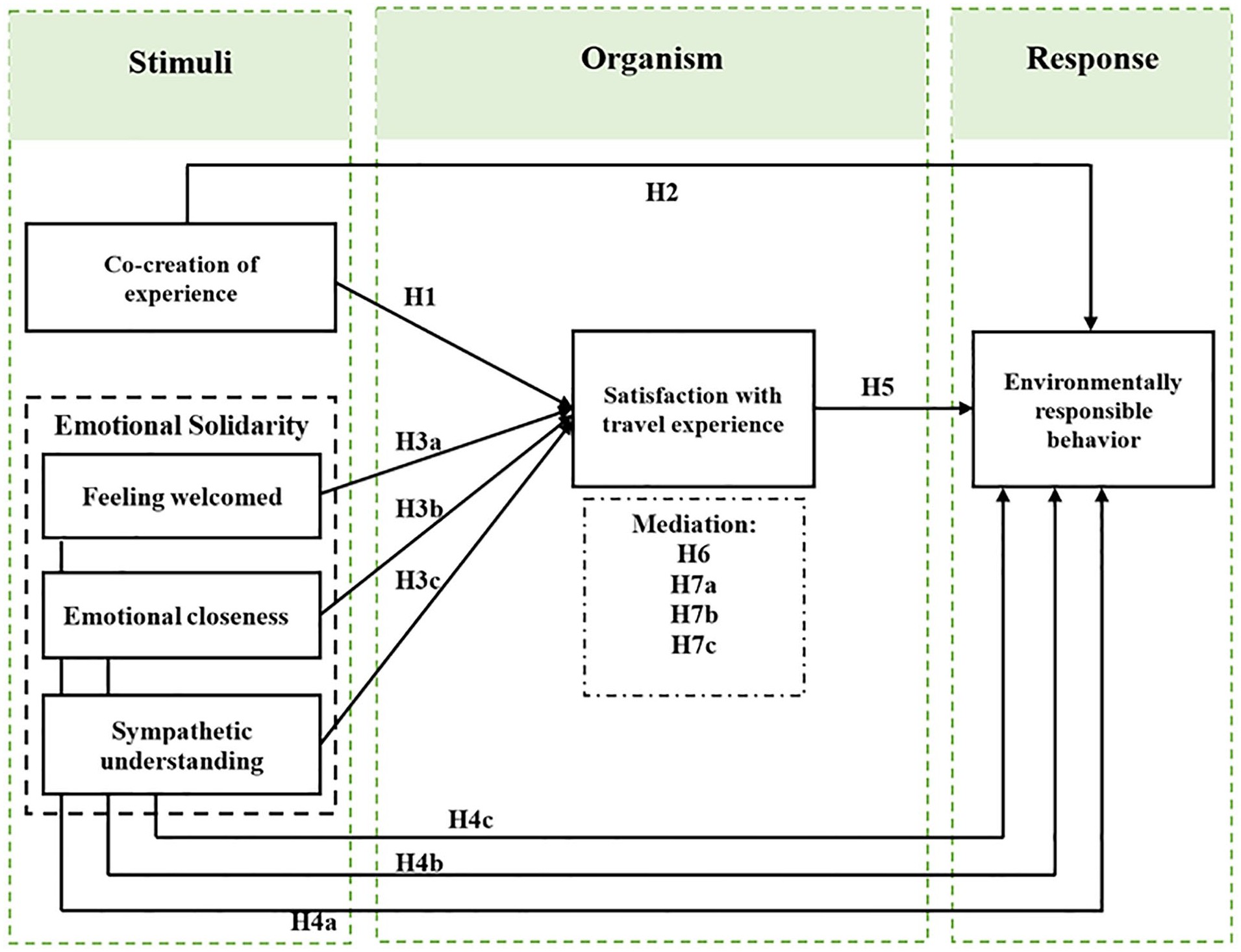
Theoretical model.
Research Methods
This study utilized a mixed-methods sequential explanatory research design by collecting quantitative data through a cross-sectional survey, followed by in-depth interviews to obtain qualitative data. The sequential explanatory research design was deemed an appropriate approach, as the main purposes of the study were: (1) to test the predictive ability of tourists’ emotional and social connections in explaining their ERB and (2) to further understand the tourists’ individual perspectives and experiences in depth. As the literature review demonstrated, most studies analyzing tourists’ ERB utilize single-method research designs and predominantly employ SEM data analysis (e.g., Lee et al., 2021; Wu et al., 2021; Xu et al., 2020). The application of the mixed-methods approach and inclusion of a second qualitative study in this research hopes to contribute to a deeper understanding of the hypothesized relationships and determinants of tourists’ ERB. While less commonly utilized in tourism research, the sequential explanatory research design allows for elaboration of the quantitative analysis findings, thus capturing a more comprehensive picture of respondents’ perspective on the study variables (Creswell et al., 2003; Ivankova et al., 2006; Khoo-Lattimore et al., 2019). Thus, while Study 1 explored whether and how interaction affects tourists’ ERB, the findings of Study 2 provided in-depth insights that the first study cannot determine, including other factors influencing tourists’ ERB, the contents, and the outcomes of engaging in such behavior.
Study 1
To test the proposed links among all the constructs in the conceptual model, a survey was developed to obtain the quantitative data. The data were collected via Wenjuanxing (https://www.wjx.cn), the largest online survey platform in China, from April to July 2021. Online surveys are considered reliable and valid for examining tourists’ behaviors (Holmes et al., 2021). The respondents to the online survey were tourists, 18 years or older, who had traveled at least once in the last 12 months. A total of 500 questionnaires were distributed and collected, from which 59 invalid questionnaires were excluded due to extreme responses or short answer times of less than 2 minutes. As a result, the number of valid responses is 441, with an effective response rate of 88.2%, which exceeds the suggested sample size requirement for structural equation modeling (Hair et al., 2014).
Measurements
The questionnaire consisted of two parts. Section 1 focused on co-creation experience, satisfaction with travel, tourists’ ERB, and tourists’ emotional solidarity (consisting of emotional closeness, feeling welcomed, and sympathetic understanding). The measurement scales were adapted from previous studies. Co-creation of experience was assessed with five items adapted from Mathis et al. (2016). Emotional solidarity was assessed with 10 items drawn from Woosnam and Aleshinloye (2013), including dimensions of feeling welcomed (four items), emotional closeness (two items), and sympathetic understanding (four items). Satisfaction with the travel experience was assessed through three items derived from Mathis et al. (2016). Tourists’ ERB was measured with four items adapted from Xu et al. (2019). Specifically, in the context of this particular study, the scale included the following items: I will not walk on the grass, or wreck and climb trees; I will not throw my trash on the ground or into a pool or river; I will not paint or scratch historic and cultural buildings and statues; I will comply with the rules and regulations of destinations, and if I see my companions doing bad things to the destination, I will persuade them to stop. All constructs were assessed with a 5-point Likert-type scale ranging from 1 (strongly disagree) to 5 (strongly agree).
Section 2 gathered tourists’ demographic characteristics, including gender, age, educational level, and occupation. Since all measurements were developed in English, each item in the survey instrument was translated into Chinese by professionals proficient in English and Chinese based on the procedure recommended by Brislin (1970).
Common Method Bias Assessment
Considering the cross-sectional nature of the current research, the study may have been susceptible to common method bias (CMB) (Kock et al., 2021). To mitigate the effects of CMB on the study findings, procedural and statistical controls were employed. Thus, the questionnaire was designed following the psychological separation method suggested by Podsakoff et al. (2003). For example, antecedent and outcome variables were not put into the same sections to decrease the possibility that the sampling population linked the cause-effect relationships between the variables of interest. Moreover, a pretest was conducted, in which six tourism scholars were asked to examine the readability and the ambiguity of the items in the survey instrument, and 15 graduate students majoring in tourism assessed whether survey questions were easily understandable. Some items were reworded according to their comments. As for statistical procedures, Harman’s one-factor test and correlation marker technique were employed. Following the common guidelines (Kock et al., 2021; Podsakoff et al., 2003), all indicators were used for exploratory factor analysis to examine how much of the variance could be attributed to one factor. As a result, 26.2% of the total variance was explained by the single factor, which is less than the 50% threshold. We further employed a correlation marker technique (Simmering et al., 2015) by introducing education and age as marker variables. The procedure did not indicate high correlations between theoretically unrelated marker variables and the primary study variables, confirming the absence of CMB.
Results
Sample Characteristics
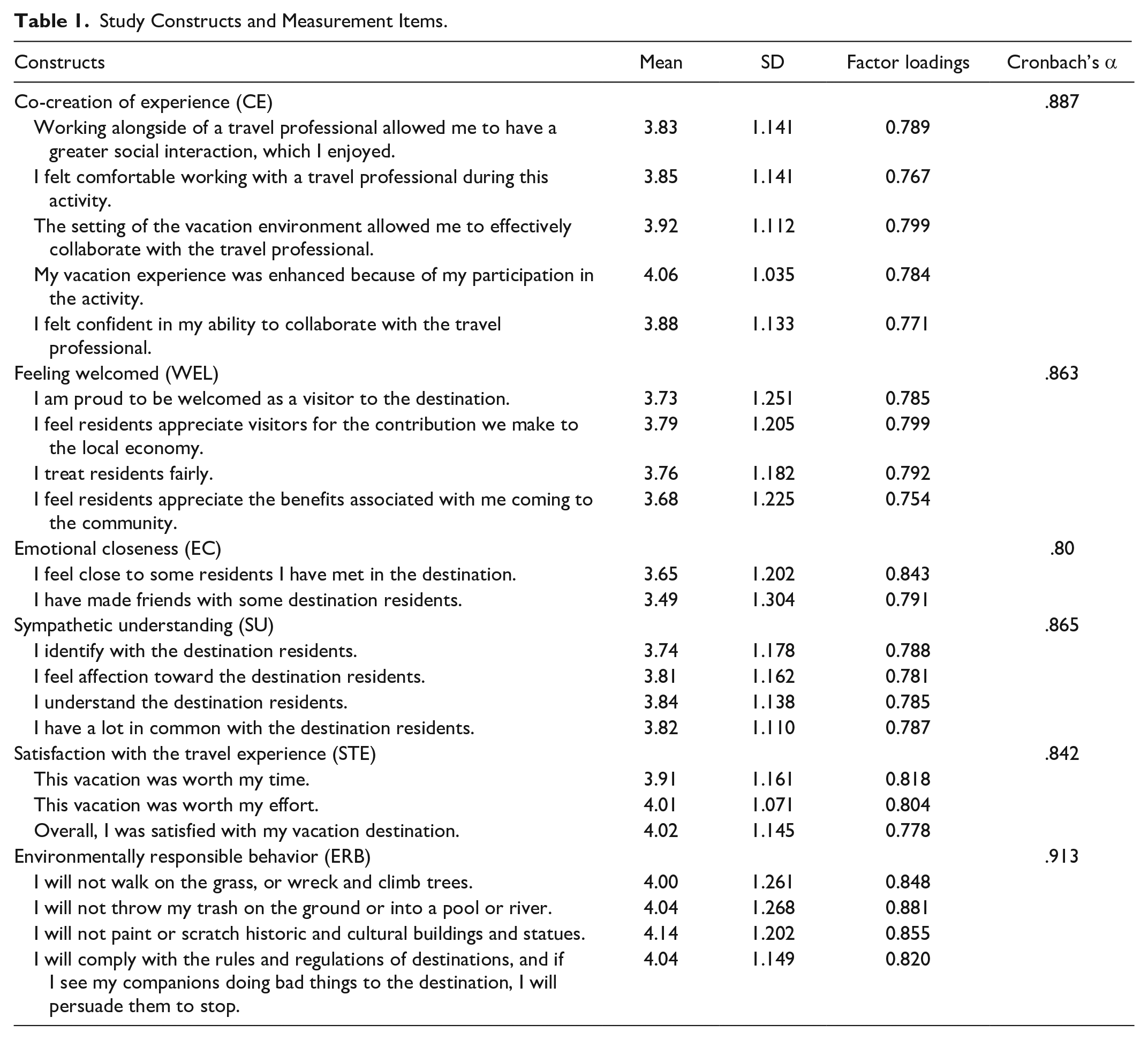
The majority of the participants, 239, were female (54.2%), and 202 were male (45.8%). The respondents between 18 and 34 years were dominant in the sample (48.5%). Almost 70% reported that they were married. Among all participants, 231 had high school or lower degrees (52.6%), and most were employed (44.9%) with an average monthly income between 230 and 765 dollars (35.8%). Table 1 provides the descriptive statistics for all measurement scales employed in Study 1. The mean scores for co-creation of experience varied from 3.83 to 4.06, while SD ranged from 1.035 to 1.141 as follows: feeling welcomed (M = 3.68–3.79; SD = 1.182–1.251; emotional closeness (M = 3.49–3.65; SD = 1.202–1.304); sympathetic understanding (M = 3.74–3.84; SD = 1.110–1.178); satisfaction with the travel experience (M = 3.91–4.02; SD = 1.071–1.161); and ERB (M = 4.00–4.14; SD = 1.149–1.268). Further information on skewness and kurtosis values is provided in Appendix 1.
Study Constructs and Measurement Items.
Measurement Model
Following Anderson and Gerbing (1988), two-step structural equation modeling (SEM) was conducted to examine the proposed conceptual model. Applying IBM SPSS Amos 20.0, a confirmatory factor analysis (CFA) was run to evaluate the fit of the measurement model, while SEM was employed to estimate the hypothesized paths in the conceptual model. A CFA with a maximum likelihood estimation procedure was employed. The proposed model fit the data well (χ2 = 248.061, χ2/df = 1.279, p = .005; GFI = 0.952; AGFI = 0.938; NFI = 0.953, CFI = 0.989; RMSEA = 0.025; RMR = 0.042; SRMR = 0.031), and the goodness of fit indices met the conventional criteria (Hu & Bentler, 1999). All 23 indicators were retained for the final model.
Next, the construct reliability of the measurement model variables was evaluated. The Cronbach’s alpha coefficients ranged from .80 to .913 (see Table 1), which exceeded the threshold value of 0.8, indicating a good internal consistency of measurement items within each construct (Fornell & Larcker, 1981). The convergent validity was also established as the standardized factor loadings of all indicators ranged from 0.754 to 0.881 and were significant at p < .001 (see Table 1) (Anderson & Gerbing, 1988). Accordingly, the AVEs of the latent constructs, ranging from 0.612 to 0.725, were larger than the threshold value. Moreover, the squared roots of the AVEs for all variables, ranging from 0.782 to 0.851, exceeded the correlation values between latent variables (see Table 2). Thus, the model demonstrated high reliability and validity.
Inter-construct Correlation and Validity Assessment Criteria.
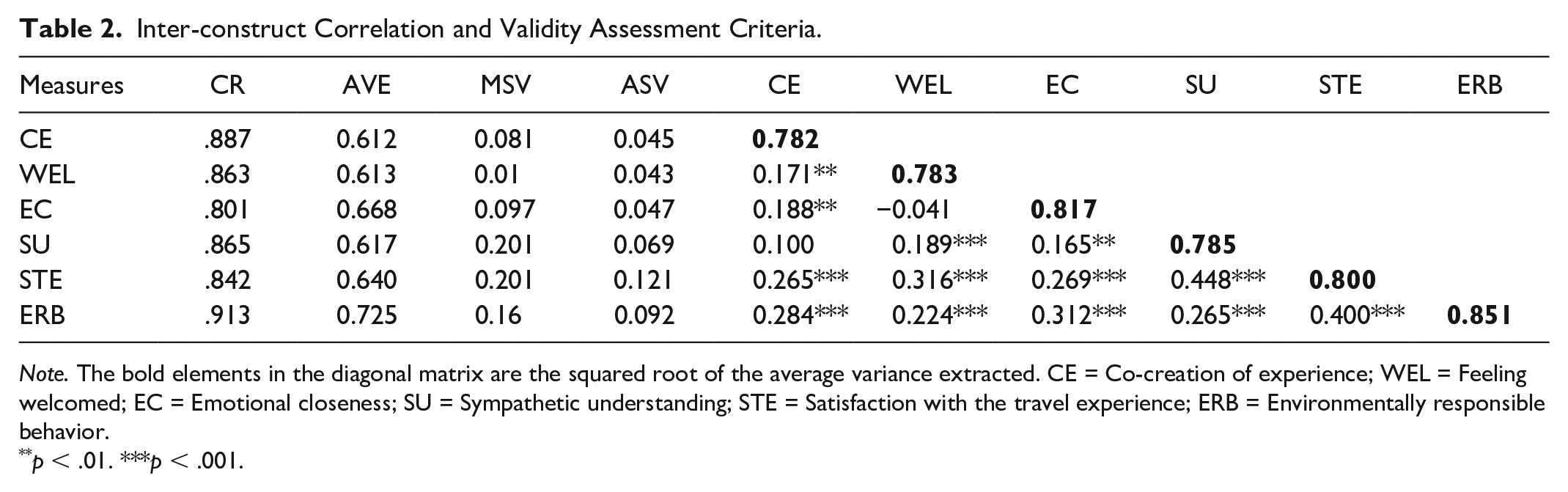
Note. The bold elements in the diagonal matrix are the squared root of the average variance extracted. CE = Co-creation of experience; WEL = Feeling welcomed; EC = Emotional closeness; SU = Sympathetic understanding; STE = Satisfaction with the travel experience; ERB = Environmentally responsible behavior.
p < .01. ***p < .001.
Structural Model and Hypothesis Testing
SEM was conducted to estimate the paths proposed in the conceptual model. The results showed that the overall model fit indices passed the recommended threshold values, displaying a good model fit (χ2 = 248.061, df = 194, χ2/df = 1.279, p = .005, GFI = 0.952, AGFI = 0.938, NFI = 0.953, CFI = 0.989, RMSEA = 0.025, RMR = 0.042, SRMR = 0.031) (Hu & Bentler, 1999). Table 3 summarizes the results of hypotheses testing in the structural model. The findings revealed that tourists’ co-creation experience directly influences both their satisfaction with the travel experience (β = .154, p < .01) and their ERB (β = .156, p < .01), confirming H1 and H2, respectively. The paths from emotional solidarity, including the dimensions of feeling welcomed (β = .230, p < .001), emotional closeness (β = .190, p < .001), and sympathetic understanding (β = .358, p < .001) to satisfaction with the travel experience were positively significant. Thus, H3a, H3b, and H3c are confirmed. Specifically, the impact of emotional closeness on travel experience satisfaction is the weakest, while sympathetic understanding affects travel experience satisfaction the strongest. Further, feeling welcomed and emotional closeness were found to be positively associated with tourists’ ERB (H4a: β = .118, p < .05; H4b: β = .212, p < .001), whereas sympathetic understanding did not statistically influence tourists’ ERB. Thus, H4a and H4b were supported, while H4c was rejected. In addition, tourists’ satisfaction with the travel experience positively affected their ERB (β = .222, p < .001), confirming H5.
Hypothesis Testing.
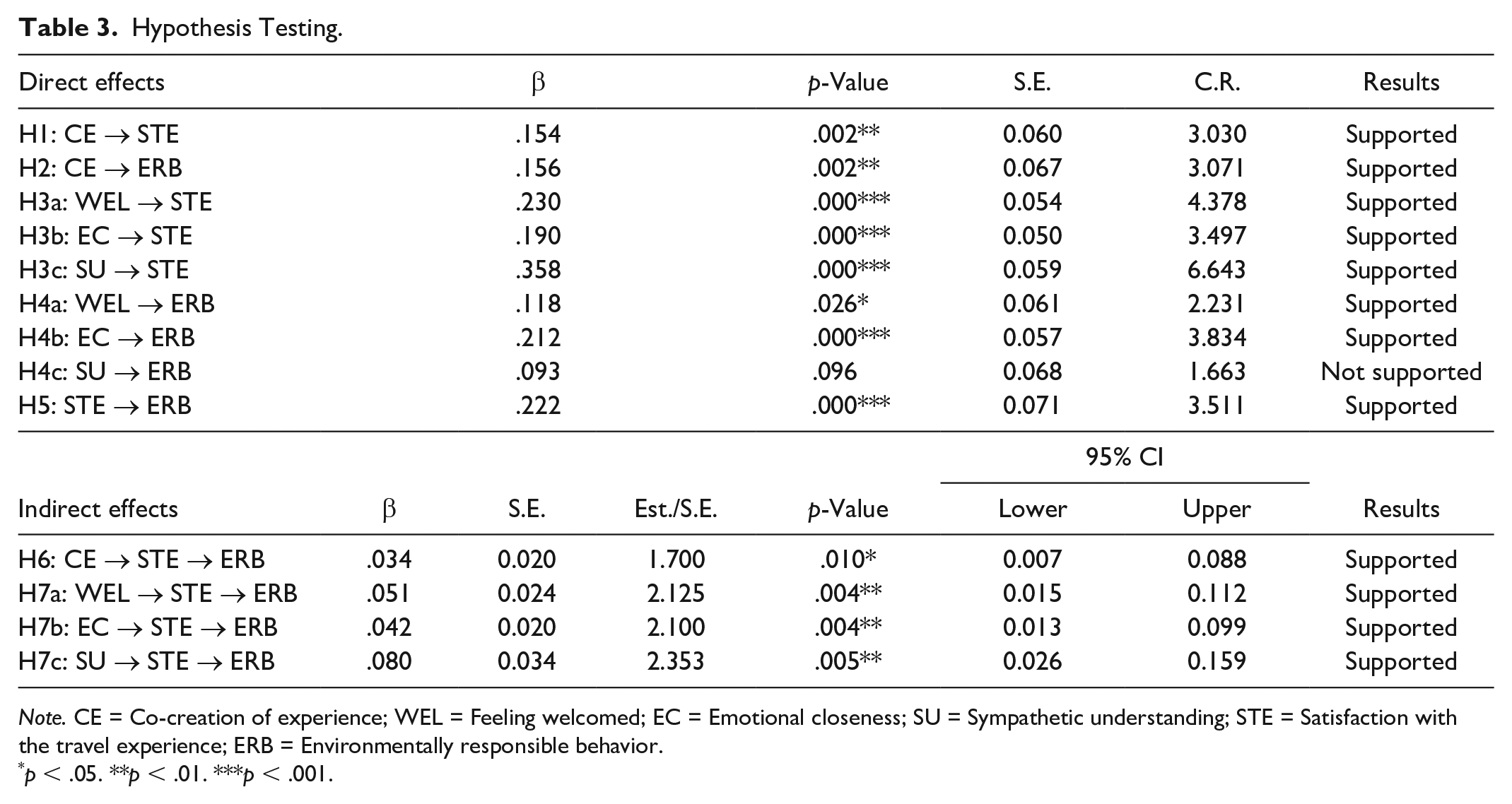
Note. CE = Co-creation of experience; WEL = Feeling welcomed; EC = Emotional closeness; SU = Sympathetic understanding; STE = Satisfaction with the travel experience; ERB = Environmentally responsible behavior.
p < .05. **p < .01. ***p < .001.
To examine the mediating role of satisfaction with the travel experience between co-creation experience, emotional solidarity, and tourists’ ERB, the bootstrapping procedure method with 5,000 resamples suggested by Preacher and Hayes (2004) and Jose (2013) was employed. The results of indirect effects are displayed in Table 3. Four mediation paths were confirmed, including H6-H7c. Specifically, satisfaction with the travel experience was shown to mediate the relationships between co-creation experience (β = .034, SE = 0.020, CI [0.007, 0.088]), feeling welcomed (β = .051, SE = 0.024, [0.015, 0.112]), emotional closeness (β = .042, SE = 0.020, [0.013, 0.099]), sympathetic understanding (β = .080, SE = 0.034, [0.026, 0.159]), and tourists’ ERB. Thus, satisfaction with the travel experience played a partial mediating role between co-creation experience, feeling welcomed, emotional closeness, and tourists’ ERB while it fully mediated the relationship between sympathetic understanding and tourists’ ERB. The variance explained by the proposed theoretical model in tourists’ ERB is R2 = 0.25 and in satisfaction with the travel experience is R2 = 0.325.
Study 2
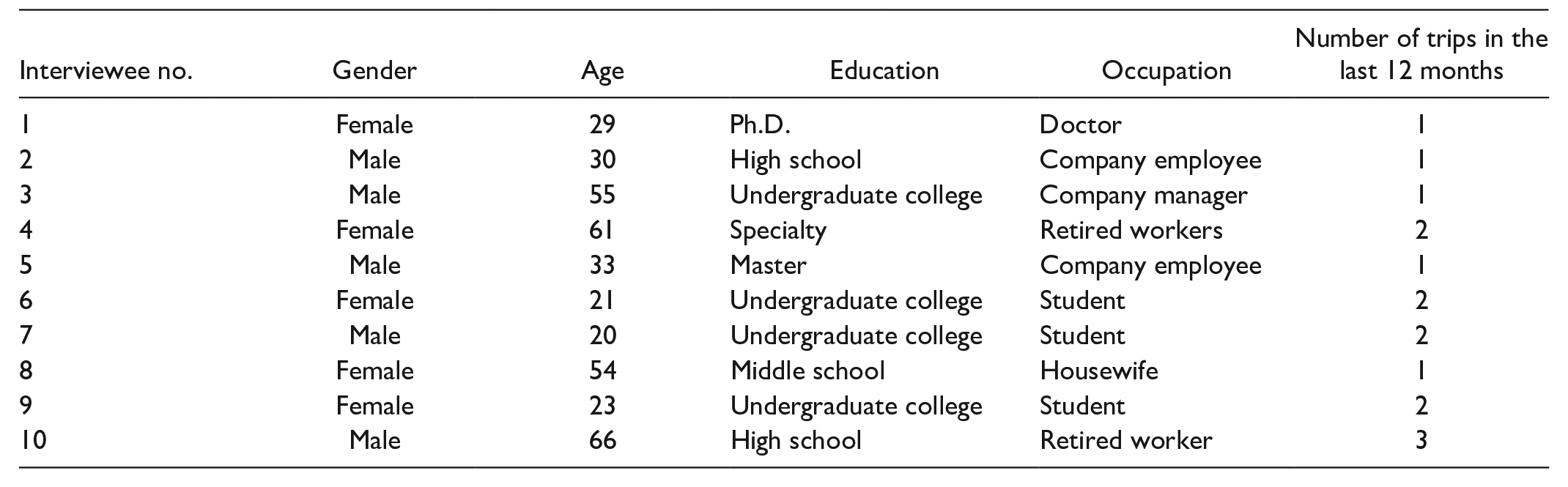
The major objective of Study 2 was to explore the survey results in depth and augment the obtained findings. Specifically, in this stage, 10 tourists (see the details of the interviewees in Appendix 2) were approached for an in-depth interview to gage a more comprehensive outlook on tourists’ understanding of ERB. Each interview lasted for 10 to 25 minutes. The interviews were tape-recorded and transcribed. Then, the data were analyzed through thematic analysis. Investigator triangulation was applied for verification purposes (Thurmond, 2001).
Three main themes emerged in the analysis of tourists’ interviews: general understanding of tourists’ ERB at the destination, reasons to engage/not engage in ERB, and outcomes of ERB. The findings are summarized in Figure 2.
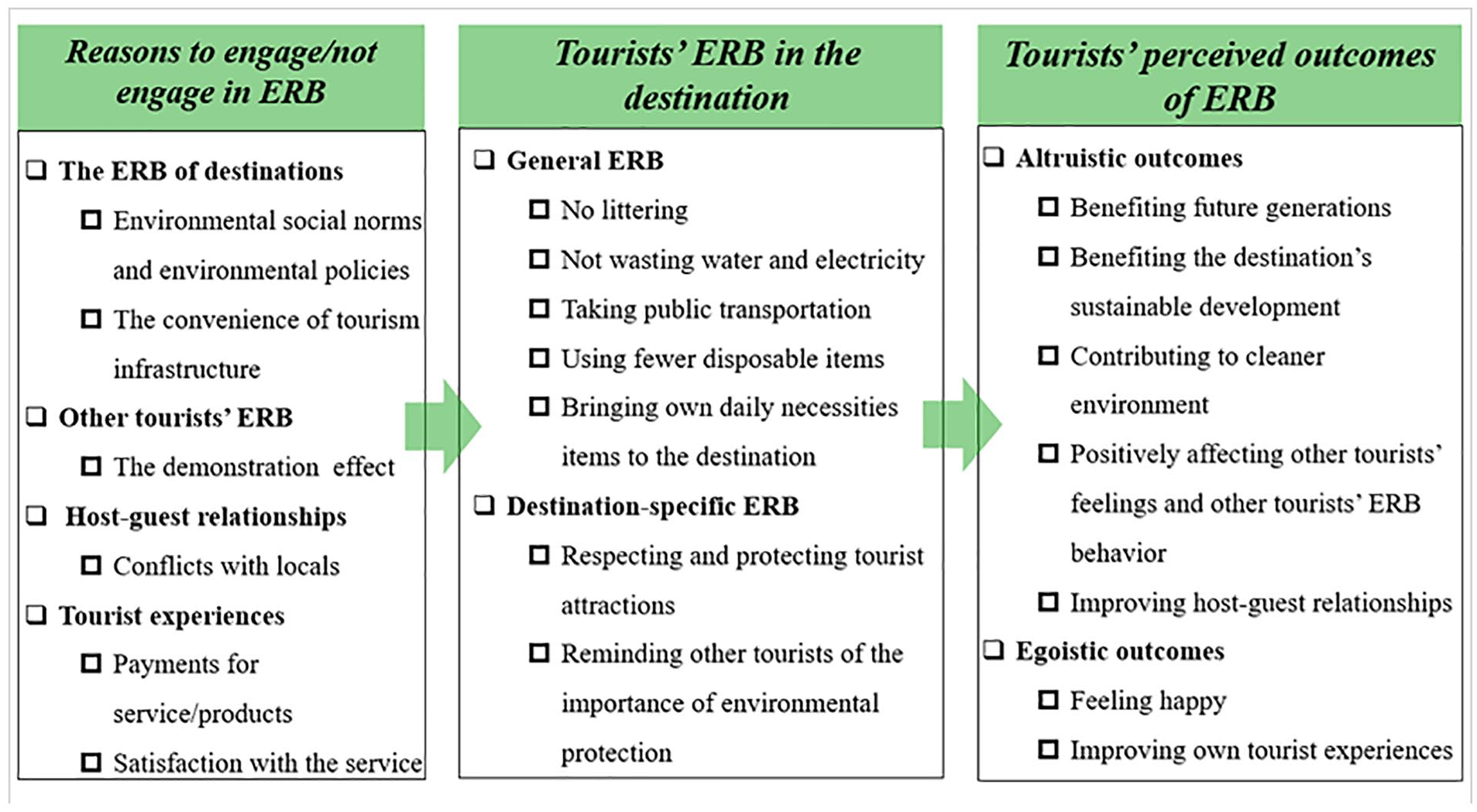
Study 2 findings.
Tourists’ Environmentally Responsible Behavior at the Destination
The first theme revealed that, in addition to accepted dimensions of general pro-environmental behavior, such as no littering, not wasting water and electricity, taking public transportation, using fewer disposable items, and bringing personal daily necessities items to the destination, visitors noted destination-specific elements of ERB. For example, respondents mentioned respecting and protecting tourist attractions and “following the destination rules.” In addition, some participants noted the importance of “picking up the garbage discarded by other tourists” and “reminding other tourists not to litter,” suggesting that visitors may share a sense of collective responsibility for behaving pro-environmentally. For instance, respondent #1 shared, “I not only do well by myself in my traveling but also remind my relatives, friends, and strangers not to litter. If someone throws it away, I will pick it up. Then, for people who I am not very familiar with, I would like to publicize or remind them to protect the environment and reduce the frequency of random littering.”
Reasons to Engage/Not Engage in ERB
The second theme that emerged in the analysis revealed factors that affect visitors’ intentions to engage/not engage in ERB. This theme included four dimensions: the ERB related to the destination, other tourists’ ERB, host-guest relationships, and satisfaction with tourist experiences. First, on the one hand, respondents noted that the environmental social norms and environmental policies at the destination would prompt them to behave more responsibly. Thus, interviewee #3 mentioned, “If a tourist destination does well in environmental protection, it will affect tourists. If I feel that the local people use or show that they use some recyclable things and pay great attention to environmental protection, I may be influenced by that. I will try to regulate and restrict my behavior like the locals, and it will have a certain impact on my cognition. How the destination protects the environment may affect my attention to environmental protection.” Interviewee #9 added, “When visiting Japan, I felt that they all pay great attention to environmental protection, so tourists can’t litter there. Their cities are relatively clean. There is no garbage or fallen leaves on the ground. Tourists don’t throw garbage there.”
On the other hand, the inconvenient tourism infrastructure was also identified as a deterring factor. As respondent #5 stated, “When I travel to Zhoushan (note: a popular destination in Southern China), because its tourism infrastructure is not well developed, in many places you have to walk far away to find the garbage can to throw away wastepaper or tissue or an empty bottle. It is very troublesome and annoying. That’s why some tourists may have to throw their garbage on the ground.” Respondents #6 and #7 shared the same sentiments. Such findings reiterate the importance of developing convenient tourism infrastructures to enhance visitors’ experiences and prompt tourists’ ERB at destinations (Uysal et al., 2020).
Second, from tourists’ perspectives, the “demonstration” of ERB from other tourists at the destination also might be one of the determining factors to engage in ERB. Thus, showing a “good behavior” that reflects a “good citizen.” For example, other tourists’ behavior shaped interviewee #7 to be a pro-environmental tourist: “I think most tourists can basically avoid littering now. If others don’t throw it, I feel embarrassed to throw it myself. We bought a lot of flowers that day and were tired, but we didn’t leave them there at that time, but took the flowers away on our initiative.”
Third, interviewees noted that host-guest relationships, especially “conflicts with locals,” could be a reason not to engage in ERB, supporting our quantitative results that the more tourists feel connected and welcomed by residents, the more they are likely to behave pro-environmentally. Participant #10 stated, “When I was shopping at a local stall, the owner had a friendly demeanor before I made the purchase, but as soon as I paid the money, they immediately changed their attitude. And after buying, I found that the quality of the things I bought from this place was poor. I felt cheated. At that time, I had a waste paper in my hand. I wanted to find a dustbin to throw it away, but I was too angry to find a dustbin, so I threw it near this stall. Although it’s not good to do so.”
Finally, satisfaction with tourist experience, embracing the quality of the products and services and associated prices, was named as another discouraging reason, supporting the proposed mediating role of satisfaction with the experience. Interestingly, tourists mentioned that “high payments for the services/products” at the destination may prevent them from engaging in ERB. For example, respondent #7 mentioned, “The room rate of this hotel is very expensive. I spend so much money on accommodation. Thus, I may be using more water and electricity.” Such findings reveal another dimension in our understanding of visitors’ ERB that requires further exploration: namely, the interplay between non-material and material factors in predicting pro-environmental behavior. While the effects of monetary incentives on willingness to participate in ERB have been studied (e.g., Line et al., 2018; Nicolau et al., 2022), less attention has been given to the material factors (e.g., price for the service/product) that may negatively affect tourists’ intention to behave pro-environmentally and how these factors interact with tourists’ norms and values.
Tourists’ Perceived Outcomes of Environmentally Responsible Behavior
The third theme uncovered tourists’ perceptions of ERB outcomes. This theme could be divided into altruistic and egoistic outcomes. Concerning the altruistic outcomes, the respondents converged in their opinion that engaging in ERB will benefit future generations, the destination’s sustainable development, and a cleaner environment. Moreover, the tourists also noted that it might affect other visitors’ feelings and behavior and prompt them to be more environmentally friendly. Interviewee #8 shared, “If you go to a tourist destination, you must like it very much. You should maintain the environment of the place you like.”
Furthermore, some interviewees indicated that host-guest relationships could be improved as a result of tourists’ demonstration of ERB. Interviewee #8 commented, “I think industry workers in the destination are very tired every day, especially during the peak period. They have to clean up a lot of garbage or perform other work to maintain order every day. If everyone can consciously protect the environment or abide by the rules, they can reduce the burden of work for the industry employees. We will see more smiles on their faces.” Respondent #9 added, “If (tourists) protect the environment of the destination, they will leave a good impression on other tourists. And for the local people, to protect the environment of the destination is to protect their homeland, which contributes to the formation of the harmonious relationship between local residents and tourists.” This finding suggests that there may be a two-way relationship between tourists’ ERB and the host-guest relationship, which needs to be further verified by follow-up research.
As for the egoistic outcomes, respondents noted that engaging in ERB may not only improve their travel experience but also make them feel happier. Interviewee #2 stated, “This way [collecting and throwing away their own trash], when I come to the seaside next time, it will still be very beautiful, and I can have a good time. If everyone doesn’t consciously protect the environment, they may not have a nice tourism experience next time due to the damaged nature. On the other hand, I feel that in doing so [behaving pro-environmentally], I am a civilized tourist. Other tourists will look at me differently, and that will make me feel happier.” Respondent #5 also expressed similar sentiments: “When I was visiting the Great Wall, my friend wanted to carve his name on a brick. I said, if you do this, others will do the same. In the future, every brick of the Great Wall will be written with words, which will look terrible. My friend took my advice and didn’t write on it. I felt very happy because I seem to have contributed to the beauty of the Great Wall.” These quotes suggest that tourists’ perceived outcomes of ERB not only account for conserving the destination’s nature and tourist attractions but also may benefit their individual well-being, bringing positive emotions and feelings of happiness.
Discussion and Conclusion
Tourism researchers and practitioners strive to mitigate the negative environmental effects of tourism and employ continuing efforts to promote tourists’ responsible behaviors. Considering the critical importance of tourists’ ERB to destinations’ sustainable development, many theoretical frameworks have been applied to examine such behavior, and several antecedents have been identified. However, only a few studies have explored the effects of social interactions between key stakeholders in the process of tourism consumption on tourists’ ERB at the destination. To fill in this gap, this study employed a mixed-methods explanatory research design and proposed an integrative conceptual model to examine the relationships between emotional solidarity, value co-creation, and visitors’ ERB. The current research is one of the first attempts to couple two distinct antecedents representing visitors’ interactions with service providers and residents in an integrated model to explain tourists’ behavior.
The study results demonstrated that both emotional solidarity and co-creation experience are strong predictors of tourists’ overall travel satisfaction, suggesting that social and emotional antecedents remain one of the key factors contributing to a satisfactory experience. Such findings are in line with previous research confirming the existence of a direct positive impact of emotional solidarity dimensions on tourist satisfaction (e.g., Ribeiro et al., 2018). The further findings confirmed that emotional solidarity dimensions (i.e., feeling welcomed and emotional closeness) and co-created experience significantly affected tourists’ ERB directly and indirectly. Similar findings were obtained from qualitative interviews in Study 2, in which tourists mentioned conflicts with locals as a discouraging factor to engage in ERB at the destination. These results are consistent with previous research, suggesting that interactions between residents and tourists may affect the overall tourism experience and, consequently, elicit certain changes in tourists’ attitudes and behavior toward the destination and local community (e.g., Yu & Lee, 2014). For example, Li et al. (2021) confirmed the mediating effect of emotional solidarity on the link between hosts’ sincerity and tourists’ environmental behavior. Their findings suggested that sincere social interaction can stimulate responsible behavior through emotional solidarity. Thus, tourist behaviors and attitudes may be altered as a result of interactions, shared beliefs, and shared behaviors with residents. It should be noted that the dimension of sympathetic understanding was not found to have a significant direct effect on visitors’ ERB in this research. Depending on the context, some preceding studies have obtained similar results for the effects of emotional solidarity on either tourists’ or residents’ behavior (e.g., Li & Wan, 2017). A possible interpretation of such an outcome could be related to the recognition of some underlying concepts of sympathetic understanding within different cultures (Chinese, in this case). Thus, the empathy that tourists feel toward locals does not affect their ERB, unlike the feeling of being welcomed to the destination.
Additionally, the findings revealed that co-creation with service providers positively predicted tourists’ intentions to engage in ERB. Such results confirmed the outcomes of previous research, suggesting the significance of value co-creation in explaining behavior. For instance, Assiouras et al. (2019) analyzed the effects of value co-creation on customers’ citizenship behavior in the hospitality industry. The authors found a strong and positive effect of guests’ co-creation experience on their subsequent citizenship behavior. Therefore, the co-creation of experience (i.e., visitors’ social interactions with service providers) that is expressed in high levels of active participation and involvement may stimulate their ERB at the destination.
Moreover, the results reinforced the importance of tourist satisfaction in predicting behavior. Consistent with previous studies (e.g., Su et al., 2020), the current research found evidence supporting the notion that tourists’ satisfaction with the travel experience positively predicts their intentions to engage in ERB, thereby moving beyond the traditional outcomes of destination loyalty and revisit intentions. Satisfaction with service was also named in qualitative in-depth interviews as determining visitors’ willingness to engage in ERB.
Overall, the current study revealed a strong predictive ability of S-O-R theory to interpret tourists’ behaviors. The findings indicated that social interactions and emotions between tourists and locals/tourism professionals (external stimuli) determined tourists’ satisfaction (organism) and that these reactions further affected their pro-environmental behavior (response).
It should be noted that the data for both studies was collected during the Summer of 2021, when certain COVID-19 restrictions were still in place and thus, interactions between residents and tourists, service providers and tourists may have been limited. Thus, the frequency and intensity of interactions and the level of tourists’ involvement may impact the results confirmed in this study.
Theoretical Implications
The current research provides various theoretical implications. First, this study validated the S-O-R framework within a sustainable tourism setting by incorporating tourists’ emotional solidarity with residents and co-creation experiences with service providers. The existing research on environmental behavior is dominated by the theory of planned behavior, which recognizes norms and attitudes as shaping behavior (Han, 2015). However, as Bagozzi (1992) noted, attitudes alone are not a sufficient premise of intentions to behave. Therefore, considering the complicated nature of individuals’ behaviors, new frameworks are introduced to better understand the formation of actual behaviors.
The current study applied the S-O-R framework, widely used to analyze the generation process of human behavior, to the context of tourists’ ERB (Goi et al., 2018; Jacoby, 2002; Tang et al., 2019). The findings revealed a strong predictive ability to interpret tourists’ behavior, suggesting that interactions and emotions between tourists and residents/tourism professionals (external stimuli) determined tourists’ emotional states (organism) and that these reactions further affected their pro-environmental behavior. Thus, it is believed the findings offer new insights into S-O-R theory advancement in the context of tourist behavior.
Second, with few exceptions, previous research has ignored the social and emotional factors in explaining visitors’ ERB. Nonetheless, tourist activities are typical forms of experience consumption, so emotions and social interactions may impact tourists’ behaviors deeply (Su & Swanson, 2017). By looking into the novel antecedents of pro-environmental tourist behavior, this study uncovered successful predictors relating to ERB. The findings suggested that both emotional solidarity and value co-creation presented significant predictors of visitors’ ERB.
Third, this study included residents and services/product providers to address multiple stakeholders’ involvement in determining behavioral processes. Focusing on different stakeholders’ stimuli can contribute to obtaining a more comprehensive picture of individual behavioral processes. Thus, the study findings add to the sustainable tourism literature, extending existing research on the links between the co-creation process and sustainable consumption in tourism (Mitchell et al., 2016) and responding to the call from Font et al. (2021), who suggested that new inquiries are necessary to further examine the effects of co-creation on social and environmental sustainability.
Additionally, this study revealed that along with emotional solidarity factors, rational considerations, such as prices for products and services could impact tourists’ ERB. Such findings further enrich our understanding of tourist behavior as a function of both rational and non-rational factors (Feng et al., 2022).
Practical Implications
As noted by Uysal et al. (2020), destination managers should focus on designing tourism experiences, taking into account the operand resources at the destination and the operant resources brought in by tourists. Thus, these parties should act as resource integrators to improve value-in-use and, by extension, the quality of the experience. In this study, we demonstrate that visitors’ co-created experiences not only positively affect their satisfaction with their travel as a whole but may also contribute to their engagement in ERB. These findings extend our understanding of tourists’ pro-environmental behavior and offer a novel view of successful interventions to stimulate such behavior. Thus, service providers should design tourism experiences to stimulate co-creation.
Tourists’ involvement can be expressed in active participation in tourism-related activities such as excursions and tours, sports and cultural events, and other activities that may be specific to a destination. The idea is to involve visitors in creating the experience together with service providers. Binkhorst and Den Dekker (2009) have pointed out that co-creation experience in tourism should be viewed not only as an approach to add value to the experience but also as a basis for further innovation of tourism products.
Our findings confirmed that the tourism experience could be designed in a way to promote sustainable behaviors. Moreover, as suggested by our results, high levels of emotional solidarity with locals positively impacted visitors’ intentions as well. The two factors of emotional solidarity were confirmed to have a positive effect on tourists’ intention to behave in an environmentally friendly way. Therefore, destination policymakers can develop spaces shared by locals and tourists to prompt interactions between these groups. The focus for DMOs should be on configuring the existing tourism infrastructure to accommodate the recreational needs of both residents and tourists, fostering shared behavior and interactions.
Limitations
There are several limitations in this research. First, we have not incorporated possible antecedents of the co-created tourism experience. As noted by Schallehn et al. (2019), service providers should constantly monitor the variety of factors that may influence customers’ engagement and involvement to ensure the improvement of value-in-use for the customers. Thus, future research should analyze the effects of potential antecedents relating to both the tourist and the tourism product on co-created tourism experiences. For instance, the study model could investigate how tourists’ personal characteristics and motivations amend the examined relationships (Uysal et al., 2020). Moreover, this research applied the construct of value co-creation experience between tourists and service providers at the destination. Nonetheless, existing research confirms that co-creation processes between locals and tourists may amend their attitudes toward tourism and even affect locals’ life satisfaction (Lin et al., 2017). Further inquiries should be made into the examination of potential links between resident-tourist value co-creation and visitors’ pro-environmental behavior.
Second, it can only be measured one way of emotional solidarity between tourists and residents (Joo et al., 2020). Future work may apply the newly updated measure of intragroup emotional solidarity to tourists’ emotional connections with one another (Joo & Woosnam, 2020) and investigate the effects of communality and fairness on tourists’ sustainable behavior. Some previous studies have demonstrated that the travel experience may be significantly impacted by interactions with other tourists at the destination (Adam et al., 2020; Lin et al., 2019). The same notion is confirmed in services marketing literature that acknowledges customer-to-customer interactions as factors that may influence consumers’ service quality perceptions and future behavior (e.g., Kim & Baker, 2020). Therefore, more in-depth research into the link between emotional solidarity between tourists and their propensity to engage in ERB is warranted. Finally, the tourism literature recognizes the importance of residents’ ERB in facilitating destination development as well (Ramkissoon, 2020). Therefore, more research is needed to investigate the defining factors leading to the sustainable behavioral intentions of locals.
Third, the findings of qualitative interviews revealed interesting dimensions for further research regarding the antecedents and outcomes of ERB. Therefore, future studies may employ an exploratory mixed-methods approach to develop a new theoretical framework of visitors’ ERB integrating both material and non-material factors.
Finally, although we have tested the psychometric properties of the ERB measure, and the scale has been widely examined in the study of ERB in China (e.g., Pan & Liu, 2018; Xu et al., 2019), it may be place-specific. For example, the item “I will not walk on the grass, or wreck and climb trees” may not be regarded as ERB in some cultures or destinations. As such, follow-up studies are highly encouraged to further test the applicability of the scale in different cultural contexts.
Footnotes
Appendices
Interviewees’ Profiles.
| Interviewee no. | Gender | Age | Education | Occupation | Number of trips in the last 12 months |
|---|---|---|---|---|---|
| 1 | Female | 29 | Ph.D. | Doctor | 1 |
| 2 | Male | 30 | High school | Company employee | 1 |
| 3 | Male | 55 | Undergraduate college | Company manager | 1 |
| 4 | Female | 61 | Specialty | Retired workers | 2 |
| 5 | Male | 33 | Master | Company employee | 1 |
| 6 | Female | 21 | Undergraduate college | Student | 2 |
| 7 | Male | 20 | Undergraduate college | Student | 2 |
| 8 | Female | 54 | Middle school | Housewife | 1 |
| 9 | Female | 23 | Undergraduate college | Student | 2 |
| 10 | Male | 66 | High school | Retired worker | 3 |
Declaration of Conflicting Interests
The author(s) declared no potential conflicts of interest with respect to the research, authorship, and/or publication of this article.
Funding
The author(s) disclosed receipt of the following financial support for the research, authorship, and/or publication of this article: This study was supported by the Shandong Natural Science Foundation, China [No. 21CGLJ20] and National Social Science Foundation of China (NSFC) [No. 21BSH150].
