




Abstract
This study examines the moderating effect of social globalization on the relationship between international tourism and economic growth using a dataset of 143 economies from 1995 to 2017. Social globalization is broadly defined as the sharing of cultures and beliefs which facilitates the flow of ideas and knowledge. Our results show that social globalization affects economic growth directly and indirectly through enhancing international tourism. However, we find that the direct effect of international tourism on growth is not statistically significant for developing economies. On the other hand, tourism-dependent developing economies can benefit from growth as social globalization increases. This implies that policymakers can promote growth by developing institutions and infrastructure to enhance social globalization, such as implementing visa-free travel and the construction of international airports, to enhance the growth-gains from international tourism.
Keywords
Introduction
According to the World Travel and Tourism Council Report in 2020, the travel and tourism industry accounted for 10.3% of the total global gross domestic product (GDP) contribution, supporting a total of 330 million jobs in 2019. 1 Due to its unique structure, the tourism sector involves highly intricate relationships with multiple industries across an economy. For example, the development of the tourism industry involves the construction of facilities and infrastructure that creates a multiplier effect on job creation and national income (Castro-Nuño et al., 2013; Nowak et al., 2010; Wu & Wu, 2018; Zamparini et al., 2017). While there is ample empirical evidence that supports this close relationship between economic growth and tourism, the role of social globalization—the transmission and sharing of “soft” influence such as arts, culture, and humanities among nations—and its relationship with tourism-led economic growth, is limited.
Theoretical studies have shown that international tourism and social globalization are endogenous to economic growth (Grossman & Helpman, 2015; Nowak et al., 2010). In this paper, we examine whether social globalization is an effective moderator for the relationship between international tourism and economic growth. Using data from 143 countries that span over 23 years, we find that social globalization has a positive and significant effect on economic growth after accounting for tourism and other key confounding factors. More importantly, we find that social globalization enhances the positive effects of tourism-led growth. While we find an insignificant relationship between international tourism and economic growth for developing economies, we find that when social globalization indicators are at their highest level, a one standard deviation increase in the share of tourism receipts (20.08% for developing economies), is associated with an overall 0.90% to 1.32% increase in growth rates. This suggests that policies targeted at improving social globalization is an effective complementary tool to enhance tourism-led growth.
Social globalization is of interest for two reasons. First, theoretical studies suggest that international tourism is a manifestation of social globalization as it involves the notions of the free movement of people (Chao et al., 2004; Sen, 2000; Song et al., 2018). However, social globalization involves many processes that include the interpersonal, cultural, informational, and political aspects that can influence international tourism (Gygli et al., 2019; Steger, 2009). 2 Hence, it is essential to analyze the differential channels of social globalization in order to provide useful policy guidelines.
Second, the direct impact between social globalization and growth can differ among economies that are highly dependent on international tourism-led growth. The theory on globalization suggest that the integration of people and cultures can facilitate the flow of knowledge that leads to growth endogenously (Grossman & Helpman, 2015). However, these theories mainly focus on economic and financial globalization that involve trade in goods and services as well as foreign investment and international financing (Gygli et al., 2019). In contrast, social globalization focuses on the humanities of globalization that encompass the transmission of interpersonal, cultural, informational, and political values, and less on conventional globalization channels such as trade and international finance. 3 Therefore, it will be interesting to study the direct impact of social globalization on economic growth and its indirect impact on growth vis-à-vis international tourism channel.
While researchers have examined the relationship between social globalization and tourism (Chung et al., 2020; Javid & Katircioglu, 2017), the role of technology and trade as a moderator between international tourism and growth (Haini, 2022; Katircioglu, 2009), and the inter-linkages between globalization, tourism, and growth (Salifou & Haq, 2017), these studies do not consider the moderating effect of social globalization on the relationship between international tourism and growth. Recent studies have suggested for quantifying the interrelationships between social globalization and tourism (Song et al., 2018). As such, our study attempts to fill this vacuum. Moreover, our study also investigates this relation among advanced and developing economies, which tend to experience different structural changes and growth trajectories. We employ the revised KOF Globalisation Index (Gygli et al., 2019) which allows us to examine the finer aspects of social globalization and its interlinkages with international tourism. 4
The rest of the study is organized as follows. Section 2 provides our theoretical considerations and a brief literature review on social globalization, international tourism, and economic growth. Section 3 provides a brief description of the data sample, variables employed and the econometric strategy. Meanwhile, Section 4 presents the results while Section 5 provides a brief discussion on the reported results. Finally, Section 6 concludes with discussions on policy implications, suggestions for future research and limitations of the present study.
Theoretical Considerations and Literature Review
Economic Growth
Earlier growth theories emphasize the importance of capital and labor (Solow, 1956), and the explicit substitutability between capital and labor in a production function. While the Solow (1956) model is one of the most prominent models in understanding economic growth, the assumption that technological progress is exogenous with substitutability between the factors of production leads to a steady-state growth rate.
Critics of the Solow (1956) model build on the restrictive exogenous role of technological progress, which is a major source of growth in the steady state. Several models have made technology endogenous by introducing the role of knowledge or human capital in the production function alongside capital and labor (see Lucas, 1988; Romer, 1986 for examples of endogenous growth theories incorporating Arrow’s (1962 learning-by-doing framework).
However, Acemoglu (2012) suggests that economic growth is more than just aggregate output, but also involves the structural transformation of an economy that ranges from sectoral, institutional, and social factors. These include the role of international trade, institutions, and policy regimes (Grossman & Helpman, 1994; Krugman, 1991; Mankiw et al., 1992).
Our study contributes to the study of economic growth by considering the potential contributions of social globalization and international tourism, particularly the interacting relationship between the two factors as depicted in Figure 1. To provide the quantitative impact of social globalization and international tourism on economic growth, we construct econometric models that include measures for social globalization and international tourism with controls for main confounding factors using the knowledge from economic growth theory. Our results provide evidence that tourism and globalization enhance income growth from the free flow of knowledge, ideas, and cultural affinity.
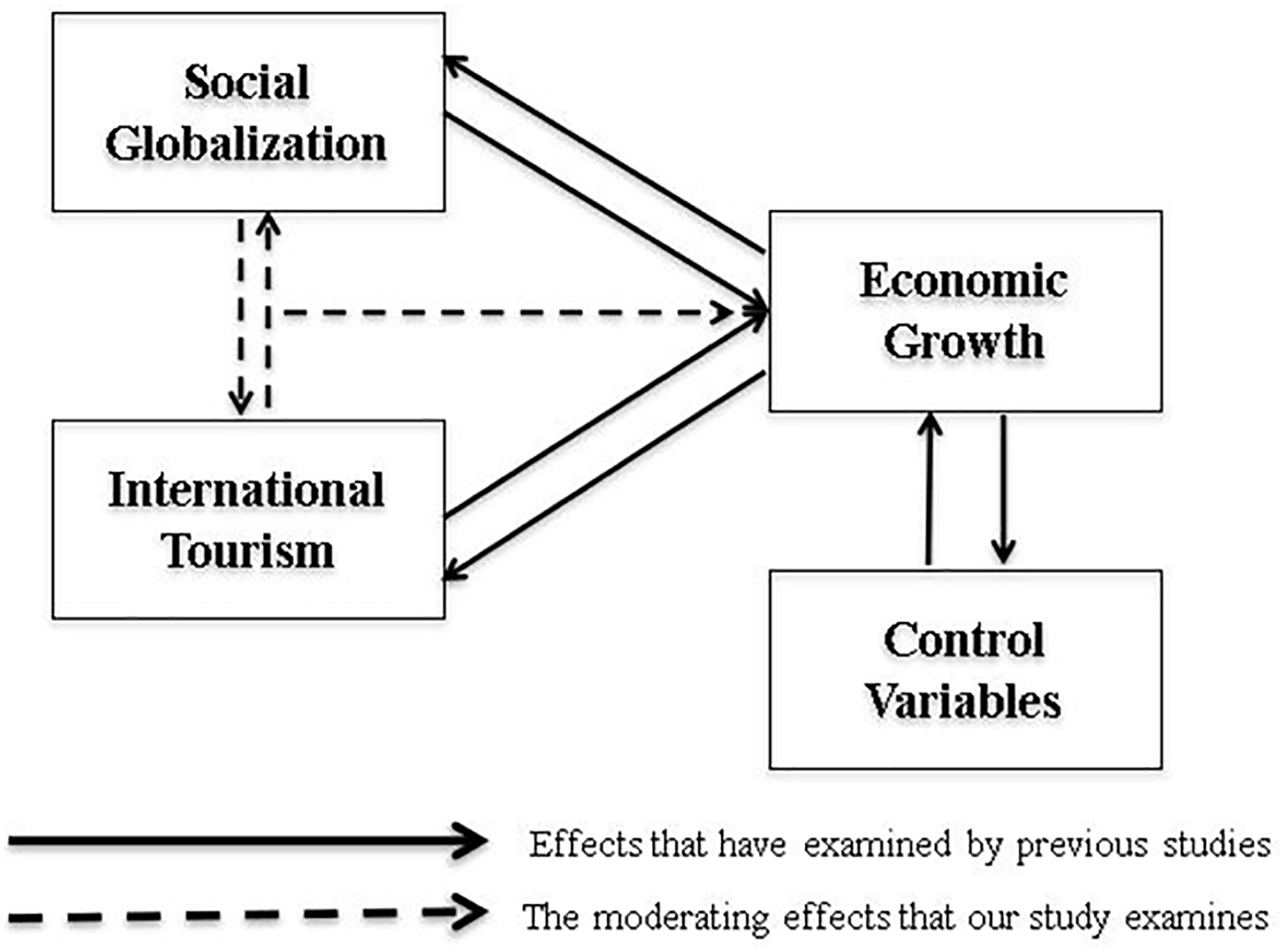
Theoretical and conceptual model.
Social Globalization
Theory of globalization
The traditional economic definition of globalization can be defined as a process that integrate goods and markets across borders, reducing barriers to foreign trade and investment (Crafts, 2004). Advocates of globalization emphasize the role of technological advancement and infrastructure, as a reduction in transportation costs and improvements in information flows, can potentially reduce protectionism, promote foreign investment, and allow for the migration of labor resources. The earliest advocate of international trade is Smith’s (1776) perspective, where one country may be able to produce one good at a more competitive price, allowing a country to purchase another good for its benefit. Ricardo (1821) extended and referred this as a comparative advantage, where each country will benefit if it specializes in the production and export of goods produced at a relatively low cost. In essence, the standard theory of comparative advantage implies that eliminating trade barriers is desirable, as it results in resources moving from low productivity to high productivity uses.
Meanwhile, the inflow of goods and capital, overlooks the role of knowledge transmission from the exchange of goods and services. Thus, in the lens of endogenous growth theories, the international exchange of goods and ideas can provide incentives for knowledge acquisition and promote knowledge spillovers across borders (Grossman & Helpman, 2015). Thus, the accumulation of knowledge involves both economic and social globalization. It is suggested that globalization is positive for the economic welfare for the majority of a nation’s population (Sen, 2000).
However, there are caveats to globalization. Stiglitz (2004) stress that globalization is responsible for weak social security systems, poverty, social injustice, and a weakening government due to the exposure of increased competition in the global market. This negative impact that economies experience is known as the competition effect, where intense global competition reduces the profitability of innovating firms and creates an offsetting disincentive for knowledge acquisition (Grossman & Helpman, 2015). Yet, different models of growth and development lead to different predictions for globalization. Potrafke’s (2015) comprehensive review on the evidence of globalization has shown that there are numerous studies that find globalization to have a positive relationship with GDP per capita and is expected to spur growth. The idea that globalization can promote growth is conditional on good governance along the necessary infrastructure to take full advantage of the mechanisms at which globalization promotes growth (Sen, 2000). In addition, Stiglitz (2004) emphasized the importance of strong governance and regulation in order to benefit from globalization.
Social integration and globalization
One overlooked aspect of globalization is social globalization, which involves the human interaction and sharing of knowledge related to cultures, values, and belief system (Chao et al., 2004). While endogenous growth theory refers to knowledge transfer that leans toward science and technology, social globalization includes ideas that can transform societies such as markets, democracy, and cultures (Gygli et al., 2019). From this perspective, tourism is both a cause and outcome of globalization. The same processes that created a global village or globalization with open borders, similar cultures, and shorter distance (space and time) between countries drive the tourism industry (Song et al., 2018).
International Tourism
Social globalization and tourism
Earlier studies have suggested that international tourism is one of the driving forces of globalization as it has become intertwined with the notions of mobility and freedom (Bianchi, 2006). However, the effect of international tourism on globalization is slower compared to globalization’s effect on tourism activity (Song et al., 2018). This is somewhat expected as countries that are naturally endowed with cultural and natural attractions have a comparative advantage in its tourism offerings, implying that globalization is a determining factor in the development of the tourism industry (Javid & Katircioglu, 2017). Since the tourism industry is a complex system that is driven by economic, environmental, political, and technological factors, it can be assumed that globalization is a driving force of tourism as it connects the tourism industry to new markets (von Bergner & Lohmann, 2014).
Social globalization and the integration of cultures and ideas have been a driving force for tourism. An increasing number of tourists are gradually moving toward developing countries to experience culture and environments, partly driven by globalization (Azarya, 2004). However, these tourism offerings are still met with demands from international tourists that expect similar local amenities, food and drinks, and as a result, developing economies need to adapt to this change (Azarya, 2004). This phenomenon is driven due to the rise of media transparency and high internet consumption, leading to a convergence in social and cultural globalization (Javid & Katircioglu, 2017).
Technological advancement has helped tourists reduce physical barriers in transport, communication, and the purchasing of goods. Thus, social globalization can be enhanced with relevant policies to speed up tourism development. More recent research highlights that global tourism networks have become consolidated over time, where social globalization factors related to transactional costs such as visa-free travel, shared language, and physical distance, are equally important at attracting international tourists (Chung et al., 2020).
Tourism-led growth hypothesis
On the other hand, the relationship between tourism and economic growth is well established in previous and recent researches (Castro-Nuño et al., 2013; Fonseca & Sánchez Rivero, 2020; Lin et al., 2019; Liu & Song, 2018; Nunkoo et al., 2020; Song & Wu, 2022). The tourism industry is unique in the sense that it is not a single industry and is made up of highly heterogeneous activities spanning multiple industries (Nowak et al., 2010). Early empirical studies have highlighted the role of tourism as an export industry and is important for the growth of many small economies (Ghali, 1976). This allows a country to benefit from foreign exchange earnings as international tourism receipts can provide funding for domestic investment and production (Katircioglu, 2009).
Ricardo’s theory of comparative advantage helps to predict the patterns of commercial trade and production based on the factor endowments of a trading region (Ricardo, 1821). The theory states that countries export the products which use their relatively abundant and cheap factors of production and import the products that produce using the countries’ relatively scarce factors. Applying Ricardo’s model, there are economies that are more capable of benefiting from international tourism than others, particularly those with a relative abundance of natural resources and a labor force readily available to work in the tourism sector. Consequently, these countries have a high propensity to specialize in tourism under free borders that facilitates the movement of goods and services across countries (Chiu & Yeh, 2017). 5
The development of the tourism industry benefits a country’s economy by increasing employment, tax revenue for the government, and increased domestic income and aggregate demand (De Vita & Kyaw, 2017; Neves et al., 2015). Theoretically, tourism also enables a host country to essentially import growth from abroad (Pina & Martínez-García, 2013). Although the tourism industry is generally a low-skilled sector, it supports employment in rural areas and allows economies to diversify their export basket offerings (Min et al., 2016). These studies that highlight the positive relationship between tourism and growth is known as the tourism-led-growth hypothesis.
The role of international tourism in economic development can also be explained using the product space and export sophistication theory (Hausmann et al., 2007). The product space theory suggests that export sophistication or product space is a process of structural changes in comparative advantage. Since the tourism industry is not a single industry and is made up of highly heterogeneous activities spanning multiple industries (Nowak et al., 2010), these sectors and industries can have heterogeneous effects on growth as they absorb technology and create multiple linkages (Koch, 2021). In essence, the product (i.e., international tourism) is highly connected to multiple product linkages.
Criticisms of the tourism-led growth hypothesis
In contrast, others have criticized the role of the tourism industry in economic development. Some studies have suggested that tourism does not necessarily lead to sustained growth in the long run (Cárdenas-García et al., 2015). Economies that specialize in the tourism industry are susceptible to the Dutch disease effect, as focusing on the tourism industry leads to de-industrialization in other sectors with growth potential (De Vita & Kyaw, 2017; Lejárraga & Walkenhorst, 2013). As a result, the manufacturing and agriculture sector suffers from a reduction in output, which can lead to a deterioration of a country’s terms of trade if the gains from tourism are less than the losses in output (Yanase, 2015). In general, the inflow of foreign capital into a tourism industry can potentially lead to an appreciation of the currency that could disrupt the balance of trade (Stiglitz, 2004).
Empirical Evidence on the Tourism-Led Growth Hypothesis
The empirical evidence on the tourism-led-growth hypothesis is abundant. Some studies examine the direction of causality and explore whether tourism cause growth or vice-versa (Katircioglu, 2009; Surugiu & Surugiu, 2013). Recent studies find a positive relationship between tourism and growth (Ma et al., 2015; Sequeira & Maçãs Nunes, 2008). In contrast, some empirical studies find a nonlinear relationship between the two variables (Min et al., 2016; Shahbaz et al., 2018).
Can social globalization facilitate international tourism?
While the empirical evidence largely supports a positive relationship between tourism and growth, the specific estimates show a large variation in magnitude and sign. This could be due to the large variations of economic activity encompassed within the tourism sector that has spillover effects to other sectors (Min et al., 2016; Nowak et al., 2010). Consequently, the impact of tourism on growth can potentially be moderated by other industrial sectors.
There is a lack of empirical evidence that examines the moderating role of other aspects of social globalization, particularly in terms of the policies that countries adopt to promote this. Gygli et al. (2019) dichotomize social globalization into de jure and de facto measures, where the former measures policies and conditions that enable and facilitate flows and activities while the latter measures actual international flows. This distinction is important as de jure measures are the prerequisite for flows.
Furthermore, previous studies tend to focus on a single aspect of the moderating effect, for example, trade in the case of Katircioglu (2009), or internet penetration rates in Haini (2022). These previous studies emphasize on the flow of these activities as opposed to the policies that potentially intertwines with international tourism. The revised KOF Globalisation Index proposed by Gygli et al. (2019) considers the various measures of de jure social globalization that encompasses the interpersonal, informational, cultural, and political aspects. We exploit the dataset provided by Gygli et al. (2019) and examine whether de jure policies that promote social globalization enhances economic growth through international tourism.
Materials and Methods
This section discusses the econometrics method employed followed by a discussion on the data and variables used.
Dynamic Panel Estimator
This study examines whether social globalization affects the relationship between international tourism and economic growth using a panel dataset of 143 advanced and developing economies. The empirical literature has employed various approaches such as time-series methodology, and structural equation modeling to examine the impact of tourism on growth (Castro-Nuño et al., 2013; Fonseca & Sánchez Rivero, 2020; Lin et al., 2019; Liu & Song, 2018; Nunkoo et al., 2020; Song & Wu, 2022).
More specifically, we employ the system generalized method of moments (GMM) estimator as it allows for the estimation of the conditional impact of international tourism on growth at varying levels of social globalization. Recent studies on tourism and globalization have employed the use of the system GMM model as it allows the use of the lagged values of the variables as instruments and avoids the weak instruments problem (Javid & Katircioglu, 2017). Additionally, recent meta-analysis on the tourism-led growth literature has implied that dynamic models are able to provide more reliable inferences and are able to capture complex relationships between tourism and growth (Nunkoo et al., 2020). Furthermore, the system GMM model accounts for the dynamic data generating process of economic growth and allows for endogeneity between independent variables (Potrafke, 2015). This is important to consider as some studies suggest that globalization and tourism are interdependent (Song et al., 2018).

Thus, consider equation (1) which presents a Barro (1991) growth regression model where the observations are measured across i th country and at time t. The dependent variable, economic growth is represented by yit, while xit is an exogenous vector of independent variables. The intercept is α, δi is an individual-specific effect that is correlated with the explanatory variable and mit is the idiosyncratic error. In addition, α and β are vectors of parameters. Taking first-differences from equation (1) eliminates the country-specific errors δi producing equation (2).

However, to ensure that the model is valid and robust, the system GMM estimator assumes that the error term is not serially correlated, and the independent variables are weakly exogeneous. As such, this avoids the endogeneity issues from the first-difference estimator, where the lagged values of the dependent variable can be correlated with the independent variables. Consequently, we report the Sargan’s and the Hansen’s test of instrument validity and over-identifying restrictions and report the Arellano-Bond test of no serial autocorrelation (Arellano & Bover, 1995; Roodman, 2009).
Data and Variables
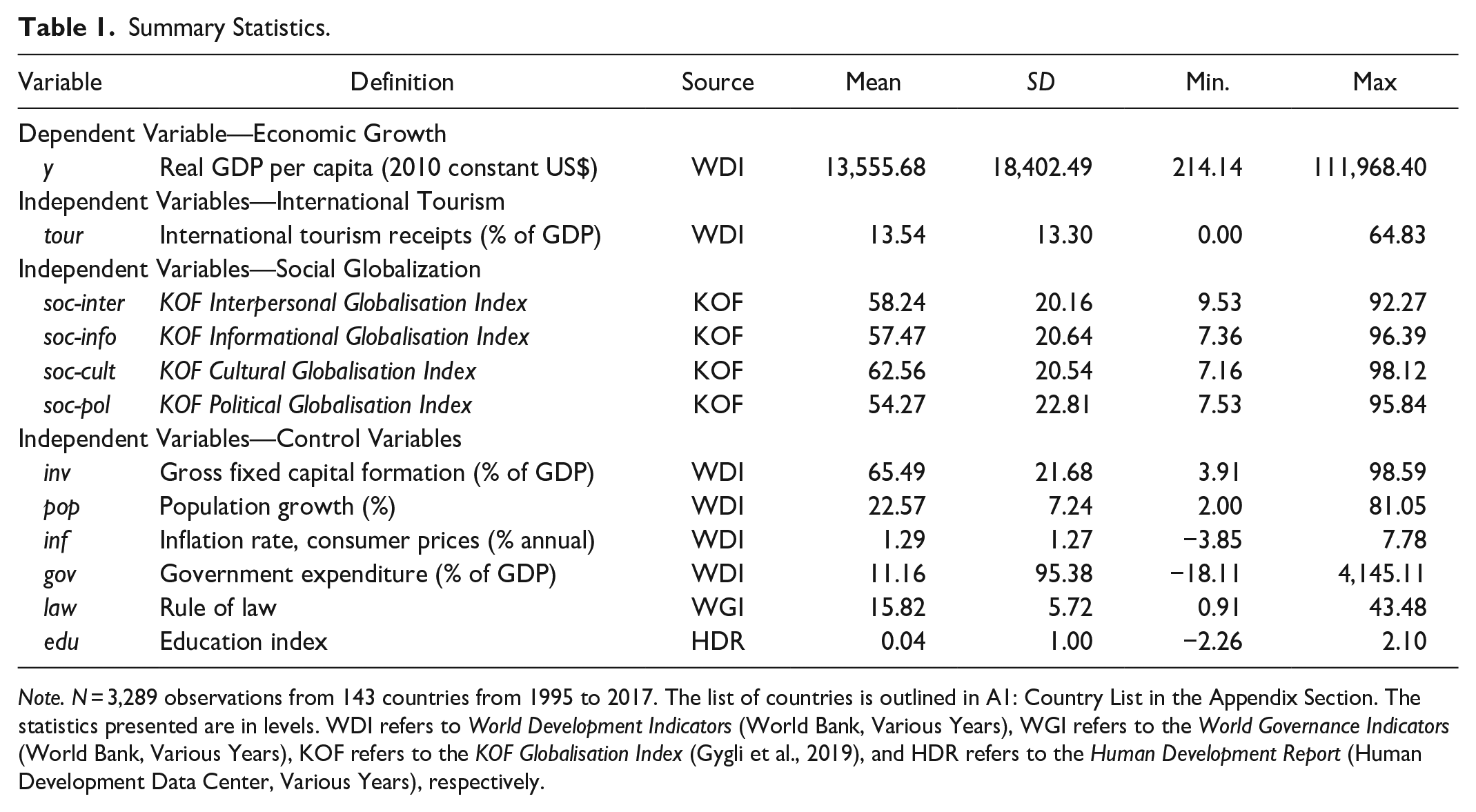
This study employs an annual-level balanced panel dataset of 143 countries (outlined in Appendix A1). We differentiate between advanced and developing economies using the World Bank Country and Lending Groups, which is calculated using the World Bank Atlas Method. Advanced economies consist of high-income economies with a gross national income per capita of $12,696 or more, while developing economies consist of upper-middle-income economies, lower-middle-income economies, and low-income economies with a gross national income per capita of less than $12,696. We compile our data from various sources which include the World Development Indicators (World Bank, Various Years), the World Governance Indicators (World Bank, Various Years), the KOF Globalisation Index (Gygli et al., 2019), and the Human Development Report (Human Development Data Center, Various Years). The variables employed are summarized in Table 1, and equation (3) represents the full specification of the estimated model.
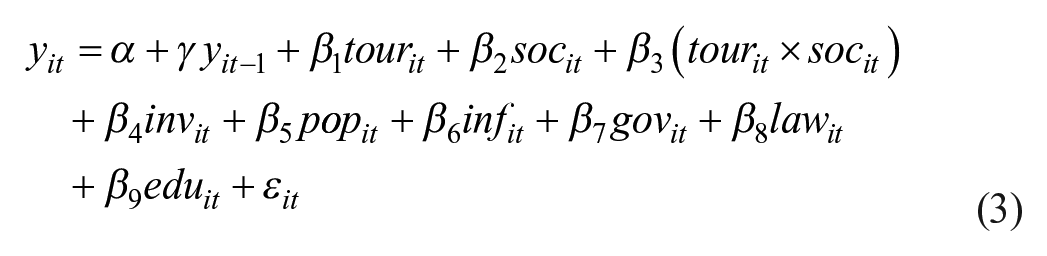
Summary Statistics.
Note. N = 3,289 observations from 143 countries from 1995 to 2017. The list of countries is outlined in A1: Country List in the Appendix Section. The statistics presented are in levels. WDI refers to World Development Indicators (World Bank, Various Years), WGI refers to the World Governance Indicators (World Bank, Various Years), KOF refers to the KOF Globalisation Index (Gygli et al., 2019), and HDR refers to the Human Development Report (Human Development Data Center, Various Years), respectively.
We standardize all variables (mean 0, standard deviation 1) and we log-transform our dependent variable, real GDP per capita. 6 To measure the rate of economic growth, we take the first differences of our dependent variable. We do not log-transform the social globalization indicators as they are bounded between 0 and 100. Similarly, we do not log-transform international tourism receipts as a share of GDP, as it is defined as a percentage. However, we standardize our variables to examine the marginal impact of international tourism receipts at varying levels of social globalization. We employ the real GDP per capita growth rate (Dyit) following the traditional Barro (1991) model and previous tourism-led growth empirical studies as it accounts for population growth and inflation (Min et al., 2016; Sequeira & Maçãs Nunes, 2008).
Analogous to Du et al. (2016) and Javid and Katircioglu (2017), this study employs the share of international tourism receipts as a share of GDP to quantify international tourism as an independent variable, denoted by tourit. More specifically, these receipts are expenditures and contain prepayment for goods and services received in the destination country from international tourism. It is suggested that the share of international tourism receipts not only measures tourism demand, but also explicitly capture the economic contribution of international tourism (Song et al., 2012). Moreover, international tourism receipts have been employed in several previous empirical studies to examine its effect on economic growth (Min et al., 2016; Shahbaz et al., 2018). While international tourism arrivals have been used in the past to proxy for tourism demand in the tourism-growth literature (Katircioglu, 2009; Ma et al., 2015; Sequeira & Maçãs Nunes, 2008; Tang & Abosedra, 2016), we are also interested in examining the marginal effects of social globalization for tourism-dependent economies. Employing the share of international tourism receipts allow us to estimate this as we can calculate the marginal effects of social globalization at varying levels of international tourism receipts.
In addition to international tourism, this study employs various measures from the KOF Globalisation Index, denoted as socit, to examine the impact of social globalization on economic growth. Due to the multifaceted nature of globalization, Gygli et al. (2019) distinguishes between three types of globalization; economic globalization, which focuses on the flow of goods, capital, services, and information on market changes; political globalization, which captures the diffusion of government policies; and finally, social globalization, which expresses the spread of ideas, information, images, and people.
The revised KOF Globalisation Index proposed by Gygli et al. (2019) is one of the most commonly used globalization measures and is comparable across many economies. Recall that the KOF Globalisation Index provides detailed measures that focuses on social globalization, and it differentiates between de jure and de facto measures of globalization. The indices are bounded between 0 and 100, where a higher value suggests a more socially globalized country.
We employ four de jure measures of social globalization to provide a richer specification and deeper inferences. We focus on de jure measures as it is often a prerequisite to de facto measures, and we are interested on whether policies that promote social globalization can enhance the impact of international tourism on economic growth. Our first measure is de jure interpersonal globalization, which refers to the policies and resources that enables direct interactions among people living in different economies. This considers the number of telephone subscriptions, number of international airports, and the freedom to visit. As a result, de jure interpersonal globalization can have direct impact on tourism activities. Secondly, de jure informational globalization, which considers television and Internet access as well as press freedom, measures the ability to share information across economies. This portrays media independence and freedom, which can have marketing implications on the promotion of international tourism.
Our third measure of social globalization is de jure cultural globalization, which considers gender parity, human capital, and civil liberties. This measure refers to openness toward cultural influences, particularly on understanding and accepting foreign cultural values. For example, gender parity proxies for the perceived role of women in society. Finally, our fourth measure is de jure political globalization, which considers international organizations, international treaties, and treaty partner diversity. In essence, de jure political globalization refers to the ability to engage in international political cooperation. These can have direct impact on tourism and growth, as it influences future relationships and proxies for the extent of economies that are willing to develop networks. On the other hand, this may not have a direct effect on international tourism as it proxies for global politics rather than social globalization.

To examine the moderating effect, we include an interaction term between social globalization measures with international tourism receipts, denoted as (tourit × socit). This allows us to estimate whether a positive enhancing effect occurs between international tourism receipts and social globalization or a negative non-complimentary effect occurs. We examine this further by estimating the marginal effect of international tourism receipts on economic growth at low and high levels of social globalization, by taking the first derivative of the interaction term with respect to international tourism, as shown in equation (4). Similarly, we estimate the marginal effects of social globalization at high and low levels of international tourism receipts to measure the effects of globalization in tourism-dependent and non-tourism-dependent economies. This is estimated by taking the first derivative of the interaction term with respect to international tourism receipts, as shown in equation (5).

We include various control variables that are commonly used in the empirical literature on growth economics. Firstly, we include the lag of our dependent variable following the system GMM specification, denoted as yit–1.We include invit which represents the share of gross fixed capital formation to GDP as a measure of investment. Additionally, we include popit which represents the population growth rate, measured by annual population growth as a percentage. We also include infit which measures the consumer price index as a proxy for inflation rate. Furthermore, we control for the share of government expenditure to GDP denoted by govit.
In addition, lawit represents the rule of law and captures the level of institutional development of an economy. We employ the rule of law index proposed by the World Governance Indicators, which measures the extent to which the public is confident that the society stands by the judicial rules of a country. Moreover, eduit is a measure of education index. We use the education index proposed by the Human Development Reports, which is estimated by combining the average adult years of schooling with expected years of schooling for those under 25 years of age. Note that while we control for these variables, we do not report them in our table of results and focus on our variables of interest. 7 Finally, all models are estimated using fixed country and year effects. Note that we employ the lagged dependent variables as our GMM instruments in both levels and differences and we collapse this to reduce the instrument count, to satisfy the Sargan and Hansen test of overidentifying instruments.
Results
Prior to the discussion of Tables 2 to 4, we find that all the estimated system GMM coefficients are robust. All estimated specifications reject the null hypothesis of autocorrelation at the second-order, thus, satisfying the Arellano-Bond test of no autocorrelation. Moreover, all specified models reject the null hypothesis of the Sargan and Hansen test of instrument over-identification. Finally, we report the variance inflation factor for all our models since we do not present the correlation matrix. All estimated models are below the threshold level of 10, which suggests that the model does not suffer from multicollinearity.
System GMM Coefficients—Full Sample.
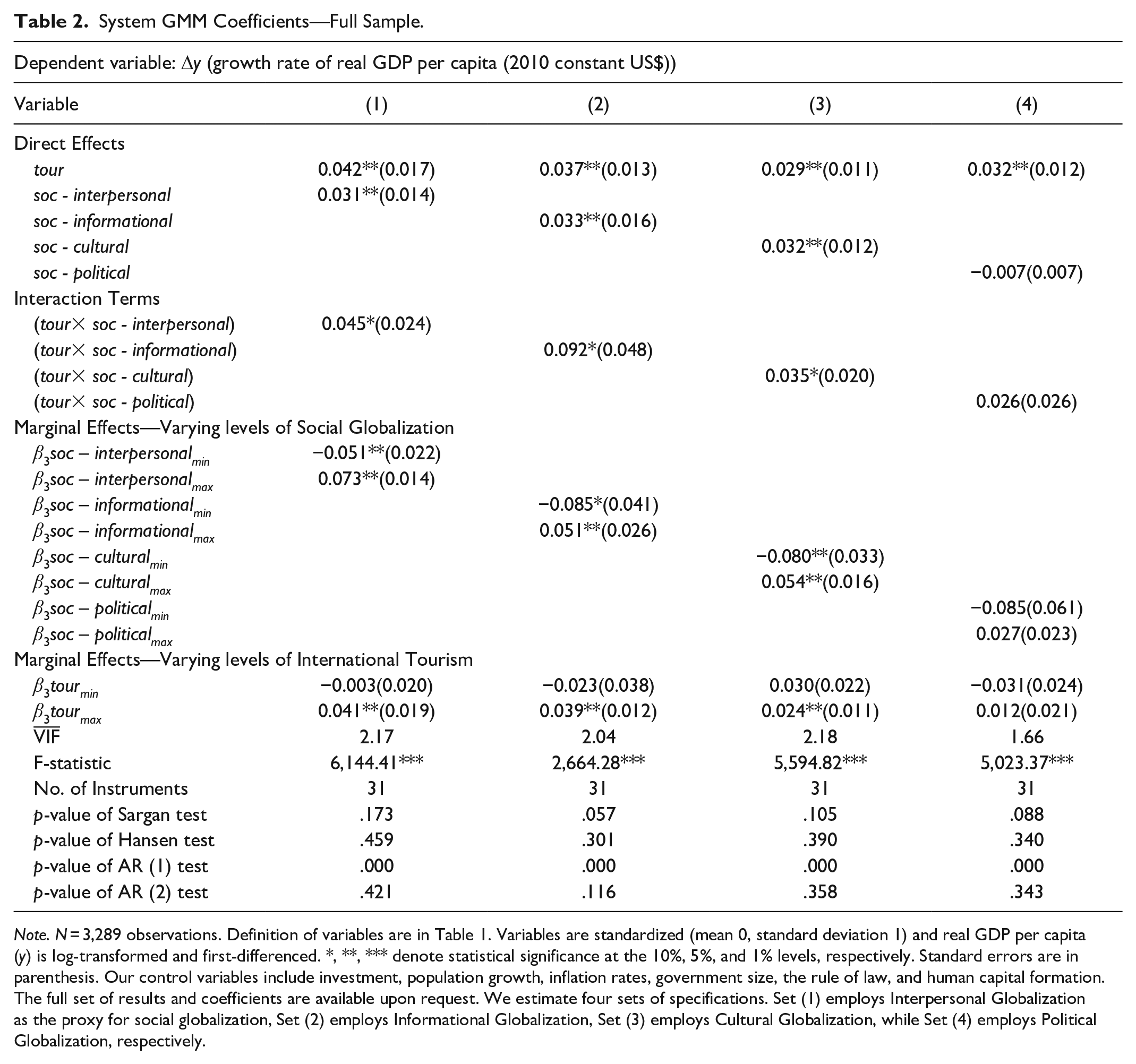
Note. N = 3,289 observations. Definition of variables are in Table 1. Variables are standardized (mean 0, standard deviation 1) and real GDP per capita (y) is log-transformed and first-differenced. *, **, *** denote statistical significance at the 10%, 5%, and 1% levels, respectively. Standard errors are in parenthesis. Our control variables include investment, population growth, inflation rates, government size, the rule of law, and human capital formation. The full set of results and coefficients are available upon request. We estimate four sets of specifications. Set (1) employs Interpersonal Globalization as the proxy for social globalization, Set (2) employs Informational Globalization, Set (3) employs Cultural Globalization, while Set (4) employs Political Globalization, respectively.
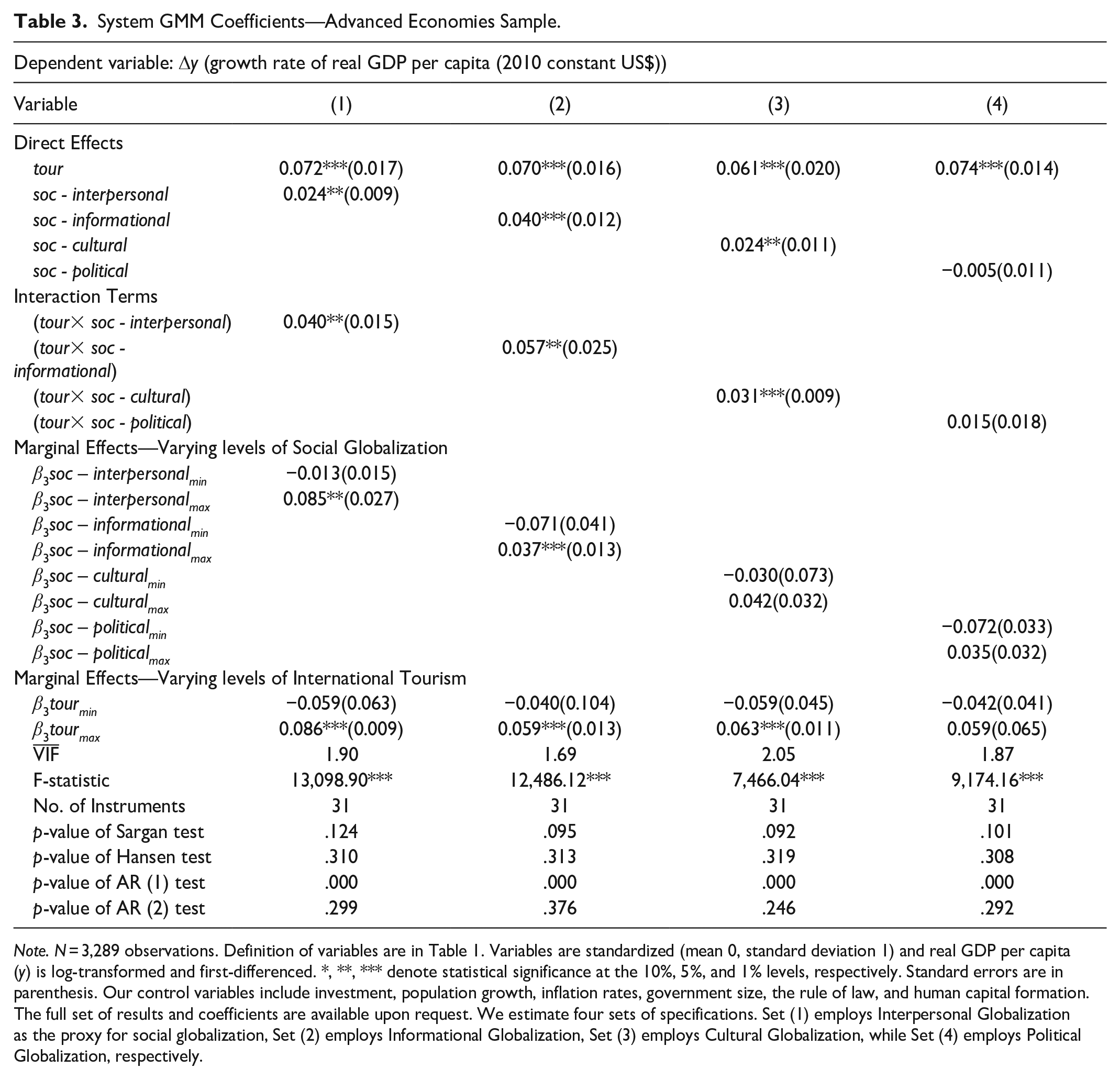
System GMM Coefficients—Advanced Economies Sample.
Note. N = 3,289 observations. Definition of variables are in Table 1. Variables are standardized (mean 0, standard deviation 1) and real GDP per capita (y) is log-transformed and first-differenced. *, **, *** denote statistical significance at the 10%, 5%, and 1% levels, respectively. Standard errors are in parenthesis. Our control variables include investment, population growth, inflation rates, government size, the rule of law, and human capital formation. The full set of results and coefficients are available upon request. We estimate four sets of specifications. Set (1) employs Interpersonal Globalization as the proxy for social globalization, Set (2) employs Informational Globalization, Set (3) employs Cultural Globalization, while Set (4) employs Political Globalization, respectively.
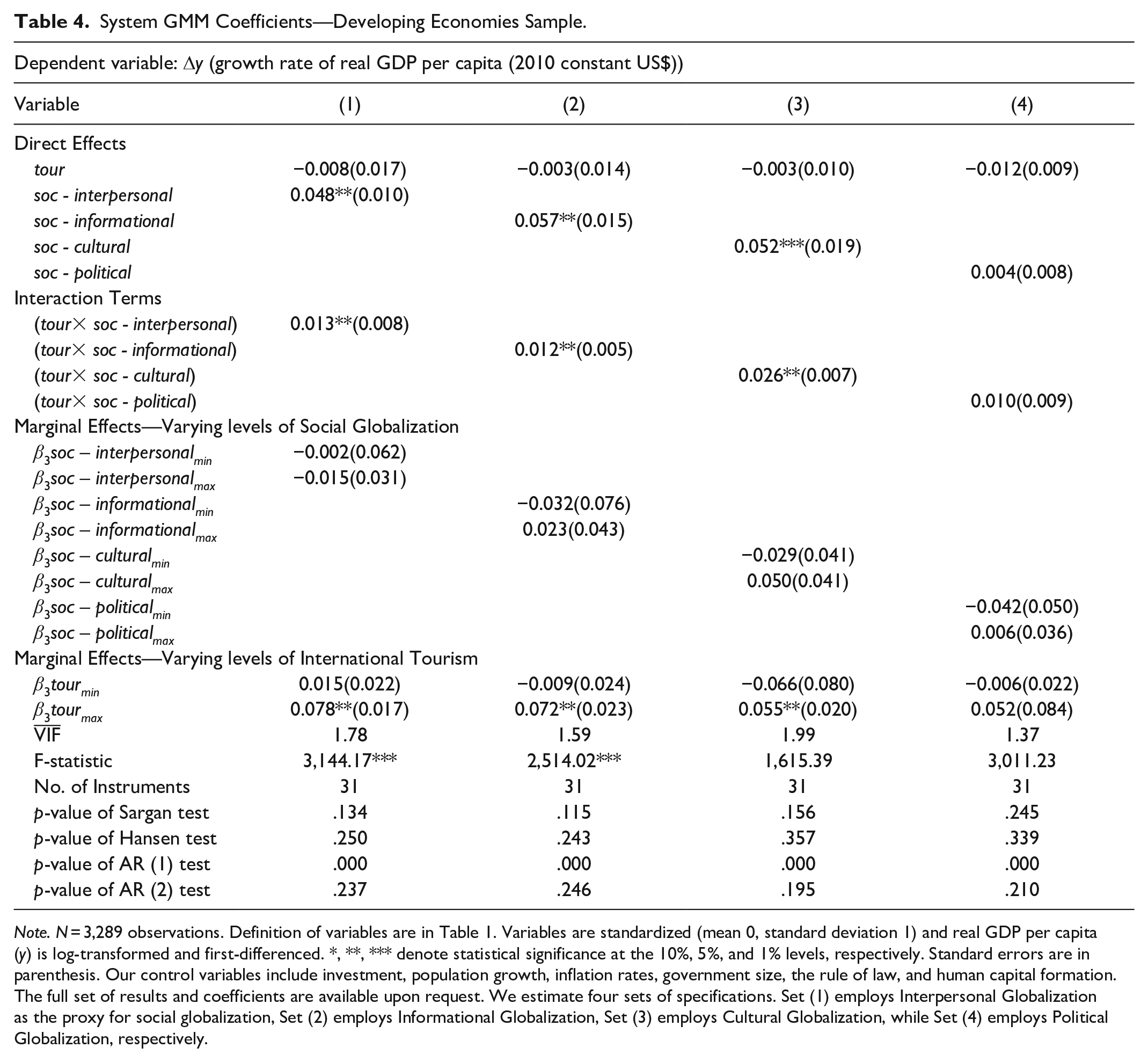
System GMM Coefficients—Developing Economies Sample.
Note. N = 3,289 observations. Definition of variables are in Table 1. Variables are standardized (mean 0, standard deviation 1) and real GDP per capita (y) is log-transformed and first-differenced. *, **, *** denote statistical significance at the 10%, 5%, and 1% levels, respectively. Standard errors are in parenthesis. Our control variables include investment, population growth, inflation rates, government size, the rule of law, and human capital formation. The full set of results and coefficients are available upon request. We estimate four sets of specifications. Set (1) employs Interpersonal Globalization as the proxy for social globalization, Set (2) employs Informational Globalization, Set (3) employs Cultural Globalization, while Set (4) employs Political Globalization, respectively.
Full Sample
Direct effects
The estimated system GMM coefficients for the full sample is presented in Table 2. The findings show that international tourism has a positive and significant impact on economic growth across all four specified models, supporting previous studies that emphasize the growth-enhancing impact of tourism on growth (Du et al., 2016; Min et al., 2016; Wu & Wu, 2018). We find that a one standard deviation (13%) increase in tourism receipts is associated with an estimated 0.38% to 0.55% increase in economic growth rates. 8 The magnitude of our estimates is similar to previous empirical studies. For example, Du et al. (2016) finds that a 10% increase in tourism receipts, leads to a 0.51% increase in economic growth rates, while Min et al. (2016) finds that a 10% increase in tourism receipts can increase growth rates by 0.17% to 0.24%. While other studies provide varying estimates (Chiu & Yeh, 2017; De Vita & Kyaw, 2017; Zuo & Huang, 2018), we attribute the variations due to different methodological approaches (Castro-Nuño et al., 2013).
In addition, our estimated results find evidence that social globalization has a positive and significant impact on economic growth, supporting previous studies that highlight the importance of globalization (Potrafke, 2015). Interestingly, we find that interpersonal, informational, and cultural globalization is positive and significant to growth, while political globalization is insignificant. Our findings suggest that a one standard deviation increase in: interpersonal globalization (20.1%) is associated with a 0.62% increase in growth rates; informational globalization (20.64%) is associated with a 0.68% increase in growth rates; and cultural globalization (20.54%) is associated with a 0.66% increase in growth rates. We find our results to be comparable to Gygli et al. (2019) except for political globalization.
Marginal effects
To examine whether the spillover effect from social globalization can moderate the relationship between international tourism and economic growth, we focus on our interaction terms and marginal effects. On an important note, the interaction term between social globalization and international tourism receipts captures the magnitudinal changes of one variable (international tourism), as the values of another variable vary (social globalization). The estimated results show that the interaction term between social globalization indices and international tourism receipts (as percentage of GDP) are positive and significant for all specifications apart from political globalization.
This suggests that a complementary effect exists between the two variables. However, we are interested in examining the variations and overall effects of international tourism when social globalization is proceeding at high and low levels. Consequently, we estimate the overall effects of tourism receipts at high and low levels of social globalization and the marginal effects of social globalization at high and low levels of international tourism. We estimate the marginal effects at the extreme levels in order to observe variations within our full sample and subsample of advanced and developing economies.
When social globalization is at its highest, a one standard deviation increase in international tourism receipts (13%) is associated with an overall 0.66% to 0.95% increase in growth rates. Note that this is an extreme case, where social globalization measures are at its maximum observed level based on the underlying data. On the contrary, when social globalization is at its lowest, the marginal effects of international tourism on growth is insignificant. In addition, we estimate the marginal effects of social globalization when the share of international tourism receipts of GDP is at its highest and lowest. Interestingly, we find that the marginal effects of social globalization on growth is higher for tourism-dependent economies, as it is associated with an overall 0.49% to 0.82% increase in growth rates.
Subsample—Advanced Economies
Direct effects
Table 3 presents the system GMM coefficients for our sample of advanced economies. The estimated results show that international tourism receipts have a positive and significant relationship with economic growth. Interestingly, we find that the impact of international tourism for advanced economies to be similar in magnitude compared to the full dataset. The findings show that a one standard deviation increase in international tourism receipts (20.08%) is associated with a 1.22% to 1.41% increase in growth rates. The results provide further evidence that tourism does indeed promote growth even for our subsample of advanced economies.
Furthermore, we also find that social globalization has a positive and significant impact on growth in our subsample of advanced economies. The estimated results show that a one standard deviation (10.23%–12.09%) increase in social globalization indices is associated with a 0.25% to 0.41% increase in growth rates, with informational globalization enhancing growth the most. However, the magnitudinal impact of social globalization is smaller for the subsample of advanced economies compared to the full dataset. This may be because social globalization may not be a dominant determinant of growth for many advanced economies that are well diversified across industries and sectors (Hausmann et al., 2007). Nonetheless, the results provide evidence in support of the growth-enhancing effects of social globalization.
Marginal effects
The interaction term between social globalization indices and international tourism is only positive and significant for interpersonal, informational, and cultural globalization. However, when we examine the marginal effects of international tourism at high levels of social globalization, we find that social globalization is an effective moderator only for interpersonal and informational globalization. At high levels of interpersonal and informational globalization, a one standard deviation (20.08%) increase in international tourism receipts is associated with increases in growth rates by 0.74% and 1.71% respectively.
In addition, we examine whether advanced economies that are tourism-dependent benefit from an increase in social globalization. We find that economies with high levels of tourism receipts as a share of GDP is associated with an overall gain of 0.60% to 0.89% in growth rates as social globalization indices increases by one standard deviation (10.23%–12.09%). However, advanced economies with low levels of tourism as a share of GDP does not benefit further from an increase in social globalization. This highlights the fact that tourism-dependent economies do indeed leverage on social globalization and vice versa.
Subsample—Developing Economies
Direct effects
Finally, Table 4 presents the estimated system GMM coefficients for developing economies. In contrast, the findings show that international tourism has a negative and insignificant relationship with economic growth. This contradicts previous empirical studies which finds low-income economies to benefit more from tourism compared to high-income economies. For example, Min et al. (2016) finds that in the long-run, the effects of international tourism on growth are only positive and significant for low-income economies, while the effect is insignificant for middle- and high-income economies. While these contrast with our findings, our estimated results are in line with studies that highlight the ambiguous effect of tourism on growth (Nowak & Sahli, 2007; Song et al., 2012).
On the other hand, the estimated results find that the social globalization indices are positive and significant to economic growth. The magnitudinal effects of social globalization for the subsamples of developing economies are slightly larger compared to the subsample of advanced economies. More specifically, we find that a one standard deviation increase (16.36%–18.17%) in social globalization indices is associated with an increase in growth rates of 0.81% to 1.04%. However, we find that political globalization is insignificant to economic growth.
Marginal effects
We find that the interaction term of interpersonal, informational, and cultural globalization with international tourism is positive and significant to growth, suggesting that a complementary effect exists. However, the moderating effect for social globalization on international tourism is insignificant. In fact, at both high and low levels of social globalization, the effect of international tourism on growth is still insignificant. This consolidates our findings with the literature that postulates an ambiguous growth effect of international tourism, as we only find evidence of a positive relationship between the two in our full sample and subsample of advanced economies. We attribute this effect on the de-industrialization effects of international tourism, particularly for developing economies (Nowak & Sahli, 2007).
On the other hand, while our results imply that international tourism does not contribute toward growth, we find evidence that tourism-dependent developing economies can benefit from growth through an increase in social globalization. In fact, we find that at high levels of international tourism receipts as a share of GDP, a one standard deviation increase in interpersonal (16.89%), informational (18.17%), and cultural globalization (16.36%), is associated with an overall 1.32%, 1.31%, and 0.90% increase in growth rates, respectively. Consequently, developing economies that are tourism-dependent relies on having open policies with regards to social globalization to benefit from international tourism.
Discussion
Tourism-Led Growth Hypothesis
Support for tourism-led growth hypothesis
In summary, we find some evidence of a positive relationship between international tourism and economic growth as we find a positive and significant relationship in our full sample and subsample of advanced economies. However, this relationship is insignificant for developing economies. Nonetheless, our findings still support studies that suggest international tourism can bring foreign exchange, generate employment, and promote local investment which affects other economic sectors positively (Neves et al., 2015; Song et al., 2012).
In addition, the positive and significant findings from our full and subsample of advanced economies highlight the importance of the tourism industry and its linkages to other economic sectors that indirectly promotes growth (Zamparini et al., 2017). It is suggested that economies that have a more complex product space are well connected to other sectors and can benefit from growth since it provides a well-balanced path in terms of economic development, as tourism is a composite bundle of heterogenous activities (Koch, 2021; Lejárraga & Walkenhorst, 2013).
Evidence against tourism-led growth hypothesis
However, this relationship does not hold for developing economies. Our findings lend support to the strand of literature that postulates an ambiguous or negative relationship between international tourism and economic growth (Nowak et al., 2010). Moreover, studies have shown that international tourism can lead to de-industrialization in other sectors akin to the Dutch disease phenomena (Nowak & Sahli, 2007; Song et al., 2012). Hence, it is possible that developing economies that aim to advance their tourism industry may not benefit from growth, as increased foreign currency and investment into the tourism industry crowd out investment in other sectors.
From our quantitative results, we propose another explanation for the Dutch disease effect of the tourism industry for developing economies. Our intuition relies on the knowledge from the development and agricultural economics literature put forth by Martin (2019). Firstly, it is expected that developing economies eventually converge with their richer or advanced counterparts, benefiting from the transfer of technology and knowledge spillovers. This structural change assumes that developing economies transition from an agrarian sector to a more industrial and manufacturing-based economy, before eventually moving into the services sector (Martin, 2019).
However, a developing economy that wants to focus on the tourism sector will need to reallocate labor from the agricultural farm sector and industrial sector to the services sector (Otsuka, 2013). This potentially creates a vacuum in terms of the de-industrialization effects as a result of developing the tourism industry, as they forgo production in the farm and industrial sector. However, our results show that developing economies that are tourism-dependent can still benefit from tourism-led growth conditional that social globalization is well-developed.
Social Globalization and Economic Growth
Support for social globalization and growth
We find consistent evidence of a positive and significant relationship between our social globalization indicators with economic growth across our full sample and when we conduct further analysis on the subsample of advanced and developing economies. Our studies provide further evidence on the growth enhancing effects of social globalization as previous studies tend to focus on the role of economic and trade globalization. The findings highlight the beneficial role of knowledge exchange and spillovers through society. As highlighted by Grossman and Helpman (2015), international interactions not only affect the incentives for technological diffusion, but the integration of people and cultures facilitate the flow of knowledge that can be useful in producing new product and service. Our results shed new lights on the importance of human capital formation in economic growth via the lens of social globalization.
Advanced and developing economies
Interestingly, we find that developing economies benefit more from social globalization compared to advanced economies. We speculate that this is probably because social globalization focuses on the integration of people and cultures as opposed to the export of products and financial markets, where the former has a more dominant effect than the latter form of globalization. This process of social integration allows the less developed countries to be exposed to a larger plethora of ideas, knowledge, and technology transmission. Hence, our empirical findings differ from studies on globalization in trade and investment which found that developing countries do not benefit as much as the advanced economies (see for nstance Sen, 2000; Stiglitz, 2004).
Information technology
In terms of our specific social globalization indicators, we consistently find that the growth-enhancing effects of informational globalization to be larger in magnitude compared to cultural and interpersonal globalization in our full sample and subsample of advanced and developing economies. Note that the informational globalization indicator considers television access, Internet access and press freedom, with a larger weight associated to Internet access (Gygli et al., 2019). On the other hand, cultural globalization captures gender parity and civil liberties while interpersonal focuses on visa-free travel and the development of air transportation.
Consequently, it is somewhat expected that informational globalization to show the largest growth-enhancing effect if we interpret our result as causal. The literature has shown that information and communications technology, particularly with the onset of the Internet, can benefit the economy by directly lowering transaction costs and indirectly by accelerating informational flows that affect growth endogenously (Niebel, 2018). Additionally, direct investment into the information technology sector such as the Internet, involves large capital investments that affect growth directly via the production function (Haini & Wei Loon, 2022).
Cultural globalization and institutions
The mechanisms at which cultural globalization affects growth lies in the literature on institutional and economic growth theory. Institutions can be referred to the humanly devised constraints that structure economic interactions and as a result, the institutional environment such as civil liberties and gender parity create conditions that affect the decision making of an individual or firm (North, 1990). In essence, poor institutions obstruct entrepreneurial and innovative activities as they increase uncertainties and cost of business, while strong institutions signal and provide critical resources for productive economic activity (Acs et al., 2009). In the context of globalization, our results support the specific mechanisms outlined by Grossman and Helpman (2015), where strong institutional support in an economy provides incentives for firms to innovate and contribute directly to economic growth.
Interpersonal globalization
Meanwhile, interpersonal globalization mainly captures the effect of travel particularly on the infrastructure and policy aspect as it focuses on visa-free travel and the development of international airports. The specific mechanisms at which this potentially affects growth leans toward the idea that globalization not only involves the movement of trade and investment, but also the transmission of ideas, people, and knowledge, which can be facilitated by international travel. However, we find that the association between political globalization and growth is insignificant in all our regressions. While we are not aware of the underlying causes, we suspect that this could be related to the measure of political globalization which focus on bilateral and international relationships and fails to capture the transmission of ideas related to beneficial institutional arrangement such as the rule of law.
Does Social Globalization Enhance the Growth Effects of International Tourism?
Marginal effects
Focusing on the intersection between social globalization and tourism, our results indicate that social globalization is indeed an effective moderator for international tourism and economic growth, as high levels of social globalization enhance the positive effects of international tourism on growth. However, this relationship only holds for our full sample and advanced economies subsample. On the surface, the results suggest the importance of promoting de jure policies on social globalization, which includes the provision of airports, telecommunications, press freedom and humanitarian rights. This allows for the integration of people and culture which can further facilitate knowledge flows across borders (Grossman & Helpman, 2015), where international tourism can prosper through foreign ideas and markets. In this case, we observe a scale effect, where the social integration enhances the growth effects from the tourism industry.
Interpersonal globalization as a moderator
More specifically, we find that the moderating effects of interpersonal globalization have the largest magnitude, compared to informational and cultural globalization. This indicates that tourism flows will be enhanced through cultural globalization, which is a major part of many tourism offerings (Azarya, 2004). Yet, recent research shows that transactional costs of travel are more important for international tourism, and these include visa-free status, shared languages, and geographical proximity (Chung et al., 2020).
This is mostly captured by the interpersonal globalization measures. In fact, this moderating effect is greater for advanced economies, however, is insignificant for developing ones. Our intuitive explanation remains the same. We argue that developing economies that try to leverage on social globalization measures for international tourism can lead to de-industrialization and a reallocation of labor away from other productive industries (Martin, 2019; Otsuka, 2013).
Tourism-dependent economies
On the contrary, tourism-dependent economies also benefit from an increase in social globalization indicators, suggesting a complementary relationship. This is observed for our full sample, and for the subsample of advanced and developing economies after segregating the dataset. Our results consistently show that at high levels of international tourism receipts as a share of GDP, increases the positive effects of social globalization. This is observed for our full sample, and subsample of advanced and developing economies. This implies that tourism is beneficial for economic growth in developing economies provided that it is enhanced through social globalization.
This is obvious in hindsight, as open borders, visa free travel, and other variables that directly and indirectly affect international tourism, can enhance tourism offerings and spillover to growth. The results highlight the fact that international tourism activity is highly linked with notions of free market, open borders, and ideologies linked with social globalization (Bianchi, 2006). Our findings support this conjecture, as the marginal impact of international tourism at low levels of social globalization is insignificant, thus, highlighting the importance of social globalization as a moderator.
Tourism-dependent economies are highly dependent on tourism activity as an export, and as a result, naturally benefits more from an increase in social globalization or integration, particularly when the transactional costs of travel are reduced (Chung et al., 2020; Ghali, 1976). While some previous studies even claim that tourism-dependent economies grow faster than others (Sequeira & Maçãs Nunes, 2008), we provide new evidence that tourism-dependent economies benefit from tourism only when social globalization is high (see results on the developing economies in Table 4).
Similarly, the magnitude and impact of interpersonal globalization, as a moderator for tourism-dependent economies, is the largest in magnitude compared to other measures of social globalization. This is expected as it captures the extent of visa free travel and the development of international airports. Consequently, social globalization is an important determinant of the tourism industry as it connects markets and societies, while promoting the flow of people, ideas, and culture beyond borders (Javid & Katircioglu, 2017). Consequently, social globalization can spur tourism and hence supports economic growth.
Theoretical Implications
Revisiting Figure 1, we examine whether social globalization can enhance the impact of international tourism on economic growth. The existing literature on the tourism-led growth hypothesis presents inconclusive findings with both positive and negative impact of tourism on growth (De Vita & Kyaw, 2017; Lejárraga & Walkenhorst, 2013; Neves et al., 2015; Pina & Martínez-García, 2013). Our evidence suggests that tourism-led growth holds for advanced economies while developing economies tend to benefit from international tourism when social globalization is developing at a high level.
Our work supports the view of the importance of absorptive capacities for the destination country and it is an essential prerequisite for tourism-led growth (Cárdenas-García et al., 2015; Chiu & Yeh, 2017; De Vita & Kyaw, 2017; Pulido-Fernández & Cárdenas-García, 2021; Song & Wu, 2022). This may arise due to the common lack of skilled labor and institutional structure among developing countries that hampers the ability to fully capitalize on the knowledge gained from advanced economies. Moreover, our study contributes to the nonlinear relationship between tourism and growth by inspecting the growth-effects of tourism when social globalization varies at different stages. For instance, we show an insignificant and negative relationship between international tourism and economic growth when social globalization indicators are at its lowest development stage. Thus, we contribute new evidence by identifying circumstances under which the tourism-led growth does not hold, which addresses recent critiques of the tourism-led growth literature from meta studies (Nunkoo et al., 2020; Song & Wu, 2022).
Conclusion
This study examines the moderating impact of social globalization on the relationship between international tourism and economic growth using a sample of 143 countries from 1995 to 2017. We empirically establish that social globalization enhances the positive impact of international tourism on economic growth through channels such as information and knowledge spillovers related to culture and beliefs. However, the magnitude of this impact is greater for advanced economies compared to developing countries. We also find that the moderating effect of international tourism on growth is greater for countries where there is a high degree of social globalization.
While our empirical evidence shows that international tourism does not necessarily benefit developing economies, we find that tourism-dependent developing economies where tourism forms a major share of GDP can still benefit from increased social globalization. Although we do not have microdata to allow deeper investigation and strong causal inferences, we conjecture that for economies with low levels of social globalization, their benefit from knowledge flows is limited due to their absorptive capacity.
On the other hand, economies with high levels of social globalization can leverage on the impact of international tourism as they can readily absorb knowledge and ideas, and through well-developed institutions and human capital. For example, institutional structure in the form of visa-free travel, similar currency exchange rate, shared language, and locational proximity lowers the transaction costs from international tourism and in turn, increases the share of contribution to economic growth. However, we find that international tourism has an insignificant relationship with growth for developing economies, especially when there is low development of social globalization. While we are not aware of the causes, we speculate that this could be potentially related to the Dutch disease phenomenon, particularly as developing economies tend to reallocate productive labor from other industrial and farm sectors.
Our findings have important policy implications particularly with the recent global pandemic. The World Travel and Tourism Council (2021) Report show that recent GDP change from travel and tourism declined by nearly 50% globally, or 4.5 trillion US dollars in monetary terms. 9 This translates into 62 million job losses resulting from the decline in travel and tourism due to the multiple restrictions imposed during the pandemic. While our data do not specifically capture the effects of the recent coronavirus pandemic, our results highlight the importance of keeping open borders.
Our study is subject to several limitations. Our study employs aggregated measures that fail to capture the impact of regional-level growth and allow for better causal identification. Furthermore, our data did not capture the role of domestic tourism. In large countries, the growth effects arising from tourism may be concentrated in certain destinations and causes unequal growth that could possibly result in unequal distribution of income. Future studies may extend the empirical literature of the tourism-led growth hypothesis by focusing on regional-level or even city-level data within a single country.
Footnotes
Appendix
Acknowledgements
The authors acknowledge the direction of the handling editors, Professor Nancy Gard-McGehee and Professor James Petrick, and the suggestions provided by three anonymous referees.
Declaration of Conflicting Interests
The author(s) declared no potential conflicts of interest with respect to the research, authorship, and/or publication of this article.
Funding
The author(s) received no financial support for the research, authorship, and/or publication of this article.
Data Availability Statement
Not applicable as no new data were created.
1.
World Travel and Tourism Council (2020). Economic Impact 2020. WTTC: London. [Online]. 
2.
3.
4.
5.
This is also related to the Rybczynski theorem in international trade theory which states that in a two-commodity sector, a rise in the endowment of one factor will result in more than a proportionate expansion of the output in the sector that uses that factor intensively, and an absolute decline of the output of other good that depends on an opposing factor, under constant relative prices (Rybczynski, 1955).
6.
The results are also consistent using non-standardized variables and are available upon request.
7.
The full set of results and coefficients are available upon request.
8.
We calculate our growth rates by multiplying the standard deviation with the respective coefficient estimate SD × β. In this case 0.13 × 0.042 = 0.00546.
9.
World Travel and Tourism Council (2021). Economic Impact 2021. WTTC: London. [Online]. https://wttc.org/Research