




Abstract
The expansion of the homestay industry is shadowed by ethical concerns and perceived risks. In this context, the emotional relationship between hosts and tourists in the wake of COVID-19 pandemic needs to be re-examined. Focusing on the togetherness of “we” rather than the demarcation of “you versus me,” we integrate homestay hosts and guests into a conceptual model to examine and compare their emotional solidarity with each other, as well as the relevance of emotional solidarity to perceived risk, MES (Multidimensional Ethics Scale), and support for homestays. Our results show that despite the assumption of perceived risk, tourists feel welcomed by hosts during the pandemic, while hosts feel emotionally close to tourists. In addition to the findings that emotional solidarity mediates perceived risk, MES, and support for homestays in both samples, we find that hosts’ perceived risk is more likely to influence their emotional solidarity and support for homestays.
Keywords
Introduction
The past few years have witnessed the rapid development of the homestay industry. The success of Airbnb, a global homestay accommodation online platform, illustrates the market’s growth. After nearly 13 years of development (since Airbnb was founded in 2008), the number of registered homestay hosts on Airbnb has exceeded 4 million (Peng, 2020). Alongside legal problems, such as unlicensed rentals or subletting, many people have expressed moral concerns over the sharing economy, ranging from host-side issues, such as misleading advertising, unfulfilled privacy guarantees, or unhygienic environments (Qlder27, 2019) to guest-side problems, such as intentional wasting of resources or failure to honor cleaning obligations upon departure (Alyse, 2022). These concerns and shortcomings impede the development of high-quality rapport, weaken the emotional bonds between the guest and the host, and hinder the sustainable development of the homestay industry. Scholars have increasingly incorporated “emotional solidarity,” a term coined to measure the emotional bond or relationship between humans, into tourism studies due to its critical role in predicting residents’ perceived tourism impact and their support for tourism development (Woosnam & Aleshinloye, 2013; Woosnam et al., 2020). Despite the urgency and relevance of moral concerns due to the destabilization of the homestay industry in the wake of the COVID-19 pandemic, research on moral concerns and their potential impact on the host-guest relationship is lacking.
Identified as a major threat to the homestay industry (Lee & Deale, 2021), risk concerns reached a new high during the outbreak of COVID-19. The unpredictability of the virus and the economic and psychological instability caused by travel and mobility restrictions have brought the tourism industry to a standstill (World Health Organization, 2020). Tourists’ perceptions of risk “during the pandemic” were empirically confirmed to be more intense and acute than their perception of risk “before the pandemic” (Lee & Deale, 2021). This heightened risk perception can affect tourists, such as changing their mental state (Joo et al., 2021) or their decision-making behavior (Yi et al., 2020). Homestay hosts, however, are exposed to just as many risks as tourists during the pandemic period. While scholarship has focused on tourists’ perceptions of risk, hosts’ perceptions of risk also deserve thorough academic investigation.
The concept of emotional solidarity has been mostly adopted to measure the emotional state of residents toward tourists (residents to tourists) (Gautam, 2022; Joo et al., 2018, 2021) or the emotional state of tourists toward residents (tourists to residents) (Lee et al., 2022; Woosnam, 2012). A recent extension of this research examined tourists’ emotional bonds at the level of individual groups (tourist to tourist) (Joo & Woosnam, 2020). There is a nascent body of literature examining the host-tourist relationship in the accommodation industry, with a strong focus on community interest, particularly from the residents who live in neighborhoods with Airbnb rentals (resident to the guest) (Suess et al., 2020, 2021), coupled with the occasional examination of guests’ perspectives (guest to host) (Zhang & Tang, 2021). Despite serving as a key facilitator of the homestay industry, however, the emotional solidarity of the host remains under-researched in the tourism literature (Moon et al., 2019). Perhaps more important than the host perspective is literature that explores the relationship between the host and the tourist. As a theory stressing “togetherness” instead of “me versus you” (Mullins, 2005), emotional solidarity connotes a dynamic relationship with a mutual emotional bond. One of the appeals of a homestay compared to a traditional hotel is the distinct two-way interaction and connection between the host (or employee) and the tourist (Moon et al., 2019). It is this social interaction, both on a personal and professional level, that adds a new element to an otherwise traditional commercial discourse (Makkar & Yap, 2022). Human connection, however, cannot be achieved if emotional bonds are not mutual. Integrating the distinct perspectives of both hosts and tourists into the literature, which has so far been dominated by the perspective of the tourist, is necessary to understand and foster reciprocal relationships within the homestay industry.
Academic discourse in the homestay industry mainly engages with economic and legal issues (Johnson & Neuhofer, 2017) and passes over emotional and moral issues. Recognizing the importance of the emotional solidarity of hosts and tourists in the homestay industry, we integrate both parties into our comparative normative model. Drawing on emotional solidarity theory, we examine how emotional solidarity affects hosts’ and tourists’ morality and moral concerns, specifically through measures of the MES (Multidimensional Ethics Scale) (Reidenbach & Robin, 1988, 1990), their perceived risk, and how this perceived risk may affect their support for homestays. We further compare the variation found between the two groups in these relationships. The results of this research can help advance the theory of emotional solidarity by addressing its fundamental premise of a mutual or bilateral relationship between two parties, host-guest dynamics at the homestay industry level in particular, and resident-tourist complexes at a destination level or at levels of sharing economy in general. It also offers practical implications for industry practitioners, host communities, and policymakers who aim to promote a socially congruent host-guest exchange and ease their moral or perceived risk concerns for them. By doing so, the possible hostility can be assessed and remedied if the rising emotional disparity between the two parties is evidenced. Action can be taken to align their relationship in favor of both parties. This reflection on ethics and perceived risk on the part of hosts and tourists is of particular importance to the recovery of the tourism industry after COVID-19 (Joo et al., 2021; Kim et al., 2023).
Literature Review
Emotional Solidarity
The theory of emotional solidarity originates from sociologist Durkheim (2016). It facilitates an understanding of the word “we” so that “me versus you” gradually gives way to the emotion of “we together” (Mullins, 2005; Wearing & Wearing, 2001). Emotional solidarity represents feelings of identification and bonding with other individuals (Woosnam & Norman, 2010) and can also be defined as a feeling of closeness with individuals sharing similar experiences (Dangi, 2018).
Although the emotional solidarity theory has been widely used in sociology, social psychology, and religious studies to examine people’s emotional bonds and feelings of togetherness (Woosnam & Norman, 2010) and has the potential for deeper understanding of relationships in a variety of settings, further investigation is needed (Fish, 2002; Woosnam, 2011). Following Durkheim’s theory of emotional solidarity (1915, 1995), Woosnam et al. (2009) developed the emotional solidarity scale (ESS), which includes three factors: welcoming nature, emotional closeness, and sympathetic understanding. This measurement has received wide empirical validation and application in various contexts, such as cultural heritage festivals (Li & Wan, 2017; Woosnam & Aleshinloye, 2013), religious tourism (Manosuthi et al., 2022), sports tourism (Hashemi et al., 2022), peer-to-peer accommodation (Suess et al., 2020), and tourism destinations (Gautam, 2022; Joo et al., 2021; Lee et al., 2022).
The emotional bond between actors in the homestay industry has been studied by a limited number of scholars. A homestay is often an underutilized private home that is temporarily or regularly converted into accommodation for tourists (Nuntsu et al., 2004). It usually offers a wide range of customized services or activities, such as photography (providing a photographer and even tourist costumes in some homestays, normally with a featured architectural style or interior design), car rental, tour guide, and pick-up service. These individualized services may differ sharply from many branded hotels (Chen et al., 2013). The novelty of the experiences and personal interactions offered through a homestay highlight the importance of emotional solidarity in the homestay industry. Within a few studies, Suess et al. (2020) found that emotional solidarity from residents can enhance their sense of safety with Airbnb visitors and the support of Airbnb hosts as their neighbors. Another study (Suess et al., 2021) examined how the emotional solidarity of Airbnb hosts’ neighbors toward visitors influences their personal quality of life, providing further support for the predictive power of emotional solidarity in the tourism industry. Juric et al. (2021) confirmed the mediating effect of emotional solidarity between personal character traits and the choice of a non-monetary peer-to-peer accommodation. In addition, Zhang and Tang (2021) discussed whether tourists’ emotional solidarity with their hosts influences the relationship between tourists’ perceived risk and customer loyalty toward the homestay.
The theory of emotional solidarity, as derived from sociology, has been extended and enriched through its incorporation in various tourism sectors, with additional empirical support among different nationalities. However, few studies have compared the perspectives of hosts and tourists, that is, the essence of “we.” To acknowledge this fundamental premise of the emotional solidarity theory, in this study, we conduct an exploratory and comparative investigation of the host-guest relationship in the context of homestay.
Perceived Risk
Perceived risk has long been recognized as a basic aspect of modern social life management (Short, 1987). Generally, it refers to an individual’s perception of the uncertainty and adverse consequences resulting from engaging in an activity or a decision (Dowling & Staelin, 1994). Bauer (1960) and Blankertz and Cox (1969) suggested that perceived risk is usually composed of two parts: uncertainty (the possibility of leading to negative results) and consequences (the importance of the damaged part). Research on perceived risk has often been interdisciplinary, reflecting the intersection of economics, tourism, psychology, and other disciplines (Cui et al., 2016), with contributions from a diverse group of scholars. For example, scientists have categorized travel risks into seven factors, including health concerns, political stability, terrorism, strange food, cultural barriers, a country’s political and religious beliefs, and crime (Lepp & Gibson, 2003). They have also suggested that modern tourists are less risk-averse and more willing to take risks (Yang & Nair, 2014).
Theoretical and empirical studies on perceived risk in tourism are numerous, but few have explicitly clarified whether perceived risk has a significant impact on emotional solidarity. Joo et al. (2021) found that perceived risk can effectively predict residents’ emotional solidarity by predicting the evolution of tourism as a risky activity during the pandemic COVID-19. In the context of the homestay industry, Zhang and Tang (2021) confirmed the negative effect of tourists’ perceived risk on their emotional solidarity during the pandemic. At the same time, these studies overlook that hosts (or residents) and tourists are possibly exposed to similar risk concerns. Risk is a pressing issue that cannot be ignored in the homestay industry, especially with the appearance of the highly infectious Omicron variant that poses a risk to both hosts and tourists. The lack of available studies comparing how these two groups face common risks gives way to our study. Based on the studies above, we hypothesize the following:
MES (Multidimensional Ethics Scale)
Teleology and deontology (the ends and means of moral/immoral behavior) are the two primary schools of thought in the literature on ethics (Fennell & Malloy, 1999). Although these opposing perspectives represent mainstream views of ethics, they do not represent the diversity of our actual ethical orientation. According to Reidenbach and Robin (1988, 1990), people’s views are usually not concentrated on a specific ethical judgment; instead, they are eclectic and scattered. Thus, the first dimension of MES, the broad-based moral equity dimension derived from moral training and education in early childhood, captures people’s basic moral judgment. The second relativistic dimension derives mainly from the social and cultural level, meaning that beliefs about cultural and traditional acceptability play a more direct role in a person’s evaluation process. The third dimension, contractualism, represents the idea of a “social contract” that permeates the business and social environment. Such a perspective deems most commercial exchanges as either implicit or explicit commitments or contracts (e.g., “fair” competition, honesty, rights), with violations of these hidden contracts considered immoral. Therefore, Reidenbach and Robin (1988, 1990) initially designed six business scenarios to measure MES, which reliably and effectively evaluates business ethics.
MES in tourism
Developing different scenarios for different business contexts is repeatedly used as a mature practice by MES. Regrettably, MES remains under-researched in the tourism literature, although ethical issues have long been a challenge in the industry. Fennell and Malloy (1999) attempted to introduce MES into the tourism literature by developing six new scenarios for different tourism operators. They found that the level of ethics was much higher for ecotourism providers than for other tourism providers. Hudson and Miller (2005) examined ethical behavior by nationality. They found that British students acted more in accordance with ethical codes than their counterparts from the United States, Canada, and Australia, using MES. Ayaz and Akbaba (2017) used MES and concluded that there was no correlation between tourism students’ moral awareness and ethics courses taken, with female students being more sensitive to moral issues than male students. Although the application of MES in tourism studies is still new, the reliability and robustness of the method leave abundant room for further inquiry.
The relationship between MES and emotional solidarity makes logical and intuitive sense despite the lack of direct empirical evidence in prior studies. Reidenbach and Robin (1988, 1990) suggested that parents’ moral standards play an important role in forming a child’s moral values (Broad-Based Moral Equity); thus, a well-developed sense of morality cultivated through family education can make people more courteous. Similarly, politeness, exhibited through the hospitality of a host, can evolve into their welcoming nature, making it easier for hosts and tourists to feel each other’s welcoming attitudes. As Hunt and Vitell (2006) suggested, the belief in culturally and traditionally acceptable norms can play a more direct role in the evaluative process (relativism dimension). Thus, the positive influence of social culture can make a person kinder, more prone to consider others’ perspectives, and ultimately more sympathetic. Finally, if tourists and hosts abide by the contract, keep the credit, and work together to accomplish the business transaction (the social contract dimension), both parties are more likely to be considered to have honored the written or unspoken contracts, reducing the emotional distance between strangers (Huan, 2012) and enhance emotional closeness. Based on the above simulation inference, we propose the following hypothesis:
Emotional Solidarity and Support for Homestays
In tourism research, emotional solidarity has been reported as a significant predictor demonstrating the strong explanatory power of residents’ and tourists’ support for tourism (Joo et al., 2019; Lai & Hitchcock, 2017; Woosnam, 2012). Scholars have further substantiated these findings in the context of the homestay industry. Suess et al. (2020) found that residents’ emotional solidarity in Airbnb neighborhoods significantly impacted their support for Airbnb. Although there are scattered perspectives examining the influence of emotional solidarity on locals’ and tourists’ support for tourism, respectively, no scholars have integrated the perspectives of guests and hosts in examining their mutual emotional solidarity and support for the industry. Woosnam (2011) compared the three dimensions of emotional solidarity between residents and tourists, but did not examine how emotional solidarity affects these two populations in terms of its predictive or explanatory power for other factors such as supportive attitudes. Thus, we propose the following hypothesis:
Perceived Risk and Support for Homestays
The COVID-19 pandemic, alongside resulting travel and mobility restrictions, has led to the stagnation of tourism in many countries. During great uncertainty, people prefer to bear economic losses rather than take fatal risks, which is also human nature (Levy, 2015). Opening a country to tourism during a pandemic increases the social costs of the destination while increasing health risks for residents (Joo et al., 2021). For homestay hosts, welcoming foreign tourists may exacerbate these risks and result in operating costs being higher than revenues, leading hosts to have a negative attitude toward the homestay industry. Research on tourists avoiding travel risk is more common due to the economic implications of decreased demand. Tourists’ decision-making process is impacted by perceived risk (Karl et al., 2020); when the perceived risk of a destination becomes too high, they will change the location or itinerary to avoid it (Hassan & Soliman, 2021; Karl et al., 2020; Sönmez & Graefe, 1998) or take safety precautions (Uriely & Belhassen, 2006). During a pandemic, tourists may respond similarly to homestays, with the possibility of heightened anxiety from the perceived lack of regulation for homestays. Even worse, the private attribute of a homestay may increase their risk anxiety. Based on those mentioned above, we hypothesize the following:
Throughout this study, we assume that the perceived risk of hosts and tourists not only significantly and negatively affects their welcoming nature/feeling welcome (H1a), sympathetic understanding (H1b), and emotional closeness (H1c) but also significantly reduces their support for homestays (H4a–c). However, we predict that hosts’ and tourists’ MES significantly and positively affect their emotional solidarity (H2a–c), while the emotional bond between them also significantly and positively affects their support for homestays (H3a–c). Moreover, the mediating role of emotional solidarity has been repeatedly demonstrated in different contexts. Aleshinloye et al. (2019) indicated that emotional solidarity creates a significant bond between place attachment and social distance. In another recent study, Joo et al. (2021) confirmed the mediating role of emotional solidarity in the relationship between perceived risk and support for tourism. Zhang and Tang (2021) further confirmed a similar relationship between tourists’ perceived risk and customers’ loyalty to homestays. Based on the above, our hypothesis is as follows:
The proposed model, which integrates both hosts and tourists, is depicted in Figure 1:
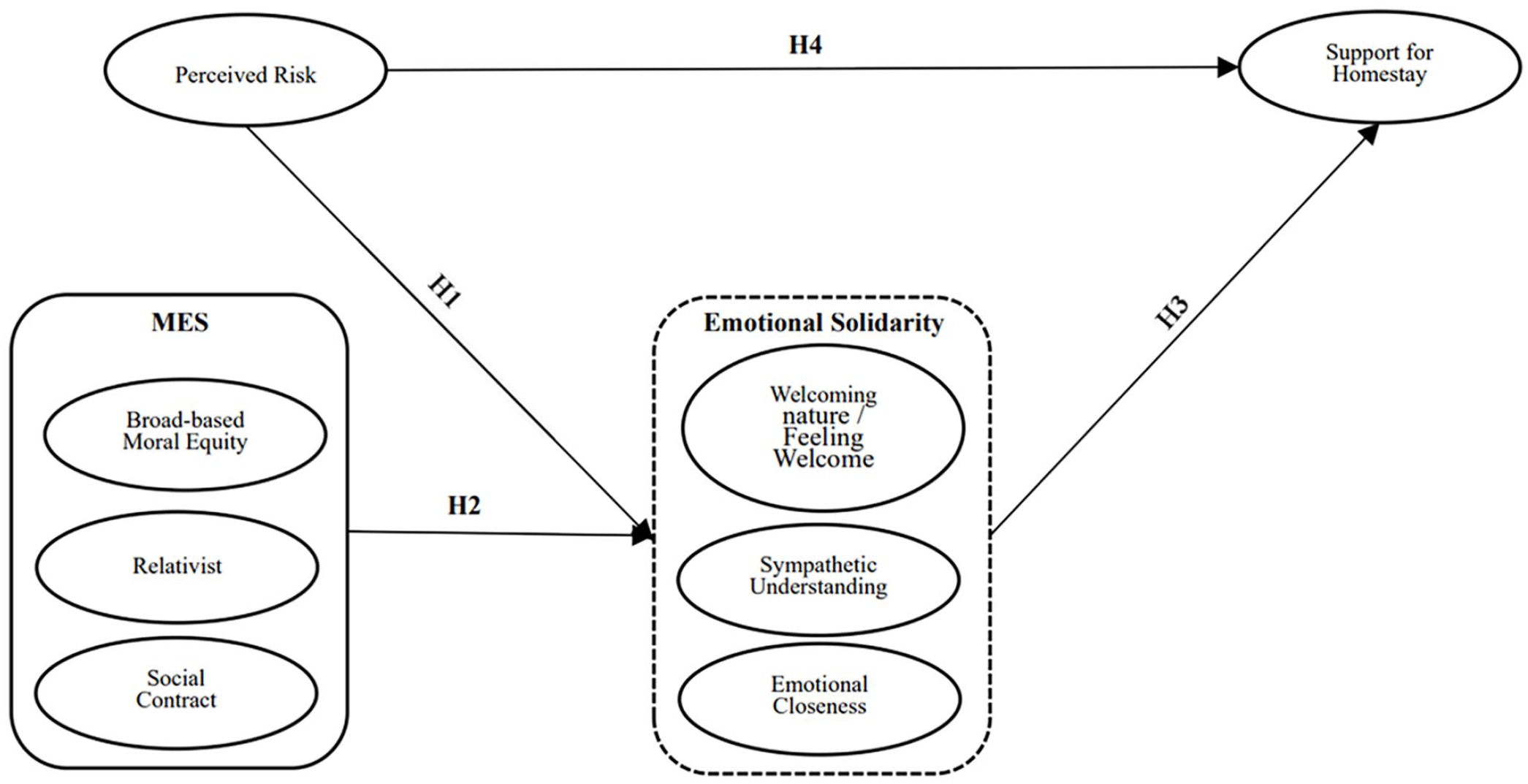
Proposed model for both hosts and tourists.
Methodology
Study Site
We chose Guangzhou as a study site for three reasons. First, historically and culturally, Guangzhou, also known as Canton, is the capital of Guangdong Province and serves as the historical center of Cantonese culture in China with a history dating back more than 2,200 years. Homestay buildings with strong local characteristics, such as the Arcade and Xiguan style, attract tourists yearly. Figure 2 depicts the geographical location of this city in China. Second, economically, Guangzhou ranked fourth in the 2022 Forbes China consumption Vitality City (Forbes, 2022) and ranked third on the list of “The most desirable Chinese city for world tourists” (China Tourism Academy, 2021). As one of China’s top destinations for domestic and international tourism, Guangzhou regularly hosted exhibitions and cultural sports activities before the pandemic; Canton Fair alone contributed almost one-third of the annual operating revenue of the tourism accommodation industry (Xi, 2020).
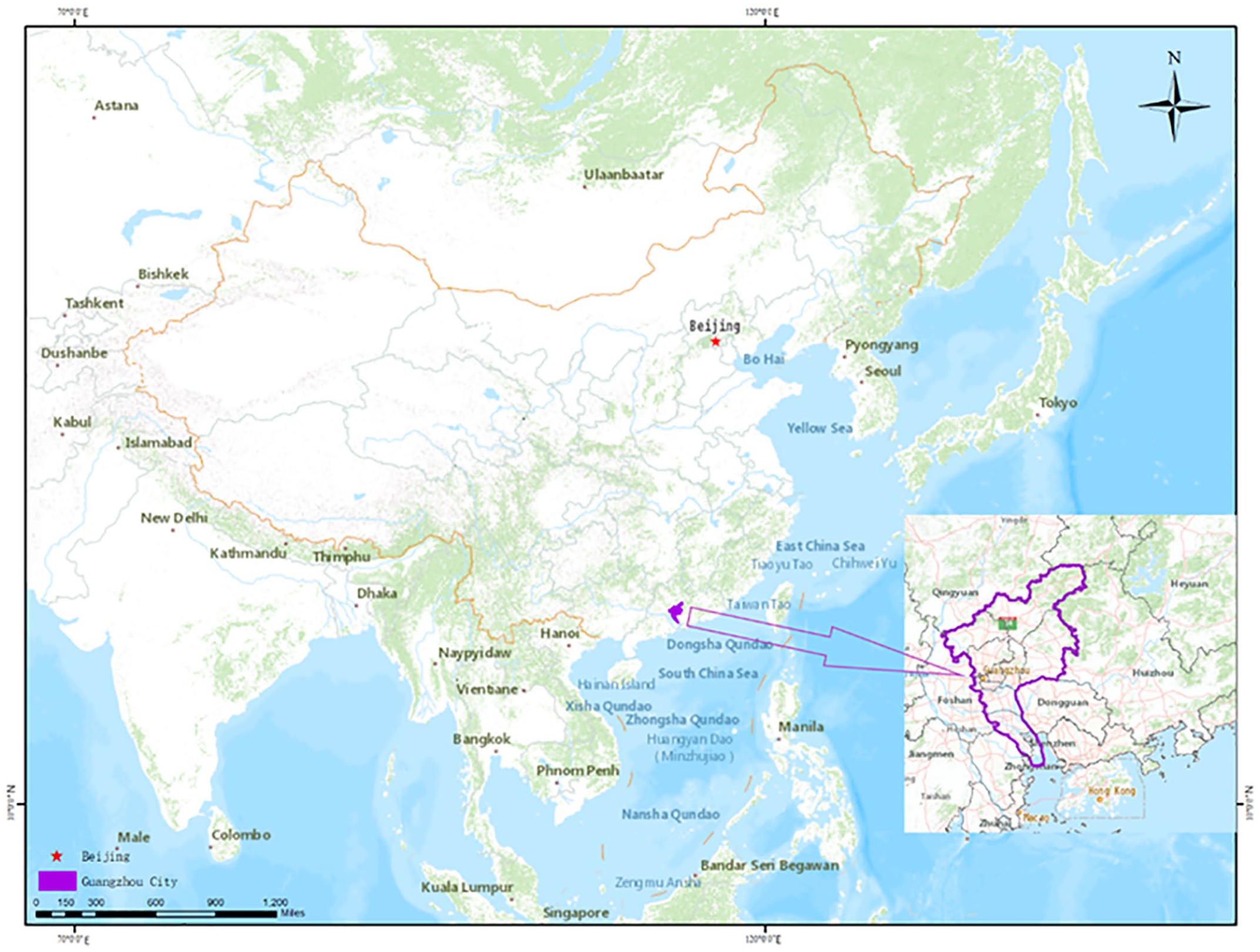
Location of Guangzhou.
As of April 2018, the number of officially registered units of homestays in Guangzhou grew from 5,807 in 2017 to 6,712 in 2018, ranking first in Guangdong Province. At the national level, it ranked fifth among the most welcome homestay cities in 2018 and third among the top10 homestay cities in 2019 (Branch of Homestay & Boutique Hotel of China Tourism Association, 2021). Guangzhou’s tourism and homestay market is quite robust and resilient in 2020, despite business closures and mobility restrictions due to the COVID-19 outbreak. The city still received more than 40 million tourists in 2020, which revitalized the local accommodation market.
Instruments
To conduct a thorough comparison between hosts and tourists, we designed two questionnaire versions for each population. Each questionnaire consisted of three parts: a filtering question, a section with perceived risk, ES, support for homestay and MES, and a section on demographics. The hosts’ questionnaire contained the filtering question, “Are you a homestay host?” While the tourists’ questionnaire used the filtering question, “Have you ever had a homestay experience in Guangzhou in the past three months?” The second section of both questionnaires included questions to determine perceived risk, MES, emotional solidarity, and support for homestays. In the third section, demographic data were collected for both target groups, including age, gender, education level, monthly income, and place of birth. We derived the structure of the questionnaires from the literature (Lee et al., 2020; Reidenbach & Robin, 1988, 1990; Woosnam, 2012; Woosnam & Norman, 2010) and made minor adjustments to fit the research context.
The ESS for hosts and tourists included three dimensions with 10 items (Woosnam & Norman, 2010): welcoming nature/feeling welcome (e.g., “I appreciate tourists for the contribution they make to the local economy” for hosts and “I feel Guangzhou homestay hosts appreciate visitors for the contribution we (as visitors) make to the local economy” for tourists), sympathetic understanding (e.g., “I identify with Guangzhou homestay tourists” for hosts and “I identify with Guangzhou homestay operators” for tourists) and emotional closeness (e.g., “I have made friends with some Guangzhou homestay tourists” for hosts and “I have made friends with some Guangzhou homestay hosts” for tourists). All the items were measured on a 7-point Likert scale (1 = strongly disagree to 7 = strongly agree).
MES was composed of six scenarios 1 adapted from Reidenbach and Robin (1988, 1990). Each scenario consisted of eight items capturing the most representative ethical problems in the homestay industry, including the violation of the “no pets” regulation, malicious negative reviews, privacy violations (strangers frequently appear in the community), late-night noise, waste of resources, and over-exaggerated commercials. We included multiple iterations of each scenario based on our knowledge of the homestay area and our prior experience in homestay research and tourism teaching. Next, we pilot-tested the scenarios and the instruments with 100 homestay hosts and tourists (50 each) and asked five tourism experts to verify the authenticity of the scenarios. These 105 pilot respondents were asked to use “Yes” or “No” to answer whether the scenarios were realistic (Liao, 2007), and approximately 98% of the respondents agreed that the six scenarios were common and likely to occur. This confirmed the authenticity of our scenario design, but we modified the wording of the scenarios based on feedback from the pilot to increase readability and validity. Homestay hosts and tourists were asked to make moral judgments on one behavior/action from each scenario on a 5-point semantic scale (1 = fair, just, morally right, acceptable to my family, culturally accepted, traditionally accepted, contrary to the agreement of acquiescence, violation of unwritten contract to 5 = unfair, unjust, morally wrong, unacceptable to my family, culturally unacceptable, traditionally unacceptable, not violating acquiescence agreement, not violating unwritten contract). The closer the score was to 1, the more the respondent agreed with the behavior/action shown in the scenario and the less he showed a sense of morality.
The scale of support for homestays was adapted from the study on residents’ support for tourism (Woosnam, 2012) and tourists’ support for tourism development (Lee et al., 2020). Both groups were asked to rate items such as “I support homestays and want to see them remain important to Guangzhou” and “Guangzhou should support the promotion of homestays.” All the items were measured on a 7-point Likert scale (1 = strongly disagree to 7 = strongly agree).
Data Collection
The data collection period was from April 15 to May 10, 2021. We chose this period to increase the diversity of the samples because the Labor Day vacation, which begins on May 1, is a high tourist season in China every year. In addition, after the last wave of the COVID-19 pandemic, this period provided a good opportunity to observe possible changes in the risk perception of hosts and tourists and their supportive attitude toward the homestay industry.
Based on the advantage that one of the two researchers has more than 15 years of tourism-related work and life experience in Guangzhou, and accounting for social and geographic proximity to host samples, we used purposive sampling to contact 87 homestay hosts in Guangzhou through WeChat’s group function (WeChat is the biggest and most popular digital social platform in China). Hosts’ WeChat groups usually contain the extensive contact information of their potential and actual tourists and even other hosts in the adjacent community. Through their consent and cooperation, we were able to collect an additional 441 questionnaires for hosts and 520 questionnaires for tourists through snowball sampling. In total, we identified 87 hosts through purposive sampling and another 441 hosts and 520 tourists through snowball sampling, ending up with 1,048 respondents. After screening responses with abnormal values, we obtained 1,010 valid questionnaires with a 96.37% valid response rate.
To avoid CMV (common method variance) in this research, we reduced response bias and deviation from social expectations through repetitive testing of mature scales, strict control of sample sources, and anonymous surveys at the first stage of data collection. After applying Harman’s single-factor test (Liang et al., 2007; Podsakoff et al., 2003), the results (Appendix B) showed seven factors with eigenvalues greater than one, and the first factor accounted for only 37.28%. Therefore, CMV does not seem to bias our results. Also, following Liang et al. (2007), we introduced a common latent factor into the structural model using the partial least squares (PLS) method to calculate the average variance of the indicators and the method factor. The average variance of the indicators was 68.4%, while the average variance based on the method was 0.4%, corresponding to a ratio of 157:1 (Appendix C). Therefore, CMV was not an issue in this study.
Analysis
We conducted data analysis following five steps with SPSS V.25 and SmartPLS (Ringle et al., 2015).
First, we used SPSS for descriptive statistical analysis. Second, we used SmartPLS to analyze the reliability and validity of each variable. Reliability analysis is designed to measure the consistency of the observation items corresponding to the variable; when Cronbach’s α (Cho & Kim, 2015) and composite reliability (CR) values are greater than 0.7, reliability is considered good. The factor loading of the measurement items of each latent variable and the average extracted variance (AVE) of the latent variables were used to assess validity (Chin, 1998; Fornell & Larcker, 1981). In the third step, we tested the path coefficients using SmartPLS in PLS. PLS is suitable for exploratory research and, after testing, has been found to be scientifically rigorous and has been used in various tourism studies (Tang & Wang, 2021; Tang et al., 2020). Next, we conducted a series of t-tests using SPSS to compare the differences in the means of the constructs between homestay hosts and tourists. The bootstrap method was used to test for the mediation effect within the two models. Fifth, we used Partial Least Squares Multi-Group Analysis (PLS-MGA) to determine if there were significant differences in all controllable paths between the host and tourist models resulting from the third step. PLS-MGA is a non-parametric significance test for differences in group-specific outcomes based on PLS-SEM bootstrap results (smartpls.com).
Results
Sample Overview
Table 1 shows the demographic data of the sample, which included 501 hosts and 509 tourists. The gender distribution of hosts in the sample was narrow, with male hosts comprising about 47.2% of respondents and female hosts comprising about 52.8% of respondents. The homestay hosts who participated in this research were mostly 31 to 40 years old (37.7%), while those in the second largest age group were 26 to 30 (34.3%). More than half of the hosts held an undergraduate degree (65.6%), and more than half had a monthly income equivalent to US$1,387 (58.3%). Most of the host respondents were residents of Guangdong Province (83.6%).
Sample Overview.
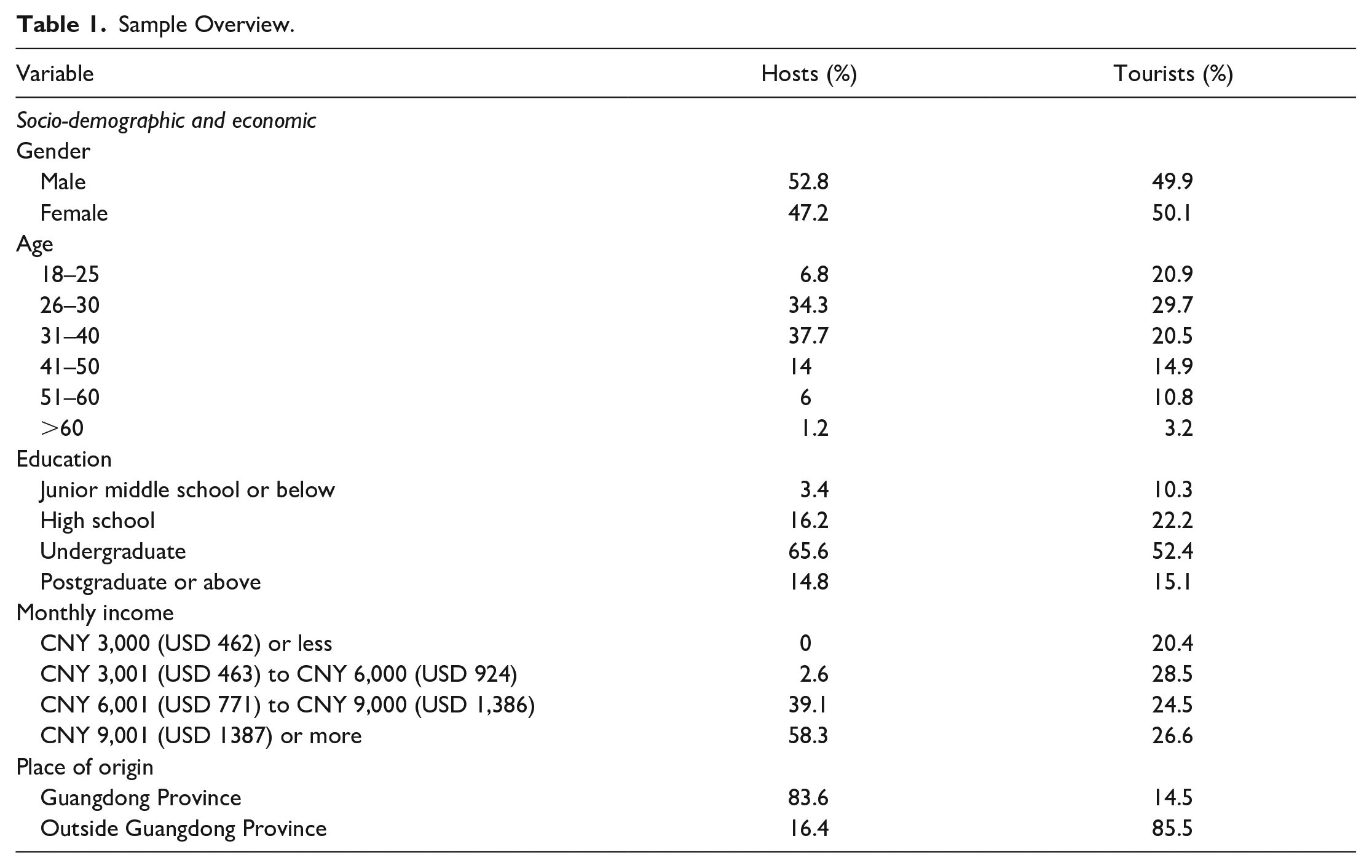
The gender distribution of the tourist sample is similar to that of the host, with 49.9% of the tourist respondents being male and 50.1% female. More than one-quarter of the tourist respondents were 26 to 30 years old (25.7%), while those in the second largest age group were 18 to 25 (18.1%). More than half of the tourists surveyed had a college degree or higher (67.5%) and more than a quarter earned a monthly income equivalent to $463-924US (28.5%). In contrast to the hosts, the majority of tourists surveyed were from outside Guangdong Province (85.5%). Table 1 provides an overview of the two samples.
Measurement Model
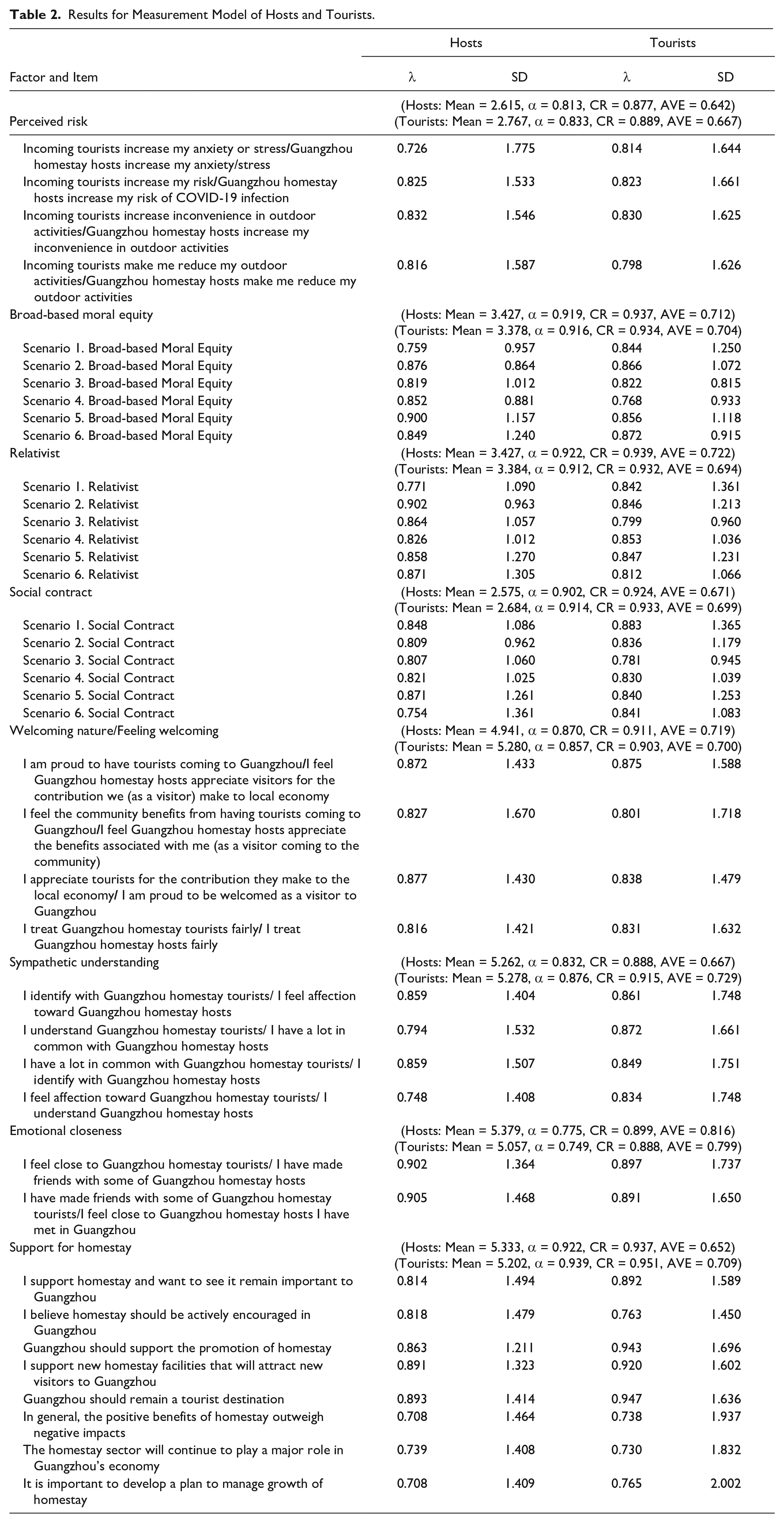
The results of the measurement model for hosts and tourists are shown in Table 2. All scales had good reliability, with Cronbach’s alpha for each construct in both samples ranging from 0.775 to 0.922 for hosts and from 0.749 to 0.939 for tourists, exceeding the recommended threshold of 0.70 (Cho & Kim, 2015). The CR values ranged from 0.877 to 0.939 for hosts and from 0.888 to 0.951 for tourists, exceeding the threshold of 0.70 (Hair et al., 2010). For convergent validity, the lowest AVE values for hosts and tourists were greater than 0.50, as suggested by Hair et al. (2010) (AVEhosts = 0.642, AVEtourists = 0.667), with the lowest standardized factor loading values greater than 0.60 (λhosts = 0.708, λtourists = 0.730).
Results for Measurement Model of Hosts and Tourists.
As shown in Table 3, the square roots of the AVE for both hosts and tourists were greater than the associated coefficients (square root of AVEhosts: 0.801–0.903; the square root of AVEtourists:0.816–0.894), indicating good discriminant for each latent variable as suggested by Fornell and Larcker (1981).
Construct Correlation Coefficients and Square Root of AVE for Hosts and Tourists’ Model.
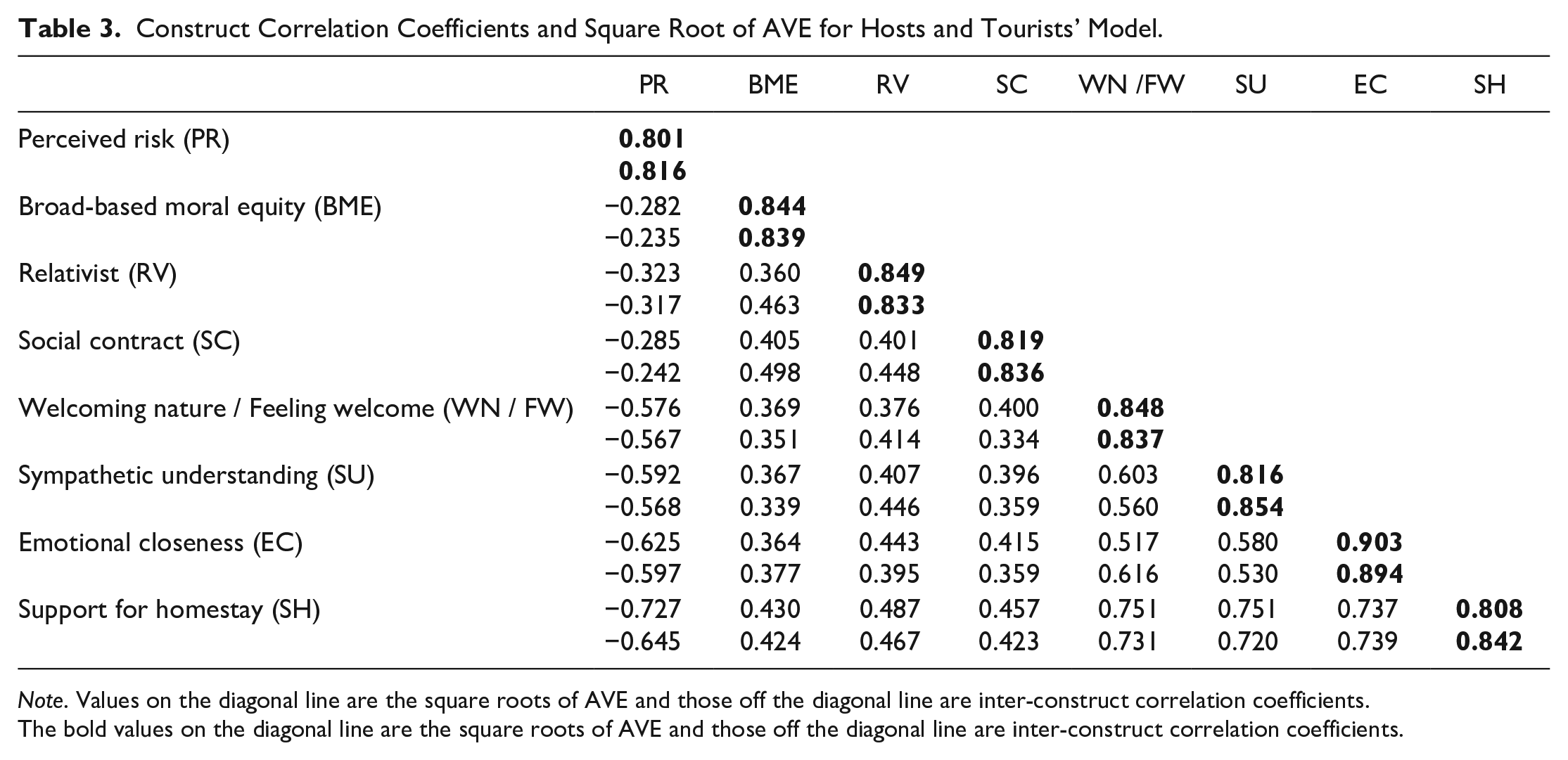
Note. Values on the diagonal line are the square roots of AVE and those off the diagonal line are inter-construct correlation coefficients.
The bold values on the diagonal line are the square roots of AVE and those off the diagonal line are inter-construct correlation coefficients.
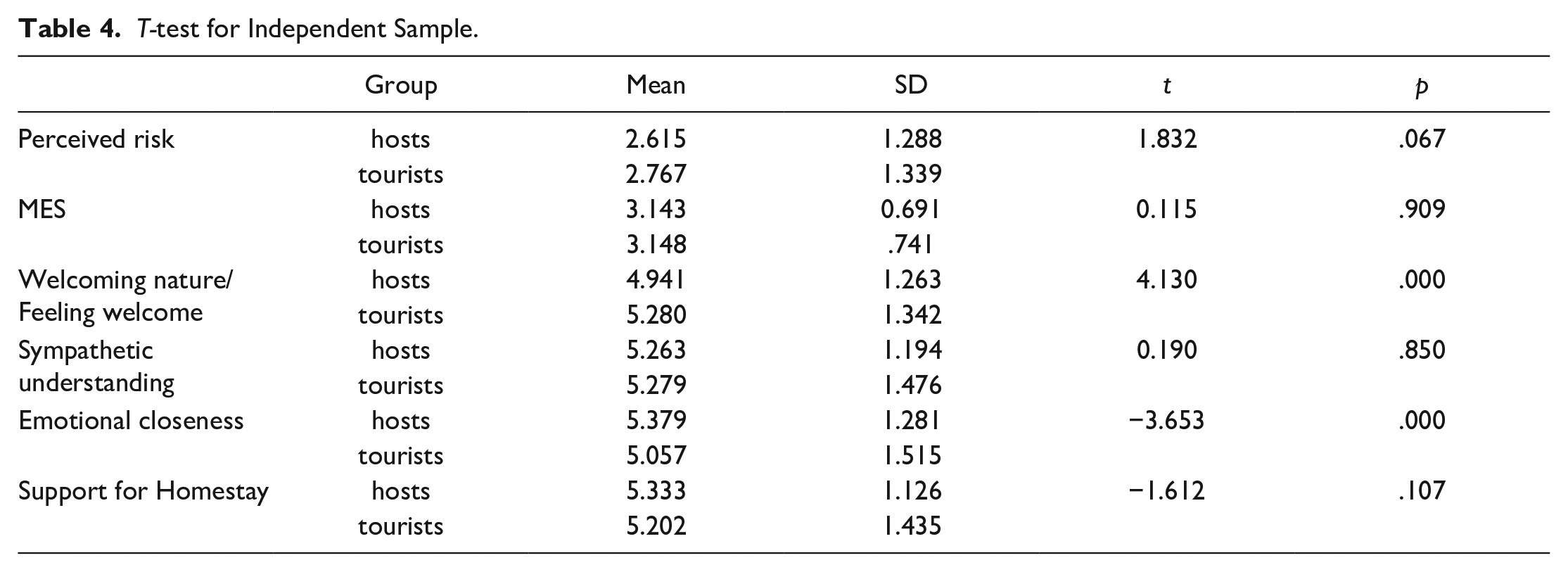
Table 4 presents the t-test results for the comparison of each independent sample. According to the results, there were significant differences in their welcoming nature/feeling welcome (Mhosts = 4.941, Mtourists = 5.280, p < .05) and emotional closeness (Mhosts = 5.379, Mtourists = 5.057,p < .05).
T-test for Independent Sample.
Structural Model
Figure 3 shows structural models for both groups, with the values above the paths indicating the path coefficients (β).
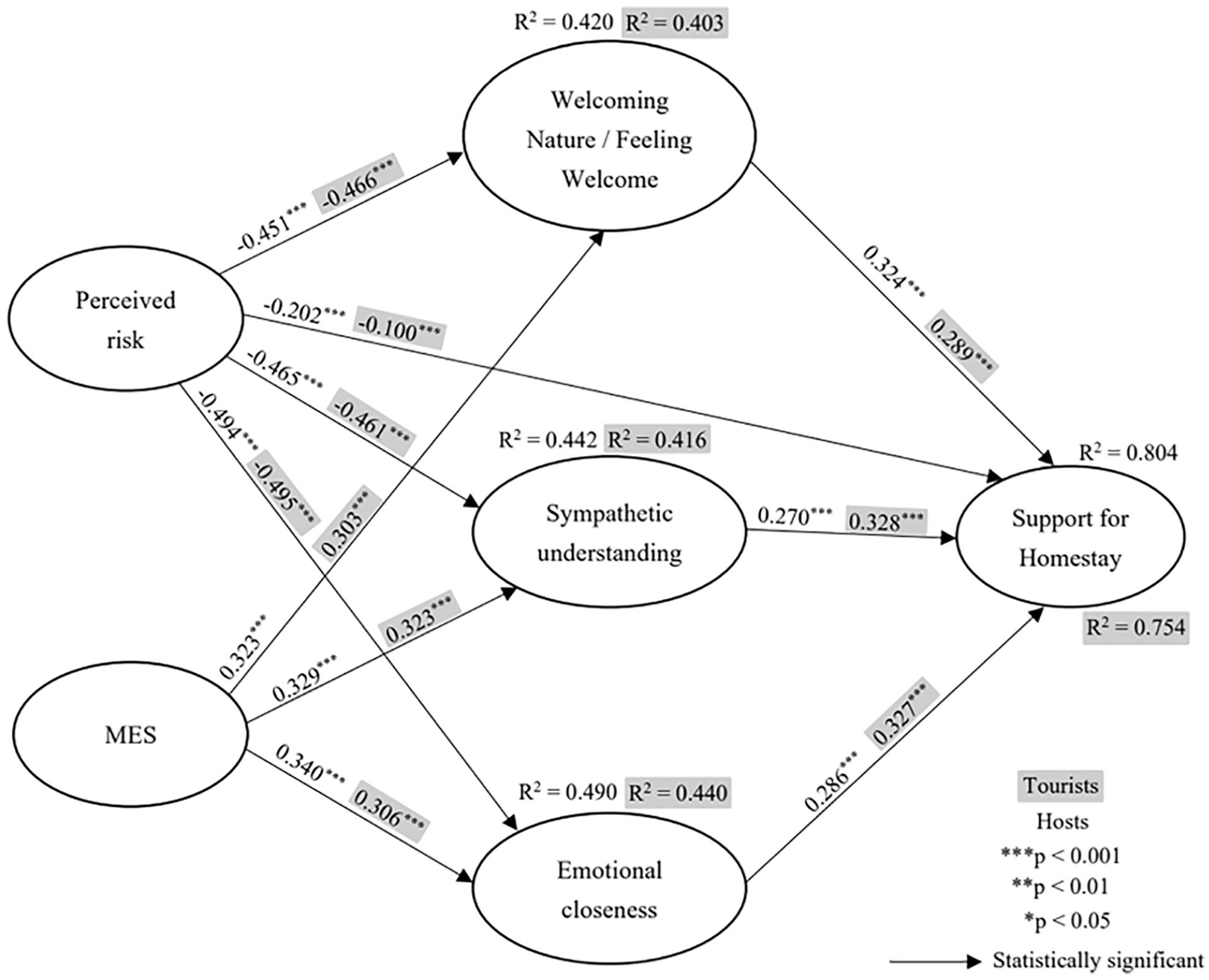
Structural models of hosts and tourists.
To determine the explanatory power of an endogenous latent variable, R2 was used (Tang et al., 2020). The structural model of the host respondents was tested through 5,000 bootstrap iterations. The R2 value for hosts’ welcoming nature was 0.420, and that for tourists’ feeling welcome was 0.403, indicating that the explanatory power of this construct was 42% and 40.3%, respectively. The R2 values for sympathetic understanding and emotional closeness were 0.443 and 0.490 for hosts, and 0.416 and 0.440 for tourists, respectively, meaning that the variance explained by these two constructs was 44.3% and 49% for hosts 41.6% and 44% for tourists. For the construct of support for homestays, the R2 value for hosts was 0.812, and that for tourists was 0.761.
Figure 3 and Table 5 show that H1a–c and H4 for both hosts and tourists were supported, confirming the significant and negative relationships between hosts’ and tourists’ perceived risk and their welcoming nature/feeling welcome (βhosts = −0.451, βtourists = −0.466, p < .05), sympathetic understanding (βhosts = −0.465, βtourists = −0.461, p < .05), emotional closeness (βhosts = −0.494, βtourists = −0.495, p < .05), and support for homestays (βhosts = −0.202, βtourists = −0.100, p < .05). These findings suggest that hosts’ and tourists’ perceived risk can negatively affect their emotional solidarity with one another and their support for homestays.
Results of Testing Hypotheses for Hosts and Tourists’ Model.
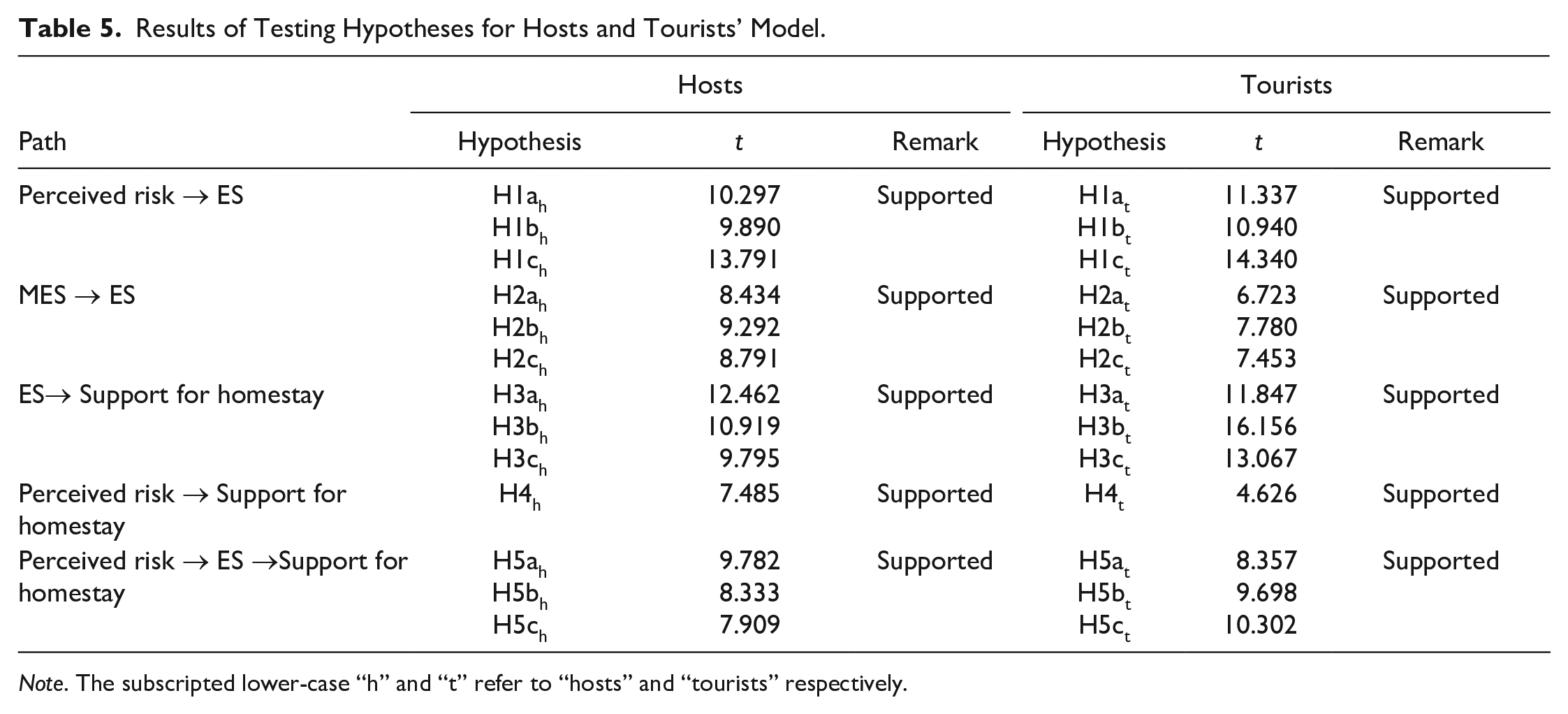
Note. The subscripted lower-case “h” and “t” refer to “hosts” and “tourists” respectively.
H2a–c for both hosts and tourists were also supported by the results. Specifically, the results showed that MES had a significant positive impact on hosts’ welcoming nature (β = 0.323, p < .05) and tourists feeling welcome (β = 0.303, p < .05), their sympathetic understanding (βhosts = 0.329, βtourists = 0.323, p < .05), and emotional closeness (βhosts = 0.340, βtourists = 0.306, p < .05). These findings suggest that MES has a significant positive effect on hosts’ and tourists’ emotional solidarity.
Furthermore, H3a–c for both hosts and tourists was supported. The results confirmed the significant positive relationships between hosts’ and tourists’ welcoming nature/feeling welcome (βhosts = 0.324, βtourists = 0.289, p < .05), sympathetic understanding (βhosts = 0.270, βtourists = 0.328,p < .05), emotional closeness (βhosts = 0.286, βtourists = 0.327, p < .05), and their support for homestays. These findings indicate that hosts’ and tourists’ (a) welcoming nature/feeling welcome, (b) sympathetic understanding, and (c) emotional closeness to each other can significantly increase their support for homestays.
Mediating effect
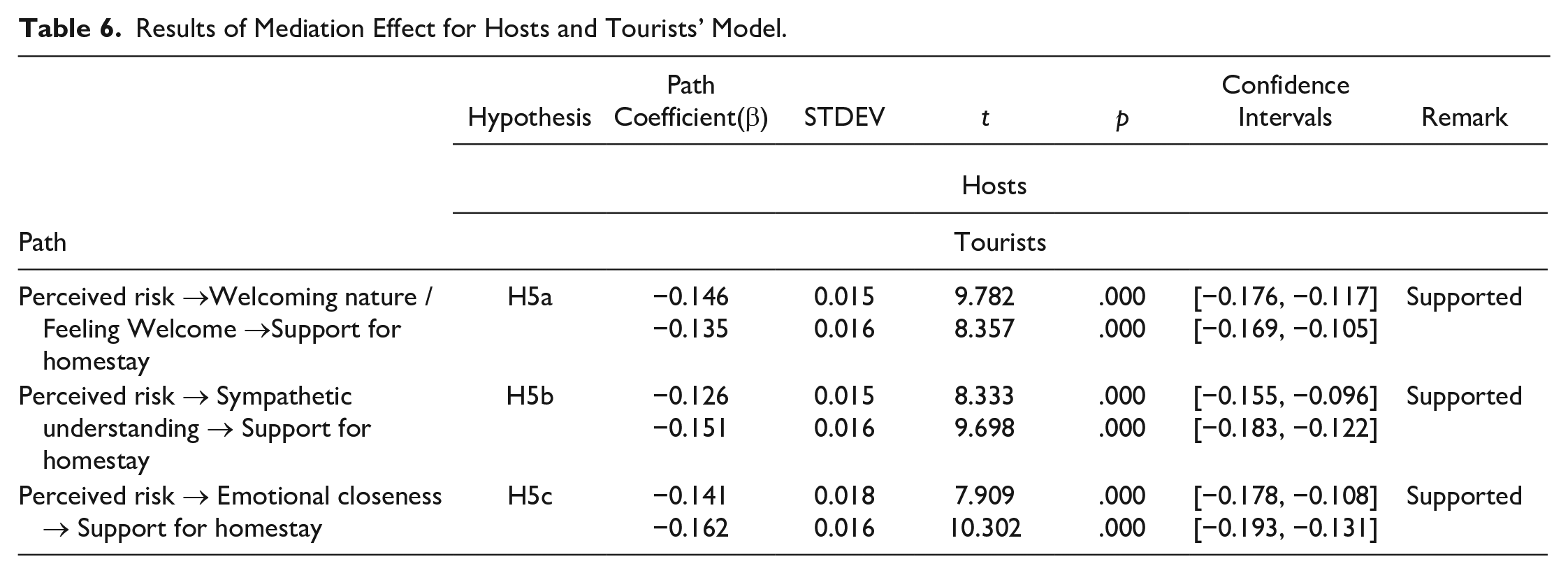
We performed 5,000 bootstrap iterations in SmartPLS, as suggested by Hair et al. (2010). As seen in Table 6, H5a–c for both hosts and tourists were supported. The results showed the indirect effect of hosts’ and tourists’ perceived risk on their support for homestays through their welcoming nature/feeling welcome (βhosts = −0.146, βtourists = −0.135, p < .05), sympathetic understanding (βhosts = −0.126, βtourists = −0.151, p < .05), and emotional closeness (βhosts = −0.141, βtourists = −0.162, p < .05). As many scholars have suggested, the confidence level represents a powerful metric for investigating mediating effects (Zhao et al., 2010). We calculated the value of the confidence interval at the 95% confidence level following Zhao et al. (2010): if the confidence interval does not contain 0, it indicates a significant indirect effect. These above results indicated a complementary mediating effect because the direct and indirect effects were in the same positive direction.
Results of Mediation Effect for Hosts and Tourists’ Model.
Path coefficient comparison
We used PLS-MGA to cross-validate the results using host and tourist data (Taheri et al., 2020). As suggested by Henseler et al. (2016), prior to conducting the MGA, measurement invariance was assessed using the three-step composite model measurement invariance (MICOM) approach, which is based on the assessment of (1) configural invariance, (2) compositional invariance, and (3) equal means and variances. Table 7 shows the MGA results.
Partial Least Squares Multi-Group Analysis (PLS-MGA).

According to Table 7, the only significant difference was between the impact of hosts and tourists’ perceived risk on support for homestay (Path Coefficients-diff = 0.102, p < .05), with the remaining paths showing no significant difference at all.
Discussion and Implications
Discussion
With the rapid growth of the homestay industry internationally, many tourism destinations are actively mobilizing homestays to serve the local tourism economy. Risk concerns (e.g., COVID-19) and moral issues, however, have attracted more attention because of widespread digital platforms that facilitate access to information and may impede the development of this industry. This study focused on the emotional solidarity of hosts and tourists by comparing the relationships between the perceived risk, MES, and supportive attitudes of these two populations. The results empirically confirmed the significant predictive role of MES and perceived risk on emotional solidarity and emphasized the importance of emotional solidarity in supporting the homestay industry.
First, the comparison of each construct showed a higher sense of feeling welcome for tourists than for hosts (welcoming nature/feeling welcome: Mhosts = 4.941, Mtourists = 5.280, p < .05). This finding reflects a previous study in which guests demonstrated a higher perception of interaction than hosts (Moon et al., 2019). A possible explanation for this result is that Guangdong Province is well known for its reputable and established service industry (Feng, 2018; Huang, 2008). A recent study ranked Guangzhou second among all cities in China in terms of service competitiveness (Zhong & Zhou, 2021). This good service and professionalism may lead to a more positive service experience for tourists than elsewhere. With regards to another dimension of emotional solidarity, hosts exhibited significantly higher emotional closeness with tourists than tourists did with hosts (emotional closeness: Mhosts = 5.379, Mtourists = 5.057, p < .05). As Qiu et al. (2021) note, affinity seeking is critical for homestay hosts to secure their business. Our results confirm this statement empirically by explicitly showing that hosts feel a much greater emotional closeness than do guests.
During our investigation (April to May 2021), the pandemic situation in Guangzhou was relatively stable, which may explain the low-risk perception for both hosts and tourists (Mhosts = 2.615, Mtourists = 2.767). The continuous anti-virus measures and the stability of the pandemic situation enabled hosts and tourists to express or experience hospitality in a welcoming atmosphere. These conditions helped mitigate the perceived threat of virus transmission through exposure to strangers and establish positive emotional ties and mutual understanding, thus enhancing their emotional solidarity. This confirms our hypothesis and strengthens the conclusion of Zhang and Tang (2021).
We also found that homestay hosts and tourists had similarly high MES levels (Mhosts = 3.143, Mtourists = 3.148, p > .05). Similar moral levels enable hosts and tourists to better understand and relate to each other, thus facilitating a stronger emotional bond. For hosts, a high level of MES may represent morally regulated professionalism, which translates into their welcoming hospitality. For tourists, a high level of MES may represent civilized and courteous guests who are more prone to appreciate hosts’ offerings with gratitude, which may strengthen their emotional bonds with hosts.
We also found that hosts’ and tourists’ emotional solidarity predicted their supportive attitudes toward the homestay industry, which is consistent with a widely confirmed finding in previous studies of residents and tourists (Lee et al., 2020; Woosnam, 2012). This finding is not surprising given that mutual understanding between hosts and tourists and the desire to make new friends and learn about a new culture can generate positive emotional energy that may further enhance their supportive attitudes toward the homestay industry (support for homestays: Mhosts = 5.333; Mtourists = 5.202, p > .05).
The complementary mediating effect of emotional solidarity observed in this study implies that reducing perceived risk by hosts and tourists can directly enhance their support for homestays while indirectly stimulating their support by enhancing their sense of welcome, sympathetic understanding, and emotional closeness. These two ways of improving their supportive attitude toward homestays complement each other. Our findings highlight the important role of emotional solidarity in bridging perceived risk and support for homestays. This is congruent with the mediating role of emotional solidarity in previous studies (e.g., Aleshinloye et al., 2019; Joo et al., 2021). In our study, both hosts’ and tourists’ supportive attitude was significantly influenced by their emotional solidarity, which addresses the academic call to “bring emotion into social exchange theory” (SET) (Lawler & Thye, 1999, p. 217). Apart from SET’s assertion that economic relationships impact people’s relationships and behavioral intentions, the role of a person’s emotional state cannot be overlooked when assessing their supportive attitude.
Our results confirmed the significant role of perceived risk in influencing residents’ supportive attitude toward the homestay industry from the study by Joo et al. (2021). Interestingly, the impact on hosts was significantly higher than on tourists (βhosts = −0.202, βtourists = −0.100; path coefficient diff = 0.102, p < .05). One possible reason is that tourists have a variety of destinations and accommodations to choose from when making travel decisions, which could mitigate these effects. While hosts are less able to close store to avoid tourists because of their identity as stakeholders and practitioners. However, this result comes with the caveat that hosts’ supportive attitudes are highly sensitive to the impact of perceived risk (Mao et al., 2020). Once their perceived risk exceeds a certain threshold, they are likely to withdraw from the homestay industry or even consider other investments in the market (Bremser & Wüst, 2021).
Theoretical Implications
First, this study is one of the first attempts to address the important premise of emotional solidarity theory, which stresses the togetherness of “we” (plural perspective) instead of “you versus me” (singular perspective). In the study, we measured and compared the emotional solidarity experienced by hosts toward tourists and by tourists toward hosts in the homestay industry. This differs from most previous studies on emotional solidarity, which have focused on the experiences of one party, either resident-side or tourist-side, in an isolated way. Notably, our multi-group analysis further revealed how emotional solidarity mediates perceived risk, MES, and support for these two populations differently. In doing so, our study provides more actionable applications for emotional solidarity theory to foster a two-way rapport of inter-relationship. Although any emotional bond can only be felt by one party, no relationship can be developed or maintained without a mutual emotional bond. Understanding the variance on both sides is key to fostering a sustained mutual emotional bond and underscores the salient yet easily neglected premise of emotional solidarity theory at the fundamental and epistemic levels.
Second, to the best of the authors’ knowledge, this study is one of the few to apply emotional solidarity to homestay hosts. However, this theory might not be entirely novel in the homestay industry, given the pre-existing focus on the attitudes of residents in Airbnb neighborhoods toward visitors (Suess et al., 2020). Notwithstanding a few recent studies that have shifted their perspectives toward homestay hosts, exploring their online trust (Wang et al., 2020), psychological ownership, and attachment (Lee et al., 2019), an integration of hosts’ and tourists’ emotional solidarity and their respective relevance with MES and perceived risk, can add a more holistic understanding of the interpersonal nature of the host-guest relationship. This approach offers several ways to examine the dynamics of relationships that extend to the sharing economy or the collaborative economy, or even to the service encounter of the customer-seller dyad in commercial sectors.
Third, this study represents an extension of MES studies in the tourism literature by predicting their impact on the emotional solidarity of hosts and tourists. As a theory widely used in business scenarios (Leonard & Jones, 2017), MES, as mentioned above, has been insufficiently explored in tourism, let alone in the homestay industry, where emerging moral issues can dilute the emotional bond between practitioners and tourists. Echoing few prior studies that have confirmed MES as an effective scale in exploring ethical cognition in tourism (i.e., Ayaz & Akbaba, 2017; Fennell & Malloy, 1999; Hudson & Miller, 2005), our results empirically confirmed that MES could influence both hosts’ and tourists’ mental states and their supportive attitude.
Finally, building on the study by Joo et al. (2021), who investigated residents’ perceived risk when predicting their support for the tourism industry, we add to this stream of research by comparing the degree of perceived risk between homestay hosts and tourists and its impact on their emotional solidarity. Despite the widely acknowledged detrimental role that perceived risk may play for tourists and residents, our results showed that hosts are more inclined to perceived risk, which may influence their emotional state and support for the homestay industry in the context of the COVID-19 pandemic.
Practical Implications
The findings of this study are of practical importance to a wide range of stakeholders, including industry practitioners such as homestay hosts, operators and online travel agencies (OTAs), host communities, and policy makers. Our findings can facilitate their decision-making on how to develop the impact and value of homestay in tourist cities and maintain a lasting harmonious emotional bond between hosts and tourists, or even broader defined convivial tourism to add a charming touch to destinations (Kim et al., 2023).
This study reveals that tourists feel more welcomed than hosts. This imbalance may result from the strong regulation of the local homestay industry and the professionalism of well-trained hosts. Our findings can boost the confidence of homestay practitioners and DMO (Destination Marketing Organizations) in the recovery of the homestay industry in places where the pandemic is controlled to relieve both parties’ perceived risk. In addition, stakeholders can adopt measures to mitigate their perceived risk and improve their MES.
Our study also shows that the reduced perceived risk can directly improve host and tourist support for homestays while strengthening their emotional solidarity can achieve the same effect. However, hosts’ perceived risk is more likely to affect their supportive attitude. Therefore, regulatory platforms and local governments need to take action to reduce or stabilize the impact of perceived risk on hosts. Intelligent technology can reduce unnecessary physical contacts during tourists’ stay (e.g., smart door locks and whole-house security systems, self-service check-in systems on smart terminals, smart home appliance systems, etc.), which can also relieve remote hosts from tedious administrative work, allowing them more time to interact with tourists. Since the intensive interaction between hosts and tourists is the special competitive advantage of the homestay industry (Qiu et al., 2021), enhanced security measures should not affect the relationship between hosts and tourists. As suggested by Scerri and Presbury (2020), there are also other ways to arrange dynamic interaction, or “talk.” Real-time interaction through social media, bilateral comments on the homestay platform, or a handwritten message board in the room could help improve the emotional solidarity of both sides and support for the homestay. Moon et al. (2019) found that social exchanges through online self-disclosure have a stronger effect on guests than offline engagement, further validating the effectiveness of alternative forms of dynamic interactions.
The positive relationship between MES and emotional solidarity suggests that maintaining and enhancing the MES of both sides is essential. OTAs are suggested to consider practices to foster host-guest relationships and ease some moral or risk concerns. Visual-based trust can be built by using real photos (Ert et al., 2016). Hosts and guests who are endorsed by OTAs with the award of “super host” or “super guest” can be exemplary in inspiring their peers. Conversely, some warning or even rooting out systems should also be implemented. Although the improvement of personal MES depends on the accumulation of multidimensional stimuli, the relevant government agencies can basically monitor and regulate potential moral conflicts by establishing and improving the platform hosts’ evaluation system. To develop mutual trust, both parties’ MES can be monitored through uncivilized blacklist publicity (the Chinese government will publicly announce a list of uncivilized stakeholders in tourism as a warning every year), highlighting the role of the social contract dimension in personal interactions. Furthermore, some morally exemplary examples should be advocated and publicized on social media, such as mutual respect of hosts and tourists for the local culture and environment, consideration for the neighborhood and community through noise control, graceful and honest reviews or feedback, or environmentally friendly resource use. Guided by a stronger moral compass, mutual trust, warmth, respect, and consideration can help maintain or even enhance emotional solidarity between hosts and tourists and improve their support for homestays.
Limitations and Future Research Directions
Although the design of this study was based on rigorous and scientific methods, there are some limitations. First, our respondents from the online survey were mainly middle-aged and young people, as most homestay customers in China are of this age (Branch of Homestay & Boutique Hotel of China Tourism Association, 2021). However, the perceived risk might differ among age groups (Le Serre et al., 2017; Simcock et al., 2006). Further studies could explore whether a more diverse population should be included in a representative sample to enrich the results. Although the city of Guangzhou was selected for various contextual reasons, our results may still provide insightful guidance for similar destinations to expand the homestay industry. To examine hosts’ and guests’ emotional relationships during the pandemic period, they need to recover and successfully garner business in the new normal. Cultural differences, however, may bring variance to perceived risk (Park et al., 2012; Weber & Hsee, 1998) or introduce additional moral issues (Sharma et al., 2014). Thus, a further comparative investigation between states and cultures is warranted in future research. Besides, future studies can consider integrating other meaningful constructs, such as place attachment as a place-oriented concept to supplement the emotional solidarity as a people-oriented one (Tasci et al., 2022) and value co-creation to understand better the dual roles of host-guest relationship (Chua et al., 2022).
Footnotes
Appendix A: Questionnaires for Homestay Hosts and Tourists
Appendix B. Communalities,Eigen Values,and Cumulative
Appendix B contains eigenvalues, cumulative and communalities values for each questionnaire item (Since the three dimensions in MES will be tested in six scenarios respectively, the items in MES are packaged in the calculation process, and 70 items will finally show 40. This practice runs through the full text).
Appendix C. Average Variance of Indicators and Method Factor
Appendix C shows the analysis results according to the procedure of Liang et al.’s (2007), which introduced a common method factor into the structured model in the partial least squares (PLS) method to calculate the average variance of the indicators and method factor.
Acknowledgements
The authors would like to thank Professor Ben Kok Goh, the dean of Faculty of Tourism and Hospitality Management, Macau University of Science and Technology, for his invaluable guidance and generous support during each stage of this research.
Declaration of Conflicting Interests
The author(s) declared no potential conflicts of interest with respect to the research, authorship, and/or publication of this article.
Funding
The author(s) received no financial support for the research, authorship, and/or publication of this article.

1.
The full version of the scenarios is available upon request via the authors’ e-mails.