




Abstract
While pride is identified as a multilayered and complex emotion, tourism studies primarily focus on the pride generated by the presence of tourists acknowledging the residents’ culture and do not address all the categories of pride. This research gap is important to investigate because research indicates that pride is associated with residents’ perceived well-being, empowerment, and sense of belonging. We examine this contingency through the lens of Hume’s Theory of Pride to investigate how destination stakeholders express multiple categories of pride (e.g., vicarious pride and self-pride) and the manifestations of pride (e.g., prestige and caring) in a rural tourism context. We apply a multi-method approach that combines focus group discussions and personal interviews with 51 stakeholders (i.e., public officials, residents, and tourism business owners) from four rural tourism destinations. These destination stakeholders reveal more thorough and powerful meanings of pride that expand Hume’s theory and provide insights to practitioners.
Introduction
Pride can be defined as being “usually a positive emotion or affect that is the result of an individual’s autonomous personal evaluation of their own behavior, actions, possessions, relationships, affiliations, self, or identity which accords with shared societal and cultural values” (Sullivan, 2014a, pp. 1500–1501). When conceptualizing pride, Salice and Montes Sánchez (2016) suggest the presence of three categories: (1) self-pride, which is an individual form of pride that consists of being proud of oneself; (2) group pride, which is being proud of a group’s success; and (3) vicarious pride, which is being proud of one specific person or entity without being directly responsible for this success. Pride is considered distinct from the four basic emotions that are identified in psychology as “happiness, sadness, fear, and anger” (Gu et al., 2019, p. 1). Pride is unique because it is based on self-analysis. Individuals need to evaluate (1) if they meet the objectives they desire to accomplish and (2) whether these objectives positively influence their identity. Pride also depends on social approval because individuals need to feel others acknowledge their success in order to feel proud (Tracy & Robins, 2004).
In the tourism literature, the existing conceptualization of pride is commonly limited to community pride, a specific kind of group pride that is associated with the residents feeling proud due to tourists visiting their community and expressing their appreciation of the local culture (Boley & McGehee, 2014; Boley et al., 2017). However, the tourism literature provides limited insight into the other pride categories, such as vicarious pride and self-pride (Lindblom et al., 2020). Noting this discrepancy, Lindblom et al. (2020) judiciously underscore that the residents do not necessarily need to interact with visitors for tourism to influence their pride. Their observation suggests that other forms of social interactions, such as those between community stakeholders (e.g., residents, tourism entrepreneurs, and elected officials), can benefit from further investigation to develop a more in-depth understanding of pride in a tourism context. From a theoretical perspective, investigating this gap is important in the process of refining the conceptualization of the interpersonal aspect of pride (Lindblom et al., 2020; Matson, 2021). A more thorough understanding of pride can also be utilized by practitioners to advocate for rural tourism development. Group pride is also related to destination residents’ stronger support for tourism, agreement that marketing the destination is important and deserve funding, and belief that tourism’s positive impacts offset the negative ones (Boley et al., 2014). Additionally, tourism researchers find that community pride has a positive effect on the residents’ perceptions of their quality of life (Andereck & Nyaupane, 2011) and sense of belonging (Magno & Dossena, 2020). Therefore, the current study intends to address the aforementioned research gap by investigating how destination stakeholders express multiple categories of pride (e.g., vicarious pride and self-pride) and the manifestations of pride in a rural tourism context.
One theoretical lens that can provide relevant insights is Hume’s Theory of Pride because it centers on categories of pride (Hume & Hyslop, 1894) that can be organized based on the object of admiration (Sugden, 2021), such as oneself for self-pride, a collection of individuals for group pride, and one specific individual or entity for vicarious pride. Focusing on pride categories is valuable to understand the complexity of pride by recognizing the multilayered aspects of self-evaluation and social interactions through which individuals can experience and diffuse pride (Salice & Montes Sánchez, 2016). In comparison, the manifestations of pride are related to its properties (Dyson, 2006), such as a sentiment of triumph resulting from taking pride in a group’s achievements. Connecting these two concepts, pride discourses encompass both pride categories and pride manifestations and refer to the ways individuals express pride through their speech and the context surrounding their speech (Van Dijk, 2015). Additionally, Hume’s Theory of Pride can be pertinent to understanding the ways individuals, such as destination stakeholders, employ pride categories to define their successes (Salice & Montes Sánchez, 2016), promote their ideas (Matson, 2021), and justify their decision-making (Bagozzi et al., 2018) within a rural tourism context. Therefore, the guiding research question for our study is: which categories of pride are central to the destination stakeholders’ manifestations of pride?
Hume’s Theory of Pride
Hume (1896) contributes to the early conceptualization of pride by theorizing in Book II of his Treatise of Human Nature that pride is a central element of individuals’ identities (Galvagni, 2020). In his view, the idea of what qualities in one’s personality are worthy of pride derives from the way we understand others’ opinions and sentiments about the object of one’s pride (Hume, 1896). Expanding on Hume’s theory, Salice and Montes Sánchez (2016) identify and differentiate three categories of pride: self-pride, group pride, and vicarious pride (Table 1). Due to its focus on whom pride is directed toward, Salice and Montes Sánchez’s (2016) conceptualization provides a valuable tool to investigate the multi-layered manifestations of pride and their connections with pride categories. Self-pride occurs when individuals feel proud of their accomplishments and successes (Delvaux et al., 2016; Septianto et al., 2018). Group pride arises when people categorize themselves or are affiliated with a group responsible for admirable behavior (Tracy et al., 2020). Finally, vicarious pride consists of individuals admiring another person’s or an entity’s success without being directly responsible for this success (Salice & Montes Sánchez, 2016).
The Theoretical Construct of Pride.
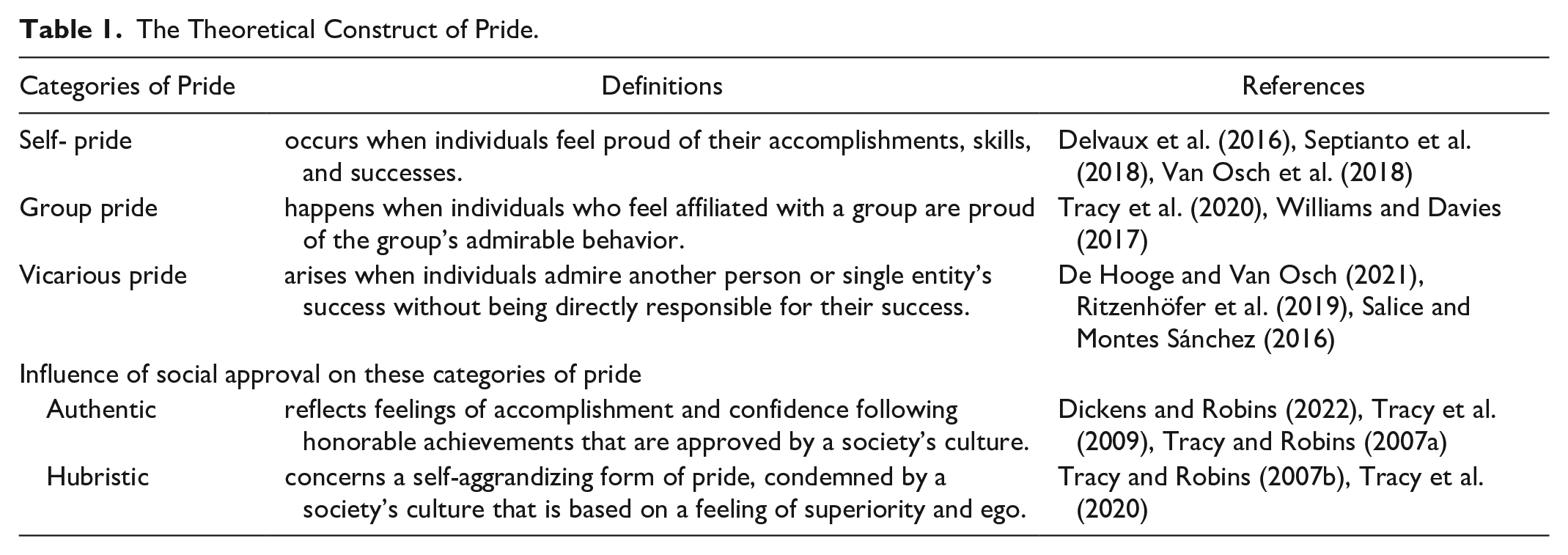
These categories of pride represent a more granular approach to examining pride that is defined more broadly in Hume’s (1896) work. Although the three categories of pride provide a refined understanding of pride, there is a dearth of research empirically comparing their experiential contexts (Bodolica & Spraggon, 2011). Additionally, there is a distinction between the categories and the concept of pride manifestations (Dyson, 2006). The categories of pride focus on who is the object of admiration (e.g., group pride), while the pride manifestations focus on the properties associated with it (e.g., a sentiment of triumph when community members successfully implement a downtown revitalization project). Furthermore, these pride categories can be combined into manifestations of pride, which makes the investigation of pride more complex (Williams & DeSteno, 2008).
Within the three categories of pride, scholars provide additional depth by explaining the influence of social approval via authenticity and hubris (Dickens & Robins, 2022; Tracy & Robins, 2007a). The positive side of pride, “authentic pride” (Tracy et al., 2009), reflects feelings of accomplishment and confidence following achievements that are considered honorable by one’s culture. Conversely, the negative side of pride, “hubristic pride” (Tracy & Robins, 2007b), concerns a self-aggrandizing emotion that is based on a feeling of superiority, highly ego-driven (Tracy et al., 2020), and is often characterized by conceit and arrogance. However, pride is likely not a dichotomous concept but instead comprises a gamut oscillating between authentic and hubristic pride (Bodolica & Spraggon, 2011), which requires further understanding (Tracy et al., 2020).
Some scholars voice concern that, in Hume’s theory, the development of pride appears to be context-dependent and contingent on the opinions of others (Salice & Montes Sánchez, 2016). In addition, Baier (1980) mentions that the social dependency of pride makes it vulnerable to the contempt of others which ignores an individual’s tendency to seek reassurance. Besser-Jones (2010) responds to these concerns by calling for further investigation into pride’s social dependency and situations in which the approval of others supersedes the manifestations of pride. The current conceptualization of pride is also criticized for focusing excessively on individual achievement rather than group success (Salice & Montes Sánchez, 2016).
Pride in the Tourism and Community Development Literature
In the tourism literature, pride is cited as one of the most significant non-economic positive outcomes of sustainable tourism (Stronza & Gordillo, 2008) because destination residents can reaffirm the importance of their own culture by observing the tourists’ interest in their community (Butler et al., 2022). For example, Xue et al. (2017) mention community pride as an outcome of tourism development due to the arrival of tourists and the implementation of Chinese governmental policies, but an in-depth conceptualization of pride is not among the objectives of their study. Whereas interactions with tourists are among the possible reasons local people experience pride (Butler et al., 2022), other social dynamics that generate pride are underexplored, such as the residents’ relationships with their fellow community members and elected officials. This gap is important to investigate because tourism developers can leverage pride to gain political and community support for projects related to tourism (Al-Emadi et al., 2017; Boley et al., 2014). Although pride is a self-conscious emotion determined by self-evaluation and self-reflection (Tangney, 2015), it is also a social construct because others’ perceptions can influence one’s self-evaluation (Sullivan, 2007). Yet, the interpersonal aspect of pride remains neglected in both social psychology and tourism literature (Lindblom et al., 2020; Matson, 2021). These social interactions are likely to be relevant to residents of rural communities, who often suffer from a cultural stigma and prejudices associated with rurality, such as being rugged and uneducated (Xue et al., 2017).
Additionally, the concept of pride is often associated with a triggering sign of psychological empowerment occurring as an outcome of tourism development (Gil Arroyo et al., 2019; Strzelecka et al., 2017). When investigating a rural county in the U.S., Boley et al. (2014) find that residents with a higher level of psychological empowerment are more likely to express being supportive of tourism, such as believing that their community should remain popular among tourists and wanting to keep tourism as a major source of revenue for the community. However, psychological empowerment is conceptualized in measurements as destination residents feeling proud of having their community valued by tourists (Boley & McGehee, 2014), centering on the presence of tourists as the main reason residents experience group pride. Therefore, the possibility of other categories of pride, such as self-pride and vicarious pride, as outcomes of tourism development is outside the scope of their study and remains an important aspect to investigate. Understanding the different categories of pride can help destination management professionals develop internal marketing campaigns that promote the residents’ support for tourism by emphasizing the enhancement of residents’ empowerment, self-esteem, and place attachment (Aleshinloye et al., 2022; Lalicic & Garaus, 2022).
Research on destination residents and quality of life also suggests that pride is connected with community well-being (Andereck & Nyaupane, 2011). Examining the perceptions of Hawaiian residents, Jordan et al. (2019) find that residents with a higher level of community pride are more likely to express positive emotions toward the presence of tourism in their community. This study provides in-depth insights into the quality of life. However, some insights are limited because pride is relegated to a secondary role and is conceptualized as a single item in their model, asking residents about their degree of group pride. Furthermore, due to treating pride as merely one of the outcomes of tourism development, the understanding of destination residents’ various manifestations of pride and the roles of different categories of pride are often neglected. Developing a more thorough understanding of pride manifestations and categories can be valuable because pride may be associated with an increase in the destination residents’ resilience when facing tourism crises (Jordan et al., 2019). Thus, pride can help elected officials boost the morale of their business owners and residents during difficult times, such as COVID-19.
Methodology
Researchers’ Stance
We adhered to a constructivist paradigm that ontologically acknowledged the importance of the meanings that participants attached to their lived experiences, the role that interpersonal connections played in meaning-making, and the ways in which participants expressed their views in their discourses (Schwandt, 2014). Epistemologically, we valued the participants’ interpretations of their lived experiences (Guba & Lincoln, 1994). We also adhered to the axiological belief that researchers’ and participants’ values influenced the theoretical underpinning of a study, the success of a methodology, and the interpretation of the findings (Lincoln & Guba, 2016). We engaged in reflexivity and acknowledged that our prior theoretical knowledge was colored by our interest in understanding how rural tourism can be economically viable and socially rewarding for small rural tourism entrepreneurs. We had past experiences living, working for, and researching rural communities in the United States. Through these combined experiences, we witnessed the presence of a strong rural identity which led to further questioning about the roles of emotions such as pride in the destination stakeholders’ lived experiences.
Data Sampling
Participants were destination stakeholders in Illinois, U.S.A, living in four rural communities. The participants were tourism business owners, destination management organization executives, public officials, and destination residents. Maximum variation in settings was used to reinforce our ability to test a theory by encompassing locations where the phenomenon of interest varied in intensity and form (Lincoln & Guba, 1985). We selected four communities in Illinois based on this maximum variation principle in terms of rural tourism development. Communities GT and SA were in the early stage of developing their tourism experiences, whereas community HA was more established and had undergone a downtown revitalization effort. Community GA already had a reputation as an accomplished rural tourism destination (Table 2).
Descriptive Information About the Communities.
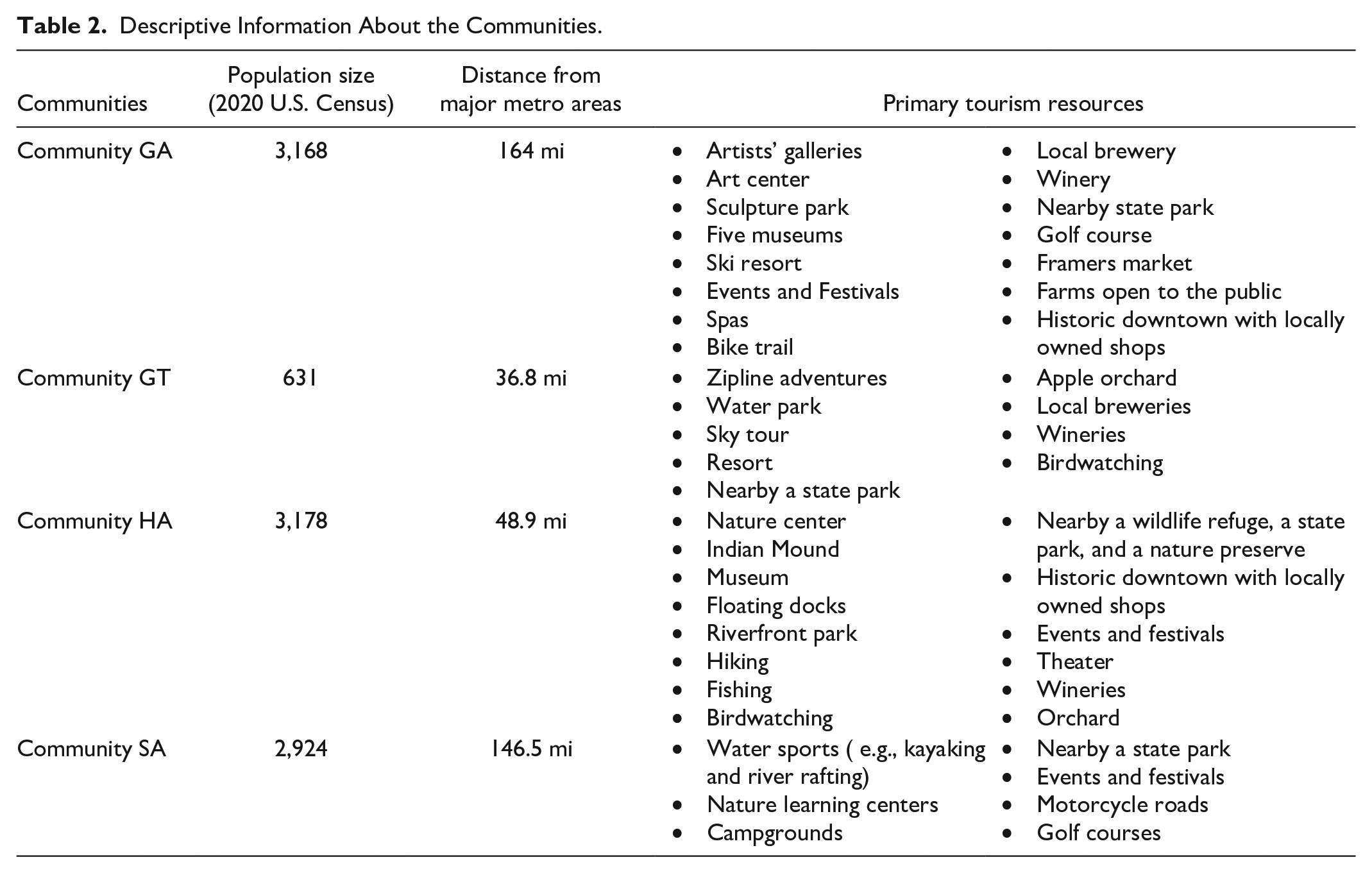
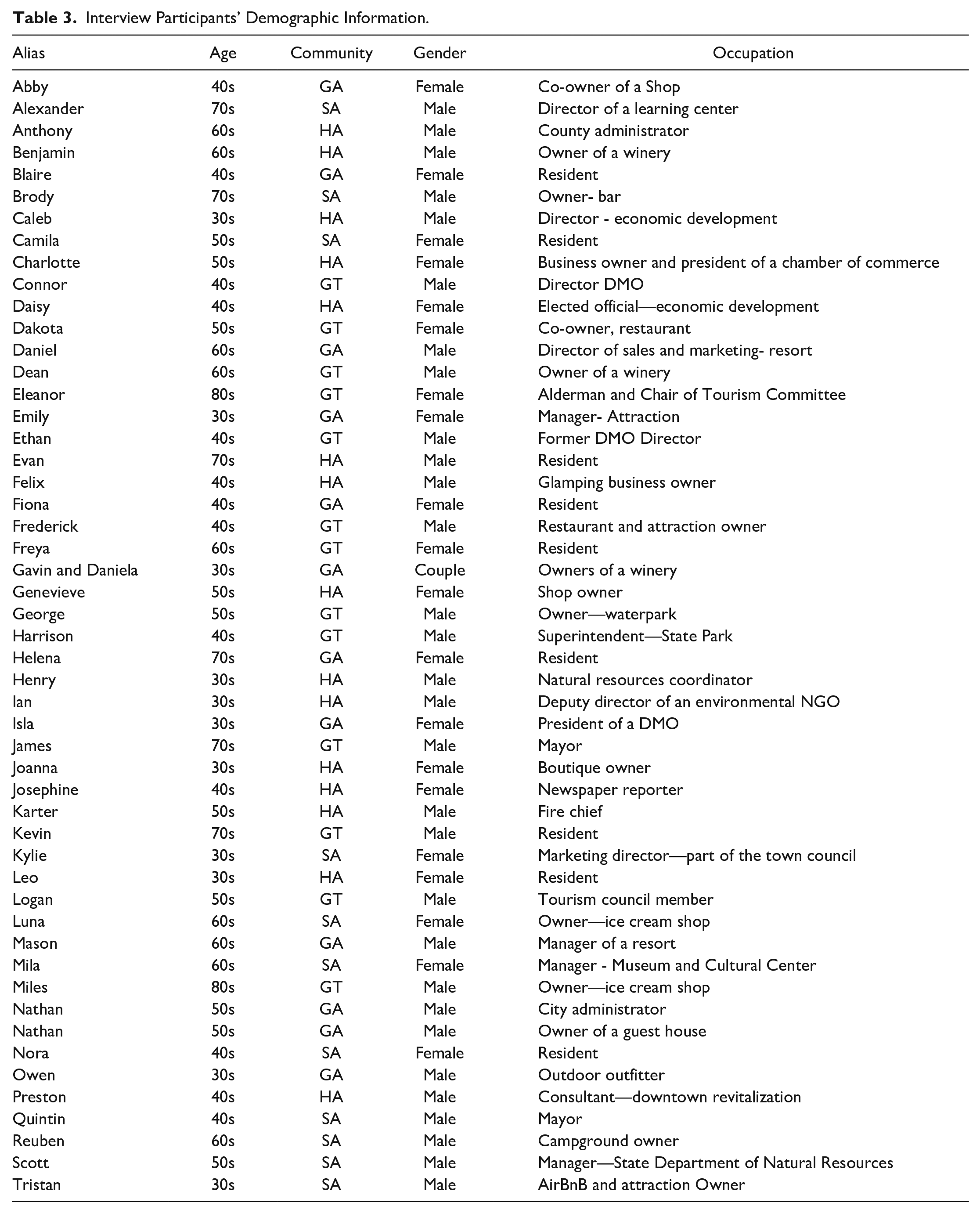
Regarding the selection of the study participants, we applied purposeful sampling to recruit destination stakeholders with various opinions about rural tourism development and distinct degrees of livelihood associated with tourism (Maxwell, 2012). Further, we combined purposeful sampling with snowball sampling by asking the interviewees to recommend other individuals who might hold similar or different views about tourism (Creswell & Báez, 2020). To develop a contact list of potential participants, we collaborated with Extension Collaborators, who were part of a branch of our university that regrouped experts on community development in Illinois. The sampling procedure employed to develop this contact list was used to send a recruitment email to participants for both the interviews and workshops (Tables 3 and 4). Extension Collaborators who lived in these communities were in frequent and direct contact with residents to identify their economic development solutions. They also worked in field offices where they offered community-based programs that directly matched the residents’ needs. To identify participants who held differing views before data collection, we asked Extension Collaborators to generate an initial list of participants to recruit that included individuals whom they knew supported or opposed tourism development and whose involvement with tourism ranged from simply residing in the community to depending solely on tourism for their livelihood. This purposeful selection aligned with Maxwell’s (2012) recommendations that variations in individuals’ views enhanced the researchers’ ability to investigate the application of a theory. Having diverse perspectives is important to understand pride discourses and to test the relevance of Hume’s theory because it allows us to compare and contrast the participants’ lived experiences to see if there are commonalities and differences across participants’ use of pride categories and pride manifestations. We discussed the diversity of our sample during each of our monthly team meetings with Extension Collaborators and made adjustments when necessary. For example, the community HA sample was missing the perspective of public officials, which led two of our Extension Collaborators in this community to add the email addresses of local elected officials to their contact list.
Interview Participants’ Demographic Information.
Workshop Participants’ Demographic Information.
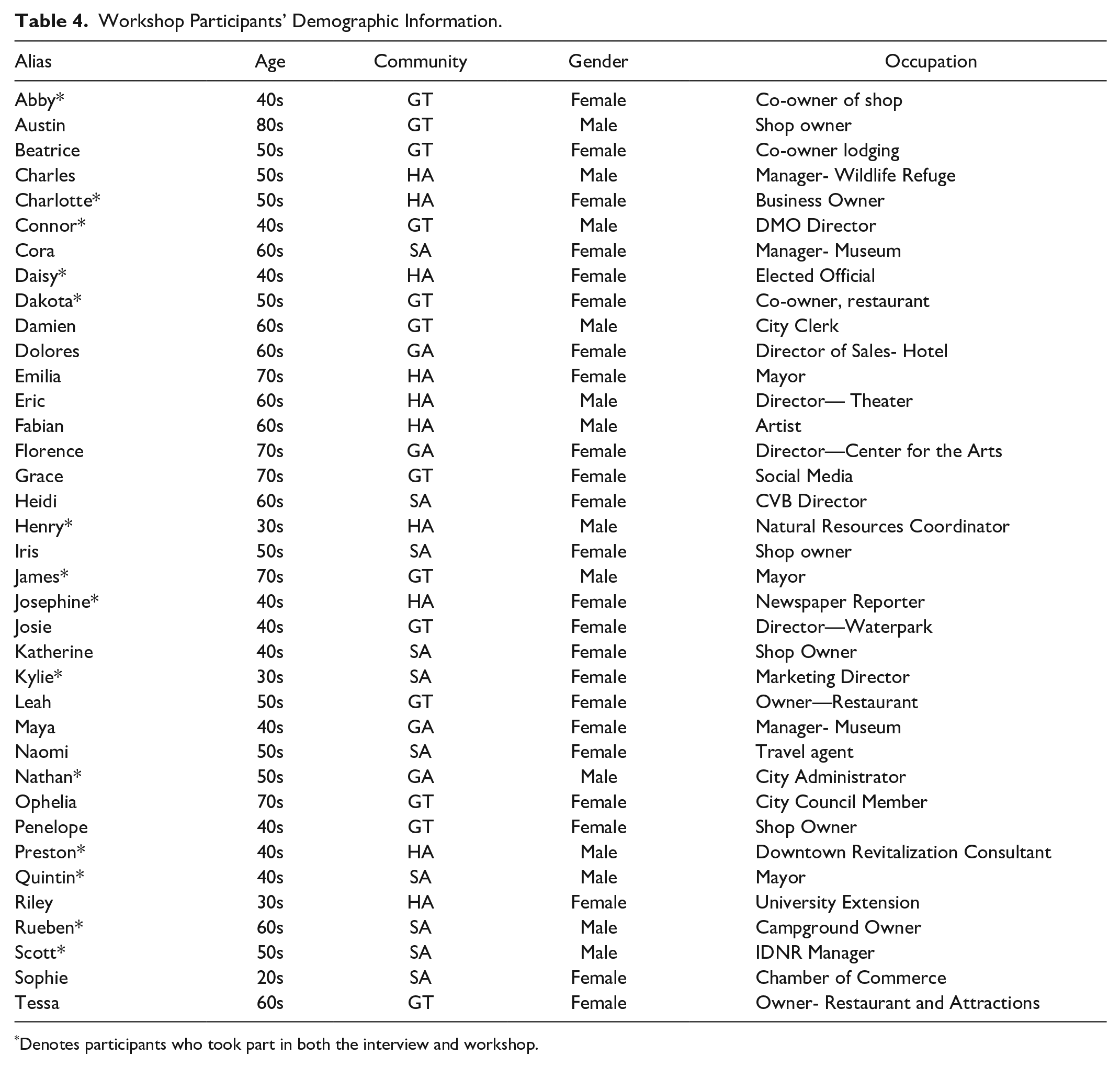
Denotes participants who took part in both the interview and workshop.
Data Collection
The research project included two phases: in-depth semi-structured interviews and community workshops. Data collection occurred between April and September 2021. All phases were inspired by the Appreciative Inquiry methodology, which could be defined as focusing on positive psychology by prompting participants through questions, discussions, and activities to consider the assets and strengths present in their community (Poudel & Nyaupane, 2013). Appreciate Inquiry was a relevant methodology for the current study because of its capacity to induce positive emotions, such as pride, in participants by focusing on the self-efficacy, strength, and success of individuals and their communities (Ludema & Fry, 2008). As a methodology, Appreciative Inquiry also aligned with the constructivist principle of individuals co-constructing realities through social interactions (Cooperrider & Whitney, 2000). Appreciative Inquiry comprised four phases referred to as 4D: Discovery, Dream, Design, and Destiny (Guix & Font, 2022) (See Table 5).
4Ds of Appreciative Inquiry.
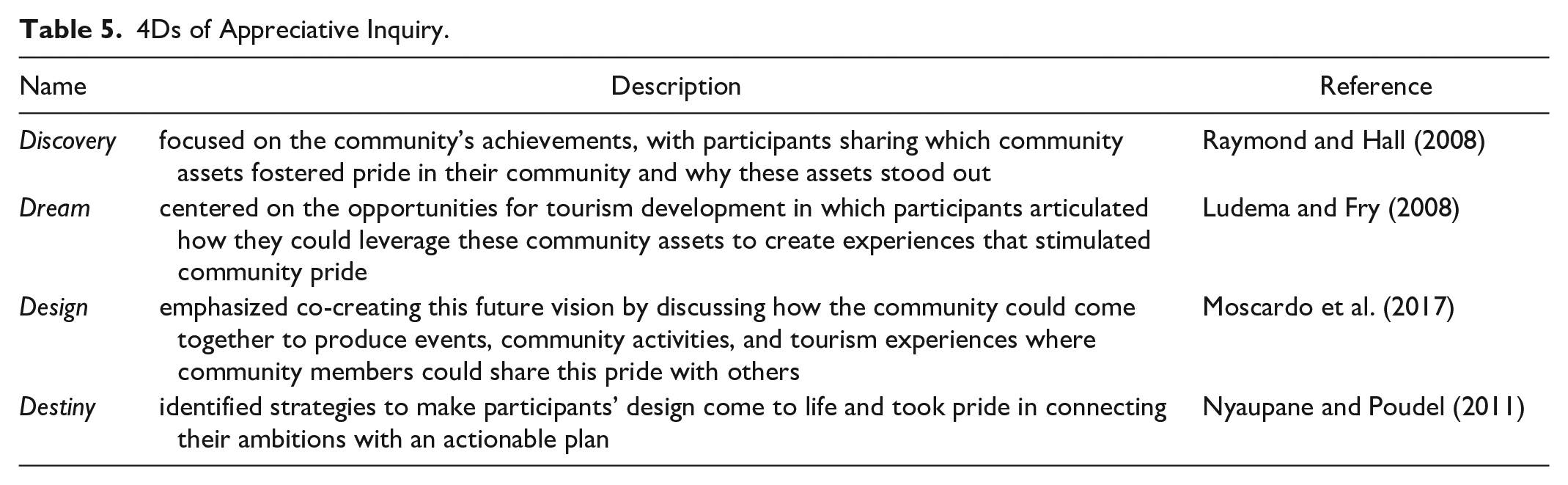
For the first phase of research, we opted for semi-structured interviews so that participants were presented with the same central questions (Creswell, 2016). The interview guide centered on the Discovery element of Appreciative Inquiry by identifying achievements that fostered participants’ self-pride and pride in their rural community (Nyaupane & Poudel, 2011). The topics covered in the interviews were the sense of pride regarding their involvement with their community and the presence of tourism in their community.
Interviews lasted 1 to 2 hours and were conducted in person when we were in the communities, on the phone, or via video conference. This approach was carried out to adapt to the participants’ schedules and adhere to COVID-19 regulations that were in place at the time of data collection. Each participant received a transcript of the interview that they were invited to review for accuracy (Creswell, 2016). We contacted 62 individuals, and 51 agreed to be interviewed; those who declined cited a lack of time. We continued to contact participants until we reached data saturation (Creswell, 2016), attained after 48 interviews. Three more interviews had already been scheduled when we reached that point.
Whereas phase one focused on individual perspectives, we were also interested in understanding the socio-cultural context underlying the discourse of pride to refine the conceptualization of pride categories and manifestations. Community workshops represented an effective way to collect these groups’ perspectives because they provided another layer of context by offering more space for the participants’ exchange of views about pride in rural communities (Priest et al., 2013). For this second phase, we focused on the Discovery, Dream, Design, and Destiny elements of Appreciative Inquiry during 4-hour community workshops held in each community. The contact roster created for the interviews was employed to email invitations to the workshop, and 37 participants attended one of the four workshops (Table 2). During the Discovery portion, participants identified assets they were proud to have in their community (Raymond & Hall, 2008) and used them in the past to overcome challenges to tourism development (Carlsen & Pitsis, 2008). In the Dream portion of the workshops, participants worked in small teams of four to six (Ivanoff & Hultberg, 2006) to individually identify novel opportunities for rural tourism experiences that could enhance group pride (Raymond & Hall, 2008). With the Design portion of the workshop, participants self-reflected on new rural tourism experiences that could improve their current offering and foster community pride among its members (Dewar & MacBride, 2017). Participants also identified strategies to achieve their goals during the Destiny portion, which facilitated discussions about pride in the local knowledge and resources the community could rely upon to concretize its dream (Joyner et al., 2019). Although all phases were important in offering rich contextual information about the communities, the Discovery and Dream phases provided the most relevant information about pride categories and manifestations.
Data Analysis
The workshops and in-depth interviews were recorded, transcribed, and uploaded to Nvivo for data analysis (Caretta & Vacchelli, 2015). We conducted a discourse analysis that was a systemic approach to analyze the destination stakeholders’ discourse by focusing on their expressed objectives, the ways they structured their thoughts, and the socio-cultural contexts in which their discourse occurred (Mayring, 2004; Schreier, 2012). We opted to employ discourse analysis because it aligned with our constructivist view that acknowledged the importance of the social-cultural context in understanding the multiple meanings associated with a lived experience (Guba & Lincoln, 1994).
We also used informed grounded theory, which is part of the family of grounded theory methods, to analyze the data (Thornberg, 2012; Thornberg & Charmaz, 2014). Informed grounded theory was defined by Thornberg (2012) as the “product of a research process as well as to the research process itself, in which both the process and the product have been thoroughly grounded in data by GT [Grounded Theory] methods while being informed by existing research literature and theoretical frameworks” (p. 249). Informed grounded theory was developed to avoid reiterating what was already covered by existing theories and to address the lost information that could occur by disregarding previous concepts when applying grounded theory in its classical form (Thornberg & Charmaz, 2014).
Additionally, informed grounded theory emphasized acknowledging and expanding theory, making it a relevant approach for our research. Combining informed grounded theory with discourse analysis was considered an appropriate method to answer our research question because it provided a richer perspective on the phenomenon of interest by combining the strengths of both approaches (Titscher & Jenner, 2000). Discourse analysis alone was referred to by Johnson (2014) as weak in terms of its ability to expand a theory but providing valuable insights into how individuals expressed their lived experiences—leading her to advocate for combining informed grounded theory with discourse analysis. Similarly, Fairhurst and Putnam (2019) supported uniting informed grounded theory with discourse analysis because informed grounded theory contributed to theory expansion, and discourse analysis provided researchers with a complementary methodological tool to refine their understanding of the performative ways individuals articulated their lived experiences. Additionally, Fairhurst and Putnam (2019) mentioned that discourse analysis enhanced researchers’ abilities to share contextual information. They explained that this contextual information was an essential element of the thick description process of informed grounded theory in which researchers provided clarifications, descriptions, and explanations to contextualize the data. Thus, uniting informed grounded theory with discourse analysis allowed us to expand the theory surrounding the phenomenon of interest by submerging it in deeper layers of contextual understanding that included the participants’ ways of expressing themselves (Fairhurst & Putnam, 2019; Johnson, 2014).
Informed Grounded Theory, Literature Review Strategies, and Data-Sensitizing Principles
Throughout the data collection and analysis, we employed two literature review strategies that Thornberg (2012) recommended for the conduct of informed grounded theory: theoretical agnosticism and theoretical sampling of the literature. We opted for these two literature review strategies because they combined the advantages of being flexible (Themelis et al., 2022) while not overwhelming researchers with a too-broad set of unrelated theories (Thornberg, 2012). We applied theoretical agnosticism by taking a critical stance toward our knowledge of the literature (Thornberg et al., 2014). We examined the limitations of Hume’s theory of pride, identified questions left answered, and noted differences in theoretical interpretations. We also viewed all initial, conceptual, and theoretical codes as subject to changes and modifications (Thornberg, 2012). The objective of theoretical agnosticism was to let codes emerge from the data and note theoretical linkages while avoiding coercing them into the theory (Dunne, 2011).
During the theoretical sampling of the literature, we continually reviewed the literature before and during data collection and analysis (Themelis et al., 2022). We reviewed articles from tourism and outside fields, such as sociology, psychology, leadership, and business. We constantly compared the merging codes, our previous theoretical knowledge, and new concepts identified (Thornberg, 2012). This theoretical sampling of the literature was relevant to enhance the validity of the findings by questioning our theoretical assumptions, refining the connections between emerging themes and theory, and pursuing questions that were relevant and not yet covered in the literature (Thornberg, 2012). We stopped conducting the constant sampling of the literature when no new emerging concepts arose from the data (Thornberg, 2012).
The theoretical sampling of the literature was part of creating the first version of the interview guide based on an earlier literature review about pride in rural tourism and Hume’s theory of pride. Then, we completed the first round of 10 interviews and met as a team to discuss whether some questions needed to be rephrased and added to the interview guide (Thornberg & Charmaz, 2014). This team meeting was also an opportunity to exchange our early analysis of the possible theoretical linkages not captured by our earlier review of the literature (Thornberg & Charmaz, 2014). The theoretical sampling of the literature connected the data collected during the in-depth interviews with those from the workshops because the knowledge gained during the data collection and analysis of the interviews was used to refine the workshops’ guidelines. For example, we realized that the concept of resilience emerged during the interviews and was not present in the initial interview guide leading us to question how pride and resilience can be connected. The researchers then conducted an additional review of the literature about pride and resilience. One of the researchers shared the concept of narrative capital that arose during their ongoing literature review. Narrative capital focused on what experiences and memories individuals decided to share with others in order to build a narrative that was engaging and captured the interlocutors’ attention (Takacs, 2020). This concept was interesting because it underscored the pride business owners expressed when sharing stories about how their community overcame challenges such as floods and covid-19. During coding, the concept of narrative capital was translated into the axial code focusing on admiring the community’s resilience. Therefore, the questions about overcoming a challenge were added to the interview guide because they encouraged participants to share stories about their actions having a positive impact on their community, which fostered pride in their resilience, agency, and ability to help others (Priest et al., 2013). This theoretical discussion also impacted the data collection for the community workshops because we designed a group discussion where group members identified assets in their community which they used to overcome challenges to rural tourism development (See Discovery section above).
When conducting informed grounded theory, we also followed Thornberg’s (2012) data-sensitizing principles of “staying grounded” in the data, “theoretical playfulness,” “memoing,” and “constant reflexivity” (pp. 252–254). We focused on staying grounded by constantly comparing the emerging knowledge from the dataset with the theoretical propositions of our chosen theory (Goldkuhl & Cronholm, 2010). To enhance constant comparison, we gathered the perspectives of multiple stakeholders (i.e., residents, public officials, and business owners), employed different methods to collect data (i.e., interviews and workshops), questioned our assumptions about our theoretical approach and whether it aligned with the collected data, and viewed our emerging codes as tentative and subject to change (Thornberg & Charmaz, 2014). We pursued theoretical playfulness during the theoretical sampling of the literature by reading literature from both tourism and other fields to provide different perspectives and foster creativity, such as with the resilience example mentioned previously. We engaged in memoing (Thornberg, 2012) by writing memos thorough the research process to record our ideas, keep track of our evolving thoughts, question our perceptions, and write down emerging conceptual linkages. Lastly, we engaged in constant reflexivity when writing memos to recognize the influence of our theoretical biases and past experiences (Thornberg et al., 2014). We also employed reflexivity to keep track of and compare the code emerging inductively from the data with the ones associated with concepts and theories found during our constant literature review (Thornberg, 2012).
For the coding itself, we followed Saldaña’s (2021) coding approach to the informed grounded theory method by engaging in two coding cycles. During the first cycle, we engaged in initial coding by annotating emerging concepts that characterized distinctive meanings that participants associated with pride, such as being proud of organizing a successful community event for fellow residents (Saldaña, 2015). Memos were useful for keeping track of our initial thoughts, questions, and possible emerging initial codes. We kept on reviewing the literature, and we met as a group to discuss the first coding cycle, share concepts discovered during our ongoing theoretical sampling of the literature, conduct a peer debriefing, and adjust the interview guide (Thornberg, 2012). Next, we individually engaged in a second coding cycle, in which we utilized axial coding by regrouping emerging concept codes into subcategories before merging these subcategories into core categories (Bailey, 2007). Memoing allowed us to indicate additional directions for the theoretical sampling of the literature, engage in theoretical agnosticism, and conduct adjustments to the topics addressed in the workshops. Once we had individually conducted axial coding (Saldaña, 2015), we carried out theoretical coding in which we distinguished between the categories and manifestations of pride. We engaged in memo sorting by comparing the memos collected to help us organize and structure our thoughts. The categories of pride centered on whom is the object of admiration (e.g., oneself for self-pride). In contrast, the manifestations of pride focused on the properties associated with it (e.g., a sentiment of prestige occurred when individuals felt socially acknowledged when others were asking them for advice, tips, and strategies).
Trustworthiness and Validity
We enhanced trustworthiness using Decrop’s (2004) four criteria: credibility, transferability, dependability, and confirmability. Credibility was strengthened by sending interview transcripts to participants for review (Guba & Lincoln, 1989). Transferability was reinforced through prolonged engagement in the communities to understand the specificities of the local context (Maxwell, 2012). Dependability was consolidated by maintaining a method trail to identify and keep track of the methodological challenges and solutions implemented by our team (Pavesi et al., 2017). Confirmability was enhanced by engaging in discussions with Extension Collaborators about our theoretical approach, methodological choice, and data interpretation (Creswell & Báez, 2020). We used a qualitative within-method triangulation with two qualitative methods to collect the data: individual in-depth interviews and group discussions via the workshops that provided richer contexts and multiple perspectives on pride (Fusch et al., 2018). Using these two data sources also reinforced confirmability because we could note convergence between the two data sets, reinforcing the confidence in the findings (Maxwell, 2012). Validity was also increased due to investigator triangulation (i.e., separate data analysis and peer debriefing) (Goodson & Phillimore, 2004).
Findings and Discussion
We develop a conceptual model to illustrate and guide the understanding of how destination stakeholders express multiple categories of pride and their pride manifestations in a rural tourism context (Figure 1). These manifestations of pride can take three forms: (1) prestige—by gaining a positive social status, (2) caring—by diffusing compassion and thoughtfulness, and (3) community triumph—through selecting successful rural tourism development strategies. The findings are presented with a focus on which categories of pride are central to each of these manifestations. We start our analysis by defining and illustrating each pride category before focusing on the manifestations of pride and illustrating how each manifestation is linked to a pride category.
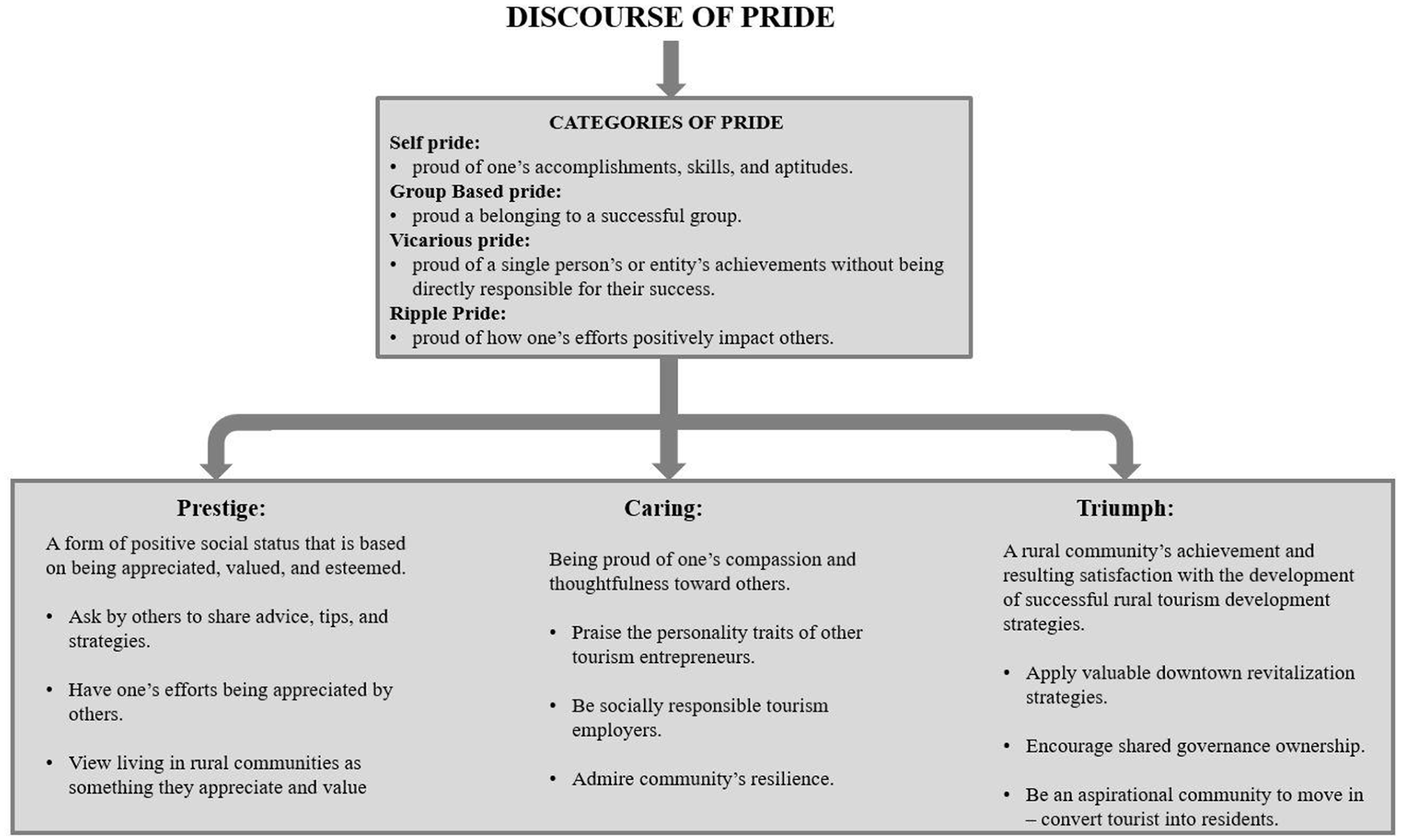
Destination stakeholders’ discourse of pride relating to rural tourism development.
Pride Categories
When contemplating pride, destination stakeholders share that they experience self-pride, which is defined as feeling proud of one’s accomplishments, skills, and successes (Ritzenhöfer et al., 2019). When being prompted to mention achievements that he is proud to have accomplished as a business owner, Gavin refers to the self-pride he feels over winning a prestigious wine award. Gavin takes over his mom’s business, and this award is a way for him to continue her legacy and assert his self-esteem:
Ever since IGVVA, the Grape Growers and Vineyards Alliance was formed, at the conference, they have different awards that you can win. The Winemaker of the Year Award, is given to the person who makes the best wine in the state. So she [Gavin’s mom] won it like the first two years, and then she said, “Well, I don’t want to win it anymore, we’ll take a break.” And then they gave it to her one more year after that. On her last speech of her third award, she said, “I am not going to accept this award anymore, unless someday my son accepts it.” The first year I was back [managing the winery and tasting center], I won the very first year! And so, she’s retired, and she’s in Florida, but she actually flew back and she went to the conference to present the award to me. And so, that was pretty special. I’ am pretty proud of that. My life mission [is] to put Illinois on the map for a variety of wine.
Gavin (M), 30s, Winery owner, Community GT, Interview
This finding provides new insights into the works of Tracy et al. (2020) and Tracy and Robins (2007a), who call for future studies to identify how pride can enhance self-esteem and posit that pride can be a way to facilitate the transfer of cultural knowledge, such as winemaking. However, they do not identify which category of pride is efficient at conveying this cultural knowledge. Participants, such as Gavin, suggest that self-esteem arises through self-pride by gaining recognition for cultural knowledge.
Destination stakeholders also acknowledge group pride occurs when individuals are proud of belonging to a successful group or a group associated with praiseworthy actions (De Hooge & Van Osch, 2021). For example, Charlotte mentions that she feels proud to belong to the Downtown Lady Bosses group, which provides creative support to women entrepreneurs in her community. She details how proud she feels that the Downtown Lady Bosses group shares critical information about suppliers and marketing strategies to advance their group’s goal of successfully attracting tourists to the community. When Charlotte is asked why she is proud of belonging to the Downtown Lady Bosses group, she shares:
It [The Downtown Lady Bosses group] provides this huge support system where [we] share messages about what to use for point of sale, where do you get your vinyl logo made, and how can we better market for our next event. It’s grown to this really awesome forum where everybody knows they can bounce ideas off each other. The most rewarding thing for me with the Lady Bosses is that they do not see an inkling of competition with each other. They constantly share information; they constantly work together and promote each other. . . Every once in a while, they [business owners who are not part of the Downton Lady Bosses group] slip back into that ‘Me me me mentality,’ and they fear competition. ‘Oh another restaurant, it’s going to crush me.’ ‘No, it’s going to build you up.’ More people [tourists] are going to come in. I always say, ‘we’re not going to slice the smaller we’re making the pie bigger.’
Charlotte (F), 50s, Business owner, Community HA, Interview
Within the context of the 2015 World Expo in Milan, Magno and Dossena (2020) find that residents report more community pride and a stronger belief that their community has stronger social ties after the event. We expand on their finding by suggesting that this sentiment of having stronger community ties exists in proud business owners who feel more secure about their business skills. Hence, they feel less threatened by potential competitors and are more likely to share useful tips with others rather than keeping them to themselves for fear of losing their competitive edge. An individual experiencing group pride is, therefore, more eager to engage in an exchange of knowledge, leading more business owners to also benefit from this shared knowledge.
Additionally, destination residents share that they experience vicarious pride in which they feel proud of the success of another specific individual or entity without feeling directly responsible for this success (Salice & Montes Sánchez, 2016). When speaking about a challenge that she is proud to see her community overcoming, Isla expresses vicarious pride toward her mayor’s ability to see what is best for the future. She is proud of this mayor for advocating and taking actions to preserve the community’s historical buildings that are one of the main attractions for tourists today:
[Community GA] was looking at tearing down buildings because they were empty. They were vacant, they were falling in disrepair. And we had a very visionary mayor that said, ‘No, these are beautiful. We cannot tear these down. They’re historic. Let’s try to save them’ and was able to convince the government at the time to write an ordinance structure to preserve what we have. So fast forward about 10-15 years. Main Street continued to stay historic. No one was allowed to tear anything down. Anybody that came in and wanted to make improvements had to improve based on the 1800s architectural structure. So that’s preserved what we’ve had, which is one of the reasons why people love to come to [community GA].
Isla (F),30s, President of a Destination Management Organization, Community GA, Interview
This finding underscores that participants such as Isla can express vicarious pride toward a specific public official (such as their mayor or city manager) for their capacity to be innovative and identify their community’s assets without feeling directly responsible for their success. While Bodolica and Spraggon (2011) posit that leaders who possess a high level of authentic pride (i.e., based on honorable achievements) are better equipped to make successful strategic decisions within a corporate context, this study’s participants suggest new insights about the significance of authentic pride in their perception of their government officials’ ability to strategize for rural tourism development.
Another key finding is the identification of a new category of pride that we name ripple pride. Ripple pride occurs when individuals feel proud of the positive ripple impact of their actions on others besides themselves. Ripple pride is at the heart of Preston’s testimony, who is a consultant specializing in downtown revitalization. Preston is also renowned for his work that attracts businesses to his rural hometown and for being one of the leaders behind the successful downtown revitalization of community HA. When mentioning his pride in seeing community HA thrive, he expresses pride in the positive “ripple” changes that occur in the way elected officials understand downtown revitalization due to his intervention:
A gentleman who does some engineering for the [community HA], knew the work that I had done in [Preston’s hometown] and he was hopeful that he could find somebody to open a hotel in [community HA]. So intrigued, I went to meet with Mayor Susan* and found out just what that meant to her. [. . .] I met with her and Brian*, the Economic Development Coordinator, and I told them what I would do, and if they wanted to do it I would just show them a proposal for that. And I help Brian to better manage the tools in their toolbox, and better leverage the city’s assets to attract private capital to their downtown. . .So we’re in the fifth year, which is pretty amazing when I look back how much work we’ve accomplished in five years in [community HA].
Preston (M), 40s, Consultant, Community HA, Interview
*The protagonists’ names are changed to preserve anonymity
While self-pride focuses solely on an individual’s characteristics (e.g., being proud of leading a successful downtown revitalization project in one’s hometown), it does not consider how one’s personal actions can positively impact others—and create a ripple effect (e.g., not only am I proud of myself, but I also want others to succeed too; so I am helping them, and I am proud of their accomplishments). In other words, one can be successful individually and enjoy the fame and accolades that go with being recognized as a leader without one’s achievement facilitating the success and well-being of others. For example, Preston is deciding to help community HA achieve its downtown revitalization goals rather than leaving them to struggle and only focus on his success. Ripple pride is also distinguished from group pride because one does not need to belong to a group to experience it. For example, Preston is not part of the public officials nor residing in the community HA. However, he is still experiencing pride in the successful downtown revitalization in HA. Lastly, ripple pride differs from vicarious pride because vicarious pride is pride targeted toward a single person, and one does not feel responsible for that person’s success. Here, Preston is proud of Ryan, and he is also acknowledging that he is responsible for Ryan’s success by deciding to share his knowledge about attracting private capital downtown. Thus, the concept of ripple pride also provides novel insights into the work of Ritzenhöfer et al. (2019), who mention the need to further investigate the possibility of other forms of pride based on individuals’ actions toward others.
Additionally, discourse analysis is insightful in understanding the significance of ripple pride. By calling Brian and Susan by their first names, Preston is individualizing them, facilitating the listeners’ immersion into his account, and underscoring the positive impact his discussion has on these local public officials (Machin & Mayr, 2012). Preston uses the adjective “better” twice to accentuate (Norrick, 1987) the improvement in tourism planning. Preston also employs the toolbox analogy to illustrate (Gavetti & Rivkin, 2005) that Brian can develop new and previously unexploited opportunities for community HA residents after Preston shares his knowledge with him.
Prestige
Prestige emerges as a manifestation of pride and is conceptualized as a form of positive social status that is based on being appreciated, valued, and esteemed (Correia et al., 2019). For example, prestige occurs as a manifestation of pride when destination stakeholders feel that they are being valued because others ask them to share advice, tips, and strategies. Being asked for advice means others socially acknowledge them as successful and capable of sharing valuable knowledge. Prestige is visible in Tristan’s testimony about other residents asking him for advice about managing vacation rentals. When asked about what he is proud to have accomplished as a business owner, Tristan mentions others asking him for help:
A positive impact of tourism is bringing people together. Getting to know the other business owners and then being able to provide them help when asked. There’s multiple people. One is a close friend now. She stayed in my place [Tristan’s vacation rental] while looking for a house to buy here because she heard that it’s a beautiful area and they want a second home, they want to do Puerto Rico stuff. They wanted to do missions and stuff like that. And they really looked up to me to ask about Airbnb, or the listing, just setting stuff, you know, the administrative side of it.
Tristan (M), 30s, AirBnB and attraction owner, Community SA, Interview
A novel finding shared by participants is that social interactions, in the form of the prestige gained by social acknowledgment, can also facilitate collaboration between tourism business owners. While Gannon et al. (2021) find that social interactions between community residents strengthen their community attachment, we expand on their findings by adding group pride as an outcome of improved social interactions. In addition, we build on the work of Yeager et al. (2020), who find that vacation rentals can trigger a sense of pride in community residents regarding their neighborhood because decrepitated buildings get refurbished as rental properties. In our study, the novel finding is that the owners of property rentals also gain pride, not only in improving their neighborhood but also on a more personal level, when they are identified as successful by others who esteem their opinions and ask them for advice.
Prestige is illustrated as a manifestation of pride by participants through their use of the ripple pride category in their discourse. Ripple pride is specifically tied to the prestige of feeling proud of one’s efforts being appreciated by others. When discussing what makes them proud, Joanna and Josephine explain that they experience pride when their community benefits from their decision to keep their business open late on Friday nights. This decision has a positive ripple impact on the community by strengthening the social fabric:
We are holding First Fridays. We have all businesses open late until 8 p.m. And we will feature some artists, whether it be music or painting. We’ll have activities going on. Last year, there was a band and an axe-throwing contest. We try to make First Fridays exciting and get our community to come and see [us]. We know many people in our community can’t make it to the shop before five o’clock when we close. So we take this First Fridays, promote it, and we’ve seen a lot of our local people come in on those Friday. Everybody on a Friday is like, “Let’s go have a drink,” or “It’s the end of the week.” Being open an extra two hours for people to come in and see that you’re there is a huge thing.
Joanna (F), 30s, Shop owner, Community HA, Interview
Responding to scholars’ calls for further investigation on interpersonal aspects of pride (Lindblom et al., 2020; Matson, 2021; Salice & Montes Sanchez, 2016), we add a sociological layer to Hume’s pride theory with the new ripple pride category by examining the positive impacts of pride through social interactions. Joanna expresses this exact ripple pride when describing how the Downtown Lady Bosses take pride in not only being successful business owners but also caring about their community’s well-being by creating successful events for community members to enjoy each other’s company. The Downtown Lady Bosses use their shops to provide their fellow community members with “third places” (Putnam, 2000). Third places are areas where community members can express their identities outside their homes and workplaces (Putnam, 2000). Including this connection between ripple pride and social space enhances the understanding of how built assets (e.g., community halls and shops) are key to providing a space for communities to express their sense of pride (Kline et al., 2019).
Prestige also relates to how destination residents view living in rural communities as something they appreciate and value. For example, Caleb underscores the importance for destination residents to be aware of all the assets rural life offers to change a negative perspective about rural identity into a positive one. He explains his own shift when he becomes aware of these assets. Expressing group pride, Caleb notes that rather than seeing more visitors in his hometown, he is particularly proud of his appreciation for living in a rural community and is eager for other residents to experience the same shift in their perspective and become proud of their group identity:
I think there is a lot of upside to being a small, cute river town, right? I didn’t look at it like that when I was a kid. I had always said, ‘you know, it’s in the middle of nowhere.’ As I got older, and I started to understand that, number one: an hour drive is not too bad at all, I could have much, much worse distances for much less fun things. So what I started to understand is, maybe it’s not necessarily the location and all the other metropolitan areas
we’re able to attract, but the people that are there, the people that are building upon what’s being offered in Havana. It was just very exciting for me. It wasn’t just how do we attract people to our town because I love [community HA] and I take a lot of pride in what we’ve done here. It was really, how do we get other people to take pride in that too and get excited.
Caleb (M), 30s, Economic Development, Community HA, Interview
Adding context to Caleb’s interview, workshop participants mention a shift involving residents experiencing group pride about being part of a rural community. During the Dream portion of the workshop, Charles mentions that “one of the most difficult things we had to do [as a community] was changed the narrative about how we talked about ourselves, how do we talk about our town. You see people that were embarrassed about [community HA] 5-10 years ago, and now they just can’t believe it.” Charles considers the redesigned downtown is a resource that can be leveraged to instill pride in living in a rural area. Previous research also mentions that residents can experience a surge in group pride when tourists visit their community because tourists express appreciation for their rural culture and are willing to devote time and money to do so (Butler et al., 2022). When examining community pride as a form of empowerment, Aleshinloye et al. (2022) find that residents who feel proud of their community are also more likely to consider their hometown an important part of their identity and feel place attachment toward it. Although these studies provide valuable insights, the discussions place the presence of tourists as the reason for a narrative shift. In the present study, destination stakeholders provide new insights by explaining that a positive narrative shift can also occur internally via group pride by becoming aware of their unique assets.
Caring
Caring as a manifestation of pride is conceptualized as being proud of one’s compassion and thoughtfulness toward others (Nakamura, 2013). Caring is visible in Daisy’s testimony when expressing her concerns for local business owners. Daisy manages economic development for community HA and mentions that businesses outside Main Street can feel left out if all her social media marketing efforts are directed at the downtown shops. When she is asked about actions that she is proud to have taken as part of her job, Daisy mentions being thoughtful about promoting businesses located outside of Main Street to make them feel included:
I’m trying to reach out to those outlying businesses. And the last one I went to they said, ‘this is so nice that you’re doing this, I can’t believe you’re doing this.’ I mean, they just mentioned it several times. And it made me feel good, because it meant so much to them. And it’s just a simple little post on Facebook. But sometimes we just all need a pat on the back. And we just need a little encouragement. And, you know, showing that I care. I’m not just focused on downtown. I care about all these businesses, all these people. . .not just the new businesses that are starting up and are shiny and new.
Daisy (F), 40s, Director of Economic Development, Community HA
The emergence of caring as a manifestation of pride is important because there are contrasting findings about the links between pride and caring (Nakamura, 2013). This can be seen in Simon-Thomas et al. (2012) conceptualizing pride as being focused solely on hubris (e.g., bragging) and caring as being the opposite of pride. Conversely, when surveying working parents about their emotions, Nakamura (2013) posits that caring can be viewed as a manifestation of pride because it includes feeling proud of one’s altruism toward others. Our finding provides empirical evidence that supports Nakamura’s (2013) work and offers a new context outside of family relationships by gathering the perspective of destination stakeholders. Thus, we offer a more refined perspective in which pride is not always associated with hubris but also a caring component.
Another way in which caring as a manifestation of pride is visible is when destination stakeholders express vicarious pride by thoughtfully acknowledging and praising the quality of one other individual. Vicarious pride appears in the discourses of Benjamin and Maya when they mention feeling proud of another tourism entrepreneur’s personality traits, such as creativity and vision. Relevant contextual information is that Benjamin and Maya do not personally know the business owner they admire. When discussing what makes him proud of his community, Benjamin states:
I think those guys [who] have [a] glamping [business], they’re pretty imaginative. They grow cut flowers there. And they have a trailer there that they rent out some glamping spots with solar panels so people can have their lights on in their camps. They’re they have innovation there. I would never have thought of anything like that.
Benjamin (M), 60s, Winery owner, Community HA, Interview
Destination stakeholders’ vicarious pride toward business owners expands our general understanding of pride toward someone one does not know well. When considering how vicarious pride forms, Sugden (2021) suggests that one must have a consistent professional or emotional attachment with others (e.g., a family member or a colleague) to feel vicarious pride toward them. We find an opposite finding that indicates vicarious pride can also be felt toward individuals we do not know. Additionally, De Hooge and Van Osch (2021) mention that vicarious pride is less likely to happen when individuals acknowledge personality traits (e.g., being innovative) rather than effort (e.g., working hard). The present study differs because we find that personality traits such as being creative and forward-thinking are central to vicarious pride.
Participants describe caring as a manifestation of pride when they indicate pride in treating their employees with compassion. Gavin and his wife Daniela say they are proud of providing fair wages and health care benefits, despite the financial burden such provision places on their business and few other competitors offering similar benefits. They express ripple pride by sharing that they enrich their employees’ welfare because they understand that by being sustainable employers, they also support their community’s well-being through full-time employment opportunities. When discussing the actions that he is proud to have accomplished as a tourism business owner, Gavin states:
As our generation and younger generations move into the workforce, retail positions are maybe less sought after. People want more, it’s highly based on the season, and it’s a gratuity-based job as well. So what we’re trying to do as a company is offer benefits, like health insurance and retirement plans and things that haven’t always been done in the past. And it’s not necessarily being done on a larger level for some of the other businesses. We’re trying to create sustainability and that loyal long term employee. . . We’re fortunate where we do have a pretty large full time staff, but a lot of the restaurants will hire an immense amount of people and they come January, February, March, they don’t have jobs. . . Our goal is [that] we want people to see that there can be a career at this company. It’s not just a job. We want people to feel like you can build a career.
Gavin (M), 30s, Winery owner, Community GA, Interview
This finding broadens the work of Williams and Davies (2017), who mention a form of social comparison, “shared fate,” where individuals feel proud of others’ accomplishments because they benefit from their success. In the present study, the novel finding is that shared fate can also occur via ripple pride without one’s need to receive an advantage from their actions. For example, Gavin is proud of his actions’ impacts on his employees, even if he does not financially benefit from the situation. He believes that tourism employers and employees are linked by the shared fate of making the tourism industry more sustainable, which requires effort from employers that involves social protection provided to their employees.
Caring also transpires as a manifestation of pride when the destination stakeholders are proud of their community’s resilience. During the Discovery portion of the workshops, destination stakeholders identify their community’s resilience as a social asset they are particularly proud of possessing. For example, Connor mentions being proud of his fellow residents’ resilience being a key factor in how community GT “perseveres through flood [and] pandemic.” Similarly, Naomi identifies resilience as a community value that she is proud to see in community SA and states, “I noticed that whenever there’s something happening, people usually come together to help out, like during the storms.” The importance of resilience is further illustrated by Abby, who describes the group pride she feels as she sees her fellow shop owners use the mandatory lockdowns during COVID-19 as an opportunity to improve the décor of their shops. When discussing challenges she is proud to have seen her community overcome, Abby shares: So during the COVID shutdown, it was very empowering to watch businesses who have been part of our group (Chamber of Commerce) say, ‘I am going to revamp my store.’ They’re shut down and [they’ve] got no income. What do they do? They got new awnings, cleaned their windows, painted their storefronts, and said, ‘This is what I’m doing so when I open my door; I look amazing.’ So that was very empowering to see people being inspired enough to say, ‘All right, it stinks, but I’m supposed to do this over the last few years anyway so let’s just do it now.’
Abby (F), 40s, Co-owner of a shop, Community GA, Interview
From a discourse analysis perspective, Abby expresses group pride with multiple strategies. Abby uses a rhetorical question, “What do they do?” that reinforces the persuasive effect of being proud to be part of a tenacious group of business owners (Frank, 1990). Additionally, Abby uses action verbs such as “got,” “cleaned,” “painted,” and “open” to describe the behavior of the shop owners and reinforce the impression of movement and activity (Billig, 2008). Abby also matches each of these active verbs with a specific part of a shop, such as the “awning,” “windows,” “storefront,” and “door.” Using features to describe a whole building emphasizes Abby’s group pride in seeing the shop owners caring for their shops (Han, 2015).
The destination stakeholders’ group pride in their resilient community also expands our understanding of the role of group pride in crisis management. When surveying Hawaiian residents about their perceptions of tourism crises in their community, Jordan et al. (2019) find that residents with a higher level of community pride report positive emotions that include feeling active and determined more frequently. Our findings build on their work because destination residents suggest that these positive emotions can still emerge amid major crises such as COVID-19, severe storms, and flooding due to the group pride destination residents derive from their community resilience.
Triumph
Triumph is another manifestation of pride and refers to the participants’ perception of an achievement that is reached and leads to a strong feeling of satisfaction about one’s image (Sullivan, 2014a). Within the context of our study, we more specifically conceptualize triumph as being related to a rural community’s achievement and resulting in satisfaction with creating successful rural tourism development strategies. An illustration of triumph occurs in communities HA, SA, and GT regarding the successful application of a Tax Increment Financing (TIF) district. The TIF is a determined geographical zone where business owners can use a subsidy to help finance the development of shops, restaurants, hotels, and vacation rental properties. When mentioning why she is proud of her community, Joanna notes the successful use of the TIF district as a tourism development strategy:
When we opened in 2018, the city was offering a TIF grant. . . They were trying to revamp old buildings. I mean, our downtown had nothing. There were buildings, and they’re beautiful, but they hadn’t been used. And so they got a really large grant. We ended up getting several of those old buildings revamped, and they look amazing. So our entire downtown just looks totally different. It looks like kind of like a little Hallmark Movie Channel town that you just walked down. I mean, it’s only a few blocks, our main street is isn’t very big, but anything that was old or broken or whatever has been revamped, remodeled, and it looks great. . .and people from towns around us are coming to [community HA] because we’ve got three boutiques, we’ve got one home good store, we’ve got three really great restaurants, So they’re just coming to a smaller town with really cool different things. I am excited about it!
Joanna (F), 30s, Boutique owner, Community HA
Destination stakeholders, such as Joanna, suggest that triumph is a manifestation of authentic pride when they feel that their downtown revitalization project is achieved due to valuable economic decision strategies. This finding also aligns with Al-Emadi et al. (2017), who find that destination residents report enhanced pride and excitement when their country triumphantly wins a bid to host an international event like the soccer World Cup. However, destination stakeholders also mention that triumph can transform into a manifestation of hubristic pride when new residents are not offered the same opportunities as long-term residents. When noting a challenge that she is proud to have overcome, Leo explains how her idea of refurbishing the old riverside clubhouse into a coffeehouse with a hydroplane-guided tour experience is met with resistance from some established residents:
The biggest challenge now is to overcome the resistance people have of changing. In those committees, like the city council and park district, we have the group of senior citizens, and they have the power to vote for this kind of decision. The park district, they have a committee to vote for certain things. People get a little bit scared, when we propose the idea of the airplane; like everybody was super happy, but a lady that works for the park district, she’s like, ‘but you cannot put a ramp there, you cannot do this because that land belongs to the park district.’
Leo (F), 30s, Resident, Community HA, Interview
Whereas community pride is usually discussed in the tourism literature in terms of positive outcomes for tourism development, such as empowerment and place attachment (Andereck & Nyaupane, 2011; Lalicic & Garaus, 2022), our current findings emphasize the value of taking a more nuanced approach to pride by investigating instances where hubristic pride can hinder tourism development. When conceptualizing triumph and its connection with pride, Bellocchi and Ritchie (2015) imply that triumph is associated with victory over a group, antagonism toward others, and hubris. Taking on a more balanced approach when investigating group pride, De Hooge and Van Osch (2021) posit that group affiliation can be both positive by fostering inclusion and negative by triggering antagonism. Leo’s testimony highlights that a hubristic form of group pride can enable division between destination stakeholders.
Additionally, destination residents suggest that triumph as a manifestation of pride is linked to specific pride categories, such as vicarious pride. Vicarious pride is visible when destination residents praise a public official for being open-minded about government decisions surrounding rural tourism development by welcoming residents’ inputs and suggestions for improvements. This shared governance ownership is visible during the Discovery portion of the community SA’s workshop. When Sophie is asked about a key political asset she is proud to have in her community, she underscores the advantage of having a “Mayor that is open to change and suggestions” from residents. Shared governance is also central for community GA, where government officials collaborate with business organizations and residents to solve an outdoor dining challenge. With COVID-19, community GA is seeing a sharp increase in rural tourists and does not have enough space inside restaurants and bars to simultaneously accommodate all visitors and respect social distancing. This challenge leads business owners to ask their mayor to act by allowing them to use the street as a terrace. After asking what makes them proud of their community, Abby and Nathan note the City Council as a single entity whose actions make them proud. They express vicarious pride toward the City Council because of how it promptly reacts to this challenge by closing the street downtown to allow space for outdoor dining:
So when that COVID hit, we kind of had a handful of us saying, ‘we got to do something, we’ve all built these businesses, we’re not going down without a fight.’ We reached out to the City Council and they said, ‘Oh, yeah, let’s talk.’ So we would get a handful of us, that are from different directions. And the city was super open to hear what’s happening. If we wouldn’t have made that change, GA would not have made it through the COVID season last year. If we didn’t whip together that outdoor dining literally in weeks. Some people, there was some turmoil with that, because of course, it wasn’t the most beautiful and well signed thing when you
roll it out. But when you’re in emergency situation, you know what your cup of water might be in the ugliest cup you ever saw, but you got a cup of water. So we fixed it as it went. But they were very good at reacting quickly.
Abby (F), 40s, Co-owner of a shop, Community GA, Interview
A great example is on Main Street the last year, when Illinois allowed outdoor dining. The City council was great. On Tuesday, they agreed to let anyone who applied for the outdoor dining permit have it. By Wednesday, they had the applications out, by Thursday they were back, by Friday, all this parking on Main Street was blocked off, and everyone could do outdoor dining. Wow, that was a response! That was fast! That was really awesome!
Nathan (M), 50s, City Administrator, Community GA, Interview
Discourse analysis provides additional contextual information to Nathan’s quote via the presence of syntactic parallelism (Fais, 1994). Nathan uses a similar sentence structure, “By Wednesday,” “by Thursday,” and “by Friday,” to accentuate the rapidity of the City Council’s actions. Nathan also mentions the positive impact of the outdoor dining ordinance approved by the City Council by using a series of exclamations highlighting his admiration (McCarthy, 1991). This finding also aligns with Boley et al. (2014), who suggest that residents who feel empowered politically (e.g., feeling that the decision is fair) are more likely to identify positive impacts of tourism. In the present study, vicarious pride occurs because destination residents feel proud that their local government listens to their concerns and prioritizes their opinions when creating solutions to issues that arise during the development of rural tourism.
Additionally, triumph also occurs via the group pride category when the participants express being proud that tourists desire to move in their community. For example, Karter expresses group pride over converting visitors into residents and the energy these new residents bring with them:
The third Tuesday of every month, the mayor has a one-hour meeting, where somebody in the community gets up and speaks about something going on. So two meetings ago, there were all these faces that were brand new. We didn’t know who they were, so the mayor went around and said, “We’re gonna introduce ourselves, because there’s a lot of new faces.” And a family, passed through Havana, rented a house down, fell in love with the community, bought property out there, renovated the old hotel out there, [and] turn it into a bed and breakfast.
This younger couple moved bought [a house]. And they are every weekend doing something to that house. And it has totally changed the look of that house that happens to be on Main Street. So as people are coming up Main Street to go to downtown, they’re seeing this progress. And I think you see that stuff. And people are like, you know, “let’s do this,” you know?
Karter (M), 50s, Fire chief, Community HA, Interview
This finding expands the work of Andereck et al. (2005), who suggest that group pride in one’s community is connected to the presence of tourists who respect the local culture. In the present study, participants indicate that group pride occurs when tourists are not only visiting but also moving into the community because they like the location. In contrast to Phillips and Schofield (2007), who find that location and accessibility are not major factors in the residents’ willingness to recommend their countryside village to tourists, participants suggest that residents take pride in having a community that is perceived to be an attractive location to move in.
Hence, the three manifestations of pride, prestige, caring, and triumph, and their linked pride categories suggest that pride is a force to be reckoned with in a rural tourism context.
Conclusion
Hume’s Theory of Pride provides an appropriate structure to comprehend how destination stakeholders express multiple categories of pride and their pride manifestations in a rural tourism context. With three manifestations of pride, destination stakeholders express: (1) prestige—by gaining a positive social status, (2) caring—by diffusing compassion and thoughtfulness, and (3) community triumph—through selecting successful rural tourism development strategies. Destination stakeholders voice these manifestations of pride by using four categories of pride: self-pride, group-based pride, vicarious pride, and the newly discovered ripple pride. One theoretical contribution is the new category of ripple pride that is expressed within the destination stakeholders’ discourses. Ripple pride expands Hume’s theory by connecting individual pride with governance, leadership, and solidarity (Bodolica & Spraggon, 2011). Although Kline et al. (2019) underscore the importance of built capital (e.g., a gazebo or a streetscape) in creating a sense of pride in a rural community through the beautification of space, we suggest another perspective in which ripple pride emerges when tourism entrepreneurs’ shops become the settings of both successful entrepreneurial ventures and places to socialize. This finding is significant because a sense of isolation is one of the primary challenges encountered by rural tourism entrepreneurs (Alford & Jones, 2020).
Another theoretical contribution that extends Hume’s Theory of Pride concerns elected officials’ roles in fostering group and vicarious pride (Bodolica & Spraggon, 2011; Matson, 2021). Destination stakeholders suggest that leaders who are perceived to have an authentic form of pride can foster a sense of agency in their community, a belief that they can tackle future challenges (e.g., applying for grants to bolster COVID-19 economic recovery), and the ability to seize opportunities (e.g., urbanites escaping the city) for rural tourism development. This finding provides new and essential insights into the subtle and complex power dynamic occurring with pride when rural tourism is developed in areas where residents suffer from prejudices, fewer job opportunities, and feelings of being excluded from the national government’s decisions (Hunter, 2013). In the current study, destination stakeholders state they take pride in their leaders because they support the creativity of their local entrepreneurs to solve problems, act quickly when new legislation needs to be passed to tackle challenges, are open to constructive criticism, and genuinely value their constituents’ opinions. This study also provides new insights into the work of Jordan et al. (2019), who underscore the importance of the residents’ positive emotions in decreasing the residents’ stress levels about negative tourism impacts. Participants in the current study suggest that all categories of pride can positively impact the destination residents’ perception of stress.
An additional theoretical contribution is the role of self-pride in facilitating the conveyance of a rural identity among destination stakeholders (Strzelecka et al., 2017). Although scholars identify tourists as a source of pride in rural identity (Butler et al., 2022), participants reveal that another crucial and previously overlooked source of self-pride resides in their neighbors’ admiration, acknowledgment, and support. However, this strong connection between self-pride and group identity is not without its pitfalls (Lindblom et al., 2020). Answering the call of Tracy et al. (2020) to understand the potential dangers associated with hubristic pride, identity, and group formation, some participants in the present study share that they feel left out from opportunities that are offered to more established residents.
The current study’s findings also have critical implications for elected officials and tourism planners. One key strategy that is identified by participants during the workshops is to organize a 1-day annual tourism planning event not only to determine the next year’s goals and strategies together (Nyaupane & Poudel, 2012) but also, and more importantly, to celebrate the community’s achievements in tourism development or their collective efforts in overcoming challenges (e.g., COVID-19) to cultivate group pride. Our findings also suggest that rural tourism entrepreneurs can foster ripple pride by encouraging business owners to develop experiences targeted toward residents, such as creating open days or special discounts so they can sample local experiences (e.g., wine tasting, goat yoga, and bread-making). Moreover, destination managers can develop tourism advertising and communication focusing on residents (Thyne et al., 2022), describing what makes them proud of their community and sharing their eagerness to welcome visitors. As for tourism entrepreneurs, destination managers can use visitor guides or social media campaigns to feature entrepreneurs who talk about their pride in their tourism-related businesses. Our research also finds that regular networking (Williams et al., 2021) or social events among tourism business owners are instrumental in sharing knowledge, advice, and tips. Sharing information further nurtures a sense of pride among entrepreneurs.
We acknowledge that our study has limitations, which present opportunities for future research. Firstly, the perspective of tourists is not included. Future research can explore the role of tourists in conversations about pride in the destination community and how interactions between hosts and guests shape this discourse. Secondly, whereas our study includes four destination communities, our sample focuses on rural areas in one state in the United States. To further extend the applicability of our conceptual model of pride discourse, more research can be conducted in a different context, such as urban areas in a developing country (Xue et al., 2017). Finally, a few participants mention the concept of diversity when expressing pride. Therefore, future studies can expand on our findings by examining the role of inclusivity and diversity (Chatkaewnapanon & Kelly, 2019) in fostering pride in the residents’ view of their community using innovative methodologies such as art-based activities and filmmaking. In conclusion, rather than being simply a static byproduct of tourism revitalization, pride is multilayered, evolves based on one’s social interactions, and is relevant to the lived experience of destination stakeholders.
Footnotes
Declaration of Conflicting Interests
The author(s) disclosed receipt of the following financial support for the research, authorship, and/or publication of this article: This research project is funded by the Extension Collaboration Grant Program of the University of Illinois Extension ($59,907). The authors would like to express appreciation for the Extension Collaborators at Illinois Extension: Jennifer Russell, Kathie Brown, Alexandra Burbach, Mike Delany, Margaret Larson, Janice McCoy, and Nancy Ouedraogo.
Funding
The author(s) received no financial support for the research, authorship, and/or publication of this article.
