




Abstract
Customer value, an important requirement for the success of tourism, is commonly seen as a phenomenon co-created between the tourist and the tourism provider. Positioned in the customer-dominant logic, this paper focuses on the tourist’s perspective and introduces the notion of ex situ value formed outside of the tourist-provider’s interaction and the on-site experiences. The forthcoming qualitative study, which is conducted in the context of an online travel community, explores customers’ travel-related experiences within their own lifeworld. The main contribution is the notion of ex situ value, which involves individual and collective experiences and develops a nuanced view of value emerging in customers’ experiential lifeworld. Thus, the article invites researchers to expand the boundaries of value into the customer lifeworld domain and encourages tourism providers to consider the tourists’ contexts outside the standard measurements of value (tourist and provider interactions as well as on-site experiences) as sources of customer value.
Keywords
Introduction
The world of business must frequently contend with regional and global disruptions, such as technological advancements, business transformations, and environmental crises, all of which impact consumer behavior and challenge the prerequisites for business. As such, it is not surprising that service providers continuously strive to enhance customer value—customers’ experiences with products, services, or brands—to attract and hold onto customers (Chen & Chen, 2010; Pechlaner et al., 2002; Williams & Soutar, 2009). Over the last 30 years, various definitions, conceptualizations, and studies have appeared with the fundamental goal of describing how value relates to quality, satisfaction, loyalty, and ultimately to business performance (Gallarza & Gil Saura, 2020; Zeithaml et al., 2020). The tourism and travel industry is not alone in its endeavor to create memorable and extraordinary experiences (Mossberg, 2008; Williams & Soutar, 2009), with the social, collective aspect of value becoming increasingly important in addition to individual value (Altinay et al., 2016; Heinonen et al., 2019).
While customer value is an area that has already been extensively explored, further research is needed to establish a more extensive, holistic view of value in the context of tourism and travel (Carvalho & Alves, 2022; Gallarza & Gil Saura, 2020). For decades, researchers assumed that value is defined by the service provider and manifested in the travel service at the destination. This value-in-exchange represented the perceived utility for customers (Holbrook, 1994; Monroe, 2003; Pechlaner et al., 2002; Zeithaml, 1988). Today, the common focus in tourism as well as in service research is generally on value co-creation between providers and customers (Carvalho & Alves, 2022; Grönroos, 2006; Ranjan & Read, 2016) such as through interactive on-site experiences (Campos et al., 2018) and tourism experience encounters (Sørensen & Jensen, 2015), which represent what we label in situ value creation. Indeed, in the context of value research, it has been argued that on-site value co-creation represents the predominant approach to tourism value (Carvalho & Alves, 2022; Eletxigerra et al., 2021).
However, because of this widespread focus, the service and tourism literature is generally silent about value creation in the customer’s lifeworld (Heinonen et al., 2010). While lived (post-consumption) experiences that include nostalgia, memory recall, and shared stories have been looked at in the literature (Arnould & Thompson, 2005; Goulding, 2005), these only serve to present the world as constructed by an external entity, as opposed to fully capturing the first-person view of the world as lived (Heinonen et al., 2010; Schembri & Sandberg, 2002). For example, what customers experience before they travel, such as pre-travel jitters, anxiety about traveling, and mental health issues, influences their on-site travel experiences (Reisinger & Mavondo, 2005). Such pre-travel value, though, remains a largely overlooked factor because “destinations are focal points for tourist activity and thus for the study of tourism” (Fyall & Garrod, 2019, p. 165).
Indeed, although the value inherent in destination and tourism services are important elements in customers’ overall experiences (e.g., Buzova et al., 2021), customers also have travel experiences ex situ and beyond the destination. Such exploration of customers’ lifeworld domain temporally and spatially from outside of any specific provider interactions is an approach that greatly departs from the common focus on experiences at tourism destinations. Experiences can be both lived and imaginary; that is, they can be speculation of what will be or fantasizing about how it should be (Helkkula et al., 2012). Yet, because the customer’s lifeworld exists outside the confines of the travel service, it is difficult for tourism providers to acknowledge and comprehend. Still, while some tourism research does acknowledge the notion of a longer timeframe of travel, such as that by Smith et al. (2015), which links the emergence of brand image to the entire travel experience, the focus on customer value is generally implicit at best. Moreover, the explored timeframe still tends to remain within the boundaries of a specific trip or destination, such as pre-trip, upon arrival, half-way, departure, and post-trip (Smith et al., 2015) and not in the lived or imaginary reality of the customer (Heinonen et al., 2013; Helkkula et al., 2012).
A customer-dominant logic (CDL) has been introduced as a perspective to expand the temporal and spatial notion of customer value (Heinonen et al., 2010) and has been used in the tourism literature to describe forms of value co-creation (e.g., Ben Gamra Zinelabidine et al., 2018; Fan et al., 2020; Rihova et al., 2013, 2018). It has emerged as a perspective on business that is inherently built on an in-depth understanding of customers’ activities, practices, experiences, and context in their lifeworld (Heinonen & Strandvik, 2018, 2020; Heinonen et al., 2010). As such, the temporal scope goes beyond a specific service experience. This is a useful lens through which to understand the complex and multifaceted reality where customers embed multiple services and accumulate experiences and practices to construct a meaningful lifeworld (Heinonen et al., 2013; Rihova et al., 2018). CDL encompasses the customer’s lifeworld including their activities and mental processes, the actors in their environment, and the role of the provider in their experiences (Heinonen & Strandvik, 2015, 2018; Heinonen et al., 2013).
Drawing on the extensive research on customer value in the service management discipline, this research approaches this visibility challenge by homing in on the customer’s lifeworld context. The aim here is to explore and characterize ex situ value, that is, what constitutes travel-related value in the customer’s lifeworld domain, focusing on customers’ sensemaking about traveling. Positioned in the customer-dominant logic (Heinonen et al., 2010), the research conceptualizes ex situ value from the first-person perspective of the customer as the origin as well as the main character. The customer-dominant logic adopts a humanistic approach, highlighting the customer’s subjectively experienced lifeworld (Husserl, 1970; Owensby, 1987) as a “world in which we, as human beings among fellow human beings, experience culture and society, take a stand with regard to their objects, are influenced by them, and act on them” (Schutz, 1966 in Goulding, 2005, p. 302). The article also aims to describe the individual and collective components of ex situ value. This understanding is important to advance the holistic sensemaking notion of value inherent in the experiential context of living, emergent from the cognitivist and constructionist notion of sensemaking. To achieve these objectives, we conduct a qualitative study of users of an online travel community, representing a form of ex situ value. A theoretical contribution is the advancement of the customer-dominant view of value based on individual and collective experiences. Practically speaking, this new perspective contributes to tourism and travel providers’ (including suppliers and intermediaries) ability to detect previously invisible, travel-related issues in the customer’s lifeworld, revealing tourists’ sensemaking about outbound tourism. It thus extends previous research on value in the tourism context from a CDL perspective (e.g., Ben Gamra Zinelabidine et al., 2018; Fan et al., 2020; Rihova et al., 2013, 2018). Understanding such ex situ value in the customer domain provides fruitful opportunities to support customers’ aspirations and concerns in relation to tourism, while also helping to strengthen relationships with customers and improving upon the prerequisites for the tourism business.
Customer-Dominant Logic and Customer Value
Customer value has been extensively explored in both consumer and business contexts (cf. Lindgreen & Wynstra, 2005; Sheth et al., 1991; Zeithaml, 1988) and has also served as an important topic in tourism and travel research (Gallarza & Gil Saura, 2020). It is a complex construct with numerous metrics and conceptualizations (Babin & James, 2010; Gallarza & Gil, 2008; Holbrook, 1994; Salem Khalifa, 2004; Zeithaml et al., 2020). In tourism, the main emphasis is on what we label in situ value; in other words, customer value created at the tourism destination (Eletxigerra et al., 2021; Leong et al., 2021; Sang, 2021). In the following we discuss how researchers have historically addressed value and we highlight the key issues that guided our research.
While there are multiple conceptualizations of customer value (as recently synthesized by Zeithaml et al. (2020)), it is generally accepted that value creation occurs in three main domains (Grönroos & Voima, 2013; Heinonen et al., 2010). Table 1 summarizes these perspectives, providing exemplary definitions of each. The traditional view labeled value-in-exchange is that value emerges out of the provider’s back-office activities in the provider’s domain; the current emphasis is on value creation in the joint domain through customer-provider co-creation, and thirdly, value in the customers’ lifeworld emerging in the customers’ experiential context of living (Grönroos & Voima, 2013; Heinonen et al., 2013; Malone et al., 2018; Schembri, 2006).
Approaches to Value.
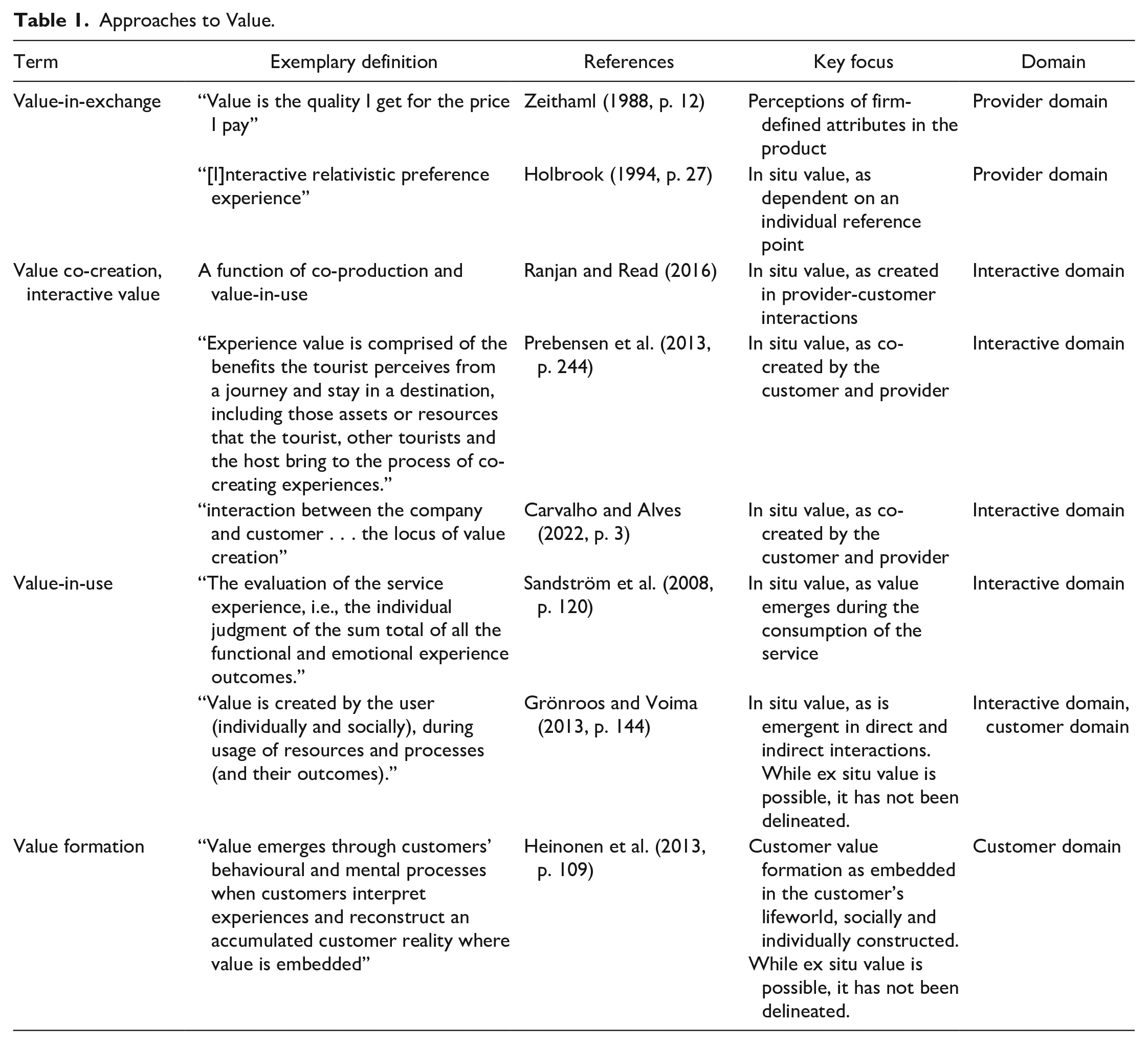
Firstly, the seminal value-in-exchange perspective highlights value as a unidimensional phenomenon involving the customer’s tradeoff between perceived quality and other psychological benefits and price including non-monetary sacrifice related to time, energy, and effort (Zeithaml, 1988). Other perspectives highlight value’s multidimensional nature, for example the “worth in monetary terms of the technical, economic, service, and social benefits a customer company receives in exchange for the price it pays for a market offering” (Anderson & Narus, 1998, p. 6), including functional, emotional, temporal, spatial, affective, and entertainment aspects of value (Chang & Dibb, 2012; Grönroos, 1990; Holbrook, 1994). In tourism research, service at the destination is commonly seen as the object of value (Buzova et al., 2021; Leong et al., 2021), involving affective and cognitive, social, and personal, as well as active and reactive elements (Gallarza & Gil, 2008). Essentially, while value is experienced by customers, it is still primarily defined and controlled by the provider and is manifested in the offering. It presumes that “products perform services that provide the relevant value-creating experiences” (Holbrook, 2006, p. 715) and that they form the basis of exchange value.
Secondly, value co-creation in the joint domain highlights the significant contribution of the tourist as a co-creator of value through on-site experiences and interactive encounter (Alves et al., 2016; Campos et al., 2018; Grönroos & Voima, 2013; Sthapit & Björk, 2020), manifesting what we label as in situ value. The seminal work by Holbrook has also been extended to value co-creation. With the exception of a recent study focusing on pre-travel co-creation (Eletxigerra et al., 2021), the co-creation perspective includes customer interactions and experiences with locations, events, destinations, and facilities (cf. Buzova et al., 2021; Getz & Page, 2016; Leong et al., 2021). The common assumption is still that value can be designed and managed by the tourism provider and that value creation occurs during the tourist’s on-site experience alone, either by interacting with the service or by applying the tourist’s own resources (Carvalho & Alves, 2022; Prebensen et al., 2013; Sahhar & Loohuis, 2022).
Finally, value can also emerge from factors beyond customer-provider interactions—such value emerging in the customer domain highlights customers’ everyday life with value emerging over longer periods of time (Heinonen et al., 2010; Malone et al., 2018; Nakata et al., 2019) that can be independent of or invisible from firms (Grönroos & Voima, 2013; Medberg & Heinonen, 2014). Hence, value is not based solely on customers’ experiences of provider-created elements. From a CDL perspective, as explained by Heinonen et al. (2013, p. 104), “the focus of value creation has changed from the company’s service processes having involved the customer, to in fact the customer’s multi-contextual value formation involving the company.” Rather than focusing on the interaction between the provider and the customer, the CDL is focused specifically on the customer as the primary stakeholder of the business (Heinonen & Strandvik, 2018) and the customers’ own lifeworld context outside the service provider’s sphere of influence. Essentially, value formation emerges from the continuously accumulating and changing customer reality and ecosystem, which is the system of actors and domains that the customer is involved with (Heinonen & Strandvik, 2018; Heinonen et al., 2013). Hence, while value can be deliberate and explicit, it can also be mental, imaginary, and even unreflective (Grönroos & Voima, 2013; Heinonen et al., 2013; Sahhar & Loohuis, 2022). Customers thus make sense of value in an iterative way that is grounded in their own personal logic and based on their previous value conceptions (Grönroos & Voima, 2013; Heinonen & Strandvik, 2015, 2018). Customers’ sensemaking, problem-solving, and attachment of meaning in a contextually determined way is therefore at the core of value within the customer-dominant logic (Heinonen & Strandvik, 2022; Heinonen et al., 2013).
Toward Ex situ Value in the Customer’s Lifeworld
In the aggregate, it can be argued that previous research deals with value created ex situ in the customer domain, but the handling of this view of ex situ value is implicit, diffuse, and primarily related to how customers use and interact with offerings and brands. The temporal and spatial scope of this conception of value is commonly confined to the tourist destination and on-site experiences. We, however, postulate that in the tourism context customer value expands beyond the provider domain to the customer’s lifeworld, in the form of ex situ value. The reference point of these experiences can be, for example, travel-related sensemaking in an online travel community.
Our literature review shows that ex situ conceptions of value are rare within the extensive body of value research. Research has overemphasized the dyadic customer-provider interaction in the investigation of value (Carvalho & Alves, 2022; Ramaswamy & Ozcan, 2018). This overemphasis is surprising when considering the value-in-use and social value creation among customers (Grönroos & Voima, 2013; Ranjan & Read, 2016). Indeed, service research has shifted from dyadic interactions to networks, ecosystems, and actor-to-actor co-creation (Akaka et al., 2015; Vargo & Lusch, 2016). This focus incorporates social, communal, and networked value (Edvardsson et al., 2011; Epp & Price, 2011); group-level experiences of tourism (Buhalis & Foerste, 2015; Rihova et al., 2018; Rojas-de-Gracia & Alarcón-Urbistondo, 2020); as well as systems of multiple actors in different communities, networks, and links (Muniz & O’Guinn, 2001; Schau et al., 2009). Yet, although value is seen as having both individual and collective elements (Heinonen et al., 2013; Macdonald et al., 2016), tourism value research still commonly emphasizes individual value. Therefore, we postulate that the perspective on ex situ value requires attention to be paid to both individual and collective experiences.
The preceding discussion addresses the current gaps in research with a particular focus on the tourism and travel domain, thus leading to the following research question: What constitutes individual and collective value for the customer when homing in on the customer’s own domain—in other words, on ex situ value outside of the tourism destination? In the next section, we apply a qualitative methodology to explore ex situ value in the empirical setting of an online travel community.
Methodology
We have conducted this research according to an abductive approach and systematic combining, which is particularly appropriate for theory development (Dubois & Gadde, 2002, 2014; Patton, 2002). Such a methodology is based on a continuous interplay between the theoretical framework and the empirical data. Therefore, certain theoretical preconceptions guide the researcher while empirical observations guide unanticipated issues; indeed, “the researcher by constantly going ‘back and forth’ from one type of research activity to another and between empirical observations and theory is able to expand his understanding of both theory and empirical phenomena” (Dubois & Gadde, 2002, p. 555). We conducted a qualitative, multi-method study of an independent, user-created online travel and tourism community. The study adopts a customer-dominant logic (Heinonen et al., 2010), which is especially suitable for exploring tourists’ experiences beyond the service interaction (Ben Gamra Zinelabidine et al., 2018; Rihova et al., 2013). It builds on the customer’s individual logic, which reflects their reasoning and sensemaking about appropriate methods of achieving goals and conducting tasks (Heinonen & Strandvik, 2018, p. 4). This methodological approach is in line with recent suggestions on the importance of qualitative online research (Pahlevan-Sharif et al., 2019), and it enables the narrative, reflexive exploration, and observation of how users construct personal meanings and emotions around tourism places and resources (Conti & Lexhagen, 2020). Thus, an online travel and tourism community is an appropriate reference point to explore ex situ value because it stimulates travel-related reflection outside the on-site experiences at a destination. The online community is approached in what Conti and Lexhagen (2020) call a valuing place, and these technology-enhanced destination experiences capture tourists’ extended destination value (Neuhofer et al., 2012). Moreover, given that online travel communities are not related specifically to specific tourism providers or any particular travel service, they represent loosely coupled and broad experiences around traveling. In this sense, the respondents’ sensemaking extends beyond reactions to one specific service (actual trip) or the general attitudes of customers.
Specifically, the ontological foundation is non-dualistic with a first-person perspective on value, where “the research focus is the experience as it is lived by the consumer” (Schembri & Sandberg, 2002). In so doing, we adopt a sensemaking approach “focusing on salient cues of an unfolding situation and developing them into a plausible narrative for what is going on” (Sandberg & Tsoukas, 2015, p. S9). Sensemaking has both constructivist and cognitivist nuances: “In its cognitivist version, sensemaking develops in actors’ minds through interactively forming convergent cause maps of a common situation; in its constructivist version, sensemaking develops by socially embedded actors enacting a world through language use, as they engage with a puzzling situation at hand” (Sandberg & Tsoukas, 2015, p. S9). It is in this interplay that we ground the notion of ex situ value by focusing on those cues that bound the respondents’ value conceptions emergent in the mental and social domains, as well as the physical and online domains through on-site interactions and online experiences.
Data Collection
Our multi-method approach consisted of semi-structured individual interviews and non-participant observation of community posts, which together provided rich insight into experiences in the natural context (Table 2). An interpretive, narrative approach is adopted by exploring online narratives where the participants mentally enter a world that a story evokes (Schembri & Sandberg, 2002; van Laer et al., 2014). Online communities have been used as research objects for exploring, for example, co-creation among football fans (Healy & McDonagh, 2013), distance-running (Chalmers Thomas et al., 2013), gambling and sports betting (Gordon et al., 2015), nature-based tourism (Conti & Lexhagen, 2020), and aviation enthusiasm (Seraj, 2012). This method enables the triangulation of the findings and strengthens the implications and contributions of the study.
Research Approach and Data.
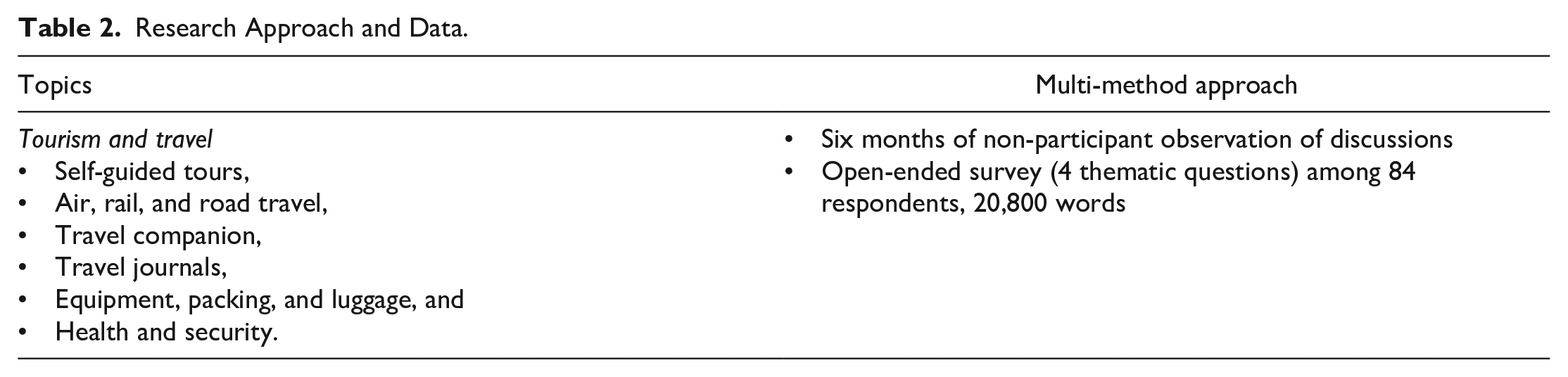
By providing the travel community with a link to the online survey, we enabled participants to recruit themselves. Vouchers randomly issued to respondents were used to incentivize participation. The online survey contained four thematic questions, each inviting narrative responses. The first question probed into the respondents’ reflections upon their initial joining of the online community. The second question asked respondents to reflect on their motives for visiting the travel community, while the third question focused on the respondents’ perceived relationship with the community. After that, the fourth question covered the respondents’ relationship with other members. The thematic questions prompted long answers—in most cases several sentences. Respondents also reported demographic data such as their age and gender as well as the frequency of their participation in the community, but we excluded these findings from the analysis. Moreover, in a similar vein to other studies on online tourism (e.g., Ben Gamra Zinelabidine et al., 2018), we adopted an unobtrusive approach by observing the content and themes of the discussion in the community (summarized in Table 2) and focusing on the users’ more general travel-related reflections. This indirect approach inspired by netnography (Kozinets, 2019) allowed for the formation of a rich narrative in relation to the study’s goals. We downloaded, coded, and sorted discussions about member experiences of tourism and traveling. The fact that the discussion threads have been available and retrievable online for an extended period of time enables the observation of historical artifacts over several years, thus improving the trustworthiness of the findings.
Data analysis
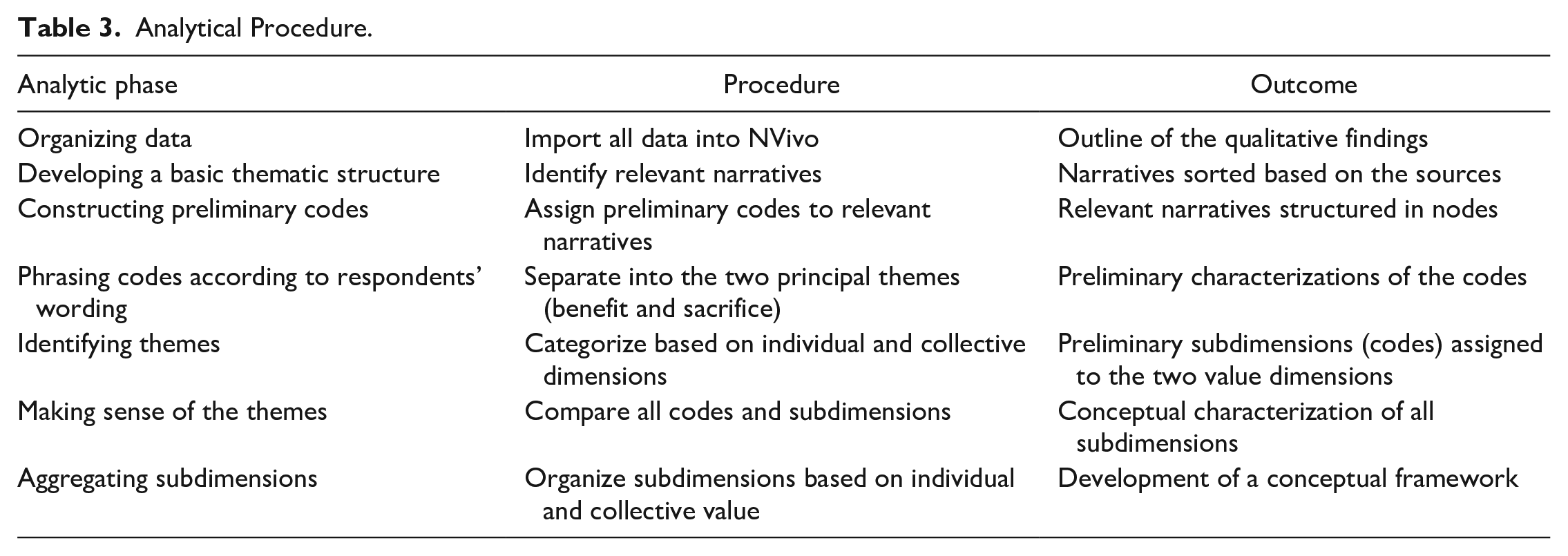
Table 3 summarizes the analytical procedure for organizing the narrative data. Following a thematic analysis procedure (Braun & Clarke, 2006), we coded and compared the narratives using the coding program NVivo, which enabled us to produce thematic codes (Braun & Clarke, 2006; Miles & Huberman, 1994). This thematic process sought to identify how the participants constructed value and to determine the ways in which ex situ value was present, or not, within these constructions. Following a study on online community value co-creation (Schau et al., 2009), we examined the narratives on the aggregate by locating major themes and multiple perspectives, recognizing similarities and differences between and within the narratives, and going across and beyond individual cases. The category codes were developed through the open-coding conceptualization and meaning abstraction of verbatim accounts (Miles & Huberman, 1994; Strauss & Corbin, 1998)—an approach suitable for theory building. In other words, in line with the concept of matching (Dubois & Gadde, 2002), the theoretical framework evolved beyond our initial preconceptions. This back-and-forth iteration between theoretical and qualitative insight resulted in a refining of codes. Thus, the focus was on ex situ value elements outside the tourism destination and individual and collective value.
Analytical Procedure.
Findings
The individual and collective value are described separately and further categorized into benefits and sacrifice that emerged from the data.
Individual Value
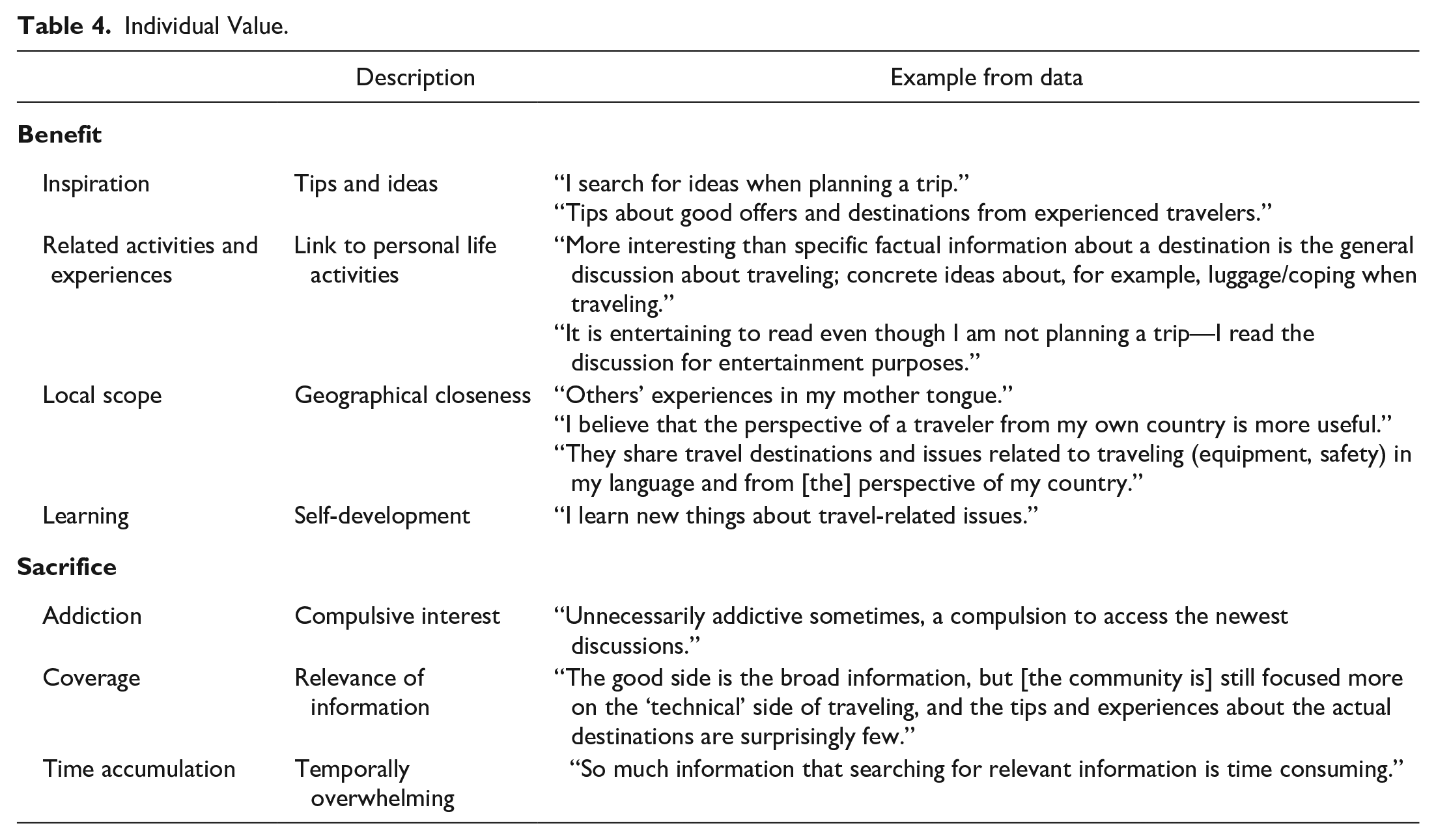
Individual value denotes value arising for individuals in their own contexts and it includes four benefits and three sacrifice subcategories (Table 4). It manifests in its everyday relevance and connection to the individual’s travel interests and aspirations. It also expands the individual’s knowledge beyond specific travel destinations and technical information, providing a platform for individual progress and improvement. The sacrifice, in turn, is related to factual content, revealing experiences as lacking in breadth or as being too rigid in terms of topics and perspectives. Another sacrifice was the coverage of content; while ideally relevant, it also resulted in a compulsive interest in new discussions, which in turn led to time allocation challenges.
Individual Value.
Collective Value
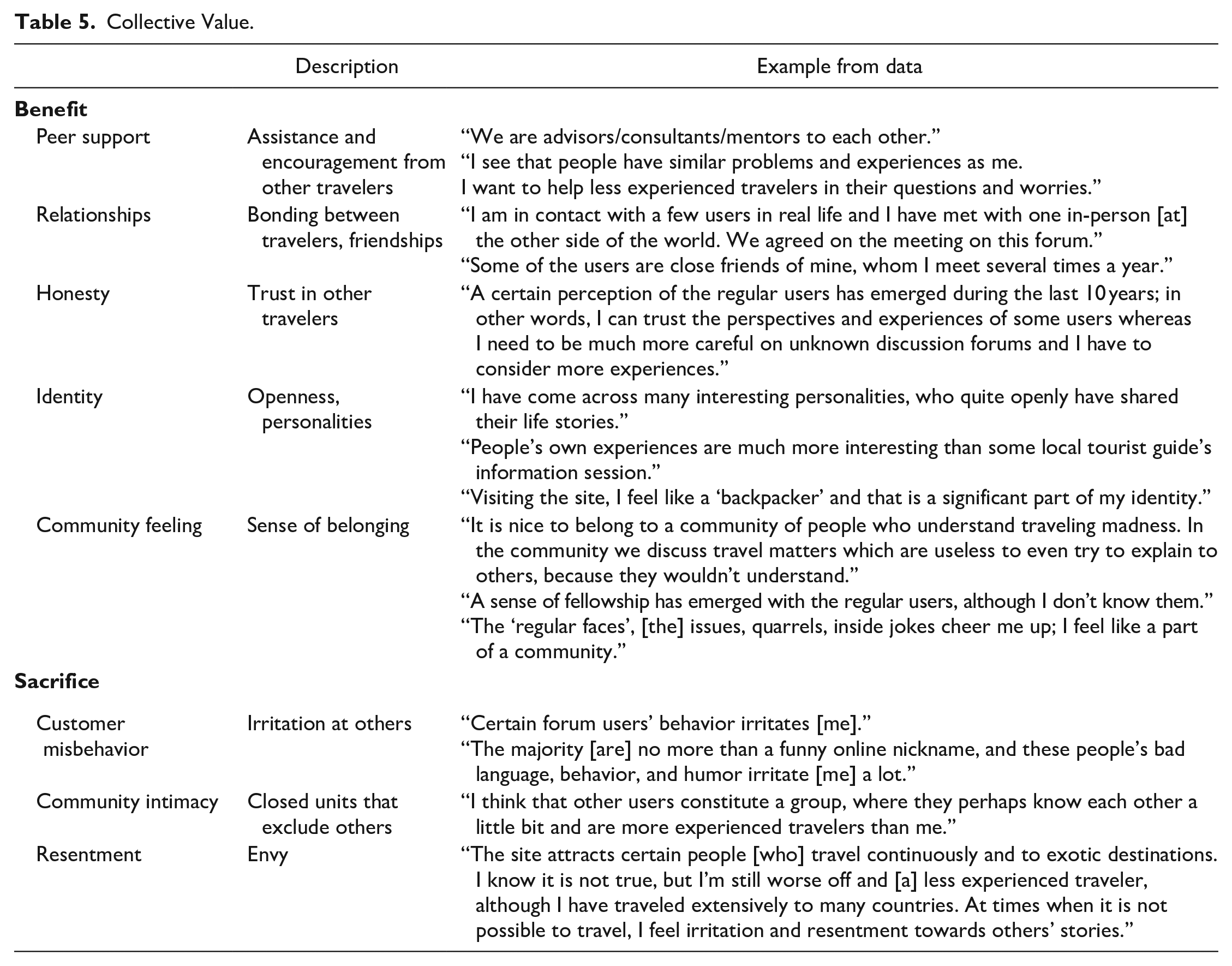
In relation to collective value, six benefits and three sacrifice subcategories denote the social aspects of this value (Table 5). Collective value highlights the importance of enjoying the company of likeminded people, the ability to share thoughts and experiences with others, interacting with a diverse range of people, and expanding the social circles of users. It also denotes being open- and broad-minded as well as promoting a positive discussion culture. Collective sacrifice, meanwhile, involves egregious behavior, either deliberate moralistic or argumentative behavior, or unintentional aggravation. It also relates to weak ties and negative emotions between users.
Collective Value.
A conceptual framework of customer value can be developed based on the theoretical foundation of ex situ value accompanied by the accounts of individual and collective value and then further deepened using the qualitative findings (Figure 1). This conceptual framework extends previous research by illustrating individual and collective value separated into benefit and sacrifice subcategories as manifestations of ex situ value in the customer domain.
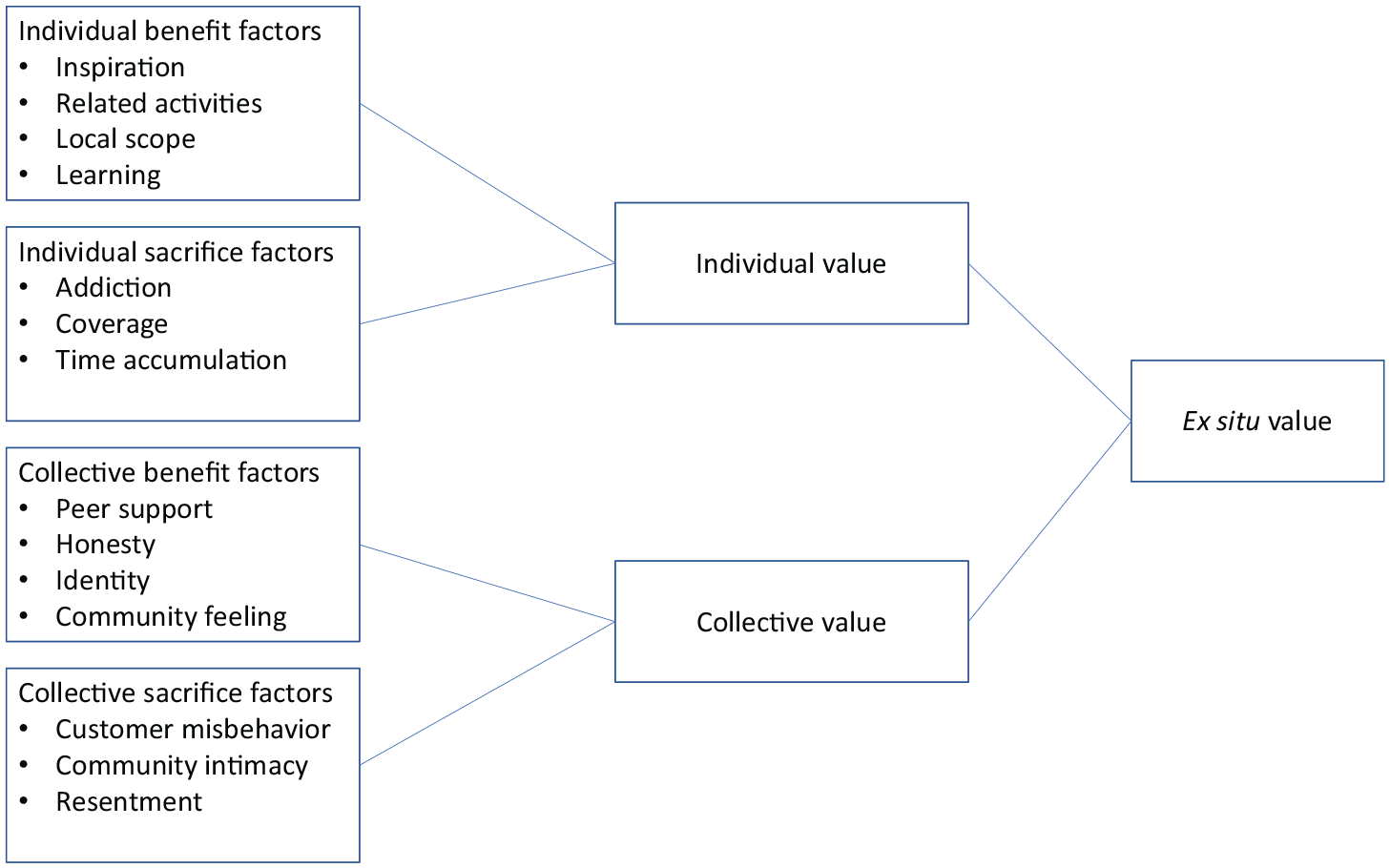
Ex situ value based on individual and collective value dimensions.
As indicated in Figure 1, ex situ value is based on individual and collective value dimensions. Premises are now outlined to illustrate the conceptual link between the components. The first set of premises relates to individual benefit, whereas the second set of premises relates to individual sacrifice.
P1. Ex situ value is a multidimensional construct that comprises individual and collective components.
P2a. Individual benefit is a multidimensional construct that comprises Inspiration, Related activities and experiences, Local scope, and Learning.
P2b. Individual benefit is positively related to individual value.
P3a. Individual sacrifice is a multidimensional construct that comprises Addiction, Coverage, and Time spending.
P3b. Individual sacrifice is negatively related to individual value.
The following set of premises is related to collective value: the first two refer to collective benefit, while the second two involve collective sacrifice.
P4a. Collective benefit is a multidimensional construct that comprises Relationships, Peer support, Honesty, Identity, and Community feeling.
P4b. Collective benefit is positively related to collective value.
P5a. Collective sacrifice is a multidimensional construct that comprises Customer misbehavior, Community intimacy, and Resentment.
P5b. Collective sacrifice is negatively related to collective value.
The study introduced and characterized ex situ value as being based on individual and collective factors in the customer domain. The qualitative exploration contributes to travel and tourism research by providing a more nuanced view of value in the tourism and travel context by homing in on the online travel community as a representation of ex situ value in the customer lifeworld domain. Here the online community is a representation and manifestation of the tourism and travel context, thus providing a concrete tourism-related reference point in the customer’s lifeworld. In the following, we synthesize ex situ value based on individual and collective value, separated into benefit and sacrifice subcategories (Table 6). Based on the findings, we develop three premises related to ex situ value.
Ex Situ Value and Its Components.

Conclusion and Discussion
Ex situ value is a phenomenon that extends beyond the interactions and co-creation activities of customers and providers. Based on the findings, ex situ value is defined as value that emerges individually through sensemaking and collectively through social interactions off-site in the customer’s lifeworld. The study findings suggest the following conclusions: (1) customer value also develops outside the scope of on-site experiences in the (lived and imaginary) realm of the customer; (2) customer value is based on a combination of individual level and collective components; and (3) customer value has both positive and negative characteristics, manifested as benefit and sacrifice. The notion of customer value as a phenomenon emerging in the customer lifeworld domain has several implications for tourism and travel researchers and providers. The key contribution of the present research is its interdisciplinary approach positioned in the tourism and service management domains. In line with Kock et al. (2020), the article bridges tourism and travel research with service research, thus contributing to an expanded view of the tourism experience. Next, we discuss the theoretical and practical implications of the study in greater detail.
Theoretical Contribution
A key theoretical contribution is the customer-dominant perspective on value in the tourism context and conceptual extension of previous research on tourism value through the explicit emphasis on ex situ value. Tourism and travel research is focused largely on provider-defined elements, that is, customer-company interactions and on-site experiences (Sthapit & Björk, 2020; Zhang et al., 2020), as well as tourist destinations and cultural areas (Pechlaner et al., 2002)—what we label in situ value. In contrast, this study highlights value occurring beyond the tourist destination and temporally beyond the interaction; that is, off-site and in customers’ own domain when reflecting upon and making sense of their traveling. As such, the customer-dominant perspective is essentially humanistic, focusing on the individual as a meaning-maker (Josselson & Lieblich, 2001; Lipkin & Heinonen, 2022) and in turn expanding the mental, temporal, and spatial scope of value beyond the tourist destination and on-site experiences. While some research explicitly focuses on pre- and post-travel value (Smith et al., 2015), such as pre-travel value co-creation (e.g., Eletxigerra et al., 2021), this study specifically highlights the notion of ex situ value created independently of tourism providers by revealing a nuanced array of value emergent in the lived and imaginary reality of the customer. As such, the study adopts a customer lifeworld approach to value focused on idiosyncratic sensemaking and thereby contributes to and deepens the understanding of customer-dominant value formation in service (Heinonen et al., 2010, 2013), particularly contributing to the customer-dominant understanding of tourism (e.g., Alakoski & Tikkanen, 2019; Ben Gamra Zinelabidine et al., 2018; Fan et al., 2020; Malone et al., 2018; Rihova et al., 2013, 2018).
Secondly, the study advances the understanding of value by combining and extending the social scope. To do this, it takes into account both individual and collective value and reflects upon the idiosyncratic combination and aggregated value of the two. Indeed, these experiences should not be viewed separately but rather as inherently intertwined. This combined characterization elaborates upon recent research on value in the travel and tourism literature (e.g., Gallarza et al., 2019) and furthermore extrapolates the research on customer perceived value toward both individual perceptions and collective experiences (e.g., Schau et al., 2009; Zeithaml, 1988). In so doing, it contributes to the group-level investigation of value (cf. Rojas-de-Gracia & Alarcón-Urbistondo, 2020) and independent value creation (Grönroos & Voima, 2013).
Moreover, the individual and collective value contributes separately to existing research. Individual value supports existing tourism research from the perspective of an individual’s perception (Sthapit & Björk, 2020) and sensemaking process (Heinonen & Strandvik, 2022; Heinonen et al., 2013; Sandberg & Tsoukas, 2015), which thus highlights the mental scope of customer value. As such, the study has important implications for consumer behavior both in the general sense and in the case of tourist decision-making, in the specific sense. These findings are well aligned with recent research on responsible consumption suggesting that consumer responsibilization involves viewing consumers as active moral subjects (Giesler & Veresiu, 2014). Similarly, for tourism, the research findings suggest that tourist responsibilization can be stimulated by pre-travel learning and inspiration as well as by peer support. The findings on collective value, in turn, indicate that customers influence each other during their interactions, both explicitly and implicitly. Whereas previous research emphasized the co-creation of value between customers and tourism providers (Campos et al., 2018; Eletxigerra et al., 2021), this paper reveals value emerging between and among customers. In this mode, the paper emphasizes tourist-to-tourist value creation (Adam, 2021; Rihova et al., 2013) as well as social value creation (Seraj, 2012). Generally, and in line with earlier research (e.g., Hallem & Barth, 2011), this study highlights the importance of the collective aspects of travel and tourism. The collective value highlights that tourism and travel can stimulate cultural understanding and diversity, while also facilitating the bridging of cultures and local structures.
Thirdly, the paper makes important advancements in regard to the conceptualization of tourism and travel value. The field’s literature frequently highlights the positive aspects of tourism and travel, such as its hedonic, social, and functional aspects (e.g., Adam, 2021; Gallarza & Gil, 2008). However, keeping in mind the classic perspective of value as a benefit-sacrifice tradeoff (Zeithaml, 1988), it is surprising that the negative aspects are largely missing. While some researchers have explored the negative aspects of tourism (e.g., Archer et al., 2005), the main focus has been on its societal, aggregate-level negative effects. Indeed, the notion of negative experiences and sacrifice associated with tourism on a customer level is yet to receive adequate attention. This study goes some way toward correcting that, revealing such negative aspects as manifested in the form of individual and collective sacrifice and relating especially to the relevance and applicability of the information on destinations and travel. These findings concur with customers’ negative or unfavorable feelings, thoughts, and behavior in the online community context (Naumann et al., 2020). Moreover, the results related to misbehavior and resentment provide support for recent findings on the negative aspects of tourist-to-tourist interactions (Adam, 2021). Building on this, it is likely that research into the dark side of tourism and travel will soon gain traction because of the continued turbulence and dynamism in different geographical areas, especially in the aftermath of the COVID-19 pandemic (cf. Martini & Buda, 2020). In fact, research is already focusing on the negative emotions associated with tourism such as travel fear (e.g., Hosany et al., 2021; Nawijn & Biran, 2019; Zheng et al., 2021).
Practical Contribution
This research has several important implications for tourism providers’ efforts to create value for customers. Our findings suggest that providers (including suppliers and intermediaries) should improve their ability to recognize individuals’ travel experiences ex situ—that is, in customers’ own domains—which often occurs long before a travel decision has been made. Online travel communities contain valuable information about sensemaking around tourism and travel, from which providers can gain insight into individuals’ interests in traveling and how traveling itself is integrated into and manifested in everyday life. For example, the findings about related activities and experiences encourage providers to highlight topics and interests supporting customers’ lives more holistically, rather than opting to enhance only on-site experiences at the destination, or, in situ value. The implication is that tourism managers need to recognize that in situ value is only part of the customer’s holistic conception of value. While the on-site provider domain is visible and controllable for the tourism provider, the off-site customer domain embeds deep-seated idiosyncratic needs, preferences, and group constellation dynamics and is therefore a more abstract concept for providers to grapple with. However, tourism providers can still make considerable efforts to contribute to ex situ value by recognizing the nuances of individual and collective value, as well as by accepting that customers may prefer only partial provider involvement, and therefore prefer ex situ value.
Specifically, the findings on ex situ value have important implications for tourism and travel providers. Individual value (such as learning) and collective value (such as peer support and honesty), are likely to serve as useful mechanisms for mitigating pre-travel jitters and the mental stress associated with traveling. Earlier studies have found that travel is associated with consumers’ travel risk perceptions as well as travel anxiety, outcome uncertainty, and safety concerns, each of which have escalated with the COVID-19 pandemic (Pan et al., 2021; Reisinger & Mavondo, 2005; Zenker et al., 2021; Zheng et al., 2021). These safety concerns can be mitigated by socially nudging individuals and strengthening their certainty and knowledge about the travel destination and culture of the holidays they are embarking upon, as well as indirectly influencing their behavior and decision-making during their travels. The study also contributes to the knowledge of inbound and outbound tourism, which carries implications for the sustainable development of the tourism and travel sector.
Importantly, tourism providers struggle with customer segmentations and recognize the need for meaningful customer groups (Gallarza & Gil, 2008). The research findings highlight the importance of tourists’ experiences at the local scope manifested in the online travel community, and this suggests that customer groups can be based on localized and focused segments; thus, emphasis should be placed on the links between individuals’ personal life activities and the broader life context in which the travel service is embedded. In a similar vein, the study results suggest that in addition to aggregate-level segmentation, it may be useful for tourism providers to emphasize idiosyncratic differences between customers. In other words, rather than stressing the similarities within a specific customer group, differences and distinct features can be highlighted, thereby supporting customers’ aspiration for individual relevance. This could be effectively facilitated by stimulating learning and inspiration in relation to activities and experiences only partly related to the focal travel provider by providing pre-travel training of specific hobby-related activities. Tourism providers should identify various opportunities to be part of customers’ pre-travel sensemaking and decision-making in order to become better aligned with customers’ travel-related goals and aspirations.
Limitations and Future Research Suggestions
In this study, we approached customer value in the travel and tourism context from an exploratory perspective with the goal of producing detailed and meaningful data. However, the study design we employed is not without limitations. We collected data through a qualitative, narrative methodology, and formed narratives representing the respondents’ feelings and experiences. While we were not interested in producing generalizable findings, we acknowledge that further research needs to evaluate the transferability of the framework to other empirical contexts and that a larger sample size should be used to further test the validity of our findings. The results we produced suggest several avenues for further research and managerial challenges. Importantly, the transferability and emergent properties of ex situ value represent an exciting agenda for future research. Ex situ value was empirically explored in the tourism context. Although it is unlikely that the proposed subcategories will manifest exactly alike in subsequent studies, the notion and general structure of ex situ value (including individual and collective value outside the destination and on-site domain) is evident and the results of this study and ex situ value are transferable on a general level to other service contexts. This is particularly likely when related to the consumption of intangible resources or services that enable customer-to-customer interactions in the customer’s lifeworld. For example, the COVID-19 pandemic enabled a vast variety of different services that traditionally have been delivered as part of the provider’s facilities, such as hair salons and restaurants (Heinonen & Strandvik, 2021), and consequently promoted and amplified the existence of ex situ value. The nuances of ex situ value in other empirical contexts provide a clear avenue for further research. Moreover, the focus on online travel communities as a representation of the ex situ context also presents some limitations. To develop a deeper understanding of ex situ value, the reference point in the travel community could be further expanded to other ex situ contexts, such as offline travel-related sharing and discussions among friends or to more explicit exploration about travel-related sensemaking and decision-making in the customer’s lifeworld. For example, how do customers interact and influence each other beyond the online community, such as by sharing travel-related experiences in domestic environments?
Furthermore, in this research, the focus on ex situ value primarily emphasizes physical or online value because the findings of the study are based on the respondents’ own sensemaking, with issues emergent in their own lifeworld. However, the travel and tourism industry is increasingly extending beyond its classic (physical) and online boundaries and emerging into a much more diffuse reality to also involve the metaverse. While this hyperreality and parallel reality metaverse is still speculative for tourism (Gursoy et al., 2022) and service research in general (Kozinets, 2022), this context represents a promising topic for future research for both customer value as well as the marketing discipline broadly. Moreover, this future approach is important because of its retrospective nature, with the sensemaking literature being criticized for neglecting the prospective nature of sensemaking (Sandberg & Tsoukas, 2015).
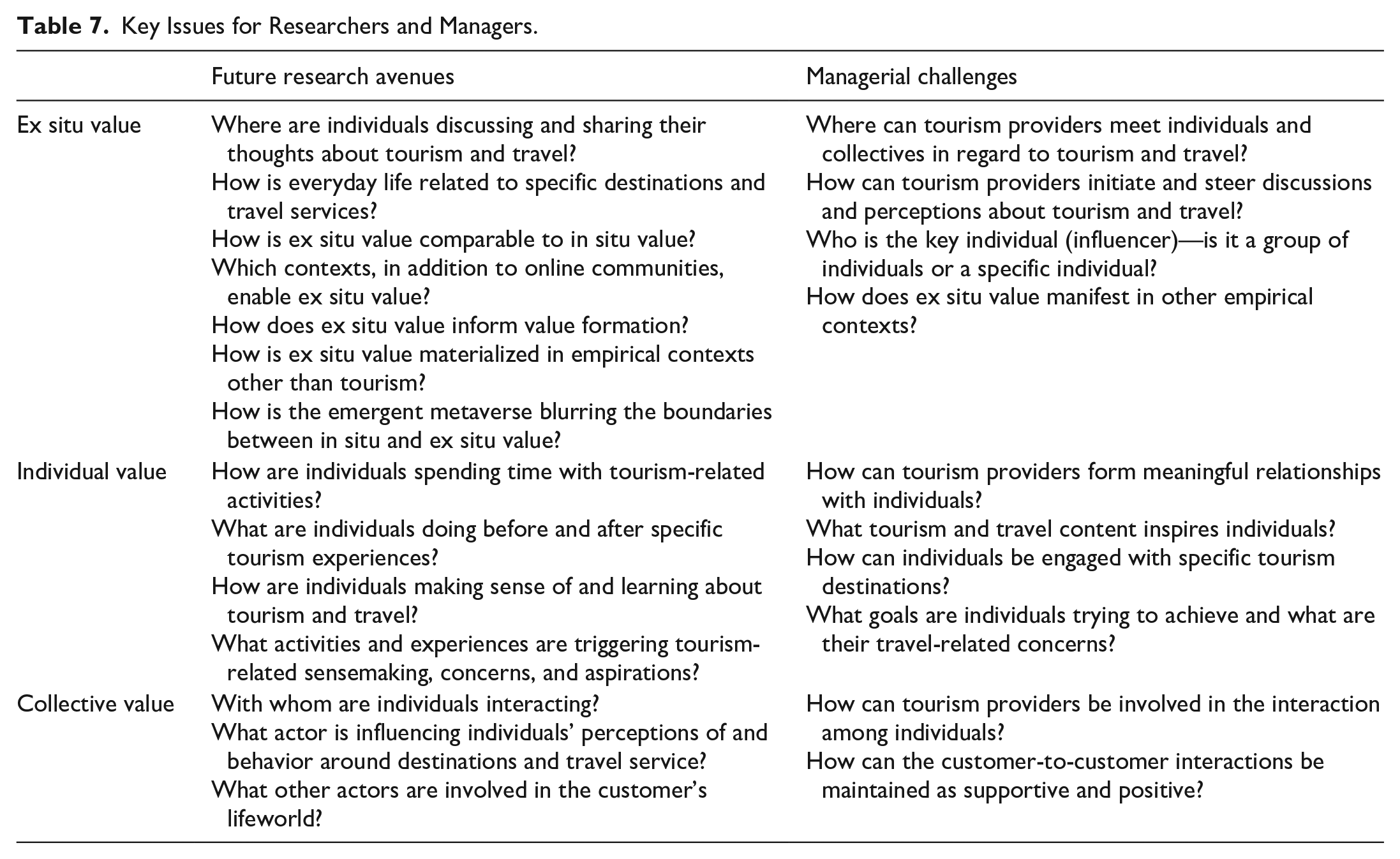
Finally, the conceptual notion of ex situ value involves a combination of individual and collective components with negative and positive features. Another future research topic is the negative nuances of value, as the negative experiences of tourism are likely to become accentuated following developments on the global scale, such as pandemics, humanitarian crises, and environmental challenges. The negative connotations are likely to be equally present for in situ value, and these should also be explored further. Table 7 delineates the theoretical and managerial avenues for future inquiry.
Key Issues for Researchers and Managers.
In conclusion, following the customer-dominant logic (Heinonen et al., 2010) the study coined and characterized customers’ ex situ value, shifting the attention away from on-site interactions and toward customers’ lifeworlds. This being said, the notion of ex situ value is different when seen from a true customer perspective. In line with the humanistic perspective emphasizing customers’ “values, actions, beliefs, motives, traditions, possessions, and aspirations” (Hirschman, 1986, p. 241), it can be argued that ex situ value in customers’ lifeworlds are not ex situ for customers, but in situ of life, and are emergent within their own contexts. In other words, ex situ value contrasts with the notion of value emergent in the service interaction on-site at the destination. For customers, all value should be relevant to improving their everyday life; in vitam cotidianam.
Footnotes
Declaration of Conflicting Interests
The author declared no potential conflicts of interest with respect to the research, authorship, and/or publication of this article.
Funding
The author received no financial support for the research, authorship, and/or publication of this article.
