




Abstract
Recently, researchers have begun to investigate the role of negative encounters, emotions and feelings in tourism and leisure activities. However, the temporal effects of negative encounters are still underexplored. This research consists of two studies that were conducted longitudinally. Study one investigated the overall visiting experience of 50 multi-generational Chinese diaspora tourists; study two interviewed 22 former participants who touched on negative experiences in their ancestral hometown eight years ago. Three scenarios of how these tourists re-interpreted negative affective encounters were identified. The findings suggest diaspora tourists’ perceptions of negative encounters transform over time, depending on their life trajectory, earlier experiences, attitudes, further exposures to Chinese culture and values, and the meanings they obtained from their negative encounters. This research is among the first to examine the temporal effects of negative experiences longitudinally, opening up for future considerations of the temporal contingencies of negative encounters in the tourism experience.
Keywords
Introduction
The rapidly growing number of international migrants and their strong desire to maintain closer ties to their ancestral hometowns have made diaspora tourism an increasingly important phenomenon. As a result, the recent tourism literature has seen an upsurge of interest in investigating the motivations, experiences, and consequences of diaspora tourism (e.g., Huang and Chen 2021; Li, McKercher, and Chan 2020; Otoo, Kim, and Stylidis 2021; Zhu 2020; Zou, Meng, and Li 2021). Studies have been undertaken to examine how diaspora tourism strengthens migrants’ place attachment (Li and McKercher 2016a) and ties to diasporic identity and culture (Mathijsen 2019), forges various types of social capital (Elo and Minto-Coy 2018; Li 2020), and enhances their life satisfaction and well-being (Li and Chan 2020). Diaspora tourism has been portrayed in most studies as a satisfying and self-fulfilling experience that can increase migrants’ hedonic and eudaimonic well-being, particularly when they experience displacement and challenges living in host societies. This over-glorification has made us question if there is a “dark side” in diaspora tourism where the home return travelers obtain more than just positive host-guest interactions and happy memories but a more complex affective experience in their long-lost hometown.
Indeed, studies suggest that diaspora members may display place and cultural distances from their roots due to significant differences in personal identity, place attachment, values, beliefs, and cultural practices (Li, McKercher, and Chan 2020). Such distances may cause different extents of conflicts in their ancestral home which could challenge their values and perceptions and engender greater psychological or emotional barriers against their ancestral home and community. In some cases, generational migrants whose ancestors left home several generations ago may have lost contact with their roots for a long time, and they are likely to lose physical connections to their authentic roots (Ioannides and Ioannides 2006; Li, McKercher, and Chan 2020). These members may not be able to connect with their clan members emotionally due to cultural differences and communication barriers (Timothy and Teye 2004). Together, these issues will result in conflicted feelings of doubt, mistrust, pain, stress, powerlessness, incapability, bitterness, disappointment, regret, shame, and guilt during and/or after their visit, and some tourists may feel like an “outsider” visiting a “foreign country” (Ioannides and Ioannides 2004; Timothy and Teye 2004).
However, how diaspora tourism evokes conflicted affective feelings and in what ways diaspora tourists perceive their negative experiences over time are still unknown. In many studies, affect has been conceptualized as very similar to emotions. Even though there is an increasing amount of research that examined the fleeting quality of tourists’ emotions (e.g., Gao and Kerstetter 2018; Lin et al. 2014; Nawijn et al. 2013; Prayag et al. 2017), the focus is still on the instantaneous emotional responses in real time or shortly after the trip (Hosany, Martin, and Woodside 2021; Kim and Fesenmaier 2015; Nawijn et al. 2013). The long-term effects of affective encounters have not been investigated sufficiently. In the context of diaspora tourism, return travelers’ affective encounters may pose a long-term impact on migrants’ personal identity, place attachment, and well-being (Li and Chan 2020). As such, it is prominent to take into consideration of a longer timeframe to examine how diaspora members confront, live with and (re)interpret their negative encounters.
This research aims to extend the current debates over the relational power of negative affect (Baumeister et al. 2001) and the nuances of negative human experience (Shiota, Sauter, and Desmet 2021) in tourism scholarship. We draw on Adam’s (2008, 2013a, 2013b) view of timescapes and use a longitudinal design to explore how Chinese multi-generational diaspora tourists perceive their negative affective encounters in ancestral homes across eight years. Two studies were conducted during the periods of 2012–2013 and 2020–2021. The research objectives are threefold: (i) exploring how diaspora tourists confront and interpret their negative affective encounters in home return travel; (ii) unveiling whether and how they re-interpret their negative affective encounters over time; (iii) discussing the role of negative affect in diaspora tourism experience. In achieving these objectives, we aim to contribute to the current debate on the role of tourists’ negative experiences, events, and feelings and open up new discussions on the temporal effects of negative affective experiences in tourism.
Literature Review
Growing Prevalence of Diaspora Tourism and its Marginalized “Dark Side”
Diaspora tourism, conceptualized as the tourism produced, consumed, and experienced by diasporic communities (Coles and Timothy 2004), has attracted growing interest from both scholars and practitioners in the last two decades. We have seen growing scholarly attention to the motivations, experiences, and impacts of diaspora tourism within diverse cultural contexts, such as the Chinese diaspora (e.g., Huang and Chen 2021; Li and McKercher 2016a, 2016b; Zhu 2020; Zou, Meng, and Li 2021), the African diaspora (Otoo, Kim, and Stylidis 2021; Timothy and Teye 2004), the Scottish diaspora (Basu, 2007), the Jewish diaspora (Corsale and Krakover 2019; Ioannides and Ioannides 2004), the Indian diaspora (Hannam 2004), and so forth. It is universally believed that diaspora tourism plays a vital role in strengthening immigrants’ ancestral ties and increasing their self-esteem, life satisfaction, and well-being over time. For example, recent studies have focused on how positive travel encounters shape diaspora tourists’ place attachment, social connectedness, and subjective well-being (Huang, Hung, and Chen 2018; Li and Chan 2020; Li and McKercher 2016a); and how home return travelers’ nostalgic memory and affective arousal positively affect their place identity, place dependence, and social bonding (Otoo, Kim, and Stylidis 2021; Zou, Meng, and Li 2021). However, the “dark side” of diaspora tourism seems to have been marginalized. We may have been overly attracted by positive encounters and emotions that occurred in diasporic return and overlooked the challenging part of this type of tourism, in terms of how diaspora members face the conflicts caused by different values, beliefs, cultural practices, and social norms.
Studies have suggested that diaspora members may display generational and cultural distances from their roots due to different levels of assimilation, place attachment, and personal differences in identity, values, beliefs, and cultural practices (Li, McKercher, and Chan 2020). Usually, the longer the generations are apart, the more likely they face challenging situations at ancestral homes. Migrants of distant-generations may not easily reconnect with the local community but have to cope with affective conflicts caused by their differing values, beliefs, and daily practices (Li, McKercher, and Chan 2020). For instance, studies highlighted that the African diaspora’s return visit contained sad, painful, and emotionally overwhelming experiences as well as feelings of forgiveness and healing, reflecting a deep and personal encounter with the place where their ancestors were tortured, killed, and forcefully displaced (Timothy and Teye 2004). Some diasporic members found it difficult to connect emotionally to the place or local community and felt rather alienated from their ancestral past (Ioannides and Ioannides 2004). Some younger generations of diaspora members such as the Vietnamese Americans have to deal with traumatic experiences which were entangled with their familial memories of the dislocation and war. This echoes with a small body of research on return migration (Black and King 2004; King and Christou 2010), that many temporary or permanent returnees struggle to cope with the changes taking place at home, and their idealized memories become frozen in the past in a “nostalgic time-warp” (King and Christou 2011, 460). As such, sociocultural transformations that occurred in both host and guest societies, such as ideologies, cultural values and beliefs, political systems, and so forth, will further shape the return diasporas’ affective encounters and host-guest interactions. Australians or Americans of Scottish descent whose ancestors settled and became part of the dominant culture of the host societies would not display as strong cultural differences as those from other distinguishable cultures (Basu 2007; Bhandari 2016). Together, these factors, entangling with time and distance, will affect how diaspora members confront, live with, and (re)interpret their encounters at home, and how such encounters transform personal interpretations of ancestral homes, identities, and their travel and meanings.
The Relational Power of Negative Affective Experience
To further attune to the complex nature of affective experience in diaspora tourism, we draw theoretical insights from a multi-disciplinary body of literature in geography, neurosciences, psychology, and behavioral science. Human geographers conceptualize affect as the potential and transpersonal capacity a body has to affect and be affected (Massumi 2002). Affect plays an essential role in determining the relationships between human bodies, environments, and objects, having the power of “going beyond the strength of those who undergo them” (Deleuze and Guattari 1994, 164). It is believed that without affect, our feelings and emotions would not have sufficient intensity to dissolve into subjective experience (Deleuze and Guattari 1994). In several influential studies, negative affective experience has shown its strength in influencing people’s memories and behaviors. Kensinger, Garoff-Eaton, and Schacter (2007) found that negative affect and feelings evoked by negative events or objects could enhance human memory for certain types of details through enhancing visual processing. Negative situations activate a human’s adaptation mechanism, as negative affect and emotions specify a need to initiate the process of self-regulation through which people adaptively respond to their physical and social environments (Baumeister et al. 2001). More importantly, negative experiences linger for a relatively long time to prevent people from repeating the same mistakes and falling into similar situations (Luhmann et al. 2012). As Baumeister et al. (2001, 357) have argued: “If satisfaction and pleasure were permanent, there might be little incentive to continue seeking further benefits or advances.”
In the psychology literature, there has been a rich discussion on how challenging experiences and emotions could play a positive role in one’s life and thus enhance subjective well-being. For instance, studies found that one could achieve a higher level of eudaimonic well-being once he/she reached a goal or gained a new skill after years of hard work, even though the process is not purely fun or relaxed (Ryan and Deci 2001; Ryff and Singer 2008). Some individuals consider going through negative events or emotions as an essential path toward personal growth and flourishing, as such experiences help to provoke personally important meanings and purposes, and consequently enhance self-acceptance, personal growth, and flourishing (Fredrickson and Losada 2005; Ryff and Singer 2008). In some cultural contexts, suffering and struggling during hard work are taken as more important than seeking pleasure and hedonia. For instance, Chinese traditional culture deeply believes in the saying that “to be a great man who is bestowed with great responsibility, your spirit and will must be frustrated; your muscles and bones must be exhausted; your body and flesh must be starved 1 .” Likewise, studies in behavioral science reveal that, in many cases, negative affective encounters were not completely negative, because they could enrich the product experience for customers and tourists (Fokkinga and Desmet 2013). For example, Fokkinga, Desmet, and Hekkert (2020) highlighted some thrilling experiences (e.g., a dangerous bus journey may start with fear but evoke immediate excitement, feelings of being alive, and a sense of pride in survival) could become an exciting encounter and an amusing tale to tell after the trip.
More tourism researchers began to challenge the conventional thinking on the absolute associations between negative affect or emotions and tourism satisfaction. Many have provided evidence from a variety of tourism contexts that negative encounters during the trips would not adversely influence tourists’ engagement, satisfaction, or subjective well-being. For instance, dark tourists would engage more deeply with the dark historical discourses of death, suffering, and atrocities, although some of their encounters were uncomfortable and painful (Oren, Poria, and Reichel 2022; Yan et al. 2016; Zheng et al. 2020). Visiting disaster sites (Martini and Buda 2019) and attending volunteer tourism (Driessen 2022; Gius 2017) and pilgrimage trips (Yousaf 2021) will usually evoke challenging and complex feelings (e.g., love and hate, anger and forgiveness, guilt and gratefulness, sadness and appreciation, shame, and reconciliation), but the tourists could also gain a much richer understanding of the local history and themselves by constantly coping with the “pains of others” and/or “pains of self.” Other evidence was provided about how negative affect or emotions could lead to positive consequences (Riediger, Wrzus, and Wagner 2014) for both tourism destinations and individuals. For instance, a sense of guilt and sadness may facilitate pro-social behaviors (Baumeister et al. 2007); feelings of sadness, anger, and fear can facilitate pro-environmental behaviors among consumers (Juvan and Dolnicar 2014).
The Role of Time in Tourists’ Affective Encounters
In a series of writings, Adam (2008, 2013a, 2013b) emphasizes the significance of timeframe for observing an effect. She argues whether we can see any patterns of changes is relative, depending on what temporal framework we use for our observations. Using different time scales to examine the effects of affective encounters may lead to varied results (Nordbakke and Schwanen 2014). Indeed, multi-disciplinary studies have been using longer timeframes to examine negative experiences, emotions, and their consequences. For instance, Walker, Vogl, and Thompson (1997) analyzed their participants’ evaluations of a negative and positive experience at intervals of 3 months, 1 year, and 4.5 years, and revealed the affective intensity of negative events faded as time progressed. Their findings suggested that people’s evaluations of negative events and experiences would change over time, and such changes could be better observed over a longer timeframe. This also coincides with the psychological features of human beings that people hope to diminish the emotional intensity of a negative event in order to reduce its subsequent influence (Berntsen, Rubin, and Siegler 2011); and sometimes, the recall of negative events may reflect a positive bias (Mitchell et al. 1997), whereby memories of the events and their feelings may provide inaccurate accounts of their experiences, mitigating assessments of such negative encounters. In the Chinese philosophy of Taoism, what was once considered as bad encounters may not remain negative for one’s life forever. As Laozi (老子), the Chinese Taoist philosopher, argues in understanding the complex relationship between good and bad, happiness and unhappiness, well-being and ill-being in his well-known dialectical view: “A blessing may be depending on misfortune; misfortune may be a blessing in disguise.” 2
The current tourism literature has mainly focused on measuring visitors’ instantaneous emotional responses during or shortly after the visit (Kim and Fesenmaier 2015; Oren, Shani, and Poria 2021; Shoval, Schvimer, and Tamir 2018; Zhu 2020). This may be because tourists’ emotional responses have been considered as short-lived, intense, and instantaneous against the stimuli of their visiting environment (Nawijn et al. 2013). Although an increasing number of studies began to investigate the fleeting quality of emotional experience, for instance by tracking participants’ experienced emotions for certain days or intervals (e.g., Gao and Kerstetter 2018; Nawijn et al. 2013) or extending the timeframe of observation to before the vacation, one week, and four weeks after the trip (Lin et al. 2014), much of this literature still concentrated on emotional responses and how they changed throughout the traveling experience (Hosany, Martin, and Woodside 2021). Although advanced strategies or methods (e.g., experience sampling method) have facilitated researchers to obtain repeated assessments of participants’ emotional responses within specific time intervals (Shoval, Schvimer, and Tamir 2018), the delayed effects over a longer timeframe are still unknown. Tourists’ affective engagement in their destinations and its consequences could be more complex than previously thought. The affective experience could be long-lasting, some of which may stay with the tourists for a much longer time and affect their future life and purposes.
Therefore, more tourism scholars call for going beyond the currently used time scale to examine more closely the role of negative encounters with particular attention to the complexity of how people interpret their negative experiences after the visit (Hosany, Martin, and Woodside 2021; Nawijn and Biran 2019). After years, how tourists think about their affective encounters could be closely associated with what they had expected from the trip, the nature, meaning, and context of the trip, the strength of their affective experience, and its evolved meanings over time. But more importantly, the consequences of negative encounters could be shaped by personal differences in one’s identity, sense of place, coping experience, and personality (Klaaren, Hodges, and Wilson 1994). How these factors independently or in combination affect the consequences of a negative affective encounter will be the main issue to address in this research.
The Chinese Diaspora Community and Their Home Return Travel
This study is situated in the Chinese context of international migration, Chinese diaspora communities and their home return travel. The Chinese diaspora, as one of the largest migrant groups in the world, has reached the number of 60 million living in more than 150 countries (Zhou 2017). Since the mid-1900s, several key migration waves were recorded from Southern China and for a very long time, thousands of Cantonese and Fujianese were brought to North America to work as miners and railroad builders. Not until recently have we seen a burgeoning body of research that examines the travel experiences of the Chinese diaspora and how their return travel shapes identity, place attachment, cultural connectedness, and social capital building (e.g., Li 2020; Li and McKercher 2016a; Weaver et al. 2018). Emphasis has been placed on the investigations of Chinese diaspora members in different generations and how generational distance affected their place attachment and subjective well-being (Huang and Chen 2021; Li and Chan 2018). This research builds upon this body of literature and aims to advance the debates on the role of diaspora tourism by looking at the negative visiting experience of this ethnic group and the longitudinal effects of negative encounters at home.
Methodology
A Longitudinal Research Design
This research adopted a longitudinal design to look closely into the changing interpretations by Chinese diaspora tourists who subjectively experienced negative affective moments during their home return visit. Drawing on the paradigm of interpretivism which takes people’s experience as complex and dynamic realities, we conceptualized affective experience as unique representations that were personally and subjectively constructed by both researchers and participants (Willis, Jost, and Nilakanta 2007). To better attend to this subjective and dynamic nature of people’s feelings and perceptions, we framed this research into two qualitative studies across eight years. As a novel means in diaspora tourism studies, the longitudinal design allowed us to collect data over two distinct periods of time and analyze and compare data of two periods (Hermanowicz 2013). Applying this design facilitated us to study how our subjects responded to time and development and changed their personal narratives over time. More importantly, the frequency and interval of conducting serial interviews in a longitudinal design will vary from study to study, depending on the given research problem (Hermanowicz 2013). For instance, medical studies often use relatively short time interval (e.g., three months) and large number of successive interviews to follow more closely patients’ illness. However, a longer time interval may pose risk of involuntary participation. Given that most of our participants were over 50 in their first interview, and diaspora individuals’ feelings and perceptions might be stable over time, a timeframe across seven to eight years could be appropriate for observing any relevant changes.
Study one was conducted between 2012 and 2013. Multiple fieldtrips were conducted to Jiangmen Wuyi 3 and the main destinations of settlement 4 for earlier Chinese immigrants. Starting from the researchers’ personal network, we contacted several major Chinese immigrant associations 5 in China, and used purposive and snowball sampling techniques to recruit interviewees from the Chinese diaspora community. Referrals from earlier participants enabled us to reach more diaspora members especially the generational members who had successfully assimilated into the host society. Finally, 50 individuals from the Chinese diaspora communities in America, Canada, UK, Japan and Brunei were recruited. They had returned to their ancestral home at least one time before our investigation (Table 1 participants’ profile).
Profile of Participants in Study 1.
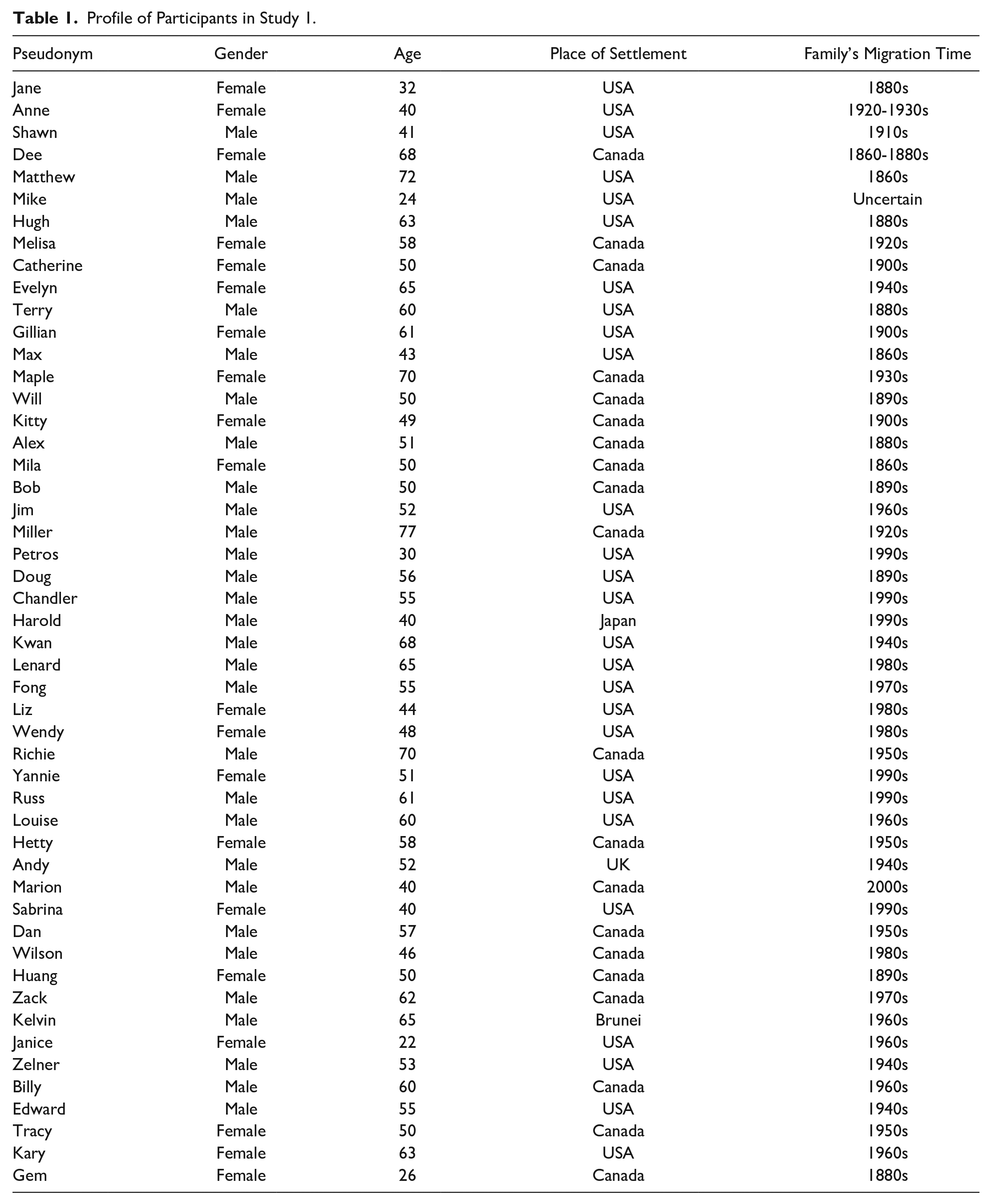
In-depth interviews lasted from 1 to 2 hours were undertaken to collect narratives on home return experiences and the perceived impacts. The interviews were recorded and transcribed except for one participant who refused to be taped. The main purpose of study one was to collect these individuals’ overall return experience. Thus, to allow them to articulate the events, moments, and themes which were of significant value to themselves, the in-depth interviews were semi-structured with ice-breaking and open-ended questions surrounding their return travel experiences, including when, why and how they conducted their home return travel, memorable events and encounters in their ancestral village, and the impacts of their travel. Once the interviewees raised an important issue, we used follow-up questions to encourage them to articulate more about their feelings and perceptions.
Study two was conducted from the end of 2020 to mid-2021 with the main purpose of examining whether and how diaspora tourists changed their interpretations of negative encounters after eight years. Our ambition was to interview the participants who had touched on negative encounters in study one. However, the process of reconnecting with our participants was very challenging, since some had changed their contacts and inconvenience of conducting fieldwork due to Covid-19 pandemic. Finally, we were very fortunate to reconnect with 22 participants who were willing to participate in the study again. All interviews in this stage were conducted virtually via Skype, Zoom or Microsoft Team Meetings according to participants’ preferences, and were recorded with participants’ consent. In-depth interview questions of this study were actively structured around three key themes: negative encounters in ancestral village; how they were affected by these encounters then and now (affect and feelings); and the impacts of these encounters on their lives.
Throughout the two studies, several actions were enacted to increase researchers’ sensitivity while enquiring negative experiences and events. Researchers were aware that participants should be free to choose any piece of encounter they prefer and elaborate any personally important encounters to us during their story-telling. Before the interviews, we informed that they could stop whenever they felt uncomfortable; and their personal information and narratives would be kept safely and anonymously and only used for research purpose.
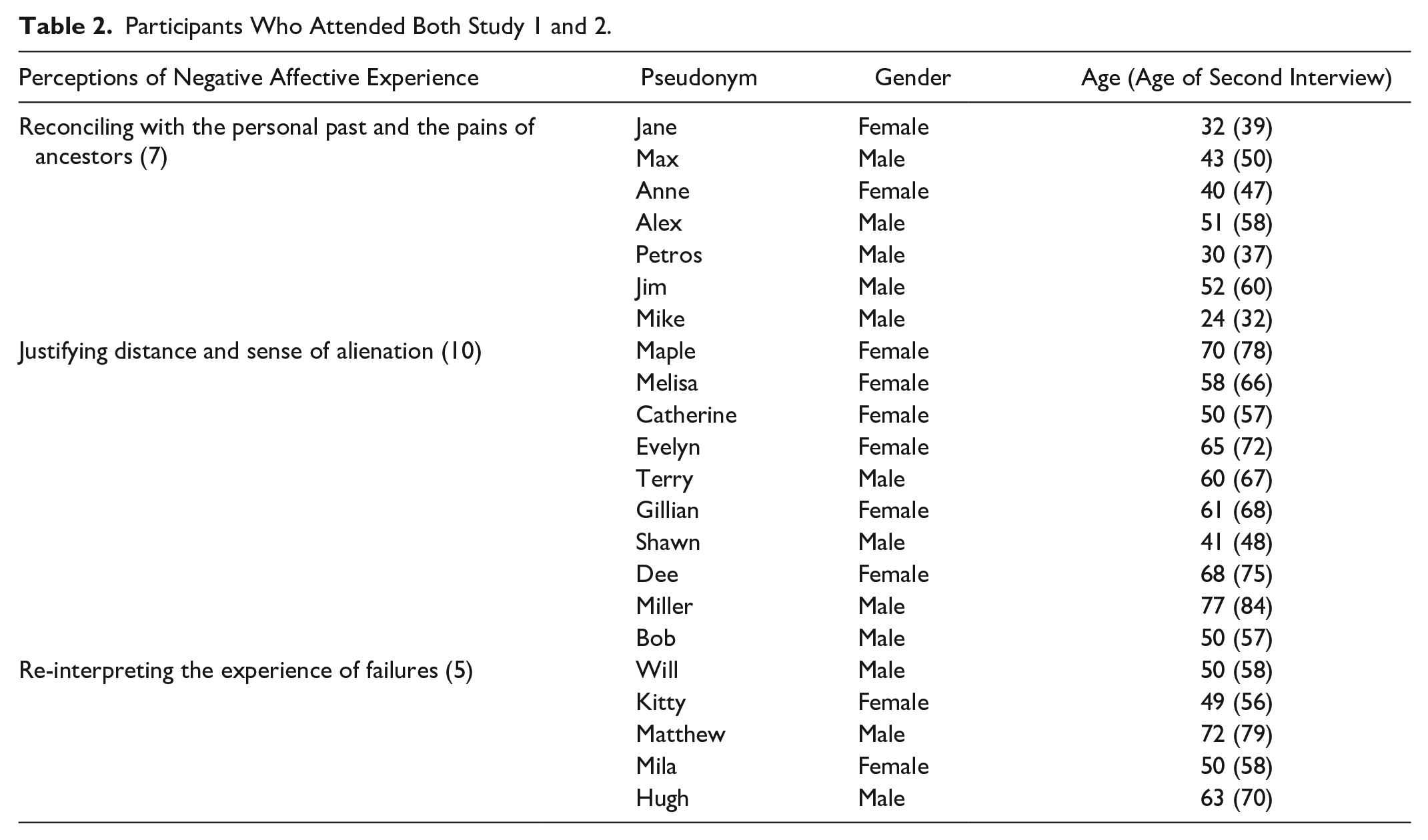
The findings and analysis of this paper are based on 44 interviews with 22 Chinese immigrants (lasting three to four hours in total), 10 female and 12 male, aged 37–84 years old at the point of the second interview (Table 2). To better ensure their anonymity, their names were changed to alias.
Participants Who Attended Both Study 1 and 2.
The Affective Potential of Voice in Qualitative Research
Qualitative researchers from multiple disciplines (e.g., Gallagher 2020; Jackson and Mazzei 2008; Mazzei 2013; Stevenson and Holloway 2017; Stone and West 2012) have initiated the debate on the potential of voice to capture people’s affect and feelings, questioning our current practice in qualitative research of largely relying on the transcribed texts to generate meanings. In most studies, voice has been reduced to written text and listening has become a practice of transcribing. The speakers’ tone, mood and manner of speaking that come along with their voice were too often being overlooked and their affect and feelings that were embedded in their voice features disappeared from our qualitative analysis (Gallagher 2020). Under such practice, we may have missed some very important and hidden messages from our interviewees underlying their transcribed narratives. Indeed, in the context of diaspora tourism, migrants may produce deep interpretations of meanings along with both the contents of narratives and the voices of describing their experiences. Particularly when we want to further explore their negative affective experiences, we need to rethink the materiality, affective capacity, and the more-than-representational potentials (MacLure et al. 2010; Mazzei 2013) of their voices used articulating personally important moments. As Kanngieser (2012) asserts, human voice is “more than a conduit for the transfer of information. . .the voice, in its expression of affective and ethico-political forces, creates worlds” (p. 337). As such, to attune to the affective potential of voice in qualitative studies, we propose to adopt an advanced data analysis method—Text-Voice Archive Analysis (TVAA)—which combines the analysis of participants’ voice with content analysis of transcribed narratives. The TVAA of this study comprises the following three stages.
The first stage was a preliminary coding process, during which the documentary and voice archives were built for each interviewee under their pseudonyms. Their documentary archives are transcribed narratives from interview recordings and two types of labels were produced to signify significant affective episodes (SAE) and significant themes (ST) that can be related to each episode. Precise starting time and duration of each episode were noted down. Meanwhile, a voice archive was built for each interviewee. We used the voice editing software Adobe Audition to manage interviewees’ voice archives, highlighting salient voice vignettes of each piece of audio recording and linking these vignettes to STs and SAEs in documentary achieve. By doing so, a volume of text and voice data was generated in a participant-based structure, under which researchers could relate to different textual and vocal narratives, episodes, and themes very effectively during the following analysis.
The second stage was undertaken for generating the preliminary patterns of how participants reinterpreted their negative affective experiences from in-depth analysis of their two data achieves. Here, special attention was paid to similarities and changes in the participants’ narratives. During this stage, we particularly attended to human voices, such as tone, manner and mood of speaking, relaying accent, rhythm, cadence, hesitations, laughter, happiness, etc. in terms of how they registered a level of detail beyond what we presumed from textual transcription. Voice descriptions were produced and attached to transcripts for identifying patterns. Importantly, to avoid falling into narcissism in analyzing participants’ voice features, the voice descriptions were shown to our participants for approval in order to prevent us from over-stating their voice expressiveness. Changes were made according to their feedback.
The third stage was for finalizing patterns by revisiting the documentary and voice data of each case, revising and justifying each pattern by linking to all relevant cases until final patterns were achieved. This stage concerned logic, coherence and accurateness of the classifications. At the end of this stage, textual narratives and vocal descriptions were incorporated to the presentation of the final patterns.
This approach is among the first to analyze both textual and vocal data in qualitative inquiries of diaspora tourism experience. This technique enabled the researchers to attend to the extralinguistic aspects of voice in their analysis (Gallagher 2020) by registering and relaying the physical vibrations of the material and intensifying “sonic affects” of interviewees’ narratives. By doing so, we were able to unveil deeper affective engagements underlying each transcribed text by linking significant themes back to voice episodes extracted from the recordings (Gallagher, Kanngieser, and Prior 2017). We can truly hear the sounds of their voices to understand more deeply about how they coped with, perceived, and made sense of their encounters.
Academic Rigor and Trustworthiness
A number of techniques were used to ensure academic rigor and trustworthiness. Firstly, to ensure data trustworthiness, we collected data from different geographical locations and through multiple associations. For instance, in study one, participants were recruited through Chinese immigrant associations from different locations including Jiangmen (mainland China), Los Angeles and San Francisco (the US), and Vancouver (Canada). In doing so, we reached a diverse group of Chinese diaspora members with different migration histories and family background. Secondly, we paid special attention to data triangulation and research triangulation for yielding meaningful results. For example, a pilot study was undertaken in prior to the main data collection period, during which the interview questions were tested by two Chinese migrants and two diaspora tourism scholars. Two authors first worked independently to generate preliminary findings and then discussed those patterns with typical cases and themes throughout the data analysis stage until final patterns were achieved. Thirdly, to ensure transferability and dependability, we provided the detailed descriptions of the research process, context, and data analysis in the paper and appendix, helping readers transfer the findings or research methods to other studies.
Findings
This section presents the results from analyzing negative affective episodes of 22 Chinese diaspora tourists. Special attention was given to the complex and heterogeneous ways of reinterpreting negative affective encounters in ancestral villages. Three scenarios of how diaspora tourists interpreted their negative affective encounters were elaborated with examples.
Reconciling With the Personal Past, Family Heritage and the Pains of Ancestors
Several participants elaborated some of their difficult feelings of pain, guilt, regret, and shame when they recalled negative affective encounters at ancestral home. They shared common experience with pains and struggles when they were young, when they had to struggle a lot to assimilate into the host community and understand their personal identity and family heritage. They were once very frustrated living in the white-dominant cultural environment, and as a result, they were not able to understand their ancestors’ decision to migrate. When they were young (mostly during childhood and/or puberty), they had ascribed this pain and frustration to their ancestors’ migration, thinking that “if they had not left their home, I would have lived a better life.” When they visited their ancestral village, the previous understanding about their ancestors’ migration was greatly challenged by what they saw with their own eyes—the place where their ancestors had been living before migration, the ancestral house, and poor living condition presented in the house. The eye-opening experience caused complicate feelings. We have several participants blamed themselves for having judged their ancestors and not being able to understand how difficult it had been for them to risk their lives to cross the ocean and find a new home. The others accused themselves of not valuing their family heritage enough when they were young and ignorant.
For example, Jane’s (female, 32/39) great grandparents first migrated to America in the 1880s. She grew up in a white-dominant environment in which most of her peers were from the host community. In our first interview, Jane walked us through one of her most important affective encounters in her ancestral village and elaborated how she started to sympathize with her ancestors when she first saw her great grandparents’ cottage in 2000. With a calm and lower voice to a more emotional and apologetic tone, she described how her intense feelings of shame and regret peaked during her visit (Appendix VA1).
“Our ancestral house is an old, small cottage. They put some furniture in the living room to make it look better. I heard it was my great uncle who helped to repair the house. After he died, his children continued [to preserve the house]. They invested a lot of money to the cottage. . . I can imagine what it used to look like without the renovation work and the furniture. . . [when I was there], I keep thinking of my great grandparents, what their lives were like in this dark and impoverished space for most of their time in China. . .how they struggled with their lives before [coming to] the States. . .it must be so desperate. . . I was ashamed of myself for having blamed them. My pain is fleabite to theirs. . .I cannot believe I hoped they never came to the States. I cannot get rid of these feelings for a long time. . . .”
When we reconnected eight years later, she expressed how some of her feelings sustained over time. The feelings of pain and regret became even stronger, while other emotions like ashamed or guilt seemed to be weakened, as she attempted to reconcile with her past, her immature thoughts and ignorance. In our second interview, she explained with a less heavy but confident and energetic voice (Appendix VA2):
“What I had [encountered] [in my trip] was emotionally challenging. Even though I am much older now, some feelings are still here. But I’d rather think more about how I can live better with my personal heritage than keep struggling with what had happened. Trying to reconcile with my personal past is more important to me. I believe this is a personal thing – a necessary process – towards personal growth. This is people who are born with their Chinese heritage and struggling throughout their childhood like me need to do with their lives. I’d rather take this as an opportunity, a fortune. . .[as] without the pains, you would never understand better.”
Another example is Mike (male, 24/32), who was in his 20s when we firstly met in Los Angeles. We visited a Chinese migration museum together and discussed how he felt about his grandparents’ migration and “home return” visit in an interview afterward. We could feel his frustration when he narrated his unhappy and lonely childhood with his low, bitter tone (Appendix VA3):
“I had a hard time when I was young. I tried very hard to fit in. . .but I never made it. I remember asking my parents once why I was different [from others]. . . I never asked for any gifts. . . I just wanted me to be like my classmates. There were a lot of things I could not understand [back then]: why did they [my family] put me in such a situation. . .to be honest, this feeling has been with me for a long, long time. . . my visit [with my parents] was necessary . . . [in terms of] seeing for myself where my grandparents lived, learning about the hardships of their lives. . . it must have been their most difficult decision.”
When we talked to Mike in our second interview, he used a more relieved and grateful tone to share his different thoughts (Appendix VA4):
“I feel more grateful that we have made it [visit ancestral village] . . . my parents were healthy then, and we did it together as a family thing. To be honest, I did not want to blame myself [anymore], because I was very young and in a difficult situation. I just wish I had been stronger, happier and less lonely [when I was young].”
The ways how Jane and Mike re-interpreted their negative affective feelings were deeply connected with their frustration and confusion during early life experiences and thoughts about their ancestors. From their emotional voice in the first interviews, we could see how important and memorable these conflicted feelings at ancestral home were to them. After they became more knowledgeable, mature, they understood better their personal heritage and ancestors’ decision and valued these experiences with a more appreciative and affirmative tone. Over time, their pain and regret sustained as they wish they could have understood their ancestors’ sacrifice and effort earlier; while other negative feelings such as shame and guilt were clearly replaced by their appreciation of such conflicted feelings and encounters, because they deeply believe these experiences made them stronger.
Justifying Distance and Sense of Alienation
We have several participants who had the feelings of distant, alienated and distrust during their visit and such encounters affected their journey and the perceived impacts of their return. For instance, in the first interview with Shawn (48), he described the only trip to his ancestral village in Kaiping with several affective episodes, in which his negative emotions, such as feeling distant and alienated from the local community arose. What he expected from the root-seeking trip was a private and sacred event that can help him physically and emotionally reconnect with his roots. Unfortunately, in reality, his ambition was challenged by the local villagers’ behaviors and attitudes, some of which were very different from those rooted in the western values. He described a very memorable episode with a calm and relaxed tone to a bit uncertain and detached: (Appendix VA5):
“We [I and my cousin] had a ritual in front of our ancestors’ altar. We kowtowed in front of their pictures to worship our ancestry. That was very emotional. . . On that day, dozens of villagers came and watched us [throughout the ritual]. That is ok, while some began to whisper with each other. We couldn’t figure out what they were whispering. We did not know who they were or if we were related. . .I guess they were just local villagers who were curious about us. . .We wanted to communicate, while we failed. . . It was very hard to communicate deeply, even though we had translators.”
Likewise, Evelyn (72) particularly remembered the tortuous journey of finding their ancestral village during her family’s only home visit in the 1980s. It took them a whole day to get into the small village due to the under-developed transport in mainland China and some incidents happened during their way. Some encounters were not pleasant, making them feel anxious and stressful. She tried to narrate her experience with a neutral tone but showing slightly uncomfortable tone in her first interview (Appendix VA6):
“Our village is in a distant rural area of Zhongshan. There was no public transport there at that time. I remember we took several buses, and then asked someone [a private car] to bring us to the village. The driver stopped in the middle of nowhere and asked for more money. We were very scared. We did not know what would happen if we hadn’t paid more money. . .God bless us we arrived safely. . . When we woke up the next day, people were already there waiting to exchange their money to US dollars. It was very shocking to me. . .They have their own way of communication. . .we had an event, and at least twenty people wanted to come with us. . . there was a huge cultural difference [with the local villagers], and they were not aware of anything about boundaries, privacy or personal space. We realised that when you first returned, people kind of thought we are very rich that they can take advantage of it.”
In our first interview, both Shawn and Evelyn elaborated how their encounters fostered negative impressions toward some residents. These encounters adversely affected their feelings about their ancestral home and intention to visit again. In our followed-up interview with Shawn, he had a completely different interpretation toward his experience. He spent more time justifying his original feelings with a more confident and reflective tone, as he tried to make sense of what he had encountered in the village: (Appendix VA7):
“I understand. . . they [the villagers] did nothing wrong. We were just different. We grew up in a completely different environment. We were exposed to different cultures; we have different beliefs. . . I forgot we did not travel for seeking similarity; we did it for learning the differences. It is like a self-education, when we learn about our personal heritage, we also learn that we can be different even though we have the same roots. Even though it wasn’t all pleasant, at least we learnt something important in this process. I think this experience allowed me to be more thoughtful about these differences.”
By contrast, Evelyn slightly changed the way of interpretations in our second interview, but much of her feelings and impressions stayed the same compared to those eight years ago. She was a little reserved to talk about her experience, while gradually she started to reflect on her feelings more calmly and sincerely afterward. She was still affirmative that a second return was not necessary: (Appendix VA8):
“I don’t feel like talking about this experience. . . you know some part of it was not pleasant. It has been thirty years, but I still remember the feelings [when we were robbed on our way to the village] . . . I heard the village has changed a lot. They built new apartment buildings all around. It is no place like a village. It is modern; it becomes a Chinese place with a western face. . . But if you ask me about this experience, I would say different people see it differently. If I were a teenager, I would want to visit again; but I am old, you don’t want to go there ever again.”
Different from Shawn’s gentle and optimistic narratives, Evelyn still stuck to similar feelings in the first interview which have affected her attitudes toward the place and people living there. From her affirmative voice, we noticed how she felt a little disappointed talking about how the village was transformed to a city with modern buildings. She was not happy about this transformation. Evelyn understood that different people would see the negative encounters and the transformation differently. In her perspective, it felt like her village has gone, replaced by some place different and irrelevant, which was no longer her ancestral hometown. She was in her 70s, and she acknowledged the personal differences and the differences between places and cultures, but the influences of her negative encounters to her may stay for a much longer time.
Re-interpreting the Experience of Failures
A few our participants exhibited a strong ambition to trace their family history back in China and identify the exact locations of where their roots are, while their ambitions were greatly challenged during their return visit. In their first interviews, they shared their winding journey from hoping to failing with profound affective encounters of “pains and happiness.” They talked about how they felt powerless when they failed to locate their ancestral village; how frustrated, helpless they were when they were too old to undertake genealogical activities any longer, since their family oral history had been interrupted due to different reasons. Although a few have successfully located the ancestral village, but the physical evidence of the existence of their families was long gone. These individuals acknowledged their failures, and in their articulations, we saw their disappointment, the sense of loss, regret, powerless, incapability.
In our first interview, Hugh (70) talked about his frustrations, and how he felt disappointed and powerless in his roots-seeking tours to Guangdong from the 1970s. He described his feelings with an affirmative and gentle voice (Appendix VA9):
“It’s difficult for someone like me [descendants of earlier Chinese immigrants] to enter China in the 1970s, due to the historical tensions between China and the US. The situation did not change until Nixon’s visit to China in 1972. I was able to go back to seek my roots when the Chinese government allowed the Chinese Americans to go back. . . People like me, we did not have any connections in China. It has been so long. I know it would be a frustrating journey. In the past 20 years, it felt like riding a roller coaster. You were excited with some clues from relatives, and you quickly got disappointed and slipped into the opposite side. . .sense of loss when I found that my village might not exist any longer. It possibly has been replaced by some shopping centres”
In a more introspective tone, Matthew (79) articulated his motive of return. He was motivated by the oral history of his family that, as a traditional convention in his ancestral village, male members’ names of each family would be submitted to the village temple and this tradition was sustained until the start of Cultural Revolution (1966–1976). His desire was to visit the temple and find the record, hopefully with his family’s names on it. Unfortunately, he was not able to fulfill his ambition. We felt his disappointment and sadness in his articulations (Appendix VA10):
“. . . the temple was smashed in the Cultural Revolution. . . it was a three-storey apartment building. We don’t believe we have our own book because we are poor family. Unless we can find a local family, who remembers our family, but it was not likely [to find one] because it has been over a hundred years. We came across a family elderly [in the village], but he was from the wrong family. . . I don’t think we can find the family record [any more].”
When we reconnected with Hugh and Matthew eight years later, Hugh was in his early 70s and Matthew in his late 70s. They were both very gentle and peaceful while talking about their affective experiences. We did not see much negative interpretations from their narratives, as both became more open-minded and produced positive reinterpretations of their experiences with a more determined and optimistic voice. For instance, Hugh did not regard his experience as a “failure”; and instead, he was very proud of his courage and effort (Appendix VA11):
“The older I become, the better I can understand how important this experience means to me. I knew finding physical evidence relating to my family was a dream that is difficult to realise. I knew it was something beyond my grasp. But at the end of the day, you’d better tried. You’d better dream big and dare to fail. Because anything you gained along the way is still a gain. I don’t see it as a failure. . . not any more. . . failing, in my opinion, means you haven’t yet tried. I am in my 80s now, and I don’t want myself sitting here and regret about what I have not done.”
Discussions
This research breaks new ground by bringing diaspora tourists’ negative encounters to the upfront stage and examining how such encounters are perceived differently over time. The findings enrich the current literature on home return visit by unveiling the temporal and intricate impacts of the bittersweet return experience. In the past studies, diaspora tourism experiences were investigated mostly by using cross-sectional data, focusing on the positive impacts of diasporic home on host-guest interactions, authentic and emotional connection, cultural exchanges, and place attachment (Basu 2004, 2007; Li and McKercher 2016a, 2016b). Our work complements the existing body of knowledge by presenting the longitudinal effects of negative encounters in ancestral hometowns. Some of these negative encounters generate positive impacts on these return travelers over time, especially when they continue to have deeper exposures to the “home” culture and values, and/or become more capable of obtaining deeper reflections and meanings from their travel experience.
Here, we found that rich and personal affective encounters were more helpful for diaspora individuals to construct a memorable life experience, although part of it could be challenging and painful. This finding is in parallel with Prayag, Hosany, and Odeh (2013) and Fokkinga and Desmet’s (2013) pioneering work on negative experience which challenges the conventional thinking on the role of negative emotions in the tourism experience. For instance, our participants who failed to achieve their ambition to reconnect to ancestral roots perceived their roots-seeking journey as meaningful, although they had been disappointed and frustrated during their journey. Some of these individuals were more peaceful and open-minded about their home return experience and preferred to use more positive interpretations to articulate their “failures.” They appreciated “what they managed to do” rather than “what they failed to do.” Other participants who displayed a more obvious emotional distance to the local community either understood the cultural differences much better after years of their return or felt the same way, depending on how their personal values transform over time and whether such emotional distance was changed. This implies that rich and diverse affective encounters are more important to the tourists (Wang, Hou, and Chen 2021), and some challenging experiences during trips can make the experience more meaningful and memorable over years.
Conclusion
The findings suggest the effects of negative affective encounters in a trip are relational and dynamic, which should be observed within a longer timeframe. We argue how diasporic members perceive their affective encounters in their ancestral home is deeply personal, subtle, and changing over time, associated with their self-regulated coping and (re)interpretations of their trip and meanings. However, we are by no means arguing that diaspora tourists’ journey back home is dominated by negative feelings or experiences; rather, in many cases, the type of trip(s) is challenging, reflecting how diasporic members have struggled, coped, failed and reconciled across their lives. The conceptual and methodological approach proposed in this paper extends the current debates in affect and emotion studies, offering a further contribution to postcolonial scholarship on diaspora, mobility and destination management.
Theoretical Advancements
Firstly, this research opens up a dialectical view to understand the consequences of negative and positive affective encounters in the tourism setting. In line with the Chinese Taoist thinking on the complex relationships between good and bad, happiness and unhappiness, well-being and ill-being, we highlight several scenarios of “a blessing in disguise” in the context of diaspora tourism and how negative encounters in diasporic return transform into more positive experiences under certain circumstances. Future research could continue to explore the relationship between positivity and negativity in tourism and how they lead to complex cognitive, psychological and behavioral consequences over time.
Secondly, we wish to call for more attention to the temporal contingency of tourists’ affective experience. Our findings suggest the effects of encountering negative things in diaspora tourism are not fully determined but change over time (Nordbakke and Schwanen 2014). We are the first to involve the issue of time and use a longer timeframe to examine the dialectical and fluid relationships between positive and negative from migrants’ life stories. Before this study, diaspora tourists’ affective experience at “home” and its impacts were usually depicted as static. For instance, if diaspora tourists’ home return did not fulfill their ambitions, the roots-seeking journey would be considered as a not very satisfying experience that adversely affected their place attachment, identity, and well-being (Li and Chan 2020; Chan and Li, 2022). If the diaspora members found it difficult to fit in and felt distant from the local community, their home attachment would be decreased, and their experience would be perceived more negatively (Li and McKercher 2016a). This research, thus, becomes one of the first to illuminate the significant role of time in shaping diaspora members’ changing perceptions of negative encounters at “home,” in terms of either reconciling with this challenging life experience, justifying the emotional and cultural distance, or perceiving failures together with the Chinese heritage as a great treasure in life.
Thirdly, we also highlighted a range of factors that contributed to the changing evaluations of travel encounters in ancestral villages, including diasporic individual’s personal characteristics, for example, the social and cultural environment they grew up in, their exposures to home culture before the first home visit, personality, personal beliefs, and values); and further interactions with the home community, culture, and values after their return, for example, whether they return again and the quality of their return and interactions. More importantly, these factors interact with each other across the diaspora’s lifespan. For example, some tourists had to deal with difficult feelings of guilt, regret, and shame, some of which were not only evoked by their on-site encounters but also by how they grew up in a white-dominant environment as a descendent of Chinese immigrants, and how they thought of their ancestors and personal heritage when they were younger. To absorb these feelings and experiences, some spent a much longer time learning, understanding, and reflecting upon this experience until they could reconcile and find peacefulness in their lives. While the other individuals may never settle with these negative feelings and impacts, some had positive interactions with the home community and culture after their encounters.
Practical Implications
Based on the empirical evidence offered by this research, the local destination management organizations (DMOs) could put forward an impact-centered and cultural-specific approach (Fokkinga, Desmet, and Hekkert 2020) to developing their own product/service and marketing strategies. Those strategies need to concern both the immediate and long-term social and psychological impacts of diaspora tourism and embrace home return travelers’ both positive and negative affective experiences.
Firstly, roots-seeking programs and services offered by local and international service providers could concentrate more on how they facilitate diaspora tourists to gain an authentic and diverse “home” experience. As Fokkinga and Desmet (2013) argued, negative encounters could also contribute significantly to a rich and diverse experience, such as “the Unreachable” that generates a bittersweet longing and desire for something currently or permanently out of reach; and “the Challenging” that generates both frustration and satisfaction but would engage problem-solving that leads to a strong fulfillment of a need and desire.
Secondly, stakeholders involved in diaspora tourism (e.g., local government, voluntary migrant associations, private sectors) (Li, McKercher, and Chan 2020) will need to work more closely with one another to improve the customization of their products and services. That means more flexibility in their roots-seeking programs can be offered with less intervention to diaspora’s personal experience. This will allow these tourists to choose/develop their personalized products and have the chance to produce richer feelings and experiences during their unique life experiences.
Thirdly, the findings of this study illuminate these parties to work on a more up-to-date and cultural-specific strategy to respond to the quest of their diasporas. Embracing the socio-cultural and historical context would be prominent in product/service design, which can facilitate practitioners to enrich the hometown experience with a variety of host-guest interactions, affective experiences, and meanings.
These implications do not mean to overthrow the mainstream thinking that aims to maximize tourists’ satisfaction; rather, they acknowledge the positive role of negative encounters in promoting creativity and productivity (Ashkanasy, Humphrey, and Huy 2017; To et al. 2012) in future diaspora tourism planning and management activities.
Methodological Insights and Future Research Avenues
We should also acknowledge the methodological advancements and limitations of this research. Firstly, this study is among the earliest to adopt a longitudinal design to examine the temporal effects of negative affective encounters of diaspora tourists. We managed to collect data in two time periods with an eight-year interval. The future study could collect data from multiple periods or use methods such as the biographical approach to investigate the process of change and the dynamics of relationships, interdependencies, and embeddedness (Adam 2008).
Moreover, this study proposes a critical data analysis technique (Text-Voice Archive Analysis), which requests researchers to attend to both transcripts and voices of interviews to maximize the affective capacity of the human voice in qualitative research. Future research could advance this technique by going beyond human voices and collecting and analyzing audio-visual material (e.g., Middleton and Byles 2019) for understanding the “felt world” of tourists from their vocal, facial and bodily expressions. Another possible approach could be using performative autoethnography which allows tourists to record and reflect upon their performances and feelings in tourism practices (McCormack 2003). We wish to call for more studies with novel methods to explore the hidden dimensions and elements of tourists’ affect, feelings, and emotions.
Footnotes
Appendix 1: Voice Analysis of Participants’ Narratives
Acknowledgements
This research would not have been possible without the support of several Chinese migrant associations in China, the US and Canada. We would like to thank all participants who were interested in this project and shared their life stories. We are also grateful for the insightful comments offered by three anonymous reviewers and our handling editor.
Declaration of Conflicting Interests
The author(s) declared no potential conflicts of interest with respect to the research, authorship, and/or publication of this article.
Funding
The author(s) received no financial support for the research, authorship, and/or publication of this article.
