




Abstract
This paper evaluates the impact of tourism on poverty alleviation using a new panel quantile fixed effects method that allows regressors to affect the entire conditional distribution of the dependent variable providing substantial information gains. Our results show statistically significant negative marginal effects of tourism on both absolute poverty measures and Gini income inequality across all quantiles, including the poorest 10%. We also find evidence that international tourism can mitigate the slow improvement in domestic income level for poverty reduction. From a policy perspective, our findings can provide insights into developing targeted tourism policies and strategies to achieve better solutions on poverty alleviation. We also call for special attention to policymakers in developing countries to continue working on tourism product differentiation and targeting a smaller but reachable market in the post COVID-19 recovery era, to prevent the adverse effect of the worldwide income growth stagnation on their poverty rates.
Keywords
Introduction
Tourism-related activities have increased dramatically in recent decades, with the tourism sector becoming one of the fastest growing in the world economy. The World Trade Organization (WTO) ranked tourism as the fifth largest traded services sector in 2019. 1 According to the World Travel and Tourism Council, the global travel and tourism sector generated one in four of all new jobs around the world contributing to 10.6% of global employment (334 million jobs in total) in 2019. Despite global and national lockdowns due to the COVDI-19 pandemic substantially reducing global travel, this sector still contributed to 5.5% of global economic activities in 2020. 2 In the existing literature, a large amount of empirical evidence suggests that international tourism prompts economic growth, with several studies suggesting that tourism expansion is likely to create more job opportunities, increase domestic demand, and generate foreign exchanges. This forms the popular tourism-led economic growth hypothesis (e.g., Antonakakis et al. 2019; De Vita and Kyaw 2017; Dogru and Bulut 2018; Kim, Chen, and Jang 2006; Scheyvens 2007).
Additionally, tourism-led economic growth has been implicitly assumed to be inclusive of the poor and may even be pro-poor, while as a derivative of the tourism-led economic growth hypothesis, tourism expansion has also been linked to poverty alleviation, particularly for the less developed countries and regions (e.g., Ashley and Mitchell 2009; Croes and Vanegas 2008; Hall 2007; Hawkins and Mann 2007; World Tourism Organization 2002). Pro-poor tourism policies focus on the needs of the poor during the tourism development and build a direct link between tourism and poverty alleviation (e.g., Chok, Macbeth, and Warren 2007; Hall 2007; World Tourism Organization 2002). The essence is to ensure the participation of poor people in tourism and let the poor reap disproportionate benefits from tourism in alignment with the sustainable tourism for eliminating poverty programme (ST-EP) launched by the World Tourism Organization (2002) (UNWTO) in 2002. 3 In particular, international tourism is viewed as a tool for poverty reduction in less developed nations through the means of economic integration and globalization. Firstly, international tourism encourages the development of domestic infrastructure and creates a large number of local jobs. Furthermore, international tourism helps domestic human capital accumulation through education and on-the-job training, particularly in the service sector. More importantly, international tourism stimulates economic diversification, structure change and tertiarization. According to the report of the World Tourism Organization and United Nations Development Programme (2017), sustainable tourism development is embedded in the economic development strategy of the United Nations Development Programme.
On the other hand, a growing debate exists over the effectiveness of using tourism as a recipe for easing poverty. Some studies suggest that while tourism development promotes economic growth, it may not reduce poverty (e.g., Alam and Paramati 2016; Blake et al. 2008; Oviedo-García, González-Rodríguez, and Vega-Vázquez 2019; Scheyvens 2007). The primary idea of using tourism activities to lift poor people out of poverty is that tourism policy design is pro-poor and can generate pro-poor income growth. Alam and Paramati (2016) argue that a pro-poor tourism policy should offer more benefits to the poor through tourism-related activities and opportunities, because if disadvantaged groups are excluded from these, tourism will not alleviate poverty. Others argue that tourism development can reduce poverty, but it may worsen income inequality (e.g., Blake et al. 2008; Croes and Rivera 2017; Mahadevan and Suardi 2019). Blake et al. (2008) argue that in countries assisting poor households, poverty alleviation is an achievable goal. Whereas in countries that provide disproportionate gains for the rich, the living standards of the poor will become worse causing in turns income inequality to get worse. Croes and Rivera (2017) argue that if tourism activities are likely to generate new or better-paid jobs for the poor, the income gap between the rich and the poor is more likely to be narrowed down. The principle here is that a low-skilled labor force can benefit from tourism activities by receiving higher wages and accumulating more skills for future development. Mahadevan and Suardi (2019) argue that even if the economic benefits of tourism spread to the whole society and achieve poverty reduction, the impact on income inequality may still be unclear. Arguably the rich may benefit more from tourism, due to their initial socio-economic status and ability to cope with domestic inflation and currency appreciation potentially caused by the expansion of the tourism industry (e.g., Copeland 1991; Du, Lew, and Ng 2016; Vanhove 1997). To briefly summarize here, whether international tourism can alleviate poverty and reduce income inequality largely depends on the tourism policy design, and the latter, we believe is closely related to the quality of domestic institutions.
Furthermore, Cárdenas-García, Sánchez-Rivero, and Pulido-Fernández (2015) conclude that international tourism can affect a country’s economy differently, depending on the country’s stage of economic development. Using 144 sample countries across the globe, they find that less developed countries are more likely to benefit from international tourism. However, the least developed countries (LDCs) do not enjoy the rewards generated from international tourism, suggesting that a certain level of economic development is a necessary condition for reaping the benefits. A similar idea can also be seen in Eugenio-Martin, Martín-Morales, and Sinclair (2008), who argue that local economic prosperity plays a vital role in improving the quality of services to tourists, enhancing tourism expansion more in these countries than in their deprived counterparts. Recently, Fang et al. (2021) show that tourism has a statistically significant negative impact on income inequality in developing countries but no significant impact on developed ones.
Given all the above, this paper aims to systematically investigate the relationship between international tourism and poverty reduction by providing some new insights, given that the effects of tourism on poverty reduction are mixed subject to a number of factors discussed previously.
Throughout the paper, we aim to contribute to the existing literature in various aspects. Firstly, this paper extends the empirical literature on the rapidly growing field of tourism-poverty nexus, by investigating how different measures of tourism (tourism receipts, tourist arrivals, tourism bed-nights) and poverty (absolute poverty, relative poverty) shape the tourism-poverty nexus. Our results are drawn from a sample of 99 countries over the period from 1996 to 2018 covering all income groups. We believe this is providing good coverage and therefore depict an accurate picture of the relationship between international tourism and poverty alleviation for most countries in the world.
Secondly, we extend the empirical literature by highlighting the tail effects of international tourism on poverty reduction, while enabling regressors (explanatory variables and entity fixed effects) to affect the entire conditional distribution of poverty measures. The essence is to apply a new panel quantile fixed effects method developed by Machado and Santos Silva (2019), which is known as the method of moments-quantile regression (MM-QR) method. The MM-QR method creates information gains (e.g., Buchinsky 1994; Machado and Santos Silva 2019), since traditionally entity fixed effects are treated as a local shifter that could not have a distribution effect. To the best of our knowledge, none of the existing studies has attempted to capture the potential distributional effects of international tourism and entity fixed effects on the conditional distribution of poverty measures in the tourism-poverty nexus. Lee and Chen (2021) is the only other existing empirical study that applied the same method as us in exploring the relationship between country risks and tourism development at different quantiles. More importantly, the MM-QR method facilitates the quantile estimation in empirical applications by dramatically reducing computational complexities but still solving practical complications, which makes this quantile method a better option for practitioners than some other quantile estimation methods (e.g., Canay 2011; Chernozhukov and Hansen 2008; Galvao 2011; Koenker 2004; Powell 2020). In practice, panel data usually have a much shorter time dimension (
Thirdly, we further evaluate whether international tourism could affect a country’s poverty measures through the level of economic development. Taking advantage of the quantile analysis, we can investigate how tourism and economic development jointly affect the entire conditional distribution of poverty measures, which is an alternative way of capturing the asymmetric relationship between tourism and poverty measures through a third factor. To some extent, the quantile method is complementary to the parametric approach when handling nonlinearity without inducing any multicollinearity. In particular, the MM-QR method allows us to study other potential nonlinear aspects through distributional effects, which is superior to some other quantile methods used in the tourism economics literature (e.g., Cho, Kim, and Shin 2015; Firpo, Fortin, and Lemieux 2009; Koenker 2004; Koenker and Bassett 1978), as it allows us to study other potential nonlinear aspects through the distributional effects.
Finally, our findings suggest that countries with different levels of poverty can apply different tourism development strategies in order to maximize the utility for the poor. In other words, different pro-poor tourism policies should be adopted for the poor at different income levels. Furthermore, we find that tourism and economic development (or the level of income) jointly affect poverty measures. When one is low, increasing the other is likely to have a more substantial effect on poverty alleviation. Through these findings, we hope to generate some practical merits that can assist policymakers in designing better tourism policies favoring the poor population, especially better pro-poor tourism policies that help to permanently lift people out of poverty.
The rest of this paper is organized as follows. Section 2 reviews the theoretical explanations and empirical studies linking international tourism and poverty reduction. Section 3 explores the data and introduces the method of moments-quantile regression (MM-QR). Section 4 reports the estimation results and robustness checks, while a few concluding remarks are given in Section 5.
Tourism and Poverty Alleviation Nexus
Theoretical Linkages
In the existing literature, the relationship between international tourism and poverty reduction is summarized and explained through the following three channels: foreign exchange earnings and domestic currency appreciations, government revenue collections and redistributions, and wage income generations between the rich and the poor (e.g., Alam and Paramati 2016; Archer and Fletcher 1996; Ashley and Mitchell 2009; Blake et al. 2008). It is generally believed that tourism activities trigger domestic aggregate demand and bring foreign exchange earnings but also drive up domestic price levels. A higher domestic price level induces a contraction of domestic aggregate demand from local people. Arguably, the increased cost of living hurts the poor more than the rich due to the lower income and wealth basis of the former. In addition, Copeland (1991) suggests that tourism receipts are likely to cause domestic currency appreciation, which can hurt other economic sectors. The same idea can also be seen in Sahli and Nowak (2007). A higher domestic price level reduces exports worsening the terms of trade, and this may cause a bigger impact on the poor as cheap labor is more likely employed in export-oriented labor-intensive industries, especially in developing countries. The results of Adams and Parmenter (1995) show that traditional export sectors are crowded out by the growth of international tourism. To some extent, the poor may face a high risk of losing a job if the size of export-oriented industries shrinks. It seems that tourism may fail to reduce absolute poverty but could even accelerate income inequality in some cases.
Furthermore, if tourism increases domestic aggregate demand, it will contribute to government tax collections. However, it is unclear if the additional tax revenue generated from tourism activities can offset the loss in trade. More importantly, taxes collected from tourism activities will only ease poverty if these funds are redistributed efficiently through increasing expenditures on education, health care and strategic investment in less developed regions. In addition, the decline in exports reduces a country’s balance of payment surplus, which may also cause further reductions in public spending and create a second-round effect on redistribution. It seems that the extent to which tourism can help to lessen poverty is largely dependent on redistribution policies. Copeland (1991) states that tourism activities may have a distributional impact on different segments of society. In other words, tourism activities may worsen income inequality, as not all tourism policies are pro-poor per se, and not all pro-poor tourism policies can deliver pro-poor economic outcomes. In the same vein, Scheyvens (2007) argues that even though tourism promotes economic growth, this may not trickle down to benefit the poor. If a tourism policy is neutral, it may deliver neutral economic outcomes. Even though this may still reduce absolute poverty, it may also increase the gap between the rich and the poor. According to the neoclassical and endogenous economic growth theories, economic policies that deliver fast economic growth are usually not pro-poor. If tourism policies are geared toward achieving fast economics growth, tourism may in fact drive up income inequality. This can be further explained through the wage income channel as follows.
Dwyer and Thomas (2012) argue that tourism provides valuable job opportunities for the poor. The wage income is a more important channel for poverty alleviation than the channels of foreign exchange earnings and taxations. Enilov and Wang (2021) find that tourism is an important contributor to the economy especially in bad times, as in for example the global financial crisis of 2008/09. During financial turmoil, international tourism can ease high unemployment pressures on central and local governments by creating temporary job opportunities. The extra funds received from tourism can also assist small and medium-sized enterprises (SMEs) in the hospitality and retail industries, which are more vulnerable during times of crisis compared to the larger enterprises and multinational corporations (MNCs). Since the SMEs in the tourism sector are the economic engines in tourism destinations according to Getz, Carlsen, and Morrison (2004), this effect might be even more significant. Hallak, Brown, and Lindsay (2012) reinforce this claim by also stating that the performance of SMEs is the key to economic success in tourism destinations. In particular, it is the SMEs in the tourism sector that usually provide a large number of jobs to the poor and vulnerable groups. In alignment with this argument, we can further argue that tourism helps to build and grow the entrepreneurial culture in society, which triggers the number and share of SMEs in the service sector, such as hospitality and retailing industries (e.g., Hallak, Assaker, and Lee 2015; Kozak and Rimmington 1998).
On the other hand, Alam and Paramati (2016) argue that low wages paid in the tourism sector undermine the pro-poor objective of tourism expansion, as tourism-related job opportunities are mainly concentrated in positions with low education requirements and low pay or zero-hour contracts. Alam and Paramati (2016) further argue that the elite classes, such as large entrepreneurs, investors and managers, receive more economic benefits from international tourism. Stabler, Sinclair, and Papatheodorou (2010) provide some explanations relevant to this claim. They state that the tourism sector is dominated by MNCs due to their significant economies of scale and cost advantages against local firms, which makes it difficult for local SMEs to enter the market. Additionally, market regulations may further prevent the entry of new firms into the tourism sector, which may be a severe problem for developing countries due to poorly developed market structures. Overall, even though it can be claimed that tourism may help a country to cope with absolute poverty, its impact on income inequality is unclear.
To summarize, it seems that from a theoretical perspective, none of the channels discussed in the literature above could provide a conclusive result regarding the tourism-poverty nexus. Chok, Macbeth, and Warren (2007) summarize the limitations of using tourism as a tool for poverty alleviation. They argue that the design and reality of tourism policies may not be pro-poor, and tourism expansion may also be interlinked with powerful global interests. If powerful stakeholders manipulate opportunities to serve their own interests, tourism expansion becomes problematic. Some other studies highlighted the non-economic channels of tourism on poverty alleviation through promoting public participation, cultural exchange, and knowledge transfer (e.g., Scheyvens 2007; Zhao and Ritchie 2007). Zhao and Ritchie (2007) argue that public participation and engagement of the poor in public councils and decision-making processes can be considered as the ultimate cure to protecting the poor. This is because by making their voice being heard, democracy and equality in society can be further enhanced. To some extent, this ensures the effectiveness of pro-poor tourism policies. Scheyvens (2007) argues that tourism helps the poor to develop new skills and increase their chances of accessing education, health care and better infrastructures. More importantly, tourism generates intangible benefits to the poor, such as greater communication opportunities with the outside world, which can in turn promote cultural exchange, knowledge transfer, and eventually the emergence of tourism enterprises by the poor. Overall, it might be that the non-economic benefits may have a more profound impact on poverty alleviation than the direct economic means.
Empirical Studies
Next, we briefly review some empirical methods used in the literature to explore the tourism-poverty nexus and some recent empirical findings. We split the existing empirical literature into time series frameworks and panel data analyzes. The most commonly used time series econometric methodology is the well-known Granger causality tests or cointegration tests based on the estimated vector autoregressive (VAR) model, the vector error correction model, or the autoregressive distributed lag model (e.g., Croes 2014; Croes and Vanegas 2008; Oviedo-García, González-Rodríguez, and Vega-Vázquez 2019; Vanegas, Gartner, and Senauer 2015). This type of work is usually based on single-country studies and the conclusions are drawn based on the Granger causality or cointegration tests depending on whether the error component is included. The estimation results are country-specific and are also sensitive to model selection, data frequency, and sample periods. For example, Croes and Vanegas (2008) found a positive relationship between tourism and poverty reduction in Nicaragua based on a VAR analysis; whereas Croes (2014) found that tourism provides benefits to the poor in Nicaragua but not to Costa Rica when using an error correction model. On the other hand, Vanegas, Gartner, and Senauer (2015) applied a cointegration approach based on autoregressive distributed lag and error correction models to assess the long-run relationship between tourism and poverty reduction in Costa Rica and Nicaragua and found that tourism is negatively related to poverty reduction in both countries. Some recent studies attempted to apply panel VAR analysis or panel cointegration technique to a group of countries selected by geographical location or their level of economic development (e.g., Alam and Paramati 2016; Antonakakis et al. 2019; Mahadevan and Suardi 2019). To some extent, the panel VAR approach shares a similar philosophy with the single-country time series studies. The conclusions are drawn from the panel Granger causality tests which can take into account some interdependencies across countries. However, if the cross-sectional dimension is broad, the panel VAR approach is not the best choice.
Another strand in the empirical tourism literature that is more closely related to the analysis in this paper is the use of microeconometric techniques to handle large panel data containing wider cross-sectional dimensions. Within the microeconometric field, the popular estimation methods are system and dynamic generalized method of moments (GMM) approaches (e.g., Arellano and Bond 1991; Arellano and Bover 1995; Blundell and Bond 1998). Many existing empirical studies have used the GMM estimator to evaluate the tourism-poverty nexus (e.g., Dossou et al. 2021; Folarin and Adeniyi 2020; Kim, Song, and Pyun 2016; Llorca-Rodríguez, García-Fernández, and Casas-Jurado 2020). In particular, Folarin and Adeniyi (2020) find that tourism contributes to poverty reduction for a sample of 36 Sub-Saharan African countries from 1996 to 2015. Kim, Song, and Pyun (2016) find that tourism only reduces poverty in the LDCs for those having income per person below $3400 (PPP adjusted) among 69 developing countries during 1995–2012. Using an unbalanced panel dataset constructed from 60 developed and developing countries from 1995 to 2014, Llorca-Rodríguez, García-Fernández, and Casas-Jurado (2020) find that even though both domestic and international tourism reduce poverty and extreme poverty, domestic tourism exhibits a more intense pro-poor nature than international tourism. In contrast, Dossou et al. (2021) show that tourism worsens poverty in 15 Latin American countries over the period 2003–2015. Overall, the findings of these studies remain mixed and inconclusive. It seems that the effects of tourism on poverty reduction is sensitive to either the geographical location or the level of income of the countries under study.
A further point that could be argued here is that the impact of tourism on poverty evaluated at the mean, may lead to information loss and misspecification, as the tails of the distribution have been ignored. To account for this, various quantile regression methods have been applied to analyze panel data in the tourism economics literature (e.g., Cho, Kim, and Shin 2015; Firpo, Fortin, and Lemieux 2009; Koenker 2004; Koenker and Bassett 1978). However, studies of the impact of tourism on poverty alleviation based on quantile analysis are rare. As a seminal contribution in the quantile regression field, the Koenker and Bassett (1978) method, in which the quantile estimator is based on the check function, has been widely used in the tourism economics literature (e.g., Du, Lew, and Ng 2016; Lee, Chen, and Peng 2021; Lv and Xu 2017; Marrocu, Paci, and Zara 2015; Xu 2016). In more detail, Marrocu, Paci, and Zara (2015) applied this method to assess the effect of the main determinants of tourist expenditure of the non-resident tourists in Sardinia of Italy from April to October 2012. Du, Lew, and Ng (2016) used the standard Koenker and Bassett (1978) method as a robustness check to further explore whether international tourism leads to economic growth, in a sample of 109 countries over the period of 1995 to 2011. Lv and Xu (2017) applied the Koenker and Bassett (1978) method to examine the relationship between corruption and tourism demand using data from 62 countries and regions from 1998 to 2011. Lee, Chen, and Peng (2021) employed the same quantile method to estimate whether the relationship between happiness and tourism development varies at the different quantiles of the tourism distribution using data from 119 countries during 2006–2017.
Some studies attempted to use the Koenker (2004) method to penalize a large number of entity fixed effects in panel quantile regression. For example, Bojanic and Lo (2016) applied the Koenker (2004) panel quantile regression method to examine the impact of tourism reliance on the relationship between tourism and economic development for 50 island economies from 1995 to 2014. More recently, Pérez-Rodríguez and Ledesma-Rodríguez (2021) applied the so-called “unconditional” quantile method of Firpo, Fortin, and Lemieux (2009) to study the spending patterns of tourists from 19 countries of origin who visited the Canary Islands of Spain from 2009 to 2012. It is important to clarify here that the unconditional quantiles in Firpo, Fortin, and Lemieux (2009) are the quantiles of the marginal distribution of the dependent variable. This approach is particularly convenient for practitioners in the case where explanatory variables are not binary when computing changes in the quantiles, due to the convenience of coefficient interpretations. However, it needs to be assumed that the conditional distribution of the dependent variable is unaffected by the small location shift in the distribution of explanatory variables. On the other hand, Benkraiem et al. (2021) adopted the quantile time series regression method of Cho, Kim, and Shin (2015), which is called the quantile autoregressive distributed lag model, to test the relationship between tourism development and economic growth in the top 10 tourism destinations using interpolated quarterly data (from annual time series) for the period of 1990Q1–2015Q4. Even though this kind of method has become popular in the econometric literature in the recent decade, we believe that quantile time series regression methods are more suitable when dealing with high frequency data, for example daily or at least monthly. If quarterly data are used, a long time dimension would usually be required (i.e., historical data) due to computation complexities. Since the available across country tourism data start from around 1995, a thorough consideration might be needed before applying this kind of approach.
Finally, to the best of our knowledge, Xu (2016) is the only existing study that applied the Koenker and Bassett (1978) quantile regression method to investigate the impact of tourism on poverty reduction across 66 developing countries from 1995 to 2012. 4 The results show that even though tourism matters when it comes to poverty reduction, the existing level of poverty matters more as the beneficial effect of tourism on poverty alleviation declines with the decreasing level of poverty. In contrast, our study in this paper includes both developed and developing countries taking into accounting all income (and poverty) levels. Our data extend for a long period of time (1996–2018). Furthermore, we also include income inequality in addition to absolute poverty measures, while also attempting to explore the potential joint effect of tourism and economic development on poverty alleviation. More importantly, we use the new panel fixed-effects method of Machado and Santos Silva (2019) where the quantile estimator is not based on the check function like in Koenker and Bassett (1978) but on the location-scale model. The same method has only been used in the context of tourism economics literature recently in Lee and Chen (2021) that explored the relationship between country risks and tourism development across 106 countries from 2006 to 2017.
Overall, the existing empirical studies have provided a solid background for our paper. We do not attempt to duplicate the efforts made previously. Instead, we want to add other aspects as complements to the existing empirical literature, particularly in the strand of using microeconometric techniques when handling large cross country panel data. Given the nature of our data, we believe the Machado and Santos Silva (2019) method is superior to any other existing panel quantile fixed-effect methods. The detail will be discussed later.
Data and Methodology
Data Sources and Variable Definitions
The primary objective of this paper is to empirically test the possible effects of international tourism on poverty measures, taking into account observable and unobservable country-specific characteristics. We are interested in both absolute and relative poverty. To measure absolute poverty, the alternative poverty lines ($1.90 and $3.10, PPP adjusted) are used, following the World Bank classification to ensure consistency in cross-country comparison. Two absolute poverty indicators are created using each poverty line: headcount poverty ratio and poverty gap. 5 The headcount poverty ratio is defined as the proportion of the population living below the international poverty line. When using this indicator, the poor are considered equally poor. In other words, if the poor become poorer but the proportion of the poor living below the poverty line stays the same, this indicator does not change. The poverty gap is defined as the mean income of the poor living below the international poverty line. When using the poverty gap, if the proportion of the poor living below the poverty line stays the same, but the livelihood of the poor becomes better, the poverty gap declines. The key here is not to claim which indicator is superior, but rather to get a better assessment of absolute poverty. We would suspect that both indicators should move in the same direction. On the other hand, relative poverty is measured using the standard Gini income coefficient derived from the Lorenz curve, where higher scores indicate higher income inequality in society. All poverty data are accessible from the Euromonitor International. 6
International tourism is measured using three different indicators. We use international tourism receipts (% of GDP) and international tourist arrivals (% of GDP) as our main indicators in line with many others (e.g., Antonakakis et al. 2019; Croes 2014; Croes and Rivera 2017; Dogru and Bulut 2018; Du, Lew, and Ng 2016; Mahadevan and Suardi 2019). Data are obtained from the World Bank, World Development Indicators (WDI). Additionally, for robustness checks, we also use international tourism bed-nights, measured using all accommodation establishments. Data are obtained from the UNWTO global tourism dashboard. 7
The selection of country-specific characteristics in the analysis is based on previous empirical studies covering three categories, namely economic development, global economic integration, and domestic institutions (e.g., Kim, Song, and Pyun 2016; Llorca-Rodríguez, Casas-Jurado, and García-Fernández 2017; Nguyen et al. 2021). Economic development is measured using real per capita GDP (PPP-adjusted) and economic growth (per capita), which is obtained from the World Bank, WDI. 8 Global economic integration is measured using foreign direct investment inflow (% of GDP), obtained from the Euromonitor International. Institutions are measured using the government effectiveness index and education index. The government effectiveness index is also obtained from the Euromonitor International. It captures perceptions of the quality of public services, the quality of civil service and its degree of independence from political pressures, the quality of policy formulation and implementation, and the credibility of the government’s commitment to such policies. Overall, a higher value of the government effectiveness index indicates better governance. On the other hand, the education index is constructed using average mean years of schooling for adults and the expected years of schooling for minors, which is obtained from human development reports published by the United Nations Development Programme.
Finally, we construct a balanced panel dataset containing 99 countries over the period from 1996 to 2018, covering four income groups (low income, lower middle income, upper middle income and, high income). 9 The list of sample countries is reported in Appendix Table A1. Variable definitions and summary statistics are provided in Appendix Table A2. The correlation matrix is given in Appendix Table A3. Before proceeding with further analysis, we first test for panel stationarity by applying several panel unit root tests including the Levin, Lin, and James Chu (2002), Fisher type test (Maddala and Wu 1999) and Im, Pesaran, and Shin (2003). All tests provide consistent evidence for the non-existence of panel unit roots. 10
Econometric Modeling
To provide an in-depth evaluation of the impact of international tourism on poverty alleviation, we intend to check whether international tourism affects poverty measures differently conditional on different quantiles. This is an alternative way to examine various aspects (or patterns) between poverty measures and international tourism. In general, quantile regressions allow for the evaluation of the dependent variable conditional on different quantiles (or percentiles) instead of only the mean. Regressions evaluated at mean may lead to information loss and misspecification, as the tails of the distribution are being ignored. Since in our case the poverty measure exhibits a heavy tail distribution, 11 the quantile method can reveal the whole picture regarding the relationship between poverty measures and international tourism. Furthermore, a quantile causal relationship may contrast with the one evaluated based on the mean level conditional distribution. For example, one may find international tourism does not statistically significantly affect poverty measures conditional on mean distribution, whereas significant tail causalities may be missed.
In this paper, we attempt a new panel quantile fixed effects method called the method of moments-quantile regression (MM-QR) developed by Machado and Santos Silva (2019). The first benefit of the MM-QR method is that it provides information on how entity fixed effects could affect the entire conditional distribution, creating information gains in that way (e.g., Buchinsky 1994; Machado and Santos Silva 2019). Secondly, the MM-QR method facilitates quantile estimation in empirical applications. For some panel quantile fixed effects methods (e.g., Canay 2011; Galvao 2011), both the cross-sectional and time dimensions are assumed to be asymptotically close to positive infinite, that is,
In more detail, the MM-QR method estimates conditional quantiles using the location-scale model, which allows independent variables to affect all higher-order moments through the scale function. Entity fixed effects do not only cause parallel shifts of the distribution of the dependent variable (i.e., location) but also the entire distribution (i.e., scale). We are interested in estimating quantiles of the dependent variable

where

where

In the benchmark model,
For robustness checks, we first exclude large emerging economies, namely the BRICS (Brazil, Russia, India, China, and South Africa) from the sample, in order to check if large emerging economies are outliers that may alter our main findings. We then exclude countries that featured in the top ten tourism destinations ranked by using both international tourism receipts and international tourist arrivals in 2018 (China, Germany, Italy, Spain, Thailand, the UK, the US) to see if our results are sensitive to top tourism destinations. 13 As a third robustness check, we use a slightly different measure for international tourism receipts. Instead of standardizing tourism receipts using GDP as in the main results, we standardize tourism receipts using exports. Finally, for the fourth robustness check, we use international tourism bed-nights measured by all accommodation establishments (31 countries) from 2000 to 2018. Due to data availability, none of the BRICS countries are included, whereas the sub-sample still covers four income groups.
Estimation Results
To evaluate the marginal effects of international tourism on poverty measures conditional on different quantiles, we apply the panel quantile fixed effects approach using
Absolute Poverty
We first estimate the benchmark model, in which
Estimates of Absolute Poverty Using International Poverty Line ($1.90 a day): The Benchmark Model.
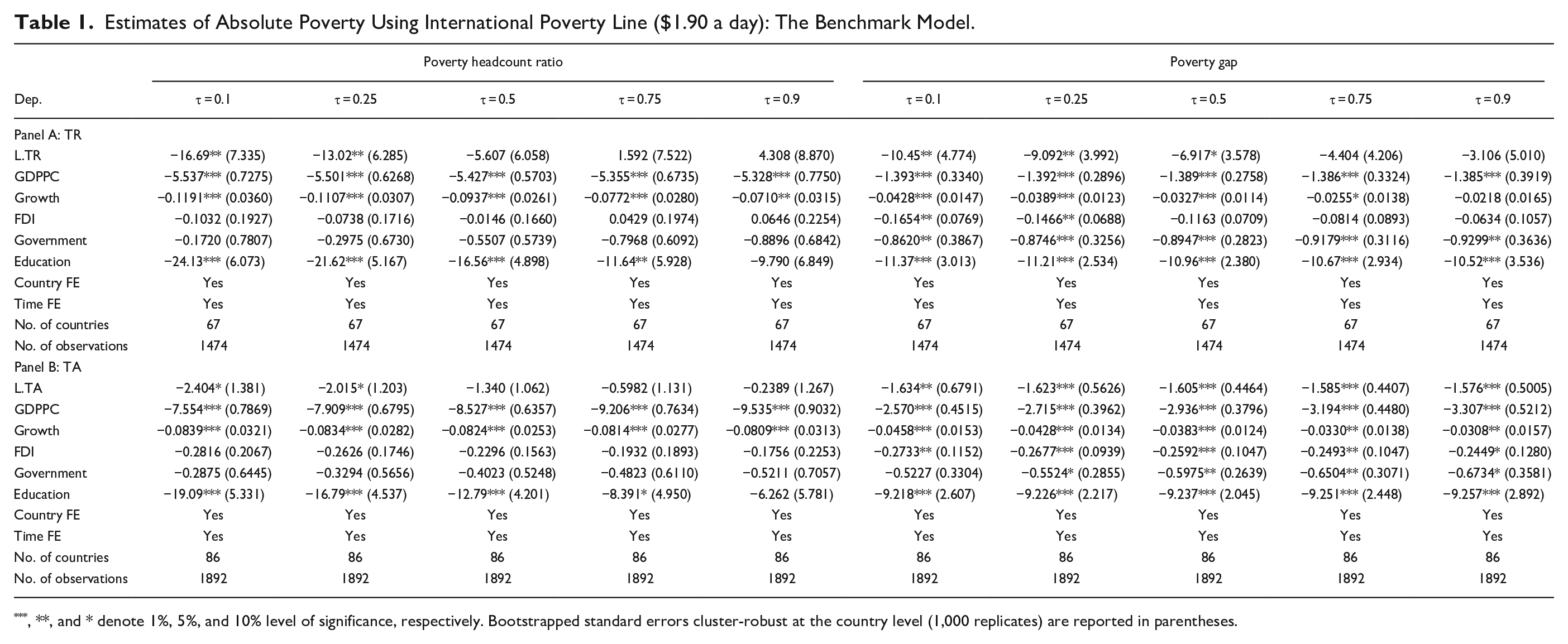
, **, and * denote 1%, 5%, and 10% level of significance, respectively. Bootstrapped standard errors cluster-robust at the country level (1,000 replicates) are reported in parentheses.
Estimates of Quantile Regression Using International Poverty Line ($3.10 a day): The Benchmark Model.
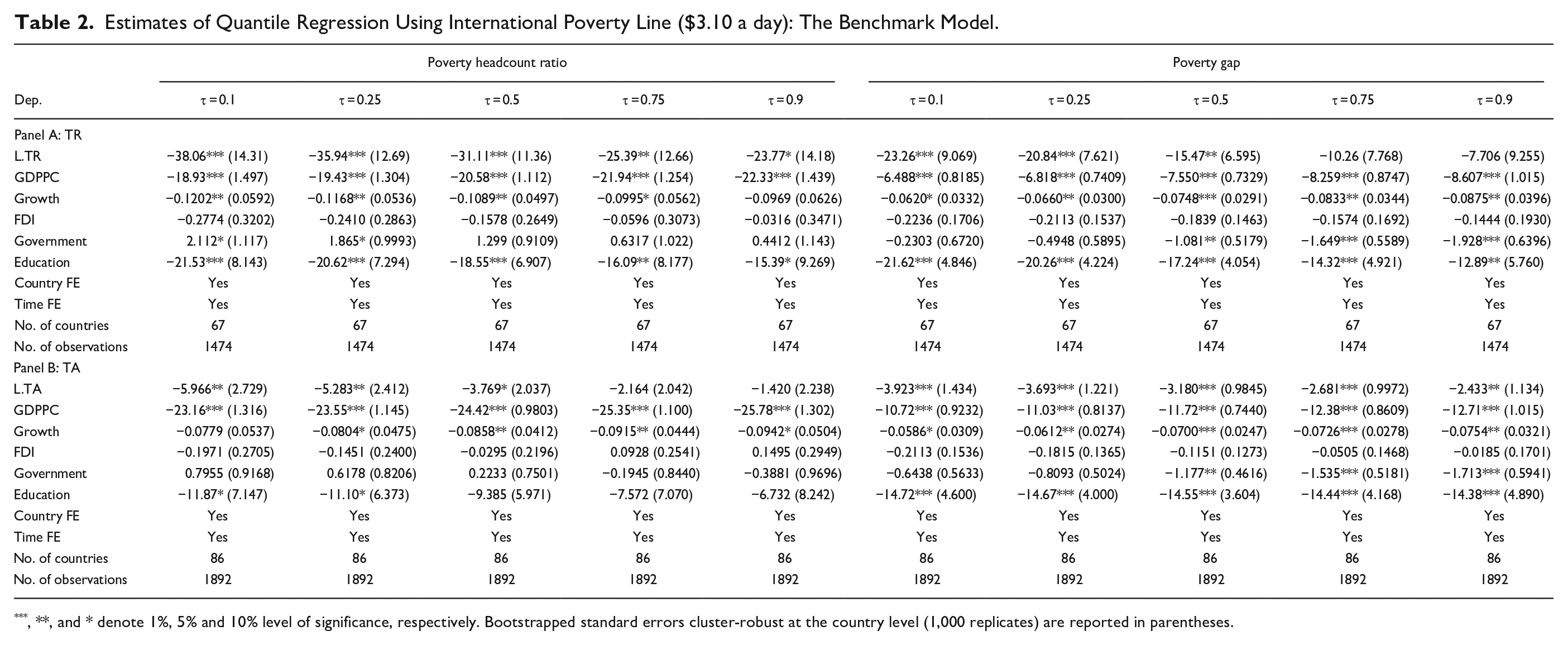
, **, and * denote 1%, 5% and 10% level of significance, respectively. Bootstrapped standard errors cluster-robust at the country level (1,000 replicates) are reported in parentheses.
In general, we observe clear evidence that poverty and tourism exhibit various patterns across quantiles, regardless of the poverty lines and tourism indicators used. Overall, we find that tourism indicators have a statistically significant negative impact on poverty measures. However, it seems to exist some striking differences across different points in the distribution of absolute poverty. More specifically, our estimation results show that the magnitude of the marginal effect declines as
Regarding the three groups of explanatory variables, we find that real per capita GDP has a statistically significant negative impact on poverty across all quantiles. There is little doubt that income level is directly linked to poverty alleviation. We also observe that the magnitude of the marginal effect increases when
Generally speaking, both government effectiveness and education have a statistically significant negative effect on poverty measures with education appearing to perform better with more columns exhibit statistically significant effects in our results. The magnitude of the marginal effect tends to decline a little when
Next, we explore the potential interactive effect of tourism and the level of economic development on poverty. We include the interaction term created using the one-period lagged tourism indicator and real per capita GDP in the extended model. 14 Our results are reported in Tables 3 and 4 using the alternative poverty lines.
Estimates of Absolute Poverty Using International Poverty Line ($1.90 a day): The Extended Model.
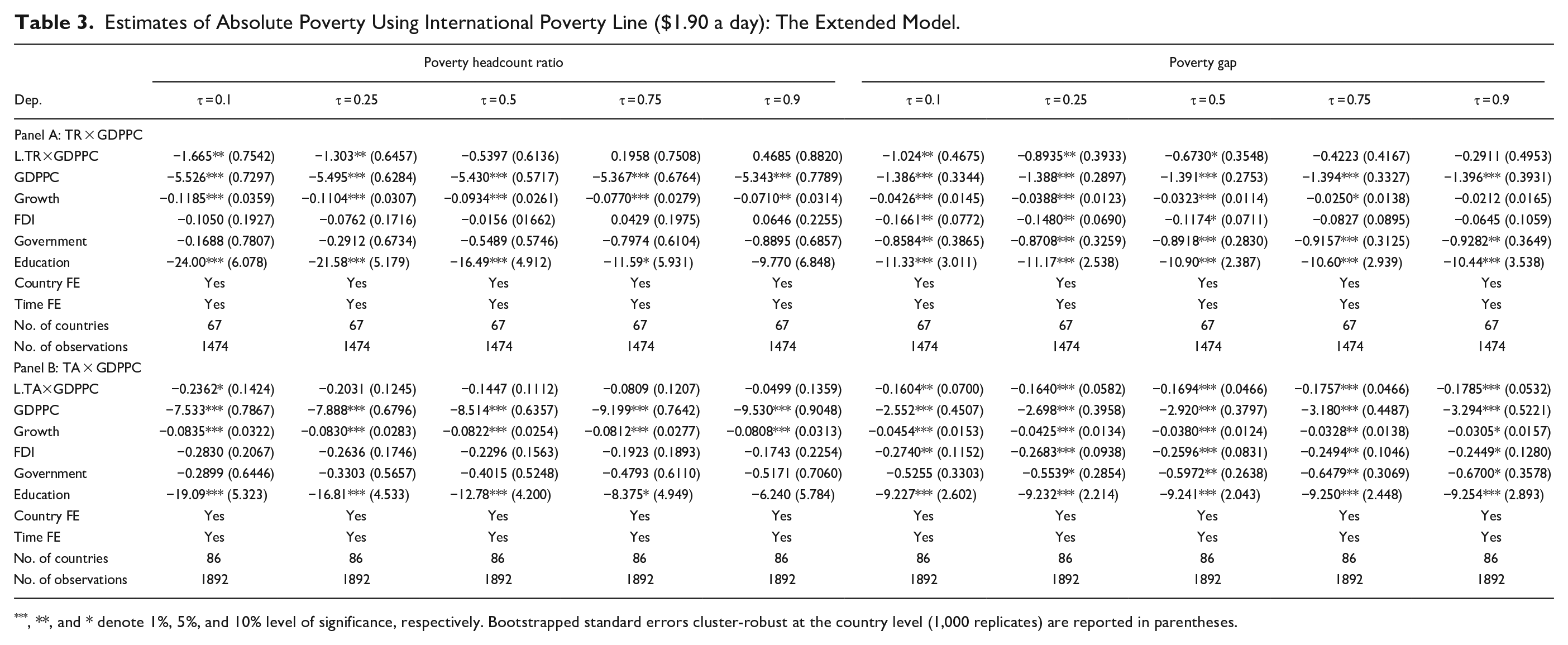
, **, and * denote 1%, 5%, and 10% level of significance, respectively. Bootstrapped standard errors cluster-robust at the country level (1,000 replicates) are reported in parentheses.
Estimates of Quantile Regression Using International Poverty Line ($3.10 a day): The Extended Model.
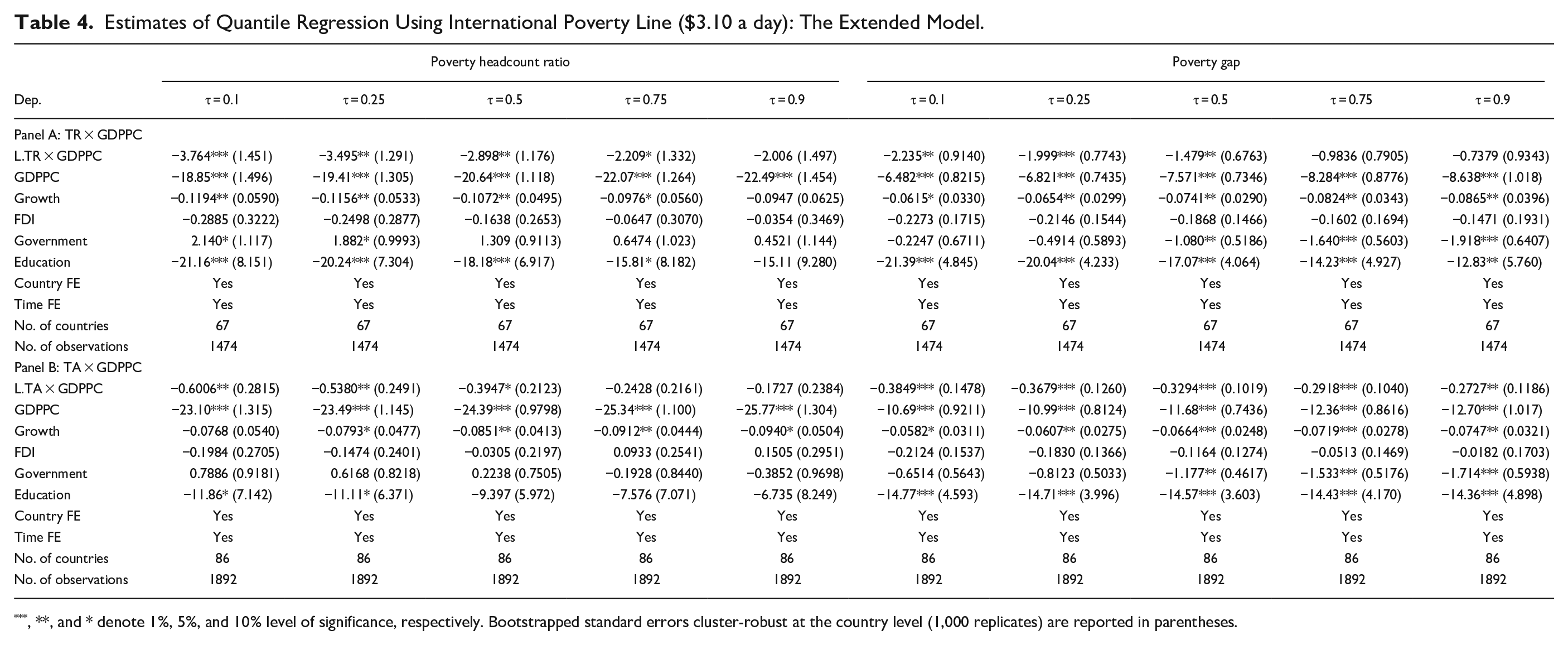
, **, and * denote 1%, 5%, and 10% level of significance, respectively. Bootstrapped standard errors cluster-robust at the country level (1,000 replicates) are reported in parentheses.
We observe that the interactive term is negative and statistically significant for most columns, including those for
Relative Poverty
In this section, we re-estimate the identical benchmark and extended models using the Gini income coefficient as the dependent variable. The estimation results are reported in Table 5.
Estimates of Relative Poverty Using the Gini Income Coefficient.
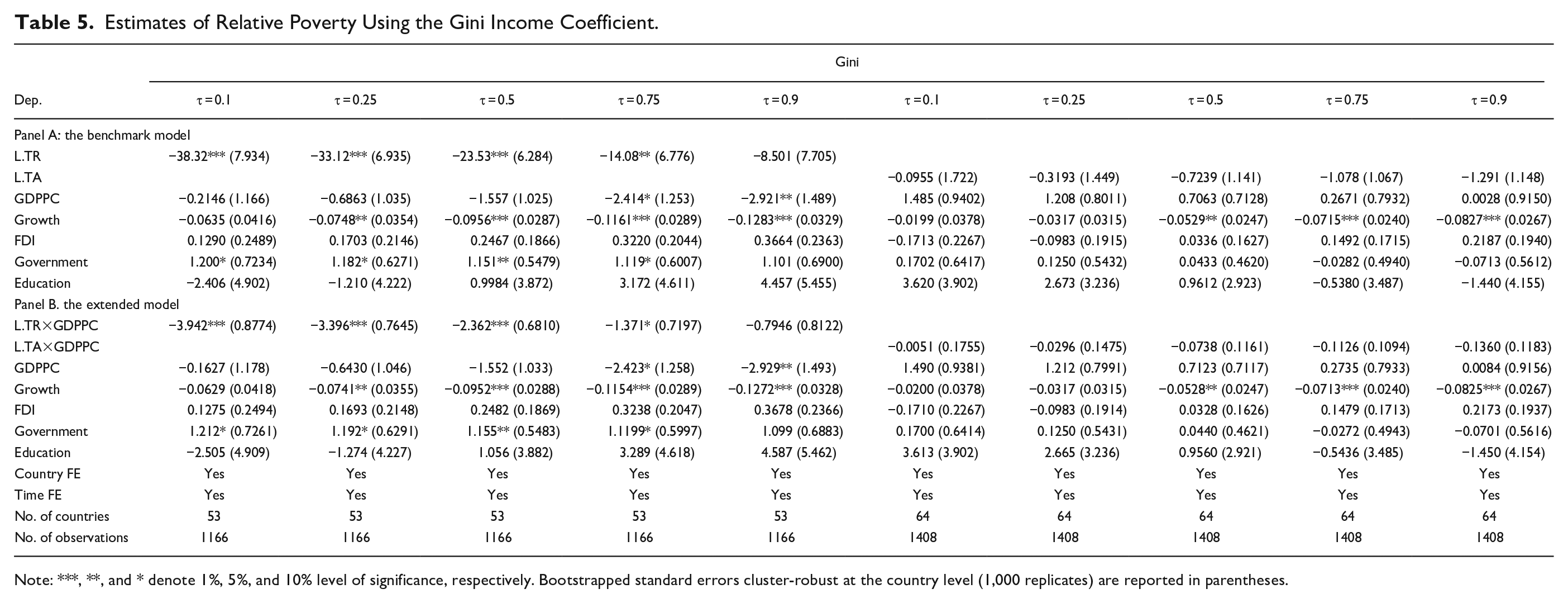
Note: ***, **, and * denote 1%, 5%, and 10% level of significance, respectively. Bootstrapped standard errors cluster-robust at the country level (1,000 replicates) are reported in parentheses.
As indicated in Panel A, international tourism measured using tourism receipts appears to have a statistically significant negative impact on income inequality in the benchmark model. More specifically, we observe a statistically significant effect for all quantiles except for
Regarding the other control variables, it seems that economic growth and income improvement are the most significant contributors to reducing income inequality for any
When looking at the extended model in Panel B, our results suggest that the tourism indicator affects the Gini coefficient through the level of economic development. The sign of the interaction term is still negative, which implies that economic development and tourism expansion act as a substitute for each other in reducing income inequality. However, this is not the case for
Robustness Checks
In this section, we perform several robustness tests to check the sensitivity of our main findings. To test if large emerging economies may be outliers that could alter our main findings, we first exclude the BRICS countries from our analysis. Next, since we also want to check whether our main results present a bias toward the top tourism destinations, we exclude the top tourism countries (China, Germany, Italy, Spain, Thailand, the UK, and the US) from our sample. After re-estimating the benchmark model encompassing these changes, we find that estimates of tourism receipts (% of GDP) vary a little compared to those in our main results. In Figure 1, we plot the estimated marginal effects for the full sample, the one excluding the BRICS and the one excluding the top tourism destinations for comparison. It seems that the estimates show a similar pattern across the full distribution of poverty measures. However, after excluding the top tourism destinations, the magnitude of estimates becomes slightly bigger in absolute terms, which suggests that the benefits for poverty reduction generated by international tourism are indeed slightly bigger in the non-top tourism destinations. Overall, our main results seem sensitive to neither the BRICS nor the top tourism destinations.
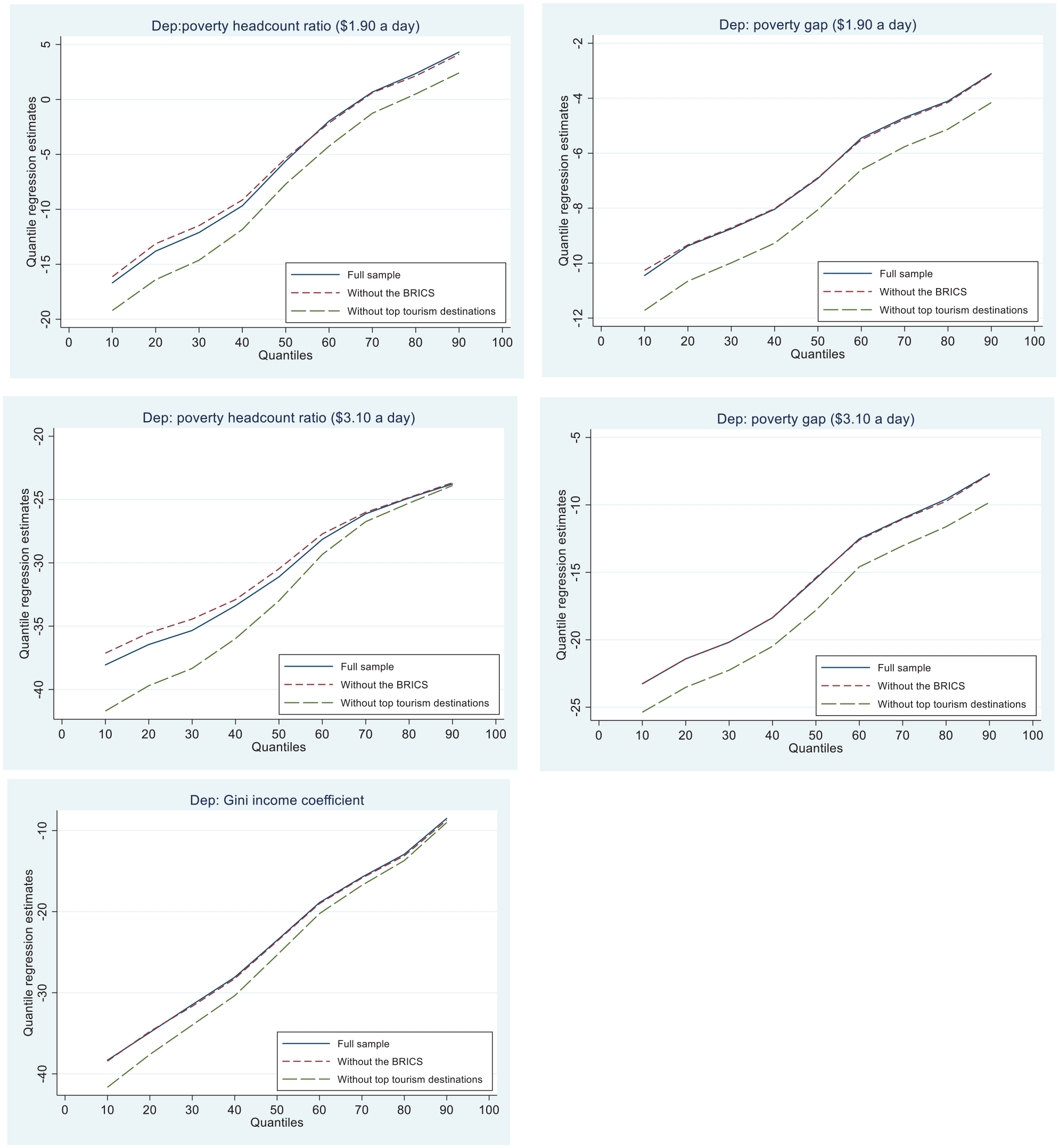
Robustness check: excluding the BRICS and the top tourism destinations.
As another robustness check, we attempt a slightly different measure of tourism receipts. Following Croes (2014), the tourism receipts are re-scaled by using exports instead of GDP. We then re-estimate the benchmark model used in the main results for the full sample and plot the estimated marginal effects in Figure 2.
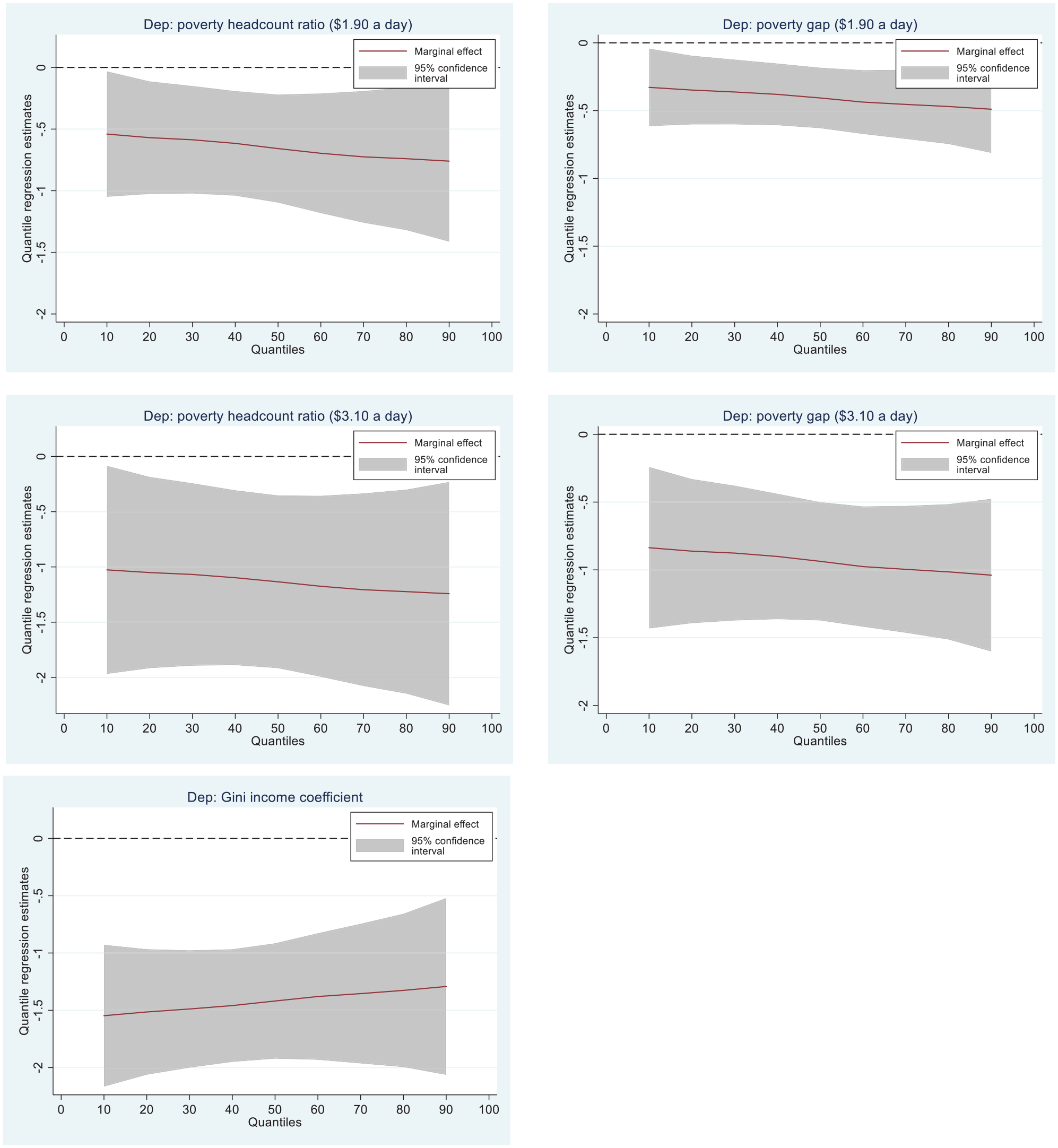
Robustness check: tourism receipts as a percentage of exports (TR2).
Plots show that tourism receipts (% of exports) has a statistically significant negative impact on poverty measures across quantiles, which is consistent with our main results. Furthermore, after adjusting the measurement of tourism receipts, we observe more significant results for higher
For the last robustness check, tourism bed-nights including all accommodation establishments is used to represent international tourism, covering 31 sample countries from 2000 to 2018. We re-estimate both the benchmark and the extended model. The estimated marginal effects are plotted in Figure 3.
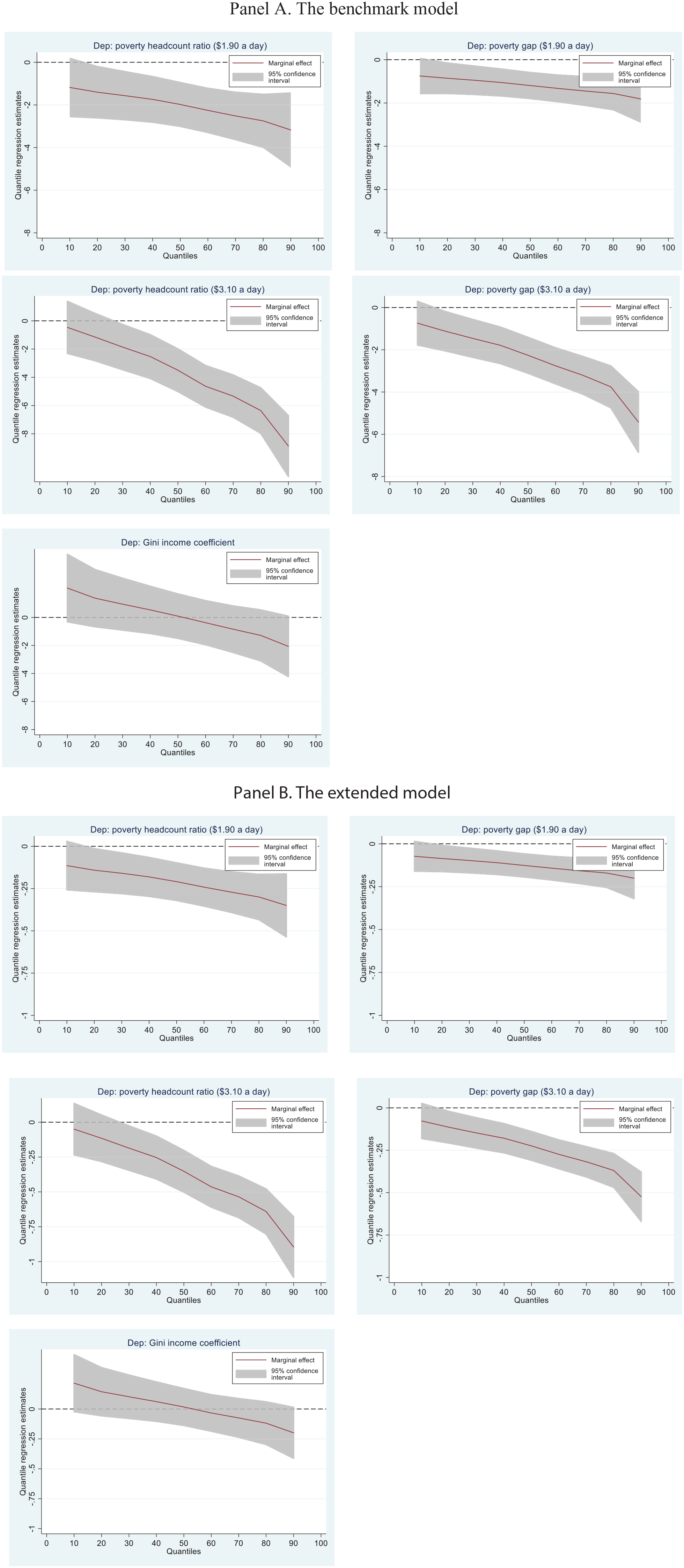
Robustness check: tourism bed-nights (TBN).
Plots in Panel A show that tourism bed-nights has a statistically significant negative impact on poverty measures across quantiles, which is consistent with our main results. We also observe more significant results for higher
In Panel B, plots indicate the estimated marginal effects of the interaction term created using tourism bed-nights and real per capita GDP. We still find consistent evidence that the interaction term is negative and statistically significant for all quantiles, which implies that tourism and economic development jointly affect poverty measures. When the value of the one component of the interaction term is low, increasing the value of the other is likely to have a more substantial effect on poverty alleviation, while the effect seems to be more prominent toward the bigger
Conclusion and Discussion
In light of our estimation results, this paper suggests that international tourism is likely to reduce both absolute and relative poverty. More specifically, our findings demonstrate that international tourism reduces absolute poverty, even though the magnitude of effects changes across quantiles regardless of the poverty lines and tourism indicators used. It seems that the magnitude of the marginal effect declines as
From a policy perspective, our findings suggest that tourism is a good option when targeting poverty alleviation, as tourism provides more domestic job opportunities for people with different backgrounds and businesses of different sizes. It could be argued that policymakers should focus on directing more resources and putting more effort toward creating a tourism-friendly business and economic environment in both developed and developing countries. However, since developed countries may have a longer tradition in tourism and may have been benefiting more from international tourism, policymakers in developing economies need to learn from their developed counterparts when designing their tourism strategies, in order to implement better pro-poor tourism policies that can further enhance the impact of tourism on poverty reduction. Additionally, international tourism can act as a possible substitute to direct income subsidies, such as foreign aids and remittances, which can in fact help to ease poverty when the improvement of the domestic income levels of poor countries progresses slowly. In that respect, enhancing tourism can be considered as a potential short-run strategy for governments in both developed and developing nations during economic downturns.
Furthermore, the COVID-19 pandemic is considered to have caused one of the main recent crises, creating high levels of uncertainty for the domestic and global economy that impacted most aspects of economic activity, including tourism. Crises and crisis-induced uncertainties present challenges to the tourism industry by reducing international tourism demand due to reduced consumer disposable income and lower incentive to travel. In particular, during the current pandemic, in order to stop the spread of the disease, many countries have implemented national and local lockdowns, and strict travel restrictions specifically targeting inbound tourists. Even though these strategies have dramatically reduced the spread of the virus, they have also reduced tourism flows and damaged the tourism industry deeply. This situation may arguably have presented greater challenges for the poorer populations involved in the tourism sector. This is because since the latter tend to have little assets and less diversified sources of income to cope with a crisis to start with the economic stagnation and job losses that came as a result of the COVID-19 crisis made things worse. To reduce the losses in tourism industry, and more importantly to protect the income of the poor, we call for a better precautionary plan that can improve the readiness of tourism policy and authorities when having to deal with pandemic alike disasters in the future. A possible suggestion could be to establish a system that can track and trace tourism cash flows. In practice, the system can be used to evaluate the impact of tourism on poverty alleviation during normal times, while it can be used to provide subsidies and ensure operational coverage and efficiency during a crisis. Furthermore, it is important to stress that government assistance is needed not only during the onset of a crisis but also during the post-crisis recovery period. Also, to mitigate any crises adverse effects, we call for a more intensive assistance and strategic decision making from central governments, while the collaboration between public and private sectors should be strengthened wherever possible, in order to maximize coordination amongst national, regional and international stakeholders.
History has shown that unexpected events such as the 9/11 terrorist attack, the breakout of SARS and COVID-19 have caused fundamental changes to some tourism destinations, affecting not only the attractiveness of these tourism destinations but also the pattern of international travel and tourism philosophy overall. Arguably, there is an already existing human capital divide between wealthy well-established tourism destinations and developing tourism destinations. This divide may broaden if selecting a holiday destination based on the price of tourism products becomes less important in the post COVID-19 era, where factors such as safety, the quality of travel and hospitality infrastructure or the accessibility to healthcare may become more prominent, developing tourism destinations could lose their price competitive advantage. To combat this, governments of developing countries should speed up tourism development and promote human capital accumulation by providing a consistent commitment to human capital development and intangible assets investment in the tourism sector. Policymakers should try to differentiate their tourism products from those of the wealthy tourism destinations. To achieve this, some short-run strategies could include the development of cultural and rural tourism by embedding the local characteristics into intangible assets investment. Stemming from the lessons learnt from the travel restrictions imposed during the COVID-19 pandemic, a further suggestion for the developing countries’ policymakers would be to target a smaller but more reachable markets and try to increase their market shares through this channel, rather than try to address the global market and be in direct competition with the well-established tourism destinations. Finally, diverting international tourists to the less prosperous regions of the country can directly mitigate the impact of a potential future crisis on the poor and vulnerable groups. To make this feasible, policymakers could consider providing direct subsidies targeted toward tourism investment in those regions, and try to strengthen the tourism-related human capital investment by making the tourism training more accessible to people from less prosperous regions. In this way, governments in both the developed and developing countries can use international tourism, not only to promote regional economic prosperity by reducing absolute poverty, but also to help alleviate regional income inequalities.
For future research, a few aspects of our study can be further extended. Firstly, even though the potential mechanisms connecting international tourism and poverty measures have been discussed in this paper, the impacts driven by these mechanisms have been investigated mainly from a macroeconomics perspective. To extend this, the theoretical hypotheses could be further examined at the micro-level, as the study of poverty alleviation and the inequality of income distribution from a microeconomics perspective could potentially provide interesting insights. However, data constraints stopped us from investigating these interesting questions at this time here. Secondly, even though we included various measures of absolute poverty and international tourism in our analysis, we have only used one measure of relative poverty, namely the Gini income coefficient. It would be interesting to try various inequality indicators and provide more comprehensive results, particularly for urban-rural inequality. A large body of tourism literature argues that tourism triggers rural economic development and economic structural change (e.g., Cárdenas-García, Sánchez-Rivero, and Pulido-Fernández 2015; Sahli and Nowak 2007; Zuo and Huang 2020). Following this strand, a rewarding area would be to investigate how tourism could affect urban-rural inequality. More specifically, if tourism helps rural economic development, rural poverty is likely to decline. Since the labor force gradually moves from the rural to the urban areas in developing nations, one may also ask whether urban poverty worsens as a result of the increase of low-skilled labor supply in urban areas driving down real wages. The existing empirical work in this area is rare, and it could be a valuable area for future research. Finally, recent tourism literature paid great attention to the relationship between FDI and tourism activities, particularly in developing economies (e.g., Lopez, Bianchi, and Chen 2021; Tang, Selvanathan, and Selvanathan 2007). On the one hand, tourism expansion increases tourism-oriented opportunities which are appealing to foreign investors and therefore attract FDI to the tourism destinations. On the other hand, FDI is also likely to boost business-related tourism. Hence, a bi-causality relationship may exist between tourism activities and FDI, which may be also subject to a country’s domestic tourism lifecycle. Therefore, we believe it would be interesting to explore this further, especially in the post COVID-19 recovery era.
Footnotes
Appendix
Correlation matrix.
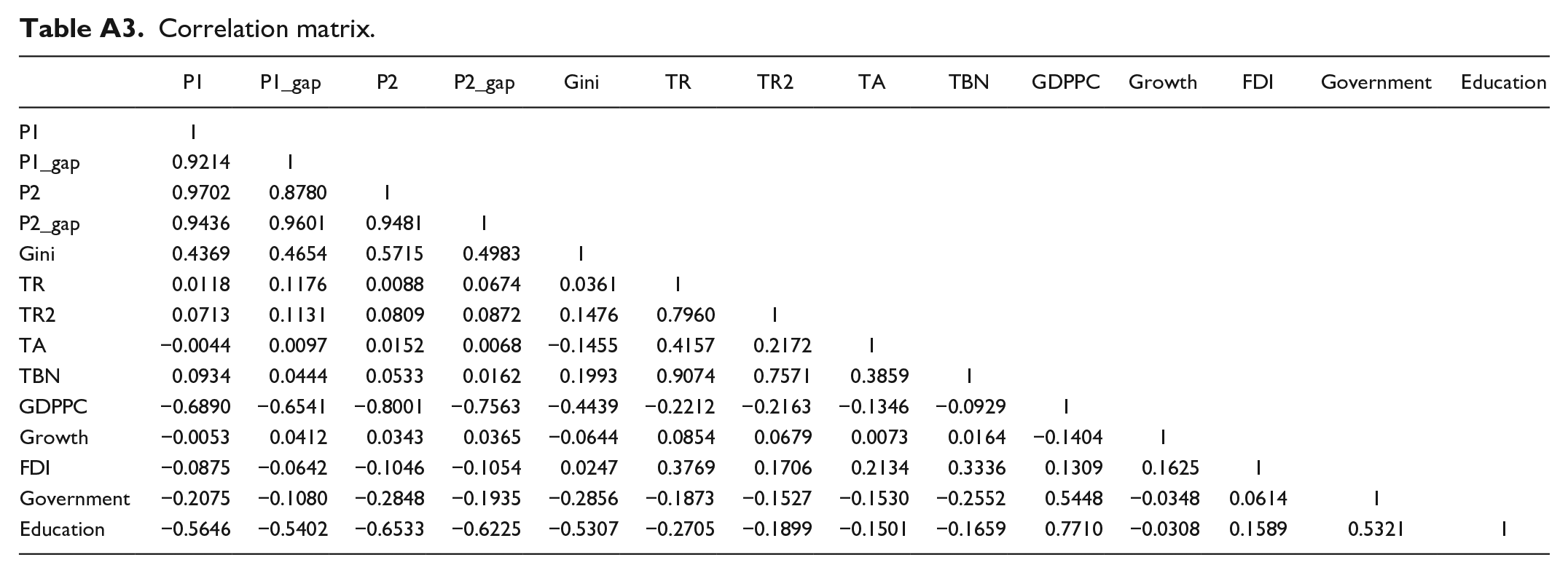
| P1 | P1_gap | P2 | P2_gap | Gini | TR | TR2 | TA | TBN | GDPPC | Growth | FDI | Government | Education | |
|---|---|---|---|---|---|---|---|---|---|---|---|---|---|---|
| P1 | 1 | |||||||||||||
| P1_gap | 0.9214 | 1 | ||||||||||||
| P2 | 0.9702 | 0.8780 | 1 | |||||||||||
| P2_gap | 0.9436 | 0.9601 | 0.9481 | 1 | ||||||||||
| Gini | 0.4369 | 0.4654 | 0.5715 | 0.4983 | 1 | |||||||||
| TR | 0.0118 | 0.1176 | 0.0088 | 0.0674 | 0.0361 | 1 | ||||||||
| TR2 | 0.0713 | 0.1131 | 0.0809 | 0.0872 | 0.1476 | 0.7960 | 1 | |||||||
| TA | −0.0044 | 0.0097 | 0.0152 | 0.0068 | −0.1455 | 0.4157 | 0.2172 | 1 | ||||||
| TBN | 0.0934 | 0.0444 | 0.0533 | 0.0162 | 0.1993 | 0.9074 | 0.7571 | 0.3859 | 1 | |||||
| GDPPC | −0.6890 | −0.6541 | −0.8001 | −0.7563 | −0.4439 | −0.2212 | −0.2163 | −0.1346 | −0.0929 | 1 | ||||
| Growth | −0.0053 | 0.0412 | 0.0343 | 0.0365 | −0.0644 | 0.0854 | 0.0679 | 0.0073 | 0.0164 | −0.1404 | 1 | |||
| FDI | −0.0875 | −0.0642 | −0.1046 | −0.1054 | 0.0247 | 0.3769 | 0.1706 | 0.2134 | 0.3336 | 0.1309 | 0.1625 | 1 | ||
| Government | −0.2075 | −0.1080 | −0.2848 | −0.1935 | −0.2856 | −0.1873 | −0.1527 | −0.1530 | −0.2552 | 0.5448 | −0.0348 | 0.0614 | 1 | |
| Education | −0.5646 | −0.5402 | −0.6533 | −0.6225 | −0.5307 | −0.2705 | −0.1899 | −0.1501 | −0.1659 | 0.7710 | −0.0308 | 0.1589 | 0.5321 | 1 |
Acknowledgements
We are grateful to the editors (Nancy McGehee and James Petrick) and three anonymous referees for numerous valuable suggestions and constructive comments that helped to substantially improve the paper. All remaining errors are ours.
Declaration of Conflicting Interests
The author(s) declared no potential conflicts of interest with respect to the research, authorship, and/or publication of this article.
Funding
The author(s) received no financial support for the research, authorship, and/or publication of this article.
