



Abstract
A solid understanding of when travel decisions are made in relation to travelers’ planning horizons is crucial for travel service providers. Despite its importance, there are very few empirical studies investigating the planning horizon and its antecedents in travel research literature. This study contributes to bridging this gap by conceptualizing a two-level model of antecedents of travelers’ planning horizons. In addition to individual traveler- and trip-related aspects, the model provides a cross-cultural perspective on international travelers’ planning horizons by including uncertainty avoidance, individualism, and long-term orientation as cultural-level antecedents. Drawing on a nested dataset of 4,074 international travelers from 17 countries worldwide, the results of a two-level hierarchical regression model show that, in addition to individual-level aspects, cultural antecedents play an important role in determining planning horizons. Based on the empirical results, the paper discusses implications for theory and travel service providers.
Introduction
Travel products are, by their very nature, both experiential and composite goods, making travel buying decisions complex and risky (Cai, Feng, and Breiter 2004; Pearce and Schott 2005; Rahman, Crouch, and Laing 2018). When planning a journey, a variety of individual, but frequently interrelated decisions must be made with regard to, for example, destination, length of stay, travel mode, accommodation, and events and attractions to be visited (Cai, Feng, and Breiter 2004; Dellaert, Arentze, and Horeni 2014). Whether to travel as a couple, with friends, family, or in a group, further increases the complexity of decision-making, particularly when travelers have different preferences and ideas as to how to make the most of the time and money available for their journey (Rojas-de-Gracia and Alarcón-Urbistondo 2019; Wang and Li 2021). Over the last decade, digitization has further added to the complexity of travel decision-making. Today, a seemingly unlimited variety of travel products is readily available for consumers through traditional, online, and mobile sales channels. In addition, the Internet has dramatically increased the information available to travelers: consumers can now benefit from the experience of others through travel stories, blogs, and other social media channels. Clearly, travel planning is no longer a one-stop shopping scenario, but a complex process that usually evolves over a certain time span (Leung et al. 2013; Schroeder and Pennington-Gray 2015; Shin et al. 2019).
When navigating this complex decision-making environment, consumers often start to gather ideas and plan their travel much earlier than the dates on which they actually book each component of their journey (Bigne, Nicolau, and William 2021; Choi et al. 2012; Rahman, Crouch, and Laing 2018). The evolving complexity of travelers’ planning approaches requires investigation from a time- or planning horizon-based perspective. In this paper, we define the length of the planning horizon (hereinafter referred to as “planning horizon” for readability) from a traveler’s viewpoint as the temporal distance between the times at which key aspects of travel-related planning occur, and the day of departure. While the objects of planning will differ depending on the travel context and personality traits, the sequence of planning activities starts with the idea of a journey. Travel planning then involves decisions to be made regarding actually making the trip, the timing and duration of the trip, and then booking transport and accommodation. The inclusion of the early stages of the planning horizon is particularly relevant for travel service providers, as traveler’s planning horizon represents a window of opportunity, with travelers being more open to inspirational offerings (Jun, Vogt, and MacKay 2007; Zalatan 1996). A thorough understanding of travel decision-making in terms of planning horizons is therefore crucial for effective media campaign planning, and for allocating advertising and sales resources (Newman and Staelin 1971; Putsis and Srinivasan 1994).
Looking at the current state of knowledge in the area of travel planning, the role that the planning horizon plays in shaping the pre-trip decision-making process is an area into which limited research has been conducted. While there has been substantial research into travel planning and its determinants (e.g., Cai, Feng, and Breiter 2004; Pan and Fesenmaier 2006; Sirakaya and Woodside 2005), only a few studies have looked at time-related aspects of the pre-trip phase (e.g., Chen and Schwartz 2008; Dellaert, Ettema, and Lindh 1998; Money and Crotts 2003; Rahman, Crouch, and Laing 2018; Schul and Crompton 1983). In particular, the role of cultural aspects in determining travel planning horizons has yet to be addressed, as can be seen from the inconclusive findings of existing studies. To some extent, this lacuna might be related to the methodological limits of existing research designs, which do not effectively reflect the nature of travelers’ decision-making as being embedded in a higher-level cultural context.
Against that background, this study aims to explain the factors that influence the duration of the time span between critical pre-trip activities (idea gathering, decision-making, and booking) and starting the actual trip. In doing so, the study responds to a recent call for a better understanding of travelers’ cultural background as an influence on their travel decision-making (Karl 2018), and adds to the current state of knowledge in two ways. First, we conceptually integrate characteristics at the level of the individual consumer, the trip, and the cultural environment into a holistic framework of antecedents to an individual traveler’s planning horizon. Second, by empirically testing the model through a two-level hierarchical linear model with sample data obtained from 4,074 international travelers from 17 different countries worldwide, we show not only that consumer- and trip-related aspects are relevant, but also that cultural aspects play a major role in determining planning horizons.
In the next section we derive our conceptual model of relevant antecedents pertaining to the individual consumer, the trip, and cultural characteristics.
Conceptual Model
Travel Planning Behavior and the Role of Time Planning Horizon
Travel planning is paramount for travel businesses because travel-related purchases are perceived as risk-intensive and complex, owing to the experiential and composite nature of travel products (Jun, Vogt, and MacKay 2007). Over the last 30 years, a vast body of literature on travel research has evolved around travel planning behavior and its antecedents (Dimanche and Havitz 1995; Moutinho 1987; Pizam, Chon, and Mansfeld 1999; Sirakaya and Woodside 2005). As the pre-trip phase culminates in a purchase decision, and provides the basis for the selection of itineraries, accommodations, and activities (Hyde 2007; Money and Crotts 2003), various models have emerged to explain travel behavior and its antecedents in the pre-trip phase (Leung et al. 2013). With regard to timing, the pre-trip or planning phase mainly involves two perspectives: the planning time and the planning horizon. Planning time has been defined as “the actual period devoted to planning the trip. It includes precise actions such as enquiries, paper searching, calling, or visiting travel agencies and was measured by days or weeks” (Zalatan 1996, 127). Travelers’ planning horizon, in turn, refers to the temporal distance between coming up with the first idea for a particular journey and the day of departure (Dellaert, Ettema, and Lindh 1998; Fodness and Murray 1997; Gitelson and Crompton 1983; Huh and Park 2010; Rao, Thomas, and Javalgi 1992). Acknowledging that travel planning starts with idea generation, but then involves a series of subsequent decisions regarding, for example, destination, travel companions, travel mode, travel date, and duration (Dellaert, Ettema, and Lindh 1998), we extend the definition of the planning horizon, defining it as the temporal distance between the times at which key aspects of travel-related planning occur and the day of departure. This definition draws on the nature of travel planning as “sequences of partial decisions that jointly determine the final travel experience” (Dellaert, Arentze, and Horeni 2014, 7). While the objects of planning will differ depending on the travel context, the sequence of planning activities starts with the idea of a journey. Long-distance travel planning then involves decisions to be made regarding actually making the trip, the timing and duration of the trip, and then booking flights and accommodation. A traveler’s planning horizon reflects his or her overall approach to the timing of key planning activities in relation to the departure date.
Based on case-based planning theory (Stewart and Vogt 1999), we develop a conceptual model for the planning horizon. The overarching goal of the model is to explain the planning horizon, defined as the time span between critical pre-trip activities (idea gathering, decision making, and booking) and the actual start of the trip. In addition to theoretical considerations, we base our model on relevant empirical research considering traveler-related, trip-related, and contextual antecedents of planning horizon in travel decision-making as outlined in Table 1.
Research Considering Antecedents of Planning Horizon in Travel Decision-Making.
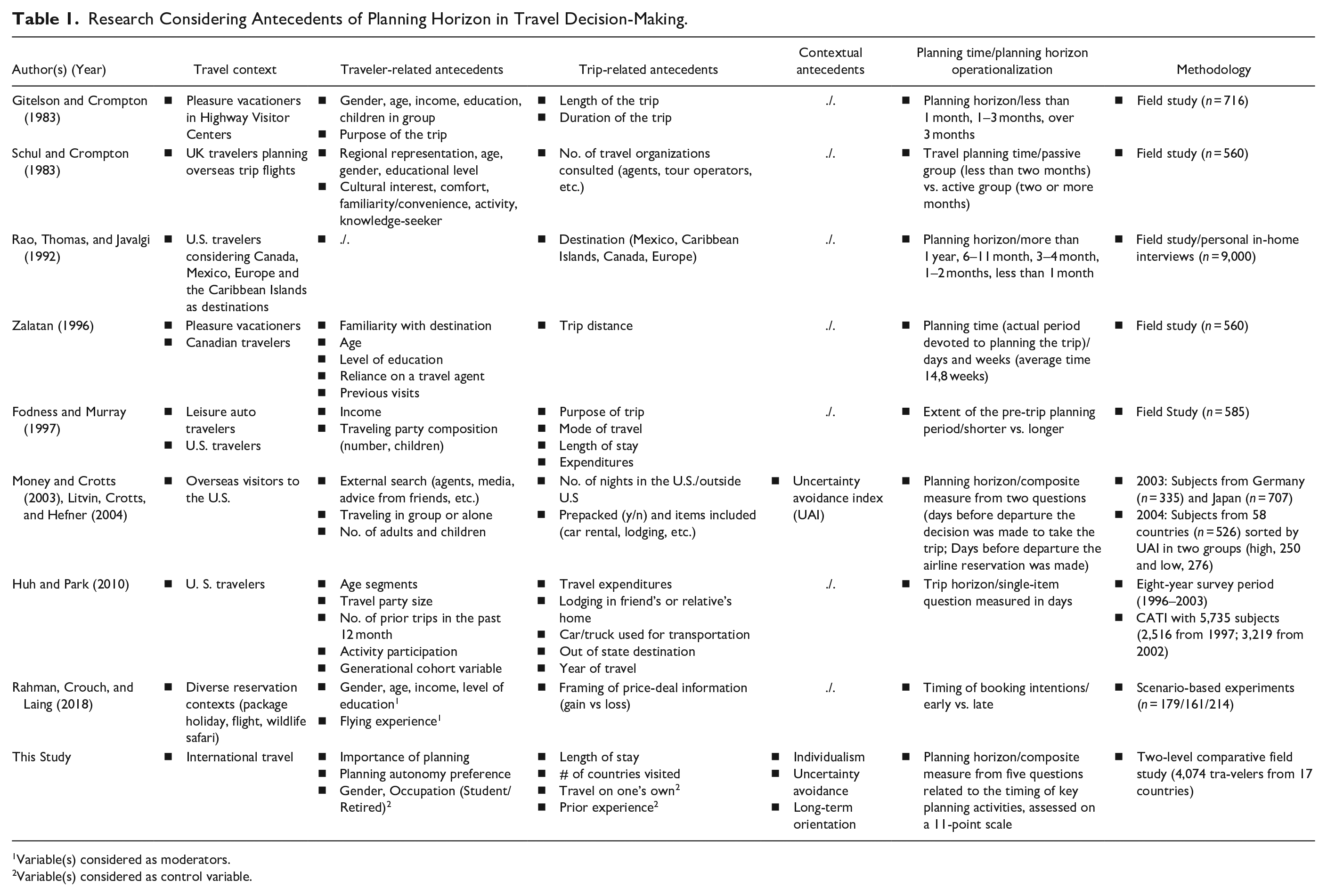
Variable(s) considered as moderators.
Variable(s) considered as control variable.
We begin describing our model by discussing traveler-related determinants.
Traveler-Related Determinants of Planning Horizon
Recent studies indicate that travelers are not a homogenous group; subpopulations have to be considered, especially in terms of individual consumer characteristics (Kim et al. 2018; Tanford 2016). Explaining planning time, travel literature focuses on socio- and psychographic variables, prior experiences and the use of new technologies.
In particular, socio- and psychographic variables play a major role in explaining travelers’ planning horizons (Fesenmaier and Jeng 2000; Gursoy 2003; Law et al. 2009; Leung et al. 2013; Schul and Crompton 1983; Tanford 2016). Schul and Crompton (1983) confirmed that psychographic variables (e.g., comfort, cultural interest, and activity) are more effective than sociodemographic descriptors (e.g., age, sex, and educational level) for predicting the length of time over which external search processes occur (Schul and Crompton 1983). Zalatan (1996) has shown that higher levels of education and age positively affect planning time.
Further, prior experiences associated with perceived risk (Roehl and Fesenmaier 1992; Stewart and Vogt 1999; Zalatan 1996) are of particular interest among the traveler-related variables. Whereas Roehl and Fesenmaier (1992) found no evidence of perceived risk being antecedent to planning time, Zalatan’s (1996) findings suggest that experience, operationalized as prior visits, significantly reduces planning time. However, familiarity, capturing experiences to be obtained through visits, or knowledge obtained from other sources, did not exert a significant influence (Zalatan 1996).
A more recent stream of studies has focused on travelers’ use of new technologies in the context of travel planning (Gao, Mattila, and Lee 2016; Jun, Vogt, and MacKay 2007; Lim 1999; Park and Gretzel 2007). Several authors have suggested that travel planning behaviors constantly change as a result of the benefits from new technologies (Kim et al. 2018; Leung et al. 2013). Over time, travelers become more experienced at gaining added value from new technologies, and spend more time using them (Jun, Vogt, and MacKay 2007; Sirakaya and Woodside 2005). In particular, the impact of social media and user-generated content on individual travel panning has been well assessed (Huang, Basu, and Hsu 2010; Leung et al. 2013; Shin et al. 2019). As organized and regular posting of content is, ceteris paribus, assumed to be motivated by the commercial self-interest of travel management companies, Yoo and Gretzel (2010) concluded that consumers pay more attention to associated communication channels, and that higher levels of trust in user-generated content correspond with longer planning time.
The use of new technologies leads to a group of variables on consumers’ individual planning preferences that has largely been neglected so far. Hence, besides the socio- and psychographic variables and prior experiences, we add two variables in our conceptual model that, we assume, influence individual planning horizons: (1) the importance given to booking all aspects of a trip before it actually starts and (2) the willingness of travelers to organize their trips themselves.
In travel booking, do-it-yourself bundling of travel services is a popular form of consumption. It is also not uncommon for parts of trips to be booked while traveling, with mobile technologies and booking tools making last-minute bookings much easier (Anckar and Walden 2001; Xiang et al. 2015). According to case-based theory, the attitude of travelers determines whether they finish all their planning before they start traveling (Stewart and Vogt 1999). Case-based, risk-averse planners anticipate and prepare for disruption, rather than relying wholly on a fixed plan (Jun, Vogt, and MacKay 2007; Stewart and Vogt 1999). Hence, such travelers plan far in advance to prepare for, and control, all kinds of conditions. Based on these considerations, Stewart and Vogt (1999) found that these travelers plan intensively before their trip, even if their plans change frequently during the trip. This implies a longer planning horizon, as these travelers like to finalize their plans before starting their trip.
Hence, we propose:
H1: The importance travelers give to booking all aspects of their trip before traveling positively impacts their planning horizon.
A recent review of the travel literature indicates that self-tailored travel packages are significant because of their appeal to the idea of self-organization and autonomy (Fernández-Herrero, Hernández-Maestro, and González-Benito 2018). Jacobsen and Munar (2012) proposed that the level of intended self-organization increases constantly, supported by new technologies (Jun, Vogt, and MacKay 2007; Lewis and Talalayevsky 1997; Sirakaya and Woodside 2005). Related research on consumer behavior emphasizes self-planning and self-regulation as relevant measures to capture the impact of free choice on purchase decisions (Baumeister et al. 2008). Based on these findings, we propose that travelers’ planning horizons may differ according to their preference for autonomy during the planning stage and hypothesize:
H2: The preference travelers give to planning autonomously positively impacts their planning horizon.
Trip-Related Determinants of Planning Horizon
At the trip-level, our model conceptualizes the length of stay and the number of countries visited as antecedents of the planning horizon. Among others, these variables show the strongest influence on planning horizon (Fodness and Murray 1997; Huh and Park 2010; Zalatan 1996). A few studies have focused on other trip-related determinants, as the distance to be traveled (Zalatan 1996), the purpose of travel, whether travel is for business or leisure (Chen 2000; Gitelson and Crompton 1983), transportation costs (Chen and Hsu 2000; Fodness and Murray 1997; Rao, Thomas, and Javalgi 1992; Wahab, Crampon, and Rothfield 1976), and time constraints (Um and Crompton 1990; Woodside and Lysonski 1989). Gitelson and Crompton (1983) found that travelers visiting friends and relatives have longer planning horizons. Chen and Hsu (2000) maintained that travel costs for Korean tourists were negatively related to trip planning time frames.
However, the length of the trip and the number of countries visited exerts the most relevant influence on planning time (Fodness and Murray 1997; Gitelson and Crompton 1983; Lewis and Talalayevsky 1997; Pan and Fesenmaier 2006). Both variables are related to increased levels of complexity and risk, as risk has been identified as an important antecedent of planning time in the pre-trip phase (Roehl and Fesenmaier 1992; Sönmez and Graefe 1998).
With regard to trip lengths, we argue that travelers perceive higher levels of risk, and attempt to mitigate these with a more detailed preparation. Specifically, longer travel arrangements should lead to higher perceptions of financial risk and of time risk. With regard to financial risk, multiple studies provide support for a positive relationship between trip lengths and total trip expenditures. Thrane and Farstad (2011), for example, suggest that “. . .a 10% increase in length of stay brings about a 6.4% increase in PTE [personal tourism expenditures, authors’ note] on average” (p. 49). While their analysis also points toward a non-linear relationship with a diminishing growth rate, it seems feasible to assume that longer trips will, due to their higher expenditures, result in higher perceived financial risk.
In addition to higher financial risks, we assume that longer trips are also associated with higher perceptions of time risk. Time risk refers to the possibility that a vacation or trip to a particular destination “will take too much time or be a waste of time.” (Roehl and Fesenmaier 1992, 18). Assuming that time represents a scarce resource, travelers will try to maximize value of trip lengths. Further linking increased levels of (time) risk with more extensive planning, several studies point toward information seeking as an effective strategy to reduce higher levels of risk (Neuwirth, Dunwoody, and Griffin 2000; Sönmez and Graefe 1998). Weiermair (2000) has attributed high levels of information searching to travelers’ feelings of uncertainty about, and having little control over, future outcomes. Based on face-to-face interview data obtained from first-time tourists to New Zealand, Hyde (2007) provides empirical evidence for increased information search behaviors as a function of vacation duration. To account for increased needs for information resulting from higher levels of perceived time risk, it can thus be assumed that travelers who plan longer stays will start their planning activities earlier. Hence, we propose:
H3: The length of stay positively impacts a traveler’s planning horizon.
Furthermore, we argue that the number of countries visited positively impacts planning horizon. While any journey—and thus also single-country trips—implies that a number of interrelated decisions needs to be made (Cai, Feng, and Breiter 2004; Dellaert, Arentze, and Horeni 2014), adding another country to the itinerary effectively doubles the number of these decisions, assuming the number of stayovers and points of interests is more or less comparable. Even if there might be certain efficiency gains due to experience effects, visiting an additional country means that travelers need to acquire and process a generally comparable amount of information as local conditions, offerings and opportunities differ from country to country. Due to this increasing complexity of the travel decision-making process, we assume that travelers will start planning sooner, the more countries they plan to visit during a particular journey. Being faced with a more complex decision-making task, more information will need to be acquired for effective planning, which results in an earlier start of the planning process.
Trips to more than one country can also be assumed to be, ceteris paribus, more expensive and should thus be associated with higher levels of financial risk—for example due to the additional in- and outbound travel activities that are necessary. Drawing on literature suggesting that information search and planning will be more extensive for more expensive journeys (Schul and Crompton 1983; Zalatan 1996), we propose that the number of countries visited represents an important trip-related determinant of the planning horizon.
H4: The number of countries visited positively impacts a traveler’s planning horizon.
Cultural Determinants of Planning Horizon
A growing body of studies confirms that travel-related decision-making and planning varies across cultures (Hsu, Woodside, and Marshall 2013; Hyde 2007; Leung et al. 2013; Li and Cai 2012; Lu and Chen 2014; Schul and Crompton 1983). Hence, we include cultural determinates in our model.
Given that culture is too global to be used as an explanatory variable, most researchers have applied Hofstede’s (1983) cultural dimensions to sharpen the definition of culture as applied to travel-related decision-making (Crotts 2004; Crotts and Litvin 2003; Reisinger and Crotts 2010; Soares, Farhangmehr, and Shoham 2007; Woodside, Hsu, and Marshall 2011). Most studies focus particularly on risk avoidance (Crotts and Litvin 2003; Jordan, Norman, and Vogt 2013; Litvin, Crotts, and Hefner 2004; Money and Crotts 2003; Pizam and Sussmann 1995; Reisinger and Mavondo 2005), long-term orientation (Crotts and Litvin 2003; Reisinger and Crotts 2010), and individualism (Crotts and Litvin 2003; Kim and Lee 2000; Pizam and Sussmann 1995). Exemplarily, in their study investigating the role of perceived risk, anxiety, and intentions to travel internationally, Reisinger and Mavondo (2005) found evidence for a positive relationship between certain cultural orientations and sociocultural attitudes toward travel risks for group of domestic (Australian) travelers, whereas the relationship was insignificant for a group of foreign visitors (Reisinger and Mavondo 2005).
Within this broader stream of studies investigating cultural attributes in the context of travel planning and decision-making, the role of these attributes in determining travelers’ planning horizon has received little attention. Drawing on inflight survey data obtained from German and Japanese visitors to the United States, Money and Crotts (2003) found evidence for differences in planning time with regard to both (1) the time between making the decision to travel and the day of departure, and (2) the time between making the airline reservation and the day of departure, between the two cultures. However, contrary to what might be expected, travelers from Germany—a country associated with a medium level of uncertainty avoidance—were found to engage in trip planning significantly earlier than travelers from Japan—a country associated with a high level of uncertainty avoidance (Money and Crotts 2003). Drawing on a broader sampling approach, with data from 526 travelers from 58 different countries, Litvin, Crotts, and Hefner (2004) similarly found that a group of travelers from countries with lower uncertainty avoidance scores exhibited longer time-horizons with regard to the two planning-related activities (i.e., the decision to make the trip, and reserving the flight). Crotts (2004) investigated the role of cultural distance between a traveler’s home country and the country visited. Using survey data from 302 U.S. residents traveling to one of 26 different countries, he found that trip planning duration times were not significantly different between respondents traveling to countries associated with high and low levels of uncertainty avoidance and cultural distance.
To summarize, while several studies have attempted to relate aspects of national culture to travel-related decision-making and planning, the role of particular cultural dimensions in determining individual travelers’ planning horizons is still unclear, with empirical results not always being in line with what might be expected.
Beyond traveler- and trip-related aspects, our conceptual model suggests that planning horizons depend on cultural-level characteristics. Following the literature on model specification in multi-level contexts, we conceptualize the concept of culture as a “shared unit properties” construct (Kozlowski and Klein 2000). Comparatively to organizational climate or other group-level characteristics, culture represent a “consensual, collective aspect of the unit as a whole” (Kozlowski and Klein 2000, 30). From a theoretical perspective, we argue that cultural influences are mainly related to risk-related differences between cultures. Against this background, our conceptualization of cultural-level antecedents focuses on cultural dimensions associated with risk attribution (Soares, Farhangmehr, and Shoham 2007). Literature confirms that risk perception, as considered by Rogers (1975) in his protection motivation theory, is particularly influenced by long-term orientation, individualism, and uncertainty avoidance (Karl 2018; Quintal, Lee, and Soutar 2010). We therefore ignore the dimensions of power distance and masculinity.
Individualism describes the relationships between individuals in different cultures (Hofstede 2001). In individualistic cultures, individuals tend to take care of themselves and their immediate family. Collectivistic cultures, however, are characterized by individuals who tend to focus on establishing and maintaining high-quality relationships, both within their group, and between themselves and the group (Hofstede 2001). With regard to travel planning, we assume that travelers in collectivistic cultures will tend to perceive less risk when others are exposed to the same risky situation (Weber and Hsee 1998). Weber and Hsee (1998) propose that collectivism “. . .acts as a cushion against possible losses” (Weber and Hsee 1998, 1208). A consequence of this is that travelers in individualistic societies will be less willing to accept risk than collectivistic travelers, who will more readily accept negative consequences. We conclude that travelers in individualistic cultures should exhibit extended planning horizons. Hence, we propose:
H5: A higher level of individualism leads to a longer planning horizon.
Of the set of Hofstede’s cultural dimensions, uncertainty avoidance represents the variable with the most direct reference to risk. Characterizing the extent to which people feel threatened by uncertainty and try to avoid risky situations (Hofstede 2001), research has been conducted into how uncertainty avoidance affects risk perception and risk-taking propensity (Kozak, Crotts, and Law 2007; Pizam et al. 2004; Seabra et al. 2013). In the consumer-related literature, several authors state that the cultural trait of risk avoidance influences product information search activities (Dawar, Parker, and Price 1996; Weber and Hsee 1998). In the context of travel planning, Kozak, Crotts, and Law (2007) have found evidence that travelers from cultural backgrounds characterized by high and medium, as opposed to low, levels of uncertainty avoidance are more likely to be concerned about risk. Against this background, we assume that travelers from cultures characterized by a high level of uncertainty avoidance mitigate, ceteris paribus, higher levels of perceived risk by spending more time planning their travel.
H6: A higher level of uncertainty avoidance leads to a longer planning horizon.
Initially defined as “the fostering of virtues oriented towards future rewards, in particular perseverance and thrift” (Hofstede 2001, 359), the current conceptualization understands long-term orientation as the relative extent to which a society prioritizes keeping linkages with its past while navigating the challenges the present and the future are holding (Hofstede 2020). Bearden, Money, and Nevins (2006) proposed that long-term orientation has a negative impact on impulsive buying (the tendency for consumers to invest little thought prior to purchase decisions). Short-term oriented buyers are likely to “buy now,” whereas long-term oriented ones are more likely to “plan ahead.” Transferred to our conceptual model, this would imply longer planning horizons for travelers from cultural backgrounds characterized by higher cultural levels of long-term orientation. We therefore propose:
H7: A higher level of long-term orientation leads to a longer planning horizon.
The conceptual model is shown in Figure 1.
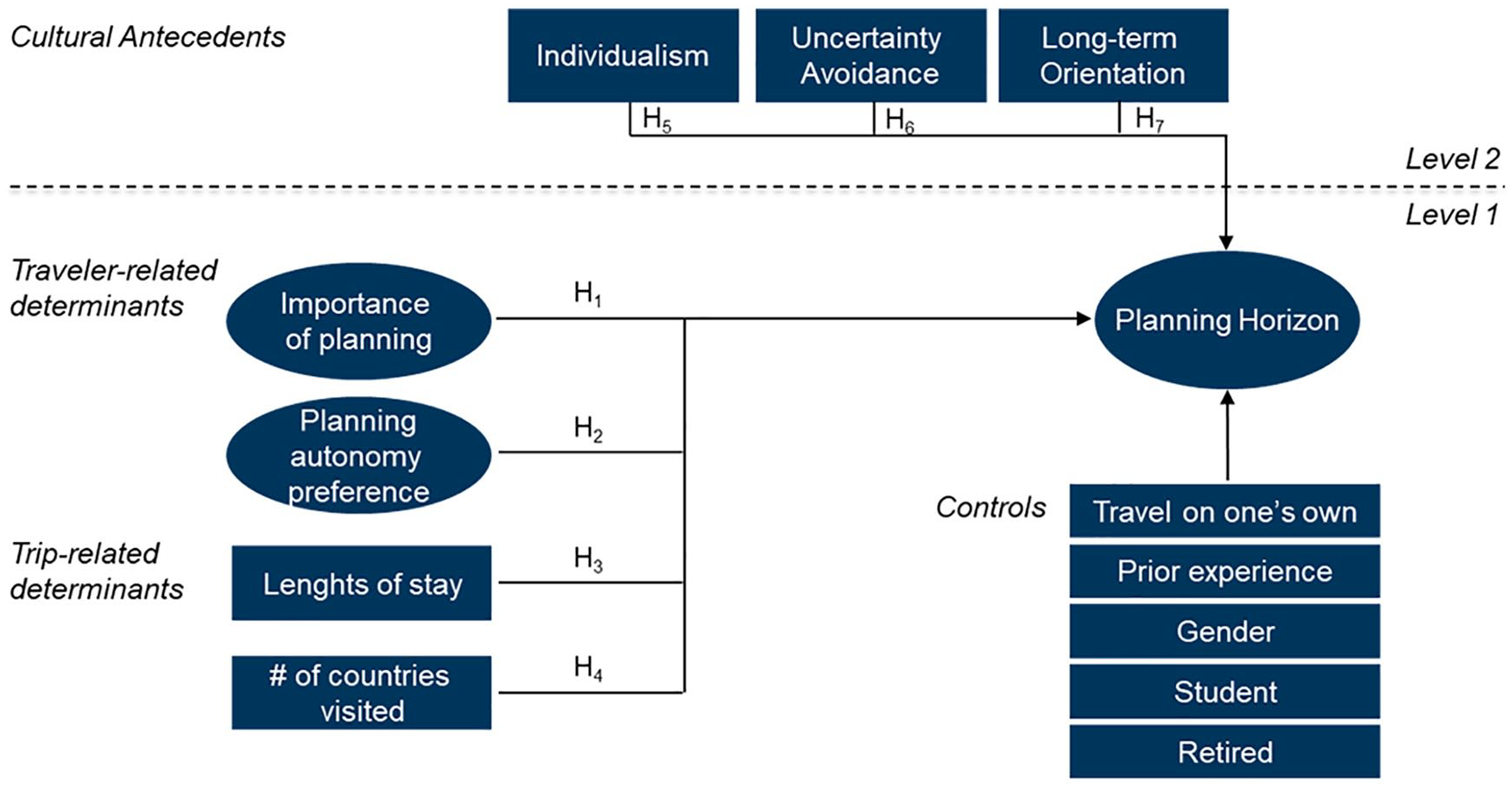
Conceptual model.
Study Methods
Data Analysis Overview
Research design and data collection
In order to test the conceptual model, we follow a hierarchical linear regression approach (Raudenbush and Bryk 2002; Snijders and Bosker 2012), using data from two sources. At the individual traveler level (level 1), we draw on survey data obtained in 2017 from 4,580 international travelers visiting one or more European countries by means of an international rail travel pass purchased from a particular travel service provider. Respondents were contacted by e-mail through travel provider’s market intelligence team after completing their journey. As an incentive to participate, respondents were offered vouchers of a value of approximately 5.00 EUR. This led to a response rate at a level of about 10%. The survey was administered through an online questionnaire hosted on Qualtrics. In addition to several aspects related to the journey experience (e.g., satisfaction, countries visited, reasons for visiting), the questionnaire contained several questions related to the pre-booking phase of the journey, such as the time span between key decision-making aspects related to the journey, or the use of diverse media channels during the planning phase. After excluding 182 respondents who did not plan the main elements of the journey themselves, but booked with travel package companies, and 324 questionnaires with incomplete data, a final total of 4,074 valid questionnaires were included in the analysis. At the country level, we obtained secondary data for the 17 countries that respondents indicated to be their country of residence, in order to model the cultural-level variables conceptualized.
Measurement
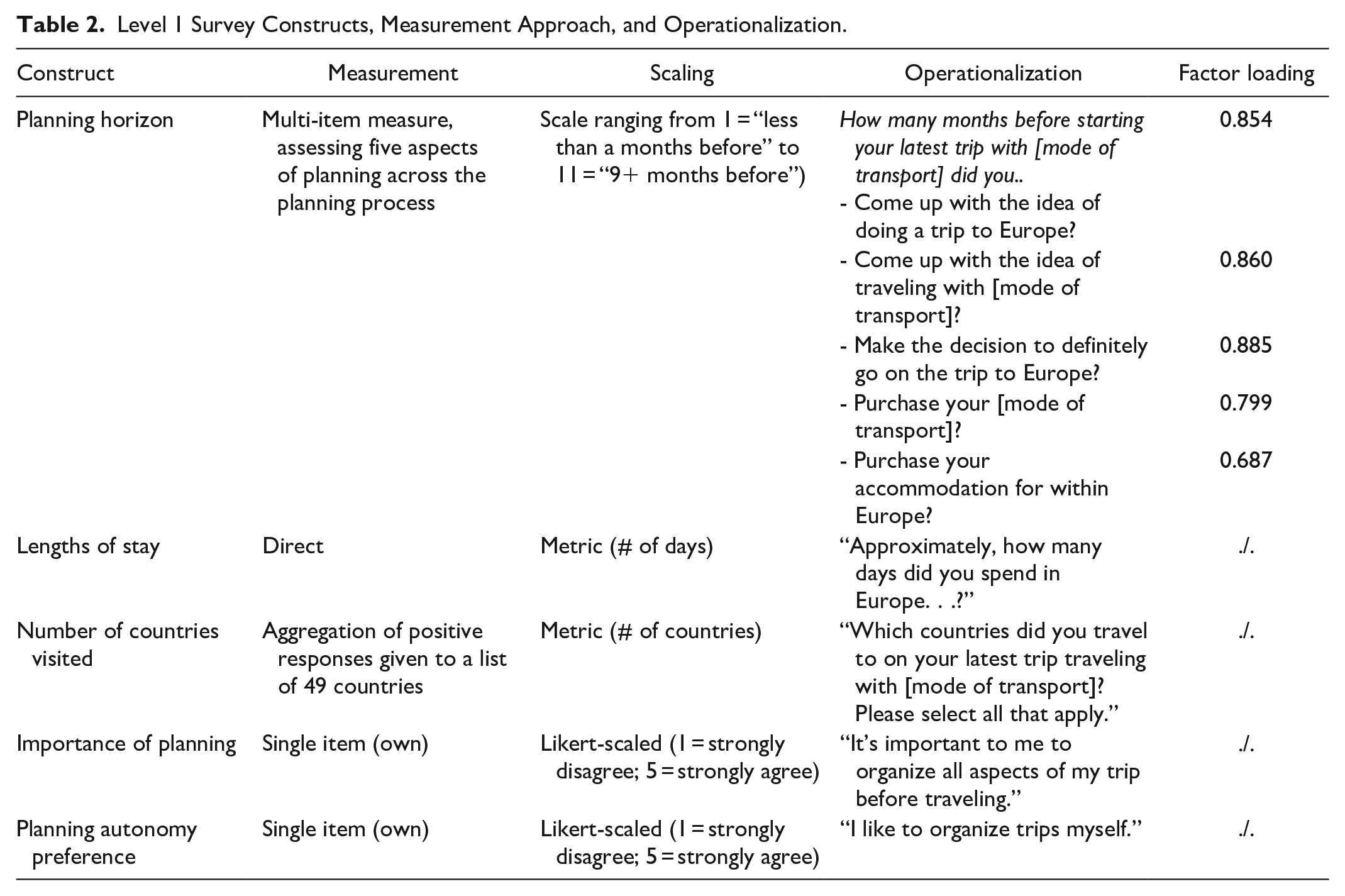
To measure the dependent variable planning horizon at level 1, we built a composite measure from answers to five questions concerning the timing of key planning activities occurring in the pre-journey phase, in relation to the day of departure. Of the five questions, two questions referred to ideation (sample question: “How many months before starting your latest trip. . . did you come up with the idea of doing a trip to Europe?”), one question to actual decision-making (“How many months before starting your latest trip. . . did you make the decision to definitely go on the trip to Europe?”), and two items to the actual bookings of accommodation and transport (“How many months before starting your latest trip . . . did you purchase your accommodation for within Europe?”). All five questions were assessed using a scale ranging from 1 (less than a month before) to 11 (nine or more months before). Given that exploratory factor analysis supports unidimensionality, and that the combined scale performs well with regard to internal consistency (Alpha = 0.873; CR = 0.911; AVE = 0.673), we aggregated the scale items to form a mean. Furthermore, the lengths of stay (“Approximately, how many days did you spend in Europe. . .?”), and the number of countries visited were measured. Likert-scaled single item measures were used to assess the importance of planning (“It’s important to me to organize all aspects of my trip before traveling”), and planning autonomy preference (“I like to organize trips myself”); both being assessed on a scale ranging from 1 (strongly disagree) to 5 (strongly agree). We included, as level 1 control variables, the respondent’s gender, occupation (student, retired), whether the trip was done on one’s own (“With whom did you travel on your latest trip. . .?—I traveled by myself”), and prior experience with this way of traveling. Tables 2 and 3 depict the measurement approaches, as well as the descriptive statistics and correlations for the individual-level variables.
Level 1 Survey Constructs, Measurement Approach, and Operationalization.
Individual-Level Descriptive Statistics and Correlations.
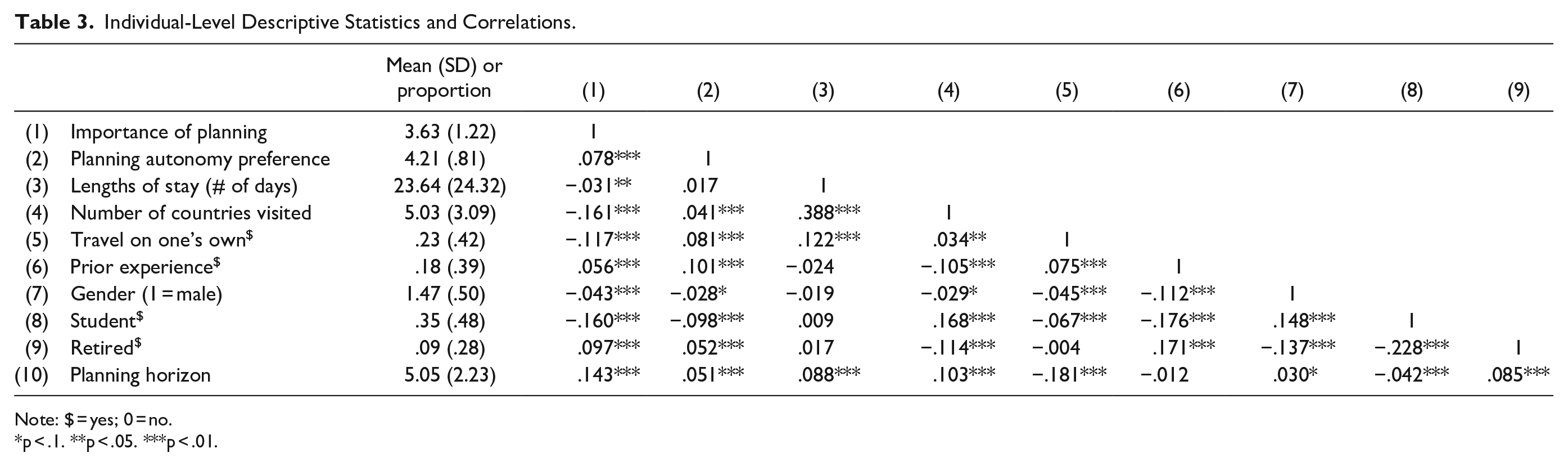
Note: $ = yes; 0 = no.
p < .1. **p < .05. ***p < .01.
At level 2, the conceptual model is constructed on the basis that three of Hofstede’s dimensions of national culture (individualism, uncertainty avoidance, and long-term orientation) could function as country-level antecedents. We obtained empirical values for the 17 countries from the level 1-dataset in Hofstede’s Country Comparison tool (Hofstede 2020). Calculations using an empty random intercept model reveal an intraclass correlation coefficient (ICC) of 9.55%, indicating that 90.45% of the variation in the dependent variable planning horizon lies at the individual traveler level, while 9.55% can be assigned to the country level (Snijders and Bosker 2012). Given a design effect (DEFF) of 25.2, both measures suggest that the group-level variance is sufficiently large to warrant the use of a hierarchical linear modeling approach (Muthén and Satorra 1995). Model results further indicate significant variation between the 17 countries with regard to the average length of planning horizon (p < .01). 1 Therefore, we estimated a random intercept model (Raudenbush and Bryk 2002), using the Linear Mixed Models procedure from IBM SPSS Statistics 26. To account for the relatively low number of level 2 cases, we conducted a restricted maximum likelihood estimation, using the Kenward-Roger approximation, as suggested in the literature (Garson 2020; Staggs 2017).
Analysis Results
Level 1 effects
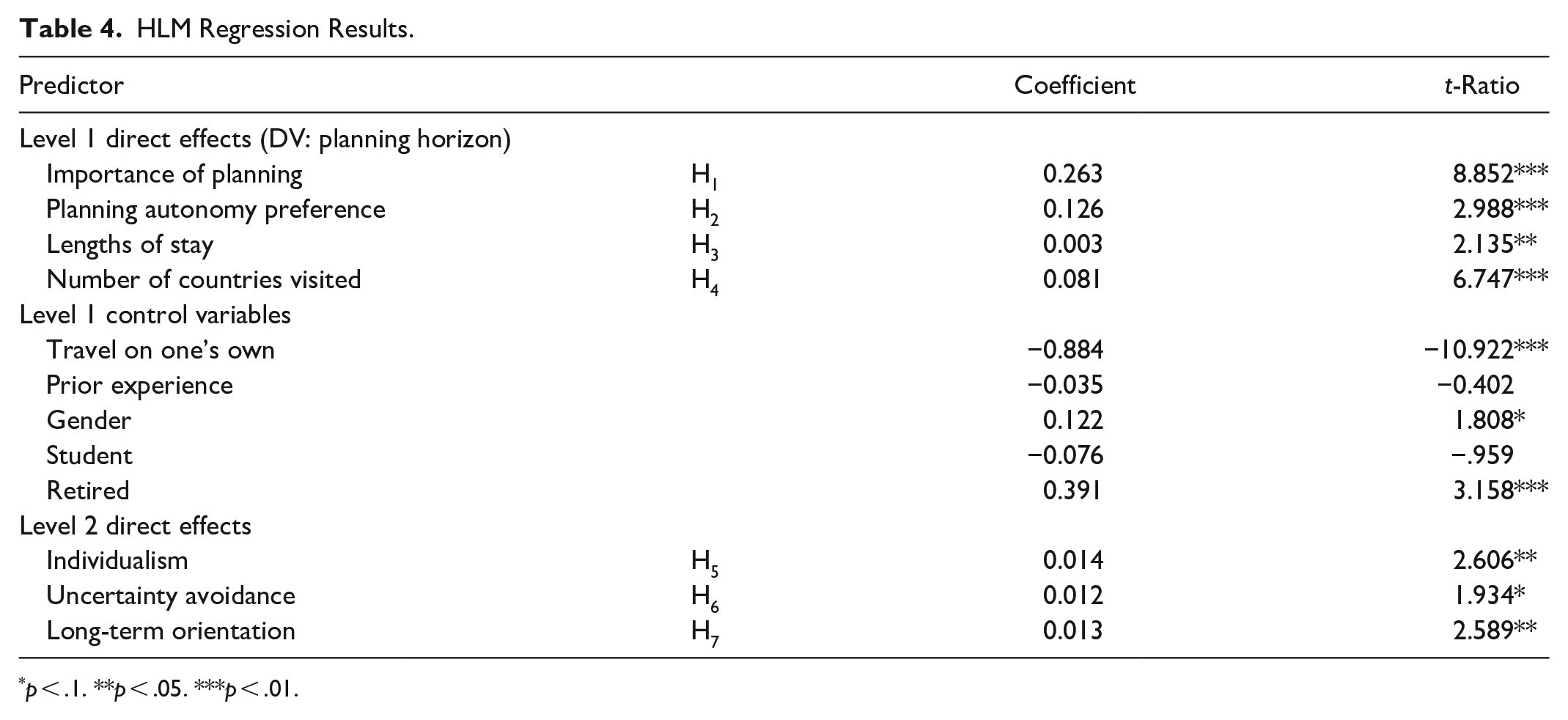
With regard to H1, the results support the positive effect of the importance to book all aspects of a trip before traveling on the length of the planning horizon (β = 0.263; t = 8.852). This finding supports the relevance of individual-level differences in terms of how travelers approach planning (Stewart and Vogt 1999): On the one hand, there is a segment that—for various reasons—attaches importance to comprehensive planning, and thus also exhibits a more extended planning horizon. On the other hand, there are travelers who value the benefits that spontaneous decision-making offers, and who thus do not book all aspects of a trip prior to departure. Against this background, the support offered for H1 indicates that planning horizon is a function of the number of booking decisions travelers choose to make based on their preferences for detailed planning.
Similarly, and as hypothesized in H2, planning autonomy preference positively affects the planning horizon (β = 0.126; t = 2.988). Notably, while significant, the effect is weaker in size, compared to the importance travelers attach to planning in general (βH2 = 0.126 vs. βH1 = 0.263). Given the increasing relevance of independent planning and booking behaviors and the role of planning autonomy in shaping customer satisfaction, this finding highlights the need for easy-to-use information and booking solutions (Fernández-Herrero, Hernández-Maestro, and González-Benito 2018).
In support of H3 and H4, planning horizons also increase with the lengths of stay (β = 0.003; t = 2.135) and the number of countries visited (β = 0.081; t = 6.747). Referring to our hypotheses development, these findings might be related to both variables contributing to a trip’s complexity, as well as its perceived financial and time risk. Of the control variables, two effects are significant below the 0.05 threshold: Respondents who travel on their own report a significantly shorter planning time horizon (β = −0.884; t = −10.992), whereas retired respondents show significantly longer planning time horizons (β = 0.391; t = 3.158). Furthermore, gender exerts a marginally significant effect (β = 0.122; t = 1.808).
Level 2 effects
With regard to the cross-level hypotheses, national-level individualism exerts a marginally significant positive influence on the planning horizon, providing support for H5 (β = 0.014; t = 2.606). Similarly, long-term orientation positively, 2 and significantly, affects the dependent variable (β = 0.013; t = 2.589), supporting H7. The positive effect hypothesized to arise from uncertainty avoidance trends in the expected direction but is significant only at the 0.10 level (β = 0.012; t = 1.934). HLM regression results are reported in Table 4. Taken together, these findings indicate that cultural-level aspects play a significant role in explaining between-country differences of travel planning horizon. In particular,
HLM Regression Results.
p < .1. **p < .05. ***p < .01.
Lu and Chen (2014) have already found that travelers’ nationality determines their utilization of information sources. Our study adds a planning horizon perspective to these kinds of considerations.
Implications
Theoretical implications
This research contributes in different ways to travel literature and management. First, we identified that there is an estimable variance in international travelers’ planning horizons. Hence, our study supports prior calls for a better understanding of planning time in the context of travel decision-making (Chen and Schwartz 2008; Rahman, Crouch, and Laing 2018; Schul and Crompton 1983). Although the time between the first idea for a trip and the day of departure has been addressed by several studies, only a few studies explicitly set the planning horizon as a dependent variable, influenced by different factors (Jun, Vogt, and MacKay 2007; Money and Crotts 2003). However, doing so does help in the understanding of when different types of travelers start their trip planning activities (Dellaert, Arentze, and Horeni 2014).
Second, by conducting a multi-level analysis, we demonstrate that traveler-related, trip-related (individual level), and cultural factors significantly influence the planning horizon. With regard to our findings at the individual level, we confirm prior findings that the length of stay prolongs the planning horizon (e.g., Lewis and Talalayevsky 1997; Pan and Fesenmaier 2006), as does the number of countries visited (e.g., Huh and Park 2010; Zalatan 1996). Additionally, a preference for planning autonomy has a positive impact on the planning horizon. Travelers who plan on their own, and those who organize all aspects of their trip before traveling, begin their travel planning earlier. This confirms the implications of the case-based planning theory of Stewart and Vogt (1999), which suggests that planners tend to over-plan, ensuring alterative plans in the event of disruption.
At the cultural level, this study confirms that cultural aspects play a role in determining travelers’ decision-making in terms of their planning horizons. While prior studies have suggested similar effects (Zalatan 1996), they draw on comparisons of few cultural contexts, whereas our study employs two-level survey data obtained from travelers from 17 countries. In an increasingly globalized sector marked by global travel styles, this finding justifies continued investments in geo-localized marketing strategies. The study results also add to the interpretation of Choi et al.’s (2012) finding that “Chinese tourists spent shorter times in preparing and planning trips than other tourists from other countries in previous studies” (Choi et al. 2012, 37). Here, our study provides evidence for three particular cultural-level variables that help explaining the abovementioned differences in planning for international travel.
Third, the correlation analysis provides insights into travel planning styles in light of the specific characteristics of travelers and trips. The importance of organizing all aspects of a holiday prior to departure tends to be closely related to being in control of the organization of the trip itself. This suggests that travelers who give high importance to planning wish to be empowered to complete all steps on their own, rather than relying on professional intermediaries to make their bookings. Prior experience with trips of more than one destination—as when, for example, using a rail pass to travel across Europe—also positively influences the use of do-it-yourself planning. Another interesting insight is that the importance of planning all aspects of a trip does not relate to the complexity of the trip, as proxied in our model by the length of the holiday and number of countries visited. This relationship suggests that the more complex the trip, the more adjustments are expected—or needed—to be made while traveling.
From a methodological viewpoint, it is suggested that the use of a hierarchical linear modeling approach is effective in addressing the shortcomings of existing studies, in which variables associated with the level of national culture have been disaggregated to the individual travelers’ level. In particular, traveler decision-making occurs, or is embedded, in a higher-level cultural context, which should empirically be reflected through the use of a two-level research design and analysis.
Managerial implications
The study findings have several practical implications for managerial decision-making in both international and also in domestic travel marketing contexts. In both contexts, knowledge about travelers’ or traveler segments’ planning horizons allows for a better timing of marketing-mix measures with regard to traveler’s planning approaches—and thus can be expected to increase effectiveness of for example advertising campaigns. Incorporated into targeted advertising, consumer segments could be approached at a time where travelers are just about to enter the ideation stage of the planning process and have not yet articulated their needs by, for example, searching the web using travel-related key words. Importantly, decisions taken at the beginning of the process define the scope of goods and services that will presumably be purchased during a particular trip. Companies targeting travelers whose individual or trip characteristics are associated with a long planning horizon should engage with their customers at an early stage to influence later decisions.
To practically account for differences in planning approaches, different types and frequencies of advertising might be advisable for target groups with short or long planning horizons. Travel managers can adjust the timing of their promotional programs to account for different cultural, trip- and travel-related determinants of the planning horizon and optimize total promotional costs.
Developing an engagement strategy for travelers with a longer planning horizon would also seem promising. Longer lead times between the inspiration and booking stage of trip planning offer both opportunities and challenges. On the one hand, companies have more time to capture travelers’ interests, on the other hand they are more exposed to competition from other offers. Developing an engagement strategy, for instance through a community of travelers or personalized inspirational itineraries, could be effective in developing a relationship with the potential customer that would eventually lead to a purchase. Another strategy would be to offer integrated booking solutions that include multiple travel services alongside the customer journey (e.g., transport, accommodation, activities, etc.). Thereby, management should also take into consideration that measures to foster bookings (e.g., discounts, promotions, or retargeting measures) decrease planning flexibility and might thus be less effective in case of longer planning horizons. In sum, it is crucial to identify and choose the right time to approach travelers during their planning sequence.
Notably, the above outlined aspects are not only relevant to providers of travel-related offerings in the narrower sense; also institutions that do not directly participate in the travel value chain but provide support functions can benefit from the study’s findings. For example, incoming agencies who provide marketing support to a particular city, region, or country can similarly optimize their marketing activities both at the national and international level.
Through the inclusion of cultural-level variables, the above outlined implications for an improved timing of marketing-mix related measures can be extended to international marketing. Specifically, when targeting international travelers, travel providers should take cultural differences with regard to uncertainty avoidance, individualism and long-term orientation into consideration in their temporal planning for international marketing activities. More specifically, customer segments from risk-averse cultures book long in advance, and may be more readily encouraged to increase the number of countries they plan to visit.
An innovative approach might be to use this study’s findings to complement geo-targeted promotion programs. Doing so, travelers’ needs alongside the travel planning process could be identified as a function of their planning horizon, based on trigger information obtained through for example, geo-targeted social media campaigns. While such targeting approaches did not appear to be practical in the past, variations in travelers’ planning horizons can today be relatively easily addressed with modern communication and sales tools; either by differential prices in accordance with the planning stage (Chen and Schwartz 2008; Rahman, Crouch, and Laing 2018) or by providing information at relevant contact points (Schroeder and Pennington-Gray 2015; Xiang et al. 2015).
Greater understanding of individual and cultural influences on planning horizon could also improve the efficiency of dynamic pricing approaches. On the one hand, early bird discounts and last-minute offerings influence the time of booking, and help travel companies to manage capacity. On the other hand, we confirm that the length of the planning horizon varies, and is influenced by a range of variables, as well as price. If pricing managers ignore the time at which different traveler segments start their planning, they will not maximize their margins.
The COVID-19 outbreak and the resulting collapse of international travel has led to increasing levels of uncertainty across the sector. While the data for this study has been collected prior to the COVID-19 pandemic, we expect our results to be generally robust and also hold in a post-pandemic context. In particular, while it seems reasonable to assume that planning activities and -horizons are affected through the pandemic, travelers from high risk-averse cultures can still be expected to exhibit longer-term planning horizons, as compared to travelers from less risk-averse cultural backgrounds. Similarly, the extents to which the individual-level effects of the number of countries visited, the lengths of stay, planning autonomy preference and importance of planning, have been found to affect planning horizon, should be generalizable to the post-pandemic context.
Notably, a post-COVID-19 perspective might shed interesting new insights when being combined with a finer-grained conceptualization of travel horizons. Independent from the cultural context, COVID-19 might on the one hand prompt travelers for more intense research activities (e.g., related to the development of the pandemic at the destination, hygiene conditions and demands or the level of medical care), which may increase the overall span of planning horizons. On the other hand, given the high volatility regarding the extent to which destinations are affected by the pandemic over time, travelers might postpone booking activities as far as possible, which may in turn reduce overall planning horizons. In so far, given an extended time span between starting information search and departure, and a condensed time span between making bookings and departure, also the mean of the composite measure of travel horizon as conceptualized in this study might be relatively stable. While beyond the focus of this study, these considerations imply that travel companies should provide timely, transparent and extensive information regarding risk situations related to transportation, destination and accommodation. Also, travel offerings should as far as possible incorporate high levels of flexibility, so that short-term changes in the risk situation of a destination can be accounted for (e.g., by travel insurances).
Limitations and Future Research
This research is not without limitations, which need to be addressed to enhance explanatory power and generalizability of our model.
First, our model is focused on the planning horizon, which is defined as the time that elapses between the first idea of traveling and the day of departure. Additionally, the planning horizon involves the day of purchase, which is not exclusively controlled in our model. However, the day of purchase is crucial to travel companies; it influences their sales and marketing promotional plans, for example, and allows them to set prices differentiated by time, or to invest in sales channels dedicated to travel destinations. More research is needed to examine the time of purchase.
A second limitation is the population tested. Our study represents a large group of travelers. However, research with other traveler segments, focusing on modes of transport other than rail, is needed to ensure our findings are consistent across contexts. Different segments may exhibit different sensitivities to time.
Third, interest in the pre-trip phase is reasonable, as it is then that destinations on the selected routes are chosen (Stewart and Vogt 1999). However, planning activities occur also in the during-trip phase, and this aspect has largely been ignored in the literature (Sammer et al. 2018). A possible reason for this can be seen in the limitations of survey methods, which do not collect a sufficient record of activities between origin and destination (Sammer et al. 2018). From a practical viewpoint, addressing this gap would seem valuable, particularly as travel planning is becoming more spontaneous, owing to travel services aiming for more flexibility in terms of itineraries (Park and Fesenmaier 2014). Customers now change their plans more frequently, both before and during their trips.
Fourth, further research may assess certain other antecedents and consequences of travelers’ planning horizons. In addition to the variables included in this study, several other traveler—(e.g., demographic, motivational) and trip—(e.g., season, destination profile) might affect planning horizons. With regard to consequences, previous research into industries other than the travel sector indicates, for example, that customers with longer planning horizons are more likely to purchase a brand different from one with which they are familiar, or to buy a particular product for the first time (Newman and Staelin 1971). Future studies may evaluate the role of the planning horizon as being associated with attitudinal characteristics, such as commitment and loyalty toward a destination, or behavioral variables such as purchase behavior, importance given to word-of-mouth, or impulse buying.
Finally, it seems warranted to replicate and extend our model and research design in a post-COVID-19 environment. Here, a special focus on risk and a finer-grained conceptualization of planning horizon seem promising, as the COVID-19 pandemic has implications for travelers’ risk perceptions and, as outlined before, can be expected to affect the phases of information and booking differently.
Footnotes
Declaration of Conflicting Interests
The author(s) declared no potential conflicts of interest with respect to the research, authorship, and/or publication of this article.
Funding
The author(s) received no financial support for the research, authorship, and/or publication of this article.
