




Abstract
Technological solutions to achieve energy efficiency and carbon reduction in tourism are unlikely to be sufficient alone. This is partly because of the rebound effect (RE) where consumer behavior can absorb some of or all the energy efficiency gains. Time savings from time-efficient technologies can intensify energy consumption, leading to the time use rebound effect (TRE). Research suggests that the TRE in tourism can be high, especially in relation to tourist travel, but its understanding is limited. This study aims to provide empirical evidence of the TRE by categorizing tourist groups that are most prone to its occurrence. An exploratory sequential mixed methods approach is employed. Key factors that influence the potential TRE occurrence include socio-demographic characteristics, holiday preferences, time/money availability, time perception/attitudes, and time use patterns on holiday. The “Busy explorer” cluster of tourists is most likely to show TREs. Implications and suggestions for future research are outlined.
Introduction
An increasing number of studies and policies have focused on sustainable tourism development due to the industry’s growing natural resource intensity and accelerating greenhouse gas (GHG) emissions (see, e.g., Gössling et al. 2010; Hall 2013; Hall, Gössling, and Scott 2015; Kim and Filimonau 2017; Organization for Economic Cooperation and Development [OECD] 2020a; Scott et al. 2016). Technological interventions have been acknowledged as an important driver of energy efficiency improvements in tourism which help reduce environmental impacts (Pratt, Rivera, and Bien 2011). However, solely technology-focused solutions have not always been successful in environmental impact reduction because they fail to sufficiently reflect upon how they might change tourist behavior (Miller et al. 2010).
The key question is whether the actual energy efficiency gains of technology use correspond to the anticipated amount of energy savings. Economic theory suggests this is not always the case due to often unanticipated changes in consumer behavior (Sorrell 2007). Behavioral responses of tourists are recognized as one of the key drivers of technological ineffectiveness, and these responses have not been considered in the projection of energy saving potential in tourism (Jenkins, Nordhaus, and Shellenberger 2011). This can be partially attributed to the rebound effect (RE).
The concept of the RE describes increased energy consumption due to the cost savings caused by an application of energy-efficient technology (Sorrell 2007). For example, people spend money saved by using energy-efficient heating at home on leisure trips (Li and Yang 2007). This brings about reduced carbon impacts at home but increased carbon impacts in relation to leisure trips.
The RE can explain how some of or all the expected reductions in consumption are offset by consumer responses. The RE describes the demand which bounces back, usually unexpectedly (Hertwich 2005). As an example, as the initial COVID-19 lockdown restrictions were eased in 2020, consumption of foodservices and holidays was shown to rebound (BBC 2020). That is, the RE can occur not only in relation to energy efficiency improvements, but also due to other major interventions such as policy changes, disasters, and crises. The RE was first conceptualized in the field of energy economics and subsequent empirical evidence was collected herewith to demonstrate the RE can be significant (Wang, Han, and Lu 2016). Scholarly discourse on the RE outside energy economics in fields such as tourism has hardly occurred to date (Czepkiewicz, Heinonen, and Ottelin 2018).
The concept of RE has been explored in the context of household and passenger transport energy consumption (see, e.g., Andersson, Linscott, and Nässén 2019; Druckman et al. 2011; Thomas and Azevedo 2013). Energy savings achieved by using energy-efficient home appliances and vehicles prompt the RE, with implications for increased energy consumption and related GHG emissions (Belaïd, Youssef, and Lazaric 2020; Murray 2013). For instance, driving a fuel-efficient car reduces its running costs, thus prompting consumers to choose it for more frequent travel or spend the saved money on other products and services that are energy-intensive (Sorrell 2007). Research indicates that the RE can occur in tourism although it has been rarely referred to as such (Filimonau, Mika, and Pawlusiński 2018; Gössling, Scott, and Hall 2013; Hall 2013, 2015; Hall, Gössling, and Scott 2015; Wang, Niu, and Qian 2018). No empirical research has been carried out to identify how the potential gains driven by technological improvements (e.g., carbon savings) in tourism could be offset by unexpected changes in consumer behavior (Kim, Filimonau, and Dickinson 2020).
Tourist behavior has been repeatedly acknowledged as a key aspect to consider in promoting (more) sustainable tourism development (see, e.g., Dolnicar, Knezevic Cvelbar, and Grün 2019; Kim and Filimonau 2017; Lee 2011). To reduce the negative environmental impacts of tourism, attempts to induce voluntary changes to tourist behavior have been made. These attempts are exemplified by the design of voluntary carbon-offset schemes for flights (Ritchie, Kemperman, and Dolnicar 2021) or provision of the opt-out option of daily room cleaning in a hotel (Dolnicar, Knezevic Cvelbar, and Grün 2019). However, voluntary behavioral changes in tourist consumption are often considered unrealistic, and studies claim that such an approach is insufficient alone (Higham et al. 2016; McKercher et al. 2010) or ambiguous (Gössling et al. 2007) for sustainable tourism management. Voluntary changes can further be complicated by the impacts of the RE.
The RE has multiple dimensions, such as time use. The temporal effects can be observed when technological improvements not only save money but also yield other outcomes, such as time savings that stimulate greater consumption (Santarius 2012). For example, the ownership of a washing machine and microwave at home has altered time use of people, which has helped them rebalancing time intensive activities such as spending less time on housework but extra time on leisure activities (Jalas 2009). These time savings can trigger the RE, known as the time use rebound effect (TRE), and are pertinent to tourism because holidays are one of the major patterns of leisure time and energy consumption (Aall 2011). Jalas (2002) defines the TRE as the new activities undertaken by a consumer when time is saved due to new technologies. In the context of environmentally sustainable tourism, time-saving technologies have implications for tourist travel behavior and patterns of tourist activities at a destination.
Becker (1965) argues that technology has improved the productivity of time and this in turn may influence the reallocation of time toward further consumption. For example, high-speed rail saves time compared to travel by conventional train (Filimonau, Dickinson, and Robbins 2014), and this time saved can be reallocated for other activities, such as sightseeing at a destination. The impact of the TRE can be particularly significant in the tourist transport sector due to the close link between travel and time. This adds an insight into sustainable tourism consumption as many tourist activities depend on transport (Kelly, Haider, and Williams 2007).
The TRE in tourism was first conceptualized by Kim, Filimonau, and Dickinson (2020), although this study lacked empirical evidence of the TRE occurrence in tourism. The lack of empirical investigation represents one of the drawbacks of TRE research (Jalas 2009). Individual consumers respond differently, and often unpredictably, to different technologies designed to speed their travel up. This is attributed to various factors, such as personal characteristics and external circumstances (de Haas, Faber, and Hamersma 2020; Spielmann, de Haan, and Scholz 2008). Zhao et al. (2018) suggest that certain groups of tourists share values and exhibit similar travel patterns during holidays, which has implications for the potential TRE.
The aim of this paper is, therefore, to provide empirical evidence of the TRE in tourism and categorize tourists in line with the likelihood of their behavioral response to its occurrence. The study provides managerial and policy-making recommendations aiming to mitigate the carbon footprint of tourism. Suggestions for future research are outlined concerning how to better understand tourist behavior and integrate the (T)RE in tourism studies for (more) sustainable tourism development.
Literature Review
Time and Travel Patterns in Tourism
Time is a determinant of travel (Pearce 2020), and the notion of a travel time budget explains well how time has been commodified and valued equally to or greater than money (Johnson 1966). Travel time budgets incorporate time spent on tourist activities en-route (traveling between home and a destination), on-site (time spent on activities at the destination), but also the travel time spent within the destination. As demonstrated in an earlier empirical study on the value of travel time on destination activities (Walsh, Sanders, and Mckean 1990), tourists are willing to substitute travel time with time they spend on-site as they then can maximize satisfaction by engaging in on-site activities. Thus, time is a precious resource that determines tourist experiences (Hall 2005). These experiences can be high or low in carbon intensity (Rico et al. 2019). For example, adventure activities, for example, off-road tours by jeep, are extremely energy-intensive whereas staying on a beach has no direct GHG emissions (Filimonau et al. 2013).
Tourists make choices that have implications for time use on holiday, including where to travel to and which activities to engage in at a destination (Sirakaya and Woodside 2005). Hall (2005) claims that tourist decisions on where to travel, how to travel and what to do at a destination are determined by time (constraints). However, under time constraints, “rational” decision making and consumption in terms of environmental sustainability are not always practically feasible (Jackson 2005). Time availability determines a tourist’s travel mode choice both en-route and at the destination (Haselsteiner et al. 2015; Prideaux 2000). The lack of time can prompt tourists to choose faster travel because time spent traveling is often seen as wasted time (Lyons and Urry 2005). At a destination, by traveling quickly in between attractions and activity sites, tourists can enrich their holiday with more experiences (Stein 2012). In other words, an increase in speed can relax the temporal constraint on travel (Dickinson and Peeters 2014). Studies focused on the availability of time and time use in the context of sustainable tourism are scarce despite the potential significance of the TRE and negative environmental consequences (Kim, Filimonau, and Dickinson 2020; Santarius 2012).
Time is an important consideration for tourists when deciding on the next holiday destination as they try to incorporate as many activities as possible within the limited time budget available (Litman 2020). In their decision-making, tourists will gage how long each mode of transport takes to reach the destination (Filimonau, Dickinson, and Robbins 2014). Technological innovations, especially in air transport, have reduced fuel consumption but concurrently increased travel speed which prompted tourists to cover longer distances (Gössling and Peeters 2015). This has increased the share of transport in the total carbon footprint of tourism as the increasing number of international holidays is taken by airplane (Eijgelaar et al. 2016). Despite technological developments and attempts to improve occupancy rates, average GHG emissions per passenger and kilometer remain static because these technological solutions and efforts in tourism are outpaced by the increasing tourist demand (Lenzen et al. 2018). Thus, facilitating fundamental changes in mobility patterns is crucial in tourism with respect to its long-term environmental sustainability (Hall 2015).
Travel patterns of tourists are unique and individualistic (McKercher and Lau 2008). These patterns can change depending on the travel context such as travel party (Davison and Ryley 2013; Zhao et al. 2018), trip purpose (Kim, Filimonau, and Dickinson 2020), and type of holiday (McKercher and Lew 2004; Smith, Robbins, and Dickinson 2019). Understanding travel patterns of tourists is essential to better comprehend tourist behavior and consumption patterns (Larsen and Guiver 2013). Notwithstanding the potential significance, the effects of technological improvements on travel behavior and the associated environmental impacts have remained largely unexplored in the context of tourism (Kim, Filimonau, and Dickinson 2020).
The Time Use Rebound Effect (TRE) in Tourism
The importance of energy-efficient technologies, particularly in tourist transport, has been a focus of tourism studies as such technologies have not only aided in mitigating the GHG emissions, but also improved capacity, comfort and speed of travel (e.g., high-speed rail) (Nižić and Bračić 2014). However, energy efficiency interventions appear insufficient to achieve the needed GHG emission reductions while accommodating projected future growth of tourism, particularly in transport (Ram, Nawijn, and Peeters 2013). The TRE is helpful here as it examines changes in consumer time use and associated energy impacts due to time-saving technologies (Sorrell, Gatersleben, and Druckman 2020). While most TRE studies investigate the TRE relationship with time-saving technologies at home (Brenčič and Young 2009; Jalas 2002; Sekar, Williams, and Chen 2018) and in the context of reduced working hours (Buhl and Acosta 2016; Nässén and Larsson 2015), the TRE is particularly important for understanding people’s travel behavior (Wiedenhofer et al. 2018).
Druckman et al. (2012) attribute the lack of TRE research to difficulties in primary data collection. Kim, Filimonau, and Dickinson (2020) discuss how recent time-saving technologies in tourist transport can affect tourist activities en route and on site in terms of energy use and related environmental impacts, conceptualizing the TRE occurrence alongside its key drivers. This conceptualization encapsulates the relevant variables, such as socio-psychological values, time and financial constraints and travel context, and maps out potential relationships between these variables. While the conceptual framework proposed by Kim, Filimonau, and Dickinson (2020) sheds light on the TRE phenomenon in tourism, it requires validation via empirical research.
Technological changes associated with time savings can have a substantial impact on the demand for a tourist service, leading to increased use of time-saving technologies or other services where the TRE may occur (Jalas and Juntunen 2015). Time savings from tourist transport are recognized as a key driver (Kim, Filimonau, and Dickinson 2020). For example, Sun and Lin (2018) note that faster travel technology can prompt tourists to generate more carbon emissions. Thus, significant impacts on environmental sustainability are expected due to the TRE in relation to tourist travel.
Time plays a significant role in tourism particularly as a cost (time constraints) since time availability enables tourists to make different choices in relation to their en-route and on-site behavior. Time is contextual and tourists’ experience of time will influence their consumption choices and subsequent environmental impacts. It is therefore necessary to understand tourists’ perceptions/attitudes and use of time and examine the implications for the environment. Thus, this study adopts the concept of the (T)RE to explore the impacts of time on tourist consumption behavior and associated environmental impacts.
Method
This study adopted the logic of abduction by combining qualitative and quantitative methods in a sequential manner, that is, an exploratory sequential mixed method approach (Creswell and Plano Clark 2011). This was due to the lack of previous research on the TRE in tourism. The study was conducted in two phases whereby Phase I explored initial tourist views on the topic using interviews and Phase II considered the opportunities to test interpretation and theoretical insights using a questionnaire based on the Phase I’s insights.
Phase I: Semi-Structured Interviews
Semi-structured interviews were carried out in order to obtain in-depth information about tourist perceptions and attitudes toward time and travel and the potential effects of technological developments in tourist transport. Previous studies (Dickinson and Peeters 2014; Hornik and Zakay 1996; Larsen and Guiver 2013; Lyons, Jain, and Holley 2007; Stein 2012; Walsh, Sanders, and Mckean 1990) including the conceptual framework by Kim, Filimonau, and Dickinson (2020) were used as resources to develop interview questions. Participants were selected using a snowball sampling strategy with participants meeting two criteria: a UK resident who traveled for a holiday purpose at least once over the past 12 months either within the UK or overseas. Initial informants were identified in Dorset, UK. The size of the sample was determined by data saturation.
Thirteen interviews were undertaken between December 2018 and February 2019 lasting an average of 56 minutes. No incentives were offered. The interviews were recorded and then transcribed verbatim. The data were coded and subjected to thematic analysis (Braun and Clarke 2006). Themes were constructed, reviewed and then refined to best demonstrate the story of the overall data set. Validity was checked following Burnard (1991) with three participants, who agreed on a follow-up interview, and an academic in the field who was not involved in the research. They were asked to read the transcripts and identify themes and then to compare their own list with the researcher’s list of themes.
Phase II: Questionnaire Survey
The questionnaire was developed based on the findings of the interviews and the literature review which identified the key topics and aided in phrasing/wording of survey questions and possible answers for closed questions. Key themes emerged from the interviews directly related to the dynamic aspects of tourism, that is, different stages of a holiday trip, from pre-trip/planning to post-trip, and included the aspect of environmental impacts of tourism from a consumer perspective and forms of the potential TRE. There was no formal hypothesis as the analysis strategy employed inductive reasoning to explore evidence of the TRE in tourism and categorize tourists in line with the likelihood of their behavioral response to its occurrence.
There were four main parts in the questionnaire. Part I contained questions associated with respondents’ general holiday preferences and their recent holiday experiences. Part II investigated respondents’ perception/attitudes toward use of time on holiday using Likert-type scale questions (strongly agree to strongly disagree). Twenty-two items measuring psychological values and time use patterns were developed using the key themes and associated quotes from interviews. “Psychological values” were linked to time perception and attitudes while “time use patterns” included items measuring tourist use of time en-route and on-site. Two additional items were included in this section to explore tourists’ pro-environmental perception and attitudes concerning travel on-site, specifically on their choice of environmentally friendly transport option while on holiday. In Part III, a scenario was provided aiming to examine how respondents’ holiday behavior would change due to the time savings en-route (TRE), using Likert-type questions. Additionally, this part included questions to identify the important factors in a tourist’s travel context related to choosing a faster travel option and to estimate respondents’ willingness to pay (WTP) for the faster travel option, that is, the time savings. Socio-demographic questions were contained in Part IV.
Following a pilot test (n = 120), several items were dropped from the measurement scales following exploratory factor analysis leaving the most robust items to measure the concepts. A representative sample of UK consumers in tourism was ensured by the use of Prolific’s sampling tool. Prolific (www.prolific.co) is an online survey platform for academics which enables researchers to access representative samples of the UK population. Registered users in Prolific are invited to participate in social, psychological, and behavioral scientific studies as they meet the recruitment criteria (e.g., Kapoor et al. 2021 using Prolific for a part of their study to explore travelers’ stay intention to eco-friendly hotel and the perceived hotels’ sustainability practices). The participants of this study were remunerated for their time completing the survey through Prolific. The major advantage of using Prolific lied in its fast response times as well as reliable, high quality data (Peer et al. 2017). The sampling tool stratified the sample across three socio-demographics, that is, age, gender, and ethnicity, using the 2011 UK Census for reference (Office for National Statistics [ONS] 2016). In total, 404 useable questionnaires were collected in February 2020. Following the data preparation, a series of data analyses were carried out using SPSS Statistics.
Internal validity was ensured using the qualitative interview research in its design and comparing the results of the questionnaire with the literature. To establish content validity, four experts reviewed and evaluated the questionnaire and also added open comments to ensure the measures were meaningful and logical to the respondents. Following Tsang, Royse, and Terkawi (2017), correlation tests were conducted to examine the association patterns between different measures of a construct and those between a construct and other constructs, that is, on the measures of psychological values and time use patterns. Cronbach’s alpha was not tested because the set of items in the questionnaire did not employ multiple-indicator measures of the same latent variable that was only one variable (Taber 2018).
Findings and Discussion
Phase I: Semi-Structured Interviews
Travel modes were a key factor that influenced participants’ perceived time en-route as they facilitated the travel experiences. Reflecting on their recent experiences of using different transport modes, including airplane, train, car, and coach, most participants felt positive about travel, illustrating it as a sensory experience and quality time. The novelty of the travel experience or the surroundings distracts from processing the passage of time whereby the duration of travel time is perceived differently from the actual clock time (Fayolle, Droit-Volet, and Gil 2014).
Participants viewed the time spent on waiting for travel (e.g., connecting time between flights) differently. Some considered it “wasted” which could have been used instead for an activity at the destination, implying time was a significant cost (Jacobsen et al. 2018). Jain and Lyons (2008) note that perception of waiting time is closely related to the ways in which people “equip,” or spend, the time, for example, by using mobile technologies. Other participants saw waiting time as an added layer of “opportunity” time which provided an extra experience, which is contrary to the findings of Lew and McKercher (2006). Especially for long-haul routes, waiting time was viewed as fairly essential as it helped to increase certainty for the rest of the travel (e.g., to arrive for plane boarding on time) and therefore reduced stress and anxiety.
Having a car meant holding control over how to use the limited time during holidays and it was noted that this contributed to tourism’s energy consumption and GHG emissions. Car use was also preferred in the case of a multi-destination trip because of the convenience and flexibility of movement between locations. Public transport was a viable option for some tourists when traveling in places that provided a visitor-friendly network such as urban areas.
Based on the limited time, activities, and visits were planned by participants or their designated person/organization (tour guide or operator). The plans were determined by the desired experiences at the destination, which was then found to help shape their time use patterns (Galí and Aulet 2019). The importance of accessibility and flexibility was discussed and seen to provide better experiences and more efficient time use. Car use was important here, especially for long(er) trips and in remote areas.
Almost all study participants believed that faster travel would have potentially positive impacts on their holiday experiences with the time paradigm of “the faster, the better,” especially for those who viewed travel to/from a destination as a waste of time. Participants believed their holiday experiences would change in several aspects, with these changes generally perceived positively, indicating the potential TRE. Examples of such positive changes from the participants’ perspective include reduced time pressure, increased range of destination choices and opportunities for more frequent trips.
Time savings from en-route travel were found to release tourists from temporal and spatial constraints (Dickinson and Peeters 2014), especially for those who traveled with children. Time savings enable tourists to travel to destinations they would not have gone without having faster modes of transport due to time constraints. Opportunities for more frequent trips were recognized. Tourists could get away from time pressure even at short notice and with no preparation for time-efficient short breaks. The potential demand for such trips demonstrates the recent trend in tourist travel patterns (Gössling, Scott, and Hall 2018), which is relevant for tourism’s GHG emissions. Participants noted that they would utilize the saved time from en-route travel at the destination, supporting Boto-García, Baños-Pino, and Álvarez (2019). Most participants understood the extra value of saving time and thus gaining opportunities to modify their holiday choices. Several fundamental factors were found to influence people enjoying the benefits of time savings from en-route travel. These mainly include financial constraints and availability of services on arrival at a destination, such as the departure/arrival times of travel, check-in times for a hotel, or opening hours of a museum. Regarding the latter factor, Dickinson et al. (2013) note that tourism is often structured by fixed schedules which impact tourists’ time management at a destination. This demonstrates, no matter how fast tourists could reach a destination, availability of services is key in determining how the saved time could be utilized for better tourist experience. Behavioral changes that emerged from the interviews were consistent with the potential TREs conceptualized by Kim, Filimonau, and Dickinson (2020).
Phase II: Questionnaire Survey
Slightly less than one third of the sample (N = 404) was aged 58 and above, and each of the rest was proportionally distributed throughout the rest of age groups. Half of the respondents were female. 88.9% of the respondents were British and 78.2% were White ethnic. Most of the respondents were employed (both full- and part-time) (65.8%) with the rest comprising retired (14.1%), students (6.2%), and unemployed (5.7%). Household income was spread across the given range with the largest group earning £20,001–£30,000 (23.5%). Approximately 40% (N = 162) had children in their household. The sample was representative of the UK population.
Psychological values and time use patterns
A series of survey items were designed and tested, against the conceptual framework of Kim, Filimonau, and Dickinson (2020) and the literature, in order to measure and identify the latent variables related to psychological values and time use patterns. It was anticipated that the 13 items under psychological values would lead to four key latent variables: time passing on holiday; travel time for holiday; time spending on-site; and time fluidity. Meanwhile, the nine items under time use patterns would lead to two latent variables: time use en-route; and time use on-site.
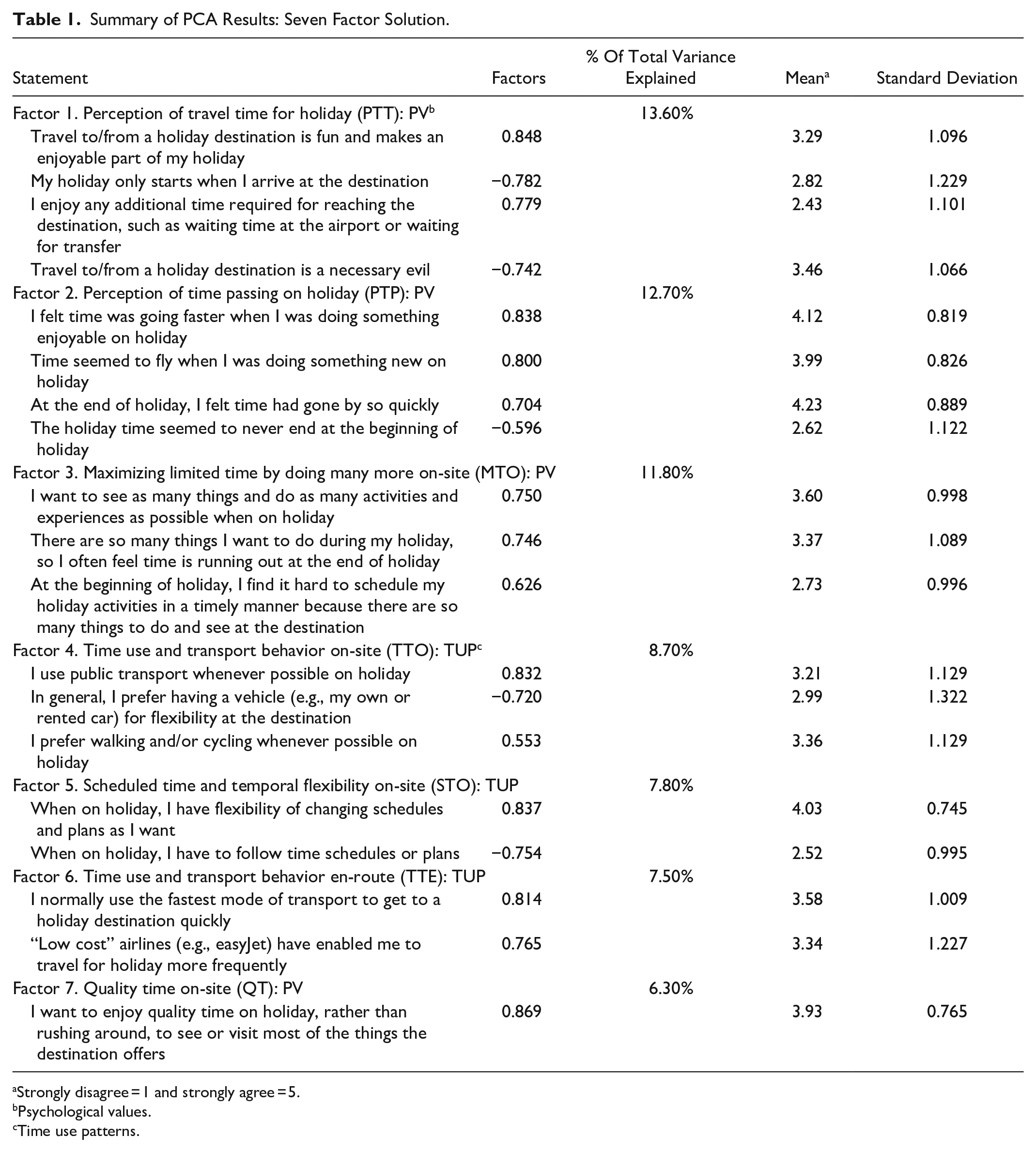
Principal Component Analysis (PCA) was run on these 22 items with an orthogonal method, that is, varimax rotation, which is the most common type of orthogonal rotation, as recommended by Kim and Mueller (1978). This analysis was performed to explore if there were common factors underlying a range of time related psychological values and time use patterns, ahead of subsequent analysis. After a first run, two items were removed because they did not load on any factor. PCA was run again on 20 remaining questions with the same rotation solution, after which an item was dropped due to loading on two factors. The final PCA was run on 19 items with the same rotation method. The determinant was .005, the Kaiser-Meyer-Olkin (KMO) was about .709, and the significance in Bartlett’s test of sphericity was less than .05 (p < .001), indicating suitability of the data for further analysis (Stehlik-Barry and Babinec 2017).
In the Total Variation Explained table generated following the final PCA, the first seven components of the total 19 items had Eigenvalues over 1.00 and together these explained nearly 70% of the total variability in the data. This led to the conclusion that a seven-factor solution after rotation was adequate (Table 1). The screen plot also supported this conclusion. PCA refined the latent variables relating to psychological values and time use patterns on holiday to be used for further analysis.
Summary of PCA Results: Seven Factor Solution.
Strongly disagree = 1 and strongly agree = 5.
Psychological values.
Time use patterns.
As a result of PCA, more refined and clearer latent variables relating to time on holiday were identified. Several anticipated latent variables were not observed in the PCA. That is, the initially defined six latent variables (time passing on holiday, travel time for holiday, time spending on-site, time fluidity, time use en-route, and time use on-site) have been restructured as illustrated in Table 1, into seven latent variables, that is, factors, showing a little distinction with the anticipated conceptualization. Four of these seven latent variables are related to psychological values (Perception of travel time for holiday, Perception of time passing on holiday, Maximizing limited time by doing many more on-site, Quality time on-site) and three represent time use patterns on holiday (Time use and transport behavior on-site, Scheduled time and temporal flexibility on-site, Time use and transport behavior en-route).
Three tourist groups clustered by psychological values and time use patterns
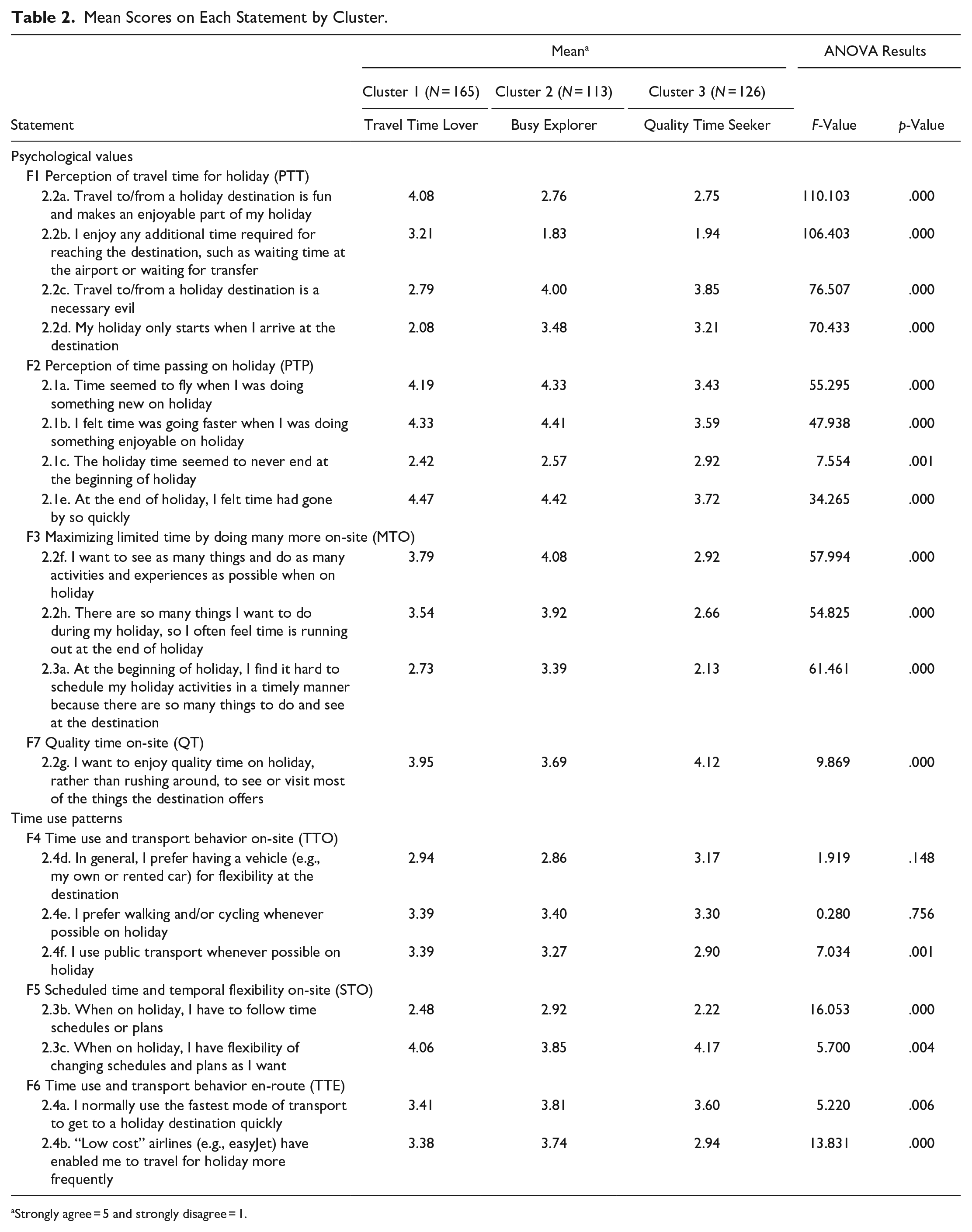
Hierarchical cluster analysis was subsequently performed several times on the 19 items that measured psychological values and time use patterns to identify tourist clusters according to the psychological values and time use patterns. Hierarchical clustering was more appropriate than partitioning such as k-means clustering given that there was no pre-specified number of clusters (Meyers, Gamst, and Guarino 2013). Hierarchical cluster analysis was employed to provide better insights into the similarities and differences between different tourist groups. In hierarchical clustering technique, a researcher fundamentally reruns and compares the clustering results with an increasing number of clusters until the final clustering solution (i.e., the final number of clusters) is determined that represents all given cases (Tullis and Albert 2013). Different cluster solutions were compared by using dendrogram and agglomeration schedule and running a series of Independent T-tests. A three-cluster solution was selected where the size of each cluster was greater than 10% of the sample (Fife-Schaw 1993). Table 2 profiles the clusters against the original statements.
Mean Scores on Each Statement by Cluster.
Strongly agree = 5 and strongly disagree = 1.
The clusters were profiled using cross tabulation to identify salient psychological values or time use patterns (Figure 1). Table 3 profiles each cluster in terms of socio-demographic characteristics, holiday preferences, and availability (time and financial), including the results of Pearson’s Chi-Square tests (significant level at .05). There were several notable differences between the clusters taking into consideration their distinctive psychological values and time use patterns.
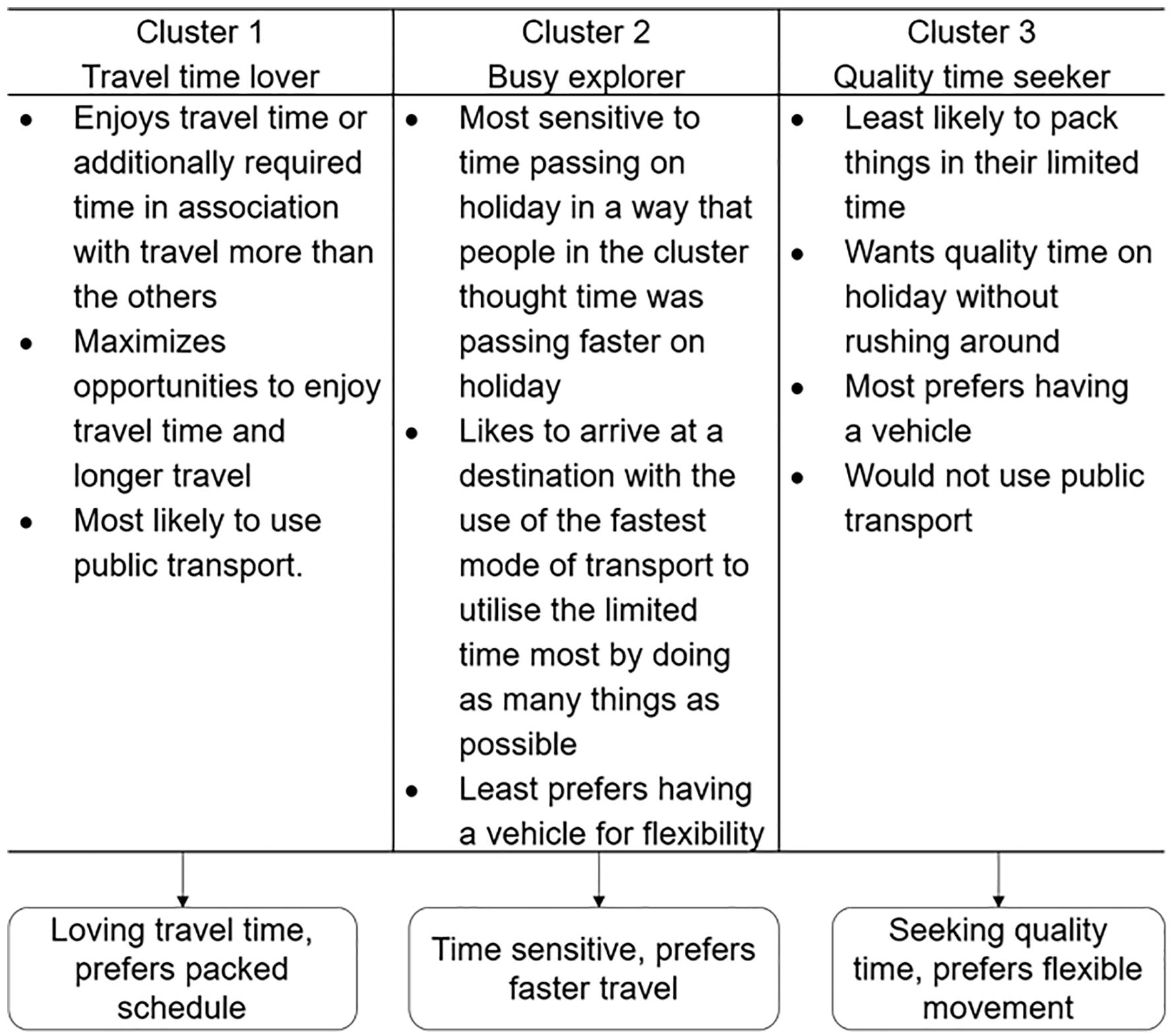
Features of each cluster.
Profile of Each Cluster.
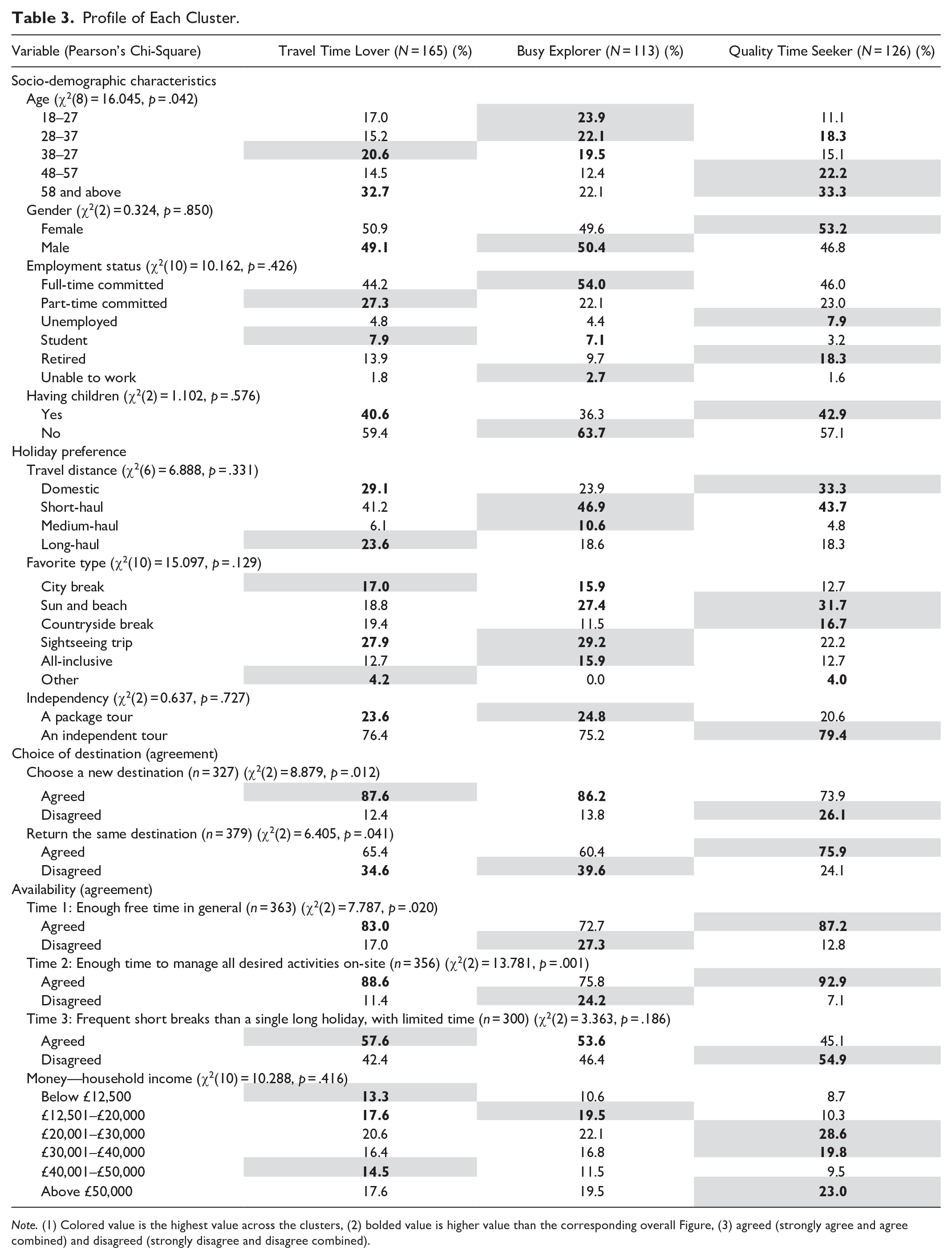
Note. (1) Colored value is the highest value across the clusters, (2) bolded value is higher value than the corresponding overall Figure, (3) agreed (strongly agree and agree combined) and disagreed (strongly disagree and disagree combined).
Members of the Busy explorer cluster are younger and mostly full-time occupied. They feel time constraints for holidays, which explains why their preference for organized trips is slightly greater than other cluster groups. Organized trips generally fit many activities into the limited time schedule. In other words, people in this group tend to have more time pressure on holiday and try to manage all desired activities at a destination, while seeking to explore unknown destinations (Jackson 2005). The Busy explorers commonly use an organized tour operator or plan their itinerary thoroughly before departure. That is, they tend to follow a certain path without making considerable changes to this plan at the destination. By doing so, they think they can do more things despite limited time budgets, not missing any single one out of the main activities and attractions or wasting time (Chang 2007; Galí and Aulet 2019; Hall 2020). Their preference for choosing the fastest transport available and low-cost carriers (LCCs) for holidays can also be attributed to their feeling of time constraints and time use patterns on-site while the latter (LCCs) may concern the cost effect as well.
Members of the Quality time seeker cluster are comparably older and retired. This cluster consists of more of the highest income groups than any other cluster. The Quality time seekers are the antithesis of the Busy explorers in terms of time. That is, they tend to have more time available and be flexible in time use when on holiday. When considering mobility, the Quality time seekers are characterized by fairly predictable holiday patterns and they prefer domestic holidays, which can be linked to the fact that they do not appreciate travel to/from destinations. At a destination, this group does not rush around for more activities/attractions which is in part due to physical fitness limiting their access to choices (Davison and Ryley 2013). In this sense, they show their preference for a private vehicle over public transport on-site. These findings support previous studies that find the differences in travel behavior and activities at destinations between people who are active in the labor market and retirees (Alén, Losada, and de Carlos 2017; Blazey 1992; Collins and Tisdell 2002).
The Travel time lovers are situated in between the other two clusters in terms of age, that is, mixed age groups. This cluster includes more students and part-time employed, which is closely linked to the lowest income group within the sample, compared to the other clusters. While the Travel time lovers are flexible in terms of time, their travel choices are often determined by travel costs, as found by Grigolon, Kemperman, and Timmermans (2012). The Travel time lovers value the enjoyment of traveling to/from a destination the most, even by public transport, which is closely associated with their preference for long-haul holidays across the clusters.
Two items asking about tourist perception and attitudes on their choice of transport option while on holiday, “If I need a car on holiday, I think it is better to hire an environmentally friendly car” and “While on holiday, it is important to avoid highly carbon-intense modes of transport,” were tested against the cluster groups using a Kruskal-Wallis test. While there was no significant difference found in pairwise comparisons (i.e., between cluster pairs), younger people including students (the Travel time lovers and the Busy explorers) agreed more with the statements than retirees and older people (the Quality time lovers). Buffa (2015) finds empirical evidence of younger people, predominantly represented by students, having more of positive environmental attitudes. This may be explained by the greater exposure of young people to the environment-related issues through more informal sources such as social media, and the importance of formal education for sustainable development. People in the youngest group used bus/coach that is less energy-intensive for en-route travel more than the rest (older aged people), despite airplane being used by the majority. This may have been because of more affordable bus/coach fares than other modes of transport. Meanwhile, Mobley, Vagias, and DeWard (2010) claim that behavior is an outcome of certain perceptions and attitudes. Looking from this perspective, the main mode of transport of younger people’s recent holiday can be a reflection of their pro-environmental perception and attitudes.
Tourist clusters and the TRE
There were 17 statements measuring the potential TREs regarding TRE destination choices, en-route, and on-site. On-site TREs hold a more prominent effect (greater agreement, Table 4) as the time savings increase probability of engaging in additional activities at destination. Amongst all, there appeared least agreement on spending the extra time in/around home before departure and after the holiday, which implies that people would rather utilize the additional time to expand their holiday trip (i.e., direct, holiday-related time use) rather than for an indirect (non-holiday-related) use. The majority of the respondents claimed that the time savings would change their current travel behavior, meaning that the potential behavioral changes (TRE) are likely to occur with the intervention of the time saving technology en-route.
The Potential TREs by Cluster.
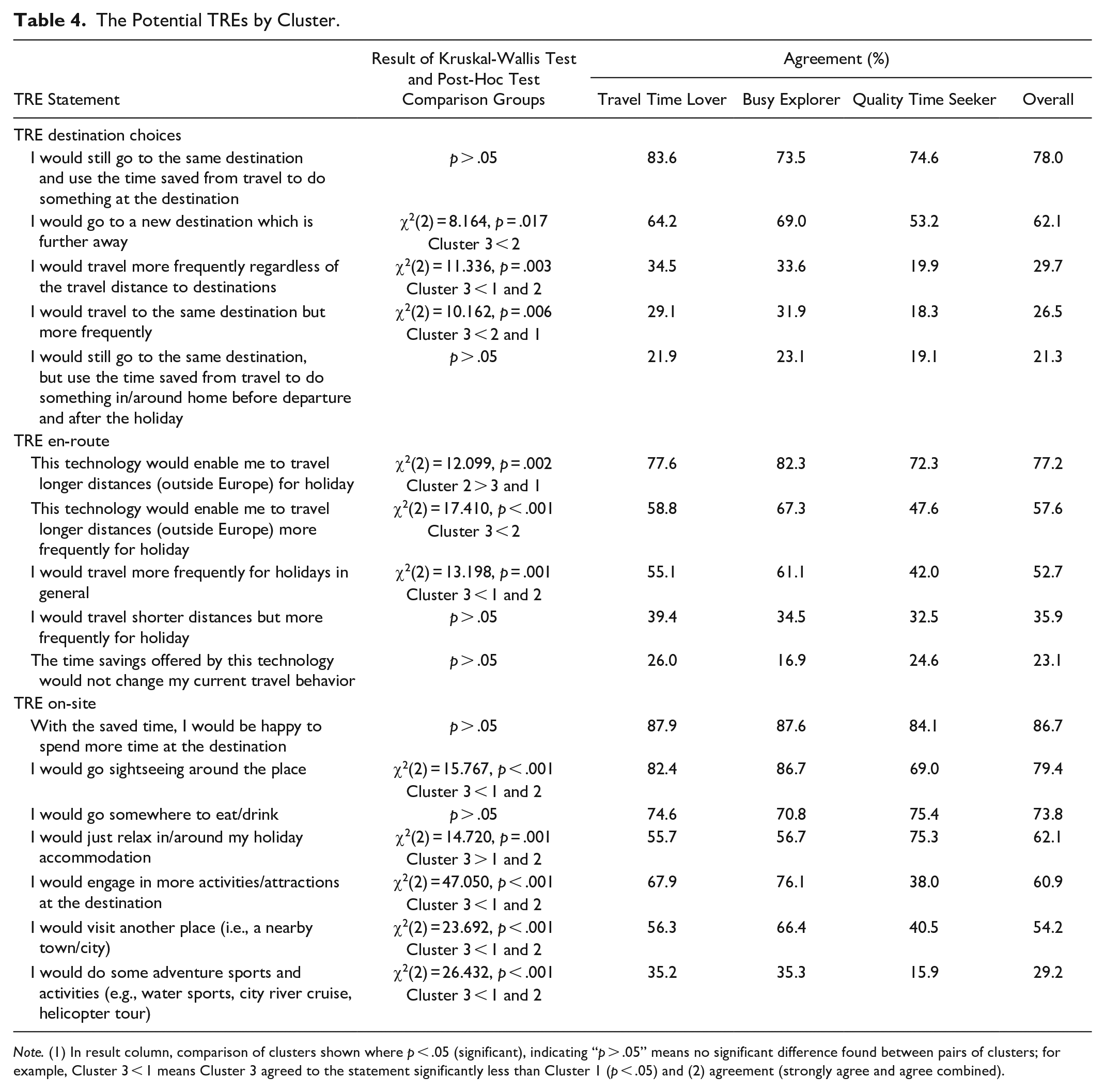
Note. (1) In result column, comparison of clusters shown where p < .05 (significant), indicating “p > .05” means no significant difference found between pairs of clusters; for example, Cluster 3 < 1 means Cluster 3 agreed to the statement significantly less than Cluster 1 (p < .05) and (2) agreement (strongly agree and agree combined).
A series of Kruskal-Wallis tests were performed to explore the differences in responses to 17 TRE statements between the three cluster groups. Post-hoc Dunn tests provided evidence of statistically significant differences between the mean ranks of the two pairs of cluster groups on most statements of the potential TRE destination choices, en-route and on-site except for five statements (Table 4).
Overall, the Busy explorers showed the greatest level of agreement for most statements, which indicates that they are most prone to potential TREs among the clusters, closely followed by the Travel time lovers. The Busy explorers are therefore most likely to increase carbon emissions compared to the other clusters.
The Busy explorer and Travel time lover clusters shared similar personal characteristics, which are in line with the findings of previous research suggesting young tourists are willing to seek active adventures and discover new places and experiences as a key element of their travel motives (Almeida-Santana and Moreno-Gil 2018; Correia, Zins, and Silva 2015; Xu, Morgan, and Song 2009). Thus, they would be more interested in spending the time savings on maximizing their holidays for novel and adventurous experiences. Their behavioral changes are linked to the potential TRE destination choices, en-route and on-site, for example, traveling further away, traveling more frequently, or doing more things that relate to physical activities and travels at a destination. This reflects the travel behavior of senior tourists (more likely to be in the Quality time seeker cluster) being significantly more likely to be constrained by age, disability, physical, and mental health conditions than time, as identified by Lee and Tideswell (2005), Kattiyapornpong and Miller (2009), and Huber, Milne, and Hyde (2018). In this regard, the intervention of time savings has fewer implications for the potential TRE of older tourists than their younger counterparts.
As the Busy explorers felt the most time constraints for holidays in general and desired activities at a destination, they may have viewed the time savings as an opportunity for doing extra activities. In fact, perception of time availability notably influences tourist activities and movement as noted by McKercher and Lau (2008). In contrast, the Quality time seekers showed less agreement on almost all TRE statements. Meanwhile, their greatest agreements were displayed in the two similar statements relating to the TRE on-site: that is, spending the time savings on relaxing around their accommodation or going somewhere to eat/drink, with limited implications for increased energy consumption (Becken and Simmons 2002).
Rest, relaxation, and comfort are the core motives of seniors’ travel (Boksberger and Laesser 2009). Considering that the Quality time seekers are represented by the older, retired tourists, the opportunities to take part in relaxing activities in the given destination are of primary interest to the Quality time seekers, which resembles the “Entertained” group in the study of Nimrod and Rotem (2010), despite the intervention of the time savings. Typical tourist motivation for holiday trips tends to be translated into their travel behavior (Alén, Losada, and de Carlos 2017; Blazey 1992; Collins and Tisdell 2002). This explains why the Quality time seekers would rather spend any extra time saved to continuously seek leisure and quality time at a destination for the sake of improving mental and physical wellbeing (Otoo and Kim 2020).
In addition, the Quality time seekers feel that they, in general, have enough time for holiday travel and all desired activities at a destination. The extra time saved may not necessarily encourage them to engage in activities that are significantly different from what they typically do. This connects with the preference of the Quality time seekers for independent tours and repeat visits to familiar destinations, which may determine the intensity of activities and experiences. Studies (Antón, Camarero, and Laguna-García 2017; Jang and Feng 2007; Li et al. 2008) find that repeat visitors tend to have very specific plans for on-site activities and thus travel less within the destination. Conversely, first time visitors are inclined to travel greater distance to partake in a wide range of activities (e.g., visit all popular tourist attractions). Rather than the Quality time seekers, that is, likely to be repeat visitors, the Travel time lovers and the Busy explorers, that is, likely to be first time visitors, would accordingly be more prone to the potential TRE.
Three statements were additionally provided to respondents to examine how the extra time saved from faster travel technology would be used if it were to be used in/around home. These included using time savings for (1) shopping, (2) resting/personal care, and (3) housework. The activities represented by each statement have implications for potential indirect TRE despite having relatively minor environmental implications. Overall, there was weak agreement in responses to these statements, compared to other TRE statements.
A Kruskal-Wallis test was performed to explore differences between clusters in response to three TRE in/around home statements with Post-hoc Dunn test with Bonferroni adjustment. The test results showed that the Busy explorers were more likely to spend the time savings for shopping than the other clusters, which has implications for the TRE in the in/around home context as shopping can be energy intense due to travel (Filimonau et al. 2021). The other pairs of the cluster groups for other statements, that is, resting/personal care and housework, did not significantly differ statistically.
Not surprisingly, the usage of the time savings from faster travel technology would depend on the cost of this technology. A large number of respondents (82.2%) were willing to pay up to 60% extra of the original fare (given a scenario where the original flight fare for the round trip to/from a Mediterranean destination was £150). This supports Jackson (2005), Lyons and Urry (2005), and Stein (2012) who argue how holiday time has become a commodity. Among the clusters, the Busy explorers are more likely to pay extra for the faster travel (85.8% within the group) while the Quality time seekers are less likely to do so (78.6% within the group). This demonstrates higher probability of the TRE occurrence among the Busy explorers than other clusters. When it comes to using the WTP approach, it is important to acknowledge that respondents may have overestimated their WTP in a hypothetical scenario setting. In other words, people would not pay as much as they claimed, and this is determined by the individual’s income status. Hence, WTP in this research should be viewed as a reflection of tourists’ perceived incentive value of faster travel rather than the absolute, actual amount they would pay for it, as noted by Huang, Wu, and Shi (2018).
Figure 2 summarizes the factors influencing the relevant TRE occurrences. Socio-demographic characteristics, particularly age and employment status, were identified as salient factors for most of the potential TREs. Availability of time and money and holiday preference were also strong factors for the relevant TRE occurrences. Time related categories, that is, psychological values and the time use patterns, contained factors that were closely related to the different types of the TRE.
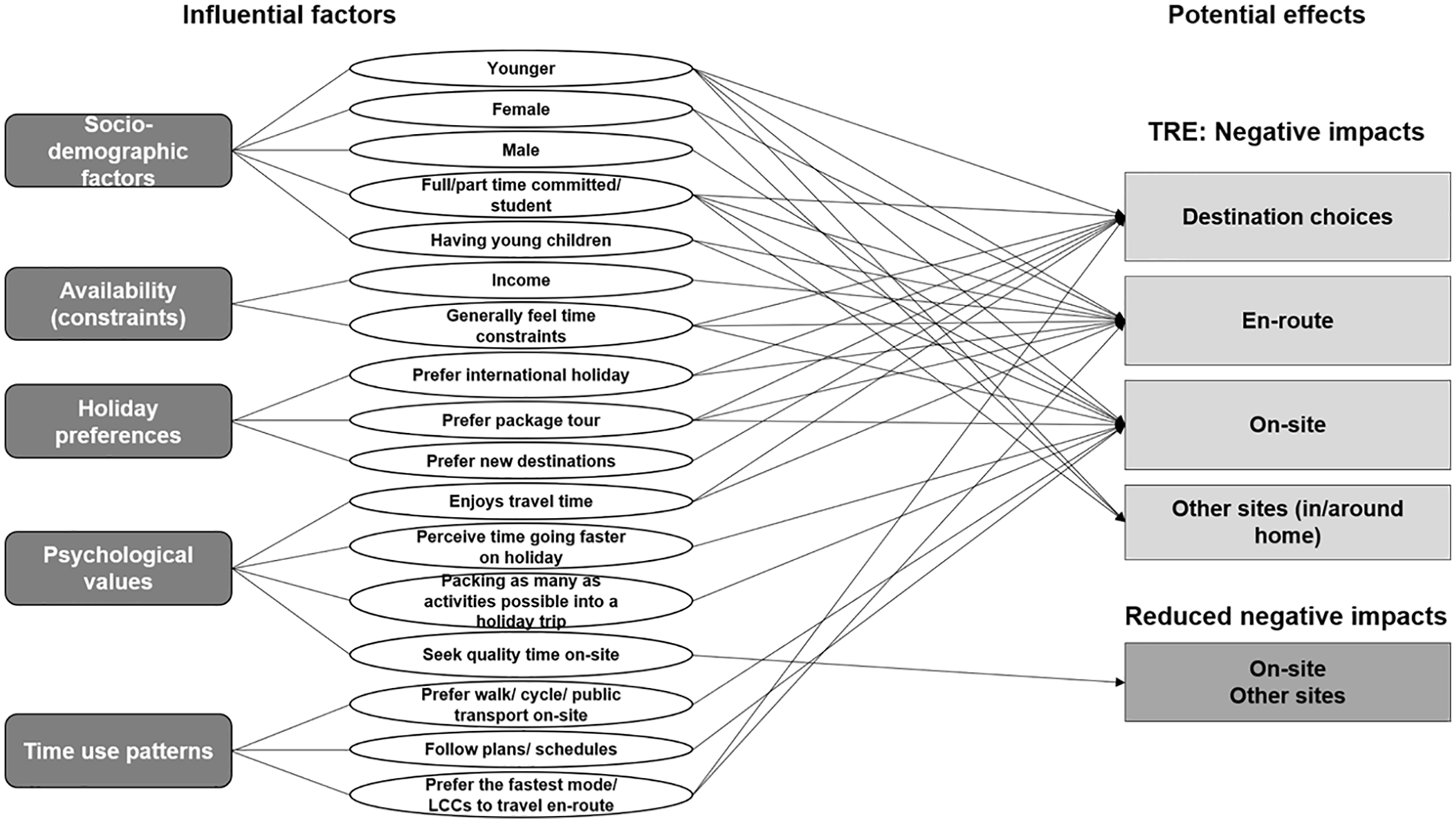
Summary of influential factors on the potential TREs.
Figure 2 suggests that behavior of tourists enjoying traveling and tolerating a long journey to get to a destination (psychological value) does not necessarily translate into potential effects that are less energy intense. This finding is inconsistent with the conceptual framework by Kim, Filimonau, and Dickinson (2020). Rather, these people may exemplify many types of TRE destination choices and en-route, such as they can travel longer distances and travel more frequently, regardless of their anticipated behavior on-site. However, the TRE occurrence and its forms can be adjusted depending on the interaction with other influential factors such as travel context or holiday preferences.
The findings hold some key examples represented by typical cases of each cluster: an exemplar of Busy explorer, Quality time seeker and Travel time lover (Figure 3).
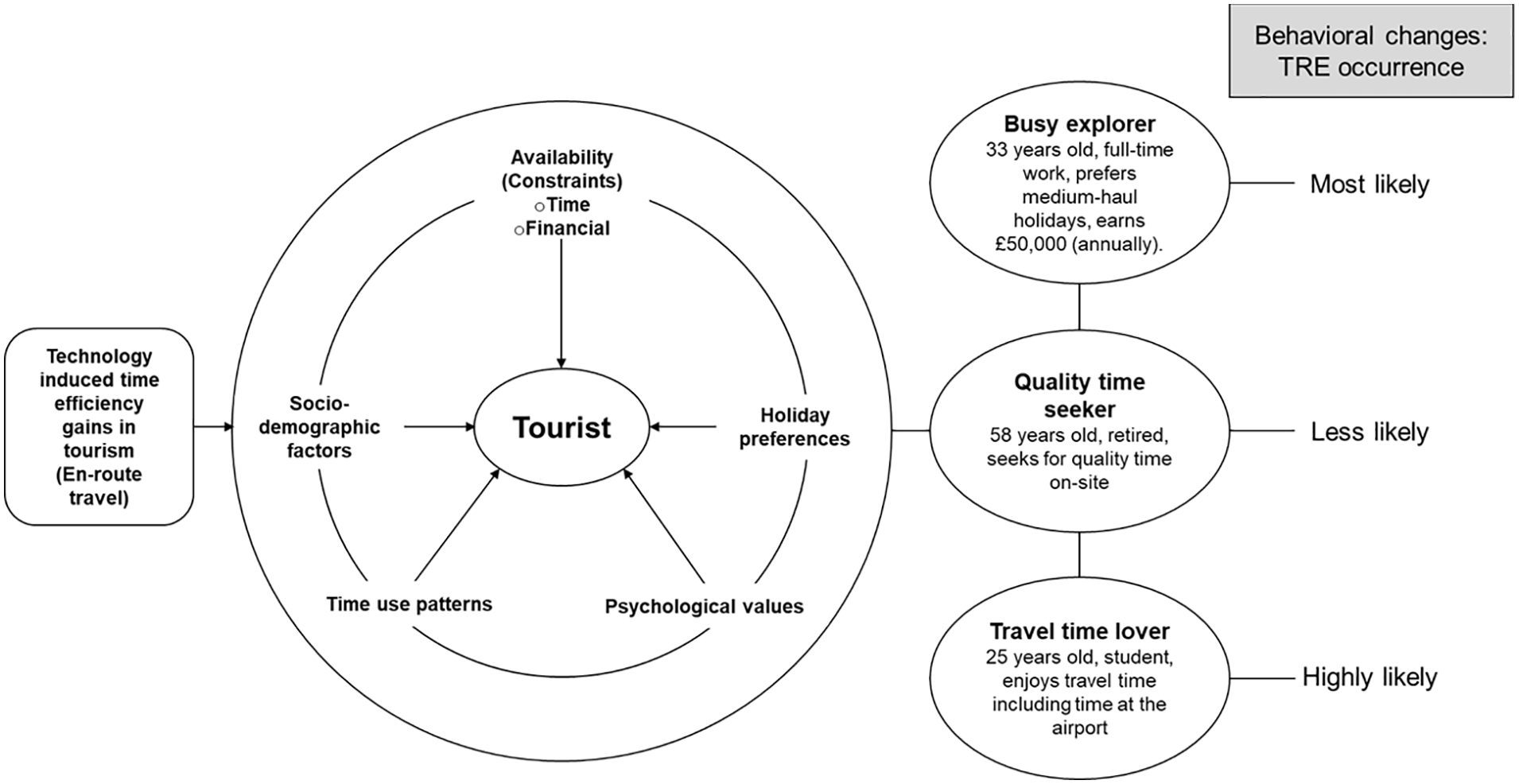
Conceptual framework of the TRE occurrence in different scenarios.
The examples reflect main tourist segments in terms of their socio-demographic characteristics and holiday preferences to demonstrate the TRE effects. A Busy explorer and a Travel time lover are prone to the TRE in all aspects based on their age, employment status, income (where applicable), and holiday preferences. A Quality time seeker is least likely to showcase behavioral changes in relation to travel or destination activities, with possibilities of imposing smaller environmental impacts. As cost is an important factor in travel en-route, the time savings from faster travel would provide more opportunities to the Busy explorer (who has regular income) than the Travel time lover (who does not have a regular income). This assumption is grounded on this study’s findings concerning tourists’ WTP for the time savings. However, these examples are provided in a fixed and controlled setting, but behavioral changes caused by the time savings may occur depending on a variety of other reasons and the types of the TRE occurring may differ. Other reasons include the travel context such as length of stay, what the destination offers to tourists and travel companions.
Conclusion and Implications
This study provided empirical evidence of the TRE in the context of tourism and categorized tourists in line with the likelihood of their behavioral responses to the TRE occurrence. Time savings from faster travel technology were found to influence tourists’ behavioral changes, that is, the TRE. Tourist behavioral changes occurred differently depending on such factors as socio-demographic characteristics (age, gender, employment status, having children or not), holiday preferences (travel distance, independency, choosing new destinations), availability of time and money. Furthermore, time perception/attitudes and time use patterns that tourists already possess are also key factors influencing behavioral changes due to the time savings. TRE relating to destination choices, en-route and on-site are evident from all the identified factors.
Three different tourist groups were identified based on the individual tourist’s underlying psychological values and time use patterns. The Busy explorers, represented by younger and full-time employed individuals who have more of time pressure for holiday trips than others, are most prone to the potential TRE in a wide range of forms. The Busy explorers prefer the fastest travel to/from a destination and an organized tour in order to maximize their experience in the limited time they have, while seeking to visit new destinations. On the other hand, the Travel time lovers are less likely to change their behavior (TRE) than the Busy explorers. The Travel time lovers value the enjoyment of traveling to/from a destination the most which is closely associated with their greater preference for long-haul holidays than others. Relatively low incomes of the Travel time lovers but their time flexibility imply that this group of tourists is largely represented by students or part-time workers. The Quality time seekers are older and retired people who have less time and financial constraints; therefore, they tend to prioritize quality time on holiday. The Quality time seekers are least likely to change their behavior (TRE) due to the time savings. These different behavioral response patterns of tourists provide a new insight into understanding tourist consumption behavior and the associated environmental impacts.
Contribution to Knowledge and Practice
This paper has added to the understanding of the important role of time in driving (less) sustainable consumer behavior in tourism. The paper has complemented the studies that have explicitly highlighted high probability of the (T)RE in tourism but provided no empirical evidence of its occurrence (Aall, Hall, and Groven 2016; Filimonau, Mika, and Pawlusiński 2018; Gössling and Michael Hall 2019; Hall 2013, 2015; Sorrell 2007; Wang, Niu, and Qian 2018). This study has indicated the existence of the TRE empirically, thus largely validating the conceptual framework of the TRE in tourism proposed by Kim, Filimonau, and Dickinson (2020) with some minor modifications.
From a methodological perspective, this study has developed a questionnaire which combines the elements of consumer time use behavior and environmental impacts of tourism to identify the potential TRE and its environmental implications in tourism. The approach was underpinned by an exploratory sequential mixed method approach which derived initial themes from the qualitative research and designed quantitative survey measures on the qualitative findings. The set of preliminary survey measures developed herewith can be adopted in future studies on the role of time in pro-environmental consumer behavior in tourism, but also in other consumption contexts.
This study provides novel insights into the design of evidence-based strategies and policies influencing tourist consumption practices. The study suggests that strategies to reduce GHG emissions from specific modes of tourist transport should encourage changes to tourist behavior integrating the time dimension, rather than solely focusing on technological solutions, supporting the argument of Kim, Filimonau, and Dickinson (2020). A deeper understanding of the underlying implications of the study’s findings including greater awareness of the (T)RE phenomenon will aid in reinforcing managerial strategies and policies to advance toward a more sustainable tourism’s future.
From the managerial viewpoint, the study reveals that certain types of tourists (e.g., young professionals) are more prone to the TREs. Tourism products can be developed not only to appeal to the specific target segments of tourists but also to be compatible with the principles of sustainable tourism development. Appropriate and adjusted marketing/demarketing strategies can be established whereby the target groups are encouraged to practice less energy intensive travel. These strategies should incorporate the time dimension as it is a critical element in what transportation means tourists choose to reach a destination.
Decisions on establishing infrastructure of faster travel technologies would require a comprehensive consideration of the potential impacts of the TRE. Such technologies should be offered to promote changes toward sustainable travel behaviors. This can not only support continuous sustainable design of transport technologies but may also encourage a modal shift of certain tourist groups. For example, the cluster of Busy explorers identified in the current study can switch from energy intensive toward less energy intensive travel modes, for example, from air to high-speed rail, in which their desire for faster travel can still be fulfilled.
Further managerial and policy recommendations lie in the importance of understanding and adapting dynamics of tourist travel patterns at the destination. There is a compelling evidence that, when it comes to on-site travel, tourists tend to prefer car for flexibility and convenience. Studies (e.g., Dickinson and Dickinson 2006; Gronau 2017; Le-Klähn, Hall, and Gerike 2014; Thao, von Arx, and Frölicher 2020) highlight the carbon benefits of alternative travel methods such as public transport use compared to other transport modes, especially cars. Although using public transport at the destination should not be considered a completely sustainable (e.g., zero carbon) tourist activity, it should be encouraged at the destination as an alternative way of traveling on-site. This provides guidance on managing and protecting tourist destinations from the environmental impacts associated with travel within the destinations. For example, local governments or tourism operators can offer local transport packages to appeal to such tourists as the Busy explorers that use more sustainable transport options, for example, bus, rail, cycle, and even walk (path), for traveling between tourist attractions and activity sites. This will help tackle travel associated negative environmental impacts and allow tourists to have seamless travel between places without time lags.
Further tourism policy implications can be drawn from the findings on people’s perception of time constraints. People with lack of time for holidays (e.g., full-time employees) tend to show behavioral changes (the TRE) more likely than those who perceive to have enough free time (e.g., retirees), with the implications for negative environmental impacts. More time available can relieve people from feeling of time constraints for holiday travel and tourist activities, which in turn can drive less of behavioral changes on holiday, both en-route and on-site. For instance, the government of New Zealand has recently suggested adopting a four-day work week (Roy 2020). Longer weekends imply more discretionary time available, three consecutive days, which can then release time pressure of tourists for holidays, disregarding income effects. As a result, this can alter behavior of some people such as the Busy explorers toward slower travel patterns en-route and on-site with reduced environmental impacts. However, the possibility of the TRE should also be noted in this context such as increasing number of short breaks taken by the Travel time lovers. These findings thus provide policy guidance on working time and pattern regulations to take into consideration the potential TRE occurrence.
Limitations
The conceptualization of the TRE proposed by Kim, Filimonau, and Dickinson (2020) is grounded on numerous factors. Some of these factors have not been explored in depth in this study. These include anticipated RE drivers such as the RE attributed to stay in hotels and participation in tourist activities, or national culture. The study focused on the TREs driven by the time savings en-route and therefore future research should aim at addressing these excluded, but potentially important, factors. This study examined tourism in the UK which is served by a plenty of short-haul destinations in Europe, but tourists living in Australia or New Zealand, due to the relative remoteness of these countries, may show different dynamics of the TREs because they are likely to travel longer distance to get to overseas destinations. Cultural differences with regard to the potential TREs should also be considered, for example, tourists in South Korea may show different responses based on how they perceive time in general (Lewis 2006). Also, the environmental impacts of activity engagement at a destination can be very different between tourists from the two cultures (Kim and Filimonau 2017). Lastly, the impacts of COVID-19 on tourism have been significant. These are not accounted for or reflected on in this study as both qualitative and quantitative research phases were conducted prior to the pandemic’s occurrence.
Suggestions for Future Research
This study indicates a number of avenues for future research. Firstly, the study finds that certain groups of tourists are more likely to show behavioral changes in relation to destination choices, en-route and on-site, given the time savings from faster travel technology. Further research can build on this finding and better understand different market segments of tourists in relation to the potential (T)RE. This research can be grounded on such methodological approaches as focus group discussions, participant observation (as a group) or choice experiment. Secondly, there is a need to understand other RE dimensions than the TRE. The research method proposed by this study can be applied to explore environmental values of consumers through qualitative and quantitative research. Such research would critically analyze how consumers’ environmental (socio-psychological) values affect their travel behavior and the use of transport on holiday trips (socio-psychological RE). Thirdly, future research can accurately assess the potential environmental impacts of the RE and TRE in the tourism context including all tourism sub-sectors of tourist transport, accommodation, and activities. Moreover, another direction for future research would be to examine the opportunity costs of time considering its association with the (T)RE with changes in energy prices and demand. As Sorrell (2007) highlights, some of the (direct) RE may be constrained by actual or opportunity costs of time with increasing demand which can further be studied in the context of tourism. In addition, future research should aim at validating the findings of this study by using actual travel data such as national time use survey data of tourists throughout a holiday journey between home and destinations collected at a large scale to analyze energy consumption through tourist behavior. Such survey data can integrate the economic parameters and further add economic value to the analysis. Finally, future research should look at the RE in tourist consumption after the imposed travel restrictions related to the Covid-19 pandemic, such as quarantines and travel bans, are lifted. This can increase the immediate demand for travel as people will be using the time and money saved during lockdowns, that is, the potential RE (OECD 2020b). People will intend to make up for missed travel during the pandemic. Such behavioral responses from tourists will, therefore, provide fertile grounds for further empirical studies of the RE and TRE in diverse contexts.
Footnotes
Declaration of Conflicting Interests
The author(s) declared no potential conflicts of interest with respect to the research, authorship, and/or publication of this article.
Funding
The author(s) received no financial support for the research, authorship, and/or publication of this article.
