



Abstract
Authenticity in travel and tourism research is often explored at the tangible-existential nexus. However, the collaborative forces embedded within digital sharing economy platforms draw attention to how the promise of social exchange can stimulate authentic consumption. The role of tour guides has evolved accordingly, from professional designation to self-acquired identity enacted ad-hoc. This study therefore applies a deductive-inductive approach—investigating over 100,000 tour guide profiles on the digital sharing economy platform showaround.com—to frame authenticity as the diverse manifestation of promised social exchanges. Combining automated qualitative analysis for large datasets with manual inductive reasoning, the findings identify four types of authenticity demonstrated within sharing economy tour guide profiles: situational, natural, personal, and positional. Doing so extends established understanding of tangible-existential and sincere-trustworthy tourism industry authenticity by capturing social exchanges in dynamic contexts; acknowledging the diverse nature of the promise of authentic tourism service delivery and consumption therein.
Introduction
Researchers have long sought to investigate and identify the antecedents, influences, and outcomes of authenticity in practice, with travel and tourism scholarship proving no different (Chronis and Hampton 2008). Fundamentally, “authenticity” is used to capture what is perceived to be true, real, and/or actual, yet takes different forms contingent upon person and perspective (Yu et al. 2020). Accordingly, authenticity has been theorized as holding influence over travelers’ decision-making processes, including destination choice and engagement with online and offline activities therein (Audrezet, de Kerviler, and Guidry Moulard 2018).
The pursuit of authentic experiences is considered pivotal within the context of heritage tourism and cultural consumption, with Ram, Björk, and Weidenfeld (2016) identifying positive associations between authenticity and place attachment. However, the nature of authenticity within this context continues to evolve as contemporary sharing economy business models offer consumers access to a wider range of novel, bespoke, and/or exclusive experiences (Garau-Vadell, Orfila-Sintes, and Batle 2021); challenging established notions of authentic travel and tourism service provision and consumption in the process. For example, the range and volume of experiences available to tourists using sharing economy platforms has gone some way to normalizing a more general move away from the staged authenticity of tour operator-organized tours, package holidays, resort hotels, and standardized experiences which were once synonymous with mass-market tourism (Chen et al. 2020).
Perceptions of authenticity in tourism services have thus evolved alongside those associated with the sharing economy more generally, responding to increasing tourist demand for experiential, meaningful, and sincere interactions with local people while traveling (Paulauskaite et al. 2017). Under such circumstances, perceived authenticity can significantly reduce the risks associated with traveling to some destinations (and any consumption enacted therein), while also shaping travelers’ quality and value perceptions (Kesgin et al. 2021; Mody and Hanks 2020). However, the way in which tourists’ pre-travel perceptions of authenticity are aroused has evolved in recent years. For example, engagement on social media is proving an increasingly crucial contemporary determinant of perceived authenticity over-and-above traditional markers such as place attachment and destination satisfaction (Kim and Kim 2020). Yet, this is perhaps unsurprising given the extent to which on-screen experiences characterize the digital sharing economy and tourism services promoted and delivered therein (Li et al. 2021).
Post-travel, authentic tourism experiences and social interactions on-site can determine behavioral and attitudinal outcomes (e.g., loyalty, intention to recommend) (Shuqair, Pinto, and Mattila 2019). Yet, the tourism sharing economy research agenda typically remains focused on business models; the nature of the sharing economy; its sustainable development; and the impact it has on destinations, services, and tourists (Cheng 2016). This overlooks the importance of social engagement in stimulating authentic experiences (Akarsu, Foroudi, and Melewar 2020), with limited theoretical conceptualization in this area. In response, this study recognizes the important role group processes, networks, and the promise of social exchange play in shaping sharing economy tourism services. It thus adopts Social Exchange Theory (SET) (Emerson 1976) to better understand how authenticity is manifest within this context.
We focus on tour-guiding as a form of social exchange which, when enacted within a peer-to-peer sharing economy setting, is characterized by particularistic, symbolic (as opposed to solely financial) benefits. According to SET, any exchange is likely to happen in a nuanced manner within this context (Paraskevaidis and Andriotis 2017). Reconceptualizing tour-guiding accordingly, guides serve to balance tourists’ demands for authentic experiences with ever-evolving sharing economy trends. Guides can transform sites into tourist attractions or authentic experiences (Kesgin et al. 2021), but professionalism and standardization issues create ambiguity around their role (Ap and Wong 2001). The curatorial role of tour guides in interpreting heritage, for example, can influence tourists’ perceptions of destination authenticity (Io and Hallo 2011).
Indeed, the importance of storytelling to tour-guiding has increased commensurately with tourists’ shifting desires for niche experiences delivered by alternative, entrepreneurial, and/or relational guides (Bryon 2012). Tech-savvy tourists can now craft experiences using smart devices and digital means (Gretzel et al. 2015). However, identifying authentic experiences remains challenging (Reisinger and Steiner 2006), with little guarantee that the nature of the social exchange enacted through tour-guiding and experiential consumption therein will authentically represent destinations visited (Cropanzano and Mitchell 2005). This is characteristic of the sharing economy more generally (Garau-Vadell, Orfila-Sintes, and Batle 2021), with a reconceptualization of tour-guiding within this context contingent upon recognizing their evolution from traditional tourism services role toward a more dynamic mode of contemporary authentic exchange.
Thus, even within contexts where user reviews are prioritized as a means of service evaluation (Cheng et al. 2019), challenges related to experiential validity and peer-to-peer trust endure; irrespective of emphasis on the part of sharing economy platforms to promote the services of those deemed “trustworthy” (Wang et al. 2016). The tour guides analyzed in this study advertise on the digital, peer-to-peer sharing economy platform www.showaround.com (hereafter “ShowAround”). Tour guides on ShowAround are typically local people who offer a range of curated destination-specific services to visiting travelers. The distinctiveness of this particular manifestation of the local-tourist relationship is highlighted by extant research, with some suggesting that positive peer-to-peer contact between locals and tourists can stimulate more responsible consumption behaviors while also increasing post-experience gratification (Tu and Ma 2021).
Thus, in this digital space, authentic tourism is characterized by the promise of trust; trust in sincere service delivery enacted through experiential exchange (Kesgin et al. 2021; Taheri, Gannon, and Kesgin 2020). Accordingly, this study suggests that authentic sharing economy experiences may be developed around social exchanges, yet conceptualization of this remains limited. The study’s research question is therefore general: Can authenticity be defined by the promise of relational exchanges? Consistent with the social nature of tour guide provision and consumption, and the guide-tourist interface therein, this study utilizes SET to offer a conceptual framework for redefining authenticity through exchanges, with emphasis on how sincerity and trust can extend extant understanding of authenticity within the travel and tourism industry.
Theoretical Framing and Literature Review: Authenticity and Social Exchange
Authenticity as Tangible or Existential Exchange: Transaction Dimension
Despite receiving widespread attention across multiple disciplines, definitions of “authenticity” remain contentious (Yu et al. 2020). In the context of branding and consumer research, authenticity is typically characterized by continuity, integrity, credibility, and symbolism (Kesgin et al. 2021; Morhart et al. 2015). In travel and tourism research however, debate around authenticity is often underpinned by inbound tourist perceptions of destination attributes (Stepchenkova and Park 2021). This discourse typically draws attention to different “types” of perceived authenticity; primarily the distinction between object-based and existential authenticity (Bryce et al. 2015).
Object-based authenticity is underpinned by the genuineness of relics, artifacts, and rituals (Lau 2010) and their staging (Chhabra, Healy, and Sills 2003), reflecting “how people see themselves in relation to objects” (Reisinger and Steiner 2006, 74). This involves both the individual’s motivation to visit and experience a site of significance and their desire to develop an understanding of the place itself and objects therein (Beverland and Farrelly 2010). Various studies explore object-based authenticity within travel and tourism contexts; highlighting, for example, its relationship with other relevant concepts, such as existential authenticity (Kolar and Zabkar 2010; Wang 1999), cultural motivations (Bryce et al. 2015; Lee et al. 2016), and tourist attitudes and loyalty (Reisinger and Steiner 2006; Zhou, Zhang, and Edelheim 2013).
Conversely, existential authenticity is not contingent upon objects (Belhassen, Caton, and Stewart 2008); rather it is described as a “state of being” (Rickly-Boyd 2013, 682). It relates to the object-free elements of the tourism experience (Lew 2011; Mura 2015), with this shaped by associations between the tourism objects and the tourists’ existential experiences, alongside both in isolation (Bryce et al. 2015; Rickly-Boyd 2013). Object-based authenticity is therefore contingent upon tourists’ perceptions of the nature of the site visited, whereas existential authenticity typically emerges as a re-created perception post-visit (Stepchenkova and Belyaeva 2021).
To this end, Wang (1999) argues that existential authenticity is comprised of two elements, which together reflect the lived experience of the tourist (Castéran and Roederer 2013): physical feelings (intra-personal/natural feelings) and self-making (interpersonal/self-made feelings) (Mura 2015). Wang (1999) also suggests that existentially-authentic travel goes beyond simply undertaking experiences bestowed with socially-constructed significance, with this instead underpinned by social exchange derived from the communal consumption of destination-specific events, products, and services.
Research exploring the importance of existential authenticity identifies various areas of scholarly interest. Reisinger and Steiner (2006) and Kolar and Zabkar (2010) found that that both existential and object-based authenticity fundamentally shape cultural motivations. Bryce et al. (2015) also suggest that cultural motivations positively influence existential authenticity. Sequentially, this can have a positive impact on tourist loyalty (Castéran and Roederer 2013).
Despite this, Zhou, Zhang, and Edelheim (2013) propose that cultural motivations have no effect on existential authenticity, instead contending that existential authenticity has an effect on tourist loyalty, demonstrating the complex nature of perceived authenticity. Nevertheless, from pioneering studies developing object-related authenticity as a concept pertinent to tourism (Hughes 1995) to more recent investigations of the subjective, existential, and experiential dimensions of authenticity (Curran et al. 2018), research into the phenomenon is well-established and continues to influence travel and tourism scholarship (Ram, Björk, and Weidenfeld 2016). However, to study authenticity it is necessary to operationalize its theoretical conceptualization into research terms.
Authenticity as a Sincere or Trustworthy Exchange: Relationship Dimension
As discussed in Section 2.1, authenticity within the travel and tourism context generally stems from tourists’ perceptions of experiences, sites, and/or related objects (Ram, Björk, and Weidenfeld 2016), manifest through objective verification or based on subjective cues (Kolar and Zabkar 2010; Rickly-Boyd 2013). However, distinct to this context (when compared to general marketing research) is the extent to which focus is also placed upon the processes and relationships that define authentic experiences (Taheri et al. 2018). Despite providing experiential tourism services, the role of tour guides therein remains largely overlooked (Reisinger and Steiner 2006).
Studies investigating tour guiding more generally have focused on a range of concepts capable of shaping tourist perceptions, such as value for money; the perceived “knowledge” of the guide; and the performative delivery of tour guiding in-action (Hwang and Lee 2019; Tsaur and Teng 2017). However, the nuance of sharing economy tour guide promotion is predicated on the promise of experientially authentic service provision; with this underpinned by tourists’ trust in the services offered (i.e., the promise of an authentic, guided experience) and the extent to which the guide is perceived as being sincere (e.g., the provision of an authentic experience to tourists is prioritized over any transactional, financial benefits).
As such, this study investigates the perceived authenticity of social exchanges enacted via sharing economy tour guiding by drawing upon two relevant concepts: sincerity and trust. Sincerity is conceptualized as when locals provide an accurate representation of themselves and their lives to tourists, actively and passionately interacting with them to share the reality of their day-to-day existence (Garau-Vadell, Orfila-Sintes, and Batle 2021). Trust, on the other hand, is concerned with how trustworthy an offering, person, destination, place, or experience is perceived to be, and whether the expected service and experience promises are likely to be met (Taheri, Gannon, and Kesgin 2020).
Authenticity, sincerity, and trust are closely related across travel and tourism research, with sincerity and trust primarily deployed to extend Taylor’s (2001) conceptualization of the “human” and relational aspects of authenticity (Wang 1999). Taylor (2001) suggests that “sincerity” is similar to destination authenticity in so much as both are considered “real” representations of place, culture, and values, but extends this by stating that sincere events occur independently of visitor presence instead of being enacted primarily for the benefit of tourists. This is echoed by Chhabra, Healy, and Sills (2003) who assert that visitor perceptions of destination, experience, or event authenticity can be erroneous and that it can be difficult for visitors to tell whether experiences undertaken when traveling (i.e., outside of their domestic locus of inherent knowledge) are authentic or staged.
There is also an expanding body of research concerned with investigating trust within the context of travel and tourism, with this often serving as a counterpoint to the more surreptitious notion of staged authenticity (Lu, Chi, and Liu 2015; Mura 2015; Zerva 2015). Staged authenticity can be considered simply as romanticizing, exaggerating, or sanitizing an otherwise accurate experience (Lu and Fulk 2017; Zerva 2015). Chhabra, Healy, and Sills (2003) go so far as to assert that the staging of authenticity is prevalent in hospitality and tourism in order to ensure that traveler expectations are met. Nonetheless, it is here that Taylor’s (2001) notion of sincerity and emerging conceptualizations of the importance of trust in tourism exchanges (Taheri, Gannon, and Kesgin 2020) come to the fore. Here, for many contemporary travelers, an event, experience, or site has to actually be real independent of their presence rather staged in order to attract tourists if it is to satisfy the expectations of those who value authenticity above all else (Zerva 2015).
Tour-Guiding as Authentic Exchange
Tour guiding is not only contingent upon formal factors (e.g., knowledge, professional competence), but is also beholden to informal cues such as word-of-mouth and customer satisfaction (Hwang and Lee 2019). Further, interactive exchanges such as playfulness have also become important in redefining contemporary tour guiding (Cheng, Chen, and Wu 2021). Research therefore contends that tour-guiding can be a deeply relational experience, with both positive and negative perceptions capable of playing an important role (Kim 2020). Moving beyond traditional single service providers in travel and tourism, it is important to consider multiple entities in the creation of customer experiences (Weber and Hsu 2020), with this reflected in the diversity of tour guides and authentic experiences on offer investigated in this study.
Given the inherently interactive nature of tour guide provision and consumption coupled with the collaborative, experiential, and participative nature of tourism services delivered within the sharing economy, this study is underpinned theoretically by SET (Akarsu, Foroudi, and Melewar 2020; Cropanzano and Mitchell 2005; Emerson 1976). While a range of established theories have been deployed in order to better understand the interface between service provider (e.g., tour guide), tourist, and tourism product (e.g., the guided “tour”), this study uses SET to investigate the reciprocal experience inherent to tour-guiding; with emphasis placed on identifying the importance of authenticity, sincerity, and trust core to the research aim.
SET has been used by tourism scholars hoping to explore various interactive, participative, and co-created consumption experiences (Bimonte and Punzo 2016), alongside those investigating concerns pertaining to core debates within the field, such as locals’ perceptions of tourism development (Rasoolimanesh et al. 2019); the impact of inbound tourists on destination ecosystems (Ward and Berno 2011); the drivers of volunteer tourism; and how best to cultivate sustainable tourism initiatives (Boley, McGehee, and Tom Hammett 2017). Further, SET has been used to investigate the interplay between power and trust (Nunkoo and Ramkissoon 2012), with this serving as a form of reciprocal exchange between multiple actors within the domain of tourism development, provision, and consumption. Its operationalization herein is consistent with Emerson (1976, 366), who considers the social exchanges central to SET as any “two-sided, mutually contingent and mutually rewarding process involving ‘transactions’, with stakeholders within the travel and tourism sector eager to engage in such exchanges when the benefits outstrip the perceived costs of doing so” (Thompson et al. 2018).
In the context of sharing economy tour-guiding, this study contends that the aforementioned “two-sided, mutually contingent and mutually rewarding process” (Emerson 1976, 366) underpinning SET may prove contingent upon authenticity, sincerity, and trust. In other words, the promotional material deployed by ShowAround tour guides suggests that they are acting from a genuine desire to share real representations of place and experiences therein to tourists, with tourists equally and increasingly eager to consume more authentic products, services, and experiences when traveling (Taheri, Gannon, and Kesgin 2020).
SET can therefore serve as the basis through which one can gain greater understanding of the nature of the promised interpersonal exchange inherent to the sharing economy tourist-guide interface. Further, as it “can account for both the positive and negative impacts of tourism” (Ap and Wong 2001, 685), SET may also shed light on the tactics tour guides employ to promote their services to appeal to visitors’ desires to undertake authentic, sincere, and trustworthy experiences when traveling (Cropanzano and Mitchell 2005).
We thus draw upon the transaction and relationship authenticity dimensions employed across tourism and hospitality research to build our conceptual framework and contribute to SET. Extent applications of SET within travel and tourism research contribute primarily on a conceptual level, investigating evidence of exchanges or perceptions thereof (e.g., Gannon, Rasoolimanesh, and Taheri 2021). We, however, operationalize SET for the digital sharing economy by looking for expressions of authenticity, remaining focused on this two-sided mutuality (Emerson 1976, 366) through the “introduction,” “identity,” and “offer” promised by the tour guides under investigation, alongside the post-experience evaluation of others (i.e., tourist reviews). The information posted by tour guides in their profiles is not only their perception of themselves, but also representative of previous successful exchanges. This, in turn shapes who they are; services demanded and offered; and how tourists assess such exchanges after they happen.
Thus, given the interactive nature of tour-guiding within the sharing economy, the complexity inherent to social exchanges within the tourism context, and the (at times) contradictory nature of the rules underlying SET, we propose a hybrid framework in order to gain greater understanding of sharing economy tour-guiding authenticity. This approach begins deductively, synthesizing what we already know about sincerity and trust related to tourism authenticity, before advancing in an inductive manner in order to unearth facets of authenticity from our dataset overlooked across extant literature. Our conceptual and research framework informed by SET and the determinants of authenticity is depicted in Figure 1.
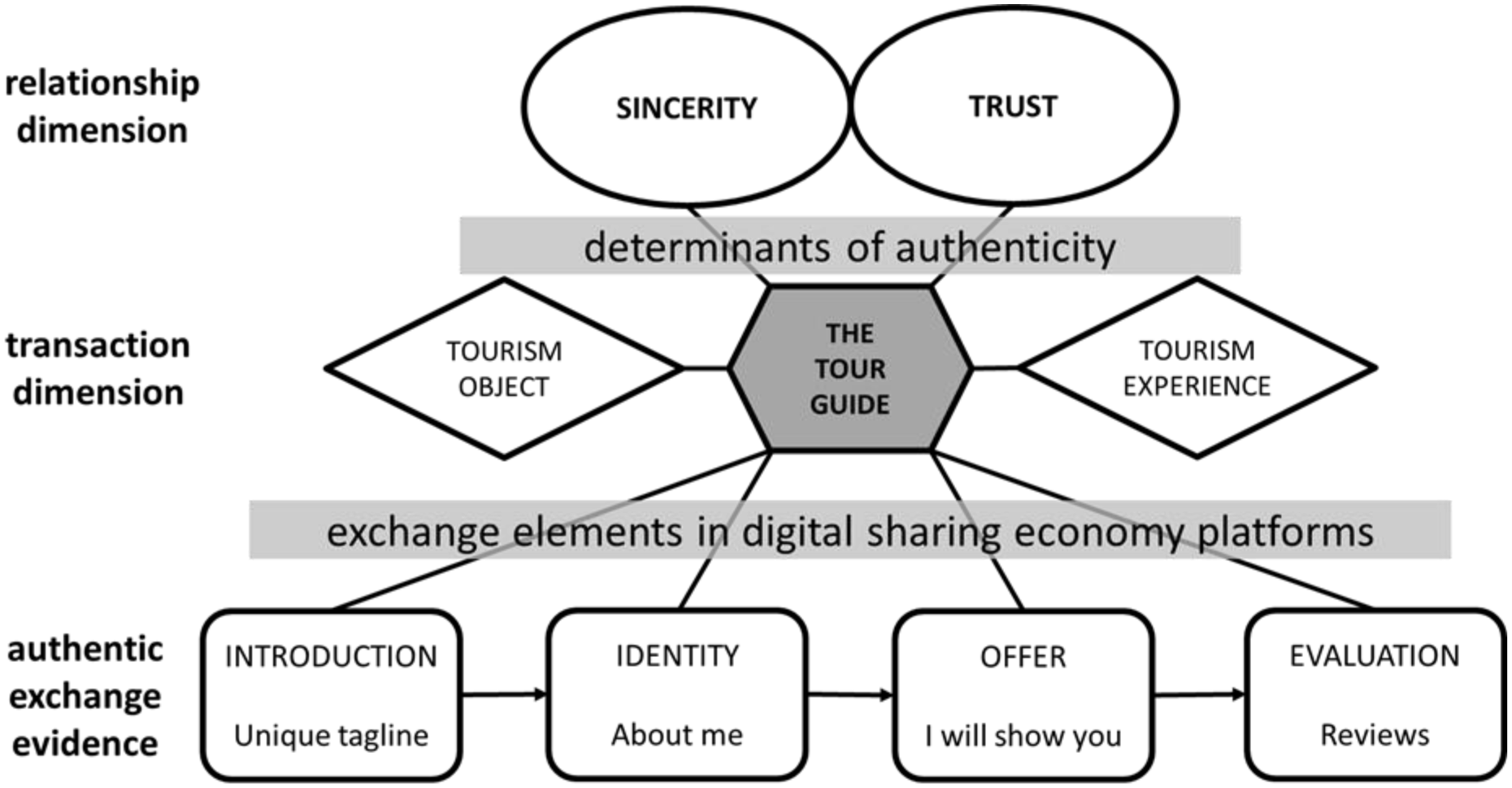
Framework for investigating authentic exchanges in a sharing economy platform.
Methodology
Theoretical Sampling Principles
Social exchanges can be conceptualized and understood in many ways, underpinned by the perceptions and experiences of multiple different stakeholders. Accordingly, the six central rules of SET (reciprocity, rationality, altruism, group gain, status consistency, and competition) can provide greater structure to the pursuit of scholarly understanding of interpersonal exchanges in context (Gannon, Rasoolimanesh and Taheri 2021). We use these principles to determine the suitability of our empirical research context: the digital peer-to-peer tour-guiding platform “www.showaround.com.”
Reciprocity highlights the mutual exchange between multiple stakeholders inherent to tour-guiding within the sharing economy, suggesting that guides are unlikely to be solely concerned with satiating tourists’ eagerness to consume authentic and sincere experiences when traveling. Research recognizes instead that reciprocal benefit can be derived from sharing real representations of one’s own locale, culture, and heritage via tour-guiding (Carmody 2013). This supports the use of SET as the theoretical framework for this study, where benefits cannot be considered in solely transactional terms and where the financial income derived from tour-guiding is extended by empowerment derived from intangible returns (e.g., prestige, educational value, social status) (Rasoolimanesh et al. 2019). As the peer-to-peer nature of the ShowAround platform allows guides to design their own service offerings, each tour guide has the opportunity to “show off” local destination characteristics that they are particularly passionate about, with this holding reciprocal benefit in-turn.
Similarly, rationality contends that social exchanges can also be used to spread the values and beliefs of a local community to a wider audience (e.g., from guide to tourist); with authentic and sincere tour-guiding in the sharing economy perhaps serving as the antithesis of overly-curated, sanitized, mass-market alternatives (Salazar 2005). In our context, this condition is met by the fact that guide profiles are in the public domain; they can compare their own offering to others, with consumers able to do likewise. Further, the supervision of platform managers ensures that the principles of rationality are maintained; information transparency and uniformity of structure are prerequisites for each guide profile.
Altruism contends that some stakeholders may tolerate negative personal costs when engaging with tourists (Rasoolimanesh et al. 2019), and this may prove important within the context of this study, where authentic and sincere tour-guiding experiences may be perceived as more resource intensive than traditional “low-effort, large-scale” alternatives (Reisinger and Steiner 2006). However, altruism also suggests that sincere, authentic tour-guiding experiences may emerge in parallel with another of SET’s underlying rules: group gain. This is reinforced by the digital platform underpinning the sharing economy research context, where the interchangeable roles of tour guides as visitors; reciprocal benefits of being able to design one’s own tour-guiding experiences for visitor consumption; transparency surrounding the post-experience review process; and opportunities to altruistically refer tourists to fellow guides who offer different experiences combine to demonstrate the varied nature of tour-guiding as “exchange.”
Group gain also suggests that the provision (and tourists’ consumption) of authentic experiences may benefit the wider community within a given destination. For example, guides may incorporate visits to local restaurants serving authentic food, “hidden gems,” and places “where the locals eat” into tours in order to simultaneously appeal to tourists’ desires for authentic consumption while benefiting other authentic service providers within the local economy. This is captured by Rasoolimanesh et al. (2017, 201), who contend that “according to the altruism and group gain rules of SET, residents may express interest in doing something for the benefit of the community and individual community members despite whatever personal costs might be incurred.” In this study, group gain may also be reflected in ShowAround’s position as networked group, the value of which increases commensurately with the platform’s size, providing local guides with greater access and exposure to travelers seeking authentic tourism experiences.
SET’s competition rule, however, contradicts group gain, instead suggesting that stakeholder behavior “can be motivated by the pursuit of benefit regardless of cost, consequence, or impact upon oneself or others” (Rasoolimanesh et al. 2019, 1298). While not necessarily consistent with sincere service provision and consumption, tour-guiding in the sharing economy may have a relatively low barrier to entry, with tour guides striving to out-compete each other in order to provide the most authentic experience possible to tourists. Thus, SET could help scholars understand whether sharing economy tour-guiding is primarily underpinned by altruism and group gain, or competition. Competition in ShowAround is primarily presented via pricing, but may also be contingent upon individual offers, profile characteristic, and post-consumption user reviews.
Finally, status consistency suggests that social exchanges can be influenced by attachment to a (e.g., demographic) group. Within the context of this study, if tour guides perceive that their offering has the potential to benefit a group they see themselves as belonging to (e.g., the local populace more generally), they may act more sincerely in providing authentic services to visitors (Rasoolimanesh et al. 2017). Regarding reciprocity and group gain, this can be born from an underlying desire to showcase and conserve local traditions and identity, and tours may be based around highlighting otherwise under-the-radar cultural assets (Rasoolimanesh et al. 2019); further emphasizing the perceived authenticity of the tour-guiding experience from the tourists’ perspective. The ShowAround sharing economy platform predicates a degree of status consistency by ensuring tour guide information is visible and transparent to the public and each other, mandating the use of a consistent profile format to allow for ease of comparison and clarity with regards to services offered.
Data Management
In late 2019, we extracted and analyzed 113,194 local tour guide profiles from www.showaround.com. To extract the data we used Grepsr (https://www.grepsr.com/); a web data mining service. Compared to other digital sharing economy platforms, ShowAround is uniquely positioned to provide the data required for a number of theoretical and methodological reasons. First, ShowAround’s mission (stated on their homepage) is to help tourists find locals to show them around a given city. This implies a wide spectrum of tourism, travel, and hospitality experiences. Therefore, compared to the focused nature of, for example, Airbnb (e.g., accommodation experiences), data derived from ShowAround can help us to study the authenticity of various modes of guided exchange.
Second, ShowAround relies on exchanges between the local tour guides and visitors. Given this, the potential for tangible and existential authenticity, alongside perceptions of sincerity and trust, have the potential to be more personal and interactive; further justifying our theoretical framework. In contrast, platforms such as TripAdvisor rely on information from suppliers for suggestions on vacation rentals, activities, and restaurants.
Finally, methodologically, the information that can be extracted from the profiles of local tour guides via ShowAround will help to address our research question. ShowAround is a digital platform where anyone can upload a profile, positioning themselves as a tour guide in their local city or region. Tourists planning to visit different places can browse and search for tour guides using the platform. By signing up to contact them and arrange for a tour-guiding service, they automatically become part of this sharing economy community; they can subsequently operate as local tour guides in their own cities of origin. The number of profiles we extracted represents 97.35% of the total on the site, with the remainder (2.65%) not publicly accessible. Each profile was open and accessible to anyone registered on ShowAround, and the platform does not forbid accessing profiles shared therein. Therefore, permission to access the information for this study was unnecessary.
The data selection process followed theoretical sampling logic (Glaser, Strauss, and Strutzel 1968), with representative case selection logic (Sarker and Sarker 2009). To complete their online profile, local guides provide their name, location, price-per-hour, and a personal tagline. Profiles indicate what each guide will show travelers, alongside a personal description, the languages they speak, and a list of activities travelers can engage with. However, the unit of analysis in this study is not tour guides as individuals, but instead expressions of authenticity across four core sections of their online profile:
“Tagline” (Introduction: A short opening statement about the guide)
“About Me” (Identity: A longer self-perceived self-description)
“I Will Show You” (Offer: A narrative description of the experiences offered)
“Reviews” (Evaluation: Post-consumption comments and feedback from tourists as consumers)
The information tour guides post in their profiles (by means of promotion) helps to develop perceptions relating to the promise of authentic exchange. Their “tagline,” what they will “show” tourists, the activities on offer, and prior reviews they have received provide respective evidence of the intention to engage in social exchange, the functional elements of the exchange, the level of service to be expected during the exchange, and others’ prior assessment of the delivered experience/exchange. Our quest to investigate the nuances of authenticity within the context of sharing economy tour guiding therefore expands in multiple directions as we analyze data derived from these ShowAround guide profiles.
Further, ShowAround recognizes that locals serving as independent tour guides also travel to other destinations; reflecting the flexibility of their role and the multifaceted nature of sharing economy services. Everyone advertising as a local guide can also find other locals through the website and can review others’ services. Thus, ShowAround can be classified as a sharing economy service within the travel and tourism context (Paulauskaite et al. 2017), offering peers the opportunity to co-create authentic and meaningful experiences with each-other.
Research Design
Given the significant volume of data collected (7,738,060 words), identifying first order concepts manually for a rigorous qualitative analysis as suggested by Gioia, Corley, and Hamilton (2013) was not possible. First order concepts are codes expected to capture data-to-theory deductive connections by attributing meaning to quotes in the data text, leading then to second order concepts and themes following an inductive process (Gioia, Corley, and Hamilton 2013; Taheri et al. 2021). We therefore adopted software-assisted coding (Basit 2003) based on auto-coding as previously used in documentary review research (Kromidha et al. 2019), but in this case around “authenticity” (Step 1). During this process we used Atlas.ti; specialized qualitative data management software (Friese 2014). Manual coding was then undertaken in order to relate automated codes and sentences from Step 1 to our interpretation of authenticity derived from literature (Step 2). As this study combines deductive and inductive thinking around authenticity (Fereday and Muir-Cochrane 2006), Step 3 was necessary to match manual inductive codes from Step 2 with theoretical constructs, expanding the scope of Gioia’s methodology. Finally, aggregate dimensions were synthesized in Step 4. Figure 2 offers a visual representation of each step with applied examples.
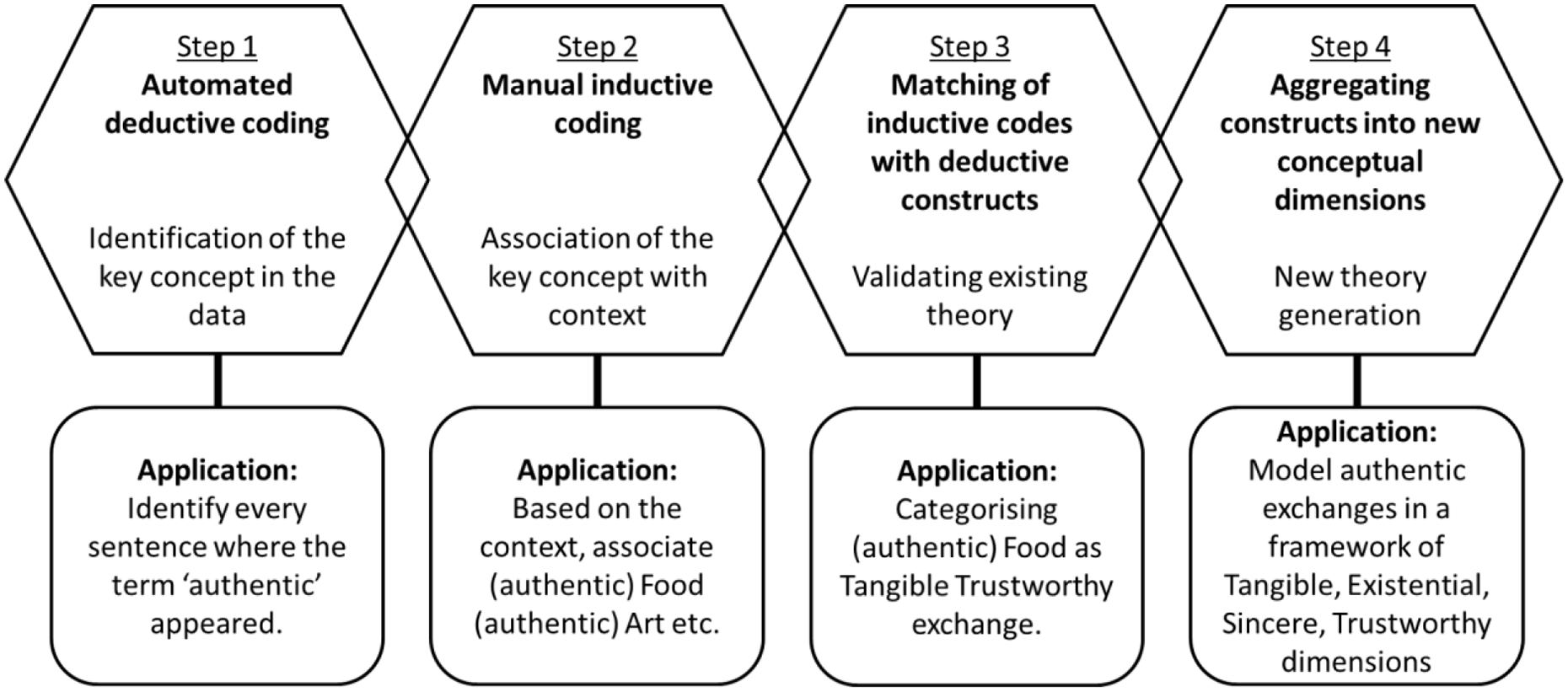
A four-step process of deductive-inductive qualitative analysis for large datasets.
Figure 2 provides an overview of the four-step process of deductive-inductive qualitative analysis conducted during this study. In Step 1 (Automated deductive coding), we recognize the constitutive nature of words and language in reflexive inquiry (Cunliffe 2003). The human-performed process of reviewing text, extracting quotes, and identifying themes core to inductive qualitative research (Gioia et al. 2013) is not possible when analyzing significant volumes of textual data. For example, “Taglines” consisted of 738,337 words; “About Me” consisted of 2,957,732 words; “I Will Show You” consisted of 2,678,079 words; and “Reviews” consisted of 1,363,912 words. In total, the data analyzed for this study comprises 7,738,060 words. Therefore, the analysis process was underpinned by the initial stage of automated computer-assisted coding (Silver and Lewins 2014). This identified all sentences where the term “authentic” and any variations (e.g., “authenticity”) appeared.
Overall, we analyzed text derived from 113,194 ShowAround tour guide profiles expressed in 7,738,060 words, finding 1,284 variations of the term; 1,284 quotes were identified from the process and labeled with the code AUTHENTICITY. While by no means exhaustive, this also helped to provide a degree of perspective on whether tour guides intended to associate authenticity with their offer. This can be compared to other intentions driving their decision to undertake the role of independent tour guide (e.g., full-time employment, additional income, etc.), but such an ambition is beyond the scope of this study.
We were mindful that authenticity could also be expressed using other terms (e.g., real, genuine, true, or even traditional) and tried to incorporate each into our auto-coding analysis at various points in time. However, the volume of quotes generated thereafter made it impossible to subsequently code the data manually. Widening the coding terms deployed would have also broadened the scope and complexity of this study, while simultaneously increasing subjectivity and diluting research rigor. We therefore consciously decided to consider only explicit expressions of authenticity, using the 1,284 quotes mentioned earlier to narrow the scope of this study and provided greater focus for subsequent manual coding.
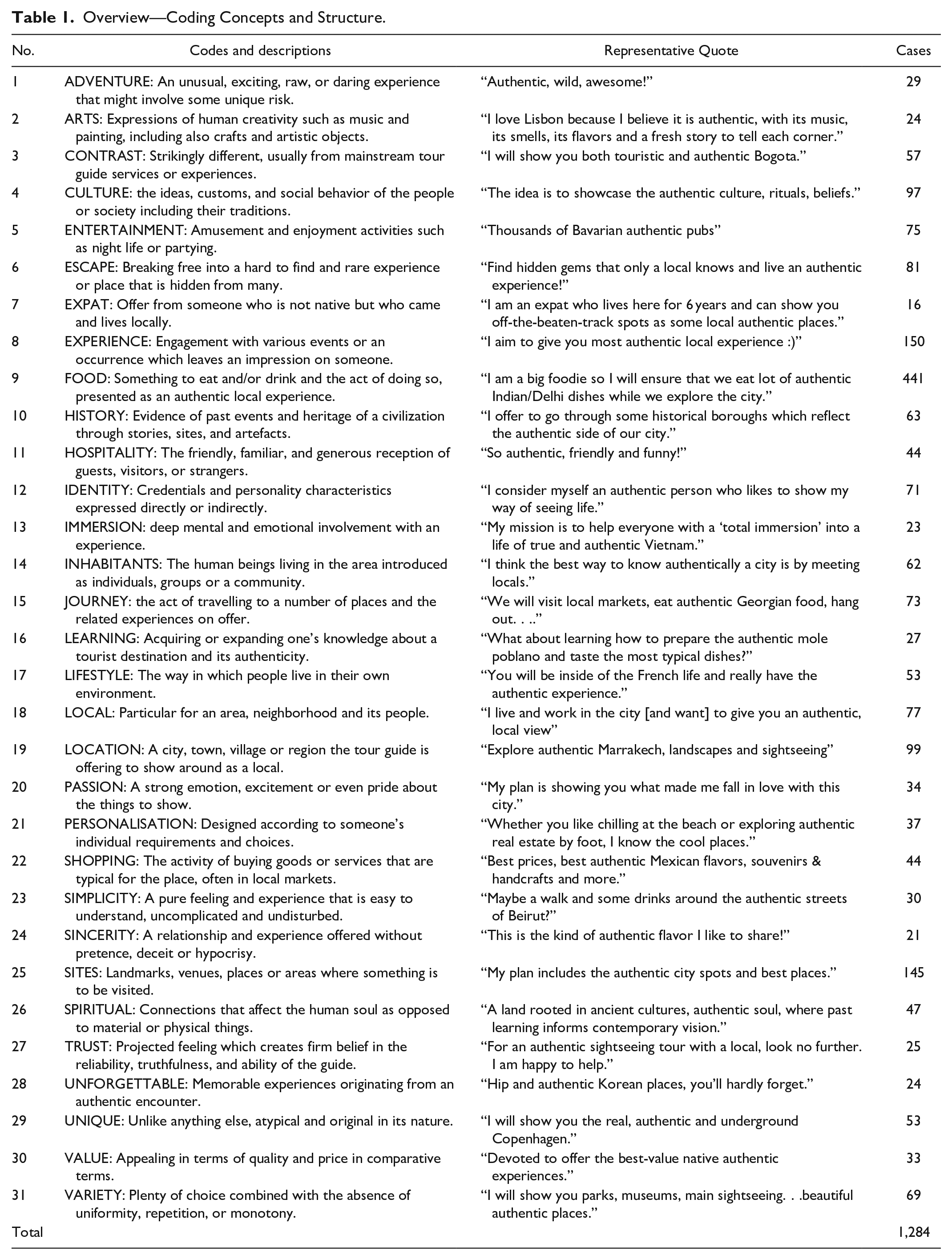
In Step 2 (Manual inductive coding), discourse is not solely considered linguistically but also as “an ordered set of polemical and strategic facts” (Foucault 2000, 2–3). Following Foucault (2000), we manually coded each quote related to AUTHENTICITY in order to better-understand the context it emerged from. A similar approach has been applied, for instance, in a structured and historic documentary review of governmentality in the context of the Olympic Games (Kromidha et al. 2019). In total, 31 codes were generated from this inductive process, including those theoretically-related to authenticity (e.g., SINCERITY and TRUST), with this stage used as a bridge between inductive coding and the aggregation of concepts.
Given the extent to which authenticity, trust, and sincerity in their many guises are discussed in relation to the conceptual framework underpinning the study, we use capital letters when we refer to the codes for clarity and to avoid confusion when parsing (e.g., differentiating between the code “AUTHENTICITY” and the conceptual review of “existential authenticity” discussed in Section 2.1). A description of each code identified at this stage, alongside representative data and the number of occurrences within the dataset, is presented in Table 1.
Overview—Coding Concepts and Structure.
In Step 3 (matching with deductive themes), the manual coding framework was revised multiple times in order to reach an appropriate level of saturation in our conceptual understanding (Miles and Huberman 1994). This was achieved by identifying logical associations with the initial authenticity constructs: TANGIBLE (object-based) and EXISTENTIAL. However, these two underlying authenticity dimensions were not used as codes like SINCERITY and TRUST in order to maintain a balance between deductive and inductive logics. Although some codes are related to both object-based and existential authenticity, we made decisions based on an interpretivist approach (Schwandt 1994), categorizing them alphabetically per Table 1. The conceptual maps outlined in Figures 3 and 4 are visualized using Atlas.ti 8 and were subsequently analyzed in line with the objectives of this study.
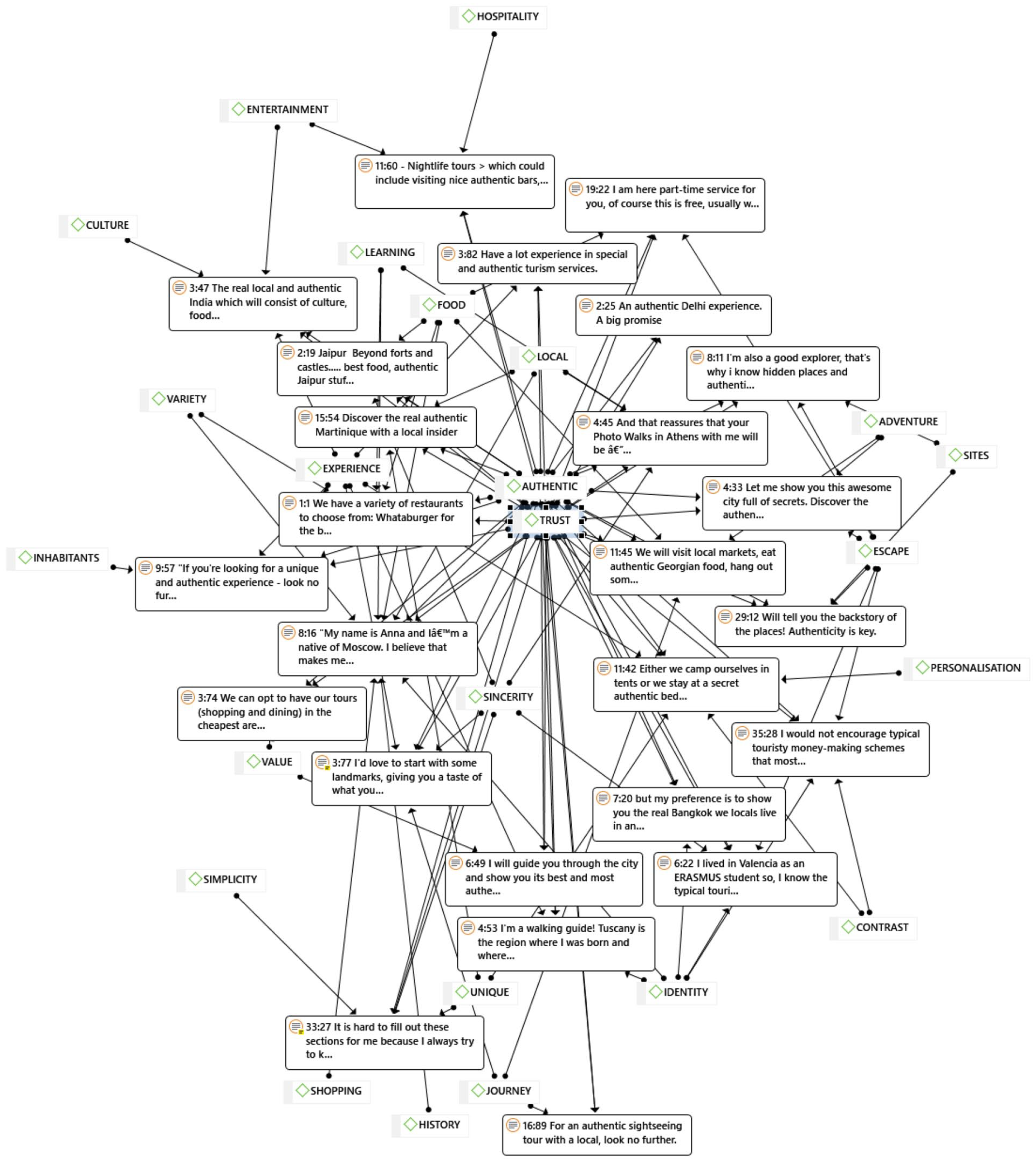
Authenticity and sincerity: Evidence and constructs.
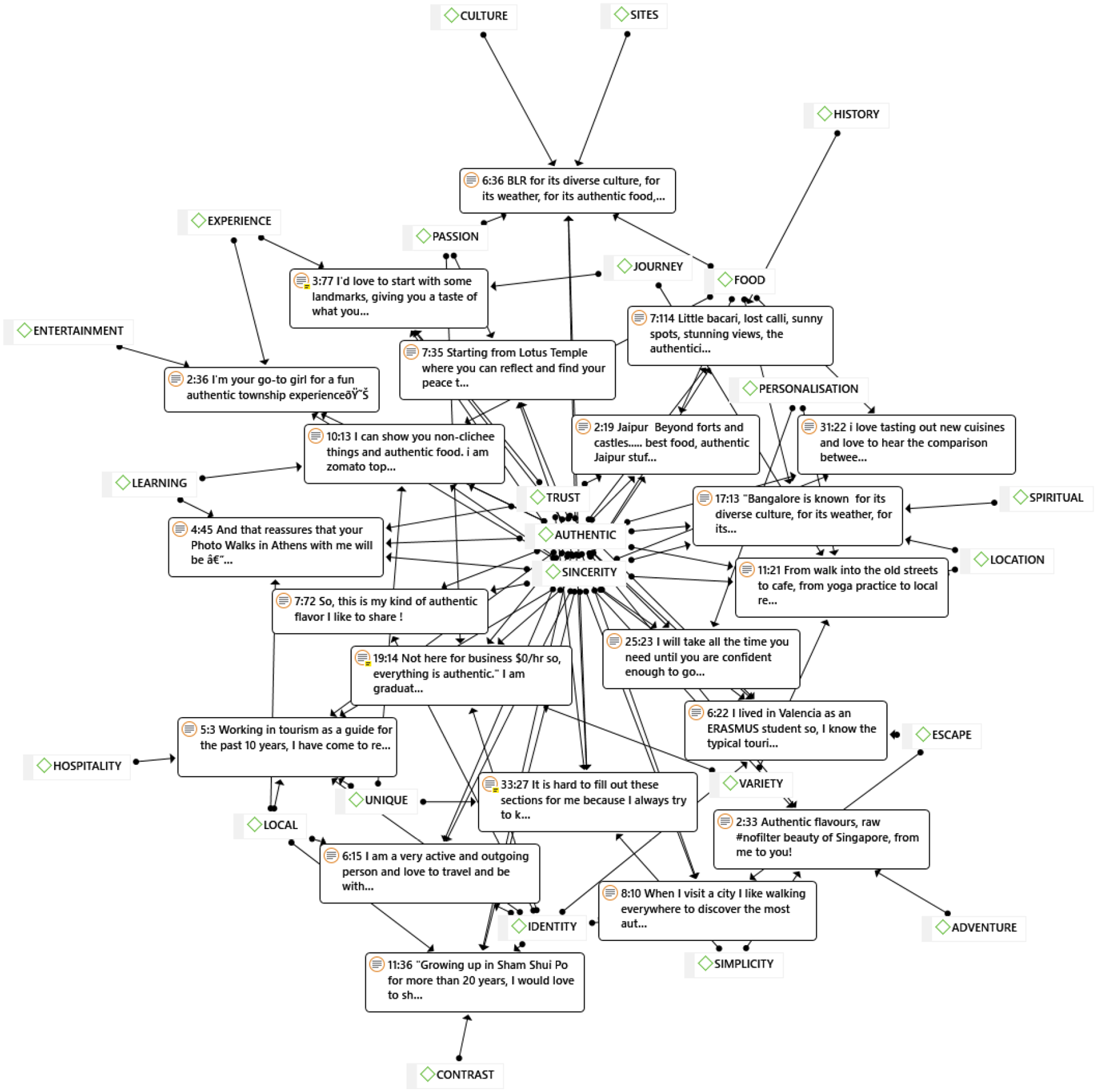
Authenticity and trust: Evidence and constructs.
In Step 4 (aggregating constructs into new conceptual dimensions), the meta-synthesis (Cooper, Hedges, and Valentine 2009) of constructs and expressions of authenticity in the context of this sharing economy platform was conducted, serving as the final analysis stage. Code co-occurrence analysis between codes and quotes was used to combine quantitative and qualitative insights for triangulation (Oleinik 2011), considering also the significant volume of textual data collected in this study.
Analysis Approach
This study uses a rigorous hybrid approach of inductive-deductive qualitative analysis for theme development (Fereday and Muir-Cochrane 2006). Deductively, object-based or otherwise tangible (Chhabra, Healy, and Sills 2003; Lau 2010) and experiential or otherwise existential (Lew 2011; Mura 2015) authenticity discourses are underpinned by both sincerity and trust (Taheri, Gannon, and Kesgin 2020), with each also considered important themes within the sharing economy context (Bucher et al. 2018). The combined inductive and deductive analysis began by analyzing the data framed by extant understanding of the concept of authenticity, with original insight derived from the iterative process of the study design thereafter. This approach allows for new insights to emerge, underpinned by the belief that it is possible to generate robust theory from qualitative data within the social sciences (Eisenhardt, Graebner, and Sonenshein 2016).
In travel and tourism research, generating theory from qualitative data is typically contingent upon the process of theoretical sampling, coding, constant methods, memos, and the categorization of new constructs (Connell and Lowe 1997). In response to criticism regarding the lack of rigor within interpretivist research, Gasson (2004) stresses the importance of reflexivity in the inductive-deductive cycle of theory generation, saturation, coding, and assessment. Following such principles while recognizing the volume of data collected, we adapted the Gioia methodology for qualitative research and construct development (Gioia et al. 2013) to the deductive-inductive approach of this study.
Gioia et al. (2013) propose a three-step process of theory generation from rigorous inductive qualitative research: first order concepts consist of quotes from qualitative data; second order themes are used to identify patterns between them; and aggregate dimensions are used to build theoretical constructs. Therefore, while retaining the underlying principles of this approach, we adapted Gioia’s inductive methodology to allow for the introduction of a hybrid inductive-deductive perspective, cognizant of its potential efficacy when applied to studies dealing with large qualitative datasets rendering human processing difficult-to-impossible (i.e., automated processing is required). To this end, the analytical process undertaken to aggregate theory from authenticity-related first order inductive concepts and two-dimensional deductive second order themes is shown in Figure 5.
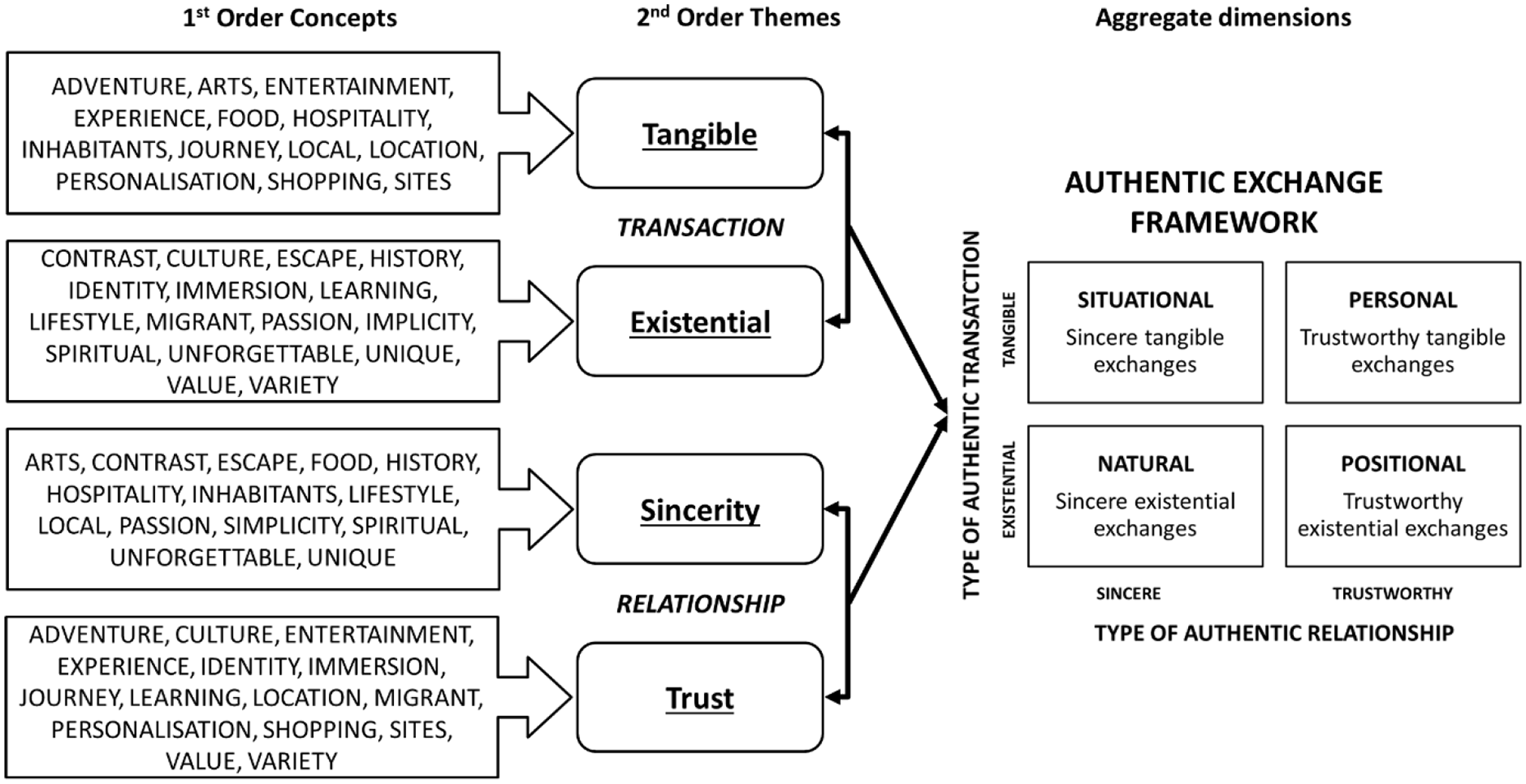
The “Authentic Exchange Framework” development process.
When data are highly-organized and contextualized (e.g., the standardized tour guide profiles analyzed within this study), content analysis is advised for knowledge and theory generation supported by reflective notes and diagramming for valid integration, interpretation, and synthesis (Finfgeld-Connett 2014). These conditions are consistent with the content of tour guide profiles on ShowAround, allowing us to combine computer tools and human qualitative coding and analysis in order to better-handle the large amount of data required to conduct textual analysis and theory development (Kelle 1997). Accordingly, qualitative computerized software was used to facilitate the systematic management of data and their analysis without taking over the role of the researchers in the interpretation of findings (Kelle 1997).
Demographic variables such as price-per-hour, location, the number of activities offered, language fluency, and quantified versions of the text variables based on number of characters were also considered and analyzed. However, the quantitative analysis of these variables did not identify any meaningful relationships related to the scope of this study, so they were not included in the discussion. Instead, the core findings and aggregated new theoretical dimensions generated from this approach are discussed in further depth, supported by representative data, in the following section.
Research reliability was initially controlled using the SET principles of reciprocity, rationality, altruism, group gain, status consistency, and competition (Gannon et al. 2021). A computational ethnography approach for transparency, replicability, and validity (Abramson et al. 2018) is provided by the way data was collected and analyzed automatically using computer software for large datasets. Finally, a rigoros data-to-theory link for qualitative research is assured through the Gioia et al. (2013) methodology of first order concepts, second order themes, and third order aggregate dimensions. These principles help to complete the hermeneutic cycle proposed by Klein and Myers (1999) for interpretive research.
Findings and Discussion
In order to develop a coherent understanding of authenticity framed by the promise of authentic social exchanges, this study explores the combined transactional and relational dimensions of authenticity within the context of tourism sharing economy services. While the value of a rigorous hybrid (inductive and deductive) approach to research is established (Fereday and Muir-Cochrane 2006), extant studies typically overlook the importance of triangulating multiple modes of data analysis when discussing research findings, instead presenting the results of each analysis stage in isolation (Gannon, Taheri, and Olya 2019). However, the “flavor” of authentic tour-guiding is captured within this study by analyzing a dataset of 113,194 independent tour guide profiles, combining computer-assisted and human research methods in a deductive-inductive manner. As such, the study findings are discussed below, supported by representative quotes, in order to bring the potential relationships between evidence, quantified codes, and newly-developed aggregate theoretical constructs “to life.”
Sincere Tangible Exchanges: Situational Authenticity
The findings suggest that object-based authenticity and sincerity can be captured by what we associate with situational authenticity profiles. The following themes, when combined, demonstrate that enjoyment and engagement with artifacts is often contingent upon the nature of the personal connection at a given moment between tourist and local (Table 2).
Occurrences of Sincere Tangible Exchanges.
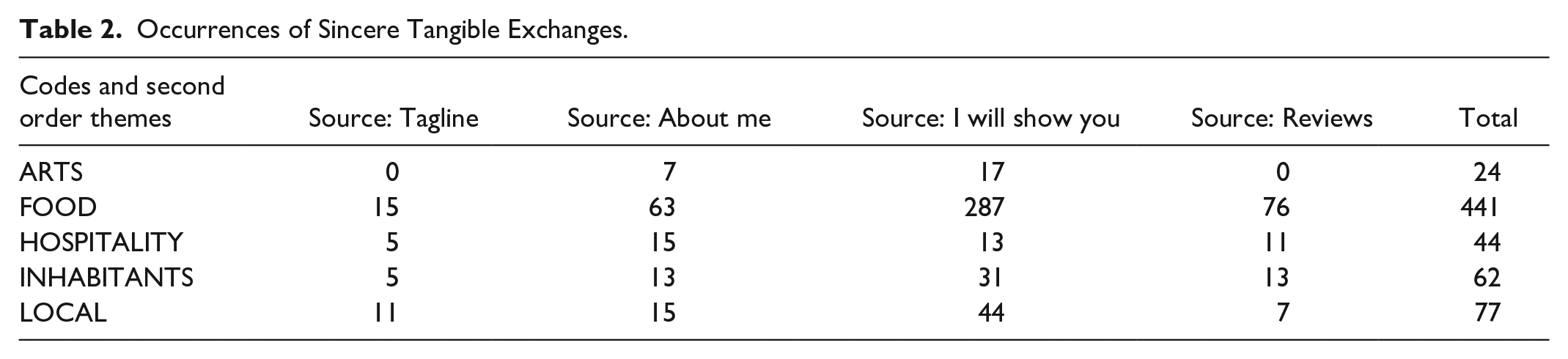
Choosing a guide to deliver on an authentic FOOD promise as an object and local experience requires trust, believing that authentic food is what makes locals proud and tourists curious. FOOD is discovered, shared, experienced, and eaten during a journey (or even after to recall the memories). However, food itself is rarely the end of the authentic tourism journey; rather serving as the gateway to further experiences. Interestingly, SHOPPING, although important and directly related to items, crafts, and souvenirs, does not seem to be important. Instead, food is often shared in these premises, before or after accessing these artifacts to complement or enhance the authentic experience:
My plan is showing you what made me fall in love with this city, such as the breath-taking views, the small ancient streets, the secret gardens, the authentic Roman cuisine and much more next to the typical touristic attractions that everybody already knows. (Ioana, Italy)
The connecting point between FOOD and HOSPITALITY is typically framed as being the insight the LOCAL guide holds; enabling authentic tourist exchanges through the lenses of their position as a local INHABITANT. From expats-turned-guides to world travelers passionate about helping likeminded individuals; from explorers in search of companions to eccentric individuals in search of a partner in crime; from solo helpers passionate about their city to expensive escort companions, the situational authenticity inherent within the world of sharing economy tour-guiding was revealed in this study. For some, this goes beyond the tangible, and instead hinges on a sincere desire to share the character of a destination (underpinned by the aforementioned ARTS, FOOD, and INHABITANTS therein) with inbound tourists:
Svendborg is no big city, and therefore the tales of the town and its atmosphere might be more interesting to discover than the sights themselves (and that is why you need me) Svendborg has some lovely cafes but, if the weather allows it, eating an ice cream in the middle of the harbor, would be my most authentic way of ending a tour. (Frederikke, Denmark).
To this end, situational authenticity serves as the convergence of both “perceiving” and “doing” authenticity; with the promise of tangible exchanges enacted in a sincere manner used by sharing economy tour guides to build a picture of access and insight into the “lived” experience of locals within destinations, providing tourists with an authentic grassroots sense of place in-turn.
Sincere Existential Exchanges: Natural Authenticity
Sincere existential exchanges are used to define natural authenticity. Table 3 summarizes the first order concepts that emerged from the data, with these combined into second order themes and an aggregate dimension. This combines elements of what can be perceived as the promise of a sincere tour-guiding exchange, projecting a sense of openness and transparency.
Occurrences of Sincere Existential Exchanges.
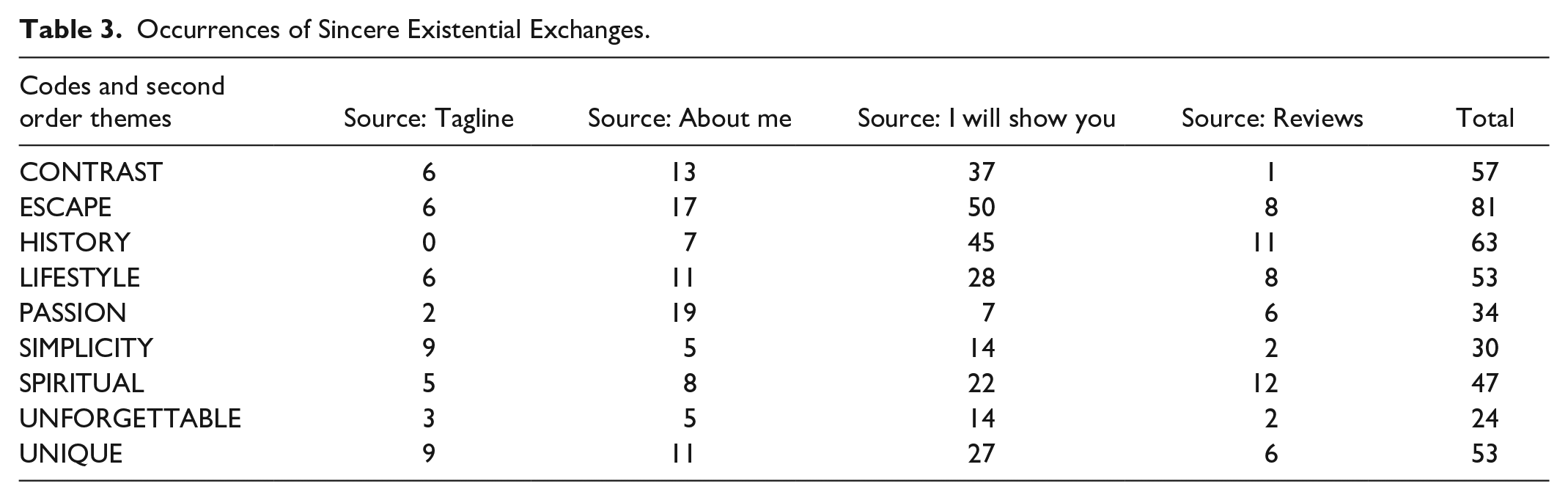
Interestingly, the search for unique local lifestyle experiences may prove a logical fallacy, as visiting what is unspoiled holds the potential to spoil it. However, the regularity with which this emerged within the context of authentic sharing economy tour guiding speaks to consumers’ increasing desires for novel experiential consumption (Gannon, Taheri, and Olya 2019). Some tour guides address this by projecting sincerity through SIMPLICITY in their profile Tagline, and PASSION in About Me sections. For some, this can serve as a core motivator to begin tour-guiding, where passion and simplicity combine to demonstrate sincerity, with this deployed in a manner likely to appeal to travelers:
I love when locals show me around as it’s more authentic. So I decided to do the same for visitors who visit Estonia so they can get the local experience (Liidia, Estonia)
Here, simply being guided by an individual local to the visited destination emerges for some as “enough” to for an experience to feel authentic post-exchange. This is consistent with the authenticity-sincerity nexus, which is often predicated on tourists’ perceived exposure to the “real” lives of “real” people (Taheri et al. 2019). As such, this simple enactment of authenticity is deemed important enough for Liidia to use when promoting her offering in order to appeal to those tourists looking for authentic tour guiding experiences who may feel the same way.
Nevertheless, the key for compromise on an existential level is to use the spiritual connection of what is perceived as sincere as a guiding compass. This is captured by the high instances of LIFESTYLE and UNIQUE in both “I Will Show You” and “Total” categories, and regular instances of SPIRITUAL and HISTORY in “Reviews.” This combination of passion, simplicity, and a sense of insight into local culture and heritage combines to develop a sense of natural authenticity, with this presented by one tour guide thus:
By meeting the locals, visiting exciting and artistic streets, and eating the most authentic food there is, I promise you that by the end of your visit you will definitely fall in LOVE with this City! (Lia, Israel)
Accordingly, natural authenticity is contingent upon tour guides recognizing and accepting that their potential customers (e.g., tourists) are likely to be unfamiliar with what it is like to “live like a local” or authentic representations of local culture, heritage, history, and lifestyles. Framed by escapism, uniqueness, and memorability, projections of natural authenticity are capable of appealing to tourists’ desires to experience authenticity while traveling by portraying the tour-guiding services on offer in a passionate yet straightforward manner, with any perceived artificiality replaced by a message underpinned by sincerity and a desire to “show-off” local sites, culture, and history to a wider audience.
Trustworthy Tangible Exchanges: Personal Authenticity
Everything seems more personal when we explore the relationship between object-based authenticity and trust. This form of exchange is characterized by a sense of ADVENTURE, underlined and supported by the social connection of “being in it together” that requires trust. As such, while FOOD is core to situational authenticity (Table 4), the nature of trustworthy tangible exchanges is better-captured by the bonding element of the exciting and hitherto unknown.
Occurrences of Trustworthy Tangible Exchanges.
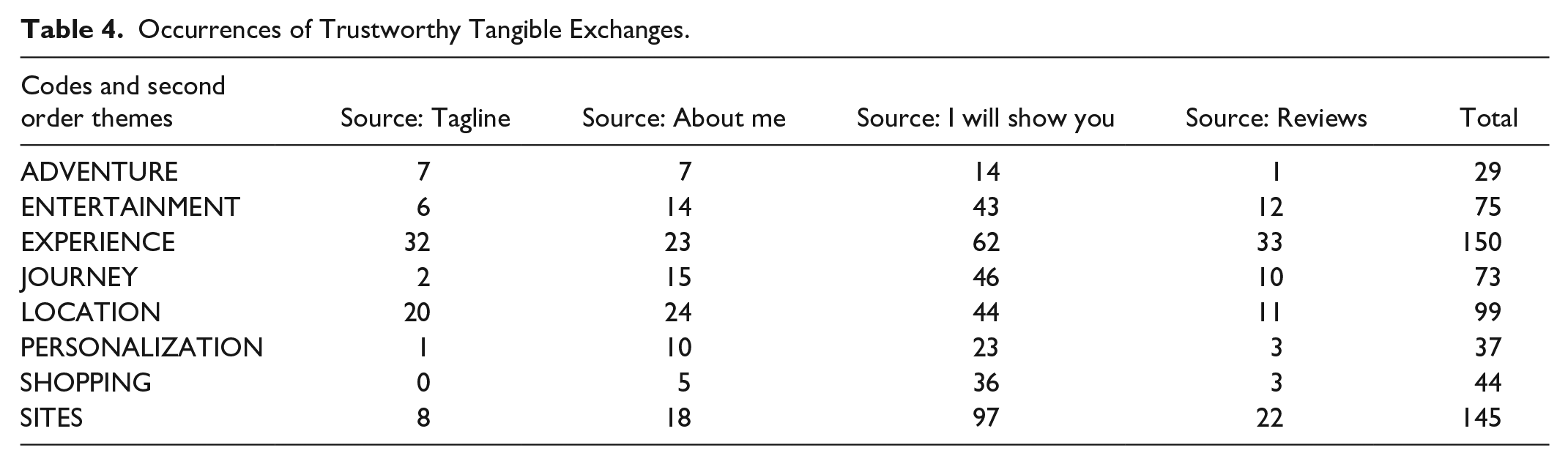
Trustworthy tangible exchanges are strongly related to the EXPERIENCE of eating and the LOCATION this is enacted in, as opposed to the authenticity of the food itself (Table 4). Nevertheless, this combined sense of authentic objects consumed in authentic places is used regularly by tour guides to sell their services. Accordingly, the consumption of food is treated as an experiential offering by many of the tour guides, woven into the fabric of their tours and serving as only a component part of the ADVENTURE on offer; as opposed to be consumed in isolation:
I can show you bucket list experiences or hidden gems, exploring the city, a walk by the River Clyde, watching the sunset from the Necropolis, a drink at a hidden bar, shopping on the high street or a bite of authentic Scottish food. (Lilly, Scotland)
The potential to personalize the consumer experience by combining tangible objects (e.g., local food and drinks) into other experiences (e.g., guided walks) allows ShowAround tour guides to demonstrate the extent to which their offerings can capture a truly place-specific authentic experience. This PERSONALIZATION can extend to the SITES visited, activities undertaken at the LOCATION (e.g., SHOPPING), and ultimately the tour-guiding EXPERIENCE as a whole; again holding the potential to contribute to a sense of ADVENTURE (Table 4). It is not surprising, therefore, to observe how trust works on a tangible level to shape the tour-guiding experience, with bespoke offerings perhaps perceived as more authentic than highly-curated, standardized, mass-market alternatives, and a sense of trust engendered by providing tourists with control over the nature of the tour and any itinerary therein:
Either we camp ourselves in tents or we stay at a secret authentic Bedouin camp hidden between the mountains of Rum (ask me for photos; not to be missed!). (Faris, Jordan)
Many tour guides also demonstrate pragmatism in acknowledging that inauthentic tourist experiences exist in order to further stimulate a sense of personal authenticity, while reassuring potential customers that they can offer insight into local culture in line with the desires of a more discerning, authenticity-seeking tourist, with this capable of portraying sincerity in the process:
I would not encourage typical touristy money-making schemes that most traditional tourists enjoy, but rather the less-popular, more authentic experiences that only locals such as myself know about. (Zoe, South Africa)
To this end, personal authenticity perhaps speaks more to the experienced traveler; those who understand the emotional value of travel, and who instead view tourism as an opportunity to experience new “things.” The findings suggest that sharing economy tour guides appeal to this subset of tourists in both functional and poetic terms, offering the promise of personalized tangible experiences (e.g., local shopping) coupled with real insight and entertainment (e.g., framing the guided experience as a journey or adventure) in order to satiate the fundamental desire for tourism to serve as entertainment characteristic to the needs of experienced travelers.
Trustworthy Existential Exchanges: Positional Authenticity
Positional authentic exchanges capture mutual understanding between tourist and guide, raising questions on “who” each is perceived as “being” (existentially) and what they believe they can give (and take from) this relationship (trustworthiness). This type of exchange is captured through first order constructs that help to confirm and reinforce the positioning of what is considered authentic through what is perceived as true and existential (Table 5).
Occurrences of Trustworthy Existential Exchanges.
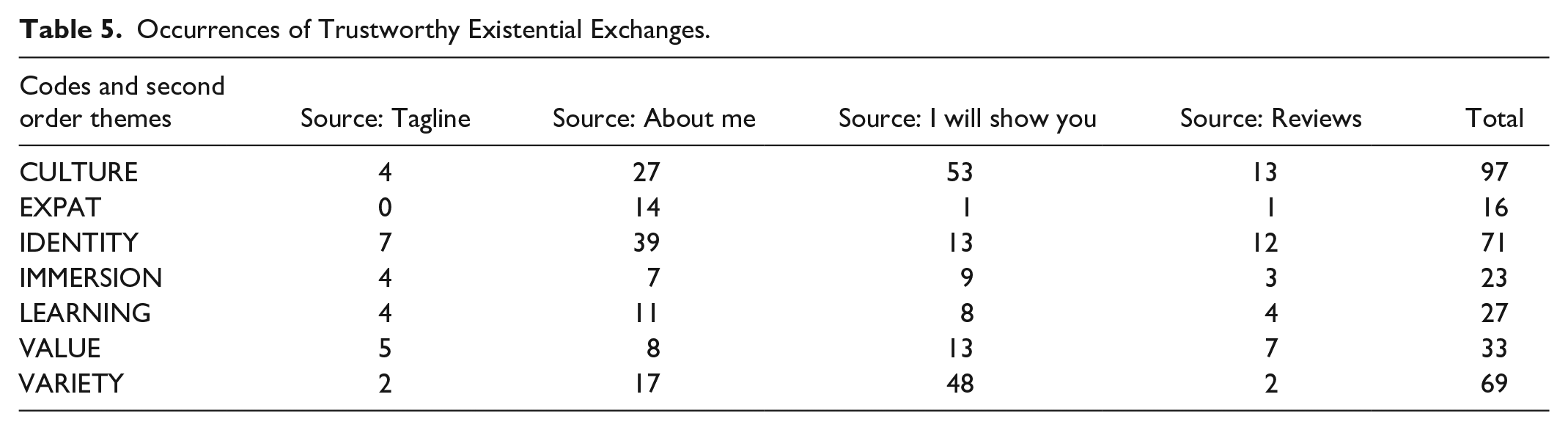
The central discussion around existential authenticity and trust is therefore the relationship between CULTURE and an IMMERSION. Unlike the case of object-based authenticity and sincerity related to ARTS, FOOD, and local INHABITANTS, here authenticity is portrayed in a more existential and experiential manner:
Many visitors fall in love with the history of Fes: culture, hospitality and architecture. I can guarantee that my tour will give you the best experience for you in exploring my city and its authenticity; I will show the most important and fascinating places. . . (Mohammed, Morocco)
Nevertheless, when viewed holistically, some of the second order themes identified do not necessarily act in the manner literature assumes. For example, characteristic of this “positional authenticity” (i.e., the interplay between trust and existential authenticity) are the tensions between CULTURE, IMMERSION, and LEARNING. Accordingly, while tourists expect to be immersed in the daily life of locals at destinations they visit (Taheri, Gannon, and Kesgin 2020), ShowAround tour guides also recognize that many also want to learn about the background of the place and its cultural heritage. It is interesting to note how each of these is associated with authenticity; trustworthy existential exchanges enacted through tour-guiding may therefore be interpreted as the bridge that brings historical manifestations of CULTURE to the present, with LEARNING and IMMERSION contingent upon the tour guide themselves.
It is not surprising therefore that although in the Tagline many guides associate IDENTITY with VALUE, what they actually offer is access to CULTURE, making the former more interesting in the process. This combination is encapsulated by Roma (India), who showcases her offering in order to appeal to tourists who desire an authentic, destination-specific tour through both time and place, which has the potential to provide deeper insight into a destination than a single activity undertaken in isolation:
From the Lotus Temple where you can reflect and find peace; to Chandni Chowk which truly captures the hustle of this city and offers you authentic Indian food, jewellery and clothes in its narrow lanes; to India Gate, which mysteriously evokes a feeling of pride about being Indian in every Indian; to Huaz Khas Village which is undoubtedly the most happening place in the city with its amazing rooftop pubs around the famous and beautiful Hauz Khas Lake. (Roma, India)
The findings therefore suggest that positional authenticity speaks to a distinct subset of traveler; experienced in much the same way as those seeking personal authenticity from tour-guiding, but also open to the possibility that the existential value of tourism goes beyond simply undertaking lived experiences. This quest for “more” is again reflected in the emphasis placed upon identity, culture, immersion, learning, and variety emerging across the profiles of the sharing economy tour guides studied.
Conclusions and Implications
This study investigated how authentic exchanges are developed in the sharing economy. This initially involved an investigation framed conceptually by both the object-based (or otherwise tangible) and the existential dimensions of authenticity, but this approach offered limited explanation of the importance of social engagement in developing and promoting experiences perceived as authentic (Bryce et al. 2015). Echoing Taylor (2001), sincerity and trust served as the starting point for a more in-depth investigation of authenticity from a relational perspective. Our contribution to SET (Cropanzano and Mitchell 2005; Emerson 1976) draws attention to the transactional and relational conceptual dimensions we borrow from extant tourism and hospitality literature, with these investigated in greater depth with focus on the promise and evaluation of authentic social exchanges in the sharing economy. The analysis of tour guide profiles in this study highlights the important role that social transactions and relationships play in SET, with each proposed as core to our understanding of authentic social exchanges within the sharing economy.
Adopting a combination of automated and manual text analysis methods, this study explored how local people operate as independent tour guides when using a sharing economy digital platform. Specific to the travel and tourism context, this platform (ShowAround) allows tour guides to promote their services while establishing authentic exchanges with potential tourists (Mody and Hanks 2020). Combining the deductive logic and conceptualization core to authenticity and social exchange literature, this study first adopted a criteria-based perspective of authenticity. Subsequently, an inductive approach to analysis led us to construct and propose a more profile-based theoretical approach to understanding the promise of authentic peer-to-peer tourism service exchanges, contextually specific to those operating at the intersection of tourism services and the sharing economy.
With regards to theoretical contribution, the study advances SET in the direction of the network transactions and relationships for which sharing economy digital platforms are a prime example. Various demonstrations of authenticity uncovered across the significant volume of tour guide profiles studied suggest that sharing economy services do indeed embody a multi-layered social exchange, satisfying many of the underlying rules of SET (e.g., group gain, reciprocity, and altruism) within a tourism and travel context. This emerges across the findings where, far from serving as the functional or transactional process associated with some traditionally-delivered travel industry services (Koens and Thomas 2016), the profiles under investigation demonstrate the reciprocal nature of sharing economy tour guiding, with both sincerity and trust contributing to portrayals of authenticity therein.
Thus, in this study, by adapting the transactional and relational dimensions of authenticity to SET we were able to identify situational, natural, personal, and positional forms of authenticity. These forms of authenticity originate from the deductive-inductive approach on perceptions and communications of authentic transactions and relationships resulting from social exchanges.
Ultimately, the findings suggest that the representation of authenticity enacted via social exchanges inherent to sharing economy tour-guiding serves to benefit both guide and tourist; satisfying the desire to share “real” representations of the host’s locale (Taheri, Gannon, and Kesgin 2020) while also appealing to inbound tourists’ increasing demands for authentic experiences when traveling. Nevertheless, this is contingent upon tourists’ perceptions and expectations related to the depth to which real experiences are shared during the guided experiences they undertake. As such, despite its focus on tour-guiding, the results shed new light on the current development and spread of authenticity and related concepts (e.g., trust, engagement, and sincerity) within the wider intersection of sharing economy and tourism studies (Altinay and Taheri 2019; Cheng et al. 2019; Mody and Hanks 2020; Paulauskaite et al. 2017), while also extending SET by demonstrating its efficacy in allowing us to better-undertake a novel profile-based approach to categorizing promised exchanges within the travel and tourism context.
This profile-based approach is common across marketing research (Jamal et al. 2006), and has been employed in a more limited fashion in entrepreneurship scholarship (Nicholson and Anderson 2005). However, our approach offers further empirical advancement as we profile exchanges and practices rather than individuals and consumers/tourists. This is achieved by combining theoretical deduction on criteria such as tangibility, existentialism, sincerity and trustworthiness with inductive reasoning on the context in which they are manifested by participants. This profile-based approach to authenticity thus differs from the criteria-based approach that dominates current research, providing the ability to combine dimension-based approaches with each other. For example, we used the tangible/existential and sincere/trustworthy dimensions to frame each profile. Thus, the results propose a new line of investigation by exploring the promised relationship between tourists and sharing economy service providers.
Second, a profile-based approach allows greater flexibility to accommodate constructivist and interpretivist inductive perspectives on data analysis, again compared with the quantitative positivist approach that dominates large-scale authenticity research. This helped to categorize and aggregate the 31 codes in Table 1 generated inductively in this study. Third, a profile-based approach can explain the nature of an authentic experience, alongside the personality of those participating in it. We evidenced this through the self-identification of quotes within local tour guide profiles, with these used to project the authenticity of their services to potential customers. Finally, a profile-based approach can be applied with methodological rigor, allowing a combination of deductive and inductive logics and automated and manual coding for any size and type of data.
Methodologically, considering our conceptual starting point and the large volume of data collected from an online platform, we also extended Gioia et al. (2013) method by adding a deductive theoretical layer to its application and an automated coding practice to analyze over 7,000,000 words of text. Figure 2 explains the new theoretical process developed, and Figure 5 outlines its application for theory development from first-order codes to aggregate dimensions. These were achieved through the examination of empirical insight and elaboration of emerging theory. Using the thematic method (Fereday and Muir-Cochrane 2006; Miles and Huberman 1994), automatically coded occurrences of authenticity were analyzed and compared manually in context to discover new insights, surface differences and similarities, resulting in 31 new themes. These new contextual constructs were compared and contrasted through existing authenticity theory dimensions and SET.
The presentation of visual coding and quotation maps facilitated the communication of the study results (Figures 3 and 4). Filtering new first-order codes through the theoretical lenses of tangible/existential and sincerity/trust authenticity, we built a framework based on four profiles of promised tour guide exchanges: situational, personal, natural and positional. It is important to mention here that the four exchange profiles we identified as aggregate dimensions are specific for this study and the deductive theoretical reasoning we followed. Yet, the process can be replicated across multiple contexts.
Further, for practitioners, this study can help shed light on the many ways to operationalize the delivery of authenticity in tourism and travel exchanges. This can be enacted based on situational, personal, natural, and positional profile-oriented exchanges informed by established conceptual dimensions associated with authenticity (e.g., tangibility, existentialism, sincerity, and trustworthiness), which in-turn play an important role in shaping today’s dynamic travel and tourism environment. Insights and reflections from this study can be used strategically to identify how to promote the authenticity of tourism services. This is contingent upon recognizing that social exchanges are essential for developing and delivering authenticity, particularly when promoted via digital sharing economy platforms but enacted within real-world environments.
The results thus hold important implications for those operating within the travel and tourism sharing economy with regards to ensuring the nature of authenticity projected via their profile matches the demands of the type of tourist they are trying to attract. This study also sheds light onto the projected authenticity of sharing economy services, recognizing that providers are likely to define authenticity differently. Thus, it is important for service providers to reflect on their promotion and use of interactional experiences as a means of understanding and evaluating their particular service offerings. More specifically, the aggregated dimensions developed from the study findings can be deployed by sharing economy tour guides in order to highlight which combinations of authenticity (e.g., situational, natural, personal, positional) they hope to portray to tourists.
Limitations and Future Research
Some limitations for this study can be observed. We extracted data from one online source: ShowAround, which may impact upon generalizability. However, ShowAround is a significant and established player within the domain of independent tour-guiding, and a key component of the tourism industry’s emerging sharing economy landscape. Its focus as the source empirical evidence from this study is based on the material local tour guides put in their profiles, their self-perception of themselves and their offering, and (to a more limited extent) consumers’ post-experience reviews. Future studies should nevertheless look to other platforms and consumer forums to generate further insight into the relational aspects of the concept of authenticity within the sharing economy from a consumer-oriented perspective. Further, the dataset was collected by utilizing keywords in the English language; the results therefore do not fully reflect a global image of authenticity and are instead somewhat Anglo-centric. Results could differ if keyword-searching was conducted in other languages (e.g., Russian, Japanese).
Additionally, we recognize that extracting quotes based only on the root term “authentic,” including also “authentically” or “authenticity,” may prove a limitation of the study. We considered synonyms such as “original,” “truthful,” “real,” and “genuine,” but the overwhelming number of results and subjective nature of the research scenarios they presented was impossible to manage in practice. Therefore, a decision was made in favor of a limited but more rigorous approach in order to increase the validity and replicability of the study. Finally, a quantitative analysis of the data was also attempted. This did not deliver meaningful results due to limitations with the number and nature of secondary cross-sectional data variables at our disposal and the inability to contact respondents directly.
Footnotes
Author Note
Babak Taheri was now affiliated to WSB University in Gdansk, Al Grunwaldzka 238A, 80-266 Gdansk, Poland.
Declaration of Conflicting Interests
The author(s) declared no potential conflicts of interest with respect to the research, authorship, and/or publication of this article.
Funding
The author(s) disclosed receipt of the following financial support for the research, authorship, and/or publication of this article: University of Birmingham, Birmingham Business School: Internal research grant for data collection.
