



Abstract
Tourist misbehavior is well documented in the literature and has predominantly focused on the visible, major, or felonious forms of deviance, such as vandalism, violence, or theft. We argue for the importance of considering a more subtle side of tourist misbehavior often tolerated, ignored, or even enabled by host communities and hospitality employees. Exploring the more subtle side of tourist misbehavior is important, because it is more clandestine and less extreme than obvious misbehaviors, yet its prevalence suggests important business and environmental implications. We undertook in-depth interviews with 47 frequent travelers and employed a criminological lens, that of deviant leisure, to uncover a range of deviant tourist behaviors by focusing on the accumulation of traveling mementos (items that tourists bring back from their travels). Two dimensions of memento accumulation emerged with eight forms of tourist misbehavior, each with unique motives, practices, and implications. Findings point to the importance and mass appeal of these more subtle and elusive deviant practices. Suggestions for practitioners, policy makers, and academics are then discussed.
Introduction
I have been working in hotels long enough now not to judge people on appearances. . . But there’s one thing they all have in common. There’s one thing that
Customer misbehavior, defined as “behavioral acts by consumers, which violate the generally accepted norms of conduct in consumption situations, and thus disrupt the consumption order” (Fullerton and Punj 2004, 1239), has been studied under different labels and in a plethora of situations. Misbehaving consumers have been termed “jaycustomers” (Lovelock 2001) or “problem” customers (Bitner, Booms, and Mohr 1994), and their behavior has been described as unjust (Rupp et al. 2008), aberrant (Fullerton and Punj 1993), dysfunctional (Harris and Reynolds 2004), annoying (Loi and Pearce 2012), and deviant (Reynolds and Harris 2006). While customer misbehavior has attracted increasing attention in management and service studies, it remains relatively understudied in the context of tourism (Cohen, Prayag, and Moital 2014), with calls for more research on “the construal of tourist misbehavior and its implications” (Chien and Ritchie 2018, 178).
Tourists misbehave in a variety of settings such as after service failure in hotels (Daskin and Kasim 2016) and airports (Taheri et al. 2020); after negative customer-to-customer interactions (Go and Kim 2018) and exchanges in the sharing economy; while visiting amusement parks (Chapman and Light 2017); and during flights (Hunter 2016). However, previous research has typically focused on major or felonious forms of travel misbehavior, including abusive language, physical violence, sexual assault, theft, and vandalism, where tourists’ misconduct is viewed as the exception, illegal, or a significant deviation from the norm (Fisk and Neville 2011). This position neglects a multitude of less prominent, but more commonplace, behaviors in the gray area between unethical and illegal actions, where tourist misbehavior is highly subjective.
Exploring the more subtle side of tourist misbehavior is important, because it is more clandestine than obvious misbehaviors, yet is widespread (Fullerton and Punj 2004); moreover, it has often been ignored by scholars (Pratt 2020). Its prevalence, however, has important business and environmental implications. Compared to violence, vandalism, or shoplifting, which attract a lot of attention, minor misdemeanors or other less acute deviant behaviors (such as taking a bottle of sand from a beach), might be viewed as insignificant or even harmless. However, using sand theft as an illustration, such small acts may threaten local ecosystems and wildlife populations—in Sardinia alone, over 10 tons of stolen sand were seized during just the summer of 2019 (Giuffrida 2019). Moreover, exploring such transgressions is morally relevant and also makes business sense: tourists taking home hotel towels or slippers reportedly adds up to a loss of $100 million a year for US hotels alone (Cooper 2015). Thus, while accepting the importance and the headline-grabbing nature of tourist felonies, it seems that examination of the less extreme, more minor, yet more prevalent, misdemeanors and/or ethically questionable behaviors of tourists would be valuable.
With this in mind, we focus on the nature, forms, and dynamics of tourists’ accumulation of mementos amassed during travel—from purchases of souvenirs, to other items accrued more covertly or even unethically. Across the many forms of tourism, item accumulation is a consistent, popular, and ubiquitous behavior across all tourists (Collins-Kreiner and Zins 2011). It also includes a variety of alternatives (e.g., tangible or intangible material) and it is widespread across both leisure and business tourists. Further, previous research has focused on the two sides of extreme item accumulation: either legal and visible collection of souvenirs or objectively illegal actions such as stealing, but no study has yet focused on more complicated forms and dynamics of the actions in-between. Our aim is to generate insights into the mechanisms and motives behind tourist memento accumulation actions and misbehaviors. To achieve this, we employ a criminological perspective using the theoretical lens of deviant leisure (Raymen and Smith 2019, 2020), to explore unethical leisure behaviors. To date, despite having theoretical and intuitive appeal, the links between deviant leisure and tourism, have not been tested empirically. Consequently, we explore the process of tourists’ memento accumulation in order to explain the main motivations and perceived benefits behind such acts, and to move beyond a universal profile of misbehaving tourists.
In the next section we review the literature on deviant leisure and subjective interpretations of harm, relating it to the current academic discourse on tourism misbehavior. This is followed by a detailed discussion of our methodology and our main findings. In the final section, we discuss the main conclusions that can be drawn from this study and illustrate their importance for scholars and for tourism organizations.
Manifestations of Customer Misbehavior in Tourism
In a book entitled “Deviance and Risk on Holiday” Briggs (2013) presents a critical ethnography examining the alcohol and drug-based leisure activities of young Britons in Ibiza, Spain. In this research, young travelers are portrayed as seeking transcendence and meaning by risking their physical and sexual health, conspicuously spending more than they can afford in an attempt to out-spend or out-risk each other and gain social status. Briggs (2013, 2) explains why tourism is an appropriate setting for examining misbehavior:
There is something distinctly liberating about the holiday as a social occasion. People say they can ‘be who they want to be’ as they free themselves from the shackles of home routines, responsibilities and identities: it is a transformation from the ordinary and mundane home to the extraordinary and the hyperreal pleasures on offer in the holiday resort.
The tourist destination is, therefore, the environment and the holidays are the occasion during which travelers are in a hurry to seize as many experiences and maximize their enjoyment as much as possible, before the inevitable return to the daily routine of everyday life (Belhassen 2016). Once away from home, tourists enter a liminal zone where there is a “license for permissive or playful behavior” (Urry 2003, 12) and individuals are encouraged, or at least allowed, to behave in an unrestrained manner that is prohibited in mainstream society (Goffman 1967). When people are “out-of-town” or among strangers, they have a tendency to be less inhibited than usual (Grove and Fisk 1997), feel less close to fellow consumers (Wan, Hui, and Qiu 2021), and they worry less about the consequences of their actions (Eiser and Ford 1995). A temporary loss of personal and social control facilitates high-risk deviant tourism practices (Theocharous, Zopiatis, and Philaretou 2015) and helps explain why, for example, some tourists participate in binge drinking (Smeaton, Josiam, and Dietrich 1998) or vandalize popular historic sites or monuments (Bhati and Pearce 2016).
A concurrent body of research that also contributes insights into tourists’ misbehavior relates to consumer behavior after service failure. When experiencing frustrating or dissatisfying service, tourists are more likely to misbehave and sabotage the service provider by, for example, consuming more food than is appropriate in a hotel breakfast buffet, or dirtying their room more than necessary (Daskin and Kasim 2016). Focusing on airports, Taheri et al. (2020) find that dissatisfaction with the quality of service received had a large and significant effect on travelers’ misbehavior, with actions ranging from being rude to staff, to making false complaints and stealing. The target of this problematic behavior may be the employees (e.g., verbal and physical abuse, threats, and sexual harassment), or the service organization (e.g., theft, breaking company laws, and abusing policies).
A third explanation behind consumer misbehavior in tourism concerns the unique context of service encounters in tourism. The hospitality industry places particular emphasis on pleasing customers (Raub 2008), such that deviant behaviors are often tolerated, ignored, or even enabled by host communities and hospitality employees. The fact that many encounters take place at night and involve intoxicated guests increases the likelihood of violence and aggression (Yagil 2008). Hotel employees are often harassed by customers due to the informal environment and the lack of structure in their service (Guerrier and Adib 2000), while hotels have also been described as sexualized environments (Pritchard and Morgan 2006). Bitner, Booms, and Mohr (1994) analyzed 774 critical service exchanges between customers and employees in the hospitality industry and report that 11% of these were due to drunk, abusive, or uncooperative “problem” customers, who Knutson, Borchgrevink, and Woods (1999) label customers “from hell.”
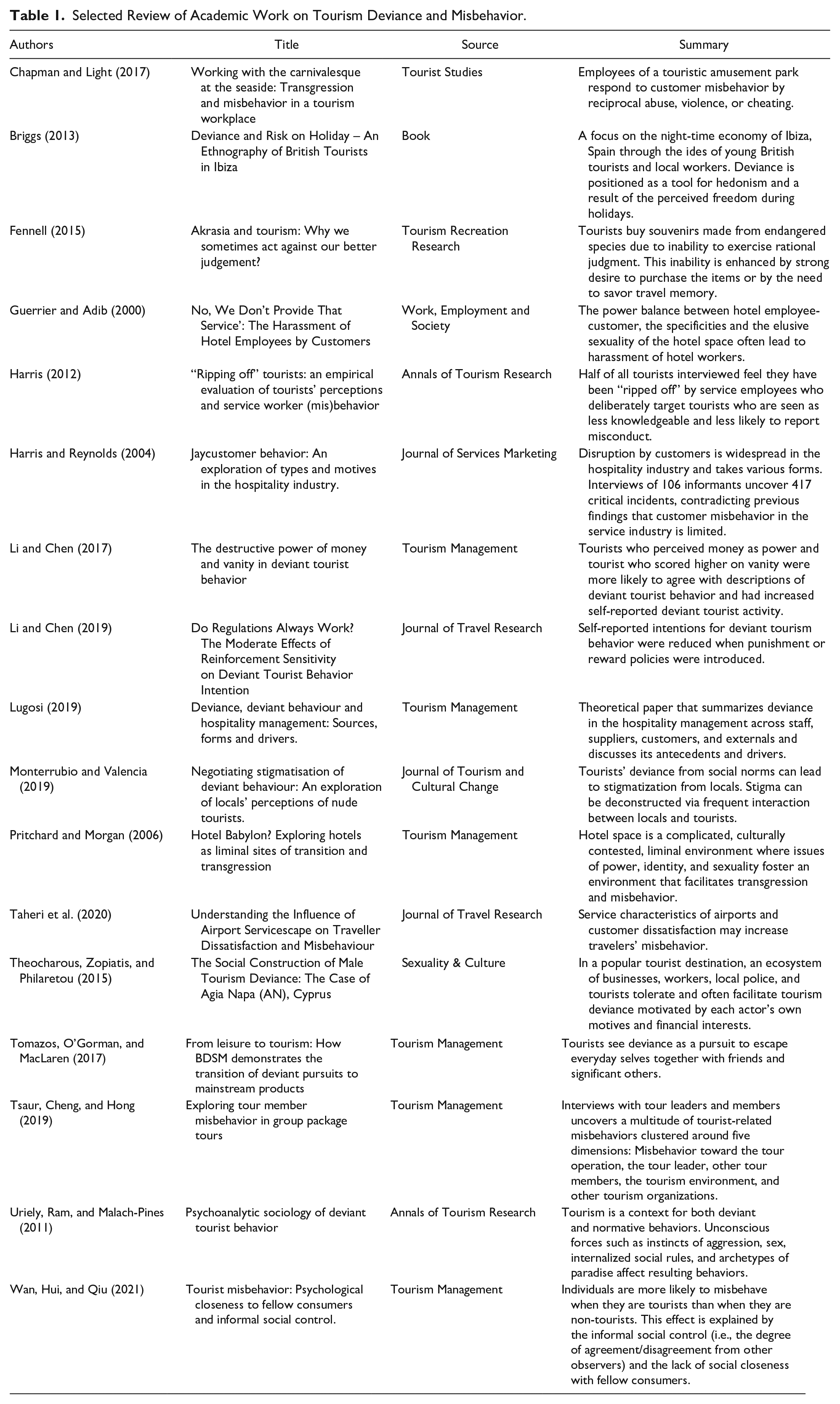
A final reason is related to the unique emotional, social, and cognitive factors of tourists in the pursuit of pleasure. Fennell (2015) introduced the concept of akrasia, or the inability of an individual to restrain their desires (Mele 1994) in the tourism literature to explain why anticipating pleasure might motivate actions against the tourist’s better judgment. From this perspective, misbehavior is not due to the in-between state of tourists or their unique service encounters, but it is motivated by the will to break free from rules and norms, in an effort to feel “more” alive (Belk, Ger, and Askegaard 2003). Touristic endeavors often elicit powerful emotions and displace rational thoughts in the background (Fennell 2015). Tourists, therefore, may misbehave because they are unable to restrain their desires or follow their rational judgment. The social element in the pursuit of pleasure abroad is reinforced when tourists travel among strangers, or in large groups. Tsaur, Cheng, and Hong (2019) study tourists traveling in group tours and document a long list of misbehaviors, such as stealing, disrespecting local heritage, violence, and aggression. Table 1 summarizes relevant academic work on tourism deviance and misbehavior.
Selected Review of Academic Work on Tourism Deviance and Misbehavior.
Toward Subjective Interpretations of Tourist-Generated Harm
Most previous research on tourist misbehavior favors or focuses on objective, universally accepted deviant behaviors that are, if not always illegal, perceived at the very least as anti-social and illegitimate (Tsaur, Cheng, and Hong 2019). However, this perspective presumes that both a universally accepted notion of deviance and an unanimously shared view of ethics and common social norms or values exists. This position is vociferously challenged by contemporary sociologists (Feldman 1988; Snyder 2017). Thio, Taylor, and Schwartz (2012) discuss these two opposing views on defining deviant behavior: The positivist perspective, developed by early criminologists, holds deviance to be absolute, objective, observable, and pre-determined. Deviant individuals have different characteristics from conventional others and their behavior is determined by forces beyond their control. In contrast, the constructionist perspective has emerged over the last 50 years to challenge the positivist assertions. According to the constructionist view, a behavior is deviant because some people view it as such. Deviant behavior is, therefore, relative, subjective, and an act of free will. Thio, Taylor, and Schwartz (2012) conclude that the positivist perspective may be more relevant in studying serious types of deviance such as murder, whilst the constructivist perspective is more appropriate for examining less serious types of deviance with lower degrees of consensus among society.
Many forms of memento accumulation are directly or tacitly tolerated by a large proportion of tourists and even service workers. In this sense, when something is tolerated, it is accorded legitimacy. Stebbins (1996) distinguishes between intolerable deviance that threatens to disrupt community order and is universally regarded as harmful and inherently wrong, and tolerable deviance that is enacted by a small number of individuals and does not threaten the majority of community members. Tolerable deviance is often “complaintless” (Schur 1984), meaning that no one feels threatened enough to lodge a formal complaint. Tolerable deviance is further categorized as criminal, non-criminal, and legitimate (Stebbins 1996): Criminal tolerable deviance is illegal according to the letter of the law, but is a low police priority, rarely challenged due to vague, or difficult to enforce laws and includes actions such as disorderliness, habitual gambling, or the recreational use of prescription drugs. Examples of non-criminal tolerable deviance include nudism, heavy drinking, and the sale of pornography; while legitimate tolerable deviance, such as extreme political beliefs or supernatural claims and rejection of scientific explanations, are rights typically guaranteed by law.
Deviant Leisure
Our investigation of tourist memento accumulation employs the theoretical lens of deviant leisure. Conceptualized by criminologists Raymen and Smith (2019, 2020), deviant leisure explores unethical leisure behaviors and aims to analyze critically the “myriad harms associated with the most legitimate, normalized and culturally embedded forms of commodified leisure” (Raymen 2017, 15). Raymen and Smith (2019, 18) explicitly contextualize such morality as being highly subjective and argue that unethical behavior should not be defined as a violation of some “non-existent social norms, values, and ethical standards.” Rather, they position social harm as the ultimate unethical practice and redefine deviance as a transgression of the “ethical duty to the other” (Smith and Raymen 2018). While previous criminology and sociology work has focused on highly visible forms of harm, such as substance use in the night-time economy (Ayres 2019); performance enhancing drugs among crossfitters (Mulrooney and van de Ven 2019); gambling (Raymen and Smith 2020); and even sadomasochism (Williams 2009), previous research has ignored the capacity to locate harm in everyday practices (Pemberton 2016) and has marginalized non-human harms (White 2013).
Deviant leisure is an appropriate theoretical lens to explore tourists’ memento accumulation because it facilitates focus on the breadth of accumulatory behaviors, including commonly underreported and unrecorded harms. For example, Tsaur, Cheng, and Hong (2019) notice small transgressions by tourists, such as inappropriately touching “do not touch” signs or picking flowers, while Li and Chen (2017) describe how tourists create graffiti or climb on sculptures and trees as a form of expression. Other violations can have instrumental benefits beyond a need for expression. In a survey of British holidaymakers, 56% of them admitted taking something from a hotel and, when asked why, common responses included that there was no harm done as the hotel would have many more of the stolen item, or because they were “getting their money’s worth” (Anderson 2016).
In this regard, deviant leisure also helps position some thrill-seeking tourist activities as harmful and, thus, unethical. Criminology literature has theorized that crime may be connected with sensation seeking (Sales 1971) and that some criminals take pleasure from committing their crimes (Csikszentmihalyi 1990). Similarly, with tourism, an analysis of 384 tourists who had previously misbehaved in a hospitality context confirmed a link between individuals’ tendencies to seek excitement and their misbehavior (Daunt and Harris 2011).
While, previously, leisure and crime have been examined separately, recently scholars have started to explore how they intertwine (see Williams and Walker 2006) and have highlighted diverse examples, from enjoyment of the social benefits of participating in gangs (Stodolska, Berdychevsky, and Shinew 2019), to murderers who collect souvenirs and trophies to help relive their crimes (Gunn and Caissie 2006). However, in tourism contexts, it seems logical that “minor” deviant behaviors may prove abundant, as there are mild consequences and only a slim chance of getting caught (Stebbins 1996). For example, visitors to New Orleans during the Mardi Gras celebrations cite euphoric thrill as motivation for their participation in “playful deviance” (Redmon 2003) and tourists participating in extreme urban exploration visit non-public places such as abandoned buildings and subway tunnels “simply for the joy of doing so” (Garrett 2013, 21).
In sum, a more critical perspective of previous literature on tourist deviance as portrayed in Table 1, offers some conclusions that guide our research aims. Firstly, the main academic attention of tourists’ misbehavior has been given to the major antisocial and/or illegal actions of tourists, potentially ignoring other more prevalent but often unreported practices. Secondly, while these major and felonious forms of travel misbehavior can objectively be characterized as illegitimate, illegal or unethical, the more minor, everyday practices that are the focus of this study may be characterized by wrongdoers and observers as insignificant or even harmless. At issue is, therefore, to employ the theoretical lens of deviant leisure to explore dimensions and dynamics of potentially harmful accumulatory behaviors of tourists. Further, we aim to contribute insights into the varying forms, mechanisms, and motives behind these behaviors.
Research Design and Methods
Our approach is inherently interpretivist in nature, reflecting our constructivist epistemological and ontological perspectives (see Denzin 1988). As the principal aim of our research is to explore and explicate how and why travelers accumulate mementos during their vacations and business trips, a grounded theory exploratory research design seemed to be the most appropriate with the most apposite method of data collection being in-depth, semi-structured interviews.
Accordingly, we undertook in-depth interviews with both leisure tourists and business travelers based in the U.K., designed to explore their tourist experiences, as well as their views and interpretations about memento accumulation. During the initial phases of data collection, we were conscious of the need to immerse ourselves in the reflections of informants, so we utilized flexible and unstructured interviews to facilitate a broader investigation of issues, allowing us the opportunity to scope out emergent ideas, notions, and reflections. Consequently, whilst our initial interview protocol was standardized to fit all tourist types, as the data collection process progressed and tentative data categories emerged, we refined our protocols and schedules to reflect the emerging themes and categories. This flexible, evolving approach had two benefits: first it allows for an initial identification of issues in the early interviews, which, in turn, enables us to refine the subsequent interview protocol to be more targeted, giving us access to insights into acts, behaviors, and interpretations grounded in data, at the same time as enabling us to incorporate tentative insights about the dynamics between concepts into the interviews.
Data was collected via a sample of U.K. tourists who responded to online advertisements for individuals in a study of work and leisure travel. Criteria for inclusion included informants who had been on trips for work or leisure (at least three times in the last 18 months) who had accumulated or collected mementos of any sort (paid for or not paid for) during their travels. Of the 75 initial contacts, 12 were excluded as their frequency of travel was too small, 7 were unable to attend face-to-face interviews at the time-locations available, 3 were excluded on the ground of age (below 18), 4 withdrew due to insufficient incentive provision, and 2 informants withdraw due to time commitments. Interviews were conducted in seven U.K. cities. In total, we conducted 47 face-to-face interviews—24 with leisure tourists and 23 with business travelers. In the interviews, 12 business travelers referred to both their business and leisure travel, necessitating a rapid restructuring of the interview protocol so that reflections on both forms of travel could be distinguished (whilst also allowing us to explore the dynamics and interpretations between reflections and activities). The majority of the informants were male (n = 26, 55%), with informants’ ages ranging from 19 to 68. The informants were drawn from a broad mix of cultures and ethnicities which broadly reflects the ethnic mix of the U.K. Consistent with ethical guidelines, we employ pseudonyms for informant names and locations, and details have been changed to anonymize contextual information such as precise locations, hotels, and addresses. All interviews were recorded, resulting in over 64 hours of recordings. On average, the business traveler interviews were longer than those with leisure tourists (reflecting the earlier comment that some business travelers discussed their business trips first before moving on to talk about their leisure tourist activities). All of the audio recordings were fully transcribed and annotated with interview notes, including reflections on informants’ tone, body language, and the interviewer’s perceptions of their emotional states. Thus, data analysis combines both interviewer observations and the interview transcripts (see Merton 2008).
Our inductive data analysis approach focused on exploring key themes to facilitate analysis both during and after data collection. Accordingly, we followed a design that drew on the recommendations set out for techniques of constant comparison (Glaser and Strauss 1967) and methods of naturalistic inquiry (see Lincoln and Guba 1985). These principles aid in data collection and analysis that are both robust, whilst constituting a rigorous basis for theme and dimension explication (see Gioia, Corley, and Hamilton 2013). In terms of coding, our procedures drew on the widely used guidelines of Strauss and Corbin (1998), and focused on the use of three forms of data coding and analysis; namely, open, axial, and selective coding. Our approach to coding, involved iteration and reiteration until we deemed that we had generated an adequate understanding of themes and relationships (Corley and Gioia 2004).
As our research is interpretative in nature, we adopted Lincoln and Guba’s (1985) critical criteria for gaging the credibility, acceptability, and overall trustworthiness of our data. Accordingly, we employed tactics to enhance the transferability, credibility, dependability, and confirmability (collectively often termed “rigor” or “trustworthiness”—see Lincoln and Guba 1985) of our analyses. Our interview guide was semi-structured, to provide some consistency and order across interviews while allowing for richer discussions with participants and for novel insights and themes to emerge. Our interview design was iterative (Arsel 2017): after conducting an interview, the authors reflected on their experience, positioned the interview in the whole data set, revisited their interpretations and if needed, amended the order or the wording of interview questions.
In conducting the interviews, emphasis was also placed in gaining “tacit” knowledge that emerged from non-verbal cues such as nods, silences, or humor (Altheide and Johnson 1994). All interviews, observational data and interviewer reflections were systematically recorded and transcribed. To accomplish research triangulation, we adopted a structured data analysis approach and used a “concurrent-dual” procedure of analysis, whereby we undertook data analyses independently, yet concurrently. This helped ensure reliability and consistency of the results (Cambell et al. 2013). Results were compared and all points of divergence were discussed until a consensus was reached.
Findings
Analysis of data led to the emergence of a number of categories, dimensions, and subdimensions of how and why tourists accumulate mementos during their vacations and business trips. In line with literature on souvenirs (Wilkins 2011), our participants discussed how they deliberately seek out, spontaneously acquire, or sporadically purchase tourist-oriented souvenirs for themselves and others. As such, the first key insight to emerge centers on the finding that memento accumulation by tourists involves a much wider range of behaviors than those currently recognized (and that are occasionally, somewhat dismissively referred to as mere “souvenir shopping”) (Collins-Kreiner and Zins 2011). Nevertheless, our results indicate that souvenir shopping behavior is overshadowed by broader and more varied traveler memento accumulation behaviors, confirming what has already been highlighted in the literature, namely the diminishing importance of souvenirs, which are increasingly seen as mass-produced, inauthentic objects that lack any substantial meaning (Swanson and Timothy 2012). This finding is consistent across both business and leisure travel, where both types of travelers commonly (but not exclusively—see later) argue that their trips involve accumulating items that are not the typical souvenirs found in stores, bazaars, souks, or tourist traps. For example: Souvenir shopping is for schmucks! Cheap tat for the dimwitted to take home and give to Granny! Nope – I hate souvenir shopping. My holiday mementos are real – not manufactured crap! [Mark, Leisure tourist, male, aged 32, 3–4 vacations per year] I can’t say I collect souvenirs – not really my thing – that said, I always pack a very light case and I always come back with a heavier one – just not with glass baubles or tourist junk – I’m more. . ..err. . .. instrumental? [Ginger, Business traveler, female, aged 34, 1–2 business trips per month]
The subjective interpretation of harm, embedded into the deviant leisure perspective, rightly precludes the over-simplified classification of such tourist actions into merely “criminal” or “unharmful” acts. In contrast, by analyzing the nature, forms, motivations, dynamics, and perceived outcomes of such behaviors, our analysis reveals that tourists’ memento accumulation behaviors vary in dimensionality and therefore can be explained by exploring a typology of common forms that embraces various types of memento gathering. Our data analysis led to the identification of diverse travel memento accumulation behaviors across two main dimensions: illegality-legality and ego-instrumental benefits, and eight main forms of tourist item accumulation. To explore these findings, our data are presented in the following way. First, we explain the two different dimensions in more detail, then we consider the nature and dynamics of the different forms of memento accumulation.
Dimensions of Tourist Memento Accumulation
The first dimension of tourist memento accumulation focuses on the extent to which travelers’ actions may be categorized as legal or illegal in nature. While legal jurisdictions, technicalities, and local variations were put forward by informants as obfuscating or complicating factors, most were broadly able to rate their actions as either illicit or licit. For example, some informants judged their behavior as illegitimate, wrong, or even illegal. Two informants discuss taking (stealing) glasses from bars and clubs when on vacation: Well, it is strictly [emphasized] against the law, isn’t it? I’ve worked in pubs and clubs – they expect a certain amount of breakage – nice glasses always get used first; they get broken faster too. Stands to reason. They shouldn’t use them for tourists if they don’t expect them to ‘go missing.’ [Donna, Leisure tourist, female, aged 43, 2 vacations per year] There’s probably a rule against it but if nobody’s looking then there’s no real harm in it. If they were that worried about it, they’d have a guard there. It’s not like stealing [dismissively]. [Leo, Leisure tourist, male, aged 23, 2 vacations per year]
In contrast, others rated some of their memento accumulation behavior as entirely legitimate, permissible, and legal: That’s what you pay for. Part of the room charge is for the soaps, shampoos, err those shoe cleaning things. . . They get replaced every day, so they expect you to take them. [Josh, Business traveler, male, aged 52, 2–3 business trips per quarter] Things like that aren’t worth anything. Just memoirs for me. Technically, somebody owned that scrap of rope, but it had fallen off the bridge years ago – it wasn’t part of the fabric of the bridge or anything, just lying next to it, going to waste. [Charlie, Leisure tourist, male, aged 61, 4 vacations per year]
In both these narratives, informants viewed their actions as unquestionably legal and legitimate—from their perspective. Which acknowledging that such behaviors can be viewed differently by other actors (e.g., relating to the two above narratives; hotels arguing that toiletries items are provided for use not acquisition or tourist destinations noting that taking items from tourist sites could damage the very heritage of that site), the perspective of this study is from that of consuming tourists; reflecting the business adage of customer perception is reality. Nonetheless, although tourist behaviors varied considerably on the legal-illegal dimension, so did individuals’ evaluation of their behavior. In this regard, what one tourist viewed as legitimate in one context was considered illegitimate in another or might be interpreted by someone else as wholly unacceptable. In a study of responsible tourists, Caruana et al. (2014) demonstrate the heterogeneity in travelers’ definitions of responsible tourism. Similarly, travelers had a varying “zone-of-tolerance” regarding the precise line between legality and illegality. For example: It is funny when you think of it. No way would she pinch a towel from Marks and Sparks [Marks & Spencer - a UK retailer] but picking up a couple when we’re in Spain is okay. I guess it varies, doesn’t it? [Josiah, Leisure tourist, male, aged 43, 1–2 vacations per year]
I’ve got a right old collection of glasses – just about every bar on the island!
But later: Taking stuff from an attraction like an ancient stone or chunk of a monument is just wrong – it’s there for generations – for history. [Sam, Leisure tourist, male, aged 28, 2 vacations per year]
The second dimension of tourist memento accumulation centers on the perceived benefits of such behaviors—ranging from monetary or instrumental rewards, to status or ego benefits. Again, tourists’ interpretations are pivotal; in this case tourists’ subjective interpretations of benefits accrued by memento accumulation. In this regard, two tourists might undertake the same behavior but with orthogonal perceptions of accrued benefits (e.g., both steal a glass the first does so because they want to acquire a set of glasses while the second does so for a dare to gain within-group status). Moreover, while many acts may be viewed by perpetrators as aim toward a single gained benefit, some acts may generate multiple or intertwined benefits. In this sense, types of memento accumulation are likely to be archetypes with blurred boundaries (see later).
Perceived instrumental rewards include benefits for the perpetrator that were directly or indirectly financial or monetary in nature, such as: I stayed there for a little over a month. At the end of the month, I had a full set of cutlery – eight sets with a few spares too! I even got a few serving spoons on the last day. [Margaret, Business & Leisure traveler, female, aged 42, 2–3 business trips, 2 vacations per year] To buy them here [Commercial DVDs bought in the U.K.] is at least a tenner a throw. For a series? Maybe twenty-thirty? There [when on vacation overseas], a few minutes, leave to download and you’re away scot-free and happy as Larry! [Abby, Leisure tourist, female, aged 35, 3 vacations per year]
In contrast, other benefits were interpreted as ego-oriented, as such items were beneficial to the ego, status, or self-worth of the tourist. For example, Kevin describes his theft (and photographing) of a sun lounger from a nearby hotel to use at his rented villa: I got the bragging rights! We photoed it and when I got home, all the lads were like “Kudos, man!” “Respect!” Fucking brilliant fun! We were pissing ourselves! Best laugh, ever. [Kevin, Leisure tourist, male, aged 23, 1–2 vacations per year]
Similarly, Brian details his winning of a vacation bet with his friends: Fearless, me. Balls of fucking iron, here! They’d bet me it couldn’t be done – so I did it to show them. Seven bars – seven glasses – I had to ask for them for couple of them– I was fucking clinking like fuck at the end of the night. The doormen were laughing too! [Brian, Leisure Tourist, Male, Aged 35, 1–2 vacations per year]
Perceived ego benefits encompass internalized interpretations of self-worth, as well as gages of group status enhancement and, as such, public self-worth.
Forms of Tourists’ Memento Accumulation
Figure 1 presents the two dimensions of tourists’ memento accumulation and maps the eight main forms of tourist behavior that we label: Souvenir Buyers, Freebie Collectors, Junk Collators, Counterfeit Copy Cats, Rescuers, Nature Lovers, Tableware Magpies, and Big Game Trophy Hunters. The remainder of this section is dedicated to outlining these eight forms. It is, however, important to note that our classification focuses on forms of memento accumulation by tourists and as such are focus is on classifying forms of behavior and not individuals. Thus, depending on the idiosyncrasies of context and over time, an individual may participate in multiple forms of memento accumulation. Similarly, while we have concentrated on the main forms of such activities, our analysis does not preclude actions that blur the boundary between the forms that we uncover (see later).
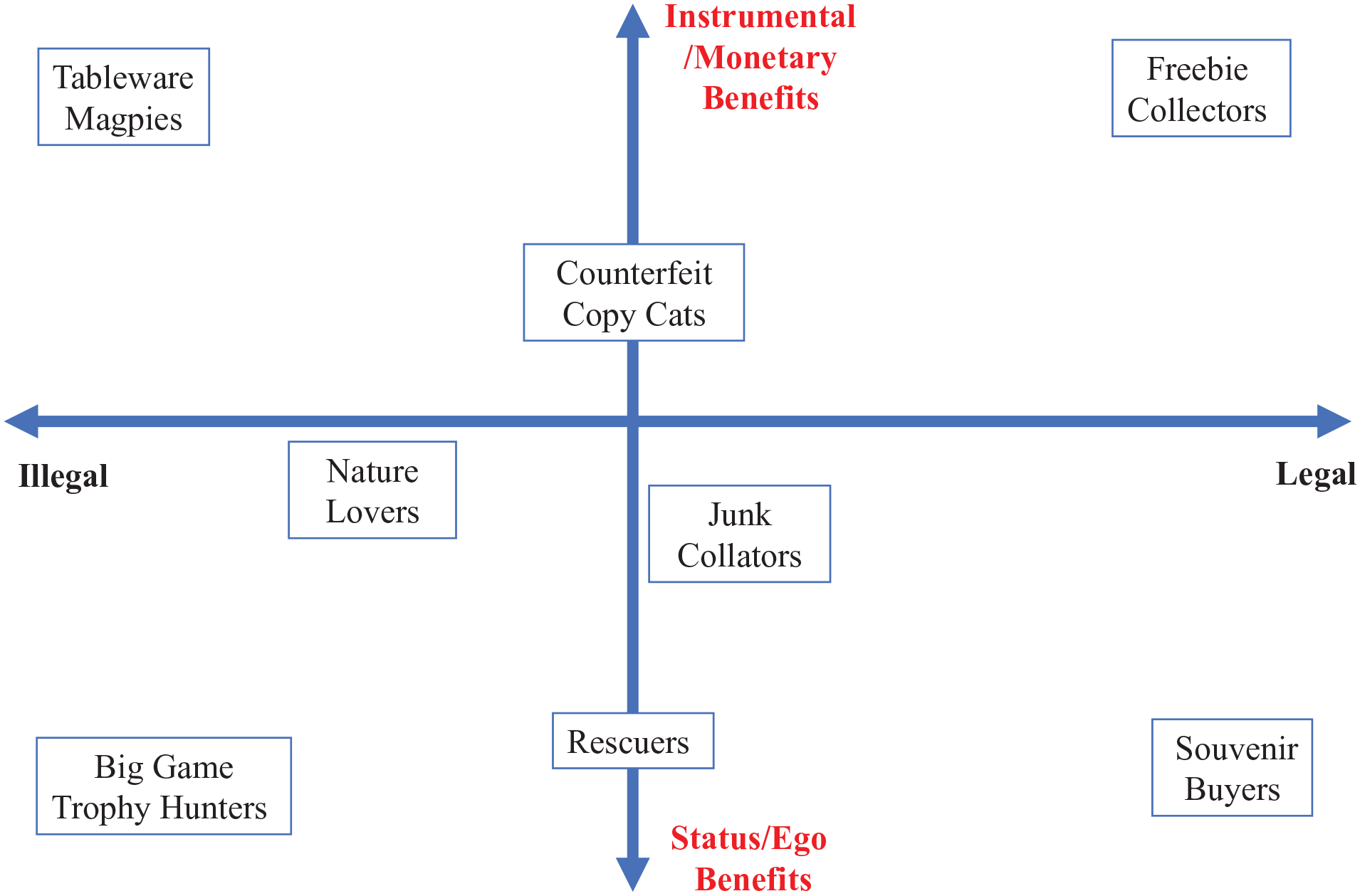
The dimensions and forms of tourist memento accumulation.
Souvenir buyers
The first form of tourist memento accumulation encompasses those travelers who deliberately acquire items that are viewed as tangible representations or mementoes of a location or trip. As depicted in Figure 1, such accumulation is entirely legal in nature and ego-oriented. Items constitute souvenirs in that they are commonly purchased from visitor-oriented outlets designed to supply traveler mementoes; in some way represent the location of the souvenir; are deemed to evoke trip memories; can be for the visitor or be gifts; vary considerably in form and cost; and can often be designed to contribute to a traveler’s collection.
Most souvenirs purchased by travelers are acquired at stalls, stores, or other local outlets whose main purpose is to serve tourists’ appetites for tangible memory representations of their visits—be this an area, region, country, or city. As such, in contrast to other categories of item accumulation (see later), souvenirs may be viewed as conventionally purchased (as opposed to non-purchased), tourist-focused items. The type of items bought as souvenirs range from bargain knick-knacks costing a few cents (such as postcards), to tableware items (e.g., souvenir plates or glasses) costing around $20–30, to more expensive items (such as locally produced art or rugs). Whatever the monetary cost of souvenirs, one key characteristic is that they are deemed to be tangible manifestations and representations of a venue or location. Often (but not always) the less expensive souvenirs depict the name of the location. For instance: Whenever we go on holidays, we get a fridge magnet for Grandpa. He was bit of traveler when he served in the forces, but he’s not really mobile anymore. So, the kids get him a magnet as a souvenir – he’s got quite a collection now. . .. we try and get one with the name of the country so it’s like a map of where we’ve been. [Carol, Leisure tourist, female, aged 45, 2 vacations per year]
Souvenir Buyers typically seek out outlets supplying mementoes with a view to purchasing items for themselves and as gifts for others. As such, souvenir buyers commonly plan memento purchasing before a trip and deliberately hunt for opportunities to satisfy this need. As such, the act of souvenir buying forms a ritual part of their traveling. Nonetheless, perceptions of such activities vary: For me – for fuck’s sake let’s buy the crap and then hit the beach – for Janet [his wife] it’s [in a high, mocking voice] “let’s browse every tourist trap for hours on end for the perfect bottle of wine or the very best papyrus piece” – waste of sun of you ask me – hours upon hours in dim alleys seeking out stuff we just give out when we get back, huh! [Will, Business & Leisure tourist, male, aged 37, 6 business trips and 2 vacations per year]
Freebie collectors
While souvenir buyers purchase items legally for ego reasons, in contrast, freebie collectors amass items during their travels that are not directly purchased and for very different, instrumental reasons (see Figure 1). The first quintessential attribute of such memento accumulation is a perception by the collector that such items are not purchased directly and, in that sense, are complimentary or of no cost. Thus, items collected from a hotel room are viewed as “free” as they are not priced independently of the room hire change. For example, Ross explains how he seeks out and uses free moisturizing samples which he collects on his business trips: I know it’s not much, but it saves me money. I carry the little moisturizers with me to work, so when I’m on the Tube [the London Underground;] I can moisturize at my desk. Those little tubes are godsend when we’re washing our hands every time we step outside the front door. It’s playing havoc with my skin! [Larry, Business traveler, male, aged 33, 2–3 business trips per month]
Discussions with Freebie Collectors revealed that travelers hoard a broad range of complimentary items, a small sample of which includes sweets at reception desks, toiletries, coasters, napkins, plastic bags, shoe polishing kits, sewing kits, soaps, scent samples, candles, jams, preserves and other edible items from buffets, slippers, dressing gowns/robes, and laundry bags.
The second key dimension of such memento accumulation centers on the motive for such behavior, which is instrumental in nature. In other words, items are acquired and taken home by the collector for pecuniary or monetary benefits—however small. Bobby comments: It’s one of the benefits of travelling! I collect them whenever I stay in nice hotels - a try to get a free set for the guest bathroom – and for myself! It’s all free but it looks really nice for your guests if there’s a matching set in a little basket. Friends have commented on how thoughtful it is – I bet they copy us, too! [Bobby, Leisure Tourist, male, aged 30, 4–5 vacations per year]
In this regard, the behaviors of freebie collectors can be viewed as a form of considered, intentional collecting, or even hoarding.
One final interesting note with regard to Freebie Collectors pertains to their subjective interpretation of “free.” That which one traveler deems to be a free item that may be collected without guilt may be viewed by another as “not free” and, as such, an inappropriate and unacceptable theft. In this way, the zone of tolerance regarding the distinction between “complimentary” and “chargeable” varies.
Junk Collators
Collators of junk accumulate mementos on their travels that are, in a similar way to Freebie Collectors, indirectly free and that are typically for personal consumption. Their activities are, by and large, legal in nature and (as with souvenir buyers) center on accumulating items that form mementoes of their tourism (see Figure 1). However, in contrast to purchasers of commercial souvenirs, Junk Collators focus on acquiring items that are not sold and, in that sense, are viewed as not having direct monetary cost or, simply, as priceless. Similarly, while Freebie Collectors are driven by instrumental motives, Junk Collators are assembling items for personal, ego reasons.
In many regards, Junk Collators are as focused on memory evocation as souvenir buyers, but, in contrast, their emphasis is on authenticity and legitimacy. Thus, Junk Collators (ironically) typically reject tourist-oriented, souvenir purchases as synthetic, ersatz bric-a-brac, lacking the realism of “free” mementos collected that are priceless in terms of memory-evoking value. Jamie explains: I don’t go for souvenir tat. You know? Crammed shops with garish crap that they knock up for any passing schmuck to buy. I like real mementos – real things that take you back to where you were. Ticket stubs, passes, bus tickets – real, authentic things – not worth a bucket of spit, but meaningful to me! If you have to buy it, then it’s tourist crap rather than ‘real’ [gesticulates inverted commas]. [Leisure tourist, male, aged 42, 3 vacations per year]
Tourists who accumulate items as Junk Collators tend to keep their items, most commonly for personal consumption or for sharing with similarly minded friends. Occasionally they display such items in their homes, but more commonly they collate them into scrapbooks or memory boxes. Liz describes these items as her tourist “real relics”: I tend to avoid souvenir shops and souks and leave them for the bus loads of sweating tourists. I’ll pick something up that evokes the memory – something to remember the smells and sounds – ummm I don’t know, what do I have – I have napkins and used tourist maps, and I have those tickets on lanyards and restaurant pens and menus. They’re junk to other people, but to me they bring back the sights and sounds, the smells and the feel. . . Those are the real relics of a trip – souvenirs are just junk. [Liz, Business traveler, female, aged 53, 1–2 business trips per quarter]
Counterfeit Copy Cats
The fourth category of memento accumulation tourists are the Counterfeit Copy Cats. This group includes tourists who acquire cheap or free copies of digitally cloned resources or tangible counterfeits of goods that they either know to be fake or accept as illicit copies. This type of memento accumulation was more common amongst both leisure and business travelers whose frequent or regular travel facilitated such activities. Such practices were typically accepted as illegal or unethical in the travelers’ country of origin but were viewed by them as morally acceptable (or merely untraceable) in overseas contexts, where lax enforcement or different legal justifications made such practices both legally ambivalent and more accessible. The benefits accrued by exploiting digital online resources were instrumental in nature, in that such practices that might otherwise require payment were without cost to the traveler. John explains how he downloads television series and movies without payment during his business trips: In different countries you can get different things – the rules are different. I’m wary of downloading here in the UK – you never know who’s tracking you, but in Spain, in the middle of a huge tourist hotel? Using the free Wi-Fi? Who’s looking? Nobody cares. I get all the series I want – pop them on a hard disk and I can watch them anywhere. I used to pay for Netflix and the Amazon one, and NowTV every now and again. Doing this saves me a bloody fortune at the end of the day. [John, Business traveler, male, aged 47, 1–2 business trips per month]
Research on music piracy (Ingram and Hinduja 2008) has suggested that individuals may place a higher value on group norms rather than legal norms, therefore tourists might more easily disobey the law in a country where online piracy is prominent. The legality of such activities depends on the laws and jurisdictions of the hosting websites, as well as the location (and therefore laws) of the downloader. In some countries such activities are legal, in others such practices are illegal. Similarly, in some contexts, it is the hosting of downloading sites that is the focus of local laws. Consequently, we place such behaviors midway between legal and illegal behavior. This positioning reflects another key type of Counterfeit Copy Cat behavior, namely where tourists acquire tangible brand name goods that are known (or very strongly suspected) to be imitations of expensive branded products (from smart phones to wrist watches, sunglasses to handbags). Freddie explains: Here they’d be arrested, but in Asia you can get a Rolex for twenty bucks. A Louis Vuitton handbag for fifty. Yeah, most are fakes, but they can be okay quality – this [shows an expensive wristwatch] cost forty quid – I can’t tell the difference. Can you? [Freddie, Business traveler, male, aged 36, 3–4 business trips per quarter]
In such cases, the traveler takes full advantage of different laws or enforcement regimes to accumulate products, largely for instrumental reasons. In this way, Counterfeit Copy Cats may argue that their behavior is licit, although most accepted that such practices were at best (euphemistically) “cheeky” and at worst “morally questionable.”
Animal Rescuers
Data collection also led to the emergence of an unusual form of memento accumulation by tourists, namely Animal Rescuers. Two of the informants had adopted a pet and (eventually) returned home with an animal originating from an overseas location (one of these doing so twice from separate locations). Moreover, three other informants knew of friends or family members who had acted similarly. Mary, a retired business traveler adopted a cat from Venezuela during a long business sales trip (over three months) and, with husband Jack, also adopted another cat during a holiday in Madeira: We saved two cats from overseas over the years – Tom actually came back with us from Venezuela, while little Josie came from an anniversary holiday in Madeira. It cost heaven and earth to ship them, and the quarantine regulations were a nightmare – sooo cruel but Jack sorted all of that. He’s a marvel with such things. [Mary, Leisure tourist, female, aged 60, 3–4 vacations per year]
Mary and Jack sincerely believed that their actions were altruistic and the monetary costs of such adoptions were considerable. However, upon closer questioning, they revealed that they thought their first rescue cat was probably “technically but ever so loosely” [Mary] owned by the hotel gardener, while for their second adoption they “asked in a few bars, well, one really” [Mary] to see if anybody had lost a cat locally. As such, while they fully complied with quarantine rules and other legal requirements, their adoptions could (strictly) be classified as theft.
Less questionably, Sue and Jenny adopted a stray cat on their honeymoon and checked with local authorities (and a vet) to ensure that the cat was not previously owned by someone else.
We actually adopted Binky on our honeymoon. He was so thin, and we fed him and couldn’t just abandon him. So, we paid to ship him home. He’s nine years old this June! [Sue, Leisure tourist, female, aged 26, 2 vacations per year].
Accordingly, we gage Animal Rescuers as acting (on balance) for ego reasons, while their actions may be entirely legal, but also, knowingly, ethically questionable.
Nature Lovers
The sixth form of memento accumulation involves tourists who deliberately seek out opportunities surreptitiously to acquire physical artifacts from tourist sites or locations and remove them for personal ego benefits. We label such practices the activities of Nature Lovers as much of this behavior typically focuses on the flora and geology of the location. Examples were found of tourists collecting sand, stones, rocks, fossils, bricks, plants, cuttings, grasses, and other items as mementoes of their tourist activities. For example: I’ve cuttings from Blenheim, Chatsworth, Highclere, Wentworth, and a beautiful centerpiece that I grew from a cutting from Chartwell [all UK stately homes with considerable gardens open to the public]. [Ed, Leisure tourist, male, aged 58, 2 vacations per year] It’s just a stone but think of what it’s seen! The Temple of Queen Hatshepsut! Amazing! [Chris, Business & Leisure traveler, male, aged 42, 3 business trips per quarter, 3 vacations per year]
The legality of such acquisitions is highly questionable. The removal of physical items or artifacts from historical sites of scientific and cultural importance is illegal in most contexts and morally questionable in all contexts. In contrast, while some keen gardeners politely asked permission to take cuttings (and abided by the responses they received), other informants, more passionate in their need to collect, either neglected to ask permission or ignored instructions not to collect plants. Other informants admitted collecting seeds, cuttings, or plants from their overseas travels and returning them to their homes so that they could be transplanted or grown. In all such cases, the traveling gardeners admitted that such practices were likely to contravene regulations regarding cross-border biohazard customs. As such, Nature Lovers disregarded legal regulations designed to protect the flora and fauna of their home countries. From this perspective, heritage sites and natural areas encourage the often otherwise disregarded sale of souvenirs, as this can help avert the collection and removal of heritage objects (Timothy 2011).
Tableware Magpies
The penultimate form of memento accumulation by tourists concerns the clandestine amassing of selected tableware items during tourist trips. Interviews revealed cases of tourists deliberately targeting and acquiring selected objects, ranging from items of cutlery to glassware, napkins and trayware. In all cases, the perpetrator accepted that such behavior could be considered deviant, but often employed neutralizing cognitive techniques to allay or minimize guilt. Examples included the use of euphemistic language (Bandura et al. 1996) to claim that such acts caused no real harm (Harris and Daunt 2011). Nonetheless, such acts are categorized as illegal activity (see Figure 1). Moreover, as such activities involve direct or indirect tangible gain for the benefit of the culprit, Tableware Magpies are deemed to be largely instrumentally oriented (although, the boundary between tableware theft for ego-reasons and for instrumental gain could be blurred, leading to misbehavior closer to Big Game Trophy Hunting—see later).
Analysis revealed that such activities were typically enacted in tourist hotels, bars, and restaurants, with targeted items typically being surreptitiously placed in pockets, handbags, and suitcases to avoid detection. Marcus “borrows” cruet sets that he then uses on guest breakfast trays at home and has perfected his acquisition technique: I’ve got six or seven little sets now. You know when you get room service, they’ll bring little cruets – just perfect for guest breakfast trays! Well, order two meals from room service – and pile the plates onto one tray – nobody’s noticed yet! [Marcus, Leisure tourist, male, aged 31 2 vacations per year]
Most commonly, items taken in this fashion are for use at home rather than for display or for personal status reasons. While some items collected in such a way were spontaneously selected, the majority of items were pre-selected, with an element of preplanning. Such planning ranged from taking larger cases or handbags, to identifying items of particular worth or value. Andrew reveals his household’s cunning plan to alleviate their collective lack of teaspoons: I live in a student house – over the summer we all agreed – get teaspoons – so we all grabbed what we could when we were away. Five lads – we got 64 spoons in one summer. Now we’re never short of spoons! [Andrew, Leisure tourist, male, aged 20 1 vacation per year]
In contrast to items accumulated to memorialize or for public display (such as those collected by souvenir buyers, freebie collectors, or junk collators), Tableware Magpies amass items for practical use and, in that sense, view such collections in terms of pragmatic value.
Big Game Trophy Hunters
The final form of memento accumlatory behavior by tourists involves the acquisition of items considered by individuals or groups to be of significant worth, for the purposes of private (within group) display. An example here could be the theft of a status item like a table centerpiece, a champagne flute from Moët and Chandon, or a stein from Munich’s Hofbräuhaus which while literal examples of tableware theft could be more for ego reasons than mere instrumental gain). Such Trophy Hunters undertake such acts knowing that their behavior is illegal, often immoral, frequently risky, and (at least within the group) considered to be humorous. Such ego-oriented behavior was found to be exclusively by leisure tourists rather than business travelers, possibly as this type of tourism commonly involves groups of close friends. Often such groups play a key role in establishing the targets of Trophy Hunters. Bertie explains the “great table theft of the summer of seventeen” in which he, after much drinking and egged on by his friends, covertly “borrowed” (stole—but left in their villa) their favorite table from a bar in Cyprus on the last night of their holiday: It wasn’t easy! Fred chatted up the owner and I swiped it when he was distracted and legged it down the alley! It’s pride of place in the clubhouse [a local rugby club] next to a photo of us at the end of the evening. Victorious but still standing! [Bertie, Leisure Tourist, Male, Aged 31, 2 vacations per year]
Motivated by tourists breaking regulations to take a distinctive photo or taking prohibitive items to keep as a souvenir, Li and Chen (2017) hypothesized and confirmed that tourists’ vanity was positively correlated with their self-reported deviant tourist activity. Quotes like the one from Bertie further highlight how misconduct acquires an epic, “big game” dimension among tourists. Similarly, Shady (a nickname he uses derived from an event over four years ago) explains his trophy hunting of a very large parasol, after the villa he was renting with friends was found to have an insufficient number: We put it up by the pool for the rest of holiday – damned useful it was too – I bet it’s still there! So, that’s why my mates call me Shady – I am the shade giver! [Shady, Leisure tourist, male, aged 24, 2 vacations per year]
Characteristically, Trophy Hunters focus on physically large items that they most commonly do not retain beyond their vacation, but of which they take photographs or undertake activities that increases the perpetrator’s status within the group. As such, Trophy Hunters (literally) target “big game,” but only permanently retain visual records of their exploits.
Discussion and Conclusions
Our investigation into tourist memento acquisition was guided by two empirical questions. One, to identify the potentially harmful behaviors of tourists while they accumulate mementos from trips and contribute insights into their varying forms. The evidence collected point to eight distinct forms of item accumulation by tourists. While some forms are widely acknowledged as conventional tourist behaviors, others have been overlooked or, often, disregarded as aberrant behavior that is unusual or irrational (Gursoy, Cai, and Anaya 2017). Our data support the view that while some forms of memento accumulation by tourists are common, every day, and entirely legal actions (such as Souvenir Shopping), other behaviors are equally common (and legal), but more covert (such as Freebie Collecting). Others still are clandestine, illegal, and harmful to host contexts (from Nature Loving sand collecting, to Tableware Magpie thefts, to trophies collected by Big Game Hunters). Behaviors such as those displayed by Counterfeit Copy Cats are unique in that they may be illegal in the traveler’s country of origin, whereas the law is different (or differently enforced) in the host country. In this regard, the assumption that tourists of all types merely succumb to the temptations of buying knick-knacks and trinkets on their trips appears to neglect a less salubrious, but commonplace, series of wider behaviors that involve accumulating mementos.
A second research aim has been the explication of the nature, dimensions and psychological mechanisms that underlie tourist memento taking (see Figure 1). While previous studies have highlighted tourist souvenir acquisition (Collins-Kreiner and Zins 2011), a systematic exploration of the range and dynamics of broader memento accumulation has been overlooked to date. Consistent with the deviant leisure perspective’s emphasis on subjective interpretations of harm, this study highlights tourists’ varying subjective evaluations on the legality, ethics, and morality of their behaviors which explain why harmful behaviors in tourism may be tolerated, legitimized, and often go unrecorded. While the subjective nature of ethically questionable behaviors is well established in the literature, what is key here is that psychological distance from home changed the same individual’s evaluations who at the time of the interview admitted freely that their behaviors “abroad” were problematic.
Regarding the motives for item accumulation, data strongly supports tourists’ behaviors being driven by both ego-oriented needs and more calculated instrumental benefits. In this regard, what emerges from the study is more complex but more complete insights into the range of behaviors and motivations for tourist memento collecting. Specifically, regarding the motives for the illegitimate or unethical aspects of memento accumulation, our findings suggests that tourism misbehavior may not just be attributed to the fact that tourists enter a liminal zone (Urry 2003) where they are unwilling or unable to control their desires (“akrasia”; Fennell 2015). A consistently important aspect of this behavior has been that in their quest for authenticity and legitimacy tourists disregard “souvenirs” and seek authentic “trophies”; mementos that offer enjoyment and benefits to the ego, status, or self-esteem which often accrue from and stimulate deviant behaviors.
Theoretically, our work extends theory centered on the growing deviant leisure literature. Deviant leisure has been a useful theoretical lens for this study; by repositioning any socially harmful actions as deviant, it assisted in uncovering a range of diverse deviant tourist practices and navigating the opposing constructionist and positivist perspectives on deviance (Thio, Taylor, and Schwartz 2012). We discover and report a range of often tolerated, legitimized, and normalized deviant practices confirming the emerging link between leisure and crime (Williams and Walker 2006). More importantly however, we extend this literature as our findings suggest that deviant behavior practices were equally performed by the large subset of business travelers among our informants. It is, therefore, reasonable to conclude that not only deviant practices manifest during leisure but also other forms of travel as well.
Another theoretical contribution is related to the advancement of the discussion on tourists’ ethical blind spots (Moorhouse, D’Cruze, and Macdonald 2017). Some actions of the memento acquisition from tourists were safe, ethical and legitimate; many others however were unethical, irresponsible, potentially harmful, and often illegal. How our informants navigated these moral decisions offers insights into the growing literature of ethical decision making in tourism. In our sample, tourists often applied different ethical rules and principles at “home” and while “abroad” potentially viewing their holidays as a different context where varying ethical and environmentally responsible standards are acceptable. Perhaps, this is because, in tourists’ pursuit of a unique experience and “seeking an escape from their everyday existence [and while] on vacation, they do not want to be burdened with the concerns of the normal world” (McKercher 1993, 12).
Empirically, this study contributes to the broader discussion on consumer misbehavior. While scholars have explored a surprising array of customer deviance (see Reynolds and Harris 2009), tourists’ memento accumulation has been comparatively neglected. In contrast, less extreme, more “mundane” deviance, such as misdemeanors or merely ethically questionable behaviors, have been overlooked (Pratt 2020). Our study contributes to debate through its focus on a single form of tourist behavior (memento accumulation), uncovering an array of actions that range from the entirely legitimate acquisition of souvenirs, to acts constituting grand larceny. Through concentrating on a single type of behavior, rich insights are contributed into continua of both behaviors and motives which highlight not only individual perpetrators’ subjective interpretations of legality and harm but also into cross-sample varying boundaries regarding ethical behavior when psychologically distant from home settings.
Overall, our study has implications for tourism practitioners and academics across various disciplines. Scholars interested in deviant leisure can benefit from a theoretical extension that not only assesses deviance based on how an objective outsider categorizes behaviors and harms, but also from the point of view of the tourist. Informants openly admitted to deviant behaviors abroad, ranging from mild non-compliance of customary rules to criminal behavior, but were always keen to qualify such behavior by stating that these actions would never occur “at home.” Literature on liminality has suggested that tourists change while abroad (Grabowski et al. 2017), but the focus of such research has tended to focus on more extreme transformations with permanent consequences. However, our informants were operating in the well-defined and visible boundaries of tourism “time” and “place,” mirroring voluntary risk taking by recreational drug users (Uriely and Belhassen 2006) who view their holiday as time for unrestrained action-seeking (Goffman 1967) and a “license for thrill” (Wickens 1997, 151).
Tourism practitioners and hospitality service providers may benefit from the results of this study by developing specific initiatives to pro-actively prevent deviant behaviors that hurt the most. For example, by anticipating the demand by Nature Lovers, museum curators and souvenir shops should provide exact replicas of stones, sand, and similar artifacts. For those tourists who think that “souvenirs are for shmucks” (see earlier) policy makers should educate the public and enforce stricter laws to protect their environment and cultural property. Hotel managers could anticipate types of tourists like Freebie Collectors and Tableware Magpies and to minimize their costs they should communicate clear messages about what constitutes theft and the cost of it for the company, alleviating popular neutralization techniques such as willful ignorance and denial of injury (Harris and Daunt 2011). A final suggestion is related to the safety of tourists. As reckless as is the behavior of types of tourists like those we labeled Trophy Hunters or Rescuers, some of the responsibility for their safety sits with the hospitality service providers that enable or tolerate their behavior. The transgression of social norms or personal ethical values and the danger of violating national laws might deter individuals to steal a bar table or hotel tableware in other contexts. Our informants, however, followed their own subjective, dynamic and contextual risk epistemologies (Uriely and Belhassen 2006) rather than an objective and rational risk versus reward estimate. Providing alternative, safer opportunities for memento acquisition is important not only for the environmental arguments and business benefits, but also from a moral agency perspective as well.
Our study is not without some limitations which offer opportunities for future researchers. In an effort to get rich insights and uncover specific tourist practices and motivations, we focused on a specific activity, that of memento acquisition. As important and pervasive as that behavior is, it remains just one aspect of tourism misbehavior. More work is needed to examine deviant tourist practices in a variety of different contexts, such as immaterial and digital mementos. Another limitation is that our data were gathered from a small sample of tourists in one context, that of item accumulation. While we strived to attain a diverse sample divided equally between leisure and business travelers, our results may not be applicable beyond our sample. Larger data (possibly drawn from different cultures and contexts) sets may be required to confirm external validity of the typology developed, and future research might attempt to develop a scale that will accurately define boundary-blurring forms and measure perceived benefits of tourists’ mementos. Finally, in the post-Covid era, it would be interesting to explore whether memento acquisition practices might change, out of fear, for example, that items taken might constitute a hygienic or health risk.
Footnotes
Declaration of Conflicting Interests
The author(s) declared no potential conflicts of interest with respect to the research, authorship, and/or publication of this article.
Funding
The author(s) received no financial support for the research, authorship, and/or publication of this article.
