



Abstract
Places hosting religious sacred events provide opportunities for visitors to find spiritual growth and also afford glimpses into the local culture, community, and hosting religious group. This study looks at tourists’ intended behavioral loyalty to a religious sacred event place as determined through motivations, shared beliefs, and emotional solidarity with other visitors, and memorable religious experiences. Data were collected from 985 visitors (556 domestic and 429 international) during the 2019 Kumbh Mela, held in Prayagraj, India. Contrary to previous studies, results indicated that emotional solidarity did not significantly influence attendees’ intended behavioral loyalty (among domestic visitors). Furthermore, in employing an invariance structural test for paths mentioned in the model, results revealed that the effects of shared beliefs, motivations, emotional solidarity, and memorable religious experiences differed among domestic and international visitors. Study implications and limitations are provided at the close of the paper, giving way to future research opportunities.
Keywords
Introduction
Research on visitor loyalty has garnered significant attention over the last two decades, arguably making it one of the most investigated themes within the travel and tourism field. Intuitively, positive visitor experiences in a destination should greatly impact the likelihood of revisiting (Ribeiro et al. 2018). However, some studies have demonstrated that positive experiences seldom translate to repeat visitation (Sun, Geng-Qing Chi, and Xu 2013; Yoon and Uysal 2005). While most of such studies are in the context of leisure tourism, the abovementioned factors may not be true in a religious context, as religious choices are elementally individualistic (Ellison 1995).
In this line of thought, Hall (1992) conceptualized and defined a novel term called as Special Interest Tourism (SIT). According to Hall (1992), a traveler’s motive is influenced by a certain special interest, with an emphasis on either activities or places and surroundings. Such travelers are eager to learn and gain new insights and want to express themselves. They demand an exceptional level of customer service and specialized attention. Further, they are interested in experiencing genuine, positive interactions with the community, whether cultural, social, or environmental.
While in the context of religious events, visitors’ motivations to attend are most often rooted in either a cultural attraction to the event due to its religious and cultural influence, categorized as pull factors (Dann 1977) or an active leisure participation precipitated by internal forces, categorized as push factors (Crompton 1979). These pull and push motivations in different forms, at an individual level, often translate into actions (i.e., visits to a religious place or sacred event). Keeping this in mind, it becomes crucial to study motivations of visitors to sacred events and how they translate into memorable experiences, especially those that are considered “one of a kind.”
Further, positive experiences have been shown to influence visitors’ image of a destination or event (e.g., Kim, Ritchie, and McCormick 2012), and ultimately, their loyalty behavior (Sun, Geng-Qing Chi, and Xu 2013). In the tourism literature, this is called a memorable tourism experience (MTE). Contemporary studies on MTE have lacked studies involving the influence of social factors like locals’ interaction with visitors, helpful nature, and readiness to receive visitors affect MTEs (Kim 2014). Based on this work, the term memorable religious experience (MRE), within the context of religious tourism, is advanced.
In the case of religious sacred events, some visitors will no doubt encounter residents and other visitors. Given the common bonds between individuals, such as having similar beliefs, participating in similar activities, and engaging with each other, such a relationship will result in emotional solidarity for those involved, as Woosnam, Norman, and Ying (2009) demonstrated within a tourism context. Most recently, Joo and Woosnam (2020) examined shared beliefs and emotional solidarity among individuals in a religious tourism context, paving the way for consideration of such constructs within an international religious festival.
The importance of religious sacred events is highlighted by UNWTO (2018) claims that travel to such venues will continue to be important to many tourists, solidifying its place as a major form of tourism. This showcases the inextricable link between religious events and tourism (Collins-Kreiner 2010) as demonstrated through pilgrimages, missionary voyages, faith-based events, religious congregations, festivals, and similar others (Bandyopadhyay, Morais, and Chick 2008). Of course, determining degree of loyalty among participants and what contributes to such loyalty is of paramount importance to managers in planning for the sustainability of such events, especially as we move into an era where global health pandemics take center stage. Most recently, research focusing on this topic has demonstrated fertile ground in better understanding this loyalty (Patwardhan et al. 2020a, 2020b), though as academics suggest, more robust models are needed to theoretically explain drivers of loyalty in religious tourism settings (Kim, Kim, and King 2020; Wu and Mursid 2019). As Kim, Kim, and King (2020) point out, future research needs to consider how visitors’ experiences, motivations, and national cultures may help advance the research concerning religious tourism, especially concerning loyalty. As a result, this study is aimed at addressing the following research questions:
a) What are the major drivers of loyalty in religious tourism settings, and how are they related?
b) Do nationalities (i.e., domestic vs. international attendees) play a significant role in differentiating the strength of relationships between the drivers of loyalty in religious tourism settings?
To address these questions, this study develops an integrative model that examines to what extent shared beliefs, motivation, emotional solidarity, and memorable religious experiences may possibly explain visitors’ loyalty to a sacred religious event place and how visitor type (i.e., domestic vs. international) can moderate these relationships. In terms of theoretical contributions, this study attempts to address Kim, Kim, and King’s (2020) call for further research surrounding religious tourism while advancing the body of knowledge through testing an integrated model involving motivation, shared beliefs, emotional solidarity, and memorable religious experience as antecedents of visitors’ loyalty behavior. Additionally, this study is expected to aid tourism managers in the design of a package of services to further aid in appealing to potential visitors to a particular religious event.
Conceptual Background and Hypothesis Development
Customized tourism activities that cater to the interests of specific groups and individuals are referred to as “Special Interest Tourism.” Tourism is pursued for the purpose of fulfilling a particular need or desire. As tourism desires and needs continue to grow more diverse, so too do individuals’ desire to engage in special interest tourism (in relation to mass tourism; Trauer 2006). As such, visitors’ with specialized interests are afforded more opportunities to select destinations that meet their unique needs. In the case of religious sacred events, visitors’ special interests are likely driven by deeply held spiritual beliefs and practices. In other cases, it may be driven by an inherent need to visit the destination and participate in the events as status symbols (Trauer 2006). Interestingly enough, few studies consider religious tourism as a component of SIT. This gap needs to be addressed to enable event managers the ability to understand the overarching reasons behind individuals selecting unique religious sacred events and the factors contributing to their revisit intentions.
Visitor Loyalty Behavior
In the marketing literature, “loyalty” is often viewed as repeated purchasing actions of consumers motivated by emotional commitment or positive outlook (Haywood-Farmer 1988), and is considered a vital aspect of decision making (Flavián, Martı́nez, and Polo 2001). In the context of hospitality and tourism, Baloglu (2001) conceived of visitor loyalty as an extension of customer loyalty. The concept is often used as a critical indicator of success (Sun, Geng-Qing Chi, and Xu 2013; Yoon and Uysal 2005), as maintaining current customers is six times more cost effective than seeking to gain new ones (Oppermann 2000).
The literature on loyalty as a concept is traditionally divided into three strands. Zhang et al. (2014) considered loyalty from behavioral, attitudinal, and a composite of the two perspectives. The behavioral perspective appears to focus on the consumptive behavior of visitors, such as revisitation (Oppermann 2000; Yoon and Uysal 2005). The attitudinal approach focuses on visitors’ psychological commitments, such as the intention to revisit and also the ability to recommend the destination for others (Yoon and Uysal 2005; Zhang et al. 2014). The integrated approach is a synthesis of the previous two, showcasing a more robust measurement of loyalty (Zhang et al. 2014), in essence suggesting that neither behaviors nor attitudes by themselves provides a sufficient representation of true visitor loyalty.
Researchers have revealed that loyalty to a destination can be demonstrated through behaviors such as destination revisit intentions (Oppermann 2000; Woosnam and Aleshinloye 2013) or the consideration of a destination as a recommendable place. Although revisit intention is the most commonly used measure for visitors’ loyalty to a destination (Oppermann 2000; Sun, Geng-Qing Chi, and Xu 2013), it is not the only measure to consider for those travelers seeking different experiences. In such situations, tourists’ willingness to recommend to others is seen as an important indicator (Ribeiro et al. 2018).
In the context of religious rituals, Collins (2014) and Whitehouse (2002) mentioned that visitors often tend to experience feelings of belonging, as well as a sense of moral correctness in belonging to the group. Along these lines, Woosnam, Norman, and Ying (2009) introduced the concept of “shared beliefs.” It is generally observed that, a higher degree of shared beliefs between visitors and other fellow participants during festivals ultimately affect visitors’ likelihood of returning to the festival (Aleshinloye and Woosnam 2015).
Further, researchers have recently identified other non-economic constructs explaining visitors’ destination loyalty such as place attachment (Patwardhan et al. 2020a, 2020b), destination image (Zhang et al. 2014), overall satisfaction (Prayag and Ryan 2012), experiencing emotional solidarity with locals (Ribeiro et al. 2018), memorable tourist experiences (Kim 2018), and motivations (Huang and Hsu 2009). It was in this latter work by Huang and Hsu that motivations served as an antecedent to attitudes concerning revisitation, and ultimately, revisit intentions.
Tourist Aggregated Motivation, Emotional Solidarity, Memorable Experience, and Loyalty
Tourism studies have described the motives of tourists as a state of mind driving individuals’ travel or leisure behaviors that provide a compelling explanation for doing so (Dann 1981). Iso-Ahola (1982) argued that social psychological research on leisure motivation had been ignored by Dann (1981) and therefore suggested “the social psychological model” of tourism motivation. Iso-Ahola identified two motivating forces which decide the conduct of tourism. One is the urge to leave behind the everyday environment (e.g., personal distractions, challenges, obstacles, setbacks, or people); the other is the desire to get psychological gratification through travel (e.g., feelings of accomplishment, understanding diverse cultures, greater social interaction with locals or fellow travelers, etc.). An analysis of the motivations that generates the intent to travel can reveal a lot about the underlying dynamics of selecting a destination and travel behavior amongst individuals (Mansfeld 1992). This is vital as it can provide tourism planners, operators, and related institutions with an understanding of travelers’ expectations, goals, and various needs (Mansfeld 1992).
Additional literature surrounding tourist motivations is divided into two main areas. The first is based on external agents including signs and symbolic structures created by textual or verbal human-made means, such as collective storylines (Badone 2007), word-of-mouth (Govers, Go, and Kumar 2007), mythology (Bell 2003), religious beliefs and affiliations (Collins-Kreiner and Kliot 2000; Kliot and Collins-Kreiner 2020). On the other hand, visual media like banners and brochures, movies and films, and videos posted on social media (Kim and Assaker 2014; Terzidou, Stylidis, and Terzidis 2018b) can motivate individuals to visit.
The second strand of literature, by contrast, is driven by the fact that motivations are not only built up by external factors, but are driven by powerful, strongly held belief systems (Badone 1990) and embodied performances that connect individuals with the divine (Belhassen, Caton, and Stewart 2008). These include motives surrounding an appreciation of nature, enrichment of education and culture (Collins-Kreiner 2010, 2020), relaxation and self-discovery (Andriotis 2009), desire for transformation, cleansing or revival (Hyde and Harman 2011), and numerous others. Given this information, aggregated motivation is presented as a second-order construct encompassing first-order dimensions (i.e., constructed motivations and embodied and effective engagements), as theoretically proposed by Terzidou, Scarles, and Saunders (2018a).
Constructed Motivations
Constructed motivations are generally driven by the first type of motivation proposed by Iso-Ahola (1982). In a religious tourism context, it is observed that institutions (i.e., religious) often influence communities and spread religious discourse (Xie 2010). Further, they tend to create “induced imagery” (Kim and Chen 2016) of sacred places using narratives and visual media. Such visits are fueled by religion and culture (Terzidou 2020; Terzidou, Scarles, and Saunders 2017). Pargament, Magyar-Russell, and Murray-Swank (2005) point out that mythological significance and stories of miracles associated with religious places also tend to motivate people. Travel motivations to religious sacred event sites are much more complex, governed by declarations from religious authorities, religious scriptures, and to some extent, religious doctrines (Bandyopadhyay, Morais, and Chick 2008; Cohen and Cohen 2012). For instance, in the Hindu culture, religious scriptures mention that a holy dip in the river Ganga will rid the individual of all sins (Sinha et al. 1991).
Other forms include providing social mechanisms that indirectly inspire visitors to visit holy sites (Belhassen, Caton, and Stewart 2008; Rickly-Boyd 2013), common understandings and shared insights (Belhassen, Caton, and Stewart 2008), beliefs and attitudes which are gained through role playing, repetition, and imitation (Bell 2008) that allow people the opportunity to become part of the larger whole (Zhu 2015). Alternatively, religious travelers may establish their own motives for travel as demonstrated by Terzidou, Scarles, and Saunders (2017) and Terzidou, Stylidis, and Terzidis (2018b). Nevertheless, some motivators may also be non-religious in nature. For instance, these include self-interest, search for emotional support during times of crisis, exploration of nature, desire to understand new cultures, relaxation, and self-discovery (Andriotis 2009; Collins-Kreiner 2020; Durkheim 1915; Pargament, Magyar-Russell, and Murray-Swank 2005)
Embodied and Affective Engagements
Embodied and affective engagements are typically considered Iso-Ahola’s (1982) second form of motivations. Motivations for visiting places also concern aspects which involve experiences and are often difficult to represent (i.e., personal experiences that influence a person to revisit; Della Dora 2012; Scarles 2009).
It is noteworthy to mention that motivated individuals usually demonstrate passion and excitement (Deci and Ryan 1985). Extending this thought, in the context of religious tourism, it can be postulated that a high level of motivation shall enable the visitor to participate in local rituals and customs thereby fostering a greater likelihood of forging emotional solidarity with residents. As Capistrano and Weaver (2018) point out, visitors’ emotional solidarity is highly contingent upon motivations to visit. Based on this, the following hypothesis is proposed:
H1a: Festival visitors’ motivations positively influence their degree of emotional solidarity with local residents.
In the context of religious tourism, Della Dora (2012) describe the subconscious pursuit of a spiritual awakening as one of the motivational factors for individuals. The genuineness achieved by such embodied performances, also known as epiphanic experiences (Wearing, McDonald, and Ankor 2016), is said to make the religious tour memorable.
Memorable experiences are believed to be lasting memories that shape and frame the future life of the person (Kim, Ribeiro, and Li 2021; Sharpley 2009). For instance, in the context of religious events, interactions with people like fellow travelers and residents (Joo and Woosnam 2020; Ryan, Jeffcoat, and Jeffcoat 1998), participation in rituals and local culture (Bell 2008), affective bonds with one another, emotional closeness, and contact also create a lasting impression amongst tourists (Hammarström 2005). While the relationship between motivation and tourism experience have been studied in the context of tourism by Prebensen et al. (2013), a study in the area of religious tourism is quite elusive, especially in the context of memorable religious experiences, necessitating further investigation. In the past, researchers (Huang and Chu 2020) have mentioned a need to examine visitors’ behavior based on their motivations to provide a better understanding of religious experiences. Huang and Chu (2020) further concluded that memorable experiences could be driven by internal motivational forces as perceived by the individual, rather than the services they purchase. Therefore, it is hypothesized that:
H1b: Festival visitors’ motivations positively influence memorable religious experiences forged on-site.
Motivation has been seen in contemporary tourism studies as the primary driving force behind visitors’ loyalty behavior. Such a perspective can be traced back to Gnoth (1997) who derived a conceptual framework discussing the relation between motivation and attitudes. This framework was later validated in different contexts such as winter tourism (He and Luo 2020) and creative tourism (Dean and Suhartanto 2019), but has not been examined in the context of religious tourism. Other researchers have linked motivation to satisfaction, and hence revisit intentions (Tichaawa and Idahosa 2020). In this space, El-Gohary (2016) claims that religion and spirituality has always been a strong motivator for travel for both pilgrims who wish to seek spiritual attainment and for casual travelers who seek an enriching cultural experience. Along similar lines, Ashton (2018) concluded that visitors who attain spiritual well-being by engaging with pristine natural environments, local customs, traditional way-of-life and outstanding tourism infrastructure, tend to revisit the destination. However, these studies are limited to spiritual and wellness tourism and not in the context of a religious gatherings. Hence, the following hypothesis is formulated:
H1c: Festival visitors’ motivations positively influence behavioral loyalty to the festival.
Shared Beliefs, Emotional Solidarity, Memorable Experience, and Loyalty
As of late, the work on shared beliefs among individuals has sparked greater attention (Lee et al. 2020). Arguably, such shared beliefs are just as important as these motivations are for impacting a degree of closeness between individuals and memorable religious experiences. Woosnam, Norman, and Ying (2009) defined shared beliefs as general convictions or views agreed upon as realities of a phenomenon amongst individuals (i.e., locals and visitors). Following this work, Woosnam and Norman (2010) found that the degree of shared beliefs between individuals was a strong predictor of the emotional solidarity that people experienced with one another. Though emotional solidarity has traditionally been considered a first-order construct, most recently, Tasci et al. (2021) highlighted the utility of measuring it as a second-order construct.
In the context of tourism in heritage sites, Chen and Chen (2010) demonstrated that the high congruence between visitors and the destination would lead to shared beliefs among tourists, and hence emotional solidarity as recently pointed out by Joo et al. (2020).
The emotional solidarity theory can be ascribed to Durkheim’s (1915) initial works, wherein it was theorized that such a sense of psychological closeness emerges from people with common views who engage in collective behavior and interact at the destination. Durkheim’s (1915) highlighted that shared beliefs, shared behavior, and interaction were contributors to individuals’ experiencing emotional solidarity with one another. Though the work surrounding emotional solidarity has been examined in numerous settings (see Maruyama, Ribeiro, and Woosnam 2020), it has not been considered in the context of religious tourism. Therefore, the following hypothesis is proposed:
H2a: Festival visitors’ shared beliefs with local residents positively influence the former’s degree of emotional solidarity with the latter.
Other studies in a general tourism context have shown how the connection between residents of a destination and tourists is enhanced by sharing common beliefs (Cohen 2004; Fredline and Faulkner 2001). Similarly, Fine and Speer (1985) suggest that an authentic visitor experience involves the possession of shared beliefs through collective cultural rituals that serve to foster a greater feeling of closeness. Derrett (2003) analyzed locals and visitors attending festivities together and reported that experiences such as being immersed in local culture and taking part in rituals that connect people to the sites (Fine and Speer 1985) contribute to unforgettable travel (Tung and Ritchie 2011). As such, the following hypothesis is formulated:
H2b: Festival visitors’ shared beliefs with local residents positively influence visitors’ memorable religious experiences forged on-site.
On the other hand, studies have examined revisit intentions or loyalty to a cultural festival primarily in the contexts of festival quality (e.g., information services, programs, souvenirs, food, and facilities), perceived value (i.e., worth in terms of money, time, and effort), and behavioral intentions (Yoon, Lee, and Lee 2010; Yuan and Jang 2008). However, studies in cognitive sciences (Hobson et al. 2018; Whitehouse 2002) have established that during rituals, individuals share perceptual attention and coordinate actions directed toward common goals. As a result, these individuals develop a sense of solidarity with the group and connection to experienced events. These types of feelings, when shared, may explain the commitment to perform actions in conformity to religious beliefs again and again. Given no work has explicitly examined the influence of shared beliefs on visitors’ loyalty behavior, it would be advantageous to study the relationship in the context of religious tourism. The following hypothesis is therefore proposed:
H2c: Festival visitors’ shared beliefs with local residents positively influence visitors’ behavioral loyalty to the festival.
Emotional Solidarity, Memorable Religious Experience, and Loyalty Behavior
Fundamentally, one can see emotional solidarity as a sense of identity that an individual develops with others (Wallace and Wolf 1999). Woosnam, Norman, and Ying (2009) identified three dimensions of emotional solidarity (i.e., emotional closeness, welcoming nature, and sympathetic understanding). Some studies consider the three dimensions as individual (e.g., Ribeiro et al. 2018; Woosnam et al. 2018), whereas other studies consider emotional solidarity as a second-order construct, assessed by its three first-order dimensions (e.g., Lai, Pinto, and Pintassilgo 2020; Suess, Woosnam, and Erul 2020; Tasci et al. 2021). In light of such research, the current study will treat emotional solidarity as a second-order construct.
Welcoming nature, as Woosnam (2012) claimed, signifies the personal interest of local residents toward visitors. The work of Wang and Pfister (2008) and others runs parallel to Woosnam’s claims, mentioning that a welcoming nature toward tourists enables residents to realize the benefits of tourism within the community (Ribeiro et al. 2017). While the preceding work has centered on emotional solidarity from the residents’ standpoint, Aleshinloye et al. (2020), Patwardhan et al. (2020a), Ribeiro et al. (2018), and Woosnam and Aleshinloye (2013), have looked at it from the tourists’ perspective, considering it as “feeling welcomed” within the destination. Findings from Patwardhan et al. (2020a) and Ribeiro et al. (2018) revealed that tourists’ degree of feeling welcomed significantly predicted a sense of loyalty to the destination.
The emotional closeness element of emotional solidarity indicates that resident-tourist similarities can turn into relationships and social affinity (Woosnam 2011). As Pizam, Uriely, and Reichel (2000) argued, positive exchanges between visitors and residents can diminish hostilities and prejudices, thus elevating emotional closeness (Woosnam 2011), and even fostering a sense of loyalty with the destination (Patwardhan et al. 2020a, 2020b). However, findings from Ribeiro et al. (2018) demonstrated tourists’ level of emotional closeness with residents did not significantly explain such individuals’ degree of destination loyalty.
Sympathetic understanding between residents and visitors takes the shape of appreciating one another and where they come from, as well as realizing what commonalities exist with others (Woosnam and Aleshinloye 2013). In particular, people with a high degree of compassion may understand one another’s feelings (Draper, Woosnam, and Norman 2011). Of course, no better place exists to see such sympathetic understanding played out than in shared spaces, where tourists and residents share amenities (Woosnam 2011). A sympathetic understanding among tourists provides an opportunity to “put themselves in others’ shoes,” as Woosnam et al. (2018) suggest. In terms of loyalty with the destination, both Patwardhan et al. (2020a) and Ribeiro et al. (2018) revealed that tourists’ degree of sympathetic understanding with residents significantly predicted a sense of loyalty to the destination.
Unlike experiences with products, tourism experiences are dependent on the level of interactions with others, whether they be residents or fellow travelers (Woosnam 2011). These encounters with residents may occur while visiting local stores and shops (Snepenger et al. 2003), using natural resources (Cohen 2004), or attending events or festivals (Derrett 2003). As such, meaningful encounters with residents also appear to significantly affect memorable tourism experiences (Kim 2018; Kim and Ritchie 2014), which has great implications for tourist loyalty behavior (Patwardhan et al. 2020a; Ribeiro et al. 2018). Given this, it is hypothesized that:
H3a: Festival visitors’ emotional solidarity with local residents positively influences visitors’ memorable religious experiences forged on-site.
H3b: Festival visitors’ emotional solidarity with local residents positively influences visitors’ behavioral loyalty to the festival.
Memorable Religious Experience and Loyalty Behavior
With the growing need to develop tourism destinations, it has become critical to design destinations in ways that facilitate mutually beneficial experiences in order to increase visitors’ perceived experience value and destination sustainability (Breiby et al. 2020; Kim, Ribeiro, and Li 2021). When visitors recognize that they might learn something, they will feel intrigued; the experience will feel meaningful. Meaningful experiences also involve experiences that can transform and stimulate deeper understandings (Kim, Ribeiro, and Li 2021; Kotler 1997), where the result is a sustained change in the individual (Smit and Melissen 2018). The active interaction between people and their environment, influenced by products in specific social, cultural and physical contexts leads to memorable and meaningful experiences (Collins-Kreiner 2020; Lindberg, Hansen, and Eide 2014).
In the context of tourism, Kim and Ritchie (2014) coined the term, “memorable tourist experience” (MTE), defining it as, “a tourism experience positively remembered and recalled after the event has occurred” (Kim, Ritchie, and McCormick 2012, 13). According to Taheri, Jafari, and O’Gorman (2014), tourism experiences are formed based on tourists’ involvement, engagement in the activities, and perceptions about the destination (Tukamushaba, Xiao, and Ladkin 2016). People remember events that leave them with positive emotions compared to ordinary events (Dewhurst and Parry 2000; Kim, Ribeiro, and Li 2021), and as such, many individuals forge memorable travel experiences that lead to strong behavioral intentions of either returning or sharing their experiences with others (Kim, Ritchie, and Tung 2010; Kim and Ritchie 2014).
In their work focusing on religious tourism, Patwardhan et al. (2020b) state that few studies have been undertaken that center on religious tourism experiences. The authors considered religious tourism as multi-dimensional consisting of factors such as mental engagement, discovery of new things, interaction and belongingness, spiritual and emotional connection, and relaxation and peace seeking dimensions. As such, much room exists for exploring the role of religious tourism experiences, especially in determining how memorable religious experiences on-site can contribute to tourism loyalty (Kim, Kim, and King 2020).
Religion is noted as a key driving force for visiting destinations, and is generally regarded as the earliest non-economic form of travel. Researchers have categorized tourists in religious tourism contexts as religiously motivated travelers and pilgrims who intend to visit religious heritage places, and other visitors (Shackley 2001) whose intent would be to either visit an element of their international, regional, local, or individual cultural identity or to learn about a place or cultural community.
Through such travel, many individuals hope to have a meaningful experience of a more authentic and holistic reality (Cohen 1996) or find spiritual growth and personal development (Timothy and Olsen 2006). A memorable religious experience is critical as the overall satisfaction of an individual from the experience may help create destination loyalty and generate positive tourist loyalty behavior. Therefore, the following hypothesis is advanced:
H4: Festival visitors’ memorable religious experiences forged on-site positively influence behavioral loyalty to the festival.
The Moderating Role of Visitor Type
Event organizers, as ideally as possible, seek to secure visitors’ perspectives regarding satisfaction with services, facilities, and the programs overall (Schofield 2000). As visitor expectations vary due to their socio-demographic characteristics, studying the moderating role of visitor types on the different indicators becomes highly relevant for practitioners so as to help plan for the most sustainable events moving forward. Travel decisions are akin to decisions regarding purchase of branded products. They are driven by personal experiences, motivations, individual traits, and characteristics (Gannon et al. 2017). Kim and Prideaux (2003) studied the impact of the socio-demographic identity and culture and its effect on the perceived image of the destinations. To summarize, the studies involving cross-cultural behaviors stem from Hofstede’s (1980, 2001) culture taxonomy, which reveals that cultural and national differences can be measured along five dimensions (i.e., individualist-collectivist, masculinity–femininity, power of distance, uncertainty avoidance, and time orientation). Though the abovementioned study has been extensively used in analyzing cross-national effects on satisfaction, loyalty, and their linkages, most of them are outside the context of religious festivals making it an unchartered territory. As such, it is posited that visitor types (i.e., domestic vs. international) may moderate the relationship that exists between the constructs (i.e., motivations, shared beliefs, emotional solidarity, memorable religious experience, and visitors’ loyalty behavior) advanced within our model. In this context, the following hypotheses are formulated:
H5a: The effect of motivation on festival visitors’ loyalty differs across domestic and international visitors.
H5b: The effect of motivation on festival visitors’ emotional solidarity with local residents differs across domestic and international visitors.
H5c: The effect of motivation on festival visitors’ religious memorable experiences forged on-site differs across domestic and international visitors.
H5d: The effect of festival visitors’ shared beliefs with local residents on behavioral loyalty differs across domestic and international visitors.
H5e: The effect of festival visitors’ shared beliefs with local residents on the former’s emotional solidarity with the latter differs across domestic and international visitors.
H5f: The effect of festival visitors’ shared beliefs with local residents on memorable religious experiences forged on-site differs across domestic and international visitors.
H5g: The effect festival visitors’ emotional solidarity with local residents on behavioral loyalty to the festival differs across domestic and international visitors.
H5h: The effect of festival visitors’ emotional solidarity with local residents on religious memorable experiences forged on-site differs across domestic and international visitors.
H5i: The effect of festival visitors’ memorable religious experiences forged on-site on behavioral loyalty to the festival differs across domestic and international visitors.
Research Methods
Study Context
This study was conducted in the context of the Kumbh Mela (The word “Kumbha” in Sanskrit language means “urn” and “Mela” meaning “fair” or “congregation”), held in Prayagraj, India between January and March of 2019. 1 The festival is considered the greatest religious congregation on Earth and is acknowledged as an intangible cultural heritage of mankind by UNESCO (Verma and Sarangi 2019). Maclean (2008) described this event as a conglomeration of the elements of religion, social communication and recreation revered over several centuries (Buzinde, Kalavar, and Melubo 2014). The event occurs every three years, rotating between different locations in India, namely Prayagraj, Nasik, Ujjain, and Haridwar (Mallinson 2015). The month and date when this festival occurs is determined on the basis of planetary positions and religious beliefs. In 2019, it attracted over 240 million visitors from India and abroad and involved a budget investment of INR 4,236 crore (US$594 million; Kenneth 2019).
Kumbh Mela is traditionally visited by two groups of people for religious purposes, pilgrims (the larger of the lot) and the Sadhus or holy men, who are smaller in number. The pilgrims come from many different parts of the Indian subcontinent. In this study, they are referred to as domestic visitors. These domestic visitors are driven by motivations like performing religious rituals, and associating with holy men, breaking barriers of societal restrictions, to experience the mystical charm of the oldest religious festival known to mankind. Other than domestic visitors, many international visitors are attracted to Kumbh Mela to observe and enjoy the “the greatest show on earth” (Maclean 2008).
The world has always been amazed by the sheer magnitude of an event of this stature, where a “pop-up” mega city takes form within one square kilometer radius on the confluence of the Ganges, the Yamuna, and the mythical Saraswati rivers during the festival, after which everything is returned to its original agricultural land. Tents are built for accommodations with various sizes and amenities. This requires both government and religious organizations (around 6,000) to come forward and build this temporary city to accommodate such a large gathering. The event requires roughly 4,200 premium tents, 122,000 toilets, 30,000 security personnel, 20,000 dustbins, 15,00 rickshaws and 500 buses, five warehouses and 160 “fair price” shops supply rice, wheat, sugar, and kerosene oil to the pilgrims for cooking. While the majority of travelers make their own food arrangements, the government has allocated around roughly 5,000 tonnes of rice, 8,000 tonnes of wheat flour, 3,000 tonnes of sugar and 800 kiloliters of kerosene for the needy during the festival.
Sampling and Data Collection
Two data sets were gathered from visitors (one for domestic visitors and another for international visitors) over a six-week period, spanning mid-January through the end of February of 2019. To minimize coverage error, responses were extracted at various times of the day. Two survey teams of four post-graduate management students were formed. The first team’s objective was to collect data from domestic visitors. All members of the first team were well conversant in English, Hindi, and other Indian languages such as Marathi, Gujarati, and Punjabi. The second team involved students, not only with full professional proficiency in English, but also limited working proficiency in foreign languages like Spanish, German, and French. They interacted with the foreign visitors and collected data from our second sample.
The research data collection teams were trained by senior professors before the distribution of the questionnaire to the visitors. Questionnaires were administered using an on-site form of interception as suggested by Deng, Yeh, and Sung (2013). The month-long festival saw a footfall of 240 million visitors, which included 1.3 million foreign nationals (Kenneth 2019). The questionnaire survey sites selected for this study were stationed at the exit of the Sangam ghat (bank of the river where the holy bath takes place), and the entrance of premium tents. Domestic visitors were a major source of respondents at the Sangam ghat, and the foreign visitors were the major source of respondents at the premium tents. The sample of respondents was secured utilizing a convenience sampling method and by offering a discount coupon for buying memorabilia from a local arts and craft store. The survey team approached visitors, explained the research objectives, and invited them to participate. Many visitors declined to participate as they were performing the religious rituals and chose not to be disturbed. However, the remaining few, after obtaining consent, were asked to complete a survey instrument involving questions pertaining to the model constructs. Nearly 1,348 domestic visitors were approached by the first research team, of which 572 responded in the affirmative. Overall, 556 questionnaires were collected, with 16 having incomplete responses. Similarly, 1,152 international visitors were approached by the second team, of which 433 responded. Overall, 429 questionnaires were retained for data analysis, with four incomplete responses discarded.
Questionnaire Design
As participants in this study were both Hindus and international visitors, all measures were designed first in English and then in Hindi via the back-translation procedure suggested by Brislin (1970). Subsequently, a group of tourism experts (i.e., four professors and four tourism officers) proficient in both English and Hindi assessed the content validity of the measures. The experts were asked to provide comments on content and understandability of the measures in an effort to improve items and increase their clarity and readability. After guarantying that the questionnaires had content validity, two pre-tests were conducted with domestic visitors and international visitors in Prayagraj (India) during the first day of the Kumbh Mela festival. Based on the results of those pre-tests, the questionnaires were finalized.
Unless otherwise reported, a five-point Likert scale (1 = strongly disagree; 5 = strongly agree) was used for each construct included on the questionnaire. In this study, visitors’ motivation and emotional solidarity were modeled as second-order constructs. Motivation was measured with 12 items adapted from Terzidou, Scarles, and Saunders (2018a) and tailored to fit our research purpose and context. The emotional solidarity scale with 10 items was also used (adapted from Woosnam and Norman 2010). Visitors’ shared beliefs were measured using a nine-item scale adopted from Woosnam and Norman (2010). During the Kumbh Mela Festival, participants were asked to evaluate their memorable religious experience using a five-point scale (1 = not at all, 5 = very much). This five-item scale was adopted from a study developed by Kim (2018). Afterward, visitors were asked to indicate their future visitor behavior using a five-item scale, also adapted from previous studies (Kim 2018; Ribeiro et al. 2018). Finally, data concerning several sociodemographic variables such as age, gender, nationality, country of origin, education, religion, occupation, and number of prior visits were collected for a better understanding of the sample.
Analytical Approach and Initial Statistical Verification
The proposed model (Figure 1) was tested using Mplus 8.2 (Muthen and Muthen 2019), following the two-step approach with maximum likelihood (ML) estimation recommended by Anderson and Gerbing (1988). Confirmatory factor analysis (CFA) and multigroup confirmatory factor analysis (MGCFA) were used to test the underlying construct structure of the variables, examine the validity and reliability of the constructs, and assess invariance results between groups. The path analysis approach was used to assess the direct and indirect effect of constructs as proposed in the model (Preacher, Zyphur, and Zhang 2010) and the structural invariance between the groups of visitors to the Kumbh Mela festival. Both measurement model and structural model were tested for reliability, validity, and goodness of fit indices as recommended in the literature (Hair et al. 2019a; Hu and Bentler 1999). In the proposed model, both motivation and emotional solidarity were treated as second-order factors. In line with reasoning provided by Bollen (1989), a second-order model is preferable to a first-order model if it fits the data, since it allows for covariation among first-order dimensions and accounts for the corrected errors that are common in first-order models.
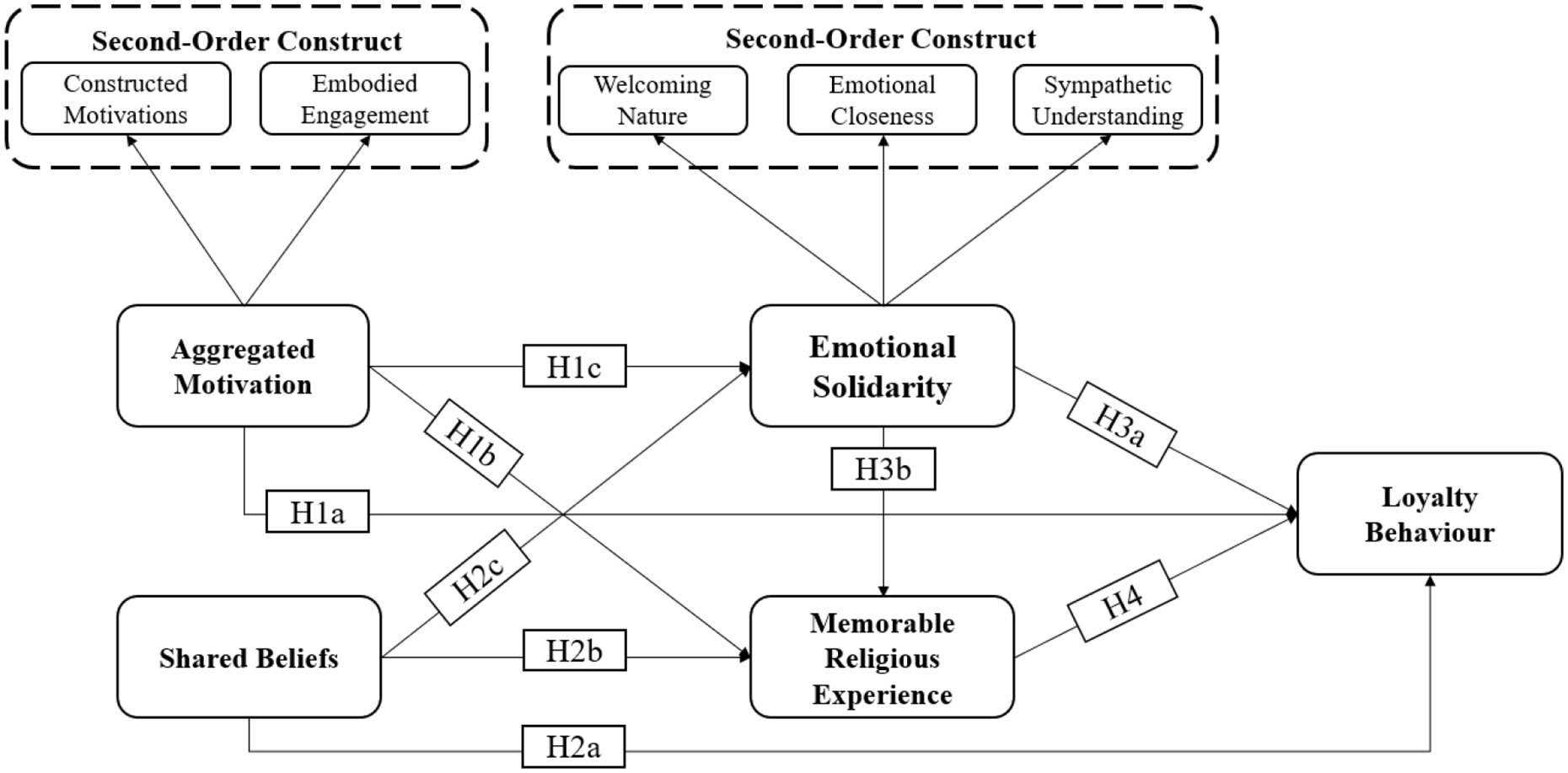
Proposed hypothesized model explaining loaylty formation.
Common method bias (CMB) may pose a potential problem because of the cross-sectional nature of this research. To mitigate the CMB issue, several procedural remedies were used following the recommendations proposed in the literature (Fuller et al. 2016; Podsakoff et al. 2003). First, anonymity was guaranteed to respondents during data collection. Further, participants were notified that there were no correct or incorrect responses. Second, the questionnaire was specifically crafted to eliminate the ambiguity and complexity of the items from the comprehension phase of the response process (Podsakoff et al. 2003).
After data collection, Harman’s single-factor test was conducted to confirm whether CMB was present in the data collected during the Kumbh Mela festival (Fuller et al. 2016). All items were entered onto a single unrotated exploratory factor analysis for both samples. The general variance accounted by a single construct was 27.8% and 29.6% respectively for domestic and international visitors, suggesting that CMB was not a pervasive issue in the data (Podsakoff et al. 2003). Furthermore, CMB analysis was undertaken using a marker variable approach for potential bias responses (Fuller et al. 2016). Results indicated that the responses to the questionnaire from domestic and international groups of visitors did not exhibit a common responses bias.
Additionally, data normality was assessed for both samples, and no major concerns were detected since the values for both skewness and kurtosis provided by Mplus output were below 3.0 and 7.0 respectively (Ribeiro et al. 2018; West, Finch, and Curran 1995), indicating the normality fundamental to the ML estimation of structural equation modeling and the appropriateness of data collected in Prayagraj.
Results
Visitor Profile
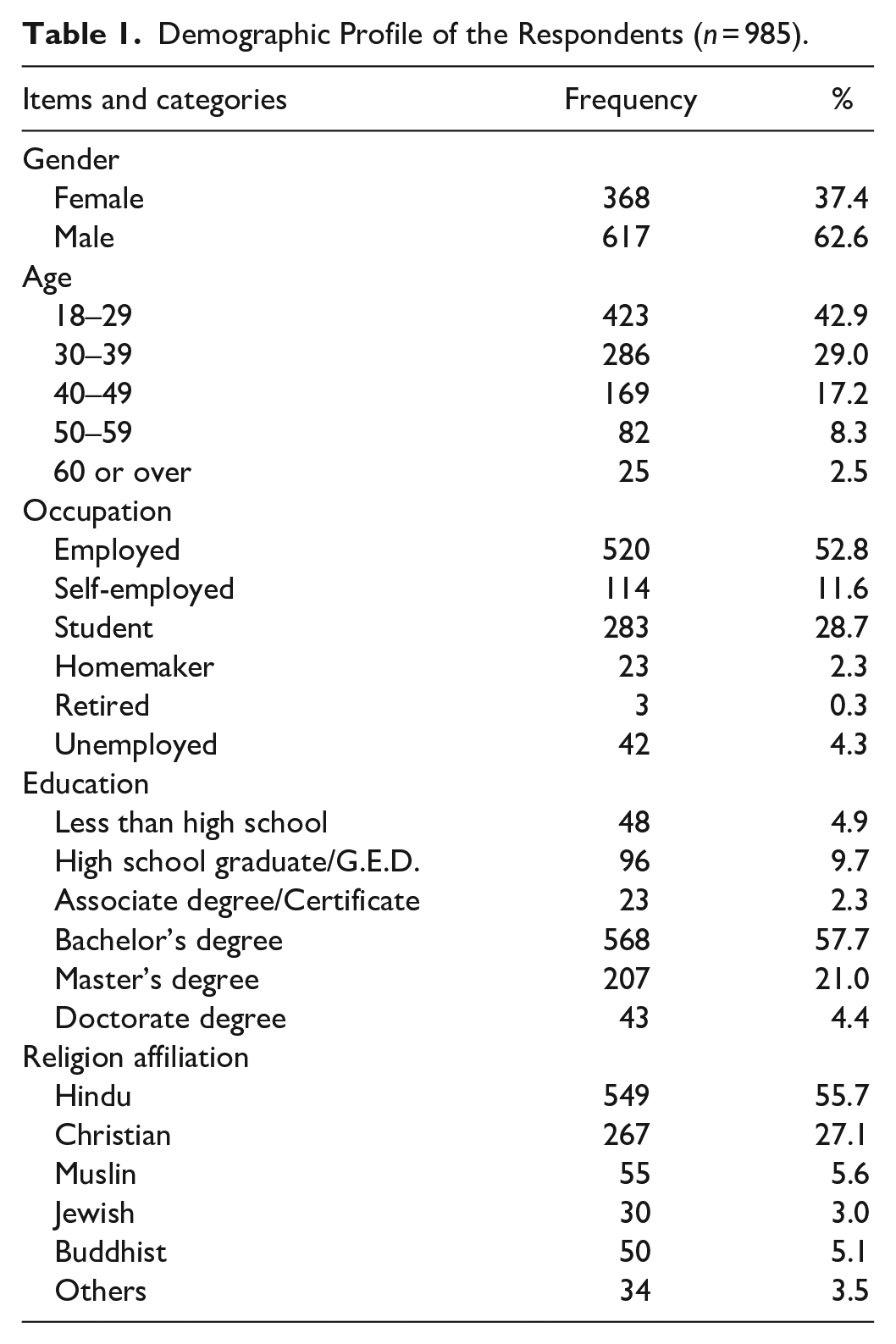
This study was based on a sample of 985 individuals who attended the Kumbh Mela festival. A majority of respondents were men (62.6%). A high percentage (42.9%) were between 18 and 29 years of age and employed (52.8%). Regarding education level, more than half of the respondents (57.7%) had undergraduate degrees with another 21% reporting they had attained a master’s degrees. More than half (57.7%) were Hindus followed by Christians (27.1%), Muslims (5.6%), Buddhists (5.1%), Jews (3.1%), and some other religion (3.5%). Table 1 depicts the demographic profile of participants.
Demographic Profile of the Respondents (n = 985).
Testing Measurement Model
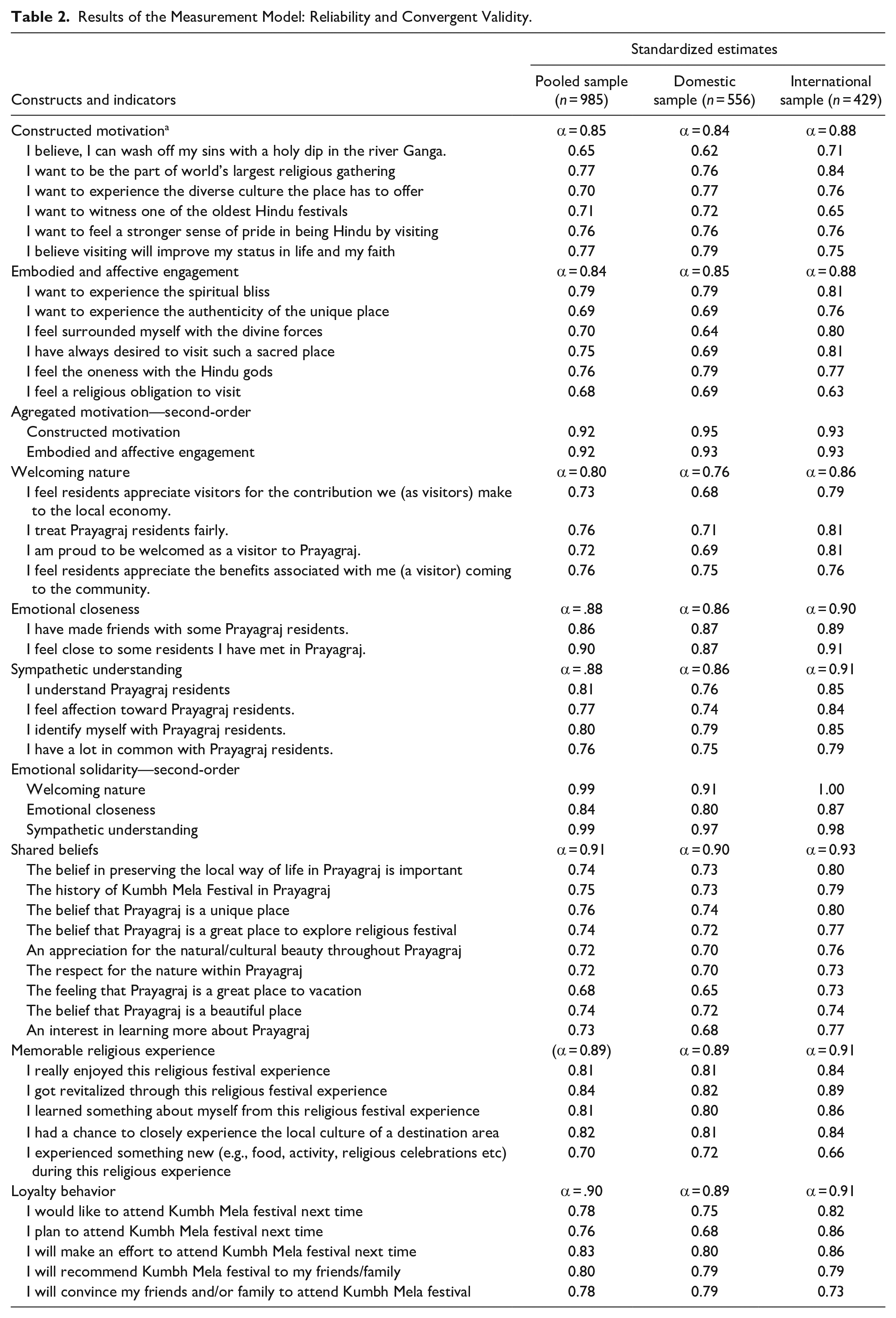
Tables 2 and 3 provide descriptive statistics, reliabilities and validities for all constructs for the pooled sample and by group of visitors (i.e., domestic and international). Prior to examining measurement invariance, confirmatory factor analyses (CFA) were carried out (which included the two second-order constructs for motivation and emotional solidarity) to assess the baseline model fit. First, the CFA (including first- and second-order constructs) was assessed with the pooled sample (domestic and international visitors’ sample) and all the fit indices satisfied the suggested threshold (χ2 = 1,912.22, df = 670, χ2/df = 2.85, p < .001, TLI = 0.95, CFI = 0.96, RMSEA = 0.043, 90% CI = [0.041, 0.046], and SRMR = 0.032). Factor loadings were all significant at p < .001, ranging from 0.65 to 0.99, as depicted on Table 2. Afterward, separate CFAs were subsequently conducted for each group of visitors (i.e., domestic and international visitors). The results demonstrated strong model fit for domestic visitors (χ2 = 1,585.12, df = 670, χ2/df = 2.37, p < .001, TLI = 0.93, CFI = 0.94, RMSEA = 0.050, 90% CI [0.046, 0.053], and SRMR = 0.038) and international visitors (χ2 = 1,492.12, df = 670, χ2/df = 2.23, p < .001, TLI = 0.94, CFI = 0.95, RMSEA = 0.053, 90% CI [0.050, 0.057], and SRMR = 0.039).
Results of the Measurement Model: Reliability and Convergent Validity.
Descriptive Statistics and Discriminant Validity (Second-Order): Fornell and Larcker Criterion.
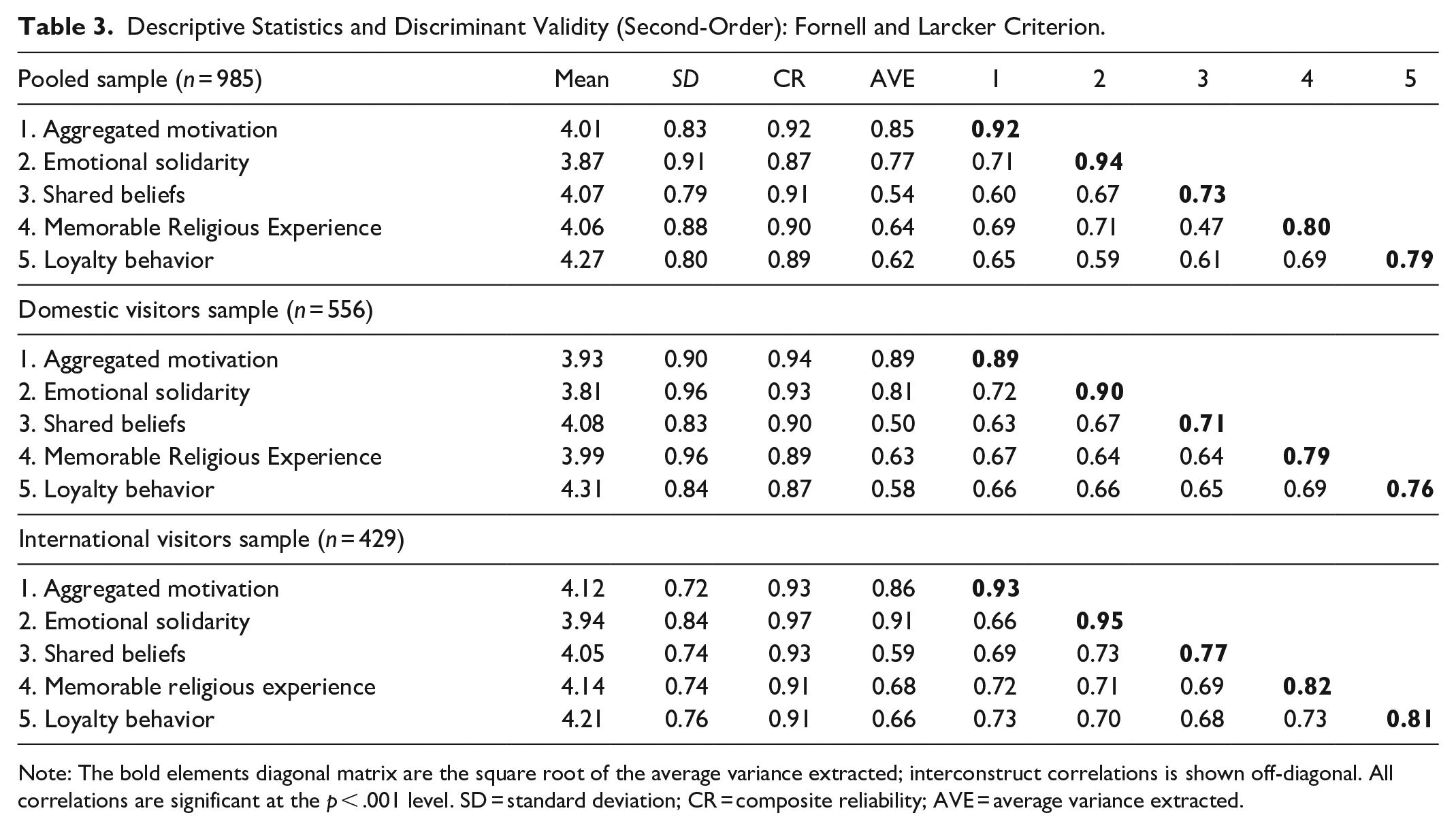
Note: The bold elements diagonal matrix are the square root of the average variance extracted; interconstruct correlations is shown off-diagonal. All correlations are significant at the p < .001 level. SD = standard deviation; CR = composite reliability; AVE = average variance extracted.
The standardized factor loadings for all items among the domestic visitors ([λ] = [0.62, 0.97]) and international visitors ([λ] = [0.63, 1.00]) were higher than 0.60. The measurement models were further tested for reliability and construct validity (i.e., convergent and discriminant validity) before testing the structural model as recommended by Cheung and Rensvold (2000) and Hair et al. (2019b).
Cronbach Alphas (α) and composite reliabilities (CR) for all variables were greater than the recommended cut-off value of 0.70, indicating acceptable reliability levels for each visitor group (Fornell and Larcker 1981; Hair et al. 2019a). Factor loadings and average variance extracted (AVE) estimates were used to assess convergent validity of the constructs in pooled and both domestic and international samples models. Based on previous studies (Lai, Pinto, and Pintassilgo 2020; Suess, Woosnam, and Erul 2020; Terzidou, Stylidis, and Terzidis 2018b), both aggregated motivation and emotional solidarity were conceptualized as reflective second-order constructs comprised of multiple reflective, first-order dimensions. In all of the models (including first- and second-orders), each factor loading was greater than 0.60 and significant (p < .001; Table 2). As depicted in Table 3, the AVEs were above 0.50, providing convergent validity for all the measurement models (Fornell and Larcker 1981). Discriminant validity for each model was calculated by comparing the square root of the AVE with correlations among the independent variables (Table 3). Results provide solid indication for the existence of discriminant validity for all three models. Results also suggest that all constructs had square root of AVE values higher than the correlations among the independent variables, providing evidence for discriminant validity (Anderson and Gerbing 1988). The above results demonstrated that the measurement models of this study exhibited acceptable psychometric properties.
Testing Multigroup Measurement Invariance
Multigroup analysis (MG) was carried out to assess the measurement invariance model across the matched data from domestic and international visitors, by comparing a baseline model that fixed an equal number of factors and factor patterns for each group (i.e., configural model) to a model that included invariant factor patterns (i.e., metric model) and the equality of intercept (i.e., scalar model) across groups (Vandenberg and Lance 2000). To assess the multigroup confirmatory factor analysis (MGCFA) for testing the measurement invariance (MI), the CFI, and RMSEA difference tests were used (i.e. ΔCFI ≤ 0.010 and ΔRMSEA ≤ 0.015) as suggested by Cheung and Rensvold (2002).
First, a configural invariance model was assessed via CFA where the factor loadings were unconstrained to be equally fixed between the two groups of visitors. The unconstrained model fit the data well (χ2(670) = 1,912.22, p < .001, χ2/df = 2.85, CFI = 0.95, and RMSEA = 0.043. All factor loadings between the two visitor groups were meaningfully different from zero (p < .001) and ranged from 0.62 to 0.99 for domestic visitors and 0.63 to 1.00 for international visitors.
Second, a metric invariance model was then assessed using CFA by constraining all factor loadings to be equal across groups. The fully-metric invariance model fit the data reasonably well (χ2(618) = 2,227.12, p < .001, χ2/df = 2.87, CFI = 0.95, and RMSEA = 0.044). To test the metric invariance, the fit of this model was compared with the fit of the configural model (ΔCFI = 0.005 and ΔRMSEA = 0.001).
Lastly, scalar invariance was assessed by constraining both the factor loadings and the equality of the intercepts to be equal between domestic and international visitors. To evaluate scalar invariance, the fit of the scalar model was compared with the fit of the metric model (ΔCFI = 0.001 and ΔRMSEA = 0.000). As presented in Table 4, the ΔCFI and ΔRMSEA values were below the recommended thresholds providing evidence of measurement invariance (Cheung and Rensvold 2002).
Test of Measurement Invariance (MI) Across Domestic and International Visitor Groups.
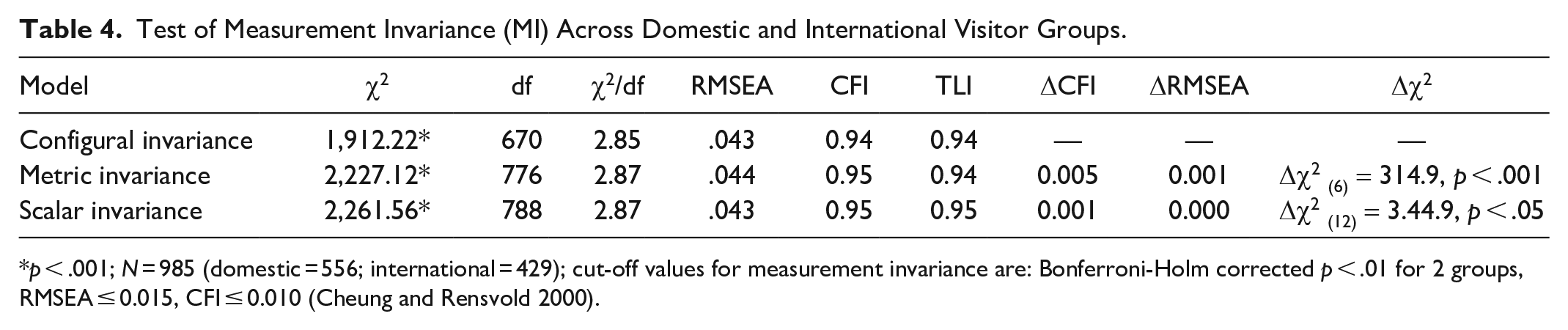
p < .001; N = 985 (domestic = 556; international = 429); cut-off values for measurement invariance are: Bonferroni-Holm corrected p < .01 for 2 groups, RMSEA ≤ 0.015, CFI ≤ 0.010 (Cheung and Rensvold 2000).
Testing the Structural Model
Structural equation modeling (SEM) with ML estimation methods was used to test the hypothesized relationships. The model fit the data generally well (χ2 = 1,912.22, df = 670, χ2/df = 2.85; TLI = 0.95; CFI = 0.96, RMSEA = 0.043; SRMR = 0.032). As depicted in Figure 2, all nine proposed hypotheses were supported, with the exception of H3a. According to these results, the effects of aggregated motivation on visitors’ loyalty (H1a: β = 0.18, p < .001, t = 3.64), emotional solidarity (H1b: β = 0.27, p < .001, t = 5.23), and memorable religious experience (H1c: β = 0.34, p < .001, t = 7.52), were found to be significant, lending support for H1a, H1b, and H1c.
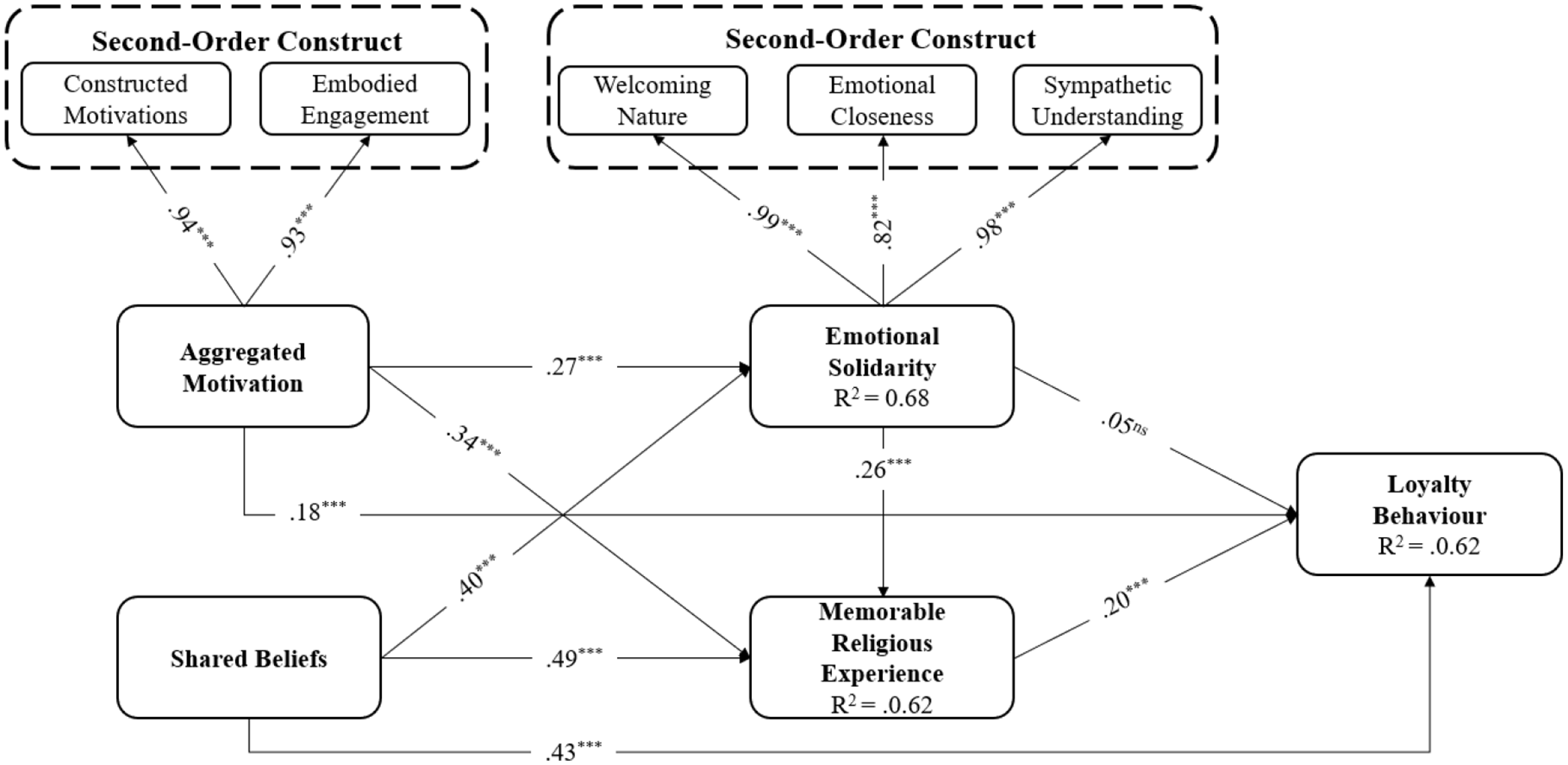
Results of the structural model.
Visitors’ shared belief was also found to significantly predict visitors’ loyalty (H2a: β = 0.43, p < .001, t = 7.85), emotional solidarity (H2b: β = 0.40, p < .001, t = 9.10), and memorable religious experience (H2c: β = 0.49, p < .001, t = 11.31), supporting H2a, H2b, and H2c. Moreover, the effect of visitors’ emotional solidarity with residents on loyalty (H3a: β = 0.05, p > .05, t = 1.12) was found to be insignificant, rejecting H3a. Conversely, visitors’ emotional solidarity positively influenced memorable experience (H3b: β = 0.26, p < .001, t = 6.44) developed during the event, validating H3b. Lastly, visitors’ memorable religious experience positively influenced loyalty (H4: β = 0.20, p < .001, t = 7.85), thus hypothesis 4 was also supported. The R2 values demonstrated that the proposed model explained a significant amount of variance in visitors’ emotional solidarity with local residents (68%), memorable religious experience (62%), and visitors’ loyalty behavior (62%).
Testing the Structural Invariance Between Domestic and International Visitors
A structural invariance test was conducted to further ascertain whether structural invariance might exist between the two visitor groups (i.e., domestic and international) to the Kumbh Mela festival. A baseline (unconstrained) model with ML estimation was generated. The results of the baseline model (where all the loadings across two groups of visitors were constrained to be equivalent) demonstrated that the model fit the data reasonably well (χ2 = 3,178.98, df = 1,382, χ2/df = 2.30, p < .001, TLI = 0.93; CFI = 0.94; RMSEA = 0.056; SRMR = 0.050). As summarized in Table 5, the baseline model where paths were allowed to vary freely (i.e., domestic and international visitors) was compared to nine constrained models in which the paths were equally constrained in sequence across the two groups. As predicted, results of the χ2 difference test showed that the two visitor groups vary at the model level (Δχ2(10) = 20.304, p < .05), indicating that there are differences in the path relationships between domestic visitors and international visitors to Kumbh Mela.
Results of the Path Differences Between Domestic and International Visitors.
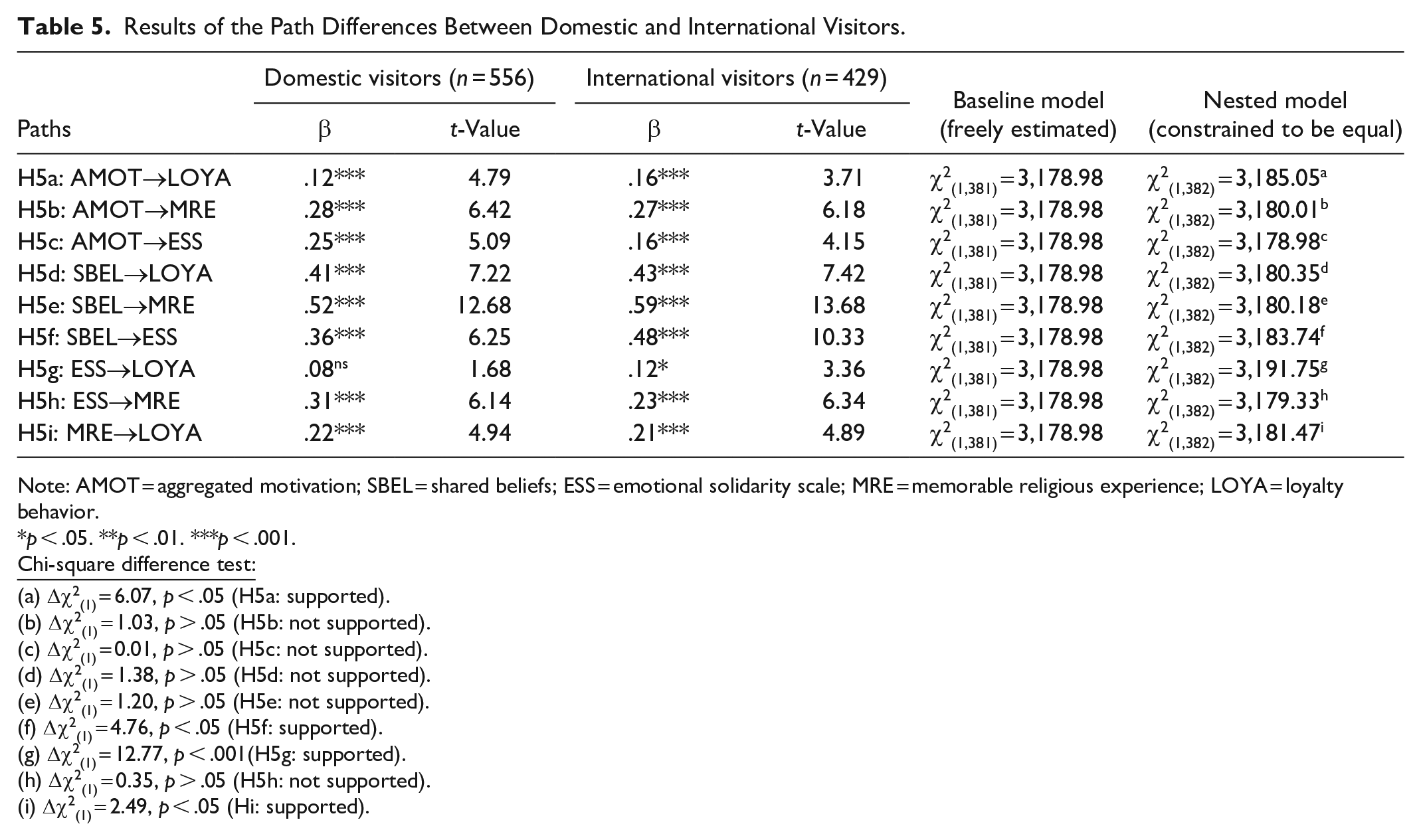
Note: AMOT = aggregated motivation; SBEL = shared beliefs; ESS = emotional solidarity scale; MRE = memorable religious experience; LOYA = loyalty behavior.
p < .05. **p < .01. ***p < .001.
(a) Δχ2(1) = 6.07, p < .05 (H5a: supported).
(b) Δχ2(1) = 1.03, p > .05 (H5b: not supported).
(c) Δχ2(1) = 0.01, p > .05 (H5c: not supported).
(d) Δχ2(1) = 1.38, p > .05 (H5d: not supported).
(e) Δχ2(1) = 1.20, p > .05 (H5e: not supported).
(f) Δχ2(1) = 4.76, p < .05 (H5f: supported).
(g) Δχ2(1) = 12.77, p < .001(H5g: supported).
(h) Δχ2(1) = 0.35, p > .05 (H5h: not supported).
(i) Δχ2(1) = 2.49, p < .05 (Hi: supported).
The findings of the invariance structural test for each path are abridged in Table 5. Results show that the effect of motivation on memorable experience (Δχ2(1) = 1.03, p > .05) and on emotional solidarity (Δχ2(1) = 0.01, p > .05) were not significantly different across national and international visitor groups, rejecting H5b and H5c. Conversely, the effect of motivation on loyalty (Δχ2(1) = 6.07, p < .05) differed significantly between the two groups, therefore H5a was supported. The results indicated that the effects of shared beliefs on loyalty (Δχ2(1) = 1.38, p > .05) and on memorable religious experience (Δχ2(1) = 1.20, p > .05) were not significantly different across domestic and international visitors leading to the rejection of H5d and H5e. Yet, the effect of shared beliefs on emotional solidarity (Δχ2(1) = 4.76, p < .05) differed significantly between domestic and international visitors triggering further support for H5f. The results further demonstrated that the relationships from emotional solidarity to loyalty differed significantly between domestic and international visitors (Δχ2(1) = 12.77, p < .05), whereas the link between emotional solidarity and memorable religious experience did not differ significantly between the two groups (Δχ2(1) = 0.35, p > .05). Accordingly, H5g was supported while H5h was rejected. Lastly, the effect of memorable religious experience on loyalty was found to significantly differ between the two groups (Δχ2(1) = 2.49, p < .05), providing support for H5i.
Discussion and Implications
In addressing Collins-Kreiner’s 2020; Kim, Kim, and King’s 2020 calls for greater research to advance our knowledge of religious tourism, the current study intertwines motivation, shared beliefs, emotional solidarity, and memorable religious experience as antecedents of visitors’ loyalty behavior. This study therefore aimed to examine, through an overarching framework, (a) the effect of motivation on visitors’ loyalty behavior, (b) the effect of shared beliefs on visitors’ loyalty behavior, (c) the effect of motivation on emotional solidarity, (d) the effect of motivation on memorable religious experience, (e) the effect of shared beliefs on emotional solidarity, (f) the effect of shared beliefs on memorable religious experience, (g) the effect of emotional solidarity on visitors’ loyalty behavior, and (h) the effect of memorable religious experience on visitors’ loyalty behavior.
Extending previous research conducted by Iso-Ahola (1982), Woosnam, Norman, and Ying (2009), Kim and Ritchie (2014), and Woosnam and Aleshinloye (2013), this study addresses a substantial literature gap by integrating four research strands (e.g., motivation, emotional solidarity, shared beliefs, and memorable religious experience) in an integrative model as antecedents of tourist loyalty behaviors during religious festivals in an event sacred place. Also, it assesses its direct and indirect effects. Further, this study uses visitor type as a moderating variable to understand whether the relationships proposed in this study vary across domestic and international visitors to the Kumbh Mela festival.
Theoretical Implications
Findings of this study make important contributions to theory and present numerous opportunities for future research concerning sacred religious events. Based on Iso-Ahola’s (1982) premise that motivation must be studied from physiological and psychological perspectives, the current study builds on previous research (Badone 2007; Collins-Kreiner 2010, 2020; Govers, Go, and Kumar 2007; Hyde and Harman 2011; Terzidou, Scarles, and Saunders 2018a) considering motivation as a second-order construct. The findings further validate the work by Terzidou (2020) that describes religious tourism as sensory-stimulating, marked by feelings of awe, relaxation, and healing.
Further, this study considers Durkheim’s (1915) emotional solidarity as a second-order construct following the recent work of Tasci et al. (2021). It builds the model on the foundations of Woosnam, Norman, and Ying (2009) involving the three dimensions of emotional solidarity. This work also extends the research of Patwardhan et al. (2020a), by considering motivations stemming from the spiritual/religious reasons and religious obligation (Kim and Ritchie 2014), and by modifying the MTE scale in the context of religious sacred events as the MRE scale. Additionally, this model tests the effect of socio-demographic identity (i.e. nationality) in this case on the model constructs. As such, it applies Hofstede’s (1980, 2001) cultural taxonomy theory in a religious tourism context.
Overall, five theoretical contributions can be summarized from this study. Firstly, it provides a new direction in the religious tourism literature by integrating the higher-order of motivation in a religious context and empirically measuring the new scale which was developed to measure visitors’ motivation to religious sacred event places. To date, few studies have considered aggregated motivations in their research; our work is among the first to highlight its validity and applicability in this context, contributing to the development of further knowledge concerning the religion-tourism nexus. In the past, Terzidou, Stylidis, and Terzidis (2018b), argued that tourist motivations can be categorized as constructed motivations (Cohen and Cohen 2012) and embodied and affective engagements (Badone and Roseman 2004). The authors limited their research to exploring theories of constructed motives, and embodied and affective engagements in the background of religious tourism and used ethnographic techniques. However, the current study advances such notions in providing an instrument to measure the higher-order of motivation, and empirically demonstrates the relationship between aggregate motivation, shared beliefs, memorable religious experience, and visitors’ loyalty behavior, making a novel contribution to the literature.
Secondly, the study demonstrates motivation as antecedents of emotional solidarity and memorable religious experience. In the past, emotional solidarity has been studied with various antecedents, such as visitor place attachment (Patwardhan et al. 2020a), nature and frequency of interaction (Joo et al. 2018), and place attachment and economic benefits. The current study offers new insights into this issue as motivation has a significant influence on emotional solidarity. Since this research is the first to examine the relationship in the context of sacred religious events, it provides direction for other researchers to explore this in different contexts. Similarly, the study offers a new direction to the field of research involving memorable religious experience (MRE) with motivation as an antecedent, thus providing additional direction for researchers that wish to apply memorable religious experiences to different contexts.
Thirdly, the study reveals support for shared beliefs as an antecedent of emotional solidarity and memorable religious experience. The relation between shared beliefs and emotional solidarity has already been mentioned as a potential area for study in the works of Woosnam and Norman (2010). They concluded that, “the process of social exchange between residents and tourists may be better explained through shared beliefs about the area” (Woosnam and Norman 2010, 13). This research is a step in that direction. Along similar lines, though there may not be much research directly studying the effect of shared beliefs on memorable religious experience, comparisons can be drawn from the literature focused on memorable tourist experiences (Kim 2014; Kim, Ribeiro, and Li 2021). Further, the study goes on to empirically establish the findings of Derrett (2003) where the author concluded that the interactions and participation in local culture and rituals will make travel more memorable. In the context of visiting sacred places, if the visitors and their counterparts have shared beliefs, then they can have a higher degree of participation in community activities thereby having an enriched religious experience.
Fourthly, our study revealed the direct effects of emotional solidarity and memorable religious experiences on visitors’ loyalty behavior. It is noteworthy that, in this context, emotional solidarity had no significant influence on the visitors’ loyalty behavior amongst domestic visitors. Such findings contradict those presented by Patwardhan et al. (2020a) and Ribeiro et al. (2018), where the effect between the abovementioned variables was significant. One explanation for this may be due to the fact that international visitors have distinctly different cultural backgrounds than Prayagraj residents, contributing to their intentions to return in the future, whereas domestic visitors likely share similar cultural backgrounds with such residents.
Finally, the visitors’ origin demonstrated significant moderating effects within the model, albeit in only four of the nine proposed moderation hypotheses Respondent nationality had a significant effect on the relationships between motivation, emotional solidarity, shared belief, memorable experience and loyalty, as well as on the relationship between shared beliefs and memorable religious experiences. These results may be explained in part due to slightly higher means for motivation, emotional solidarity, and memorable tourism experiences reported among international visitors. Arguably, this makes sense given international visitors may be more vested in making the journey to the Kumbh Mela as opposed to those who live closer, in-country. Such findings further support the work of Hofstede (1980, 2001), reflecting that such differences are largely attributed to distinct cultural backgrounds of international visitors. This is an important contribution to the religious tourism literature, further echoing what others have found (Schofield and Thompson 2007; Woosnam, Aleshinloye, and Maruyama 2016) concerning heterogeneous perspectives among domestic and international festival visitors.
Practical Implications
Implications also exist for practice. Findings suggest that both domestic and international visitors’ motivations had a significant influence on visitors’ memorable experience, shared belief, and loyalty. This is an important finding from the event organizer’s point of view. Kumbha Mela, a religious Hindu festival is one of the largest gatherings in the world and considered as worlds’ largest congregation of religious gatherings. Hindus believe that bathing in the sacred river during the Kumbh Mela makes them eternally blessed while washing away sins. Interestingly, this intangible cultural World Heritage Site has experienced a huge influx of international visitors (a growth of around 35% 2 ) in comparison to the 2013 Kumbh Mela which was around 3.5 lakhs. 3 While religious beliefs motivated domestic visitors to attend the festival, international visitors were motivated to visit given its magnitude, opportunities to practice important rituals and chances to relive century-old traditions and religious practices. Additionally, living among Saints and Sadhus in tents is one of the important motives for international visitors. The findings of our study provide empirical evidence for this and thus provides important managerial contribution to the stakeholders such as festival organizers, tourism policy-makers, and government bodies. Policy-makers should recognize the saliency of non-religious motives among festival visitors and accordingly formulate appropriate marketing strategies for future Kumbh Mela festivals Given the fact that the 2019 Kumbha Mela generated roughly 600,000 hospitality and tourism jobs 4 (both direct and indirect), benefits are not uniquely reserved for visitors and not always centered around spirituality. However, national and international travel have been severely affected by COVID-19 world. In this sense, policy makers, destinations management organizations (DMO) and event’s organizers need to adapt and adopt extensive transformation within the destination and religious events venues in the post COVID-19 pandemic to integrate and put in place updated protocols and operated strategies to guarantee healthy safety of all travelers.
Visitors’ shared beliefs also had significant positive influences on visitors’ memorable experience, emotional solidarity, and loyalty. This is to say that higher levels of shared belief yield higher level of memorable experience, emotional solidarity, and ultimately, higher levels of visitors’ loyalty. When festival visitors believe that they share a common understanding of the significance of festival, they may develop a sense of group membership which is considered a fundamental element in developing social identity (Brown 2000). Based on our findings, sharing beliefs with others is a root contributor in explaining other outcome variables in the model. Efforts made by festival organizers to further reinforce shared beliefs while on-site (i.e., through manifestations of dress, performances, rituals, teachings, and food preparations) will ultimately serve to foster memorable religious experiences, emotional solidarity with residents, and ultimately, greater festival loyalty.
Our findings also provide support for the positive relationship between emotional solidarity and visitors’ memorable experiences. As residents provide a welcoming environment to visitors, the potential exists for the festival visitors to be satisfied and have a memorable experience of Kumba Mela. Policy-makers and festival organizers should consider appropriate marketing strategies that encourage residents and festival visitors to build emotional solidarity with one another. Additionally, residents need to be educated about the importance of festival visitors and the economic impact contributed to the region. This can be achieved by including residents in festival committees to raise awareness of the receiving festival visitors in an affable manner. Festival visitors’ emotional solidarity, an intangible antecedent of memorable experience, can be perceived as a more sustainable way to enhance festival visitors’ overall experience and thereby encourage greater repeat visitation and word-of-mouth shared with other potential visitors after COVID-19 pandemic when attending crowded religious events is permitted.
Limitations and Directions for Future Research
This analysis, like any study, poses certain limitations. First, the data were collected at one festival. Furthermore, based on study participant demographics, the majority of domestic respondents were from states in the northern portion of India. Consequently, the results reflect those visitors’ degrees of motivations, shared beliefs, and emotional solidarity that might hinder the generalizability to the entire country. The regional diversity of India, with its unique characteristics require a comprehensive study with due consideration to variations in diversity. Hence, future researchers may consider regional diversity of visitors and may validate our findings. Furthermore, despite our work capturing some sense of diversity among visitors (i.e., domestic vs. international), subsequent work should focus on differentiating between individuals based on cultural background (Soldatenko and Backer 2019). This would help to better understand nuanced distinctions primarily in motivation, but also in emotional solidarity, shared beliefs, memorable experiences, and loyalty among visitors from within and outside of India.
Secondly, the data were collected in selected places at the Kumbh Mela, such as the exit of the Sangam ghats (for the domestic visitors) and the entrance of the premium tents (for the international visitors). This method has its own limitations in the sense that this may not have guaranteed that all tourists had equal opportunities to participate in the survey. Moreover, it can be seen in the demographics that a majority of the domestic respondents (greater than 70%) were born between 1981 and 1996, meaning they belonged to the Millennial generation. Millennials are characterized as individuals who challenge status quo and do not typically follow customs and traditions. As a result, this likely explains why few differences were found between domestic and international visitors on many of the antecedents within the model. Hence, future research may look to emulate our study at other sites where the Kumbh Mela is organized and collect data from domestic and international visitors across numerous age groups so as to examine the moderating effect of visitor origin (i.e., domestic and international visitors) within the venue.
Finally, the data were collected during the Kumbh Mela in 2019. Hence, the results have to be interpreted keeping this in mind. With the COVID-19 pandemic prevalent throughout the world since 2020, it has had a profound impact on tourists’ visitation behaviors. Considering the context of the festival and the sheer number of visitors, it will be very crucial to study the impact of risk and uncertainty on visitors’ loyalty behavior, in light of the pandemic. As such, it would be interesting to examine whether religious faith supersedes risk and uncertainty among individuals potentially planning to attend religious festivals such as the Kumbh Mela.
Footnotes
Acknowledgements
The authors would like to thank Mr Aneesh Puri, undergraduate student (2019 graduating batch) of the Department of Automobile Engineering from Manipal Institute of Technology for his help in the data collection during the Kumbh Mela-2019, Prayagraj, India. The authors also would like to express their gratitude to the anonymous reviewers for their constructive feedback and encouraging words.
Declaration of Conflicting Interests
The author(s) declared no potential conflicts of interest with respect to the research, authorship, and/or publication of this article.
Funding
The author(s) disclosed receipt of the following financial support for the research, authorship, and/or publication of this article: This work is partially financed by Portuguese Funds provided by FCT—Fundação para a Ciência e a Tecnologia (Foundation for Science and Technology, Portugal) through project UIDB/04020/2020.

1.
Kumbh Mela: How to plan a festival for 100m people—BBC News.
3.
A record over 24 crore people visited Kumbh-2019, more than total tourists in UP in 2014–2017 | Hindustan Times.