



Abstract
The Rich Kids of Instagram (RKOI) portray luxury lifestyles on social media. The potential roles of travel and transport within these online displays of affluence have not yet been examined. This paper’s purpose is to analyse how transport modes and luxury travel are depicted and interrelated through RKOI images. Co-occurrence analyses were conducted using a data set of Instagram posts with RKOI as a hashtag (2012–2018) to visualize the roles of transport modes and luxury travel in RKOI image construction. The findings demonstrate that both energy-intensive transport modes and luxury travel, whether through air/watercraft or luxury cars, play a vital role in signaling RKOI’s self-image on Instagram, with gendered differences. The article contributes an original conceptual model of how RKOI construct their image using transport modes and luxury travel. Implications for the social normalization of carbon-intensive transport choices, coupled with luxury destinations as a backdrop, are discussed.
Introduction
Since its launch in 2010, Instagram (instagram.com/), a social media platform where users post captioned photographs, has quickly risen in prominence among millennials to become one of the world’s most popular social media platforms with more than one billion users globally (Smith 2018; Statista 2019). Instagram users visually document a range of conspicuous consumption activities frequently associated with fashion, cars, food, holidays and landscapes, often through well-rehearsed, staged and manipulated “selfies.” These are photos they have taken of themselves, usually with a smartphone (Marwick 2015; Ok Lyu 2016). Travel features heavily in Instagram posts, as evidenced by the site’s more than 179 million posts with the hashtag #travel (Terttunen 2017). Hashtags are a form of user-generated tagging used on microblogging sites (e.g., Twitter and Instagram), which link content together across multiple users.
It is claimed that a holiday destination’s perceived “Instagrammability” is now the most important factor in millennials’ decisions on where to visit (The Independent 2017). A large reason for Instagram’s appeal is its value as a “travel accoutrement” (Smith 2018). Instagram’s social network is asymmetric: users following another Instagram user are called “followers,” and the latter need not follow the former (Hu, Manikonda, and Kambhampati 2014). The Instagram users with the most followers are mostly pop stars and other high-profile celebrities. Yet “influencers”—usually people who start out without fame but develop it over time by gaining influence over their peers, often through social media—have also amassed large followings. Across these groups, the luxury nature of the accounts and posts are indicative of the lifestyles that many young millennials now dream of living (Marwick 2015). Carefully composed images of outfits, meals, and holidays increasingly attract adoration and emulation (Khamis, Ang, and Welling 2017).
One of the most prominent collections of Instagram posts featuring this luxury aesthetic is that of the Rich Kids of Instagram (RKOI). RKOI began as a hashtag in 2012 and is consolidated through a Tumblr blog (http://therkoi.com/the-rkoi/), which is a secondary site devoted to Instagram (Marwick 2015), where its more than 1,500 posted images are archived. The RKOI are essentially super-rich teenagers and young adults who openly flaunt their wealth through (social) media. As Marwick (2015, p. 154) explains, RKOI “functions as both a critique of income inequality and a celebration of it,” as its collection of “photos of young, good-looking people drinking magnums of champagne at nightclubs, snoozing on private jets, summering in the Hamptons, and driving Ferraris, reveals the louche nature of the most privileged people on earth.”
There is a lack of research that examines the interrelationships between luxury travel, transport modes and image construction on social media. Given the increasing role that Instagram travel photos can play in transforming destination imagery, Volo and Irimias (2020) advocate for more rigorous visual analyses of Instagram images collections in tourism research. While it seems evident that travel must play a role in how the RKOI depict their lifestyles, and that these portrayals are likely to contribute to the social normalization among some millennials of what is desirable (Gössling et al. 2018), research has yet to reveal how travel and transport is depicted within RKOI images. Therefore, this paper draws on a co-occurrence analysis, which visualizes relationships between attributes extracted from the RKOI Tumblr blog, with the aim of examining the ways in which transport modes and luxury travel are depicted and interrelated through RKOI images. As user-generated content on social media can vary by gendered norms (Hum et al. 2011), our analysis is furthermore carefully attenuated to gendered dimensions of the visual material.
In the following sections, the article first situates itself within a theoretical background based on the roles of luxury travel and transport modes in experience sharing, signaling, and millennials and social media. This provides a deductive basis for the article’s empirical contribution, which relies on its co-occurrence analysis of the RKOI Tumblr blog. The article then turns to its presentation of findings, before developing an original conceptual model that explains how RKOI construct their image using transport modes and luxury travel. The article offers a concluding discussion of the importance of the findings for the sustainability of the tourism and transport systems.
Experience Sharing on Social Media
Consumer behavior has arguably undergone three recent shifts: from material purchases to immaterial experiences, from signaling wealth and status through consumption to signaling self-identity, and to a state of higher consumption visibility because of the rise of social media (Bronner and de Hoog 2019). Social media allow users to construct a self-image and identity to communicate to the wider online community, and there is now a substantial literature on how users are motivated to use the platforms for self-construction (Hum et al. 2011). Sharing travel experiences on social media has become ubiquitous, and doing so may gratify social needs for self-expression and communication (Liu, Wu, and Li 2019; Ye et al. 2018). At the same time the Internet has become an increasingly visual medium, wherein individuals tend toward images rather than textual descriptions to express themselves—as in the case of Instagram (Marwick 2015). Zappavigna (2016, p. 272) observes that Instagram affords “a style of ‘you could be here with me’ photography . . . ” that invites “the viewer to imagine themselves in the frame.”
It has been argued that holidays are in principle socially visible and are at least partially chosen for the role they can play in displaying status and signaling identity (Bronner and de Hoog 2018). The social visibility of travel consumption has been significantly enhanced in the era of social media (So et al. 2018). This contrasts with the past when the primary way of communicating holiday experiences was often by sending a postcard (Bronner and de Hoog 2019). Tourists claim the “bragging rights” from sharing uncommon, luxury, highly exclusive and extremely expensive travel experiences on social media (Liu and Li 2020). Through sharing such experiences, tourists seek to express themselves, enhance their self-esteem, and construct desirable self-image and identity, as well as gain external validation (Liu and Li 2020). Taylor (2020) points to the importance and power of user-generated social media content in influencing others’ evaluation and selection of travel destinations, citing a wider range of sources that have demonstrated this link (e.g., Casalo et al. 2015; Cox et al. 2009). As such, the vicarious consumption of travel has become critical to the travel industry because of its leading to the patronage of destinations (Marder et al. 2018). Shared experiences on social media can thus provide a window into societal changes in tourism behavior and travel desires. Despite this, Instagram has to date “been used timidly by tourism researchers and its exploitation as a visual data source has been limited” (Volo and Irimias 2020, n.p.).
Signaling via Luxury Transport
Consumption plays a vital role in self-identity formation (Taylor and Strutton 2016). While luxury goods may be sought by consumers for their intrinsic value in boosting self-esteem and sense of self, they nonetheless still play an important role in signaling social status to others (Wang and Griskevicius 2014). Consuming expensive items to signal wealth or prestige, rather than to meet utilitarian needs, has long been termed conspicuous consumption (Veblen 1899). The consumption of certain luxury transport modes and brands, in which their high cost conveys success, wealth, and other symbolic aspects (Cohen and Gössling 2015), is indicative of these Veblen effects, whereby conspicuous consumption is used as a signifier of social status and self-identity (Bagwell and Bernheim 1996). Showcasing brand logos is a means of building a positive self-representation, which is associated with bragging and boasting (Sekhon et al. 2015). In this sense, particular transport mode choices and luxury travel experiences are not only about the utility they provide but also about what they show or signal to others in a social environment (Bronner and de Hoog 2019).
Mobility-related goods and services have been discussed within Hirsch’s (1977) notion of “positional goods,” that is, goods that increase the status of their consumers and are viewed as desirable by others. Positional goods are thus intertwined with the notion of conspicuous consumption (Taylor and Strutton 2016). Litman (2011) explores how luxury vehicles and exotic vacations affect transportation decisions and suggests that consumer demand becomes increased for more resource-intensive transport modes, while also encouraging travel to more distant holiday destinations.
The ability to convey flexibility through a geographically mobile luxury consumer lifestyle has become increasingly important in the ascension of social hierarchies (Eckhardt and Bardhi 2020). Social capital generation has to an extent become based on one’s power to cultivate global networks and become mobile (Cohen and Gössling 2015). This is reflected by the concept of “mobility capital.” Brooks and Waters (2010) define mobility capital as a form of capital that is enmeshed with Bourdieusian economic, social, and cultural forms. Mobility capital is primarily amassed from experiences of living and traveling abroad and has become one of the strongest markers of power and distinction in contemporary societies. Mobility capital is signaled, leveraged, and amplified through social media. Travel is thus increasingly motivated by the social returns it facilitates through social media (Boley et al. 2018). Research has even revealed that signaling social status through social media is an important factor in motivating eco-tourism (Beall et al. 2021). This finding does not bode well for the nexus of sustainability and the symbolic conspicuous consumption of travel.
The use of luxury transport in constructing self-image and signaling self-identity on social media can partly be explained by costly signaling theory (Zahavi 1975). Rooted in evolutionary psychology, costly signaling theory posits that human beings tend to engage in behaviors that could communicate desirable personal characteristics at the sacrifice of significant amounts of resources, like money, time, energy, or risk (Bird and Smith 2005). These behaviors are thus termed as “costly signals,” and the costlier the signals, the more reliable they are (Iredale, Van Vugt, and Dunbar 2008). Examples of costly signals include luxury goods and services (Nelissen and Meijers 2011; Kim and Jang 2014), altruistic behaviors (Millet and Dewitte 2007), and biological displays like muscular male bodies (Su, Kunkel, and Ye 2021). Public display of such signals could help demonstrate individuals’ access to abundant resources, like wealth and social status, as well as abilities to acquire these resources, which ultimately help increase one’s attractiveness and mating opportunities (Nelissen and Meijers 2011). Costly signaling theory has been widely used to understand conspicuous consumption and status consumption (Griskevicius et al. 2007; Kim and Jang 2014). As costly signals, luxury transport displayed on social media, like luxury branded cars and private aircraft, could convey wealth, social status, and other desirable personal characteristics of the signalers. From an evolutionary perspective, overtly displaying luxury transport on one hand helps increase intersexual attraction, and on the other hand aids in social competition for social status, alternatively termed intrasexual competition (Bird and Smith 2005; Hennighausen et al. 2016).
The desire to signal status via conspicuous luxury goods tends to be stronger among male as compared to female consumers (Kruger and Kruger 2018; Panchal and Gill 2020). From an evolutionary psychology perspective, this signaling is viewed as directed at potential mates, and it is alleged that conspicuous consumption among men is a signaling system particularly focused on short-term mating (Sundie et al. 2011). It could also be understood as a way that masculinity is performed, through consumption habits and signals of wealth associated with prestige and success. Indeed, it has been reported that men tend to be more materialistic in conspicuous consumption than women (Segal and Podoshen 2013). Whereas both genders use luxury products in intrasexual competition (Hennighausen et al. 2016; Wang and Griskevicius 2014), masculinities are often associated with luxury goods that convey power, status, and success, like luxury cars (Segal and Podoshen 2013; Hennighausen et al. 2016). In contrast, femininities are framed in relation to attractiveness-enhancing luxury products, such as luxury fashion, cosmetics, and beauty items (Hudders et al. 2014). Moreover, different self-presentation strategies are visible on social media, which mirror traditional conceptions of masculine and feminine traits: status and risk-taking are linked to masculine identities, and emotional and relationship-oriented performances are associated with feminine identities (Tifferet and Vilnai-Yavetz 2014). However, little is known about gendered differences in the use of transport modes to signal physical attractiveness as part of constructing self-image on social media.
Millennials and Social Media
Generational cohorts are also an important consideration in this article, as peer-to-peer communication on social media is of particular influence on travelers who are millennials. Millennials have become one of the most important segments in the travel industry (Liu, Wu, and Li 2019). Millennials are characterized by the ubiquity of their mobile devices and a tendency towards peer comparison on social media, with Instagram the site of choice for sharing posts about travel (Siegel and Wang 2019).
Tourism has been an overlooked factor that is contributing to a normalization of narcissistic displays within societies, not least the result of sharing selfies through social media (Canavan 2017). Narcissistic behavior is linked to social comparison (Taylor 2020), with social comparison theory defined as the tendency to self-evaluate through comparing ourselves to others (Festinger 1954; Garcia, Tor, and Schiff 2013). Social comparison manifests through travel as with other domains of consumption, as part of the desire to have a superior position in comparison to others. Such comparative concerns among peers can drive competitive behavior, as mobility capital is sought through tourism consumption (Gössling, Cohen, and Hibbert 2018).
The RKOI construct an image of themselves as materialistically rich, and through the asymmetric nature of Instagram they may influence social norms (Gössling 2019). Social norms are informal rules guiding and governing behavior within social groups (Bicchieri, Muldoon, and Sontuoso 2018). Social norms influence and shape perspectives on what is considered appropriate, desirable, or “normal” behavior (Gössling, Humpe, and Bausch 2020). The subject position of RKOI thus resonates with Leban et al.’s (2020) notion of high-net-worth social media influencers. Whether RKOI are truly financially rich is beside the point; they seek to convey that they are, as part of creating a personal brand that can lead opinions. Through sponsorship, they may collaborate with businesses and marketers to reach more consumers (Leban et al. 2020). As Marwick (2015, p. 141) succinctly puts, “What the young users of Instagram find aspirational often resembles ‘the lifestyles of the rich and famous.’”
Liu, Wu, and Li (2019) showed that sharing experiences of luxury destinations on social media leads other millennials to desire a similar travel experience. However, not all consumers will identify with the luxury lifestyles portrayed by RKOI. Notably, specific forms of transportation, including all air travel, have also been affected by powerful new social norms created by the global Fridays for Future movement, that is, the rejection of carbon-intense forms of consumption by millennials (Gössling 2019).
Against this background, it is important to begin to consider how luxury travel and energy-intensive transport may be depicted on Instagram. It is well established that the travel and transport patterns of the wealthiest people globally are unsustainable. They contribute disproportionately to global GHG emissions, as their mobilities are often characterized by multiple abodes dispersed around world cities and popular destinations, reached by super yachts, private jets, and helicopters (Beaverstock and Faulconbridge 2014; Gössling et al. 2018). Understanding the depictions and interrelations of luxury travel and transport within RKOI images thus represents a promising entry point into revealing the roles of travel and transport in online image construction among the super-rich.
Materials and Methods
The data set was obtained from Tumblr blog (http://therkoi.com/the-rkoi/), which consolidated the Instagram posts using RKOI as a hashtag from when it began in 2012 to 2018 when the hashtag changed to the Rich Kids of the Internet. This endpoint was marked by the Tumblr website not only providing an archive of all past RKOI posts but also adding a commercial element selling luxury services in the form of private jet charters and “super car” rentals in the United Kingdom. This commercialization made the experiences and identity signaling of the RKOI more available to ordinary young people, who for instance might take selfies with luxury shopping purchases next to their short-term super car rental when on holiday in London. It was therefore deemed appropriate to review posts up to this change. The focus on travel and transport in this new commercial aspect provided a further indication to the authors that the role of luxury travel and transport modes within RKOI posts demanded examination. Data were collected from the website on May 24, 2019. A total of 1,882 Instagram posts were collected and saved into a Microsoft Word document for later analysis. The 1,882 posts were then screened by the researchers to remove irrelevant posts. From this, 19 posts were removed during the data cleaning process for the following reasons: 10 duplicates, 1 video, 7 advertisement posts, and 1 post that contains unmeaningful information. As a result, 1,863 Instagram posts were used in the data analysis, which include both photos and captioned texts.
Coding Procedure
To establish coding variables for this project, the lead author examined the first 100 Instagram posts to develop the initial coding framework. This initial coding framework was established with the project aims in mind and therefore focused on developing categories for specific modes of transport, the people featured in the images, symbols of cultural capital, the setting of the images, and the activities taking place in them. This initial coding framework was then discussed with a co-author who then examined a sample of 150 Instagram posts in the data corpus to concept check and apply the coding framework to this sample of the data set. A further discussion took place to agree on the final coding framework with a consensus easily established given the objective nature of the coding framework (e.g., number of cars featured in the image, number of men featured in the image, personal assistant featured in the image). The final agreed framework was then administered by a research assistant on the sample of 150 posts mentioned above to ensure intercoder reliability. For the categorical variables, Cohen’s Kappa (McHugh 2012) was utilized and with intercoder reliability ranging from substantial (κ = 0.61-0.80) to almost perfect (κ = 0.81-1.00) across all variables, except the “aesthetic” composition of the image (κ = 0.23), which was subsequently removed from the analysis. In addition, while practicality/necessity mentioned in captioned texts had a moderate intercoder reliability (κ = 0.44), it was also removed from the analysis as the authors agreed that it was difficult to interpret and there was some confusion in its meaning. For the continuous variables, Pearson’s r correlations were conducted between the two coders’ scores. This correlation was extremely high (r = .904), showing high agreement between the two coders.
Following an initial exploration of the data, several variables were recoded to simplify the data set and facilitate data analysis, including for instance money/receipt, alcohol, luxury cars, designer clothes/accessories. The continuous variables were further recoded into dummy variables, where 1 represents presence of the attribute and 0 represents no presence, in order to conduct co-occurrence analysis. A total of 66 variables were included in the co-occurrence analysis. These variables cover seven aspects of the RKOI Instagram posts, including elements in the photos: people, comfort of mobility, transport mode, posture, leisure settings, and objects, as well as captioned texts accompanying the photos (see details in Table S1 in the Supplementary Material). A series of co-occurrence analyses were conducted to see the relationships between transport mode and the remaining six aspects featured in the RKOI posts.
More specifically, an overarching co-occurrence analysis was conducted first to cover all extracted variables from the Instagram photos. To reduce the complexity and improve the visual readability of the overarching co-occurrence network map (Li and Stepchenkova 2012), following Stepchenkova and Zhan (2013), only attributes with occurrence frequencies of 3% or higher were included in the overarching co-occurrence analysis. Hence, 27 attributes covering four aspects featured in the Instagram photos, including transport mode, people, leisure settings, and objects, were involved in the overarching co-occurrence analysis. To further understand the role of transport in RKOI image construction, five subgroup co-occurrence analyses were conducted with each transport mode and one of the following aspects in Instagram posts: comfort of mobility, postures, objects, leisure settings, and captioned texts. Because postures are closely related to people, people were also included in the subgroup co-occurrence analysis on transport mode and postures. To increase the informational richness (Li and Stepchenkova 2012) in the subgroup co-occurrence analyses, the 3% cut-off was not used in the subgroup analyses. Based on the findings from the co-occurrence analyses, a conceptual framework on how transport modes and luxury travel are used in image construction by RKOI was developed and is presented in the Discussion section.
Co-occurrence Analysis Procedure
Co-occurrence analyses were conducted following the procedure introduced by Li and Stepchenkova (2012). Frequency of co-occurrence represents the strengths of the association between any two events (Van Osselaer and Janiszewski 2001). Through mapping out the occurrences and co-occurrences of various attributes, network-based co-occurrence analysis has been used to visualize destination images perceived by tourists or projected online by DMOs and user-generated photos (Li and Stepchenkova 2012; Stepchenkova and Zhan 2013). In this study, co-occurrence analysis was used to visualize the self-images and identities constructed by the RKOI on Instagram.
To determine the relationship between any two attributes shown in the Instagram posts, a co-occurrence analysis aims to compare the probability of actual co-occurrence of two attributes and probability of the expected co-occurrence of these two attributes (Li and Stepchenkova 2012). The test statistic is calculated as

where
The test statistic (z score) was compared with critical z score for a non-directional hypothesis at the significance level of 0.05, i.e. 1.96 (Ritchey 2007). Larger absolute value of z scores indicates that independence of the two attributes is unlikely. A larger positive z score indicates positive statistical association between the two attributes, while a larger negative z score (in absolute value) indicates that the two attributes are less likely to co-occur.
Findings
Co-occurrence Analysis of Attributes Extracted from ROKI Photos
The co-occurrence data were loaded into Gephi, an open-source network analysis and visualization software (https://gephi.org/) to visualize the relationships between the attributes extracted from the RKOI Instagram posts (see Figure 1). In the network map, the nodes represent the individual attribute from the Instagram posts, and the size of the nodes represent the frequency of the individual attribute. The solid lines represent the connections among the attributes from the Instagram posts, and the thickness of the lines represents the strength of the associations. Only attributes with occurrence frequencies of 3% or higher were included in the overarching co-occurrence analysis, and only positive significant associations (z scores higher than 1.96, p < 0.05) were shown in the map (Stepchenkova and Zhan 2013). Consequently, 27 attributes covering four aspects of the Instagram photos: transport mode, people, leisure settings and objects, were included in the overarching co-occurrence analysis. The frequency of each attribute is shown in the label of each node in the map. To highlight the important role of people (including gender and groups of people) and transport modes in the co-occurrence network, people-related nodes were colored in yellow, and transport mode–related nodes were colored in blue (see Figure 1).
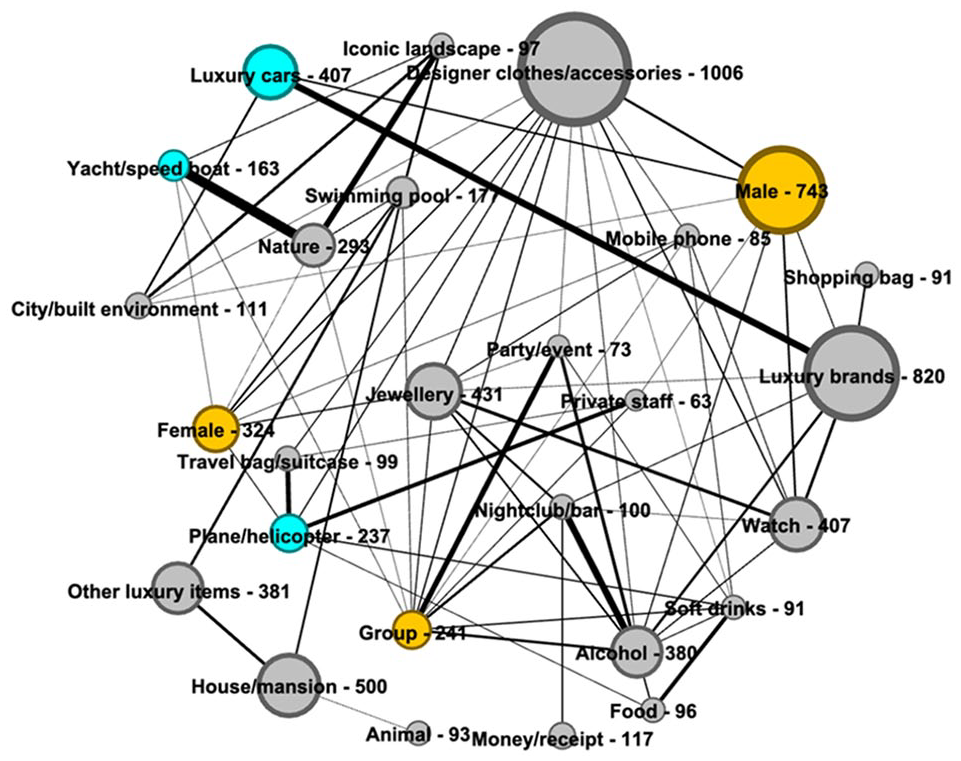
Image map of the relationships between the attributes extracted from the RKOI Instagram posts.
Results show that RKOI tend to use designer clothes or accessories, including handbags, hats, and sunglasses (n = 1,006), luxury brands (n = 820), and houses/mansions (n = 500), which are the top three attributes extracted from their Instagram posts, to construct their self-images on social media. There are significantly more photos featuring men (n = 743) than women (n = 324), and the number of photos featuring one man is high at 588, indicating that male RKOI are more likely to post photos of themselves, and this could suggest that RKOI speaks more to a masculinized identity. This is consistent with observations by others that women are less likely than men to use conspicuous wealth displays to signal status (Kruger and Kruger 2018; Panchal and Gill 2020). Comparatively, men are more likely to co-occur with luxury cars (z = 4.66), watches (z = 4.99), private staff (z = 2.18), cities/built environment (z = 2.09), alcohol (z = 3.60), and luxury brands (z = 3.23), whereas women are more likely to co-occur with planes or helicopters (z = 3.12), yachts or speedboats (z = 2.21), nature (z = 2.00), swimming pools (z = 4.95), jewelry (z = 3.66), and mobile phones (z = 2.41). These differences indicate that male RKOI are more likely to showcase wealth, power, and items that signal their masculinity, such as expensive cars, watches, and alcohol, which from an evolutionary perspective can be understood as part of a mating display (Sundie et al. 2011), or a repeated performance of hegemonic masculinity (c.f. Baker and Walsh 2018). In contrast, female RKOI mainly focus on luxury hedonic experiences in their Instagram posts, such as nature and swimming pools, and symbols of femininity, such as jewelry. Both male and female RKOI tend to showcase their designer clothes or accessories. A group of people, either men, women, or mixed gender, are most likely to co-occur with parties and events (z = 11.60), and settings where parties are highly likely to occur, like nightclubs/bars (z = 6.16), yachts (z = 2.39), swimming pools (z = 2.76), together with soft drinks (z = 3.87), alcohol (z = 6.19), and private staff (z = 3.11).
The category “transport mode” includes land vehicles (different kinds of luxury cars, n = 407), watercraft (yachts and speedboats, n = 163), and aircraft (commercial or private planes and helicopters, n = 237). Results show that besides men, luxury cars are also highly likely to co-occur with luxury brands (z = 14.68), which indicates that RKOI tend to showcase the logo and brands of luxury cars. Luxury cars are highly associated with cities/built environments (z = 5.26), which makes sense given high-end cars are usually showcased in urban areas. Besides groups of people and women, yachts and speedboats are highly associated with nature (z = 20.95) and iconic landscapes (z = 3.27), which indicates that yachts/speedboats are usually used in pristine natural settings and that RKOI tend to visit famous places in their yacht/speedboat tours. In addition to women, planes and helicopters are highly likely to co-occur with private staff (z = 9.20), designer clothes or accessories (z = 3.67), travel bags or suitcases (z = 10.58), food (z = 2.81), and soft drinks (z = 3.96). Planes and helicopters are highly associated with private staff, particularly private pilots and crew members. Taking planes and helicopters often means travel, hence they are also highly associated with travel bags or suitcases. Moreover, the findings show that RKOI tend to showcase their food and drinks in the air to signal the comfort of their mobility, which is intended to advertise wealth (Cohen and Gössling 2015).
The above results show that vehicles and air/watercraft used for travel play an important role in constructing RKOI’s self-image on social media, and different roles for varying transport modes across male and female RKOI are observed. Among the different modes, luxury cars can be further divided into sports cars (n=244), luxury SUVs (n=44), and other luxury cars (n=149); planes/helicopters can be divided into commercial planes (n=10), private planes (n=179), and helicopters (n=49); and yachts/speedboats can also be separated—yachts (n=152) and speedboats (n=29). When the specific vehicle type enters the co-occurrence network, it shows that men are strongly associated with sports cars (z = 3.82) and other luxury cars (z = 2.32), and women are strongly associated with private planes (z = 3.59) and yachts (z = 2.46).
Co-occurrence Analysis of Transport Modes and other Attributes in RKOI Posts
To further understand how different transport modes are used to construct RKOI’s self-image together with other attributes, five subgroup co-occurrence analyses were conducted, in which different transport modes and one of the five categories of attributes extracted from Instagram posts are included in the co-occurrence analysis, including comfort of mobility, postures, objects displayed, leisure settings, and captioned texts. Again, only positive significant associations (z scores higher than 1.96, p < 0.05) are shown in the maps. The cut-off point, 3% of occurrence frequency, was not used in the subgroup analyses, as some attributes have a frequency below 3%, but are important in meanings. To ensure informational completeness, all attributes in each of the five categories were included in the subgroup analyses.
Comfort of Mobility
Comfort of mobility in the RKOI Instagram posts includes private staff (including private pilots, private air crew, chauffeurs, and butlers), first class, space in aircraft, champagne/caviar during travel, and other signifiers of comfort during travel (e.g., comfy blankets, sofa-style seats or beds in airplanes). The co-occurrence analysis results (see Fig. 2) show that sports cars, though having the highest frequency among the three types of cars (n=244), have no strong associations with any indicators of comfort of mobility. This is unsurprising, given that speed is mostly associated with aggressive driving and masculinities in transport discourses (Cohen and Gössling 2015), which may be viewed as antithetical to comfort.
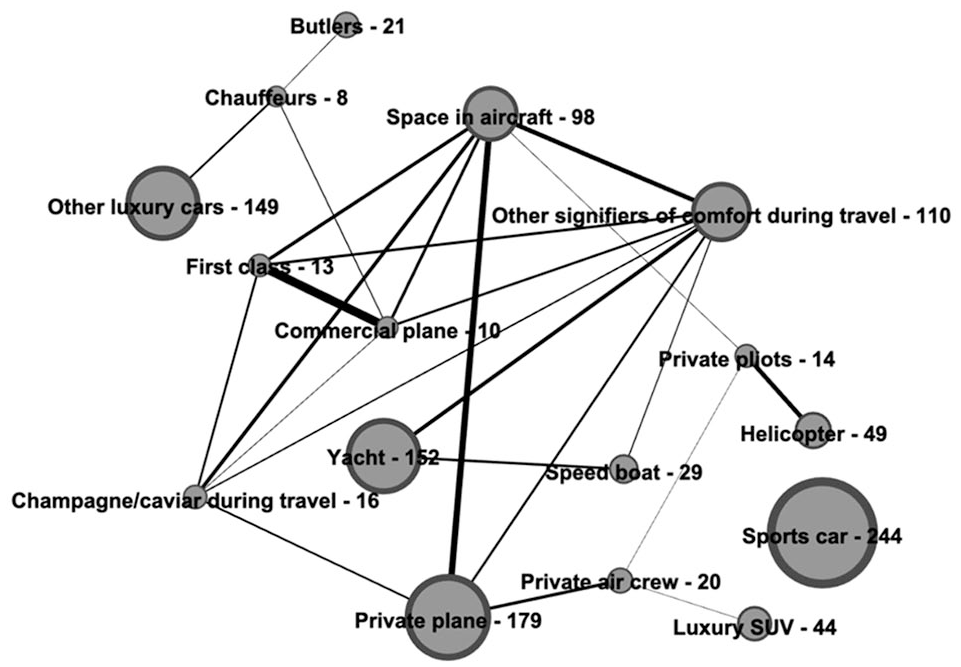
RKOI image map based on transport modes and comfort of mobility.
Luxury SUVs are more likely to co-occur with private air crew (z = 2.22), which is mainly because RKOI tend to take SUVs to go to and return from airports, and other luxury cars are more likely to co-occur with a chauffeur (z = 7.95). Both yachts and speedboats are more likely to be associated with other signifiers of comfort during travel (e.g., sofa-style seats and beds) (zyacht = 15.07, zspeed =9.39). Commercial planes, though with a low occurrence frequency (n=10), have a strong association with a chauffeur (z = 4.62), first class (z = 33.81), space in aircraft (z = 11.69), champagne/caviar during travel (z = 3.12) and other signifiers of comfort during travel (z = 9.64). Private planes are associated with space in aircraft (z = 24.37), champagne/caviar during travel (z = 7.64), other signifiers of comfort during travel (z = 9.39), and private air crew (z = 12.33). These results show that RKOI tend to showcase their luxury and exclusive travel experiences on aircraft. Not surprisingly, helicopters are strongly associated with private pilots (z = 8.04), as helicopter pilots are highly visible compared to pilots of planes.
Posturing with Transport Modes
In order to understand how transport modes are used for posing by RKOI in their photos, an analysis was conducted to see the co-occurrences of different vehicles/craft and the varying postures related to these, including standing on, laying on, sitting on, sitting in, and driving a vehicle or water/air/craft. The co-occurrence analysis results (see Fig. 3) show that sports cars are more likely to be associated with sitting on (z = 9.26), sitting in (z = 6.68), and being driven (z = 4.31). Luxury SUVs are highly likely to be associated with standing on (z = 6.59) and sitting on the vehicle (z = 3.58). Other luxury cars are highly associated with standing on (z = 4.27), sitting on (z = 3.63), driving (z = 5.28), and sitting in the vehicle (z = 6.74). Among the five postures, yachts only have a significant co-occurrence score with being driven (sailed) (z = 2.10), whereas speedboats are highly associated with standing on (z = 3.03), sitting on (2.32), and being driven (steered) (z = 7.80). Although yachts are highly associated with being driven by RKOI, such photos actually tend to show people steering smaller boats or driving a jet ski next to a yacht. Both commercial planes and private planes are strongly associated with sitting in a vehicle (zcommerical = 3.07, zprivate = 10.99). Additionally, private planes are also significantly associated with being stood on (z = 2.22), which mainly came from people standing on a car next to a private plane.
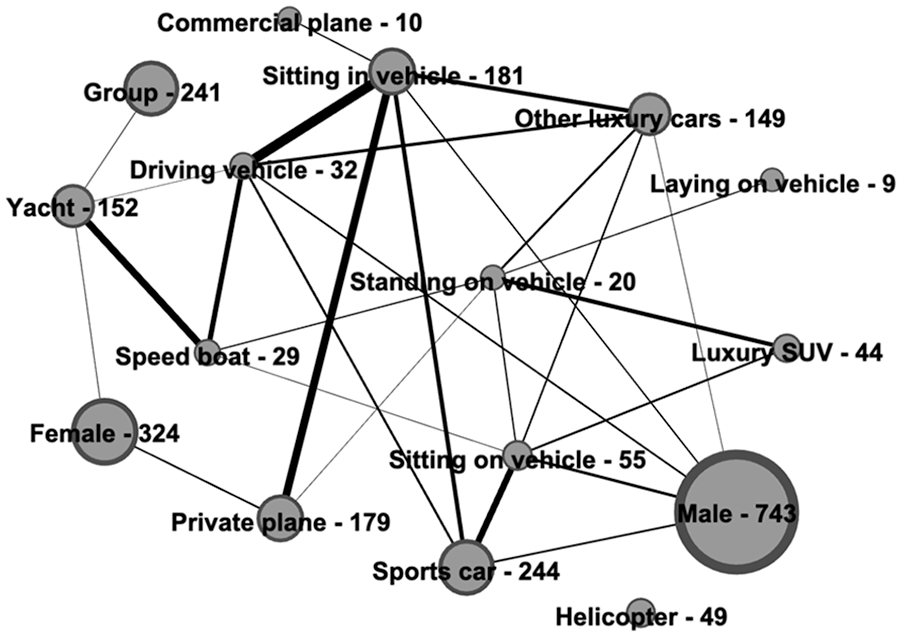
RKOI image map based on transport modes and postures.
When looking at the postures by gender, men are more likely to use these postures in their photos, including standing on, driving, and sitting in and on a transport mode, whereas women were not significantly associated with any of the studied postures. This could be because men generally co-occur more often with luxury cars than women in the Instagram posts. But this can also be linked to a potential desire among male RKOI to achieve high status by signaling dominance and control over transport modes, displayed through their position in relation to the transport mode. This may be especially relevant in the context of luxury SUVs, whose large size already signals dominance before they are even stood upon (Panchal and Gill 2020).
Displaying Objects in Transport
To test the relationship between different transport modes and objects in the RKOI Instagram photos, only transport modes and objects were included a subgroup analysis (see Fig. 4). The results show that all kinds of luxury cars are strongly associated with luxury brands (zsports = 12.09, zsuv = 4.71, zother = 7.47), indicating that RKOI showcase the brand logos of their luxury cars. Drawing attention to brands in this way is a means of crafting a positive self-representation, also associated with bragging and boasting (Sekhon et al. 2015). Yachts and speedboats are not significantly associated with any of the objects featured in the Instagram photos. All aircraft are strongly associated with travel bags or suitcases (zcommercial = 4.76, zprivate = 7.96, zhelicopter = 5.83), as aircraft are most relevant to notions of speed and reaching distant destinations in tourist travel (Larsen and Guiver 2013). Both commercial and private planes are highly likely to co-occur with food (zcommercial = 2.07, zprivate = 3.56) and soft drinks (zcommercial=2.16, zprivate = 4.49), and commercial planes are also highly associated with other wine, including wine, beer, and cocktails, z = 2.33).These findings indicate that RKOI tend to showcase their exclusive luxury life in a first-class commercial flight or a private plane, where objects are showcased that contribute to the elite status (c.f. Thurlow and Jaworski 2006), which RKOI seek to convey.
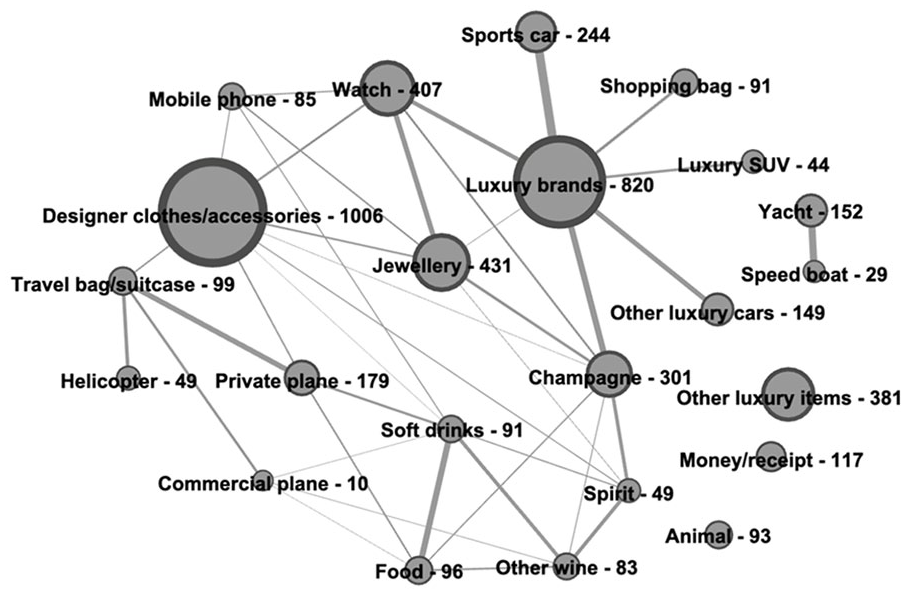
RKOI image map based on transport modes and objects.
Transport in Leisure Settings
To examine how different kinds of transport modes are shown in different leisure settings in RKOI Instagram photos, only vehicles and air/watercraft and leisure settings were included in a subgroup analysis (see Fig. 5). The results show that sports cars and other luxury cars are highly associated with city and built environments (zsports = 4.07, zother = 2.40). In addition, sports cars are very likely to co-occur with other natural environments, such as for instance, mountains, lakes, rivers, jungle, and forests (z = 2.03). Commercial and private planes are not significantly associated with any of the common leisure settings, as given their size they can only land at airports. In contrast, helicopters can land on open spaces in natural settings, and hence are highly associated with seas/beaches (z = 3.04) and other natural environments (z = 3.45). Both yachts and speedboats are highly associated with seas and beaches (zyacht = 26.2, zspeed =10.89), other natural environments (zyacht = 26.2, zspeed = 10.89), and iconic nature settings (zyacht = 4.22, zspeed = 4.00). This is mainly due to the nature of watercraft, which have to be used in natural environments, and that RKOI tend to showcase their holidays in iconic destinations, which convey status (Taylor 2020).
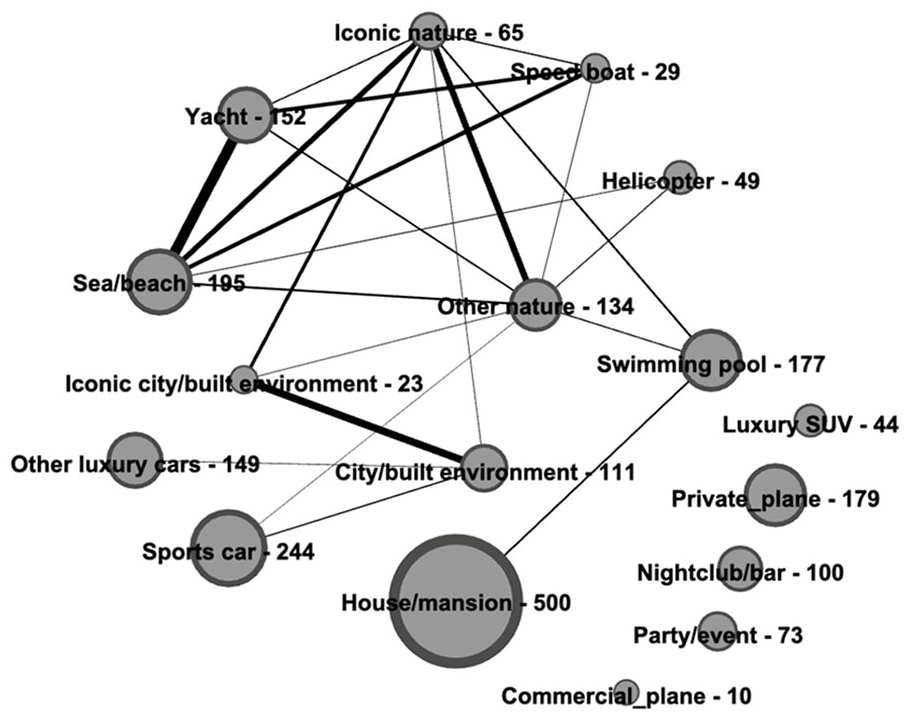
RKOI image map based on transport modes and leisure settings.
Captioned Texts on Transport Modes
To understand how photos picturing transport modes were described by RKOI in their Instagram photos, an analysis was conducted to see the co-occurrences of different modes and texts (see Figure 6). Results show that sports cars are more likely to co-occur with showcasing money or wealth (z = 2.59), luxury brands (z = 6.93), and “humblebragging” (z = 3.45). Compared to other types of luxury cars, sports cars are more conspicuous and indicative of wealth and social status. Hence, RKOI tend to mention the brands of the sports cars. Moreover, RKOI tend to use an indirect way to brag about their sports cars, such as being humble, or complaining about a problem. Bragging masked by complaint or humility is termed as “humblebragging” (Sezer, Gino, and Norton 2018). It is a self-presentation strategy that facilitates self-enhancement without overt bragging (Chen, Liu, and Mattila 2020). However, humblebragging could backfire because of insincerity (Sezer, Gino, and Norton 2018). Matley (2018, p. 30) shows the fine line between bragging and humblebragging, which “negotiates an appropriate level of self-praise and positive self-presentation.” The following verbatim text shows examples of showcasing money/wealth, luxury brands, and first humblebragging, followed by more overt bragging, under photos of sports cars: “I’m having difficulties choosing what to drive tonight, guys help me out please.”—No. 646 “Tough decisions this weekend #rollsroyce #phantom #bentley #gtc #porsche #whichdowetake?”—No. 835 “Jump starting the Ferrari #ferrari #problems”—No. 1239 “Time is money, so I use money to buy time. #cartier #ap #rolex #ferrari”—No. 459 “So much money I need three hands to count. Lambo just came out with a new custom colour. Blu Glauco #lamborghini #aventador”—No. 1020
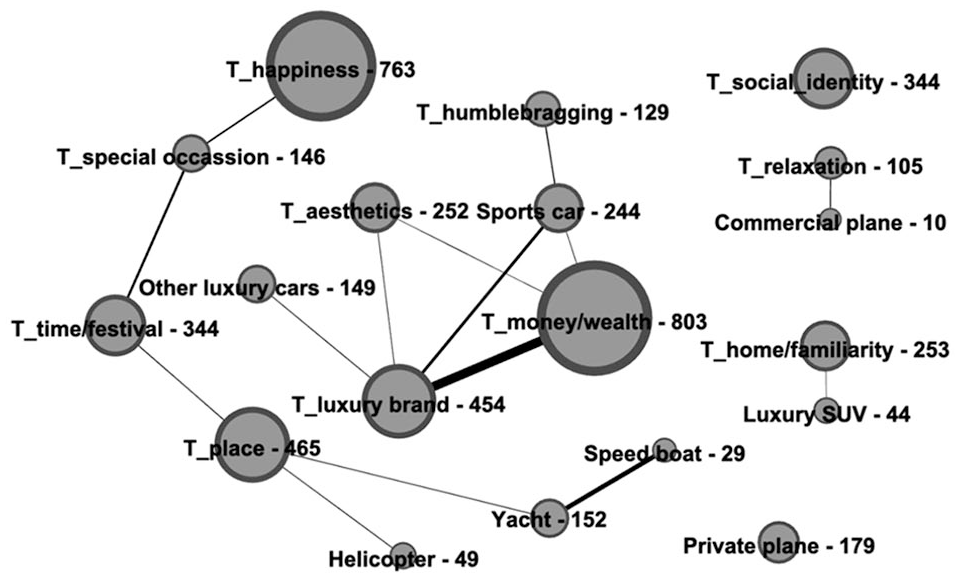
RKOI image map based on transport modes and texts.
Luxury SUVs are significantly associated with home or familiarity in texts (z = 2.06). This is mainly because SUVs take up a larger space than sports cars, and thus serve protective needs. They function as metaphorical tanks that reduce public exposure while providing safety and familiarity that proxies for home. Hence luxury SUVs, which are displays of material wealth and status in their own right, are more likely to appear in one’s home or yards. Other luxury cars are also highly associated with luxury brands (z = 2.80), indicating that RKOI tend to mention the brand name of other luxury cars. The following verbatim text shows examples that mention home under photos of luxury SUVs, but that also convey a type of “likeable bragging” in which the characteristics of luxury brands are downplayed (Sekhon et al. 2015): “Home sweet home”—No. 238 “It’s a casual home. Subtle.”—No. 340
Commercial planes are highly associated with words related to relaxation (z = 3.25), as commercial planes are highly associated with various things indicative of comfort, such as first class, space in aircraft, champagne, caviar, other food and drink, and other signifiers of comfort. The following text shows an example of relaxation on a commercial plane: “Ballin in the skiess #emirates #firstclass #suites #superchill”—No. 1562
Both helicopters and yachts are highly associated with place in texts (zhelicopter = 2.80, zyacht = 2.80), which indicate that RKOI often associate helicopters and yachts with iconic destinations. These are typically famous as luxury holiday destinations, for instance: St Tropez, The Hamptons, and Monaco. Tourists tend to mention destination names on social media when the destinations are luxurious, exclusive, remote, and recognizable by the audience, which help signal their status and financial freedom (Liu and Li 2020). The following text shows examples of mentioning iconic and luxury destinations, and their imbrication with transport modes: “Waiting for our chopper. . . . The only way to beat the Hamptons traffic these days.”—No. 1251 “#Back2theYacht #SouthOfFrance #MonacoGp #CannesFilmFestival #MegaYachtDocked The best way to end a crazy night”—No. 1343
As such, the mobilities depicted by RKOI are largely consistent with the travel and transport patterns that characterize the world’s wealthiest people (Beaverstock and Faulconbridge 2014).
Discussion
Our findings demonstrate that both energy-intensive transport modes and luxury travel, whether they are through air/watercraft or luxury cars, play a vital role in constructing RKOI’s self-image on Instagram. The luxury lifestyles portrayed by RKOI can be viewed as catalogues of what many young millennials “dream of having and the lifestyle they dream of living” (Marwick 2015, p. 155). Building on the findings and underpinned by literature related to experience sharing, costly signaling theory (Zahavi 1975), and mobility capital, we constructed a conceptual model (Figure 7) to encapsulate the interrelating roles of transport modes and luxury travel in RKOI image construction, and to reduce the wide range of processual factors into a manageable and visualized explanatory framework.
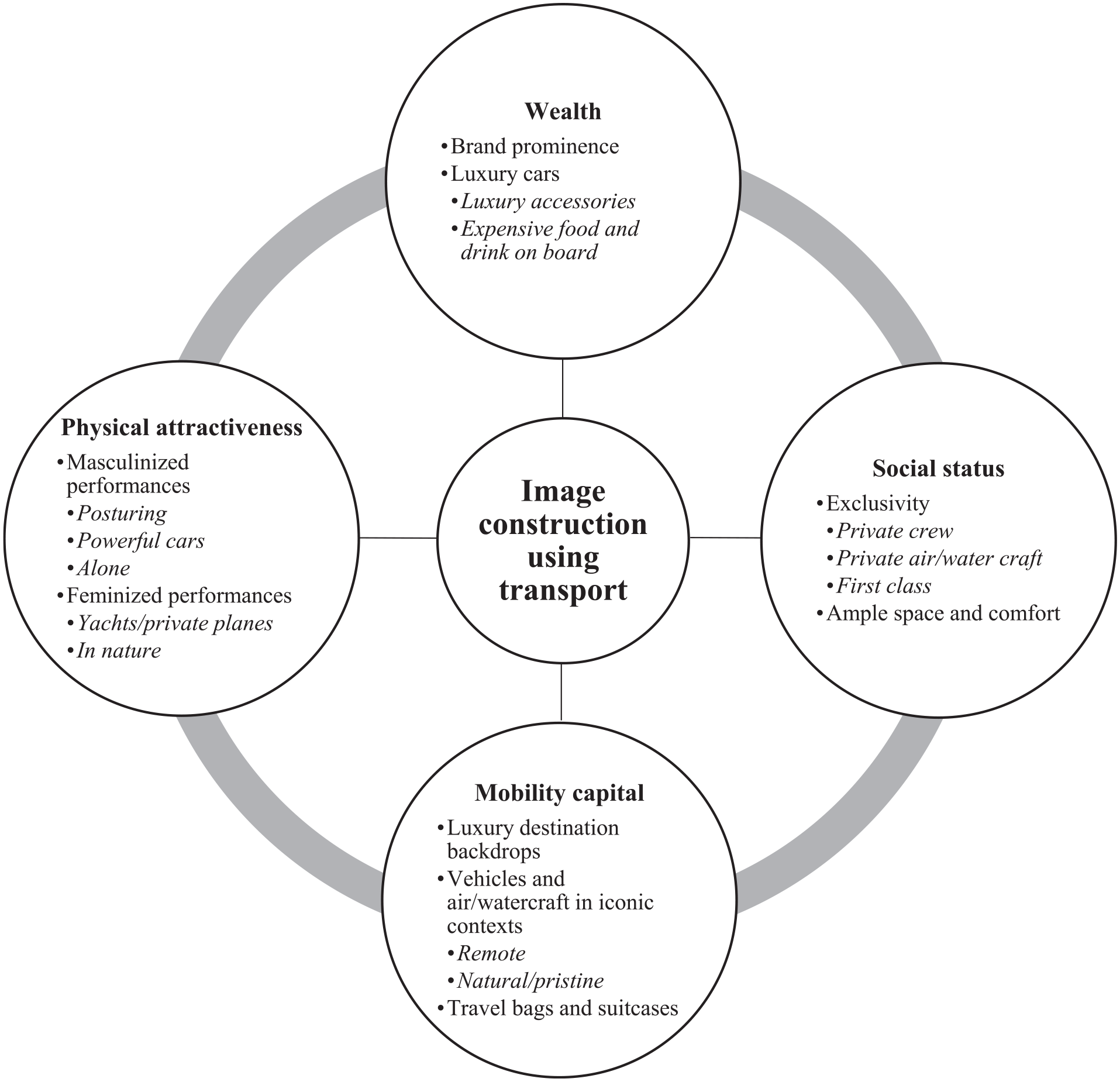
Conceptual model of how RKOI construct image using transport modes and luxury travel.
We identify, as indicated by the outer ring of circles, four interconnected macro-level signaling mechanisms through which RKOI construct image (the center circle) using transport modes and luxury travel: wealth, social status, mobility capital and physical attractiveness. These four mechanisms are each accompanied by meso-level consolidated evidence, with subthemes nested under the main points. Wealth is largely demonstrated through brand prominence, often via luxury cars. Brand prominence reflects the conspicuousness of a brand and hence could serve as a signal of wealth for luxury brands (Han, Nunes, and Drèze 2010). Transport modes, both cars and air/watercraft, become platforms for displaying luxury branded accessories (e.g., designer watches/shopping bags) and/or expensive food and drink. Flaunting wealth via conspicuous consumption is fundamentally driven by the need for social status (Lee, Ko, and Megehee 2015; Sivanathan and Pettit 2010). Besides the luxury transport, social status is also signaled through symbols of exclusivity, including private crew, the use of private air/watercraft, or where the latter are not accessible, the ability to travel in first class. Crucial to both private transport modes and the highest classes of service is that the displays are characterized by ample space and comfort. Luxury brands, luxury transport, and comfort of mobility are typical costly signals among human beings, as these signals require significant amounts of resources, like money and time (Bird and Smith 2005). They also indicate access to quality resources (wealth and social status), which may be thought to increase attractiveness (Zahavi 1975; Nelissen and Meijers 2011).
Mobility capital is signaled through luxury and/or iconic destinations as backdrops for air/watercraft. These are often remote or pristine natural settings, with travel bags and suitcases highly visible. These displays of distance, exoticism, and physical mobility aim to distinguish RKOI from their peers and show that RKOI have the freedom to travel wherever they choose in the world as a type of lifestyle. Such mobility freedom is enabled by financial freedom, as for instance, private aircraft also signal wealth. While mobility capital has been elaborated in past scholarship (e.g., Brooks and Waters 2010), “mobility signaling,” a term we coin here to express the importance of mobility capital in image construction through social media, has yet to be explored.
Lastly, physical attractiveness, including both elements of intrasexual competition and intersexual attraction, which reflect human beings’ evolutionary motive of mating (Buss 1988), is operationalized through heavily gendered dimensions. Displaying luxury possessions could inherently signal male attractiveness (Sundie et al. 2011). Posturing (i.e., standing on, sitting in) with powerful sports cars or luxury SUVs, often alone, reflects highly masculinized RKOI performances, intended to impress and signal dominance and control. This is in line with literature that masculine traits can be used as costly signals (Su, Kunkel, and Ye 2021). In contrast, physical attractiveness in female RKOI performances is primarily associated with yachts and private planes, often drawing on natural settings as backgrounds. This is evocative of associations of femininity with naturality (Soper 2000).
These four aspects interlace with each other, as each has its own meaning but can be connected with other aspects and extended beyond its own category (Figure 7). This conceptual framework provides a comprehensive understanding about the signaling mechanisms of the RKOI posts on Instagram. RKOI use luxury transport and associated contexts as costly signals to signal their wealth, status, mobility capital, and physical attractiveness, which help them construct a desirable self-image, to further enhance their social status, and increase their “mate value.” Signaling these four aspects via luxury transport on social media also reflects human beings’ social comparison motives: for self-evaluation purpose, or to signal a desirable self-identity via affiliating with a desirable social group (Nabi, O’Cass, and Siahtiri 2019).
Aircraft emerged as a notable transport mode within the analysis for their common depiction as places of comfort, becoming stages for elite displays of luxury food and drink, especially champagne and caviar. Where these are commercial flights, images centre on first class, with an emphasis on the ampleness of space. Where flights are private, space in the aircraft is again flaunted, alongside private aircrew. In COVID-19 times, this is likely to be extenuated, where private planes offer quick escape from impending lockdown regulations, as well as safety from potential infection on a commercial flight. Since the COVID-19 pandemic started, there have even been reports of “staged” photos for Instagram posts, which appear to be on private jets, but are actually a set in a warehouse (RogueRocket 2020). For US$64/hour, an influencer can rent a set in California through PeerSpace (peerspace.com/), to take a series of photos which are then selectively posted to appear mobile even when grounded (by the pandemic). This staging perpetuates further the status signals associated with private flights and suggests that the mobility itself is less important than the performance of wealth and prestige. It also demonstrates that some of the RKOI’s typical displays of affluence are increasingly being made available to ordinary people of lesser means, if even only staged and for a few hours.
The prominence given to either business or first-class air travel is deeply troubling for climate change, as the World Bank (2013) suggests that these have a three times (business) and nine times (first-class) larger carbon footprint than economy class. In turn, flying first class in scheduled air traffic consumes only a fraction of the energy used by private jets (Gössling 2019). The emphasis on accentuating private crew is also found within helicopters, which often come into juxtaposition with nature, signaling that this carbon-intensive transport mode is a desirable choice for reaching remote natural settings. Such iconic natural settings are also highly associated with yachts, which play an important role in signaling status among RKOI. The coupling of helicopters and luxury yachts with iconic destinations signals to followers that the most energy-intensive or exclusive modes of transport are the most desirable. This contributes to social norms that contradict and reject personal responsibility for climate change.
Our analysis was carefully attenuated throughout to further differences according to gendered dimensions. Male RKOI posted much more often than women, often posting photos of just themselves, particularly with expensive and powerful luxury and sports cars (Figure 7). Where “friends” are present, they are often positioned separately within the image, with each person standing on a separate car, or each presenting a very expensive item. This suggests their social networks are as exchangeable as their cars. Especially for sports cars, boasting of their exclusive brand was common, although this was sometimes attempted in a humble or indirect manner.
The results suggest that air/watercraft and vehicles intermingle in important ways. For example, luxury SUVs were found to be the vehicle of choice to reach airports, often chauffeured. There is a penchant among male RKOI to stand on such luxury SUVs to amplify the power and dominance these energy-intensive vehicles connote, even though their prominence may be downplayed in captions through understatement. In contrast, female RKOI were more likely to appear with private planes and yachts, often accompanied by private staff and pictured in iconic destinations. Images that highlight travel bags or suitcases, and hence directly imply tourism consumption, are predominantly associated with aircraft. This perpetuates the notion that air travel, and the consumption of distance, is the mode par excellence for tourism (Larsen and Guiver 2013), despite aviation’s significant impacts on climate change (Cohen and Kantenbacher 2020).
The paper’s findings are thus deeply connected to questions of sustainability, even though our results can only demonstrate that both energy-intensive transport modes and luxury travel play vital and varied roles in constructing RKOI’s self-image on Instagram. The highly consumptive lifestyles displayed by the RKOI have implications for broader social norms that constitute the foundations for what millennials may think is “normal,” desirable, or aspirational travel and transport behavior. This is despite the reality that access to such energy-intensive transport modes and luxury travel experiences is highly inequal and practiced by just a small minority of the global population (Gössling and Humpe 2020). The COVID-19 pandemic is however amplifying these disparities, as destinations are looking to rebound and rebuild, with some actively planning to target affluent/super-rich segments as part of their recovery strategy (c.f. Higham and Tucker 2020). This reflects COVID-19 having made many affluent people even more wealthy, while many others of lesser affluence have simultaneously suffered enormously economically. Such increasing divergence in the distribution of wealth has implications for the immediate future of the tourism sector, in terms of both social justice and environmental sustainability.
Although there is emerging evidence that the travel of the world’s wealthiest and most famous citizens contributes disproportionately to global GHG emissions (Gössling 2019), the role of the super-rich in generating transport emissions remains insufficiently understood (Gössling et al. 2018). Through the case of the RKOI, we argue that the tourism- and transport-related displays of affluence of the super-rich are an important yet largely neglected barrier to shifting social norms toward less carbon intensive travel. These displays lie in an unresolved tension with recent starkly contrasting media attention on environmentalism and sustainable travel among young people, that is, “the Greta Thunberg effect” and the Fridays for Future global youth movement (Gössling 2019; Mkono, Hughes, and Echentille 2020).
In contrast to Hanna et al. (2018), who unpacked the potential for celebrities and role models to advocate sustainable transport, the present article has brought to the fore an opposing perspective. The identities signaled by the RKOI have the potential to influence the social normalization among millennials of energy-intensive transport modes, luxury travel, and broader lifestyles of affluence. Such highly visible lifestyles are arguably the height of capitalism and the antithesis of sustainable, low carbon living. Signaling strategies based on wealth displays are costly for individuals as well as society given the need for collective action to decarbonize consumption and production (United Nations 2015). While the RKOI can potentially derive a biological value from costly signaling, it is against a social cost for society, with the notable implication (and irony) that wealth displays contributing to climate change undermine the reproductive opportunities of other humans, and, in the longer run, the RKOI’s own. They are potentially an important yet largely overlooked puzzle piece in understanding persistent injustices and inequalities in travel and transport consumption.
Conclusion
The purpose of this article was to analyze the ways in which transport modes and luxury travel are depicted and interrelated through RKOI images. Instagram allows for the study of shifting societal discourses of tourism, yet to date its use as a visual method in tourism research has been characterized as timid (Volo and Irimias 2020). We have thus responded to the call from Volo and Irimias (2020) for bolder and more rigorous analyses of Instagram image collections as a visual data source. Our co-occurrence analyses have shown that the RKOI tend to depict themselves with powerful cars, helicopters, luxury yachts, and private jets, where they for instance flaunt ample space, private crew, and luxury food and drink, often coupled with iconic destinations as the backdrop.
Addressing a lack of research on the interrelationships between luxury travel, transport modes, and image construction on social media, this article has offered the first empirical evidence that energy-intensive transport modes and luxury travel are highly visible in RKOI Instagram posts. This allowed for the development of a conceptual model, which as a further original contribution to knowledge, sheds light on the ways in which online displays of affluence in travel and transport consumption manifest. The conceptual model provides the foundations for future research that can empirically test the relationships between its factors and their implications for sustainability.
The lifestyles represented by RKOI may contribute to the social normalization of carbon-intensive transport choices that are coupled with luxury destinations as a backdrop. However, the article is limited in that it has not examined whether demand for luxury travel and carbon-intensive transport modes is in fact induced by these RKOI posts. Future research could also explore the audience’s attitudes, perceptions, and potential aspirational consumption intentions in response to the RKOI posts. Big data analytics could be used to explore the audience’s attitudes and perceptions by analyzing followers’ engagement with the RKOI posts, such as comments, number of likes, and number of shares. Experimental methods could be used to test the causal effects of RKOI posts on potential induced demand for luxury travel and carbon-intensive transport modes among the audience members. In addition, this study included Instagram posts with the hashtag of RKOI but did not differentiate social media influencers and noninfluencers. Self-presentation strategies could be different depending on the size of the audience (Barasch and Berger 2014). Future research could investigate how social media influencers use luxury travel and carbon-intensive travel modes in image construction, as they have a larger audience and greater influence on shifting social norms toward or away from sustainable travel behavior.
The affluence of millennials is less than previous generations (Marder et al. 2018), and COVID-19 will likely further diminish, at least in the short term, the attainability of luxury travel for this generational cohort. An exception to this may be the continued rise of hourly rentals of staged or real luxury vehicles (air, land, and sea), through which aspiring millennials can affordably secure photos of themselves that are used to signal desired identities on social media. There is little doubt though that destinations will nonetheless use highly visible influencer posts to restart and accelerate their hoped-for return to pre–COVID-19 “normality.” If the tourism and transport industries are serious about promoting sustainability, it may be necessary, however, to counter posts like those of the RKOI by using opinion leaders and social media influencers, who reach out to hundreds of millions of followers, to lead opposing trends toward less carbon-intensive travel. The power of social media and the accounts such as those we have discussed in this article need to be accounted for in the purposeful development of a travel and tourism market that is not dependent on high-carbon forms of mobility.
This research also has policy implications. Highly carbon-intensive lifestyles have been recognized as barriers to the attainability of sustainability goals, such as to limit climate change. While concerned individuals struggle to limit their carbon footprints, the RKOI exhibit a sense of entitlement and carelessness regarding these challenges. This confirms the inadequacy of current climate governance systems to deal with wealth, and to specifically address and include the high emitters: market-based policies will have little effect in this regard.
Supplemental Material
sj-docx-1-jtr-10.1177_00472875211037748 – Supplemental material for The Rich Kids of Instagram: Luxury Travel, Transport Modes, and Desire
Supplemental material, sj-docx-1-jtr-10.1177_00472875211037748 for The Rich Kids of Instagram: Luxury Travel, Transport Modes, and Desire by Scott Cohen, Hongbo Liu, Paul Hanna, Debbie Hopkins, James Higham and Stefan Gössling in Journal of Travel Research
Footnotes
Declaration of Conflicting Interests
The author(s) declared no potential conflicts of interest with respect to the research, authorship, and/or publication of this article.
Funding
The author(s) received no financial support for the research, authorship, and/or publication of this article.

Supplemental Material
Supplemental material for this article is available online.
Author Biographies
References
Supplementary Material
Please find the following supplemental material available below.
For Open Access articles published under a Creative Commons License, all supplemental material carries the same license as the article it is associated with.
For non-Open Access articles published, all supplemental material carries a non-exclusive license, and permission requests for re-use of supplemental material or any part of supplemental material shall be sent directly to the copyright owner as specified in the copyright notice associated with the article.
