




Abstract
COVID-19 reaction policies have had the effect of putting the tourism economy into a form of forced hibernation. Currently there is speculation about what will happen as tourism begins to emerge from its dormant state. In this article, we use the concept of a system to analyze the potential research implications of COVID-19 effects on tourism. In doing so, we firmly place tourism within the concept of a system that relies on a steady flow of money from tourists to function. Three scenarios, each with two end states, to cover the array of potential reactions and recovery from the pandemic are presented. An impact grid is constructed to be able to follow the effects of policies and interventions on tourism objects and subjects. Examples of how research may use the grid to uncover impacts are presented. Conclusions reinforce the need for a system approach to guide COVID-19 tourism research.
Background
The pandemic, brought on by novel coronavirus SARS-CoV-2, started mid November 2019 in Hubei, China. According to the World Health Organization (WHO 2020b), this new disease was treated as a local phenomenon by the Chinese government for a long time. It took one and a half months before China reported at the end of the year (31 December 2019) to the WHO a cluster of pneumonia in Wuhan, Hubei Province. One week later, the WHO published a first “Disease Outbreak News” on the new virus, but already one week after that, a first case was confirmed in Thailand. On the 10th of January, China documented the first death caused by the new virus (Qin and Hernández 2020). After two more weeks (23 January 2020), the WHO could not reach a consensus as to whether this outbreak should be assessed as a public health emergency of international concern. On the same date, China imposed a travel ban for Wuhan, which, however, was issued too late to avoid rapid and sustained transmission of the virus (Chinazzi et al. 2020). This regulation prevented people to travel from or to the province of Hubei. Public transport was suspended and the airport closed. Shortly after, the population was obligated to stay at home under a government “lockdown order.” Economic and social life came to a halt. It took two months before the Chinese government declared the end of the epidemic and lifted the lockdown and travel ban. On the 29th of March, the number of flights departing from Wuhan Tianhe international airport increased from almost zero to 139, reaching a level of 206 flights on the 9th of April (Flightradar24 2020).
In the meantime, the virus SARS-CoV-2 spread over the globe. The WHO classified the crisis as a pandemic named coronavirus disease COVID-19 one month later (March 11) because of the alarming speed of spread and severity of the disease (WHO 2020a). Shortly after, the number of infections increased at an exponential rate in Italy, and just one or two weeks later in most other European countries and the United States (Johns Hopkins University & Medicine, Coronavirus Resource Center 2020). Gradually, all countries affected by the virus imposed travel restrictions and started to lock down single regions and, finally, even the entire country. In this way, core destinations of three of the world’s largest tourism areas ranked by revenues, namely, Europe (39%), Asia and Pacific (30%), and Americas (23%) (UNWTO 2020), had taken measures to stop the pandemic but at the same time also the tourism economy. The number of daily scheduled commercial flights decreased from around 125,000 at the beginning of the year 2020 to around 30,000 since the beginning of April (Flightradar24 2020). Most cruise companies had to stop operating (Luscombe 2020), Alpine ski resorts had to end their season one month early, and large, profitable tour operators became companies in crisis, needing state aid to survive, for example, Europe’s largest tour operator TUI with 1.8 billion Euros by the German government (TUI Group 2020).
This deep crisis of the tourism economy also has changed the world of tourism research. There are obvious disruptions caused by this crisis. Phenomena such as overtourism or the contribution of air traffic and cruise tourism to climate change are, at least temporarily, not observable anymore. Additionally, some research using recent pre-crisis studies such as time-series and forecast data are not valid anymore, causing researchers to update their models with new exogenous effect variables. Empirical studies working with personal interviews had to be stopped as well as long-running longitudinal studies, which might fail because of the incomparability of data collected before, during, and after the crisis. On the other hand, the crisis opens a door for new research as new phenomena can be observed, tracked, measured and analyzed. It is almost a given that industry sectors, destinations, and policy makers are searching for advice about how to handle the crisis for a fast recovery.
Disruptions in tourism are nothing unknown. They had been studied in a variety of contexts, covering innovative, social, market, or environmental disruption. Innovative disruption caused by the emergence of the sharing economy were discussed by Guttentag (2015), Sovani and Jayawardena (2017), Widtfeldt Meged and Zillinger (2018), and Dogru, Mody, and Suess (2019). Veiga et al. (2017) describe disruption of tourism markets by the changes of consumer preferences through the generational shift of millennials. Disruption based on social disruption theory and brought on by rapid tourism growth (Perdue, Long, and Kang 1999; Park and Stokowski 2009; Han, Wong, and Ho 2018) as well as disruption through crisis and disaster from the perspective of companies (Henderson 2005; Hirudayaraj and Sparkman 2019), the airline sector (Amankwah-Amoah 2016), and destinations or regional economies (Cole 2010; Montenegro et al. 2014; Gani, Ramjit, and Nazki 2018; Starosta, Budz, and Krutwig 2019; Jawahar and E. N. 2020) are further observed and studied types. The dimension of the disruption caused by the COVID-19 pandemic goes far beyond all these types and happens globally at once. Often the disruptions described are of a fundamentally different character. For example, social disruption theory was applied to rapid growth but so far not to dramatic decline. Disruptions caused by innovation and new business models took place in stable or even growing markets and not in a situation of a market collapse. Thus, the presented research results will contribute as valuable knowledge to handle some aspects of the crisis, but they do not cover the crisis in its totality.
Similar limitations exist for the literature on tourism crisis/disaster response and management: In a review of 142 papers, Ritchie and Jiang (2019) showed that most publications took a case study approach for a single destination and/or tourism type or sector and noticed a general lack of conceptual foundations and framework testing. One field of management as response to crisis is the handling of resources. The political interventions as answers to COVID-19 created within a very short time a tremendous volume of temporarily redundant resources: infrastructure, equipment, staff in the tourism business but also all types of public services used and needed by tourists. Being confronted by overcapacities all over the globe and in nearly all parts of the tourism business, traditional answers for reallocation potentially will fail.
Consequently, change and challenges in tourism research due to the COVID-19 pandemic caused by the SARS-CoV-2 virus have sparked a lively discussion in the tourism science community. The “Tourism Research Information Network” TRINET is the largest information exchange platform of tourism scholars in the world, with currently about 3,350 registered subscribers (information from TRINET administration from end of March 2020). It showed a rapid increase of discussion threads dealing with diverse topics caused or linked with the virus since the end of February. To create an overview of the new COVID-19 research activities, a new web-page www.tourismtransformed.com has been set up by R. Ohridska-Olson, P. Singh Manhas, B. M. Kitheka, and A. A. Lew (Travel & Tourism Transformed 2020) listing a large number of special issues book projects from publishers and research proposals.
The question the world and research are facing with the COVID-19 pandemic is not whether there will be significant disruptions as a result of the virus but where those disruptions will occur, how long they will last, and what elements of the tourism economy will emerge from this battered and diminished system but ready to embark on the road to recovery. The most promising way to try and understand the implications of something so disruptive as a pandemic is to understand how the affected system operates. That is what this article tries to do by offering a theoretical review of the tourism system in place and providing practical examples of scenario building by subjecting different elements of the system to different stresses. Furthermore, methodological considerations concerning the identification of research topics and the use of existing knowledge will be drawn.
Tourism as a System
The fundamental question is how the pandemic and its long-term effects change tourism. This needs a differentiated view of tourism in all dimensions. In other words, a system approach. In extant literature several models for tourism as a system can be found. As models are a simplified picture of reality, it is logical that there does not exist one single model, as varying the perspective leads to other models. Six types of perspectives can be found in the literature (see Table 1).
Tourism Systems in Literature.
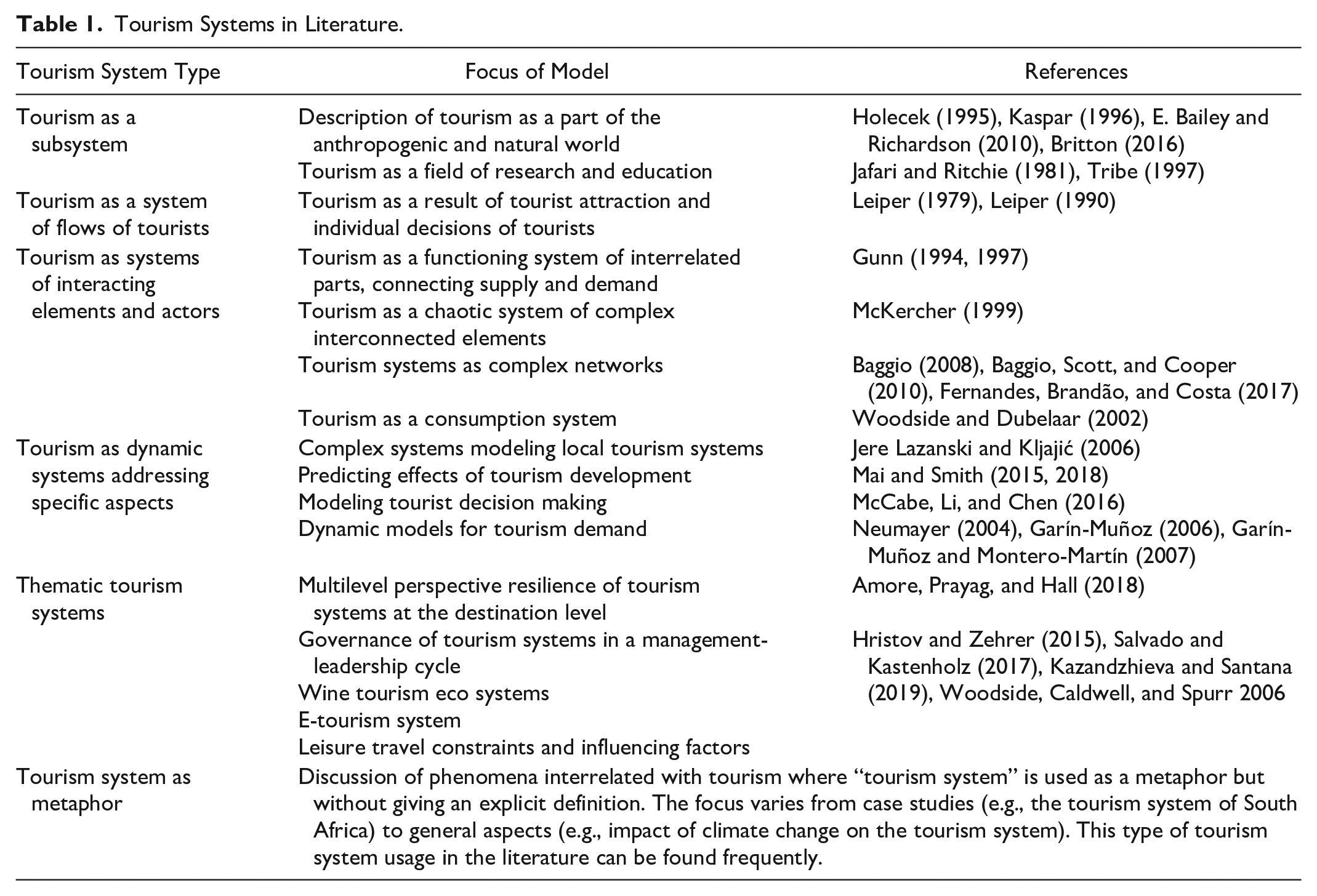
The virus SARS-CoV2 in its origin is not the result of tourism. It is a tourism external intruder, an exogenous shock, in the anthropogenic sphere causing a change of subordinate systems of tourism.
From all existing tourism systems described in the literature, the authors chose the first two model types (Figure 1A and 1B) as the basis for further discussion. To derive an applicable and easy-to-use research classification, which will be presented later as a tourism research grid, static tourism systems are favorable. Nevertheless, they allow to add or erase system elements, to increase or decrease their importance, and to create new connections or drop existing ones. By this, they allow to introduce dynamic elements and later to work in detail with dynamic subsystems as they are listed in Table 1. However, the tourism system is a highly complex and dynamic network, which is composed of nonlinear relationships (Baggio 2008) and is highly influenced by feedback mechanisms, creating intended as well as unintended effects (Mai and Smith 2015, 2018).
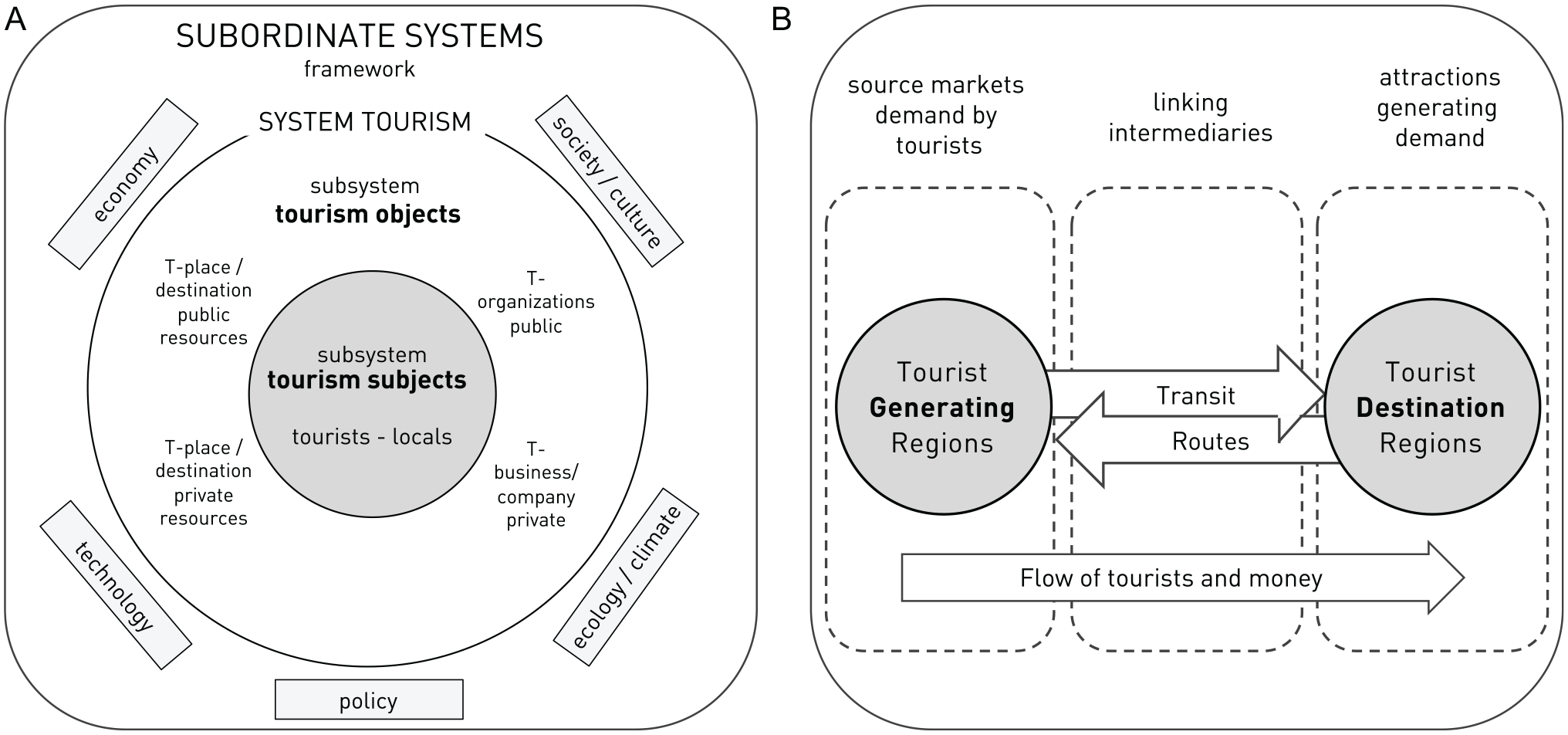
Tourism as (A) embedded and (B) flow systems.
Conceptualizing tourism as an embedded system (Figure 1A), the changes caused by COVID-19 take place in the framing conditions—the subordinate systems (Holecek 1995; Kaspar 1996). Policy makers react by nonpharmaceutical interventions (NPIs; Cowling et al. 2020) as well as by financial and economic policy measures. Societies change their awareness of risks in daily life, including individual decisions about traveling. Nature shows some recovery in lockdown areas, including wildlife taking back tourist-free areas (The Guardian 2020). However, the tourism system as a subsystem is not changed. It still consists of two major elements: tourism objects and tourism subjects. Tourism objects cover all types of private and public businesses, organizations, and resources. Tourism subjects are a grouping of tourists and locals sharing tourism objects at a destination level. The change of the framework conditions changes processes and management activities of objects and individual behavior of subjects in the tourism system but not the general structure of the system itself.
The tourism system as described in Figure 1B is akin to a biological system in the sense that it relies on a steady flow to function. In a biological system, the flow is composed of fluids that sustain and grow the biological organism. In the tourism system, as in all other economy-based systems, the flow is money. In the case of tourism, the flow is carried and disseminated primarily by tourists (Figure 2A) through a system of intermediaries to destinations. The amount of flow is symbolized in the figure through the size of the arrows between the elements. The tourists are groups of people traveling from different regions and for different reasons such as leisure or business travel, represented in the model through the source markets Sn and illustrated in the figure with five symbolic source markets S1 to S5. A second group of system elements are intermediaries, offering services to plan, book, and organize these journeys. Travel agents, tour operators, as well as airlines, railway companies, and other carriers bring tourists from their home to the holiday destination. These are named In and are exemplified in the figure by five symbolic intermediaries of different size by I1 to I5. The third group of system elements are destinations Dn and their network of businesses offering touristic and nontouristic services, such as hotels, gastronomy, retail, and local transport. The figure shows five symbolic destinations D1 to D5 with different sizes and capacities.
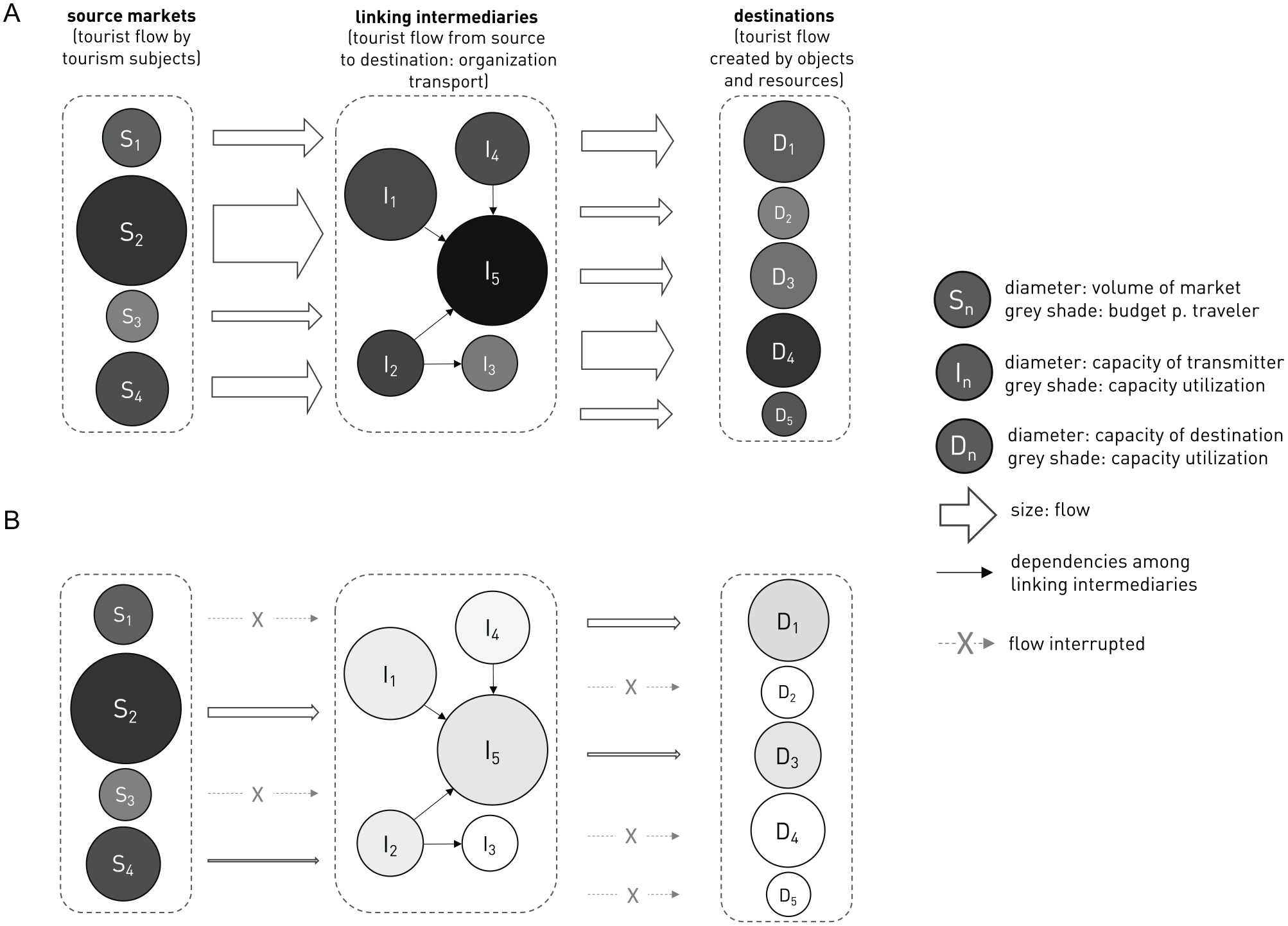
Tourism flow system (A) before COVID-19 and (B) after COVID-19 travel restrictions.
There are many concerns and issues brought on by the flow of tourist money that affects components of the system. The direction and intensity of the flow first of all is caused by the attractions (Leiper 1990). Overtourism is one example of unintended consequences, caused by an increased flow to outstanding and unique attractions (Avond et al. 2019). It exceeds what some elements in a local system might find acceptable while others in the system actively promote a greater flow to the same attractions. The extent of flow is situational, which cannot be any clearer than at this moment when the responses to COVID-19 have virtually cut off the flow of tourist money to many areas in the world (Figure 2B). Venice, Dubrovnik, Amsterdam, and Pattaya as tourist destinations, inter alia, no longer have an overtourism problem. Rather they are experiencing an undertourism problem brought on by a greatly diminished flow in the system from the tourist-generating regions (Leiper 1979). Even when structural elements connecting the tourist-generating regions and the destinations move to increase the flow, as through government support policies, the flow on the transit routes may not be turned back on until the carriers of the flow (i.e., tourists) decide to turn it back on.
As shown in Figure 2, the COVID-19 pandemic leads to political decisions (Gostin and Wiley 2020), which cut the flow in the system from one day to the next. The main components of the system remain at the first moment untouched: there are still people having the wish to travel, and there are intermediaries linking the source markets with the destinations being able to offer services needed to organize a trip. And no destination disappears. They are just unavailable because of the travel restrictions imposed, thereby interrupting the flow. Over time, the size of system elements, as source markets, capacities of intermediaries, as well as destinations, might change. In extreme cases, it also might happen that an important intermediary like a large airline or cruise-line fails or some destinations remain inaccessible for a longer time . Nevertheless, it is very unlikely that the virus will destroy the reason of traveling to a destination, that is, the attractions. Thus, the general components and basic principles of functioning remain the same. In other words, the system remains intact but the global disruption forces some operations to function at a diminished level while some system elements struggle to survive. Recent changes have seen the introduction of a sharing society into the heavily controlled accommodations sector through the introduction of Airbnb, although other sharing sites such as VRBO preceded it. But has this led to a change of the tourism system? No, as Airbnb only took a structural change in the group of intermediaries and expanded it. The general components of the flow model did not change—it just added another intermediary changing process and the adaptation of new management practices. The strong control exerted over the accommodations sector by businesses that for years had been in a position of power began to erode (Guttentag 2015). Overtourism became one of the system responses to this emergence of a vast new supply of destination accommodations no longer controlled by a few hoteliers. Lyft and Uber have done the same thing to local private ride services. New ways of doing some of the same old things can change the conditions and interrelations of a system, leading to both desired (i.e., new markets) and unexpected (i.e., overtourism) changes (Bourliataux-Lajoinie, Dosquet, and del Olmo Arriaga 2019). Structural changes such as adding a new accommodation form affect the flow and thereby create issues that were not previously considered relevant.
Future Scenarios of the Tourism System Considering COVID-19
There are many unknowns when trying to project the aftermath of the COVID-19 pandemic. These unknowns make it very difficult to forecast the future or even to construct research studies necessary to study short-term and intermediate impacts. No one really knows how long the pandemic will last, if there will be treatments or a cure in the near future, or if draconian NPIs such as quarantine requirements will be imposed on all international travelers. But some things are fairly easy to predict based on what had been happening in the tourism system before the disruption brought on by the pandemic. There are five obvious triggers from reactions to the COVID-19 pandemic influencing the tourism system as described by the model presented in Figure 2A:
Travel restrictions preventing the population from leaving their place of residence. This makes the travel of tourists with their flow of money from the source markets (Sn) impossible.
Lockdown of regions, or at a national level (Sjödin et al. 2020), including the mandatory closure of accommodations, restaurants, and tourism-related attractions. Locking the attractions stops the flow as there is no more reason to visit a place. Furthermore, the capacities of the destinations (Dn) become unavailable.
Intensive search for a vaccine and/or effective treatments. Their availability (Dresden 2020) is the basis for stopping the two types of NPIs and reopen the transit routes and revitalize the flow. A vaccine will bring back the demand from source markets (Sn), allow intermediaries (In) to restart their services, and lead to a stepwise reopening of the destinations (Dn). However, it is not at all clear how much of the flow will return and in what time frame.
State interventions including massive bailout programs to keep economies running and to avoid failure of system-relevant tourism objects (i.e., elements). These affect tourism objects acting as linking intermediaries (In) such as airlines, tour operators, and the huge number of tourism businesses in the destinations (Dn), primarily the small and medium enterprises, seeking support for survival. Despite these interventions, it is very likely that some tourism objects will fail. This will change the overall capacity of intermediaries as well as the competition between them, consequently affecting the flow on the transit routes. It will also affect capacities in destinations as some of the most vulnerable tourism-dependent businesses fail.
Recession, and possibly depression, is an unavoidable result of the lockdown of entire economies (OECD 2020). This will reduce the volume of tourists from generating regions, the source markets (Sn). Furthermore, the travel budgets of those who still are willing or have to travel might shrink as well. As the money spent by tourists is the product of the volume and the budgets of tourists, these two effects of a recession exacerbate the reduction of flow. Even when the virus is no longer an issue affecting travel, the extent of its effects can linger for a long time, depending on how severe the effects have been on structural elements in the system.
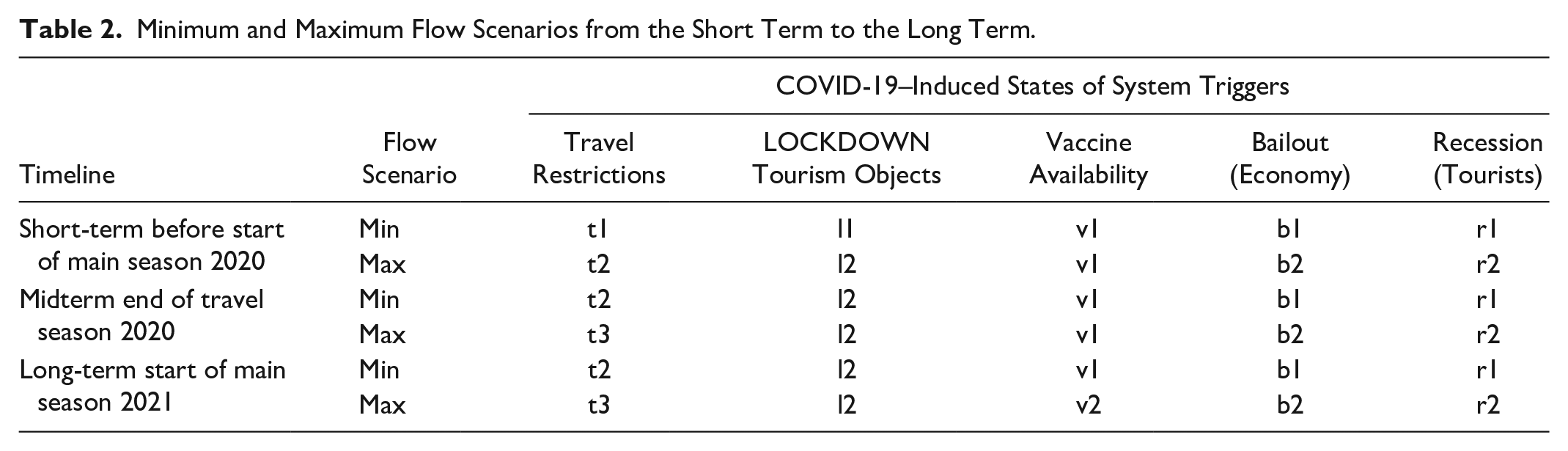
The described five main effects on the tourism system and its components do not show up globally at the same time and intensity. And all are unpredictable concerning their end. Regarding travel restrictions, three levels are relevant: full restrictions, returning from “unavoidable” trips implies 2 weeks’ quarantine (t1); national traveling allowed within some countries, mandatory use of surveillance apps, and some bilateral alleviations (t2); and finally, if most international traveling is allowed, in some countries the use of surveillance apps will be mandatory (t3). The lockdown of tourism objects can be categorized in two stages: first, the lockdown of accommodations, restaurants, and attractions (l1) and, second, the reopening of all tourism-relevant objects but still under mandatory regulations about distancing and hygiene. The availability of a vaccine is of the binary type: no (v1) and yes (v2). Currently, experts do not expect a vaccine before the end of 2020 (Weintraub, Yadav, and Berkley 2020). The duration and volume of bailouts will differ among countries. What we saw at the beginning of the crisis had been ad hoc support programs in most of the countries, creating a high money flow in the tourism system substituting the tourist money by state aids. For example, the US Senate approved a “$75 billion for industry-specific loans to airlines and other hard-hit sectors” (Cochrane and Fandos 2020) that was later supported by the US Congress and became part of a bill signed into law by the president. Recently, the government of France provided direct subsidies of approximately 3 billion Euros and loan security for an addition 4 billion Euros (European Commission 2020a). End of April 2020, the total sum of direct state aid and loan guarantees for European airlines summed up to more than 30 billion Euros (J. Bailey 2020). Worldwide, most countries announced to support their “system relevant” tourism companies such as major airlines, airports, or big players from tour-operating or cruising. So far, it is uncertain if this will be limited to a one-time bailout or needs to be extended for businesses most at risk (b1). If the countries continue payments without limitations (b2), who is to receive them? Intermediaries that carry the flow? Large corporate entities that overall account for the most capacity in a destination? Or SMEs that are the lifeblood of many local entrepreneurs? One could argue that the tourists themselves need support payments, which is happening in some countries through direct payments to residents, as they are responsible for the flow (The Economist 2020). Without tourists, businesses dependent on tourism are essentially empty shells. Regardless of the bailouts, a recession has occurred. Although recessions showed a moderate negative impact on leisure travel in the past, business travel was always hurt earlier and at a greater rate. The most negative impacts occur when there is a fast and strong decline of the number of travelers in combination with a significant reduction of the average budget per traveler (r1). This would significantly reduce the flow in the system and make it more likely that a recovery will not occur within a short period. The hope of many countries is that bailouts will bridge the lockdown period, recession will be moderate in 2020 and the first signs of a global recovery will appear already in 2021 (r2). However, whatever recovery results, it will be uneven. Parts of the world, such as Sub-Saharan Africa where health and economic systems were already stressed, may not be able to recover for a longer period of time (Cordall 2020). It is important to remember the situation in place before the economic distress caused by policies to stem the pandemic to understand implications for the future post pandemic.
Ancillary effects, although not modeled by a tourism system, are potentially even more serious. Some countries rely on tourism for an inordinate amount of their GDP. If a large percentage of people in these countries fall deeper into poverty as a result of tourism flow reductions, starvation is a very serious concern. Failing economies can lead to failing states, rising crime, global terrorism threats, and a prolonged depression due to safety and security concerns, further reducing the flow of tourists to an affected destination’s tourism objects. The virus may become history but its long-term effects on economic systems can persist and cause the world other concerns. This is the nature of any system. It does not remain isolated in its own domain but affects all other connected systems.
Considering the states of the five triggers, there exist 24 × 3 = 48 theoretical combinations of events that could occur and therefore are potential scenarios. Many of them are inconsistent and not likely, such as the availability of a vaccine but still maintaining national travel restrictions in highly developed markets with partial lockdowns in place. Out of the consistent combinations, minimum and maximum flow scenarios along a timeline (short-term, midterm, and long-term) can be identified (see Table 2).
Minimum and Maximum Flow Scenarios from the Short Term to the Long Term.
Short-Term Scenarios
First, the steady flow of money in the system will be reduced or completely interrupted as the carriers of the flow (i.e., tourists) are prevented from traveling. People would like to travel but are not allowed because of the lockdown and the travel restrictions imposed to stop the spread of the virus.
In the short-term minimum flow case (Figure 3A), this status (t1) might go on until the middle of the year or even longer in Europe. The fast-shrinking average travel budget caused by an upcoming strong recession (r1) reduces the potential of people willing or able to travel. The immediate decrease of the flow to linking intermediaries leads to an enormous share of unused capacities (e.g., intermediary I3 might be a cruise-line not able to operate). In the short term and with one-time bailouts (b1), most intermediaries can survive but will need further support. The low flow to destinations as well as the lockdowns in situ leave their capacities unused. A short-term reduction of capacities in most destinations is not possible unless bankruptcies reduce capacities. Capacities remain as they were before COVID-19 but in the short term they go unused.
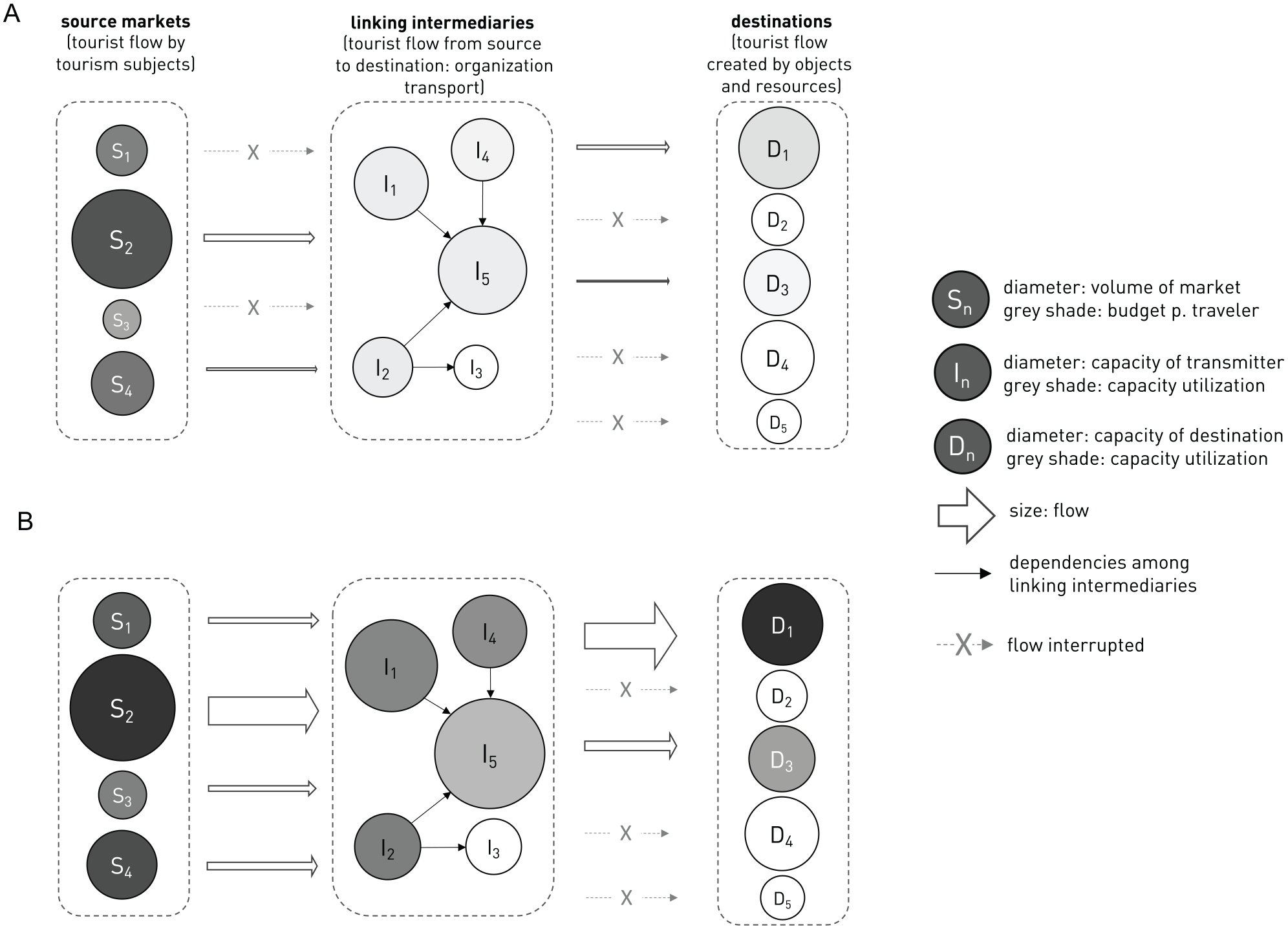
Short-term minimum and maximum scenarios.
Looking at the maximum flow in the short term (Figure 3B) lockdowns, partially, are over after a few weeks or months (Cooke 2020). Opened attractions give people a reason to travel. As the recession is mild (r2), most have the necessary budget for discretionary travel. The European Commission (European Commission 2020b) announced to lift the coronavirus containment measures gradually, observing by each step the development of new infections. Starting already by mid-June with allowing cross-border or continental traveling, a step-by-step withdrawal of travel restrictions (t2) opens some paths for the flow to resume. Along these paths tourism comes back, but at much lower levels as restrictions are gradually eased over time. Not all restrictions will be eased in all places at the same time. It will be a staggered reopening. Thanks to massive government bailouts (b2), intermediaries can survive and thereby bridge the phase of lockdown and travel prohibitions.
Intermediaries return to operating their businesses but suffer from much too high capacities not matching the lower demand. Some destinations are still not accessible, with part of their flow being redirected to other destinations, which have the opportunity to boost their tourist arrivals, at least temporarily. Under these circumstances, domestic markets with a large source market volume and a high share of pre-crisis outbound traveling can recover quicker or even gain flow (exemplified by D1 and D3). In Europe, there are countries (e.g., Germany, Great Britain, Netherlands) in which less than one-third of the holiday trips (4+ nights) had domestic destinations (Eurostat 2020) pre-COVID-19. These countries are in a good position to gain domestic travel flow should long haul international travel destinations open later than domestic destinations or risk-averse travelers opt to stay closer to home. The short-term impact from the COVID-19 pandemic is clear: the system will shrink. There will be objects in the system that are not able to survive. For example, some airlines will cease to exist. This has already happened, with Condor, flybe, or Virgin Australia declaring bankruptcy (Slotnick 2020; Financial Times 2020), and it seems very likely that others will follow. Governments around the world are attempting to limit bankruptcies by pumping flow into the system through stimulus payments. However, it does not matter how much support is given to businesses in the system if the carriers of the flow are fewer in number or carry with them less flow per person. Increasing unemployment, loss of savings, reduced money in long-term investments, and diversion of funds for other purposes (e.g., medical) will all serve to reduce the flow of money into the tourism system. These interventions might help in the maximum flow scenario to keep recession in the short term milder than without the stimulus payments, but regardless the recession is real and has already arrived (Federal Reserve 2020). In the minimum scenario, a double effect keeps the flow on an even lower level: unemployment and fear of unemployment prevent a higher share of people from traveling, and those making trips will be forced to cut their budgets. This again augers well for domestic destinations in the short term even if long haul travel is possible.
Midterm Scenarios
In the minimum scenario, the flow from the source markets is further diminished through recession (r1) and travel restrictions that only permit domestic holidays (t2), which leads to bankruptcies of intermediaries (I3) and prolonged substantial vacancies in many destinations (D4 and D5). As detailed in the short-term scenarios, other destinations (in this scenario D1 to D3) meanwhile profit from a redistribution effect, mostly through domestic travel. Since the bailout programs in this scenario are only short-term remedies, intermediaries and destinations must adapt their capacities as much as possible (symbolized through the downsizing of diameters).
In the midterm maximum-flow scenario (Figure 4B), most international travel is possible again (t3) and travelers’ budgets are not as strongly affected (r2), leading to higher flows in the system and higher capacity utilization for the intermediaries and destinations. Support payments in this scenario are longer-lasting (b2) and intermediaries and destinations will not have to adapt their capacities as much as in the minimum midterm scenario (Figure 4A).
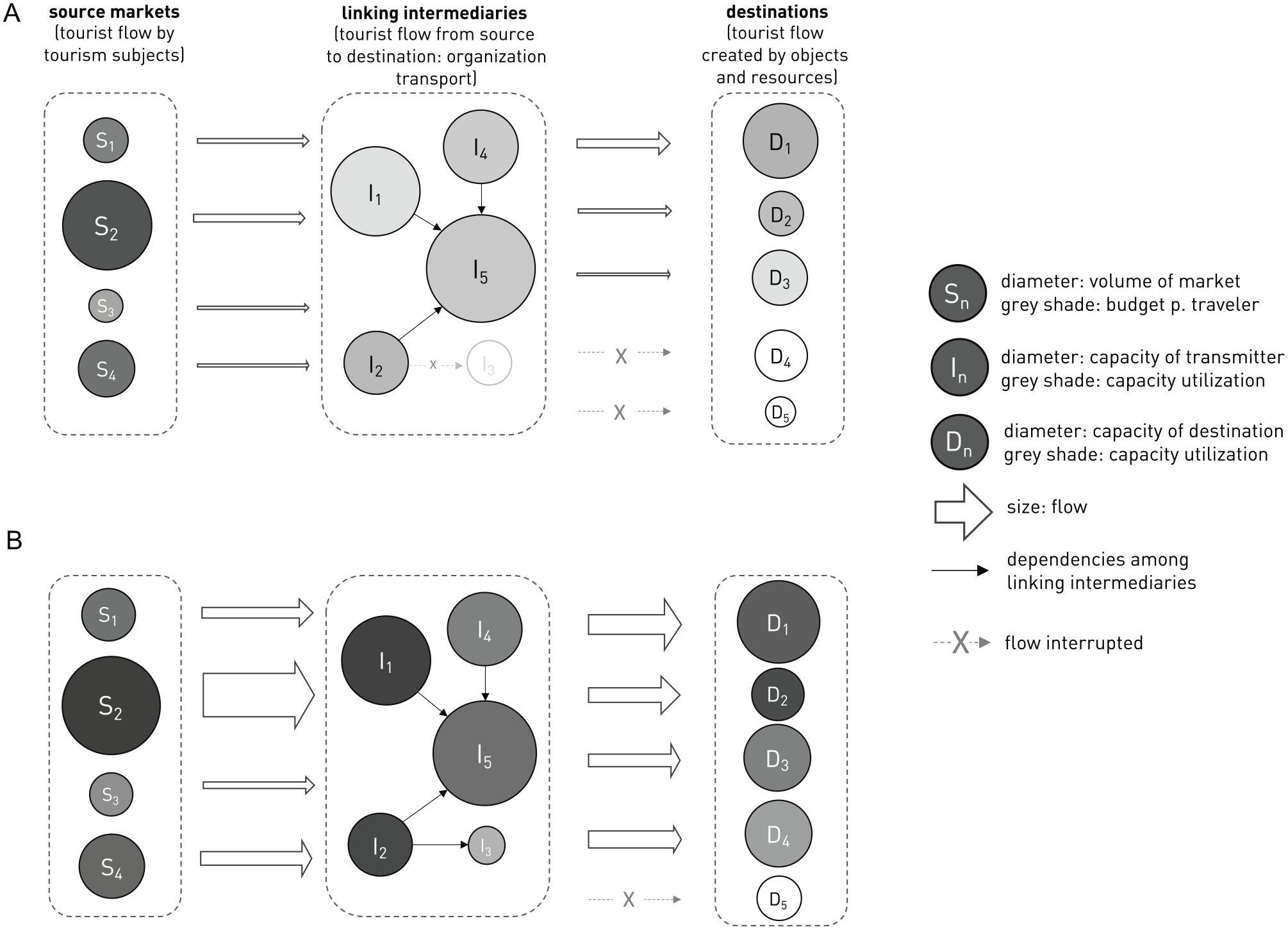
Midterm minimum and maximum scenarios.
There is some speculation, now being confirmed, that in the absence of a vaccine (v1) or effective treatments against COVID-19 domestic tourism will for a longer duration replace international tourism in the upcoming main season in Europe (t2) and the United States. However, the flow is lower than before the pandemic (Minder 2020). Even in the original first COVID-19 infection hotspot, the province of Hubei, the reopening of tourist attractions under strict precaution measures could already be observed by the end of March (General Office of Hubei Provincial People’s Government 2020). Is it possible then for domestic tourism to replace the loss of international tourism as speculated above? After all, if international tourists now become domestic tourists while waiting for a solution to the pandemic, would not the system still function the same? The answer is no, as in this case there will be objects of the tourism system that are no longer in demand, such as big body airlines used for international travel. Also, some destinations that are almost entirely dependent on international tourism will suffer from an almost completely lost season. Any system that relies on a constant flow for its overall well-being will suffer significantly from a prolonged closure. Even in the case (t3) in which some international long-haul destinations will be allowed to accept visitors again, the flow will not return to previous levels within a few weeks. People still remember the dramas of hundreds of thousands of travelers who had been stranded at places around the world waiting for a lift back home and who after return were sent into quarantine for two weeks (German Federal Foreign Office 2020). However, even during the height of the pandemic, international travel continued, including in most places the requirement to self-quarantine for two weeks upon arrival. Travelers willing to put up with the restrictions are at such a low level that even with greatly reduced capacities, the system is in no danger of being strained.
Governments, which in addition to supporting the economy (b2) may direct further support payments to individuals, will at some point have to deal with the consequences of their actions. The almost unlimited printing of money to keep the world financial system awash with flow will eventually have other deleterious effects, such as inflation or reduced flow to other parts of the system that can no longer be supported at the level they were before the pandemic. That is the nature of a system. A change in one part will affect changes in other parts, and the foundational piece of all economic systems is the individual. Without consumer spending, our economic systems stagnate and lead to overall economic distress (r1 or r2). The tourism system tells us that due to the pandemic the flow in the system has been greatly reduced and this will lead to change. That is certain. As described above, in the short run those marginal and vulnerable parts of the system will collapse. Expect more bankruptcies throughout the system. For intermediary objects linking the source markets with the destinations (airlines, cruise lines, tour operators), there will be fewer of them and they will be smaller in capacity when some form of “normalcy” returns. The same applies at the destination level for hotels, restaurants, and other objects in the system. However, not all objects will be affected at the same level.
Long-Term Scenarios
In the minimum-flow scenario (Figure 5A), the source markets have shrunk further because of the recession that was strong and immediate (r1). Owing to stricter travel restrictions, the intermediaries are facing a worse situation with less demand: the ones able to reduce capacities in the long run did, but some could not and therefore had to close down (I3). This might be the case for some airlines, cruise lines, or tour operators. This scenario also shows a large impact on destinations, with some not being able to operate anymore (D5). This might be due to bankruptcy of the only airline serving this destination, or a failure of the main attractions such as a casino or a leisure park.
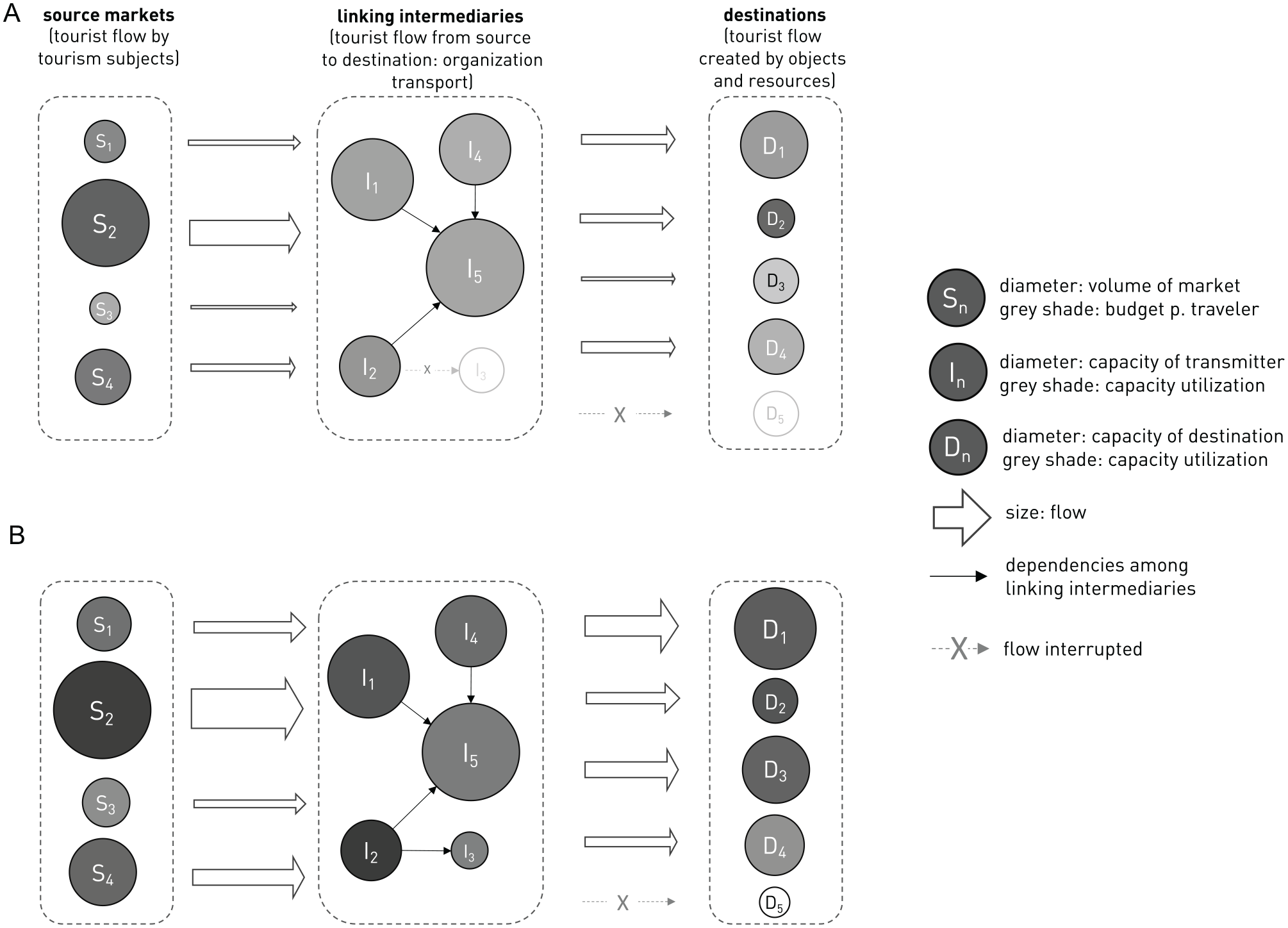
Long-term minimum and maximum scenarios.
In the maximum flow scenario (Figure 5b), the virus nightmare has an end. An effective and broadly available vaccine (v2) allows almost unlimited traveling after a short time. The recession was milder, and first indicators show a return to growth (r2). This leads to bigger and more affluent source markets, generating a growth in flow. The travel restrictions have been lifted (t3) and the intermediaries, which could be saved by government support programs over a longer time period (b2), have higher capacity utilization; there only the demand changed, and capacities could be adapted. Also, the destinations are not so troubled having more demand due to the assumption that international travel is allowed. The destinations that were able to adapt their capacities without excessive loss of businesses due to bankruptcy become economically viable again (D1 to D4). Nevertheless, a few objects and destinations will have failed, needing a complete restart by new business partners.
An important question facing those who deal with the tourism system is what effects can we expect in the long run? Again, this question is clouded by concerns over how long the pandemic remains uncontrolled without effective treatment or eradication. The availability of a vaccine (v2) or the stop of the virus by NPIs will be the most important switch, opening all doors again. What is certain though is that the tourism system will reconstitute itself as the world economic system recovers by turning the recession first from r1 to r2 before experiencing new steady global growth. Assuming this happens, and an examination of historical disruptions tells us it will, how will the system elements reconstitute itself? Will it come back and look similar to what it was before the pandemic or will a new tourism system emerge? Most likely, it will look more like the system of today, albeit with some new policies embedded in it. These policies will change the behavior of tourists and lead to adaptation of strategies, processes and management practices by the tourism objects and open the door for new players in the system.
Just as the tourism system rebounded after 9/11 with new security policies, including more restrictive visas, no-fly watch lists, increased fees to cover new security services, bio passports, and other changes, the structural elements of the tourism system remained intact and as the carriers (i.e., tourists) acquired more flow, the system once again reached pre-9/11 levels and then greatly surpassed them (Aratuo et al. 2019). COVID-19 might add surveillance apps and immunity certificates, but the system itself will primarily stay the same.
It is not the intent of this discourse to suggest that everything will be the same as it was before. It will not. It will be different, but in what sense it will be different is not known except for some short-term effects that can be easily discerned by examining economic history and its reactions to other exogenous disruptions to the system. But what will remain the same is that the system structure that brought us pre–COVID-19 tourism will be essentially the same system structure that is with us during and post COVID-19. Nothing that has happened so far, or is projected to happen, puts the system at risk. Rather, it simply diminishes elements of the system and changes some of the structural elements of the system.
System-Based COVID-19 Tourism Research: An Impact Grid Approach
This study has used the argument that the tourism system in place resists change and will emerge as the system on which future tourism will be built. Yet the COVID-19 pandemic offers interesting research opportunities to see how the system components adapt themselves or to enlarge the proposed static model by dynamic components and feedback loops. For example, restaurants are opening back up with limited spacing, use app-based menus so paper menus do not have to be reused, and have introduced other adaptions to limit the spread of infectious diseases. Do traditional practices such as handshakes in western civilizations go away to be replaced by something with limited social contact already being practiced in many Asian and Arab countries? These adaptions, even if SARS-CoV-2 were eradicated, would appear to be good changes intended to limit the spread of other infectious diseases, such as the seasonal flu. Or does everything return to the way it used to be such as it did after the 1918 flu pandemic?
A systems approach says that any study of the system requires more than a treatment/outcome binary approach or what some call the mechanistic approach. Medical research has operated under this paradigm for a long time: if you have a headache, take a pain reliever. Later it was discovered that some pain relievers may have damaging effects on other organs in the body, which is to be expected as a body is a biological system. Nothing happens in a vacuum. One reaction will lead to another reaction which will lead to further reactions. That is a systems approach. There will be multiple outcomes from any one treatment. In economics, input–output tables reflect this approach. Increase final demand in one sector in the input–output matrix and the model will tell you what happens to output in the other sectors. In a similar way, computerized general equilibrium models essentially perform the same analysis (Dwyer, Forsyth, and Spurr 2005).
The scenario approach presented in this article is based on minimum- and maximum-flow scenarios using two complementary static tourism systems: tourism as a subsystem and tourism as a system of tourist flows. The first system allows one to identify the main triggers coming from external forces that become manifest in the subordinate systems (Figure 1A) consisting of tourism subjects (tourists and locals) and objects (elements), which are formed by the tourism industry acting as intermediaries as well as at the destination level. The second allows one to show the interruption of the flow of tourists (tourism subjects) and money into the system of intermediaries and destinations over time (Figure 1b). This approach leaves the tourism systems, as we know and use them, untouched. Therefore, we can analyze the known processes tourists pass through before, during, and after a trip (Shaw and Williams 2009; Yachin 2018) considering the COVID-19 pandemic–caused changes in the subordinate systems, and their options to travel, thereby creating the money flow (see Figure 6, col. 1). COVID-19’s impact on local communities as part of the tourism-subjects at a destination level is another key topic to be analyzed (Figure 6, col. 2). Concerning the intermediaries, questions that are linked to the strategic and operational tasks of a tourism industry are of interest (Figure 6, col. 2). The third main part in the flow model are the destinations with their organizational issues as well as public and private resources (Beritelli, Bieger, and Laesser 2014; Sheehan et al. 2016). In the context of COVID-19, questions of leadership, governance, and destination management tasks concerning strategies, market reactions, or the utilization of public and private resources are obviously relevant (Figure 6, col. 3).
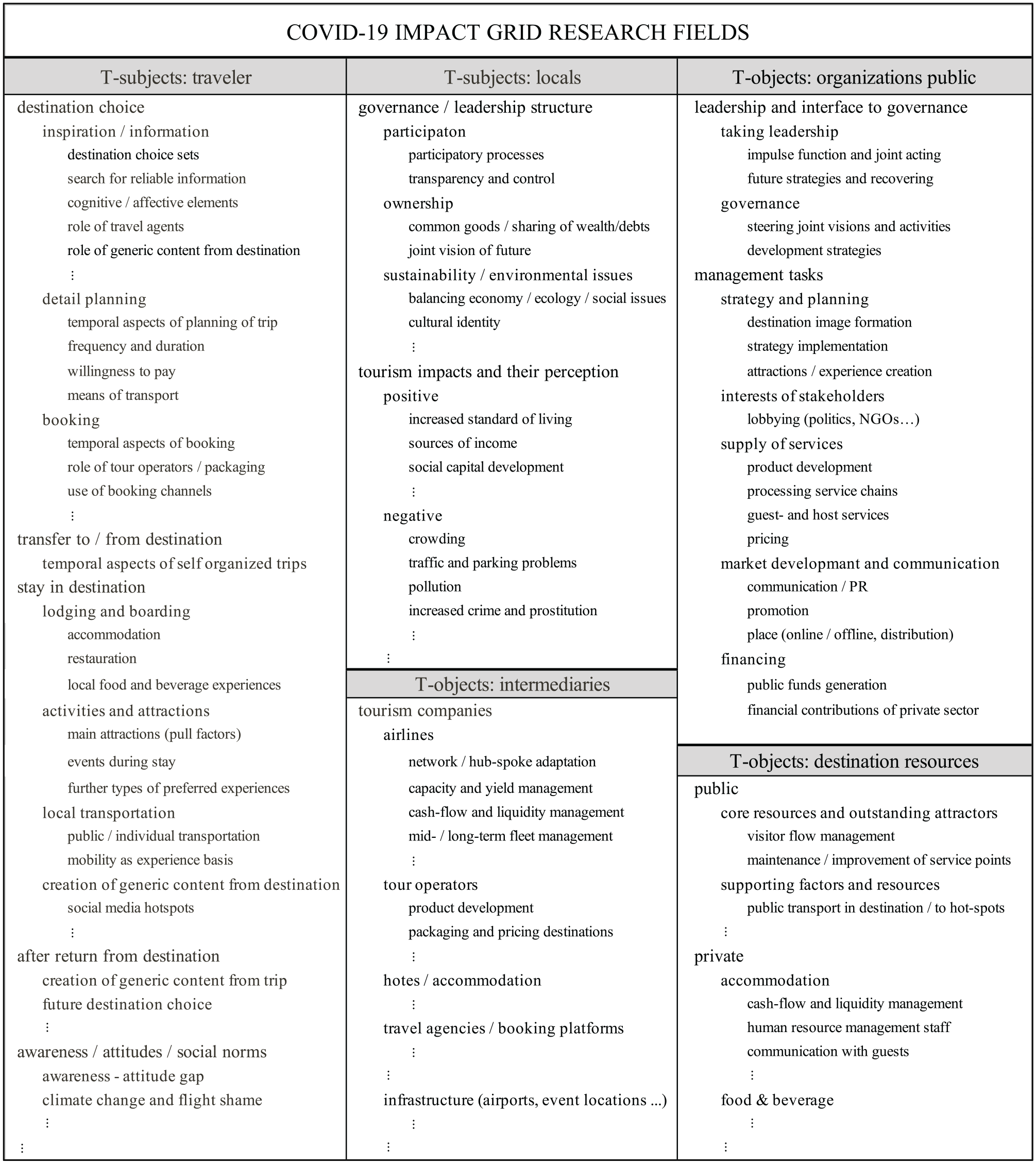
Structure of COVID-19 impact grid research fields.
Furthermore, a system approach allows one to consider the interlinkages between system elements affected by changes in the subordinate framework. Putting the COVID-19 triggers from the subordinate system into columns and the flow-related process and management tasks of tourism subjects and tourism objects from Table 2 into rows, an impact grid is built (Figure 7). Single lines or blocks of associated rows from the tourism system can be chosen to analyze the impact of one or several triggers to the selected research field within the tourism system. In addition, a check of interdependencies between tourism subject and tourism object aspects can be undertaken.
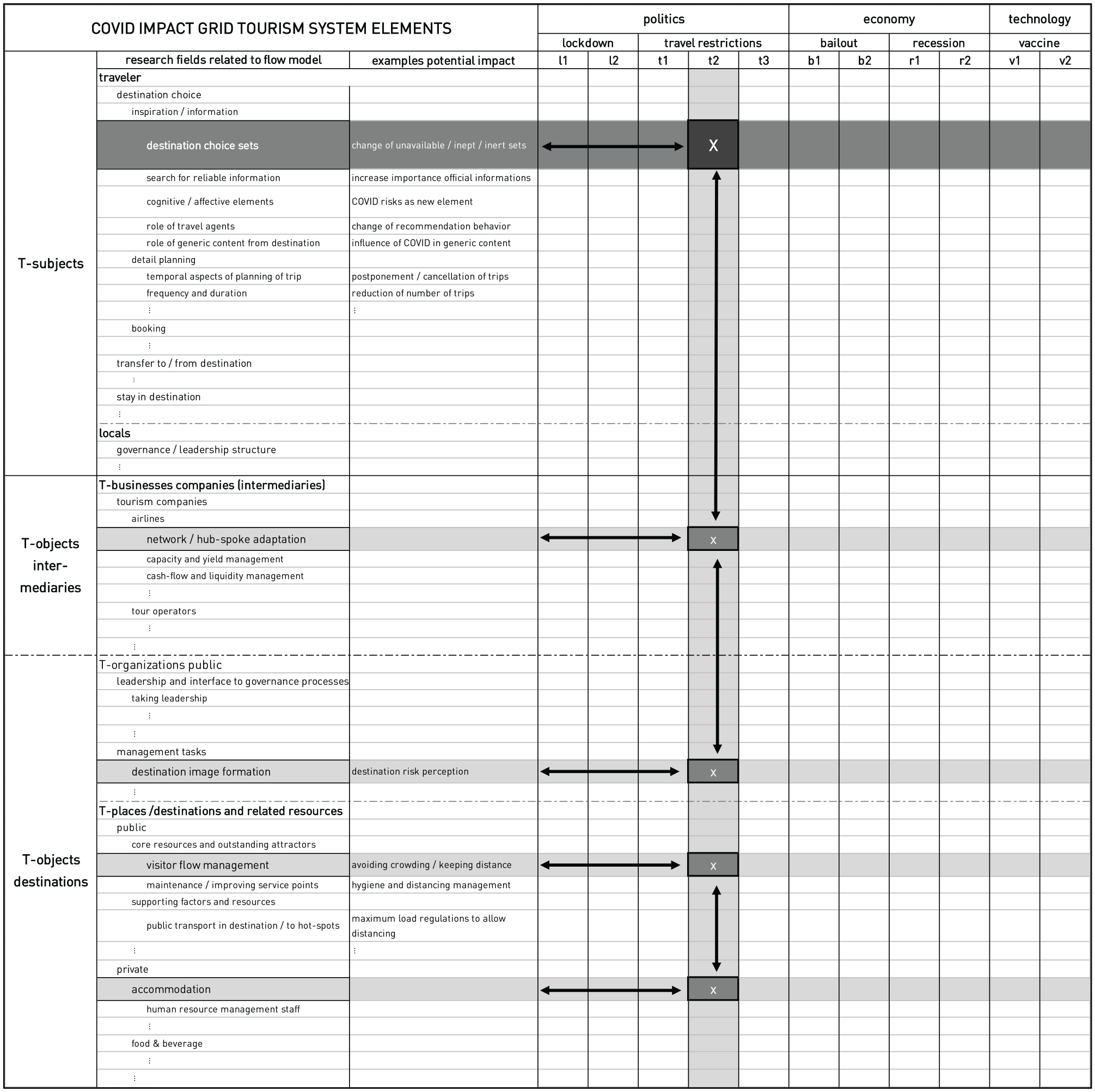
COVID-19 tourism system research grid.
The pictured grid is a simplified proposal to show the structure of the approach and includes only an exemplary selection of tourism research fields (rows) and the five most obvious triggers described in this study (columns), which can be allocated to the economic, political, and technological spheres of the system as shown in Figure 1A. As a matter of course, the crisis will also have societal, cultural, and ecological effects. Thus, an enlargement of the grid by further columns covering these subordinate areas can be done, bringing up more highly relevant fields of research.
To illustrate this approach, the question of COVID-19 impact on destination choice and destination image formation shall be discussed in detail. Destination choice is a field of tourism research with a long tradition. There exist many destination choice models (Sirakaya and Woodside 2005) and comprehensive discussions about the core elements of destination choice, the choice sets (Woodside and Lysonski 1989; Decrop 2010). Further research analyzed the role of pretravel information exposure about the destination and experience options (Oppewal, Huybers, and Crouch 2015). It is obvious that travel restrictions from the level l2 (no international traveling) changes the existing choice sets of travelers. Considered outbound destinations move to the unavailable and inert set, and domestic destinations never having been considered before as a real option move from the inert set to the consideration set. But travel restrictions themselves are not the only influence regarding destination choice. Because of low demand, airlines as intermediaries might decide to no longer serve a destination, or a preferred type of accommodation in the destination may not be available. A further reason for shifts between consideration, inert, inept, and unavailable sets can be the unavailability of the main attraction in a destination, which may still be closed to avoid crowding. The general decision process concerning traveling to an alternative destination or opting for a temporal shift, a delay until the preferred location opens back up, are important topics related to destination choice research. The impact grid can be used to select a starting point of research, for example, the impact of travel restrictions on destination choice of tourists as tourism subjects, identifying relevant literature from existing research but then also cross-checking further potential impacts caused by disruptions of relevant tourism objects from the intermediaries such as airlines or from the destinations such as accommodation or attractions.
A related type of research, destination image formation (Gallarza, Saura, and Garcı́a 2002; Pike 2002), can also be examined using this approach. For example, there are some countries or regions in countries that have taken different approaches to dealing with the transmission of SARS-CoV-2. Sweden is one of those countries within the European Union that have taken a less restrictive and more relaxed approach to mobility and social interaction. In the United States, as this section is being written, states are opening up that still have increasing rates of infection and problematic testing (CNN 2020), leading to greatly accelerating infection rates and deaths. Assuming there is no magic bullet (i.e., vaccine) available soon, what does this approach mean for the touristic image of these destinations? At the moment of this writing residents of the United States are prohibited from traveling to many parts of the world. Does this ban, caused by the approach the United States has taken to combating the virus, affect how potential international travelers view the United States in terms of future destination? A longitudinal study that begins while uncertainty about the different societal approaches is high and continues through the pandemic would provide a chance to study temporally the impact on objects in the system from a consumer preference viewpoint.
Additionally to analyzing the impact on a research field related to one flow model (see Figure 7), which is done by going along one row of the grid, the system approach also allows one to start with one external driver – that is, recession, and go along the respective column to analyze the impact on the tourism subjects and objects. The recession facing the world economy in general and tourism specifically has one important difference from past recessions. This one starts with tourism. Transmission of SARS-CoV-2 was carried out by tourists transporting it to all corners of the world. The initial response was to shut down international tourism in stages. Tourism is by definition mobility, and the virus needs mobility to spread. The medical course of action is to curtail mobility. Policy makers, by and large with some exceptions, embraced this strategy making tourism the first economic sector to be seriously affected by the COVID-19 pandemic and probably the last sector to emerge from under its shadow. In past recessions, the research community would focus on other sectors of the economy to forecast when tourism may rebound. In this case, when tourism rebounds, other sectors of the economy will most likely have already been well on the way to recovery. The impact grid can guide the type of objects that can and should be examined to see how tourism recovers when travel restrictions are eased, or more generally, as subordinate systems are rearranged. Apart from simply analyzing the impact, the grid can also be helpful to identify, develop, and test interventions and strategies to mitigate occurring issues or to discuss potential dynamic feedback effects within subsystems or sectors.
Conclusions
We do not pretend to know what the future will look in all the fine details. To do so would require a close examination of elements in the tourism system that are affected by the flow of the system. To speculate without understanding the system is a form of a mechanistic approach to the problem. In other words, if an airline is nearing bankruptcy then the mechanistic response is to provide support payments to keep it solvent. Problem solved. Or is it? What if the tourists are not there to sustain the airlines operations into the future, especially if it faces increased competition from other carriers all vying for the short-term reduction in the flow of money through the system? Can the airline be supported indefinitely, and should it be? These are questions that will be addressed by policy makers and businesses all over the world with respect to many elements in the tourism system in the coming months.
There will be a price to pay for propping up the economic system in general, and eventually the carriers and receivers of the flow, in our case tourists and locals, will have to carry that burden. Inflation bringing on rising prices, capacity reductions, and new travel policies such as health screening before boarding are all real consequences that may occur as a result of public and private reactions to the COVID-19 pandemic. The pressure from the tourism industry objects to policy makers to grant endless subsidies and to support, at least at the national level, a fast recovery of tourism by withdrawing travel restrictions on state territories is increasing daily. But looking into a tourism flow model, we can anticipate what will happen. In countries with large source markets and a high share of outbound tourism, this will lead to redirecting the flow from many international destinations to just a few national destinations, at least temporarily. The result from opening up destinations without changes (e.g., social distancing, testing) in terms of SARS-CoV-2 risks may be enormous. These risks, following the logic of the model, are not coming from accommodations or restaurants assuming they take effective measures for distancing, and hygienic cleaning can be implemented, albeit with a reduction in revenue. The tourism system approach shows us that the real risks are coming from the attractions. The pull factors in tourism are the attractions, and without a strict visitor flow management policy limiting and distancing visitors we will see, very soon, the well-known effects of overtourism again, but this time paired with uncontrollable contagion risks. The wild card in all of this is the comfort level and risk acceptance level of tourists. Tourists, in the absence of a vaccine or effective treatment, will ultimately determine when destinations recover from the virus instigated shutdown. Their risk acceptance, image of precautions taken by tourism objects, amount of disposable income, and other virus-related consequences will ultimately determine when the tourism system begins to fill up with flow once again. The system approach presented in this article can be used to study one or all of the impacts occurring not only as a single event but as a series of interrelated connected events as tourists think about and begin to return to their travels.
However, there still exists a major problem with the flow models as presented. It only applies to the economic sphere and can only measure output in terms of monetary return or loss. So, what if an environment is completely destroyed as long as there is a positive return to all economic sectors? This would show up as a beneficial impact in the system model used today. Unless an environment can also be monetized, then it has no chance of being considered as an output of increased production. That is why the Natural Capital Project (2020) is such an important advance leading to a systems approach for development. It introduces the environment as a subordinate system element framing the embedded tourism system. And in the process, it structurally changes the system. Now flow impacts can be measured in monetary terms for more than simply the economic sphere. It puts the environment on the same footing as the economy. The consideration of culture and societies is also needed as an addition to the system model and could be an important field of future research.
The rapid recovery discussion that popped up among the research community was astonishing unilaterally focused on how to come back to what was before COVID-19. A critical reflection that suggests that the development goals of destinations and intermediaries in tourism might be in the long term of a destructive nature, is missing. The COVID-19 crisis offers the opportunity in the sense of a full reset, to redefine the long-term goals, related strategies, and their implementation. While on the practical side of tourism management the crisis tests the resilience of business models by default, for tourism research it brings along the challenge of putting the validity of established models to the test. For example, it allows researchers to examine whether something often referred to as destination brand equity (a marketing economic approach to destination value) is really no different than a form or measuring sustainable tourism development (Gartner 2014). The presented grid easily can be extended by columns representing the subordinate component of the environment and the sociocultural elements with respect to sustainability goals. In this sense, the approach presented in this article offers the possibility to take a more holistic perspective.
The system approach allows researchers to focus on general system-relevant issues. In the flow system model, first we have on the left the source markets and consumers. Of general relevance, there is the research field of behavioral changes during the pandemic as well as in the long term because of permanent adaptation of new social norms. Before the crisis, we observed in northern Europe the first signals of a flight shame debate and a change of social norms by the Fridays for Future movement (Gössling, Humpe, and Bausch 2020). Further research of the impact of the COVID-19 crisis on social norms seems to be important for a better understanding of long-term travel behavior changes. In the midst of the model, the above-described general problem of overcapacities and reallocation of resources but also global disparities of state aids or other political interventions is a key issue. The capacity utilization rate is linked to the flow of tourists and the availability of destinations and their attractions. The dependencies there are highly complex and dynamic, as many tourism products are substitutable and marginal changes of the safety situation of transportation or at destinations can cause significant shifts. The ex-ante evaluation of safety measures including mobility restrictions could be an important contribution of tourism researchers. Were some methods more likely to ameliorate or shorten the economic fallout are relevant questions to guide future policy decisions. Looking at the right side of the system model, the most crucial challenge for destinations is visitor flow management. The pull factors of tourism, the attractions, need new solutions to balance the wish of tourists to visit outstanding attractions and to have unique experiences with the need to avoid crowding and to keep distancing. The attractions themselves are not the only bottleneck. The public transportation system used to access attractions is just as much an issue, if not more, when it comes to social distancing as the attractions themselves. So far, the analysis of complex visitor flow systems in combination with the development of instruments to manage the flows within capacity limits has not been a concern of tourism research judging by the discussions on tourism research discussion platforms.
The COVID-19 pandemic creates a need for new services for tourists covering their wishes for safety without compromising their travel experiences. Along all connections in the tourism system, the digitalization of processes, aligned with business models, is needed to support the responses of tourism business. Some of the many areas for digital solutions needing accompanying research are new types of realtime information about safety, on-site medical services or hygienic regulations, additional guidance during the booking procedure covering personal risk profiles, autonomous vehicle–based mobility offers guaranteeing exclusive safe spaces, or virtual and augmented experiences supporting individual on-site activities without groups or tour guides. In addition, research can address new framing policies, further digital technologies, or societal reactions suitable to supporting the digital transformation of tourism during the disruptive phases of the pandemic. How many and what type of these digital solutions will be adopted and used post pandemic is a relevant research question.
When analyzing the literature discussing disruptions in tourism, we became aware that all approaches were either discussing disruptions in fully functional and growing markets or looking at short-term local or regional effects. Previous social disruption research in tourism was based primarily on regions economically dependent on tourism and were related to the issue of overtourism. The global tourism crisis being experienced now reveals a new issue needing attention: social disruptions caused by fast decline and slow recovery. This is directly linked to the question of tourism-related resources provided by public authorities and contributing to tourism services, as well as to quality of life of local residents. Balancing the need for savings in the public budgets and the availability of public services that are part of the competitiveness of destinations and the contentment of residents will be a major task. Here a research field dealing with a new holistic understanding of regional governance considering social disruption within the tourism system as only one part of the total system seems of major interest.
These are not the only examples of using a system approach to studying real-world phenomena. But they do provide examples of how research can be conducted utilizing a system approach. It is those types of research approaches to studying the effects of COVID-19 on the tourism system that this article advocates.
Of course, COVID-19 will offer new research opportunities. This is the silver lining in an otherwise gloomy situation for the tourism researcher community. Are there really so many topics with a potential for promising new knowledge when the system itself is stable? Or does innovation come from adversity? We believe the latter prevails. Looking at the long list of call for papers and the related topics to be covered in special issues, a flood of case studies having a descriptive character is the most likely outcome. We see studies speculating and rapidly assessing how COVID-19 might change tourism. As the system itself is stable, although diminished, these will be frequently mechanistic academic exercises. The opportunity though is now before tourism researchers to examine COVID-19 effects from a more holistic perspective. In this way, substantial research results creating scientific or practical added value are entirely possible. Although research findings cannot be expected before major attempts to restore flow to components in the tourism system occurs researchers can examine the effects of those attempts. The key here is not to simply examine one effect, one outcome, but to embed the research into a system analysis to get a much better picture of what happens and to whom. However, this may be a once in a lifetime opportunity for tourism research to help create a more balanced tourism system by providing new development paradigms. If researchers and editors do not accept that tourism is a system with more than a binary effect when one element of the system changes, then we will have a tsunami of research papers. If on the other hand there is recognition of the system as pervasive and responsive in all spheres of tourism subjects and related objects, even extending into other human systems (e.g., poverty), then the virus will not have been a useless plague on humanity. It will teach us how to structurally change the system to make it more responsive to societal desires.
Footnotes
Acknowledgements
The authors would like to thank Verena Tauber and Valentina Pizzuto, members of the Competence Centre Tourism and Mobility of Free University of Bolzano for their useful remarks on the draft version and the preparation of the figures.
Declaration of Conflicting Interests
The author(s) declared no potential conflicts of interest with respect to the research, authorship, and/or publication of this article.
Funding
The author(s) received no financial support for the research, authorship, and/or publication of this article.
