




Abstract
Travel bragging rights have become an important factor influencing travel decision making in the social media era, yet research on this topic remains scant in the tourism literature. The present study attempted to answer the question “What constitutes travel bragging rights?” from tourists’ perspectives using in-depth interviews and means–end analysis. A comprehensive conceptualization of travel bragging rights was provided. Specifically, we identified seven dimensions of travel bragging rights. These dimensions are located on a continuum between a focus on the self and a focus on the audience and serve several social psychological functions reflecting social media posters’ (those who post content on social media) personal values. The conceptualization of travel bragging rights highlights the perception gaps between travel posters and the audience. Theoretical and managerial implications are discussed.
Keywords
Introduction
In everyday language, perceived entitlement to communicate about one’s accomplishments is termed “bragging rights” (Kerr, Lewis, and Burgess 2012). People can earn bragging rights by sharing or bragging about unique travel experiences or a place that friends have not visited (Kerr, Lewis, and Burgess 2012; Cha, McCleary, and Uysal 1995). The term “travel bragging rights” was coined to capture the perceived entitlement to talk about or show off one’s travel experiences to others (Kerr, Lewis, and Burgess 2012). The social media era has witnessed the increasing importance of bragging rights in the tourism industry, as it becomes common to share and brag about travel experiences on social media. More than 70% of travelers reportedly post vacation photos and update their status on social media during vacation (Visit Mammoth 2018). The notion of “Instagrammability,” referring to how attractive vacation photos look on Instagram, was a primary factor in choosing a holiday destination for more than 40% of surveyed Briton millennials (Hosie 2017; Arnold 2018). The trend of seeking travel bragging rights is especially prevalent among millennials, with 60% of US millennial travelers admitting to uploading vacation photos and checking in at trendy locations for bragging purposes on social media (Hotels.com 2017). Some have gone so far as to claim that “modern millennial vacations are all about bragging rights” (Ogintz 2016), and travel bragging has become “a social norm for millennials, and an essential part of any trip” (Little 2018; Hotels.com 2017). Despite the importance of travel bragging rights among today’s tourists, little is known about what constitutes travel bragging rights in tourists’ minds.
As a travel motivation, seeking travel bragging rights is not new. Participating in leisure activities and visiting prestigious resorts have long been considered signs of upper social class (Smith 1979; Veblen 1994; Towner 1985). Nowadays, tourism has become democratized such that it is becoming more affordable for the general public; travel is no longer an exclusive privilege reserved for the elite (Furlough 1998). Tourists are now less likely to use tourism consumption to signal their wealth extravagantly; rather, they prefer to demonstrate their cultural capital (i.e., knowledge and intellectual skills that promote social status), aesthetic taste, and self-concept via subtle signals in tourism consumption (Trigg 2001; Boley et al. 2018). As such, it is important to gain an updated understanding about travel bragging rights as a travel motivation in the new media and social environment, hence the present study.
So far, the tourism literature has not paid much attention to travel bragging rights. Although it has been studied as a travel motivation in early research (e.g., Cha, McCleary, and Uysal 1995), the notion lacks conceptualization from tourists’ perspectives. Using qualitative research methods, including in-depth interviews and a means–end approach, this study aims to provide a systematic conceptualization of travel bragging rights from tourists’ perspectives. By doing so, this study attempts to make a significant theoretical contribution to the tourism literature. Moreover, by gaining an understanding of the meaning of travel bragging rights on social media, this study updates travel motivation theory in the social media era. Further, by uncovering which aspects of a destination help tourists earn bragging rights, this study sheds light on destination marketing strategies—specifically in determining what to emphasize and how to stimulate tourists’ destination visit intentions through travel bragging rights.
Literature Review
Social Media and Travel Experience Sharing
The use of social media has revolutionized consumers’ communication behavior, and sharing experiences on social media has become an important aspect of consumption. The social visibility of consumption experiences has increased dramatically amid the social media era, particularly experiential consumption (Bronner and de Hoog 2019). Research has documented a growing trend wherein consumers share experiential consumption more than material consumption, as the former is more closely tied to self-identity (Bronner and de Hoog 2019; Lin, Van De Ven, and Utz 2018; Duan and Dholakia 2018; Carter and Gilovich 2012). Relatedly, Bastos and Brucks (2017) argued that experiential consumption possesses stronger conversational value than material consumption due to closeness to the self, social approval, and the purchase uniqueness associated with experiential consumption. As typical examples of experiential consumption, leisure activities and vacations have long been considered signals of wealth and social status (Dimanche and Samdahl 1994; Veblen 1994). However, Boley et al. (2018) pointed out that today’s tourists tend to use subtle signals in tourism consumption to convey cultural capital, taste, and self-concept. Hence, publicizing travel experiences on social media has become a key means of constructing one’s self-image and signaling self-identity. Furthermore, the anticipated social return from sharing travel experiences via social media has become an important factor influencing destination choice (Boley et al. 2018).
A growing number of studies have been conducted on travel experience sharing on social media. Scholars have identified an array of motivations behind such behavior, including self-centered motivations, such as self-enhancement and self-presentation, and community-related motivations, such as helping others (Munar and Jacobsen 2014; Kang and Schuett 2013; Oliveira, Araujo, and Tam 2020). Other studies have revealed the benefits of such practices, including increased trip satisfaction, positive affect, and subjective well-being (J. Kim and Fesenmaier 2017; Lee and Oh 2017). However, scant work has explored what makes a travel experience or travel destination worth sharing on social media. In other words, exactly what constitutes the conversational value of travel consumption, aptly termed “travel bragging rights,” deserves more scholarly attention.
Travel Bragging Rights
Travel bragging rights encompass the belief that traveling to a certain destination, or participating in a particular tourist activity, can provide tourists opportunities to share travel experiences with others (Kerr, Lewis, and Burgess 2012). The term “travel bragging rights” originated from “travel bragging,” which refers to showcasing and boasting about travel experiences (Cha, McCleary, and Uysal 1995). When a travel post features superiority, such as wealth, power, and social status, it could be perceived as bragging (Scopelliti, Loewenstein, and Vosgerau 2015). A perception gap may exist between braggers and their audience (Scopelliti, Loewenstein, and Vosgerau 2015), such that a travel post deemed as positive experience sharing by posters may be considered as travel bragging by the audience. Because of the negative connotations of bragging (Scopelliti, Loewenstein, and Vosgerau 2015), travel posters could be reluctant to admit to bragging even if their motivation is to showcase and show off their travel experiences. As such, the concept of travel bragging rights concerns perceptions of whether a travel experience offers something worth sharing with others, irrespective of whether such bragging is purposeful.
According to Kerr, Lewis, and Burgess (2012), acquiring bragging rights involves a three-step process: belief (anticipated bragging rights), behavior (travel consumption), and communication (travel bragging or sharing). Accordingly, anticipated travel bragging rights precede tourism consumption behavior, which precedes travel bragging in temporal order. More specifically, prior beliefs regarding bragging rights could influence tourism consumption behavior, such as choice of destinations, tourist activities, and hotels. However, anticipated travel bragging rights are not a necessary antecedent of travel bragging behavior; that is, tourists may not intend to brag about their travel experiences before travel but may engage in travel bragging after having experiences that warrant it. The second step in acquiring travel bragging rights is tourism consumption, which could “give rise to the ability to brag” (Kerr, Lewis, and Burgess 2012, p. 11) and provide a foundation for travel bragging. After travel consumption, tourists earn the right to brag about or communicate their experiences with others. Travel bragging, as a way of sharing travel experiences with others, can be verbal or nonverbal such as through displaying souvenirs or artifacts from a trip (Kerr, Lewis, and Burgess 2012). Travel bragging on social media can further stimulate or influence others’ beliefs about bragging rights and intentions to visit the same destination.
Seeking Travel Bragging Rights as a Motivation
Seeking bragging rights embodies a type of travel motivation, wherein tourists are motivated to visit a destination by the bragging rights they will earn from their experiences (Kerr, Lewis, and Burgess 2012). Seeking bragging rights was first identified as a push motivational factor among Japanese overseas travelers by Cha, McCleary, and Uysal (1995). Using exploratory factor analysis, the authors identified three items representing tourists’ travel bragging motivations: talking about a trip after returning home, going places friends have not been, and indulging in luxury. These actions suggest that travel experiences or destinations that are unique, exclusive, and indicative of wealth and social status provide travel bragging rights. Following research by Cha, McCleary, and Uysal (1995), several studies have verified bragging rights as a travel motivation, including K. Kim, Oh, and Jogaratnam (2007), Sirakaya, Uysal, and Yoshioka (2003), K. Kim, Noh, and Jogaratnam (2007), and Özel and Kozak (2012).
Other studies have implicitly lent support to seeking bragging rights as a travel motivation. For example, tourists who visit film sites wish to brag about insider knowledge of how movies were filmed (Beeton 2005). Tourists who visit an upscale resort are more likely to discuss their experiences with others than tourists patronizing unknown or low-tier destinations, as upscale resorts indicate wealth and social status (Phillips and Back 2011). Some tourists wish to visit uncommercialized destinations or participate in exclusive activities (e.g., hunting in sub-Saharan Africa) because they can earn bragging rights among their peers for unique and exclusive travel experiences (Launius and Jenkins 2006; Brooker and Burgess 2008). Other tourists want to travel to as many destinations as possible to brag about their widespread adventures while acquiring the prestige of belonging to a “unique group of privileged travelers” (Timothy 1998, p. 126). In the social media era, earning more “likes,” comments, and envy from peers on social media platforms constitutes new travel bragging rights, and tourists are concerned with the “Instagrammability” of travel destinations as a form of travel bragging rights (Hosie 2017; Arnold 2018; Boley et al. 2018).
The rise of social media and shifts in the socioeconomic environment have altered how and what people brag about with respect to travel experiences. In the past, travel bragging relied on verbal communication or travelogues about experiences based on memories and physical photos of the trip. Contemporary travel bragging is more diverse in format and content thanks to the Internet technology; people can share travel experiences anywhere and at any time with a much larger audience owing to social media and mobile technologies. Moreover, changes in the social, economic, and technological environment have led to a global rise in individualistic and narcissistic values (Santos, Varnum, and Grossmann 2017; Twenge and Campbell 2009). These changes may have also caused travel bragging content to become more self-centered, such as posting holiday selfies as a means of travel bragging. Thus, travel bragging rights deserve renewed attention to extend travel motivation theories.
Travel Bragging Rights as Social Value
With the intention to communicate with others, seeking bragging rights as a travel motivation is primarily driven by individuals’ needs for social approval and social recognition. According to Kerr, Lewis, and Burgess (2012), travel bragging provides a value in that “it can communicate conformity and potentially superiority with existing or aspirational group norms” (p. 6). As such, bragging rights are associated with the social value conveyed through tourism consumption.
Social value is one of the components comprising consumption value, referring to the perceived utility of goods or services (Zeithaml 1988; Sheth, Newman, and Gross 1991). Specifically, social value is the perceived utility derived from the association of goods or services with one or more social groups (Sheth, Newman, and Gross 1991). Social value captures the ability of a product or service to enhance one’s social self-concept, gain social approval, and exert a desirable impression on others (Sweeney and Soutar 2001), which is consistent with the purposes of bragging: self-enhancement and identity signaling. Consumers’ purchases of luxury products (e.g., high-end clothing and jewelry) and expensive gifts are often driven by those goods’ social value (Sheth, Newman, and Gross 1991). Accordingly, the social value of goods or services can be achieved either through public exposure to the goods (e.g., wearing clothes or jewelry) or communicating with others about them. Consumers are more likely to brag about goods or services with higher social value that are more worthy of showcasing to others. Hence, bragging rights (i.e., whether goods or services warrant communication) are highly associated with the perceived social value of given products or services.
Because of the inherent intangibility of travel, the social value of tourism consumption is mainly achieved through communication, such as displaying or sending souvenirs and postcards from a trip, sharing travel photos, and discussing travel experiences with others (Munar and Jacobsen 2014; Kerr, Lewis, and Burgess 2012). As such, bragging rights are associated with the social value of tourism products and services, and may play an important role in influencing the choice behaviors of tourists seeking self-enhancement or identity signaling. In the tourism field, Boley et al. (2018) highlighted the role of travel bragging rights as a social value. The authors termed the amount of positive social feedback generated by travel posts on social media as “social return,” operationalized as whether sharing travel experiences to a destination on social media makes tourists seem cool, popular, unique, savvy, and enviable (Boley et al. 2018). Their study found that anticipated social return from a travel destination has a positive impact on tourists’ destination visit intentions (Boley et al. 2018). Anticipated social return, which is used to measure the perceived social value of travel experiences, is akin to anticipated travel bragging rights in a social media context.
While Boley et al. (2018) provided a proxy of travel bragging rights, their measure of social return focused more on anticipated outcomes of travel bragging behavior in relation to impression management. Arguably, this is only part of travel bragging rights. The authors did not identify which aspects of a travel experience or destination contribute to anticipated travel bragging rights. It is important for destination marketers to associate bragging rights with specific destination features so they can act accordingly to enhance the braggability of the destination (Kerr, Lewis, and Burgess 2012). As such, research on what constitutes and contributes to travel bragging rights as a social value of travel experiences or destinations is warranted and will likely generate meaningful practical implications.
Travel Bragging Rights as Human Capital
Human capital refers to intangible assets and individual capabilities that can be converted into productivity, such as education, experience, knowledge, and skills (Becker 1964; Unger et al. 2011). Bourdieu (1986) outlined three forms of human capital: economic capital, cultural capital, and social capital. Economic capital refers to capabilities that can be immediately and directly converted into money, such as intellectual property (Bourdieu 1986). Cultural capital consists of three forms: an embodied form, including practical knowledge, skills, and dispositions; an objectified form, as in cultural objects such as art and pictures; and an institutionalized form, referring to educational degrees and qualifications (Bourdieu 1986; Holt 1998). Cultural capital represents important status resources that can promote social mobility within a stratified society (Bourdieu 1984). This type of capital can be objectified through consumption objects, and consumers’ cultural capital can be expressed via their consumption practices, aesthetic tastes, and choice preferences (Coskuner-Balli and Thompson 2013; Holt 1998; Berger and Ward 2010). Tourism consumption is often used to demonstrate cultural capital as it entails tourists’ cultural knowledge, skills, dispositions, and aesthetic taste. Tourists also seek to signal cultural capital through travel experience sharing due to the intangibility of tourism consumption (Boley et al. 2018). Social media provides a platform through which users can demonstrate cultural capital, and tourists often face normative pressure to do so in an effort to indicate they have the “requisite cultural capital” to gain respect from peers and fit in with desired social groups (Boley et al. 2018; Berger and Ward 2010).
Social capital refers to resources accumulated via social connections and interactions (Coleman 1988; Valenzuela, Park, and Kee 2009), such as valuable information, business opportunities, financial and emotional support, power, and influence (Baker 2000). Social capital has three dimensions, namely, structural, cognitive, and relational (Wasko and Faraj 2005; Nahapiet and Ghoshal 1998). The structural dimension involves patterns of social connections, such as tie strength and centrality (Wang et al. 2016). Cognitive social capital encompasses resources that provide shared interpretations and meanings within a social group (Wasko and Faraj 2005). Relational social capital captures personal relationships developed through myriad interactions, including trust, commitment, and reciprocity, such that people are willing to help each other and feel obligated to participate in collective actions (Wasko and Faraj 2005). Building or maintaining social capital is a major driver behind individuals’ engagement in word of mouth (WOM) on social media (Wang et al. 2016; Chu and Choi 2011). As a type of WOM, travel bragging or experience sharing on social media provides a way to build and maintain social capital by constructing a desirable social self-identity and cultivating connections with desirable social groups. Through travel bragging or experience sharing, individuals aim to increase all forms of social capital: structural social capital by enhancing their influence among peers (e.g., gaining attention, approval, envy, and followers), cognitive social capital by identifying with a desirable group and demonstrating insider knowledge or skills, and relational social capital through engaging with family and friends.
Cultural and social capital can each be converted into economic capital, while cultural capital facilitates the accumulation of social capital (Bourdieu 1986). Tourists aim to demonstrate cultural capital and build/maintain social capital via travel bragging and experience sharing on social media. Therefore, perceptions of travel bragging rights could be highly associated with a travel experience’s ability to demonstrate cultural capital and build/maintain social capital.
Methodology
Because of the exploratory nature of this study, qualitative methods were used to answer the research question (i.e., “What constitutes travel bragging rights?”), including in-depth interviews and the means–end approach. Semistructured in-depth interviews, which employ a predetermined interview guide but allow for flexibility to pose different questions depending on the situation (Dunn 2010), were used to collect data.
Means–End Approach
The means–end approach was adopted during interviews to assist with answering the research question. This approach links consumers’ personal values to product attributes (Watkins and Gnoth 2011); hence, this method was appropriate for investigating the attributes of travel experiences that help tourists earn bragging rights and the internal values that shape tourists’ perceptions of such rights.
The means–end approach builds on means–end chain theory and the laddering technique. Means–end chain theory elucidates how goods or services are associated with personal values, whereby goods or services are treated as “means” to facilitate realization of personal values (i.e., desired end states, such as happiness and self-esteem) (Gutman 1982). According to this theory, goods or services are tied to personal values through hierarchical linkages among three components (Watkins and Gnoth 2011): (1) attributes, namely characteristics of goods or services; (2) consequences, referring to the positive or negative consequences of using products or services; and (3) personal values, reflecting fundamental personal needs and goals (Watkins and Gnoth 2011). A widely used qualitative approach to testing means–end chain theory is the laddering technique, which is a structured interview method (Nunkoo and Ramkissoon 2009). The laddering technique begins by eliciting lower-level concrete attributes consumers find important for certain products or services and then asking a series of probing questions (e.g., “Why is that important to you?”) to elicit more abstract and higher-level meanings behind product attributes (Klenosky 2002). In this way, the laddering technique guides respondents to uncover linkages between attributes, abstract consequences, and highly abstract personal values.
The means–end approach provides a useful framework to identify and link destination attributes to more important factors that influence tourists’ attitudes and behavior (Klenosky 2002). This approach has been widely used in tourism research to study travelers’ motivations, preferences, and decision making, such as factors influencing ski destination choice (Klenosky, Gengler, and Mulvey 1993), tourists’ push and pull motivational factors (Klenosky 2002), residents’ attitudes toward tourism development (Nunkoo and Ramkissoon 2009), and cultural values influencing travel behavior and destination choice (Watkins and Gnoth 2011).
Sampling and Data Collection
Purposive sampling was applied in this study. Based on the authors’ a priori theoretical understanding of the research topic, two groups of respondents were targeted: those who actively bragged about travel experiences on social media (i.e., travel braggers) and those who had been frequently exposed to others’ travel bragging on social media (i.e., the audience). It was important to target both travel braggers and their audience due to potential perception gaps between these two groups (Scopelliti, Loewenstein, and Vosgerau 2015). Such a target population could provide rich information about the research question from two perspectives.
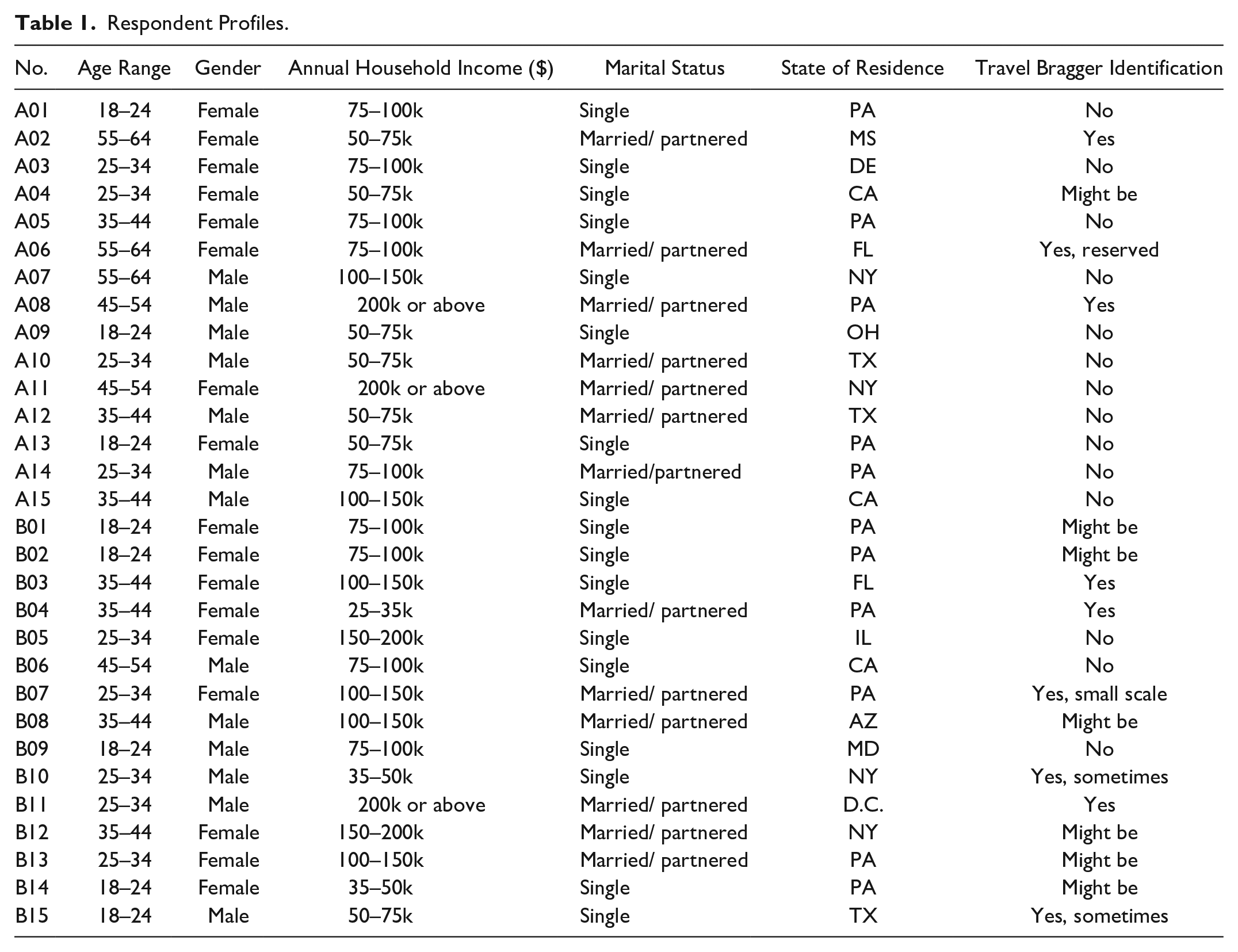
Recruitment messages were posted on Facebook, Instagram, and Craigslist, and qualified potential informants were approached for interviews. Respondents who stated they shared travel experiences “often” or “very often” on social media were approached to discuss travel braggers’ opinions, and respondents who acknowledged having one or more social media friends who were travel braggers were approached to discuss their opinions from the audience’s perspective. A total of 30 respondents were interviewed during December 2018 and January 2019, including 15 audience respondents (A01–A15) and 15 respondents who posted their travel experiences on social media (B01–B15), 12 of whom admitted to having bragged about their travel experiences to varying degrees (many were reluctant to admit to bragging), and three did not identify themselves as travel braggers despite sharing travel experiences quite often. The 15 respondents who posted their travel experiences on social media were referred to as “travel bragger/experience sharer” respondents. Among the 30 interviews, 22 were conducted via Skype, and eight were conducted face-to-face in an eastern US city.
An interview protocol, containing the interview procedure and questions to be answered, was used during interviews. Respondents were asked to provide examples of their own travel bragging behavior or that from social media friends during the interview. The laddering technique was used by asking “What was bragged about in the example?” and “Why?” Respondents were asked to explain “Why?” until they mentioned a value or inherent need pertaining to the bragged-about tourist experience or object.
Data Analysis
Data collected from in-depth interviews were transcribed verbatim and later analyzed using content analysis, which provides a systematic analysis of textual data through coding and identification of key themes or patterns (Hsieh and Shannon 2005). Two researchers performed content analysis independently, including identifying codes and assigning them into categories and themes. The results were then compared, and discrepancies were reconciled via discussion. Data gathered via the laddering technique were analyzed using the means–end analytic approach (Klenosky 2002). These data were coded as either an attribute, consequence, or value. Links among different concepts were summarized in an asymmetric implication matrix, indicating the number of times each concept led to other concepts from respondents’ perspectives. A hierarchical value map was next constructed based on the matrix to illustrate relationships among identified attributes of destinations and tourist experiences, consequences of travel bragging, and tourists’ internal values. Means–end analysis was conducted separately for travel braggers/experience sharers and the audience respondents.
Credibility and Validity Issues
Following Lincoln and Guba (1985), several approaches were employed to improve the credibility and validity of this study’s findings, including triangulation, peer debriefing, and member checking. Triangulation in qualitative research involves using multiple data sources, data collection methods, theoretical lenses, or researchers to study the same phenomenon (Tracy 2010). The triangulation of data sources in this study was achieved by recruiting respondents from diverse demographic backgrounds, particularly by including both travel experience posters and their audience to enhance confidence in and credibility of the results (Patton 2002). Researcher triangulation was accomplished by involving two researchers (the first author and a second coder) to do coding independently, which helped ensure reliability and consistency of the coding results (Campbell et al. 2013). Results were then compared and discussed to resolve discrepancies, as noted, until a consensus was reached.
Peer debriefing involves a review of the study results and/or the research process by experts in the field, which helps further enhance the credibility of the study findings (Creswell and Miller 2000). Two peer debriefers were involved in this study. The second author reviewed the entire research process, including the data analysis and the results, by providing support and constructive feedback. The coding results were also reviewed by an expert in qualitative research in the tourism field. Revisions were made based on these two peer reviewers’ feedback. Member checking refers to sharing data and/or results with research participants to check accuracy of data and corresponding interpretations (Lincoln and Guba 1985). Member checking in this study was conducted during the interviews by asking relevant probing questions and after the interviews by seeking participants’ feedback and clarifications; five of the nine participants approached replied with clarifications or feedback via email after the interviews. Together, the above measures helped increase the credibility and validity of the findings and ultimately improved the rigor of this study.
Results
Profiles of the Respondents
Respondents’ profiles are shown in Table 1. The respondents came from different states in the United States, with more than half between 18 and 34 years old, and a roughly even gender distribution. Most respondents earned an annual household income between $50,000 and $100,000. All respondents were frequent social media users who mainly used Instagram and Facebook. Other common platforms included Twitter, Snapchat, and Google Plus.
Respondent Profiles.
Definition of Travel Bragging Rights
To conceptualize travel bragging rights from tourists’ perspectives, all respondents were asked what they considered travel bragging rights to be and what constituted travel bragging rights. All respondents were first asked about whether they had heard of “travel bragging rights”; if they had, they were asked to discuss their definitions and opinions of what constituted travel bragging rights. Otherwise, respondents were asked about the definition of “bragging rights,” and some respondents went on to discuss their opinions about the term “travel bragging rights.” Respondents who used Instagram as a major social media platform but were unaware of bragging rights and travel bragging rights were asked whether they were familiar with the concept of “Instagrammability.” Twenty-three respondents discussed bragging rights or travel bragging rights, and six discussed Instagrammability either organically or when asked about the term. The two independent coders agreed on 75% of the initial code list, and discrepancies were resolved after discussion (see Table 2 for the code list).
Code List for Travel Bragging Rights and Instagrammability.
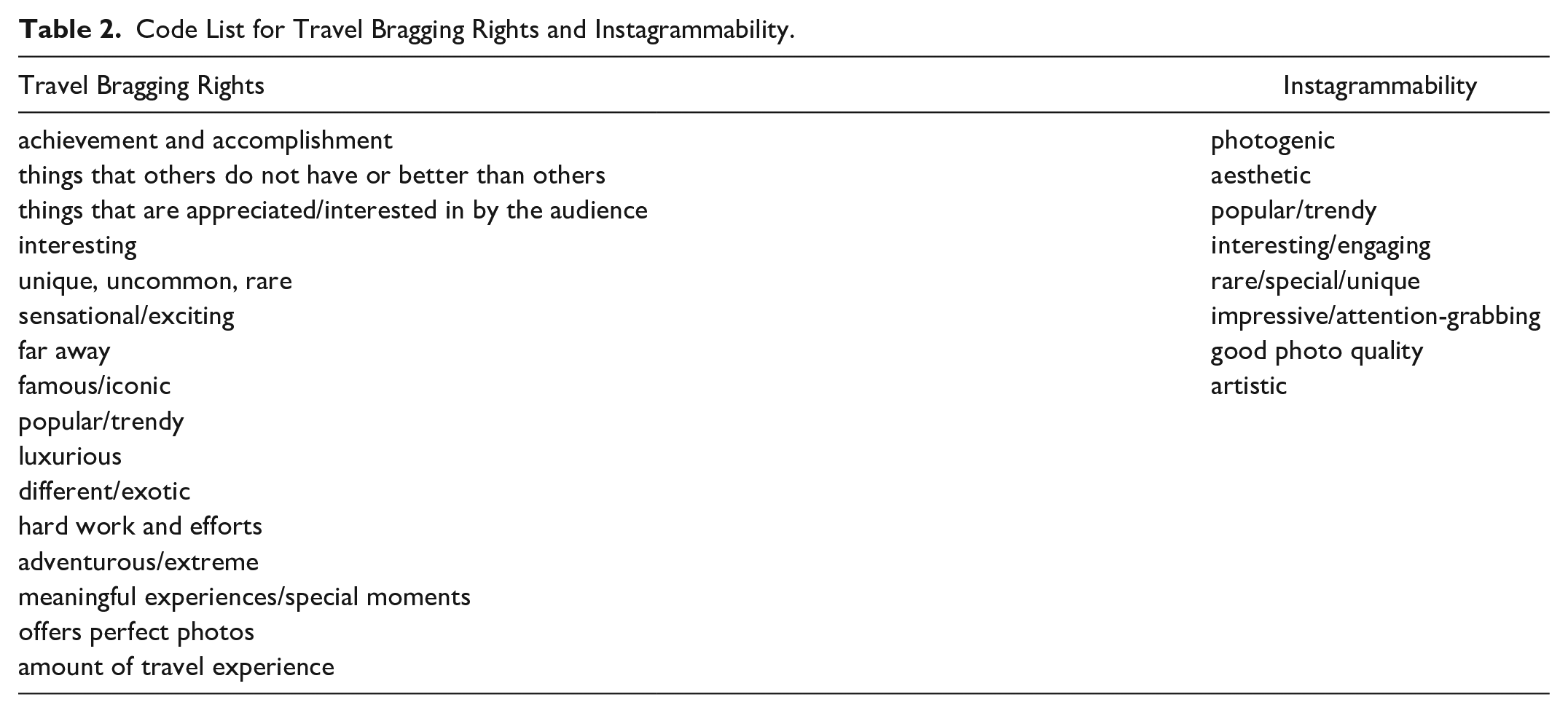
Respondents generally agreed that bragging rights refer to one’s perceived entitlement to brag about or communicate achievements or possessions of which he or she is proud (e.g., winning a game or having a cute baby). Travel experiences can earn individuals bragging rights, as completing a trip by “having been there and done that” is an accomplishment. The number of travel experiences also reflects one’s expertise and achievements. Travel experiences can directly or indirectly showcase one’s wealth, education, social status, desirable characteristics, or anything else of which a person is proud. Moreover, individuals can earn bragging rights from travel experiences if an experience or destination is interesting, rare, different, or recognizable, as the audience finds such experiences particularly valuable, appreciable, or intriguing. In addition, travel experiences that showcase a desirable image or personality can help tourists earn travel bragging rights, such as luxurious experiences and adventurous activities. Many respondents mentioned that displaying effort or hard work to make a trip, or simply having meaningful experiences (e.g., a once-in-a-lifetime experience or dream trip), warranted travel bragging rights and was thus perceived more positively among the audience.
Travel bragging rights are essentially a type of social value. These rights are related to the value of travel experiences in enhancing one’s social connections, constructing image, and signaling identity through communication and engagement with one’s audience. Sharing selected travel experiences facilitates development of a desirable social self-identity, building connections with desirable social groups, and signaling social status and influence, all of which indicate the level of social capital to be gained from sharing such experiences. Hence, travel bragging rights are associated with the level of social capital that could be acquired from sharing certain travel experiences on social media. Moreover, travel posters tend to display cultural capital, such as their education, knowledge, aesthetic taste, and skills, through travel-related posts. Therefore, travel bragging rights are also directly related to the ability of travel experiences to demonstrate cultural capital.
Interestingly, some respondents mentioned that locations that appeared “Instagrammable” or offered perfect photos worth sharing on Instagram helped people earn travel bragging rights. The notions of “Instagrammability” or “being Instagram-worthy” first emerged once Instagram, a photo- and video-sharing social networking site, gained popularity. Instagrammability comprises a new form of travel bragging rights, illustrating tourists’ evolving media consumption habits. According to the respondents, “travel bragging rights” is a generic term referring to the worthiness of travel experiences to be shared on all social media platforms. As an Instagram-specific term, “Instagrammability” focuses more on photos’ visual appeal. When asked about what makes a destination or attraction Instagrammable, respondents emphasized the visual features of a destination or attraction, including photogenic, aesthetic, and artistic qualities. In addition, good photo quality (e.g., composition, lighting, and color) was identified as a necessary criterion for Instagrammability but depended on tourists’ photography and photo-editing skills. These visual features cause a photo to be more visually pleasing on social media, thus garnering envy, attention, or appreciation from the audience. Besides visual features, Instagrammability shares features with other characteristics that help posters earn travel bragging rights (e.g., being popular, interesting, engaging, unique, meaningful, or anything either related to one’s image or personality or likely to be appreciated by the audience).
Means–End Analysis Results
To explore the meanings behind travel bragging or experience-sharing posts, a means–end analysis was conducted for the travel bragger/experience sharer group and audience group, respectively, based on their accounts of what people preferred to brag about and why. Overall, 54 conceptual codes were generated from the travel bragger/experience sharer group (19 attributes, 24 consequences, and 11 values), and 44 conceptual codes were generated from the audience group (17 attributes, 19 consequences, and 8 values) (see Table 3). On average, each respondent in the travel bragger/experience sharer group generated 7.7 means–end chains, and each respondent in the audience group generated 5.4 means–end chains. Approximate intercoder agreement of 82% and 86% was reached on codes and chain structures for the travel bragger/experience sharer group and the audience group, respectively.
Conceptual Codes and Frequency in Means–End Analysis.
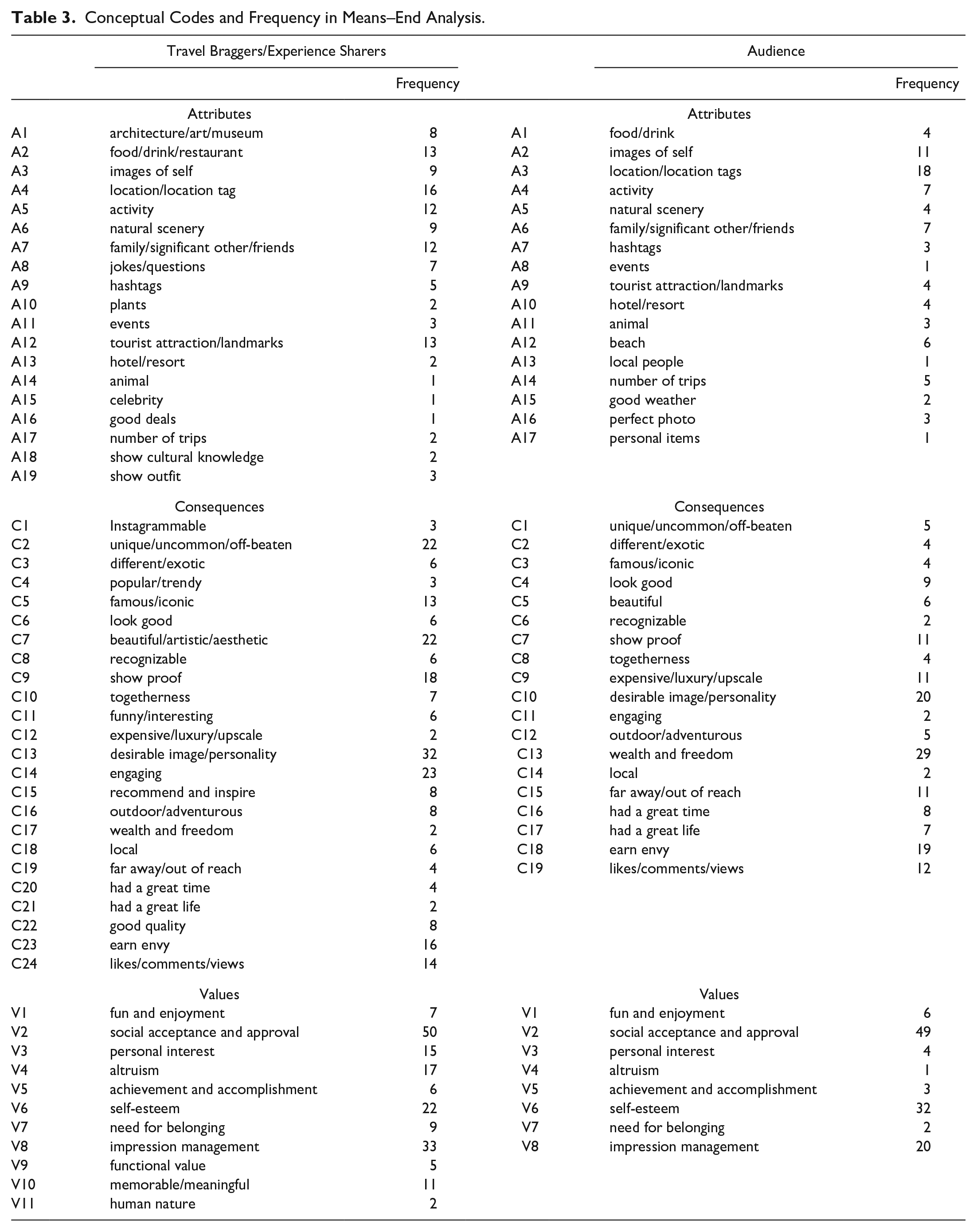
Attributes, consequences, and values and the relationships between them were summarized using implication matrices (see Appendix Table A1 for the travel bragger/experience sharer group and Appendix Table A2 for the audience group). Numbers in the implication matrix reflect the number of times each concept (shown in the first column) was linked to another concept (shown in the first row) in the means–end chain. Out-degrees in the implication matrix represent the number of times each concept was mentioned as the means or origin of a connection with other concepts, and in-degrees represent the number of times each concept was mentioned as the end or destination of a connection with other concepts (Pieters, Baumgartner, and Allen 1995). In- and out-degrees directly reflect a concept’s importance relative to all other concepts in the implication matrix (Pieters, Baumgartner, and Allen 1995). Among the travel bragger/experience sharer respondents, the most important means concept was “construct a desirable image” (out-degree = 34), which indicates this concept had the most connections leading to other concepts. The most important end concept was “social acceptance and approval” (in-degree = 50), which indicates it had the most linkages resulted from other concepts. Notably, “construct a desirable image” had a high in-degree (32) as well, suggesting this concept’s central importance both as a means and an end in the means–end structure. Among the audience respondents, “wealth and freedom” (out-degree = 36) had the most connections leading to other concepts, and “social acceptance and approval” (in-degree = 54) had the most linkages leading to it from other concepts. The latter pattern was consistent with that in the travel bragger/travel experience sharer group. “Wealth and freedom” had the highest frequency in terms of its in-degree (32) and out-degree (36), indicating that it was considered most important by the audience group. This differed from the travel bragger/experience sharer group, for whom “construct a desirable image” was most important.
The abstractness ratio in the implication matrix represents the level of abstraction of each concept in means–end chains, namely, the possibility of serving as an end in the chains (Goldenberg et al. 2000). The abstractness ratio can be calculated as the ratio of in-degrees to the sum of in-degrees and out-degrees of a concept, ranging from 0 to 1, with a higher value indicating greater abstractness (Pieters, Baumgartner, and Allen 1995). More specifically, concrete “attributes” normally have an abstractness ratio of 0 or close to 0, abstract “values” have a ratio of 1 or close to 1, and “consequences” have a ratio between 0 and 1. The “consequences” for both respondent groups in this study demonstrated moderate abstractness, with ratios ranging from 0.33 to 0.57 for the travel bragger/experience sharer group and from 0.27 to 0.67 for the audience group.
Two hierarchical value maps, which illustrate relationships among the conceptual codes, were constructed based on the implication matrices. To reduce the complexity of hierarchical value maps, only dominant relationships among all conceptual codes were presented on the basis of a cut-off value of 3, given the sample size (Reynolds and Gutman 1988; Gengler and Reynolds 1995). Linkages that were mentioned 3 times or more in hierarchical value maps represented 56% of all associations mentioned by the travel bragger/experience sharer group and 59% of all associations mentioned by the audience group. These proportions adequately reflect most relationships in the original matrices (Goldenberg et al. 2000).
Figure 1 shows the hierarchical value map for the travel bragger/experience sharer group. According to this map, the most important reasons for travel braggers/experience sharers to post travel experiences on social media were social acceptance and approval, impression management, and self-esteem. Social acceptance and approval mainly came from earning audience members’ likes, respect, appreciation, and engagement as well as gaining external validation. Impression management was mainly associated with travel posters’ need for self-enhancement and construction of desirable identities and images (e.g., being “unique” and “explorative”). Self-esteem was primarily associated with posting self-portraits (including selfies) and experiences that help earn envy from the audience. The travel bragger/experience sharer respondents posted self-portraits because they thought they “look good” or they wanted to look good in others’ eyes. Earning envy through signaling superiority represented a sense of “feeling good about themselves.” Other important values for travel braggers/experience sharers to post travel experiences on social media include altruism (benefiting others), showcasing personal interest, and need for belonging (showcasing togetherness with friends and family).
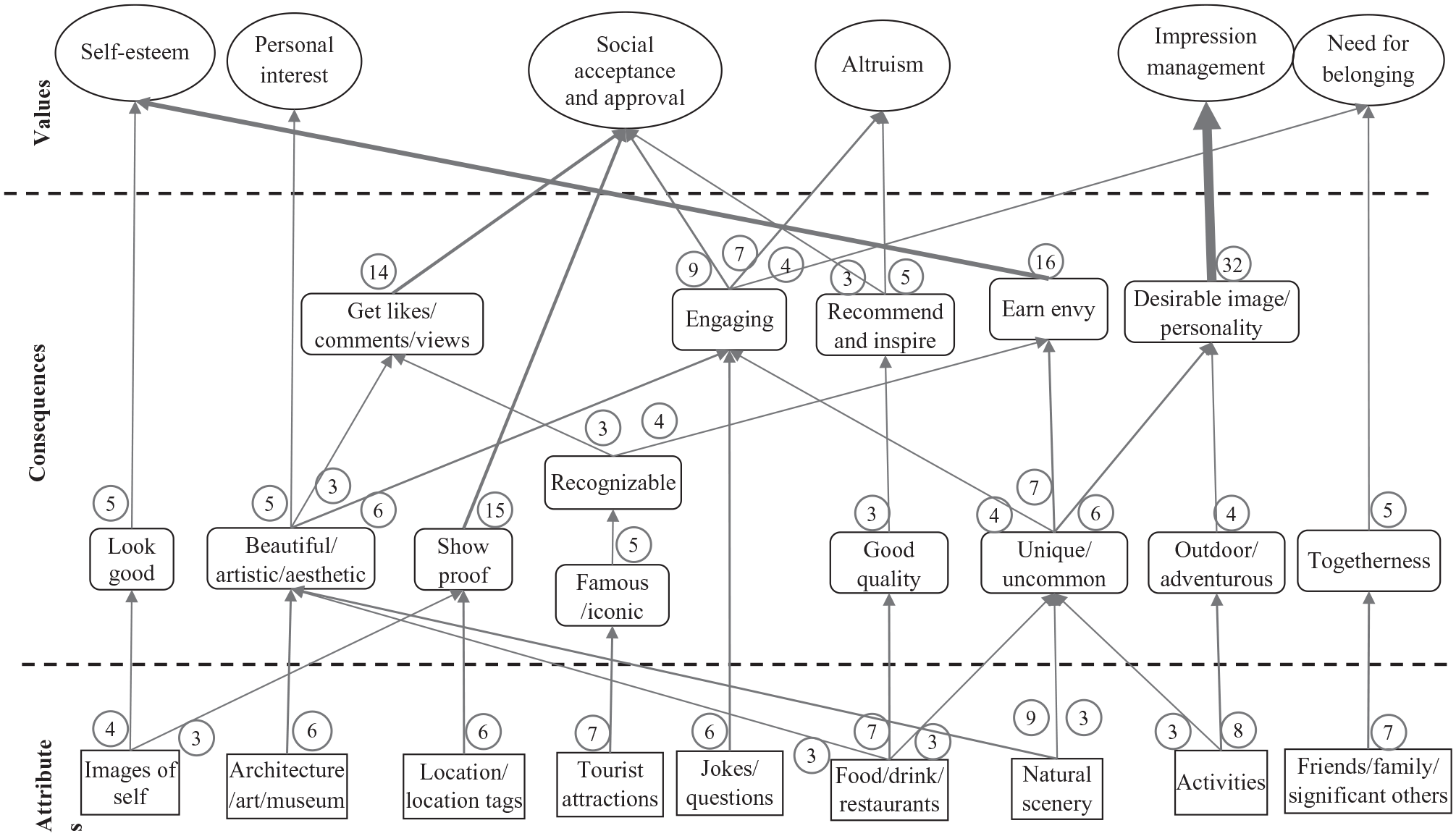
Hierarchical value map for travel braggers/experience sharers.
Among the most frequently mentioned attributes in travel braggers/experience sharers’ travel posts, “architecture/art/museum” stood out. Such posts were partly related to posters’ personal interests and partly related to seeking social acceptance and approval through audience appreciation and engagement. More importantly, travel posters wanted to show their “artistic and aesthetic taste” through such posts.
Figure 2 shows the hierarchical value map for the audience group. Consistent with the travel bragger/experience sharer group, the most important values the audience group associates with others’ travel bragging posts were social acceptance and approval, self-esteem, and impression management. In the audience’s view of points, travel braggers sought social acceptance and approval through audience engagement (“likes,” comments, and views), gaining external validation, earning envy, and showcasing one’s financial ability and freedom (e.g., wealth). Consistent with travel bragger/experience sharer respondents’ accounts, self-esteem was mainly associated with posting self-portraits (including selfies) and experiences that help earn envy, and impression management was mainly associated with construction of desirable identities and images. It was interesting to see “beaches” among the attributes mentioned by the audience group in others’ travel bragging posts. Beaches were mentioned frequently as proof of being on vacation and having the “freedom and financial ability” to take a vacation. Hence, beach was somewhat being seen as a symbol of a vacation or luxury vacation by the respondents.
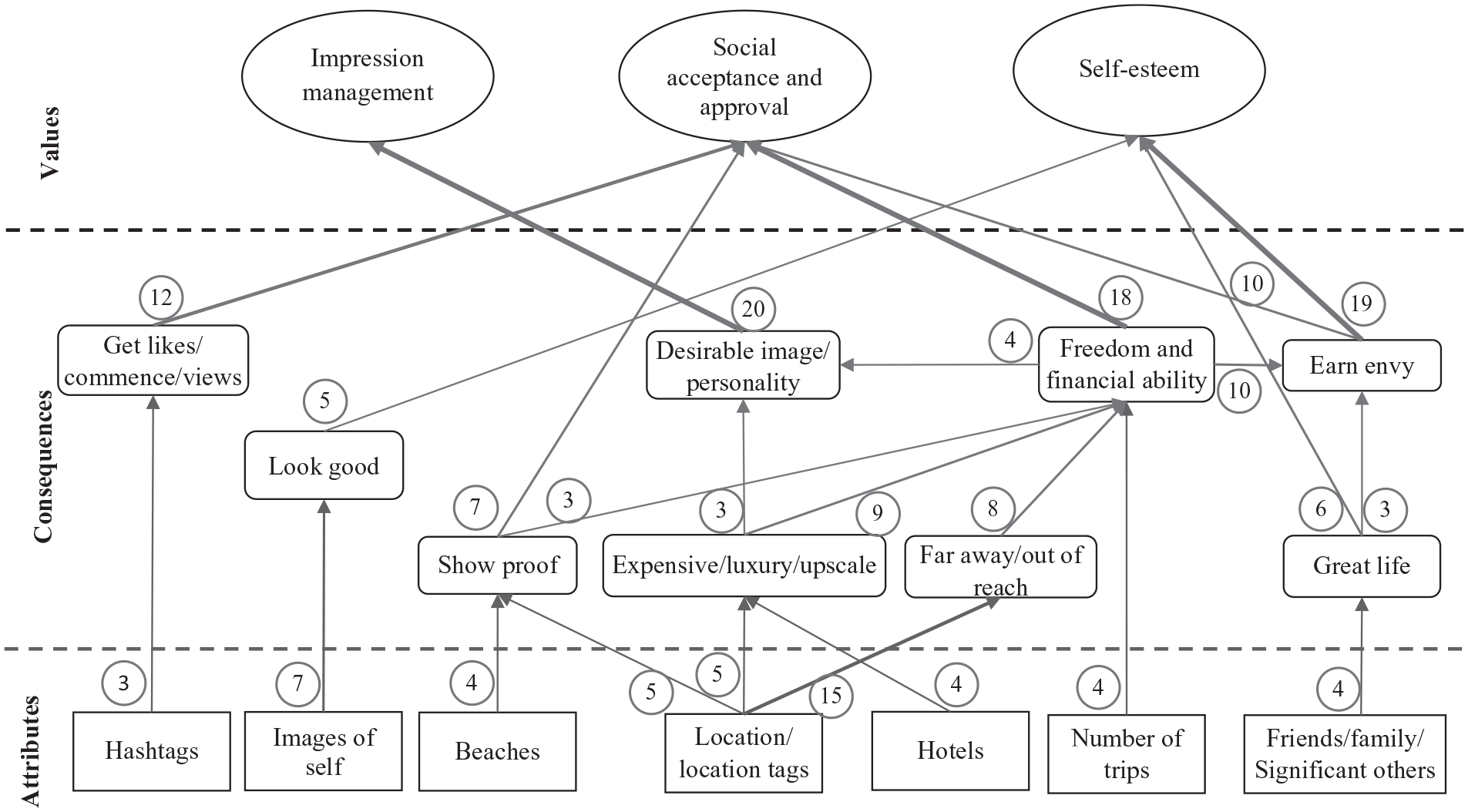
Hierarchical value map for the audience.
These hierarchical value maps reveal substantial differences between the two respondent groups in terms of what people bragged about or shared and why. The audience respondents emphasized three major values associated with others’ travel bragging posts: impression management, social acceptance and approval, and self-esteem. However, the travel bragger/experience sharer group reported other values like personal interests, altruism, and need for belonging. In addition, the audience respondents emphasized the freedom and financial ability indicated by others’ travel bragging posts, whereas travel braggers/experience sharers stressed expression of personal interest and enjoyment and construction of a desirable self-image or identity. In particular, the travel bragger/experience sharers reported earning travel bragging rights by posting content related to “architecture/art/museum,” which showed their artistic/aesthetic taste. This trend supports claims in the literature that tourists prefer to showcase their taste and cultural capital by publicizing experiential consumption rather than wealth (Boley et al. 2018; Trigg 2001). Presumably, the trend of earning travel bragging rights through visual appeal is partly driven by the popularity of Instagram, which focuses on presenting perfect photos and photography skills. By contrast, audience respondents emphasized wealth in others’ travel bragging posts, which is more consistent with classical accounts of travel bragging (Cha, McCleary, and Uysal 1995). Interestingly, the audience respondents associated the appearance of “friends/family/significant others” in travel posts with earning envy and gaining self-esteem, whereas the travel bragger/experience sharer group deemed “friends/family/significant others” appearing in travel posts as a demonstration of togetherness and a need for belonging. These discrepancies in the hierarchical value maps reflect perception gaps between travel braggers/experience sharers and the audience.
A Conceptual Framework
Based on the interviews and means–end analysis results from both travel braggers/experience sharers and the audience, seven dimensions were identified among travel experiences or destination attributes that could help posters earn travel bragging rights; these dimensions lie on a continuum between a focus on the self and a focus on the audience (see Fig. 3).
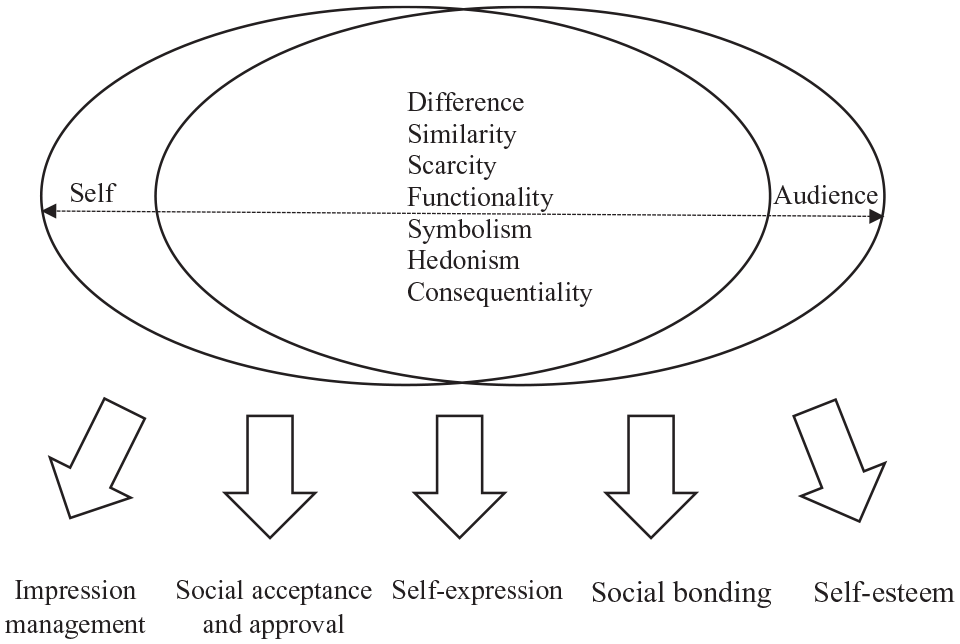
Conceptual framework of travel bragging rights.
Difference
Difference was mentioned as a dominant feature of travel experiences that helped posters earn travel bragging rights. Most respondents mentioned that people (including themselves and others) wanted to share things that were “local,” “uncommon,” or “exotic”; that differed from aspects of their home environment; and that most of their audience might not have seen or experienced. In addition, respondents mentioned that people wanted to share experiences that were “extreme,” “adventurous,” or “sensational” and differed from everyday life. Such travel experiences could be more intriguing for travel braggers/experience sharers and the audience because of humans’ need for novelty. This finding is consistent with the essence and primary motivation of travel, which is to escape from a “mundane home or work environment” and seek new and different experiences (Crompton 1979; McCabe 2000). One respondent from the travel bragger/experience sharer group said: I really feel great showing people different sides of life, how different people live, how they eat, how they shop—just different things, how things are different from American culture versus a different culture.—B04
Scarcity
Another important feature of travel experiences worth sharing on social media was scarcity. “Scarcity” is an economic term referring to the limited availability or unavailability of commodities due to limited supply or high acquisition costs (Lynn 1991). According to commodity theory, “any commodity will be valued to the extent that it is unavailable” (Brock 1968, p. 246); hence, scarcity reflects value. In a tourism context, scarcity refers to the uniqueness and exclusiveness of travel experiences. Respondents mentioned that “luxurious,” “remote,” “unique,” “exclusive,” and “rare” locations could help people earn travel bragging rights. Such experiences either have limited supply (e.g., local experiences unavailable elsewhere) or high acquisition costs—monetary (e.g., luxury locales) or non-monetary (e.g., faraway locations or extreme sports). These experiences signal the status or uniqueness of travel braggers/experience sharers and are valuable for the audience. The following quote illustrates this dimension: We also went on a hot air balloon ride in Napa, so that’s very unique, and it was really fun. So just, you know, the pictures were amazing from up high and . . . nobody I know has actually gone hot air balloon riding or hot air ballooning.—B03
Similarity
In contrast to difference and scarcity, similarity also helped people earn travel bragging rights. Similarity is reflected in travel experiences or objects at a travel destination that are also available or similar to objects at home, or travel experiences that imply common ground with the audience. Such experiences are more relevant to the audience and help build connections with them, thereby facilitating audience engagement. For example, one respondent mentioned posting a park in the United Kingdom that happened to have the same name as a place in her hometown in the United States and helped start conversations with friends at home. Meanwhile, showcasing a similar experience or object encountered at a different, faraway place also indicates the uniqueness of an experience, which posters may find “interesting.” For example, one respondent mentioned that this is bragging rights because we don’t have any more [phone booths] like this. . . . I wanted to show them that they still use Bell, which used to be a big company here in the States. They no longer have Bell because no one uses—we don’t have these phones anymore, but they still use them.—B04
Moreover, similarity with a certain audience group can indicate travel braggers/experience sharers’ association with a desirable social group or a desirable self-identity, such as being “popular” and “trendy” by posting popular experiences or tourist attractions. Some respondents reported sharing a similar experience with their aspirational social group to prove their ability to have the same experience or achievement, which was driven by a human need for social comparison. Travel experiences or locations that are sought after, which signal similarity with other people, are also more likely to be shared on social media. These experiences or locations are presumably more recognizable and can engage one’s audience more easily, which could be driven by one’s need for affiliation.
Individuals tended to seek a balance between posting unique and popular experiences or different and similar experiences. On one hand, the need for belonging or fear of missing out could compel posters to share popular or trendy experiences, but on the other hand, people also wanted to share unique experiences to stand out among their peers because of a need for differentiation. Several respondents mentioned they were hesitant to post landmarks unless their photos offered a unique perspective. One respondent reported she liked to search for popular spots on Instagram but was less willing to try an experience if it was popular among her social circle. This finding is consistent with optimal distinctiveness theory, which suggests that people strive to achieve an optimal level of distinctiveness (Brewer 1991). Here is one example: I feel like there is so much pressure to [post pictures of iconic places]. If you go to Paris, it’s like, how many pictures of the Eiffel Tower have you seen unless you are doing something different in it? . . . One of the last photos I shared from Australia was the Sydney Opera House because, like, everyone had that photo. And the only reason I shared it was because it was from a cool vantage point and the sun was rising, so I was like, “Okay, this is not the one [where] you are up close and [in] front of it, like straight,” No, it was a little different at least.—B07
Functionality
Functionality refers to superior qualities of tourism products or services. Several respondents mentioned they shared content related to food or restaurants because the food tasted good or the views were breathtaking, and they wanted others to have the same experiences. Sharing these experiences was driven by tourists’ satisfaction with tourism products or services and could be informative for the audience. For example, one respondent said: I think in this case I’m doing it to benefit other people, so people engage with me on my experiences so I can recommend experiences for them or say, “This is a great experience, you should try it.”—B11
However, functionality usually works jointly with other features. People are less likely to share mundane travel experiences only because of high quality; they are more likely to share a unique experience that is also of good quality. Notably, people may share satisfactory experiences because they wish to brag about an experience or validate that they made a good choice (Chen and Lurie 2013). Many respondents mentioned that people tended only to post positive travel experiences and exaggerate their experiences to make them appear better than reality. The quote below represents these respondents’ view: But I would say that generally every—all their contents are very positive and very clean cut, as in, like, it’s very, beautiful. Like, everything is stunning, images and video-wise.—A14
Symbolism
Symbolism refers to the use of symbols or objects to construct, confirm, and communicate one’s self-concept and identity (Ekinci, Sirakaya-Turk, and Preciado 2013). Tourism consumption is inherently symbolic (Brown 1992) and has been a signal of social status since the 18th century when leisure travel emerged in Europe (Towner 1985). Research has found that the congruence of destination image or destination personality with tourists’ self-concept could influence tourists’ destination choices and loyalty (Beerli, Meneses, and Gil 2007; Ekinci, Sirakaya-Turk, and Preciado 2013; Usakli and Baloglu 2011). Respondents frequently reported that people intended to construct a certain image or identity by sharing specific travel experiences. For example, some respondents wanted to appear “sociable and popular” by posting get-togethers with friends during travel. Some wanted to be seen as “active” or “adventurous” by posting outdoor activities. Others wanted to be seen as “cultured” or “artistic” by sharing local cultures or artwork. Still others posted photos of themselves to showcase their desirable physical appearance. In addition, people preferred to show objects to indicate they were on vacation, such as photos of themselves, beaches, location tags, checking in at the airport, and passport stamps. People tend to share travel experiences that can communicate their social status, wealth, knowledge, physical appearance, skills, and any desirable or superior characteristics out of a need for self-enhancement, identity signaling, and evolutionary needs such as courtship. The quote below shows an example of the symbolism dimension of travel bragging rights: [By posting a photo with a group of friends at a restaurant, I’m trying to say] I’m in good company and just enjoying this time away from the everyday. . . . Like I’m a sociable guy and I’m very cool, popular.—B10
Hedonism
Hedonism refers to multisensory, entertaining, and emotional aspects of consumption experiences (Hirschman and Holbrook 1982). Tourism consumption is hedonic in nature, as it involves the pursuit of pleasure, fun, and excitement (Mannell and Iso-Ahola 1987; Hosany and Gilbert 2010). Many respondents mentioned they liked to share travel experiences that were “exciting,” “sensational,” and “fun,” as well as tourist attractions or scenery that were “beautiful,” “aesthetic,” and “artistic.” Sharing emotional experiences, especially those that are particularly arousing, could be driven by human beings’ need for emotional venting (Hennig-Thurau et al. 2004; Berger 2014). In addition, highly arousing emotional experiences and exceptionally aesthetic experiences could differ from everyday life, making them interesting for the audience. Furthermore, posters wanted to show their “artistic taste” by sharing “artistic/aesthetic” objects. They also aimed to display that they “had a great time” and “a great life” by sharing positive emotional experiences; doing so could make them feel good about themselves and enhance their self-esteem. For example, one respondent said: [I want to post objects that are] colorful, they are always bright colors like high saturation in those photos. . . . [They] have really interesting lines, which I know is a weird thing to say but pictures of architecture, like my friend who went to Italy posted these beautiful photos from Italy, and they are almost all buildings but it was just like these really beautiful lines. It was just like perfect composition, and you knew exactly where he was. Like you [didn’t] need to read the caption, you just knew it was Italy when you saw [it]; it was perfect. But at the same time, he posted some scenery photos were just, like the cliffs around the Positano coast or whatever. It’s like beautiful, beautiful shots of these stark contrasts between ocean and sky and these really steep, sandy cliffs. Oh, beautiful! So dramatic. Yeah, dramatic photos for sure.—B07
Consequentiality
Consequentiality refers to the perceived personal importance and meaningfulness associated with a trip (Tung and Ritchie 2011). Consequentiality makes trips more memorable by enhancing social relationships, intellectual development, and self-discovery and overcoming physical challenges during travel (Tung and Ritchie 2011). Respondents mentioned that people may want to share a travel experience because it was “meaningful,” “memorable,” and involved a sense of “achievement” or “accomplishment.” For example, one respondent mentioned he posted his travel experiences in different countries because traveling around the world was one of his life goals, and he wanted to reveal that he had finally realized his childhood dream. Another respondent mentioned that a friend posted a destination that was meaningful for her, as it was where she started traveling independently, and she had grown substantially since then. The following quote shows another example of consequentiality: [I like to post photos] with food, the places that I’ve been and like, “Look at this beautiful scenery,” Or some kind of achievement, like, “Oh, wow! I climbed this mountain,” and “Look at the beautiful view from climbing up that mountain.” It’s kind of like when people post those gym selfies. Like, “Oh, I just ran five miles on the treadmill,” and they show the treadmill, like it’s just . . . bragging about achievement.—B12
Sharing travel experiences with consequentiality was considered more deserving of travel bragging rights from the audience’s perspective. Respondents indicated that if a trip was a “once-in-a-lifetime” or “dream trip,” or otherwise achieved after “struggling” or “hard work and effort” (e.g., saving money or studying for a long time), they would react more positively and consider travel posters to have earned the right to brag about it.
These seven dimensions can be put on a continuum between a focus on the self and a focus on the audience. People may strive to post travel experiences characterized by a combination of self-serving features and audience-serving features. For example, unique experiences are new and interesting to the audience and signal one’s unique image. Still, some respondents tended to focus solely on themselves in travel experience sharing, such as displaying themselves in every photo. Travel experiences or locations that hold any one or more of the above-mentioned features could help people earn travel bragging rights. Posting such experiences can serve several social psychological functions from travel braggers/experience sharers’ perspectives, including impression management, gaining social acceptance and approval, self-expression, social bonding, and boosting or maintaining self-esteem. Notably, all seven dimensions and five social psychological needs were reported by the travel bragger/experience sharer respondents. However, the audience group did not mention similarity and functionality as constituting travel bragging rights, nor did they mention self-expression or social bonding among posters’ personal needs corresponding to travel bragging rights.
Conclusions and Discussion
The present study attempted to conceptualize travel bragging rights from travel bragger/experience sharers’ and the audience’s perspectives using qualitative approaches. According to the interviews, travel bragging rights denote the perceived worthiness of sharing travel-related experiences or objects on social media. Travel bragging rights reflect the social currency or value of travel consumption in enhancing social connections, constructing image, signaling identity, and demonstrating cultural capital through communication and engagement with one’s audience. The increasingly popular phrase “Instagrammability,” referring to the sharing worthiness of travel experiences on Instagram, can be considered a subset of travel bragging rights but focuses on the visual appeal of tourist attractions and accompanying photos. Seven dimensions of travel experiences or destination attributes that can help posters earn travel bragging rights were identified in this study: difference, similarity, scarcity, functionality, symbolism, hedonism, and consequentiality. These dimensions are located on a continuum between a focus on the self and a focus on the audience, and people strive to post travel experiences that often contain a combination of self-serving features and audience-serving features. On one hand, people want to share travel experiences that communicate a desirable image, personal interests, social status, achievement, meaningful experiences, and positive emotions. On the other hand, people wish to share travel experiences that the audience will appreciate and find interesting, impressive, or relevant; such experiences can be either unique (e.g., the audience has never seen it before) or able to generate common ground with the audience (e.g., representing similar interests). Sharing travel experiences that help posters earn travel bragging rights serves several social psychological functions, including impression management, gaining social acceptance and approval, self-expression, social bonding, and boosting or maintaining self-esteem.
Theoretical Contributions
This study makes several theoretical contributions to the literature. First, this study represents an initial attempt to provide a comprehensive conceptualization of travel bragging rights from the perspectives of travel braggers/experience sharers and the audience. A conceptual framework of travel bragging rights was thus constructed. It was concluded that bragging rights associated with travel consumption depend on its ability in both facilitating positive self-disclosure and building/maintaining connections with the community, and consumers generally seek a balance between these two ends. This conclusion is consistent with the optimal distinctiveness theory, which asserts that individuals strive to achieve an optimal level of distinctiveness between their need for inclusion and need for differentiation (Brewer 1991). Further, the developed conceptual framework of travel bragging rights supports Bastos and Brucks’s (2017) argument that experiential consumption possesses high conversational value due to disclosure of the self, social approval, and uniqueness. This conceptualization also highlights the importance of fulfilling the audience’s needs to gain attention under information overload in today’s “attention economy” (Webster and Ksiazek 2012). Additionally, the present study extends the social return scale developed by Boley et al. (2018) by incorporating destination attributes that can help posters earn travel bragging rights.
Second, this study contributes to travel motivation theory by investigating whether and how seeking travel bragging rights motivate travel in the era of social media. In the past, travel bragging motivation focused more on luxury and wealth (Cha, McCleary, and Uysal 1995; Sirakaya, Uysal, and Yoshioka 2003). However, today’s tourists also seek travel bragging rights from travel experiences that generate common ground with their audience, communicate an image or identity not necessarily related to wealth and social status (e.g., adventurous or sociable), express personal interests and emotions, or simply display perfect photos. Seeking travel bragging rights as a motivation is therefore broadened in the social media era. The components of travel bragging rights echo the motivations for sharing travel experiences on social media identified by Munar and Jacobsen (2014), which contain both self-centered motivations and community-related motivations. However, earning travel bragging rights as a travel motivation is conceptually distinct from one’s motivations for sharing travel experiences, as the former focuses on seeking travel experiences that are worth sharing on social media as a motivational factor for travel.
Third, changes in the meaning of seeking bragging rights as a travel motivation reflect a shift to the use of cultural capital in identity construction. As such, this study contributes to the literature on symbolic consumption and identity construction through tourism consumption. The interview results highlight the use of cultural capital rather than wealth in identity construction from travel braggers’/experience sharers’ perspectives. By consciously or unconsciously displaying their education, knowledge, or travel experiences related to museums and visual arts, theaters, festivals, and concerts, the respondents wanted to signal their “cultured, artistic, and aesthetic” taste and cultural capital. External wealth, according to Bourdieu (1997, p. 46), can be “converted into an integral part of the person” through investment in knowledge, which forms a long-lasting disposition and embodied cultural capital. These findings corroborate the emerging trends observed by previous scholars in that today’s consumers tend to signal identity via experiential consumption, and through the cultural capital and taste conveyed by such consumption (Boley et al. 2018; Bronner and de Hoog 2019; Duan and Dholakia 2018; Lin, van de Ven, and Utz 2018).
Practical Implications
Anticipated travel bragging rights not only inspire destination visit intentions but also motivate social media WOM. It is therefore important to leverage travel bragging rights in destination marketing strategies. Destination marketers should develop marketing campaigns that highlight destination attributes that are Instagrammable or can help tourists earn bragging rights. Specifically, depending on a destination’s tourism resources, marketers could highlight various features: unique differences, scarcity, connections to tourists’ home country, symbolic meanings, hedonic and aesthetic aspects, superior products and services, or meaningful experiences. For example, Egypt’s Ministry of Tourism showcased the country’s “hidden gems” in a 2019 destination marketing campaign (Maged 2019), which highlights the uniqueness and authenticity of its tourist attractions.
The growing trend of Instagrammability, especially among the millennials, has made tourists’ visual experiences more important than ever. To embrace this new trend, destinations and attractions could incorporate more Instagrammable designs featuring visual elements that are photogenic, aesthetic, and artistic to revive existing tourist experiences or create new ones. For example, many destinations in Southeast Asia, such as Indonesia, have built swings designed for Instagram shots to attract tourists (Indonesia Ministry of Tourism 2019). Several pop-up museums featuring Instagrammable visual designs intended for photos, have emerged and became popular in recent years, such as the Museum of Ice Cream in New York (Ell 2018). As for destinations restricted to renovating or adding designs, destination marketers could determine locations or angles offering photogenic views or Instagram-worthy photos. In addition, using “perfect” or visually stunning travel photos in destination marketing materials could lure tourists who value Instagrammability as part of travel bragging rights.
Moreover, the increasing importance of cultural capital in shaping travel bragging rights warrants attention from destination marketers. Travel experiences that demonstrate cultural capital are more worthy of sharing on social media as tourists today seek to signal status in more sophisticated and subtle ways (Trigg 2001). Destinations could develop more cultural tourism products that help tourists acquire cultural capital, such as gaining new knowledge and skills, experiencing local culture, and demonstrating taste. Examples of such tourism products include artistic tourist attractions (e.g., architecture, graffiti, and sculptures), theaters, museums, heritage sites, cultural events and festivals (e.g., concerts and exhibitions), creative tourism sites (e.g., factories, wineries, and farms), and immersive experiences such as workshops and classes (Carvalho 2014; Quaglione et al. 2020).
Travel bragging rights could be constructed via a conditioning process, specifically by projecting destination images related to social desirability in marketing activities (Kerr, Lewis, and Burgess 2012). Accordingly, destinations should engage in various marketing activities through owned, paid, or earned media to establish connections between destinations and travel bragging rights sought after by target markets. Furthermore, destination marketers could provide channels to aid tourists in obtaining bragging rights, such as by developing location tags and official hashtags that can be used to engage with destination management organizations on social media.
Limitations and Future Research
Despite its significant contributions, this study is not without limitations. First, this study focused on an American sample; whether the findings are applicable to other demographics and cultural contexts requires further research. Second, this study focused on tourists’ perspectives on travel bragging rights. Thoughts from industry practitioners may be helpful in clarifying the influences of travel bragging rights in practice. In addition, a measurement scale could be developed in future research to quantitatively assess the extent of travel bragging rights associated with a destination or tourist attraction and to examine the influences of travel bragging rights on tourists’ attitudes and behavioral intentions.
Supplemental Material
Appendix – Supplemental material for How Travel Earns Us Bragging Rights: A Qualitative Inquiry and Conceptualization of Travel Bragging Rights
Supplemental material, Appendix for How Travel Earns Us Bragging Rights: A Qualitative Inquiry and Conceptualization of Travel Bragging Rights by Hongbo Liu and Xiang (Robert) Li in Journal of Travel Research
Footnotes
Acknowledgements
The authors gratefully acknowledge the financial support from the Fall 2018 Seed Funding Forum, Fox School of Business at Temple University. In addition, the authors would like to express their sincere gratitude to Professor Svetlana Stepchenkova for her help, as well as the editor and anonymous reviewers for their constructive feedback and suggestions to help improve the manuscript.
Declaration of Conflicting Interests
The author(s) declared no potential conflicts of interest with respect to the research, authorship, and/or publication of this article.
Funding
The author(s) disclosed receipt of the following financial support for the research, authorship, and/or publication of this article: This study was funded by the Fall 2018 Seed Funding Forum, Fox School of Business, Temple University.

Supplemental Material
Supplemental material for this article is available online.
Author Biographies
References
Supplementary Material
Please find the following supplemental material available below.
For Open Access articles published under a Creative Commons License, all supplemental material carries the same license as the article it is associated with.
For non-Open Access articles published, all supplemental material carries a non-exclusive license, and permission requests for re-use of supplemental material or any part of supplemental material shall be sent directly to the copyright owner as specified in the copyright notice associated with the article.
