




Abstract
We study the formation of pro-environmental behaviors (PEBs) by integrating both the promoting (moral obligation) and inhibiting (moral disengagement) PEB mechanisms. Results of a sample of 285 tourists at a National Nature Reserve in China affirm that moral obligation positively affects PEB intention, while moral disengagement has significant negative impact. There is little difference in the relative importance of moral obligation and moral disengagement in affecting PEB intention. Social influence plays an important role in regulating the impacts of moral variables on PEB intentions. This study also broadens knowledge of the structure of PEB, by unveiling low-effort PEB intention as a precursor to high-effort PEB intention, and a mediator between moral obligation / moral disengagement and high-effort PEB intention. This study provides insights and implications for tourism practitioners and policy makers, and opens up future research exploration of the paradox of the promoting and inhibiting PEB mechanisms.
Introduction
In light of the negative environmental consequences often associated with tourism behaviors, it is imperative to mitigate the environmentally harmful effect of tourism activities and to encourage pro-environmental behaviors (PEBs) of tourists (Hindley and Font 2017; Juvan and Dolnicar 2014; Miller et al. 2010). Substantial research efforts have been devoted to the promoting mechanisms of PEBs based on moral considerations (Clark, Kotchen, and Moore 2003; Han 2015; Han and Hyun 2017), among which moral obligation has been consistently affirmed as a crucial driving factor (Dolnicar and Leisch 2008; Han, Meng, and Kim 2017). Yet there is a distinct gap between individuals’ moral thoughts and real actions (Juvan and Dolnicar 2014; Shepherd, Patzelt, and Baron 2013; Wu et al. 2013). Individuals express strong moral obligation toward environmental conservation yet act in ways inconsistent with it (Shepherd, Patzelt, and Baron 2013). This paradox raises a critically important research question: Why do tourists with a strong moral obligation not adopt pro-environmental actions? In an attempt to answer this question, it is necessary to determine both the mechanisms that inhibit the formation of PEBs and those that promote them.
The theory of moral disengagement, which originated from Bandura’s (1986) social cognitive theory, may provide a compelling theoretical foundation to understand the inhibiting mechanism of PEBs. Moral disengagement refers to the cognitive process with which one is able to deactivate moral self-regulation and to disengage from moral norms without suffering apparent self-censure (Bandura 1999). As asserted by Bandura et al. (1996), moral disengagement can explain how people morally disengage from pro-social actions by reframing the causes and consequences of their behaviors. People with a higher level of moral disengagement are less likely to engage in pro-social behaviors (Bandura et al. 1996; Tsai, Wang, and Lo 2014). We posit that we can expect moral disengagement to inhibit PEB intentions.
Some progress has been made in exploring the reasons why tourists do not engage in PEBs; reasons such as responsibility denial (Gössling et al. 2009; Juvan and Dolnicar 2014), responsibility displacement (Miller et al. 2010), consequence denial (Gössling et al. 2009), and downward comparison (Juvan and Dolnicar 2014). These studies have focused primarily on separate factors that inhibit individuals to take actual environmental actions, but they have not provided an empirically validated, parsimonious measure of the propensity of tourists to morally disengage from PEBs.
Tourism studies focusing on the two-dimensional PEB rarely examine the relationship between low- and high-effort PEB. The exceptions are Ramkissoon, Smith, and Weiler (2013), who conceptualized PEB as a two-dimensional construct comprised of low-effort PEB and high-effort PEB; and Shahzalal and Font (2018), who found that low-effort PEB generates the behavioral efficacy needed to promote subsequent high-effort PEB. Even less is known about whether the relationships between moral variables and high-effort PEB are mediated by low-effort PEB. Because of the social nature of human beings, social influence is considered to be an important situational factor that affects an individual’s decision making toward moral actions. The presence of others provides stimulus cues to trigger the translation of moral thoughts (e.g., moral obligation) into PEBs (Göckeritz et al. 2010). By contrast, if significant others around us merely perform environment-friendly actions, the gap between moral considerations and PEB intentions would likely widen. A moderating effect of social influence on the indirect relationships between moral variables (moral obligation and moral disengagement) and PEB intentions is expected, yet it has received little attention in prior literature.
In response to the research gaps discussed above, this study seeks to address three primary objectives. First, we shall develop and validate a conceptual model to integrate the promoting and inhibiting mechanisms of PEBs. In this study, we propose that the propensity to morally disengage is a significant inhibitor of PEB intention. Second, we examine and compare the relative importance of moral variables in affecting PEBs in a tourism context. Third, we determine the moderated mediation relationships between social influence, moral variables (moral obligation and moral disengagement), and low- and high-effort PEB intentions.
Literature Review
Based on Bandura’s (1999) theory of moral disengagement (MD) and Schwartz’s (1977) norm-activation model (NAM), we develop a theoretical framework that considers both the promoting (moral obligation) and inhibiting (moral disengagement) factors that are involved when tourists engage in a given behavior. We analyze (1) the relative importance of each mechanism in affecting the tourists’ PEB intentions and (2) whether social influence moderates the indirect effect of moral variables on high-effort PEB intention via low-effort PEB intention.
Pro-environmental Behavior: A Two-Factor Structure Construct
PEB represents the behavior that minimizes the negative impacts of an individual’s action on the environment or that even benefits the environment (Steg and Vlek 2009). There are a variety of activities that can be deemed as PEBs including recycling, picking up litter, conserving energy, and volunteering time to conservation projects. Traditionally, PEB has been largely investigated as a singular and undifferentiated behavior, while emerging research advocates a more nuanced understanding of PEBs (Ramkissoon, Smith, and Weiler 2013). Different types of PEBs may differ in their antecedents and consequences (Song and Soopramanien 2019; Stern 2000), hence differentiating and categorizing among PEBs is psychologically and empirically meaningful (Miao and Wei 2016).
In nature-based tourism, Ramkissoon, Smith, and Weiler (2013) determined PEB intention as a two-factor structure construct, comprising low- and high-effort PEBs. Low-effort PEBs refer to behaviors that require lower commitment to undertake the activities (e.g., recycling), while high-effort PEBs indicate behaviors that, comparatively, require more time and attentions to be invested (e.g., volunteering time for conservation projects). Such two-factor classification of PEBs has been subsequently employed and validated (Ramkissoon, Mavondo, and Uysal 2018; Song and Soopramanien 2019; Zhang, Moyle, and Jin 2018), affirming the necessity to distinguish between low- and high-effort PEBs in sustainable tourism research. We now understand that the same antecedent can have distinct effects on the type of PEB according to the perceived level of effort required. For example, Ramkissoon, Smith, and Weiler (2013) found that place satisfaction positively affects low-effort PEB intention whereas it negatively influences high-effort PEB intention. Hence, in the present study, we employ Ramkissoon, Smith, and Weiler’s (2013) two-factor measures (low- and high-effort) of PEB intention in preference to a unidimensional construct.
Moral Obligation
Morality features highly in the study of altruistic reasons for PEB (Han and Hyun 2017; Li and Wu 2019; Shi, Fan, and Zhao 2017). Schwartz’s (1977) NAM is commonly employed to support the link between morality and PEB. NAM originated from moral decision-making research (Schwartz 1977), which was mainly applied to explain altruistic pro-social and pro-environmental behavior (Saphores, Ogunseitan, and Shapiro 2012). NAM suggests that personal norms or feelings of moral obligation are critical to encourage an individual’s PEBs (De Groot and Steg 2009; Shi, Fan, and Zhao 2017). The social cognitive theory literature similarly identifies a strong association between one’s moral reasoning and altruistic behavior (Bandura 1991, 2002). According to social cognitive theory, individuals tend to conduct moral actions in line with their adopted moral standards via self-regulatory mechanisms (Bandura 2002). The higher their level of moral reasoning, the more likely a person is to behave altruistically.
Recent studies have analyzed tourists’ senses of obligation or moral standards to engage in PEBs (Dolnicar and Leisch 2008; Han 2014, 2015; Han and Hyun 2017; Li and Wu 2019). There is evidence of a direct positive relationship between tourists’ moral obligations and PEBs in both low-effort pro-environmental actions, such as recycling (Saphores, Ogunseitan, and Shapiro 2012) and using “green” shopping bags (Lam and Chen 2006), and high-effort PEBs, such as volunteering time toward conservation projects (Harland, Staats, and Wilke 2007). Prior research posited that small commitments may foster bigger commitments to environmental conservation (Werner et al. 1995). Furthermore, according to self-efficacy theory (Bandura 1997), increasing one’s confidence in conducting specific actions is one of the best ways to influence one’s intention to engage in the actions that require more efforts.
In a tourism context, efficacy for PEBs also plays an important role in encouraging more sustainable behaviors and can be enhanced by providing evidence to tourists (Shahzalal and Font 2018). In this sense, low-effort PEBs constitute the evidence of behavioral efficacy, thus enhancing the tourists’ intentions to engage in high-effort PEBs. We, therefore, argue that the activation of moral obligation influences engagement in low-effort PEBs, which in turn enhances intentions to conduct high-effort PEBs. As such, we expect low-effort PEB intention to mediate the effect of moral obligation on high-effort PEB intention. Based on the above literature review, we offer the following hypotheses:
Hypothesis 1a: Moral obligation positively affects low-effort PEB intention.
Hypothesis 1b: Moral obligation positively affects high-effort PEB intention.
Hypothesis 1c: Low-effort PEB intention mediates the relationship between moral obligation and high-effort PEB intention.
Moral Disengagement
The moral disengagement concept was first proposed by Bandura (1986) from the perspective of social cognitive theory, whereby an individual’s self-regulatory system monitors their behavior against their personal standards (Bandura 1991). People tend to conduct pro-social behavior because it is in accordance with their internal moral standards. Conversely, people refrain from reprehensible behaviors that violate their moral standards such as feelings of shame and guilt (Bandura 1999). Moral disengagement affects moral self-regulation by selectively activating (or not) one’s self-regulatory system (Bandura et al. 1996). Instead of changing the underlying moral standards, moral disengagement describes the process through which people cognitively restructure the amount, or the cause, of harm generated by unethical behaviors (Detert, Treviño, and Sweitzer 2008). That is, through moral disengagement, people are able to justify their behaviors without suffering from guilt and distress (Hinrichs et al. 2012). As such, people with higher moral disengagement levels are more likely to conduct unethical behaviors, whereas they are less inclined to engage in pro-social behaviors (Bandura et al. 1996).
Bandura (1986) conceptualized eight psychological mechanisms of moral disengagement, namely: moral justification, euphemistic labeling, advantageous comparison, displacement of responsibility, diffusion of responsibility, distortion of consequences, dehumanization, and attribution of blame. Moral justification describes how people justify to themselves the rightness of their detrimental behaviors. For example, in the context of PEBs, people may say it is acceptable to cause environmental damage (e.g., flying) when this serves a socially valued purpose (e.g., to take a “well deserved” break). Euphemistic labeling refers to the mechanism whereby people utilize morally neutral language to sanitize their reprehensible actions, for example, referring to pollution leaked from engines in cruise ships as “fugitive emissions,” or the clearing of forests to build golf courses as “timber harvest,” or the substantial destruction of natural landscapes in tourist resorts as “landscape enhancement.” By advantageous comparison, individuals can make their detrimental actions seem less harmful. For example, individuals may justify flying by then staying at an eco-lodge compared to the seemingly less sustainable impact of staying at an all-inclusive hotel or going on a cruise.
Both displacement of responsibility and diffusion of responsibility describe how people minimize the associations of actions with the corresponding consequences (Hinrichs et al. 2012). People displace responsibility onto others, when they regard their reprehensible behaviors as a direct result of social pressures (e.g., the travel agent recommended this product). In this case, displacement of responsibility occurs. When a group of people are responsible for one action, then diffusion of responsibility occurs (e.g., other members of my holiday group wanted to do something), as “when everyone is responsible, no one really feels responsible” (Bandura et al. 1996, p. 365). People may also distort the consequences of their actions to sanitize the harm they cause, thus reducing the feeling of distress, which is called distortion of consequences. For example, people argue that their personal environmental behavior is negligible in terms of causing significant harm to the environment (Gössling et al. 2009).
Under dehumanization and attribution of blame, individuals can eliminate the self-censure by minimizing identification with the targets of unethical actions. Dehumanization describes the mechanism whereby individuals’ internal moral standards are less likely to be activated if the target behavior has been defined as unworthy of moral regard. In a pro-environment context, one may say that eating meat from endangered animals while on holiday cannot be deemed as a reprehensible behavior because animals are not human beings. Likewise, attribution of blame manifests when people place the blame on others or the context. For instance, people may justify their lack of concern with environment as government does not do its job effectively.
Moral disengagement has been applied in multiple contexts, such as aggressive actions among children (Bandura et al. 1996), unethical organizational behaviors (Moore et al. 2012), and antisocial behaviors in sports (Boardley and Kavussanu 2010). Although scholars identified the role of moral disengagement in inhibiting prosocial behaviors (Bandura et al. 1996; Shepherd, Patzelt, and Baron 2013), research regarding how individuals morally disengage from PEBs is still insufficient. The extant tourism literature suggests that tourists may displace the responsibility of their travel behavior (Miller et al. 2010); distort the consequences of their actions, for example, argue that personal actions cause little impact on the environment (Gössling et al. 2009); or use advantage comparison to minimize the negative impact they cause and to comfort themselves, for example, compared with the mining business, tourists are doing more good than bad (Juvan and Dolnicar 2014). Font and Hindley (2017) studied five stages of moral disengagement in relation to individuals’ reluctance to give up flying, namely, to deny the threat of climate change, to realign tensions arising from travel, to apportion blame for the impacts of travel, to increase demand to threatened products/destinations, and, eventually, to dismiss the value of the threatened behavior.
Despite this evidence, few studies have demonstrated a direct link between moral disengagement and PEB intention. The current understanding of the inhibiting mechanism of PEBs can be furthered, by adopting Bandura’s (1986) conceptualized moral disengagement model, as a coherent set of cognitive tendencies that affect individuals’ PEB. We expect that moral disengagement acts as a significant inhibitor of the engagement of PEBs in tourism contexts. That is, tourists with higher levels of moral disengagement are less inclined to perform PEBs at destinations. Since low-effort commitment promotes the generation of high-effort conservation commitment (Shahzalal and Font 2018; Werner et al. 1995), we also expect that a tourist’s intention of low-effort PEB mediates the link of moral disengagement with intention of high-effort PEB. In consideration of the above theoretical reasoning, we hypothesize that:
Hypothesis 2a: Moral disengagement negatively affects low-effort PEB intention.
Hypothesis 2b: Moral disengagement negatively affects high-effort PEB intention.
Hypothesis 2c: Low-effort PEB intention mediates the relationship between moral disengagement and high-effort PEB intention.
Social Influence as a Moderator
It is well accepted that individuals’ behaviors are susceptible to the presence of others (Göckeritz et al. 2010). According to social cognitive theory, the way in which people act, with respect to moral behaviors, varies depending on situational imperatives (Bandura 1991). Considering the collective feature of environmental problems, social influence is an important situational factor that can provide a deeper understanding of PEBs (Uzzell, Pol, and Badenas 2002). In situations where others do not behave pro-environmentally, the strength of the moral obligation–PEB link is likely to be weakened (Steg et al. 2014), as the pressure to comply with social norms is one of the major barriers to PEBs, as perceived by individuals (Lorenzoni, Nicholson-Cole, and Whitmarsh 2007; Miller et al. 2010). Despite people claiming that they care about the environment, they still will not adopt PEBs alone (Lorenzoni, Nicholson-Cole, and Whitmarsh 2007). However, observing that others are trying to conserve the environment may strengthen the predicting effect of moral obligation on high-effort PEB intention via low-effort PEB intention. That is, if one’s reference group does behave in an environment-friendly way, it is more likely that one’s moral obligation will be converted into PEB intentions.
Limited information can be found in the existing literature about the effect of moral disengagement on PEB intentions, and even less is known about the impact of situational factors (e.g., social influence) on the moral disengagement–PEB intention association. It is possible that individuals who perceive low levels of social influence regarding PEBs are more likely to morally disengage in PEBs. As such, we need to examine the moderating role of social influence on the indirect relationship between moral disengagement, low- and high-effort PEB intentions. Recent research contends that a destination where most visitors do not act sustainably is sending signals to others that non-sustainable behaviors are acceptable (Liu, Wu, and Che 2019). Under such circumstances, finding excuses to morally disengage in PEB becomes easier, and the negative influence of one’s moral disengagement becomes more salient. Hence, we expect that social influence also exerts a significant moderating impact on the mediating relationship of moral disengagement on high-effort PEB intention via low-effort PEB intention. Considering the above discussions, we propose a moderated mediation relationship between social influence, moral variables (moral obligation and moral disengagement), and PEB intention.
Accordingly, we hypothesize that
Hypothesis 3: Social influence moderates the indirect relationships between moral variables (moral obligation and moral disengagement) and PEB intention.
The proposed research framework is illustrated in Figure 1.
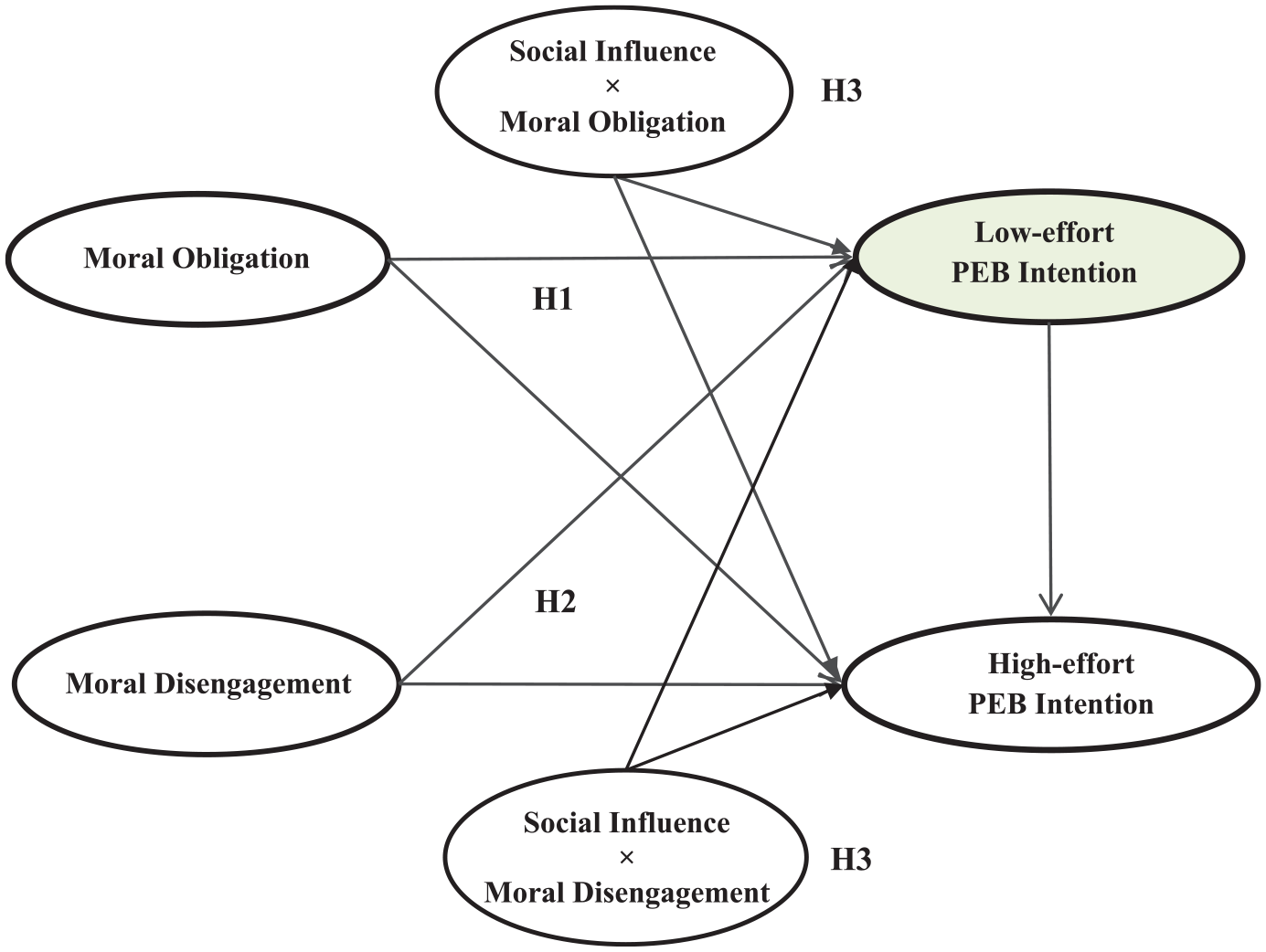
The conceptual model of tourist PEB intention.
Methodology
Measures
The measurements used in this study were substantiated by a detailed review of relevant literature. By seeking expert opinions (five scholars who specialize in sustainable tourism and five tourists who have sustainable tourism experience), a pretest was conducted to ensure content validity. On the basis of the pretest, the items were modified in accordance with our research context. The wording of the questionnaire and the sequence of questions were also improved. We developed the original questionnaire in English and then translated it into Chinese using the expertise of the project team. Then, following Brislin’s (1980) approach, we asked a Chinese-English bilingual scholar to undertake the back-translation process. As such, the content validity of the instrument was assured.
The final survey instrument measured the five constructs shown in Figure 1, as well as questions regarding respondents’ demographic information. For moral obligation, the scale included four items adapted from Onwezen, Antonides, and Bartels (2013). The moral disengagement scale was measured with eight items adapted from Bandura et al. (1996) and Moore et al. (2012). Social influence included three items from Nolan et al. (2008) and Göckeritz et al. (2010). In response to the call by scholars that PEBs should be delineated in relation to the perceived level of effort required (Ramkissoon, Smith, and Weiler 2013; Song and Soopramanien 2019), we followed Ramkissoon, Smith, and Weiler’s (2013) two-factor approach of measuring PEB intention. The measurements of low-effort PEB intention and high-effort PEB intention were adapted from Hughes, Packer, and Ballantyne (2011) and Ramkissoon, Smith, and Weiler (2013), and the scales included four items for each factor.
All the items were measured by a seven-point Likert scale, ranging from 1 (strongly disagree) to 7 (strongly agree). The Cronbach’s alpha values for the latent constructs of moral obligation, moral disengagement, social influence, low-effort PEB intention, and high-effort PEB intention were 0.842, 0.872, 0.778, 0.787, and 0.830, respectively. All the Cronbach’s alpha values exceeded the recommended level of 0.70 (Nunnally and Bernstein 1994), thus demonstrating good reliability. The details of the measurement items can be seen in Appendix A.
Sampling and Procedure
The main survey was conducted at Dinghu Mountain National Nature Reserve, which was the first national nature reserve established in China. Dinghu Mountain (112°31′E, 23°10′N) is located in Southern China, Guangdong Province, with an area of 1,133 hectares. Surrounded by tropical forest and a home to more than a thousand species (including some rare species), Dinghu Mountain is known as a “living nature museum.” It is also recognized as a UNESCO International Man and Biosphere Reserve, making it a worldwide nature conservation area. Providing opportunities for people to get close to nature and wildlife, Dinghu Mountain National Nature Reserve attracts millions of tourists every year. Dinghu Mountain is situated near Guicheng Town (with approximately 20,000 residents) and the city of Zhaoqing (approximately 18 km away, with a population of 3.7 million). It is also relatively close to the metropolitan city of Guangzhou (approximately 85 km away, with a population of over 13 million). Because of its superior location and convenient transportation, Dinghu Mountain attracts visitors both from rural areas and big cities, who seek nature-based leisure opportunities. Although Dinghu Mountain Reserve provides a variety of ecological education and interpretations for visitors to learn about natural resources and local history, the impacts of tourism activities and tourists’ behaviors inevitably threaten its conservation.
The onsite survey was administered at three popular tourist spots within the Dinghu Mountain Nature Reserve in April 2017. As the reserve is in Southern China, April is the last month in Spring before the monsoon season begins. The temperature in April is generally pleasant, varying from 19.4 °C to 25.9 °C (Climate-Data.ORG., 2017), but is followed by warm and muggy weather for the subsequent six months. Thus, April is one of the favorite months for visitors in Dinghu Mountain and it was deemed, therefore, an appropriate time for data collection. Six well-trained investigators, who were informed about the research background, distributed 330 questionnaires at a variety of times during nine days from April 1 to April 9, including weekdays and weekends. To ensure the representativeness of the sample, a convenience sampling method was adopted by intercepting every third visitor. If the respondent declined to participate in the survey, the selection process was repeated with the next third respondent, and so forth.
A total of 285 valid responses were collected, of which 59.3% of respondents were female and 40.7% male. Dinghu Mountain appears to attract relatively young visitors. Most respondents were aged between 16 and 35 years, with a further 13.7% aged 36 to 55 years. Such a young profile of respondents is consistent with recent research on Dinghu Mountain (Chow et al. 2019). More than half of the respondents held a college degree or higher. Most respondents were from urban areas (e.g., Zhaoqing and Guangzhou), with only a small number of rural visitors from local areas. Among the 285 respondents, 43.9% earned a monthly income of RMB 1001–5000 (US$145–725), followed by the cohort that earned RMB 5001–10000 (US$726–1451) per month.
Data Analysis
SPSS 24.0 and Amos 24.0 software were used to perform data analysis. We evaluated the profiles of the respondents, the correlations between constructs, and the reliability of the measurement with SPSS 24.0. We assessed the quality of the measurement model as well as the structural model by using Amos 24.0. Confirmatory factor analysis (CFA) and exploratory factor analysis (EFA) were conducted. Structural equation modeling (SEM) was employed to test the relationships between constructs. To examine whether the links between moral variables and high-effort PEB intention are mediated by low-effort PEB intention, and whether this indirect relationship is contingent on social influence, moderated mediation analysis was conducted using PROCESS macro for SPSS (Hayes 2015, 2018). Moderated mediation analysis is advocated by researchers as having several advantages over the traditional causal steps suggested by Baron and Kenny (1986), as seen in Ribeiro et al. (2018). According to Hayes (2015), PROCESS macro provides a more powerful method, by using bias-corrected bootstrap confidence intervals (CIs) within a single test of indirect effects. Bootstrapping is strongly recommended (Preacher, Rucker, and Hayes 2007), wherein the null hypothesis should be rejected if zero lies outside the bootstrapped CIs. Thus, following Hayes’ (2015, 2018) procedure, this study used 5,000 bootstrapping resamples to generate a 95% CI for the statistical significance of the predicted associations.
Results
Measurement Model
Considering that the items of PEB intention (including intentions toward low- and high-effort behaviors) had been modified to suit the current research context, we conducted an EFA first to ensure the underlying dimensionality of the data. The Kaiser-Meyer-Olkin (KMO) value of the general PEB intention was 0.872 (which exceeded the threshold of 0.7) and the Bartlett’s test of sphericity was significant (P < .001), indicating that it is appropriate to conduct a factor analysis. The results showed that four items clustered on factor 1 (low-effort PEB intention) and the other four items on factor 2 (high-effort PEB intention), which was consistent with the adapted measurement scales of this study.
CFA was then performed to assess the measurement of each construct. The results suggested a good measurement model fit: χ2/df = 1.75 (p = 0.000), goodness-of-fit index = 0.90, comparative fit index = 0.95, normed fit index = 0.90, Tucker–Lewis index = 0.94, and root mean square error of approximation = 0.05. We followed Parasuraman, Zeithaml, and Berry’s (1988) criteria for item elimination: (1) whether the elimination improves the corresponding alpha values and (2) whether the corrected item-to-total correlations is greater than 0.40. As a result of this process, the item “Not taking public transportation is okay if you are in hurry” was excluded from further analysis; this was consistent with the argument from a recent case study that less efficient public transport systems in China make sustainable transportation behaviors unfeasible (Waqas et al. 2018). The results of the reliability and validity tests are presented in Table 1. The internal consistency of the indicators was further confirmed when the composite reliability values for each construct exceeded 0.70. All the factor loadings exceeded 0.50, which indicated good convergent validity. Most of the average variance extracted (AVE) values were greater than the recommended value of 0.50. Yet, the construct of “low-effort PEB intention” fell below 0.50 with the AVE value of 0.492. Though problematic, prior literature indicated that strict statistical assumptions are not always met in social science research, and broader criteria can be applied in the question of validity (Hult, Hurley, and Knight 2004). Additionally, the factor loadings, Cronbach’s alpha, and composite reliability values of low-effort PEB intention all exceeded the recommended level, which suggested that the 0.492 AVE value was not a serious threat to the validity of low-effort PEB intention. Discriminant validity was supported when the square root of the AVE on the diagonal were greater than the correlations between the corresponding latent constructs (Hair et al. 2010). Table 1 shows that this criterion was met, indicating the adequate discriminant validity of this study.
Descriptive Statistics and Correlations among Variables.
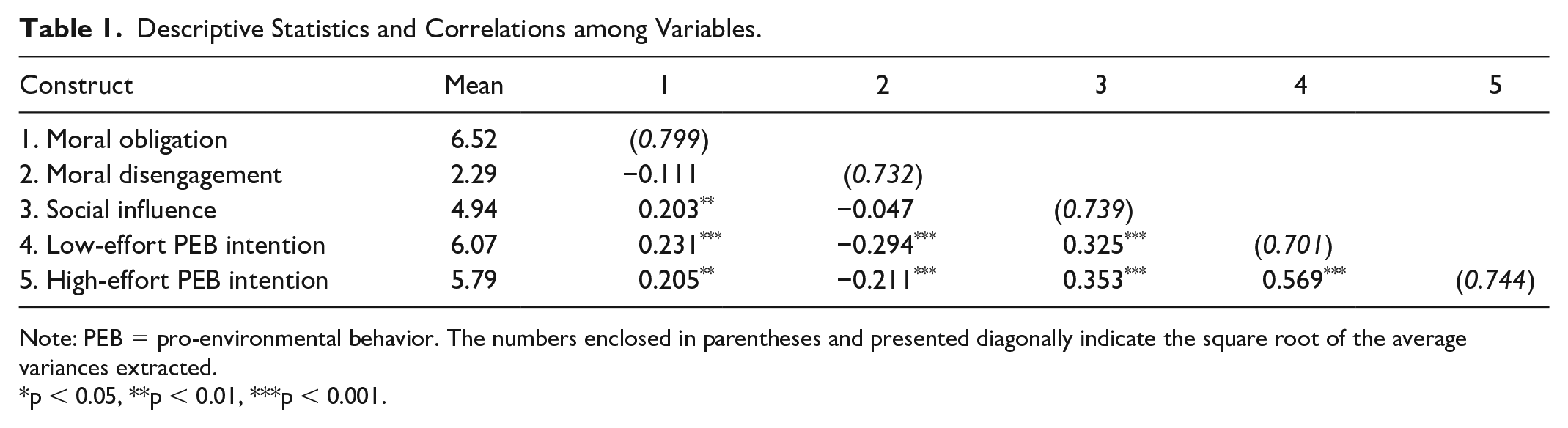
Note: PEB = pro-environmental behavior. The numbers enclosed in parentheses and presented diagonally indicate the square root of the average variances extracted.
p < 0.05, **p < 0.01, ***p < 0.001.
Structural Model
The results indicated that the structural equation model yielded a good fit to the data: χ2/df = 1.82 (p = 0.000), goodness-of-fit index = 0.91, comparative fit index = 0.95, normed fit index = 0.90, Tucker–Lewis index = 0.95, and root mean square error of approximation = 0.05. The structural model, showing coefficients in standardized form, is illustrated in Figure 2, where ovals represent latent variables and circles represent measurement errors. As hypothesized, moral obligation positively and significantly affected low-effort PEB intention (β = 0.21, p < 0.01), while moral disengagement negatively and significantly influenced low-effort PEB intention (β = −0.27, p < 0.001). Thus, hypotheses 1a and 2a were supported. However, the SEM analysis showed that the links of moral obligation–high effort PEB intention (β = 0.03, p > 0.1) and moral disengagement–high effort PEB intention (β = −0.001, p > 0.1) were not significant. Hypotheses 1b and 2b were thus rejected. These findings suggested that the moral variables (moral obligation and moral disengagement) have direct impacts on low-effort PEB intention but limited influence on high-effort PEB intention.
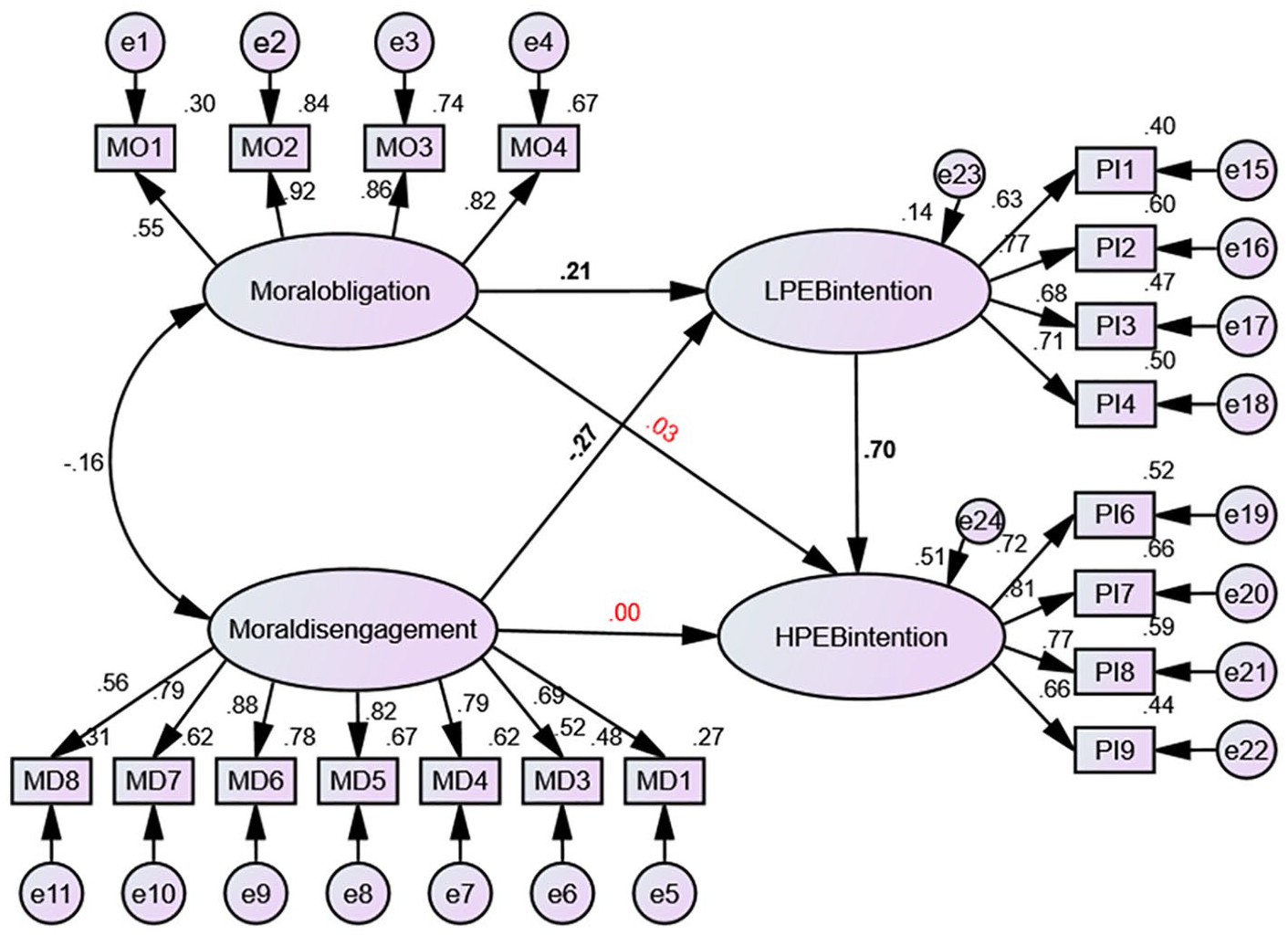
The results of structural model.
Mediation and Moderation Analysis
We proposed that low-effort PEB intention mediates the links of moral obligation–high effort PEB intention (hypothesis 1c) and moral disengagement–high effort PEB intention (hypothesis 2c). These hypotheses were tested following Hayes’ (2015) approach using the bootstrapping method. Table 2 shows the results of a simple mediation using the PROCESS macro with 5,000 bootstrap resamples. According to Hayes (2015), indirect effect is significant when the 95% CI does not include zero.
Results of Simple Mediation.

Note: MO = moral obligation; MD = moral disengagement; PEB = pro-environmental behavior; SE = standard error; CI = confidence interval; β = unstandardized regression coefficient.
The results suggest a significant indirect effect of moral obligation through low-effort PEB intention on high-effort PEB intention (β = 0.16, 95% CI [0.05, 0.33]), and moral disengagement through low-effort PEB intention on high-effort PEB intention (β = −0.14, 95% CI [−0.21, −0.08]). The results shown in Table 2 are unstandardized coefficients, which were recommended by Hayes (2018) when using PROCESS macro. Significant direct associations of moral obligation–high-effort PEB intention (β = 0.25, p < 0.001) and moral disengagement–high-effort PEB intention (β = −0.18, p < 0.001) were found when there was no mediator between them. When low-effort PEB intention was inserted between moral obligation/moral disengagement and high-effort PEB intention, the unstandardized coefficients of moral obligation–high-effort PEB intention (β = 0.10, p > 0.1) and moral disengagement–high-effort PEB intention (β = −0.04, p > 0.1) became insignificant. Together, the results show that low-effort PEB intention fully mediated the relationship between moral obligation / moral disengagement and high-effort PEB intention. Hypotheses 1c and 2c were supported.
We also expected that social influence moderates the indirect relationships between moral obligation / moral disengagement and high-effort PEB intention via low-effort PEB intention (hypothesis 3). To test the conditional indirect effects, PROCESS macro (model 8) was used to estimate the results of moderated mediation (Hayes 2018). Continuous variables were centered at their mean prior to computing their interaction (Aiken and West 1991). Consistent with prior research, some demographic variables (e.g., gender, education, and income level) were controlled, which the literature suggested to be related to moral variables and PEBs. These variables were not the focus of this study and, thus, were controlled to avoid statistical confusion. Table 3 shows the results of the moderated mediation analysis.
Results of Moderated Mediation.
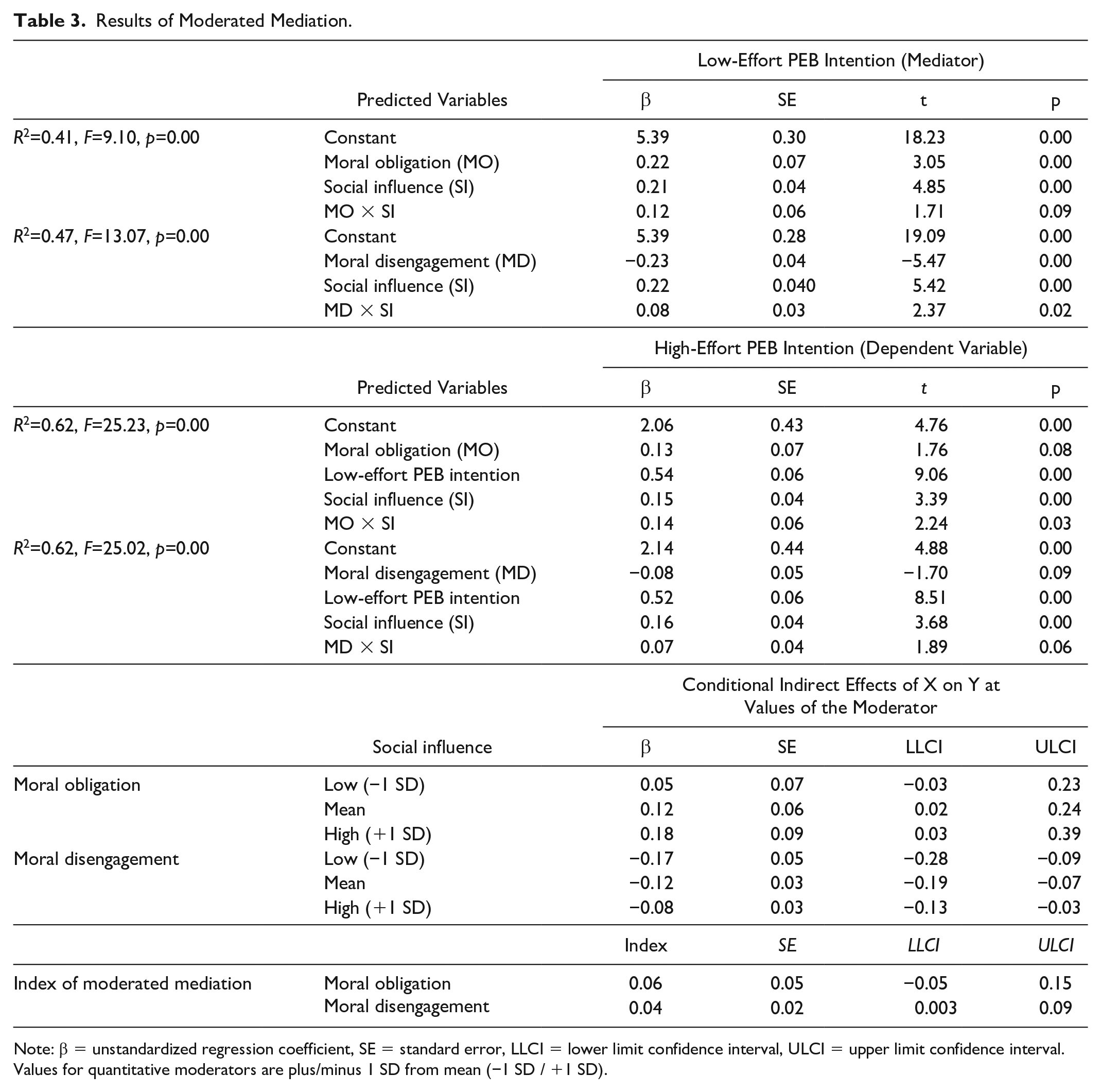
Note: β = unstandardized regression coefficient, SE = standard error, LLCI = lower limit confidence interval, ULCI = upper limit confidence interval. Values for quantitative moderators are plus/minus 1 SD from mean (−1 SD / +1 SD).
The results indicated that the overall model, with moral obligation as the independent variable, was significant (F= 25.23, p < 0.001, R2 = 0.62), with one significant interaction of moral obligation and social influence on high-effort PEB intention (β = 0.14, p < 0.05). The overall model with moral disengagement was also statistically significant (F= 25.02, p < 0.001, R2 = 0.62), as were the interaction effect of moral disengagement and social influence on low-effort PEB intention (β = 0.08, p < 0.05).
As Hayes (2015) suggested, to confirm the moderated mediation hypotheses, two conditions should be met: the indirect effect needs to vary as a function of the level of the moderator, and the index of moderated mediation needs to differ from zero. The bootstrapping tests (5,000 bootstrap samples) showed that the conditional, indirect effect of moral obligation on high-effort PEB intention was significant and stronger for tourists with average social influence (β = 0.12, SE = 0.06, 95% CI: 0.02 to 0.24) or high social influence (β = 0.18, SE = 0.09, 95% CI: 0.03 to 0.39), but not significant for those perceived to have a low level of social influence regarding environment conservation (β = 0.05, SE = 0.07, 95% CI: −0.03 to 0.23). Notably, although the indirect effects of moral obligation on high-effort PEB intention varied with the level of social influence, the CI of the index of moderated mediation did not differ from zero with 95% confidence (β = 0.06, SE = 0.05, 95% CI: −0.05 to 0.15). As such, we cannot say with 95% confidence that the indirect effect (via low-effort PEB intention) of moral obligation on high-effort PEB intention was significantly moderated by social influence.
In support of the moderated mediation hypothesis for the moral disengagement model, the results suggested that the indirect effect of moral disengagement on high-effort PEB intention, mediated by low-effort PEB intention, was significantly stronger for tourists with low social influence than high (low social influence: β = −0.17, SE =0.05, 95% CI: −0.28 to −0.09; high social influence: β = −0.08, SE =0.03, 95% CI: −0.13 to −0.03). The result of the index of moderated mediation shows that the CI did not include zero (β = 0.04, SE =0.02, 95% CI: 0.003 to 0.09), further validating the moderating mediation hypothesis for the relationships between moral disengagement, social influence, and low- and high-effort PEB intention. Specifically, we can conclude that tourists who perceived a low social influence regarding environment conservation were more susceptible to the negative impact of moral disengagement on PEB intention than those with more pro-environmental social influence.
Discussion and Conclusions
Discussion and Theoretical Implications
Pro-environmental behavior is critical to ensure environmental sustainability (UNWTO 2015). Tourists’ PEBs have been widely asserted to play an important role in mitigating the negative impacts of tourism on the natural environment (Bramwell et al. 2017; Juvan and Dolnicar 2014). However, the adoption of PEBs is complicated, with various factors affecting its formation. A focus on the promoting mechanism is far from enough. To have a richer understanding of PEB formation, delving into the question of why people do not engage in PEBs is imperative. Although some research efforts have been made on the reasons and barriers constraining PEBs (Font and Hindley 2017; Juvan and Dolnicar 2014; Lorenzoni, Nicholson-Cole, and Whitmarsh 2007), few have theorized and empirically validated the inhibiting mechanism of PEB as a coherent set of cognitive tendencies. This study, thus, advances the existing research by conceptualizing a range of excuses as the propensity to morally disengage from PEBs, based on moral disengagement theory.
The present study also provides a more refined view into the mechanisms that influence the formation of PEB, by integrating both the promoting (moral obligation) and inhibiting (moral disengagement) perspectives into our research model. The findings affirm the promoting effect of moral obligation, which is consistent with conclusions drawn by previous research (De Groot and Steg 2009; Han, Meng, and Kim 2017; Shi, Fan, and Zhao 2017). A tourist with a high level of moral obligation toward environmental conservation is more likely to conduct PEBs. Regarding the inhibiting mechanism, we found a significant negative impact of moral disengagement on PEB intention. This finding aligns with our theoretical reasoning and provides important insights into the investigation of PEBs. Notably, when comparing the relative criticalities between moral obligation and moral disengagement in affecting PEB intention, we found that the promoting and inhibiting effect of each are almost equivalent to each other. This finding further underscores the necessity to consider the promoting and inhibiting mechanisms simultaneously within an integrated model. Additionally, this finding highlights the need to identify and assess possible situational interventions on the relationships between moral variables and PEB intentions (Juvan and Dolnicar 2014).
Though prior research has extensively studied the associations between moral variables and PEB intentions, the present research extends existing knowledge by making links to outside influences and situational factors, namely, social influence. This study examined the role of social influence as a situational intervention in moderating the mediating effect of low-effort PEB intention between moral variables and high-effort PEB intention. The results show that social influence significantly moderates the indirect effects between moral disengagement → low-effort PEB intention → high-effort PEB intention. These findings offer new insights into the relationships between moral considerations and PEB intentions. The effect of the inhibiting mechanisms on PEBs is contingent on different levels of social influence. That is, when tourists perceive that other people rarely adopt conservation behaviors, the inhibiting effect will be more salient, while in circumstances where people in the vicinity are generally engaging in environment protection, tourists are less likely to morally disengage in relation to their pro-environmental actions. The role of social influence in moderating the indirect relationships, confirmed in this study, can both inform tourism policy makers and open up future research opportunities to identify effective situational interventions.
Furthermore, this study echoes the calls for a more nuanced understanding of PEBs (Miao and Wei 2016; Ramkissoon, Smith, and Weiler 2013), by adopting Ramkissoon, Smith, and Weiler’s (2013) two-factor measures: low- and high-effort of PEB intention. The present research extends the existing studies on PEB by affirming the predicting effect of low-effort PEB intention on high-effort PEB intention. Additionally, we found low-effort PEB intention fully mediates the relationship between moral obligation → high-effort PEB intention and moral disengagement → high-effort PEB intention. Such findings highlight the need to have a closer look at the structure of PEB and its complex relationships with other variables. We conclude that moral obligation/moral disengagement affects one’s high-effort PEB intention via one’s low-effort PEB intention. Through low-effort PEB intention, individuals obtain stronger self-efficacy to engage in more challenging PEBs (Shahzalal and Font 2018), thus fostering the intention to engage in high-effort PEB.
Managerial Implications
From a practical view point, the findings of this study offer important insights, for tourism managers and public policy makers, regarding sustainable development. The results provide policy makers with an improved understanding of the formation of PEBs. Notably, besides promoting people’s feelings of moral obligation toward environmental conservation, tourism practitioners, and policy makers need to increase their attention to the inhibiting mechanism of sustainable behaviors. The results of this study indicate that moral disengagement plays an important role in hindering the actual conduct of PEBs. In addition, the almost equal effects of moral obligation and moral disengagement in affecting PEB intention suggest a need for practitioners to develop more nuanced interventions. Such interventions should help to enhance the positive impacts of people’s moral obligations and mitigate negative contextual influences on tourists.
The moderating effect of social influence, which has been confirmed in this research, suggests that managing the social context in which tourists are prompted to conduct PEBs could be an appropriate intervention. The results show that the adoption of actual PEBs largely depends on the social context; when people observe others not engaging in PEBs they are more likely to morally disengage, and vice versa. As such, policy makers should not rely on environmental education programs alone to encourage PEBs: more efforts should be made to create an environmental-friendly social atmosphere. It is worth remembering that low-effort PEB intention has a significant mediating effect between moral considerations and high-effort PEB intention. This fact should remind policy makers that rather than striving to promote all sorts of PEBs, they could focus on encouraging low-effort PEBs, which are easier to engage in, in the first instance. The findings in this study show how the adoption of low-effort conservation actions will foster the formation of high-effort PEB intentions. This means that PEB campaigns need to segment tourists based on their previous environmental engagement.
Limitations and Directions for Future Research
The present study has some limitations that provide interesting avenues for further research, for example, expanding the scope of data and validating the model in different contexts. First, although a nature reserve is an important context in which to study sustainable tourism, some researchers argue that people who visit nature reserves are more environmentally concerned than the average (Higham and Carr 2002; Lemelin, Fennell, and Smale 2008), which may bias the results in PEB studies. However, other scholars assert that there is little difference in environmental concern between nature-based tourists and mainstream tourists (Beaumont 2011; Sharpley 2006). Dinghu Mountain is just a 30-minute drive from a large city, which generates a large number of visitors who aren’t necessarily pro-environmentally oriented. While it should not be assumed that visitors to a nature reserve have a higher than average environmental concern, it is a premise that would benefit from further testing. In addition, because social influence impacts on PEB intentions, research needs to be conducted in settings with different social contexts. Furthermore, it would be interesting to conduct cross-cultural research to compare and contrast the findings of this study.
Second, although this study is among the first to adapt and examine the concept of moral disengagement in the context of PEB, much remains to be known about moral disengagement, for example, under which conditions is moral disengagement likely to occur. Future research should explore the antecedents of moral disengagement or other interventions between moral variables and sustainable behavior. Third, the findings from this study can inform the design of field experiments to study the relation between PEB intentions and actual PEB. Finally, this study is based on cross-sectional data. Conducting a longitudinal research from an onsite context to an offsite context may provide more interesting insights.
Footnotes
Appendix
Confirmatory Factor Analysis of Constructs (N = 285).
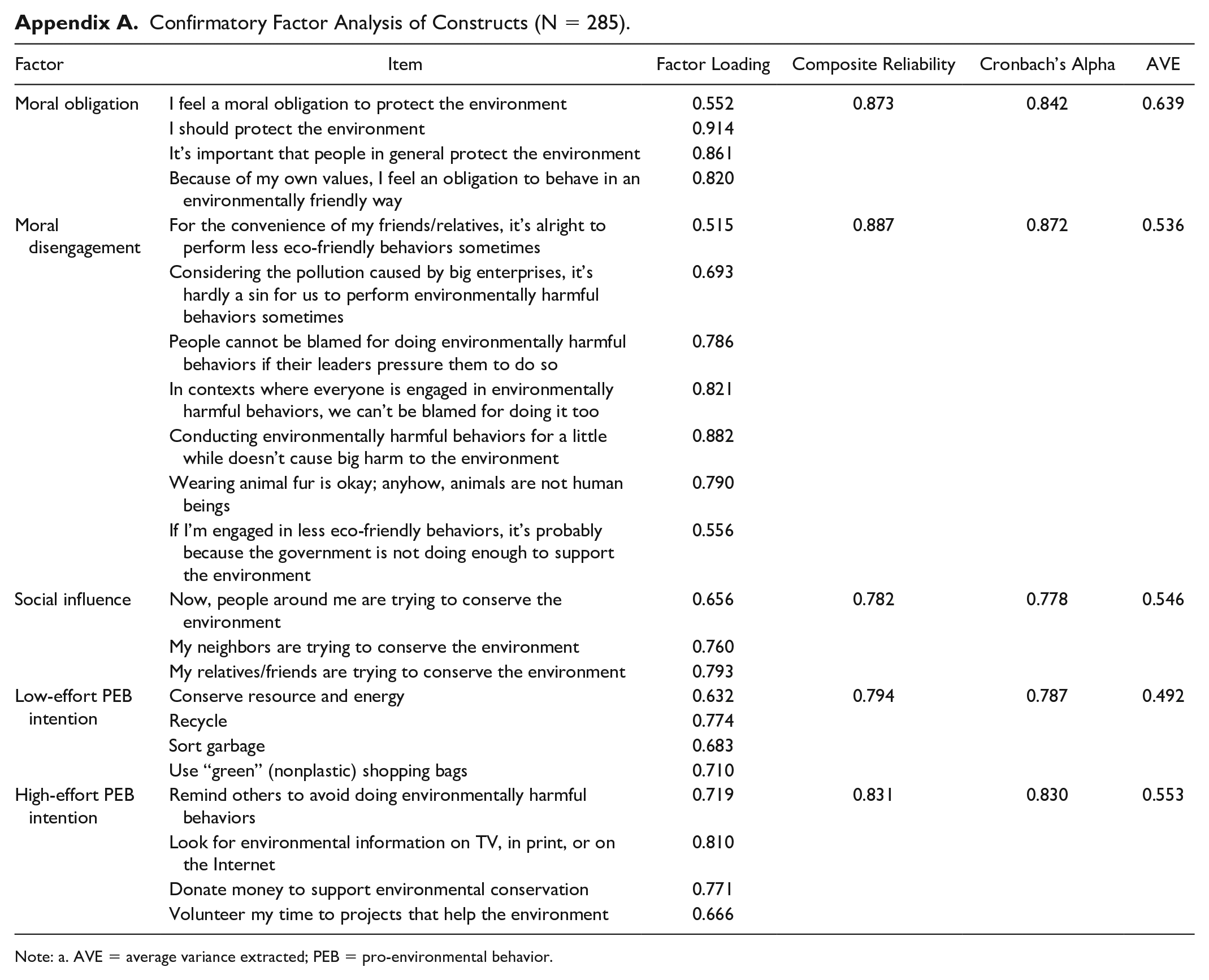
| Factor | Item | Factor Loading | Composite Reliability | Cronbach’s Alpha | AVE |
|---|---|---|---|---|---|
| Moral obligation | I feel a moral obligation to protect the environment | 0.552 | 0.873 | 0.842 | 0.639 |
| I should protect the environment | 0.914 | ||||
| It’s important that people in general protect the environment | 0.861 | ||||
| Because of my own values, I feel an obligation to behave in an environmentally friendly way | 0.820 | ||||
| Moral disengagement | For the convenience of my friends/relatives, it’s alright to perform less eco-friendly behaviors sometimes | 0.515 | 0.887 | 0.872 | 0.536 |
| Considering the pollution caused by big enterprises, it’s hardly a sin for us to perform environmentally harmful behaviors sometimes | 0.693 | ||||
| People cannot be blamed for doing environmentally harmful behaviors if their leaders pressure them to do so | 0.786 | ||||
| In contexts where everyone is engaged in environmentally harmful behaviors, we can’t be blamed for doing it too | 0.821 | ||||
| Conducting environmentally harmful behaviors for a little while doesn’t cause big harm to the environment | 0.882 | ||||
| Wearing animal fur is okay; anyhow, animals are not human beings | 0.790 | ||||
| If I’m engaged in less eco-friendly behaviors, it’s probably because the government is not doing enough to support the environment | 0.556 | ||||
| Social influence | Now, people around me are trying to conserve the environment | 0.656 | 0.782 | 0.778 | 0.546 |
| My neighbors are trying to conserve the environment | 0.760 | ||||
| My relatives/friends are trying to conserve the environment | 0.793 | ||||
| Low-effort PEB intention | Conserve resource and energy | 0.632 | 0.794 | 0.787 | 0.492 |
| Recycle | 0.774 | ||||
| Sort garbage | 0.683 | ||||
| Use “green” (nonplastic) shopping bags | 0.710 | ||||
| High-effort PEB intention | Remind others to avoid doing environmentally harmful behaviors | 0.719 | 0.831 | 0.830 | 0.553 |
| Look for environmental information on TV, in print, or on the Internet | 0.810 | ||||
| Donate money to support environmental conservation | 0.771 | ||||
| Volunteer my time to projects that help the environment | 0.666 |
Note: a. AVE = average variance extracted; PEB = pro-environmental behavior.
Declaration of Conflicting Interests
The author(s) declared no potential conflicts of interest with respect to the research, authorship, and/or publication of this article.
Funding
The author(s) disclosed receipt of the following financial support for the research, authorship, and/or publication of this article: The authors acknowledge the support of the National Natural Science Foundation of China (NSFC, grant no. 41471467) for funding support in data collection.
Author Biographies
 ), a web-based organization helping the travel industry to understand the issues around tourism and sustainability. His research focuses on understanding reasons for pro-sustainability behavior and market-based mechanisms to encourage sustainable production and consumption.