




Abstract
Durkheim’s theory of collective emotion and the concept of perceived emotional synchrony are used to explore tourism memories and to create a conceptual model explaining how and why we come to agree on how we felt when reliving past tourism experiences. This process is dependent on the malleability of memory, which allows emotional synchrony to happen in retrospect, regardless of actual feelings at the time. I argue that the innate motivations behind this post-consumption merging are a stronger sense of community and of belonging to a social group. For tourism practitioners, this highlights where the true value lies for the consumer, the belief in a shared emotional experience. This value develops through the synchronization of memories creating the basis for a shared memory economy. The implications for tourism marketers are discussed, and suggestions for further research into memory and travel experience are identified.
Keywords
Introduction
This article presents a novel conceptualization of how memories of past emotions are told, confirmed, adapted, and ultimately agreed on through sharing with others. This is explored within the context of tourism experiences taking a Durkheimian approach to collective experience and building on Páez et al.’s (2015) work in emotional synchrony and collective gatherings. Travel and tourism often create social experiences that have the potential to form emotional collectives through memory sharing (van Kleef and Fischer 2016). They provide emotion-rich experiences that are anticipated beforehand, shared during the experience and again in the retelling afterwards (J. Lee and Kyle 2012; McCabe and Foster 2006). An understanding of the drive to share, the process through which memories are agreed, and the outcomes of this is needed in order to develop a coherent theory of emotional memory sharing and the motivation for developing, what Páez et al. (2015, p. 16) term “perceived emotional synchrony.” A concept defined as “the intensification of socially shared emotions . . . strengthening perceived similarity, unity, and entitativity with the group.” This enables a deeper understanding of how affective tourism experiences expand and alter through time and through social connections and is therefore particularly relevant to the deeper understanding of the lasting effects created from such experiences (Tung, Cheung, and Law 2018).
Although there is an established body of research within the services industry on consumer experience, this research tends to focus on the immediate consumption experience with far less attention on the extended life of experience though memory (e.g., Arnould and Price 1993; Carù and Cova 2015; Malone, McKechnie, and Tynan 2018). There appears to be a recognition of the importance of creating memorable experience but less attention given to the process of remembering (Tung and Ritchie 2011), the outcomes of remembering, and in particular, an understanding of the social dimensions of postexperience memory and emotion (Marschall 2012; Coghlan and Pearce 2010; Pearce and Packer 2013).
Notable exceptions to this within tourism are the works of Pearce and Packer (2013), Tung et al. (2017), and Braasch (2008) who recognize both the importance of emotions within memory and the malleability of memory in relation to tourism experiences. Pearce and Packer (2013, p. 405) also suggest that greater “attentiveness to the social context and a focus on social representations and group processes in tourist experience studies” is needed. Thus, this article brings together emotions, memory, and group processes with the aim of better understanding how social emotion-rich memories emerge (and more interestingly merge), and why this happens. Tourism provides an ideal context in which to consider this process as these experiences are designed, and consumed, in order to create memories. Anticipated memories therefore potentially become the motivation for visitor decisions, the social glue that binds the visitor to a group after the experience and, in consequence, are an essential component of a feeling of belonging (Malone, McKechnie, and Tynan 2018; Bradley and Sparks 2012; Helkkula, Kelleher, and Pihlström 2012).
Theoretical Perspectives
In exploring the social dimensions of emotional memory consumption, sociological approaches, such as the seminal work on collective memory (Halbwachs 1980) and more recently social memory (Jedlowski 2001), offer useful insights. From sociopsychology, we can draw on the concepts of collective emotion and memory sharing (Páez et al. 2015; Von Scheve and Ismer 2013; Collins 2004) and memory malleability (Edelson et al. 2011). Kahneman’s work within hedonic psychology on the effect of future happiness anticipation on present decisions also highlights the nonlinear temporality of experience and memory (Kahneman and Tversky 1999). These provide a basis on which to investigate the anticipation of future positive memory sharing as a motivator for current consumer decisions such as planning a weekend break or booking a family holiday. Similarly, in tourism narratives, the emotions that are remembered in postexperience stories and shared with others are often linked to pretrip expectations (Tung, Cheung, and Law 2018). In this way, the anticipated experience is often the experience remembered most positively afterwards (Servidio and Ruffulo 2016; Perugini and Bagozzi 2001), suggesting that we have planned what we are going to remember even before the trip.
Consideration is given here not only to the process through which social emotional memories are formed and agreed but also to the reasons for this consensus. This requires an understanding of the formation of the shared memory of emotions as a motivator within tourism consumer decision making and the greater social role this plays (Diener and Biswas-Diener 2008; Wearing and Wearing 2001). A consumer behavior perspective also adds to an understanding of the roles played within social groups, neo-tribes, and their power and influence (Jamrozy, Backman, and Backman 1996; Maffesoli 1995). The creation of communities of shared interest through agreed memories also has resonance with Carù and Cova’s (2015) study of the neglected area of cocreation of collective experience (see also Malone, McKechnie, and Tynan 2018; Cova and Dalli 2017) and recent work on fandom (Fillis and Mackay 2014; Lundberg and Ziakas 2018). Of particular note is Fillis and Mackay’s (2014) category of social devotees. These types exist in a variety of leisure consumption settings and are likely to be actively looking for emotional memories to share in order to reinforce their sense of belonging. Lundberg and Ziakas (2018, p. 293) focus on this social interaction as a cocreation process and note the need to “relive fandom past memories permeated by feelings of nostalgia.” Memories are again, therefore, a vital element in the formation of such neo-tribes, or consumer collectives, highlighting the value cocreated through the sharing, and agreeing, of these, and made more affecting when linked to strong emotions (Arnould et al. 2006).
Memory sharing, I argue, is a vital part of the binding process and can also be seen in Hardy and Robards’s (2015) framework, which illustrates how collaborative consumption, lifestyle, and values leads to community consolidation through cocreation. This happens over an extended time period, not merely during the consumption experience. Tourism experience is therefore a process that we enter into but also reflect back on as having been through, creating lasting emotional memories and social bonds (Matson-Barkat and Robert-Demontrond 2018).
A desire to belong can therefore encourage the sharing of affective experiences. In memory, this can enable a felt synchrony with others that might not have existed during the experience itself. This sense of belonging tends to lead to and be developed from attitudes held in common (Douglas 1983; Ahmed 1999). Attitudes are an essential element of affective memory sharing where the sharing confirms the agreed attitude and the sharing creates an attitude. This teleological process suggests that attitudes held in common give a sense of belonging and that the desire for a sense of belonging creates the drive for attitude conformity. A malleable memory helps us to reduce such cognitive dissonance and feel in tune with those whom we wish to fit in with (Festinger 1957; Tanford and Montgomery 2015). Therefore, it can be hypothesised that the purpose of developing a perception of emotional congruity is to feel a sense of belonging, or as Pinel et al. (2006) suggest, to feel “existentially connected” with others, and that this can be achieved through the synchronisation of emotional memories.
With this in mind, the conceptual development for this article is set within a consumer culture theory (CCT) perspective (Arnould and Thompson 2005). CCT calls for consumer researchers to broaden their focus to investigate the neglected experiential, social, and cultural dimensions of consumption in context and in particular the theoretical questions related to “consumers’ personal and collective identities; the cultures created and embodied in the lived worlds of consumers; underlying experiences, processes and structures; and the nature and dynamics of the sociological categories through and across which these consumer culture dynamics are enacted and inflected” (Arnould and Thompson 2005, p. 870). Jensen, Lindberg, and Østergaard (2015) also argue for a greater use of consumer culture theory within tourism research with a focus on how meaning is created through social interaction and the cultural (or collective) meanings that result.
This article contributes to the literature on tourist experience and memory by conceptualizing the process of emotional synchrony in shared memory. It provides a framework for investigating the deeper motivations for tourism consumption in terms of a sense of belonging gained through memory sharing. This has implications for the design and management of experience/postexperience highlighting the need to stimulate, create, and reengender positive memories and the wider sharing of these (S. A. Lee and Oh 2017; Carlson et al. 2016). More generally, this provides a different approach to understanding the human need to feel at one with others and how this feeling can be created through, an often illusionary, perception of shared emotional memory.
In order to conceptualize this process, literature was reviewed in the areas of collective memory, emotion and memory, collective emotion, memory malleability and memory sharing. These formed the basis for the search terms entered into a variety of academic publication databases sources (including EBSCO, Scholar Google, Ingenta Connect, and Scopus). Broader works were sought out as well as those with a particular relevance to tourism, travel, leisure, and events (identified by adding these to the search terms). From this literature review, gaps in existing travel and tourism research in relation to collective memory and emotion were identified. These are discussed and developed below beginning with an overview of the tourist experience and in particular the collective nature of this. Consideration is then given to emotions, collective experience, and communitas, enabling a link to be made between shared tourism experience and belonging. The importance of memory permeates these sections and is then discussed in more depth in terms of shared memory and the role of memory malleability in the sociality of humans. A model is then developed and discussed to explain the process through which a tourism experience can become more meaningful as the memory of it is shared and reformed to create a synchrony with others.
The Tourist’s Experience
The two key aspects that are of importance in this context are collective experience and emotion-rich experience. The focus, therefore, is on tourists’ collective gaze where the presence of “others is obligatory for the emotional experience of place” (Urry 2005, p. 78) and on the sociality of tourism (Larsen 2008). Páez et al. (2015) provide a useful summary of a collective gathering experience from a sociopsychological, rather than sector studies, perspective. They highlight six elements that bring about social and personal transformation. These are physical convergence, shared mutually reinforced goals, shared cognitive and emotional responses, focused attention, coordinated collective behaviors, and coordinated expressive manifestations (e.g., singing together). These “stimulate participants’ emotional arousal in such a way that they will experience and enact similar emotional states; therein probably lies the strongest source of the social and individual effects of participation in collective gatherings” (Páez et al. 2015, p. 713).
This emotional mutual entrainment (Collins 2004) creates an experience that is to some extent mindless. As opposed to other tourist experiences (e.g., Urry’s romantic gaze, where the emphasis is on solitude, privacy, and a personal relationship with the object of the gaze) where mindfulness leads to stronger memories (Tung and Ritchie 2011; Urry 2001), within a collective gaze, mindlessness is often a vital part of the experience (i.e., being lost in the crowd, feeling part of a group rather than “self,” being pulled along without thought or volition) (Langer and Moldoveanu 2000; Moscardo 1996). What might make some tourist experiences memorable therefore is this apparent mindlessness, particularly if we equate mindlessness with liminality, escapism, or flow (Csikszentmihalyi 2014). Walker (2010) demonstrated that experiencing flow in a social situation elicits higher feelings of joy than does solitary flow. In addition, in line with the ideas developed above, Walker (2010) argues that experiences of collective flow involve both a loss of consciousness of the self and a perception of emotional synchrony with the group and the audience.
The travel and leisure activities we choose to pursue are also strongly linked to our lifestyles, interests, and social groups, with participation in them strengthening, reaffirming, or changing our desired social identity (Crawford et al. 1992; Wearing and Wearing 2001). We may go to find like-minded others, or perhaps, we travel with like-minded others to have the same experience among others whom we see as different. We may travel to experience the “different” but we see others who are traveling as the same as us and seek out emotional synchrony where we can (Woosnam 2011).
Surprisingly, tourist-to-tourist interactions (TTI) have received little attention from tourism scholars (Torres 2016). Recently Lin et al. (2019) studied TTI in terms of self-disclosure, finding that greater personal story sharing with like-minded others resulted in higher levels of perceived intimacy and group cohesion. A number of other studies have examined interactions in tourism experience, but most focus on the relationships between tourists and locals or tourists and service providers (e.g., Woosnam 2011; Kastenholz et al. 2013; Sipe and Testa 2018).
These interactions happen both online and offline and, as the focus here is on memories of emotional experiences, it is necessary to consider the within and posttrip sharing of experiences on social media. A number of recent studies have considered the impact of social media sharing on the sharer and the sharee (Munar and Jacobsen 2014; Luna-Cortés, López-Bonilla, and López-Bonilla. 2019; Liu et al. 2019; Gannon, Taheri, and Olya 2019). It appears that sharing memories via social media is an expression of sociability and a means of gaining emotional support and that this is stronger when shared among acquaintances (rather than all) (Munar and Jacobsen 2014). This has implications for word of mouth in that memories shared with an existing community (e.g., friends and family) are far more influential on visit intention than those shared more generally. The link between sharing behavior and social identity is also evidenced by Luna-Cortés, López-Bonilla, and López-Bonillaet al. (2019, p. 406), who found that when tourists “perceive that the experience lived during their holidays is congruent with their identity, they use their virtual social networks to create content about the trip” and gain greater social value from it (see also Liu et al. 2018). Thus, positive holiday memory sharing has a greater effect on those who “know” the sharer and are similar to them. The sharer also benefits through accruing social status, as evidenced in Gannon, Taheri, and Olyas (2019) study of braggart word of mouth. WOM, whether on- or offline, is a particular form of memory sharing where there is an element of recommendation or critique rather than mere storytelling. Similarly to the findings of Luna-Cortés, López-Bonilla, and López-Bonilla. (2019) and Liu et al. (2018), greater social status is gained when the “braggart” feels a self-connection (identity congruity) with the experience (Gannon, Taheri, and Olya 2019). Memory sharing therefore can create belonging, form communities, and improve the self-esteem and social status of the storyteller.
Tourism provides mostly out-of-the-ordinary liminal experiences, has the propensity to be more memorable in contrast with mundane everyday life experiences, and therefore, is more likely to be shared on social media. We tend to mark our progress through life with events that stand out from daily routines such as summer holidays, city breaks, Christmas celebrations, theatre trips, or end of exam festivals. These moments have a clear link to how we want to remember our lives and how we want others to see our lives. Rarely do we see a photo of a day at work posted on Facebook or stuck in the family album. Instead, we have one-off memorable moments that we want to capture and share. Tourist experiences provide an opportunity to create those memorable moments and say something about us to others (S. A. Lee and Oh 2017; Gannon, Taheri, and Olya 2019). If the “future is anticipated memories,” then these provide the ideal product through which to achieve this goal. To paraphrase Kahneman, “the future is anticipated shared memories.”
Williams, Stewart, and Larsen (2012) argue that further research is needed on the anticipated social return from travel, the symbolic value of which now often revolves around the image curated through social media posts. Taking up this call, Boley et al. (2018, p. 125) explore the social return of sharing travel experiences on social media and the impact on intention to travel finding further evidence of the value in memory sharing and the “the anticipated positive social media feedback that a destination offers” as a driver of destination choice. This again exemplifies the value created via memories and the motivating power of the anticipation of sharing these.
One of the key arguments I propose here is that the actual experience and the emotions engendered are far less important than the memories created, embellished and passed on, by whatever means. For example, a family outing to the local funfair is shared through remembering the win on the coconut shy, the screaming on the ghost train, the group shot with candy floss. The memories talked about among the family and shared beyond are the positive ones, not the grumpiness of the teenager or the distracted parent checking emails. The illusion of quality time spent together is created through the edited memories of the experience, curating a happy family life in retrospect.
The wider connotations of this are that we live for our memories and therefore live in the future via an anticipation of the past (Kahneman and Tversky 1999). This suggests we live in the past and the future (as anticipated past) but rarely in the present. We make choices based on how we think we will remember the experience rather than how we will experience it and we then make the memory fit. What does this say for the reality of the tourism product or indeed for any form of consumer experience? Initially it suggests the need for a managerial focus on packaging the experience to make it sound like it will be memorable, on making sure memories are created, on offering opportunities to share memories, and on finding ways to manage memories postexperience (Prayag et al. 2017). For consumers of tourism experiences, the creation of less than accurate agreed memories suggests a desire for, or at least an acceptance of, inauthenticity in memory that has not yet been addressed within the literature. This would be an interesting extension to the research on existential authenticity in tourism in that being authentic to oneself, rather than to the experience, can be created in retrospect through “adjusted” memories (Lin et al. 2019).
Emotions, Collective Experience, and Communitas
Durkheim’s (1912) classic model of effects of participation in collective gatherings states that shared beliefs, shared behavior, and interaction tends to lead to emotional solidarity. It is this concept of emotional solidarity that underpins some of the few studies in the tourism sector relating to this aspect of collective emotion (Woosnam 2011; Woosnam et al. 2014). Woosnam’s development and subsequent testing of a scale based on Durkheim’s model reaffirms the components of emotional solidarity within a tourism context but has not, as yet, explored the process through which this emotional synchronisation comes about.
Woosnam’s (2011) work also serves to highlight the importance of distinguishing between similar but related terms. Solidarity, for example, suggests a power in togetherness that perhaps synchrony (coming together to avoid conflicting emotions), congruity (deliberate “matching” of emotional response to fit a social situation), or attunement (a largely empathetic response to those around us) do not. There is also a distinction to be made between the shared, social, or collective when used with memory and emotion, and different connotations to the terms used to describe the spread of these (e.g., sharing, entrainment or contagion). There are subtle differences here relating to the individual as subject or object (sender or receiver) and to the extent of volition in the process (conscious choice or irresistible urge). For example, sharing suggests deliberate choice, whereas contagion infers a process beyond the individual’s control. Basing this conceptualization on the previous work of Páez et al. (2015), the term synchrony appears most appropriate as this denotes both outcome (value in togetherness) and process (a merging of memory in order to feel the same).
Durkheim (1912) proposed that gatherings re-create the social group and revive shared beliefs through the sharing of emotions. This leads to heightened emotions or “collective effervescence” where individuals are transported out of themselves and experience a sense of union with others. This, according to Durkheim, results in a renewed sense of confidence in life, and in social institutions, which lasts beyond the experience. Durkheim therefore explains the cause, the outcome, and the lasting effect of such collective gatherings. Exploring this further, Rimé’s (2017) study of emotion sharing suggests that each time the memory of the emotion is shared it is strengthened, thus extending the effect further into the future. What has not yet been addressed, particularly within travel experiences, is how this sharing, via memory, creates a new collective experience and further opportunities for emotional synchrony and value cocreation.
Malone, McKechnie, and Tynan’s (2018) study begins to address this through customer-dominant logic. They explore value cocreation beyond experience and into the consumer’s “lifeworld” and the importance of emotions within this. In line with Bradley and Sparks (2012) and Helkkula, Kelleher, and Pihlströmet al. (2012), Malone, McKechnie, and Tynan (2018, p. 851) conclude that “value arises from lived or imaginary experiences arising from past, present, and future consumption encounters.” They also note that this value is created at both the intra- and intersubjective level, thus recognizing the collective, and re-collective, nature of the experience.
This collectivity leads us to consider the wider notion of communitas in this context. J. C. Turner (1982) suggests that a liminal experience, such as a collective gathering, forms communitas and that this can be spontaneous (transient), ideological (transformative), and normative (permanent). Feeling part of the group and extending this to others after the gathering extends and prolongs communitas. This, in turn, helps form or maintain the emotional experiences felt, at the cultural performance or on the family holiday, far into the future through a form of “social group” memory. The emotion-rich memories of these experiences become the glue that binds groups, transforming spontaneous communitas to normative as these are repeatedly shared over time.
Communitas reflects “intense feelings of belonging, beyond social presence and mutual interaction, and a sharing amongst likeminded equals” (Carlson et al. 2016, p. 905). V. W. Turner (1969) saw this as a consequence of travel, pilgrimage, or festival experiences defining it as a temporary state bonding together people of different backgrounds. This desire to feel belonging, albeit often temporary, is a motivator for seeking out ways to maintain the togetherness. This is likely to be both a driver for emotional memory sharing and a consequence of it. Communitas therefore enriches the experience adding value through the social interactions experienced via tourism encounters (Reichenberger 2017) and this augmented value is created in both offline and online spaces (McLeay, Lichy, and Major 2019). Although not considering how shared memory enhances the cocreation process, these studies offer useful insights into how social emotion, augmented community, and social interaction adds value to the tourism experience.
There are several different perspectives on how emotion spreads. If a “perception,” as Páez et al. (2015) argue, then it is about how we perceive the emotional states of others and how this perception affects our own emotional response. If we truly feel the same as others and this collectivity transcends our own personal emotions, then we need to understand how this happens. Although there is evidence to show that physical proximity and the synchronization of movement have a role to play (Hennig-Thurau et al. 2006; Pugh 2001), there is also much to suggest that collective emotion can occur without such bodily closeness (Sullivan 2014; Podoshen 2013).
Whatever the mechanism, Durkheim (1912) argues that rituals and the experience of collective effervescence (or “emotional entrainment”; Collins 2004, p. 47) of individuals in crowds and gatherings are crucial in establishing and reinforcing identification with the group and in maintaining solidarity beyond the gatherings. These are clearly then precursors to the creation of communitas and a new or strengthened social group identity (J. C. Turner 1982).
Building on Durkheim’s theory of contagion, Collins (2004) develops the concept of “ritual entrainment.” Such rituals require an existing feeling of collective emotion but then regenerate and heighten this. When the ritual is performed successfully, there are a number of outcomes: (1) individuals feel solidarity with one another; (2) they are infused with “emotional energy”; (3) collective symbols are generated that are defended and reinforced; and (4) violations of these symbols provoke indignation, and sanctions. Collins (2004) also argues that participation of individuals in successful rituals stimulates them to repeat the experience, entering into successive new rituals in what he terms an “Interaction Ritual Chain.”
Think, for example, of a college reunion weekend break, rituals are performed, emotions elicited, and symbols created with memories (Larsen 2008). This is based on initial shared memories but becomes something else in its replaying. The ritual is the memory of past reunions but performed in a particular way agreed by the in-group and often coalesced into a few words that conjure up the “story.” This condensed essence of a shared memory is referred to by Novick (1994) as a “mythic archetype,” suggesting that it may no longer reflect the reality of the original experience.
Other research on interpersonal similarity suggests that sharing positive subjective experiences (e.g., reacting to something with laughter or awe at the same moment) increases liking for the other to a greater extent than objective similarities between individuals (Pinel et al. 2006), and a perception of emotional similarity leads to a greater increase in the humanization of the out-group than either attitudinal or value similarity (McDonald et al. 2017).
Surprisingly few studies have considered these aspects of collective experience within tourism although there are a growing number within event studies, for example, football (Von Scheve and Ismer 2013), festivals (Wood and Kenyon 2018), event design (Richards, Marques, and Mein. 2014), and political events (Sterchele and Saint-Blancat 2015). There has also been work on the related area of emotional attunement, music, and festival experiences (e.g., Waitt and Duffy 2010; Volgsten and Pripp 2016).
Although it is important to understand the concept of collective emotion, the focus here is on memory. It is therefore less important how collective emotion happens at the time, but how it is re-created or initiated afterward. This remains a neglected area of consumer experience research but undoubtedly has implications for attitude and behavior change and longer-term value in remembered collective experiences (Barnes, Mattsson, and Sorensen 2016; Allen, Machleit, and Kleine 1992; S. A. Lee and Oh 2017; Volo 2017).
Collective Memory and Memory Malleability
What is triggered by effervescence, reemerges via ritual entrainment, and is dependent on perceived emotional synchrony (feeling that others feel the same as us), therefore, is collective memory. Indeed, Halbwachs (1992) argues that there is no such thing as individual memory stating that memory is recollection and through this “collective memory” is formed. Within sociology, collective memory has been studied in terms of the more distant past or the memory of nations often linked to national identity formation and the power dimensions of what becomes the memory narrative (Jedlowski 2001). Here, in the tourism context, this is shifted to the more recent memory of experiences within a smaller social group. The terms “social” and “group” memory may therefore be more appropriate as these reflect the memories shared by groups of friends, visitors, fellow tourists, and relating to specific tourism experiences.
Jedlowski (2001, p. 31), in his critique of Halbwachs, argues that memory is not a collectively held repository of information but “social memory manifested as a set of practical, cognitive and affective attitudes which prolong past experiences in the present.” This prolonging of the past in the present can create normative communitas and attitudes in common and, therefore, links the formation of social memory clearly to social identity and belonging.
Memory work within psychology has started to look at how emotional memories are shared. Hirst and Echteroff (2008) describe the process of collective memory formation as (1) the transmission of a memory from one person in the community to another, (2) the convergence of disparate individual memories into a shared rendering, and (3) the stability of this shared rendering over time. This stability of the agreed memory plays a key role in determining whether the memory is merely a widely shared individual memory or has become collective memory. Gedi and Elam (1996) argue that this only happens if the memory has a bearing on collective identity. However, there is also likely to be a precondition of shared identity in that convergence is more likely to occur among in-group members than across out-group members.
Studies of memory sharing within tourism have identified the attitude-changing effect of posttrip sharing of emotional experiences (e.g., McCabe and Foster 2006; Tung and Ritchie 2011). As expected, sharing positive emotions positively affects the posttrip evaluations of sharer and receiver, but perhaps more surprisingly, sharing negative emotions also leads to more positive overall evaluations (Kim and Fesenmaier 2017; Prayag et al. 2017). This reinforces Rimé’s (2017) findings that sharing emotions leads to stronger emotions and collective memory of the experience and that affective memory can be changed through sharing.
Indeed, Tung, Cheung, and Law (2018, p. 1142) found that sharing a positive travel memory with a listener “increased ratings of the positivity of that experience” in a way that did not happen when writing a diary or reminiscing in private. They conclude on the importance of listening opportunities in that “the sincere and simple act of listening to tourists’ stories can help them savor their travel memories.” This research also highlights the marked difference between sharing in person as opposed to online as the reactive emotions of the listener heighten emotions, both positive and negative, in the storyteller. Despite the current emphasis on technology and online sharing, this demonstrates that “interpersonal sharing or ‘high-touch’ experiences that occur in real life and in person . . . remain one of the important and intimate forms of relationship building that enriches tourists’ experiences” (Tung, Cheung, and Law 2018, p. 1142). Although both interesting and valuable, Tung, Cheung, and Law’s (2018) study focuses on the organization as listener (i.e., customer to host and customer to researcher) rather than fellow travelers, wider social acquaintances, friends or family of the customer and, therefore, does not consider the process or reasons behind the posttrip convergence of emotional memory.
There is much evidence to suggest that this process happens but still little understanding of how and why. In order to form a collective memory of a travel experience, the initially different individual memories must be transmitted from one person to another in a manner that allows the memories to converge on a shared representation (Kansteiner 2002; Ahmed 1999). “This convergence is only possible because of a distinctive feature of human memory—its unreliability and malleability” (Hirst and Echteroff 2008, p. 189).
In one of the few articles that highlights the need for tourism research into the malleability of memory and its purpose, Braasch (2008, p. 15) argues that “tourism researchers need to embrace the concepts of malleability and continuous reconstruction of memory observed by their psychological counterparts.” This perspective draws on the wider literature recognizing that the means through which memories are recounted and relayed is a largely social, not merely cognitive, process and that the telling and retelling of stories reaffirms key tourist experience events and may even create imagined new ones (Loftus and Pickrell 1995; Prayag et al. 2017; Tung, Cheung, and Law 2018). Indeed, sharing has been found to increase the capitalization of memory, strengthening the sharer’s belief in its positive or negative nature. For example, “I chose to describe this travel memory; therefore, th[e] experience must [have been] . . . truly wonderful or terrible” (Tung et al. 2017, p. 1133).
The purpose behind such memory malleabilty can be partly explained by its use in collective memory, facilitating the creation and maintenance of social groupings (Halbwachs 1992). Memory adaptation therefore allows the development of collective versions of the past through which groups identify.
This malleability is also an advantage for well-being as it allows a focus on positive past experiences rather than difficult times, and this viewing the past through rose-colored spectacles makes us happier in the present (Olick and Robbins 1998). Studies of social influence on memory have also shed some light on the benefits of memory conformity to society. For example, Edelson et al’s (2011, p. 111) study concludes that a socially malleable memory may “serve an adaptive purpose, because social learning is often more efficient and accurate than individual learning . . . [and] humans may be predisposed to trust the judgment of the group, even when it stands in opposition to their own original beliefs.” Again we see a link to social identity and belonging as an outcome or goal of such memory conformity.
As Gedi and Elam (1996, p. 48) argue, collective memory is “a fabricated version of that same personal memory adjusted to what the individual mind considers, rightly or not, as suitable in a social environment.” It is through frequent interaction that we come “to share the same rendering of the past, without the intention to do so, and through these social interactions collective memory is formed which, in turn, helps to consolidate collective identity” (Hirst and Echteroff 2008, p. 190). Therefore, memory can be seen as a social contract, an agreement about how the past should be conceptualized and discussed, what to remember, and what to forget (French 1995).
The process through which a memory consensus emerges is partly dependent on “memory talk” and “conversational remembering,” resulting in the creation of stories that can be told again and again (Welzer 2010). These stories tend to simplify events and reduce them to Novick’s (1994) “mythic archetypes,” which have a far greater influence on revisit intention and attitude formation than those recalled immediately after the visit (Barnes, Mattsson, and Sorensen. 2016; S. A. Lee and Oh 2017).
The creation of shared stories about past events has always been part of life and undoubtedly helps to create and strengthen communities (Ahmed 1999). We see this in microcosm in the way we share and agree memories of experiences condensed in space and time. For example, in Iceland, the traditional festival of Thorrablot centers around reliving amusing, poignant moments of community life from the distant past but also about living residents from the last year (Schram 2009). The memories become folklore and create an enjoyable way to feel belonging, to strengthen community and provide entertainment in the dark winter days.
In the earlier discussion, it becomes clear that the outcomes of perceived emotional synchrony through social memory are a stronger sense of group identity and a feeling of belonging. The psychological view considers the process through which social identity is formed, with memory sharing a key part of this. From sociology, we gain an understanding of the need or the motivation to belong to a “group” permitting “individual members to be welded together in collective perceptions and behavior” (Turner in Capozza and Brown 2000, p. 185).
If we consider this, alongside the positive effects yielded by social experiences, it is also clear that the intensification of shared emotions has a vital role to play in strengthening the perceived similarity with the group (Páez et al. 2015; Van Kleef and Fischer 2016). Additionally, the memory of such shared emotions plays an important part in the construction of “self” (Crawford et al. 1992). In the remembering of emotions and the sharing of these memories with others, we are signaling our own beliefs and seeking out (or possibly creating) similarities with others. This is an important aspect of group- and self-identity formation that has seemingly been overlooked in the tourism literature.
As Servidio and Ruffulo (2016) found, what is most remembered from a tourism experience is what was most anticipated before the experience. Anticipation therefore creates empty memory pockets to be filled during and added to after that experience. Such mental time travel can be seen as a vital part of human evolution (Suddendorf and Corballis 2007) and manifests itself in how we think about the past in terms of how it shapes the future and think about the future in terms of the past. The present seems to fade into insignificance. In this way, a constructive episodic memory allows us to imagine future happenings in a manner that “flexibly extracts and recombines elements of previous experiences”; indeed, there is “considerable overlap in the psychological and neural processes involved in remembering the past and imagining the future” (Schacter and Addis 2007, p. 773).
Within tourism, Gao and Kerstetter’s (2018) study of emotion regulation found that in memory, emotions were dynamic, variable, and adapted for a purpose (e.g., moving from sad to happy, and happy to happier). In this way, the past is adapted to meet the needs of the future self in terms of well-being. This might also explain why sharing memories of a tourism experience leads to positive emotions and mood (Tung et al. 2017) and, through attitude conformity, a greater likelihood of purchases sourced from the remembered place (Yin, Su, and Poon 2017).
It is well established that memories are rarely, if ever, accurate recounts of what happened or what was felt but a constantly adapting, evolving, and negotiated view of the past. As we remember and share, the memory becomes reinforced and “agreed,” which is particularly true of emotional memories (e.g., feelings of awe, joy, disgust, anticipation, affection, and anxiety). What appears to be emerging from the literature is that there may well be an innate human drive to feel that we felt the same as others (Ryan and Deci 2000). This synchronicity of emotions can happen (or be perceived to happen) during the experience; however, it appears to be actively strived for in the remembering of it (Wood and Kenyon 2018).
As we share with others over time, we come to agree on how we felt, and it matters not whether this is a true reflection of our feeling at the time or on the amount of synchronicity at the time. What matters is that we believe we felt the same. This desire to feel at one with other human beings is well documented (see Baumeister and Leary 1995), but the process that enables this through memory adaptation has not been addressed within tourism studies or indeed the wider literature.
Conceptual Model
Building on what is already known about emotion, social memory, and memory malleability, a conceptual process model relating to tourist experience can be developed. This complex and neglected aspect of the visitor experience has the potential to impact on many other areas of consumer studies, management, and wider sociological theory. The model hypothesizes a process and in doing so highlights areas for future research (see Figure 1). The specific components of the model are highlighted in italics within the discussion below.
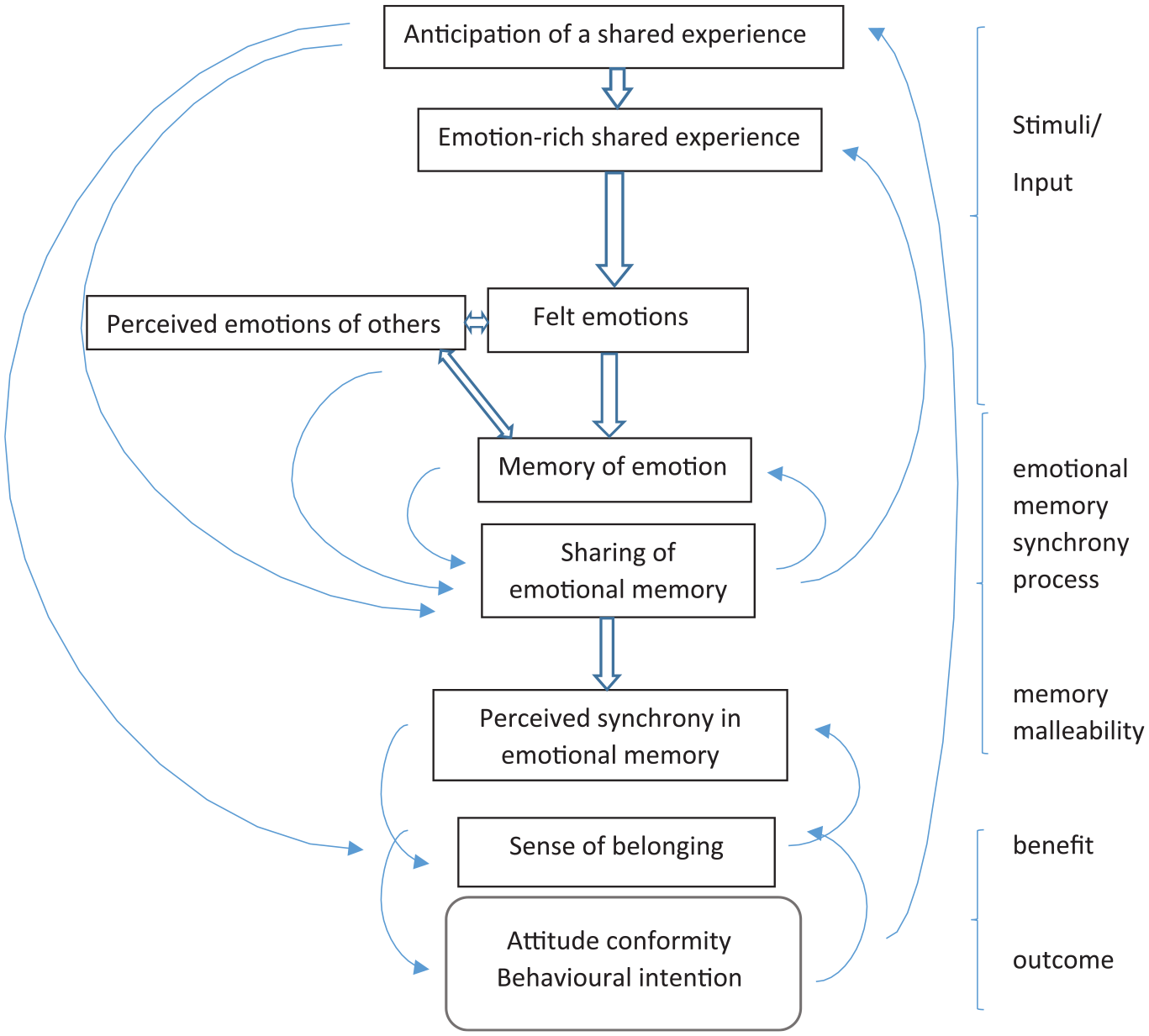
A process model of emotional memory synchronization.
The model begins with the anticipation of a shared emotion-rich tourist experience. At this stage, the future-self is already being considered as we imagine recollecting the experience and sharing those emotion-rich memories with others. Anticipating not only the experience, but also looking forward to the shared memory of it (Wood and Moss 2015; Servidio and Ruffulo 2016) and the ensuing sense of belonging. The wider outer left arrow depicts this link between pretrip and posttrip, highlighting the importance of the imagined future self in consumer decision making. On the right, the arrow depicts the circular nature of this in that the posttrip benefit of a sense of belonging leads to attitude conformity and behavioral intention, and the anticipation of the next shared experience.
The felt emotions triggered during an emotion-rich shared experience are individually experienced but are influenced by the emotions we perceive in those around us as, in turn, our own responses influence them (Stieler and Germelmann 2016). For example, how hard is it to be the one person in a social group not enjoying the local performance, or finding the on-board comedian funny, or not being awestruck by the grandeur of the scenery? There are clearly different expectations on how we should feel, or express how we feel, that are culturally bound and related to social norms (Russell 1991). We are, to some extent, preprogrammed to respond in certain ways to certain stimuli but also to feign a response in a form of social desirability bias.
During the travel experience then, we have a complex interplay of our own emotional response, the emotional response we display to others and the influence on this of the perceived emotions of others (Wearing and Wearing 2011). This perception might be based on an interpretation of physical expressions of face and body, actions, and/or through spoken words or through “projection” of our own feelings. There is some evidence to suggest that we project our own feelings onto others and therefore often mistake the emotions felt by others as being similar to our own (Salmela 2012). We then display or express our emotions to those around us, potentially affecting the emotional response of others. A continuous moderation and affirmation of emotional response therefore takes place in a social setting. Consider how in an audience we glance at those around us to assess their responses. We use this information to inform our own responses, and our own responses are picked up by those around us. Some have termed this emotional contagion (Hatfield, Carpenter, and Rapson 2014), entrainment (Collins 2004) or collective effervescence (Durkheim 1912). In a collective experience, this process can reinforce and concentrate feelings of joy or anger in that the emotional response in the individual is strengthened by the crowd or social group. Indeed, there is evidence to suggest that stronger emotions are rarely felt on our own. We may feel pleasure, contentment, and anxiety but it seems to take a group or at least social interaction of some kind to create joy, anger, hate, or love (Jasper 1998).
Is the emotional synchrony therefore “caught” or “mirrored,” real or perceived? In mirroring the responses of others, the emotion might become real or at least be perceived as real (Iacoboni 2007). “Fitting in” plays an important part in this process but is likely to be subconscious or, at least, other than conscious (Miao and Mattila 2013). Indeed, studies in emotional labor and positive psychology suggest that faked emotions can become real—smile and laugh enough and you will become happy (Wong and Wang 2009). So we may initially mirror or pretend but in doing this we start to really feel the feigned emotion and therefore remember that created emotion. Emotional memory synchrony may therefore begin even before the sharing of the memory.
Memory malleability has a key role to play in this process as it helps us to not fake it but to believe it and to feel it at a later point in time. We can adjust our memory of the emotion to make it fit and therefore achieve the social bonding we strive for along with a strengthened feeling of belonging to the in-group. This stage is referred to as perceived synchrony in emotional memory within the model. We have all undoubtedly experienced a shift in feelings about an experience after the event. For example, we may have found an art gallery inspiring and then, reading poor online reviews, speaking to less appreciative others, realising the person we were with was not enjoying it as much, all make us moderate how we think about our own enjoyment of the experience (Liang 2016; Tanford and Montgomery 2015). Subsequent experiences also change our frame of reference (e.g., going to a bigger, better gallery the following month). Research within psychology suggests that later experiences have a stronger effect on emotional memory (Kahneman and Egan 2011). For example, a great holiday can be ruined in memory if there is bad weather only on the last day, a concert spoilt by the queue to leave the car park, a restaurant dismissed as a bad experience because of the state of the toilets when leaving.
This suggests that newer experiences, and particularly newer emotions, tend to occlude earlier ones regardless of how strong the earlier ones were. This continues beyond the experience being moderated by postexperience sharing and dependent on who it is shared with, how many people, what aspects are shared, and when (S. A. Lee and Oh 2017). In this way, memory sharing creates new emotional experiences, and new emotional experiences moderate the memories of the old. This is depicted in the model by the bidirectional arrows connecting memory of emotion with sharing of emotional memory with the remembered perception of how others were feeling feeding into this synchronization process. The longer right-hand arrow indicates that such sharing creates new emotion-rich shared experiences.
Therefore, even if not felt at the time, we can create the illusion of emotional synchrony through adapting our memories of how we (and they) felt. This takes place through multiple interactions with those that were there and with our wider networks. In remembering, a shared “emotion story” thus emerges. This process allows memories to synchronise or converge toward a consensus, and the benefit of this is a feeling of togetherness and a sense of belonging. This will be affected by the opportunities for sharing, the strength of the emotional experience, the cohesion of the social group, and the needs of the individuals.
It appears that more often than not memories coalesce to the positive (Servidio and Ruffulo 2016; Tung and Ritchie 2011). Often the “bad” (if not too extreme) is glossed over and the good reigns. Indeed, even an emotional experience that was agreed to be bad at the time can still become positive in memory when shared with family, friends, colleagues. The disastrous Christmas dinner, the horrendous holiday weather, the out-of-tune singer, etc. can all become fond memories in retrospect because of their shared nature (Cowley 2014).
Therefore, it can be argued that because of the infallibility and malleability of memory, how we think we felt is more important than how we actually felt at the time, and we have a strong drive to believe that others share that same emotional memory.
Although conceptual, there is already some evidence for the process described here. For example, Wood and Kenyon’s (2018) festival memories longitudinal study drew a number of pertinent conclusions. These can be summarized as follows:
Memory detail (not accuracy) increases with time: false memories are subconsciously created through sharing and other experiences. Details are filled in inaccurately over time often to justify emotional reactions or choices made.
Sharing of the memory creates stronger emotions that are solidified into attitude: sharing more often with more people accelerates this process.
Perceived emotional synchrony is strived for in the shared memory of the experience and seems to coalesce months after the experience.
The remembered emotion is rarely attributed to the event or to self but to “others,” thus suggesting the belief that the behavior of others creates our own emotional response.
It is not the experience but how we believe others reacted or will react that determines how we individually feel. Again we see the innately social nature of humans and how easily our own emotional response is affected by how we perceive the emotions of others. This process then continues in the remembering, reliving, and reflecting on with others.
Conclusions
The link between value and emotion within tourism is now well documented (Gnoth 1997) with emotions identified as an important customer resource in the value creation process (see Prebensen, Vittersø, and Dahl 2013; Arnould, Price, and Malshe 2006). This article recognizes this key source of value and begins to address an important aspect currently overlooked in tourism research, the value of social emotional memories. Drawing together theoretical concepts from sociology and consumer psychology, I propose a new conceptualization of the process of, and the drivers for, emotional memory synchrony.
The concepts discussed build on the growing number of articles on memorable tourism experience design (Y. Lee 2015; Tung et al. 2017) and the calls for greater use of established theories within sociopsychology to understand the tourist experience (Braasch 2008; Pearce and Packer 2013). What results is the means to understand how anticipated future memory sharing influences present choices and how the memory sharing triggered by the tourist experience leads to enhanced feelings of belonging. This highlights the merging of the “future self,” “present self,” and “past self” in travel experiences. Memories become both a motivator, in their anticipation, and a personal and social benefit in that sharing creates belonging. In marketing terms, memory becomes more tangible than the experience itself and can be seen as the merchandise taken away from the experience and shared with others as souvenirs. In this “shared memory economy” (an evolution of Pine and Gilmore’s [1999] “experience economy”), the travel experience is only a means to create what is of real value—a memory that can be shared with, or used to create the illusion of, like-minded others.
If, as Kahneman and Egan (2011) suggest, we think of the future as “anticipated memories,” the implication is that memories are the most valuable commodity that the tourism industry can supply and that sharing emotion-rich memories is the ultimate goal of a social leisure experience (as well as many other life experiences).
Future Research Agenda
Future studies of emotional memory synchrony would fit well within the hermeneutic paradigm because of the reciprocity between context and text in tourism experience memory. This approach is also appropriate given the complex interplay between future, present, and past emotions and the shifting sands of memory. As Jedlowski (2001, p. 41) states in his argument for this approach in social memory studies, the past structures the present through its legacy but it is the present that selects this legacy, preserving some aspects and forgetting others, and which constantly reformulates our image of the past by repeatedly recounting the story.
Combining the hermeneutic paradigm with social interaction allows an understanding of what has become the agreed emotional memory of the “group” (hermeneutics) alongside an interpretation of the reasons why (symbolic interaction) (Colton 1987). The methods employed therefore would need to be largely based in qualitative soft science, requiring reflexivity and self-awareness (Wilson and Hollinshead 2015). Such emotional reflexivity suggests the necessity for a humanist approach where participants become coresearchers who benefit through their participation (Pocock 2015; Ateljevic, Morgan, and Pritchard 2007).
This area of tourism research lends itself particularly well to longitudinal in-depth individual cases within multiple groups and locations. In particular, cross-cultural research that explores any differences in tourist memory formation and sharing processes would greatly enhance existing knowledge, which tends to be western- and anglophone-centric. Big data could also provide insights making use of existing shared narratives via social media, identifying the characteristics of sharers, influencers, and followers (Y. Liu et al. 2017; Liu et al. 2018; McCabe and Foster 2006). An anthropological or certainly ethnographic approach seems necessary to understand the process through which memory coalescence happens and the subsequent benefits that accrue to individuals. It would also be valuable to explore how Durkheim’s theory applies to 21st century shared memory within the social media environment and how this affects belongingness (see Neuhofer 2016).
The practical implications are that this conceptualization moves the focus from the in-the-moment experience and the stated motivations for the visit and highlights the importance of memories as the value sought from tourism products. Those involved in tourism experience design and management therefore need to consider how this motivator can be marketed, put in to practice and leveraged postevent. This sits well with the growing interest in consumer (rather than brand) narratives and the cocreation of these with fellow travelers and the wider social network (Reichenberger 2017; Prebensen, Vittersø, and Dahl 2013; Boley et al. 2018). The concept of emotional synchrony also helps us to understand important, and perhaps neglected, aspects of the social nature of humans, why we seek out shared experiences, and how strongly we need to be able to create a shared narrative about these experiences.
Footnotes
Declaration of Conflicting Interests
The author declared no potential conflicts of interest with respect to the research, authorship, and/or publication of this article.
Funding
The author received no financial support for the research, authorship, and/or publication of this article.
