




Abstract
Vicarious consumption of travel is ubiquitous. However little is known about the psychological processes this initiates or the potential for resultant behaviors beyond direct steps toward patronage. We address this gap through developing and testing the incidental vicarious travel consumption model (IVTCM), which draws from well-established knowledge of the self-concept and compensatory consumption. In the context of vicariously consuming idyllic vacation posts on Facebook, the model identifies the following: individuals’ travel-related self-discrepancies may become active, leading to feelings of dejection, initiating five possible compensatory consumption behaviors (Direct, Symbolic, Dissociation, Escapism, Fluid). A sequential mixed-method design (total n=860) provides support for the IVTCM. The primary contributions of the paper are as follows: first the IVTCM can be used to understand different forms of vicarious travel consumption. Second, specific understanding on the impact of idyllic vacation posts is contributed, furthering knowledge on the role of social media within tourism.
Introduction
Facebook users seem to want us to know that their summer is more inherently summery than ours: more barefoot, more glistening, more sarong-driven.
The importance of the impact of idealized images of travel destinations on vacation choices has been recognized for many years (Mayo 1975). The cognition that results from vicarious travel consumption (VTC) is critical to the travel industry as it stimulates the desire for travelers to experience a destination personally (Govers, Go, and Kumar 2007; Sparks and Browning 2011; H. Kim and Richardson 2003). However, despite its importance, little is known about the underpinning psychological processes initiated by VTC of idealized travel phenomenon or the potential for resultant behaviors, beyond stimulating the act of booking a vacation to that destination.
VTC refers to the indirect experience of travel-related content. This may take two forms based on which stage the consumption occurs along of the tourists’ decision-making process (see Solomon, Russell-Bennett, and Previte 2012; Oppermann and Chon 1997). Incidental VTC, where the person’s interest starts elsewhere but is diverted to travel-related phenomenon (e.g., a banner ad while reading an online news article, or receiving a post card), occurs at the beginning of a decision-making process with the potential to prompt need-recognition. In contrast, intended VTC, where the experience of the travel-related artifact is integral to the intended activity (e.g., in an online search for holiday destinations), may occur at any stage of the decision-making process post need-recognition. Our focus is on incidental VTC (herein known as IVTC) as one consumption experience alone may potentially catalyze the decision-making process; therefore, it is of great importance to the travel industry. Further, we focus on consumption of idealized travel depictions, which are commonly produced within tourism marketing (Mayo 1975) and by travelers themselves, for example, social media posts (Hosie 2017). Abstracting from Higgins (1987), we define such depictions as aspirational portrayals of travel experiences an individual would ideally like to venture.
We draw from the field of consumer psychology by applying Mandel et al.’s (2017) novel conceptualization of compensatory consumption to infer a model for understanding IVTC. This proposes that ITVC—perhaps in the form of a friend’s Facebook post of a trekking holiday—activates self-schemas within the self-concept that are related to travel (in this example adventure). Where we feel discrepant in one or more of these schemas (e.g., our lives are too set in routine), we experience feelings of dejection (Higgins 1987), which may initiate one or more of five compensatory consumption behaviours (Mandel et al. 2017).
Our article aims to validate this model of IVTC in the context of social media content, such as that described in the NYT article quoted above, which are referred to as idealized vacation posts (IVPs). Social media is now understood to be pivotal in tourism: users view, contribute, and become loyal to tourism-related Facebook pages (Ben-Shaul and Reichel 2017), creating a form of travel diary with their posts (Vu et al. 2017). Such user-generated content has been found to raise expectations for tourists pretrip, leading to impact on satisfaction posttrip (Narangajavana et al. 2017). Furthermore, sharing positive tourism experiences through social media was found to increase positive feelings (J. posttrip (Kim and Fesenmaier 2017). Luna-Cortés, López-Bonilla, and López-Bonilla (2018) showed that when lived tourism experience is congruent with their own identity they are morely likely to post about it on social media. So et al. (2017) conclude that such conspicous consumption of travel brands should be encouraged by managers. Travelers’ posts on social media present evidence that the user has actually visited a destination (Garrod 2009; Belk and Hsiu-yen 2011) and that their primary aim is to enhance the poster’s digital self-presentation (S. Zhao, Grasmuck, and Martin 2008; Jensen Schau and Gilly 2003; Erz and Christensen 2018). Viewing such posts has been found to cause “benign envy toward others’ positive travel experience” (Liu, Wu, and Li 2018, p. 1). The extent to which a holiday destination would be considered to be “Instagrammable” was recently found to be the most important factor among a majority of millennial respondents (Hosie 2017). Our focal site is Facebook, as it has 1.15bn daily active members (Newsroom FB 2017), many of whom routinely post holiday-related content, which has the potential to be vicariously consumed by thousands of other users (see Binder, Howes, and Sutcliffe 2009). This context was chosen as social media is integral to the travel sector (Lo et al. 2011; Deloitte 2016) but extant research is somewhat limited by two factors: (1) a focus on travel-specific review sites such as TripAdvisor (Mkono and Tribe 2016; Y. Choi, Hickerson, and Kerstetter 2018; Bronner and de Hoog 2011) and (2) research on generalist social platforms has focused on the poster rather than the consumer perspective (Boley, Magnini, and Tuten 2013; Lyu 2016).
This article makes three contributions: first and foremost is the proposal and empirical testing of the IVTC model, which is of value to researchers and practitioners understanding the psychological and behavioral impact of IVTC, a ubiquitous phenomenon in modern society. Second, emerging from the context of our study, specific results contribute knowledge on the IVTC of IVPs and the behaviors this may initiate, including those that are favorable to tourism managers such as direct actions related to purchase as well as those that are less supportive such as avoiding travel-related content. Boundary conditions of these phenomena will also be assessed. This is crucial for researchers, as well as practitioners who leverage targeted marketing through social media and encouraging IVPs by travelers. Third, we contribute directly to Mandel et al.’s (2017) conceptualization of compensatory consumption by responding to their call for further insight into the propensity toward five specific behaviors. This is the first study to use a single stimulus to test these behaviors simultaneously. Overall, our paper responds to the call for research to provide a more holistic understanding of travel consumer behavior (H. Kim and Richardson 2003) and that which “recognizes the full capacity of social media” within tourism (Mkono and Tribe 2016, p. 1).
Our research involves two studies that, in combination, provide support for the IVTCM. Study one aims to expose the key schemas that may become active when IVPs are vicariously consumed. Study two uses the schemas uncovered by study one to test the pathways within the model.
Background
Vicarious Consumption
The act of vicariously consuming travel is critical in the travel industry. There is a wealth of research on the topic, although many studies do not explicitly refer to it in specific terms, focusing instead on consumption of intermediary sources of travel experience. Govers, Go, and Kumar (2007) found that “vicarious place experiences” (p. 16) are important in the formation of destination image, particularly literature and television, highlighting National Geographic as being of particular importance (Govers, Go, and Kumaret al. 2007 p. 16). However, they found that Internet technologies had a lesser impact on destination image, although the authors predict the impact of these to increase in the future. H. Kim and Richardson (2003) find that watching motion pictures that depict a destination increases the viewer’s intention to visit there, although the level of empathy with the characters within the movie did not. Connell and Gibson (2004) discuss how music about travel destinations creates “vicarious tourism” and may lead to the “emergence of new destinations” (p. 2).
Vicarious consumption may occur at different stages of the decision-making process, including being a stimulus for travel (i.e., need arousal) through Internet banner advertisements or, once the needs has been aroused, as part of an Internet search (Wu, Wei, and Chen 2008). It “can provide an experiential benefit, evoking emotional responses and arousing affective reactions, such as aesthetics feelings or enjoyment, during an information search on the Internet” (Cho and Jang 2008, p. 73). Such positive emotions within information search are confirmed by more general consumer research (Bloch, Sherrell, and Ridgway 1986; Hirschman 1980). Further, viewing luxury travel posts on social media breeds benign envy as they engage in social comparison with the poster (Liu, Wu, and Li 2018). The focus of our study is on incidental vicarious consumption: that which occurs without intention, which largely is the case with advertising on TV, websites etc., or user-generated content on generalized social media. The rationale behind this focus is that this is the crucial phase in the decision-making process, as first a need must be aroused before steps are taken toward purchase (Solomon, Russell-Bennett, and Previte 2012). To date, little knowledge is provided by the literature on the psychological process and behavioural outcomes (beyond purchase or information search) stemming from incidental vicarious consumption of travel. The following review builds on notions of the self-concept and compensatory consumption to address this gap.
Effect of Incidental Vicarious Consumption on Ideal-Self
The self-concept is “a system of self schemas or generalizations about the self derived from past social experiences” (Markus and Wurf 1987, p. 301). A self-schema, is an idea-state with regard to a certain self-aspect (e.g., intelligence, attractiveness, power, adventure) that a person endeavors to achieve and maintain. Self-schemas may become active (i.e., a person becomes conscious of it) when a stimulus occurs that focuses attention onto that self-aspect. For example, seeing a beautiful model in a catalog may activate one’s own self-schema of attractiveness. Such activation may give rise to negative affect and compensatory consumption. Drawing on key works in psychology (e.g. Higgins 1987; Carver and Scheier 2001), Mandel et al. (2017) theorize the following process: when a schema is activated a comparison will occur between the current-state and the ideal-state and if a discrepancy exists, a negative affect will arise and compensatory consumption will ensue. They define compensatory consumer behaviors as “any purchase, use, or consumption of products or services motivated by a desire to offset or reduce a self-discrepancy” (p. 2) and posit that this may occur in five forms (i.e., Direct, Symbolic, Dissociation, Escapism, and Fluid Compensation).
In an endeavor to maintain stability within their psyche (i.e., self-concept), people monitor the proximity of their current (or actual) self with guiding selves such as ideal selves, which indicate their preferred state (Carver and Scheier 2001; Carver, Lawrence, and Scheier 1999; Higgins 1987). Guiding selves, such as an ideal self, are positive referent points that a person uses as goals that guide behavior (Oyserman and Markus 1990). A key distinction between self-guides is that they are either positioned within or predicated toward one’s own standards (i.e., private orientation), or the perceived standards of others (i.e., public orientation) (Phillips and Silvia 2005; Froming, Walker, and Lopyan 1982). Thus, the incidental vicarious consumption of travel occurs largely in private (e.g., seeing an advertisement or a post on social media); therefore, it is one’s own standards that are of particular importance. With this in mind, we focus on the ideal-self, as this is known to be more privately orientated than others, such as the ought-self (Carver, Lawrence, and Scheier 1999; Froming, Walker, and Lopyan 1982). The ideal self, here, is defined as representations of an individual’s “beliefs of their own hopes, wishes, or aspirations” for themselves (Higgins 1987, p. 319).
In common with other self-guides, the ideal-self is essentially made up of a number of specific ideal-goals that relate to different self-schemas, such as attractiveness, relational success, power, and intelligence. The number of schemas is essentially unlimited, depending on what is important to the individual (Carver and Scheier 2001). An ideal–actual discrepancy exists when an individual perceives that her or his actual self is discrepant from self-schemas within her or his ideal-self. For example, a person who identifies with being adventurous has a self-schema within her or his ideal-self associated with adventure, from which she or he may become discrepant if they believe her or his actual-self is not experiencing enough adventure.
A person’s self-concept internalizes a number of self-schemas that are discrepant at one time. However, only when the self-schema is activated does emotion and a consequent change in behavior arise. Self-schemas typically become active when an event occurs that makes salient (i.e., draws attention to) the associated self-aspect (Higgins 1987). We propose that such events may take the form of incidental vicarious consumption of idealized travel. Building on the example above, a person’s self-schema for adventure may become active when they see, for example, an advertisement for idealized experience climbing in Argentina. Sobol and Darke (2014) support this proposition, finding that people exposed to very attractive advertising models versus those of average attractiveness were more likely to experience an active self-discrepancy. It should be noted that multiple self-schemas may become active simultaneously if an event resonates with different self-aspects at the same time (Higgins 1987; Tesser et al. 2000). When self-discrepancies exist and become active, a negative emotional response will ensue, such as anxiety, depression, shame, or guilt, depending on the type of self-guide that is activated (Tangney 1999; Packard and Wooten 2013). Higgins (1987) found that discrepancies from ideal selves are “associated with dejection-related emotions e.g. disappointment, dissatisfaction, sadness” (p. 319). He further points out that the magnitude of emotion felt is related to size of the active discrepancy, as well as its importance within the overall self-concept.
When negative affect arises, this discomfort motivates individuals to reduce or resolve the discrepancy, and such motivation is proportionate to the size of the emotion and thus also the discrepancy (Higgins 1987; Carver and Scheier 2001). Behavior enacted to address a discrepancy is commonly referred to within psychology as self-regulation (Carver and Scheier 2001). Discrepancies can be addressed in three broad ways (Mandel et al. 2017; Tesser et al. 2000). First, through behavior or thinking, people can reduce the discrepancy, directly removing the negative affect that has arisen. Second, people can downplay the importance of the schemas underpinning the active self-discrepancy, reducing the negative affect. Third, individuals can lessen the salience of the active schema, thereby reducing its negative affect. There is potential that IVTC may activate self-schemas resulting in positive emotions, if the subject believes she or he is succeeding in the activated schemas, that is, experiencing a positive self-discrepancy. Furthermore, mixed feelings may arise if two schemas are simultaneously active, which makes salient both negative and positive discrepancies (Carver and Scheier 2001). That said, our focus will be on negative emotions, stemming from negative self-discrepancies as their link with these idealized stimuli and their role in driving consumption is well established, compared to positive discrepancies and emotions where the evidence for the link is “limited” (Mandel et al. 2017, p. 11).
Compensatory Consumption Behavior
Such self-regulatory behaviors are known in a consumer context as “compensatory consumption behaviors” and have been well studied (Mandel et al. 2017). Consumption is viewed as playing a dual role in the self-concept: as a stimulus for self-discrepancies and as a means to remedy them. For example, a person may read an article about macroeconomics and feel unintelligent, leading to feelings of dejection that initiate a search for books or evening classes to help them understand the topic. To understand the behavioural implication of IVTC, we draw from Mandel et al.’s (2017) categorization of five forms of compensatory consumption (i.e., Direct, Symbolic, Dissociation, Escapism, and Fluid Consumption).
Direct Resolution
The strategy of direct resolution requires consumers to engage in behavior that directly addresses the root of the self-discrepancy associated with the specific self-schema. For example, consumers who believe that their current physical appearance does not match their ideal may choose to join a gym, sign up for cosmetic surgery (Schouten 1991), or buy clothes they perceive to enhance their appearance (Park and Maner 2009). In response to discrepancies related to intelligence and power, S. Kim and Gal (2014) found participants to respectively subscribe to a brain training technology and pay more for a book titled “Power and Influence for Dummies.”
Symbolic Self-Completion
Derived from Wicklund and Gollwitzer’s (1981) symbolic self-completion theory, the strategy of symbolic self-completion involves behavior aimed at showing mastery of the domain in which the self-discrepancy is located (Rucker and Galinsky 2008). In contrast to direct resolution, symbolic self-completion aims to reduce or resolve the discrepancy without direct action on the source (Mandel et al. 2017). Wicklund and Gollwitzer (1981) evidenced that MBA students who had a shortcoming in objective measures of success (job offers or grades) reconciled this discrepancy not through direct action, such as searching for jobs or studying, but symbolically through wearing expensive watches and suits. Support for symbolic self-completion has also been found to arise from the experience of self-discrepancies related to a sense of power (Rucker and Galinsky 2008) and appearance (Hoegg et al. 2014).
Dissociation
Contrary to the aforementioned strategies that generally involve an increase in consumption relevant to a particular domain—addressing the discrepancy either literally or symbolically—dissociation entails a reduction in consumption in the associated domain. It has been found that when people are experiencing a self-discrepancy associated with their identity, they are more likely to forget (i.e., dissociate) advertisements with identity symbolism (Dalton and Huang 2014). Men were also found to dissociate themselves with products when they were marketed in a non-masculine way (White and Dahl 2006). Research by Lastovicka and Fernandez (2005) found that people disposed of products that made salient the self-schemas with which they were self-discrepant.
Escapism
Escapism is a strategy that involves a deliberate attempt to divert attention away from the self-schema with which the self-discrepancy is associated. In a consumption context, this strategy is also commonly known as “retail therapy” (Atalay and Meloy 2011). It may manifest in hedonistic pursuits such as “comfort eating” or “drowning one’s sorrows” (Heatherton and Baumeister 1991). Furthermore, Moskalenko and Heine (2003) found that in order to escape a self-discrepancy, people “binge” watch television. Escapism does not reduce the discrepancy; however, it can reduce the saliency of the discrepant self-schema (a precursor needed for activation), allowing people to forgo the negative affect (Mandel et al. 2017).
Fluid Consumption
Fluid consumption involves consuming for self-affirmation in different self-schemas where the discrepancy is not located (Heine, Proulx, and Vohs 2006; Lisjak et al. 2014). The premise is that fortifying the self in other valued self-schemas can help reduce the perceived value of the active self-schema where the discrepancy exists (Steele 1998). Mandel et al. (2017) note the conceptual distinction between fluid compensation and escapism: the former requires affirming one’s self in an unthreatened self-schema, where the latter relates to behaviors that aim to distance or distract a person from her or his self-concept. Sobol and Darke (2014) provide support for fluid consumption, finding that people discrepant in the self-schema of attractiveness made an effort to bolster their intelligence, as demonstrated through their decision making. Furthermore, Martens et al. (2006) found that female respondents were able to mitigate negative feeling by writing about aspects they valued about themselves.
The Present Research
IVTC is a crucial indirect touchpoint between the travel industry and consumers. Existing studies have made the important link that such vicarious consumption can motivate consumers to pursue firsthand consumption experiences of travel. This knowledge has become a cornerstone for travel promotion, both from provider-to-consumer and consumer-to-consumer (see H. Kim and Richardson 2003). However, little is known about the psychological process that underpins this, the emotions it may stimulate, or other potential behaviors that may stem from such vicarious consumption. Recent novel findings noted that viewing posts of luxury tourism makes millennial viewers feel envy and which increases their intention to visit the posted destination (Liu, Wu, and Li 2018). Building on this recent work through synthesizing well-established knowledge on the self-concept and compensatory consumption, our primary contribution is the IVTC model illustrated in Figure 1, as a way to address this gap in understanding. Focused on incidental forms of vicarious consumption of idealized travel depictions, the model proposes the following: that consumers internalize discrepant self-schemas which become activated when they vicariously consume idealized travel phenomenon. This leads to feelings of dejection, which in turn motivates the need for five potential compensatory consumption behaviors. Our article seeks to validate the model in the context of idealized vacations posts (IVPs) on Facebook as supported within the introduction. Through this, we will contribute further by addressing the knowledge gap on understanding of the impact of IVPs, as well as empirical scrutiny of Mandel .et al.’s (2017) original conceptualization of compensatory consumption.
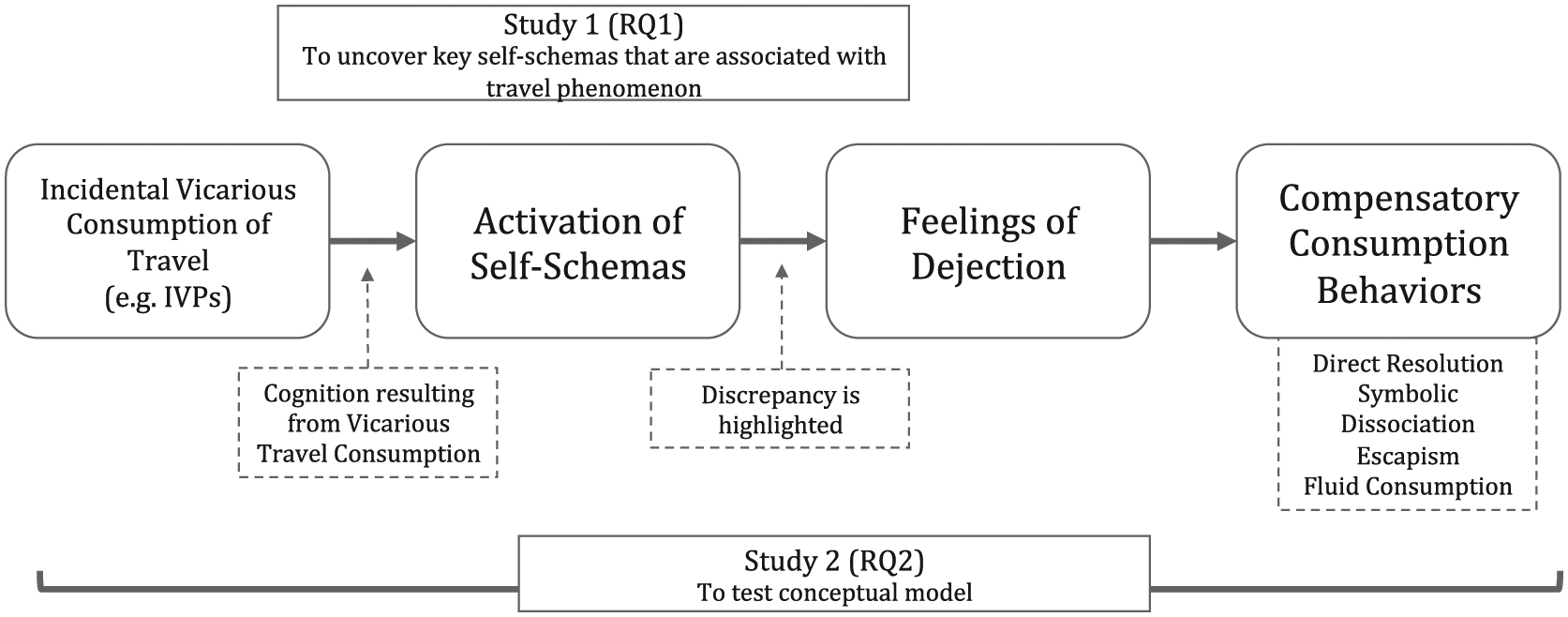
Incidental vicarious travel consumption model (IVTCM).
The article focuses on answering two research questions that are intended to evaluate the conceptual model and to contribute to the identified gaps in current knowledge.
Research question 1: Which are the relevant self-schemas that may become salient through vicarious consumption of travel following sight of an IVP shared by a Facebook friend?
Research question 2: Does vicarious consumption of travel initiate the process (self-discrepancies → feelings of dejection → compensatory consumption behaviors) as outlined in the IVTCM?
Although Direct Resolution, Symbolic Self-Completion, and Dissociation behaviors are self-schema specific, they are assessed within our model more broadly, related to travel and based on the following rationale. Given that IVPs may stimulate multiple self-schemas—the importance of which varies across individuals—we examine behaviors that address the higher-order issue of “not being on an idealized vacation.” Our reasoning is that if IVPs stimulate a discrepancy, addressing the absence of being on an idealized vacation should simultaneously resolve, or reduce, specific discrepancies of self-schemas that are associated with vacations (uncovered through research quastion 1). For example, after seeing an IVP, a person may experience a discrepancy related to self-schemas, such as adventure and/or belonging (especially if the post makes reference to friends or family). From this, a number of self-schema–specific direct resolution behaviors exist, for example, buying hiking shoes or calling a loved one. To avoid the potentially wide scope of schema-specific behaviors that exist, we examine behaviors that will have relevance to the self-schemas, albeit not specifically. Thus, by searching for or booking a vacation, a person may simultaneously reconcile discrepancies in adventure or belonging. This also allows us to provide understanding that is of greater value to travel stakeholders. Furthermore, for fluid compensatory consumption, following the guidance of Mandel et al. (2017) we have not narrowly defined which product will be purchased, as fluid consumption leading to self-worth may be situated in a wide range of domains (i.e., any that are not specific to the self-schema in which the active discrepancy is located).
A sequential mixed-methods design was chosen involving two studies: first, a qualitative phase to ascertain self-schemas that associate with VTC addressing research quastion 1, and second, a quantitative analysis of survey responses was used to address research quastion 2.
Study 1
Methods
This study involved a multimethod triangulation of findings from two independent data collection phases. First, a survey was conducted in October 2016 through Amazon Mechanical Turk, with respondents being adult Facebook users located in the United States (n = 80). The sample consisted of 61% female participants, with an overall average age of 37 years. Participation was open to people who had a validated track record in past surveys of greater than 80% approval, and the Qualtrics (the survey publishing tool adopted) anti-ballot stuffing setting was enabled to circumvent multiple submissions from the same participant. The survey was introduced as the following: “The aim is to understand factors that influence vacation decisions.” Participants were asked, “Please list 5–10 reasons ‘why’ you feel you need a vacation,” which they reported in a series of open text response boxes. These data provided some understanding of self-schemas within which people may feel discrepant, if not currently on vacation. We considered directly asking participants “why” they felt sad when they viewed IVPs, but preliminary testing identified this as being abstract for a self-report survey. Therefore, we approached by enquiring what symbolic value is gained from a vacation (e.g., Spend time with the people I love) to illuminate potential self-schemas that may be activated (e.g., belonging).
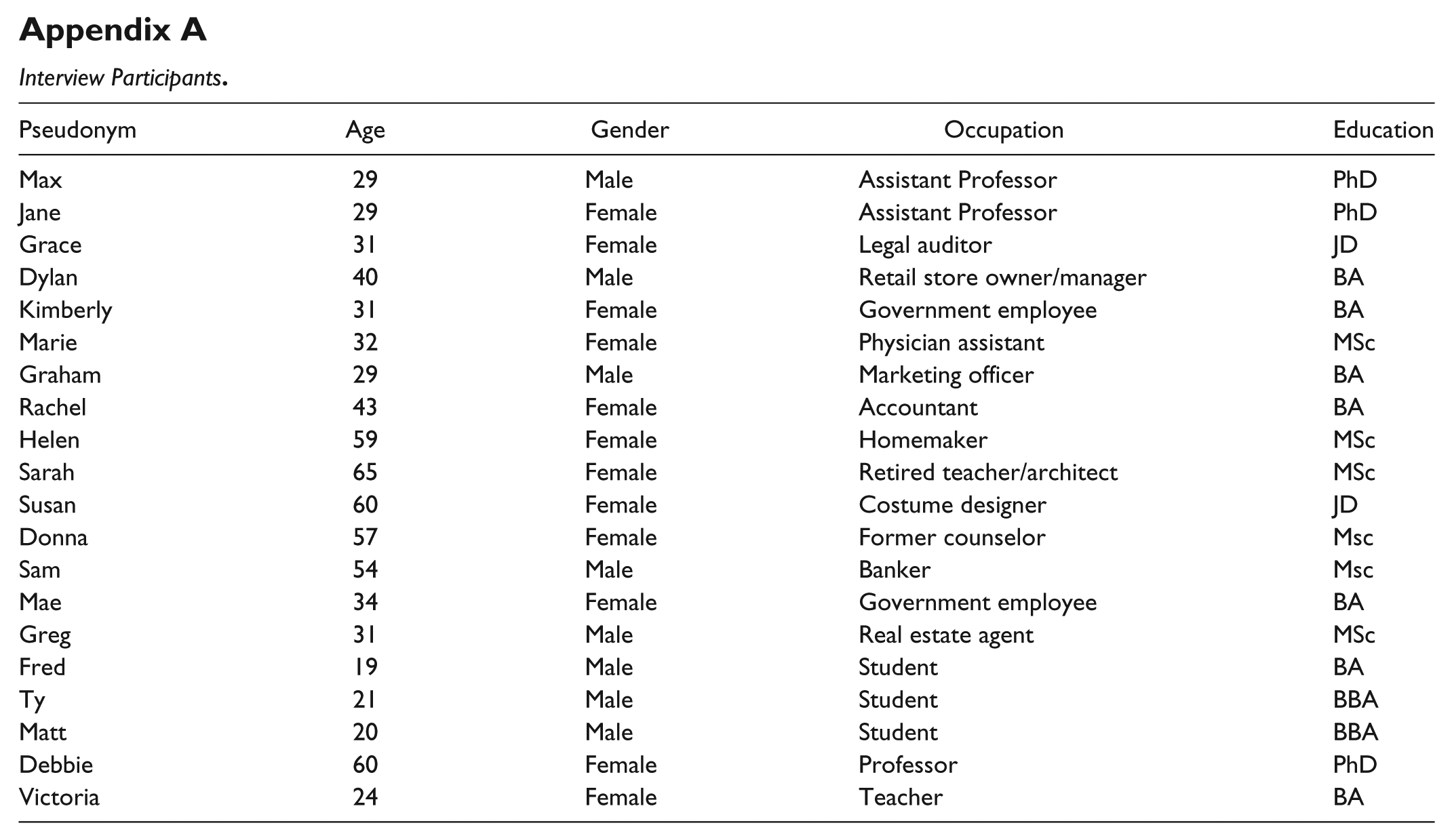
To complement and add depth to the breadth of results of the phase above, 20 semistructured face-to-face interviews were undertaken via Skype. A purposeful snowball sampling technique of US adult Facebook users was employed, stemming from the interviewer’s own network. Participants were middle-class and aged 19–65 years, 12 being female (Appendix A provides full participant details). The primary objective of conducting interviews was to explore motivation to go on vacation, as above to uncover potential self-schemas. However, the interviews also explored emotions following engagement with IVPs (stimuli were used within the interview to encourage discussion) and also to gain insight into potential compensatory consumption behaviors that may have been initiated. At 15 interviews, theoretical saturation was believed to have occurred as themes began to significantly overlap, although five more interviews were conducted to further validate our findings, with no new themes emerging.
It must be noted that it was intended that the interviewer had no involvement in the data collection or analysis of the initial survey phase, reducing potential bias within the analysis and comparison of both data sets (see Flick 2004). Interviews were transcribed and analyzed using thematic analysis (Braun and Clarke 2006). Independent analysis of each data set was carried out by the interviewer for the interview data and by the three other members of the research team for the survey data, for cross validation (see Denzin 1973). Once the two data sets were analyzed, the data was triangulated and consensus provided by all researchers for the key themes relating to self-schemas.
Results
Three emergent themes were triangulated from the two data sets. These represent key possible self-schemas that may become salient following exposure to IVPs and therefore where self-discrepancies may become active. First, belonging (spending time with loved ones), second exploration (need for new experiences), and third leisure (need for relaxation). Exemplar quotes are provided in Table 1 below.
Exemplar Quotes.
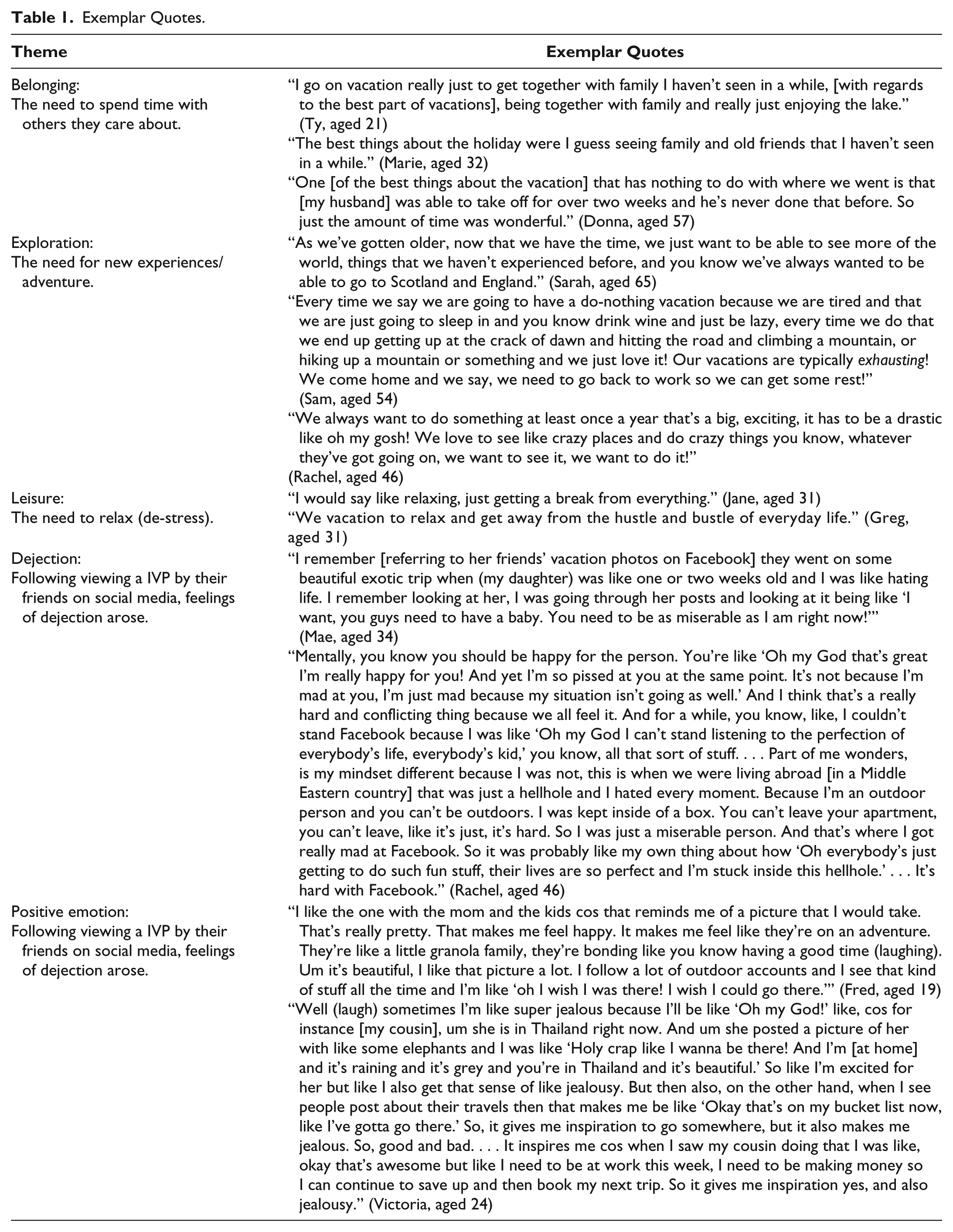
Frequency of mentions of each theme from the survey data were counted to provide an understanding of the breadth of importance, leisure = 104, belonging = 72, exploration = 61. The themes identified within the sample are supported by Crompton’s (1979) exploration of the motivation for pleasure vacation. However, we noted a further potential schema that emerged related to “status.” Younger people in the interviews (aged <50, n=15) often remarked either about their own motivation to go on holiday to “show off” their exotic, expensive vacations to others (desiring “likes” as affirmation), or believed their Facebook friends to have this motivation, often expressed through the term “bragging.” Although this highlights a possible additional schema within the data, it was intrinsically linked to exploration and therefore problematic to disentangle as status was shown through adventurous, exotic, out-of-the-norm experiences. Given this, we were satisfied that adequate support has been provided for the three self-schemas, though we will suggest that “status” should be understood further by future studies. The interviews further provided qualitative support for key association within the VTCM. First, for most participants, feelings of dejection arose from viewing IVPs and in some cases they admitted that this motivated them to avoid looking at IVPs (i.e., dissociation) or to book a vacation (i.e., direct resolution), exemplar quotes provided in Table 1.
In conclusion, the primary contribution of Study 1 is that when people vicariously consume travel, self-schemas associated with leisure, belonging, and exploration become salient. The proceeding study empirically tests the VTCM, with the three self-schemas identified.
Study 2
Methods
Data were collected through Amazon Mechanical Turk from adults residing in the United States who were also members of Facebook in December 2016. Research has supported the validity of Amazon Mechanical Turk data within quantitative studies as compared to other methods for online survey data collection (Paolacci, Chandler, and Ipeirotis 2010; Buhrmester, Kwang, and Gosling 2011) %%%%%%%%%%%and has been used by prior studies to understand the impact of social media within travel research (S. Choi et al. 2016; Ert, Fleischer, and Magen 2016). This purposive sampling method is satisfactory where the criteria are objectively set and sustained by the context (e.g., US residents who use Facebook), and on the premise that authors must be cautious in generalizing beyond the sample (Black 1999). Track record restrictions and the anti-ballot stuffing option were employed as outlined in Study 1. We recognize the conceivable limitations of our approach; however, we support its efficacy in the context of this study. First, acquisition of a list of all US Facebook users is impossible in order to create a sampling frame for use with a random approach (Tow, Dell, and Venable 2010). Second, our sampling procedure is consistent with other travel research examining adult Internet users (Filieri and McLeay 2014; Michaelidou et al. 2013). The sample consisted of 760 respondents, with an average age of 36.78 (SD = 12.29), and 66% were female. More than a third (35.2%) had a high school education, 44.0% had bachelor’s degrees, and 17.7% had graduate degrees. The sample also reported having an average of 320 Facebook friends each. The demographic profile is similar to recent travel research into Facebook users (Wang, Kirillova, and Lehto 2017). To mitigate the risk of social desirability bias, only workers with a validated track record of more than 50 past surveys were selected, and participants were assured of their anonymity (Peer, Vosgerau, and Acquisti 2014). Arguably, this may raise questions of validity regarding the sample given it is likely to include some professional respondents, although Matthijsse, De Leeuw, and Hox (2015) support that this is little threat to data quality and generalizability.
Stimuli
The impact of IVTC was assessed by presenting participants with one of two IVPs (Appendix B). Within the survey used in Study 1, participants were asked to rate the appeal of “spending a long day on vacation in [Hawaii; Palm Springs; Colorado].” Answers were given along a 7-point scale of not appealing to extremely. A one-way analysis of variance revealed there was no significant difference in appeal for a vacation in Colorado versus Palm Springs; however, Hawaii was viewed as significantly more appealing (p<.05). Given that our aim for the selection of the stimuli was to mitigate the risk of endogeneity rather than investigate conditions under which our findings may be varied, we selected the two images which were most closely matched (i.e., Colorado and Palm Springs).
In order to activate the self-schemas identified in study 1, it was crucial that the stimuli (1) were idealized depictions of vacations; (2) showed the traveler was having a relaxing time; (3) had an element of exploration; and (4) indicated a shared experience. Pictures of dining tables on a beach [Palm Springs] and with a mountain view [Colorado] were chosen, accompanied with the following text: “First day dinner, looking forward to an amazing week of sun and [mountains/sea] in [Colorado/Palm Springs] with my love #qualitytime.” A further pretest survey was launched (n=64), through Amazon Turk with the same sampling restriction as Study 1, to test that stimuli, against the criteria that it was an idealized viewed depiction and had relevance to the three self-schemas identified in Study 1. Participants were presented with the two stimuli and asked to report their opinion of posters’ vacations along four 7-point semantic differential scales (Imperfect–Perfect, Stressful–Relaxing, Mundane experience–Different Experience, Lonely experience–Shared experience). A one-sample t-test was conducted for both stimuli against the midpoint value of 4, and all criteria were satisfied as values were all significantly greater than 4 (p<.01). Thus, the stimuli were supported as idealized depictions as well as having relevance to the self-schemas. A paired-sample t-test was used to assess differences across the two stimuli. For all four measures, Palm Springs was significantly greater, with a mean difference ranging between .62 and .68 (p<.01). When testing the model outlined in Figure 1, it was imperative to avoid the risk of endogeneity, where effects noted in both the independent and the dependent variables are caused by a factor outside the model (Antonakis et al. 2014). By having two different images that were tested for similarity in their ability to activate self-schemas, and by rigorously testing for differences throughout the analysis, the study was considered to offer sufficient dynamism to avoid this risk.
Measures and Procedure
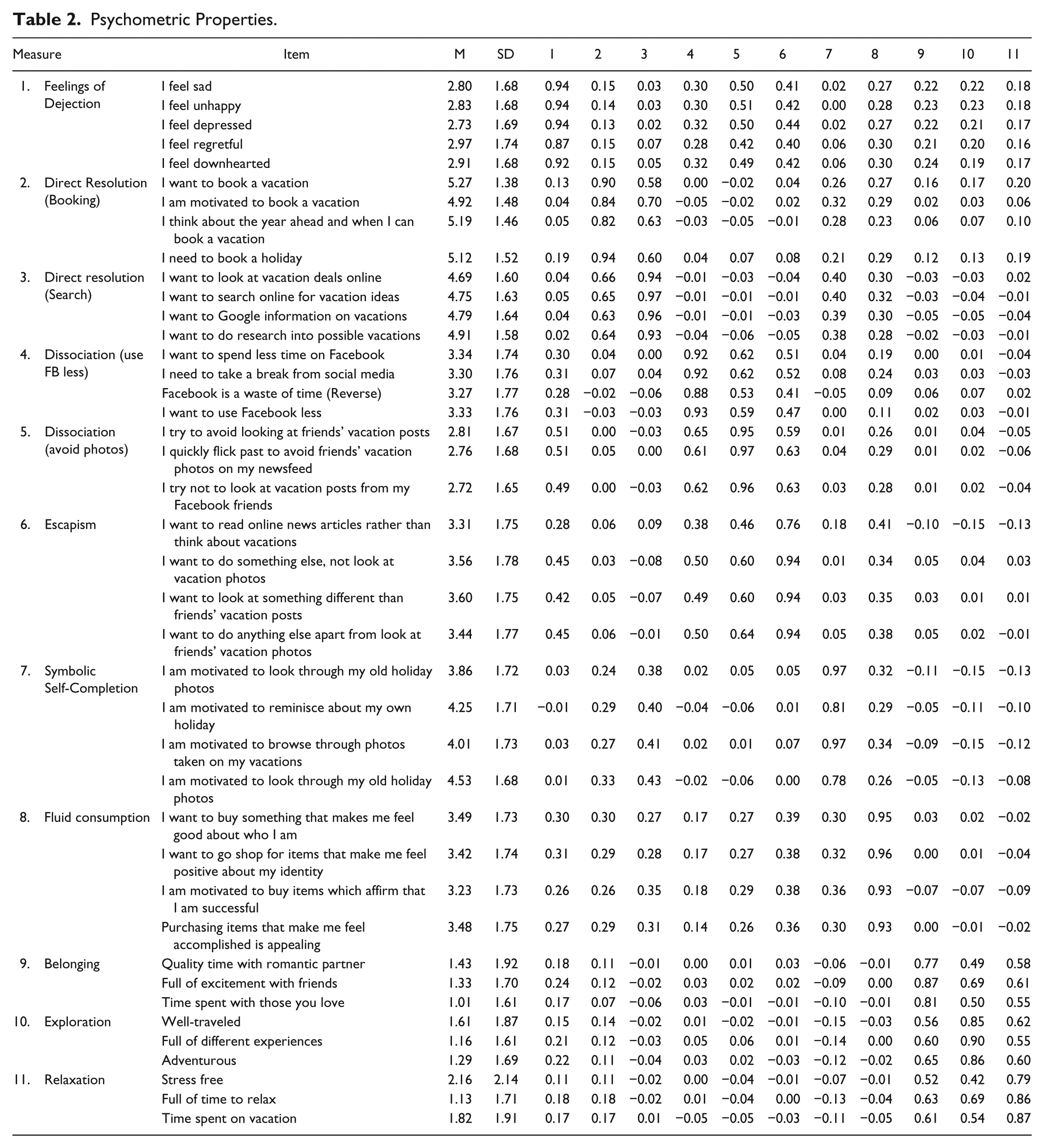
Measures from the specified model are detailed in Table 2. The survey commenced with general social media usage questions. Participants were then presented with the measures needed to test the paths within the specified model, thus the process illustrated in Figure 1. First, ideal-self discrepancy measures for the three self-schemas. Subsequently, respondents were presented with one of the two IVPs stimuli. This was accompanied with the following instruction: “Please imagine you see the following post in your Facebook Feed, posted by one of your Facebook friends. Please look carefully at the post.” A timer was set within the survey tool to allow us to ensure that participants spent at least 3 seconds looking at the stimulus, confirmed by an eye-tracking study to be the minimum amount of time attended to social post on Facebook (Vraga, Bode, and Troller-Renfree 2016). Following the stimulus, feelings of dejection and the compensatory consumption behaviors were measured using multiitem scales. Feelings of dejection were measured using 6 items reported along a 7-point scale (strongly disagree–strongly agree) adapted from Watson and Tellegen (1985). Direct resolution was measured by two behavioral intentions: to book a vacation and to search online vacation related information. Dissociation behavior was also measured through two scales: intention to use Facebook less, and avoidance of vacation posts by friends. The remaining three compensatory consumption behaviors—symbolic self-completion, escapism, and fluid consumption—were measured using a single scale.
Psychometric Properties.
Measures were included beyond those within the specified model to evaluate boundary conditions. Ellison, Steinfield, and Lampe’s (2007) Facebook Usage Intensity scale was provided. This involved 7 items responded to along a 7-point scale (strongly disagree–strongly agree), with an α equal to .80. Higher scores represent greater usage intensity. Vacation frequency and time since last vacation were each reported using three items along a 7-point scale (strongly disagree–strongly agree) (α < .89, 83 respectively). Demographic data were also recorded before the participants submitted the completed survey.
Using an amended version of Pelham and Swann (1989), self-conception scale discrepancies were calculated with Ideal-state minus Actual-state for individual attributes. Actual self-statement: “With regards to different life characteristics below, please rate yourself relative to other people of the same age, based on how you believe your life to be at present.” Ideal self-statement: “With regards to different life characteristics below, please rate yourself relative to other people of the same age, based on how you ideally would like your life to be.” A 7-point scale of way below average–way above average was provided.
Measures were created to assess the participants’ compensatory consumption behaviors based on Mandel et al.’s (2017) conception with specific relevance for travel scholars and practitioners. Participants were provided with the following question: “After seeing the vacation post by your Facebook friend, please rate how much you agree with the following statements.” A 7-point scale of strongly disagree–strongly agree was provided.
Data Analysis
To test the specified model, we employed a partial least squares approach to structural equation modeling (PLS-SEM). This method has been well applied in travel research (Simpson, Siguaw, and Sheng 2016; do Valle and Assaker 2016), marketing (Archer-Brown et al. 2017), and information systems (de Oliveira, Huertas, and Lin 2016). SEM-PLS models’ causal relationships with the aim of maximizing the explained variance in latent dependent variables (Hair et al. 2016) state that it provides a number of advantages over prior established covariance-based SEM, including greater flexibility on assumption, sample size and in assessing the impact of both reflective and formative constructs.
Results
SmartPLS version V3.2 was used to specify and evaluate the model (Hair et al. 2016). Harmann’s common factor test was run to assess for potential common method bias. Close to one-fourth (22.3%) of the variance was explained by one factor. This was well below the threshold of 50%; therefore, the results were satisfactory. Cross-loadings are shown in Table 3, indicating that all items fit in the assigned factor and no other. Composite reliability scores, Cronbach’s α, and assessments of discriminant validity are shown in Table 4. Composite reliability and Cronbach’s α values all exceeded the recommended value of 0.7. The AVE scores were all above .07, exceeding the accepted threshold of 0.5 to support convergent validity. Based on the Fornell and Larcker (1981) criteria all the square roots of the AVE values exceeded the correlations among latent variables. Further, the heterotrait–monotrait (HTMT) ratio of correlations are acceptable (<0.9) (Henseler, Ringle, and Sarstedt 2015). Together, these support the discriminant validity of the constructs. Multicolinearity was examined by assessing the variance inflation factors (VIFs) for all constructs and items. VIFs for the outer and inner models were acceptable at the Hair et al. (2016) recommended threshold of 0.2 to 5.0.
Data Validity.
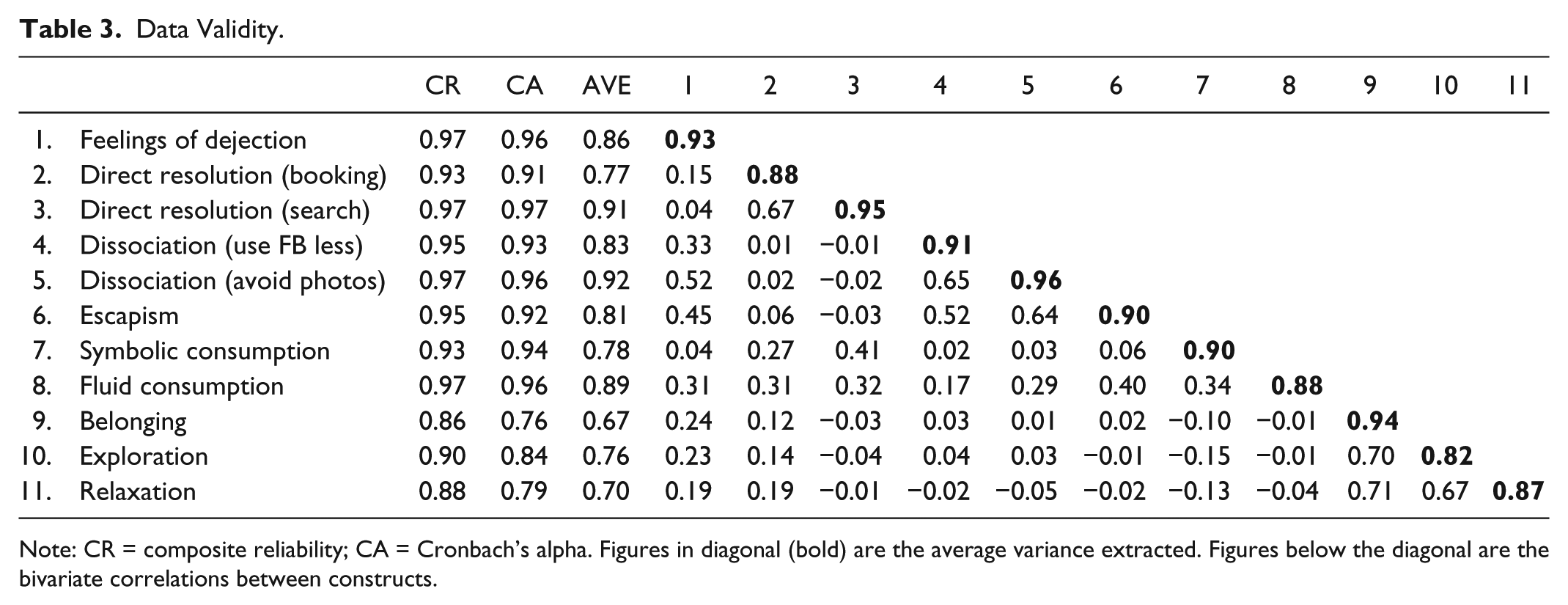
Note: CR = composite reliability; CA = Cronbach’s alpha. Figures in diagonal (bold) are the average variance extracted. Figures below the diagonal are the bivariate correlations between constructs.
Coefficients and Significance of Pathways Within the Specified Model.
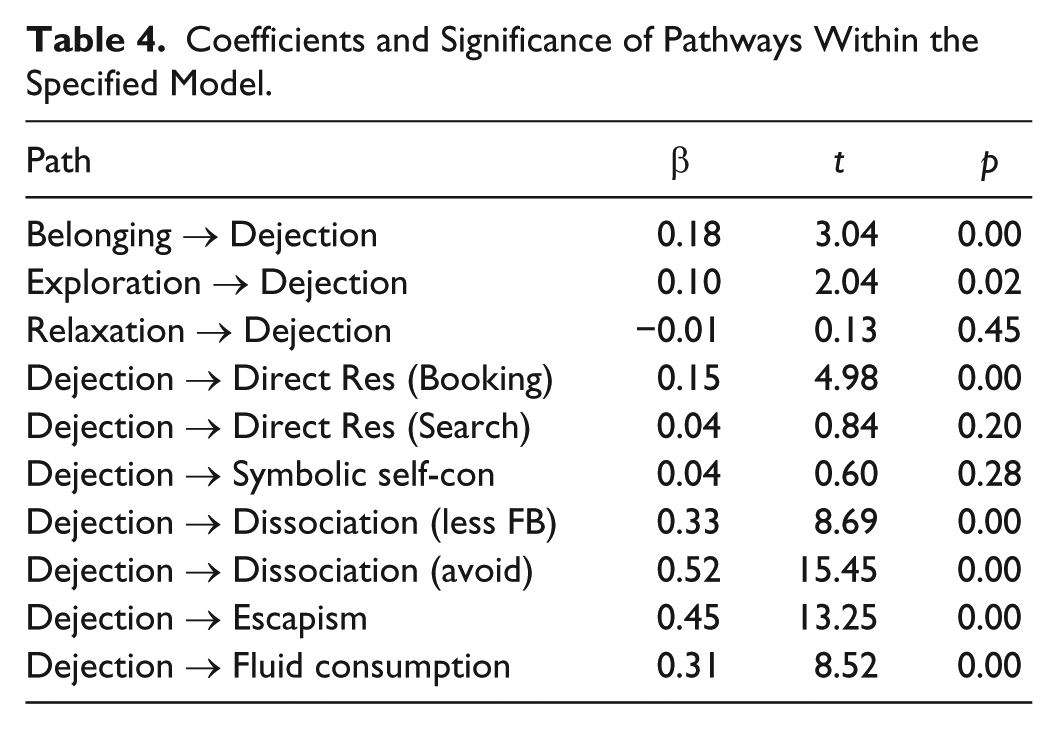
Before proceeding with the path analysis, we considered the overall plausibility of the specified model. Scholars are divided in their view of the appropriateness of overall fit indicators, where the overarching aim of the study is exploratory. Although we believe providing a measure of overall fit is less essential in this case than in a study aimed at confirming models, it is useful to give a sense of fit (Henseler, Ringle, and Sarstedt 2015). R-squared fit measures are less suitable for our specified model, given the use of multiple DVs. Thus, we report the standardized root mean square residual (SRMR) of 0.047, which below the most taxing threshold of 0.06 asserted by Hu and Bentler (1999). The specified model provides a plausible explanation of variance in the compensatory consumption behaviors. In order to control for any variance in our two stimuli, we used multigroup analysis to test differences across all paths in the model using Palm Springs and Colorado images as groups. No significant differences were noted, allowing us to confidently merge the data.
Testing Relationships
Path coefficients were tested through the bootstrap procedure. The results are summarized in Table 4. The size of a discrepancy related to the self-schemas of belonging and explorations increased feelings of dejection, after being exposed to the idealized vacation post (β = 0.18, t = 3.04, p < 0.01, and β = 0.10, t = 2.04, p =.02). Conversely, when examining the self-schema relaxation, the path was found to be nonsignificant (p=.45).
Greater feelings of dejection following vicarious consumption of an IVP positively affected the following behavioral intentions toward booking a vacation (β = 0.15, t = 4.98, p < 0.01), using Facebook less (β = 0.33, t = 8.69, p < 0.01), avoiding vacation photo posts by friends (β = 0.52, t = 15.45, p < 0.01), escapism consumption (β = 0.45, t = 13.25, p < 0.01), and fluid consumption (β = 0.31, t = 8.52 p < 0.01). However, no significant relationship was found for information search or symbolic completion consumption (p > 0.05 in both cases).
Mediation analysis
Tests were carried out to explore whether feelings of dejection mediated the discrepancy IVs and the compensatory consumption behavior DVs, and results are outlined in Table 5. Mediation was determined using the bootstrap methods (Preacher and Hayes 2008), where significance is determined through a 95% confidence interval for the indirect effect. X. Zhao, Lynch, and Chen (2010) was used to determine the type of mediation. For belonging (IV) to the DVs Dissociation (Avoid photos), Direct Resolution (Booking), Escapism, Fluid Consumption, and Dissociation (Use social media less), indirect only mediation was established for feelings of dejection. This was the same for exploration (IV) to DVs Dissociation (Avoid photos), Direct Resolution (Booking), Fluid Consumption, and Dissociation (Use social media less). We further found that feelings of dejection provided competitive mediation between exploration and escapism, as the direct path remained significant (β = −0.12, p = 0.04) and the product of direct path and the indirect path is negative. No other significant indirect effects were found.
Mediation Results.
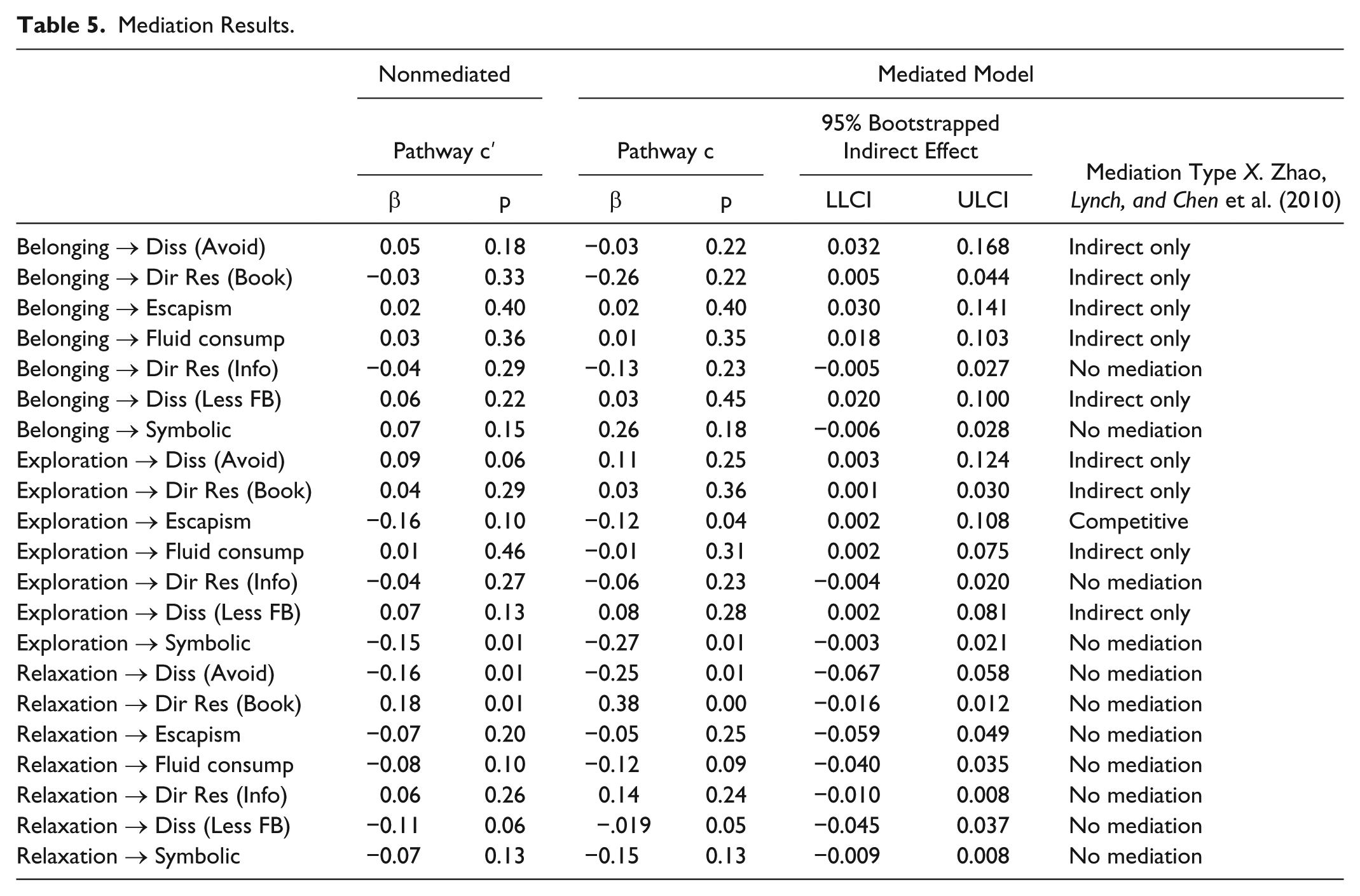
Moderation Analysis
To understand the boundary conditions of the specified model, we ran a series of multigroup analyses, focusing on the effects of gender (Male vs. Female), age (Generation Y vs. Generation X / Baby Boomers), Facebook usage intensity (High vs. Low), vacation frequency (High vs. Low), and the time elapsed since the participant’s last vacation (Less vs. More). Results are summarized in Table 6. For less recent (β = .43) versus more recent vacationers (β = .25), feelings of dejection had a greater affect intention to enact escapism behaviors, showed by the MGA significance (p<.01) value (Hair et al. 2016). No other significant differences in paths were found for those that were both significant themselves. However, in a number of cases, a path was found to be significant for one group but not the other. The path between belonging and feelings of dejection was significant for female, Generation X/baby boomers and for those who had been on vacation more recently (p<.05) compared to their respective alternative groups. For Generation X/baby boomers, as well as frequent vacationers, the pathway between exploration and feelings of dejection was significant (p<.05), as opposed to Generation Y participants and those who less frequently go on vacation. Furthermore, the link between feelings of dejection and the direct resolution behavior of booking is only established for females and Generation X/baby boomers (p<.05). The effect of feelings of dejection on escapism and symbolic self-completion behavior was only established for high-intensity Facebook users versus low intensity (p<.05). Feelings of dejection were only found to lead to dissociation through reducing social media usage in participants who vacation more frequently and who had been on vacation more recently (p<.05) compared to their counterparts. Lastly, only for those participants who had been on a vacation more recently did feelings of dejection predict escapist behavior (p<.05).
Multigroup analyses.
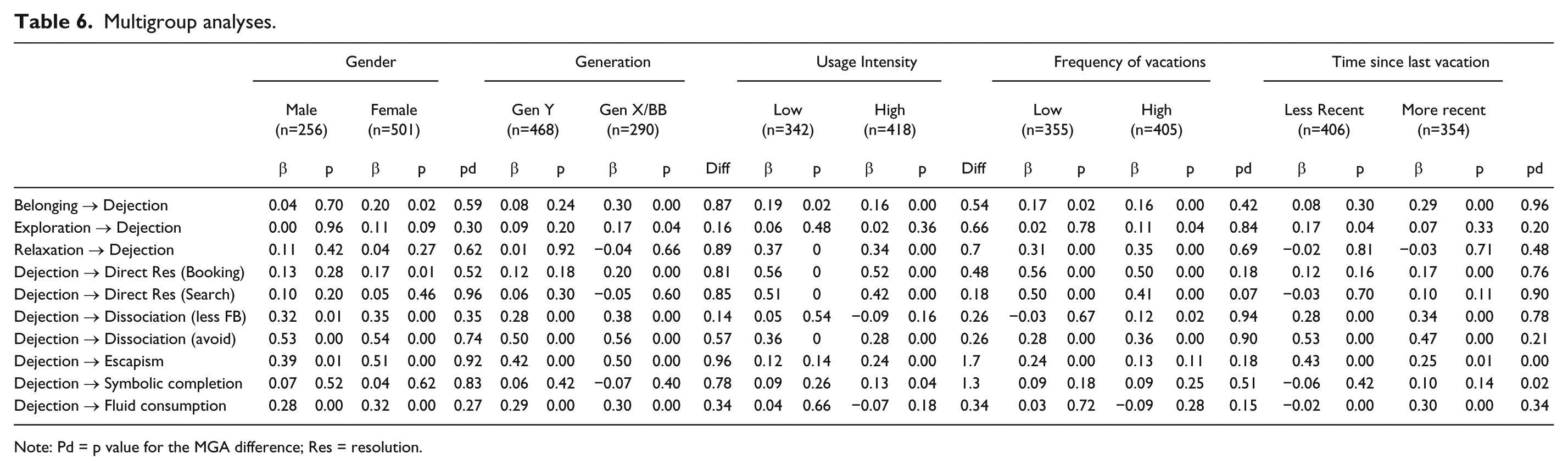
Note: Pd = p value for the MGA difference; Res = resolution.
Conclusions and Practical Implications
Vicarious consumption of travel is an important phenomenon within the travel industry, and one that largely underpins the promotion of travel. There has been a well-established link between vicarious consumption leading to patronage of destinations. However, little was known about the psychological process, associated emotions, and outcome behaviors on which this was founded, beyond information search or purchase. Addressing this gap, supported by the two studies, our primary contribution is the IVTC model. Specifically, we have evidenced that incidental vicarious consumption of idealized travel phenomenon, can activate self-discrepancies within the consumers’ self-concept that are associated with belonging and exploration, leading to feelings of dejection, motivating compensatory consumption behaviors. One of these behaviors manifests an increased motivation toward booking a vacation (Direct resolution); thus, IVTC viewed to stimulate the tourist decision-making process. However, intention to enact other behaviors that are less favorable to travel practitioners was also found, as participants expressed their intention to avoid further vicarious consumption of travel (Dissociation), escape into non–travel-related pursuits (Escapism), and to more broadly consume products/services that increase their self-worth (Fluid consumption). Although the IVTC model was validated here in the context of IVPs, we propose it can provide an important understanding of the process underpinning other forms of IVTC (e.g., receiving postcard).
Our secondary contribution is specific knowledge on the impact of IVTC of IVPs, a phenomenon until now unaddressed in the literature. This was found to activate self-discrepancies such as the impact of seeing idealized models in advertising (Sobol and Darke 2014). These activated self-discrepancies were associated with the self-schemas of belonging and exploration, supported indirectly by Crompton (1979), which finds these are important motivators for tourism. In other words, seeing IVPs compels the viewer to reflect on their own needs for exploration and belonging and whether they are being fulfilled. Belonging was found to have a greater effect on feelings of dejection than exploration did. This suggests that belonging is more important within the self-concept (Higgins 1987), which is unsurprising given the critical need to belong within the human psyche (Maslow 1943; Walton and Cohen 2007).
Our finding that feelings of dejection are stimulated by viewing IVPs, builds on Liu, Wu, and Li (2018) who assert viewing tourism posts breeds envy and Tandoc, Ferrucci, and Duffy (2015), finding that people who are more envious of their Facebook friends report higher trait levels of depression. It does this by showing how such activities influence state-level depressive feelings, which are likely to be antecedent to the trait-level differences they evidence. This sheds scholarly light on why vacation posts are indeed “tyrannous” to their viewers (Now 2016). Our results show that in general IVTC has the opposite emotional effect than intended vicarious consumption, which occurs as consumers become excited while searching for vacations (Cho and Jang 2008).
IVTC was found here to result in increased intention to book a vacation, relative to the magnitude of feelings of dejection and, thus, discrepancy. This is similar to prior research that showed envy stemming from viewing posts of luxury leads to increased intension to visit the posted destination (Liu, Wu, and Li 2018). However, IVPs were not found to stimulate vacation-related information searches. It is plausible that consumers, experiencing a negative emotion, are seeking the more instant reconciliation that booking would provide but information search may not. Carver and Scheier (2001) support this, asserting that people are motivated to increase the velocity which discrepancies are reduced. This finding compels managers to streamline consumers’ journeys between IVTC and purchase. In the context of Facebook, travel managers should post content with call-to-actions such as “Book Now” rather than those that target earlier stages of the consumer decision-making process (e.g., “Read More”). Smiliarly, tourist firm webpages should increase efforts through conversion rate optimization techniques to ensure potential customers who land on their pages, thirsty to quench their need for travel, quickly can book and pay seamlessly. To leverage this urgency for discrepancy reduction, we further suggest that tourism managers consider scarcity tactics, for example, promoting limited demand/supply in their marketing, akin with Booking.com’s pop-up alerts that let potential customers know that others are looking at the rooms they are and there is a limited supply (see Verhallen and Robben 1994).
Motivation to enact dissociation behaviors (i.e., use social media less and avoid vacation posts) was found to increase with feelings of dejection. Participants wished to dissociate themselves with what had stimulated the negative emotion, in an endeavor to reduce the saliency of the activated domains. This builds on findings by Lastovicka and Fernandez (2005), who found that people tended to discard products that made salient discrepancies (see also Dalton and Huang 2014) by finding this too occurs with IVTC. Increased feelings of dejection from viewing IVPs also positively predicted the intention to enact escapism and fluid consumption behaviors. This mirrors prior studies that found that people were motivated to resolve active discrepancies by immersing themselves in activities that were not specific to the discrepant domain, also wanting to purchase products that increased self-worth in other domains (Heatherton and Baumeister 1991; Martens et al. 2006). Together, our results show that IVTC can initiate both approach and avoidance forces toward vacation-related phenomena. They show greater intention to book a vacation, but are also motivated to avoid further vicarious consumption of travel. The existence of these avoidance forces further supports the assertion that, once in a negative state, people desire instant relief, whether through booking a holiday or engaging in non–vacation related behaviors. To leverage the latter—beyond the aforementioned “book now” campaigns—travel managers may provide content that is carefully designed not to resonate with the self-schemas of belonging or exploration, while still maintaining awareness of the brand. For example, a blog about exotic animals captioned “The secret wild life of Indonesia” has more relevance to the self-concept than “Experience the exotic wildlife of Indonesia on your next family holiday.”
The relationship between feelings of dejection and symbolic self-completion behavior (i.e., reminiscing over their previous vacations) was not significant. This may be because people may have preferred symbolic self-completion behaviors more directly resonating with belonging, such as thinking about their children or texting their partner.
Our exploration of boundary conditions to the specified model provides important insight for travel researchers and managers. We found that the belonging domain, as an initiator of the process, was only significant for females. Lounsbury and Polik (1992) support this by finding that females have a greater social need related to vacations. This promotes the use of belonging (e.g., pictures of families, or couples) within the design of travel-related marketing content to be targeted at women. Females and older generations (generation X and baby boomers) were found to be significantly motivated to book a holiday after IVTC, but not males or those from generation Y (i.e., millennials). Travel managers should take this into account when using personal data to target “book now” campaigns through social media. By comparing different generations, our work extends findings by Liu, Wu, and Li (2018) that millennials, feeling envious of luxurious travel posts by their peers on social media, are motivated to visit destinations posted about. Specifically, building on this prior work, our findings imply that although millennials may have increased intention to visit such luxury destinations, their actual intention to book is less, likely because of lack of economic resources compared with older generations. This highlights a potential important distinction between generations who IVCT: the bucket lists of younger generations becomes longer whereas for older generations, items are crossed off. Therefore, we propose this indirect tactic leveraging avoidance (e.g., exotic animal blog mentioned above) behaviors is most suitably targeted at generation Y and younger, whereas older generations will respond best to “book now” direct resolution campaigns. Though the former is unlikely to drive quick sales contact with travel brands in this way will help affirm positive attitudes and relationships with younger potential customers, leading to greater loyalty in the future. We suggest social media influencers be considered to disseminate such content given their established role in driving consumption from younger generations (Khamis, Ang, and Welling 2017).
Furthermore, only high-intensity users were found to have greater intention to enact escapism and symbolic self-completion behaviors. We propose that this is because these specific measures largely focused on “within site” actions, for example, looking at non–vacation related articles on Facebook or back at their vacation photos. Thus, it makes sense that users who believe Facebook is more highly ingrained in their lives are likely to turn to the technology as a means of coping: for example, Instagram helps more intense users cope with loneliness (Pittman and Reich 2016). In addition, more frequent vacationers showed a significant link between the exploration domain and feelings of dejection. This makes sense, as the need for new experiences is likely to be more important for frequent vacationers. This is important knowledge for the tourism industry as it promotes the need for content that emphazises exploration to frequent vacationers a segment which is relatively easily targetable through the use of web-analytics. More speficially, we suggest frequent vacationers will respond best to images and phrasing, that distill a romanticized depiction of adventure, out of the ordinary experiences and wanderlust. Rather than less frequent vacationers that our results suggest would react best to content that stimulates notions of belonging, for example, images of families or couples enjoying time together.
Lastly, only for participants who had been on vacation more recently was there a significant association between feelings of dejection and motivation to book. This provides travel managers with an opportunity to benefit from re-marketing using records of prior behavior. This may occur through e-mail for those who have booked in the past but also through targeting content based on location data that highlight that a person has likely been on vacation recently.
We have thus far only provided implications for tourist managers in leveraging IVTC of IVPs to improve their bottom-line. Our findings, however, provoke discussion of implications for broader stakeholders. Feelings of dejection arising from IVPs (or likely idealized content more broadly) on social media, which is a ubiquitous phenomenon, raises concerns about users’ mental health. We urge education policy makers and the social media designers themselves to educate people as a means to reduce feelings of dejection arising from using social media. This would involve raising awareness that what we see on social media posted by others is generally a highly polished version of the poster’s life and it should not be used as a yardstick to compare one’s own life. This is akin with general rhetoric around avoiding engaging in comparison of oneself with airbrushed versions of celebrities in the media. For instance, designers at Facebook could provide periodic reminders of the idealized nature of posts for users at the top of their newsfeeds, so users can better ground their comparisons. Further, the algorithm that selects the content of users’ feeds could intersperse idealized content with more realistic images in order to offer a balanced view. Educators may consider addressing the topic in schools and universities as part of their initiative to increase well-being.
For tourism managers, this proposes an ethical dilemma between encouraging IVPs and harnessing the demand they create in comparison with the negative effects of consumers. Managers should carefully consider this aspect prior to operationalizing these findings and exploiting the effects noted. One initiative that could be considered is encouraging consumers to post “their real vacation” using elements that are not polished, or within post both polished and nonpolished elements. This would be somewhat similar to the “No make-up selfies” campaign encouraging people to show their natural appearance online. The potential positive of encouraging less glamorized depictions of travel may be a favorable brand image, resonating with calls in the airline industry to provide a behind-the-scenes understanding of the processes involved (see Flightmedia 2016).
Our final contribution responds to Mandel et al.’s (2017) call for empirical understanding of consumer choice between compensatory consumption. As the first study to examine the five compensatory consumption behaviors in combination, our results suggest that in order to counteract a discrepancy within the self-concept, consumers are simultaneously motivated to enact a number of these behaviors, as the strength differed across different pathways. We found marginally stronger effects overall with regard to dissociation and escapism, and choice was dependent on boundaries. Although these differences cannot be generalized beyond the specifics of the study, we propose that choice of compensatory consumption behaviors is complex and requires much further work to unravel conditions that predict the prominence of these behaviors. These represent significant advances in the literature both of a general nature, and more specifically in the context of travel.
Limitations and Future Research
Although our study provides valuable knowledge, there are a number of limitations. First, feelings of dejection were found in large part to mediate the relationship between discrepancies and compensatory consumption behaviors. This is supported by work that asserts the overarching need for emotion to arise before there is a behavioral response (e.g., Carver and Scheier 2001; Atalay and Meloy 2011; Cryder et al. 2008; Sela and Shiv 2009). However, given the small body of research that proposes discrepancies may lead to behaviors without a change in mood (Rucker and Galinsky 2008), future research should explore the role of emotion in the relationship between vicarious consumption and compensatory consumption. This may also help shed light on the competitive mediation of feelings of dejection between exploration and escapism found here. Such research should consider the potential for IVTC to lead to positive or mixed emotions as consumers find joy in the experience of others, perhaps alongside feelings of dejection, a phenomenon Study 1 provided some support for.
Second, the study lacks ecological validity as it was conducted with fictional IVPs from an imagined Facebook “friend.” We expect that in a real-life setting where participants are subject to IVPs from people they actually know, the effect may be greater, based on the notion that social comparison is stronger when ties are closer (Suls, Martin, and Wheeler 2002). Although we made a concerted effort to make the stimulus material as authentic as possible, further research is needed to validate our findings in a setting with greater ecological validity. Third, we propose that self-schemas stimulated by IVPs are not limited to exploration and belonging. Participants suggested within study 1 that they believed people made vacation posts to project status, through appearing attractive or successful; therefore, it is plausible that IVPs stimulate a self-schema related to attractiveness or potentially career success. Subsequent studies should investigate more broadly self-schemas related to status, but must be cautious to delineate potential overlaps with the schema of exploration, as it appeared from our study that status in the context of travel is innately linked to projecting novel or exotic experiences. Furthermore, our nonsignificant effect of “relaxation” was surprising, given the importance of this to vacationers. We speculate that relaxation is a proxy for other self-schemas and not a self-schema itself. There are many different reasons why a person may need relaxation (e.g., family issues, performance at work, health). We suggest future research to validate the domains found here, and particularly to provide insight on latent self-schemas that people may need for relaxation. Fourth, our study focused on IVPs. Of course, there are varying levels of idealization in vacation posts—some may even assert what a terrible time they are having on holiday. Further experimental research should examine the impact of vacation posts with degrees of idealization on emotion and behavior. Fifth, additional studies should employ our model, in order to contrast the effect of vicarious consumption of IVPs by brands to ascertain similarities and differences with the IVPs by travelers explored here. Sixth, our research is limited by the use of self-report measures and the measurement of behavioral intentions. Future research should validate our findings through measurement of actual behavior and physiological response in order to understand emotion, possibly with the use of experimental conditions that, while mitigated here, would eliminate the danger of endogeneity in the model. Seventh, we employed a self-selected sample of US Facebook users, and therefore caution should be taken when generalizing our findings. Subsequent research should be carried out on samples residing in different locations in order to understand any cross-cultural effects, while also considering other prominent social media (e.g., Instagram) and adopt more randomized sampling techniques. Lastly, our focus was on IVTC occurring as an initiator of a decision-making process; future research should consider expanding our model to incorporate further intended VTC that may occur at later stages of the process.
In conclusion, we contribute a valuable model to assist researchers and practitioners in understanding incidental vicarious travel consumption. It also has specific implications for theory and practice, as associated with consumption of IVPs: a specific, novel, and ubiquitous intersection between the travel industry and consumers. Furthermore, we contribute knowledge to the underlying theory base of compensatory consumption.
Footnotes
Appendix A
Interview Participants.
| Pseudonym | Age | Gender | Occupation | Education |
|---|---|---|---|---|
| Max | 29 | Male | Assistant Professor | PhD |
| Jane | 29 | Female | Assistant Professor | PhD |
| Grace | 31 | Female | Legal auditor | JD |
| Dylan | 40 | Male | Retail store owner/manager | BA |
| Kimberly | 31 | Female | Government employee | BA |
| Marie | 32 | Female | Physician assistant | MSc |
| Graham | 29 | Male | Marketing officer | BA |
| Rachel | 43 | Female | Accountant | BA |
| Helen | 59 | Female | Homemaker | MSc |
| Sarah | 65 | Female | Retired teacher/architect | MSc |
| Susan | 60 | Female | Costume designer | JD |
| Donna | 57 | Female | Former counselor | Msc |
| Sam | 54 | Male | Banker | Msc |
| Mae | 34 | Female | Government employee | BA |
| Greg | 31 | Male | Real estate agent | MSc |
| Fred | 19 | Male | Student | BA |
| Ty | 21 | Male | Student | BBA |
| Matt | 20 | Male | Student | BBA |
| Debbie | 60 | Female | Professor | PhD |
| Victoria | 24 | Female | Teacher | BA |
Appendix B
Declaration of Conflicting Interests
The author(s) declared no potential conflicts of interest with respect to the research, authorship, and/or publication of this article.
Funding
The author(s) received no financial support for the research, authorship, and/or publication of this article.
