




Abstract
The hybrid exchange project described here aims to facilitate intercultural learning and cultural awareness by promoting meaningful virtual and cultural interactions among students from universities in Kenya, Ireland, and Germany. We collected qualitative data from former participants, who engaged in virtual and in-person exchanges. Our study indicates that hybrid exchange programs effectively promote intercultural understanding, and personal and professional development in technical communication. The program's design, which includes structured activities and social exchanges, contributed to the successful achievement of these goals. Such approaches can serve as a model for improving virtual team dynamics in various sectors, applicable beyond educational contexts.
Introduction and Background
The discipline of technical communication and the attendant labor market are growing, and degree programs in this future-oriented discipline are increasingly in demand. As organizations and business practices have become progressively globalized, technical communication researchers have highlighted the importance of intercultural understanding and internationalization in this discipline (see, for example, St.Amant, 2013). Programmatic opportunities for international collaboration are one means of facilitating intercultural understanding and developing key competencies, but such opportunities also present challenges (St.Amant, 2021), such as adapting pedagogical approaches for culturally and linguistically diverse audiences, navigating differing national laws regarding the sharing of educational materials, and sustaining international partnerships despite logistical barriers such as different time zones and institutional systems.
To date, programs and international collaboration projects in technical communication have tended to be confined to the Global North. The discipline is, to some extent, established there, and a substantial network of educational institutions has grown, whereas the labor and education markets for technical communication in the Global South are only now beginning to emerge.
This article describes a study in which students based in three different countries collaborate and interact virtually in structured ways for several weeks, before meeting in person. In response to the COVID-19 pandemic, a hybrid exchange program was conceptualized and implemented from autumn 2021 onwards, involving three partner institutions: Karlsruhe University of Applied Sciences, Germany, Pwani University, Kenya, and University of Limerick, Ireland. Our hybrid program combines virtual exchanges with in-person meetings to develop the cultural awareness, adaptability, and empathy necessary for more effective global collaboration in technical fields. The primary aim of this initiative is to develop participating students’ intercultural understanding and skills by enabling them to engage in a trinational, hybrid exchange experience, structured around three key components: virtual social interaction, discipline-specific virtual workshops, and a face-to-face short-term stay. The article examines how intercultural relationships among students can be established in a virtual environment and further cultivated through in-person meetings. The project implementation and findings are relevant to the education sector, and indeed to any kind of international collaboration.
Literature Review
Our focus in this article is on developing intercultural competencies that prepare students for virtual and hybrid teamwork through international collaboration projects.
Developing Intercultural Competencies
Intercultural communication has been an active, multidisciplinary research area since the mid-twentieth century, spanning disciplines including anthropology, sociology, linguistics, and communication studies (Martin et al., 2020). Earlier definitions of intercultural communication focused on identifying cultural heuristics and typologies such as Hall’s (1976) and Hofstede’s (1984) dimensions of culture. More recent research acknowledges that culture is socially constructed (Agboka, 2012) and intercultural communication requires “reflexive awareness of the Self and Other in a crossing of boundaries” (Holliday, 2018, p. 6).
Engaging and dealing with other cultures are the subject and core of intercultural communication. Whether individuals and groups understand each other depends on shared symbol systems, recognizing one another's world views, socio-cultural and aesthetic orientations, as well as factors such as empathy and tolerance. Intercultural communication is always linked to specific meanings that communication partners assign to the—conscious and unconscious—expressions and behaviors of others (Deardorff & Hunter, 2006). Orienting oneself in the field of tension between “localism” and “globalism” requires skills in symbol expression and comprehension: understanding other cultures and lifestyles, perceiving similarities and differences, and relating to them.
Students also need to reflexively understand their own culture and its norms and expectations (Deardorff & Hunter, 2006). Intercultural understanding begins when students explore cultural self-awareness through self-reflection and moving “beyond their own cultural comfort zones, whether through education abroad, cross-cultural simulations, or through meaningful intercultural interactions” (Deardorff & Hunter, 2006, p. 79). According to Deardorff and Hunter, a stay in another country provides an initial foundation, but it is not sufficient for global readiness. Rather, the foundation of “openness, curiosity, and respect” (p. 77) must be built upon. By interacting with fellow students from diverse backgrounds, students develop a greater level of tolerance, empathy, and openness, characteristics that are an advantage, both personally and professionally, in an increasingly globally connected world.
Internationalization has become a significant force in global higher education over the past two decades, evolving both conceptually and practically. As Knight (2012) explains, “the international dimension of the curriculum has progressed from an area studies and foreign language approach to the integration of international, global, intercultural, and comparative perspectives into the teaching/learning process and program content” (p. 27). Nowadays, internationalization is central to higher education, influencing social relevance, educational quality, prestige, national competitiveness, and innovation. It can be implemented in various ways, affecting all levels of an institution: mission, management, teaching, learning, research, enrollments, staffing, and the student experience.
A central mission of universities is to prepare graduates for the challenges of the 21st century and the increasingly interconnected global society (Deardorff & Hunter, 2006). This preparation incorporates the development of intercultural competencies, including understanding cultural norms, empathizing without ethnocentrism, interpreting others’ perspectives, gaining insight into cultural differences, and acknowledging both one's own and other cultures (Byram, 1997). Although many academic programs incorporate intercultural communication into the curriculum, the approach is often to describe theoretical models that may promote the “false idea that culture is a set of habits and traits that one can learn and regurgitate in intercultural communication situations” (Agboka, 2012, p. 169), when a more nuanced, open and non-judgmental understanding of others is a more useful competence.
Virtual and Hybrid Teamwork in Technical Communication
Many technical communicators are employed in globalized corporations, where their work is organized around projects and undertaken in international teams. Because their work is internationally oriented and collaborative, the ability to communicate reflexively in virtual, as well as in-person, settings with colleagues from other countries and national cultures, and to work effectively on international projects, are essential graduate competencies. Indeed, in almost all workplaces, common business activities such as project meetings are now regularly undertaken virtually, even if team members are collocated or semi-virtual (some members meet in person). Collocated, virtual, and semi-virtual teams differ in key ways. Webster and Wong (2008) found that team identity, trust, and communication patterns differ depending on whether some or all team members meet regularly, occasionally, or at all. For effective outcomes, virtual and hybrid teams need regular interactions, task clarity, and “relationships-oriented behaviors” (Caputo et al., 2024, p. 17).
Hopkins and Bardoel (2023, p. 1) suggest that post-pandemic, “the most common work arrangement for knowledge workers is now some form of a hybrid model” where employees work a mix of remotely and in-person in different configurations. Many organizations are seeking hybrid working solutions, and in-person collaboration is increasingly encouraged (Yang et al., 2022). There is, however, a gap in the research regarding how to prepare students to work in teams that meet first virtually and later in person.
While virtual teams can be as effective as collocated teams, virtual work is challenging. Projects may fail or become inefficient because team members do not meet in person, especially when they are globally dispersed. Despite regular virtual information exchange, the trust and understanding that come more naturally with face-to-face meetings are more difficult to foster virtually (Morrison-Smith & Ruiz, 2020). Virtual interactions can lack socioemotional communication, the personal connection that comes from spending time together and talking about topics that are not directly related to work (Alaiad et al., 2019; Flammia et al., 2010). This disconnection can test even the most committed team. Furthermore, virtual work teams can result in silos and reduced communication, with potential long-term negative impacts on productivity and innovation (Yang et al., 2022).
For these and other reasons, technical communication students need to develop intercultural communication competencies and to gain experience in international collaboration.
Research on International Collaboration Projects in Technical Communication
For over three decades, technical communication educators have sought to expand the communicative competencies of their students and to prepare them for the globalized workplace by facilitating various types of internationalized experiences. St.Amant (2002) described internationally oriented activities that students could undertake to improve their intercultural competence in technical communication, as well as collaborative virtual projects to build understanding. St.Amant (2005) also outlined challenges and strategies for teaching international online classes and navigating cultural differences in these environments.
Some technical communication teachers have incorporated international virtual teamwork into their courses to develop these competencies. Global virtual team projects enable students to have a low-risk, no-cost international and intercultural experience (Flammia et al., 2016). Team members located in different countries or continents share tasks, interacting through technology-enabled structures that mimic corporate workplace projects. Starke-Meyerring (2010) describes these initiatives as globally networked learning environments (GNLEs). In one such project, Herrington and Tretyakov (2005) taught collaboratively on an interactive online distance learning course in cross-cultural digital communication. The students, from Georgia Institute of Technology in the USA and the European University at St. Petersburg, Russia, discussed intercultural communication and collaborated to develop digital artifacts. Flammia et al. (2010) designed a project in which US and Irish technical communication students worked in teams to create website content. They found that teams that made time for social, as well as task, communication were more cohesive and reported more satisfaction with the project experience. Students met virtually using text, audio, and video meeting tools. They did not have opportunities to meet in person or experience other cultures.
The Trans-Atlantic and Pacific Project (TAPP) is a network that supports teachers in finding partners for international writing, translation, editing, and usability testing projects. It includes partners in “49 universities in 21 countries across 5 continents” (University of Houston Downtown, 2023). Although one African university is listed on the TAPP website as a previous project partner, none of the publications listed describes a project that includes the African partner. Crabtree and Sapp (2005) described a technical communication research project with community partners in Kenya, and the opportunities for global civic engagement and intercultural connections it afforded. The authors also encountered logistical, linguistic, cultural, technological, and political challenges. While their study offers insight into international collaboration in Kenya, it describes a research collaboration between a Western university and an African NGO, not a collaboration among students.
These collaborative projects offer significant learning opportunities. Scholarship about international student teams has examined topics including skills development (Vanderstukken et al., 2019); building trust (Coppola et al., 2004); communication strategies (Flammia et al., 2010); facilitation of international projects (Mousten et al., 2018), and increased respect for cultural differences (Swartz et al., 2020). In doing so, they prepare students to work in international teams and develop content for global audiences, including content that may be translated and localized (St.Amant, 2013).
While internationalization has become a prominent strategic goal in universities, and international team collaboration is seen as an important graduate competence in many disciplines and professions, limited research to date examines reflexively oriented international projects in technical communication programs that include both a virtual and in-person exchange. The lack of international collaboration between Western and African technical communication programs or, more generally, programs based in universities in the Global South, is also a significant gap in the literature.
The project described in this article is a collaboration between students based in Germany, Kenya, and Ireland. Our project expands on studies that examine business and technical communication interactions in a global context, and specifically the literature about intercultural competence and virtual teams. The participating students from Germany are enrolled in the Communication and Media Management Master's program at Karlsruhe University of Applied Sciences, while the students from Ireland are part of the Technical Communication and E-Learning Master's program at the University of Limerick. Since there is currently no dedicated technical communication program at Pwani University in Kenya, the Kenyan participants are drawn from various disciplines within the Faculty of Humanities and Social Science. The project enables students to first develop relationships in virtual settings through task and non-task communication, with the goal to achieve stronger relationships more quickly when the team members meet in person.
Background to the Project
Like in many universities, the internationalization strategy of Karlsruhe University of Applied Sciences aims to strengthen international partnerships and create exchange opportunities to prepare students for the global market. Karlsruhe University of Applied Sciences has maintained close cooperation with Pwani University in Kenya for years.
Kenya is an important partner country for German development cooperation (German Trade & Invest, 2023), focusing on economic development and employment promotion. The coastal state on the Indian Ocean is considered the growth engine of the sub-Saharan region, with stable and continuous economic and population growth for several years (ibid). Many universities are, therefore, seeking to establish partnerships with Kenyan universities.
The first contact between Karlsruhe University of Applied Sciences and Pwani University was initiated in 2014, leading to a cooperation agreement. In September 2017, Project “ADDI” (Development of an ADaptive DIgital Learning System for the Expansion of Technical Communication and the Multicultural and Multi-medial Exchange in Kenya and Germany) started, focusing on developing an adaptive digital learning system for technical communication and multicultural exchange between Kenya and Germany. The project ran for three years and was funded under the Baden-Württemberg-STIPENDIUM for University Students – BWS plus, a program of the Baden-Württemberg Stiftung. Due to the COVID-19 pandemic, the project was extended by nine months until July 2021.
Situated within Karlsruhe University of Applied Sciences’ technical communication program, the project aimed to support collaboration between the two universities. To enable German and Kenyan graduate students to work together, each semester, two students had the opportunity to spend a semester abroad at the partner university. A shared learning platform was developed in summer 2018 as part of a Karlsruhe University of Applied Science graduate course, “Information Architecture and Content Strategy with DITA.” In collaboration with a Kenyan local women's empowerment project (WEIKE), content for the platform was subsequently developed over several semesters, addressing topics such as agriculture and family planning. The materials were carefully tailored to meet the specific needs of key stakeholder groups involved in the WEIKE-project—namely the participating women, their spouses, and local workshop facilitators—through adjustments in language, imagery, and instructional design. The content was tested and refined through workshops conducted on-site in Kenya. When the pandemic disrupted the project in March 2020, the exchange continued virtually through digital workshops. Project ADDI concluded successfully in July 2021 with a final virtual event.
The results of Project ADDI informed the design of future international learning projects. Most notably, it revealed the powerful impact on both German and Kenyan students of a stay abroad, working in a multicultural team, and getting to know a new culture. Through detailed experience reports, participants described their personal and professional growth, particularly in crucial intercultural competencies, including cultural awareness, adaptability, empathy, open-mindedness, conflict resolution, and tolerance for ambiguity, valuable assets that can contribute to their success in a globalized world.
In addition to individual learning outcomes, Project ADDI also had institutional implications—it raised awareness of the field of technical communication in Kenya. While technical communication has advanced in the Global North, with Karlsruhe University of Applied Science as a pioneer in Germany, educational opportunities in this field are rare in Africa, especially in the sub-Saharan region where Kenya is located, and there is no comparable degree program to date. Project ADDI introduced technical communication at Pwani University, raising awareness and interest in a local degree program among lecturers and students.
Most significantly, the enforced transition to virtual modes of collaboration during the pandemic demonstrated the potential of online exchange formats for maintaining student exchanges and inter-university collaboration under mobility constraints. Based on the demonstrated impact of Project ADDI and the practical experiences gained, particularly during the pandemic-related shift to virtual formats, the project team developed a hybrid model for international academic exchange, which became the foundation of Project “VIEL” (Virtual International Exchange and Learning (VIEL) Kenya–Ireland–Germany).
Project VIEL: Virtual International Exchange and Learning
Project VIEL is also funded by the Baden-Württemberg-STIPENDIUM for University Students – BWS plus, a program of the Baden-Württemberg Stiftung, and will run until September 2025. This project added a third partner to the exchange, the University of Limerick in Ireland. Participating students develop intercultural understanding and skills through a trinational hybrid student exchange. The exchange begins virtually, with students participating from their home countries. Knight describes this concept of international online distance learning as “internationalization at home” (2004, p. 17). The hybrid model offers inclusion advantages: students unable to take breaks from their home universities due to financial, family, or travel constraints can participate. Virtual exchanges also enable the development of crucial intercultural and professional skills and exposure to new cultures and traditions. The program is designed to:
Expand the global university network: student involvement in projects and potentially encouragement of academic careers lead to sustainable and expanded university partnerships, with former participants becoming part of the academic network. Promote technical communication globalization through awareness of educational opportunities, eventually leading to the development of a master's program in technical communication at Pwani University. Foster essential skills and personal development of students by combining elements of technical communication with intercultural competence to enable effective communication in global and multicultural contexts. Key aspects include:
∘ Cultural awareness: Understanding different cultural norms, values, and communication styles, fostering curiosity and mindfulness. ∘ Adaptability: Adjusting content and communication strategies to various cultural contexts. ∘ Technological proficiency: Using digital tools to bridge geographical and cultural distances, developing digital skills and practice in virtual environments. ∘ Empathy and openness: Understanding and respecting other perspectives, cultivating intercultural skills. ∘ Enhanced real-life encounters: Strengthening bonds through joint activities, combining virtual and in-person experiences.
Project Initiation and Starting Point
Planning for the project started in late 2020. The largely virtual project implementation provided an opportunity to involve another partner and expand the network, so the University of Limerick joined the cooperation. The University of Limerick has offered technical communication programs since the late 1990s, including a hybrid online/on-campus master's program since 2015. With many years of online experience, the University of Limerick could enrich the project both professionally and organizationally. The project launched with a virtual kick-off event in October 2021 via Zoom.
The project organization team currently consists of eight members from the three participating universities, who plan and implement the project via virtual meetings. Since most of the exchange takes place virtually, the main resources are virtual communication tools such as Zoom and social media channels, as well as the exchange platform developed for Project ADDI. Project VIEL is managed by Karlsruhe University of Applied Sciences under the leadership of Prof. Sissi Closs. Project coordinators Belinda Oechsler, Dr. Yvonne Cleary, and Edith Miano act as contact persons for the students at their university.
Project Design
Project VIEL is organized into recurring exchange cycles, with one cycle occurring each semester—one in the fall/winter semester (October to February) and another in the spring/summer semester (March to July). Each cycle involves a new cohort of students who complete their exchange within the respective semester. The project is open to master's students in technical communication from different backgrounds. At the Karlsruhe University of Applied Sciences, these are students on the master's program in Communication and Media Management, while at the University of Limerick, students on the master's program in Technical Communication and E-Learning can apply. When the project started, Pwani University did not have a program in technical communication. Therefore, master's students from the Faculty of Humanities and Social Sciences were invited to apply (Table 1).
Overview Participants per Exchange Rounds.
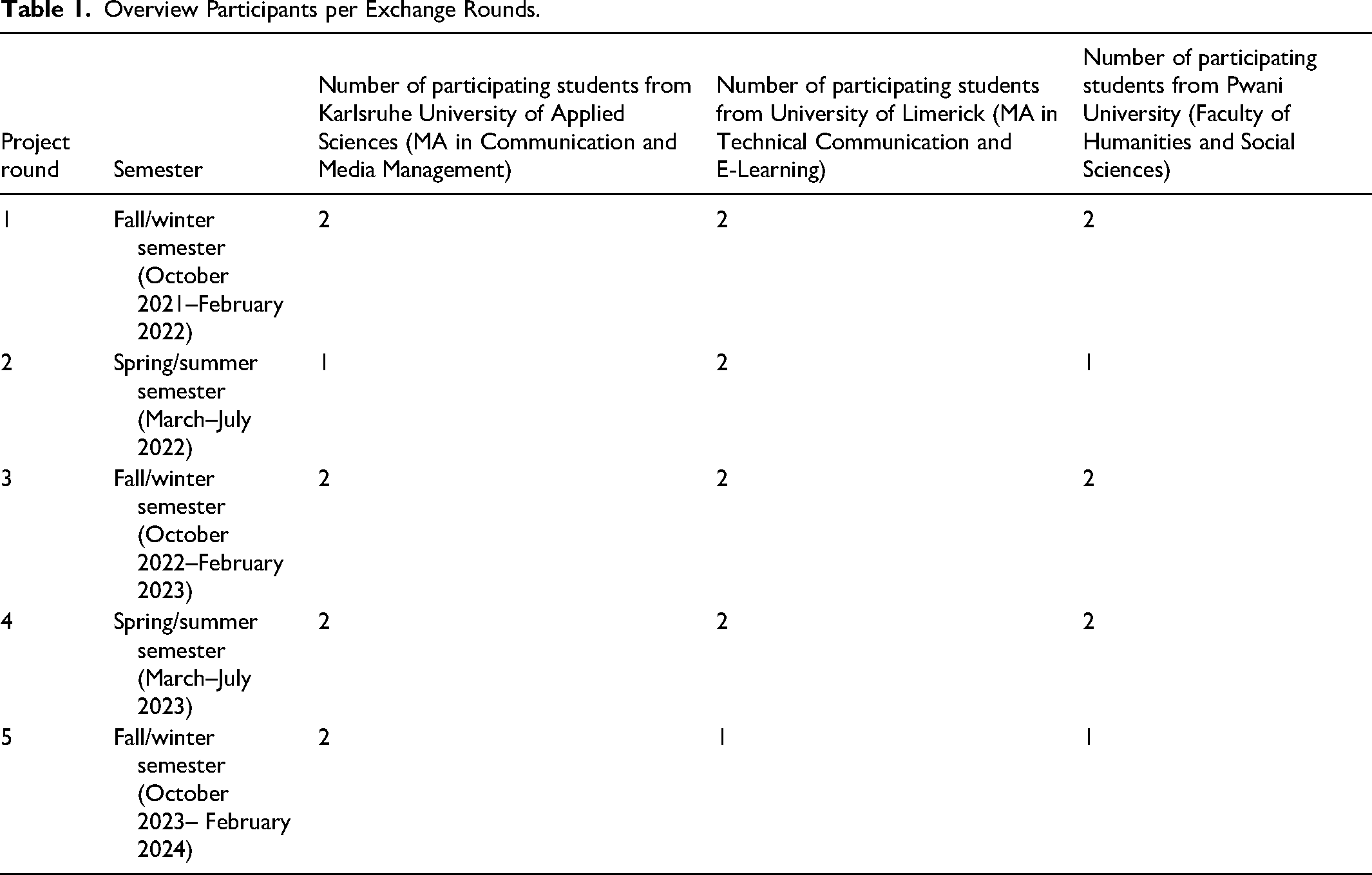
The project attracts a diverse group of students who share a common disciplinary interest. Because the MA in Technical Communication and E-Learning at the University of Limerick can be taken as a virtual program, many students are based outside Ireland, adding to the intercultural diversity of participants. The number of participants is limited to two per university per semester, resulting in a core group of a maximum of six students in each round. If appropriate, up to 60 other students can take part in virtual events in addition to six core participants, ensuring far more students benefit from the virtual intercultural exchange.
A hybrid cultural program for the core group consists of virtual workshops, social exchanges, and a short stay at one of three universities. The main language of the project is English. Students have a central contact person who interacts with them. A password-protected space on the shared platform supports workshop administration, provision of materials, and publication of outputs. At the end of the semester, students receive a certificate confirming their participation in the project, workshops, and short-term stays.
Virtual Workshops for Intercultural Learning
Three or four workshops per semester take place via Zoom, led by one of the participating universities. These workshops cover topics in technical communication, such as podcasting, video editing, visualization, and intercultural communication. In addition to technical input, these workshops create space for personal interaction and intensive intercultural and interdisciplinary exchange. The program emphasizes direct interaction with other cultures through partner work in a non-judgmental environment, fostering open dialogue and mutual understanding. Students have small homework assignments that help them get to know each other and work together. For example, following a podcast workshop at the start of the semester, students interview a participant from one of the other universities and produce a podcast. In these interviews, they discuss their home environments, personal interests, daily lives, and more. As well as developing technical skills, this activity encourages students to explore and reflect on their own and their partners’ cultural identities. Following the video editing workshop, students film their holidays—Easter or Christmas, depending on the term—and edit the video. These activities provide insight into each culture and promote understanding of each other's traditions. After completing the video projects, students engage in guided discussions about the cultures and traditions they've observed, fostering deeper intercultural understanding and reflection. Students thus learn to navigate cultural differences and develop intercultural competence in a practical, experiential way. This structure promotes professional development and cultural diversity awareness, key project goals.
Social Exchange
In addition to professional exchange, a particular goal of the project is to practice cultural and social exchange virtually. Students meet weekly for a chat in a virtual “Stammtisch”—a German concept of having a regular table in a local bar. They share their experiences of the past week and current topics, as well as reflecting on their personal concerns and interests. Social exercises explore cultural diversity and bring participants closer to each other's cultures, such as sharing and cooking traditional recipes. A WhatsApp group facilitates daily interaction, providing insights into each other's lives and traditions.
Through these virtual meetings and joint activities, students get to know each other personally, even though they are geographically separated. These interactions create a safe and open environment for practicing intercultural communication, allowing students to develop empathy, cultural awareness, and the ability to navigate different perspectives.
Short-Term University Stay
Traditional virtual learning models enable students to attend classes at an institution in another country while staying in their own country (Mittelmeier et al., 2021). A special feature of Project VIEL is a planned short-term stay of about five days in one of the partner countries towards the end of the exchange round. Participation is financially supported to enable every student to travel, regardless of their financial background. During this stay, participants can get to know their group partners and the host country, and present workshop and project results together.
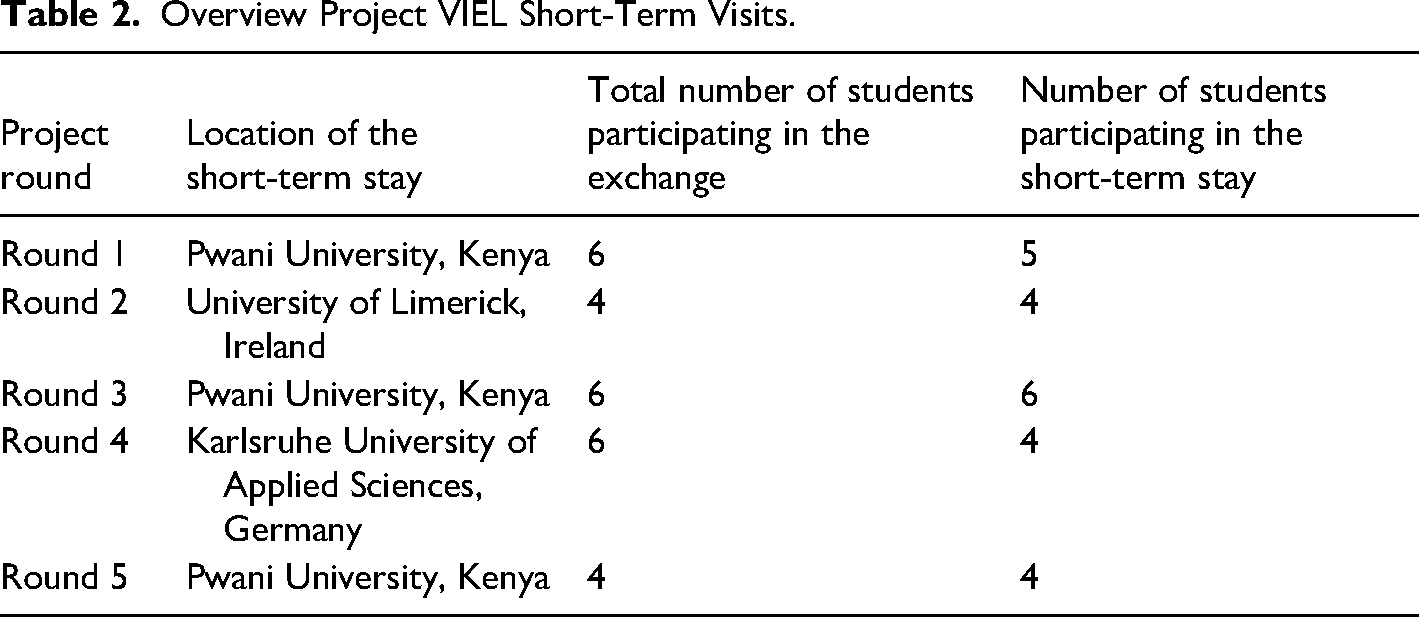
The university at which the short-term stay will take place is selected based on events, e.g., conferences, taking place at the same time. The following short-term visits have taken place in previous rounds (Table 2):
Overview Project VIEL Short-Term Visits.
Continuous Evaluation
After each project round, students submit experience reports. In addition, there are feedback discussions with the project organization team, consisting of academic staff from all three universities, with a particular focus on student satisfaction. The insights from the students’ feedback and the project team's evaluations jointly inform improvement measures for the next round.
Research Methodology
Although the coordinators and instructors involved in this program generally perceive it as a positive experience for students, there are limitations within the feedback mechanisms. Specifically, the experience reports are not anonymous, which may discourage students from sharing negative feedback. Moreover, the feedback tends to be thematically diverse, complicating the identification of specific areas for improvement. Therefore, to evaluate the impact of Project VIEL and to identify potential areas for improvement, we used standardized, anonymous surveys to gather qualitative data about the experiences of former students who participated in Project VIEL.
The results of the research will help improve future iterations of this project. The results also suggest an effective framework for international cooperation in virtual environments. We received approval from the University of Limerick's Faculty Research Ethics Committee to conduct this study.
Research Questions
To address the research objective, we were led by the following research questions: RQ1: How do hybrid exchange programs like Project VIEL facilitate intercultural learning and understanding among participants? RQ2: To what extent does a deep virtual exchange lead to stronger relationships forming when people meet in person. RQ3: What are the post-project impacts of participation in hybrid exchange programs like Project VIEL on individuals’ personal and professional development?
Data Collection
We used anonymous standardized online questionnaires, developed in Microsoft Forms, to collect primary data. Due to the global reach of the survey, with students in Kenya, Ireland, Germany, and other countries depending on their current place of residence, online questionnaires could accommodate respondents regardless of their location, schedule, or device. The questionnaires included only open questions to assess the experiences of students who had participated in international exchanges, first virtually and later in person. A note at the start of the questionnaire explained to participants their rights to anonymity and confidentiality, and outlined that completing and submitting the survey implied consent.
The request to participate in the survey was sent via email to all participants of Project VIEL up to spring 2024. These students were or are currently studying at Karlsruhe University of Applied Sciences, Germany, Pwani University, Kenya, or the University of Limerick, Ireland. Given that the project began in 2021, many former participants have already graduated and entered the workforce, while others have acquired relevant work experience through part-time employment during their studies.
Students had about 5 weeks to respond to the survey. A reminder sent after four weeks boosted participation. When the survey closed, the response rate was 77%; 20 of 26 possible participants. As the survey was anonymous, it was not possible to determine the specific countries of origin for the responses or to make comparisons between different groups of students. We assigned a number to each completed survey. These numbers are included in direct quotes reported in the findings. All participants answered all six questions. We were therefore able to draw on 20 fully completed surveys.
Data Analysis
We used a classical approach for qualitative data analysis (Hayhoe & Brewer, 2021). Participants’ responses were first extracted from Microsoft Forms and saved in an Excel file. They were further processed in individual Word document sorted by question. To preserve the participants’ anonymity, statements that could lead to conclusions about their identity were either deleted or anonymized.
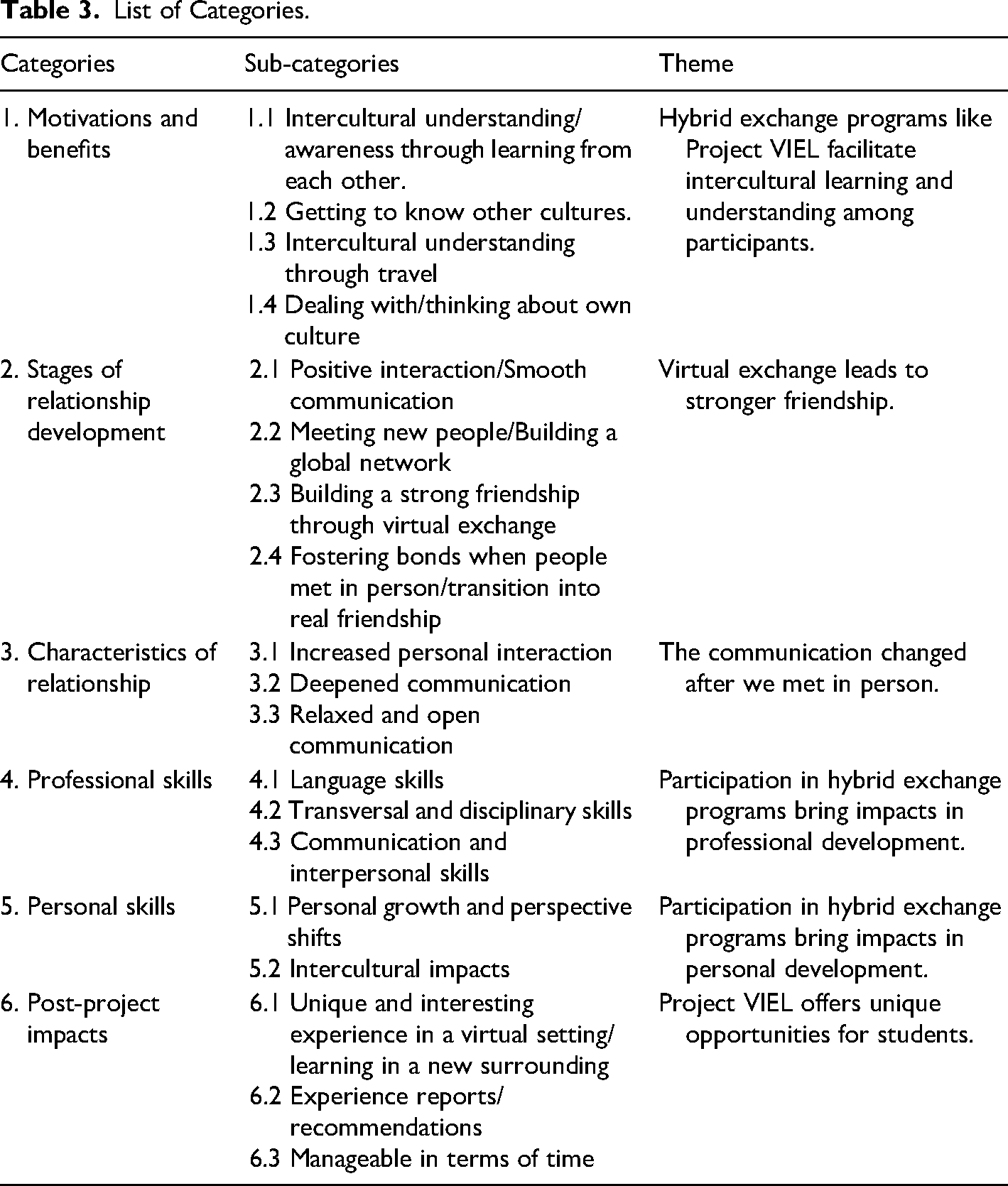
We then coded the data, using a mixture of inductive and deductive coding. Initially, categories were predefined based on our research questions (deductive). However, during the first coding run, it became clear that inductive coding was also needed. Therefore, a total of three runs were conducted to identify additional categories that emerged from the data, as well as a final test run. The accuracy of the coding was ensured by a coding process carried out independently by two researchers. Finally, overarching themes were defined, into which the individual categories and codes were grouped. In the end, we worked with the following defined list of categories (Table 3):
List of Categories.
As researchers, we acknowledge that we were directly involved in the organization of the project. In designing the research study and analyzing and reporting the data, we were mindful of separating our role as project organizers from our role as researchers in order to conduct an unbiased analysis.
Findings
Below, we provide a summary of the survey responses. This discussion incorporates verbatim quotes from the questionnaire responses. The language of the responses was preserved in its original form, including occasional typographic errors.
Motivations and Benefits
Participants’ motivations for engaging in Project VIEL were diverse. A prominent theme was the pursuit of intercultural learning and understanding, with six respondents expressing a desire to learn about other cultures. For instance, participants expressed their passion for cultural exploration; one respondent stated, “I've always been passionate about culture and I wanted to know more about the similarities and differences that we have” (2). Another remarked, “My participation in VIEL was motivated by the love for diversity and desires to understand different cultures and how they vary from one group to another” (10).
Two participants aimed to gain a “global feel” and learn from each other (16). Additionally, the prospect of travel and experiencing different cultures first-hand was a motivating factor for two individuals, as one participant highlighted, “I thought it would be an interesting cross-cultural experience, an opportunity to travel” (11).
Another key motivation was forming friendships and global networks through virtual exchange. Six participants valued the opportunity to meet new people from diverse backgrounds, build connections, and establish lasting friendships as their motivation to participate. For example, one respondent mentioned, “I wanted to make connections with people from different cultural backgrounds, I also wanted to meet more people in technical writing” (14).
In terms of post-project impacts, participants hoped for professional and personal development. Three respondents aimed to improve their English knowledge. One respondent expressed a desire to improve English skills, primarily to be better prepared for an upcoming semester abroad. As well as language skills, three other respondents hoped to acquire technical skills and stated that participation was “good for the CV” (5).
On a personal level, one respondent expressed a hope to “get out of my comfort zone” (13).
Overall, there was an interest in participation not only in what participants would learn or hope to achieve but also in the novelty of the project in a virtual setting. One respondent stated, “I was eager to know what VIEL all is about” (3). Another said, “the virtual part was the mind-blowing part” (18). Additionally, three other respondents indicated that their participation was primarily motivated by the positive feedback from other Project VIEL participants and the good experience reports.
The analysis of participants’ motivations for engaging in Project VIEL revealed diverse reasons, including a strong emphasis on intercultural learning, the desire to build friendships, and the opportunity for personal and professional development. Positive feedback from previous participants also played a role in motivating others to participate.
Stages of Relationship Development
We were interested in participants’ perceptions of their initial, virtual relationships with other students. Four participants emphasized the importance of intercultural understanding, describing their interactions as an opportunity to learn more about different cultures and “social matters” (15) and enrich each other. For example, one said: “Everyone brought different experiences and learned new things from the others. It was very interesting to slowly learn more about the different cultures of the other students” (13).
Six participants highlighted that interactions were positive, friendly, sympathetic, and smooth, enabling them to build relationships and collaborate effectively. One noted: “Good…we were able to interact and exchange ideas smoothly without getting/stepping on each other's toes” (16). Overall, students perceived communication as relaxed and positive. “It was easy it left like we actually close yet far” (18). Only one participant expressed a slightly negative sentiment: they felt the relationship in this virtual setting was “open-minded but reserved” (19).
Sixteen participants described how genuine friendships were established through virtual exchange. They characterized their friendship with fellow students as friendly, curious, and open. The term “friendship” or “friend” was mentioned 10 times in this context. As one observed: “Considering that we didn't know each other really Well, we got along very well, and we always had interesting conversations” (5). One student mentioned that they are still friends today and continue this through WhatsApp.
The survey responses illustrate that virtual exchange led to intercultural understanding and facilitated genuine interpersonal connections, despite students never having met in person. “When we Met in Kilifi for the First time, it was as if we had known each other for ages,” (5) one student explained. However, the development of virtual friendships was described as a process that started as strangers and evolved into friendships through regular meetings, as one response shows: “The relationship between the VIEL students developed from a basic knowing each other to a real friendship. During the virtual time, it was sometimes hard to dive deeper into topics and get to know each other very good. Anyway, with some time it started that our meetings feel more and more like a meeting between friends or at least a common group” (7).
The responses illustrate that virtual exchange fosters intercultural understanding through learning from each other, and, if combined with a more personal and emotional virtual exchange, also enables genuine interpersonal connections, despite the absence of physical contact.
Changes in Communication After in-Person Meetings
Analysis of the responses regarding the change in communication after participants met in person revealed several key themes. Two respondents noted that they had already built such a strong relationship through virtual exchanges that when they finally met in person, it felt like they had known each other for a long time. As one explained, “We didn’t meet in person until after the project had finished but it was great. We had the feeling we already knew each other so we weren’t as nervous or unsure as when meeting someone totally new” (8).
Seven participants outlined how the transition from virtual interactions to face-to-face meetings fostered deeper connections and a sense of stronger friendship, making communication easier. “I felt there was a more stronger connection in our communication” (20). Existing friendships or relationships were strengthened through face-to-face encounters, and initially casual friendships developed into firm ones. “First we were a bit shy, but after 1 or 2 days, we could talk about everything and it felt like we were old friends” (13). One student emphasized that creating new memories and spending time together contributed to this: “We got to know each other way better, did jokes and get connected by the amazing experience we made. […] After all I would say, with the journey, nearly unknown people became friends within a few days” (7).
Increased personal interaction led to participants sharing more personal details and engaging in more frequent exchanges. “The communication increased. Also, it felt a little different because we all know each other better now and share more memories with another” (17). Six students noted that communication deepened, allowing for more open and intimate exchanges. One respondent stated: “We became more friends and would relate at a personal level” (15). Finally, one student described communication as more relaxed and open, allowing participants to joke and express themselves freely. “I think we were able to relax a bit more and joke around. It's hard to know someone's full personality until you meet in person” (11).
Professional Skills Development
The newly acquired professional skills reported by students through Project VIEL can be broadly categorized into three main areas.
Language skills development
Two participants mentioned improvements in their language skills, with one stating: “I learned some more words in Kiswaheli, now I know that the pronunciation of words in Irish are not like I would expect” (17). Although all participants had a basic understanding of English, one student mentioned: “I also improved my English skills,” (13) echoing their initial motivation for participation.
Transferable skills
Almost half the students reported learning many new technical communication skills through the virtual workshops and strengthening their communication and interpersonal skills. Students mentioned 14 times that they had gained transversal and disciplinary skills, particularly in the field of technical communication. Skills such as video editing (mentioned nine times), podcast production (mentioned eight times), and visualization were highlighted. These skills align with the topics covered in virtual workshops and homework assignments. One student mentioned that participation helped them to understand the interconnectedness of diverse topics in the discipline: “I acquired comprehensive knowledge on how language, technology, and design and translation all put together play a major role in communication and media” (10).
Communication and interpersonal skills
Students described progress in communication and interpersonal skills nine times, including intercultural communication and public speaking/presentation skills learned through attending conferences and creating presentations. Virtual skills were also highlighted, as one participant mentioned: “I learned more about working in virtual teams” (1), while another emphasized “intercultural skills” (5). Among these responses, intercultural communication was particularly emphasized, as one participant's response shows: “I learnt that you must ensure you that what you mean is what is understood” (18).
Two participants mentioned that during their stay and interactions with locals in Kenya, they learned how to cook on open fire and how to prepare food with limited resources. Although not directly related to professional skills, we categorized this under intercultural impact in personal development rather than professional skills. It also suggests a deeper impact of the project on participants’ awareness of culture differences, an outcome that was further emphasized in responses to question 5.
Personal Skills Development
Some respondents used excerpts from their experience reports to vividly describe the virtual semester's dynamics and their time in one of the three countries. Nine participants commented that the collaborative nature of the program gave them the opportunity to learn about other cultures firsthand: “Everyone always added information about how certain things were done or said in their language or culture and so we learned a lot” (5). Similarly, one student shared her enriching encounter with Kenyan culture: “Learning first hand about their culture and lives was very enriching and would otherwise probably never have happened” (8). Another emphasized the unexpected depth of cultural exchange: “I would have never thought that one day I would be sitting on a beach in Kenya with friends and talking for hours about the different lifestyles and cultures in our home countries” (13). Participants regularly exchanged views on their cultural backgrounds in a protected social setting and learned to appreciate and respect cultural differences. One participant describes this as follows: “I learnt about their approaches to time-keeping and work and that hakuna matata is more than just a Disney cliche” (8).
Again, participants emphasized the importance of the short-term stay in achieving a deeper cultural understanding. Three students reported that the continual exchange about cultures and lifestyles made them think much more about themselves and their own culture (16). As described in previous sections, the virtual meetings and workshops not only fostered intercultural exchange but also the development of friendships. “We used to have weekly meetings, which I loved attending, for it felt like a therapy section to me” (10). Participants felt more and more connected over the course of the semester: “The weekly meetings made the program feel like I was catching up with friends, it was a nice way to unwind after a busy day“ (14). One participant described this meeting as follows: “Meeting the other ones in real life was surreal! But all the love and the heart-warming welcome really took away our shyness and we instantly took off, where we left in our last online meeting” (5).
Virtual interactions laid the foundation for strong bonds, seamlessly reinforced through in-person meetings and lasting friendships. Only one student wanted more communication, citing time constraints rather than a lack of interest or connection: “Our journey to Kenya was the climax of the whole project. It was amazing meeting all those people I just knew from the screen. Also, I would say it bounded all of us. Although I had the impression, that chatting in our group was stagnant from time to time. Now it is similar (sadly) however it feels different. We know how busy each of us is and what goes on in each other's life” (17).
Participants described once more how their participation and the course of the project, especially the opportunity to travel, influenced their self-perception. One participant reflected on the trip, describing it as “an eye-opening experience filled with memories that I will never forget” (2). In addition, another participant expressed how the trip challenged their ideas and broadened their horizons: “As I came back to Germany, I started to overthink my privileges and way of life” (7). Overall, the experience was described as life-changing and profoundly impactful on their personal growth and perspective (13,15).
Some students emphasized that the project was a unique and interesting experience in a virtual environment. Participants described it as an outstanding experience of their studies that they would recommend to anyone interested in other cultures. They also emphasized that participation was easy to manage and compatible with other study commitments.
Impacts of Participation
Participation in Project VIEL has had a strong impact on the lives of participants, both personally and professionally. Through the project and the continual learning from each other, they expanded their intercultural understanding, as one student described: “Interacting with students from different countries and cultures has greatly broadened my perspective and increased my cultural awareness” (10). This student's answer also demonstrates that cultural awareness was strengthened: “Interacting with students from different countries and cultures has greatly broadened my perspective and increased my cultural awareness. In essence, it has heightened my understanding of diversity and accommodation of more inclusive behaviour at both private and professional” (10). Another student pointed out: “VIEL also sharpened my thinking and opened me up to see the world in a different way than before; that we are just a small global village with diverse cultures” (20). Two students emphasized that they had learned a lot about other cultures, and one described how it had also opened his eyes to his own culture: “Participating in VIEL opening my eyes to different cultures and also made me appreciate differences between the Irish and German cultures even though we usually think of them as being quite similar” (8).
These sentiments echo the intercultural learning and understanding described in questions 1 and 5. In terms of professional impact, responses were similar to those in questions 4 and 5, with students stating that they had learned technical communication, communication, and interpersonal skills. One student stated that participating in Project VIEL had impacted their personal future aspirations. “Since the project I am more open to get in touch with other cultures. I would also like to work in the cultural sector in the future and bring people together with my work” (13).
On a personal level, participation in Project VIEL led to deeper personal growth and a change in perspective, as described in detail by five participants. Participants described how the trip to Kenya changed their perspectives and made some reflect on their privileges. The experience even motivated one participant to get involved in social projects: “Since the project I have started a project that focuses on helping young students from humble backgrounds pay their school and college fees. The project also focuses on helping widows left behind to fend their own children alone, a task that appears like a mountain for them to fulfil” (20).
Seven participants emphasized again that they had made friendships in other countries that continue to this day. Two others mentioned that the concept of virtual exchange had influenced them, stating, “The use of technology in matters virtual learning. I can meet my students online instead of having face-to-face meetings. This has to some greater extent made my work easy” (4).
Discussion
Categorization, coding, and analysis of the survey data suggest that the students’ responses were similar in essence. Based on the data and the insights gained from the analysis, we respond to our research questions in this section. RQ1: How do hybrid exchange programs like Project VIEL facilitate intercultural learning and understanding among participants?
Exchange programs such as Project VIEL play a critical role in fostering intercultural learning and understanding among participants through engaging digital interactions combined with a project design that promotes social communication. This aligns with recent research acknowledging that culture is socially constructed (Agboka, 2012) and demands reflexive acknowledgement of oneself and others (Holliday, 2018).
By using technology to connect people from different cultural backgrounds, this project creates virtual environments where participants can immerse themselves in meaningful personal interactions, collaborative tasks, and cultural exchange. Structured activities such as regular private meetings and discussions, as well as collaborative projects, support learning about each other's cultures, traditions, values, and perspectives. This direct contact fosters empathy, tolerance, and mutual respect, breaks down stereotypes, and promotes cultural sensitivity. In addition, the safe environment encourages participants to critically examine their own cultural biases and assumptions, further enhancing intercultural understanding and appreciation.
Our findings align with the literature on international collaboration projects in universities. Studies show that global virtual team projects enhance students’ cross-cultural communication skills and respect for cultural differences (Author, 2016; Swartz et al., 2020). Additionally, research highlights the importance of structured activities and regular interactions in promoting intercultural learning and understanding (Coppola et al., 2004; Vanderstukken et al., 2019). Our project builds on these findings by emphasizing the effectiveness of hybrid virtual and in-person exchange programs like Project VIEL in facilitating vital intercultural learning.
Our study also addresses a significant gap in existing research by including an African partner university, providing insights into global collaborations beyond Western perspectives. This contributes to a more comprehensive understanding of intercultural learning in diverse global contexts and begins to address the lack of international collaboration between Western and African technical communication programs. The results confirm enhanced cultural awareness and improved intercultural communication skills among participants, although specific country-based comparisons are not possible due to the survey's anonymous nature. RQ2: To what extent does a deep virtual exchange lead to stronger friendship forming when people meet in person.
Intensive virtual interaction can go a long way toward developing stronger friendships when people eventually meet in person. The bonds formed through virtual interactions provide a solid foundation for meaningful relationships that are further strengthened through face-to-face meetings. In-person meetings during a short-term stay enabled participants to turn their online interactions into real-life experiences, deepening their bonds and strengthening the trust and friendship already established virtually. In addition, face-to-face meetings provide opportunities for shared activities, cultural insights, and memorable experiences that can foster friendships and create lasting memories. The transition from virtual to face-to-face interactions was often smooth because participants already had a sense of familiarity and connection, leading to deeper friendships that continue throughout the project.
For example, former Project VIEL students from different universities collaborated on a separate university project after the semester ended, demonstrating the lasting impact of the connections formed during the virtual exchange. Additionally, we observed that the relationships in later iterations of the project appeared to be even stronger than in the earlier iterations.
Our findings support and extend previous research on international collaboration in technical communication. For instance, Flammia et al. (2010) found that teams that made time for social, as well as task, communication were more cohesive and reported more satisfaction with the project experience. Our study demonstrates the importance of both virtual and in-person interactions in building strong relationships, addressing a gap in the research regarding how to prepare students for hybrid work environments that combine remote and in-person collaboration (Hopkins & Bardoel, 2023). This combination of virtual and in-person interactions leverages the strengths of both formats to foster deeper and more meaningful friendships. RQ3: What are the post-project impacts of participation in hybrid exchange programs like Project VIEL on individuals’ personal and professional development?
Participation in hybrid exchange programs such as Project VIEL can have a profound and long-lasting impact on the personal and professional development of participants. Overall, our findings demonstrate the effects of participating in hybrid exchange programs extend far beyond the duration of the program and shape the perspectives, attitudes, behaviors, and growth of individuals in both their personal and professional lives. Our findings confirm the benefits of virtual exchange, such as a low-risk, no-cost international and intercultural experience that significantly enhances students’ confidence in communicating across cultures and fosters respect for cultural differences (Flammia et al., 2016; Swartz et al., 2020). These programs also help develop essential skills such as trust-building (Sarker et al., 2011). As previous research has shown (see, for example, Swartz et al., 2020), virtual exchange activities provide insights into different perspectives, cultures, and ways of thinking, broadening participants’ horizons and increasing their cultural competence. This increased cultural awareness fosters greater empathy, tolerance, and appreciation of diversity, improves participants’ interpersonal skills, and enhances their ability to work effectively in multicultural environments. The long-term impacts include improved global competence, adaptability, and preparedness for diverse work environments, making participants more competitive in the global job market (Mousten et al., 2018). In addition to the personal and professional impact, virtual exchange programs enable the formation of diverse and global networks.
Our findings suggest that these benefits are heightened when virtual social exchange and, where possible, in-person exchange are designed into the project. Professionally, participation in hybrid exchange programs can improve participants’ global competence, communication skills, and adaptability. In addition, hybrid exchange experiences can lead to personal growth and self-discovery as participants engage in cross-cultural interactions and overcome challenges outside their comfort zones. Our findings indicate that a deeper understanding of global issues and cultural nuances prepares participants to succeed in diverse work environments and contribute to intercultural teams.
By interacting with participants from different countries and cultures, participants in this project had the opportunity to make valuable contacts and build international friendships. Finally, in our project, the inclusion of an African partner appears to have broadened global perspectives.
Conclusion
Our findings suggest that intended project goals were largely achieved, leading to a successful project that enables students to experience exchanges in a virtual environment as effective preparation for later in-person encounters. The study shows that a solid bond was developed among the students through continuous exchange, especially on a social level. Working in small teams fostered closeness, while face-to-face meetings in a respectful environment further strengthened these relationships. These interactions enhanced cultural sensitivity, supported personal and professional development, and helped students develop technical communication skills, intercultural competencies, and a broader understanding of global diversity.
We believe it is important for participants to acquire specialized knowledge, skills, and behaviors for successful intercultural exchange and intercultural communication. These include curiosity, empathy, and mindfulness, which can be practiced in a virtual environment and applied in real-life encounters during short-term stays. The face-to-face encounters strengthen bonds between students and ensure that skills and experiences acquired virtually can be transferred to in-person contexts. Joint activities further foster intercultural understanding. The program also enhances digital skills, preparing students for an increasingly digitalized world. The impact of our project is already evident: participation in Project VIEL has motivated some former participants to pursue education and community building in technical communication. Others enrich their work teams through skills acquired during Project VIEL.
Further research could also address some limitations of our study. One limitation is the small number of total participants, which precluded us from gathering demographic data (e.g., about participant locations) due to the likelihood of compromising anonymity. We gathered only qualitative data, but future studies with larger numbers of participants could also gather quantitative data from which inferences about the impact more generally could be drawn. While our study explored the impact of a hybrid exchange in an educational setting, our results suggest that the project design could serve as a model for improving relationships in virtual teams across sectors. It may also serve as a transferable model for comparable projects in the educational context, particularly those aiming to combine virtual and in-person exchange formats. By refining these methods, companies facing challenges with virtual collaboration post-pandemic could strengthen interpersonal connections and improve work processes. Further research could explore how this design could benefit organizations and be adapted for different, e.g., corporate, environments. Our project examined a hybrid student collaboration. Researchers could build on the findings by exploring whether hybrid exchanges also foster stronger relationships in workplace teams.
Our program also promotes the establishment of technical communication in countries like Kenya where the discipline is less well known. We aim to raise awareness by enabling Kenyan students to participate in the exchange program, and thus introducing them to the field. Some have also taken part in a pilot academic program in technical communication at Pwani University. While Project VIEL introduces technical communication in Africa in a limited way, more research is needed on technical communication and its educational development in Africa and other parts of the Global South.
Footnotes
Acknowledgments
We gratefully acknowledge the anonymous respondents who made this study possible.
Data Availability
Because some respondents provided information in their survey responses that could identify them, and which we have anonymized for this article, it is not possible to make the data openly available.
Declaration of Conflicting Interests
The authors declared no potential conflicts of interest with respect to the research, authorship, and/or publication of this article.
Ethics Considerations
This project received approval from the Ethics Committee of the Faculty of Arts, Humanities and Social Sciences at the University of Limerick. Approval number: 2023-12-10-AHSS.
Informed Consent
All participants consented to respond to the survey.
Funding
The authors disclosed receipt of the following financial support for the research, authorship, and/or publication of this article: This project described in this study was funded by the Baden-Württemberg-STIPENDIUM for University Students – BWS plus, a programme of the Baden-Württemberg Stiftung.
