




Abstract
Creating new emojis is predicated on a system of technical writing that lobbies for new emojis to the Unicode Consortium. Emojination, an activist collective working for cultural inclusivity, helps everyday people write proposals for inclusive and culturally sensitive emojis. Through a case study of Emojination, this article describes ways that Tactical Technical Communication can work toward cultural inclusivity within regulatory frameworks.
Emojis are globally important. Billions of people use them to communicate on their mobile devices. When these devices install updates, users sometimes receive new batches of emojis. Emojis are made possible by Unicode, an information standard used in most Internet-enabled writing devices. The standard is maintained by the Unicode Consortium, an organization comprised of multinational technology conglomerates, including Adobe, Amazon, Apple, Yat, Facebook, Google, Etco, Microsoft, Netflix, SAP, and Salesforce as well as some governments, namely Bangladesh, India, Tamil Nadu, and Oman. Governments are represented by councils and ministries, such as the Ministry of Awqaf and Religious Affairs (MARA) who votes on behalf of the government of Oman.
Since 2013, the Unicode Consortium, specifically their subcommittee on emojis, has allowed the public to propose new emojis by offering a set of technical procedures for writing proposals. The consortium summarizes its criteria for new emoji proposals as follows: The Unicode Emoji Subcommittee regularly reviews proposals for new emoji. The selection criteria are fully defined here [hyperlink], but in essence they boil down to this: a) will the image work at the small size at which emoji are commonly used, b) does the emoji add to what can be said using emoji or can the idea be expressed using existing emoji, c) is there substantial evidence that a large number of people will likely use this new emoji. (Unicode, 2022)
The criteria are, however, much more complicated. The link in the above passage takes users to an elaborate 5,000-word template, with numerous screenshots, for writing a proposal (see Supplementary File B for a stable version). Factors of inclusion in this template are (a) compatibility, (b) usage level, (c) distinctiveness, and (d) completeness. Exclusion criteria are (a) frequent requests, (b) overly specific, (c) open-ended, (d) already representable, (e) logos, brands, other third-party IP rights, UI icons, signage, specific people, specific buildings and landmarks, deities, (f) transient, (g) faulty comparison, (h) exact images, (i) region flags without code, (j) lack of required rights or license for images, (k) variations on direction, and (l) includes text. After summarizing these factors, the template then elaborates on each factor with a variety of images and technical procedures. Just by the sheer number of exclusion criteria, a proposal is much more likely to be rejected than approved by the consortium.
In fact, the Unicode Consortium and its technical writing procedures have a documented problematic history of when it comes to approving new emojis (Gray & Holmes, 2020; Miltner, 2021, Sweeney & Whaley, 2019). Miltner (2021) and Sweeney and Whaley (2019) provide an in-depth look at some of the racist color-blindness of the Unicode Consortium. Sweeney and Whaley (2019) write: Though Unicode introduced skin-tone modifiers as a response to criticism about racial representation from BIPOC audiences, whiteness remained central to the design logics of emoji. Couched in terms of “diversity” and “skin-tone”, Unicode was able to respond to a critical public while sidestepping deeper questions about race and representation in emoji design. The reliance on beliefs about technological neutrality and colorblindness—hallmarks of American technoculture—shaped the resultant encoding mechanisms and recommendations for interpreting emoji glyph design, further entrenching whiteness in the interface.
Picking up on Sweeney and Whaley's project (2019), Miltner (2021) conducted a study of the Unicode Consortium's public email archive, finding that “the racial composition of the original emoji set was ultimately shaped by an institutionalized form of colorblind racism which insists that concerns regarding racial representation and identity are irrelevant to ‘neutral’ technical systems and workplaces” (p. 517). The consortium's technical writing procedures, explicitly endorsed in their template, have the appearance of objectivity or neutrality. But in the actual email exchanges of the organization, Miltner identifies several themes of implicit bias, including attempts to avoid racial politics (p. 522) and a “universality” mindset that tries to avoid controversy (pp. 521–2). Miltner (2021) is careful to note, in her conclusion, that the Unicode Consortium has made strides in being more inclusive, such as soliciting the public and being more proactive about the types and number of approved emojis. She writes: Under the leadership of Unicode Consortium President Mark Davis, the Consortium has established an Emoji Subcommittee that is responsible for considering proposals from external stakeholders, including corporations, organizations, and individual members of the public. This subcommittee not only includes members of the Consortium, but external contributors including Emojination founder Jennifer 8. Lee and Emojipedia founder Jeremy Burge. Hundreds of new emoji have been added in the past 5 years, and new characters including the hijabi emoji (Vonberg et al., 2017) and the curly hair emoji (Allen, 2017) have been celebrated for expanding the number of “diverse” emoji included in the set. (Miltner, 2021, pp. 529–30)
This article extends this scholarly focus on how emojis are approved by spotlighting the technical and professional communication (TPC) procedures that external contributors make to the Unicode Consortium. It specifically focuses on Emojination, an activist organization founded by journalist Jennifer 8. Lee. Emojination mentors everyday writers to propose inclusive emojis to Unicode.
Founded in 2015, Emojination offers its own proposal template, a modified version of Unicode's proposal procedure, as well as mentorship from Emojination's team leaders and members. The mentorship is unpaid and voluntary, as Emojination is not an officially designated organization. As Lee told us during one-on-one interviews, Emojination is “just a slack channel and people writing proposals.” Nevertheless, the organization/collective has successfully helped writers lobby for new culturally sensitive emojis, including the dumpling and hijab emojis. This article, then, offers a case study of Emojination and the way it centers tactical technical communication (TTC) as a form of cultural inclusivity.
The rest of this article has four parts. First, we provide an overview of tactical technical communication (TTC) scholarship in TPC. We use this review to motivate our investigation into Emojination. Second, we describe the methodologies and methods for data collection and analyses, all of which were IRB-approved by our institution, including three interviews with team leaders (on-the-record). Third, we analyze Emojination's template. Here, we identify themes of the ways Emojination's template helps everyday writers with writing proposals to the Unicode Consortium. Lastly, we discuss the limits of this study and areas for further research.
Tactical Technical Communication in TPC
TTC has emerged as a pivotal topic in TPC research (e.g., Alexander & Edenfield, 2021; Caravella & Holmes, 2022; Colton et al., 2017; Edenfield & Ledbeter, 2019; Edenfield et al., 2019; Kimball, 2006, 2017; McCaughey, 2021; Pflugfelder, 2017; Sarat-St. Peter, 2017; Stambler, 2022). TTC could be summarized as a form of technical writing “wherein users resist dominant strategies of control (including symbolic and narrative) by appropriating official discourses and genres for their own purposes” (Caravella & Holmes, 2022, p. 3). The term “tactical” is rooted in Michel de Certeau's definitions of “tactic” and “strategy” in The Practice of Everyday Life. Per his philosophy, a tactic is an individualistic action that opposes “strategies,” or oppressive institutional frameworks that assure an established status quo. This status quo is based on a cycle of production and consumption, wherein the institutions produce, and the individuals consume (de Certeau, 1984). An example of TTC could be informal online spaces, such as reddit (e.g., Alexander & Edenfield, 2021; Pflugfelder, 2017), where users seek out creative, everyday uses of technical documentation for their own personal—rather than institutional—purposes.
These informal spaces tend to be viewed apart from the formal spaces out of which corporations, businesses, institutions, and other structural entities operate. Many TPC studies of user-generated content on online platforms that explicitly refer to tactics and strategies (Ding, 2018; Edenfield & Ledbeter, 2019; Holladay, 2017; McCaughey, 2021; Sarat-St. Peter, 2017; Yusuf & Schioppa, 2022) rarely acknowledge any connection between TTC and the regulatory institutions that it seeks to undermine. The strategies of governments, corporations, and even scientific institutions are often depicted as something to recognize, reveal, reject, and replace (Walton et al., 2019) while TTC spaces are upheld as sites of resistance and even social justice. For example, online platforms such as Reddit and YouTube offer transgender audiences access to vital knowledge and experiences about transitioning while, as Edenfield and Ledbetter describe, “allowing them to bypass traditional gatekeeping mechanisms” (2019). This research judiciously points out that TTC in action can protect members of marginalized communities and provide vital knowledge and resources to those who need it. However, it overlooks that there is an ostensible relationship between the user-generated, “do-it-yourself” (DIY) writing that occurs on platforms such as Reddit and the regulatory frameworks that enable it to operate on such a massive scale. Massive content-hosting platforms such as YouTube and Reddit imitate tactics, but they are necessarily rooted in strategy owing to their corporate foundations and widespread reach.
A similar dynamic is discussed in spaces where online discussion board conversations attempt to navigate the complex structures of institutional healthcare. Drew Holladay (2017) studied writers in online mental health discussion forums who share knowledge about highly technical medical concerns, and he invokes TTC to examine how these writers interpret medical documents such as the Diagnostic and Statistical Manual of Mental Disorders (DSM). Holladay reminds readers that “users in these forums are extra- and intra-institutional actors: they discuss documents like the DSM outside of its official applications but are also subject to the decisions and descriptions of mental health professionals and thoroughly enmeshed within institutional practices” (Holladay, 2017, p. 8). These everyday writers are working to positively change the lives of individual people on a large scale, but they are also working from within regulatory frameworks, not merely around or against them. The tension between the individual and the institution, or the tactic and how it relates to the strategy, is left unexplored in much of the TTC literature.
Randall (2022) attributes this troublesome tension, in part, to a theoretical reliance on de Certeau's (1984) distinction between strategies and tactics. In de Certeau's terms, strategies are deployed by organizational or institutional power structures whereas tactics are used by those suppressed under those power structures. Strategies are often used to describe commodified aspects of production at scale. Tactics are typically applied to everyday noncommodified life while strategies are reserved for institutional life. Tactics tend to be focused more on individual consumption and resistance while strategies emerge from organizations and those in power. For de Certeau, tactics are ways for consumers, imbricated in late capitalism ideology, to wrest some freedoms away from institutions and become resistant creators themselves. Randall (2022) qualitatively reviews TTC scholarship, noting that de Certeau's original project was to investigate “… the practices of everyday living in order to understand how people actually behave, dwell in our society” (p. 14). Randall understands de Certeau's original project as useful to TPC scholarship because de Certeau avoids pragmatic utilization, something Randall views as central to much of the TTC. Randall urges work on TTC to avoid framing technical communication as commodification and instead as something that provides people “a greater understanding of humanity” (p. 14). While Randall is critical of the use of de Certeau's tactics in TTC scholarship, he urges the field to look at more everyday (notably non-commodified) types of technical writing and communication rather than at structural, institutional, and regulatory contexts.
The reliance on de Certeau's binary of tactics and strategies leaves intersections between everyday (tactical) and regulatory (strategic) technical writing and communication ripe for exploration. By conducting such an investigation, TPC researchers can show that do-it-yourself (DIY) informal technical communication can transform institutional and formal technical communication. Rather than relying on de Certeau's (1984) supposition that tactics are the “art of the weak” (p. 37) and strategies are the “calculations” of “will and power” (pp. 35–6), our study of Emojination seeks to link tactical and strategic forms of technical writing. Institutions may produce commodities, representations, and infrastructure for people to use and those people may choose to consume that production in subversive ways. Yet, these tactical uses and strategic uses are intimately related, possibly even reliant on one another. To be subversive, after all, means to understand normative uses.
Our case study of Emojination demonstrates how users move between strategic and tactical forms of technical writing, thereby illustrating ways everyday technical writing can achieve large-scale social change if regulatory frameworks are worked from within. In this case study, working within a regulatory framework can provide people with an array of tactical communicative means: a broader range of emojis to use for everyday purposes. Practically, such investigations can better highlight the collective efforts to successfully achieve inclusive outcomes while not valorizing and idealizing the work such laborious efforts require. Conceptually, this approach shows how formal procedures do not need to be necessarily resisted and replaced (Walton et al., 2019) but instead can be influenced and/or changed through collectively crowdsourced action. Thus, identifying, describing, and researching case studies that exemplify collectively crowdsourced technical writing and communication within regulatory frameworks can provide TPC researchers with ways that may achieve organizational change, in our case cultural inclusivity within the emoji approval process.
With the aim of linking informal and formal technical communication in mind, we pose the following research question about the ways collectively crowdsourced technical writing works toward change within regulatory frameworks: How do informal groups of people create technical writing for cultural inclusivity while working with regulatory frameworks? Answering this question, as this article demonstrates, shows how activist collectives can mentor users to participate in institutional, strategic discourse while remaining tactical.
Collectively Crowdsourced Technical Writing: The Origin Story of Emojination
Emojination's work can be described as collectively crowdsourced technical writing grounded in regulatory structures. Unlike explicit activism that seeks to replace, dislodge, or challenge institutional, organizational, or political structures, Emojination functions within, and in response to, dynamic systems. Emojination was founded by journalist Jennifer 8. Lee in 2015 in response to a lack of a specific emoji, the dumpling. As she told us in an on-the-record, one-to-one interview: [Emojination] originally started, you know, a friend of mine [redacted], who's a designer…. And I would text her about dumplings. After she texts me, I texted her a picture of dumplings, and she texts the back, “yum!”. Then she stops, she's like, “Oh, Apple doesn’t have [a dumpling] emoji.” And I was like, “that's kind of interesting.” …That's kind of weird, given all the kinds of foods that are on the emoji keyboard….And then about half an hour later onto my keyboard pops on this dumpling with little heart eyes. And they were blinking. [My friend] called it bling bling dumpling. And she had decided to make her own dumpling emoji because she is a designer. (Initial interview)
Lee has told a version of this story on multiple podcasts and websites, all of them recalling this specific moment when she did not have the communicative means to express herself as fully as she felt necessary. She was not motivated by what TTC scholars might call “strategic” purposes. There was no institutional or structural purpose. Rather, she wanted to use emojis for everyday informal purposes based on the consumption of emojis.
This experience led Lee to investigate how emojis are approved, as she wanted to determine if a dumpling emoji could be created. She looked up how to create a new emoji and discovered the Unicode consortium. As she recalled: …you could join as an individual member for $75 with no voting rights, but that allows you to be on the mailing list and show up to meetings. So I did that. And then, a couple weeks later, I think they said, “We’re going to have our next quarterly meeting, please RSVP.” I was like, “Oh, I’ll be in the Bay Area!” So I just RSVP which I now realize is very strange. Their meeting was in Sunnyvale….And it was at Apple's legal building. And I just showed up and it was a conference room with very nice people…
After learning about the process for proposing new emojis, Lee and some collaborators, including fellow journalists Amanda Hickman and Samantha Sunne, made their first proposal in January 2016, which was a dumpling emoji. As part of writing that proposal, Lee and the collaborators created a successful Kickstarter campaign, which was a way to raise money from the public. Afterward, they created a slack channel and began writing proposals. Since then, Emojination members, including Lee, have been mentoring the public to write technical proposals for new emojis.
Methodology and Methods
Case Study Approach
Our approach in this article is informed by an interdisciplinary case study methodology (e.g., Bartlett & Vavrus, 2017; Bromley, 1986; Dyson & Genishi, 2005; Gerring, 2017; Jocher, 1928; Tellis, 1997; Yin, 2009). As noted elsewhere, a case study is not synonymous with an example (Gallagher, 2019). A case is a systematic investigation marked by an interest in holistic descriptions and marked by multiple sources of data, i.e., triangulation. The case study presents a holistic understanding of Emojination and its technical writing and communication practices.
The first author informally interviewed Lee in the fall of 2020 as part of an information gathering session. The first author then interviewed team leaders Lee (36 min), Amanda Hickman (50 min), and Samantha Sunne (35 min) formally and on-the-record in the fall of 2021. A semi-structured, specialized interview protocol for participants was used (see Appendix A for interview protocols). During each interview, live notes were taken. Afterwards, interviews were transcribed. We analyzed the transcripts with our research question in mind, thereby using deductive qualitative coding.
In October of 2021, we received permission and access to the extensive versions of Emojination's template, which can be found in Supplemental Files A. There are six main versions of the templates, although minor revisions were made over the course of time via Google documents (e.g., Google docs). We included the most recent version of Unicode's template (Fall of 2021) as Supplemental Files B. We also included a PDF of the Google document “draftback” feature, which shows main revisions to the document, including timestamps and author attribution tags (Supplementary File C).
Template Description
The Emojination template provides novice proposal writers with awareness of regulatory and institutional requirements. Amanda Hickman, an Emojination founder, journalist, and non-profit leader, stated that the template came about because the Emojination team leaders wanted to keep their “proposals consistent with [Unicode's] guidelines and to expand on what people want [to propose].” This aligns with Hickman's own talents as she has a “strong eye for ways that systems can solve problems” (Hickman interview). Hickman expressed a view reflected in conversations with Jennifer Lee and Samantha Sunne: they want proposals mentored by Emojination to follow Unicode's directions while clarifying and expanding on those guidelines to increase the chances of a proposal being accepted and codified.
The revisions of the Emojination template over time, as recorded through the Google “draftback” feature, show that the team members provide advice and experiences within the document. The original template was simply a set of headers pulled directly from the original Unicode guidelines. All formatting is retained from the original template (11/26/2015):
Compatibility
Expected Usage Level
Frequency
Multiple Usages
Emotional Content
Persistence
Overly Specific
Open Ended
Already Representable
Logos, brands, UI icons, signage, specific people, deities
In the original Emojination template, these headers are the same headers from Unicode's proposal guidelines, and they did not include any additional commentary or technical descriptions. As Emojination grew and evolved as a collective, each revision of the template added advice and commentary based on the experiences and expertise of the Emojination administrators. For example, in the second major version of the template, details and clarifications are added (5/25/2017). Below is a selection of the template with all formatting and spacing retained:
• CLDR short name
• CLDR keywords
for for Inclusion
This version of the template clarifies that “Factors for Inclusion” in the previous draft are actually “Selection Factors,” a clearer indication of the content that should appear in this section. Unicode continues to refer to this section as “Factors for Inclusion,” a heading which, unlike “Selection Factors,” does not point to the desired outcome of the proposal as clearly as “Selection Factors.” The team also notably added “Sort Location” to the template. Sort Location, while not a requirement per the Unicode guidelines, bolsters the proposal with an organizational recommendation that firmly places the proposed emoji within existing categories or among related objects.
The sixth, and most recent, version of Emojination's template (8/26/2021) coalesces the advice from the team after many years of experience. This most recent version is twelve pages long, a dramatic increase from the original one and half page template. The introduction of the sixth version is below (Figure 1):
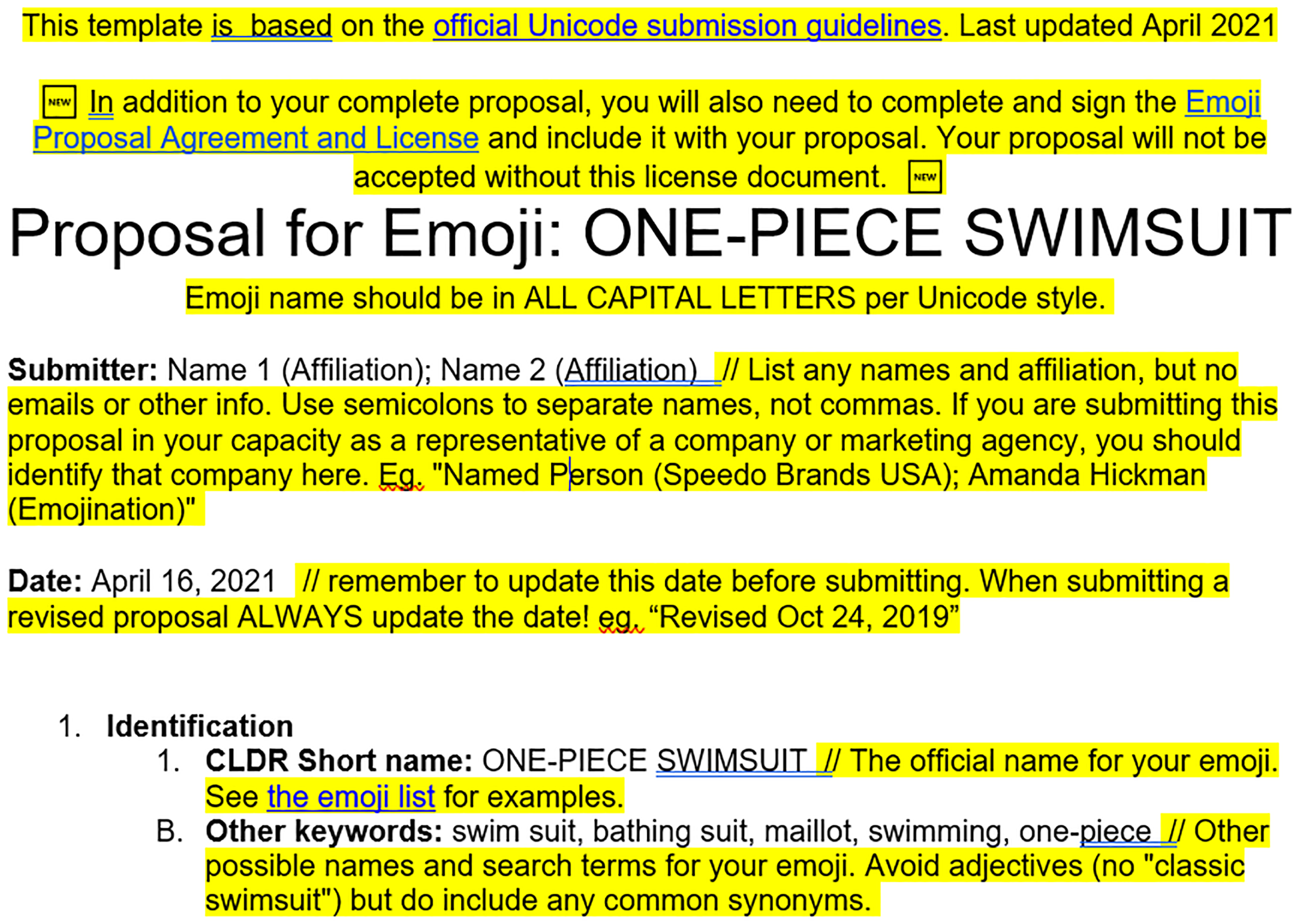
Introduction of Emojination's template (sixth version).
Figure 1 retains all formatting from Emojination's template. The yellow highlighting and backwards hashmarks (“//”) represent the generalized commentary from the team members to extrapolate on the template formatting and suggestions. Technical advice is offered, including completing licensing agreements, capitalization of the proposal name, appropriate use of semicolons to expedite processing of the proposal, stating the organization of the proposal (if applicable), and avoiding adjectives of the proposed emoji. The template offers casual advice too, including a reminder to update the date of the proposal.
The template reflects the tension between needing to remain transparent about Unicode's procedures while assisting potential proposal writers. As Samantha Sunne stated, the proposal process can be “way too technical for a lot of people.” Sunne goes on to explain: …you need to look at the submission instructions on the Unicode website. You pretty much need to read through that whole thing. And ideally, understand not just what the instructions are asking for, but why they’re asking for them. For example, there's a section called distinctiveness….[Y]ou have to explain why [the proposed emoji is] a visually iconic entity that can be clearly represented by an emoji style rendering. So a lot of times distinctiveness, what they’re asking is “can your item be recognized?” ….So if someone's going to file a submission, they need to read through all of this. And then ideally, understand why the committee's even asking these questions.
Sunne's perspective provides evidence that the Emojination team leaders are aware of the technical considerations and specifications necessary for proposal writing, as well as the rhetorical elements involved, such as distinctiveness. They have internalized many of these requirements too. In fact, as Sunne was recounting this passage, she found the proposal requirements during the zoom interview, but she was able to recall the distinctiveness section without needing to find the documentation. The occluded genre conventions of emoji proposals, conventions handed down by Unicode's review board members, were tacit to her.
Transmitting this tacit knowledge was similarly a guiding goal for Amanda Hickman when she helped write the template. When asked about her guiding goals for the template, she responded by saying it was to “stop being asked to read proposals” and “to stop repeating myself.” For Hickman, a primary challenge of being part of Emojination was being accessible while ensuring people did not misunderstand Emojination. For example, Hickman recalled that some of the proposal writers thought Emojination could approve proposals. She had to repeatedly clarify to proposal writers that Emojination did not have that power. Instead, proposals are passed based on adhering to the procedures and genre conventions laid out by Unicode.
As a direct response to Unicode's procedures, Emojination's template balances technical specifications, rhetorical work, and practical labor associated with helping everyday, tactical people write proposals. It uses the procedures offered by Unicode (Supplementary File B) while remediating them with advice and learned experiences. The template elaborates on obscured bureaucratic requirements, such as the pixel specifications that Sunne referenced. The template consequently balances restrictive genre work while pointing to places where writers have flexibility for proposing emojis.
Emojination mentors writers to fulfill the Unicode Consortium's requirements.
Emojination team leaders developed unofficial templates to overlay on Unicode's guidelines and proposal procedures wherein they advise potential and future proposal writers not to reinvent the submission process but to underscore Unicode's procedures guidelines. This advice attempts to expedite the submission process and increase the likelihood of proposal acceptance. As a collectively crowdsourced technical writing organization, Emojination thus provides and mentors concrete genre knowledge and template knowledge while encouraging proposal writers to adopt conceptual flexibility within structured genre conventions.
Throughout the revisions of the Emojination proposal template, the Unicode template is consistently used as a foundation for the Emojination template. The Emojination team, as they recounted in interviews, does not attempt to restructure or change the requirements as set forth by Unicode; they build their template upon the Unicode requirements. The template itself encourages readers to adhere to these requirements or risk the rejection of their proposal.
For example, in the Third Revision of the Emojination template (7/2/2018), the team added their own commentary under Selection Factors. This commentary is written in an informal tone and is stylized to emphasize what the Emojination team has determined are critical details to regard. The commentary makes recommendations (i.e., “LOTS OF SCREENSHOTS HERE…”) directly based on their own anecdotal experience as emoji proposal facilitators: “This is the most common reason for emoji proposals being kicked back is bad work on this side” (Supplemental File A, p. 8). This observation, its tone, and its style point to their commitment to illuminating the proposal process for authors with less experience without attempting to resist or reinvent the Unicode requirements. The formal requirements of the Unicode proposal guidelines, and the genre conventions of proposals more broadly, are made more accessible and more relatable to non-expert audiences by the commentary in the template.
The purpose of the template serves to coach the readers to expose occluded practices, including commentary on institutional procedures and pre-/post-submission advice.
The Emojination template ultimately serves as a model for a successful proposal, meaning that it provides a normative way of writing proposals. It is an outline of the existing Unicode emoji submission guidelines with added advice, commentary, and sample text. For example, the Third Revision of the Emojination template (7/2/2018) includes a model abstract (Supplemental File A, p. 7). Previous revisions included “Abstract” in their outlines, although the template never elaborates on what to include in the abstract. The Unicode proposal guidelines notably do not specify the need for an abstract at all. However, the best practices for proposal writing almost always recommend, if not outright require, an abstract or an executive summary. Including an abstract is an occluded practice that the Emojination team likely chose to include in their template based on their most fundamental understanding of the proposal genre conventions. The example abstract follows the same style guidelines outlined in the template (e.g., the name of the emoji is stylized in all-caps, and so forth). The sample abstract serves as an exemplar that authors of new proposals can emulate.
In another example from the Fourth Revision of the Emojination template (11/21/2018), the team clarifies the meaning of “median” emoji and provides examples of median emojis. The previous revision (Third Revision) suggested that the proposal writer to include benchmark data of the proposed emoji against another “existing” emoji but did not attempt to explain “median.” Unicode guidelines specify that the proposed emoji should be compared to an existing “median” emoji, a qualifier which is not defined nor supported with examples by Unicode (Supplemental File B, p. 18). The Emojination team, via their template, offers an example list of “median” emojis organized by “type” (a taxonomical category, like “face” or “animal”) and recommends that the proposal writer use one of those recommendations. To elucidate this occluded process, the team invites the reader to “pick another one, if you can, with great confidence, show it's median with like emojistats.com,” but they offer a strong disclaimer: “This is hard, so don’t do this at home” (Supplemental File A, p. 13). Here, they reveal a source and process for choosing a suitable “median” emoji for benchmark data while cautioning the reader to avoid the challenge if they don’t feel entirely confident about their results. The team demonstrates a healthy balance between guiding the reader to understand the process as well as the product and ensuring that certain challenges within this process do not hamper the integrity of the proposal. This commitment shows a dedication both to transparency and to their non-expert audience who reaches out to them for support.
Finally, the Emojination team includes a “Next Steps” section in the Fifth Revision of the template (5/3/2019), which is not designed to be included in the proposal but is a helpful scaffold elucidating the submission and post-submission procedures. The Unicode guidelines do not include such a detailed description of the submission process, short of providing the form and outlining important deadlines (Supplemental File B, p. 2). The Emojination team includes a section about deadlines that exposes the entire roadmap that the proposal will travel through before the final acceptance or rejection, including the approximate time frame during which the Emoji Subcommittee (ESC) and the Unicode Technical Committee (UTC) will formally meet. They explain the purpose of each committee and even include a rough agenda for each meeting (Supplemental File A, p. 40). The level of transparency exposes institutional procedures and provides firm guidance to the proposal authors about what happens with the Unicode committee work.
These templates translate technical terms and vague jargon into everyday language through concrete examples.
While the Unicode guidelines are not inherently dense with jargon, they do include several vague terms, convoluted phrasing, and attempts to raise the threshold of comprehensibility for novice audiences. The Emojination team makes several efforts to define vague terms (e.g., median emoji and transient) by using clear and relatable examples. They also cut a clearer path through legal jargon by writing clear instructions and providing links that are easy to locate. Technical descriptions of abstract terms are written in plain, informal language that readers who do not regularly engage with proposal-writing or emoji requirements can easily comprehend.
In the original unrevised template (11/26/2015), the Emojination team includes a section called “Other Character Properties” in the contents, with details on other properties that may be included in the proposal. Unicode does not specify a section for “Other Properties,” but they do recommend that the proposal include “Other Information.” Emojination makes clear and concrete suggestions on what “other information” would be most beneficial to a proposal, including highly technical details such as Canonical Combining Class, Bidirectional Class, and Decomposition Type (Supplemental File A, p. 1–2). The details are minimally explained, as these definitions are not relevant to the writer but may be appreciated by a Unicode reviewer. They are, however, already filled-in with the appropriate classes and types. This section not only aids proposal writers in creating a highly specific and technically accurate proposal but it also exposes the writers to these terms and familiarizes them with information they may (now or later) be expected to provide without weighing the template down with excessive technical information.
By the Third Revision of the template (7/2/2018), the team includes single-line technical explanations of the various Exclusion Factors. These technical descriptions are limited in length and scope (compared to the Sixth Revision from 8/26/2021), but they mark the first attempt the Emojination team made in clarifying what is meant by vague factors outlined in the Unicode template such as “Open-ended” and “Transient.” For example, “Transient” refers to an emoji's longevity (i.e., “Why this item will be distinct in 50 years or so.”) (Supplemental File A, p. 11). The Emojination team may not be the authority on what number of years appropriately defines the enduring relevance of an object, but they pragmatically assume that any object still identifiable after “50 years or so” would safely pass a review.
Compare this definition with the description of “Transient” offered by Unicode: “Is the expected level of usage likely to continue into the future, or would it just be a fad? Transient or faddish symbols are poor candidates for encoding” (Supplemental File B, p. 13). While Unicode's effort to define the transience of an emoji is present, it is not especially helpful to most readers. The non-specific and technical nature of these phrases, i.e., “expected level of usage” and “likely to continue into the future,” are confusing to an audience that knows little about the “expected” usage of an emoji and whether a symbol (which may have some cultural or emotional significance to them) will continue to be relevant in the arbitrary “future.” Moreover, this description repeats the term it attempts to define, i.e., transient. This description would be unhelpful to someone without the appropriate experience to recognize the meaning of transience in this context. Emojination attempts to mitigate this confusion by specifying, in measurable terms, that an item which can be recognized by any observer “50 years” into the future would likely pass Unicode's transience test (Supplemental File A, p. 11).
Finally, in the Sixth Revision of the Emojination template (8/26/2021), the Emojination team addresses vague language surrounding a legal agreement that emoji submissions must include. To this template, they added a comment at the beginning of the proposal that reminds the reader to complete and sign an Emoji Proposal Agreement and License. They also include a hyperlink that leads directly to a PDF version of the same document. This agreement is an essential part of the submission packet and serves as a legally binding contract. Unicode includes this disclaimer in their guidelines, although the language is vague and leaves room for ambiguity: “So your first step in this process is to read the Emoji Proposal Agreement & License that you will be required to agree to as part of your Submission” (Supplemental File B, p. 2). This language does not clearly indicate whether the contract should be completed alongside or after the proposal submission. Unicode later adds that “The Consortium cannot accept any submission that is not accompanied by this warranty and license from you” (Supplemental File B, p. 2). This sentence is an example of obfuscation, in which an essential outcome is not only implied but is also placed in a location where readers are not likely to notice it. The Consortium, they say, “cannot accept” any submission that is “not accompanied by this warranty and license,” but this critical information is buried within the “Important Legal Notice” at the top of the guidelines that many users are likely to skip as the notice is dense with legal jargon. Emojination clears up any ambiguity in their template: “In addition to your complete proposal, you will also need to complete and sign the Emoji Proposal Agreement and License and include it with your proposal. Your proposal will not be accepted without this license document” (Supplemental File A, p. 30; emphasis in original). Their direction here is explicit and specific. They show the reader a clear path to the document and tell the reader to include with their proposal. This short and visible reminder disentangles the evasive and longwinded structure of the original text.
The template integrates Emojination team members’ personal experiences and writing advice, such as humor, with the Unicode proposal submission experience.
Many of the recommendations made by the Emojination team are derived from their experience with the post-submission process. Particular attention is paid to sections that played a key role in the rejection of a proposal. These sections include more commentary that implies that the team has not only facilitated the submission of many proposals, but that they have kept track of reviewer comments and that they use this information to make their template better with each revision. Their desired outcomes of this template are a more informed proposal writer and, consequently, successful emoji proposals.
In the Third Revision of the template (7/2/2018), the Emojination team added author biographies with suggested details to the end of the template. They recommend introducing the authors with a “funny line,” to placate the proposal review committee with an amusing line that, in our analysis, likely breaks the monotony of reviewing hundreds of bland proposal submissions (Supplemental File A, p. 11). Self-effacing humor is known as an effective persuasion tool in business communications, as it builds credibility (Lyttle, 2001). This suggestion, then, does more than just add quippy amusement to the proposal. It reveals humor in professional documents to be a powerful rhetorical device, one that is affirmed by the Emojination team and their accrued experiences.
In the Fourth Revision of the template (11/21/2018), the Emojination team clarifies the meaning of “Use in Sequences” and offers an example of a sequence. Unicode notably offers more concrete examples of an emoji sequence (i.e., water splash, soap, and hands may represent “hand washing”) (Supplemental File B, p. 9). The Emojination template offers a less concrete example than the Unicode guideline, a choice that is both unusual and intentional. The advice they offer ultimately leaves the decision open to the reader, but it does imply a pattern of acceptance around occupational sequences: “Objects associated with professions or activities are of interest for use in sequences.” (Supplemental File A, p. 16). The subsequent lines inform the reader that sequences are “not necessarily common” and simply carry over Unicode's guideline for this section: “Mark this n/a unless there are compelling examples.” Because Emojination's template seldom advises the reader to leave out any information that may encourage acceptance (in fact, they typically do the opposite), this advice springs directly from years of experience wherein the “Use in Sequences” section served a negligible role in either the acceptance or rejection of a proposal. It implies that most sequences involving humans doing activities with other objects may return better results than other less familiar sequences. Their commentary on this section, while less concrete than the Unicode guidelines, reveals ways to avoid spending unnecessary energy.
Discussion: Tactical Templates Inside Strategic Templates
We suggest that to work within regulatory frameworks, collectively crowdsourced technical writing groups can develop unofficial templates to overlay on official templates. These collectivist templates contain procedural, strategic, and collective knowledge, advice from past experiences, and institutional savvy. While the templates may be drafted and curated by a more tightly organized group of moderators, such as the Emojination team, the knowledge the templates contain is gathered and shared by a cooperative of people with relevant educational backgrounds, experiences that grant them technical insight, and institutional access that reveals occluded practices behind the scenes. This knowledge, advice, and savvy are passed on to everyday technical writers from these templates, often in more user-friendly form and language.
Emojination is just one example of an organization that creates tactical technical communication while working within regulatory frameworks in that their work is largely based on the original Unicode guidelines, but remediated for a public (i.e., non-technical and non-institutional) audience. Rather than working in direct opposition to regulatory framework, they make it more accessible to people who are marginalized due to their race, class, or educational background. Their templates function as an invitation to learn about the existing process rather than dismantle the existing process.
Limitations
Two main factors limit this study. First, this study was limited to the leaders of Emojination and did not interview Emojination proposal writers. We surveyed the entire collective by sending the members IRB-approved messages via Slack. But we only received seven responses out of 506 individuals whom we messaged (between December 2021 and January 2022). While we were tempted to include some participant open-ended responses and demographic information, the sample was too small, thereby making it biased. Future studies ought to survey and interview Emojination members more broadly, as well as possibly collect drafts of their proposals.
Second, this study did not include an analysis of new emoji proposals. Conducting a qualitative and/or quantitative analysis of these proposals would provide more concrete evidence to determine if Emojination's proposals have a higher success rate than the counterpart proposals. However, the main point of this article was not to determine if Emojination-supported proposals were more successful than non-Emojination proposals. Rather, it was to highlight how a culturally inclusive collective functions within regulatory systems.
Conclusion: Systemic Change
Individual writers cannot engender systemic or institutional change on their own. Cultural inclusivity or social justice cannot be achieved by individuals or even organizations if the aim is simply to resist existing structures or re-imagine new structures. TTC operates within and through established institutions by reappropriating language, tools, and practices of everyday life not always designed to circumvent, demolish, or replace the existing strategy. TTC can make the strategy more accessible to users on a broader scale. Tactics gain their meaning through the apparent changes that they make to the everyday lives of individuals. In digital contexts, TTC often owes its power of influence to the very same structures of control afforded by institutional strategies. For real systemic change to occur, institutions must be changed, often from within.
Our case study of Emojination, we thus suggest, offers some guidance here about how large-scale systemic change may occur. While the Emojination team does not attempt to make sweeping changes to the Unicode emoji proposal guidelines, they ensure that their own template is comprehensive and updated and that their users are provided with the tools they need to ensure their highest chance of submitting a successful proposal. Emojination executive members have an ongoing obligation to the Unicode proposal guidelines and submission process (i.e., the strategies) even as they work on their social justice mission to make emoji approval an inclusive, representative process (i.e., their tactics). Select members are part of Unicode's emoji proposal committee and help boost the voices of individuals who would not otherwise be heard. They say on their own website: “When we started, the decision makers along the way skewed male, white, and engineers. They specialize in encoding. Such a review process certainly is less than ideal for promoting a vibrant visual language used throughout the world. We wanted to change that” (Emojination, 2021). Without Emojination, everyday devices that use Unicode might not contain important cultural emojis, including the dumpling and hijab. Emojination has a global impact on social justice. Emojination did indeed “change that” while working within structures of power and lowering the threshold for participation.
Supplemental Material
sj-docx-1-jtw-10.1177_00472816231161062 - Supplemental material for Emojination Facilitates Inclusive Emoji Design Through Technical Writing: Fitting Tactical Technical Communication Inside Institutional Structures
Supplemental material, sj-docx-1-jtw-10.1177_00472816231161062 for Emojination Facilitates Inclusive Emoji Design Through Technical Writing: Fitting Tactical Technical Communication Inside Institutional Structures by John R. Gallagher and Rebecca E. Avgoustopoulos in Journal of Technical Writing and Communication
Supplemental Material
sj-docx-2-jtw-10.1177_00472816231161062 - Supplemental material for Emojination Facilitates Inclusive Emoji Design Through Technical Writing: Fitting Tactical Technical Communication Inside Institutional Structures
Supplemental material, sj-docx-2-jtw-10.1177_00472816231161062 for Emojination Facilitates Inclusive Emoji Design Through Technical Writing: Fitting Tactical Technical Communication Inside Institutional Structures by John R. Gallagher and Rebecca E. Avgoustopoulos in Journal of Technical Writing and Communication
Supplemental Material
sj-docx-3-jtw-10.1177_00472816231161062 - Supplemental material for Emojination Facilitates Inclusive Emoji Design Through Technical Writing: Fitting Tactical Technical Communication Inside Institutional Structures
Supplemental material, sj-docx-3-jtw-10.1177_00472816231161062 for Emojination Facilitates Inclusive Emoji Design Through Technical Writing: Fitting Tactical Technical Communication Inside Institutional Structures by John R. Gallagher and Rebecca E. Avgoustopoulos in Journal of Technical Writing and Communication
Footnotes
Appendix A: Interview questions for Emojination team leaders
Questions for Jennifer Lee
What was it like to found Emojination? What's it been like now that you’re an official part of Unicode? How is Emojination nation doing now? Can you tell me a bit about how the template idea came to be?
Who was involved with writing the template? What were your guiding goals for the template? What's it like managing the proposals? What are some of the rewards & challenges of running Emojination? Do you have suggestions for other contacts that I might interview? Can you tell me a little bit about yourself, how you came to Emojination, and your role at Emojination? Can you tell me a bit about how Emojination's template came to be? What was it like writing the template?
Who was involved with writing the template? What were your guiding goals for the template? What's it like managing and facilitating the proposals? How has your role changed at Emojination? What are some of the rewards & challenges of being a part of Emojination? Are there other Emojination people you might suggest I contact?
Questions for Amanda Hickman and Samantha Sunne
Declaration of Conflicting Interests
The author(s) declared no potential conflicts of interest with respect to the research, authorship, and/or publication of this article.
Funding
The author(s) received no financial support for the research, authorship, and/or publication of this article.

Supplemental Material
Supplemental material for this article is available online.
Author Biographies
References
Supplementary Material
Please find the following supplemental material available below.
For Open Access articles published under a Creative Commons License, all supplemental material carries the same license as the article it is associated with.
For non-Open Access articles published, all supplemental material carries a non-exclusive license, and permission requests for re-use of supplemental material or any part of supplemental material shall be sent directly to the copyright owner as specified in the copyright notice associated with the article.
