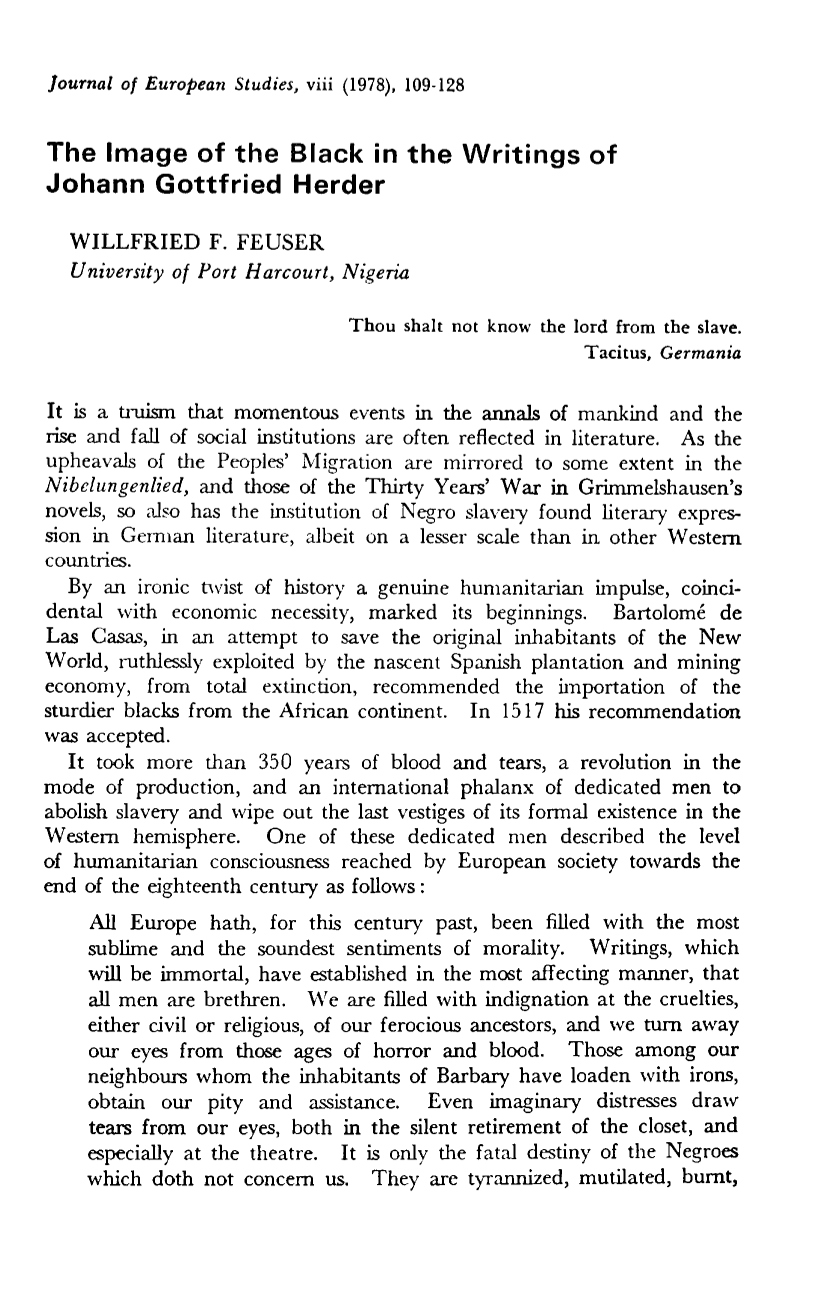
Abbé Raynal, A Philosophical and Political History of the Settlements and Trade of the Europeans in the East and West Indies (1770); reprint of second English edition, originally published in 1798 (New York, 1969), iv, 97.
2.
Abbé Raynal, op. cit., 256-7.
3.
See Willfried Feuser , "Das Bild des Afrikaners in der deutschen Literatur ", Akten des V. Internationalen Germanisten-KongressesCambridge1975 (Jahrbuch für Internationale Germanistik, Reihe A. Band 2, 4 (Berne and Frankfurt o. M., 1976) ), 306-15, and "Slave to Proletarian: Images of the Black in German Literature", in German Life and Letters (forthcoming).
4.
H.B. Nisbet, Herder and the Philosophy and History of Science (Cambridge , 1970), 212, 219.
5.
Johann Gottfried Herder, "Ideen zu Philosophie der Geschichte der Menschheit", 1. Teil; Sämtliche Werke, ed. by B. Suphan (reprinted Hildesheim, 1967), xiii, 71 (hereafter cited as SW).
6.
"Ideen ...", SW, xiii, 136.
7.
Ibid., 110, 147.
8.
Ibid., 155.
9.
Ibid., 255.
10.
Ibid., 257.
11.
H.B. Nisbet , op. cit. (ref. 4), 217.
12.
"Ideen ...", SW, xiii, 151.
13.
Ibid., 257-8.
14.
"Briefe zu Beförderung der Humanität", 10; Sammlung (1797), SW, xviii, 287.
15.
Ibid., 289.
16.
"Ideen ... ",SW, xiii, 4.
17.
"Briefe ...", SW, xviii, 237. Cf. also 249.
18.
"Ideen", SW, xiii, 233.
19.
"Des Lord Monboddo Werk von dem Ursprunge und Fortgange der Sprache ... Vorrede des Herrn Generalsuperintendenten Herder" ( Riga, 1784); SW, xv, 185.
20.
"Ideen ...", SW, xiii, 232.
21.
22.
"Briefe ...", SW, xviii, 224.
23.
"Ideen ...", SW, xiii, 227-8.
24.
"Briefe ...", SW, xviii, 248.
25.
Letter to Georg Müller, SW, xviii, 555.
26.
"Ideen ...", SW, xiii, 155, 156, 161.
27.
SW, xviii, 503.
28.
"Ideen ...", SW, xiv, 217.
29.
Ibid., 220.
30.
Letter to Gleim, quoted SW, xviii, 557.
31.
"Briefe ...", SW, xviii, 291.
32.
"Ideen", SW, xiii, 382.
33.
"Briefe", SW, xviii, 299-300.
34.
"Ideen", SW, xiii, 262-3; see also 264-5. I do not agree with Walzel's suggestion that Heine's source was Béranger's poem "Les Nègres et les marionnettes", although the motifs of dance and puppet-show in the two poems are certainly related. See Werner Vordtriede, Heine. Kommentar zu den Dichtungen, i (Munich, 1970), 86.
35.
Bernhard Suphan defines the "Briefe" as "Silvae ... Sammlungen von allerlei Materialien", SW, xviii, 547.
36.
See Wylie Sypher , Guinea's Captive Kings ( Chapel Hill, 1942), 313 fn.
37.
Le Génie du Christianisme (1802), quoted by Léon-François Hoffmann in Le Nègre romantique. Personnage littéraire et obsession collective (Paris, 1973), 103.
38.
"In Jamaika ist eine freie Neger-Republik, deren Unabhängigkeit im Jahre 1738 von den Englandern anerkannt und bestatigt werden musste", Herder's footnote, SW, xviii, 230.
39.
References to African geography, titles and institutions tend to be garbled in the antislavery literature of the epoch. The mention of Benin and Orissa (orisa = deity, spirit; here "the great spirit", Orisanla, the Yoruba God of Whiteness) in the same poem seems to be a realistic departure from the usual wanton mixing of elements. The name Zimeo itself is, however, far from being authentically Edo, it is one of the many fanciful names starting with a Z in the exoticist manner of the eighteenth century (cf. Voltaire's Zadig, among others).
40.
Cf. Frantz Fanon, Les Damnés de la terre (Paris, 1961), passim, and Renate Zahar, Colonialism and Alienation, trans. W. F. Feuser (Benin City, 1974), 54 sq.
41.
Apart from the "Neger-Idyllen" and various poems drawn from Berber folklore Herder published the following pieces with an African interest: "Nigra sum sed formosa", in Lieder der Liebe, SW, viii, 576; "Alkanzor und Zaida. Eine maurische Geschichte", SW, xxv, 148; "Lieder der Madagasker. Aus dem Französischen des Ritters Parny" (Paris, 1787), SW, xxv, 637 sq.; "Der afrikanische Rechtsspruch", in Nachdichtungen aus der morgenländischen Literatur, SW, xxvi, 359; "Alte Aegyptische Philosophie", SW, xxix, 305.
42.
Herder, Johann Gottfried, Sämtliche Werke (33 vols, Berlin , 1877-1913), ed. Bernard Suphan.Repr., Hildesheim1967.
43.
Barnard, F.M., Herder's Social and Political Thought : From Enlightenment to Nationalism (Oxford, 1965).
44.
Coupland, Reginald, The British Anti-Slavery Movement (London, 1933).
45.
Davis, David Brion, The Problem of Slavery in the Age of Revolution, 1770-1823 ( Ithaca, 1975).
46.
Fugate, Joe K., The Psychological Basis of Herder's Aesthetic (The Hague , 1966).
47.
Fairchild, Hoxie Neale, The Noble Savage. A Study in Romantic Naturalism (New York , 1928).
48.
Hoffman, Jean-François, Le Nègre romantique. Personnage littéraire et obsession collective (Paris, 1973).
49.
Mayo, Robert S., Herder and the Beginnings of Comparative Literature (Chapel Hill, 1969).
50.
Nisbet, H.B., Herder and the Philosophy and History of Science (Cambridge , 1970).
51.
Seeber, Edward D., Anti-Slavery Opinion in France during the Second Half of the Eighteenth Century (Baltimore, 1937).
52.
Steins, Martin, Das Bild des Schwarzen in der europäischen Kolonialliteratur, 1870-1918 (Frankfurt o.M., 1972).
53.
Sypher, Wylie, Guinea's Captive Kings (Chapel Hill, 1942).
54.
Gilman, Sander L., "The Figure of the Black in German Aesthetic Theory", Eighteenth Century Studies, viii, no. 4 (Summer, 1975), 373-91.
55.
Salmon, P., "Herder's Essay on the Origin of Language, and the Place of Man in the Animal Kingdom", GLL, xxii, no. 1 (October, 1968), 59-69.
56.
Shelley, P.A., "Crèvecoeur's Contribution to Herder's 'Neger-Idyllen' ", Journal of English and Germanic Philology, xxxvii (1938), 48-69.