



Abstract
This introduction briefly traces the development of historical and philosophical responses to COVID-19 in its longue durée and considers the pandemic’s lasting biopolitical effects in contemporary digital culture and its implications for democratic mechanisms and citizenship in Europe. It is argued that the present juncture constitutes a crucial and propitious moment in European thought and culture to take general stock of COVID-19 and to re-present it within the evolution of both European society and the European imaginary. Furthermore, the collective experience of COVID-19 has engendered important new confluences between humanities and the social sciences. Cinema is offered as a case study of biopolitical practice, or ‘bioart’, produced during the pandemic, revealing how ideas of community and citizenship are being re-thought and re-conceptualised ethically and politically in terms of relationality that surpasses standard disciplinary and ideological borders. Finally, the introduction outlines the six chapters comprising the volume.
Introduction: Recent interventions around COVID-19
Since May 2023, when the UN World Health Organisation (WHO) officially declared ‘with great hope’ an end to COVID-19 as a public health emergency (while stressing this did not mean the disease was no longer a global threat), there has been a flurry of books reflecting on the history and evolution of COVID-19 and its long-term social, cultural and political legacy. They are very different in aim and tone from those written and published during the course of the pandemic when, according to the WHO, nearly seven million people perished globally with a positive COVID-19 test, 1 and when the need to chronicle and historicise the event as it unfolded, precipitating state policies of social restriction (lockdowns, social distancing, health precautions), was urgent, making COVID-19 the most documented pandemic in history.
As early as March 2020, the Pulitzer prize-winning writer Thomas Friedman declared that COVID-19 was ‘our new historical divide’ and predicted that henceforth there would be ‘BC’, the time Before Corona, and ‘AC’, the time After Corona. Yet while during the crisis health formed the primary focus of interest and analysis, it has become increasingly evident that COVID-19 will most likely not enter the history books as the devastating threat to public health it was presented as, but rather as a watershed in the Western world concerning attitudes towards democracy and the relationship between the state and its citizens in contemporary digital culture. 2 With the comfort of chronological distance and less urgency, it is now possible to look at the events from a more objective and rounded perspective. This special issue reflects theoretically on the changing attitudes and redefinitions of key democratic notions or mechanisms, and casts a spotlight on some aspects of these transformations in different European countries and in different areas of human life.
Let us first remind ourselves of some of the immediate theoretical responses to the COVID-19 crisis. Perhaps the most notable, at least in terms of media coverage, was Slavoj Žižek’s (2020, 2021) two-volume work provocatively titled Pandemic! (Pandemic!: COVID-19 Shakes the World (2020) and Pandemic! 2: Chronicle of a Time Lost (2021)), which adopted an unflinching and defiantly intersectional approach, setting the pandemic firmly within a larger context of social and political crisis (or better: polycrisis) in the West. The cover puts in relief the word Panic in Pandemic. In one chapter in Pandemic! 2, entitled ‘COVID-19, Global Warming, Exploitation – The Same Struggle’ (Žižek, 2021: 23–28), Žižek pondered the link between COVID-19 and the anti-racist protests such as the Black Lives Matter movement then erupting around the world, arguing that in gathering to protest against police violence and therefore increasing the risk of spreading or contracting COVID-19, Black people, along with their supporters, were ‘ready to risk a lot, including sometimes their lives’ (2021: 27). Žižek probed further the question of what it means to be human during a pandemic, moving from the ideals of Black Lives Matter to the fate of the common worker: Do we have to risk our lives (by way of exposing ourselves to possible infection) in order to remain fully human? The problem with this stance is that, today, the main proponents of abolishing lockdowns are to be found in the populist new Right: its members see in all similar restrictive measures – from lockdowns to the obligatory wearing of masks – the erosion of our freedom and dignity. To this, we should respond by raising the key question: what does abolishing lockdowns and isolation effectively amount to for ordinary workers? That, in order to survive, they must go out into the unsafe world and risk contamination (2021: 28).
Žižek’s calculated juxtaposition of the act of risking one’s own life and that of risking the lives of others characterised many of the critical debates engaged during the pandemic about both the medical value and the potential social dangers of protective measures introduced by European governments. However, while he was sympathetic to the cause of the Black Lives Matter demonstrations in that situation, Žižek appeared unwilling to grant the same right to other demonstrations for democratic values and a dignified life, which were all presented as being right-wing driven. In this regard, his intervention was symptomatic of COVID-19 narratives in general, which too often appeared to confuse categories of political left and right for the sake of building new alliances of pro- or anti-pandemic measures (cf. Broecker, 2023).
Other less prominent but equally far-reaching responses to COVID-19 and the dilemma of being human in a period of obligatory social confinement included Kristin Ann Hass’s (2021) impressively wide-ranging 2021 collection, Being Human during COVID, encompassing multiple cultural approaches. For media and cultural studies scholar Sherryl Vint (2021), COVID-19 was a ‘governance event’ that made starkly visible two ways of thinking about our taken-for-granted structures of biopolitical governance. First, it demonstrated unequivocally the uneven distribution of chances to thrive or exposure to the risk of death that structures racialised, as well as the class binaries within modernity. Second, in the decision to suspend some operations of business-as-usual capitalism to slow the spread of the pandemic, this experience revealed that it was possible to live another way, contra the prevalent ideology of austerity that insists there is no alternative to capitalism and its privileging of economic growth. Vint’s assertion of positive change reflected a common hope and belief during the first months of the COVID-19 crisis that no-one profited from this situation. However, it has since become clear that the economic consequences of the pandemic played out very much to the interests of the richest percentage of the population who increased their wealth enormously since 2020 at the expense of the medium- and lower-income sections of the population who find themselves much worse off today. Moreover, some of the most powerful industries, namely, information technology (IT) and pharmaceuticals, made spectacular profits, demonstrating once again that the laws of corporate capitalism prevail.
Of course, in addition to aggravating economic disparities, the pandemic also reignited long-standing forms of social and ethnic discrimination. In Writing Plague: Language and Violence from the Black Death to COVID-19 (2022), the comparative literary scholar Alfred Thomas focuses on plague writing from the outbreak of the Black Death in Europe during the fourteenth century to the emergence of COVID-19 in 2020 to show how ‘in times of pandemic human beings have a particular need – and desire – to scapegoat and demonize minority groups’ (2022: ix), most obviously Jews. He traces recurring patterns of linguistic deformation and rhetorical violence in the manipulation of ‘pandemic discourse’, characterised by a metaphoric identification of a disease with a particular group of people and the constitution of the ‘other’ as a source of biomedical catastrophe (in the case of COVID-19, described by many, especially in the United States, as the ‘Chinese virus’ on account of its probable origins in Wuhan in Hubei Province, the Asian population).
The need to engage with COVID-19 holistically (i.e. socially, economically, politically) characterises the critical work produced in its aftermath, a period that is perhaps best regarded as the longue durée of COVID in view of both the large numbers suffering medically and psychologically from the long-term health impact of the COVID crisis (including long COVID) and the many people still having to negotiate the deep and continuing social and political impact of COVID, notably the strains on social infrastructure, increased levels of hardship and greater polarisation across Europe. In The Fatal Breath: Covid-19 and Society in Britain, the British social historian David Vincent (2023) offers what its publisher Polity promotes as the first complete account of the epidemic as it affected the United Kingdom. In what is a forensic retrospective account of the pandemic drawing on research reports, official data and personal testimonies (including previously unpublished diaries from the Mass Observation study), Vincent underlines the sheer scale of suffering and the often deleterious consequences of state measures taken and also not taken, with the poor and isolated particularly badly hit.
At the present juncture, however, there is little certainty or optimism that the pandemic will result in a ‘Great Reset’ in living and working conditions, as promoted by Klaus Schwab, founder and executive chairman of the World Economic Forum. 3 On the contrary, as memories of lockdown – and with it the vision of a better world – have faded, one has witnessed, as the historian Mark Honigsbaum (2023) rightly asserts, ‘a resumption of the neoliberal project and a return to the status quo ante’. Vincent emphasises, with reference to the WHO, that the Coronavirus pandemic is ‘a pale reflection of earlier tragedies’ (e.g. the 1918–1920 ‘Spanish flu’ pandemic which killed more than 50 million people globally). He even suggests that COVID-19 may well turn out to be more a footnote in a much bigger and ongoing global crisis extending from Brexit to the current energy crisis to the ongoing war between Russia and Ukraine that began in February 2022 and the war in the Middle East that started with the attack of Hamas (the Islamic Resistance Movement) on Israel in October 2023.
Yet there has been a mounting desire since September 2022 to address the legacy of COVID-19 in Europe from a multidisciplinary theoretical – and not strictly historical or historiographical – perspective. Although such interventions are very different in conception and design, they all seek to benefit from the emotional distance afforded by time to evaluate ethically, philosophically and politically the lasting changes and evolution in thinking which the pandemic provoked in European society and culture. To give a sense of the range and variety of the current period of critical (re)assessment, here is a brief and far from exhaustive overview of the field, focusing on three recent major works in the order they were published.
In What World Is This?: A Pandemic Phenomenology (2022), the cultural theorist and philosopher Judith Butler first notes that the term ‘pandemic’ derives from the Greek pan-demos, denoting all the people, or the people everywhere, or something that crosses over or spreads over and through the people (2022: 45), before then engaging with the European phenomenology of Max Scheler and Maurice Merleau-Ponty to reflect on the lived experience of ‘restricted life’ in what she calls ‘these interconnected times’ (2022: 67). Invoking Merleau-Ponty’s idea of the entrelacs, Butler asks: ‘How, then, do we rethink bodily relations of interdependency, intertwinement, and porosity during these times? What difference would it make to rethink equality in light of bodily interdependency?’ (2022: 45). By way of an answer, she seeks to ‘illuminate some aspects of the pandemic that bear on sociality, interdependency, and embodiment’ (Butler, 2022: 79). Adopting a progressively more poetic tone, Butler suggests that ‘interdependency describes a condition of life awkwardly and necessarily shared – the perils and passions of bodily exposure, of porosity, taking or letting something in, letting something out, existing, as it were, in that threshold, and through such passages’ (2022: 98). She formalises the ‘intertwining’ of ethics and politics thus: A politics of life would not be the reactionary one, nor would it reduce to a simple vitalism. Rather, it would be a critical reflection on the shared conditions of life for the purposes of realising a more radical equality and honoring a non-violent mandate of a global character (Butler, 2022: 99).
Butler argues affirmatively that ‘a new imaginary emerges from the hauntings of the present, the liminal horizon of this world’ (2022: 99), due to the advent of ‘mutual aid societies, nonnuclear pods, and expanding networks of care’ (2022: 106). In a postscript that evokes Black Lives Matter she reflects on transformations and ‘transformative protest’: once we recognize the unequal distribution of the grievability of lives, our debates about equality and violence will be transformed [. . .] we live [. . .] in relation to a world that sustains us [. . .] where that exchange of breath, free and syncopated, becomes what is shared – our commons, as it were (Butler, 2022: 107–108).
The cultural historian Simon Schama’s Foreign Bodies: Pandemics, Vaccines and the Health of Nations examines the modern history of vaccines and epidemiology to consider what he calls ‘the two inter-connected crises of our age – the health of our bodies and the health of the earth’ (2023: 389). Engaging directly with both medical history and developments in natural science, Schama (2023: 395) shows how the fact that vaccination involves the puncturing of the defensive casing of skin, and hence, a pathway for foreign bodies to enter, has been negatively absorbed into the distorting mirror of populist politics, particularly in the United States, where Americans want liberty of movement, sovereignty of physical power, at almost any cost. Schama catalogues how ‘the rhetorical coinage of science as the enemy of liberty has generated populist dividends for those seeking power’ (2023: 391). He concludes, however, on a more positive note born of an acute awareness of the wider global questions affecting the planet: ‘even as paranoia about borders and frontiers continues to dominate populist rhetoric, the inseparability of human beings – and, for that matter, the indivisibility of humankind and nature – remains the saving imperative of our beleaguered time’ (2023: 408).
Jacqueline Rose’s (2023) The Plague adopts, like Žižek, a fully-assumed intersectional and all-encompassing approach that aims to place the pandemic in its full interrelated context. Acknowledging from the outset ‘the fatally uneven response to Covid-19 by governments across the world’ (2023: location 1588), and that [n]o amount of common purpose has been able to thwart the power of wealth and status to determine who lives and who dies – whether in the guise of big pharmas blocking patient waivers on COVID-19 vaccinations, or the surge in domestic violence, or the daily threat of racist killings on the streets (2023: location 53),
Rose poses the difficult question: ‘What do you do with death and dying when they can no longer be pushed to the outer limits of your lived experience’ (2023: location 64). She argues that ‘living death’ will ‘appear as something of a refrain, a reminder that to think of death as an unavoidable intruder into how we order our lives, especially in the West, is an act of defiance that is doomed to fail’ (2023: location 68). Revisiting the complexities of Albert Camus’s (1947) novel La Peste and the philosophical work of Simone Weil which cry injustice (e.g. with reference to Camus, ‘it is a delusion to suggest that death is the great equalizer’ (2023: location 355)), Rose contends that ‘[e]veryone is accountable or should behave as if they were. Pandemics threaten to bring – or should bring – to the forefront of human consciousness, the extent to which we are all responsible for each other’ (2023: location 110). She proposes what might appear a counter-intuitive way forward: If the hardest task in the struggle for life is to give death its place at the core of being human, then psychoanalytic thought, failure and fragility are a crucial part of who we are (only by knowing this can we make the best of our lives) (2023: location 1162).
Rose concludes on a stirring note of resistance, suggesting that it is far better to start with imperfection, that is, imperfect knowledge within the scope of human understanding: ‘The delusion is to believe that moral purity and perfection are possessions, that imperfection is shameful, that violence is a spanner in the works, rather than part of the inner portion of everyone’ (2023: location 1172).
As with Butler and Schama, Rose’s argument for commonality and shared responsibility is pursued with great commitment and sensitivity, yet the strong trend towards the moralisation of politics in recent years suggests instead that some peoples’ convictions demand to be taken as absolute truth, and that anyone taking a different position is consequently ignorant and dangerous – an enemy to be neutralised. The idea that some elites know best what is good for the world (or for themselves), and that the general population needs to be manipulated into following them, has gained traction. This contradicts the official political line of Western states after World War II, when an open society of autonomous individuals was promoted. Such a major shift in thinking about democracy and the relationship between the elites and the population received a powerful push during the COVID-19 crisis.
The biopolitics of citizenship under COVID-19
Taking fully on board the above very different yet also complementary interventions, which together insist on the ethical ramifications of the pandemic, we wish in this special issue to reflect on specifically biopolitical aspects in order to examine and assess some of the fundamental effects and implications of COVID-19 for notions of community and citizenship in contemporary Europe and the underlying role of digitalisation.
Debates about citizenship have, of course, been central to European politics following the Maastricht Treaty of 1992, in which unrestricted movement and the right to reside freely in the European Union (EU) were conceived as a means of defining European identity and building lasting international partnership. Yet while individual citizens’ rights and European citizenship have been enshrined in the Charter of Fundamental Rights of the European Union, the Treaty on the Functioning of the European Union, and Article 9 of the Treaty on European Union, 4 the essence of the institution of citizenship and its acquisition criteria are continually being transformed, meaning that the idea of citizenship and integration in Europe remains in a state of constant evolution. The three main theoretical approaches to citizenship formulated notably by Michael Lister and Emily Pia in 2008 – classical positions (liberal, communitarian, republican) primarily concerned with questions of rights and responsibilities; multiculturalist and feminist theories concerned with the question of difference; postnational or cosmopolitan theories emphasising how citizen rights and behaviours are increasingly located beyond the nation state (Lister and Pia, 2008) – have been complicated by the new realities of a progressively more globalised, digitalised and technocratic Europe. Indeed, debates on European and transnational citizenship have intensified in the light of the interrelated emergency situations (democratic, financial and migration crises) that have struck Europe during the last 15–20 years, with explosive political events like Brexit in 2020 provoking new patterns of political participation in Europe.
Among the many pressing practical issues facing European integration is the daily challenge of how to manage mass migration flows or the infrastructure changes needed in the host state to accommodate a significant number of arrivals of EU citizens. COVID-19 served to bring to a head and expose the core issue of freedom of movement within Europe’s expanded borders due to the dramatic steps taken by individual states to restrict human movement and effectively immunise citizens against the virus. It also shifted the ideas about the rights of the individual against the state and weakened liberal democracy in the name of solidarity (cf. Pajević’s article in this special issue). The strengthening of the power of the state over the citizen during COVID-19 is only one element in a series of events and their corresponding narratives: the fear of terrorism in the wake of 9/11, the manifest corruption of the financial sector and the free market in 2008, the fear of a deadly new coronavirus in 2020, the fear of an evil enemy/system with the Russian invasion in Ukraine in 2022 and, since autumn 2023, another clash of cultures narrative between the West and the Islamic world. All these fears shift the mood in favour of a strong state and a logic of confrontation, where one needs to choose one’s side. The good citizen is obedient and supports the state against outer enemies, with the result that liberal values have lost currency. This is in line with North Atlantic Treaty Organisation (NATO)’s openly claimed efforts towards ‘cognitive warfare’, where the ‘human domain’ becomes the new battlefield. In the words of François du Cluzel (2021: 36) from the Innovation Hub of NATO, written in the second half of 2020, cognitive warfare ‘is a war through information, the real target being the human mind, and beyond the human per se’. For NATO, what and how one thinks is now a key strategy in geopolitics and warfare (cf. Tögel, 2023).
In their introduction to Care, Control and COVID-19: Health and Biopolitics in Philosophy and Literature, Marko Pajević and Raili Marling (2023: 13) formulate the dangers implied in this tendency and particularly in the social and political transformations produced during COVID-19: We are currently experiencing how the state, via biopolitics, fights a virus to protect the citizens, but also how the virus is transforming society: there is an economic transformation towards much greater inequality and a political transformation, powered by digitalization, towards what is, in biopolitical terms, a far more controlling state and invisible media corporations. It is very questionable whether this serves health and a healthy society.
It would be beneficial at this point to return to Michel Foucault’s influential and fundamental (if indeterminate) definition of the term biopolitics in the context of his reflections on governmentality from 1978 (cf. Campbell and Sitze, 2013; Lemke, 2011; Thumfart, 2008). 5 Foucault (2004) saw biopolitics as the way the modern state manages demographic phenomena such as health, hygiene, birth rates, life expectancy and race, and he points to their growing importance since the nineteenth century. Two years prior, he had mentioned the term to describe a shift in the eighteenth century from a sovereign power, directed at the human body and which makes die and lets live, towards the processes that make live and let die. In other words, according to Foucault (1986 [1976]: 213–235), in the nineteenth century, as the new liberal economic system developed, attention was directed at the population and at methods of regulating and making use of the life of the people. This power does not deal with the individual, but rather with statistics (birth and death rates, health, alimentation, work and living conditions, etc.). Which is to say, to prosper, the State and business need people to function well. Foucault’s (1961, 1963, 1975) concept of ‘disciplinary society’ (as analysed in his work on the hospital (1961), the psychiatric clinic (1963) and the prison (1975)) implies a positive suppression, a rationally evidenced care system. In spite of its risks, as with the term power generally in Foucault’s oeuvre, this is not bad in itself: who would want to oppose the State as a provider of health care, education and infrastructure of all kinds? After all, every convenience of our modern life is based on it. The benefits of a regulating state are evident, and in many societies it has given rise to historically unprecedented social circumstances with an exceptional level of justice and well-being for a great majority of the population.
The central question Foucault raises is how biopolitics, developed to promote and care for life, could turn into fatal and destructive processes. His argument operates with a very broad notion of racism, which, he contends, is used to fragment the continuum of humanity so that the state can, on the premises of bio-power, fight ‘lower life’ in the interest of a healthier and purer life in general (Pajević and Marling, 2023: 7). Looking at life in such a biological manner paves the way for killing some individuals in the interests of the population as a whole: an individual deemed racially or otherwise inferior is a threat to the population and needs to be eradicated. This extreme consequence has been put into practice, most obviously by National Socialism. Such disastrous ideology was not the result of a lack of reason or education, but one possible logical consequence of Enlightenment thought when it takes the form of instrumentalised reason (cf. Bauman, 1989; Horkheimer and Adorno, 1947). In short, bio-power and biopolitics can be used to subdue the body politic and control the population in the interests of inhumane goals (Foucault, 1986 [1976]: 166–167).
Building on Foucault’s work, the philosopher Giorgio Agamben takes a more radical position. He argues that looking at life reductively from a biological or functional perspective, current politics (i.e. in 1995) has become completely biopolitical, and for him this equates to totalitarianism. He develops this thesis via the notion of the homo sacer, a figure of Roman law, according to which a person is placed outside divine and human law. A homo sacer can therefore be killed but not sacrificed for religious purposes, for such a being becomes, according to Agamben, ‘bare life’, reduced to a merely biological being, to a physical body, deprived of all aspects of ‘good life’ available to citizens who are incorporated into the body politic. Agamben (2002 [1995]: 14, 30, 128) compares this with the Nazi concentration camps, which, in his view, have become the global biopolitical paradigm. Agamben refers here to the ancient Greek difference between zoë and bios, that is, the bare fact of life, as opposed to life as a form of life (2002 [1995]: 11). Biopolitics thus always has a flip side, the politics of death, for which Agamben uses the term ‘thanatopolitics’ (2015: 24). The historian and political theorist Achille Mbembe has since coined the term ‘necropolitics’, a variation of Agamben’s thanatopolitics applied to colonialism and its neocolonial and postcolonial forms – the power to dictate who may live and who must die (Mbembe, 2003).
Coming from yet another angle, and developing further his earlier work on the notion of a socially interpreted immunity, in Common Immunity: Biopolitics in the Age of the Pandemic (Esposito, 2023; originally published in Italian in 2022) the influential Italian philosopher Roberto Esposito explores what he calls the current ‘immuno-political’ turn, interrogating the democratic potential of a politics of universal social immunity able to overcome, as Alberto Moriera’s cover blurb powerfully puts it, the terminal limitations, contradictions, and impasses of contemporary liberal governmentality. Esposito claims that the COVID-19 pandemic has taken the system of immunisation to a new level: for the first time in history, societies are seeking to achieve generalised immunity in their entire populations through vaccination. For Esposito, this phenomenon allows, at its most positive, for the possibility of a ‘common immunity’ that strengthens the relations between community (communitas) and immunity (immunitas). The evidence of the recent COVID-19 history would appear to indicate the contrary, however. Esposito (2023 [2022]: 5) shows in his introduction how protection in the early stages of the pandemic through distancing, before vaccination was available, represented a negative biopolitical choice because it ensured social protection through desocialisation. The question is therefore posed how to discern and distinguish between protective and constrictive modes of individual and collective life (Esposito, 2023 [2022]: 12).
For Esposito (2023 [2022]: 12–13), the key issues at stake come down to a set of relations which he groups under the immunity paradigm: between the right to life and the right to freedom; between the state of exception and the state of emergency; between science, technology and politics, and between competition and disparity in vaccine acquisition. He reasons thus: the immune system is not so much a rigid barrier that protects individual identity as a dialectical filter vis-à-vis the external environment, which inhabits it from the beginning. In the continual lexical transit between the political and the biological, the biological can stop being the natural cage of the political and become instead its symbolic referent – in other words, the immune system’s opening to otherness can symbolize political systems’ opening to the other. Our immune system shows better than anything how we can and must welcome the external inside ourselves, making our bodies into a place of continual exchange and passage between the inside and the outside (Esposito, 2023 [2022]: 13).
Esposito (2023 [2022]: 14) ultimately argues for the mutual co-belonging of immunity and community, even though logically and etymologically they are opposites, for one cannot exist without the other. He states that for the first time one glimpses ‘the emergence [. . .] of a possible overlap of community and immunity that could well receive the paradoxical name of “common immunity”’ (2023 [2022]: 14). COVID-19 reveals, in fact, ‘the ambivalent character of the immune system – at once protective and negative’ (2023 [2022]: 176), since the initial logic of protection against the virus and of immunity implies first of all an introduction to the lethal threat within oneself and then a turning against the other and the foreign. According to Esposito, ‘[w]hat appeared to be a paradigmatic opposition – between communitas and immunitas – was suddenly revealed during the pandemic to be what it has always been, that is, a dialectic in which one term is indistinguishable from the other’ (2023 [2022]: 185). Hence, ‘[t]he negative, held back and at the same time produced by immune dispositifs, does not disappear completely but re-emerges in ever new forms’ (Esposito, 2023 [2022]: 188). Esposito sums up thus: ‘When community and immunity rediscover a shared boundary, the life of each is protected only by the life of all’ (2023 [2022]: 190). For Esposito, a fundamentally humanist theorist who uses the language of immunity to speak about the body politic, the only non-regressive response to the insidious face of populism that technocracy now represents is an affirmative biopolitics which requires a seismic shift in thinking.
Esposito’s bold understanding of biopolitics in the COVID-19 era exposes the danger presented by biopolitics if it reverts to the plague model and adopts its totalitarian features. Yet, as Pajević and Marling (2023: 13) argue, the immunitary logic can lead some to an obsession with security and exclusion, the creation of borders and protections against perceived threats. Desire for immunity characterizes communities that struggle to maintain a sense of control in a chaotic situation like the present one. The challenge is to avoid the logic of immunitary exclusion and to reach a community logic.
What is needed, they claim, is ‘to come back to recognizing our shared vulnerability and shared humanity. The balance between control and care is at stake’ (Pajević and Marling, 2023: 19). In the same volume, Marge Käsper (2023: 248), in her commentary on Esposito’s bodily metaphor of pregnancy to conceptualise vaccination as the creation of a ‘healthy social body’, unravels the ambivalent role and status of digital culture: social media networks can be considered a means for people to reject everything they fear and to stay in their ‘immunity bubble’. On the other hand, these networks nowadays make society exist, providing the opportunities not only for sharing the contested or appreciated content but also for creating novel content.
Agamben (2021 [2019]), too, has extended his ideas about bare life to the COVID-19 crisis and his native Italy. Seeing that Italians were willing to sacrifice practically everything when faced with the risk of getting sick, he deplored that bare life has become the sole criterion in today’s society (Agamben, 2021 [2019]: 17–18). Referring to the right-wing thinker Carl Schmitt’s (2021: 18) notion of the state of exception, in which normal laws and rules are suspended even in liberal democracies and where the value of human life is radically re-valued (or, more precisely, where the decisions about whose lives are valued are being made), Agamben points out that this has become the norm in a purely biological state. Agamben (2021 [2019]: 8) does not shy away from stating the similarities to the National Socialist state of exception that lasted for 12 years, pointing to new devices of monitoring and surveillance, security cameras and mobile phones that allow for a level of control far exceeding any former totalitarian forms (Agamben, 2021 [2019]: 43) – what Shoshana Zuboff (2019) has called surveillance capitalism, with its pervasive but invisible systems of control. (We are reminded that as early as 1992, Gilles Deleuze (1992) had observed a shift from Foucault’s disciplinary society to a ‘society of control’: the new digital technologies have allowed institutions to be decentralised and the citizens, by measuring their life data, constantly control themselves instead). More than for Foucault, the government of life is for Agamben the government of death.
It is crucial to understand that the fight for the new key resource of power, information and data, was a mighty driver in the state’s presentation of the COVID-19 pandemic. With COVID-19 passports, tracking apps and QR codes, the state could re-appropriate some of the data now largely in the hands of social media and IT companies. For all that, full state control may, however, be illusory, for this new media situation also creates infinite possibilities for other agents to gain a measure of control (e.g. through the outsourcing of data-gathering to private enterprises) (cf. Pajević and Marling, 2023: 10), thereby allowing for change and movement within the biopolitical situation. Hence, a corroborated biopolitical strategy aligned with the new opportunities enabled by digitalisation (which received an enormous boost through COVID-19 as a social phenomenon), together with the political shift away from the strong citizen of liberal democracy towards a paternal controlling state, ultimately represent a very different outlook on the world in Europe. It is too early, however, to say how this will eventually pan out and where Europe will stand socially and politically in 10 years’ time.
Biopolitics and humanities: New confluences
It is within the context of the biopolitical debates generated by COVID-19 in its longue durée that fresh interdisciplinary approaches to biopolitics within the expanded field of the humanities, including medical humanities, have been initiated. For example, a recent edited volume by Carl F. Stychin (2023) entitled Law, Humanities and the COVID Crisis examines various facets of the extraordinary legal response to COVID-19 and the impact on society as well as on law making itself. In his introduction Stychin (2023: 2–5) refers to several publications demonstrating how the pandemic exacerbated social injustice in diverse areas and gave draconian powers to the government and the police, emblematic of an increasingly authoritarian state. The collection focuses on the importance of the humanities for law – an importance that has received wide recognition due to the problematic one-sidedness of the focus on ‘science’ during the pandemic years. The failure of that strategy highlighted the relevance of critical thinking, interrogations and new visions provided by the humanities, ‘because of the insights it can provide in terms of morality, culture and narrative, all of which are central to policy making’ (Stychin, 2023: 7). Stychin (2023: 8) concludes that ‘understanding law’s response to COVID-19 requires a broader intellectual horizon, which can be found in the humanities’. The confluence between law and the humanities is not new, but the COVID-19 crisis has given it new recognition and justification.
An instructive example of the humanities intervening directly in biopolitical debates prompted by COVID-19 is offered by ‘Translating COVID-19: From Contagion to Containment’, an article by Marta Arnaldi et al. (2022), which presents exploratory research conducted during one of the peaks of the Coronavirus crisis (March–June 2020), and which tests the hypothesis that contagion can be physiologically destructive but culturally valuable. The authors argue that translation and translation theory can be fruitfully used to understand and manage epidemics, for they can serve to explore concepts of infectivity and immunity in terms of cultural and biological resistance. After examining the linkage between translation and COVID from three different yet interlinked perspectives – cultural, medical, and biocultural – the authors make a case for a translational medical humanities framework for tackling the multifactorial crisis brought about by the severe acute respiratory syndrome coronavirus 2 infection. This entanglement of perspectives allows a new space to be carved out for translation research at the intersection of the sciences and the humanities, providing sustainable ways to conceptualise the production of science at times of crisis, and challenging conventional views of translation as a primarily linguistic and cultural phenomenon that traditionally does not engage with science. The authors ultimately put forward a biocultural understanding of translation that can help confront and potentially contain epidemiological outbreaks, such as the crisis provoked by COVID-19. They compare and interweave notions and practices of translation both in the sciences and the humanities to investigate the consequences and mutual benefits of this reciprocal engagement. This innovative entanglement of perspectives has the merit of (1) carving out a new space for translation research at the intersection of the sciences and the humanities (interdisciplinarity being translational by definition); (2) providing sustainable ways of conceptualising the production of science at times of crisis when the interpretation of existing results is perhaps more urgent than the generation of evidence-based ones; and (3) challenging and transforming conventional views of translation as a primarily linguistic and cultural phenomenon that traditionally does not engage with science. Their hope is that the preliminary steps undertaken can pave the way for future interdisciplinary enquiries into translation as an epistemic framework suited not only for crossing linguistic, cultural, and disciplinary boundaries at times of emergency, but also for shaping and impacting medical knowledge, practice and policy. For as the Coronavirus pandemic has revealed, the rules of health and contagion rely upon a delicate balance of factors that science on its own can neither explain nor re-establish.
If one turns now to aesthetic thinking and practice in the wake of COVID-19: how might artistic endeavour and engagement link theoretically with research conducted in the social and natural sciences? Building on the work of Foucault and Agamben in the broad field of biopolitics, Pajević and Marling make a powerful call for alternative ways of thinking and new imaginaries post-COVID-19. There is always, they argue, the question of the right balance between a paternalising state and the freedom of the citizens to decide about their lives, that is, the balance between care and control. They state: After two years of the pandemic, we need to get out of the emergency mode and consider the long-term consequences of the crisis in a more global manner. We need a real debate that includes all aspects of social life, since giving life the absolute status of mere survival carries the risk of totalitarianism. Instead, we should strive for the dignity of life as well as the openness of societies as goals (cf. Brenner, 2020: 91; Pajević and Marling, 2023: 3)
Literary works, Pajević and Marling advance passionately, allow for the possibility to see something that remains invisible to policy documents and health guidelines, namely, the ambiguity and complexity of human beings, their contradictory wishes and behaviours. The biopolitical management of the present crisis has lacked imagination, and they understandably wish to provide examples of imaginaries where richer responses to biopolitical crises are modelled (5).
Marling (2023) herself starts from the ‘failure of the dream of biopolitical control’ in the COVID-19 pandemic and turns to Butler and Rosi Braidotti to explore ‘biopolitical relationality’ as a potential source of political agency, and to grasp shared vulnerabilities as a potential source of political agency. She writes: ‘In this relationality, we are not bounded subjects closed off from the world and each other, but porous and leaky, perceptually open to and being with the others’ (Marling, 2023: 140). Fiction, Marling (2023: 151) persuasively argues, is one space in which we can imagine new forms of liveable conditions of vulnerability, as well as new modes of affective relationality [. . .] Fiction is also a space in which people learn to re-relate, not necessarily in the format of the dramatic gesture of resistance but also in detachment.
Marling’s insistence on the vital relational function and value of aesthetics and the artistic imagination in the biopolitical context of COVID-19 raises the possibility of new forms of ‘bioart’. In a chapter entitled ‘What Is the Bio- of Biopolitics and Bioart?’, a leading exponent of posthumanist theory, Cary Wolfe (2022 [2021]), posits with reference to Esposito, Agamben and Foucault, as well as the work of Niklas Luhmann (e.g. Art as a Social System (2000)), the socially and politically representative character of bioart, addressing in particular the truism that in bioart life itself becomes the medium of the artwork (vs, say, the digital image). He takes aim at Esposito’s idea of an ‘affirmative biopolitics’ (contra Agamben, for example) which entails, he argues, a kind of neovitalism (Wolfe, 2022 [2021]: 131). Wolfe (2022 [2021]: 131), proposing instead that the meaning and politics of bioart cannot simply be understood as anchored in or indexed to the particular character of its medium, its material substrate. He argues for an ‘ecologisation’ of the biopolitical paradigm which drives instead towards ‘a denaturalized understanding of the ecological paradigm that emphasises form, time, and the dynamic complexity of their interrelation [. . .] as the key constituents for thinking how biopolitics and bioart operate and signify’ (Wolfe, 2022 [2021]: 131) – in other words, an ecological or ‘metabiological’ emphasis on social complexity. Wolfe considers further how art forces us to attend on the empirically ethical, emotionally charged questions of ‘life’ and the ‘living’ amid ecological catastrophe. Viewed in this way, ecology demonstrates that what the immunological paradigm of biopolitics and the ecological paradigm have in common is that, for both, it is not a question of a biological or ecological substrate, but rather of thinking the forms and processes by which the system/environment relationship is stabilised and managed by systems that find themselves in an environment of exponentially greater complexity than they themselves possess (Wolfe, 2022 [2021]: 132). Wolfe (2021: 150) foregrounds Derrida’s analysis of the autoimmunitary logic of modern democratic politics (a thanatopolitical approach, to be compared with that of Agamben), as well as Luhmann’s social-systems theory which allows one to understand that art’s relationship to the political is non-representational in making visible for society’s self-observation the ‘socially regulative’ and ‘stabilising’ contingencies that structure the field of objects and observations in which we make art and communicate, the highly selective overdeterminations that bear upon how [. . .] we conjugate the relationship between what we call ‘Life’ and its empirical instantiations in the domain of ‘the living’.
Such resolute thinking inspires Wolfe to look in fascinating granular detail at the biopolitical worlds created in the recent multi-channel film and video installations of the celebrated Finnish artist, Eija-Liisa Ahtila, which explore the relations between the realms of the human, the animal and the divine (or transcendent) through the desynchronising of time and space and strategies of framing. For Wolfe (2022 [2021]: 151–162), Ahtila’s work is exemplary of film’s potential as a biopolitical apparatus that not only frames one’s relationship to others (including nonhuman others) and to oneself, but also dictates the ethical and political disposition of different kinds of life forms as subjects of bio-power.
‘Isolation cinema’: A case study of biopolitical practice
The British novelist Ian McEwan complained during the pandemic of an existence where ‘bleached of events [. . .] time compresses and collapses in on itself’. 6 This perception, shared by many during lockdown, of a temporal black hole presents a particular challenge for social history, a discipline rooted in a deep engagement with time and work. Indeed, Vincent has acknowledged in The Fatal Breath that the novel may be better equipped to capture COVID-19’s peculiar warping of the present. Yet film, as a time-based and popular medium, may also offer a rich and profound form of creative encounter and engagement with a global pandemic like COVID-19. Of course, with film production on hold throughout the world and film exhibition and viewing massively curtailed by confinement rules, COVID-19 totally disrupted the industry and profession, instantiating an abrupt global shift in spectatorship from the large to small screen – a shift that coincided ironically, and perhaps not un-coincidentally, with Mark Zuckerberg’s rebranding of Facebook as Meta and the advent in March 2021 of the ‘metaverse’, a logical next stage in techno-mediated culture. 7
A raft of recent edited volumes has charted this economic crisis in the development and performance of the film industry, notably Qiao Li et al.’s (2023) wide-ranging edited collection The Global Film Market Transformation in the Post-Pandemic, which takes the reader to the furthest reaches of world cinema (China, Korea, India, Spain, Macedonia, Poland). Focusing on the particular genre of documentary, Pietari Kääpä and Dafydd Sills-Jones’s (2023) Documentary in the Age of COVID challenges our thinking about how the cultural and technological disruption in both cinema and television brought about by the pandemic response has upended documentary culture. The book evaluates the funding and circulation/distribution implications of the pandemic, but also insists on the closeness, connectivity and co-creation encouraged by the crisis, and how institutional responses to disruption stimulated new kinds of innovation. The specific aspect of film festival curation and viewing is explored in Antoine Damiens and Marijke de Valck’s (2023) Rethinking Film Festivals in the Pandemic Era and After, which, while acknowledging the many contaminated circuits and ecosystems wreaked by COVID-19, celebrates at once the rise of virtual film festivals which have served to engender new forms of film community on streaming platforms, the idea of curating festivals as care, and the new emphasis on decolonised film festival worlds and greening festivals Meanwhile, Carol Owen and Sarah Meehan O’Callaghan’s (2023) Psychoanalysis and the Small Screen: The Year the Cinemas Closed explores from a psychoanalytical (and primarily Lacanian) perspective the impact of cinema closures and the shift to ‘exclusive’ small-screen consumption in secluded domestic space on people’s aesthetic and subjective desires.
In fact, very early in the epidemic the British sociologist Eugene Nulman (2021) noted the forces of Coronavirus capitalism at work in cinema, which he defined as ‘a convergence and rupture of the “normal” everyday’ (2021: 2). He argued, however, that crises are not just tools for the 1% to amass more wealth and power, but also for the 99% to reorganize aspects of society to at least minimize the damage done, medically and financially but also socially and ecologically (2021: 1).
In Nulman’s case, this translated as the opportunity to view pre-COVID-19 films through a new COVID-19 lens and establish what they reveal of politics in a time of COVID-19. Through their moving images, he argued, ‘we find our blind spots, our non-COVID contagions, our voluntary collective self-isolation and our ideological vaccines’ (Nulman, 2021: 5). Informed by George Lakoff’s Moral Politics: How Liberals and Conservatives Think (2002), Nulman explored the family dynamic in films such as Knives Out (US, 2019), an American mystery written and directed by Rian Johnson, as an allegory for capitalism and the role of non-White immigrant health care workers whose lives are on the line during a pandemic because of the failures of neoliberalism. Parasite (South Korea, 2019), a black comedy thriller directed by Bong Joon-ho, was discussed in relation to what Marxist historian Peter Linebaugh has referred to in his work on pandemics of the past as macro- and microparasites. Class solidarity against macroparasites was critical, and this is presented in the climax of Parasite which concludes a conflict created by neoliberal self-interest (Nulman, 2021: 6). Elsewhere, Nulman explored Spider-Man: Far From Home (US, 2019; dir. Jon Watts) through the lens of Naomi Klein’s theory of disaster capitalism, reflecting in particular on how the Coronavirus crisis can continue to be used by neoliberals to further their interests, or, alternatively, for radicals and progressives to reshape the world (he cites the mobilisation of mutual aid seen during the pandemic (Nulman, 2021: 103)). 8
There is one short step between Nulman’s at once backwards-looking and anticipatory critical project and an automatic wish to read pre-COVID cinema proleptically as a harbinger of the pandemic. Brian A. Shaer’s (2022) Are We Living in a Disaster Movie?: How Genre Conventions Predict the Plot of the Covid-19 Pandemic views cinema as predictive of COVID-19, proposing that certain periods of history like the early 2020s contain so many compounded disasters that they seem strangely to be inspired by disaster movies (films such as Outbreak, The Towering Inferno and Armageddon). Shaer argues further that the life cycle of COVID-19 closely parallels various apocalyptic films, from the personas of the main players to the strike of the cataclysm itself.
Yet how is one to approach the few films actually made during the pandemic and which directly address COVID-19? For the most part, such films, which may be classified for the sake of convenience as ‘isolation cinema’, reproduced the norms of mainstream genre filmmaking, albeit with a pandemic twist. 9 For instance, Homesick (dir. Jason Farries), made in the United Kingdom in 2020 during lockdown, was clearly based on current or very recent lived events. In the midst of a global pandemic, a university student returns home on the occasion of nationwide lockdown and finds himself alone and isolated. A clinical study of loneliness and depression, filmed with a quasi-documentary objective camera, changes course when the young man falls ill with the Coronavirus and turns to despair, before eventually moving into apocalyptic mode with standard horror tropes. Another UK film produced in the same year entitled Host, directed by Rob Savage, where the form of the film was directly determined by the effects of lockdown, created a new kind of ‘intimate’, do-it-yourself horror film, billed as a Blair Witch Project for the pandemic era. Featuring a group of friends who in July 2020 attempt to escape a deadly supernatural force inadvertently spawned during a séance, the film was shot entirely on Zoom on a tiny budget with all the actors locked down in their respective houses and without the spectatorial comfort of dubbed theme music.
Yet other independent art films were made during lockdown that avoided reverting to well-worn genres and formal templates, for the tight confines of the pandemic offered also the opportunity to rethink ways of thinking and producing cinema more freely and organically. During the first global pandemic lockdown in March 2020 the Egyptian-American filmmaker Sam Abbas commissioned a series of six shorts by cinematographers from around the world, which he subsequently compiled as an arthouse documentary entitled Erēmīta (Anthologies) (US/France/Argentina/Italy, 2021) (the title translates as ‘hermit’, and the film opens with a quote defining hermit as ‘a person who lives in seclusion from society’). Each short was a lockdown experiment: directors were told to shoot on their mobile phones without any lenses, rigs or audio devices. What resulted was a tribute to creativity and plurality out of self-imposed limits and boundaries. It runs the gamut from the avant-garde/impressionistic – like Soledad Rodríguez’s The Eagle and the Snake, shot through what appears to be a tube – to the socially observed, typically defined by a sense of being inside looking out. American indie Director of Photography Ashley Connor’s A Well Watered Woman offers up a jaggedly edited bath starring her own body in close-up fragments, while in Point of View Stefano Falivene contrasts the majesty of the ancient Coliseum in Rome with the apartment-bound strangeness of his son’s online learning and his own video call about an upcoming, COVID-affected film project. A few of the films point the camera at others. Alexis Zabé’s Shelter in Place juxtaposes the pedestrian-cleared zones of Venice Beach with its ever-present homeless encampments, while French cameraman Antoine Héberlé’s Ceux d’en Haut invents a delicate story of connection among young residents of an apartment building who live on separate floors. Abbas’s own static, crisply realised shots of a single woman and her dog at home provide a textual framework related to Nietzsche’s philosophical epic Thus Spoke Zarathustra (the story of the eponymous hermit who lived in solitude for 10 years, accompanied by an eagle and a snake, and ‘did not grow weary of it’). While clearly running the risk of over-determination by using a voice from the past to capture present reality, Erēmīta represented a boldly innovative, heterogeneous and boundary-pushing anthology responding to the specific challenges of the COVID-19 crisis.
A more free-flowing and organic example of isolation cinema, that interrogates both the limits and potential of film and encourages a new, open, receptive and relational approach to the world, is the French-Senegalese filmmaker Mati Diop’s In My Room (France/Italy, 2020), part of the film platform MUBI’s ongoing series commissioned by Miu Miu entitled ‘Women’s Tales’.
10
It was made in March 2020 while Diop was quarantined in her studio apartment in Paris, and made available to stream worldwide immediately following its premiere at the Venice Film Festival in September 2020. In My Room plunges the viewer into the poignant story of a woman at the twilight of her life through recordings of the director’s recently deceased grandmother Maji, including her exchanges with her daily carers as they carry out their jobs while negotiating the rules of confinement. Maji, who has already spent over 20 years stuck in her apartment in the city’s 17th arrondissement, takes the time to reflect dispassionately on the life she lived and her surrender to the exigencies of time and impending death. Diop plays the recordings that took place in her grandmother’s living room over more recent footage from days spent alone herself in her studio apartment in the 13th. What results, as MUBI puts it, is ‘a melodramatic home movie that playfully blends themes of womanhood, transmission, and freedom’. Diop’s silhouette stands before five long, narrow windows. We also see her crouch in front of her tiny fridge, bathed in a purple light, looking for a late-night snack. In another instance, she dances sensually in front of a mirror, towering in scarlet peep toe heels as a rotating disco ball light illuminates the space. There are also determinedly ‘flat’ moments of longueur where she simply stares at her phone or lounges in bed. In Diop’s restricted interior domestic space, living rooms become stages where life is performed. Diop even films herself dancing in a black, crystal-decorated Miu Miu dress while lip-syncing to La Traviata (it is revealed that Maji’s mother was a dramatic soprano). Intimate, humorous, poignant: this is a film effortlessly about urban space, privacy, social relations, time, memory, class and ethnicity. But Diop also captures the interior lives of her unknown and unknowing neighbours. In her statement for Miu Miu, which she typewrites in real time on her computer screen, she states that she had already started making a home movie by filming her confined neighbours at night, in long focal length, from the window of her own 24th floor apartment. In this intermixing of two separate urban spaces and locations, Diop, as Neyat Yohannes (2020) eloquently writes, pans from unit to unit, pausing briefly to catch glimpses of how others are biding their time. Some gather around a laptop propped on a kitchen table, others smoke a cigarette with their top-halves slumped out an open window. We see a disembodied, outstretched arm reaching for the ceiling. With fluorescent kitchen lights on at night, the endless rows of apartments look like stacked fish tanks – each inhabitant swimming in circles and waiting for a new routine.
Hence, the deep sense of a universal network of intersecting lives (of isolation and life by remote), of inter-crossings between different spaces, times, ages and cultures, of absence/presence, distance/proximity, intimacy and dépaysement, is vividly created spatially and affectively. Windows become portals to the lives of others, an open window with sunlit and dusk views of the city of Paris in the distance offering a form of exchange, however, limited and circumscribed, across and through space. The extraordinary final sequence – an extended long take of exterior space where the camera simply tracks the rapid movement of a couple of birds rolling back and forth over each other in the air between the residential tower blocks, set to the brooding instrumental music of the British musician and composer Dean Blunt – opens up and out to the world and the Other. The film thus constitutes what might be called a cinematic act of resistance by recording new, unbounded, transnational forms of relationality beyond borders and fixed notions of subjectivity and citizenship, moving across time and even species in a multi-sensual poetics of cinematic form (Figure 1).
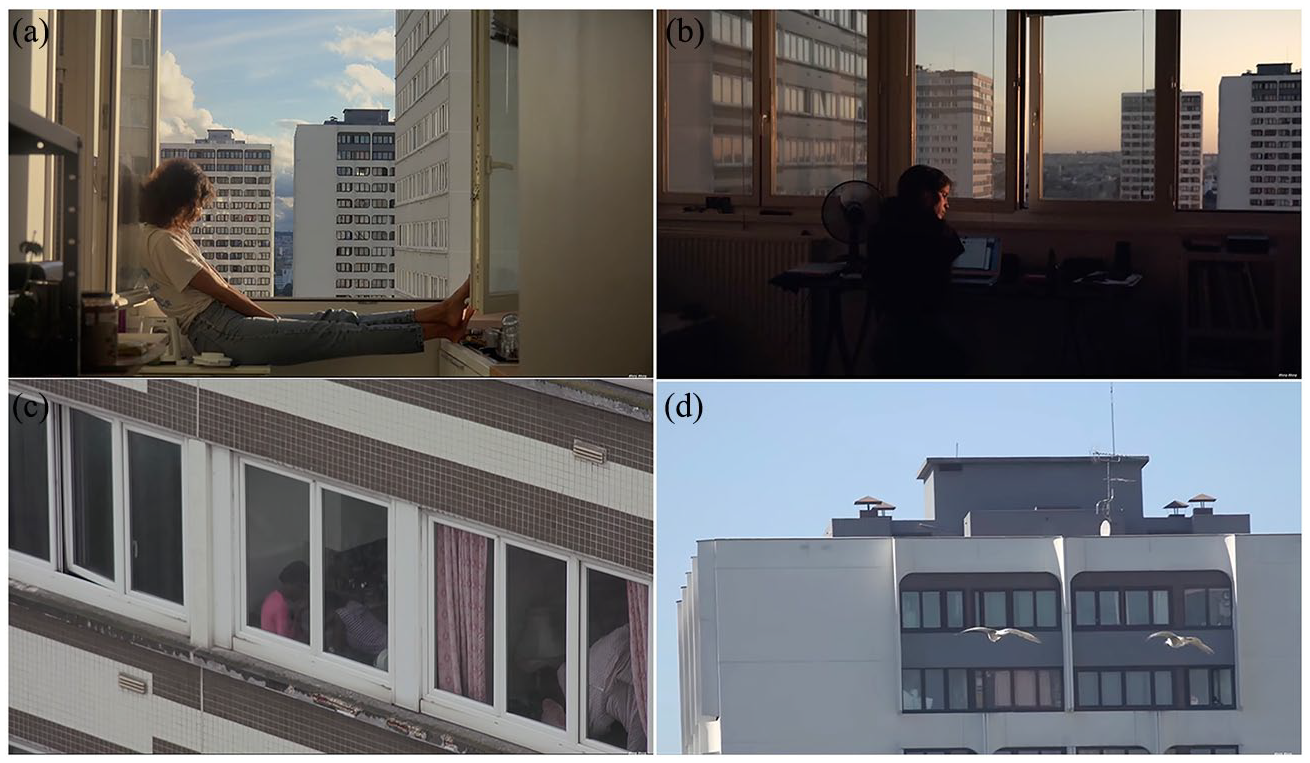
Moments of contemplation in In My Room (2020), dir. Mati Diop: (a) Mati Diop reclining at the window; (b) Mati Diop at her computer; (c) an anonymous neighbour glimpsed in a facing tower block; and (d) a pair of birds flying between blocks. © Miu Miu.
One might link such gently radical aesthetic and poetic strategies pursued in an avowedly ‘minor’ independent film with those of recent experimental migrant documentary films addressing another urgent contemporary manifestation of digital biopolitics, namely, the datafication of refugees to Europe (i.e. non-citizens) and the humanitarian issues this raises. Examples include Purple Sea (Germany, 2020), made ‘live’ on a boat fleeing Syria which sank off the coast of Lesbos, and Asmat: Names in Memory of All Victims of the Sea (Italy, 2014), a video short commemorating the victims of a disaster that occurred in October 2013 off the coast of Lampedusa. As Christian Rossipal (2021) has shown, the directors (Syrian artist Amel Alzakout and Ethiopian-born Italian director and writer Dagmawi Yimer respectively) are forced to slow down and withdraw from representation and the exhausted mediatised image by focusing on materiality, to the point of deconstructing or reconfiguring representation in the process of documentary filmmaking. Rossipal writes: ‘A cinematic poetics of refraction [. . .] imagines another (im)possible world by working through the opacities of difference rather than seeking the immediacy, transparency, and instant exposure of conventional documentary’ (2021: 41). He adds: The poetics of refraction [. . .] introduce a kind of indeterminacy that gives expression in the irreducible and always incomplete encounter with radical alterity (in this case, the dead). This indeterminacy marks a significant break with a documentary ethics and aesthetics based on transparency and the prior separability of self and other (44).
Such cinematic refraction encapsulates the essential question that underpins this special issue, that is: what do human relations and freedom look like now, in the new, post-pandemic present, where the mounting crisis in understanding and honouring citizenship in an increasingly fractured and digitalised Europe has often been exacerbated by state responses to COVID-19? In the absence of an immediate and definitive answer, the more mobile, inclusive kinds of transnational, relational being formulated in films like Erēmīta (Anthologies) and In My Room offer a potential path forward – a new form of cultural resistance – with possibilities for ethical and political transformation.
Outline of volume
As editors of this special issue we do not seek to harmonise or level out the different positions taken on what actually happened during the pandemic, still less to steer a collective interpretation of events. Rather, we propose the volume as a forum for open debate and competing views. The essays collected offer a purposely varied and eclectic range of perspectives from various disciplines in the humanities (notably literature and philosophy) and the social sciences, and together they contribute to new and propitious interdisciplinary dialogues in the domain of the biopolitical. Guided by different methodologies and points of critical focus, the six contributors move from literary novels to journalism and social media, from urbanisation to medical care, and from the discourse of propaganda to the politics of human rights, forming an experimental, hybrid critical mix appropriate to the multi-dimensional impact and concerns of COVID-19. Beyond the explicit themes of biopolitics, digital culture and citizenship in today’s Europe, a rolling set of shared and overlapping concerns is created: discourse and violence; mobility and freedom; affect and care; community and relationality; individual health and the health of the polity; human rights and state control; technocracy and techno-politics.
In ‘Rethinking biopolitics: COVID-19, differential vulnerabilities and biopolitical rights’, Daniele Lorenzini develops a critique of the forms of differential vulnerability produced by biopolitical technologies of power during the COVID-19 crisis. Addressing the conceptual and methodological aspects of Foucault’s notion of biopolitics, he isolates a politics of differential vulnerability. Lorenzini develops an immanent critique of this politics and its forms of injustice. He presents some of the most fundamental human rights as ‘biopolitical rights’, in the sense that their normativity stems from biopolitical mechanisms of power. He suggests a critical theory of biopolitical rights as an effective strategic response to the various injustices created, before, during and after the COVID-19 crisis.
In ‘Platform urbanisation, infrastructures and techno-politics: The turn towards urban citizenship’, Filippo Bignami and Naomi C. Hanakata address the ways in which digital platforms challenge and redefine urban forms of citizenship. Considering platforms as an assemblage of digital and physical infrastructures resulting in a new techno-political environment, they develop the concept of ‘platform urbanisation’ to demonstrate the profound changes in urban citizenship that accelerated during the COVID-19 pandemic. While these digital platforms facilitate increased possibilities for engagement, access to services, efficiency in processing data, and customising responses to people online and offline, they also pose challenges related to inequality, privacy, exclusion and social polarisation. Bignami and Hanakata present platform urbanisation as a profoundly political process with a biopolitical dimension. They discuss the infrastructural and political implications of this development and the subsequent need to reconceptualise and extend the concept of citizenship with the aim of advancing reflections on two facets of platform urbanisation: (1) the political nature of such a process that requires a re-framing of citizenship; and (2) the role of material and immaterial infrastructures in this process, which also constitute a new biopolitical territory. They ultimately describe digital platforms as an inextricable merging of political rationality, administrative techniques and technology.
In ‘Health versus humanity? Three recent German novels on biopolitics and citizenship’, Marko Pajević analyses the dystopian views of a future society based on a health system, as presented in three recent German novels: Juli Zeh’s Corpus Delicti (2009), Zoë Beck’s thriller Paradise City (2020), and Martin Schäuble’s youth novel Cleanland (2020). All three novels represent a thoroughgoing critique of biopolitics as defined by Michel Foucault and radicalised by Giorgio Agamben and Achille Mbembe. Pajević investigates their criticism of biopolitics in the light of the transformation of society due to COVID-19 measures, focusing on the situation in Germany. To shed light on the changes in our conception of citizenship, he first presents an analysis of the shift in meaning of the concept of ‘solidarity’ as an example of discursive change and reflects on the role of literature for societal development. Against that backdrop, he examines the conflict of interests that sees health and security pitted against freedom as presented in the novels and explores further key aspects: the media, manipulation and fear, the counterworlds both inside and outside the shiny world of these affluent societies, and the constructed opposition between humanity and health system. These considerations lead in the conclusion to a discussion of biopolitics in the context of the COVID-19 crisis with regard to digital culture and citizenship.
Raili Marling’s ‘The boring apocalypse: The representation of flat affects in contemporary British pandemic novels’ starts out from Adam Grant’s designation of COVID-19 as the ‘boring apocalypse’, as opposed to former imaginings of pandemics incorporating spectacular killer viruses. Indeed, for many people in the Global North the challenge of the pandemic was, if not boredom, then a sense of recurring routine. Instead of looking at ‘strong’ affects like fear and anger triggered by COVID-19, Marling examines the ‘flat’ affects that grew out of the sense of stasis. She leans on the thinking of Lauren Berlant (2011, 2015) to analyse three British novels written during the pandemic: Sarah Moss’s The Fell (2022), Sarah Hall’s Burntcoat (2021) and Clare Pollard’s Delphi (2022). Her focus is on the representations of affective responses to the routines of the pandemic in the often overlooked private sphere. The novels considered evoke the importance of cherishing the mundane infrastructures of daily life. They teach us to stress not only the impasses, but also the glitches that could open a space for new and alternative forms of attachment, however unheroic, for everyday friction with other people can counter our socialisation in loneliness and political impotence.
Mojca Ramšak explores the public discourse about health workers in media and social media in Slovenia during COVID-19 in her article ‘COVID-19 discourse in the context of verbal as well as physical violence against medical professionals’, where she describes a fluctuation between extremes ranging from idolisation, hero worship and contempt to verbal and physical threats. She establishes correlations between the measures taken to contain the epidemic in Slovenia and the consequences for the lives of those who suddenly lost their livelihoods and sense of freedom. The discourse on this topic shows that the entire burden of staff shortages and otherwise poorly organised healthcare fell on medical personnel, who became victims of intense anger, vulgar insults and comparisons of all kinds, including physical harassment and death threats, as well as of growing distrust of medicine in general. Ramšak analyses the hostile and abusive online communications and highlights the complicated interplay between medicine and the social and cultural context during COVID-19, illustrating the complexity of medicine beyond merely biological understanding.
Finally, in ‘Technocratic totalitarianism: Gunnar Kaiser and Dissident discourse in pandemic-era Germany’, Thomas Crew examines the ideas, reception, and social role of Germany’s most prominent cultural critic of lockdown politics, Gunnar Kaiser. In contrast to the majority of European intellectuals, Kaiser took an early public stand against any naïve adoption of science as a social authority and the unprecedented overturning of core democratic principles. He argued that without vigorous, open debate, the worldwide state of emergency threatened to usher in a fundamentally new (bio)political era, in which liberal democracy would be replaced by an increasingly totalitarian technocracy. Yet despite his voluminous philosophical output, which included a highly creative and increasingly professionalised YouTube channel as well as two best-selling books, Kaiser found himself largely excluded from mainstream German discourse. Crew analyses the full range of Kaiser’s interventions while also situating him within the broader landscape of European dissent.
What ultimately unites these very different and wide-ranging essays is an ethical concern to interrogate presuppositions about Europe and European society and to explore new relationalities and affectivities, with a focus on digitalisation and citizenship and with a view to helping formulate new and sustainable kinds of commonality and kinship in a post-COVID-19 world.