



Abstract
Differences in Northern and Southern European gender relations have historical roots that can be investigated in the regions’ literature and cinema. The mating morality of romantic love facilitated the West’s First Sexual Revolution of the mid-eighteenth century. The Scandinavian Modern Breakthrough, a late-nineteenth-century literary movement, used Darwinian perspectives to reveal romantic delusions and double standards. The movement’s insights undergirded twentieth-century Nordic gender equality and social democratic governance. Coinciding with the Second Sexual Revolution, the film movement Comedy Italian Style (c. 1958–1979) used psychoanalytical perspectives to promote a similar cultural effect nearly a century later. Both movements contributed to the transition to our present era’s demythologised morality of confluent love, which sacralises gender equality, but the Scandinavians’ head start, evolutionary approach and genre choices partially explain why today’s Nordic women are more empowered than their Italian counterparts. Comparing these movements offers insight into how fiction helps populations transition to new mating moralities.
Henrik Ibsen’s A Doll’s House (Et dukkehjem, 1879) made the Modern Breakthrough (det moderne gjennombrudd, c. 1871–1888) reverberate far beyond Norway, Denmark and Sweden. When the play ends with ‘the door slam heard round the world’, the protagonist, Nora, shuts the door on the ideology of romantic love. This modern mating morality had grown hegemonic in the eighteenth century, facilitating the First Sexual Revolution, which reached Scandinavia around 1770 (Ågren and Erickson, 2005). The medieval ideology of companionate love had deprived young men and women of copulation and pair-bonding while they accumulated resources on labour markets. Population growth was restricted by pushing the female marriage age up to the mid-to-high 20s (Henrich, 2020). This pragmatic morality had motivated kin and tight-knit rural communities to coerce individuals into resisting their own sexual impulses. Romantic ideology sacralised individual emotion and choice, thus facilitating the nineteenth century’s population explosion.
Gender inequality was justified by the romantic ideal of complementary sexes meant to merge through a pair-bond, letting the man and woman become whole and authentic (Singer, 1984). The Darwinian revolution inspired Scandinavian authors and playwrights to question romantic ideology and Church doctrine, both of which sacralised lifelong monogamy. The men and women of the Modern Breakthrough used drama and literature to investigate humans as evolved animals, suggesting various answers as to what the actual nature of love and sexuality was (Clasen et al., 2014; Lie, 2008). Their insights laid the foundation for twentieth-century gender equality and social democratic governance in the Nordic region. The Darwinian demythologised view on human nature inspired the West’s next mating ideology, confluent love, which grew hegemonic after the region’s Second Sexual Revolution of the 1960s. Sacralising convenience, reward and self-realisation, this morality put male and female individuals on an equal footing.
As the second revolution unfolded, the film movement Comedy Italian Style (Commedia all’italiana, c. 1958–1979) portrayed how romantic delusions and double standards prevented gender equality and modernisation in the Italian post-war environment. The movement was influenced by its era’s infatuation with psychoanalysis. This intellectual perspective motivated many filmmakers to dramatise sex differences as females being victimised by individual male psychopathology rather than to look deeper into human nature and our evolutionary past, as the Scandinavians had done. Many Nordic authors had simulated in their naturalistic works alternatives to current dysfunction. In contrast, most Italian filmmakers chose satirical genres, mostly mocking tradition rather than to suggest societal solutions. Still, the enormous commercial success of Comedy Italian Style makes it reasonable to assume that the movement influenced how audiences changed their thoughts around gender and sexuality in the transformative 1960s and 1970s. Divorce had been legal in Scandinavia since the sixteenth-century Reformation. Italians only supported such mutual gender emancipation – the linchpin of confluent love – with a 1974 referendum. The Catholic country still has some catching up to do, placing 76th among the world’s most gender-equal societies, while the Nordic countries rank at the top (World Economic Forum, 2020). Comparing these movements illuminates the role of fiction in motivating populations to examine their own mating beliefs and to explore and unite around new ones.
Between mating moralities
From the play’s premiere through almost a century and a half of criticism, A Doll’s House has been haunted by the question of ‘why Nora leaves, what her motivations are’ (Lisi, 2007: 218–9). Narve Fulsås and Tore Rem (2018 [2017]: 82) call her exit ‘a decisive turning point . . . in the history of modern drama’. But from what does Nora turn, and towards what? Georg Brandes, the theorist behind the Modern Breakthrough and its premier critic, found Ibsen’s ending unconvincing, as he could imagine no woman leaving her husband to attend to her own self-realisation (qtd. in Fulsås and Rem, 2018 [2017]: 93). In an early draft of the play, Ibsen stated that ‘a woman cannot be herself in contemporary society’ (qtd. in McFarlane, 1961: 436). No longer willing to sacrifice her own authenticity and completeness as an individual, Nora leaves her husband and children behind to transform herself so that their ‘living together could be a true marriage’ (Ibsen, 1978a: 196).
Those are her final words. Nora’s door slam became the Modern Breakthrough’s inflection point, which triggered the 1880s’ ‘morality debate’, a fierce literary – and political – contestation over what ‘true marriage’ and ‘free love’ should entail. If men and women neither were two romantic halves meant to merge through lifelong monogamy, nor God’s children intended for the same exclusive pair-bond, in which ways were they meant to copulate and pair-bond? Scandinavian authors sought to develop a new, naturalistic mating ideology (Kjærgaard et al., 2008). Some resorted to Darwinian window dressing – topical, superficial references – while others offered penetrative evolutionary analysis that illuminated human universals and educated audiences (Shepherd-Barr, 2015).
The authors of the Modern Breakthrough generated insights that contributed to a cultural evolution that further transformed the pair-bonding practices of modern Westerners (Larsen, 2021). The Church’s dissolution of Europe’s tribes had set in motion a coevolution between love and modernity that is still unfolding (see Figure 1). Antiquity’s ideology of heroic love had dictated that ‘a woman had to love the best warrior, even if he had killed her father or husband’ (Bandlien, 2005: 57). To discourage such polygynous rape culture, medieval courtly love sacralised female consent and lifelong monogamy (Larsen, 2022d). Companionate love was a bottom-up response to harsh realities, insisting that marriage decisions should not be informed by those strong emotions that courtly love sacralised but by ‘the mutual responsibility of husbands and wives for running the household or farm’ (Giddens, 1992: 43). Only in the modern environment could regular people more afford to give in to their emotional impulses although the romantic ideology emphasised that such indulgence was a once-in-a-lifetime ordeal.
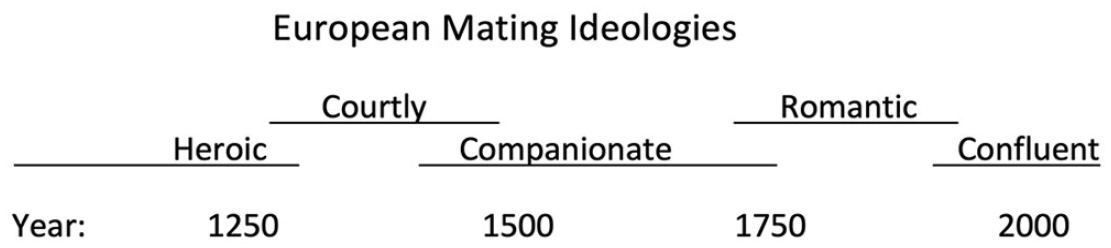
These terms conceptualise the evolution of Western mating beliefs after the Church dissolved Europe’s polygynous kinship societies. Years correspond to transitions in the Nordic region.
As the nineteenth century progressed, romantic delusions became increasingly apparent. They were also a poorer fit in a changing environment. Economic growth from the industrial revolutions created a middle class whose females were meant to remain chaste until marriage, which entailed finding their one true love, according to romantic ideology. Urban and foreign migration contributed to a skewed sex ratio – to women’s disfavour – so that many women did not marry at all (Blom and Sogner, 1999; Matović, 1984). There was also a lack of prosperous-enough men to provide for middle-class daughters and other socially ambitious women. With the romantic equation not adding up, a sexual double standard was institutionalised. Men were meant to pursue professional success that would let them pair-bond according to romantic ideals, that is, with a stay-at-home wife. While in waiting – since it was assumed to be unhealthy for young men to go without sex – they were culturally permitted to copulate, discreetly, with lower-class lovers or government-regulated prostitutes. Since the public assumption was that women were not driven by sexual desires, no such accommodations were made for those who were waiting for Mr. Right (Bredsdorff, 1973).
In 1871, this mismatch between environment and ideology made Brandes call for socially conscious literature to rebel against tradition. When Ibsen heeded this call, he was already a renowned author, but his contributions to the Modern Breakthrough would establish him as the father of modern drama and one of history’s greatest playwrights (De Figueiredo, 2019). His new writing should lead to revolution, Ibsen (1964: 123) insisted, a ‘mortal combat between two epochs [because] anything is better than the existing state of affairs’. When Nora slams the door, I propose that Ibsen can profitably be understood as primarily engaging the literary contestation between mating regimes that has marked the past millennium. Similar to the way in which authors of medieval romances had argued against antiquity’s polygynous social orders and how Ludvig Holberg – the eighteenth-century founder of Scandinavian drama – had argued against companionate love (Larsen, 2022b), Ibsen aims for the jugular of romantic love. These authors may not have had a conscious understanding of precisely which historical tradition they wrote in, but one of fiction’s many functions is to let moral communities discuss whether their mating practices are still functional and, if they are not, to develop and agree on new ones (Carroll et al., 2020, 2012). When Nora leaves her husband to seek self-realisation as an individual, Ibsen’s lets her adhere precisely to what the West’s next mating ideology would sacralise.
A Darwinian exploration of interiority
That Nora’s door slam reverberated internationally was partially due to how Ibsen attacked ‘the general values of the European bourgeoisie’ (D’Amico, 2013: 81) who viewed women to have different traits and skills that complemented those of men. Like Nora, women were supposed to restrict themselves to the domestic sphere as their husbands’ subordinates. Ibsen based his dramatic conflict on this ‘essentialist conception of separate and irreconcilable gender spheres’ (Fulsås and Rem, 2018 [2017]: 84). The linchpin of this belief was that human love was meant to last a lifetime. Courtly and romantic ideologies had exaggerated the power and duration of human pair-bonding affect to convince in particular high-status men not to hoard women, which powerful polygynists had done throughout humanity’s agricultural phase (Raffield et al., 2017a, 2017b). Today’s evolutionary scholars conclude that Homo sapiens evolved for serial pair-bonding with clandestine extrapair copulation but with exceptional flexibility to adapt to environmental circumstance (Chapais, 2008). The authors of the Modern Breakthrough built on each other’s contributions to arrive at a similar understanding of human mating.
People have always noticed that sexual and romantic feelings change and dissipate over time. A Darwinian theoretical foundation compelled the authors of the Modern Breakthrough not to reject such notions for breaking with their era’s ideals but to further investigate them to develop norms more in line with what they perceived to be actual human nature. In their exploration of concepts like ‘true marriage’ and ‘free love’, they sought answers to a line of questions. If we accept humans as they are, with whom is it okay to copulate and pair-bond, and when should such bonds be broken? If women are not meant to be provided for, should they seek professional equality?
Jens Peter Jacobsen was the first writer to dissect pair-bonding emotions with a Darwinian scalpel, exploring the relationship among lust, love and emotional attachment (Fisher, 2016). After translating Darwin’s works, the Danish botanist became an author of exceptional prominence, celebrated across Europe at the turn of the century. Although today mostly forgotten outside of Scandinavia, Jacobsen’s naturalist deep dives into human psychology inspired writers and thinkers such as Joyce, Mann, Freud and Kafka (Jensen, 2017). His debut, the short story, ‘Mogens’ (1872), and his final novel, Niels Lyhne (1880), bookend his remarkable career, which was cut short by tuberculosis when he was 38 years of age. These works dramatise how the transitory nature of our feelings, which evolved to motivate reproduction and pair-bonding for early hominins (Chapais, 2008), can sabotage modern relationships for those convinced by the myth of lifelong love.
The young lovers in the short story ‘Mogens’ experience how their own nature clashes with romantic ideology: ‘That which was called love, it was the hollowest of all hollow things, it was lust, flaming lust, glimmering lust, smoldering lust, but lust and nothing else’ (Jacobsen, 1921: 64). The protagonist expected lifelong happiness from merging with his lover, but long-term pair-bonding seems impossible: Passion spoiled everything, and it was very ugly and unhuman. How he hated everything in human nature that was not tender and pure, fine and gentle! He had been subjugated, weighed down, tormented, by this ugly and powerful force; it had lain in his eyes and ears, it had poisoned all his thoughts. (Jacobsen, 1921: 79)
In Niels Lyhne, one of the first truly modern novels (Jensen, 2017), the protagonist notices that after being married for 2 years, a couple he knows have seen their intense passion replaced by ‘a sweet contempt which day by day lessened in sweetness and became, at last, utterly bitter’ (Jacobsen, 1919: 197). His father had understood that humans cannot cling to romantic delusions if they want a marriage to last. After a year of bliss, his intense love dissipated. He adapted by letting go of his ‘plumage of romance’ to ‘settle peacefully’, accepting that their mutual feelings become ‘more like the quiet glow of embers on their bed of ashes, spreading a gentle warmth’ (Jacobsen, 1919: 11). His wife, having grown up reading romantic literature, is filled with sadness when her dopamine level diminishes. Her feelings of lust and love had affected her cognition, the manner in which she perceived the object of those feelings. Her husband now begins to appear no whit different from the people she used to live among. She had merely been deceived by the very ordinary fact that his love, for a brief moment, had invested him with a fleeting glamor of soulfulness and exaltation. (1991: 12)
A movement for social change
In the early phase of the Modern Breakthrough, authors established that human nature is not as romantic ideology portrays it to be. Nor are our sexual impulses best understood as a moral test devised by a Lutheran God. In the 1880s, authors turned their focus to social consequences. Ibsen’s Ghosts (Gengangere, 1881) dramatises how bourgeois sexual morality makes people miserable and immoral – and stands in the way of better solutions. This, his most naturalistic play, also caused a scandal; it portrays infidelity, venereal disease and incest – the ugly side of human sexuality, which was amplified through moral dysfunction. Ghosts took the modern tragedy in a new direction by not dramatising ‘the unhappy consequences of breaking the moral code’, which was what tragedies had normally done. Ghosts showed the detrimental ‘consequences of not breaking it’ (Valency, 1963: 162). A younger Ibsen (1871) had written that as an author, it was not his task to solve problems, but merely to ask questions. Now part of a movement with the expressed purpose of changing the world, he allows himself to be more constructive. In The Wild Duck (Vildanden, 1884), he suggests that ‘to establish a true marriage’, it would have to be ‘based on complete trust, one that’s wholehearted and open on both sides [without] secrets [and with] mutual forgiveness of sins’ (Ibsen, 1978b: 465).
Such pragmatism towards pre-marital sex also for women was a bold public position. The Wild Duck can be read as an attack on Ibsen’s rival, Bjørnstjerne Bjørnson. His long-time literary competitor, who at this time still had a more prominent standing as a public intellectual, had recently enlivened the morality debate with A Gauntlet (En hanske, 1883). To the surprise of audiences and other authors, Bjørnson’s play argued that the solution to ‘the double standard’ was to demand pre-marriage chastity also from men. Instead of moving beyond the ideology of romantic love, Bjørnson wanted to double down on it. He claimed that his position was grounded in Darwinism, although not in Darwin’s own view of evolution being without will. Having sided with Lamarckism (inheritance of acquired traits), Bjørnson thought that offspring would not only inherit their parents’ predispositions for promiscuity but also, importantly, the parents’ lifelong efforts at resisting promiscuous impulses (Gjellerup, 1881). After reading Darwin, Bjørnson had convinced himself that lust led to cruelty. If Scandinavian men remained virgin until marriage, he thought, they would be less burdened by the kind of vanity and lack of moderation that so plagued the French (Bredsdorff, 1973).
The circle around Brandes responded with contempt and ridicule. Christian conservatives and much of the general public supported Bjørnson. Similar to what would be the case with Comedy Italian Style in the 1960s, the Scandinavian movement was avant-garde in terms of portraying promiscuity and alternate forms of cohabitation. While the Italian filmmakers were able to appeal to wide audiences, the Scandinavian authors mostly sought support from urban progressives. The big theatre stages functioned as testing grounds for the dramatists’ Darwinian interpretations. A Gauntlet was thoroughly rejected; Bjørnson’s play became a cult hit that drew roaring laughter (Lindberg, 1943). There was a diminishing space for collegiality among those who disagreed on mating ideology; perceived to be at stake in their literary contest was the future well-being of Scandinavian men and women. The Swedish polymath August Strindberg had no patience for Bjørnson’s re-embrace of romantic ideals, writing ‘Be immoral, Bjørnson, like you were in your youth, for the virtue that comes after age 50 is no good for preaching!’ He signed his letter, ‘your former friend’ (qtd. in Jansson and Schröder, 1981: 34).
Strindberg’s literary response was his short stories in Married (Giftas, 1884–1886). Unlike Ibsen whose Darwinian influence was ‘almost incalculably diffusive’ (Ewbank, 1999: 301), Strindberg ‘had an overt and well-documented interest in evolution’ (Shepherd-Barr, 2015: 128). How he engaged with Darwin also evolved however. During his naturalistic phase of the 1880s, Strindberg often focused on the survival of the fittest, crafting literary themes that he sought to prove like scientific theses through convincing dramatisation. His short stories reject the possibility of ‘true marriage’, in the sense that couples could live together harmoniously if the right laws were passed and the proper cultural adaptations made. Strindberg posits that men and women will have to accept a certain level of matrimonial terror, as the sexes are stuck in a Darwinian contest. His hope was that insights from the Modern Breakthrough could help them find ‘safety-valves for their temperaments which refused to blend’ (Strindberg, 1917: 239).
Relying on his era’s crude understanding of evolutionary psychology, Strindberg argues that our animalistic nature lends itself poorly to romantic idealisation of mating markets. Instead of a man and a woman being meant for each other, ‘right is on the side of the strong and the beautiful’ (1917: 226). Modern research documents how much more is at play than strength and beauty when men and women assess each other (Lukaszewski and Roney, 2010). By focusing on sexual selection, Strindberg sought to counter the movement’s more simplistic ‘indignation literature’, which reduced men to villains and women to victims. Darwinian competition entailed that men and women were stuck in mutually exploitative and supporting relationships. His contemporaries were not ready for these perspectives. The Swedish dramatist was charged with blasphemy for having written Married although later acquitted (Meyer, 1985).
Bohemian prescience
As the 1880s progressed, a more-complex argument for gender relations developed. Amalie Skram, the movement’s premier female author, dramatised in Constance Ring (1885), Lucie (1888) and other works the ways in which women suffer under the romantic regime. In The Making of Daniel Braut (Bondestudentar, 1883), Mannfolk (‘Men’, 1886a) and Weary Men (Trætte Mænd, 1891), Arne Garborg chronicles how men suffer in a premarital limbo, testifying to a mating regime that is not moral but cruel and nonsensical. For him, ‘free love’ meant ‘free divorce’, the right for men and women to move on without social sanction (Garborg, 1888). Skram and Garborg were members of the Kristiania Bohemians, the Norwegian capital’s artist community that was led by Hans Jæger, the ‘rabid dog’ of the Modern Breakthrough (Anon, 1886: 1). Their mission was to wake up those in power by writing controversial literature that displayed reality as it was. By doing this, these three authors developed an understanding of human mating that in the twentieth century would become the foundation for Scandinavia’s gender-equal, high-public-spending social order.
In the movement’s most scandalous novel, Fra Kristiania-Bohêmen (1885), Jæger envisions how, instead of lifelong monogamy, we could ‘have free love, so that men and women can leave each other and seek new love when they became transparent to each other’ (1885: 274). If this proved possible, Jæger estimates that he would like to have around 20 ‘such complete intimate relationships’ in his lifetime. This seemingly exorbitant number left the public aghast, turning Jæger overnight into ‘Norway’s most infamous man’ (Bredsdorff, 1973: 120). Jæger’s estimate corresponds quite well with what today’s Nordic men express as their preference for partner variety (Schmitt, 2003). His attempt at imagining a society adapted to human nature was thoroughly rejected. Jæger’s novel was confiscated, and he lost his job. The authorities submitted him to mental evaluation and imprisonment (Bjørnstad, 2001).
Jæger’s opponents were so provoked that they failed to give his argument a fair hearing. Those convinced by romantic love felt that the bohemians promoted ‘copulation en masse’ (Rosenberg, 1872). By ‘free love’, Jæger did not mean unrestrained promiscuity; he wanted social acceptance for serial monogamy. Jæger considered economic independence and equality, across gender and class, to be paramount if his vision was to stand a chance at realistic implementation. For men and women to be equal partners, free to leave when they no longer felt lust and love, Jæger imagined a future in which both genders had well-paid jobs. This is the crux of confluent love (confluence: come together), that people should pair-bond only for as long as both benefit from the union (Giddens, 1992). Skram (2014: 94) concurred, later adding that if society ran on social democratic principles, all this would resolve itself. Because the crux of the problem is economic. In politics we know that might makes right. In the domain of love it’s the same, and here ‘might’ means the opportunity for both men and women to properly provide for themselves.
Skram (1989: 6) later questioned if pre-marriage chastity made sense for anyone given the confusing and transitory nature of our feelings. In Betrayed (Forradt, 1892), she suggests that it would be better if people ‘know each other for seven years and then get married, if you have not yet lost your lust for each other’. Twentieth-century Scandinavians were to heed her advice, becoming the world’s leading pre-marriage cohabitators (Heuveline and Timberlake, 2004).
Another bohemian, Christian Krohg, had a novel confiscated for its dramatisation of legislative dysfunction. Albertine (Krohg, 1886) argues that laws meant to promote morality could drive women into sex work. Five thousand people protested the confiscation, compelling the minister of justice to undo the law on government-regulated prostitution. This political victory led Garborg (1886b) to insist that his latest novel too had to be seized. By then, authorities seem to have wised up to triggering protests and providing free PR. The morality debate had reached its apex. The Modern Breakthrough ended after nearly two decades, similar to what would become the duration of Comedy Italian Style. For both movements, critics suggest different end dates (Brantly, 2004; Moi, 2006), but most agree that by 1890, the Modern Breakthrough had played itself out.
From first- to second-wave feminism
A Doll’s House’s Italian premiere in 1889 was surprisingly free of scandal (D’Amico, 2013). This did not entail that southern Europeans were similarly ready for first-wave feminist victories as more northern Protestants were. Nora, the self-supporting New Woman, found less fertile ground elsewhere for a variety of historical reasons (Sjögren, 2010). Joseph Henrich (2020) substantiates how the core division of Western culture follows a line that bifurcates north-western and south-eastern Europe. With the Church’s dissolution of European tribes, a psychological-institutional coevolution followed that drove people towards ever-greater abstraction and individualism. This process resulted in the Reformation, after which north-western Europeans received more of those influences that drove WEIRD psychology (western, educated, industrialised, rich, democratic; Henrich, 2020). The Lutheran ideology prepared for modern gender equality through a variety of beliefs and practices. That only the Nordic nations embraced Lutheranism on the national level is thought to be the main factor behind why today they are the world’s most gender-equal nations (Nelson, 2017).
Scandinavians were thus uniquely positioned to untangle and adapt to gender implications of the Darwinian revolution. They had a rich tradition of using written fiction to discuss changes in mating regimes which goes back to the sagas (Larsen, 2022c). Their culture prepared avant-gardes for abstracting gender to the extent that they could envision women as sexual and professional equals – and eventually convince regular people of the same proposition. Already in the early-eighteenth century, Holberg had promoted educational and professional equality for women, putting him ‘ahead of the entire Enlightenment Hall of Fame’ (Bredsdorff, 2014: 23). The Modern Breakthrough followed in this tradition. Elias Bredsdorff (1973) argues that the morality debate, with its extreme irreverence for sexual and social taboos, would have been inconceivable at this time in any other place than Scandinavia. Darwin was discussed around the world, but only in these countries did he inspire a movement with such a powerful effect. Its insights contributed to a line of emancipatory legislation and welfare benefits over the generations that followed. After World War II, social democratic governance provided females with a level of freedom that they had generally not experienced since pre-Neolithic times.
When the Second Sexual Revolution unfolded, Nordic women already had an economic and cultural foundation that let them seize new opportunities with less risk than what women faced elsewhere. Second-wave feminism found fertile soil. In Italy, romantic delusions and double standards had not been challenged to the same extent. The honour culture that had been integral to antiquity’s heroic love still had a strong standing, especially in the south, which had been the region least exposed to WEIRD practices (Henrich, 2020). Comedy Italian Style emerged as an artistic movement whose main unifying purpose was to convince audiences that the time had come to reconsider gender relations.
Modern women, outdated men
Big Deal on Madonna Street (I soliti ignoti, dir. Mario Monicelli, 1958) is commonly viewed to be the movement’s first work. The heist story features hapless gangsters who try to keep up with a changing Italy. The same forces of urbanisation and economic growth that had contributed to Nordic mating dysfunction in the nineteenth century now changed post-war Italy. As their national income doubled between 1952 and 1962, agricultural employment fell from 42 to 29 percent. The excess population moved to the cities. Rising salaries led to a ‘cult of consumerism’ encouraged by the introduction of advertising on TV in 1957 (Günsberg, 2005: 60). Like several of these films, Big Deal on Madonna Street seeks to expose how the era’s economic boom does not benefit everyone. Modern Italians are culturally compelled to seek self-realisation through the new consumer society, inspiring those who fall behind to commit crime to keep up. The film’s marginalised men are portrayed with considerable sympathy. Audiences are given the impression that in a changing Italy, so many men fail to live up to ancient masculine ideals that the time has come to consider new ideals.
The movement’s psychoanalytic origins are often traced further back to I vitelloni (dir. Federico Fellini, 1953). The title is slang for ‘an immature, lazy person without a clear identity or any notion of what to do with his life’. Five listless young males are portrayed not in the flat stereotypical manner audiences were used to in comedies but with the ‘increased psychological profundity’ that would come to mark Comedy Italian Style (Bondanella, 1992: 90). The social context is provincial Italy. In this backward environment, men have become a burden to the era’s more well-adapted females. Males are so useless that the old patriarchal order appears absurd. How they sexually harass women on the street is a pathetic re-enactment of gender patterns that the film’s modern women have left behind.
Fellini’s mask play during a carnival sequence portrays the male characters as incapable of the authentic individualism that modern ideology requires. Romantic love expected men to fulfil their half of a dyad through a predetermined role that would let them complement the woman. Confluent love expects men to be whole on their own so that they can pair-bond with an equally whole woman for as long as both parties benefit. Andrea Bini (2015: 9) finds the mask play to be an obvious dramatisation of how the movement’s ‘humour is deeply Pirandellian in describing men incapable of facing the dissolution of traditional values and the consequent discovery of social identity as a mere mask’. Luigi Pirandello was an Italian dramatist who won a Nobel Prize for ‘his almost magical power to turn psychological analysis into good theatre’ (Hallström, 1934). I vitelloni offers convincing insights into why its male protagonists feel so lost. However, when the film ends, these men are about as immature as they were in the opening scenes. No alternative roles are explored, and little hope is offered for a New Italian Man. Men are in a mostly hopeless situation, primarily due to their own dysfunctional response to change.
The satirical format informs this narrative choice, as does perhaps the movement’s psychoanalytical inspirations. Mainstream film often gives the impression that humans change rather easily; a final act catharsis helps protagonists overcome their main character weakness so that they become whole and authentic (Larsen, 2020). Fellini’s (1996: 150) unwillingness to dramatise a solution could be read as him striving for greater interior realism. He explains that in his films: the story never reaches its conclusion . . . my characters . . . cannot evolve in any way . . . I have no intention of moralizing, yet I feel that a film is the more moral if it doesn’t offer the audience the solution found by the character.
No more sexual egalitarianism
When individuals do change in these films, they can even be punished, as in Il sorpasso (dir. Dino Risi, 1962). This aesthetically innovative and masterfully executed road movie is often viewed as the quintessential boom-era comedy due to how it ‘discloses fully the genre’s humourist core – that is, the gap in the symbolic realm that causes the split between the character and its social mask’ (Bini, 2015: 142). The male protagonist clings to romantic beliefs, which only make him lonely. An opportunity for modern self-realisation comes in the form of a speedy, sun-drenched adventure. On his journey through boom-era Italy, he learns the ins and outs of confluent love from his sidekick who is a master of this shallow game. Not only can women be pursued for pre-marital sex, but men who prefer a romantic strategy will fall behind. Risi portrays the world to have become this way but is unwilling to condone its new morality. The charismatic sidekick who embodies confluent love is portrayed as a social failure although a likeable one who knows how to enjoy life. The protagonist is immediately punished for mimicking him. In the final sequence, his romantic backwardness gives way for the live-in-the-moment attitude typical of the era. As soon as he adopts this new morality, he dies in a car accident, and the film is over.
In A Doll’s House, Nora avoided the suicide Ibsen had originally intended for her. That he instead granted her agency to move beyond traditional femininity, defined by romantic ideals, has been viewed as a feminist victory (Fulsås and Rem, 2018 [2017]). A similar agency to move beyond traditional masculinity rarely befalls the characters of Comedy Italian Style. Millennia of honour culture have so entrenched themselves in the male psyche that a novel environment mostly results in new expressions of old habits. Men cannot help but victimise women through their playing out of ancient gender roles. Il sorpasso’s iconic sports car, a Lancia Aurelia B24, is symbolic of how male-male competition finds new forms. The car represents new mobility, economic opportunity and cultural instability. The agricultural environment had compelled lifelong monogamy since fields could not be split up and carried away in case of divorce. The urban environment’s greater mobility and economic freedom changed how men and women related to each other, as they could be out of reach for the social control of families and local communities. This freedom created a chasm between types of men.
Natalie Fullwood writes that cars came to symbolise virility, as sexual opportunity increased in this new reality. Many ‘“ordinary” male protagonists’ find themselves unable to compete on the now less-restricted market for uncommitted sex. Under a romantic regime of lifelong monogamy, there is one woman per man. Under a confluent regime of serial monogamy with extrapair copulation, successful men can hoard women – similar to the way in which their high-status ancestors had acted in the post-Neolithic environment. In the second millennium, the Church had imposed a sexual egalitarianism that made the modern world possible (Henrich, 2020). This mating regime lost its ideological justification after the Second Sexual Revolution. Fullwood notes that the failure that low-status men experience is likened to being left behind as other men speed past in their faster, more expensive cars. Il sorpasso means ‘the overtaking’, of which the road movie features many exhilarating examples. The works of Comedy Italian Style have ‘a huge amount of attention devoted to the benefits and pleasures of increased sexual liberation, especially increased female sexual liberation as enjoyed by men’. However, they also dramatise how men suffer on account of their assigned gender role. Male promiscuity ‘is represented as inevitable and even becomes expected; a failure to adequately perform promiscuity signals a failure of masculinity’ (Fullwood, 2015: 200–3).
Men and women trapped by marriage
For female characters, too, cars become symbols of promiscuity, of the possibility of evading male control. For women, these new opportunities are also not portrayed as unambiguously positive. In The Girl from Parma (La parmigiana, dir. Antonio Pietrangeli, 1963), the young female protagonist commits to the era’s ethos but ends up as a prostitute, albeit an empowered one. Audiences are led to question whether she would have been better off had she pursued romantic love. Pietrangeli was an unusual director within this movement by not structuring his stories exclusively around males. Seven of his 10 features have female protagonists. His indictment of the patriarchy is scathing. In his films, writes Emma Katherine Van Ness (2020: 196), the women’s ‘choice between marriage and independence is often reduced to the choice between submission to a husband and a life of prostitution’.
Pietrangeli’s emphasis on feminist concerns goes back to his critical writings from before Comedy Italian Style. The influential critic, doctor and politician theorised what Italian national cinema should become to be a progressive influence. He played a similar role of the theorist and critic as Brandes did for the Modern Breakthrough. While the Dane motivated some authors to advocate certain social changes, Italian filmmakers were rarely as constructive, mostly dramatising dysfunctional tradition. The Girl from Parma follows this pattern, offering no vision for more harmonious pair-bonding practices, suggesting no content for a ‘true marriage’ or ‘free love’. Pietrangeli’s pessimistic view on marriage was shared by other filmmakers who portrayed the institution as similarly oppressive towards men.
Divorce Italian Style (Divorzio all’italiana, dir. Pietro Germi, 1961) gave the film movement its name. More than a decade before divorce was legalised in Italy, the protagonist feels he has no choice but to kill his wife if he is to be with his new love. The dark plot is hilariously executed. The story ridicules how poorly adapted the romantic regime is to the modern environment. Other films often placed the psychopathology in individual men. This film’s exaggerated characters lend themselves to no such individualization of responsibility; society is the organism suffering from psychopathology. It may have been adaptive for agricultural communities to coerce couples into staying together for life, which had been sacralised by courtly, companionate and romantic love. In this film’s post-agricultural community, such ideology results in everyone ending up crazy, miserable or dead.
Divorce Italian Style, which won an Oscar for best screenplay, exemplifies the movement’s ‘new type of ruthless social satires through the lenses of cynicism and the grotesque’ (Lanzoni, 2008: 8). Although the male protagonist gets a lenient sentence after having orchestrated the murder of his wife as a crime of passion, Marcia Landy (2000: 222) notes how the film makes clear it is not only the men who wield power and work to maintain the status quo: The women are complicit in reinforcing, when expedient, the repressive aspects of family life. [They are] no mere victims, they are subversives whenever possible, engaging in dramas of betrayal, threatening the men with cuckoldry, and, in the final analysis, resorting to violence.
The end of a movement
The sexes’ mutual responsibility for honour culture is emphasised in several notable works. Cuckoldry functions as the ultimate threat against a man’s social standing. Female characters cheat on men who appear to be just as bound and oppressed by outdated gender roles as women are. If a man fails to control the sexuality of his wife, daughters and female family members, he and his family could suffer detrimentally. The consequences of subjugating modern people to such dictums of honour are portrayed as inhumane. These social and psychological mechanisms make for ruthless satire in films like Seduced and Abandoned (Sedotta e abbandonata, dir. Pietro Germi, 1964) and The Seduction of Mimi (Mimì metallurgico ferito nell’onore, dir. Lina Wertmüller, 1972). Entire communities are involved to ensure that both women and men act in accordance with inane rules of which no one seems to question the authority. Men are portrayed as puppets of culture worthy of ridicule but also sympathy. For Wertmüller’s protagonist, his ‘masculinity constitutes a central target of humour’, and his attempts at performing in line with ‘the mythologies of Sicilian masculinity . . . is exposed as ludicrous’ (Rigoletto, 2013: 77). How the male should act instead – and still have a chance at professional and romantic success in modern-day Italy – is not suggested.
Wertmüller ends her film on a despondent note. The honorary Oscar winner turned her back on the award-winning approach of her early career to join the commercial movement of Comedy Italian Style. She expressed strong political ambitions for her films, yet she does not let her narrative dramatise an alternative to the status quo. After failed experiments with new mating moralities, her characters in The Seduction of Mimi return to the ancient regime, symbolised by the mafia and overproductive uteruses. Thus, not even the 1970s’ utopian left-wing politics get to formulate a way out. The film’s female love interest, while strong and politically pure, ends up being reduced to ridicule – although she does get to make the final choice of the film when, in the resolution scene, she leaves the protagonist. Her choice, however, hardly evokes that of Nora, as she moves towards no new morality.
The 1970s’ economic crises and more hard-line politics made for a context different from that of the boom years. The further evolution of Comedy Italian Style ‘pushed the tragic-comic element beyond the public and critic’s level of tolerance’ (Lanzoni, 2008: 229). So-called chronicle films, which covered the past decades, heralded the movement’s end. We All Loved Each Other So Much (C’eravamo tanto amati, dir. Ettore Scola, 1974) was one of these. Scola ‘wanted to make a film on [his] generation, which had by then reached the summing-up point’ (Apra and Pistagnesi, 1986: 77–8). The director begins his ambitious narrative with the idealistic and socially united anti-fascist resistance of World War II. He dramatises the 1950s’ and 1960s’ failure of idealism, which informs the ensuing decade’s political and social disillusionment. His chronicle film posits that a society’s well-being primarily depends on individuals retaining a healthy psychological makeup as the world around them changes. Through his criticism of the utopian excesses of the 1960s and 1970s, Scola prepares for the individualistic turn of the impending neoliberal era.
Different films and years are suggested as endpoints for the Comedy Italian Style (Bini, 2015; Di Carmine, 2013; Günsberg, 2005; Lanzoni, 2008), but by 1980, the movement was over. Filmmakers had aged, as had the actors they had relied on. A new generation of moviegoers were less enthusiastic about the satirical, psychoanalytical comedy format their parents had enjoyed. Media liberalisation and home video also created less-favourable economies of production. Only after the movement’s end did domestic critics become aware of what they were missing. Notoriously high-brow Italian critics had mostly shunned the popular genre of which American and other critics had extolled the brilliance (Vitti, 1990). Today, Comedy Italian Style is generally praised as a unique and fascinating blend of comedy and drama, low- and high-brow tastes and entertainment and social engagement. Critics do not agree, however, to what extent the movement simply reflected ‘the mores of a changing Italy’ (O’Rawe, 2008: 182) or whether its satire influenced how modern Italians came to view gender relations.
Similarities and differences
It is tempting to declare the Modern Breakthrough to be the more influential movement. Its dramas, in particular A Doll’s House, inspired debate on gender equality across the world and continue to do so (Larsen, 2022a). Today, the Kristiania Bohemians’ insights into our serially monogamous, partly adulterous nature may seem obvious, but during their era of romantic delusions, such claims felt blasphemous and landed authors in prison. Their literature undermined contemporary mating beliefs, a practice which tends to motivate strong resistance, but they merely claimed what modern social democrats take for granted. Being such an early, and fairly unified, voice for confluent love speaks to the movement’s prescience.
Comedy Italian Style was also defined by its engagement with contemporary social issues, often related to gender. Concurrent with the movement and second-wave feminism, Italians legalised divorce and abortion and granted gender equality in marriage. However, the movement’s influence is disputed. Bini warns against overestimating the social effect of films in general, viewing them more as ‘mirrors of a society’. She downplays these Italian films’ political aspects, viewing their approach to gender dysfunction as more psychoanalytic. Instead of representing the era’s issues as ethical conflicts, the filmmakers narrate ‘the loss of a national symbolic order – what has been defined as the “divided self”’ (Bini, 2015: 205). Such alienation explains the male characters’ psychological crises, which cause them to engage in anti-social behaviour, such as being unpleasant towards women.
Giorgio De Vincenti (2001: 14) finds that these satires do ‘not include any alternative model [merely] disapproving without proposing anything else’. The films typically end with resignation and without reconciling individuals with their communities. Viewers are left with the impression of an Italian middle class that is amoral and self-indulgent, writes Bini. Maggie Günsberg (2005) finds the movement’s pessimistic approach to be best understood through the psychoanalytic perspectives of Lacan and Freud. Van Ness (2020) substantiates how Freud influenced the works of filmmakers such as Pietrangeli, the most feminist director in a movement criticised for being an ‘all-male genre with all-male stars’ (Bini, 2015: 203).
Comparing these two temporally and geographically distant movements throws up intriguing similarities and differences. Both engage with the transition from rural to urban living during transformative eras. They point to romantic expectations of female chastity as a key problem with far-reaching consequences. The movements portray both women and men as burdened by what other perspectives could conceptualise as male villainy with respect to oppressing female sexuality. The medial differences are the most obvious. Nordic authors imbued their arguments in serious plays and literature mostly consumed by the middle class. They sought to influence not only public opinion but also legislators who had the power to enact change. Several of the Italian filmmakers transitioned from serious drama to more low-brow comedy to reach wider audiences, and many did so for political reasons. However, they remained ambiguous in terms of solutions. Both movements challenged hegemonic practices by portraying a more liberal behaviour and views than what were common among contemporaries and in other cultural discourses.
Instead of embarking on naturalistic explorations of opportunities, the Italian filmmakers chose the format of satire. Its function can be defined as to cynically ‘criticize and not to propose a cure from social illness’ (Bini, 2015: 75). The satirist’s purpose is to diagnose, not plan the ideal society. Satirical stories should oppose any conciliatory plot resolution, writes Leonard Feinberg (1968). The movement is mostly viewed as having brought attention to timely issues, but not to have significantly impacted in which direction Italian culture evolved from the 1960s onwards. Rémi Fournier Lanzoni (2008: 1) writes that Comedy Italian Style was ‘an accurate social barometer and a powerful tool to mirror the time’s struggles within Italian society’. The films’ influence came from undermining the status quo. Peter Bondanella (2009: 181) concludes that the ‘comedies may accurately be said to have treated real social, political and economic problems quite courageously and more successfully than overtly ideological films’.
A psychoanalytic perspective motivated filmmakers to explain social dysfunction at the individual level. Honour culture is a social phenomenon, but how this historical remnant creates mental pathology in many modern men is portrayed as the core of the issue. Italy’s cultural past influenced how men viewed their own masculinity and self-worth. Such values were portrayed as deserving nothing but derision, not only in urban settings but also in the movement’s depiction of rural environments. Hardly any attempt is made to explain or contextualise old morality; it is simply wrong. Italian women and men have suffered long enough under patriarchal oppression, which drives psychological illnesses. Modernity is here to save them, if only male individuals can extricate themselves from their ancestors’ beliefs. This simplistic approach seems informed by how the age-old honour culture had become tied to the former regime’s politics. Sergio Rigoletto notes how masculinity itself emerged as a political battleground for the national soul. In Comedy Italian Style, ‘male prowess and sexual vigour, previously celebrated by the propaganda films of the fascist period and so central to the representation of masculinity in Hollywood cinema, are frequently ridiculed as untenable for Italian men’ (Rigoletto, 2014: 4–5).
Conclusion
To what extent these movements influenced cultural evolution we cannot know, which is mostly the case with all fiction. Instead of asking which movement was more influential, it is more productive to compare how they both engaged with their time and cultural context to make people consider how a changing environment should influence gender relations. Differences in genre, audience and theoretical approach influenced the movements’ capacity, or at least intention, to affect change. The naturalistic drama seems more suited for uncovering human nature in a way that lends itself to prescribing social solutions. With young progressives and the intellectual middle class as target audiences, the men and women of the Modern Breakthrough dared to offer deeply unsettling analyses and prescriptions for cure. Many readers and audiences revelled in such irreverence. The Darwinian metanarrative encouraged authors to view society as an environment that should be adapted to human nature, not to sanctify our evolved desires but because the ideology that goes against human nature is less likely to succeed as a societal foundation.
In contrast, satire is widely enjoyable, writes Feinberg (1968: 7), because ‘nobody really expects us to do anything about it’. Audiences assume that satirists ‘have no real intention of ever doing anything’. De Vincenti believes that how Comedy Italian Style complained without suggesting alternatives, which inevitably would alienate some audiences, was key to its popularity. For 2 decades, these films were the financial backbone of Italian cinema (Lanzoni, 2008). Most audiences could unite around their country needing new values, but not around what these should be. Instead of pointing a way out of the malaise, Comedy Italian Style became ‘the epic of failure’, concludes Maurizio Grande. The movement was ‘seen not like a mechanism that introduces to adulthood and “teaches” access to society anymore (as in classical comedy), but as a permanent condition of living with no centre or periphery’ (Grande, 2003: 87). Such a condition lent itself to the psychoanalytic metanarrative for which human interiority is the primary focus. Historically, Italian literary and theatrical comedy had been ‘characterized by a stark realism and the satirical tendency to describe humanity as it is, made of flesh and (illicit) desires’ (Bini, 2015: 3). In Comedy Italian Style, these desires are understood in moral and psychoanalytic terms instead of being dissected by the naturalistic perspective that Darwinism encourages.
The result was a movement whose popularity and aesthetic innovations are its primary strengths. Lanzoni (2008: 231) concludes that the films’ ‘cinematic cynicism, social satire, and grotesque caricatures permanently shifted Italian comedy’s aesthetic horizons’. In terms of cultural change, Roberta Di Carmine (2013: 455) acknowledges no more than that the films ‘unsettled the foundations of Italian society by openly showing its hypocrisy and pettiness’. Comedy Italian Style protested against the politics that its era had inherited. After the war, masculine and feminine ideals became a battleground for two transitions that occurred concurrently, but which it became politically opportune to conceptualise as the same. The first transition was away from the early-twentieth-century fascism, and the other was from the honour culture and romantic ideals that had regulated gender relations for much longer. As these transitions unfolded, Comedy Italian Style provided two decades’ worth of widely accessible films, many of which appealed across class, gender, geographical and generational divides. The success and subject matter of these works made them, arguably, the most important arena for the Italian post-war discussion on gender.
The Modern Breakthrough had been more divisive, appealing predominantly to urban progressives. Its issues mostly related to the urban middle class. At the time, those of lower and rural classes faced different challenges. To assess the relative success of the movements, we must also consider that for the Modern Breakthrough, a transition towards confluent love was paramount. For Comedy Italian Style, this was one aspect of a wider project. For an Italy that, after fascism and war, had lost what Bini calls its ‘symbolic edifice’, an inclusive discourse was preferable. As many as possible should participate in the creation of a new cultural imaginary so that this could replace the old one that caused shame for many Italians. The movement’s cruel, low-brow ridicule must be understood from this perspective. The stakes were no less than the Italian understanding of itself. The director of Il sorpasso concluded, with hindsight from 2005, that thanks to Comedy Italian Style, ‘we have told the [true] story of Italy’ (qtd. in Lanzoni, 2008: 231). In the extension of this reasoning, we can conclude that both movements were remarkably successful – on their own terms, adapted to distinct contexts – and that both helped men and women transition past a romantic ideology that no longer fits their environment.