



Abstract
Lectures and seminars increasingly strive for continuous interactions between learners and the instructor. I study whether the communication program Slack contributes to these goals by analyzing daily activity statistics in methodological and project-based postgraduate courses at an Irish university. Both semester-long courses were taught online during the coronavirus pandemic (Covid-19) and in person. The quantitative analysis reveals three insights. First, students are active on Slack throughout the term. Second, students post messages in public channels and extensively use private channels and direct messages. Third, many students follow the conversations, ensuring transparent and fair communication between students and instructors. Open-ended responses suggest that Slack created “team spirit.” I conclude with five recommendations: students should sign up in the first week of term; create channels for different aspects of the module; explain when students can expect a response; encourage private conversations between students; and monitor activities regularly.
Introduction
Facilitating communication with and between students, coordinating group projects, and collaborating on assignments are central features of modern teaching and learning approaches. In the past, module instructors communicated with students during and after lectures and tutorials, on Learning Management Systems (LMS), and via email (Lowerison et al., 2006; Miller, 2014; Trudeau, 2005). Digitalization, the coronavirus disese 2019 (COVID-19) pandemic, and the move toward active learning have changed many of these traditions (Kerrigan et al., 2022; Loepp, 2021; Singh et al., 2021). Meetings via videoconferencing applications became more common; physical distancing restrictions or long commutes moved formerly in-person meetings to on-line settings; and the emergence of smartphones incentivized many groups to communicate via messenger apps.
In this paper, I assess how the free version of the business communication software Slack can be used as an effective tool for enabling collaboration, communication, and coordination. I combine daily usage statistics and student evaluations from two semester-long master's courses taught in the School of Politics and International Relations at University College Dublin. Introduction to Statistics was attended by 23 (2020) and 44 (2021) master's students. Many students did not have prior knowledge of quantitative methods, and the course was compulsory for most students. The project-based course Connected_Politics was attended by 13 (2021) and 12 (2022) students. This course taught participants how to work in small teams and conduct research projects on computational social science under the guidance of a project coordinator and the course coordinator. The groups addressed research gaps by applying cutting-edge methods, such as quantitative text analysis, machine learning, and computer vision techniques. 1 The courses have been delivered both online and in person, allowing us to assess whether Slack encouraged online discussions even when students could meet physically on campus.
Several research papers provide examples on how to use online communication tools to facilitate exchange between learners and instructors. For instance, Dahdal (2020, p. 239) shows that discussions on WhatsApp resulted in “increasing motivation to participate actively in the lecture's topic.” According to Bouhnik and Deshen (2014, p. 229), WhatsApp enabled a “dialogue between students, whether spontaneous or directed by the teachers [and] creates an atmosphere of cooperation, solidarity.” Building on these findings, I explain why Slack might be better suited for active learning and communication than other messaging apps.
Prior work has assessed Slack as a tool for software developers (Lin et al., 2016), research teams (Kates et al., 2020; Perkel, 2017), a vocational senior high school (Heryandi et al., 2020), undergraduate courses (Papathoma, 2022; Sabin & Olive, 2018), and a master's thesis writing course (Tuhkala & Kärkkäinen, 2018). These studies underscore the usefulness of Slack for collaborations and teaching purposes. So far, only a few studies have explored the daily usage statistics to understand how learners communicate via Slack in courses offered in person or online (for an exception, see Rouhani, 2020). I address this gap by analyzing daily time-series data and moving beyond self-reported measures to reveal the factual engagement with the communication software. The empirical analysis shows that most students actively use the platform several times per week. Across the four courses, on average, between 130 and 383 messages have been sent per week. During a typical weekday almost half of the participants checked Slack. The program also enables efficient communication between learners and instructors: not all students ask questions, but many read questions and responses. These numbers highlight that Slack can contribute to ‘learning from listening to peers’ (Hamann et al., 2009), which has been identified as an important factor for course performance.
Learning Needs and Choice of Technology
Group-based and problem-based courses enjoy greater popularity in many disciplines (e.g., Krajcik & Blumenfeld, 2006; Meyer, 2022). Collaboration and constant interactions motivate learners and correlate with performance. For instance, Hamann et al. (2009) find that reading others’ comments can improve grades. Glazier (2016) tests rapport-building teaching strategies, such as video updates, personalized emails, and electronic feedback. These interventions lowered attrition and improved grades. Discussions, questions, and examples thus play a crucial role in enabling constant exchange and motivating students.
Problem-based learning requires software tools for discussions, feedback, allocating tasks, and monitoring progress (Singhal et al., 2021). Appropriate software should facilitate effective and intuitive communication between groups of students and between learners and instructors. Ideally, the software solutions are used in university settings and in the public and private sectors to develop transferable skills.
Slack is a popular communication platform in the private sector. Messaging tools such as Slack are “rapidly becoming an expected stable of [the] professional toolkit” (Menzies & Zarb, 2020, p. 1). Slack runs on laptops, tablets, and smartphones, or can be accessed through web browsers. Each Slack “workspace” includes “channels” for specific content or groups (public or private) and direct messages. 2 Slack enjoys high popularity in companies and among software developers. More than 10 million people and over 600,000 organizations use Slack. According to these statistics, only 50,000 organizations rely on the premium version, which requires a paid subscription. 3 These numbers highlight that the free version is usually sufficient, even for companies. A survey conducted by Lin et al. (2016) reveals that software developers mention communication, team collaboration, discovery, and community support as some of the main reasons for using Slack.
Many research teams rely on Slack to allocate tasks, provide real-time updates, recognize collaborators’ inputs, and brief new members (Perkel, 2017). Since Slack seems to work well for teamwork, several studies tested the usefulness of Slack for teaching purposes. Meyer (2022) recommends Slack as a communication platform for peer support and cohesion in a project-based methodological course. Based on questionnaires and interviews Heryandi et al. (2020) conclude that Slack helped students improve their writing skills in online teaching. Tuhkala and Kärkkäinen (2018) used Slack to support students during a master's thesis writing course. Feedback and a qualitative analysis of discussions demonstrated that Slack was easy to use and that asking questions was encouraged. However, discussions on substantive questions were scarce, and students mentioned information overload as a potential downside. An analysis of an undergraduate class revealed that “Slack is easy to use, the discussions are flowing, the communication with educators is personal and friendly, and they get the opportunity to network and socialize with new fellow students in a less formal environment” (Papathoma, 2022, p. 566). However, the study also mentioned that some students were overwhelmed by the information and details shared by the course instructor. Sabin and Olive (2018) tested Slack in a second-year undergraduate course with over 160 students. The authors conclude that Slack “replicates and integrates the online and social-media environments that students already inhabit” and that it “can assist faculty in meeting their pedagogical goals online” (Sabin & Olive, 2018, p. 183).
Slack has at least four advantages over emails, LMS platforms, and other messenger tools. First, the software facilitates real-time conversations. Most LMS solutions include discussion forums or the opportunity to chat with peers. However, these functions are often ‘hidden’ in the system and not as user-friendly as software specifically designed for communication. It can be challenging to receive updates on discussions. While email notifications are one way of staying up to date, they could fill the students’ and educators’ inboxes, given that over 100 messages per week were the norm across the courses analyzed in this paper. In addition, many universities use different LMS (Turnbull et al., 2022), making it hard for students to find the relevant functions after moving to another institution. To be clear, Slack is not designed to replace LMS. These e-learning platforms are well-suited for submitting assignments, receiving grades and feedback, and accessing required and recommended readings (Tuhkala & Kärkkäinen, 2018). Instead, I argue that tools such as Slack could facilitate the communication that traditionally took place on e-learning platforms or via email.
Second, unlike private email exchanges with the instructor, Slack ensures that all students can read an instructor's reply to a question. Transparency enhances fairness since students who are less willing to ask questions will be able to read the responses. Instructors can encourage students to help each other before providing an answer and share additional materials without drafting a formal email. Learners can communicate with one another and approve content by adding emojis below messages.
Third, Slack allows for setting up channels dealing with different aspects, for instance, readings, lectures, or assignments. While popular messenger tools such as WhatsApp have been successfully deployed for active learning (Dahdal, 2020), many students primarily use WhatsApp to chat with family and friends. Communicating with learners on WhatsApp could diminish the separation between professional and private life, potentially worsening learners’ (and the instructor's) work-life balance. Slack can solve this problem since it is designed for work-related conversations and because users can easily “snooze” notifications outside their regular working hours. Finally, many companies and institutions use Slack, but most undergraduate or postgraduate students have not worked with this software before. Using Slack provides students with technical skills that can be beneficial when entering the job market.
Results
The evidence presented in this paper comes from two courses offered for master's students at University College Dublin between 2020 and 2022. Introduction to Statistics is targeted at master's students without advanced knowledge of quantitative methods or statistical programming languages. The first part of each two-hour class consists of a lecture on methods and programing. The second half is devoted to a lab session in which students solve problem sets using the statistical programing language R. Connected_Politics is a project-based course. Students have advanced knowledge of computational social science methods. Connected_Politics involves attending a bi-weekly speaker series, presenting progress from a group project, and writing a final research paper and blog post about the methods and findings. The overarching goal is to produce research papers that the groups could submit to a peer-reviewed journal.
Slack served slightly different purposes in the two courses. In Introduction to Statistics, Slack should facilitate discussions about statistical concepts, implementing these methods in programing languages, and questions about assignments. In the project-based course, Slack should ensure constant exchange between group members and project coordinators.
Evidence From Slack Usage Data
Before moving to student feedback, I assess the suitability of Slack for communication with and between students through daily statistics. 4 Slack publishes information on the number of messages per day, the number of members posting messages, and the number of members reading the content. 5 By default, all statistics are anonymized and do not allow for identifying students, specific channels, and textual content.
Figure 1 shows the number of weekly messages throughout the teaching terms. The average ranged from 130 (Introduction to Statistics, in person) to 383 messages (Connected_Politics, online) per week. On a typical day, users posted between 18 and 54 messages in public and private channels. These levels of engagement are considerable, given that only 13–44 students signed up for the courses. We observe spikes before submitting assignments (usually in weeks 4–6 and weeks 9–11), but generally students and the instructor have communicated on Slack throughout the teaching term. Table 1 presents additional summary statistics revealing that messages in public channels account for a large share of the activity.
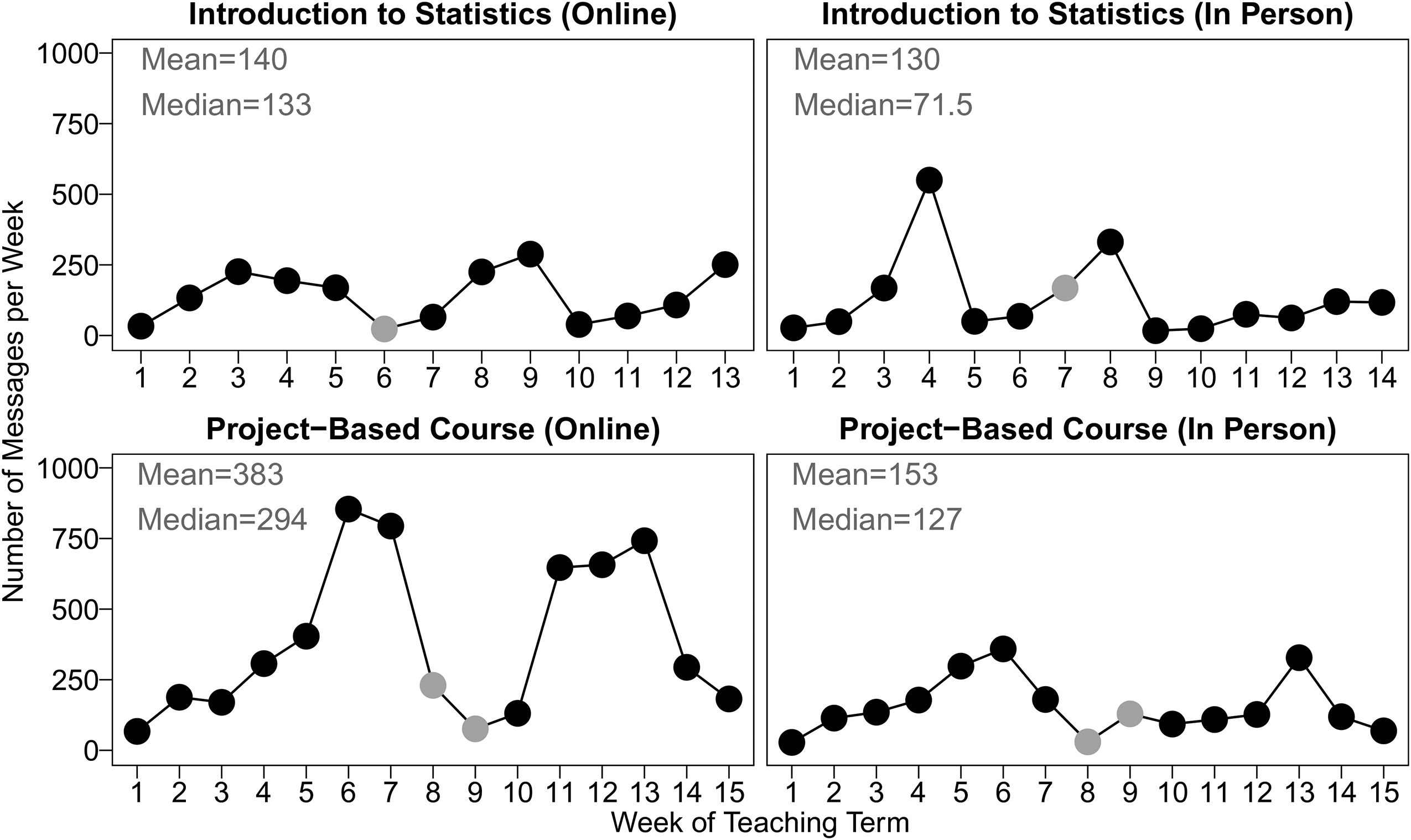
Number of messages in channels and private messages per week (gray circles indicate “reading weeks” without lectures or seminars).
Summary Statistics of Weekly Slack Messages.
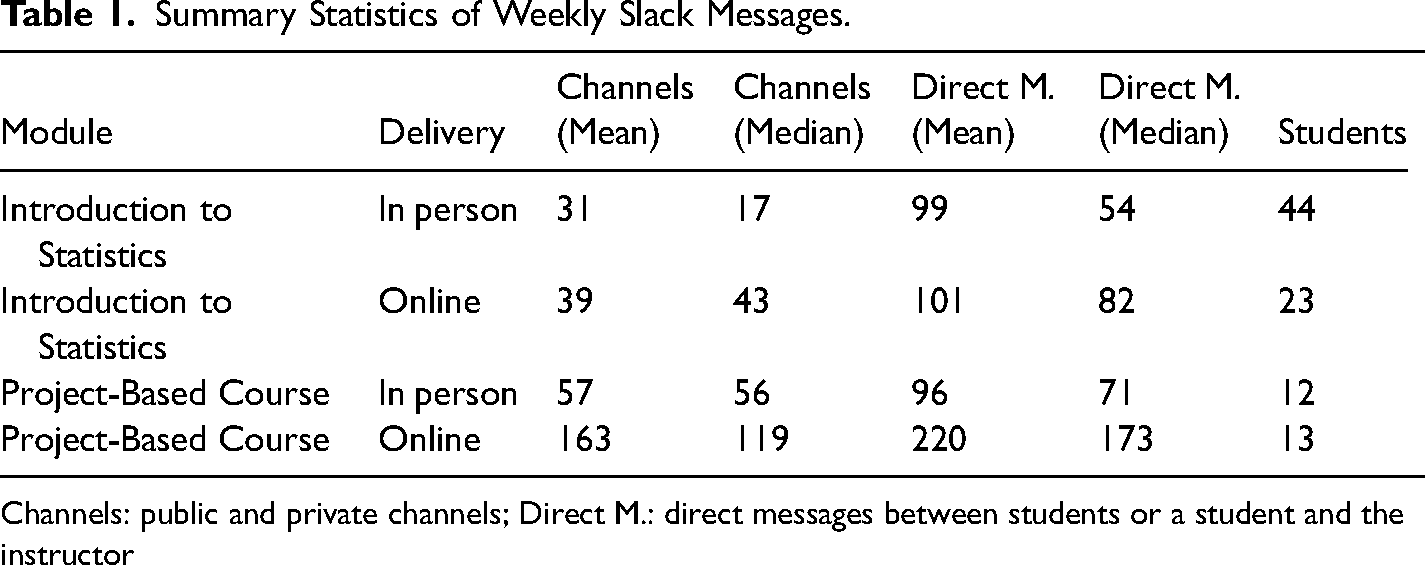
Channels: public and private channels; Direct M.: direct messages between students or a student and the instructor
The data also allows for comparing online and in-person deliveries of the same module. The summary statistics suggest that engagement on Slack was considerably higher when the module was delivered fully online during the COVID-19 pandemic. This difference is most noticeable in the project-based course, which is understandable given that students did not have the opportunity to meet in person to discuss their collaborative research papers. However, even during the in-person delivery, students and the module instructor posted, on average, 18 (Project-based Course) and 21 (Introduction to Statistics) messages per day.
After providing evidence that Slack facilitated communication, I compare “active” and “passive” users. I define active users as students who posted at least one message on a given day. Passive users are students who check at least one channel but do not post any content. Figure 2 shows the percentage of students who posted content (Active Users) in public or private channels, students who only followed conversations (Passive Users), and the total number of students checking or posting on Slack (Active + Passive Users). The black dots indicate the average number of users for each group across the teaching term. The horizontal lines depict the intervals that include 50 (thick line) and 95% (thin line) of all observations in each group of users.
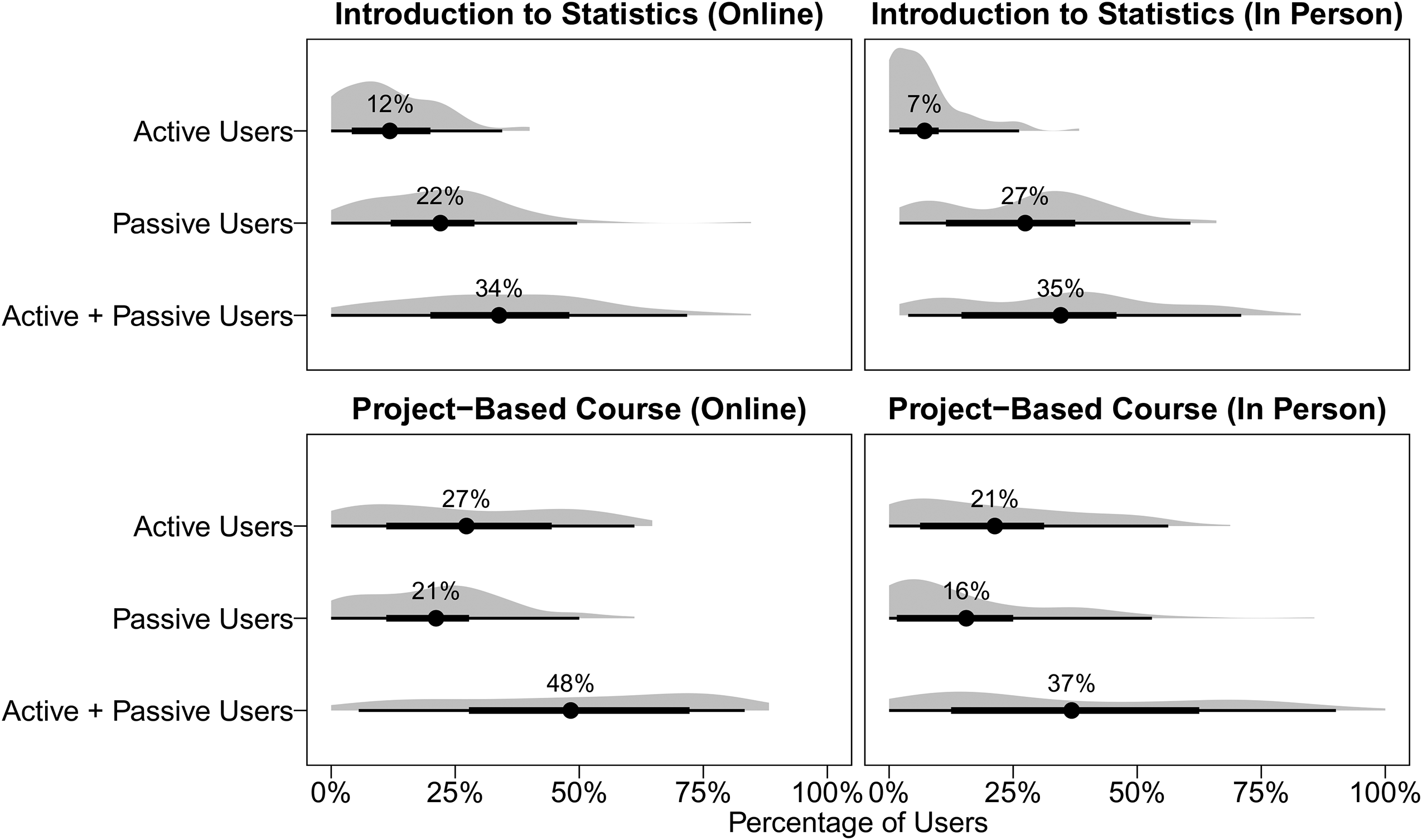
Daily statistics on the percentage of students who posted messages (Active Users), read messages (Passive Users), or used Slack to post and/or read messages (Active + Passive Users). The dots and numbers show the average across the observations in each group of users.
Figure 2 reveals substantial variation in the percentage of users who checked or posted on Slack. On some days, neither the students nor the course coordinator posted a message. These days usually occurred at the beginning of the term or during weekends. Over 80% of module participants checked the Slack workspace on other days. In all courses, the number of passive students typically exceeded the number of active users, which is a reassuring and encouraging finding. Although fewer students may be willing or comfortable to post messages, many students still follow the activity on Slack. This difference between active and passive users was particularly pronounced in Introduction to Statistics.
Table 2 presents summary statistics of the percentage of active and passive users across the four courses. On an average day, 38.5% of students (median: 37%) checked Slack or posted content, and these numbers increase to 47% (mean) and 46% (median) when excluding weekends from the sample. This indicates that during a typical weekday, almost half of the participants accessed Slack to follow or contribute to conversations. These levels of engagement on an online platform during virtual and in-person courses are impressive and encouraging.
Average Daily Levels of Activity.
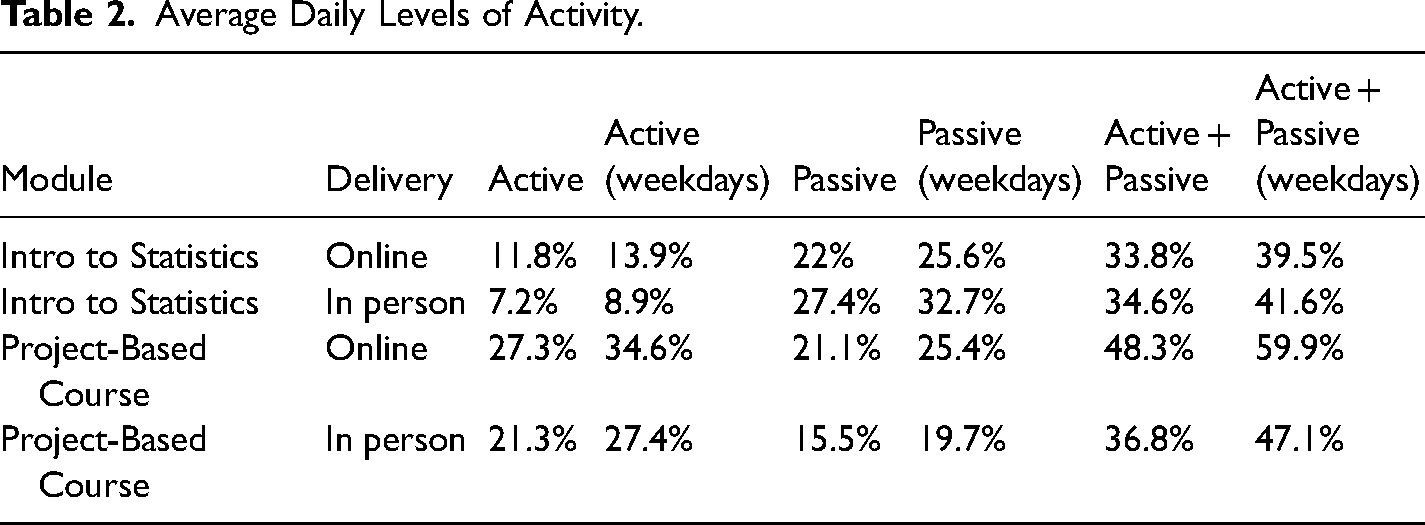
To sum up, the quantitative analysis reveals two main insights. First, hundreds of messages were sent on Slack (Figure 1 and Table 1), and many students contributed to discussions or asked questions (Figure 2 and Table 2). Second, the fine-grained data reveal that many learners use Slack passively. Not all students posted messages, but most students checked the workspace several times per week. Thus, “listeners” can benefit from their more active peers and conversations between students and the instructor, highlighting the advantages of Slack for collaborative learning. Unfortunately, the anonymized statistics do not reveal how many posts or channels a passive user checked on a given day. Students frequently reacted with emojis below the educators’ or their peers’ posts to express their approval. Moreover, several students mentioned in their course evaluation that they liked to follow discussions on Slack (see examples below). This anecdotal evidence suggests that many passive users read new content, but future work should investigate the behavior and motivations of passive users in more detail.
Student Feedback
Having investigated the daily activity quantitatively, I turn to qualitative evidence based on official course evaluations conducted by the university. I focus on the following survey question: “Identify up to three aspects of the module that most helped your learning.” Over 40% of the students who participated in the surveys for Introduction to Statistics explicitly mentioned Slack as one of the three aspects that most helped their learning in this open-ended question. After the online delivery of Introduction to Statistics, a student mentioned that the “use of the platform Slack was super helpful for asking questions and discussions amongst peers.” Another student stated that “the Slack channel makes sure that we can all learn from other students’ questions.”
The responses also suggest that Slack encouraged students to communicate with each other. During the in-person delivery, a student liked the “emphasis on collaboration through Slack in seeking assistance.” Another participant appreciated “constant help from other students on Slack.” A student who completed the project-based module mentioned that “the Slack channel was invaluable in this module. It helped me stay up to date with the general class events as well as my team group.” The text box below presents additional comments from module evaluations. These opinions provide further evidence for the popularity of Slack in postgraduate methods courses and project-based seminars.
Selected replies to the following question from module evaluations: “Identify up to three aspects of the module that most helped your learning.”
“The module instructor setting up Slack was a really great idea and I think it was utilized very well” “Slack channel proved useful for assistance between classmates and with the module instructor” “He created additional channels for all the students to connect (via Slack), which was desperately needed considering how terrible online learning can be” “Brilliant communication between lecturer and students” “Use of the platform Slack was super helpful for asking questions and discussions amongst peers” “The module instructor is also very responsive to questions and the Slack channel makes sure that we can all learn from other students’ questions” “Easy ways how to communicate with colleagues (e.g., Slack)” “Constant help from other students on Slack” “The emphasis on collaboration through Slack in seeking assistance” “Use of Slack for communication and to support each other with code” “The Slack channel for questions” “Possibility for instant help via Slack” “Superb one-to-one feedback in the form of Slack responses and final paper comments” “The ability to get help from classmates and the lecturer on Slack is a nice option” “The use of the Slack channel was invaluable in this module. It helped me stay up to date with the general class events as well as my team group”
Conclusion and Lessons Learned
Friendly interactions between students and the module instructor are vital for in-person and online modules. Glazier (2021) recommends four actions to build trust and human connections. Lecturers should ‘humanize themselves’ by staying engaged with the class, reacting to questions, providing opportunities for interaction, and being compassionate. The quantitative and qualitative analyses presented in this paper suggest that Slack can help module instructors achieve these goals.
I conclude by summarizing five lessons I have learned when using Slack. First, students should create their accounts in the first week of the term. By sharing additional materials, links to online tutorials, or newspaper articles, instructors can initiate interactions early in the teaching term. Mentioning that communication will happen on Slack, not via e-learning platforms or email, ensures that students install and monitor the software.
Second, communication on Slack is particularly effective if the workspace contains various channels (e.g., questions, assignments, coding, events, materials). Channels structure discussions and avoid some questions or comments ‘getting lost’ by being hidden between conversations on different topics.
Third, private channels enjoy high popularity and are vital for group work. Students may not want to share questions on public channels. Participants who are not confident about posting a message publicly can send a private message to peers or the module instructor. If the instructor believes that a student's question is relevant to multiple learners, they can re-post it in a public channel.
Fourth, lecturers should set clear boundaries around when to expect a response. To promote a healthy work-life balance for both students and staff, it is best to avoid sending messages during the weekend or after regular working hours. Slack has features that allow users to change their status to offline during certain hours or to use ‘snoozing’ functions. Adjusting the default settings and disabling notifications after core hours or during the weekend could lead to healthier interactions with and between students and contribute to Equality, Diversity, and Inclusion in higher education.
Finally, the module coordinator must monitor the activity on Slack regularly. If students do not answer a question among themselves, after 24–36 hours, the module coordinator should provide an answer or additional materials. Timely replies motivate module participants to continue asking questions on Slack.
Despite these advantages, Slack also has some potential shortcomings. First, data protection could be an issue with Slack or similar platforms. Since companies own many LMSs and communication software, privacy regulations may change over time or differ across platforms (Schlosser et al., 2022). Slack is “committed to helping Slack customers and users understand and, where applicable, comply with the General Data Protection Regulation (GDPR).” 6 Yet, if data regulations or university requirements change, instructors must reassess the suitability of Slack.
An advantage of Slack could also turn into an issue: the software provides very transparent insights into the dynamics of a module. Learners will immediately notice low levels of activity and engagement, which could discourage them from collaborating. To avoid this issue, module coordinators should post insightful materials throughout the term and encourage learners to ask questions. For example, if instructors cannot reply to questions in class due to time constraints, they could respond to the question on Slack after the lecture or seminar.
Future work could investigate the differences between in-person and online modules in more detail. While the results suggest that students benefited from using Slack in virtual courses and seminars on campus, the online delivery of a course may affect learning and engagement on Slack. I hope my approach encourages other module instructors to rely on Slack (or similar tools) and assess the software's effectiveness for teaching and learning.
Footnotes
Acknowledgments
The author(s) thanks James P Cross, Alan Duggan, David Jennings, and Sarah King for comments on previous versions of this paper.
Declaration of Conflicting Interests
The author(s) declared no potential conflicts of interest with respect to the research, authorship, and/or publication of this article.
Funding
The author(s) disclosed receipt of the following financial support for the research, authorship, and/or publication of this article: University College Dublin Ad Astra Start Up Grant.
Ethics Approval
The data provided by Slack do not contain any sensitive or personal information since information are aggregated to the unit of days. The author confirms that the study design and method of data analysis were reviewed and approved by the Office of Research Ethics at University College Dublin (approval number: HS-C-22-92).

Data Availability Statement
The anonymized data and materials required to verify the computational reproducibility of the results, procedures, and analyses in this article are available on Harvard Dataverse at https://doi.org/10.7910/DVN/MBO0VN.