



Abstract
Why do states select different regional integration projects? Previous literature explains regional integration choices with reference to strategic and economic interests, as well as through the repertoire of abstract ideas and ‘the logic of appropriateness’. The present study employs a prospect-theoretic approach and the concepts of risk, the reference point and loss aversion to account for distinct regional integration choices. It combines semi-structured elite interviews with Time-Series Cross-Section data, based on an original dataset covering six Eastern Partnership countries: Armenia, Azerbaijan, Belarus, Georgia, Moldova, and Ukraine. The study finds that variation in risk propensities of incumbent elites from the Eastern Partnership region may account for distinct choices between the EU and the Russian-led Eurasian Economic Union. Risk propensities and the resulting regional integration choices are primarily conditioned by varying contextual multi-attribute reference points and further reinforced by the psychological effects of loss aversion.
Introduction
Why do states select different regional integration projects? (Neo)realists argue that states partake in regional integration initiatives in order to maximize their power-related and strategic interests. 1 For liberal theorists, the primary object of states’ maximization is not strategic power, but their peculiar economic interests. Liberal intergovernmentalism, an influential strand in the liberal tradition, places at the core of its analytic introspection trade interests of countries pursuing regional building. 2 Constructivists use the repertoire of abstract ideas and norms, and ‘the logic of appropriateness’ to explain the articulation of regional integration orders. 3
This study employs an alternative prospect-theoretic framework to analyse regional integration. Since prospect theory is a theory of decision-making under conditions of risk, 4 its application can be extended to situations that imply risky choices between concurrent regional integration alternatives. An instance of such a risky choice was the selection of the European Union (EU) or the Russian-led Eurasian Economic Union (EAEU) 5 as regional integration projects by incumbent elites from Eastern Partnership (EaP) countries: Armenia, Azerbaijan, Belarus, Georgia, Moldova, and Ukraine. Despite a common Soviet heritage, ruling elites from EaP countries have made divergent choices between two distinct and competing regional integration orders. Georgia and Moldova’s ruling elites chose the EU as their preferred integration path, while Belarus became a founding member of the EAEU. Armenia and Ukraine are unique in the region for experiencing abrupt shifts in regional alignment in 2013, driven by considerable strategic and economic pressure from the Kremlin, though with differing outcomes. Yerevan signed the Treaty to join the EAEU, whereas Ukraine’s post-Euromaidan administration overturned the Azarov Cabinet’s decision and signed an Association Agreement (AA) with the EU in 2014. For the time being, Azerbaijan’s leadership has chosen to remain uninvolved with either of the regional integration blocs. Why did incumbent elites in EaP countries choose different regional integration initiatives?
The consequences of concurrent regional integration around Brussels and Moscow are non-trivial and costly, especially for Ukraine, which lost Crimea in 2014, and, at the time of writing these lines, is still enduring extraordinary territorial, human and material losses because of Russian military aggression in 2022. The latter has clearly generated the most severe security crisis in the world since WWII. The present article examines concurrent regional integration choices in the EaP region, which lie at the core of the 2022 Russo-Ukrainian war. In doing so, the paper imports the prospect-theoretic concepts of reference point, risk, and loss aversion.
The article tests two hypotheses building on the conceptual role of the reference point and loss aversion. It hypothesizes a relationship between low multi-attribute reference points (MARP) and risk-seeking inclinations, as well as a second relationship between the extent of perceived endowments and the incidence of loss aversion, including the ensuing regional integration choice.
The method used in this study embraces a pluralistic approach, triangulating semi-structured elite interviews with logical necessity evaluation of contextual conditions and Time-Series Cross-Section (TSCS) analysis. The elite interviews point to the conjecture that dimensions capturing the conceptual role of MARP might have variable salience, conjecture which is then subjected to a logical necessity evaluation. TSCS analysis serves a complementary probing role and tests seven models, which are detailed in Table 3. The main findings build on an original dataset constructed for this study and insights derived from elite interviews conducted in Yerevan and Kiev.
In short, the study concludes that varying risk inclinations among ruling elites in the EaP region may account for their divergent choices between the EU and the Russian-led EAEU. These risk tendencies, and the subsequent regional integration decisions, are primarily shaped by the shifting contextual MARPs and further reinforced by the psychological effect of loss aversion, particularly in countries with high scores on the main gains associated with Russia and its integration offer (more below).
The paper contributes to three areas of scholarship. First, it adds to the body of literature on comparative regionalism, including scholarship on competitive regional integration between the EU and Russia. 6 Comparative regionalism studies have primarily focused on the competition between integration frameworks, such as the EU and the EAEU. 7 However, this literature often overlooks the role of national elites in actively making decisions driven by their own risk perceptions and evaluations of expected value. 8 Our study fills this gap by focusing on the agency of EaP countries – specifically, the decision-making process from the perspective of domestic incumbent elites. By using prospect theory, we provide an interdisciplinary-informed account of why these countries made different integration choices despite facing similar external pressures. We show how country-specific MARPs and subjective risk perceptions guide these choices. Our contribution lies in shifting the focus from external pressures (i.e. the EU and Russia) to internal risk assessments within EaP countries. This ‘inside-out’ approach emphasizes domestic agency, complementing the ‘outside-in’ perspective. 9
Second, the paper adds to the current use of prospect theory in International Relations (IR). 10 However, unlike most applications that typically align with American scholars’ research interests and are largely confined to U.S. foreign policy, this study examines prospect theory within a distinctly different policy, strategic, and regional framework. It focuses on three critical actors for European order and peace: the EU, EaP countries, and Russia. Moreover, the paper puts forward a general formal model, which can be extended to other cases of competing regional building, implying multi-attribute reference positions and outcomes.
Third, the article seeks to broaden the scholarly debate about regional integration within the field of IR. While traditional IR theories have been useful in explaining regional integration, they do not adequately capture the subjective psychological factors driving decisions under conditions of risk, particularly when states face significant potential losses. For instance, realist perspectives emphasize the pursuit of security and power, 11 suggesting that states in proximity to stronger powers (e.g. Russia) would align with them for survival. However, as demonstrated in the cases of Georgia, Moldova, and Ukraine, domestic incumbent elites opted for the EU, a decision that entailed substantial short-term risks, including security threats from Russia. Traditional realism would predict alignment with Russia, but a prospect-theoretic account explains this deviation as driven by risk-seeking behaviour when elites perceive themselves to be in the domain of losses, such as experiencing low dyadic peace with Russia with severe consequences for their territorial integrity.
Rational choice theory assumes that decision-makers perform cost-benefit analyses based on objective material gains. 12 However, prospect theory demonstrates that decisions are not purely utility-maximizing but are influenced by reference points and loss aversion. 13 For example, Armenia’s decision to integrate with Russia, despite economic incentives from the EU, can be better understood through the lens of loss aversion – Armenian incumbent elites feared losing existing security guarantees from Russia more than they valued potential economic gains from the EU. Since rationalism assumes individuals evaluate outcomes based solely on their final state of utility, conventional rational choice would find it difficult to explain this outcome without accounting for the psychological weighting of losses over gains.
Finally, while constructivist approaches provide valuable insights into why elites in states like Ukraine are attracted to the EU’s normative appeal, they would find it challenging to explain why Ukrainian and Belarusian incumbent elites, sharing a vast cultural heritage of Slavic origin and Christian Orthodox tradition, opted for distinct regional integration initiatives. In contrast, a prospect-theoretic approach can account for these divergent choices based on different reference points, idiosyncratic risk propensities, and a perceptual imbalance between gains and losses.
Besides filling in the explanatory gaps of the traditional approaches, the employment of prospect theory more generally represents a response to the call to integrate psychological theories into broader IR paradigms. Stein explicitly calls for integration of new findings of neuropsychology into traditional IR approaches. 14 Some other scholars advocate for the incorporation of psychological insights into IR research to build better micro-foundations. 15 These insights are gradually being incorporated into IR through conceptual borrowing from the behavioural sciences, 16 but they remain insufficiently explored. Our study takes a modest step in this direction.
The rest of the article is organized as follows: Section ‘Prospect theory, key concepts and hypotheses’ offers a brief introduction to prospect theory, defines three core prospect-theoretic concepts, and hypothesizes the relationship between the reference point and loss aversion, on one side, and regional integration choices, on the other side. Section ‘Model and research design’ puts forward a general formal model and presents the research design. Section ‘Results’ reports the results of the study. Section ‘Mechanism’ identifies a causal mechanism, which connects the concepts of MARP and loss aversion. Finally, Section ‘Conclusion’ discusses several implications of the main findings.
Prospect theory, key concepts and hypotheses
Prospect theory, introduced by Daniel Kahneman and Amos Tversky in 1979, 17 offers a framework for analysing individual decision-making under risk conditions. Drawing on assumptions form cognitive psychology, prospect theory mounted one of the first systematic challenges against the expected utility theory (EUT) that was at the time the most influential rational-choice model of decision-making under risk. EUT has old intellectual roots, tracing back to Daniel Bernoulli’s pioneering work and a solid axiomatic foundation provided by John von Neumann and Oskar Morgenstern. 18 Having previously studied cognitive biases and heuristics, Tversky and Kahneman 19 were quick in recognizing the normative validity of EUT, yet they also recognized its limited descriptive capacity. For the sake of brevity, the rest of this section pauses on three core prospect-theoretic concepts. A supplementary account on prospect-theoretic value and weighting functions, their interaction and the ensuing fourfold pattern of risk propensities is provided in Supplemental Appendix A.
The concepts of reference point, risk, and loss aversion are key to understanding prospect theory. Before extending it to situations involving choices under uncertainty, Kahneman and Tversky 20 confined their theory to instances of individual decision-making under risk. Narrowly conceptualized, risk is reserved for (experimental) contexts in which the exact contingencies are known. However, the exact probabilities remain generally unknown in the realm of international politics. Therefore, the present study follows McDermott 21 and defines risk relative to the variance in the outcome. The wider the variance between potential gains and losses, the riskier the choice implying this variance. In the context of regional integration of EaP countries, economists posit that choosing the EU is likely to yield lower economic gains in the short term but higher gains in the long term. Conversely, opting for the EAEU is expected to result in higher short-term gains but lower gains over the long term. 22 However, Russia may also inflict sizeable losses to countries opting for association with the EU, as the Ukrainian case dearly confirms, but Brussels is not expected to have a symmetric deleterious action against countries opting for the EAEU (more below). Given the variance in the short- and long-term instantiation of gains and losses with each integration option, as well as the possibility of Russian coercive action against EaP countries pursuing association with the EU, one can argue with the advantage of hindsight that the EU is riskier than the EAEU as a regional integration option.
If the notion of risk was borrowed from the EUT, the reference point is an original conceptual contribution of prospect theory. In contrast to EUT, Kahneman and Tversky argue that the primary carriers of value are changes in wealth, interpreted as either gains or losses relative to a neutral reference position. The reference point concept serves thus as a demarcation line between gains and losses. Correspondingly, in its original formulation, the theory sets the reference point at a fixed value of zero; 23 however, it can also assume non-zero values, as acknowledged by Kahneman 24 in his later work.
What is more, while the concept of the reference point is one-dimensional in the original version of prospect theory, 25 in complex, non-experimental settings like international politics, it can become multi-dimensional. For example, the reference points of alliance-seeking adversaries during wartime, opposing factions in revolutionary events, and rival groups in ideological conflicts are likely shaped by multi-attribute reference points (MARP). Equally, since regional integration is a complex international phenomenon, one can also expect for regional integration choices to be influenced by reference levels varying on multiple dimensions or, in short, MARP. This study draws on Buscaneanu 26 and admits that regional integration prospects in the EaP region may have been shaped by MARP across three dimensions: (a) economic affluence, (b) peace with Russia, and (c) domestic transformation costs. Economic affluence and peace with Russia align with the fundamental economic and power-related conditions proposed by liberal and (neo)realist scholarly traditions, 27 while the dimension of domestic transformation costs is inspired by Schimmelfennig and Sedelmeier’s 28 external incentives model. The costs of democratic transformation are expected to be higher in authoritarian polities, such as Azerbaijan and Belarus, and discourage incumbent elites in these contexts from pursuing political reform and integration into regional organisations with a high democratic density, such as the EU. 29 These three dimensions define the economic, strategic, and political context in which regional integration offers from the EU and Russia have been considered.
Extending the prospect-theoretic concept of the reference point to multiple dimensions and to the study of regional integration choices, the first hypothesis that this article seeks to examine is the following:
H1: The lower the multi-attribute reference position assessed by national incumbent elites, the stronger their risk-seeking tendency, and the higher the likelihood of their opting for the EU as a regional integration prospect.
Loss aversion is the second most influential behavioural insight from prospect theory. In short, it implies that losses are typically perceived as having a greater impact than comparable gains. The imbalance between equivalent losses and gains was rightly intuited long ago, but the corresponding psychological phenomenon was only formally theorised by Kahneman and Tversky in 1979. 30
One manifestation of loss aversion is the endowment effect, a concept introduced by behavioural economist Richard Thaler. 31 He observed that individuals tend to value goods more when they are part of their own endowment than when they are not. An implication of the endowment effect is the tendency to place greater weight on actual ‘out-of-pocket’ losses compared to similar foregone gains. 32 In the study of regional integration prospects, the phenomenon of loss aversion can be hypothesized as follows:
H2: The greater the endowments associated with a given regional integration option, the higher the likelihood of loss aversion and the selection of this integration prospect.
The next section introduces a formal general model and the design of the study.
Model and research design
A formal model
Regional integration with the EU or Russia involves two competing prospects, noted conventionally as x and y. For tractability, the model excludes the third option of a neutral choice, where neither regional integration project is pursued. Each prospect allows for the instantiation of multi-attribute outcomes, such as v(x11, . . ., x1m) . . . v(xn1, . . ., xnm) or v(y11, . . ., y1m) . . . v(yn1, . . ., ynm), where v stands for the expected value, x1 . . . xn or y1 . . . yn for the number of possible outcomes and x1 . . . xm or y1 . . . ym for the number of possible attributes. The weighted probability of each integration prospect is assumed to be π(p)1 . . . π(p) n or π(q)1 . . . π(q) n , as in the following general model. 33
Figure 1 suggests that regional integration with the EU or Russia may result in multiple equilibria, allowing for many configurations of multi-attributes outcomes to be instantiated. The number of attributes is so large that any meaningful analytical model would need to be restricting. 34 For reasons of parsimony, the association with the EU or integration into the EAEU is expected to have consequences for the following attributes: (1) financial assistance, (2) gas imports, (3) trade regime, (4) visa regime, (5) access to the labour market, (6) security support, and (7) political regime. The comparative advantages that the EU and Russia possess with respect to these attributes represent a function of historical legacies, existent capabilities, and future projections. One could also envision additional attributes, such as foreign direct investments, but the article restricts the design to those attributes for which reliable longitudinal data is available. The distinction between dimensions capturing the conceptual role of MARP and the above seven conditions is that the former define the context in which regional integration choices took place, whereas the latter approximate multi-attribute outcomes expected form the EU or Russia and their integration offers.
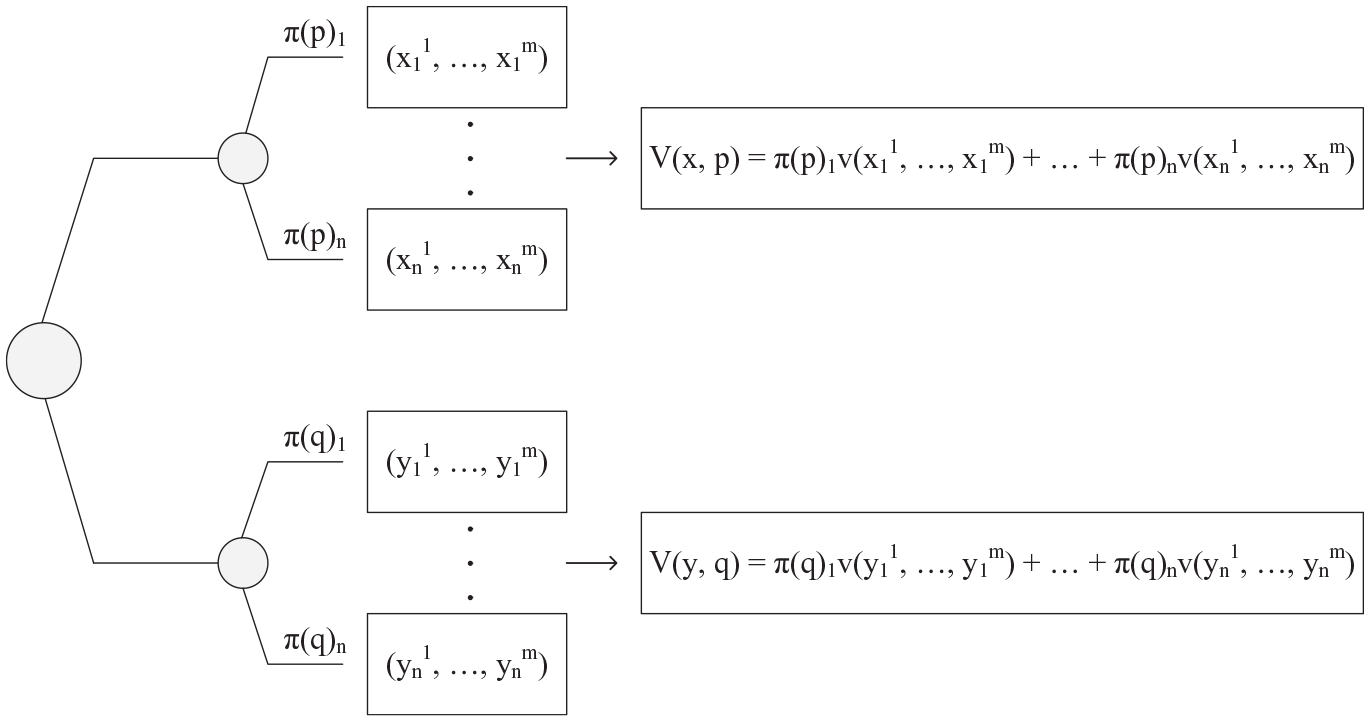
A formal model.
The EU gradually became the biggest provider of financial assistance to countries from the EaP region and was expected to further increase its financial support to the countries pursuing political and economic association. By contrast, Russia does not run an official aid program, but has used discretionary prices for energy resources, including gas, subsidizing the economies of selected partners, such as Armenia and Belarus (more below).
Whereas the EU and Russia had comparable trade regimes in place with EaP countries, the latter had notable advantages with respect to its visa regime and access to its labour market. Visa-free travel arrangements between the EU and Moldova, Georgia and Ukraine have only recently been introduced, 35 whereas the free travel of people between Russia and EaP countries, except Georgia, has remained largely unrestricted. The visa regime between Russia and Georgia has been introduced in 2000 and then slightly liberalized for Georgian citizens in 2015. 36 Following the Russian full-scale military aggression, Ukraine introduced a unilateral visa regime with Russia in July 2022.
Likewise, the job seekers from EaP countries have traditionally enjoyed a relatively free access to the Russian labour market and could further expect the removal of formal requirements, 37 such as the obligation to obtain special permits, to pursue employment in Russia. 38 Moreover, access to the Russian labour market has been facilitated by a deliberate instrumentalisation of an intense passportisation policy (pasportizatsiya), particularly targeting residents of Abkhazia, South Ossetia, Transnistria and, more recently, Donbass. 39 On the contrary, the access of people from EaP countries to the EU’s job market remains generally restricted to this day.
With respect to security support, the EU was not perceived as highly credible in providing significant strategic assistance to EaP countries, 40 which, however, may face significant security challenges if they opt for the EU, as the Ukrainian case clearly demonstrates. 41 If anything, whereas the EAEU is not primarily about security support, joining it does not create severe security challenges from either Russia or the EU.
Finally, association with the EU and membership in the EAEU are expected to have different effects on regime quality in the EaP region. Whereas the former is more likely to encourage democratization, 42 the latter option is more likely to perpetuate the extant (competitive) authoritarian regime. Levitsky and Way 43 convincingly argue that in regions dominated by non-democratic hegemons, such as Russia or China, competitive authoritarian regimes are more likely to endure or shift toward greater authoritarianism.
Explanandum
The explanandum of this study is the choice of regional integration with either the Russian-led EAEU or the EU, or the decision to remain distant from both regional integration options. While joining the EAEU and association with the EU are not entirely equivalent phenomena – the former representing a form of ‘holding-together regionalism’ and the latter a form of ‘coming-together regionalism’, 44 they are both the result of risky decision-making. Then, though teleologically inferior to full membership, association with the EU became a form of ‘differentiated integration’. 45 Moreover, the ongoing Russian-Ukrainian war has exposed the flaws of ‘holding-together regionalism’ and accelerated the replacement of the weaker association with an integration perspective in the EU for Ukraine, Moldova, and Georgia.
H1 and H2 are evaluated against the evidence collected from the EaP region: Armenia, Azerbaijan, Belarus, Georgia, Moldova, and Ukraine. The period 2013–2014 is the precise focal point of the study. In 2013–2014, Armenia and Ukraine underwent integration U-turns, and by 2014, all EaP countries, except Azerbaijan, had either signed Association Agreements with the EU or the Treaty establishing the EAEU. However, for greater analytical leverage, the study also draws on evidence spanning the period 1991–2018.
Data and method
To assess the relation between contextual MARP, loss aversion and regional integration choices, the article draws on an original dataset constructed for this study. The dataset covers all six EaP countries, the period 1991–2018 and includes 21 variables (6 × 28 × 21 = 3528 data points). As far as contextual conditions are concerned, economic affluence is approximated with GDP per capita (PPP) in current international USD. 46 Dyadic peace with Russia is coded based on the peace scale conceptualized by Klein, Goertz and Diehl, who argue that such a scale allows both peace and conflict scholars to trace the dynamics of interstate relations. 47 For the dimension of domestic transformations costs, we use two alternative types of data. First, we approximate transformation costs by measuring the distance between a given political regime’s empirical state, as evaluated by V-Dem’s Liberal Democracy Index (LDI), 48 and the theoretical threshold of 0.8 on the LDI scale, above which regimes are considered democratic. Second, we also estimate the extent of domestic transformation costs based on the neopatrimonial rule index of V-Dem. 49 We use the second approximation of costs for a robustness test, which we report on in Supplemental Appendix B. The detailed coding strategy used for all contextual MARP is reported in Supplemental Appendix C. Given the high number of conditions corresponding to integration offers put forward by the EU and Russia, and control variables, we describe them in detail in Supplemental Appendix D.
In addition, the data collection strategy also involves qualitative information gathered during field research in Armenia and Ukraine, which are the cases that experienced regional integration U-turns in 2013–2014. The field research took place in November-December 2018 and involved semi-structured interviews, conducted with 20 decision-makers in charge of foreign policy and/ or trade in 2013–2014, and policy experts from Armenia and Ukraine. The first category of participants includes a former prime minister and parliament speaker, high-ranking diplomats, a former chief of the presidential office, senior public officials, and members of Armenia’s National Assembly and Ukraine’s Verkhovna Rada. The second category includes experts from academia, research institutes, think-tanks, and NGOs. Elite interviews aimed at generating supplementary evidence about contextual conditions and regional integration U-turns experienced by Armenia and Ukraine in 2013–2014. We provide detailed information on ethics-related issues in Supplemental Appendix E.
Methodological strategy takes on a pluralistic approach, which triangulates: semi-structured elite interviews, logical necessity evaluation of contextual conditions and Time-Series Cross-Section (TSCS) testing. Elite interviews signal the possibility of variable salience of dimensions capturing the conceptual role of contextual MARP. Prompted by the former, the study also provides a logical necessity evaluation of contextual reference point dimensions. Finally, TSCS analysis turns to the probabilistic logic and tests seven models, which are detailed in Table 3 below.
Results
Multi-attribute reference points
This section starts by examining the hypothesized relationship between multi-attributes reference points and regional integration choices. Figure 2 illustrates below the coordinates of MARP in a tri-dimensional vector space. The location of MARP along the three contextual dimensions varies across EaP countries and two points in time, 2013 and 2014, when regional integration U-turns of Armenia and Ukraine took place and when all cases have either concluded AAs with the EU or signed the Treaty establishing the EAEU.
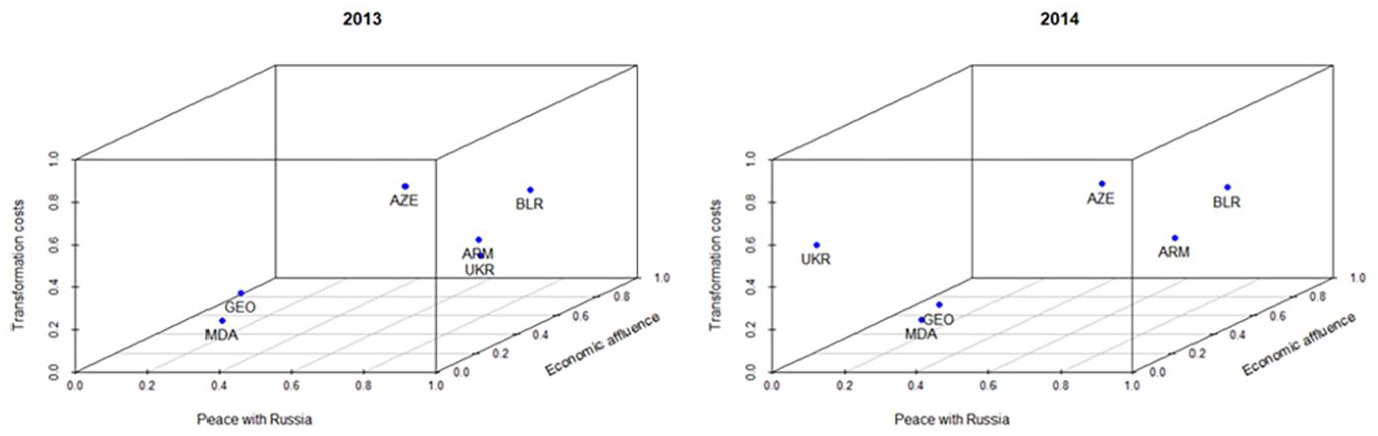
Multi-attribute reference points.
Despite the moderately higher short-term gains expected from integration with the EAEU, the results support H1, indicating that incumbent elites in EaP countries with lower levels of economic development, low to medium domestic transformation costs, and an absence of resilient peaceful relations with Russia have tended to adopt a risk-seeking approach, opting for the EU as their integration path. Georgia, Moldova, and Ukraine illustrate this pattern. While powerful competing groups alternating at the helm of Ukrainian politics were able to successively impose their will on the direction of regional integration, the abrupt shift in 2014 of the reference level into the domain of losses, following the open conflict with Russia, has indefinitely eliminated the option of Eurasian integration. Conversely, ruling elites in EaP countries with low to medium affluence, medium to high domestic transformation costs, and resilient peaceful relations with Russia have shown a risk-averse attitude, choosing the Russian-led EAEU as their integration path. Armenia and Belarus exemplify this trend.
Azerbaijan is an ambivalent case. The contextual MARP coordinates for Azerbaijan are quite similar to those of Belarus but slightly lower on the dimension of dyadic peace with Russia, reflecting the limited trust Baku had in the Kremlin’s genuine intentions regarding the status of Nagorno-Karabakh. This adds to the explanation of why Baku proved highly reluctant with respect to the Russian-led multilateral initiatives within the Commonwealth of Independent States (CIS) organization. On the other hand, Azerbaijan has also proved less willing than Ukraine, Moldova, and Georgia to integrate with the EU. Having access to rich internal energy resources, Azerbaijan is more affluent and less financially dependent on EU’s financial support. In addition, Azeri incumbent autocratic elites oppose high transformation costs that would come along with liberalization of their political regime, as demanded by the EU from aspiring associate countries.
However, are all contextual dimensions equally salient? A high-profile Armenian decision-maker observed, for instance, that the strategic relationship with Moscow ‘became more salient’ than economic considerations at the time of changing the course of regional integration in 2013. 50 To evaluate the conjecture that dimensions of contextual MARP might have a variable salience, the paper turns to an analysis of their logical necessity.
Logical necessity
The evaluation of the variable salience of contextual MARP follows set-theoretic rules in the tradition pioneered by Ragin 51 and developed further by Schneider and Wagemann. 51 Assessing logically necessary conditions has deep-seated philosophical and epistemological foundations. 52 Schneider 53 revisits the two-step QCA approach for remote and proximate conditions, suggesting that the first step in the protocol should consist of a necessity analysis. Given the conceptual equivalence between contextual MARP and what Schneider and Wagemann 54 call ‘remote factors’, the analysis of logical necessity in this article enacts the first step in the revised protocol proposed by Schneider. 55 Since set relations are asymmetric, we construct two distinct crisp sets with case membership in the outcome of regional integration with the EAEU and with the EU, respectively. Supplemental Appendix C provides details about coding and calibration procedures. Table 1 reports the results of the logical necessity analysis for regional integration with the EAEU.
Logical necessity: Regional integration with the EAEU. 56
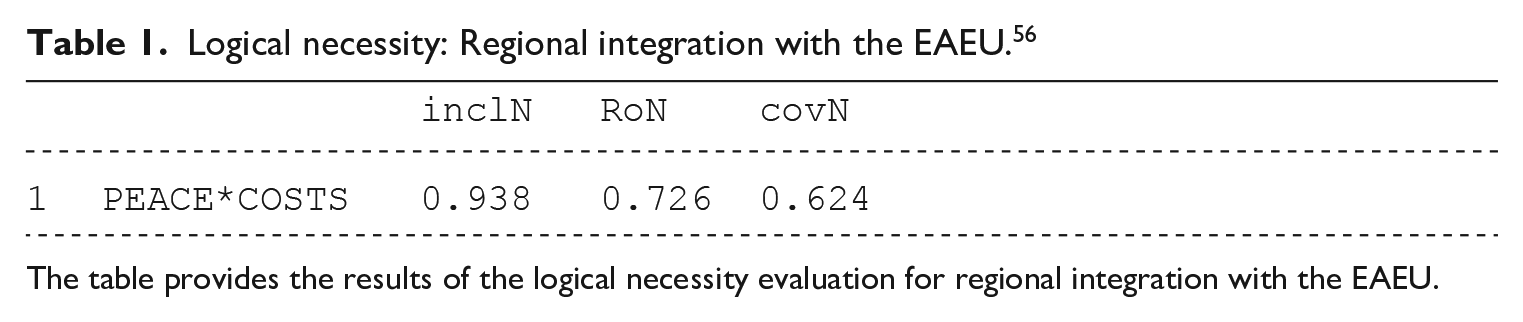

The table provides the results of the logical necessity evaluation for regional integration with the EAEU.
The results in Table 1 confirm the assumption that contextual dimensions used to account for the coordinates of MARP may vary in their salience. Case membership in the intersection between dyadic peace with Russia AND high domestic transformations costs appears to be necessary for regional integration with the Russian-led EAEU. This conjunction has a high inclusion score and relatively high coverage and relevance of necessity scores. In set-theoretic language, case membership in this intersection represents a superset of case membership in the outcome. Table 2 provides below the results of the logical necessity analysis for regional integration with the EU.
Logical necessity: Regional integration with the EU. 57
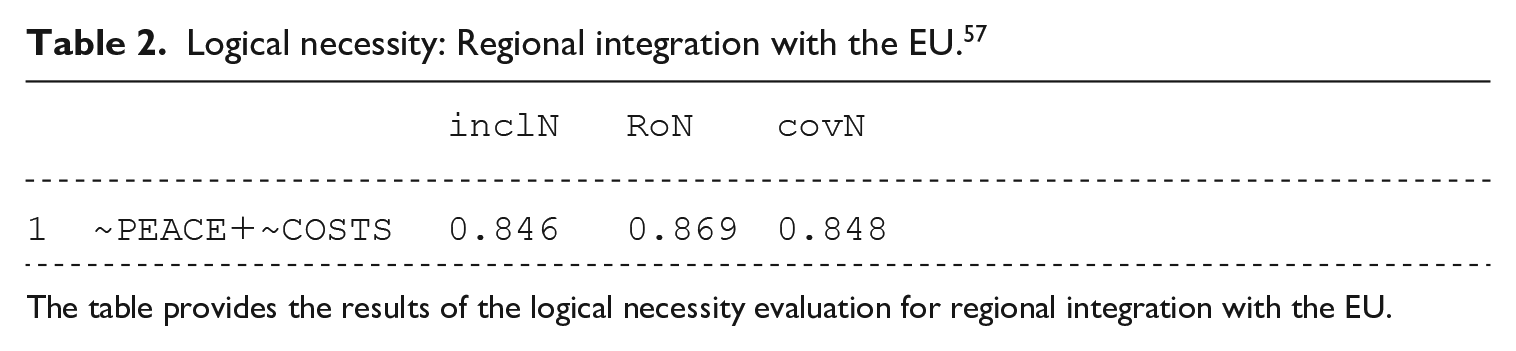

The table provides the results of the logical necessity evaluation for regional integration with the EU.
The results in Table 2 confirm that set relations are asymmetric and indicate that case membership in the union defined by the absence of resilient peaceful relations with Russia OR low domestic transformation costs appears necessary for regional integration with the EU. For greater confidence, set relations reported in Tables 1 and 2 have been confirmed with the alternative neopatrimonial rule index of V-Dem inputted for domestic transformation costs. 58
Before concluding this sub-section, we pause briefly on the issue of trivialness raised by Braumoeller and Goertz.
59
They recommend employing the χ2 test of homogeneity, which can evaluate if a given necessary condition or combination of conditions is trivial depending on whether this condition or combination and the response variable are independent. Adapted to this study, testing for trivialness implies examining whether
Multi-attribute outcomes
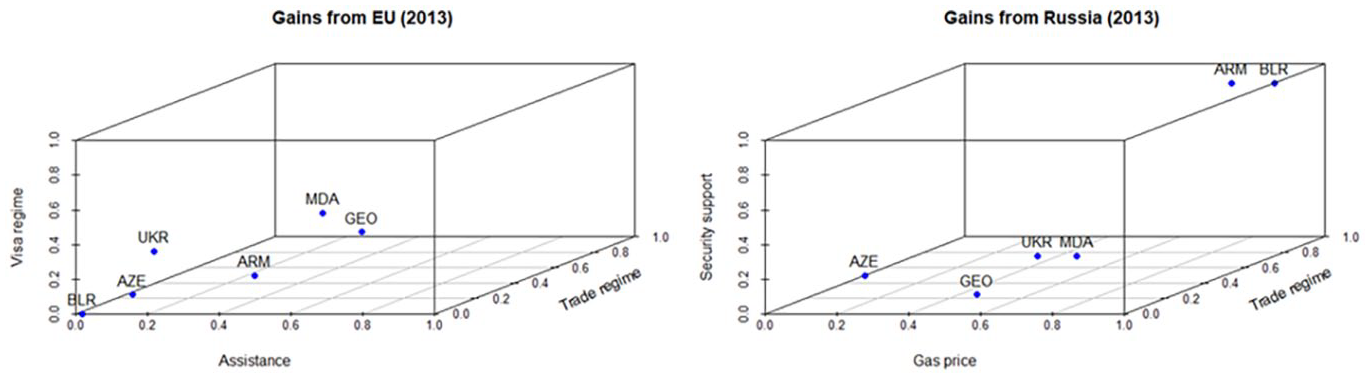
Evaluating the hypothesis on loss aversion (H2), one can begin by illustrating cross-case variation regarding the main gains implied by association with the EU or integration with the Russian-led EAEU. The main gains implied by the former are the so-called ‘3-Ms’, referring to money, mobility, and market access, 61 whereas the core gains linked to integration with Russia include the price of imported gas, security support, and market access. Figure 3 illustrates the distribution of EaP countries on these attributes.
Gains from EU versus Russia.
In 2013, the EU has disbursed to Georgia (42.02 EUR/cap) the highest amount of per capita assistance, which significantly exceeds the amount provided to Moldova (22.26 EUR/cap) and Armenia (18.15 EUR/cap), the second and third recipients of EU’s financial support from the EaP region. Owing to its large population, the per capita assistance provided to Ukraine (6.42 EUR/cap) in 2013 was rather modest, only slightly more than the modicum assistance provided to the autocratic Belarus (1.49 EUR/cap) and Azerbaijan (1.39 EUR/cap). The patterns of average per capita assistance disbursed by the EU to EaP countries in the extended period 1991–2018 remain similar: Georgia (17.95 EUR/cap), Armenia (12.75 EUR/cap), Moldova (12.50 EUR/cap), Ukraine (3.89 EUR/cap), Azerbaijan (2.44 EUR/cap) and Belarus (1.84 EUR/cap). Figure 4 visualizes per-capita EU assistance to the EaP countries in 2013 and its long-term averages. One can easily tell by visual comparison that the pattern of EU assistance in 2013 is consistent with that of the extended period (1991–2018). Given the smaller size of their economies, the volume of EU assistance provided to Georgia, Moldova and Armenia was non-negligible. In contrast, the amount of EU’s financial incentives for Ukraine, Belarus and Azerbaijan was insignificant.
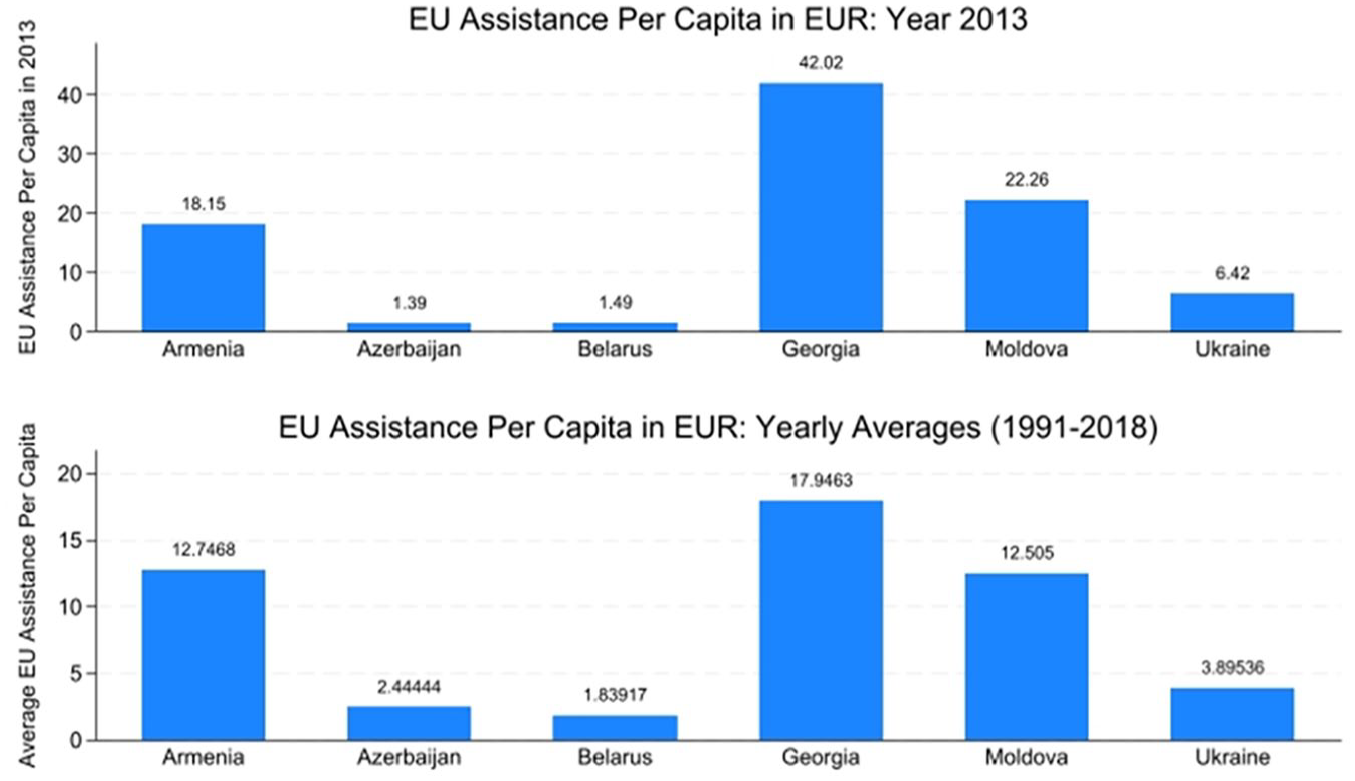
EU assistance per capita.
Owing to visa- and readmission-related agreements in force between the EU and Moldova and Ukraine since 2008 and between the EU and Georgia since 2011, the formal requirements requested for the issuance of visas for certain categories of Moldovan, Ukrainian and Georgian citizens have been slightly liberalized. The two other participant states in the European Neighbourhood Policy (ENP), Armenia and Azerbaijan, were still in the process of negotiating similar facilitations for the mobility of their citizens in 2013. Belarus, though involved only to a limited extent in the EaP before 2021, expressed a similar interest in obtaining travel facilitations for its own citizens. 62
The EU’s third major incentive involves granting access to its trade market. Moldova benefited from Autonomous Trade Preferences (ATP) that represented the most comprehensive regime of trade preferences provided by the EU in the EaP region in 2013. Slightly less encompassing was the Generalized System of Preferences Plus (GSP+) applied by the EU to Georgia since 2006 and to Armenia since 2009. Due to the structure of the Azeri economy with energy resources as the main export commodity and to the relatively large industrial and agricultural sectors of Ukrainian economy, the EU was applying a less generous GSP scheme for its trade with Azerbaijan and Ukraine in 2013. Belarus was the only country in the EaP region, whose trade with the EU was exempt from both ATP and GSP preferences.
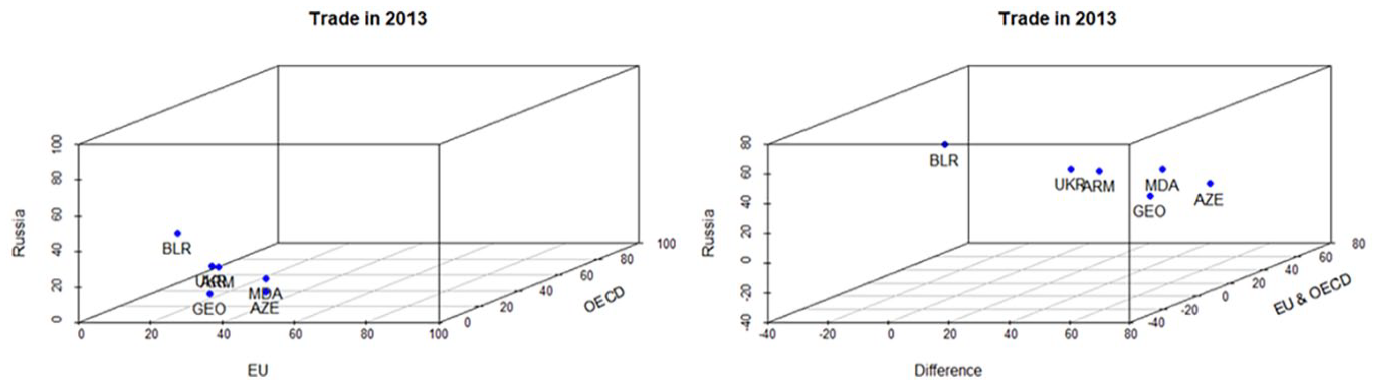
The various trade regimes applied between the EU and EaP countries could not leave the trade patterns unaffected. Figure 5 contrasts the proportion of external trade between EaP countries and the EU, Russia and (non-EU) OECD countries.
External trade.
The variation of external trade of EaP countries, captured in the left panel of Figure 5, does not appear to be empirically highly evocative. To improve the visibility in the representation of trade exchanges across different markets, the right panel of Figure 5 illustrates the cumulative share of EaP countries trade with the EU and (non-EU) OECD countries, the proportion of their trade with Russia, and the difference between the former and the latter. Interestingly, except Belarus, the EU was in 2013 the main trading partner for all EaP countries and the cumulative share of trade with the EU and (non-EU) OECD countries exceeded visibly the proportion of bilateral trade with Russia. This difference was 51% in the case of Azerbaijan, 39% in Georgia, 37% in Moldova, 22% in Armenia and 15% in the case of Ukraine. Belarus was the only EaP country in 2013, which on the contrary traded 20% more with Russia than with jointly the EU and (non-EU) OECD countries.
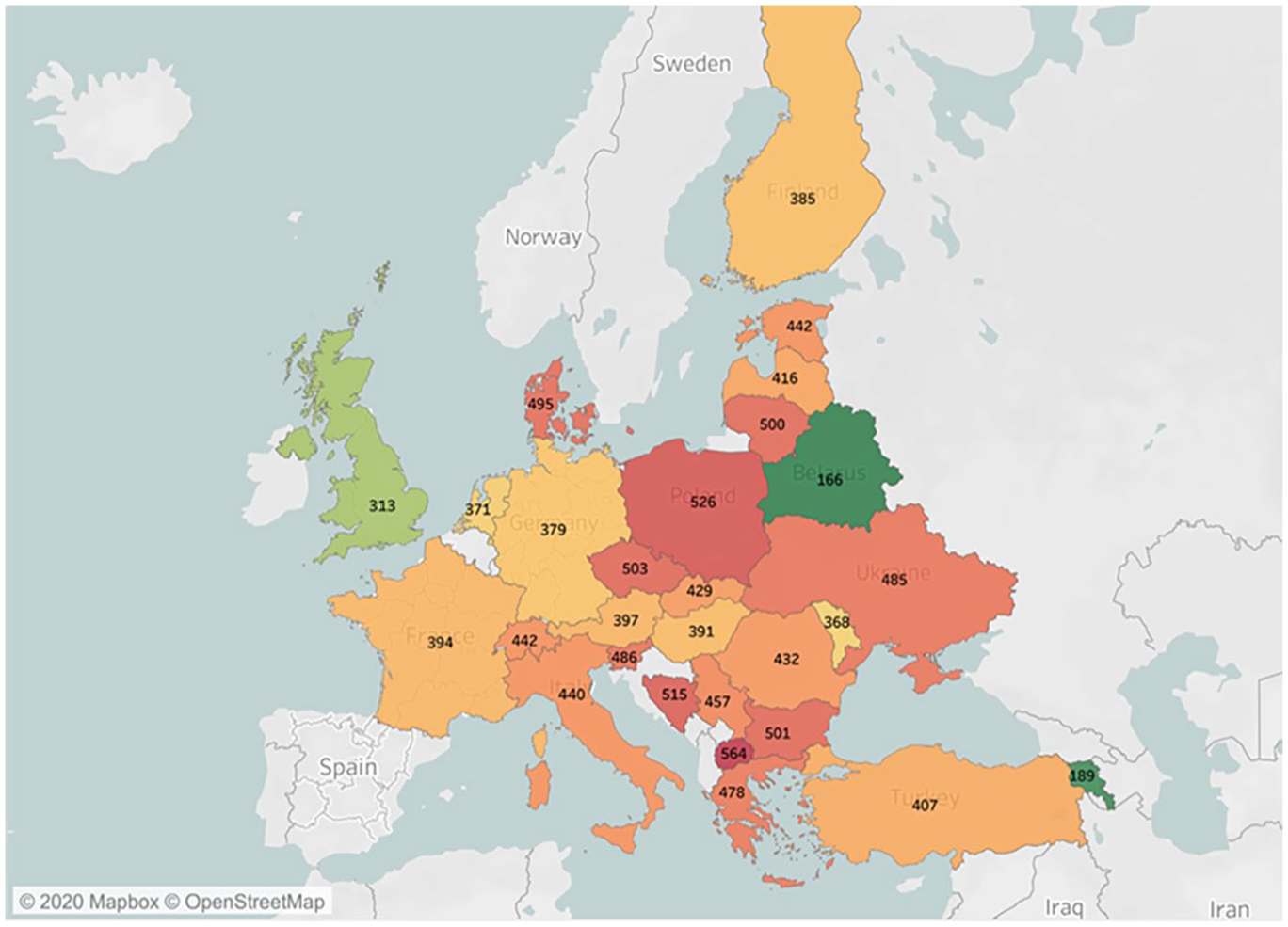
Considering the main gains associated with Russia and its integration offer, the right panel of Figure 3 illustrated above shows that among all EaP countries, Belarus and Armenia had access to the cheapest Russian gas in 2013. To put the extraordinary price discount made by Gazprom to Minsk and Yerevan into a broader perspective, Figure 6 indicates the gas price paid in 2013 by 28 European countries to the Russia’s state-own energy group Gazprom.
Gazprom gas sale price (2013).
The preferential treatment of European countries – via Gazprom – by Kremlin is obvious. Beside the evident variability of the gas price showcased, the map in Figure 6 also makes clear that Gazprom pricing policy defies the logic geographic distances. The neighbouring Baltic States and Ukraine were paying in 2013 a significantly higher gas price than the similarly proximate Belarus and even the geographically distant France and the UK.
In 2013, the price for Russian gas varies from as low as 166 USD/tcm (2.85 standard deviations below the mean) for Belarus to 564 USD/tcm (1.55 SD above the mean) for North Macedonia. The second cheapest price for Russian gas of 189 USD/tcm (2.60 SD below the mean) was paid by Armenia. The price of 368 USD/tcm (0.62 SD below the mean) paid by Moldova was also one the cheapest in comparative terms, but it almost doubled the amount paid by Armenia. In contrast, Ukraine was paying one the highest prices of 485 USD/tcm for the imported Russian gas, which represents 0.68 SD above the European average. What is more, Ukraine has also imported in 2013 the highest volume of 25.80 bcm of Russian gas in the EaP region, compared with 19.80 bcm by Belarus, 2.40 bcm by Moldova and 1.70 bcm by Armenia. The promise of a significantly lower price for Russian gas was one of the core bargaining chips used by Kremlin to force Yanukovych and his entourage to suspend the association process with the EU. 64 Delivering on this promise, Kremlin has indeed offered Ukraine, in December 2013, a significant price discount down to 268.5 USD/tcm (1.72 SD below the mean), offer which became obsolete with the removal of Yanukovych from power in February 2014. In 2013, Azerbaijan and Georgia have either imported no or insignificant gas resources from Russia.
Apart from receiving the cheapest gas from Russia, Armenia and Belarus were also the only countries from the EaP region involved into the Russian-led Collective Security Treaty Organization (CSTO). Having a more limited geographical reach than the Warsaw Pact, the CSTO also pledges to provide military support to any member state in case of external aggression. 65 This mutual obligation clause, though weaker formulated than in the case of NATO, was especially highly valued by Armenian authorities, which have eyed Russian military backing to counterbalance Baku’s strategic influence over the highly disputed Nagorno-Karabakh region. 66 Reassuringly, an Armenian high-profile decision-maker confirmed that ‘[f]or years or for decades Armenia was cooperating with both sides, obviously more closely with Russia in different formats, including CIS, CSTO [. . .] and the [integration] choice was made accordingly’. 67 If anything, Russia’s security promises and threats proved decisive at the time of Armenia’s integration U-turn in 2013. 68
Owing to historical legacies and structural dependencies, the access to the Russian market continued to remain high on the agenda of ruling elites from the former Soviet satellites. Moscow has, in turn, sought to leverage access to its own market for geopolitical and geostrategic purposes. 69 After a failed attempt at the beginning of 1990s, the multilateral Commonwealth of Independent States Free Trade Area (CIS FTA) became functional only in 2012, when Armenia, Belarus, Moldova, and Ukraine, together with Russia and Kazakhstan, have ratified the agreement establishing the CIS FTA. The agreement included provisions for the liberalization of trade in goods, but it kept in place multiple exemptions and quantitative restrictions. 70 Azerbaijan was the only full CIS member, which did not sign the CIS FTA and had its trade with Russia regulated by a less advanced bilateral trade agreement. Georgia, in turn, was the only EaP country, which withdrew from the CIS in 2009 and had its trade with Russia regulated on a loose bilateral basis. 71
To test the causal weight of gains associated with the EU or Russia and their integration offers, the paper turns next to probabilistic logic.
Time-Series Cross-Section
The Time-Series Cross-Section (TSCS) analysis tests seven distinct models. The first model tests the causal effects of the three contextual dimensions defining the concept of MARP. The second and the third models consider the effects of the seven attributes capturing the role of gains associated with the EU or Russia and their integration offers. Model (4) and (5) test the conditions corresponding distinctively to the two integration prospects. The sixth model includes all dimensions and conditions reported in the previous two models, whereas the seventh model adds three additional control variables, which account for the proportion of trade between each EaP country and the EU, Russia and (non-EU) OECD countries.
Given the ordinal nature of the dependent variable (1 for integration with the Russian-led EAEU, 0 for association with the EU and 0.5 for ambivalent cases), all models are estimated with ordered logit models. We believe that the pooled estimator is the most appropriate for this purpose. Greene 72 shows that for binary dependent variables, random effect models perform far worse than pooled or fixed-effect models. Worse yet, categorical dependent variables are more complicated, and little is known about their behaviours under different model specifications. Fixed effect models, however, are highly problematic for the current study because some independent variables do not contain much within-country variation. Fixed effect estimators would therefore exclude information from many observations and run into singularity or convergence issues. We thus obtain the pooled estimators with standard errors clustered on country and include time-fixed effect. Clustered standard errors are effective at addressing serial correlation in panel data, even when the number of panels is relatively small. 73 Table 3 presents below the results of the analysis.
Time-series cross-section.
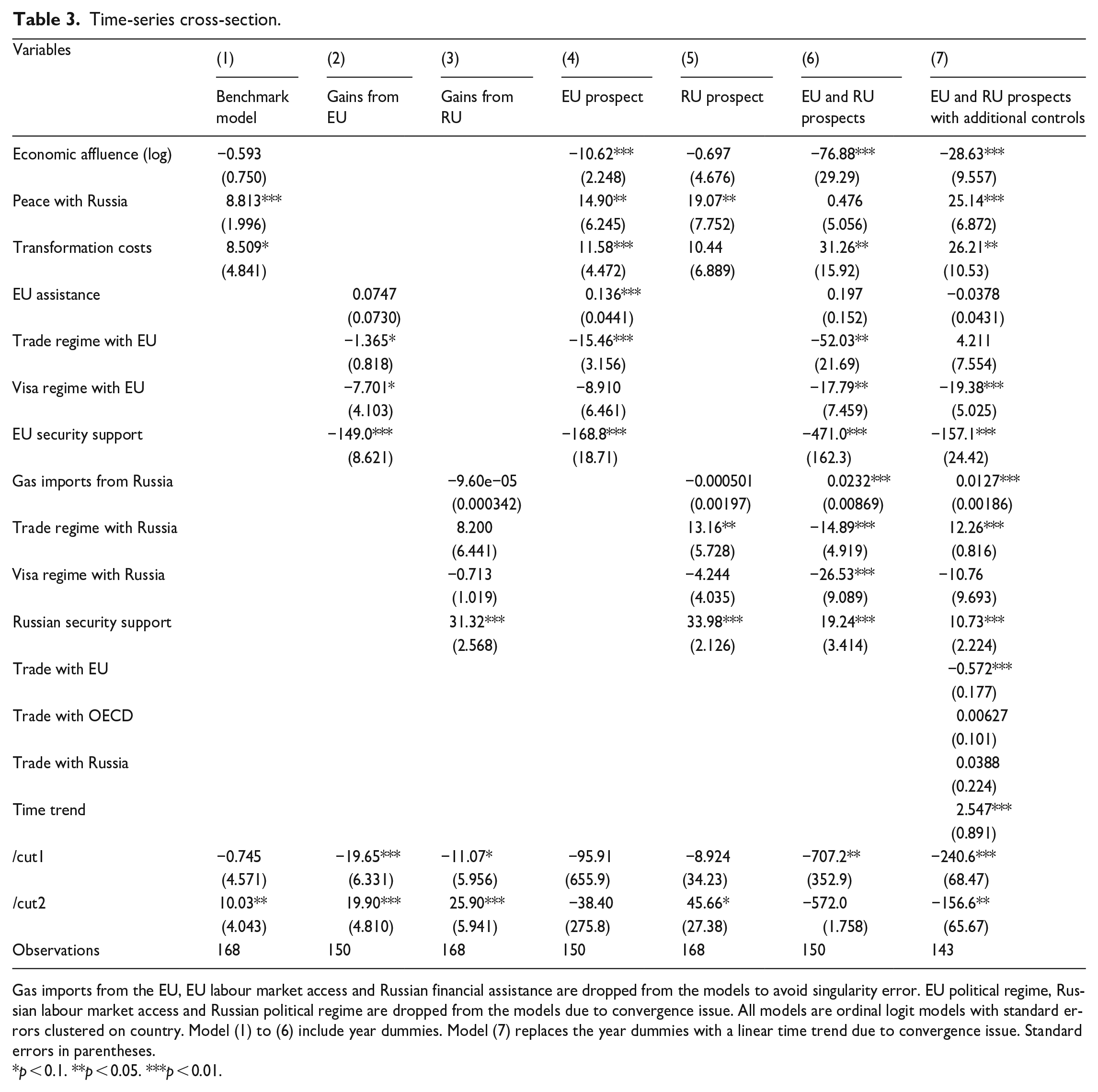
Gas imports from the EU, EU labour market access and Russian financial assistance are dropped from the models to avoid singularity error. EU political regime, Russian labour market access and Russian political regime are dropped from the models due to convergence issue. All models are ordinal logit models with standard errors clustered on country. Model (1) to (6) include year dummies. Model (7) replaces the year dummies with a linear time trend due to convergence issue. Standard errors in parentheses.
p < 0.1. **p < 0.05. ***p < 0.01.
Since the dataset is limited to 168 observations, the results of TSCS cannot be used in isolation or independently from other results to build the argument on. They serve a complementary probing role. The results of TSCS analysis suggest tentatively that two contextual dimensions defining the concept of MARP – dyadic peace with Russia and domestic transformation costs –, and three attributes approximating EU and Russian integration offers – advanced trade and visa regimes with EU, and Russian security support – signal eloquently the choice of regional integration prospects. Specifically, countries that enjoy resilient peaceful relations with Russia, face higher transformation costs, and benefit from Russian security support under CSTO are more likely to choose the Russian-led EAEU, other things being equal. Conversely, advanced trade and visa regimes with EU increase the likelihood of regional integration with the EU. In the same vein, the proportion of bilateral trade with the EU also emerges with the right sign and highly significant in Model (7), the only model where this control variable could be evaluated. Ceteris paribus, countries that trade more with EU are also more likely to choose the EU as a regional integration option. 74 The results in Table 3 are largely confirmed by an iterated TSCS analysis (see Supplemental Appendix B), which inputs the alternative neopatrimonial rule index of V-Dem for the condition of domestic transformation costs. 75 Reassuringly, recall from the above logical necessity evaluation that resilient peace with Russia AND high domestic transformation costs appear as enabling regional integration with the EAEU. The theoretical implication of this dual – necessity and probabilistic – evaluation logic, combined with insights from semi-structured elite interviews, underscores the nuanced role of the reference point concept, which frequently remains vaguely defined in prospect-theoretic applications within IR. The next sub-section returns briefly to the concept of risk. The next sub-section returns briefly to the concept of risk.
Gain-loss asymmetry
Recall from Section ‘Prospect theory, key concepts and hypotheses’ that we define risk in relation to the variance in outcome and the asymmetry between Russia and the EU in their ability to inflict deliberate losses. 76 Armenia and Ukraine are the only EaP countries that, under considerable Russian strategic and economic pressure, temporarily or permanently suspended their association process with the EU in 2013. Armenian incumbent elites chose instead to sign the Treaty on the EAEU in 2014, while Ukraine underwent a double U-turn: after the Second Azarov Cabinet suspended the EU association agreement in November 2013, the post-Euromaidan administration reversed this decision and signed the AA with the EU in the first half of 2014. How did Russia and the EU react to regional integration U-turns of Armenia and Ukraine? Figure 7 contrasts this reaction.
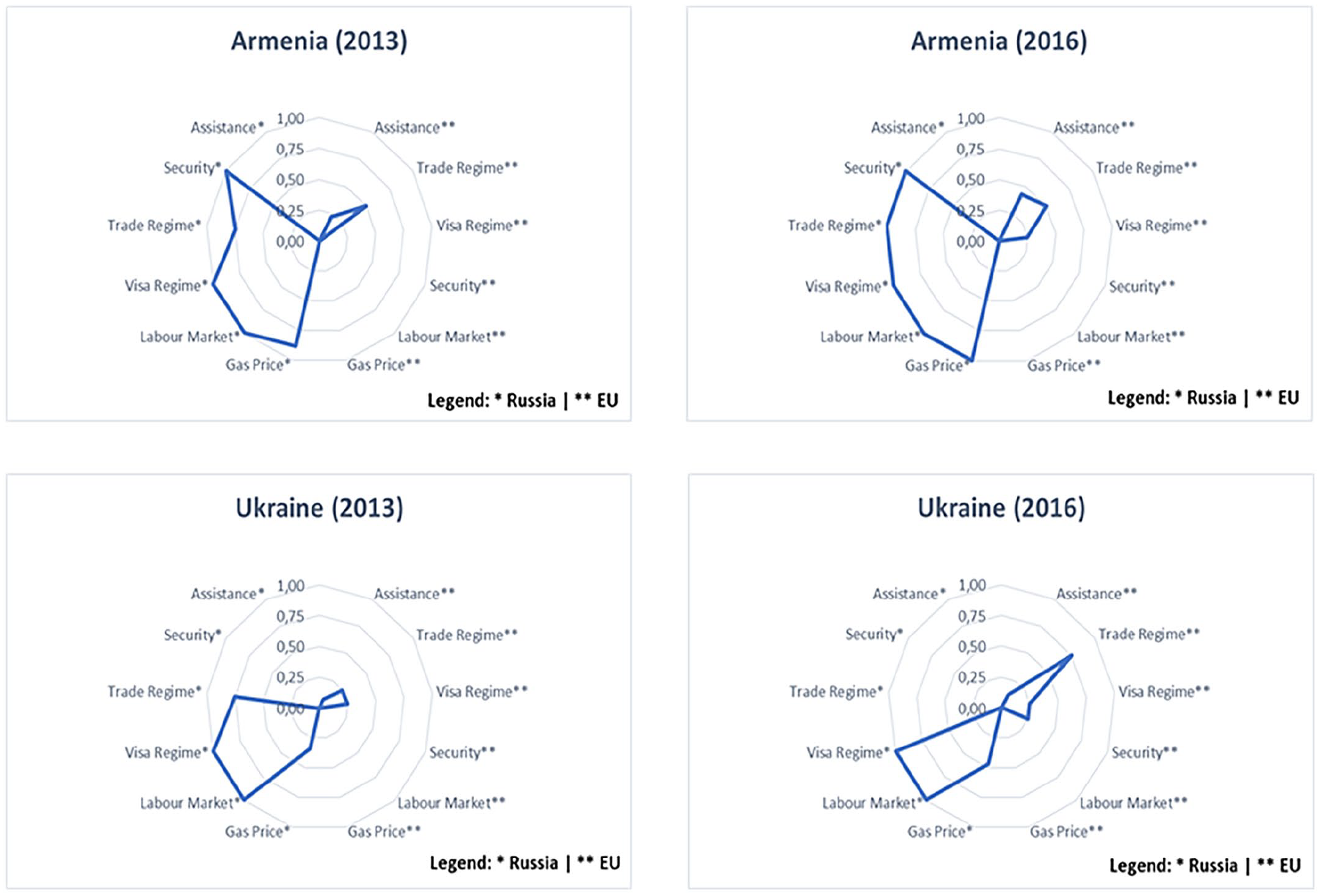
Gain-loss asymmetry.
Apart from getting access to the EAEU’s trade regime, Yerevan received a further immediate price discount down to 165 USD/tcm for the imported Russian gas. Recall from Figure 6 that the initial price of 189 USD/tcm for Armenia was already 2.60 SD below the average gas price paid to Gazprom by various European countries. In contrast, in response to the pro-EU course of the post-Euromaidan administration, the Kremlin swiftly rolled back the gas price concessions agreed upon with Yanukovych in December 2013, annexed Crimea, and supported unrest in the Luhansk and Donetsk oblasts. 77
In a symmetrical fashion, the EU increased the amount of financial assistance to Ukraine and upgraded the trade regime with Kiev to ATP. Following the invitation of the post-Euromaidan administration, the EU has also deployed to Ukraine the European Union Advisory Mission with the mandate of providing strategic advice for the civilian security sector reform. However, rather than symmetrically punishing Yerevan for choosing integration with the Russian-led EAEU, Brussels took the opposite approach: it doubled the amount of financial assistance to Armenia and introduced visa facilitation measures for specific categories of Armenian citizens. In 2015, when Yerevan had just formally joined the Russian-led EAEU, Armenia received the highest per capita EU assistance among EaP countries (46.04 EUR/cap) in the whole EaP region, exceeding the volume provided by the EU to its associate members Georgia (34.06 EUR/cap), Moldova (19.16 EUR/cap) and Ukraine (4.87 EUR/cap). In 2016, Armenia (34.76 EUR/cap) switched places with Georgia (44.76 EUR/cap), but it was still ahead of Moldova (26.98 EUR/cap) and Ukraine (9.91 EUR/cap) in terms of received EU assistance. Given the signature of the Comprehensive and Enhanced Partnership Agreement between the EU and Armenia in 2017, Brussels is expected to continue providing sizeable financial resources to Yerevan. 78 The above illustration of the gain-loss asymmetry brings us to a causal mechanism, which connects contextual MARP (H1) with loss aversion (H2).
Mechanism
Existing empirical evidence suggests that the regional integration decisions of incumbent elites in EaP countries have been primarily conditioned by contextual MARP and reinforced by the multi-attribute outcomes associated with the EU or Russia. This relational sequence approximates the mechanism accounting for regional integration choices in the EaP region. Georgia, Moldova, and Ukraine, selecting the EU, have low to medium contextual MARP and relatively higher gains associated with the EU in 2013. Conversely, Armenia, and Belarus, selecting the EAEU, have medium to high MARP and comparatively higher gains associated with Russia in 2013.
For the sake of nuance, this explanatory sequence applies generally to both set of countries, but choice reinforcement had a stronger effect in the case of Armenia and Belarus. While Yerevan and Minsk have often expressed dissatisfaction with the security (Armenia) and economic (Belarus) support received from Moscow, what Armenian and Belarussian ruling elites disliked more was, in line with H2, losing these security and economic endowments from Russia. Reassuringly, a high-ranked interviewee from the Armenian MFA confirmed that given the highly difficult relationships with neighbouring Azerbaijan and Turkey, Yerevan could not afford losing the strategic backing of Moscow. Given the asymmetry between the EU and Russia in their ability to inflict deliberate losses, as illustrated in the previous section, loss aversion is expected to be higher among countries that maintain peaceful relations with and receive greater gains from Russia, as seen in the cases of Armenia and Belarus.
Another way to analyse this sequential mechanism is through prospect-theoretic notions of ‘foregone gains’ and ‘out-of-pocket losses’. Prospect theorists document that expected out-of-pocket losses tend to have a higher perceptual impact than anticipated foregone gains. 79 Note that the selection of any regional integration prospect implies foregone gains, which the selecting country would need to renounce reaping from the alternative integration. However, choosing the EU as an integration option may also imply non-trivial out-of-pocket losses deliberatively inflicted by Russia. Moscow, in contrast to Brussels, made clear throughout 2013 the possibility of inflicting imminent losses to those countries, which would choose to associate with the EU. 80 While every EaP country selecting the EU would need to reckon with potential out-of-pocket losses, countries experiencing territorial conflicts with Russia, such as Georgia, Moldova, and Ukraine in 2014 (see the right panel in Figure 2), would tend to be more risk prone and ready to take on further losses. Given the unfortunate legacy of conflict with Russia, it is thus possible that their risk-seeking attitude and the resulting regional integration choice has been mainly conditioned by their contextual MARP. Though ruling elites from Yerevan and Minsk might also have made their choice based on contextual MARP, including resilient peace with Russia, their decision was more strongly reinforced by the fear of losing the already high gains from Russia in terms of security support, preferential gas imports and trade regime.
Conclusion
Why do states select different regional integration projects? Drawing on evidence from EaP countries, the short prospect-theoretic-informed answer is that they have different risk propensities. This study confirms that incumbent elites in EaP countries with lower levels of economic development, low to medium domestic transformation costs, and an absence of resilient peaceful relations with Russia have tended to adopt a risk-seeking approach, opting for the EU as their integration path. Georgia, Moldova, and Ukraine illustrate this pattern. Conversely, incumbent elites in EaP countries with low to medium levels of development, medium to high domestic transformation costs, and, essentially, resilient peaceful relations with Russia have exhibited a risk-averse attitude, opting for the Russian-led EAEU. Armenia and Belarus exemplify this trend.
The logical necessity evaluation and TSCS test, combined with insights from elite interviews, suggest that the dyadic peace with Russia and domestic transformation costs, defining the decision-making context, as well as trade and visa regimes with EU, and Russian security support signal eloquently risk propensities and the resulting regional integration options. The implication of this double necessity and probabilistic evaluation logic, coupled with evidence from elite interviews, recommends the use of methodological pluralism in accounting for the nuanced role of the reference point concept, which often remains vaguely defined in prospect-theoretic applications within IR.
However, while risk inclinations and the resulting integration options are primarily conditioned by variable contextual reference positions, they are further reinforced by the multi-attribute outcomes expected from the EU or Russia and their integration offers. This sequence mechanism applies to both sets of countries selecting regional integration with the EU or Russia, but reinforcement effects of multi-attribute outcomes are expected to be stronger in the cases of Armenia and Belarus. Given the threats of Moscow to deliberatively inflict costly losses to countries that will opt for the concurrent integration alternative, the effects of loss aversion are expected to be more prevalent in the case of Yerevan and Minsk that had what to lose, namely high security and economic endowments from Russia. Prospect-theoretic conceptual repertoire instructs thus the students of risky choices to examine country-specific coordinates in multi-attribute vector spaces and the reinforcing effects of loss aversion.
Do the findings of this study generalize to other contexts? The insights resulting from this study could be extended to other instances of concurrent regional building, such as that between the EAEU and the emerging Chinese-led regional initiatives in Central Asia. Moreover, they could also be extended to crucial historical episodes in which states were forced to choose sides in times of war, revolutionary events, and ideological struggles. One instructive historical example is the intricate choice of belligerent sides in the wake of WWII. Viewed in isolation, the bold decision of the Finnish leadership to abandon neutrality and confront its far stronger Soviet neighbour during the Continuation War (1941–1944) might appear, at the very least, adventuristic. At the time, Finland’s population was 3.7 million, at a ratio of 1:46, compared to a population of 170 million in the Soviet Union. However, the Finnish executive dared to take on the immense risk of attacking the Soviet neighbour starting from an unbearable low reference level, which was forced upon Finland at the end of the ferocious Winter War (1939–1940), fought with the Soviet Union only 15 months earlier. The Winter War was in turn the consequence of ruling Finnish elites’ firm decision to resist territorial and strategic concessions demanded by Moscow following the Molotov-Ribbentrop Pact. The outcome of the Winter War was dramatic. Beside costly human losses, Finland accepted to cede the entire province of Karelia, the home of about 10% of Finns, and the port of Hanko, near Helsinki, for a Soviet naval base. 81 Prospect theory predicts taking on higher than usual risks when the reference point shifts abruptly in the domain of losses and when decision-makers operate from a previously superior reference level, as experienced by the Finnish executive in the wake of the Continuation War. Prospect theory might provide thus an insightful conceptual apparatus enabling a novel problematisation of the choice of belligerent sides in times of war. 82
Among the limitations of this study, at least two warrant further scholarly attention. First, the article evaluates prospect theory within a scientific tradition that presupposes the falsification of theories based on empirical evidence. 83 The paper refrains from advancing claims about alternative theory testing, often referred to in the literature as ‘sophisticated falsificationism’, which involves assessing prospect theory against evidence and competing ontological paradigms. 84 Nonetheless, pursuing such an alternative Lakatosian falsification of prospect theory could be a valuable and fruitful endeavour. Second and relatedly, though an exegesis on logical sufficiency of contextual MARP and gains associated with the EU or Russia was beyond the scope of this article, it can also generate fruitful insights. Furthermore, given the two prospect-theoretic stages of decision-making identified by Kahneman and Tversky, 85 logical sufficiency evaluation can be coupled with what Mahoney, Kimball and Koivu call the method of sequence elaboration. 86
This study suggests that the lower the extent of the dyadic peace with Russia, the more countries in question tend, no surprise, to move away from the Russian-led EAEU. The 2022 Russian military aggression in Ukraine is expected to amplify this trend. The longer it takes Moscow to understand this non-trivial strategic implication, the longer it will generate self-defeating consequences for its own regional integration initiatives. Since the start of the war in 2022, two new developments merit attention. Armenia’s strategic loss of control over Nagorno-Karabakh in 2023 offers a compelling case for the shifting reference points and risk propensities that prospect theory predicts. As Kahneman and Tversky highlight, a downward shift in the reference position – in this case, conditioned by the loss of territorial control over Nagorno-Karabakh – can lead to risk-seeking behaviour. The recently ‘frozen’ membership in the Russian-led CSTO 87 can be explained by the propensity to accept higher risks when the reference position is perceived as plunging in the domain of losses. To be sure, a prospect-theoretic account cannot predict whether Armenia will leave the CSTO (and the EAEU), but it does suggest that, in the new context of perceived strategic loss, Yerevan would be more inclined toward risk-seeking behaviour in its relationship with Moscow.
Georgia’s post-war ambivalence, with incumbent elites balancing between the EU and Russia and civil society pushing for EU integration, underscores the relevance of viewing the reference context as multidimensional. While Georgian elites and civil society may share a similar negative assessment of conflict with Russia, they are expected to evaluate domestic transformation costs differently. The former, operating from a higher ex-ante reference position defined by their privileged political, economic, and social status, will seek to avoid the transformation costs implied by the EU accession process and opt for a risk-averse preservation of their authority. In contrast, the latter, operating from a lower reference position, perceive fewer transformation costs associated with democratization required by EU accession and are expected to be more risk-acceptant, discounting potential losses inflicted by Russia.
Finally, the prospect-theoretic implication of this study for the EU is straightforward. Brussels should persist in offering sizable gains to countries choosing to associate with the EU and avoid imposing deliberate losses on those opting for the alternative Russian-led EAEU. Epitomizing the perceptual gain-loss asymmetry, an old Latin proverb aptly states: ‘Men feel goods less keenly than evils’. 88
Supplemental Material
sj-docx-1-ire-10.1177_00471178251351458 – Supplemental material for Regional integration choices and prospect theory: Evidence from Eastern Partnership countries
Supplemental material, sj-docx-1-ire-10.1177_00471178251351458 for Regional integration choices and prospect theory: Evidence from Eastern Partnership countries by Sergiu Buscaneanu and Andrew X Li in International Relations
Footnotes
Acknowledgements
The authors are highly grateful to Christoph Meyer, Silvia von Steinsdorff, Lorenzo Bastianello, Vitalie Spinu, Elena Korosteleva, Tuomas Forsberg and to conference and seminar participants at MPSA (2019), BASEES (2019), BISA (2019), CES (2021), KCL, Oxford and HU Berlin for help and feedback during different stages of the project. The authors hereby give their special thanks to Yudan Yi (NTU MME, Class of 2024) for her excellent research assistance rendered to the study and her help in writing the manuscript.
Author’s note
Sergiu Buscaneanu is also affiliated with Humboldt-Universität zu Berlin.
Funding
The author(s) disclosed receipt of the following financial support for the research, authorship, and/or publication of this article: This project has received funding from the European Union’s Horizon 2020 research and innovation programme under grant agreement No. 746909. Sergiu Buscaneanu also acknowledges the support under the Horizon Europe REDEMOS project, grant No. 10040721.

Supplemental material
Supplemental material for this article is available online.
Notes
Author biographies
Supplementary Material
Please find the following supplemental material available below.
For Open Access articles published under a Creative Commons License, all supplemental material carries the same license as the article it is associated with.
For non-Open Access articles published, all supplemental material carries a non-exclusive license, and permission requests for re-use of supplemental material or any part of supplemental material shall be sent directly to the copyright owner as specified in the copyright notice associated with the article.
