




Abstract
Over the past two decades, the frequency and intensity of global mega-shocks – such as the climate crisis, the COVID-19 pandemic, record levels of forced migration, and the crisis of multilateralism – have increased markedly. In this context, the term ‘polycrisis’ has gained growing prominence. While rooted in complexity theory, the concept remains underexplored and underutilized within International Relations (IR) scholarship. This article examines the analytical value of the polycrisis perspective and identifies necessary refinements to enhance its utility. The discussion begins by introducing the concept, defining its core characteristics, and evaluating its analytical contributions. Empirically, the article applies the polycrisis framework to analyze shifts in the global order and the war in Ukraine, a contemporary crisis with significant polycrisis links. The findings suggest that while the polycrisis concept provides a valuable complexity-driven lens to enrich IR analysis, its foundational theoretical assumptions often require modification. Drawing on the notion of restricted complexity, the article proposes adjustments to strengthen the theoretical coherence and practical applicability of the polycrisis framework in IR.
Introduction
Describing and understanding the current state of international relations and the transforming global order is hardly possible without referring to the term crisis. Undoubtedly, the 21st century is shaped by deep reaching changes in our social and planetary system. 1 The frequency of substantial crises across a wide range of sectors has risen visibly. For Europe this encompasses a financial crisis in 2008, followed by a debt crisis in the Eurozone, major armed conflict in its neighborhood, the Middle East, a refugee and migration crisis, democratic back-sliding in some countries, the Covid-19 pandemic, the return of large scale conventional warfare with Russia’s invasion of Ukraine, soring energy and food prices as a consequence of the war in combination with post-pandemic inflation, as well as the growing threat through climate change.
Some of these crises are regionally confined, others have a global dimension and appear in close frequency or even simultaneously. All of them have in common that they are significantly disrupting the existing order with the consequence that IR scholarship connotes a decline in multilateralism and global governance structures as well as rising tensions among great powers. 2 Of course, crises are no new phenomena, history provides for many examples. In the end, all empires disintegrated, whole civilizations disappeared and there is no political system or organization which is eternally stable. In fact, crises have been a defining element throughout history, but they have hardly been recognized as a constitutive element in IR scholarship but rather treated as unwelcome distraction of episodic relevance. The increasing prominence of the term polycrisis has the potential to bring in crisis as a central element of IR debates. With the existence of numerous crises in international affairs the question emerges, is the term merely a neologism or can it provide real analytical value? 3
For this reason, the article places the notion of the polycrisis at the center of analysis. The aims of the article structure its content. Accordingly, the main aim is firstly to introduce the term to a wider IR readership, presenting and discussing its theoretical roots which are linked to complexity theory. 4 This first section explores three major conceptual categories on which the idea of the polycrisis is built. These are unboundedness, non-linearity and emergent system properties. This longer section is important because the underlying conceptual foundations are often not sufficiently reflected in the emerging literature. In a second step, these foundational categories are critically explored with the intention of conceptual refinement. Thirdly, the article probes the empirical applicability within an IR relevant context. This section starts with a discussion of global order changes and what the perspective of the polycrisis can add to current debates. In the second part of this section a specific case study is chosen offering a more detailed analysis.
The war in Ukraine constitutes a major crisis not only for European countries and can be categorized as an important global order making event with multiple and unexpected consequences across different policy areas. It thus constitutes a case which corresponds well with the formulated presumptions the polycrisis concept offers. In the end, the main aim of this article is not to either refute or uncritically apply the polycrisis concept but contributing to conceptual refinement within an IR relevant context which requires both theoretical clarification and discussion on what conceptual building blocks the term polycrisis is built as well as an empirical probe into its explanatory value. The concluding section summarizes these processes and indicates areas for future research.
The polycrisis
The term polycrisis was first coined by Morin and Kern 5 and later popularized by former EU Commission president Jean-Claude Juncker pointing out how the many crises in the EU are interconnected. 6 It also found its entrance into EU integration studies. 7 Leading English-speaking newspapers, such as the Financial Times have dedicated editorials to the issue. 8 The 2023 Global Risks Report by the World Economic Forum (WEF) identified the polycrisis as a pertinent threat to humanity. Furthermore, the term found entrance in EU and UN policy documents. 9 However, until today the phenomenon and its consequences remain underspecified and under-theorized. Research is at the beginning of understanding what a polycrisis is and what consequences it brings about.
The number of academic publications remains limited but is growing dynamically. 10 The theoretical underpinnings on which the concept is built can connect to well-established fields of research such as complexity theory. In fact, Edgar Morin is best known as a complexity theorists. Furthermore, research on the Anthropocene or Earth Science Systems are prominently using the term. 11 While these fields might not count as forming part of conventional IR, 12 they are of growing popularity and relevance for the discipline. Still research exclusively devoted to the polycrisis is an emerging literature. For this reason, this section provides a short introduction of the main characteristics of the polycrisis starting with defining the term.
So far, the literature has not produced a single comprehensive definition of the term integrating all its aspects into a parsimonious formula. Instead, authors have emphasized different aspects of it. Morin and Kern point to causal complexity and crisis overlap when saying: ‘There is no single vital problem, but many vital problems, and it is this complex intersolidarity of problems, antagonisms, crises, uncontrolled processes (. . .) that constitutes the number one vital problem’. 13 Swilling adds more focus to this observation when defining the polycrisis as ‘a nested set of globally interactive socio-economic, ecological and cultural–institutional crises that defy reduction to a single cause’. 14 Most recently Lawrence et al. (2024) understand the polycrisis as a ‘causal entanglement of crises in multiple global systems in ways that significantly degrade humanity’s prospects’. Lastly, Henig and Knight speak of an ‘entangled system of escalating problems’. 15
These definitions while framing the issues in important ways fall short of comprehensively covering the polycrisis. This might be because of the relative newness of the concept and because of the complex nature of the phenomenon which tends to escape the formulation of parsimonious statements. Despite this, there is agreement that the term polycrisis refers to multiple crises (harmful disruptions) which condition each other and therefore appear in close succession or simultaneously. Importantly the amalgamation of several crises leads to the creation of a system which is different from the causes, consequences and properties of individual (separate) crises who may be reducible to individual causes. In simple words, a polycrisis consists of multiple inter-connected crises which has system character.
Based on this definition which key properties and subsequent operating principles can be identified? First, a polycrisis is an unbound phenomenon. 16 At the operational level it is both inter-sectional and multi-scalar, cross-cutting various policy fields, spaces and connecting several crises. This makes it challenging to neatly delimit where one crisis starts and another one ends. Unboundedness does not equal limitless, thus a crisis even a polycrisis does not endlessly expand but it cannot be reduced to a single sector or event. The unbounded character informs the remaining two key properties, causality and emergence.
Second, causality. A polycrisis consisting of a complex entanglement of crises which cannot be reduced to single triggers is expected to operate in a non-linear manner. Non-linearity does not signify the absence of any causal relationship. Instead, multiple forms of causality are likely to work alongside each other. These are often described as cascading, spill-over effects or tipping points encompassing positive or negative feedback loops. 17 The concurrent appearance of multiple crises can create multiplying effects. Within a polycrisis the single crisis can be both, the cause for another crisis but also the effect of it. An element of endogeneity becomes visible. The combination of multiple and interwoven crises can have hard to control ripple effects when a tipping point has been reached, causing a cascade of consequences after which system changes accelerate and are irreversible. Such arguments have most prominently been made with regard to climate change, research on the Anthropocene and planetary boundaries. 18 Despite the prominence of these concepts in other disciplines, complexity thinking as well as research on the Anthropocene have not made it to the core of conventional IR. Instead, they appear as highly specialized sub-sections. 19 Furthermore, within the context of the polycrisis causal relations may also consist of very long and therefore difficult to trace chains of consequences which are hard to anticipate or encounter. 20
Although the exact character of causality is part of ongoing research, there is a common understanding that observable causal logics reinforce the existence of the polycrisis and that this is based on non-linearity. 21 Non-linearity might best be understood as consisting of multiple forms of causality which populate a continuum beyond a narrow deterministic understanding of universal cause-effect relationship. The described effects of the polycrisis are not assumed to occur with deterministic certainty. Rather the emphasis is placed on non-determinism and non-linearity which are triggering unexpected effects creating an environment of limited predictability and reduced governability because of their complexity. The argument is that in a world which is strongly interconnected the effects of a single crisis are less likely to operate in isolation from others.
In sum, it is fair to argue that polycrisis research tends to use ‘hard’ and ‘soft’ forms of causality. The mechanism through which crises spread are usually linked to hard causality such as cascading and spill over effects. However, the effects of various crises are understood as unintended consequences, non-linear events with limited predictability, a softer form of causality. Conceptually the unpredictable disruptive crisis character conditions the hard causality spreading of a crisis. In terms of hierarchical relationship, the non-linear precedes the linear which assigns the latter a greater relevance.
The third key property refers to the emergent system character of the polycrisis. A crisis which is unbound and non-reducible to individual causes but working under circumstances of non-linearity provides a fertile environment for establishing a self-regulating system. Such a system is more than the addition of its single parts. As a system with emergent properties it is assumed to be self-organizing. 22 Without being deliberately designed, single crises relate to one another in a manner which forms a larger whole. As the above-described causal logic works self-sustaining (spillover effects, feedback loops, cascades etc.) and is unbounding, the polycrisis is self-organizing creating conditions which re-enforce itself. In other words, it has emergent properties. Without the assumption of emergence, a polycrisis would merely consist of multiple crises which can be disaggregated into individual crises having individual roots.
The growing interconnectedness of today’s world in combination with increasing polarization in global politics creates favorable conditions for crises to spread fast and stir disruptions, which are difficult to overcome. A cycle of unresolved and overlapping crises is the result. Before starting to probe into usefulness of the concept empirically, the next section offers a critical reflection of these three foundational properties.
A critical view on polycrisis
The theoretical foundations of the polycrisis concept are internally coherent, logic and strongly linked to an established theory, namely complexity thinking. Complexity theory understands complex systems as principally open, operating under non-linearity and leading to self-organization. 23 While this makes up for a solid conceptual foundation as such, the make-or-break point is the question if the three theoretical building blocks (unboundedness, non-linearity, emergent properties) are merely theoretical categories or if they reflect an accurate assessment of the world of crises? While anecdotal evidence of inter-linked crises is easy to find, a close examination of each of the three key properties reveals several limitations which are discussed in this section
Unboundedness, the concept of the polycrisis builds on the premise that a crisis cannot be fully isolated to a particular field but spreads across different areas having difficult to control consequences. Tipping points and cascading effects are mentioned in this regard. The most prominent example is the warning about a critical threshold of global temperature increases. While climate change is a very pressing issue, a priori assuming that it is an unbound phenomenon is problematic. A radical interpretation of unboundedness implies that unstoppable processes are at work with infinite disruptive consequences. Unboundedness conceptually suggests that crises are inherently global, penetrating all areas of human life, in other words being all-comprehensive. Most crises might not escalate to this extreme level but are more sector or regionally confined (as the empirical section will demonstrate). However, a rise of global temperatures beyond two degrees is likely to cause catastrophic consequences which come close to the concept of unboundedness. But even within climate research the 2023 Global Tipping Point report finds that ‘Tipping “cascades,” where tipping one system causes another tipping point to be passed, and so on, are possible but currently highly uncertain’. 24 In practice, the crises we are confronting in IR are hardly fully unbound but more likely have no clear boundaries. A slightly different characterization referring to trans-boundary crises is a better fitting characterization. The term trans-boundary refers to the polycrisis consisting of multiple causally linked crises but does not assume that these crises expand endlessly. A fully unbound crisis unraveling makes human agency redundant, an assumption, which comes close to doomsday prophecy. Referring to trans-boundary crises still leaves space for human action but points to complex causal entanglements of inter-linked crises. Thus, the difference between unboundedness and trans-boundary crises is not merely semantic but substantial.
Furthermore, research on the polycrisis has the tendency to focus on disruptive causal links, which makes it vulnerable to the problem of confirmation bias and underestimating forces of resilience. A crisis usually triggers responses to end or contain it. Of course, with different prospects to succeed. One of the weaknesses of the literature is, that it is not specific on when and under what circumstances spill over effects occur and how strong they are and what works against crisis contagion. 25 Crisis transmission is often just assumed to happen without knowing how and under what conditions it actually occurs. Future research would need to be more specific in theorizing the exact mechanism through which crises spread.
Causality, the literature on the polycrisis is not very clear about what concept of causality it is favoring. On the one hand, the argument is made that interconnected crises have hard to control and difficult to predict consequences. 26 This speaks for a non-linear understanding of causality in which tracing causal chains of events is compromised because of unexpectedly occurring ruptures and turns. On the other hand, the literature is concerned about cascades, tipping points and causal mechanisms. 27 While causal non-determinism informs the former, the latter displays a rather rigid understanding of causality, for example, in the form of a cascade. The problem which emerges is not that the literature has not decided for a particular type of causality but the conditions when a type of causality is operating are not known. When do cascading and spill over effects occur, when are they absent and unpredictability reigns? So far, the literature has not developed indicators for complexity thresholds and interconnectedness. How and why crises are interconnected producing certain effects still needs to be explained whenever possible However, one may also argue that the phenomenon at hand renders the search for causal explanations difficult to impossible. If this is really the case still needs to be evaluated. Because non-linearity might be mis-understood as the absence of any causal relationship, referring to multiple causality instead better matches a situation in which different forms of causal linkages co-exist. Still the current literature is not specific on when what kind of causal logic applies.
Emergent self-organization
At the heart of the argument is the assumption that the interconnection among crises is strong enough to form a self-sustaining system. Because crises are trans-boundary and have multiple effects, they create favorable conditions for their endurance. Taken seriously a polycrisis once established has the ability of system self-sustenance. As a system it is supposed to be more than the sum of its parts. However, crises when they emerge might in fact be still caused by single decisions or trigger events but later have many consequences contributing and reinforcing several other crises. If the initial cause for a crisis weakens or disappears it is still reasonable to assume that the crisis follows suit. While a polycrisis might not simply be reducible to its single parts, these single parts may still play a non-marginal role and have influence on the system. Indeed, it is rather hard to proof that a polycrisis exists as a self-reinforcing system operating autonomously from its constituent parts. In the end, a polycrisis might better be characterized as an assemblage of crises in which individual crises are impacting on and shaping the system which are inter-connected but not creating a fully self-sustaining system. 28 In this regard a polycrisis is an emergent system in which agent properties remain influential but under system conditions. After all, even the most stable and intrusive system relies to some degree on individual building blocks which have a degree of autonomy. In conclusion, the value of the concept of the polycrisis does not rest on essentialist claims of radical unboundedness, non-linearity and emergent system properties. In fact, complexity theorists also offer a more moderate approach which is known as restricted complexity. 29 In this context crises can be understood as being trans-boundary phenomena and not fully unbound. Restricted complexity would characterize non-linearity as following the logic of multiple causality and emergent systems as partially self-organizing and relying on agent properties. 30
The following sections start applying the concept of the polycrisis within an IR context. This will be done first by exploring what it can contribute to a better understanding of changes in global order. This short macro focus will be complemented by a more specific exploration of the war in Ukraine as an example of how various crises are interconnected.
The polycrisis in IR: an initial empirical evaluation
What value does the concept of the polycrisis has to offer for analyzing global affairs? While a single article cannot offer an exhaustive assessment of the concept (within an IR context) because both fields are covering an extensive and diverse set of phenomena, it still can offer a probe into the viability of the concept. This section aims to show what a polycrisis perspective can offer as an analytical lens. The section is divided in two parts. The first one builds closely on the conceptual discussion, showing how the polycrisis is substantiating itself in global order questions. The second section is focusing on a more specific case, the war in Ukraine and takes a closer look at how a single major crisis is inter-connected to others, exploring its consequences. Together both examples offer a macro and micro perspective on what the concept of the polycrisis has to offer also discussing its limitations and shortcomings.
Global order in the polycrisis
Following the concept of the polycrisis, the main argument that can be developed would emphasize that the current order is not only the result of the arrangement of individual state capabilities and interests but is also informed by the challenges and crises it is reacting to. Thus, there are good reasons to think global order making from a defining phenomenon such as the polycrisis. In this regard a polycrisis perspective takes a system and complexity oriented approach which contrasts the dominant debates on global order challenges which tend to concentrate on how different models of polarity (state power) are shaping international affairs. 31 The following paragraphs concentrate on three key features of the polycrisis as discussed above. Figure 1 illustrates these findings and links them to the analysis of current global order changes.
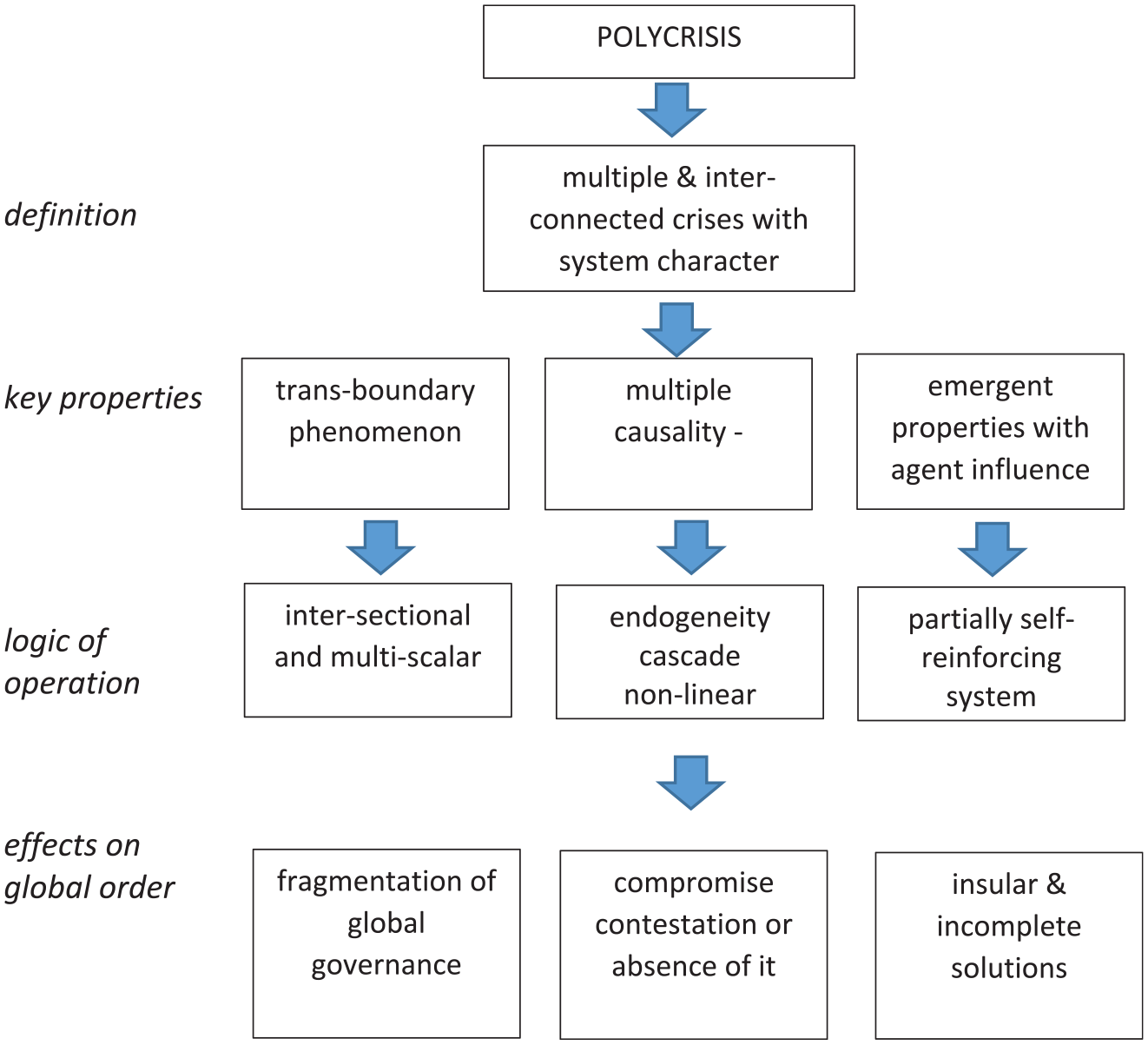
Possible effects of the polycrisis on global order.
Assuming that the polycrisis is a trans-boundary phenomenon manifesting itself in an inter-sectional and multi-scalar manner one can logically assume that it has disruptive consequences for global order, a weakening and fragmentation of global governance can be the consequence. In this context, an increasing informalization of global governance and a tendency of setting up low-cost institutions as well as a general rise in de-globalization is identified in many recent studies. 32 Increasingly states are bypassing established international institutions and set up their own task-specific clubs outside of established organizations. Increasingly, ad hoc coalitions are the preferred arrangements instead of large multipurpose international organizations. 33 Consequently, global governance institutions get weakened visibly.
How is the global polycrisis involved in weakening global governance structures? In situations in which crises are trans-boundary, they reinforce themselves and evolve, the ability of large multilateral organizations to solve deeply entangled crises is reduced. One example is the issue of food security. The number of people threatened by food insecurity grew from 563m in 2014 to 735m in 2022. 34 This increase is triggered by several crises. These range from climate change, Covid-19, the war in Ukraine, to a general increase in armed conflict in Africa. Together these crises are responsible for a deadly cocktail such as food price inflation, reduced food production and trade obstacles. The consequences of one crisis, for example, a higher likelihood of droughts through climate change cannot simply be compensated by other means such as more efficient trade flows. Furthermore, even if one crisis is tackled successfully (grain deal with Russia in the war against Ukraine in 2022–2023) this does not lead to a quick turnaround of the problem of rising food insecurity which existed before the war. Given the entanglement of several crises at once, global governance institutions can easily appear as overburdened and less and less able to address global challenges effectively. This in turn undermines international trust in them and willingness to engage in multilateral institutions which in turn weakens prospects for encountering the polycrisis constructively. If declining problem-solving competence meets policymakers who see interconnections as potential risk (weaponization of interdependency) and are advocating for processes of de-globalization in order to ‘de-risk’, then global governance institutions operate in a shrinking space of opportunities. 35 This in turn can further contribute to the worsening and deepening of existing crises. The problem of food insecurity is not likely to simply disappear by ignoring it.
Linked to the multiple causality character of the polycrisis, another consequence is compromise contestation or even the absence of it. A polycrisis which cannot be reduced to a small set of single causes which could be addressed one after the other complicates finding a common ground. Complex situations are characterized by multiple causality. This means that no universally deterministic solution exists for the problem at hand. In this context Davies and Hobson identify a ‘breakdown of shared meaning, stemming from crises being understood differently and from the complex ways in which they interact, and how these interactions are subsequently perceived differently’. 36 Logically a joint or global narrative on the causes, effects or remedies against a crisis or crises is difficult to generate. In the absence of it, polarization increases and global compromises are hard to reach.
It is increasingly visible that on key global issues, there is a lack of common ground leading and supporting multilateral agreements and institutions. This is true for example regarding trade regimes and climate change. Indicative of the lack of agreement in trade regimes is the fact that the World Trade Organization (WTO) trade rounds are stuck in endless negotiations with no result in sight and even the internal dispute settlement mechanism becoming defunct. With the absence of a global unifying trade paradigm, the majority of arrangements are negotiated bilaterally, around 600 are on records at the WTO creating a patchwork of treaties.
In the area of climate change we can observe a similar pattern. The high number of global climate summits (30 by 2025) is no sign of unity indicating on a vital global governance issue. It is rather a reflection on disagreements on how to proceed and what action to take. Breakthrough moments such as those in Paris at COP 21 in which global consensus was reached not to increase average temperatures by more than 2 degrees are rare. While it expresses consensus on the need to reduce harmful emissions, such an agreement is ‘cheap’ if it is not accompanied by specific action. The absence of legally binding reduction targets reflects on a deep sitting dissent on how reductions should be reached and how the burdens of climate change are shared financially. 37 In other words, the substance of the matter remains contested despite an existing agreement.
Why are state preferences so far apart from each other? While an actor-centered realist and rationalist approach would highlight an underlying power shift of rising countries, attempts of free riding or interest diversity, a polycrisis approach would point to multiple effects of the liberal trade paradigm and varied consequences of climate change. The profits from liberal trade are not unidirectional positive for all and ideologically centered on what the Global South considers a neo-imperial imposition in the form of global governance institutions (Washington Consensus). Furthermore, the effects of global warming are not equally shared as well as CO2 emissions are very unequally emitted. Climate change produces a set of hard to control consequences. It best fits the assumption of cascading effects and tipping points (although none has happened yet). In such a context, an erosion of international compromises is hardly surprising. Furthermore, in a fossil fuel-based economy the liberal economic paradigm has contributed to climate change but also to poverty reduction while at the same time can fuel excessive inequalities. Thus, the consequences can be many and cross-cutting policy sections which complicates taking supposedly rational decisions. The current capitalist organization of the global economy bears significant risks contributing to climate change, pandemics and depletion of key resources but there is no alternative model insight which is agreeable globally. 38 The consequences of the polycrisis are many and costs are not equally shared, thus contributing to a fractured causal assessment. Adopting a polycrisis perspective allows one to step out of the silo. In simple words, poverty reduction a function of simply implementing neo-liberal economic policies if these trigger or aggravate other crises.
Lastly, and connected to the presumption of multiple causality the polycrisis is a partially self-reinforcing system. This can manifest itself in insular and incomplete solutions for existing crises contributing to negative externalities. The interconnectedness of several crises, their intersectional and multi-scalar nature in an environment of multi-polarity can create situations in which no final solution might exist. Given the current structure of the global economy, it is not very likely that advances in economic development are disconnected from the use of natural resources. Growing out of poverty, to reduce food insecurity is usually linked to higher CO2 emissions and a higher degree of environmental degradation. This, however, increases risks for climate change or the spread of zoonotic diseases. 39 The consequences of both is that solutions which address a single crisis in isolation from other related crises only produces incomplete solutions. In the security field the length of armed conflicts has increased with numerous wars appearing as intractable. 40 At the same time the number of UN peacekeeping missions is in decline while the number of conflicts the UN Security Council is incapable of addressing has increased. 41 These unsolved crises aggravate other crises such as food security, increase geopolitical tensions among great and regional powers as well as extend un-governable zones making it hard to implement all kinds of global governance initiative from lowering CO2 emissions, vaccination campaigns to poverty elevation or international peacekeeping missions. In this regard they contribute to crisis self-sustenance in some instances. However, the causes for these conflicts might also be individual ones loosely connected to other crises.
In sum, taking on a polycrisis perspective for exploring global order issues helps better understanding current challenges. For example, the crisis of multilateralism and global governance cannot be traced back to a single causal event but is linked to the complexity of multiple interlinked crises. Approached from a polycrisis perspective power rivalry, which is often treated at the single most important political crisis, is less reducible to individual power aspirations but also results from intractable crises with varied consequences which have the potential of self-sustenance. Such a systematic and complexity infused view is often neglected in mainstream IR. A Hobbesian realist orientation remains popular especially at times of great power rivalry which understands power competition as a quasi natural status of inter-state relations. However, realities are complex and the notion of the polycrisis makes us aware that reductionist views are problematic. The UN Security Council being increasingly barred from taking action is both a symptom of the polycrisis in the form of defaulting multilateralism as well as contributing to other crises through the absence of international responses to armed conflicts, the climate catastrophe and other major crises. The rising number of armed conflicts more than likely fuels more power rivalry aggravating the current crisis of multilateralism. For recognizing linkages between supposedly separate fields the concept of the polycrisis makes an important contribution making us aware of the inherently complex agglomeration of current crises. Because instantiations of the polycrisis cannot only be found at the macro systemic level with entire systems being causally linked in a state of crisis, the following section focuses at the mid-range level selecting a prominent case, the war in Ukraine.
The war in Ukraine in the context of a global polycrisis
Complementing the section above, this one explores how far the war in Ukraine fits into the paradigm of the polycrisis. To which extent can we observe trans-boundary effects, multiple causality and partially emergent system properties for a major contemporary crisis? And what analytical value-added can these central elements of the polycrisis offer for research in IR? The case of the war in Ukraine has been chosen because it can be labeled a hard test case. A hard test is a case a theory is expected to explain but is somehow outside its original explanatory field. A theory can be regarded a strong model if it is able to explain cases extending its explanatory reach. The war in Ukraine constitutes such an extension going beyond research on the Anthropocene and climate change in which the concept is most popular and has already demonstrated its relevance.
From an IR perspective, the war in Ukraine is an interesting choice because it is a major contemporary crisis extending beyond several policy sectors, displaying polycrisis potential. Naturally, a single case exploration comes with a number of limitations in terms of generalization. However, the counter-intuitive argument holds that if the used concept struggles to explore the selected core case, it is less likely to offer analytical value in similar situations. In the end, the Ukrainian case is rather a probe than a full ‘blown’ test. The overall aim is not to dismiss or accept the concept of the polycrisis but to acknowledge its strength and weaknesses and contribute to a more nuanced understanding of it.
No doubt, the invasion of Europe’s second largest state, the unlawful annexation of around 25% of Ukraine’s territory until 2024 and the systematic targeting of civilian infrastructure constitute a significant crisis for the existing global order. By violating a whole set of international treaties and dismantling the post-Cold War European security order, the conflict is challenging the global order as laid down in the UN Charter, in particular state sovereignty, territorial integrity and the right to self-determination. The conflict has wider global geopolitical meaning as it is accelerating a transformation of global order away from its Western centrism. China’s close alliance with Russia and Russia’s attempt to instrumentalize the war as defensive action against western global hegemony make it clear that whatever the future fallouts of the war will be, they are not just regionally confined. As major energy and food exporting country, nuclear superpower and veto-holding permanent member in the UN Security Council Russia’s role in global affairs remains important.
The war in Ukraine as a trans-boundary event
Large and deep reaching crises such as the war in Ukraine are not confined geographically to the places where the fighting is taking place but produce ripple effects across a variety of sectors, which increases the likelihood of linking it to other crises. An event which produces trans-boundary effects is less likely to trigger a unified reaction as its consequences vary across sectors and affect different actors differently. To which extent is the war producing trans-boundary effects?
With the beginning of the war global energy and food prices rose sharply because Russia is a major energy and food exporter (oil, gas, coal, uranium) and Ukraine was a major transit country for Russian energy and significant food exporter. Ukraine and Russia make up a sizable share of global grain exports. The oil price (WTI) jumped from $77 at the beginning of 2022 to over $120 in June of the same year. While this increase can be traced back to a single crisis, the war against Ukraine, its effect was amplified by another crisis which occurred before, the Covid-19 pandemic. During the pandemic outbreak in 2020 WTI at some point sold for less than $0, short time sellers needed to pay for oil. Although oil prices often follow a boom and bust cycle with significant ups and downs, these extreme variations are uncommon and were driven by two closely following crises. The change from sub 0$ to over 100$ within such a short time is unique in history. 42
Even more extreme increases could be observed at the gas market which has seen an increase of 400% from the low point in 2020 to the peak 2 years later. When the war erupted in February 2022 energy prices were already increasing as a consequence of production reductions during the pandemic but increasing demand following the end of Covid-19 containment measures. The war further accelerated price increases. High energy prices are at the center of rising inflation which triggered an abrupt end of low interest rates. The US federal reserve started a sharp turnaround from nearly 0.25% interest during the pandemic to around 5.5% in 2023. 43 During the pandemic many countries tried to keep their economy running with national rescue packages financed by low interest rates. Financing debt becomes significantly more challenging at times of higher interest rates. A similar bonanza of escalating prices can be observed in the food sector. While they already increased during the pandemic they accelerated further with the outbreak of the war. Between March 2020 and March 2022, the wheat price surged by 125%. 44 With Russia and Ukraine agreeing on the continuation of Ukrainian food exports prices consolidated. A deal which lasted for 12 months. Russia and Ukraine are major global players when it comes to wheat, barley and maize export. They cover 30%, 25% and 15% of global exports. Additionally, Russia is the largest global exporter of fertilizer.
Sharply increasing food prices have the most negative effects in situations of production shortages and/or increasing demand. Such a situation can be found in some developing countries which experience population growth and climate change related consequences. The war has contributed to prior existing food insecurity.
Energy and food price increases are one example how different crises are intersecting and create ripple effects across different areas with the potential to amplify each other. Extreme fluctuations in global energy markets, food prices, sharply rising interest rates within a short period exert significant pressure especially on weak economies such as those in developing countries. The consequences of the Covid-19 pandemic had not been overcome when the war started. In this regard, the war amplified an existing crisis in a number of developing countries. In this context diplomatic frictions emerged between countries of the Global South and the West. 45 The latter expected a nearly global followership when condemning the Russian invasion and implementing hard and comprehensive sanctions. The former showed much more reluctance in condemning the invasion and did not join the sanction regime, avoiding the impression of a political alignment to the West.
Within the security sector, the war produced a number of ripple effects. Although the actual fighting remains concentrated on Ukrainian territory, its consequences are felt beyond the country and in particular affect the European continent. As Russia turned its economy into a war economy the threat perception increased for most European countries triggering an uptake in military spending and modernization of weapon systems. Extensive sanctions against Russia let to a disentanglement of economic relations and a reorientation of Russia’s relations to eastern partners, such as China, North Korea, and India. 46 Russian foreign policy is now perceived differently, bringing with it a strong geopolitical dimension. In Africa, Russian military engagement has increased, coinciding with the invasion of Ukraine. 47 The infamous Wagner Group (now the Africa Corps) operates in numerous countries in the Sahel closely cooperating with military governments at the expense of France and other EU countries. Lastly, the war contributes to the crisis of multilateralism, for example visible in a decline of UN Security Council resolutions adopted by consensus and the highest number of vetos (7) used in 2024 since the end of the Cold War which is further straining relations among great powers. In sum, the war produced a number of ripple effects contributing to the further aggravation of existing crises such as food insecurity, energy crisis, debt stress, and inflation pressure. In this regard, it is an example of a major crisis operating within the parameters of the polycrisis.
Understanding crises as producing trans-boundary effects which not only feedback into the ‘original’ crisis but are also re-enforcing others holds important practical and analytical value. Within a polycrisis setting, treating a single crisis as an isolated event risks misunderstanding both its sources and consequences. Any selected policy countering a problem through a single-crisis perspective increases the likelihood of unwanted side-effects and minimizes the prospects for crisis resolution.
One example is the Western crafted response to Russia’s invasion which aims at political and economic isolation. In large parts, this is not full-heartedly supported from country of the Global South, despite the near global rejection of the invasion. One explanation for this is varied consequentialism that the war is producing in combination with a degree of crisis saturation produced by the polycrisis. 48 At times of multiple crises especially emerging countries are exposed to multiple stressors (climate change, food insecurity, post-pandemic inflation, persistent underdevelopment, high public debt, increased armed conflict etc.) these crisis pressures limit the willingness and ability to take on potential burdens resulting from a comprehensive political and economic isolation of Russia. Thus, the trans-boundary character of such measures provides explanatory value in this case.
The war and multiple causality
The multiple causality element of the polycrisis typically refers to hard to predict or control consequences of the crisis at hand and contribution to crisis spill over and unexpected side effects. Accordingly, a crisis is expected to have multiple effects. Certainly, warfare itself carries a large degree of unpredictability with it. The possibly most referenced phrase in this context is emanating from Carl von Clausewitz who characterized war as ‘the realm of uncertainty; three quarters of the factors on which action in war is based are wrapped in a fog of greater or lesser uncertainty’. 49 From the invasion in February 2022 until August 2024, the war indeed has taken numerous unexpected twists and turns producing multiple effects.
Here are some examples. Instead of a quick operation capturing the entire country using overwhelming military power, Russia lost the battle for Kyiv, Kharkiv, and Kharson in 2022 and got tied up in a war of attrition against a de facto much weaker opponent. 50 In in the course of the war Russia massively propped up private military contractors aiding its regular army. At its peak, the Wagner Group commanded over 50,000 soldiers. However, instead of winning the war, its leadership staged a short-lived munity in August 2023. Although Russia commands over the largest fleet of any Black Sea country and Ukrainian maritime capabilities were closed to none existent, the country managed to expel Russian war ships from its shoreline including occupied Crimea through developing a fleet of sea-drones. Despite Russia commanding over significantly more firepower in almost all weapon system, Ukraine started an incursion into Russian territory in August 2024. 51 In sum, limited predictability of and unanticipated consequences, seem to be a defining element also impacting on the ability of crisis spill over.
The unexpected course of the war in the form of a war of attrition caught both the West and Russia off guard. The consequence of this are geopolitical shifts contributing to more power rivalry. The shortage of military equipment especially artillery ammunition forced Russia to go into a closer alliance with North Korea, seek alignment with China and maintain India as a market of its energy exports. Because of Western sanctions, which aim at isolating the country and constraining its war production and the slow ‘progressing’ invasion, Russia is strategically forced to keep its small group of essential partners content. This has to the consequence that great power rivalry is increasing. Fears of China following the Russian example occupying Taiwan, supporting Russia directly if it should come under military pressure and collapse or loose the war are not unfound.
Furthermore, as Western sanctions have not crippled the Russian war economy to a degree that it has impacted military operations, Western countries are forced to at least think about applying secondary sanctions against countries/companies supplying Russia with essential products for its war. This fosters processes of de-globalization, on-shoring and consolidating regional trade blocks at the expense of global trade. The comprehensive sanctions regime against Russia has also accelerated plans of BRICS countries to gradually reduce their dependency on the US dollar and the Western financial system. 52 All these processes are contributing to a further fragmentation and polarization of global affairs. Again, the war is contributing to crisis transmission with multiple ripple effects.
However, counter examples also exist. Russia’s unexpected loss of maritime dominance in the Black Sea enabled Ukraine to gradually transport more of its grain by ship. This had a positive impact on global food prices contributing to an easing of food insecurity and inflation pressures. This is especially important for developing nations with a fragile economic and political system. Here crisis spill over is impacted by an unexpected turn of the war. 53 In sum, neither the outbreak of the war in its full scale of destruction, nor its course of events have been fully predictable or follow a linear course. Despite this, it is also no erratic event as such. Rather than being dominated by one type of causal logic, it consists of a diverse set causalities. The discipline of IR struggles with such kind of events. Conventional IR tends to stick to a narrow understanding of causes and effects and assesses the analytical value of a theory or conceptual framework according to its ability to proclaim and verify law-like relationships. Polycrisis research once more points to the necessity to engage with a wide spectrum of causal relations. It remains astounding that despite a general agreement that world affairs increase in complexity, IR treats complexity research as a rather marginal sub-field while it is centrally important.
Emergent system properties
Important for the idea of a polycrisis, is the assumption, that it can constitute a system with emergent properties. In other words, the crisis should have the ability to reinforcing itself. In this sense a polycrisis is at least partially self-organizing. There is no question that the war is consequential beyond the narrow battlefield. It is more difficult to argue that the war contributes to building a fully emergent system operating independently. The energy price shock, inflation pressure, increasing geopolitical tensions and the issue of food security in the context of a post-Covid-19 economy and prior existing crisis of multilateralism and climate change are anything by trivial. However, are the spill over effects from this crisis to another strong enough to create negative feedback loops instigating new crises and are critically contributing to the maintenance of the existing ones?
The answer is mixed. Crisis spill over from the war is likely not strong enough to speak about the creation of an emergent system but the war among other crises is contributing to the further conservation of the polycrisis which without it might be less severe. Despite the ongoing war, energy prices in 2023 have consolidated or their high level is not any more exclusively linked to the war. The same is true for the wheat price. It was falling sharply from its peak of nearly $1,200 per ton in May 2022 to $524 in September 2023, despite Russia discontinuing the grain deal. Likewise, inflation is receding in many economies and the UN Security Council continues to adopt a majority of resolutions with consensus albeit not on contested issues such as Ukraine and others. The existing global order, despite experiencing significant ruptures, seems to be able to absorb crisis shocks.
It should be treated as a sign of hope that despite the disruptive consequences of the war global markets also display elasticity if not resilience. In less than a year Europe’s largest economy, Germany, managed to replace all its Russian energy supplies because the global oil and gas markets are flexible. 54 Supply shortages from one source (Russia) could be replaced quickly by increased production from other countries (Netherlands and Norway, gas) as well as by replacing pipeline gas with LNG (US and Qatar). Catastrophic predictions of a massive decline of German industrial production did not materialize for a country that was heavily energy-dependent on Russia. The potential for a crisis cascade was contained by the structure of the global energy market with many suppliers and a government willing to invest billions for the building of LNG terminals (before the war Germany did not have a single terminal). In the end, the war created spill over effects but not at a catastrophic level. For the majority of countries, it is an important crisis event but of a manageable character.
The Ukrainian case shows that even a major crisis with global implications does not lead to automatic cascading effects. A crisis is not easily becoming a self-sustaining system. While crisis spill over could be observed it mostly had a catalytic effect on existing crises (food insecurity, power rivalry etc.) Furthermore, crisis inter-connection appears to be one-sided, while the war contributed to other crises it is difficult to argue that it was caused by another crisis or created new ones. The decision to invade Ukraine rather appears to be taken by individual Russian leadership. The case of the war in Ukraine, which continues to have the potential of significant crisis spill over, also demonstrates that system self-sustenance is not easy to reach or maintain and individual leadership matters significantly.
The case of Ukraine might be symptomatic for many other cases. The crisis environment displays elements of systemic self-organization, reinforcing conditions for its self-sustenance but this does not neutralize individual agency operating outside and beyond the limits of the crisis. Conceptually polycrisis research leans significantly more to the system element than agency properties while conventional IR offers rich analysis on actors their preferences and interests and appears to be more agent-driven. Despite Alexander Wendt’s 55 famous call for a middle path position and emphasis on the mutual constitution of agency and structure, in practice such a via media has hardly been used.
Conclusion and future research
What do we gain from importing the concept of the polycrisis into IR scholarship, is it just a neologism or promising research agenda? To answer this question the concluding section follows two aims, summarizing the findings from the conceptual discussion and empirical paragraphs but also sketching out issues for future research. After all, polycrisis research, especially with regard to the IR discipline, is an emerging concept.
Theoretically, it shares close relations with complexity theory. This is most obvious with regard to the underlying foundational principles, the notion of the polycrisis is built on. A polycrisis implicitly draws on the idea that crises are unbound phenomena not confined to a specific sector but can spread to other areas. It also draws on the assumption of non-linearity in which events have limited predictability and many consequences and lastly a polycrisis draws its attractiveness from the claim that it constitutes a self-sustaining system in its own right being different from multiple crises occurring at the same time.
As the theoretical discussion and empirical analysis have shown, these foundational assumptions are not entirely unproblematic but require refinement. Based on the concept of restricted complexity the article proposes a different terminology. Instead of unboundedness crises display trans-boundary effects, instead of non-linearity, the article refers to multiple causality and instead of assuming that the polycrisis has emergent system properties it is more accurate to refer to it as a being partially self-sustaining and recognizing individual agency.
Crises are often not radically unbound but rather trans-boundary. If they would be fully unbound crisis transmission would turn out to be unstoppable and likely disastrous. While some crises can turn out to be catastrophic (large asteroids, nuclear war, untamed climate change) the vast majority of crises in IR are of a different character and are limited in impact and scale. The case study on Ukraine also showed that despite the war producing numerous and unexpected consequences feeding into other crises, there is a fair amount of resilience visible. Energy and food prices were experiencing significant shocks but also returned to pre-war levels despite the war continuing. They fizzled out rather quickly.
One important lesson one can learn from this analysis is, that crises do not spread easily or automatically. Instead, crisis resilience co-determines the prospect of crisis transmission. However, so far the research on the polycrisis has insufficiently paid attention to this issue. Here the literature on resilience offers insights for polycrisis research. For example, it has been argued that creating redundancy (overlapping capacities), institutional learning and adaption as well as decentralizing systems can contribute to crisis resilience. 56 As not all crises are the same, one can expect a wider range of measures being of relevance. Future research would need to be more explicit on those conditions supporting resilience as they are constituting important scope conditions for the concept.
Non-linearity might also be a misleading term as it implies a general unpredictability and the absence of causality. This is not the case. Instead, multiple causal directions exist. The absence of a universal condemnation of Russia’s invasion and the diverse responses to the crisis result from the varied (multiple) consequences the war is producing. These are not non-linear events but multi-directional ones. The polycrisis literature uses a wide array of different causality types for explaining different events. A more systematic ordering of when which type of causality is at play might help understand better what effects a polycrisis is producing and is essential for solving or managing these crises, offering polysolutions. 57 At the moment polycrisis effects are categorized as harmful but this is a too general assessment not going into detail of what these crises are producing. More systematic cross-crisis analysis is needed to understand what mechanisms are at work and how crisis transmission can be reduced.
Lastly, on system self-sustenance. Much of the attractiveness of the concept of the polycrisis comes from the assumption that a polycrisis is distinct from any other form of crisis. Assuming that the concurrent appearance of so many crises is not a random phenomenon, it requires explanation. Indeed, claiming the existence of a polycrisis offers just that, an explanation for the existence of so many other crises. The underlying assumption is that in a polycrisis system, crises are mostly caused and maintained by themselves. In the case of Ukraine, there is clear evidence that crises can spread and affect many other sectors, which was poorly anticipated. However, it would be problematic to claim that the war has been caused by the polycrisis or that it causes a new crisis. Instead, it functioned as a catalyst for existing ones, solidifying them and adding more complexity to them. In this regard, the war contributed to the polycrisis in a significant way. Despite this, the outbreak of the war can be referred to individual decision-making. This reminds us, that even under the conditions of the polycrisis individual actorness remains an important analytical category. For subsequent research on the polycrisis this means finding a convincing but flexible way of combining the system element (emergent properties) with individual actorness (agent properties). So far, the relationship is not clearly articulated.
In sum, the concept of the polycrisis is a useful analytical tool but need for continues conceptual refinements which this article has started and hopefully is followed by many more studies. Without trying to forecast the future course of the discipline, it is rather unlikely that it turns out to be less complex, more functional or exempted from crises. Thus, it is leaving ample space for a concept like the polycrisis to enrich and develop IR debates.
Footnotes
Funding
The author(s) disclosed receipt of the following financial support for the research, authorship, and/or publication of this article: This article is based on a keynote lecture presented at the opening conference of the PolyCIVIS project co-funded by the EU Commission, Grant No. 101127795. PolyCivis is a network of 21 African and European universities dedicated researching the global polycrisis.
