



Abstract
This article develops a framework for theorising middle power identity formation. It contends that middle power identity formation has frequently been driven by both the pursuit of elevated positions within hierarchies of status, and by the construction, (re)organisation and navigation of hierarchies of order. The role of three essential concepts driving middle power identity formation are highlighted: middle power identity entrepreneurs, middle power identity narratives and periods of middle power identity ignition. Through application to the case of South Korea, it finds that structural change and elite activism combined to form a new middle power identity from 1987 to 2013. This identity change was driven by attempts to reposition the country in international society’s status community; while simultaneously renegotiating the terms of the country’s subordination to the US and attempting to initiate superordinate roles over North Korea and Southeast Asia.
Introduction
The middle power literature is at a crossroads. Existing approaches have had limited success in defining which states fall into the middle power category and how they behave in the contemporary system, and the ‘continual assault of newer definitions’ 1 of middle powers has hardened the task of those scholars wishing to contribute to a shared dialogue about these second-tier actors. Meanwhile, real-world attempts to achieve formal legal recognition of middle powers as a distinct class of states in international society have historically struggled to achieve their goals. 2 Yet, at the same time, claims to middle power standing have been surprisingly persistent in those states that have a longstanding association with the middle power label, and have attracted significant interest in newly rising states. 3
The optimal route forwards through this puzzle is contested. For Efstathopoulos, the best approach is to reconceptualise middle powers through a Global International Relations (IR) analytical framework, 4 while for Abbondanza and Wilkins many of these states should be labelled ‘awkward middle powers’. 5 More radically still, Robertson and Carr have called for the ‘historicisation’ of the middle power concept, arguing that it no longer tells us anything useful about the behaviour of second tier actors. 6 In this article, I offer an alternative way forward: the further development of the identity approach to middle powers through a framework of middle power identity formation that explicitly draws upon both status and order theories of international hierarchies. According to the identity approach, middle powers are those states that have narrated themselves in these terms and had this identity validated by peers, and the formation of middle power identities has important consequences for the behaviour of these states. 7 But what drives the foreign policy elites of some states to make these claims? My central argument here is that middle power identity formation may emerge alongside – and contribute to – status-seeking and order (re)organisation behaviour within international hierarchies, that is shaped in each case by unique circumstances.
This article makes contributions in two areas. Theoretically, it brings together the insights of the literature on middle powers with recent innovations in those on international hierarchies, demonstrating the broader potential for middle power scholarship to explicitly centre mid-range 8 theories when addressing the central research questions that have long animated the field: which states are middle powers? And how do they behave? The theoretical framework presented further highlights the agential and structural forces driving middle power identity formation, introducing the concepts of middle power identity entrepreneurs, middle power identity narratives and periods of middle power identity ignition.
The case study of South Korea presented here acts as a plausibility probe for this theoretical framework. At the same time, it contributes empirically to understandings of South Korean foreign policy in its own right, through fresh insights drawn from archival collections and official government sources, as well as a review of secondary literature – tracing the emergence of the middle power concept in Korean history. The South Korean case is particularly helpful in demonstrating the utility of the framework presented, because the country’s traditional understanding of its geostrategic position as that of a ‘shrimp among whales’ with little associated agency 9 made its rise to middle power standing historically improbable. Additionally, interpreting South Korea’s middle power identity formation through the lens of hierarchy (re)organisation may shed new light on policy areas in which Seoul is currently at risk of radical divergence from the expectations of the existing middle power literature – such as recent debates around its potential for nuclear proliferation. 10
The remainder of this article proceeds in four main sections. The first provides a review and critique of the dominant paradigmatic approaches to theorising middle powers, positioning the identity approach as the best immediate hope for unifying the field. The second section introduces and applies mid-range theories of status and order hierarchies to the study of middle powers, demonstrating their use in explicating why and how states pursue middle power standing. The third section further develops a conceptual framework for understanding the formation of new middle power identities as hierarchical relocation. Finally, this framework is applied via the case of South Korea, which successfully formed a middle power identity between 1987 and 2013. Through this case study, I show how a combination of structural change and the agency of Korea’s foreign policy elites led to the gradual assertion of a new, powerful, and externally validated foreign policy identity that helped to reposition South Korea within both status and order hierarchies.
Paradigmatic approaches to middle powers
Three paradigmatic approaches dominate the contemporary middle power literature. The positional approach, associated with realism, 11 produces lists ranking states according to some combination of empirically measurable attributes of power – identifying middle powers below the most powerful system-defining great powers, but above the mass of weak, minor powers. 12 Praise for the simplicity of this approach 13 has been undermined by attempts to increase its ‘sophistication’ through the inclusion of an ever-larger combination of empirical indicators of power when making lists. 14 Moreover, in true positivist fashion it ‘swaps what we can count for what we want to know’, 15 and largely ignores the context under which particular measurable attributes could indicate either a powerful or a weak state (e.g. population size in terms of food [in]security). Ultimately, the middle power lists produced by this approach are unconvincing, because they rely on the preconceptions of those who produce them in the construction of measurement metrics and say little about how these diverse and geographically-dispersed states behave. 16
The behavioural approach, associated with liberal institutionalism, 17 identifies middle powers based on how they act: ‘their tendency to pursue multilateral solutions to international problems, their tendency to embrace compromise positions in international disputes, and their tendency to embrace notions of “good international citizenship”’. 18 This approach has produced a thick literature on the roles and preferences of these actors, but has also been subject to the repeated and damning criticism that it is fundamentally tautological in reasoning, 19 due to its instruction to identify ‘middle-power behaviour as the actions of states that it already assumes to be middle powers’. 20 With the heterogeneity of states identified as middle powers only increasing as the literature moves away from its Eurocentric foundations, Robertson and Carr have recently concluded unequivocally that, in the contemporary era, ‘the middle power concept does not capture anything substantive about the behaviour of mid-sized states’. 21
Finally, the identity approach, associated with constructivism, 22 views the middle power concept as a ‘self-created identity or ideology’. 23 This approach identifies middle powers as those states that self-identify in these terms and have this identity affirmed by peers. 24 Its analysis focuses on how middle power identities are constructed by foreign policy elites, that can ‘help . . . win or lose middle power status’. 25 Indeed, these elites have articulated middle power identities in distinct and contrasting ways, and therefore the identity approach allows us to better comprehend the variety of different ways in which middle powers behave. The identity approach is particularly well-suited to the study of second tier states, whose ambiguous international position makes them predisposed to project – and to seek affirmation of – strong identities. 26 Despite recent interest, it has gained less attention than positional and behavioural approaches, and consequently it is more open to potential innovation and development. 27 But it has not escaped critique. Carr has criticised the identity approach for its vulnerability to termination following a single alteration in government, and for its association with liberal-left administrations. 28 However, this reading depends on a narrow view of a state’s foreign policy identity as reflecting the views of prime ministers/presidents and their foreign ministers, rather than a broadly-defined foreign policy elite. The proposition that liberal-left governments are more enamoured with the middle power concept has yet to be seriously tested in non-Western states. In middle power-identifying Indonesia, for instance, ‘[a] language of left–right cleavage is rarely used in daily political discourse’ but nevertheless ‘Indonesian parties mostly view themselves as being right-of-centre’. 29 And in South Korea – where middle power standing is central to the country’s view of its own foreign policy 30 – ‘the question of why Korea aspires to assume and project a middle power role and identity remains understudied’. 31 Additionally, Carr claims that the identity approach offers no means to enforce boundaries in membership, and that consequently even the weakest or most powerful of states could feasibly proclaim themselves middle powers. 32 But this ignores the fact that intersubjectivity is a crucial aspect of the identity approach, and consequently the construction of state identity may be as much about achieving recognition from other states as it is about self-identification.
As demonstrated here, reviews of the middle power literature typically set out the paradigmatic positional, behavioural and identity approaches, presenting them as distinct and in conflict. However, this conventional mapping of the literature risks misrepresenting the extent to which these approaches have interacted and influenced each other. To move forward, some scholars have begun to employ overlapping hybrid approaches, identifying middle powers as only those states that explicitly meet the criteria proposed by two or all three approaches. 33 But this method risks returning the middle power literature to its Eurocentric roots, with only Canada and Australia recognised as ‘true’ middle powers because they alone comfortably meet all three criteria for identification. 34 Instead, I argue here that the identity approach, further developed alongside mid-range theorising, could help to reinvigorate the middle power literature, because it contextualises the meaning of middle power standing in specific cases – better understanding the popularity of this language among foreign policy elites, and why and how the concept means different things to different states. Moreover, it offers the best immediate possibility of unifying the middle power literature, because many of the foreign policy elites who seek or validate middle power standing are likely informed and influenced in their claims by their own real-world encounters – through prior study or discussion – with positional and behavioural approaches and their advocates. In this way, middle power scholars can rescue the middle power concept from potential irrelevance by centring the real-world ways in which this language has been employed by foreign policy elites. And, at the same time, by signalling an intention to move away from this tripartite, paradigmatic organisation of the middle power literature we can open up new space for middle power theorists to more confidently and explicitly draw upon the implications and insights of recent innovative scholarship engaging in pluralistic, mid-range international theory building – such as the literatures on international hierarchies of status and order to which I next turn.
Repositioning middle powers in international hierarchies
Hierarchies have been conceptualised within international theory in both status and order terms. Following Renshon’s widely deployed definition, status hierarchies can be conceived as reflecting an actor’s ‘standing, or rank, in a status community’ – with a ‘status community’ being ‘a hierarchy composed of the group of actors that a state perceives itself as being in competition with’. 35 Status may, therefore, refer either to an actor’s ordinal position within a given hierarchy (e.g. fourth place on Transparency International’s Corruption Perceptions Index), or – as in the case of middle powers – a state’s identity as a member of a particular status-oriented group. 36 Crucially, status reflects the general collective agreement of the community, rather than the beliefs of any one state, is subjective, rather than a pure reflection of material capabilities, and is relative, with high status restricted to preserve the benefits of those select few that achieve it. 37 Status matters to states because it can be used as a currency to achieve other aims, and because maximising status is seen as a desirable goal in itself. 38 Consequently, states have sought to increase or reinforce their status through a range of ‘status-seeking’ strategies. These strategies include the acquisition of highly conspicuous, capital and/or technology-intensive material capabilities 39 ; hosting major international diplomatic, sporting, or cultural events/sites; entering or winning international competitions or awards; joining and taking senior positions within elite international clubs; and providing economic or security public goods. 40
In contrast, order hierarchies are predominantly conceived of as authoritative social relationships established between a superordinate state and a subordinate state, where ‘one is entitled to command and the other is obligated to obey, and this relationship is recognized as right and legitimate by each’. 41 These individual dyads exist within a broader web of order hierarchies, that are ‘nested’, ‘intersect’ and are ‘navigate[d]’ by actors in the international sphere. 42 Much mainstream order hierarchy literature is divided between contractual and identity approaches. Within the contractual view, a superordinate provides security or economic goods to a subordinate, and in return the subordinate grants them authority over some part of its sovereign decision making. For Lake, these are social contracts ‘in which the ruler provides a political order of value to the ruled, who in turn grant legitimacy to the ruler and comply with the restraints on their behavior necessary for the production of that order’. 43 In this way, sovereign rights in one area are viewed as being tradable for material benefits in another, in interactions that resemble market transactions. 44 Alternatively, identity approaches focus on the social aspects of super- and subordination, ‘in which both the authority to command and the obligation to obey are shaped and informed by the ideas and norms that underpin the hierarchical relationship’. 45 For Hobson and Sharman, these social logics have played a key role in underpinning hierarchy, with highly fluid social identities having ‘changed over time, as religious, racial, socialist, and democratic identities have succeeded each other’. 46 Together, these contractual and identity approaches to order hierarchies have succeeded in challenging widely-held assumptions of anarchy in the international system, revealing how ‘actors exist in hierarchies’ in multiple varying contexts. 47 More broadly still, the range and number of hierarchies to be uncovered in the international system means that differing conceptualisations within the status and order literatures are not necessarily in direct conflict with each other, but instead only specialise in locating and identifying particular types and levels of hierarchy.
One limitation of both the status and order hierarchy literatures is that they have primarily focused on the behaviour of great powers – having developed over the last three decades as a means of grappling with the mechanisms, consequences, and challenges to Washington’s foreign policy agenda amid US unipolarity. 48 Consequently, many of the leading indicators of hierarchy in each literature – status symbols like aircraft carriers in status scholarship and overseas military bases in order scholarship 49 – have obscured the hierarchies of second-tier states without these capital and technology-intensive capabilities. Similarly, the middle power literature has failed to engage sufficiently with recent progress in international theory’s conceptualisation of hierarchies in status and order terms – instead persisting with an outdated conception of hierarchy as merely empirically measuring and grading state power (i.e. the positional approach). Some recent middle power scholarship has begun to show interest in status theories. For example, Moch Faisal Karim has investigated the roles performed by states in the pursuit of middle power status, 50 and Emel Parlar Dal has compared the status-seeking strategies of traditional and emerging G20 middle powers while drawing on social identity theory and much important status hierarchy literature. 51 But Parlar Dal’s investigation is on the status-seeking of established middle powers, rather than establishing how states gained their middle power status to begin with. Moreover, in an attempt to quantify and rank the status of these middle powers Parlar Dal falls into the familiar trap of simply ranking states’ material power, 52 rather than acknowledging middle powers as a status-oriented group that has gained this standing through a combination of capabilities and behaviour. Most promisingly, de Bhal has drawn directly on the insights of the status hierarchy literature to develop a model of how and why states may claim to be middle powers – treating middle powerdom as a ‘category of practice’, and finding that ‘[t]he deployment of the label “middle powers” by actors self-identifying and self-representing as such signifies an attempt to distinguish themselves from “small states”’. 53 For de Bhal, states’ use of the middle power label has been an hierarchical exercise, positioning themselves above small powers. This is certainly half right, but it does not capture anything like the full picture of how hierarchy has impacted the formation of middle power identities. Crucially, by focusing on states’ attempts to ‘escap[e] those from below’ 54 via middle power standing, de Bhal’s analysis misses the fact that for many would-be middle power states hierarchies of order are equally, if not more, important for providing a state’s security and prosperity.
This article advances the literature by reappraising middle powers in both status and order hierarchies. The status and order hierarchy literatures each point towards a distinct way of thinking about middle powers in hierarchical terms (see Figure 1). Through a status hierarchy lens, middle powers are positioned in global and regional status communities as having a social standing significantly higher than small powers, but somewhat lower than great powers (though closer in standing to the latter due to their co-membership of elite clubs such as the OECD/G20). In this article I am principally interested in international society’s broad status distinction between great, middle and small powers. This tripartite division is far from the only way in which scholars have conceptualised gradation in the ‘pyramid’ of states in international society. For example, Abbondanza and Wilkins prefer a five-tier system consisting of superpowers, great powers, middle powers, regional powers and minor powers. 55 The greater complexity of a five-tiered understanding may result in claims to greater sophistication. Yet, any such gains must be balanced against the danger of losing clarity. This consideration is particularly important when it comes to international status hierarchies, where simplicity is key to enabling and maintaining shared global understandings. Put simply, the tripartite division between great, middle and small powers is likely universally comprehensible, whereas it may be unclear which group has greater standing when comparing middle and regional powers. 56
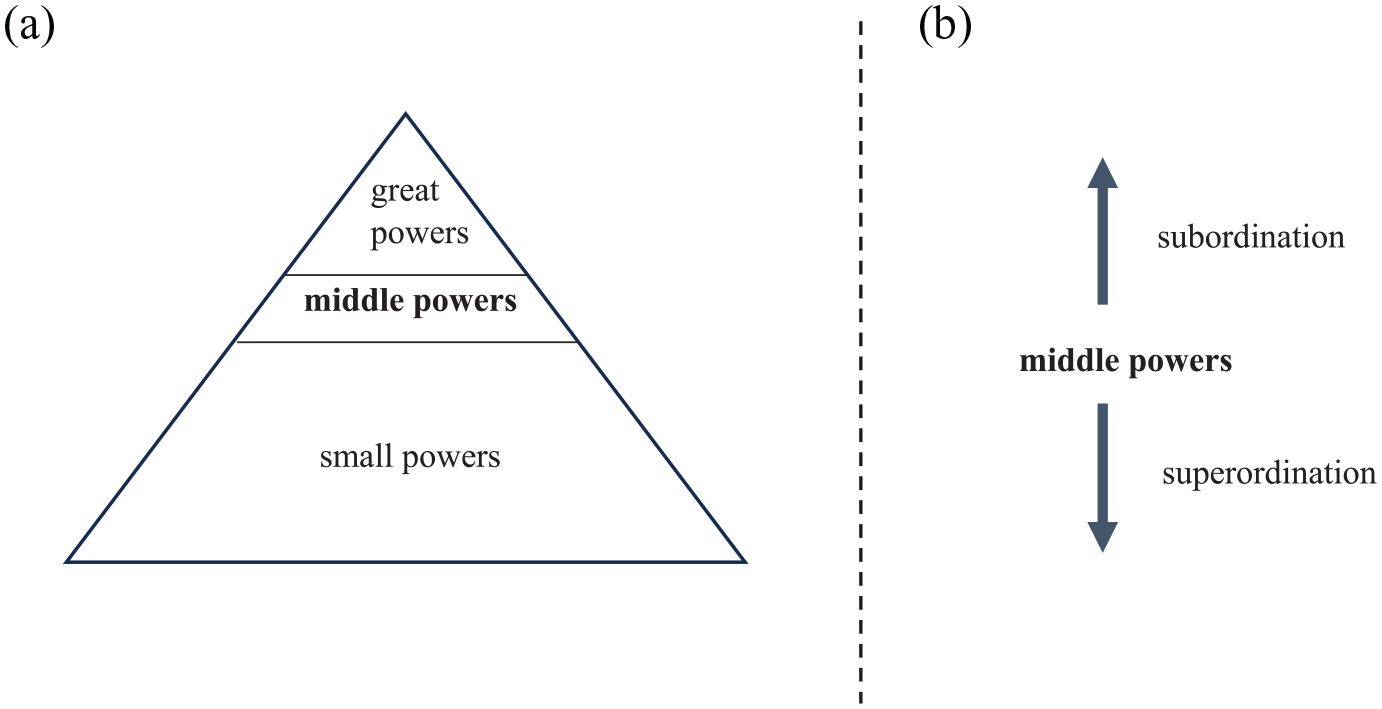
The position of middle powers in: (a) status and (b) order hierarchies.
Simultaneously, through an order hierarchy lens we can conceive of middle powers as being positioned in the middle of a web of layered and interacting dyads, acting as both potential superordinates and potential subordinates. Of course, a state transitioning from small to middle power standing may maintain a pre-existing subordinate relationship under an order-providing great power, with the terms of this hierarchy restructured to provide the new middle power with more autonomy than it previously held. But this does not mean that great powers necessarily stand to lose from a subordinate’s middle power aspirations. Greater independence is likely accompanied by a reduction in the burden on a middle power’s superordinate in terms of providing for its security or economic prosperity, and a superordinate could also receive prestige payoffs if it is viewed as having facilitated a subordinate’s rise to higher standing.
There is some potential for overlap in theorising middle powers’ positions in these two variants of hierarchy. Middle powers are unlikely to enter an order hierarchy dyad as a superordinate where their subordinate counterpart is recognised as a great power in status terms; nor as a subordinate power where their superordinate counterpart is recognised as a small power in status terms. This is because the material and social resources necessary for producing order are unlikely to be more abundant for middle powers than great powers; and conversely are likely to be greater for middle powers than those of small powers. To this extent, the models of hierarchy do correspond, with middle powers positioned most commonly as potential subordinates to those states recognised in status terms as great powers, and as potential superordinates over those recognised in status terms as small powers. Complication lies in two main areas. First, where there is a narrow or a disputed status gap between two given states – particularly when examining the relations between two states that both hold status-oriented identities as middle powers. In this situation, the two middle powers may compete for superordinate position through social creativity strategies 57 in which, for example, one emphasises contemporary economic performance while the other emphasises historical claims to civilisational greatness. Second, while middle power status may help position states as potential subordinates in their relations with great powers, and potential superordinates in their relations with small powers, there is nothing inevitable or preordained implied here. A range of other factors determine whether an order hierarchy is formed between two states, such as geographic distance between them, their historical relationship, or their ideological alignment – not to mention the agency exercised by the given states’ foreign policy elites responsible for forming, navigating and dissolving order hierarchies. Consequently, it would be inaccurate to describe middle powers as a status group that always acts as subordinates in relation to great powers, and as superordinates in relation to small powers. Instead, detailed case studies are needed in each instance of middle power identity formation to understand the specific ways in which new middle power identities have contributed to shifts in international hierarchies of status and order. Furthermore, at a conceptual level we need a model that locates the agential and structural forces responsible for initiating and driving this new identity formation. In the following section, I set out three such forces crucial for understanding middle power identity formation as hierarchical relocation.
Making middle powers – entrepreneurs, narratives and ignition
Middle power identity formation, and the attendant repositioning of states within hierarchies of status and order, is driven by three overlapping conceptual forces. Middle power identity entrepreneurs are those foreign policy elites that exercise agency to reposition their state as a middle power through their own meaning making – as early adopters, consistent advocates of the term within elite discourse, or those whose endorsement holds particular influence (e.g. heads of state). Existing accounts of the emergence of middle powers in specific national contexts tend to focus narrowly on presidents/prime ministers and/or their foreign ministers. 58 But middle power identity entrepreneurs can also be located in a broader pool of foreign policy elites that includes, for example, federal level politicians, journalists, bureaucrats and academics – all those capable of contributing to the national foreign policy discourse over a sustained period. In this way, both Indonesian journalist Budiarto Shambazy and Turkish middle power scholar Emel Parlar Dal – each of whom has positioned their respective state as a middle power 59 – fall into this category. Acknowledging a wide range of middle power identity entrepreneurs enables scholars to trace the emergence of the middle power identity more comprehensively and further back in history than would be the case if investigations were limited to senior political leaders. It also recognises that, where middle power identity is deeply ingrained within the collective beliefs of a state’s foreign policy elite, it may persist long term (albeit in a diminished and weakened form) where a particular administration or national leader is ambivalent – or even outright hostile – to the term. Finally, in addition to speech acts, middle power identity entrepreneurs may take actions likely to assist in repositioning their respective states in hierarchies of status and order as middle powers, such as putting themselves forward as a candidate for high-status leadership roles in prominent international institutions like the UN, IMF or World Bank; or advocating for their own state to increase its level of autonomy in a particular area of policy vis-à-vis their great power superordinate. Examples here include Australian Minister for External Affairs H.V. Evatt’s election as President of the UN General Assembly in 1948, or more recent attempts by Mexican President Andrés Manuel López Obrador to prevent US military violations of Mexican sovereignty. 60
Middle power identity narratives are specific stories told about a nation’s historical trajectory, its material or social attributes and credentials, or its social position in international society’s clubs and organisations, that work to advance a middle power identity claim and thus reposition a state’s standing in status and order hierarchies. Drawing on Wilén, 61 I argue that, in the case of middle powers, identity narratives are simple and straightforward storylines that can be easily communicated to both international foreign policy elites and mass domestic audiences. Consequently, they are typically limited to a maximum of three core features. First, they may reference a historical disaster or crisis, such as a military conflict or another period of domestic political/financial turmoil. Next, they may cite the efforts, sacrifice, or skill of the country’s leaders or general population, in areas such as leadership, the endurance of economic hardship and bad working conditions, or military casualties, as somehow overcoming their previous misfortune and ‘earning’ new middle power standing. Finally, they may celebrate the attributes that justify the state’s middle power standing, drawing attention to factors such as their economic and political development, or their membership of the G20. In this way, the middle power identity narrative concept is better able to account for change and hierarchical relocation than Shin Soon-ok’s existing concepts of ‘self-conceptualisation’ and ‘self-identification’, 62 because it places emphasis not only on a state’s views of what it is and how it compares to other states but also – crucially – a comparison of what it used to be and what it has become. Examples of middle power identity narratives include that built around Indonesia’s rise in the aftermath of the 1997 Asian Financial Crisis, which included the motifs of sacrifice, political and economic reform, and ultimately emergence as an economically resurgent and democratic polity; and Australia’s narrative built around its sacrifice and contribution to allied efforts during World War Two. 63 Given that they are frequently espoused by middle power identity entrepreneurs, it should be no surprise that middle power identity narratives are agency-centric justifications of a state’s repositioning within international hierarchies. This increases the simplicity of a given narrative, and its appeal to any nationalist-inclined domestic audiences, through emphasis on factors within the populace’s control: hard work, skill and sacrifice. Yet, at the same time, these narratives only represent one side of the dynamic driving middle power identity formation, because they do not directly acknowledge the role of structural change in driving a given state’s rise to middle power standing.
Drawing on historical institutionalist understandings of ‘critical junctures’, 64 the final conceptual force I identify here is periods of middle power identity ignition: those historical moments in which structural transformations, at the international and/or domestic levels, intersect with the elite agency exercised by middle power identity entrepreneurs – ultimately resulting in the successful formation of a new middle power identity. Of course, the agency exercised by middle power identity entrepreneurs, in part through their articulation or reaffirmation of middle power identity narratives, can be a potent social force in the generation of new identities and in hierarchical relocation. But this elite agency is unlikely to result in the successful formation of new middle power identities on its own – in part because states are often held in hierarchical positions of status and order by powerful structural forces beyond their immediate control. Take, for example, Canada’s pre-Second World War position as a subordinate White Dominion within the British Empire, or Indonesia’s pre-Reformation status as an authoritarian developing state – which in each case likely limited the ability of foreign policy elites to reposition their respective states towards middle power standing. At the same time, structural change will not lead to middle power identity formation on its own, without the repeated and sustained intervention of key identity entrepreneurs. What middle power identity formation ultimately requires, then, is the confluence of identity entrepreneur agency and major structural changes, which together open up opportunities to significantly reappraise a given state’s standing within hierarchies of status and order.
Having now set out three crucial conceptual elements that play a key role in the formation of new hierarchy-oriented middle power identities, in the section that follows I demonstrate the explanatory power of this framework through its application to the case of South Korea’s middle power identity formation.
Repositioning South Korea as a Middle Power, 1987–2013
South Korea’s middle power identity formation has been crucial to the development of the country’s foreign policy not only because it distinguished the country in general status terms from small powers and helped it join some of international society’s most elite decision making bodies, but also because this new identity accompanied the reorganisation of its subordination to the US in substantial ways – as well as nascent attempts to establish itself in a superordinate role in order hierarchies over North Korea and Southeast Asian states. In the remainder of this section I provide an analysis of middle power identity formation in the South Korean case in three stages – initiation (1987–1996), consolidation (1997–2007) and explosion (2008–2013). As I demonstrate, each of these stages involved a combination of structural change and elite agency, and accompanied hierarchical (re)organisation of South Korea’s position in status and order hierarchies.
Initiation (1987–1996)
South Korea’s period of middle power identity ignition began around 1987, in the form of dual transformations that provided an initial structural opening for South Korea’s middle power identity formation and hierarchical repositioning. Internationally, the end of Cold War bipolarity triggered a reconsideration of Seoul’s role in its alliance with the United States, and its broader position within international society – while undercutting the ideological and material threat posed by North Korea. Notably, the joint entry of South and North Korea into the United Nations in 1991 gave Seoul’s diplomats access to a new institutional setting that would come to act as a crucial global stage for their novel identity claims. Domestically, rapid and sustained economic growth complemented the country’s democratic transition, with 1987’s June 29 Declaration acceding to the opposition’s key demand for direct presidential elections. Contemporaneously this development was viewed as ‘South Korea mov[ing] one giant step closer to joining the ranks of advanced, democratic countries of the world’, 65 emboldening new generations of the country’s foreign policy elite to act more confidently and assertively on the international stage.
The country’s most prominent middle power identity entrepreneur in this period was President Roh Tae-woo, who – during a speech at Stanford University’s Hoover Institution on June 29, 1991 – used hierarchical framing to call for South Korea to ‘play a new role as a middle power located between developed and developing countries’. 66 Other early identity entrepreneurs include academics such as Byung-Joon Ahn, whose 1987 article ‘Korea: A Rising Middle Power in World Politics’ claimed that ‘the international status of this country has been transformed from being a burden to being a partner of the West’. 67 Notably, South Korea’s own elites may not have been the first to acknowledge the country’s potential rise to middle power standing. In confidential communications to Washington in 1975, US Ambassador to South Korea Richard L. Sneider concluded in distinctly order hierarchy terms that ‘Korea is in transition from a client state to middle power status’ 68 and that ‘[a]s a middle power, [South Korea] can be expected to project increasingly independent policy lines, but its dependence [on the US], while of a changing nature, will continue’. 69 A decade later, US Ambassador Richard Walker was among the first to publicly recognise Korea as a middle power, noting similarly that ‘[t]he day when we (the US) could inform our ally of decisions taken, directly involving Korea, without prior consultation, has long since passed’. 70 However, it was not until the mid-1990s that this recognition began to spread to the established middle powers. In 1993 Australian Prime Minister Paul Keating visited Seoul and implicitly repositioned South Korea as a middle power, declaring that ‘[t]he economic weight you (Korea) wield in the world is about the same as ours’ and that ‘[l]ike us, you are always aware you are a big player in relation to some countries, and that Japan, China and the United States are big players in relation to us’. 71 Canadian Prime Minister Jean Chrétien recognised South Korea as a middle power in 1995 72 ; during a 1994 bilateral summit in Australia the Canberra Times acknowledged that ‘South Korea, like Australia, sees itself as a “middle power” in the region’ 73 ; and in 1996 Australian defence minister Ian Mclaughlan included South Korea in a list of the region’s emerging middle powers. 74
South Korea’s nascent middle power identity claims in this period were accompanied by a range of hierarchical status seeking behaviours, including event hosting and joining/taking leading roles in international clubs, and order (re)organising behaviours such as adjustments to the US-South Korea military alliance. In 1988 Seoul hosted the Summer Olympic Games, an event then viewed by elites as a ‘coming out party’ that, if done right, ‘would change South Korea’s place in the world’. 75 Joo, Bae, and Kassens-Noor have since concluded that, due to the success of the Olympic Games, the ‘international community began to recognize South Korea as a middle power country rather than a Third-World country’. 76 South Korea similarly hosted the 1993 Daejeon Expo, which attracted 14 million attendees, further shifting perceptions of the country’s status at home and abroad. 77 Away from the peninsula, a major status-seeking achievement from this period was South Korea’s 1996 entry into the Organisation for Economic Co-operation and Development (OECD). For Sook-Jong Lee, membership of this high-status organisation meant that South Korea’s position as an ‘economic middle power’ had become ‘internationally recognised’. 78 At the same time, South Korean officials sought to maximise the potential status benefits of the country’s newfound UN membership. South Korea’s first peacekeeping operation (PKO) took place in Somalia in 1993, and it was elected to non-permanent membership of the UN Security Council (UNSC) from 1996 to 1997. Seoul’s 1995 Diplomatic White Paper made explicit the intention, in part through involvement in PKOs, ‘to increase our diplomatic role commensurate with our expanded international status’, and noted that ‘Korea, which has emerged as a middle power within the United Nations in a short period of time based on such active activities, decided to advance into a non-permanent member of the Security Council’. 79 Similarly, one senior South Korean diplomat was quoted in domestic media as stating that ‘this position (in the UNSC) matches Korea’s image as a middle power in international society’. 80
Simultaneously to these status-seeking behaviours, Seoul and Washington undertook a major reorganisation of their order hierarchy dyad. The US aimed to reduce its costs in providing security for South Korea while retaining dominance, whereas South Korea aimed for greater political autonomy while retaining US security guarantees. By 1991, the US had withdrawn almost 7000 troops and had removed its remaining tactical nuclear weapons from the peninsula; while Seoul expanded its autonomy from the US in December 1994 by gaining peacetime operational control (OPCON) of its own armed forces. At the same time, as part of Seoul’s new Segyehwa (‘globalisation’) policy, South Korean firms’ total outward Foreign Direct Investment (FDI) almost doubled between 1993 and 1995 (from US$5.4 to US$10.22 billion) – a large portion of which targeted Southeast Asian countries. 81 This instigated South Korea’s long-term interest in establishing new and weak order hierarchies over potential economic subordinates in Southeast Asia.
Overall, despite these major changes, during this initial period ‘middle power’ was still one of multiple overlapping but distinct terms employed by South Korean elites, including ‘newly industrialised economy’, ‘dynamic Asian economy’ and ‘leading developing country’. South Korea’s hierarchical repositioning attempts were considerable, but its identity claims were sporadic and not consistent – and the country’s middle power identity narrative was yet to be deployed. At the same time, South Korea’s accession to the OECD in 1996 was to be the high-water mark of its hierarchical repositioning achievements during the 1990s, due to a financial crisis that engulfed the Asia Pacific region the following year.
Consolidation (1997–2007)
The 1997 Asian Financial Crisis (AFC) risked undermining the formation of South Korea’s middle power identity due to the threat it posed to domestic and international perceptions of the country as rising in wealth and status, and because the resultant recession forced Seoul to negotiate a humiliating US$57 billion bailout package with major contributions from the International Monetary Fund (IMF) tied to ‘structural and institutional reforms’ that positioned South Korea as subordinate to Western-dominated financial institutions. 82 However, a 1998 domestic gold-collecting campaign contributed a modest amount of money to pay back the IMF loan, and moreover created the perception that the patriotic Korean populace had made sacrifices to defend the country’s sovereignty from outsiders. 83 Meanwhile, at the regional level Beijing won widespread praise for its ‘responsible’ reaction to stabilising the financial crisis, because it did not devalue the renminbi despite incurring economic costs. 84 This positive impression of Beijing occurred alongside a concurrent structural shift during this period: the rise of China. Bilateral trade between Seoul and Beijing grew 32 times from 1992 to 2007, and in 2003 China overtook the US to become South Korea’s single biggest trade partner 85 – contributing to the diversification of Seoul’s political relationships and a dilution of the existing economic aspect of the US-South Korea hierarchical dyad.
By successfully responding to the AFC, South Korea was empowered to articulate a strong middle power identity narrative in the early 21st century. An early version was promoted in an article published in the country’s leading daily newspaper, the Chosun Ilbo, on January 1, 2000 – which emphasised escape from subordination within imperial hierarchies. Korea in 1900, it contended, was dominated by imperial powers, had a weak and divided national leadership, and a population facing starvation. In contrast, the South Korean state entering the 21st century had ‘grown 200-fold in just 40 years, leaping from being the world’s weakest country to a middle power in the top 10-15 states’. 86 More commonly, Seoul’s narrative took as it starting point the devastation of the Korean War, before highlighting the hard work of the Korean people and leadership in raising the country up to middle power positions in global economic league tables, diplomatic and financial institutions. Ban Ki-moon – foreign minister from 2004 to 2006 and Secretary-General of the UN from 2007 to 2016 – was among South Korea’s most prominent and effective middle power identity entrepreneurs during this period. For example, in 2004 Ban praised the South Korean people for ‘building up the 10th largest economy globally from the ashes of the Korean War’, claiming that this justified an extension of Seoul’s international status and leadership. 87 And, as a candidate for UN Secretary General in 2006, Ban at times personified this narrative on the world stage. In his acceptance speech for the role he noted ‘[i]t has been a long journey from my youth in war-torn and destitute Korea to this rostrum and these awesome responsibilities’. 88
As Seoul entered the new millennium, the activism of Korea’s middle power identity entrepreneurs was complemented by the continuation of major status and order hierarchy (re)organisation behaviour. South Korea continued its status-seeking strategy of hosting major international events, including both elite-oriented policy-dialogues such as the 2000 Asia-Europe Meeting (ASEM), and public-facing mass sporting events such as the 2002 FIFA World Cup. One domestic media report from the time claimed that hosting ASEM ‘provides a decisive opportunity for Korea to leap into a responsible middle power position in the international community’, 89 while the South Korean team’s World Cup success was interpreted domestically as an important symbol that Seoul had overcome the AFC. 90 Simultaneously, South Korean elites ramped up their activism and pursuit of high status roles at the highest levels of international institutions, particularly at the UN. Reflecting this, Korea’s 1999 Diplomatic White Paper acknowledged that ‘in order to solidify our role as a middle-power country that contributes to solving global problems, Korea has been participating in multilateral initiatives in international organizations centred on the United Nations’. 91 And in 2001 South Korean foreign minister Han Seung-soo was elected President of the UN General Assembly (UNGA), which prompted his successor as foreign minister, Choi Sung-hong, to praise Han’s ‘accomplishment in uplifting the status of the Korean diplomacy onto a higher level’. 92 Meanwhile, despite the setback of the financial crisis, South Korea continued to seek incremental renegotiation of its subordination to the US. From 2003 to 2008 South Korea contributed around 3000 troops to its great power superordinate’s invasion and occupation of Iraq. However, this was only a fraction of the 310,000 South Korean soldiers that had participated on the US’ side of the Vietnam War, and in the same timeframe several thousand US troops were withdrawn from the Korean peninsula. 93 Additionally, in 2005 South Korea rejected the US-proposed Operation Plan 5029, a joint military strategy for responding to a sudden collapse of the North Korean government, with South Korea’s National Security Council complaining that ‘[a]spects of the plan could be a serious obstacle to exercising South Korea’s sovereignty’. 94 For Jong-Yun Bae, the assertiveness of the South Korean government in this instance ‘was perceived as one of many attempts to put relations between the U.S. and South Korea on a more equal footing’. 95 Benefitting in this period from its increased political autonomy from the US, and its burgeoning second tier status, South Korean elites also demonstrated newfound confidence in attempting to take on a more autonomous role in changing the political status quo in inter-Korean relations. Hynd and Connolly have argued that in this period the liberal administrations of Kim Dae-jung and Roh Moo-hyun sought to establish a novel order hierarchy as a superordinate over North Korea through the so-called ‘Sunshine Policy’ – but this attempt was thwarted, in part due to North Korea’s own resistance. 96
In sum, the elections of Han Seung-soo and Ban Ki-moon into UN leadership positions traditionally held by second tier states were a major validation by South Korea’s peers of its new status within international society, and attempts to drive change in inter-Korean relations with a high degree of autonomy from Seoul’s sceptical superordinate US ally demonstrated the reorganisation of this hierarchical dyad. Financially, South Korea recovered quickly from the AFC, thereby consolidating its claim to middle power standing through economic capabilities. But it would take a further international crisis to stress-test this newly formed middle power identity, finally elevating it to a core element of the country’s foreign policy.
Explosion (2008–2013)
At a structural level, compared to the 1997 AFC the 2008 Global Financial Crisis (GFC) did not pose the same threat to South Korea’s newly articulated positioning as a middle power in status and order hierarchies. For one, the fundamentals of the South Korean economy were much stronger in 2008. Despite an initial contraction, ‘the Korean economy made a remarkable V-shaped recovery by the second half of 2010, notching an impressive 6.2 percent growth in 2010’. 97 In the same year, South Korea became a $1 trillion economy by GDP, another symbolic milestone in its economic development and status. 98 Moreover, unlike the AFC, the GFC originated in the US and affected high status Western countries. Recognising Seoul’s newly consolidated standing as a middle power in international society, these states sought to include South Korea in their response to the crisis, first as part of a Group of 20 (G20) summit in the US in 2008 when, ‘for the first time in history, Korea won a seat at the highest level of global economic diplomacy’. 99
One of the major elements of President Lee Myung-bak’s ‘Global Korea’ foreign policy during this period ‘was its projection of Korea as a “middle power”’, 100 and Seoul also sought niche leadership in areas like green growth, 101 echoing the claims of the behaviouralist literature. Internationally, South Korea’s identity claim to middle power standing was now so widely acknowledged and validated that by 2013 it was able to help lead in the formation of a new middle power club in the form of MIKTA (Mexico, Indonesia, Korea, Turkey and Australia). 102 Seoul’s explosion in confidence during this period manifested in its increasing desire to not only seek inclusion within elite international society clubs as a middle power, but to help shape and set the agenda of these clubs. As South Korea’s 2008 Diplomatic White Paper noted, ‘Korea’s focus in the past was on learning and emulating the best practices of the OECD member countries. However, this approach is gradually being replaced by an evolving one in which Korea plays a more active role, widening its participation in shaping international economic regulations and policies’. 103 In February 2008, outgoing South Korean foreign minister Song Min-soon emphasised in a farewell speech to his colleagues the need for the country’s diplomats to exercise agency, ‘writ[ing] the history of Korea by ourselves’. For Song, it was now clear that ‘Korea is not a small country’ and that ‘Korea, as a middle power, can take a part in changing the world order’. Over the previous few years, Song argued, South Korea had taken on a middle power role in the international system, and ‘countries in our region as well as the international community have acknowledged our accomplishments’. 104
In status terms, Seoul’s international position was fixed as a middle power state, behind the great power permanent members of the UN Security Council but above the non-G20 small powers – some of whom were newly benefitting from South Korean PKO and/or Seoul’s expanding Overseas Development Aid (ODA). Under President Lee South Korea’s ODA expanded considerably, with ‘more than 50 percent of this development funds . . . being directed to Asian developing nations; which is an indicator of Seoul’s regional leadership intentions’. 105 In 2009 then (leading South Korean think tank) East Asia Institute President Sook-jong Lee claimed that the country’s ‘less threatening middle power position would make smaller countries more inclined to cooperate with it’ over aid, ‘while other middle powers such as Australia and Canada would find South Korea an attractive partner in developing a common front to resolve conflicts in international politics’. 106 In November 2009, South Korea officially joined the OECD’s Development Assistance Committee (OECD-DAC), making it the only country in the programme’s history to have successfully transitioned from aid recipient to aid donor, another clear indicator of South Korea’s dramatic shift in standing. Notably, the Special Review that South Korea was required to undergo before gaining OECD-DAC membership in 2010 was led by examiners from Australia and Canada 107 – two long-established middle powers tasked with assessing and validating the credentials of a third. Reflecting this new position, in 2010 South Korea acted as the first Asian non-Group of Eight (G8) member G20 summit host – which a Chosun Ilbo editorial tied to South Korea’s middle power narrative by calling it ‘an historic event for a country that rose from the ashes of war and colonial occupation to be able to provide the setting for the discussion of global economic policies’. 108 South Korea’s successful hosting continued thereafter, with international events including the Seoul Nuclear Security Summit in March 2012. In order hierarchy terms, the US-South Korea bilateral relationship had been gradually reorganised to expand Seoul’s political and economic autonomy while reducing Washington’s financial and security burden; and Seoul had initiated attempts to establish itself as a nascent superordinate, both over North Korea and, more successfully, over Southeast Asia – where access to cheap labour, migrant wives for low-income rural South Korean men, and a range of natural resources could be paired with South Korea’s surplus capital, aid, advanced technologies and political objectives. It is true that the conservative administrations that ruled South Korea from 2008 to 2016 slow-walked attempts to further increase autonomy from Washington – most notably the wartime OPCON transfer. However, at no point did these governments attempt to revert to a deep Cold War-style subordination to the US after regaining power in 2008. By the early 2010s, middle power identity had become a primary element of Seoul’s foreign policy – and there was to be no turning back in status or order terms.
In sum, South Korea’s persistent efforts to reposition itself as a ‘middle power’ in status and order hierarchies, reflected in its newly recognised middle power identity, went through three stages between 1987 and 2013: initial claims and activism in the context of economic growth, democratisation, and the end of the Cold War system; consolidation in the aftermath of the 1997 AFC and a rising China; and, finally, an explosion in confidence around the 2008 GFC, with Seoul moving from joining elite clubs to leading or even initiating them. By 2013, the middle power concept had become a core identity and conceptual lens through which South Korean foreign policy elites viewed their country’s place in the world, and this identity had also been widely accepted by peer states – as demonstrated by Seoul’s involvement in the ‘middle power club’ MIKTA. In a region dominated by the great powers, Seoul’s experimentation in taking on a superordinate position over North Korea and parts of Southeast Asia was limited in its effectiveness. But South Korea was much more successful in renegotiating the terms of its subordination to the US to increase its autonomy – and interest in new superordinate roles continues to inspire contemporary policy positions in Seoul, from the Moon administration’s ASEAN-focused New Southern Policy, to the Yoon administration’s so-called ‘Audacious Initiative’ proposition to Pyongyang.
In foreign policy elites’ telling of the country’s story, South Korea was a state that had emerged from the ashes of the Korean War reliant on foreign aid, before rapidly rising through the sacrifice and diligence of its labour force and leadership. It was now a democracy and OECD member; a bridge ‘in between’ developing and developed states, willing to contribute to regional order through its provision of public goods; and a G20 economy engaged in the highest levels of economic diplomacy alongside great and middle powers alike, while leading in establishing new forms of cooperation with other recognised middle powers. But this transformation had not been entirely of the South Korean elite’s own making. Crucial in this change was recognition of the country’s middle power identity claims – particularly from established middle powers Australia and Canada – and major structural shifts at the domestic and international levels, without which Seoul may have remained a minor power locked into deep subordination.
Conclusion
In this article I have called for middle power scholarship to more explicitly embrace theoretical pluralism and to refocus its attention on the rich potential insights of mid-tier theorising – such as the literatures on international hierarchies of status and order. Indeed, I have proposed here that one helpful way of thinking about why and how states may seek to ‘become’ middle powers is that these identities, when validated by peers, can be utilised as powerful tools to reposition states within international hierarchies of status and order. Middle power standing is attractive to states because status is seen as both a valuable end in itself and as a currency for states to achieve their other aims; and because (re)organising subordinate or superordinate roles can empower newly recognised middle power states to exercise greater control over their own resources and those of any newly identified subordinates. Consequently, middle power clubs such as MIKTA should primarily be viewed as status signifiers that validate and reinforce their members’ middle power standing, rather than failing mechanisms for solving international problems. But this does not mean that middle powers are inconsequential actors in the international system. Indeed, states that gain middle power standing frequently contribute to regional and global orders. Although their material and social capabilities are more limited than great powers, middle powers nevertheless frequently seek validation for their identity claims through the provision of public goods like peacekeeping forces or ODA.
As demonstrated by the South Korean case study, middle power identity formation is a complex process frequently involving deep structural changes, the activism of a committed foreign policy elite, and recognition by a state’s peers within international society. For Seoul, the new identity claims and narratives of its middle power identity entrepreneurs accompanied creative and sustained status-seeking activities such as hosting international events and winning leadership positions in international organisations, the gradual reorganisation of the terms of its subordination to the US, and nascent attempts at superordination over North Korea and Southeast Asia. At the same time, this activism necessarily coincided with major structural changes during the crucial ignition period of 1987–2013, which came together to produce Seoul’s convincing transformation in identity.
Other would-be middle power states can learn from the South Korean experience here, as long as they recognise the importance of major structural events in shaping potential outcomes. For example, Le Dinh Tinh and Vu Thi Thu Ngan have recently pointed to the role of the COVID-19 pandemic in moving Vietnam towards potential middle power status. 109 But repositioning a state in international hierarchies has not only been the preserve of contemporary rising non-Western states. The framework presented here may as much be applied to those states with longstanding middle power identities, such as Canada and Australia, whose new claims emerged around the (re)negotiation of their places within the British Empire and the US-led alliance system, and desire for high status in the immediate post-Second World War era. In short, the emergence of middle power identities matters in international society, both historically and today, and understanding the origins and implications of these identities in each case remains a necessary task for IR scholars and practitioners alike.
Footnotes
Funding
The author(s) disclosed receipt of the following financial support for the research, authorship, and/or publication of this article: This work was supported by the Core University Program for Korean Studies through the Ministry of Education of the Republic of Korea and Korean Studies Promotion Service of the Academy of Korean Studies (AKS-2023-OLU-2250001).
