




Abstract
Since the Great Recession in 2008, the academic debate has been flooded with literature that predicts the sunset of the liberal world order including the practice of humanitarian intervention as initiated at the United Nations (UN) in the early 1990s and regulated by the adoption of the Responsibility to Protect (R2P) in 2005. In contrast, this article argues that the practice of humanitarian intervention continues to operate under post-hegemonic and multipolar conditions, but in new ways. Based on a theorization of fundamental institutional change and exploratory case studies of the international reactions to the humanitarian crises in Libya, Côte d’Ivoire, Syria and Mali, and supportive evidence from Gambia and DR Congo, we show that contemporary humanitarian intervention is closely related to a normalization of the fundamental institution of great power management and a regionalization of international society. In this post-hegemonic world order, humanitarian intervention is shaped, facilitated or hampered by various practices of great power management including concert, soft balancing and hard balancing. The return of great-power competition means an inconsistent and sometimes counterproductive resort to humanitarian intervention far from the ideals of the R2P, but the growing importance of regional ownership affects the great powers, keeps this potential response to mass atrocity crimes on the table and adds to its legitimacy.
Keywords
Introduction
Many scholars have lost their faith in the viability of the practice of humanitarian intervention initiated at the United Nations (UN) in the early 1990s and the related Responsibility to Protect (R2P) principle, which was adopted at the UN World Summit in 2005 to add legitimacy and accountability to this potentially disruptive principle. 1 According to Ignatieff, ‘the whole project belongs to a vanished era’, in which the United States of America (US) was able to orchestrate most humanitarian interventions without Russian and Chinese obstruction in the UN Security Council (UNSC). 2 Similar concerns about the growing influence of China and Russia have been raised by other scholars with reference to the failures to respond effectively to the mass atrocity situations in Syria, Myanmar and Yemen, 3 places where it ‘matters the most’. 4 This bleak outlook echoes the early prediction by Murray and Hehir that R2P proponents would come to ‘miss the unipolar moment’ due to the revival of security competition and balance of power dynamics under multipolarity. 5 Furthermore, a strong preference for non-intervention is often associated with the Global South and the revitalized ‘revolt against the West’ due to historical reasons including colonialism, imperialism and late state-building. 6
In our view, the death of humanitarian intervention and the R2P has been greatly exaggerated. Humanitarian interventions continue to occur under post-hegemonic, multipolar and regionalized conditions, which have been underway for decades with the Great Recession of 2008 and the Russian resort to force in Georgia that same year as key markers of the end of the unipolar era, following years of Chinese rise, early balancing efforts against the West, opposition to the liberal world order, and a general diffusion of economic and political power. 7 Since then, a number of humanitarian interventions of various forms (with direct or indirect reference to the R2P or humanitarian law) have taken place, most notably the interventions in Libya 2011, Côte d’Ivoire 2011, Mali 2013, Gambia 2017 and DR Congo 2013 and 2022. 8 How can states and international organizations continue to agree on humanitarian intervention in spite of value differences, multipolarity and great-power tensions? What are the new drivers, understandings and practices of humanitarian intervention?
Based on primary and supplementary case studies of the series of humanitarian interventions listed above and a refined theorization of great power management and the role of regional organizations, we argue that humanitarian intervention has survived the end of the unipolar and liberal world order and continue to occur in distinct post-hegemonic forms. Here, the fundamental institution of great power management 9 has become a dual sword – to a greater extent than before – because the end of hegemony has given way to both concert and balancing dynamics, also in humanitarian crisis situations. This means that humanitarian interventions and R2P-initiatives are sometimes disputed, undermined or blocked in the UNSC, or at worst they are caught up in military balancing, and thereby destroyed or abused. In turn, regional initiative has become a key driver of great power compromise and concerted action in the Security Council, and the main source of legitimacy for humanitarian intervention, which has often been associated with Western double standards, abuse and imperialism. 10 We call this post-hegemonic principle ‘regional ownership’ to stress that it goes beyond a role as assistant, implementer or gatekeeper. 11 Today, regional organizations have the potential to lead various forms of humanitarian intervention or pull the great powers towards concert-styled practices of great power management in the UNSC, rather than balancing. In short, humanitarian intervention has become post-hegemonic and regionalized rather than obsolete and abandoned.
Theoretically, we start from a refined conceptualization of great power management understood as a fundamental or primary institution consisting of a set of principles and practices that shape the ongoing interaction of states including the resort to humanitarian intervention. 12 Furthermore, we offer a conceptualization of regional ownership over humanitarian intervention as a key principle for the negotiation of different perceptions of order and justice in the centre, meaning the UNSC, and in what used to be the periphery, especially Africa. Finally, we theorize the drivers of regional ownership on the basis of a post-hegemonic refinement of Mohammed Ayoob’s perspective of ‘subaltern realism’. 13
Methodologically, we apply Weberian ideal types 14 of great power management and regional ownership to the key cases of humanitarian intervention and non-intervention since the great financial and economic crisis heralded the end of the unipolar world order in 2008. Inspired by Bull and Francioni and Bakker, 15 we define humanitarian intervention as dictatorial or coercive interference by a state or a group of states into the sphere of sovereign jurisdiction of another state in order to limit or stop mass atrocity crimes that the state itself is not able or willing to bring to an end. Following this definition, the UNSC has authorized humanitarian intervention on a number of occasions since 2008. This has sometimes been with the consent of the (interim) government, but elements of coercion or dictate have still been present, either against the conflicting parties or against the government to obtain formal consent. The former was the case in Mali (2012–2013) and Congo (2013 and 2022), the latter in Syria (removal of chemical weapons, 2013). In other situations, interventions have taken place without the consent of the sitting government. This occurred in Libya (2011), Côte d’Ivoire (2011) and Gambia (2017). Since we are examining the resort to humanitarian intervention in the unfolding multipolar world order, we pay attention to the full record of such interventions in a series of exploratory cases studies informed by our theoretical framework. 16 For practical and methodological reasons, we distinguish between primary case studies of the formative humanitarian interventions in Libya, Côte d’Ivoire and Mali, which reveal a number of new patterns and dynamics, and secondary case studies of the ensuing humanitarian interventions in Congo and Gambia, which allow us to consolidate and specify our initial findings. Furthermore, we consider Syria as a particularly instructive case, since the dominating trend of non-intervention was supplemented by the collective UN-authorized removal of chemical weapons following a US threat of force.
We will not examine humanitarian intervention in the unipolar era, but it is generally agreed that the key cases of northern Iraq (Kurdistan, 1991), Somalia (1992), Bosnia (1992–1995), Rwanda (1994), Haiti (1994), Kosovo (1999) and East Timor (1999) were highly influenced by US-leadership, while regional organizations played a minor role with Liberia (1990) and Sierra Leone (1997) as notable exceptions. This relative subordination of great power management and regional initiative under hegemonic leadership in the 1990s will be our baseline understanding of the new principles and practices of humanitarian intervention under multipolar conditions.
Great power management, regional ownership and humanitarian intervention in a multipolar world order
The concept of fundamental or primary institutions has primarily been cultivated inside the International Society Approach of the English School. Here, great power management, the balance of power, diplomacy, international law, mutual recognition of sovereignty and environmental stewardship (among others) are seen as the sociological foundations of modern international society. 17 In this perspective, a fundamental institution is ‘a set of habits and practices shaped towards the realisation of common goals’. 18 In a constructivist terminology, fundamental institutions are intersubjective understandings laid down in shared principles and practices over time. 19 Moreover, it is widely agreed that they are constitutive of both state actors and international society, or its elements of order and justice. 20
However, the constitutive nature of fundamental institutions does not make them unchangeable. 21 Accordingly, we define a fundamental institution as a set of constitutive principles that make meaningful interaction possible, and a set of associated practices by which the constitutive principles are reproduced, with the combined effect of structuring the (inter)actions of states in a sociological rather than a deterministic sense. Institutional continuity can be understood as the ongoing reproduction of one or more constitutive principles while fundamental institutional change can be understood as changes in the practices by which the constitutive principles are reproduced. 22 International organizations like the UN or the African Union (AU) are based on the more fundamental institutions of international society, but they may also affect their working (a relationship of mutual constitution) due to evolutionary change or conscious design by states and other actors. 23 This may obviously be the case for great power management and humanitarian intervention in the unfolding post-hegemonic world order.
According to Hedley Bull, 24 a state that wants to position itself as a great power must have (1) the military and other resources to establish itself among other great powers; (2) the will to act as a great power and assume the associated special rights and duties; and (3) the status as a great power which can only follow from the recognition of such a status by other great powers. In recent years, the club of great powers has been changing according to the above-mentioned criteria. First, China and Russia have been catching up on three Western permanent members in the UNSC (P3), both economically and militarily. Secondly, they have demonstrated an ambition to act as global great powers increasingly defying the P-3 in the UNSC. 25 The number of Chinese and Russian vetoes has thus increased from six in 1989–2007 to 28 in 2008–2022. 26 Thirdly, they have sought and to a considerable degree received recognition as full great powers from the West. 27 Indeed, the 2017 US National Security Strategy designated China and Russia as challengers to American primacy, 28 while the EU Commission referred to China as a ‘systemic rival’ in 2019. 29 This means that the institution of great power management is operating in a multipolar order.
However, the number of great powers says little about their interaction in international society. Here, the shared principles and practices that evolve over time are more important. Following Bull, the special rights and responsibilities of the great powers for the maintenance of international order is a constitutive principle of great power management as evident from their special role at the UNSC and in earlier periods. 30 This is the shared understanding that the great powers must take on a special responsibility in turn for international acceptance of their special rights. Today, humanitarian crisis management belongs to this responsibility. This follows from the adoption of the R2P-concept in the 2005 UN World Summit outcome document, 31 and the recurrent resort to humanitarian intervention by the Security Council since the early 1990s. This does not render power politics irrelevant, nor does it guarantee an appropriate great power management of all, or even most, international crises. It means, however, that the great powers must take this special responsibility into account to be regarded as legitimate. 32 This is a key point of the sociological understanding of power put forward by the English School and Constructivism.
As a fundamental institution of international society, great power management is often associated with more or less advanced forms of concert, but in the historically informed theorization originally put forward by Hedley Bull and Martin Wight, keeping a balance of power through political (soft) or military (hard) means is a minimum requirement of great power management, while concert is seen as a more advanced contribution to international order. 33 As recognized by Bull, the propensity of the great powers to involve themselves in international crises and balancing activities may sometimes be harmful rather than conductive to international order, and by implication to the ideals of humanitarian intervention. This possibility must be taken into account now that the fundamental institution of great power management is once again operating under the historical normality of multi-polarity. Consequently, we focus on three main practices of great power management and their more or less constructive relevance for humanitarian intervention, namely hard balancing, soft balancing and concert.
Hard balancing, soft balancing and concert
Great powers may engage in various forms of balancing to maintain or restore the balance of power between them, or ‘to avoid crises carrying the danger of war with one another, or to control them when they do occur’. 34 Hard balancing involves the use of military measures short of war including the protection or management of allies and the use of threats. 35 Hard balancing may also lead to proxy war, but normally with a minimum of restraint to avoid direct military confrontation. 36 In the context of hard balancing, (attempted) humanitarian intervention is likely to be met by military measures by opposing powers in order to prevent a perceived disturbance of the balance of power, or a loss in the ongoing great power competition. This will typically be dysfunctional to the goals of humanitarian intervention and the R2P, amounting to great power mismanagement rather than management of humanitarian crises.
Soft balancing can be defined as attempts to balance other powers by diplomatic, political or economic means, either in general or in specific crisis situations where the great powers have competing interests at stake. In Bull’s classical treatment of great power management, the use of political measures were seen as an alternative to military confrontation or war, potentially leading to war-avoidance or de-escalation. 37 More recently, soft balancing has been discussed as an alternative to hard balancing by realists like Robert Pape and T.V. Paul in the context of the unipolar world order and beyond, but their ideas are valid for the current multipolar order as well, and they are quite close to the institutional approach to the great powers normally found in the English School. Paul defines soft balancing as restraining the power or policies of a state through international institutions, concerted diplomacy and economic sanctions in order to make its actions less legitimate and its goals more difficult to obtain. 38 Pape identifies territorial denial, entangling diplomacy, economic strengthening and signals of resolve to balance as key measures of soft balancing. 39 For our purposes, soft balancing is pursued by a range of institutional and other non-military means in order to ‘delay, frustrate and undermine’ the resort to humanitarian intervention and other R2P-based measures. 40 These means include veto policies, no-votes, abstentions and vocal protests in the UN Security Council and elsewhere, denial of military bases facilitating humanitarian intervention and other opposing steps of a non-military character. Soft balancing is therefore likely to be subversive of attempted humanitarian intervention, but it may also pave the way for an ensuing compromise (for instance a re-negotiated UN mandate), as a bridge between hard balancing and diplomacy. Alternatively, it may at least prevent a resort to military balancing and thereby a humanitarian intervention that simply makes things worse.
Concert describes a situation where the great powers work together to manage their internal relations and key issues of international order such as the resolution of conflicts and intervention. 41 To make that work they must be willing to compromise, exhibit mutual restraint and avoid taking home every possible gain to the detriment of other great powers. As stressed by Hedley Bull and Robert Jervis, they must also agree on basic principles for the maintenance of international order as in the Concert of Europe following the 1815 Peace of Vienna. 42 As a potentially explosive subject of international order and great power relations, humanitarian intervention may be part of such a shared understanding as indicated by the adoption of the R2P at the 2005 UN World Summit, and the occasional resort to such measures since 1991.
As pointed out by Kenneth Anderson and David Bosco among others, the great powers may also go further and act like a ‘management committee’ 43 or take on a ‘governance role’, 44 either in specific crisis situations, or on certain key issues of international peace and security. Moreover, they may do so in institutional settings like the UN-system where great-power cooperation is shaped by rules and the positions of other states, and thereby more in line with contemporary standards of legitimacy. We will consider these possibilities as more advanced forms of concert-based humanitarian intervention when the great powers act jointly and with others actors in institutional settings to draft mandates and manage humanitarian crises as they unfold.
Regional ownership and great power management
In the new multipolar and post-hegemonic world order, the various practices of great-power management depend on regional conditions to a higher degree than before. Regional international societies have their own history, culture and norms, which shape their interpretation of global rules and institutions. 45 Regional organizations therefore have a special legitimacy in regional matters, which is valuable to both the UN and the great powers, and difficult to get around. Consequently, regional ownership may influence the practice and conduct of humanitarian intervention. We define regional ownership as (1) agenda-setting power in regional questions (2) the ability to confer or retain, increase or limit, the legitimacy of key decisions and (3) the capacity to design and organize collective intervention, stabilization and peace-building. This is an elaboration of what Bellamy and Williams call ‘regional gatekeeping’, 46 but in our approach as a direct implication of regional international society theory.
Third World scepticism towards Western humanitarian interventions make regional ownership particularly important. As argued by Mohammed Ayoob, 47 Third World countries have distinctive priorities on order and justice because colonialism and late independence have left them with difficult state-building and fears of neo-imperialism, potentially also under a pretext of humanitarian intervention. The consolidation and protection of domestic order is therefore a top priority, and so is the promotion of international justice understood as equality, self-determination and freedom from oppression. 48 Consequently, the ‘subaltern realism’ of Third World countries 49 – meaning the realism of those who are outside the hegemonic circle of international society – has caught them between a non-interventionist orientation as a defence against (Western) abuses and a certain sympathy for humanitarian intervention, especially in parts of Africa, to prevent mass atrocity crimes and restore domestic order. 50 Such priorities are not static, however. What happens when the hegemonic centre loses its ability to direct the affairs of other regions, while the peripheries increase their capacities for collective action? They will hardly lose their post-colonial DNA, but they may engage the world more actively and become critical players – for or against humanitarian interference on a case by case basis.
Summing up, we examine the changing practices of humanitarian intervention in a multipolar world on the basis of Figure 1 in which fundamental institutions, state actors and international organizations are mutually constitutive:
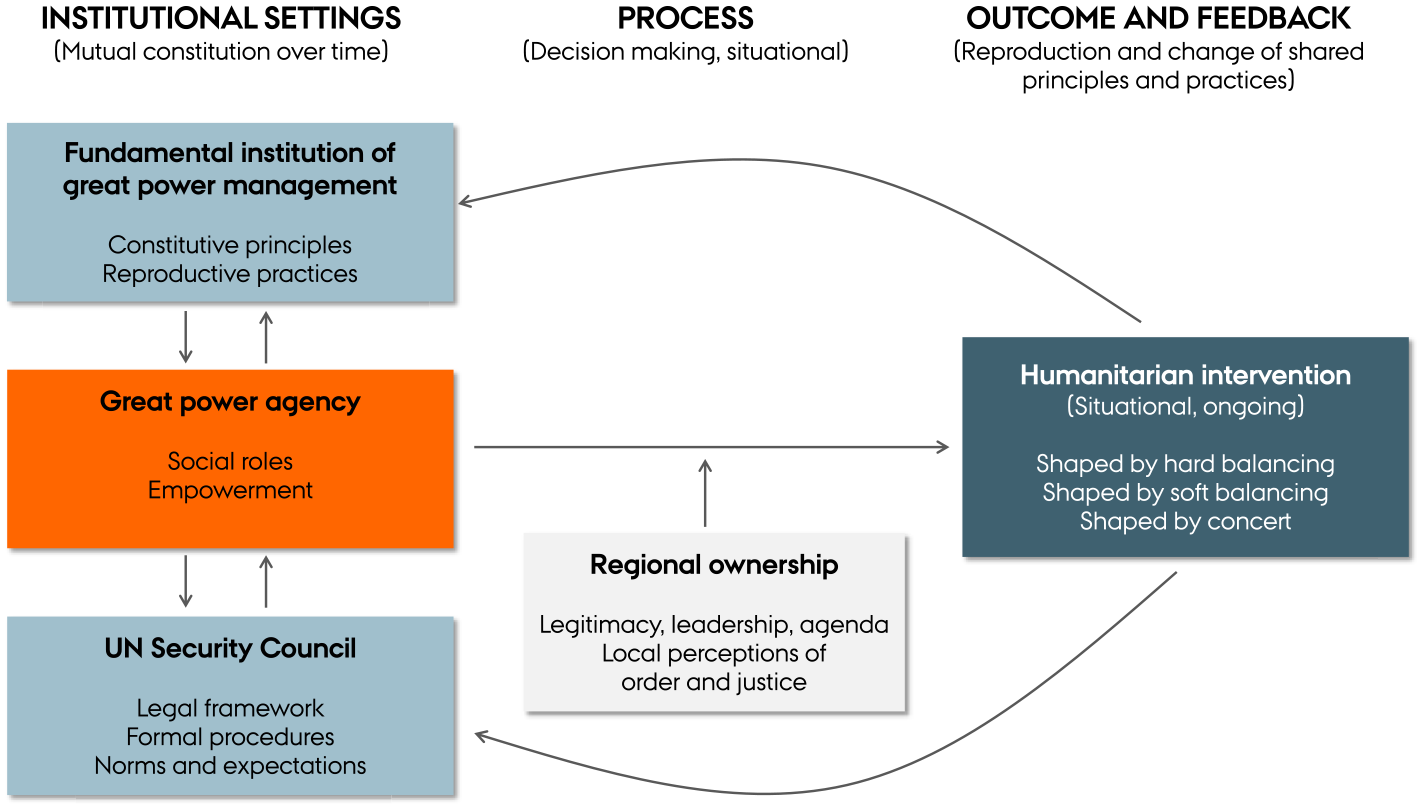
Great power management and humanitarian intervention: institutional dynamics.
The left side of Figure 1 shows the ongoing institutional setting of great power management and the UNSC. According to our theory, the resort to humanitarian intervention will be shaped by both institutions – essentially by the shared knowledge and empowerment of constitutive principles and associated practices of great power management on the one hand, and the rules and procedures of the UN on the other. In this process (middle of the figure), we expect regional ownership to affect the decisions of the great powers and the UNSC due to the formation of regional international societies, the legitimacy of regional organizations and the waning of US hegemony. The outcome of this process (right side of the figure) is humanitarian intervention shaped (in various ways, positively or negatively) by hard balancing, soft balancing or concert as well as regional ownership. Finally, a humanitarian intervention, or a series of cases as the ones we have witnessed since 2008, can either reproduce or change the established principles and practices of humanitarian intervention (feedback, right side of Figure 1).
In the following, we examine the cases of Libya, Côte d’Ivoire, Syria and Mali in order to understand and map the institutional patterns of humanitarian intervention in the unfolding multipolar world order. We focus on the initial formative phases of the interventions, and only later developments when they affect our findings. To qualify our findings further, we also pay attention to other recent cases, especially Congo 2013 and 2022, and Gambia 2017. Based on our general research question and the theoretical framework, the case studies are guided by the following more specific questions:
(1) Great power management: How have the practices of concert, soft balancing and hard balancing shaped humanitarian intervention in the multipolar world order?
(2) Regional ownership: Did regional positions alter great power approaches to humanitarian intervention? What were the drivers of regional ownership?
(3) What are the general patterns that are emerging from the first cases of humanitarian intervention in the multipolar and post-hegemonic world order?
Libya: from concert and regional ownership to soft balancing
In early 2011, the wave of popular protests sweeping the Arab world triggered an armed rebellion in Libya. The Gaddafi regime’s brutal crackdown on the protesters quickly drew international criticism. On 22 February, the Arab League condemned the use of force against civilians and suspended Libya’s membership until the regime met its demands to stop all violence. 51 The UNSC followed suit later that day condemning the violence and welcoming the statement from the League. 52 The AU also condemned the targeting of civilians. 53 On 26 February, the UNSC unanimously deplored the ‘gross and systematic violation of human rights’ by the Gaddafi regime, imposed an arms embargo, froze Libyan assets abroad, and referred crimes committed by regime members to the International Criminal Court. 54
On March 12, the Arab League urged the UNSC to impose a No-Fly Zone over Libya to stop the violence. 55 This paved the way for the adoption of UNSC Resolution 1973 on 17 March, which declared such a zone and authorized member states ‘to take all necessary measures . . . to protect civilians and civilian populated areas under threat of attack’. 56 The Arab League’s unprecedented push for humanitarian intervention against a member state proved decisive as it convinced US President Obama about the use force, and made it costly for China and Russia to resort to the veto. 57 Instead they abstained together with India, Brazil and Germany. Russia demanded assurances that the enforcement of the no-fly zone did not turn into a ‘large-scale military operation’, 58 but this was precisely what happened. The three permanent Western UNSC members (P-3), which dominated the air campaigns led by the US and subsequently the North Atlantic Treaty Organization (NATO), interpreted Resolution 1973 to allow the targeting of Gaddafi forces and military installations all over Libya regardless of whether they posed an immediate threat to civilians or not. Effectively, NATO served as the rebel air force facilitating their march on the capital in an open pursuit of regime change. 59
In this way, the P-3 broke with the initial P-5 concert ignoring protests from China, Russia and the AU. They regarded the Western-led air campaign as a clear violation of the ‘spirit and letter’ of Resolutions 1970 and 1973, as South Africa put it in several UNSC meetings. 60 The P-3 ignored requests for AU-led peace negotiations, arguing that NATO-actions were in accordance with Resolutions 1970 and 1973. 61 Their behaviour was thus void of the restraint and willingness to compromise that characterize great power concerts. The P-3 exploited that Resolution 1973 denied China, Russia and the AU the ability to engage in effective, rather than rhetorical, soft balancing within the Security Council. The P-3 emphasized the importance of regional ownership as long as it suited their interests. Yet when this ceased to be the case, they ignored the AU preference for a negotiated restoration of domestic order. This led to resentment in the Council where China and Russia indicated that their faith in a concerted approach had backfired, while Third World actors warned against abuse in line with the traditional version of subaltern realism.
Two factors explain why China and Russia refrained from vetoing Resolution 1973, or sanction the ensuing mandate abuse. First, the unusually strong regional support by the League and, initially, the AU made a strong impression on the Security Council as stressed in Articles 5 and 8 of Resolution 1973 regarding the use of force. China had ‘serious difficulty with parts of the resolution’ but attached ‘great importance to the relevant position by the 22-member Arab League on the establishment of a no-fly zone over Libya’ and the position of the AU. 62 Similar references to the importance of regional ownership came from Russia, Brazil and several Third World countries. 63
Second, China and Russia had some $20 and $7 billion worth of investments respectively that could be lost if they alienated the new government, which they quickly recognized after the fall of Tripoli. 64 In contrast, they had no strong strategic interests in Libya. Therefore, they opted for soft balancing in the shape of recurrent criticism of NATO excesses, instead of a politically expensive obstruction of regional ownership and Western initiative. This robbed the humanitarian intervention of critically needed legitimacy and weakened the grounds for sanctions against the Assad-regime in the parallel discussions of the humanitarian crisis in Syria.
In short, regional ownership paved the way for concerted action on the two key resolutions, but Russia and China resorted to soft balancing in the form of diplomatic entanglement in response to the unauthorized regime change orchestrated by the P3 and NATO. Subsequently, Libya has been ravaged by civil war fuelled by outside support of the various fractions, but the case demonstrated how regional support for humanitarian intervention can make a decisive difference.
Côte d’Ivoire: concert shaped by Franco-African leadership
In November 2010, a presidential runoff election between President Gbagbo and former prime minister Ouattara led to escalating violence as both candidates declared themselves victors and formed opposing governments. Ouattara based his claim on the UN-certified runoff results announced by the Ivoirian Independent Electoral Commission. Gbagbo referred to a dubious ruling from the Ivoirian Constitutional Council annulling the results and declaring him the winner. On 8 December, a united UNSC called upon all parties to respect the UN-certified election result, despite Russian misgivings about intervening in domestic affairs. 65 Moreover, the Council threatened to impose sanctions against persons who obstructed the work of the UN peacekeeping force in the country (UNOCI) or committed ‘serious violations of international humanitarian law’. 66
On 20 December, the Council unanimously extended the mandate of UNOCI and reinforced it with additional soldiers and helicopters thus ignoring a demand from Gbagbo that the UN force be withdrawn. Following additional reinforcements of UNOCI in January and February, the Council unanimously passed Resolution 1975 on March 30. The resolution recognized Ouattara as president, condemned Gbagbo’s refusal to step aside, reaffirmed UNOCI’s mandate to use ‘all necessary means’ to protect civilians, and imposed targeted sanctions against Gbagbo and his closest entourage. 67 A few days later, UN and French forces launched a number of air strikes on Gbagbo’s forces helping Ouattara to prevail. 68
UNOCI’s involvement in the final assault on the presidential palace prompted a Russian call for a UNSC emergency meeting. Here, China, Russia and India criticized UNOCI for excessive use of force. Apparently, the concerted UN approach was giving way to soft balancing. However, the head of UN peacekeeping operations, Alain Le Roy, argued that the use of force had been necessary to protect civilians and UNOCI personnel. UN Secretary General Ban Ki-moon agreed maintaining that UNOCI had stayed within its mandate. 69
Three factors explain the collective authorization of the use of force on humanitarian and electoral grounds as well as Russia and China’s eventual acceptance of the removal of Quattara. First, regional ownership: the Economic Community of West African States (ECOWAS) and the AU endorsed Quattara as President-elect and sanctioned the Gbagbo regime. 70 They also supported the authorization of force with reference to humanitarian grounds and Gbagbo’s constitutional coup, a double blow to African charter provisions. Russia initially prevented the Security Council from issuing a press statement supporting the election result, certified by the UN special envoy, arguing that it would constitute interference in the internal affairs of the country. 71 However, Russia yielded as soon as ECOWAS and the AU issued statements backing Quattara. 72 Similar deference to actions taken by ECOWAS and the AU is evident from the language of subsequent UNSC resolutions and accompanying statements from China and Russia. 73
Second, the swift African and international recognition of Quattara in late December 2010 allowed China and Russia to support the intervention in Côte d’Ivoire without formally violating its sovereignty. The African insistence on the anti-coup principle made this possible. Third, neither of the two great powers perceived national interests in protecting the Gbagbo regime.
In short, the regional ownership by African organizations led to concerted action at the UN. Moreover, attempts at soft balancing by Russia and China against the French- and UN-backed use of force were quickly called off in the face of sustained African support.
Syria: soft and hard balancing tempered by momentary concert
In March 2011, the al-Assad regime of Syria resorted to force to quell peaceful protests calling for political reform in the context of the Arab Spring. The continuing regime brutality against civilians revealed a split between the Western P-3, who sided with the demonstrators and subsequently the rebels, and Russia and China, who rejected any form of coercive intervention at a UNSC meeting on 27 April. 74 The battle lines inside the Security Council were drawn from the outset.
Over the summer, the EU and the US imposed economic sanctions upon Syria, 75 and US Foreign Secretary Hillary Clinton stated publicly that Assad had ‘lost all legitimacy’ signalling a US preference for regime change. 76 On 4 October, China and Russia blocked a P-3 sponsored UNSC resolution arguing that economic sanctions constituted an unacceptable interference in the internal affairs of Syria. 77 The double veto marked an open resort to soft balancing.
In November, the Arab League proposed an Action Plan, which the Assad regime signed, but failed to implement. The League responded by suspending Syria’s membership and imposing economic sanctions. Damascus subsequently agreed to the Arab peace plan and the deployment of an Arab League military observer force, but non-cooperation from the Syrian regime quickly forced its suspension. 78 The League then turned to the UNSC asking it to endorse its peace plan. The resolution proposed by Morocco on behalf of the Arab League was supported by all 15 members except China and Russia, who vetoed it on 4 February 2012 arguing that the resolution was biased against the regime. 79 In response, the League turned to the UN General Assembly who supported its proposal for a joint Arab League-UN mediator, UN observers, a stop of all violence and negotiations on a transitional government. 80 Former UN Secretary-General Annan was appointed as the joint Special Envoy for Syria on 23 February, and he secured regime acceptance of a peace plan 3 weeks later. This paved the way for a unanimous UNSC authorization of a 300-strong UN observer mission on 21 April. 81 Apparently, regional ownership made a difference even under difficult circumstances. However, the UN observers quickly suffered the same fate as those of the League, and Western attempts to mobilize UNSC pressure on the regime to cooperate were met by another Chinese-Russian double veto on 19 July. 82
The Chinese-Russian soft balancing was soon accompanied by hard balancing. While Russia, Iran and Hezbollah stepped up their military support to the regime in order to keep it in power, 83 Saudi Arabia, Qatar, Turkey and Western states increased their military support to the rebels in order to overthrow it. 84 In early August 2012, Annan stepped down, frustrated by the lack of P-5 cooperation. The failure of the Annan-plan also ended the leadership of the League.
In the following years, the civil war grew more and more atrocious. 85 Both Russia and the P-3 used military power to help parties on the battlefield, but it was increasingly an asymmetrical hard balancing where Russia invested most. While the US launched a major air campaign against the Islamic State in the Levant (ISIL) in August 2014, it refrained from targeting the Syrian regime and its supporters. Russia and Iran, on the other hand, provided decisive military support to the Assad regime saving it from collapse and giving it the upper hand against the rebels. By keeping the regime in power, Russia protected its principal ally and military base in the Middle East, and Iran prevented the Sunni majority from taking power thereby maintaining the existing sunni-shia balance of power in the region. After the American withdrawal of most of its forces from Kurdish controlled areas in October 2019, Russia, Turkey and Iran became the leading great power actors in the Syrian war.
An exceptional resort to concerted humanitarian intervention took place following the use of chemical weapons by the regime on 21 August 2013 killing approximately 1400 civilians in Ghouta, Damascus. 86 Following American threats of punitive air strikes, Russia persuaded the regime to hand over its chemical weapons to the UN for destruction. This paved the way for a bilateral Russian-US agreement, which the UNSC endorsed unanimously in Resolution 2118 on 27 September 2013. 87 The removal of most of Syria’s chemical weapons in the first half of 2014 was a momentary shift to concert triggered by a credible American threat of force. The removal was designed to maintain the balance of power in the civil war, and between Russia and the US, not to upset it. It was remarkable that concerted humanitarian results could evolve from a situation characterized by elements of hard balancing, but great-power cooperation did not endure beyond this operation, only some ongoing restraint and coordination.
Two factors explain why the initial attempts at collective humanitarian crisis management ended up in soft and hard balancing. First, Russia considered it a national interest to protect its most important ally in the Arab world and its only naval base. This was consistent with its grand strategy to counter US dominance and re-establish a multipolar world order with Russia as one of the principal great powers. 88 China, who shares Russia’s deep-seated aversion to externally engineered regime change, 89 has supported Russia in soft but not hard balancing. The West has been driven primarily by humanitarian concerns, although the fall of Assad would have removed an anti-Western regime and reduced Iran’s regional influence. However, a lack of faith in the pro-Western rebels and a strong reluctance to deploy ground forces induced the US to retreat from regime change. 90
Second, the initial regional ownership of the Arab League was contained and neutralized by the Russian resort to both soft and hard balancing. The League got some momentum when it turned to the UN General Assembly but the UNSC disagreement on regime change prevented the League from making a lasting difference.
Summing up, great-power balancing left little room for regional initiative and concerted action on Syria. Retrospectively, a collective humanitarian intervention would only have been possible if global (and regional) great powers had agreed on a format that did not affect the balance of power. Instead, balance of power politics shaped humanitarian crisis management in dysfunctional ways.
Mali: UN concert, regional ownership and French leadership
In January 2013, France intervened in Mali to halt an offensive initiated by a coalition of secessionist Tuareg rebels and Islamist jihadists in the northern part of the country against the government-controlled south. The French-led intervention successfully halted the violent offensive and by April, the surviving hard-core elements had been pushed out of northern Mali and into ungoverned neighbouring areas.
The French intervention was based on African initiative and UNSC decisions. On 20 December 2012, the UNSC passed resolution 2085 giving an ‘African-led International Support Mission in Mali’ (AFISMA), organized by ECOWAS and the AU, Chapter VII authorization to ‘take all necessary measures’ to ‘support the Malian authorities in their primary responsibility to protect the population’ and ‘consolidate State authority’ by ‘recovering the areas in the north of its territory’. 91 This meant enforcement to protect the population, a humanitarian intervention, but with governmental invitation. However, the force was not deployed by the time of the January rebel offensive, which threatened Mali with a total collapse. On January 10, the UNSC called upon UN member states to help the Malian government ‘reduce the threat posed by terrorist organizations and associated groups’. 92
This was precisely what France did the following day upon request from the Malian government and other ECOWAS members. 93 The United Kingdom, the US and other NATO members provided support for the French operation, 94 and the other UNSC members expressed their ‘understanding and support’ at a meeting on January 14. 95 On January 22, the Malian government, ECOWAS and the AU expressed their gratitude to France at a UNSC meeting, and ECOWAS reiterated it on 28 February. 96
The Security Council repeated its support for France in UNSC Resolution 2100 of 25 April 2013, which established the ‘United Nations Multidimensional Integrated Stabilization Mission in Mali’ (MINUSMA) tasked to use all necessary means to protect civilians, stabilize key population centres and support the reestablishment of state authority throughout the country. 97 This marked a transition to stabilization and peacebuilding, though Resolution 2085 had already stipulated a political and a security process based on work done by ECOWAS and the AU in 2012. Resolutions 2085 and 2100 were remarkably precise regarding protection, state-building and measures of accountability leaving less room for interpretation and freedom of manoeuvre than the 2011-resolutions on Libya and Cote d’Ivoire. The key resolutions on Mali, and subsequent ones, were adopted unanimously reflecting a concerted and inclusive approach of collective governance, which lasted until military coups and Russian (Wagner Group) involvement on the side of the new regime started to undermine UN stabilization and the aspirations of ECOWAS since 2021. 98
Four factors explain the concerted approach to the Mali conflict. First, there was a strong regional ownership from the beginning. Flanked by the AU and the UN, ECOWAS effectively quelled the military coup d’état of 22 March 2012 (triggered by setbacks on the battlefield) by rejecting it completely, resorting to sanctions and insisting on a legitimate transitional government as a precondition for any military assistance to Mali against the violent rebellion. According to the UN Secretary General’s Special Representative for West Africa, Djinnit, the military junta made an appeal to the African-UN delegation that met with them after the coup to help them against the rebels. The answer was that ‘we can only help you after the restoration of constitutional order’, 99 which happened on 12 April 2012, when interim president Traoré was inaugurated. African states have also provided strong support to the military operations conducted in Mali since 2013 and provided the lion’s share of the troops in the MINUSMA operation. 100
Second, the French military intervention in January 2013 was generally perceived as necessary to prevent the collapse of government forces. Furthermore, it bought time for the deployment of African forces and the realization of UNSC resolution 2085 at a critical moment.
Third, the intervention was requested by a sovereign member-state of the UN in order to defeat a terrorist threat, protect the population and restore order. It was consequently in accordance with the UN Charter and status quo-oriented. China, Russia and Global South states emphasized both factors in their explanations of why the Mali intervention differed fundamentally from the NATO-intervention in Libya. 101
Fourth, the P-5 had a shared interest in defeating the jihadist threat and enhancing regional stability. The French intervention helped to protect Chinese nationals and investments in the Sahel region, 102 and Russia used the opportunity to sell weapons to the Malian government. 103
In short, great power management in Mali was characterized by concert and collective governance in the UNSC stimulated by strong regional ownership. To China, Russia and members of the Global South, Mali was a perfect demonstration of collective intervention in respect of state sovereignty and thus a perfect illustration of what was wrong with the Western approach to Syria and Libya. To France, it provided an opportunity to demonstrate great power leadership and support of regional solutions, and protect its national interests at the same time. To the African organizations, it was necessary to restore constitutional order in Mali, stop the maltreatment of civilians, and prevent the spread of anarchy and terrorism in the Sahel region. Institutionally, it was a textbook example of the preferred Third-World approach to humanitarian intervention: an intervention that saved lives and restored order at the same time; an intervention based on regional decision-making, strong measures of accountability, and a clear plan for reconstruction. The ongoing violence and coups do not annul these findings, but the stabilization process is under serious threat today.
Humanitarian intervention in a multipolar world order: findings
The discussion of the findings will follow the theoretical logic laid down in Figure 1, but this time we start with the outcome, meaning the evolving practices of humanitarian intervention in the multipolar world order. Then we discuss how and why regional ownership is shaping these practices, and finally we analyse the feedback from this first round of post-hegemonic humanitarian intervention into the UNSC and the fundamental institution of great power management. The main findings are summarized in Figure 2.
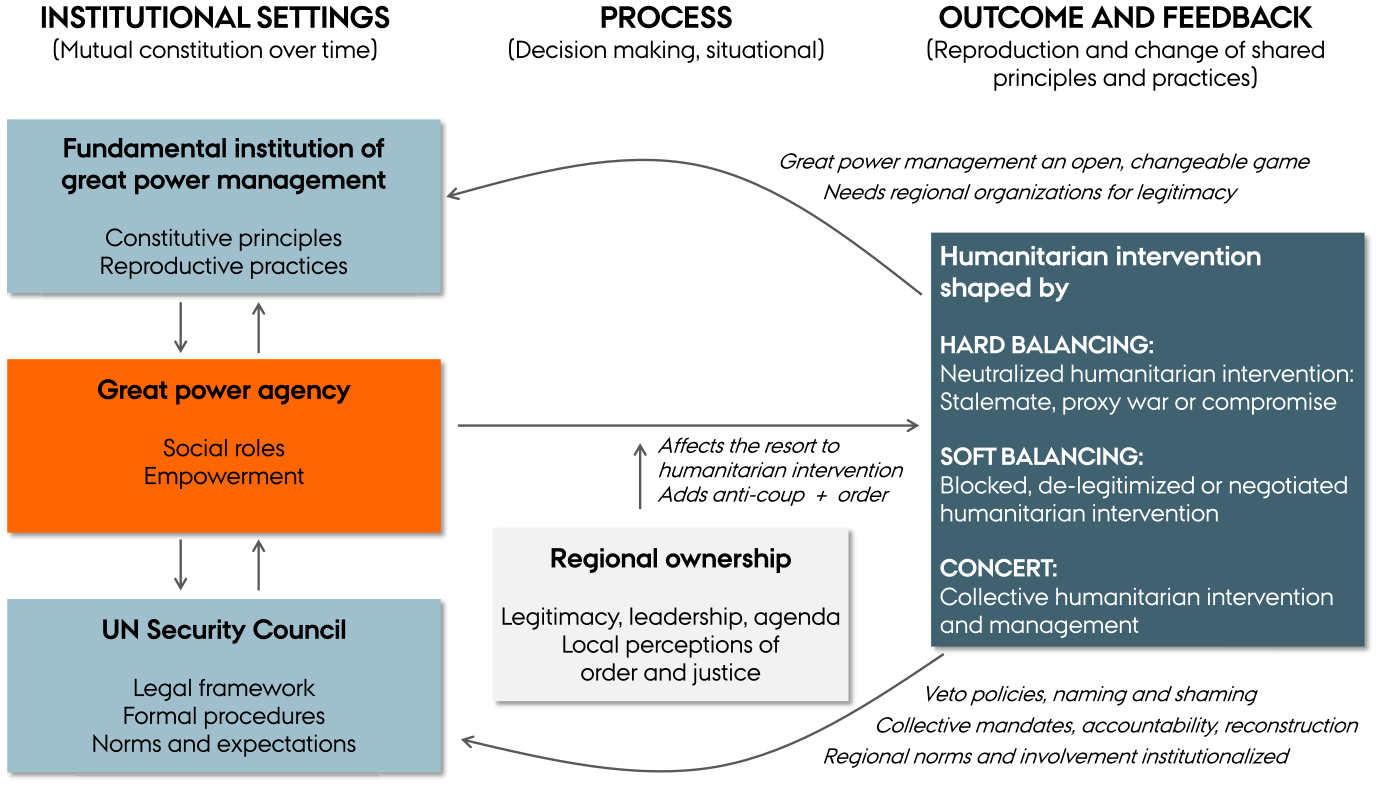
Great power management and humanitarian intervention under multipolarity: findings.
General patterns: an open and post-hegemonic game
As demonstrated in the case studies, humanitarian intervention continues in the new multipolar order, but now as an open and changeable game, which is no longer as dominated by P-3 as in the 1990s. Only one of the four examined cases was characterized by just one practice of great power management, namely Mali taking the form of a UNSC based great power concert with strong regional involvement. Libya went from concerted action to soft balancing, Syria went from soft balancing to hard balancing with an intermezzo of concerted action, and Côte d’Ivoire saw a brief impulse of soft balancing by China and Russia in an otherwise concerted management characterized by strong regional ownership. This indicates that humanitarian intervention has become post-hegemonic, rather than obsolete. In the post-hegemonic logic of humanitarian intervention, leadership can come from several great powers, and not just one, or from other actors including regional organizations. Furthermore, humanitarian crisis management reflects real negotiations, bargains and compromises. It is an open and changeable game, but it is still a relatively orderly rather than a chaotic one, due to the fundamental institutional practices and organizational rules that continue to inform it. What characterizes these rules and practices?
Humanitarian intervention shaped by concert
The humanitarian interventions in Libya, Côte d’Ivoire and Mali took the form of a great power concert based on UNSC mandates, but in different ways and degrees. In all three cases, regional ownership gave rise to real negotiations, a will to compromise and an ability to authorize the use of force for humanitarian and other purposes. The concert elements of mutual restraint and collective action were evident, but the drafting of the mandates were hasty or imprecise in the cases of Libya and Côte d’Ivoire, whereas a lot of time and energy went into the key resolutions and associated reconstruction plans for Mali. In Libya, the concert fell apart as soon as NATO started providing air support to rebel forces, whereas it survived critical questions by China and Russia on the use of force in Côte d’Ivoire, after affirmative African and UN responses, and remained robust for many years in Mali.
This indicates that the formative moment of concerted humanitarian intervention is of critical importance to its continuing robustness, with mandate precision, reconstruction and accountability as key elements. Here, Mali represents the high end of the concert spectrum given the involvement of other states and organizations and an ambitious program for the restoration of domestic order. The collective removal of Syria’s chemical weapons in 2013 may be seen as the low end of the concert spectrum. However, the momentary resort to concert was remarkably principled and effective. Everything followed the book as soon as the US and Russia agreed to remove these weapons from Syria: A carefully drafted and precise UN mandate, an inclusion of great powers and small states alike, and an activation of the UN system and specialists. The key actors knew how to play the concert game, even in the context of hard balancing.
Humanitarian intervention shaped by soft balancing
Soft balancing has been most evident in the Russian attempt to shield the Assad-regime from interventionist measures by means of a sustained veto policy and further diplomatic entanglement. Western great powers responded with a naming and shaming campaign against Russia, and this lighter form of soft balancing was also evident in Libya, where Russia, China and emerging powers criticized NATO for mandate abuse. De-legitimizing or blocking humanitarian intervention is part of the multipolar game.
However, soft balancing does not always take this confrontational form. In the case of Côte d’Ivoire, Russian and Chinese critique of the forcible removal of former president Gbagbo led to African responses and a renewed common ground. Soft balancing may lead to negotiated humanitarian intervention, providing a bridge from an inclination to balance to diplomatic solutions. Arguably, this happened in the early phase of the case of Libya where initial Russian and Chinese statements seemed to rule out interventionist measures as proposed by the West, until regional ownership and compromise kicked in. Obviously, it has not been the case during the genocide against the Rohingya of Myanmar since October 2016 where China has maintained a non-interventionist position. 104
Soft balancing may become a standard inclination for Russia, China and other non-Western powers, since they fear (Western) abuse of humanitarian intervention. 105 In the multipolar world order, however, soft balancing has become an instrument for all great powers and other actors, and not just rising powers as originally expected by Pape and Paul. 106 Notably, soft balancing keeps the door open for a shift to other practices and it can lead to several outcomes including blocked, delegitimized and negotiated humanitarian intervention.
Humanitarian intervention shaped by hard balancing
The case of Syria confirms the expectation that hard balancing is subversive of humanitarian intervention. Russian and Iranian military intervention effectively blocked the initial Western agenda of humanitarian results by means of regime change. Instead, hard balancing has contributed to more than a decade of human suffering and proxy war.
There are other implications to draw, however. First, a humanitarian intervention or R2P-initiative that would not overthrow the Syrian regime and thereby affect the balance of power might have been acceptable for Russia. Russia’s sudden decision to support the removal of Syria’s chemical weapons in order to prevent American air strikes supports this thesis. The regime did not depend on its chemical weapons for its survival, but an American air campaign against the regime could have triggered its downfall. Balance of power dynamics do not necessarily prevent humanitarian crisis management, if such measures respect the power political status quo. Secondly, hard balancing involves some coordination, restraint and compromise, as evident from the collective removal of chemical weapons and the continuous American-Russian coordination of military operations in Syria to avoid clashes.
Regional ownership in humanitarian intervention: new logics of subaltern realism
The resort to humanitarian intervention has been shaped by the various practices of great power management, for better or worse, but there is strong evidence that regional ownership is of critical importance when it comes to the initial definition of the game, and subsequent changes in the practices adopted. Moreover, humanitarian intervention today seems to require regional ownership in order to claim legitimacy, certainly for Africa. In the cases of Libya, Côte d’Ivoire and Mali, proactive regional ownership defined humanitarian diplomacy, pressure and intervention as legitimate options at the UNSC. The initiatives and recommendations of regional organizations set the UN agenda, affected the views of the P-5, influenced the drafting of UNSC resolutions and added substance to humanitarian intervention and, in Mali, political reconstruction. In Libya and Côte d’Ivoire, regional recommendations tipped the balance in favour of collective UNSC action at critical moments. Only Syria contradicts the picture of regional ownership tipping the balance between R2P-based action and inaction, since Russia and China vetoed Arab League proposals in the Council. However, the League was remarkably persistent and its activation of the General Assembly paved the way for the early UN mediation and deployment of observers.
The importance of regional ownership is in line with our theoretical expectations. The fading of US hegemony, the formation of distinct regional international societies and the evolution of strong regional organizations particularly in Africa have created the room for regional involvement. Normatively, humanitarian intervention remains controversial to the Global South in the absence of regional legitimization and an associated adaptation to local norms and priorities. Materially, there is a growing need for regional capabilities. Politically, the great powers and the UN need regional backing to secure legitimacy. Most of all, regional actors are not inclined to accept hegemonic dominance over what used to be the periphery, now that they can actually do something to change this long-standing tendency by means of regional organization. This is the logical implication of Ayoob’s ‘subaltern realism’ in a post-hegemonic world order.
However, what explains whether regional ownership works for or against humanitarian intervention? In Africa, subaltern logics have increasingly led to attempts to shape humanitarian intervention along African lines rather than to policies of non-intervention. This is in line with the ‘African renaissance’ including the aspiration to provide ‘African solutions to African problems’ and move ‘from non-interference to non-indifference’ by means of organizational reform and activism, spearheaded especially by the AU and ECOWAS. 107 The African quest for state-building, international equality and human justice can now be pursued proactively instead of defensively. The DNA of subaltern realism remains the same, but the means and policies are changing in accordance with the loosing of hegemony and the strengthening of African organizations.
It is not least the ‘rejection of unconstitutional changes of government’, 108 the so-called anti-coup norm, and civil war (which often go hand in hand with mass atrocity crimes and disorder) that have been the key triggers of African leadership on humanitarian intervention. This was the case in Côte d’Ivoire (rejection of a constitutional coup, mounting civil war and violence) and Mali (rejection of rebellion, military coup, terrorism and violence).
The tendency finds further support in the deployment of the robust ‘Force Intervention Brigade’ in the eastern parts of the Democratic Republic of the Congo (DRC) in 2013 with the objective of ‘reducing the threat posed by armed groups to state authority and civilian security’, in particular the infamous M23 Militia. 109 Here, the South African Development Community (SADC) played a central role in the planning and implementation of the operation. 110 Most recently, the East African Community (EAC) has taken similar steps with the deployment of an ‘EAC Regional Force’, mandated to ‘contain, defeat and eradicate negative forces’, in order to stop the fighting, atrocities and massive refugee flows triggered by the renewed advancement of the M23 rebel group in eastern DRC in the fall of 2022. 111 The unprecedented EAC military and diplomatic initiatives were taken at the request of DRC and condoned in UN Security Council statements and resolutions on 23 November and 20 December 2022, stressing humanitarian concerns and linking the EAC Regional Force to the ongoing joint UN-SADC operation. 112
Another example is the swift ECOWAS intervention in Gambia in January 2017 in order to undo a constitutional coup by President Jammeh, who refused to step down after losing an election. 113 Representatives of regional organizations expressed concerns for a spread of violence and disorder and ECOWAS resorted to force on the very day that the UNSC encouraged ‘the use of political means first’. 114 Evidently, African organizations have considerable room of manoeuvre, when they intervene on the grounds of regional charter based instruments, including the anti-coup principle, which was recognized a number of times in UNSC Resolution 2337. As intended, the intervention led to the removal of President Jammeh. In the words of the Chinese UN ambassador at the adoption of Resolution 2337 on 19 January 2019, this was ‘Africans settling African issues in the African way’. 115
In these African interventions, regional recommendations aligned humanitarian concerns with state-building when coups, rebellion or violent extremism threatened both domestic order and populations. Regional ownership seems to be the master key that makes humanitarian intervention more or less likely and the anti-coup principle and the concern for state-building seems to be the central factors in deciding the direction of regional ownership. In the African context, humanitarian intervention has become regionalized and institutionalized rather than neutralized.
Feedback into the fundamental institution of great power management and the UN
In the post-hegemonic and multipolar world order, great power management has returned to a theoretical and historical normality in the sense that all main practices are at play. Hard balancing is no longer excluded, soft balancing is not just a tool for the otherwise powerless and concert is a relatively equal game, which is not necessarily organized by the US. Consequently, humanitarian intervention must rest on consensus or compromise to work.
At the UN, the normalization of great power management has led to changes in the veto game. Since bypassing the Security Council in humanitarian interventions has become less likely and more costly also for the US, the veto card is a real option for all five great powers including the more R2P sceptical ones. Consequently, denial of R2P action by use of the (hidden) veto is a real possibility as evident from Syria and Myanmar. On the other hand, the veto option has prompted real negotiations in the Council. This may water down the R2P and humanitarian intervention, but it may also lead to agreements laid down in detailed mandates providing for protection, reconstruction and accountability, as in Mali. This means negotiated and organizational rather than hegemonic legitimacy, and it takes humanitarian intervention in a Global South direction. So does the institutionalization of regional involvement in UN interventions, which has almost become a pre-condition for UN initiatives in Africa. The logic of it is anti-hegemonic, post-colonial and in line with the ongoing formation of regional international societies. The latter makes regional ownership an indispensable mechanism for bringing global rules in alignment with regional norms and preferences, such as the African focus on state-building and the anti-coup norm.
Conclusions and implications
Based on the primary and supplementary case studies and the theoretical framework that informed them, we conclude that humanitarian intervention has become post-hegemonic and regionalized rather than obsolete and abandoned. The post-hegemonic turn in humanitarian intervention and the R2P is characterized by changeable and sometimes troubled great power management, but also a strong regional ownership which has generally been conductive to various forms of humanitarian intervention since the onset of multipolarity.
The renewed competition and rivalry between the great powers involves an obvious risk of obstruction, abuse and deterioration of humanitarian intervention and the R2P when soft and especially hard balancing kicks in. This is far from the humanitarian ideals of the 1990s and the 2005 R2P framework, but as evident from our findings, regional ownership has the potential of tipping the calculations of the great powers from an inclination to balance each other towards permissive and concert styled practices of great power management in the UN Security Council. This is of critical importance in so far that 21st century international society maintains a potential response to mass atrocity crimes, also under post-hegemonic and multipolar circumstances which are often taken to be inhospitable to collective humanitarian action.
Our findings have some further implications for the ongoing debate about humanitarian intervention and the R2P.
First, multi-polarity and the increasing self-confidence of regional actors do not only involve new challenges, as indicated by Murray and Hehir’s early prediction that proponents of the R2P would soon come to ‘miss the unipolar moment’, 116 but also new possibilities. The relative retreat of the Western great powers from humanitarian leadership has opened a new space in which regional actors are able to step forward and take the lead in regional matters or engage with the great powers in the UNSC. For African organizations especially, this involves a combination of humanitarian intervention and state-building, the rejection of coups and the promotion of international equality. These new shared understandings have materialized in UNSC discussions and mandates over time, but African organizations have also gone ahead of the UN in bold moments, as in Gambia in 2017 and DR Congo in 2022. Humanitarian intervention has become institutionalized and localized at the same time. These observations add further substance to the statement by Alex Bellamy a decade ago that UNSC decisions on humanitarian intervention and the R2P remain fundamentally political and circumstantial in spite of the set-backs in Libya and Syria, 117 and the more recent scenario-based prediction by James Pattison that the R2P is not necessarily dead in a post-hegemonic and post-liberal world order. 118
Second, the importance of regional ownership is unlikely to be a temporary phenomenon. In the new multipolar and competitive word order, the great powers will tend to look for the legitimacy and resources provided by regional actors in atrocious and chaotic situations. Moreover, African norms, practices and ambitions are too firmly institutionalized to allow for a return to external great power dictate on the continent. A similar development in Asia seems less likely. Here, regional international society norms, rules and institutions would hardly support this kind of outside interference, unless, perhaps, if it was in a Mali-styled fashion and in line with the semi-official Chinese concept of ‘Responsible Protection’, which keeps the door open for political flexibility in spite of a critical tone and a high threshold for R2P action. 119 In other parts of the world, a regionalization of the R2P and humanitarian intervention seems more likely. For instance, Brazil’s post-Libyan concept of ‘responsibility while protecting’, 120 a Global South styled formula for more effective, accountable and regionally sensitive humanitarian intervention, may reflect a deeper regional inclination of ongoing relevance.
Finally, the wider theoretical implication of this article is that humanitarian intervention and the R2P framework are not restricted to a unipolar or liberal world order. They can operate across various orders and eras, like more established fundamental institutions.
Footnotes
Acknowledgements
Earlier versions of this article were presented at the EISA conferences in Prague 2018 and Sofia 2019 and at the ISA conference in San Francisco 2018. We would like to thank Barry Buzan, Jamie Gaskarth, Cornelia Navari, Kilian Spandler and the panel participants for valuable comments.
Funding
The author(s) received no financial support for the research, authorship, and/or publication of this article.
