



Abstract
After years of highlighting the importance of cyber elements to the battlefields of the 21st Century, many observers are perplexed to see how conventional the war in Ukraine seems to be. We argue, nonetheless, that the war in Ukraine is another step in an incipient shift in international relations and international security inextricably linked with the cyber era. The cyber era has ushered in a key change in the sense that companies, in addition to nation-states, now play a role with meaningful and substantial consequences for the geostrategic upshots of the conflict. Key elements in this new IR reality are formed in the vision and spirit of the tech titans – Google, Microsoft, Meta, Apple and Amazon. The cyber commons, which includes elements that had not existed as shortly as two decades ago, and that are almost purely a product of the inventiveness and entrepreneurship of the tech titans – such as cloud computing or social media – is now part and parcel of the way states identify themselves, recognize their friends and foes, protect themselves and attack others, and operate internally and externally.
Keywords
Introduction
After years of highlighting the importance of cyber elements to the battlefields of the 21st Century, many observers are perplexed at how conventional the war in Ukraine seems to be. 1 The centrality of kinetic weapons stands out. Indeed, while cyber tools are part of the arsenal, taking the headlines are tanks roaming the streets of Ukrainian cities and infantry battles, Russian missiles hitting Ukrainian targets and direct hits by unmanned aerial vehicles (UAVs). We argue, nonetheless, that the war in Ukraine is another step in an incipient shift in international relations and international security inextricably linked with the cyber era. The shift is not, as many had anticipated, a battlefield where cyber means take over, nor a reality where the digital replaces traditional means of war. Instead, the cyber era ushered in a key change in the sense that companies, in addition to nation-states, now play a role with meaningful and substantial consequences for the geostrategic upshots of the conflict. Whereas the actions of many companies of varying types and sizes attract public attention, it is a very limited category of companies that spells a shift in the international realm. Tech giants gained an unprecedented status, changing the way in which the international system operates, which is revealed in more than one way in the conflict in Ukraine.
Seminal work examined states as the key players in the international arena, and examined a range of issues, such as how states use and exert their power. 2 Power developed from the concept of getting others to do what they would not do otherwise to the importance of agenda-setting and coercion. 3 It then further evolved from a conceptualization underlining ideas, beliefs, and norms to the distinction between hard and soft power. 4 As the most important actors in the international arena, within these frameworks states create the context for national power in multidimensional interrelationships that influence the relations and dynamics in the international system as well as the competition over comprehensive national power which is the amalgamation of material capacities, national ethos, and impact in the international arena. 5
In the postindustrial era, however, national power is a function of a host of capabilities, such as innovation and governing institutions, in addition to military capability, which may also be impacted by innovation cycles. 6 The impact of innovation on international affairs is particularly linked to technological innovation. The reverse effect also holds, as technology is also affected by world politics. 7 Such technology may be a distinctly military technology, such as nuclear weapons, but also one that is not military as such, like the Internet, widely associated with civilian use for a broad range of purposes. Indeed, the very concept of power is now more elaborate and may include compulsory, institutional, structural and productive facets, with such change also pertaining to how powerful entities, such as major nations, compare in the international arena and how conflicts unfold. 8
The nature of power and international relations changes for several reasons, including technological innovation and globalization. 9 The most recent shift in the nature of power in international relations is closely associated with the rise of cyberspace as a fifth domain, added to the four domains previously used by humans – land, sea, air and outer space. 10 Beyond the major technological advancement that underlies this change, there are also changes in the patterns of power and the nature of international relations. The implications for power and governance in both domestic politics and international affairs are far-reaching, and even though governments and traditional geographical jurisdictions still play a major role, cyberspace turns into an increasingly important domain of power that changes the landscape of international relations. 11 This results in changes in power differentials and diffusion of power, which fundamentally alter global politics and its key players. 12 It is within this altered context of international relations that the Tech Titans rise. The key contribution of this project is to argue and demonstrate how this status of the Tech Titans – Microsoft, Google, Amazon, Meta, and Apple – in the international realm is different from that of any company in history and how that new status changes international politics in both theoretically and empirically meaningful ways.
The shift that ushered in the Tech Titans as key players in the international arena had commenced before the war broke in February 2022. In 2020, for instance, Microsoft established an office at the UN, both in New York and Geneva. The company created a UN affairs team and appointed a UN Head. The following statement provided the rationale for a move that distinctly defies standard expectations from a business operation, and more closely resembles a political entity: ‘Increasingly, as a company, we’ve been working on global issues. In this 75th UN General Assembly, we are committed to collaborating to advance seven priorities: human rights, defending democracy, economic growth, education, broadband, environmental sustainability, and digital empowerment of the UN itself’. 13 Participating actively since the 75th UN General Assembly, Microsoft has committed to changing the institutions of the international system, for instance in the form of empowering the United Nations to digitally transform itself and hence be able to do more in terms of its humanitarian, environmental and other goals.
Key aspects of contemporary international politics are designed, fashioned and even controlled by tech giants. In this paper we delve into this novel phenomenon, demonstrate how it has been around for a while predating the conflict in Ukraine by several years, and develop a theory about the Tech Titans and their transformation of the international arena. The war in Ukraine is the first case in decades of a full-fledged conventional land war between nation-states, in which much of the international community is involved, where the cyber domain – social media, cloud computing, search engines, and even access to the internet – and in particular the companies that control the cyber domain, play such a major role.
We introduce the Tech Titans, discuss the sources of their power in the cyber commons, and the consequent shift in international relations. To fully understand the changes in world order, the role of the Tech Titans should be recognized, not as supplanting states but as supplementing them as key international players. The Tech Titans do not only influence a new strategic domain in the digital world, but indeed control much of it, with key strategic implications for international relations and international security writ large. We contend that the war in Ukraine is a further step in a trajectory that has been in place for a while and explain its evolution. To that end, we provide a plethora of empirical evidence from the actions of Microsoft and Google during the war in Ukraine substantiating the theoretical argument about the incipient shift in international politics.
Companies and the international arena in the cyber era
Before the cyber era, the traditional toolbox of companies in the international arena was largely limited to various types of economic leverage. Thus, corporations potentially had an indirect impact on wars and international conflicts. Their influence was mostly in line with the interests and goals of their home nations. Companies could boycott a certain country, stop providing services or deny goods.
With cyber becoming a key domain in the international system, moves by the Tech Titans are not limited anymore to economic ramifications. Indeed, they move to a new dimension, with far greater strategic significance. While the decision to stop selling some of their merchandise – such as smartphones, for example – in Russia, may be more akin to the traditional forms of boycott, the same cannot be said for many of the recent moves by the Tech Titans. Such moves would deprive nation-states of cloud computing services, grant cyber capacities and protections, control social media, and even mediate access to the World Wide Web. The strategic importance of such moves could not be overstated.
This new reality is a marked departure from the traditional part of companies in the international realm in three major ways. First, the leverage is direct and strategic. When a tech titan such as Google denies, or limits, access to the cyber domain – such as Google Maps – to some and grants exclusive access to others with strategic considerations in mind, the implications for the conflict are different from severing economic ties. It is not uncommon for states to control access to territorial air, sea or land in times of war in a way that serves their goals in the conflict and the goals of their allies and with clear geostrategic ramifications. Similarly, when a Tech Titan allows certain pronouncements on its platforms to promote one side in an international conflict, and bars pronouncements with the opposite purpose, and while this is done with a clear recognition of the strategic implications for the unfolding conflict, the parallels in traditional battlefield terms are clear. In other commons, such as the air commons, the equivalent would be allowing certain nations to use airspace, while imposing a no-fly zone for others. The use of the cyber domain by the tech companies is distinctly strategic. Denying or allowing the use of the cyber domain carries increasing resemblance to similar actions on land, air or sea. 14 Not surprisingly, then, the cyber domain and the involvement of Tech Titans in it are also increasingly associated with moves typical to the conventional battlefield. This is the case when the president of Ukraine lobbies tech companies to react to the war and side with Ukraine, and when Russia leverages condemnations of some of the Tech Titans using not its international trade commissions but its diplomatic corps.
Second, apart from the strategic rather than economic leverage now available to companies, the actions of the Tech Titans are not necessarily aligned with the grand strategy of any one nation or alliance of nations. It is not that the cyber actions of any of the tech giants could be readily coopted into the war effort of a party to the conflict. Indeed, in the case of the Ukraine conflict, the tech companies took the initiative, and their actions go well beyond the strategic frameworks delineated by the USA or by NATO, at least early in the campaign.
Thirdly, and most important, the actions of the tech giants are undertaken in a novel domain: the Cyber Commons. Those commons are controlled by the Tech Titans, much of them were designed by those companies and their future trajectories are largely a function of the titans’ visions. When a nation denies access to its territorial airspace or sea, the commons at issue were not created by the nation. Rather, they are merely controlled by the nation under clearly defined international pacts and norms. Conversely, when a tech titan denies its services in the cyber commons to some – or alternatively guarantees access to the cyber commons for others – it does so within a domain that it controls almost in absolute terms. Furthermore, it is a domain that was created by the company. Many of the elements of this domain are proprietary, and it is not international or public in nature. Any international accords or standards pertaining to this domain are loose at best. This is markedly different from how students of international relations are used to conceptualize the world order and the principles of international security as almost exclusively pertaining to states, to interstate interactions and to a state-centric world.
The Tech Titans and the cyber sovereignty principle in international relations
States hold a key role in international relations. 15 Yet, the advance of cyber age has ushered in companies as key players, qualitatively and quantitatively more potent than ever in the past. Since the early 1970s, international relations scholars have recognized the role of multinational corporations as important players in the international system. 16 Yet, we argue that like the titans in the Greek mythology, mammoths of technology relatively recently established as the new hulks of the corporate world, have forged new elements that shift international reality. Distinctly different from the traditional commons of the international system – land, air, and sea – the new cyber commons are settings for an altered international system. 17
A new reality of international relations has taken form with some of its key elements shaped in the vision and spirit of the Tech Titans – Google, Microsoft, Meta, Apple, and Amazon. An increasing number of the building blocks of international relations are designed, planned, programmed, and produced by those Tech Titans, to the point where this process has reached a critical point heralding fundamental change, as reflected, inter alia, in the war in Ukraine.
The Tech Titans stand out as players of unprecedented stature, in the type of power they wield, in its magnitude and in how it has developed, often not fully intentionally and in some ways as a byproduct of their business endeavors. They are independent from the state and still exert tremendous influence internationally. Characterized by the lack of territorial boundaries, real time synchronization, relative transparency, asymmetry in players’ vulnerabilities, relative anonymity and decentralization, instead of sovereignty in the old sense, it is cyber sovereignty that matters in this new arena. 18 Accordingly, we define cyber sovereignty as the ability to freely operate in cyberspace in unhindered pursuit of goals.
In the past, states created general frameworks of rules for the digital environment. Such frameworks were then implemented by private actors, as was the case with E-Commerce. 19 Yet, the cyber arena has evolved to the point where key elements of this environment are designed exclusively by corporations, rather than in a hybrid fashion. With the advance of digital technologies, the increasing centrality of cyberspace in all aspects of human and political life and with the unprecedented prominence of Tech Titans, states are not in the position anymore to create general frameworks of rules for the digital environment. At least in some key aspects of the activity in cyberspace – designing cloud computing, search algorithms, and social media, for instance – companies have almost complete freedom to operate as they see fit and to design cyberspace in line with their business, moral, social, economic, and political visions. As such, they exercise cyber sovereignty, progressively unhindered by the state.
Tech Titans develop their cyber sovereignty in a multitude of ways. They have designated encryption allowing the secrecy of their traffic characteristics. They set user rules almost with no external influence. Governments use their services and platforms to improve their interface with their citizens and to control information concerning their physical infrastructure, relations with other countries, financial and political institutions, and more. Inevitably, these processes affect state security, identity, power, and interests, including those that pertain to the Tech Titans themselves. 20 We do not expect this budding shift to slow down. Instead, we anticipate it will increase, exponentially in some periods, as political activity becomes even more digitally based.
Accordingly, we posit The Cyber Sovereignty Principle in International Relations: With the explosive growth of the virtual domain into all aspects of political activity, Tech Titans’ dominance of the cyber commons and their pursuit of cyber sovereignty catapult them into an indefinitely increasing central status in international relations, equal to, and in some critical respects in cyberspace more important than, states.
The contemporaneous and historical uniqueness of the Tech Titans
Tech Titans stand out as more agile, efficient, and powerful transnational corporations even among other technology giants and certainly among other multinationals today or at any point in the past. One useful metric to compare the power of Tech Titans would be their non-precedence non-competitive total market cap and the ratio of market cap to number of employees. While the ratio of market cap to number of employees at HP (59,400 employees; $31.47 Billion market cap, 530K market cap/employee ratio), GE (205,000 employees; $116.65 Billion market cap, 570K ratio), and GM (155,000 employees; $76.72 Billion, 495K ratio) are comparable to that of Apple (147,000 employees; $2.361 Trillion, 16M) or Microsoft (182,268 employees; $2.134 Trillion, 11.7M), the remarkable market cap by historical standards of the Tech Titans (Apple and Microsoft) means a ratio that is larger by more than one order of magnitude. These numbers are a result of both their stupendous workforce and the characteristics of the digital domain that allow exponential growth and expansion. It indicates their levels of efficiency in cyberspace and technological, financial and economic capacity to be dominant international players, unrivaled not only by other tech companies (HP, GE, or GM) but also by most countries.
In light of these remarkable numbers, we propose a new taxonomy for companies in the international system. We use two axes to theoretically organize companies’ roles in international relations. This taxonomy not only helps in forming the range of companies and their effect in the international system, but it also highlights the historical uniqueness of the Tech Titans. The combination of those two axes holistically covers both the key domestic aspects and the important international dimensions of the companies’ activity.
The first measures the extent to which the company is independent from the state. In particular, we are interested in the extent to which the interests, vision and goals of the company are subject to control by the state. In other words, this axis gauges the extent to which the company is independent from state control and is able to pursue its own interests at home and abroad.
The second axis is the extent to which the corporation exerts power in the international arena. Traditionally, international relations theory conceived of corporations as able to exert power in the international system by threatening to pull out or divest in a certain nation or area unless their demands are met. A more radical example is the East India Company, which had a small standing army. This is a rare case of a private corporation that employs hard power against established sovereigns.
Between those two axes, as depicted in Figure 1, four categories of companies are formed. Category [2] includes powerful corporations that serve the interests of the state abroad. Categories [3] and [4] include companies that have little international power and are either controlled or not by the state. Those are of lesser interest to us. For instance, a company like McDonald’s, with franchises and restaurants in over 100 countries, falls into category [4]. It is largely independent form the US Government. Yet, whereas its international presence is conspicuous, its influence on international politics is marginal.
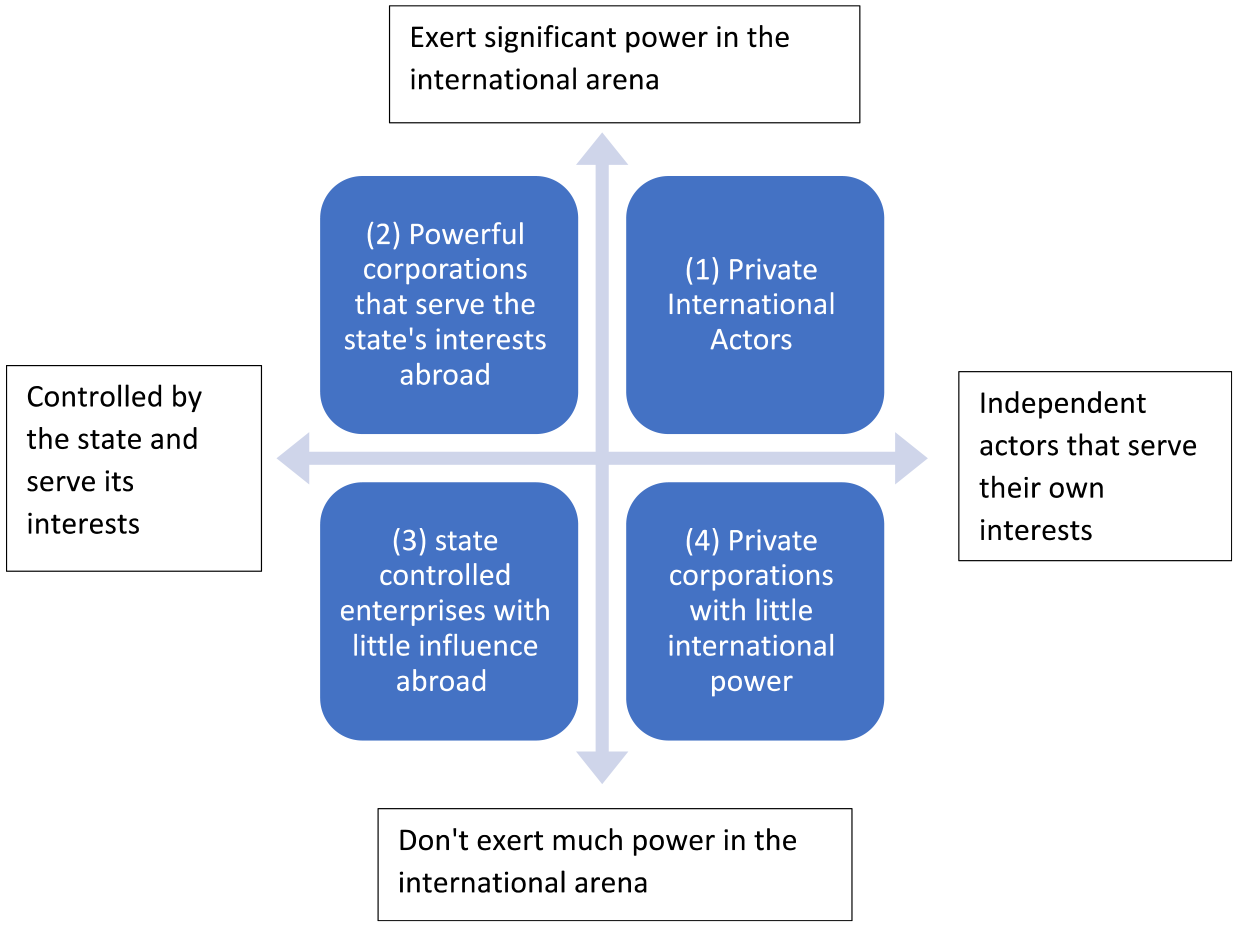
The horizontal axis pertains to domestic politics and measures the extent to which the company is independent from the state (are the interests, vision and goals of the company subject to control by the state?) The vertical axis is the extent to which the corporation exerts power in the international arena.
It is companies in category [1] that are of particular interest. This group of companies includes powerful private actors that are independent from the state to a substantial degree, and still wield momentous power internationally. It is this category, we argue, that is exclusively populated by the Tech Titans, both in the current international system and historically. No other company, even those that wielded immense power internationally, had the international sway and independence from national government enjoyed by the Tech Titans.
When comparing the Tech Titans to the most conspicuous historical example, the East India Company (Category 2), and to two contemporaneous cases of extremely powerful companies internationally: Multinational arms-producing corporations and U.S oil majors and large independents (also in Category 2), we find that the Tech Titans are in a distinctive position on this combination of the international axis and the domestic one. The Tech Titans are international players of stature hereto forth never occupied by transnational corporations, even the most powerful among them.
The Tech Titans stand out among mammoth tech transnationals as well as in comparison to past and present companies that exerted power in the international arena. Judged by two dimensions – one domestic and the other international – both related to political issues and unrelated to the core of the Tech Titans’ business, which is technology, their prominence is unique. Only technology corporations, whose business is in cyberspace, who accumulate cyber power and whose goal is cyber sovereignty, won such a status in international relations to warrant their inclusion in category [1]. Now that we established their uniqueness, let us look into the sources of this unique power, which most recently was manifested in the Ukraine crisis.
The sources of power of the Tech Titans
The information-based business of the Tech Titans means that they have unlimited access to the web-based economic, social and political activity of their clients. Even by the standards of nation-states, this level of control over information and concentration of data is unprecedented in scope and scale. 21 Those companies are constantly in pursuit of protecting their status, which includes buying potential competitors, turning into public companies, and harnessing their power to grow even more essential for their clients. The service package the titans provide is so encompassing that it grows increasingly close to the state-citizen interface. With the services of one of the titans (Google, for instance), we are able to search for information online, manage our business and private communication through a potentially unlimited mailbox, store data, make financial transactions to a range of entities, and find our way home on a map. Organizations at subnational levels, nations, and intergovernmental organizations grow increasingly dependent over time on the Tech Titans, which consequently grow omnipotent in the cyber commons.
We define cyberspace as the global domain within the information environment consisting of the interdependent network of information system infrastructures. Those include the Internet, telecommunication networks, computer systems, and embedded processors and controllers. 22 It is a borderless manmade virtual domain, perceived as an additional stand-alone domain of human activity and military power besides the physical domains such as air, land, sea, and outer space. 23 The exponential growth of human activity in cyberspace is first due to the fact that certain types of activity, which had used to exist outside of cyberspace, now switched over to digital and happen also in this domain. Shopping, trade, SIGINT intelligence, financial transactions, and academic research are good examples. In addition, some increasingly popular and prevalent forms of human activity that are relatively recent, came to life only in the digital age (e.g., liking and sharing content on social media).
The Tech Titans are ambitious, innovative, agile, and flexible transnational corporations, constantly in touch with their environment and in search of potential business competition and other types of threat. Their human capital is top notch, and their services are either completely free or sell for a minimum charge for individual users and for a relatively reasonable price for companies, organizations, and governments. Users are uniquely identified digitally and for the most part data and advertisers are the crucial elements in their business model, as in the case of Meta and Google. Using personalized platforms, unique protocols, and costly switchovers to the competition, the Tech Titans are able to maintain a growing clientele, the type of stability that enhances the economic interests of the company and its superiority in its unique winner-takes-all market. 24
As many of their products and services are bundled, the amount of information the Tech Titans amass allows them to further perfect the service package they provide, and thus further entrench users’ loyalty. This means that the dominance of each of the titans in their unique market is almost unrivalled. The startup costs of forging a viable competition become prohibitively high as the tech titan further embeds its superiority.
In the cyber era, given the technological advance of the titans – and in particular the use of artificial intelligence and bigdata – in order to advance political goals, there is no longer need to choose mass scale blanket messaging strategy (such as through radio or TV) over personalized messaging or the other way around (e.g., Cambridge Analytica). Thus, the messages that the digital platforms controlled by the Tech Titans carry, and in some cases manipulate, can be individually tailor-made but still on a large scale. As such, digital platforms hold the potential of wielding immense political prowess, unmatched by anything we have seen in the past. This catapults the Tech Titans to the position of key global players, changing the nature of international political transactions.
The technological and algorithmic infrastructure underlying modern states and the institutions of the international system are increasingly dependent on the Tech Titans. For a modern state to function as such, its operations in the cyber sphere are critical. States are still in need of their production means, of their land resources, of their infrastructure. But they grow increasingly dependent on the integrity of their cyber-digital infrastructure. Unlike land, production means, energy resources or infrastructure, their cyber sphere is created by and is largely controlled by the Tech Titans.
Conversely, the dependency of the Tech Titans on any political entity, be it the state or any intergovernmental organization, is little to start with and further decreases with time, even considering recently implemented European regulatory frameworks. 25 Unlike many of the multinational companies discussed above, Tech Titans exert power internationally with hardly any dependency on the state. The digital nature of their services means that the Tech Titans are geographically independent of many, if not most, countries, and in almost any way possible. As their services are utterly virtual in nature, in most countries where those services are available, the Tech Titans do not require maintenance, storage, human resources, or support. Thus, the inextricable link to territory, that is part and parcel of the definition of the nation-state and source of much of its powers – and which one way or another is basic for the function of the vast majority of other types of transnational corporations – is lacking in the case of the Tech Titans. 26
The titans are hardly required to meet any standard of transparency. Rather, if there is such a standard, it is determined by the corporations themselves and to some extent by their employees, boards, and shareholders. In many cases, in order not to undermine their economic interests, the Tech Titans would opt to not contribute to national security interests. For instance, aiming to preserve the trust of their customers, who are afraid their private information may be shared with the state, corporations deny the state access to such information, in some cases even when national security is at stake, and it is the national security of their home country. Indeed, the Tech Titans pride themselves on their encryption algorithms, which even the state is often unable to decode. 27 Let us delve in detail into the involvement of two of the Tech Titans – Google and Microsoft – in the war in Ukraine, to examine the plethora of empirical evidence for the implications for international politics of the ascendance of the Tech Titans.
Empirical test #1: Google in Ukraine
To empirically examine the effect of Google as a tech titan in the war in Ukraine, we used data from The Keyword. It is a consolidation of all of Google’s official blogs, and it is a central destination for the latest news updates and stories from inside the company. 28 This blog is effectively Google’s main forum for announcing goals and actions.
To empirically test our argument, we used the universe of cases of the entire corpus of blogposts since the beginning of the war until the end of June 2022. Kent Walker, President of Global Affairs at Google, for instance, has written three blog posts for The Keyword since Russia’s invasion of Ukraine. They each detail Google’s intentions to support those affected by the war through google-run services and products, cybersecurity, financial aid, and a push for accurate information online. Overall, there have been 12 posts on The Keyword significantly related to the war. We first examine the overall picture that arises from The Keyword about the extent and nature of Google’s involvement. We then separate the discussion into five spheres of activity for the tech titan: finance, services and products, cybersecurity, Russian relations, and technology and democracy.
A birdseye perspective on Google’s involvement in the war in Ukraine
Figure 2 summarizes the content of the blogposts in The Keyword in the time period under examination. As is visible from this bird’s eye perspective, a consolidation of all of its official blogs suggests that Google as a corporation operated in a way that was a far cry from what the null hypothesis would suggest. Rather than as a purely business endeavor, which would be the null for a multinational corporation, Google was engrossed with the war and its political and humanitarian repercussions and the ways in which it saw itself involved in this hotbed of international politics. Indeed, it was not just the war that troubled the corporation. Rather, it was its own actions related to anything from finance to technology and from NGOs to cybersecurity which pertained to the war that completely dominated the blog. At least as far as the content of the blog is concerned, as fighting began, Google put aside its business focus and was dominated by politics.
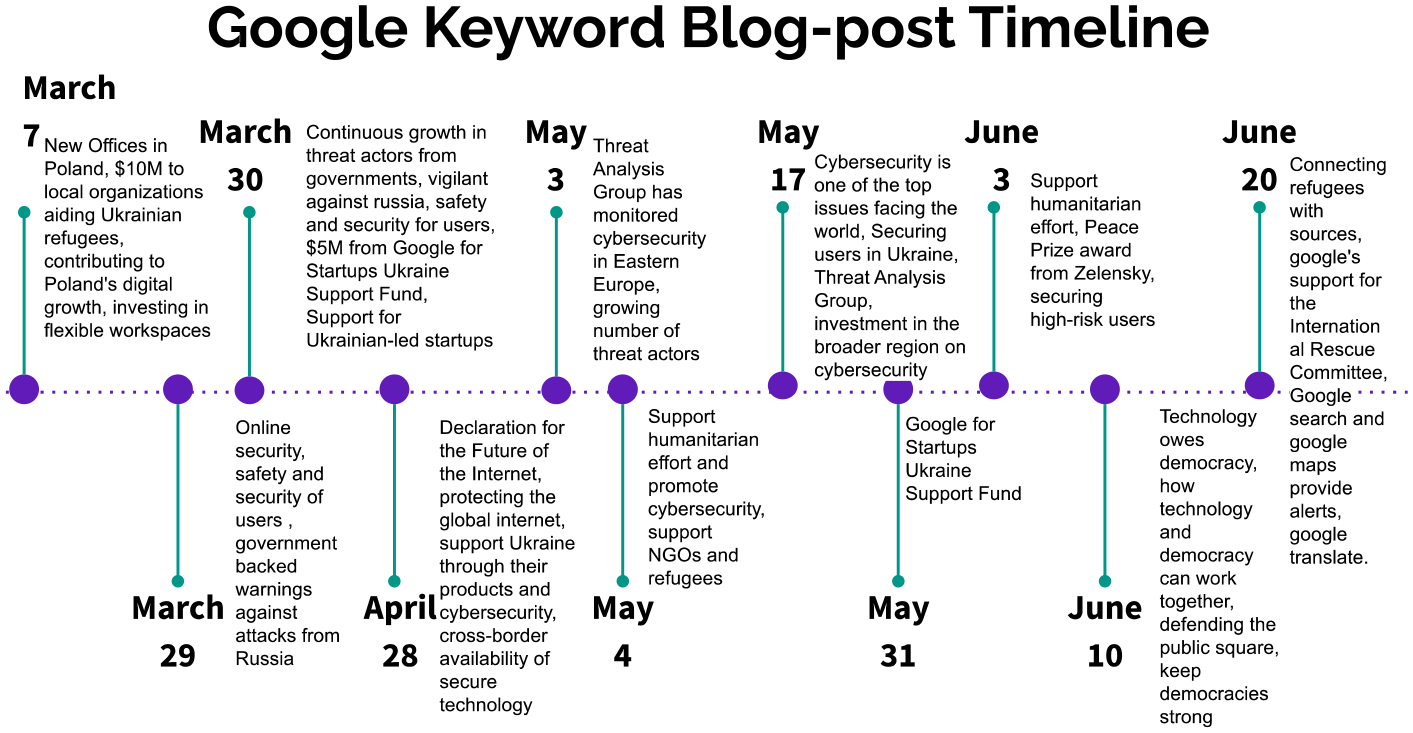
Summary of the content of the blogposts in The Keyword from February to June 2022. Political and humanitarian repercussions of the war occupied Google as well as the ways in which it saw itself involved in the war.
What is more, the political angles that dominate Google’s approach to the war cannot be simply reduced to the business goals of a transnational corporation. The word clouds in Figure 3 establish this point as they reveal how deep Google’s involvement ran. Rather than a focus on the substance of the topics discussed in the blog, as in Figure 2, in Figure 3 we look at the volume of words used to discuss Google’s values. Each word cloud indicates the proportion of the text dedicated to each of the values Google had endorsed. The commitment to end the war, the importance of human rights and democracy and the significance of security all stand out. Indeed, comparing The Keyword during this period to its content during any other period preceding the war in Ukraine, the absence of the business goals and values of the corporation stands out as does the outright focus on political, international and social values. What at first blush may seem like the flagship blog of the State Department is actually the top blog of a Tech Titan, visibly dedicated in unequivocal terms to the international political values it had committed to.
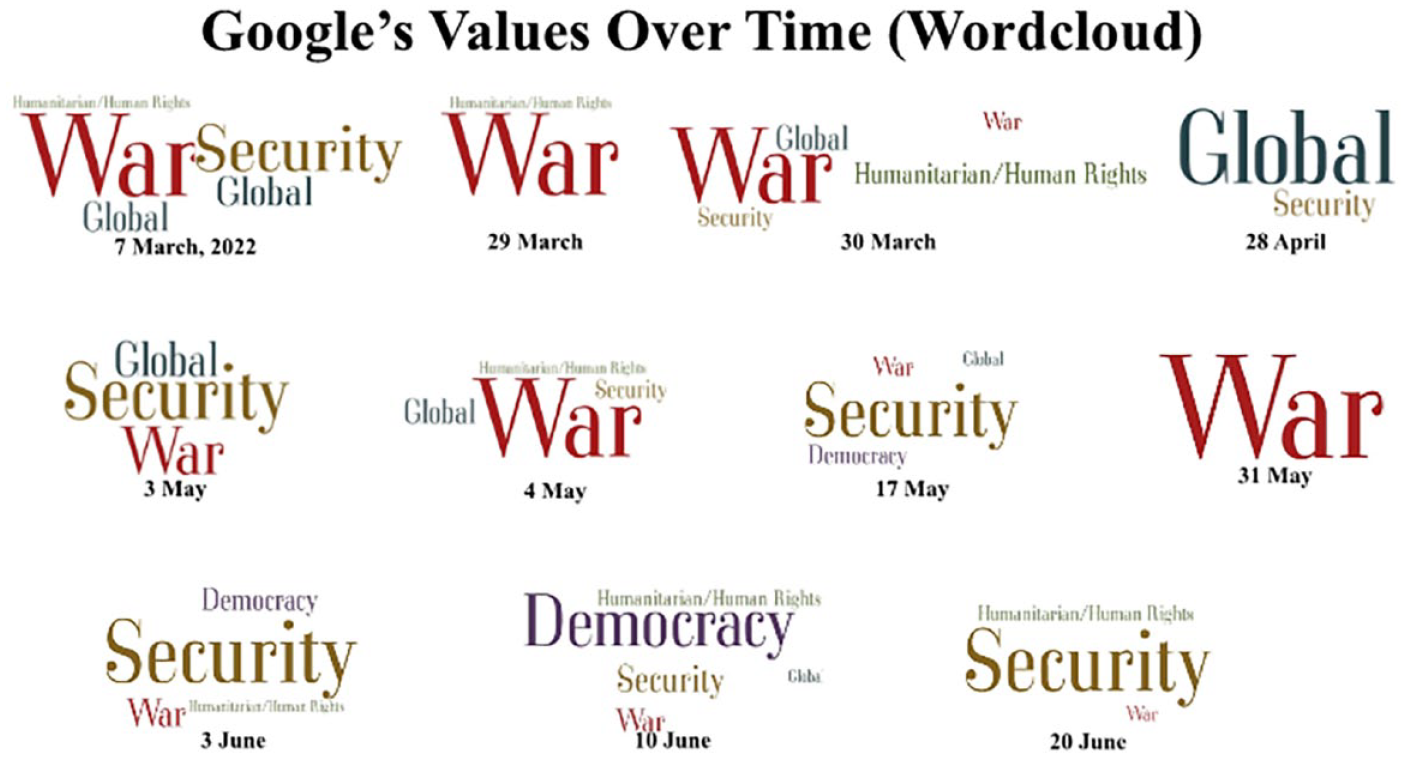
Word clouds representing the content of The Keyword blogposts from February to June 2022. The commitment to end the war, the importance of human rights and democracy and the significance of security completely eclipse Google’s business goals.
Let us now delve into the details of Google’s involvement in the war in several spheres of influence: finance, services and products, cybersecurity, Russian relations, and technology and democracy.
Finance
Google has publicly announced a total of $55M in support for Ukraine by May 2022. 29 The tech titan advertised grants with the goal of helping humanitarian and intergovernmental organizations in their effort to connect people to sources of aid and resettlement information. The breakdown was $35M in funding and in-kind support to aid relief efforts, specifically from an employee matching campaign and direct grants. Funding was also made available specifically to advance Google’s goals within its own domain – the cyber commons. 30 Google pledged $10M to address spreading Russian misinformation about the realities of the war. Google’s financial support was not limited, however, to the cyber commons, as the company also included an additional $10M ‘to help organizations delivering both immediate humanitarian aid and longer-term assistance for refugees in Poland’. 31 To put the financial assistance in perspective of classical players on the stage of international relations, the $55M pledged by Google is comparable to what several central European countries, which were directly and indirectly affected by the conflict, donated. It is comparable to the amount given by Austria ($58.5M), Luxembourg ($54M), or Switzerland ($57.8M).
Services
In addition to financial aid, Google has been arguably even more influential to the crisis through its control of its digital services. The tech titan has pledged to aid in any way it could through its services. Influencing the geostrategic balance, on Maps, Google has ‘temporarily disabled some live Google Maps features in Ukraine, including the traffic layer and information about how busy places are, to help protect the safety of local communities and their citizens’. 32 Further bolstering Ukraine’s geostrategic position, Google has created an Air Raid alert system for Android phones by using already-existing earthquake warning technology. Google is working hand in hand with the Ukrainian government to receive accurate information about security-related announcements. They have also launched an SOS alert on Search.
Furthermore, to support its humanitarian goals, Google has added features to Maps and Search for businesses (like hotels and restaurants) to flag if they were providing discounted or free services to refugees. The company has increased free services on Google Cloud, waived international calling fees on Google Fi, and waived calling fees for those using Google Voice as well. They have also added information on refugee and migrant centers in neighboring countries to Maps. Finally, Google Translate is used to aid refugees with a language barrier. No nation-state could have launched such a comprehensive cyber-digital based support.
Cybersecurity
When it comes to cyberwarfare, big tech companies like Google possess better capabilities than many governments. Google’s Threat Analysis Group (TAG) is uniquely equipped to observe activity and take action against hackers worldwide. Russia-backed operations are not new to TAG, which has been able to fight back against attempts to invade Ukrainian cyberspace. According to The Keyword blog posts, Google has shared more information about threats like Fancybear and Ghostwriter, issued government-backed attack warnings to Ukrainians using products like Gmail, blocked attempts to attack Ukrainian government and military officials online, increased Google account security protections, and expanded eligibility for Project Shield. Project Shield is Google’s free protection against DDoS attacks, allowing Google to absorb bad traffic and shield smaller websites. Over 200 websites in Ukraine are using Project Shield. Google also has an Advanced Protection Program, its highest level of security, for hundreds of users in Ukraine. Finally, Google Safe Browsing has blocked phishing domains targeted by Fancybear and Ghostwriter, Mustang Panda. Almost no nation-state, with the exception the US, could have provided such a comprehensive aid in cyberspace.
Russia
One of Google’s main goals was to combat misinformation. The main way this has been accomplished was by limiting Russian influence on Google Search. According to their blog posts, the tech titan has ‘significantly limited recommendations globally for a number of Russian state-funded media outlets across our platforms. In Europe, we are removing apps from Russian state-funded media beyond RT and Sputnik from Google Play. And as stipulated by the EU’s Council Regulation (EU) 2022/350 we have removed RT and Sputnik from our Search results in the European Union’. 33 Google has also paused their advertisements in Russia, although they are still running their free services (Search, Gmail, Youtube) to provide access to global information and perspectives. YouTube has removed more than 8000 channels and 60,000 videos for violating its Community Guidelines, including a number of channels engaging in coordinated deceptive practices, misinformation, hate speech or graphic violence related to the war. These actions show a political choice rather than just a business decision.
Democracy through technology
Google’s expressed goals in their involvement in the conflict in Ukraine are to support the humanitarian effort through their services, provide trustworthy information and promote cybersecurity. Much like NGOs and large nations, Google has created programs and workshops to promote democracy in the region. In one blog post, Google details how a ‘delegation of top security engineers and leaders met with orgs in Czechia, Poland, Lithuania, Latvia to train high risk groups, distribute security keys, engage in technical discussions with government experts, and support local businesses’. 34 Google’s high-risk user team conducted workshops for NGOs and publishers and journalists. They created the Protect Your Democracy Toolkit to provideassistance to institutions and civil society striving for democracy.
Highlighting its commitment to democracy through technology, the company recently received the Peace Prize Award from the Ukrainian President, Volodymyr Zelenskyy, for their commitment to these causes. The mission of Google Cybersecurity Action Team (GCAT) is to advise governments, critical infrastructure providers, enterprises, and small businesses on cloud security and IT modernization. Google has hosted roundtable discussions with Chief Information Security Officers (CISOs) from around the region to learn about the challenges they face, and shared resources on how they can accelerate their response to threats, secure their open source software supply chains and stay up-to-date with evolving regulations. Google has publicized their belief in the importance of democracy, especially with Kent Walker’s June 10 speech at the Copenhagen Democracy Summit, where he outlines the dependence of tech companies on democracy as ‘fertile soil for innovation’. 35
Most recently, Google has expressed support for the Declaration for the Future of the Internet, a document signed by the U.S. and partners around the world, in order to promote a positive vision for the internet and digital technologies by putting human rights first, alongside other important goals. The way Google positions itself behind efforts to promote a humanitarian vision of the internet and backs democratic governments in these efforts shows, inter alia, how the corporation hopes to be viewed on the world stage.
Empirical test #2: Microsoft in Ukraine
To examine the various aspects of Microsoft’s presence in the ongoing war in Ukraine, we look at empirical evidence from statements from Microsoft officials, cyber-security measures, cooperation with other governmental organizations or governments themselves, their financial commitments, and also past actions and endeavors that had an impact on their current involvement.
Microsoft’s statements
Throughout the crisis, Microsoft has been heavily involved in the cyber defense of Ukraine. The tech titan released countless blog posts, press releases, and statements by President Brad Smith and Tom Burt, the Corporate VP of Customer Security and Trust. Their mission statement claims that their presence in this conflict is aimed to protect civilians from attacks and share information about Russia’s cyberwarfare so the public is aware of what is occuring and others in the security community can identify other cyber threats and defend themselves and Ukraine.
Using distinctly national security terms, throughout the conflict Microsoft described a secure line of communication that they set up with the government of Ukraine. Smith went on to state that he regularly spoke with Volodymyr Zelenskyy. The corporation did not go into much detail however about how exactly Microsoft’s security teams worked hand-in-hand with Ukrainian government officials. What they did report is that they shared threat intelligence on a twenty-four-seven basis.
During a press conference, Microsoft President, Brad Smith, claimed that the corporate is a company, not a government or a country. Later language, however, reminds one of a statement that would be uttered by a State Department official or by the Secretary of Defense, not a president of a tech company: ‘One of our principal and global responsibilities as a company is to help defend governments and countries from cyberattacks’. 36 Smith also called on other multinational tech companies to step up their humanitarian and defense effort in Ukraine: ‘. . . Requires decisive efforts across the tech sector – both individually by companies and in partnership with others – as well as with governments, academics, and civil society’. 37
In times of war, official news updates from the front would almost always come from a government agency such as the Department of Defense. The Ukrainian crisis introduced a new wave of information processes and brought new players to the table, including Microsoft. In this conflict, Microsoft was and is still acting almost as a hegomonic country, calling for peace between Ukraine and Russia, quick to condemn actions of certain countries, and stating: ‘We call for a restoration of peace, respect for Ukraine’s sovereignty, and the protection of its people’. 38
Microsoft is also extremely quick to announce their accomplishments. They are not shy from declaring the various philanthropic organizations they are leading, as well as the code and cyberattacks they have broken and conquered from Russia . . . ‘Microsoft Philanthropies and UN affairs teams work closest with the ICRC and multiple UN agencies’. 39
Microsoft’s cyber presence in Ukraine
Microsoft’s primary geostrategic contribution to the Ukraine conflict comes in the form of its dominance of the cyber and digital domains. Microsoft Defender is the chief program defending Ukraine from Russia’s cyberattacks. The day before Russian tanks rolled into Ukraine on February 24th, the company was the first to detect attacks. This first detection was identified as FoxBlade. After alerting the Ukrainian government, Microsoft provided the steps needed in order to deal with the malware. Since then, Microsoft has worked to continuously target incoming cyberattacks from Russia. Apart from identity theft, which is a major concern, Russian cyber forces targeted certain sectors, which according to Microsoft, included ‘the financial sector, agricultural sector, emergency response services, humanitarian aid efforts, and energy sector organizations and enterprises’. 40
As a part of Microsoft’s cyberwarfare effort, they also focused on removing state-sponsored disinformation campaigns from Russia. The goal was to eliminate the exposure to Russian propaganda and limit the amount of fake information available on the internet. The company removed state-sponsered Russian media outlets from the Microsoft Start platform and removed access to these campaigns on their internet platforms.
Further developing its collaborative efforts with both nation-states and other companies, with an attempt to advance coalitions for the protection of Ukraine, in a blog post in June 2022, titled Defending Ukraine: Early Lessons from the Cyber War, Brad Smith shares a list of five important lessons that Microsoft had learned in the first few months of the war. 41 Those included: (1) ‘Defense against a military invasion now requires for most contries the ability to disburse and distribute digital operations and data assets across borders and into other countries’, (2) ‘Recent advances in cyber threat intelligence and end-point protection have helped Ukraine withstand a high percentage of destructive Russian cyberattacks’, (3) ‘. . . as a coalition of countries has come together to defend Ukraine, Russian intelligence agencies have stepped up network penetration and espionage activities targeting allied governments outside Ukraine’, (4) ‘. . . in coordination with these other cyber activities, Russian agencies are conducting global cyber-influence operations to support their war efforts’, (5) ‘. . . the lessons from Ukraine call for a coordinated and comprehensive strategy to strengthen defenses against the full range of cyber destructive, espionage, and influence operations’. In past conflicts, such assertions would be published solely by the spokespersons of militaries or national defense institutions of nation-states, rather than by multinational business corporations.
Microsoft also uploaded Ukraine’s governmental data onto their cloud. With cloud computing becoming increasingly central in the cyber domain, governments around the world including the US government, started experimenting with uploading data to the cloud. The crisis and the ceaseless cyber campaign against the Ukrainian government increased the urgency of such a move. In the midst of the conflict, Microsoft worked to upload the government’s data onto its servers, which were dispersed into the cloud, making it increasingly difficult to track and then hack, being cyber-secured by Microsoft’s technologies developed by Microsoft engineers. This system which decentralized and duplicated data, provided key protection against possible attacks.
WhisperGate
In January of 2022, it became known that Russia had tried to hack into Ukraine’s governmental systems, using WhisperGate. Russia’s intention was to infiltrate and destroy Ukraine’s systems and devices. First identified by the Microsoft Threat Intelligence Center (MTIC), WhispterGate was launched close to a month before the first Russian tanks rolled into Ukraine. Using Microsoft Defender, the tech titan was able to uncover the malware before it was able to cause any major damage to Ukraine’s technological systems and infrastructure.
Humanitarian efforts
Along with their technological efforts concerning the cyber defense of Ukraine, Microsoft has also dedicated its philanthropy organization and UN Affairs team to provide aid directed at the citizens of Ukriane. Just like their efforts toward coalition building in the cyber domain, Microsoft has partnered with several nongovernmental organizations, including the International Committee of the Red Cross (ICRC) and various United Nation humanitarian agencies. Their humanitarian efforts make use of their distinct capabilities as a tech titan. A good example is how Microsoft mobilized the Microsoft Disaster Response Team, which specializes in using technology to better aid those who currently experience the crisis. This response team also allowed Microsoft to stay in close contact with the first responders tending to those in need.
Another ongoing effort by Microsoft aims to match donations received from employees worldwide through the Microsoft’s Employee Giving Program. According to Brad Smith, these donations were aiding to fund various nonprofits, and he lists the ICRC, UNICEF, and the Polish Humanitarian Action in particular.
Russia and microsoft
The interaction between Microsoft and Russia during the conflict resembles that between two nations more than between a nation-state and a transnational corporation. Russia blocked Microsoft’s cloud network access for all of its citizens. Russia has been using Microsoft utilities to hack into Ukraine’s databases, including their SecureDelete utility. As of March, Microsoft suspended the sales of their products in Russia: ‘. . . are stopping many aspects of our business in Russia in compliance with governmental sanctions decisions’, 42 as well as limited access to Russia’s state sponsored media like RT, including purchases made of facilities, technological services, and objects by both regular civilians and the government of Russia itself. There were, however, several of their products – such as Xbox and Windows – that were not regulated or held to the same standards. These sanctions removed Russia’s access to Azure where ‘. . . more than 200 products and cloud services designed to help you bring new solutions to life–to solve today’s challenges and create the future. Build, run, and manage applications across multiple clouds, on-premises, and at the edge, with the tools and frameworks of your choice’. 43 Azure is one of very few platforms that became essential as the basis for a range of both private and governmental online cloud operations and services. Following Microsoft’s restriction of this program, Russia lost a key cloud platform and was, thus, forced to find substitutes.
Funding
Among various governments and organizations providing funding for the Ukrainian war effort, Microsoft falls into the category of those spending around $100M. This category consists of several large and politically powerful countries including Latvia, Netherlands, Australia, and Findland. Some of those countries were directly impacted by the war, not least because of their physical proximity to the ongoing conflict and their contiguous borders with either Russia, Ukraine or both. Microsoft outspends several governments like Austria, Hungary, New Zealand, and Spain, in terms of their funding for the primary three aid categories. 44
Discussion
The immense growth in the power Tech Titans wield in the international system is not a result of delegation from the state. Neither is this growth a matter of outsourcing state functions or state services to technological companies. Instead, the power wielded by the Tech Titans is a product of the creation and formation of new areas of human activity. These realms of human activity, in many cases had not existed, at least not in that form and with such implications for international relations, before those giants stepped in and crafted them.
Rather than occupying existing commons, where international political activity takes place, the Tech Titans created manmade ones. To dominate maritime commons, passenger and freight ship companies created the technology operated by anyone from longshoremen to sailors. To rule the aerial commons, aerospace industry manufactured the technology serving those occupying airport traffic control towers to those in the cockpit. Thus, many of the tech companies in the past created technology that controlled existing international commons.
Conversely, the Tech Titans continuously create manmade commons, which are completely dependent on their technological visions, understanding of human society, physical and software infrastructure and their service bundles. When airlines or airplane producers operate, they take over existing commons – the air. The same applies to maritime companies. Yet, while controlling the industry, they do not control the commons; air or the high seas are still either territorial or exterritorial. Tech Titans are different. They not only created commons that changed international relations and its terminology, but they also control substantial parts of them and own critical elements within them. 45
The volume of human activity compared to other commons is unique to the cyber sphere. There are approximately 0.5–1.5 million people in the air at pick moments worldwide. The number of people on the high seas is about the same. Conversely, the number of people actively engaged in cyberspace can be in the billions. Theoretically, given that people are simultaneously logged onto and active in more than a single digital domain, the total number of people active in the cyber commons may surpass the size of humanity. The latter point also means that unlike physical commons – be they land, air, or sea – if the Tech Titans as super-entities in cyberspace are analogous to continents in the physical world, simultaneous presence on multiple continents is possible. While presence in both Africa and America or both the Atlantic and Indian Oceans at the same time is impossible, presence on Meta, Microsoft, Amazon, and Google at the same time is. The second characteristic of the cyber commons is, thus, reduced significance of geographic proximity. In cyberspace, the local and the global are mixed and a state can interact with states that are further away or with non-state actors with which it has no contiguous borders.
The roots of the power the Tech Titans amassed are dissimilar to how such power is traditionally conceptualized in international relations theory. Their growth of power was unpredictable, not only to the states but to the Tech Titans themselves. We are used to thinking about states, certainly in the international sphere, as strategic players. By their nature, states strive to survive and thrive, and be able to protect and develop their norms and values. 46 The titans’ preeminence is at least partly haphazard. The mindset of the Tech Titans during the lion share of their history was fundamentally different. As their key goals were focused on their business, it was often their bottom line that they aimed to maximize. This could involve increasing the number of customers, producing better products and improving services. It also involved use of customer information for their own benefit. Initially, the Tech Titans were just another major tech company, far from the stature of a titan of international relations.
Let’s take social media as an example. As recently as the mid-2000s, when social networks were starting to form, much if not most of the current role of those networks was largely unpredictable. First, it was almost impossible to predict the rapid growth of those platforms. Second, their scope and scale, with currently billions of users, were hard to forecast. Certain elements which became key features, such as content sharing, were hard to envisage as well. Likewise, out of various companies that were engaged in social media at the time, it was hard to foretell that Facebook would be the one to eventually dominate the field. Likewise, little did experts know that the platforms would become so essential to political activity within and between states, including election campaigns, public policy, news consumption and foreign interventions such as the Russian interference with the 2016 US presidential elections or the recent Meta, Google, and Microsoft influence in Ukraine.
Furthermore, the various cyber vulnerabilities that the growth in social media created were nearly impossible to foretell at the time. Yet, those vulnerabilities just like the rest of the elements of social media, are key to the political landscape of our time. Almost all of the major technologies that have become central to human activity and to international relations since are controlled exclusively by Tech Titans. It was probably impossible to forecast the importance of storage and cloud computing, and how companies like Amazon, Google, and Microsoft would become so powerful in dominating them. The same applies to search engines and data collection. Whether it is storage, search engines, social media, or other technologies dominated by the Tech Titans, those were largely created due to the creativity and entrepreneurship of the Tech Titans. They were not delegated from states, nor were they necessarily designated as key areas of development by the states. The jumbled nature of their growth, and the fact that political goals were not at the top of their agenda, sets the Tech Titans apart from states. The increase in Tech Titans’ power in the Cyber Sovereignty Principle was a product of free market, entrepreneurship, and innovation more than any regulatory scheme or political aspirations.
Let us depict players in the international system as positioned variably with respect to a central roundtable where decisions are made. In most theories of international relations, states would be seated in concentric circles, the more powerful the state, the closer it would be to the innermost circle. In this metaphor, superpowers are seated in that central circle. States of lesser sway in the international arena are seated in circles further away from the center of decisionmaking.
Realist, liberal and constructivist paradigms would give different meanings to states as players and to the importance of the institutional architecture of the concentric circles. Some of those theoretical approaches would find the international institutions that form the table of consequence. Others would focus on the power struggles between the states. And yet others would consider identity and ideas as key. Some of the approaches to international relations would even include other players, among them multinational corporations, but only in the role of active participants in limited areas of activity, such as economic or trade relations.
We argue that the Tech Titans, recently arrived into these international settings, are already seated in that innermost circle or very close to it. What is more, the Tech Titans change the nature of the table and the political transactions undertaken on it. The institutional framework, character and underpinning of international political interactions is changing because of the Tech Titans and their dominance and ownership of cyberspace.
The inventiveness and entrepreneurship of the Tech Titans – such as cloud computing, means of cybersecurity, or social media – is now part and parcel of the way states identify themselves, recognize their friends and foes, protect themselves and attack others, and operate internally and externally. The goals states set for themselves in the international system, as well as how transactions in this system are undertaken, are different due to the dominance of the Tech Titans and the technologies they produce, which become key to the cyber realm and thus to the international system. Those new types of international interactions and political transactions were not in the realm of possibility, or admittedly hardly in anyone’s imagination, as shortly as a few years back.
The dominance of the Tech Titans goes beyond the information they control, and extends to the uniqueness of their services and their almost unhindered control over large swaths of cyberspace and the ways in which they can exercise cyber sovereignty in this space to reach business and political goals. When Microsoft experts work on FoxBlade, it is distinctly different from when Ford Motor Company converted automobile production lines during World War II to make Sherman tanks. Ford used its capabilities to augment the ability of the USA to produce means to win on land. Tank production was temporary, it was not among Ford’s goals, and it was not for a commons created by and controlled by Ford. Microsoft, on the other hand, is constantly engaged with cybersecurity. It is among its major goals since it views cybersecurity as the defense of their cyber ‘territory’, and the company’s power is wielded in the cyber commons, which is of its own making. The Cyber Sovereignty Principle in International Relations suggests that this trend is bound to grow even further.
Conclusions
‘The frontline in the Ukraine conflict ran through Redmond, Washington’. This was not a statement made by the governor of the state of Washington, or by the president of the United States or his Secretary of Defense. Rather, it was Microsoft President Brad Smith that explained how his Redmond-based company was on the frontline of the conflict. 47 The war in Ukraine is the most outstanding example to date of the change the Tech Titans introduce into international politics. However, this change did not start in February of 2022 with the Russian invasion.
When asked on an interview featured on the corporation’s official website why he believed that as of 2020 Microsoft as a private corporation should have an office at the UN, John Frank, Vice President and Chief Public Affairs Officer responded: ‘We think multi-stakeholderism is key’. 48 Frank articulates a worldview of cooperation between multinational corporations and governments to make policy. He advocates for a level of trust between the two in order to advance projects and policy. In the language of a stateman, Frank goes on to say ‘Establishing our representation office with people based in New York and Geneva is the next natural step for a company that values multilateralism and multi-stakeholder solutions to global challenges’. 49 Microsoft is not alone. The other Tech Titans are at different stages of putting together their own UN office. What is more, their extent of UN involvement notwithstanding, as we showed with a plethora of empirical evidence, Microsoft and Google have shaped key aspects of the conflict in Ukraine.
The induction of the Tech Titans as crucial players in the international system spells profound change in international relations, comparable to the change stemming from other fundamental shifts related to pandemics, 50 to powershifts in the global order and in concentrations of power, 51 and to shifts in hierarchies in world politics. 52 How states are influenced by digital technologies has been examined from various perspectives, including the potential of digital technologies to undermine the Westphalian order. 53 Digital technologies allow greater mobility for capital and labor as they erode the ability of governments to provide a robust safety net. 54 By spreading misinformation, sewing confusion, and undermining trust in institutions, illiberal powers have been able to turn the liberal international information order against liberal democracies. Private digital platforms, aiming to maximize user engagement, spread this polarized information, and thus serve the goals of illiberal states, 55 also by means of truth subversion practices leading to epistemological insecurity. 56 Also undermining democracy and the liberal international order, digital platforms may serve authoritarian regimes in suppressing dissent. 57
In spite of governmental, political, regulatory, and cultural differences between states, with hardly any exceptions, around the world cyberspace has pervaded all aspects of life. Both state and nonstate actors increasingly make use of cyberspace to coordinate actions, collect information and influence public perceptions. This virtual domain as well as battlefield has grown side by side with other realms in cyberspace, all allowing different types of actors, state and nonstate alike, substantial impact. Yet, the unique characteristics of cyberspace – including its lack of traditional territorial boundaries, real time and synchronous activity patterns, openness, decentralization, anonymity, and broad distribution – mean that interactions between states in this realm take on an augmented and different nature, which spells a paradigm shift. The cornerstones of the international system – including means of communication, data management and storage systems and even military capabilities – are altered in cyberspace due to better connectivity, immediacy, and openness. 58
Due to its technological architecture – most importantly the TCP/IP protocol, which can ensure anonymity and decentralization – the decentralized network is transnational and global in nature, and as such, it is unlimited and has no geographical or sovereign borders. 59 The Tech Titans control cyberspace, set the rules in it and set the agenda for the trajectory of its future expansion and growth. This has implications for our understanding of the concept of power in international relations and the key players who wield it. 60 The role of the Tech Titans sheds light on the impact of innovation on international affairs, 61 and specifically within the concept of conflicts, as our extensive analysis of the War in Ukraine suggests. 62 The political implications of this new political reality are immense. This includes anything from election campaigns to international negotiations, and from how terrorist networks are organized and operate to immigration trends. All those either happen in the cyber domain or are inextricably linked to it. Yet, the state has limited influence on the infrastructure, rules, growth trajectory, and services forming cyberspace. Compared to what was traditionally regulated by the political apparatus of the state, cyberspace is hardly managed or constrained regulatorily.
The war in Ukraine brings to a new level, both quantitatively and qualitatively, the effect of those companies in international relations. The change is threefold: the leverage the titans muster is direct and strategic; the actions of the tech giants are not necessarily aligned with the grand strategy of any one nation or alliance of nations; and, the actions of the tech giants are undertaken in a new domain, which is created and largely controlled by the Titans themselves.
States are here to stay. But in the increasingly important international domain of cyberspace, their standing compared to the Tech Titans is shrinking with implications for many aspects of international relations. As The Cyber Sovereignty Principle in International Relations suggests, the dominance of the Tech Titans in international relations is bound to even further increase as nascent technologies develop, and in particular extremely powerful ones like quantum computing and artificial intelligence. Accordingly, future research should look at the implications of the rise of the Tech Titans for international law, our understanding and analysis of national security, the implications for democracy and domestic politics, and how democracies are able to protect themselves in this new international environment.
Footnotes
Acknowledgements
We thank Alon Berkman for his research assistantship on the topic of the uniqueness of the tech titans. We also thank participants in the Cyber Sovereignty Workshop at Tel Aviv University: Nir Hasid, Nuffar Ariel-Shashua, Ross Horesh, Alon Berkman, and Lihi Friedman for their useful comments. Udi Sommer would like to thank research assistants on his research team, including: Roee Braverman, Izzy Lashley and Benjamin Schiffman.
Funding
The author(s) disclosed receipt of the following financial support for the research, authorship, and/or publication of this article: Israel Science Foundation, Grant number 2737/20 “The effects of legal data regimes on the global data race” funded part of that research (Open Access).
