



Abstract
While South America made significant strides in regional security cooperation since the 1990s, more recently the region seems to have entered a process of backsliding from its cooperative achievements and towards mere coexistence. This article proposes that an English School approach allows for a nuanced assessment of regional security cooperation. It contributes to the analysis of regional international societies and regional organisations as markers of fundamental institutional change. While scholars have studied how regional organisations shape the fundamental institutions of regional international societies as they emerge and evolve, little research has been done on whether a decline in regional organisations can lead to changes in the fundamental institutions of regional international societies. Using a set of indicators for coexistence and cooperative international societies, we analyse whether there is evidence of backsliding from cooperation to coexistence in South America with regard to three different types of security challenges: interstate conflict and militarisation; inter-mestic repercussions of internal conflict and violence; and extra-regional influences. We argue that a decline in regional organisations exacerbates those challenges, as they are no longer mitigated through institutionalised diplomatic procedures. However, despite the organisational decline, fundamental institutions in South America have so far proven relatively resilient.
Introduction
The announcement of Brazil’s new version of its National Defence Policy in 2020 caused concern throughout South America. For the first time since the Brazilian Ministry of Defence was founded in 1999, national defence policy did not assume the absence of conflict risk in the region. This disturbing reorientation runs counter to the trend over the past three decades, where South America made strides in international security and defence cooperation. Starting in the 1990s, military cooperation intensified via joint exercises and the participation of several South American countries in United Nations (UN) peacekeeping operations. Hemispheric institutions such as the Organization of American States (OAS) and the Inter-American Defence Board (IADB) were revitalised after the confrontations of the Cold War. In Latin America, new regional institutions were created, such as the Southern Cone Common Market (Mercosur) in 1991, the Bolivarian Alliance for the Peoples of Our America (ALBA) in 2004, the Union of South American Nations (UNASUR) in 2008 and the Community of Latin American and Caribbean States (CELAC) in 2010. Especially UNASUR with its South American Defence Council (SDC) set out to coordinate its members’ security and defence policies.
South America has long been regarded as a region with few interstate conflicts. Tensions among states are still relevant though, as exemplified by long-standing rivalries and territorial disputes, as well as militarisation and rearmament of many countries in the region. In addition, high levels of internal violence and ‘inter-mestic’ security threats of domestic origin with ramifications throughout the region, such as organised crime, drug trafficking, non-state violent actors, the spill-over of political instability from neighbouring countries and illegal migration, are of national and international concern. A critical flashpoint is the border area between Brazil, Colombia and Venezuela.
While those security challenges persisted over the past decades, they were mitigated by the expansion of institutionalised regional cooperation – that is, of what English School scholars would call secondary institutions. 1 The various security challenges and the obstacles that hindered the development of a consensual regional security agenda, such as diverging threat perceptions or tensions over democratisation and economic integration, were put on the agenda of existing and new regional security organisations. 2 However, since the mid-2010s there has been growing evidence that the period of ‘peace by regional institutions’ 3 might be coming to an end. Political and ideological divisions between countries (drastically epitomised by the persistent economic and political crisis in Venezuela since 2013 and the election of an extreme right-wing president in Brazil in 2018), internal instabilities and increasing mass migration point to rising tensions and insecurity throughout the region. Conflict and crisis management by regional and hemispheric institutions such as UNASUR and the OAS has not only been insufficient, but those institutions have been seriously impaired by ideological stand-offs between member states, as evidenced by the clashes over the Venezuelan crisis that brought about the end of UNASUR. 4 The countries of South America seem to be losing their cooperative achievements and moving towards mere coexistence.
This article draws on the English School (ES) of International Relations (IR) to explore what could be interpreted as a period of backsliding from cooperation to coexistence in South America. While Buzan and Waever’s Regional Security Complex Theory (RSCT) has achieved prominence in the region, ES approaches are less common. This could be because the ES is known for articulating a globalist rather than a regional perspective, and where it has analysed sub-global international society, the bulk of attention has been paid to Europe and the European Union as a model case for a transformation towards cooperation and convergence. 5 Only few scholars have looked at other regions such as Latin America, the Middle East or Asia through an ES lens. 6 Yet, contemporary global international society is culturally heterogeneous and includes several more culturally homogeneous regional international societies. 7 According to Buzan, international society focusses on how security dynamics have shaped modern regions since their formation: ‘These security dynamics, plus underlying cultural and political patterns […], have generated constructions of international society at the regional level that are significantly distinctive from the western norms and institutions that define the global level of international society’. 8 ES scholars should therefore continue to identify and analyse the institutions of additional regional international societies. 9
We take this recommendation and even go a step further by attempting to embed the study of international organisations more closely within the general ES theory of international society. Drawing on recent work by Knudsen and Navari, 10 we propose that the ES offers a fruitful avenue to explore the relations of international organisations with the more fundamental institutions of international society. In particular, we analyse to what extent international organisations can bring about change in the fundamental institutions that constitute international order, such as law and diplomacy. Although the fundamental institutions are ontologically privileged, as they are constitutive of international society as such, we assume that international organisations are important as drivers of fundamental institutional change. However, such a change usually happens incrementally and over time. 11 This raises the question of whether a (temporary) organisational deterioration is enough to propel change, or whether fundamental institutions might also prove to be resilient. Regional security in South America is a good area to study these dynamics of institutional change and resilience, allowing us to assess the impact of the recent rise and decline of regional security organisations on fundamental institutions.
We start by developing our theoretical framework with a view to the South American context. The following section summarises the trajectory towards cooperation in the region, prevalent from the 1990s to the mid-2010s and highlights how regional organisations have contributed to this development. Subsequently, we analyse the countertrend of organisational deterioration since the mid-2010s, raising the question of whether this has led to a relapse in the fundamental institutions of the regional international society from cooperation to coexistence. Empirically, the analysis focusses on three different types of security concerns that are among the main drivers of regional security cooperation 12 : First, interstate conflict and militarisation are still relevant, considering that rivalries between neighbouring states persist and a recent trend of military build-up can be observed. Second, inter-mestic repercussions of internal conflict and violence aggravate interstate tensions and conflicts. Third, extra-regional great powers exert influence on security in South America. Across all three types of security concerns, we can observe a decline in institutionalised regional security cooperation. This decline of regional organisations has acted as an amplifier of existing problems, which were otherwise contained by regional diplomacy and cooperation. However, despite the alarming organisational deterioration, fundamental institutions in South America have proven surprisingly resilient. The concluding section summarises our findings and presents final considerations.
The English School and the South American security puzzle
South America has long been characterised by a paradoxical simultaneity of conflict and peace. Advances in regional security cooperation have existed alongside dynamics of militarisation and the possibility of interstate conflict and high levels of intra-state violence. Scholars have described the absence of war, coupled with the persistence of interstate rivalries and high levels of internal violence, but also efforts of international cooperation, as a ‘puzzle’, 13 an ‘intriguing anomaly’, 14 and a ‘paradox’, 15 both on empirical and theoretical grounds. Empirically, ‘the diplomacy of cooperation coexists with that of militarised coercion, just as in the past’. 16 The theoretical puzzle arises when different accounts, based on mainstream frameworks which privilege certain aspects in detriment of others, find contradictory pictures: Whereas realism analyses balance of power and militarisation, 17 liberalism and constructivism emphasise cooperation and discuss a security community in South America. 18 Scholars have pointed out the limitations of realist and liberal IR theories in understanding the South American context and have called for ‘multiperspectival’ frameworks. 19 Correspondingly, others have portrayed the region as a space of ‘hybrid security governance’, combining balance of power and security community practices and discourses. 20
While highlighting the overlapping of cooperative efforts and practices with conflictive processes, 21 scenarios like a ‘militarist peace’ 22 or ‘violent peace’ 23 are rather static and do not reflect that the level of conflict and cooperation varies over time. In the decades following the transitions from authoritarian rule, South America moved towards cooperation, but in recent years the deterioration of regional organisations suggests that the region might be backsliding towards a more insecure and conflictual configuration. RSCT and the ES offer a more promising perspective to analyse these variations over time. So far, numerous studies on regional security in South America adopted RSCT as a theoretical framework. 24 We therefore begin by comparing the similarities and differences of the conceptual toolkits of both approaches, with the intention of showing why we believe that an analysis of these contradictory trends – the existence of security cooperation alongside interstate tensions and dynamics of militarisation – through an ES lens might shed new light on the South American security puzzle.
Several points of contact among RSCT and the ES international society framework were highlighted by Barry Buzan, one of the leading scholars of the ES research programme, 25 and, along with Ole Waever, the author of RSCT. 26 The security concept proposed by Buzan and Waever in RSCT encompasses not only material and structural aspects, but also the processes of social interaction between the actors. This conception is also reflected in the ES which, according to Buzan, is ‘interested in analysing the social dynamics such as the ideational forces, the rules of conduct, the intentionality of actors and the normative tensions and problems generated by the interplay of these factors’. 27 For Buzan, ‘the ES incorporates both the realist and liberal framings and contextualises them in a range of possible types of international society’. 28 It provides a holistic approach, combining elements of all these mainstream research traditions, with historical elements along the systemic logic and societal norms, considering that ‘these analytics together have explanatory power in considering how the world hangs together’. 29 The idea of ‘society’ as expressed in Hedley Bull’s concept of International Society ‘does not in any way imply that relations among states are necessarily peaceful, stable or harmonious’. 30 Levels of conflict or cooperation occur in a framework of shared institutions, rules and social norms, where power and conflict might ‘play a major, even at times dominant, role in international relations’. 31 Power remains key to international society considering that its fundamental institutions such as balance of power, the role of great powers and great power management and war all revolve around it. 32
Buzan identifies four types of international society 33 : Power-Political represents an international society based largely on enmity and the logic of war, however with some diplomacy, alliance-making and trade, where survival is the main motive. In a coexistence international society, the core institutions are balance of power, sovereignty, territoriality, diplomacy (mainly in the form of bilateral contacts between states), great power management, war and international law. States are self-centred and war is not infrequent. Cooperative is an international society where war and balance of power are downgraded, states seek a level of order and instrumental (not necessarily ideological) agreement sufficient to pursue joint projects (such as collective environmental management and scientific projects), diplomatic practices become more advanced and other institutions and international organisations are created, depending on what types of values are shared and how/why they are shared, though Buzan stresses that the standard model is based on shared liberal values. A convergence international society develops a substantial range of shared values within a set of states, who adopt similar political, legal and economic forms and aspire to be more alike. The main empirical case, according to Buzan, is the European Union.
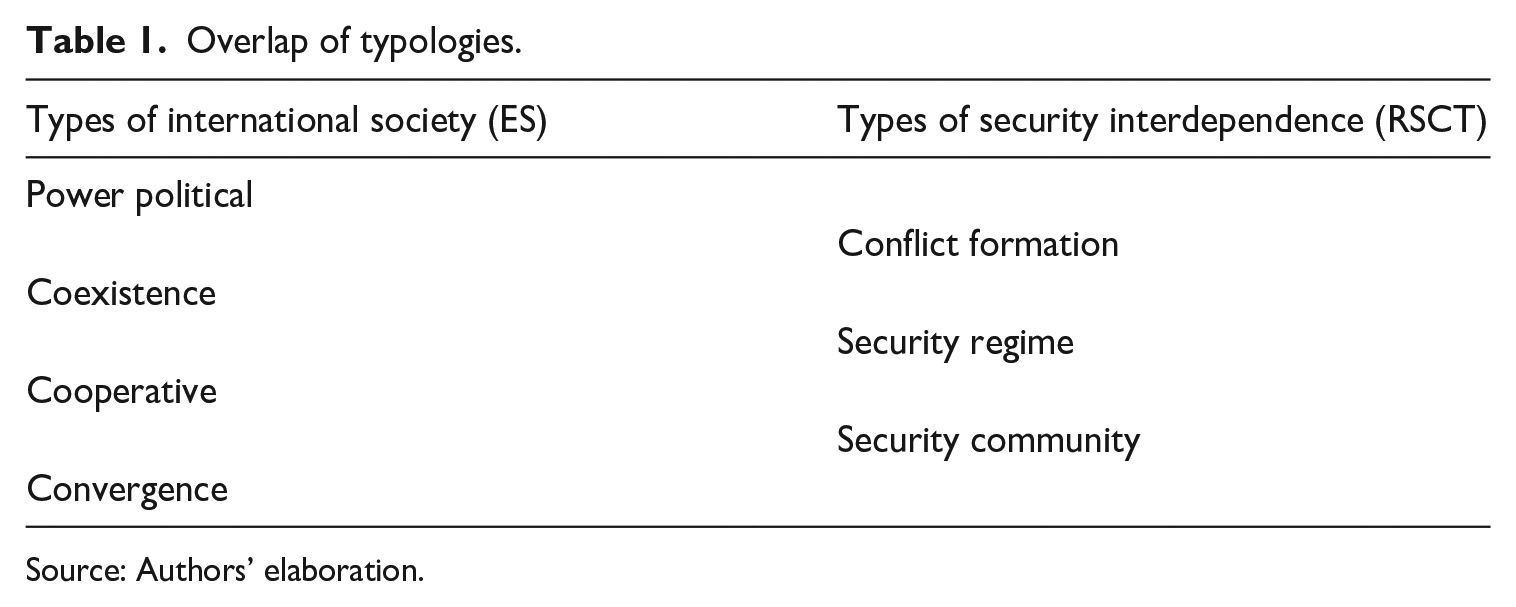
These four types overlap with the three types of regional security complexes 34 : In conflict formations, security interdependence is driven by fear, rivalry and mutual securitisations (corresponding mainly to power-political and, to some extent, coexistence international society). In security regimes, states have set arrangements to reduce the security dilemma among them, and to constrain processes of mutual securitisation (bridging across coexistence and cooperative international society). In security communities, states have de-securitised their relationships and do not expect or prepare to use force against each other (bridging across cooperative and convergence international society). 35
Table 1 illustrates the relationship between the two typologies, which define security relations by the degree of amity or enmity between states. Obviously, both have normative implications, suggesting that moving from enmity-based to amity-based types represents progress.
Overlap of typologies.
Source: Authors’ elaboration.
The regional security complex of South America, in the analysis of Buzan and Waever, constitutes a ‘security regime’ (situated between ‘conflict formation’ and ‘security community’), and its main security dynamics ‘predates, continued during and still exists after the Cold War’ 36 and is divided into two regional subcomplexes: the Southern Cone (Argentina, Brazil, Chile, Uruguay, Paraguay and Bolivia), where the mitigation of rivalries and the building of regional security organisations in the 1990s and 2000s seemed to indicate progress towards a regional security community 37 ; and the Andean North subcomplex (Colombia, Venezuela, Peru, Ecuador and Guyana), presenting a conflictual and unstable situation, aggravated by transnational security problems, such as drug trafficking. 38 Many studies of the region have adopted the conceptual tools of RSCT mostly in combination with mainstream IR theories, tending to reproduce the dichotomy between a more conflictive Andean subcomplex and the Southern Cone on its way to a security community. 39
In our view, the ES categorisation allows for a more nuanced view of international security in the region as it enables a more fine-grained differentiation in the middle of the scale. In contrast to other scholars’ classification of South America as an emerging security community, we suggest that it continues to be a security regime in RSCT terms, moving back and forth between a coexistence and a cooperative regional international society (see Table 1). While the wave of democratisation in the region in the 1980s and 1990s introduced a period of more cooperative relations, the second half of the 2010s brought a decline in regionalism that might have heralded a downward trend towards coexistence, as the security challenges affecting the region are no longer mitigated by functioning regional organisations.
The ES puts a strong emphasis on institutions as indicators to determine the type of international society. According to Hedley Bull, ‘By an institution we do not necessarily imply an organisation or administrative machinery, but rather a set of habits and practices’. 40 He originally listed five institutions of international society: balance of power, international law, war, diplomacy and great power management. Buzan later expanded the list and introduced his influential distinction between primary and secondary institutions. 41 Primary institutions, such as mutual recognition of sovereignty, territoriality, balance of power, international law, diplomacy, nationalism and great power management, represent fundamental underlying principles and norms that are evolving rather than designed, while secondary institutions are relatively specific and consciously designed. 42 Secondary institutions, in Buzan’s terms, are the specific rules and decision-making procedures formalised in the international agreements, organisations and regimes that constitute the governance structure of an international society. 43 They are ‘products of certain types of international society’, constituted by, ‘for the most part, intergovernmental arrangements consciously designed by states to serve specific functional purposes’. 44
While Buzan’s seminal distinction is widely used in the ES literature, few attempts have been made to date to analyse international organisations from the perspective of the primary or fundamental institutions of international society. Authors like Spandler and Knudsen therefore have suggested to pay more attention to secondary institutions, to explore more deeply the relation between and interactions of primary and secondary institutions and to clarify their role in international society including their potential for stimulating fundamental institutional change. 45 Generally, ES scholars either assume a derivative relationship between the two layers of international society, or a reticular relationship where both primary and secondary institutions have some effects in relation to the other. 46 But even if the terminology suggests a derivative relationship with international organisations as ‘secondary’ to primary institutions, they are important for the reproduction and working of primary institutions, and therefore also to transformations of their working. 47 Spandler disputed the notion that secondary institutions merely adapt to changes at the primary institution level, pointing out that they could potentially have effects of their own, such as helping to make primary institutions more durable. 48 Navari and Knudsen stressed that ‘fundamental institutions enable and constrain international organisations, while international organisations introduce changes into the fundamental institutions that they generally and habitually support’. 49 Regarding regional international organisations, the authors added that they ‘may be understood as forums for a particular regional operation, translation or shaping of the fundamental or primary institutions of international society’. 50 With regard to regional security cooperation, Floyd argued that elaborate secondary institutions are indicative of cooperative international societies, as the ‘joint pursuit of security…comes to define the basic character of international society as inter alia peaceful (at least with one another), cooperative, international-law abiding and defined by a commitment to sub-global collective security institutions’. 51
Knudsen and Navari and several of the authors in their edited volume studied how secondary institutions shape primary institutions when they emerge and evolve. 52 However, none of these works set out what happens to primary institutions when secondary institutions decline. This might indicate that nothing is assumed to happen. However, if we assume that secondary institutions underpin the logic of cooperation in cooperative international societies, their decline could have significant implications. Our analysis addresses this conundrum and explores the impact of a downward trend in international organisations on fundamental institutional change. Using evidence from South America, we investigate whether a deterioration in secondary institutions affects primary institutions to the extent that it causes backsliding from a cooperative to coexistence type of international society, or whether the primary institutions of a cooperative international society can persist.
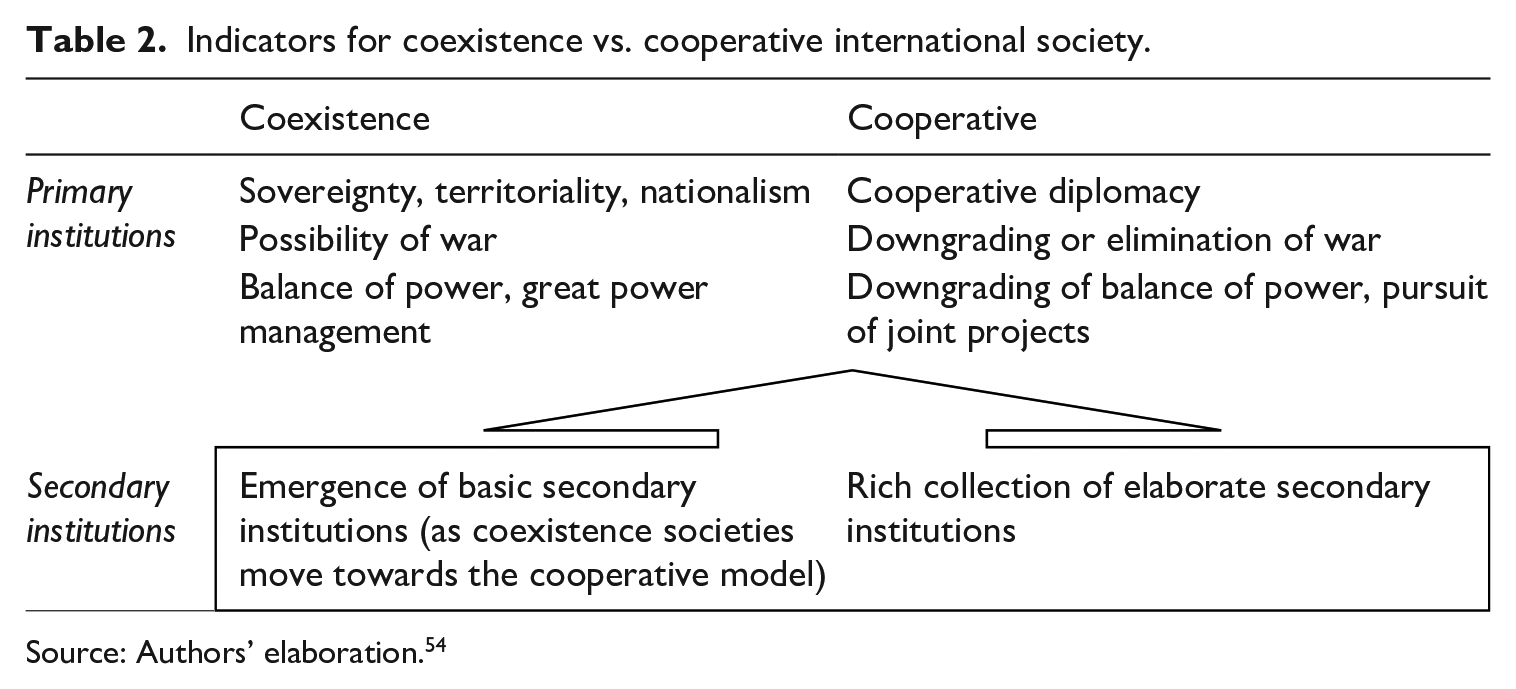
An ES analysis of institutional change looks out for changes in the fundamental institutions of international society. We therefore single out key indicators for coexistence and cooperative international societies, as displayed in Table 2. Among the primary institutions identified by Buzan, we concentrate on those that are most relevant for security and processes of securitisation. 53 We assume that a prevalence of the logics of balance of power and great power management, along with the possibility of war, an emphasis on sovereignty, territoriality and nationalism and the existence of only basic secondary institutions, are indicative of a coexistence international society. In turn, a prevalence of a logic of cooperative multilateral diplomacy, the downgrading or elimination of war, the downgrading of balance of power logic and the pursuit of joint projects, as well as more advanced secondary institutions, indicate a cooperative international society.
Indicators for coexistence vs. cooperative international society.
Source: Authors’ elaboration. 54
Backsliding from cooperation to coexistence is defined as the deterioration of qualities associated with a cooperative international society through a series of incremental changes. It occurs when (1) states turn away from the logic of cooperative diplomacy, when (2) war is no longer unthinkable and when (3) great power management and balance of power considerations take precedence over pursuing joint projects. The arrow in Table 2 represents the focus of our analysis on how secondary institutions shape primary institutions. We suggest that secondary institutions are not just an additional indicator to look at but an overarching influence. Their rise and decline could potentially support or undermine the shift from one type of international society to another. It is plausible to assume that backsliding from cooperation to coexistence is more likely when secondary institutions decline and are no longer able to commit states to common norms, to limit the use of force and to provide venues where states can mitigate security challenges.
In the South American context, the role of regional organisations is particularly important. Numerous efforts have been made to advance ideas and practices of regional cooperation and integration, and even if one might argue that certain secondary institutions have come and gone over time and often did not advance beyond pure rhetoric, their constant reinvention can nonetheless be interpreted as an indication of the willingness of the participating states to move towards cooperation. In line with the framework laid out in Table 2, the next section analyses how an expansion of regionalism supported the emergence of a cooperative international society, while the subsequent section presents evidence of backsliding.
Regional security architecture between the 1990s and the mid-2010s: from coexistence to cooperation
Various authors analysed South America as a ‘regional international society’ and identified its core primary institutions. Holsti emphasised that the region cannot be understood adequately without recognition of the legal tradition that has underlain diplomacy and conflict resolution in the 20th century. 55 The ES-inspired analysis developed by Kacowicz highlighted the importance of principles of non-transfer of territories and of effective possession (uti possidetis); non-intervention; non-recognition of territorial conquests; the use of morality in international relations; equality of states and respect for sovereignty. 56 Merke singled out concertación (literally, concertation) as unique institution of the South American regional international society, defining it ‘as a loose form of international organisation based on consensus-seeking and peaceful settlement of disputes’, and pointing out that the normative instruments of concertación include uti possidetis, non-aggression, non-intervention and arbitration. 57 Overall, these authors argued that international law and diplomacy are central institutions of the South American regional society, meaning that political disagreements are legally processed and that legal disagreements are often resolved by the use of presidential diplomacy.
While the existence of the logics of diplomacy and concertación seemed to indicate a cooperative orientation, the persistence of certain primary institutions such as the staunch defence of sovereignty and nationalism pointed towards South America as a coexistence international society and suggested that a potential for conflicts still existed. Although major wars in the region happened mainly in the 19th century, many interstate controversies continued into the 20th century and flared up from time to time. Until the 1980s and 1990s, the central interstate rivalry between Argentina and Brazil persisted and showed signs of escalation (including nuclearisation), and tensions were high between Argentina and Chile. Other unresolved controversies included border issues between Chile and Bolivia, with the latter claiming right of exit to the sea; between Colombia and Nicaragua, because of the dispute over sovereignty over the archipelago of San Andrés; between Colombia and Venezuela regarding the delimitation of the continental shelf of the Gulf of Venezuela (or Gulf of Maracaibo); or between Venezuela and Guyana on the Essequibo River basin. 58
Starting in the 1990s, however, a plethora of secondary institutions deepened the cooperative shape of primary institutions in South America. In line with the logic of concertación, defence and military cooperation has been expanded at both bilateral and regional levels. Bilateral cooperation efforts included the implementation of joint military exercises and initiatives (such as the establishment of the joint brigade Cruz del Sur between Chile and Argentina); the creation of Brazilian-Argentine and Argentine-Chilean bilateral consultation and cooperation mechanisms between the ministries of foreign relations and defence; the consensual disclosure of military budget and expenditures and the publication of defence white papers of each country; and the development of joint projects by the defence industry. In particular, the shared experience of contributing troops to UN peacekeeping missions potentiated the exchange of information and confidence-building measures among several South American nations. For some time, the advances in bilateral confidence-building and cooperation were considered exemplary. 59
On the regional level, several overlapping and competing bodies operated and were created in the field of defence and international security, such as the Committee on Hemispheric Security within the OAS, the Political Consultation and Coordination Forum in Mercosur, the Rio Group (which was succeeded by CELAC in 2010) and the South American Defence Council (SDC) within UNASUR. UNASUR intended to expand South American autonomy while limiting the regional influence of the United States, as well as that of the OAS as a forum in which to address security issues. 60 The SDC was the first institution to exclusively congregate the South American countries for defence cooperation and concertación. 61
The creation of UNASUR and its SDC were viewed with great enthusiasm, as they seemed to offer an auspicious approach to regional security cooperation. UNASUR provided both a discursive space and an agency for collective securitisation and de-securitisation. 62 On the discursive side, the declared objectives of the SDC were to consolidate South America as a zone of peace, form a South American defence identity, identify threats and risks and articulate common positions in international organisations. On the institutional front, it was originally a pragmatic forum to facilitate consultation and coordination in defence and security; annual meetings of the chiefs of staff of the armed forces; exchanges around military education; the coordination of sub-regional participation in peacekeeping; and the construction of a shared vision of defence, based on specific needs and common interests of the countries of the region. 63 Subsequently, the SDC began to grow a denser organisational structure, such as the Centre for Strategic Defence Studies (CEED) and the South American School of Defence (ESUDE) and took actions to reinforce defence cooperation and joint military training and to define a common methodology for measuring defence expenditures.
Yet, the SDC did not establish a more sophisticated conflict resolution mechanism and did not settle potential sources for conflicts such as border issues, which were still rather referred to the International Court of Justice (ICJ). 64 Furthermore, Colombia generated considerable distrust among its UNASUR partners from the outset due to the country’s close relations and security cooperation with the United States. This problem was not alleviated during UNASUR’s institutionalisation process and constantly undermined the generation of consensus. 65
Overall, however, regionalism flourished in South America between the 1990s and the mid-2010s: a rich collection of secondary institutions emerged, establishing norms and practices of security cooperation. Although ambitious political statements in favour of regional cooperation have often been matched with little effective action, those institutions overall buttressed the primary institutions of a cooperative regional international society, as suggested by Table 2: They provided spaces for diplomacy and concertación and served to develop joint projects not only in conflict and crisis management, but also in fields like infrastructure, trade, democracy protection or social policies, thus containing tensions and instabilities, mitigating rivalries and making war in the region unthinkable.
Regional security architecture since the mid-2010s: backsliding from cooperation to coexistence?
Since the mid-2010s, secondary regional institutions have entered in crisis, jeopardising the achievements in the transformation of primary institutions towards cooperation. In the OAS and Mercosur, progress towards security and defence cooperation made in the 1990s and early 2000s has stalled, and the demise of UNASUR offers a prime example for the difficulties (or contradictory nature) of security cooperation in the region. The South American system of defence diplomacy showed two mutually exclusive faces 66 : The first institutional one, as exemplified by the SDC, responded to supranational aspirations, geared towards giving the region an articulated order through coordination. In turn, the second one was based on the evaluation of national capabilities and interests and was the result of historical, ideological and geopolitical conditions. While Latin American decision-makers strongly endorsed regionalism in their rhetoric, the primacy of national interests counteracted regional cooperation. The staunch defence of sovereignty is key to understanding the fate of UNASUR and its SDC.
From the outset, UNASUR possessed the germ of its potential self-destruction, due to the concurrent strive for regional and national autonomy, the so-called ‘paradox of autonomy’, 67 which resulted in a lax institutional design and the lack of a supranational structure. The institutional ‘minimalism’ of UNASUR seemed positive for the functioning of cooperation in some instances but was also a reason for its later weakness. 68 Following the inability to agree on a new Secretary-General, all countries (except Venezuela, Suriname and Guyana) announced suspension of their membership in 2018. The deep political and economic crisis that engulfed the region in subsequent years and brought ideological conflicts and the fall of governments cemented the organisation’s disbandment.
The decline of secondary institutions threatens to undermine the cooperative nature of primary institutions in South America. There is a danger that states will turn away from the logic of cooperative diplomacy, that war ceases to be unthinkable and that balance of power considerations will regain relevance. The following analysis traces the indications of backsliding laid out in Table 2 regarding three contemporary security concerns that rank among the main drivers of security cooperation in the region, namely interstate conflict and militarisation; inter-mestic repercussions of internal conflicts and violence; and extra-regional influences.
Interstate conflict and militarisation
Sources of interstate conflict, such as boundary and territorial issues; disputed natural resources; and porosity of borders propitious to transnational crime, cross-border insurgency, drug and arms trade and illegal migration are all present in most regions of South America. These issues run the danger of becoming militarised, and it might ‘still be premature to completely eliminate the idea of interstate war from our understanding of Latin American conflict’. 69 Brazil’s National Defence Policy of 2020 in fact indicates that the country’s armed forces no longer consider South America to be a region free of possible armed conflicts and that they are preparing to intervene in the ‘solution’ of regional problems. 70 In the view of Merke, power politics and potential tensions in the region are seen ‘particularly through still problematic dyads’, 71 such as Chile-Bolivia, Chile-Peru, Colombia-Venezuela, Peru-Ecuador and Peru-Bolivia. Most of these tensions are motivated by historical grievances and territorial disputes, such as the border issues between Bolivia and Chile, with the former claiming right of exit to the sea; between Colombia and Nicaragua, as a result of the dispute over the archipelago of San Andrés; between Colombia and Venezuela regarding the Gulf of Maracaibo; and between Venezuela and Guyana over the Essequibo river. 72
Military build-up is a matter of concern in the region. The increase in military spending was particularly evident in the 2000s, especially for Brazil, Venezuela and, to a lesser extent, Chile. 73 Their military political goals coincided with a vigorous economic expansion in South America which, coupled with a weak dollar, encouraged different types of goods imports, and with the political will to modernise the armed forces, which faced the obsolescence of equipment. 74 These countries sought to modernise their military power capabilities, while strengthening strategic ties and partnerships with governments considered to be global suppliers of advanced military material. Militarisation is expressed not only in defence budgets, but especially in the growing purchase of weapons and equipment, and there is no relationship between South American countries’ total defence spending and weapons purchases. 75 For example, with a military budget four times smaller than Brazil, Chile is the biggest spender on armament in the region; Venezuela is the second largest and Brazil only the third-largest importer of weapons.
Due to lack of communication and the low institutionalisation of confidence-building measures, the goals of countries like Brazil, Chile and Venezuela, which were more of a political than military nature, suffered from the problem of misrepresentation, given that the motivations behind the build-up were not clear to some of their neighbour states. 76 Chile’s arms purchases are among the most challenging for analysts to understand. While some acquisitions were clearly geared towards its participation in multilateral peacekeeping missions, others also increased Chile’s abilities within its neighbourhood. 77 Brazil acted as a regional leader when promoting cooperation in the framework of institutions like UNASUR, in line with the logic of concertación. Yet, because of its size and capabilities, some countries saw Brazil as a potential regional hegemon that needed to be contained by efforts of institutional binding, buffering and economic diversification, in line with a balance of power logic. 78 In the case of Venezuela, the acquisition of military equipment was driven not only by the surge of economic resources, but also by ‘a shift in perceptions of threat, which has identified the United States as the main threat to security’. 79
Countries might have an incentive to either inflate their military expenditure figures to imply military strength or hide it, depending on their intentions. Villa and Weiffen emphasise the growing importance of motives unrelated to interstate conflicts and threat perceptions, arguing that rearmament in the region is used ‘as an expression of a country’s increasing power aspirations, to project and achieve greater international power’. 80 Likewise, the militarisation of disputes (such as troop movement across borders), rather than constituting a real possibility of war and conflicts, is often employed as a bargaining tool among Latin American states. 81 Mares points to several instances where not only the leaders of these countries saw and obtained gains in using the threat of interstate violence, but where the lack of sanctions or the inaction of regional security institutions served as an incentive to this practice. 82
In sum, this section has demonstrated the continuing relevance of interstate tensions. Many rivalries persisted, and there have been recent spikes in military spending that are not explicable by a changed threat level. For a while, these issues were mitigated (albeit not always resolved) by regional organisations. Since the mid-2010s, however, the dynamics of backsliding (as outlined in Table 2) seem to be at play: In view of the decline of regional organisations, exemplified by the demise of UNASUR and the unwillingness of many countries to address security issues in the OAS, mutual mistrust and misperceptions are more difficult to contain. The logics of diplomacy and concertación are downgraded, balance of power considerations are becoming more important again, and militarised interstate disputes are no longer unthinkable.
Inter-mestic repercussions of internal conflicts and violence
Internal conflicts and violence in most countries in South America affect their neighbours and thus become transnational (inter-mestic) issues. The issues at stake are closely interwoven and include threats from non-state (organised crime) and sub-state armed forces (paramilitaries); internal conflict and guerrilla warfare; political instability, most prominently in Venezuela; and cross-border migration of people seeking to escape from the aforementioned problems. With deficient public security services and a lack of trans-border cooperation between police and other agencies, these issues have the potential to escalate, generating militarised responses and engulfing the region in conflicts.
Clashes between criminal gangs for control over contraband, narcotraffic and illegal mining, which occur across borders, combined with corruption and ineffective public security services, contribute to the high levels of violence across the region and are an international concern. Latin America remains the world’s most violent region not at war. Roughly 33% of the world’s homicides occur in Latin America and the Caribbean, home to just 8% of the global population; 43 of the 50 most murderous cities in the world and 8 of the top 10 countries in terms of homicide rates are located in the region. 83
One of the flashpoints for conflict and violence in South America is the border region between Colombia and Venezuela, which also connects Brazil to the Andean regional security subcomplex. Villa and Pimenta point out that most of Colombia’s diplomatic frictions with its neighbours in recent years were the result of domestic conflicts in this country, 84 with tensions being caused by actions of criminal gangs, guerrilla groups and drug traffickers, interpenetrating borders with an intense practice of arms smuggling and route to illegal drug trade, and mass migration to and from neighbouring countries. After the Colombian government’s peace agreement with the FARC (Revolutionary Armed Forces of Colombia), the largest guerrilla group in the country, some prominent FARC dissidents as well as parts of the ELN (National Liberation Army) that did not join the agreement have settled in Venezuela, taking advantage of the chaos in the country to expand their criminal activities from kidnapping and extortion to illegal mining, smuggling and drug trafficking and seizing control of key routes along the border. Colombian authorities estimate that around 40% of the ELN fighting force – or 1000 rebels – operate from Venezuela and plan attacks on Colombian territory. 85
Apart from the guerrilla groups, there are highly organised and armed criminal gangs, Bandas criminales (or BACRIM), who were barred from participating in the peace talks as they are not politically motivated. The main three BACRIM factions, of a total estimated size of 3400 members, count with the assistance of smaller criminal gangs, making this network likely much larger. In addition to cocaine production and trafficking, BACRIM organisations are involved in illegal gold mining and smuggling. 86 In the Colombian-Venezuelan border region, non-state armed groups control the lives of residents and enforce their own rules, threaten civilians on both sides of the border and impose punishments which range from fines to forced labour or killings. 87
The political, economic and humanitarian crisis in Venezuela has only worsened since the mid-2010s and the number of Venezuelans leaving the country reached 5.9 million by the end of 2021, about 20% of the country’s total population, with a large majority hosted by countries in Latin America and the Caribbean. 88 With the help of the Quito Process, the principal regional coordination forum between countries hosting Venezuelans, governments coordinated their response and facilitated the legal, social and economic inclusion of Venezuelan citizens. 89 However, the increased presence of armed groups in the border areas with Colombia and Brazil and clashes between them over control of mining and smuggling activities have impaired the provision of assistance to refugees. 90
These problems add to the border issues discussed in the previous section. The recurring tensions between Colombia and Venezuela are also attributable to the trans-border impact of Colombia’s internal problems such as drug trafficking and the presence of irregular armed groups. For example, in 2008, Colombia, Venezuela and Ecuador were on the brink of war: After the Colombian military attacked a guerrilla camp on Ecuadorian territory, Venezuela sent troops to the border and Ecuador mobilised its military. A week later, the three presidents ended the crisis at a meeting of the Rio Group, though Colombia and Ecuador did not re-establish diplomatic relations until 2010. 91
Even if the conclusion of this crisis, among others, demonstrates not only the possibility of war but also the potential of presidential diplomacy and concertación in South America, the inter-mestic issues that have long plagued the region frequently trigger tensions between neighbouring countries. Referring to the analytical framework in Table 2, the dynamics of backsliding in terms of the inter-mestic repercussions of internal conflicts and violence are primarily reflected in the decline of secondary institutions and the possibility of militarised disputes. While regional organisations’ responses to those issues have never been determinate and effective, they at least provided for regular consultations, information exchange and some attempts at coordination. With regionalism in decline, these opportunities are waning.
Extra-regional influences
South America was persistently exposed to external interference. The United States is considered an external actor in the South American regional security complex delineated by Buzan and Waever. 92 In a highly asymmetrical relationship, the United States has always been involved in South American security affairs, providing military assistance, training and cooperation in counterinsurgency and the fight against drugs in the Andean region. While ‘US engagement is not constant and the United States neither ‘rules’ the region nor even generally shapes it’ 93 and has also never directly intervened in or militarily invaded any South American country, it remains a central actor in the region, ‘even in periods of less notable diplomatic activity’. 94 Although the region has become less economically dependent upon the United States due to the increasing advance of China, relations with the northern neighbour are still a major cleavage shaping intra-regional relations. As Thies points out, ‘Great Power interventions have often served both as a source and potential resolution of some conflicts’. 95
The fight against drugs in Colombia and the ideological and geopolitical rift between Washington and Venezuela reveal a strong US impact on the Andean subcomplex. Plan Colombia (2000–2006), a US$7.5 billion programme primarily advertised by the United States as ‘counter narcotic programme’, has instead been ‘an undisputed success’ as a counterinsurgency programme. 96 The US ‘intervention by invitation’ happened upon initiative of the Colombian government. 97 This process of militarising the fight against drugs meant that Colombian soldiers received training and technology (including Black Hawk helicopters), turning the country’s armed forces into ‘Latin America’s best-prepared and most professional military’. 98 In a ‘top-secret’ programme which ‘included extensive CIA support and billions of dollars in additional “black budget” secret funding’, the US government provided satellite-guided bomb ‘kits’ to the Colombian forces that killed more than two dozen FARC commanders. By 2003, the American embassy in Bogotá had nearly 5000 staff members and private contractors, making it the largest US embassy in the world. 99 However, the impact of the anti-drug effort was disappointing, as illegal coca remained a major problem and cocaine production decreased by only 5.3% in the period of implementation. At the same time, human rights abuses were rampant – for example, between 2004 and 2008, army troops extrajudicially executed more than 3000 peasants, farmers and other mostly poor people, dressing them in FARC uniforms and claiming they were killed in battle. 100
In Venezuela, the government of Nicolás Maduro has been facing a crisis of legitimacy due to its authoritarianism, disrespect for human rights and charges of fraud in the 2018 presidential elections. In response to the latter, opposition leader and president of the National Assembly Juan Guaidó proclaimed himself president in 2019 and was recognised by more than fifty nations, however without the power to govern the country. The Maduro government continued to count on the support of the armed forces, despite the strong sanctions put in place by both the United States and the European Union, which have had scarce or counterproductive effects. 101 Ideological confrontations between Venezuela and the United States escalated under the Trump administration and generated a state of alert, in particular once the Venezuelan government developed closer relations with Russia and China. Military cooperation between the armed forces of Venezuela and Russia fuelled ‘speculation in the US government on Russian regional geopolitical ambitions’. 102 Russia has established itself as main arms supplier to Venezuela, accounting for the supply of 93% of the arms purchased by the Bolivarian government in the period 2003–2007. 103
The political instability in Venezuela greatly heightened the risk of international military conflict in 2019 when humanitarian convoys led by the United States, Colombia and Brazil, carrying hundreds of tons of medical and food supplies, were blocked at Venezuela’s borders with Colombia and Brazil. Maduro accused the United States of plotting a military intervention using humanitarian aid as pretext. 104 The United States pressured Brazil to allow American troops into its territory. Although the Brazilian Ministry of Defence refused out of concern that the situation would escalate into open conflict, President Jair Bolsonaro did not rule out supporting a potential US intervention in Venezuela. Meanwhile, Colombia had around 1000 US troops on the ground and set up a distribution centre in Cúcuta, a town on the border with Venezuela. The government of Iván Duque aligned with Washington’s uncertain strategy of tough man and diplomatic encirclement against the Maduro government to remove it from power. 105 Tensions were diffused (if only temporarily) by cooperative diplomacy: The Lima Group, an ad hoc forum formed by the governments of Argentina, Brazil, Canada, Chile, Colombia, Guatemala, Honduras, Panama, Paraguay and Peru to support crisis management in Venezuela, condemned the Maduro government and called for political and democratic solutions.
China has been rapidly increasing its influence in the region. In 2009, China assumed the position of Brazil’s first trading partner. While the implications of China’s rise are mainly political and economic, it also has an impact on the armed forces and defence policies. 106 Latin American and Caribbean militaries have expanded their education and training interactions with the People’s Liberation Army, and they have bought arms and equipment from Chinese vendors. For example, Argentina signed an agreement in 2015 to buy Chinese fighters and ocean patrol vessels for one billion dollars, while also giving the Chinese the right to build a satellite-tracking station in the province of Neuquén, in Argentine Patagonia. 107
In sum, extra-regional influences have constantly existed in South America and have gained in importance in recent years, particularly in connection with the Venezuelan crisis after the failure of crisis management efforts by regional organisations. The traditional centrality of the United States as a player in South American security has become particularly evident in Colombia and Venezuela. At the same time, China and Russia are engaging more forcefully in South America. Regarding the dynamics of backsliding from cooperation to coexistence (see Table 2), with major regional organisations at an impasse, practices of cooperative diplomacy become less viable, hampering the possibility of a joint regional response. The influence of extra-regional actors on security issues is likely to continue to increase, reinforcing great power management and balance of power as organising principles of security interactions.
Conclusions
Since the mid-2010s, South America seems to be in a process of backsliding from its cooperative achievements and moving towards mere coexistence. Political and ideological divisions between South American nations, coupled with economic and political crisis, internal instabilities and mass migration point to rising tensions and insecurity throughout the region. While previous decades witnessed a strong tendency to move from a coexistence to a cooperative international society, the growing divergence and fragmentation indicate a reverse trend towards a coexistence international society.
This article contributes to the burgeoning debate on the ES and international organisations by investigating the link between international organisations and fundamental institutions of international society. In particular, we raised the question of whether international organisations can influence change in fundamental institutions of international society not only during their formation and development, but also during their decline. Drawing on Buzan’s work, we identified indicators for coexistence and cooperative international societies. As summarised in Table 2, we considered a backsliding from a cooperative to a coexistence international society to be in progress when states in a region turn away from the logic of cooperative diplomacy, when they no longer exclude the possibility of war, when great power management and balance of power logics take prevalence over the pursuit of joint projects, and when secondary institutions are in decline and no longer able to uphold common norms and put restraints on the use of force. This analytical framework allows us to examine institutional change and resilience and offers a fresh perspective on the South American security puzzle that cooperative norms and practices coexist with conflictual dynamics.
Both the expansion of regionalism in South America in the 1990s and the crisis of regional organisations since the mid-2010s have occurred in a global context with similar trends unfolding in other world regions: While the number of international institutions in general, and regional institutions in particular, expanded after the end of the Cold War, the recent accumulation of global and regional crises has exposed the limitations and weaknesses of multilateral institutions and put regionalism under stress, especially in Europe and Latin America. 108 Yet, our analysis suggests that there is something unique about the norms and institutions of the South American region – namely, the continuity of certain fundamental institutional characteristics even if the organisational momentum that cemented them is now over, or in trouble.
The decline of regional organisations since the mid-2010s, which manifested itself in blockages in the OAS or CELAC and in the demise of UNASUR, threatened to weaken primary institutions, which was felt to varying degrees in different problem areas. We have traced the hypothesised backsliding from cooperation to coexistence regarding three security challenges facing the region. First, in interstate relations, the persistence of rivalries between neighbour states and shifting definitions of threat perceptions (such as the ones announced in Brazil’s National Defence Policy in 2020), coupled with rearmament and modernisation of military equipment, which could easily lead to misperceptions, suggest that South American states are now less oriented towards cooperation, that the balance of power as organising principle is once again on the rise, and that war is no longer unthinkable. Second, the growing influence of inter-mestic issues, such as organised crime and violence by transnational criminal gangs with ramifications throughout the region, could potentially generate more tensions between states. Third, the increasing presence of extra-regional powers, not just the United States, but also China and Russia, threatens to turn the region once again into a playing field of global power rivalries between the United States and its adversaries. Overall, the decline of regional organisations has the potential to exacerbate these three security challenges, as they are no longer managed and contained by institutionalised diplomatic procedures.
Yet, it is questionable whether a (temporary) downward trend in international organisations is impactful enough to change fundamental institutions. As the South American experience shows, secondary institutions are more volatile than primary institutions. They have risen and declined repeatedly over time, often driven by the convergence (or divergence) of presidential ideologies between member states. In contrast, primary institutions evolved much more slowly and therefore tend to be more resilient. Certain fundamental norms and practices may thus persist despite backsliding in other areas. In summary, our analysis suggests that the deterioration of secondary institutions to date shakes, but does not shatter, the primary institutions of a cooperative regional society in South America. If the deterioration continues over a longer period of time, the fundamental institutions may change; but an organisational revival is also not impossible.
Footnotes
Acknowledgements
The authors thank Federico Merke, Jamie Gaskarth and the anonymous reviewers of International Relations for their helpful suggestions and insightful comments on earlier drafts of this article.
Declaration of conflicting interests
The author(s) declared no potential conflicts of interest with respect to the research, authorship, and/or publication of this article.
Funding
The author(s) received no financial support for the research, authorship, and/or publication of this article.
