



Abstract
How do status-seeking governments in small states mobilize parliamentary support for participation in US-led warfare coalitions? We argue that the formulation of official invitations by the United States plays an overlooked instrumental role in the domestic ratification game. Invitations can be a strategic tool for governments confronted with divided parliaments to secure support for contributions close to their position. Building on a modified and reversed version of Schelling’s tying hands strategy, we develop a novel invitation game to explain dynamics in the two-level game between coalition leader, government and parliament where governments tie their hands internationally rather than domestically. By signalling their intentions and strategic commitments to the coalition leader, small state governments can seek to influence the content of the coalition leader’s invitation, which they in turn can present as a take-it-or-leave-it offer to parliament. In this way, governments can raise the perceived abandonment costs to a level that outweighs parliament’s fear of entrapment, making the latter more willing to support a forceful commitment. We illustrate the plausibility of this invitation game model with empirics from Denmark’s past contributions to US-led coalitions, which show that the domestic value of these US invitations has so far been underestimated, even in a case where there exists a strong Atlantic security predisposition. In this way, this paper not only raises attention to the importance of studying how small states decide on costly military contributions, it also shows that understanding domestic contestation of military deployments requires taking into account the strategic importance of international signals.
Introduction
In recent decades, several small states have received formal invitations or requests from the United States to contribute to military coalition warfare. Small states such as Denmark, Norway or the Netherlands have repeatedly responded positively to these invitations and contributed visibly to operations in Kosovo, Iraq, Libya, Afghanistan and against the Islamic State in Iraq and Syria. But what is the value of these invitations in a small state’s decision to join the United States and put its troops at risk, besides the diplomatic signal of a US demand for support? We suggest that US requests to join coalition warfare can be a strategic tool, instrumentally used by small state governments to get domestic support for a forceful military commitment that benefits their international visibility, reputation and status.
The coalition warfare literature has traditionally focused on why major powers such as the United States decide to form coalitions with their allies 1 and what strategies they use to mobilize and forge those coalitions. 2 It has long been assumed that small states – defined here in relational terms, as the weaker part in an asymmetric relation with the coalition leader – can do little more than accept a request to join a coalition, paying the so-called ‘entrapment cost’ of alliance membership. Declining such a request would come with potentially detrimental ‘abandonment costs’ in the form of reduced diplomatic support, withdrawal of protection, marginalization or reputation loss – all strong incentives to join coalitions. 3 From this logic, formal invitations to join a US-led military intervention are a simple one-directional move to pay for protection or avoid penalties. However, warfare coalition formation is much more complex and involves proactive informal consultation about the content of the invitation between the coalition leader and the small state. Self-evidently, placing a small allied state in a situation where it must refuse a request for assistance would be detrimental for both actors, which has led to a growing scholarly consensus that small states can attempt to benefit from coalition participation. The small state government can consider coalition participation to be a costly signal of a desire to strengthen their relationship with the coalition leader 4 in order to improve the small state’s international reputation and status in the international hierarchy. 5
Despite this progress, it is less clear how these status-seeking governments manage to mobilize parliamentary support for these contributions and what they do when there is no parliamentary consensus about participation. After all, contestation of military deployment decisions is far from unlikely in parliamentary systems, particularly in cases with weak governments, minority governments or fractionalized parliaments 6 that can be less war-prone or status-oriented. To address this gap we introduce a novel invitation game model. It starts from the premise that status-seeking governments of a small state can perform agency during the formation of warfare coalitions. The game involves the formulation of a pre-negotiated formal invitation between the coalition leader and the status-seeking government, which in turn uses this invitation vis-à-vis its parliament to gain domestic political support for a military engagement. Theoretically, the invitation game model is founded on a reversed tying hands strategy, which is an adaptation of Schelling’s tying hands strategy. 7 Instead of tying their hands domestically, we argue that status seekers might strategically aim to tie their hands internationally regarding coalition participation. By signalling their intentions and strategic commitments to the coalition leader, small state governments can attempt to shape expectations and influence the coalition leader’s invitation. In this way, they can try to raise the perceived abandonment costs to a level that outweighs parliament’s fear of entrapment, making the latter more willing to support a forceful commitment rather than accepting abandonment and marginalization costs. To illustrate the plausibility of this new model, we develop the arguments and rationale based on a case study of Denmark, a country case for which it is known that status ambitions are a driver of international military engagement. Methodologically, we use congruence analysis on recently declassified archival material and commissioned reports. 8 The empirics from the Danish case show that our model can offer deeper insights into how warfare coalitions and contributions are proposed, negotiated and ratified in parliamentary settings. Theoretically, this newly introduced invitation game model adds to the growing literature on status and recognition ambitions by showing how small state governments can get approval for a contribution that is deemed internationally reputable and domestically acceptable. It furthermore bridges the two seemingly opposing theoretical ideas of positive and negative drivers of warfare coalition participation. The reversed tying hands logic can also push the study of parliamentary contestation of military deployments beyond the dominant party political and ideology focus 9 towards greater recognition of the complex interplay between international and domestic negotiations.
Explaining contributions to coalition warfare
Coalition warfare has become a defining feature of contemporary international security. 10 Many scholars have attempted to understand why a major player such as the United States tends to rely on coalitions for waging wars or conducting military interventions, even though it does not necessarily need to do so. Benefits in terms of sharing the burden and increasing the international legitimacy of their actions are two of the most common explanations. 11 Over the years, studies of the US’ motivations for coalition warfare have been complemented with an equally rich literature on the motivations of its coalition partners for contributing or withdrawing troops. 12 Shared threat perceptions, alliance loyalty or reputation concerns are just a few of the many reasons why states are willing to join US-led coalition warfare.
Another strand of the coalition warfare literature offers insights on how the coalition leader manages to get partners on board. At the time of the 2003 Iraq War, Anderson, Bennis and Cavanagh 13 suggested dynamics of coercion, bullying and even bribery. Newnham 14 further investigated this claim by looking into the use of positive and negative economic linkages and found that economic compensations and sanctions can tilt a state’s cost-benefit calculation, although economic motivations are rarely the sole reason for joining forces. Following these findings, Henke highlighted that ‘the existing literature has largely overlooked that US-led coalitions almost never fall into place automatically’. 15 She raised attention to the US’ diplomatic network, which plays a critical role in gathering sufficient information on the preferences of coalition partners in order to get them on board. Later, she added evidence of buying practices, where the United States foresees so-called ‘deployment subsidies’ or ‘political side deals’ to successfully recruit coalition partners. 16
What is remarkable is that much of this literature on the politics of establishing military coalitions takes a one-directional approach, predominantly oriented towards the major power’s ability to shape coalitions. Following traditional realist assumptions, ‘small states’ have long been considered mere followers of the great power. US requests to allied states to join a particular warfare coalition could easily be read in a similar one-directional manner. The small state’s government would, from such a perspective, face the choice of taking the invitation or leaving it, which would imply potential entrapment or abandonment consequences.
However, a one-directional approach tends to ignore the interactions in the informal consultation process preceding a commitment. The potential agency of small state governments in the process of setting up warfare coalitions and the domestic political ratification of such costly commitments remains so far largely black-boxed. Uncovering the agency of small state governments in decision-making towards coalition warfare participation requires theoretical and empirical attention to the complex two-level interaction which takes place (a) between the coalition leader and the small state government, and (b) between the small state government and parliament. At this point, it is worth highlighting that we follow a relational understanding of ‘small states’, as is commonly applied in the small state status literature. Small states are here defined as the weaker part in an asymmetric (bilateral) relation with a great power; hence those states that are inferior to great powers or modestly inferior to middle powers in terms of influence at any given time. 17 The definition of smallness relates to the power the state is able to exercise, rather than to the level of absolute power it holds. 18 This in contrast to the (traditional realist) absolute understanding of small states, which would put focus on the position of capabilities measured by criteria based on GDP, population size, area, military spending etc. 19
Importantly, the idea that small states’ bandwagon behaviour is driven by instrumental considerations has increasingly been recognized, reflecting an awareness that they are more than mere followers. One strand of the small state bandwagon literature follows a threat-induced perspective, where small states’ coalition participation is seen as a means to pay for their territorial protection and avoid increasing military expenditures. 20 This emphasizes negative drivers behind the partner’s coalition participation. 21 Another recent strand of this literature suggests that while protection motives play a central role, more positive drivers are also at play. Costly commitments to coalition warfare are seen as a way for small states to improve their prestige, reputation and status position in the alliance hierarchy. 22 Developing the revisionist argument originally proposed by Schweller, 23 the bandwagon literature largely assumes that either dependency or status ambitions help explain the durability, form and shape of small states’ coalition contributions as they are assumed to be designed to be visible to the coalition leader. This has significantly increased our understanding of the motivations of small states for joining US-led coalitions, which adds new insights about how major powers mobilize coalitions through either formal or informal invitations.
What remains underexplored is how these international invitations to join coalition warfare are received and whether they have any domestic value in the small state. This directly follows from the limited research on how small states’ domestic decision-making practices shape their international contributions, as most of the small state bandwagon studies adopt a unitary actor perspective. Status and reputation gains are often (implicitly) assumed to be evenly distributed among domestic shareholders. This comes at the expense of knowing how actual contributions in the pre-deployment phase are negotiated and settled between the small state government and parliament, which are not necessarily equally enthusiastic about going to war.
Tying foreign policy decisions, such as troop deployments, to domestic politics is of course not new. 24 McInnis rightfully notes that ‘when weighing military coalition participation decisions, state leaders must develop a contribution “package” to a coalition – or an operational profile – that satisfies the demands and constraints of a variety of different international- and domestic-level constituencies’. 25 It has been shown that decisions about coalition participation, rules of engagement and troop withdrawals are not determined solely by international alliance and security considerations but also by domestic calculations. 26 The parliamentary war powers literature offers further testimony of the value of this logic, as both institutionally strong and weaker parliaments can shape troop deployment decisions. 27 Studies of coalition leader strategies to get partners on board also reflect this complexity. For instance, Henke’s work on side payments shows the need to convince domestic audiences and powers to successfully attract contributions. 28 Mission characteristics and domestic dynamics determine the level of parliamentary contestation of deployment decisions as well. 29 Yet what is largely missing are in-depth studies that seek to explain the contribution decision of the small state itself by unpacking the interaction between intra-alliance dynamics and domestic bargaining.
We aim to introduce a model that offers a more process-oriented understanding of small state coalition commitments and which recognizes the potential agency of small state governments in warfare coalition formation. To do so, we build on the foreign policy analysis literature. In the following, we argue that in order to achieve the positive gains of international influence or reputation, governments in parliamentary systems might often strategically need to influence the perceptions of domestic parliamentary actors in such a way that the potential abandonment costs (resulting from a refusal to participate) will outweigh the potential entrapment cost (of joining coalitions as small states). In this domestic bargain, the invitation of the coalition leader can play a much more central role than has so far been acknowledged.
Two-level invitation games
In order to understand how small state governments with an ambition to be recognized internationally manage to get domestic parliamentary approval for forceful coalition commitments, we introduce an invitation game model that revolves around the coalition leader’s formal request or invitation. Our model starts from Putnam’s two-level game logic, 30 where an executive negotiating a deal with a foreign country is assumed to be playing two interacting games that must be balanced: an international game to secure the best possible deal for the country (Level I) and a domestic game to secure ratification of the deal (Level II). Each actor in the international negotiation has a win-set, which is defined as the set of all possible Level I agreements that would ‘win’ – that is, gain the necessary majority among the constituents – when simply voted up or down. Put differently, it refers to the range of international negotiation outcomes that are acceptable domestically. Between these two levels, we find the government, which has its own views about what type of deal is most favourable to the national interest and its own private interests and which possess private information about the size of the win set in parliament. 31
The two-level game hypothesis that has attracted the most attention is a conjecture originally formulated by Schelling. 32 It posits that ‘domestic weakness’ can be an international bargaining asset in certain situations. A government (actor) who is forced to secure a preferential deal due to reserved domestic constituencies can exploit having its hands tied domestically in the Level I game, as ‘the power of a negotiator often rests on a manifest inability to make concessions and meet demands’. 33 Domestic constraints then refer to how an international deal is ratified domestically, which affects the placement of the win-sets of actors. 34 When a deal has to be ratified by the parliament, more domestic constituencies have to be satisfied, which restrains the government even more. A central assumption behind this model is that the government’s preferences are closer to the domestic constituency and that there is full information about the bargaining process in the external game.
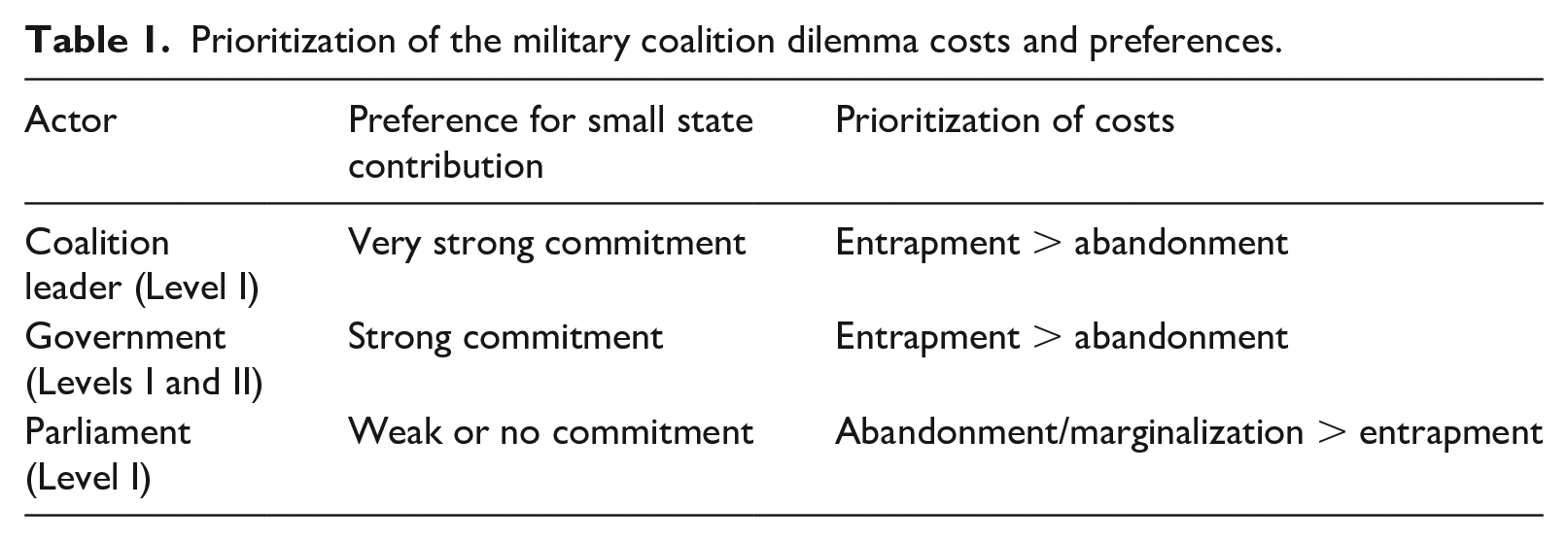
Building on Putnam’s logic, we introduce an invitation game model that includes three actors: the coalition leader, here the United States (Level I), the small state parliament (Level II) and the small state government that is placed between the two levels. Our model is meant to apply to the subpopulation of those small states with an ambition to gain something from coalition participation. 35 More particularly, we here focus explicitly on those small state governments with an ambition to be recognized internationally. For states such as Denmark, Norway or the Netherlands, it has been shown that their desire to be internationally recognized and avoid potential abandonment or reputation costs has repeatedly prevailed over other costs and benefits, such as the cost of entrapment. 36 We furthermore assume that these motives are more potent to these governments than to their parliaments, which for various ideological, political or electoral reasons might be less concerned with status motives. This builds on the rich literature on parliamentary votes on troop deployments and parliamentary war powers, where examples of parliamentary contestation of coalition participation have featured prominently. 37 Accordingly, it can be derived that some actors within parliament might prefer abandonment over entrapment costs as they either assume more dovish, non-interventionist or isolationist positions (policy) or because they prioritize domestic electoral motivations (vote and office). 38 In other words, in the domestic arena, the estimated costs and benefits of coalition participation can be assumed to be unevenly distributed, with parliaments feeling the international implications of reputation losses, lack of access, marginalization or abandonment much less heavily than the government. This implies that small state governments with an international agenda or status ambition are likely to prefer more visible and considerable military commitment compared to the parliament as a whole. The preferences of the actors are illustrated in Table 1.
Prioritization of the military coalition dilemma costs and preferences.
The hypothetical dynamics of the invitation game are illustrated in Figure 1, where A1 represents the small state government’s ideal negotiation outcome, A2 the ideal outcome of the small state’s parliament and B the coalition leader’s ideal outcome. 39

Preference constellation for coalition warfare contributions.
As A1 is closer to B than A2, we can deduce a bargaining process where A1 can have strategic motivations to engage B in the domestic game in order to convince A2 to accept bargaining positions closer to A1 due to the credibility of the potential inflicted abandonment costs, which is made possible due to the existence of information asymmetries that generally favour the executive power. Following a reversed tying hands strategy, A1 can attempt to convince A2 to accommodate its position by means of an invitation from B that shows that failure to accommodate would inflict serious costs on A as a whole. The result of the reversed tying hands strategy would be a shift in the agreement from point * to **, shifting the deal closer to A1’s preferred outcome. In this example, a successful tying hands strategy increases the utility of the deal for A1 and for B (point ** is closer to B’s preferred outcome than *). This suggests that A1 and B have a common interest in formulating realistic requests in the invitation that allow A1 to balance the outcome in the two interrelated games and secure domestic legitimation of the best possible outcome. In other words, proactive – and most likely informal – coordination by the small state government before the coalition leader sends an official invitation is essential for shifting domestic preferences. As Henke has shown, the coalition leader can use its strong diplomatic network to that end. Importantly, however, the common interests with and the privileged access that national governments have to the negotiations on Level I mean that the government also has an information advantage over the alliance leader (about its own win-set but also about its domestic constituency). This assumption about information asymmetry between governments and parliaments echoes insights from the principal-agent literature. 40 This information advantage means that A1 has an opportunity to influence the content of the invitation and move it closer to its own ideal point, but it also has the opportunity to present the (maximally ambitious yet also realistic) invitation in a later phase to pivotal parliamentary actors as ‘an offer you cannot refuse’, emphasizing potential abandonment and marginalization costs that might outweigh potential entrapment costs.
Three remarks are in order here. First, a less war-prone parliament can always hinder the small state government by downscaling or even rejecting the proposed military contribution. Following our invitation game model, however, this will depend strongly on the credibility and degree of the presented abandonment costs. Second, an unrealistically hawkish invitation can lead to a domestic veto as the entrapment costs of joining the coalition are simply too high compared to the cost of potential marginalization. Third, our model focuses uniquely on the interaction patterns between the coalition leader, the small state government and its parliament. We deliberately make abstraction of a range of factors which might lead to varying levels of parliamentary support for the use of force, such as party ideology, upcoming elections or the prospect of government participation. 41 These are here considered potential scope conditions which require further testing in more comparative or variable-based designs. Our model also does not include other domestic political considerations, such as issue linkages, public support or domestic financial constraints. This seeming (over)simplification is well considered for the sake of theoretical clarity.
Following this logic, two challenges for the small state government can be identified. First, the government needs to ensure an ambitious but realistic expectation level on the part of the coalition leader. This requires proactive coordination between, on the one hand, the small state executive, which can be the government and its diplomatic representatives or high-level military officials, and on the other hand, the coalition leader. Second, the official invitation sent by the coalition leader to the small state government has to fall within the latter’s win-set. That means that the coalition leader and small state government a priori explore the maximum contribution that can get domestic support, as a public rejection of the invitation would imply a serious loss of status and reputation for the coalition leader and the small state government. As mentioned earlier, it is to the benefit of both the coalition leader and the small state government to come up with an invitation that is as ambitious as possible without running the risk of being rejected. Proactive exploration of parliamentary preferences by the government is therefore essential. This is expected to be particularly challenging in situations of weak governments or minority governments, where opposition parties have to be convinced in order to avoid contestation. 42 What is crucial here is that the small state government has to perform proactive consultations in order to obtain a strategic information advantage in the domestic legitimation game. This is of course most relevant in cases with a high degree of dissonance in preferences between government and opposition, but can also be relevant in situations where we observe less dissonance.
Method and case selection
The empirical section of the paper intends to illustrate the plausibility of this invitation game model and show its analytical potential. We deliberately opted for a plausibility-probing approach, rather than full-fledged theory testing. Our goal is first and foremost to highlight the need for more explicit modelling of the influence of international contacts on small state domestic ratification games in the field of military deployments to address the gap in the literature. In operationalizing the invitation game model, we use a variant of the congruence method. We develop observable implications for the essential parts of the invitation game, which are then illustrated by conducting a plausibility probe on a series of deployment decisions. 43
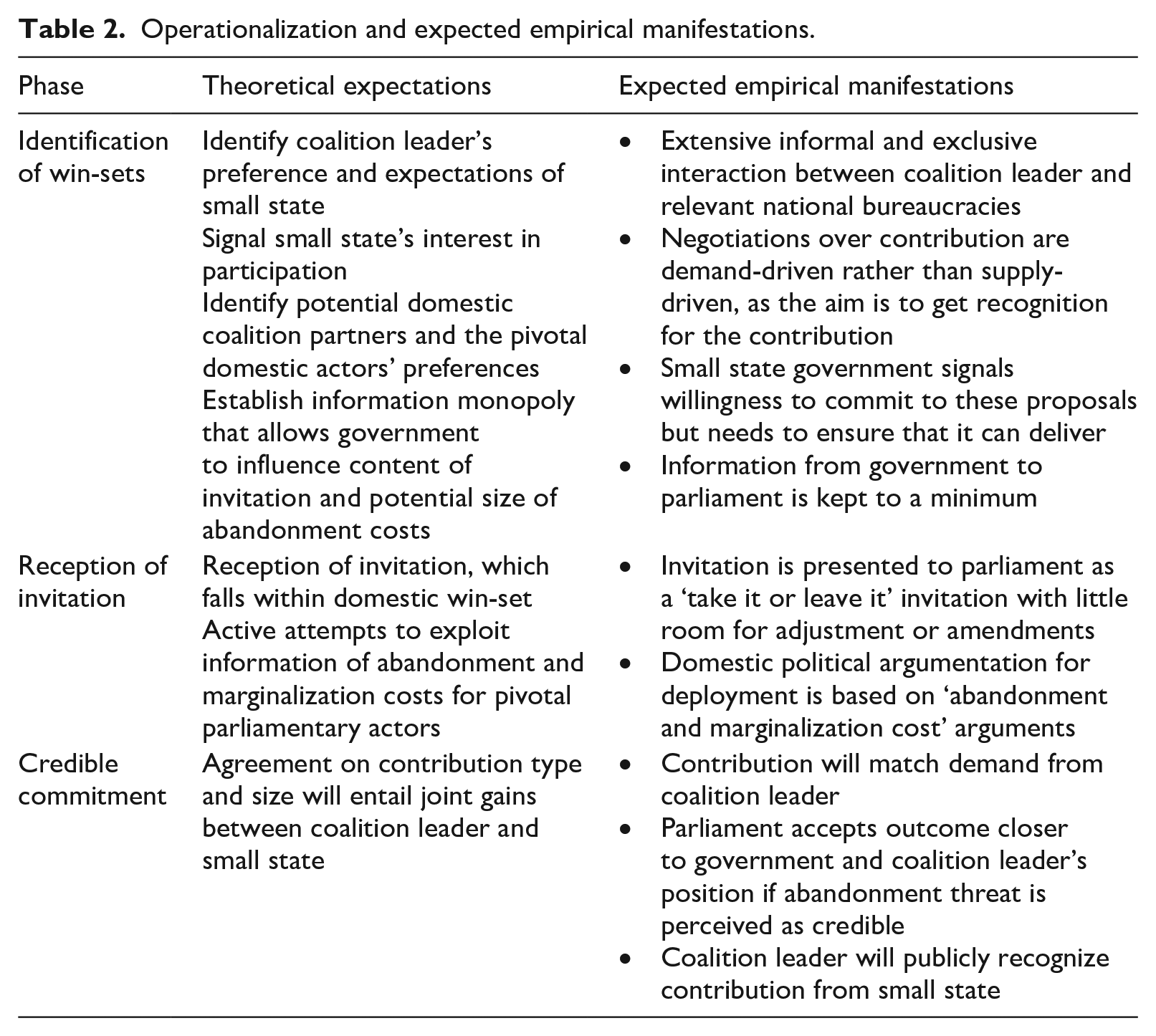
The invitation game has three separate stages that lead up to the small state’s deployment decision, following the original logic of Putnam’s model (1988): in a first phase (‘identification of win-sets’), the small state government engages in several preference exploration exercises, exploring the preferences in parliament as well as the contribution desired by the coalition leader. Both explorations and negotiations are geared towards arriving at an invitation that is ambitious enough to provide status and prestige but still realistic vis-à-vis parliament. The government here engages with parliament to identify the domestic win-set but keeps information-sharing to a minimum, while explicitly signalling its readiness to the coalition leader. In a second phase (‘reception of invitation’), the small state formally receives the invitation, and the government emphasizes domestically that rejection of the invitation will involve high abandonment costs. In a third phase (‘credible commitment’), domestic approval is achieved for a credible commitment that raises the chances of being recognized internationally. Each of these stages can be operationalized in further detail, as summarized in Table 2.
Operationalization and expected empirical manifestations.
In terms of case selection, we focus on Denmark’s forceful contribution to a series of US-led military coalitions. One key reason to choose this country case is because Denmark is among those small states for which it has convincingly been shown that status ambitions are an important driver of its international military engagements. 44 Another reason is that the Danish parliamentary system requires that the government negotiates mandates with and finds support from the parliament. These two reasons are essential conditions of the invitation game model. There are other potential cases with largely similar characteristics, such as Norway or Sweden. In these cases too, governments need to secure parliamentary support (either formally or informally) for military deployments, and evidence has been found of status ambitions. These could thus also have been suitable country cases for testing the plausibility of the invitation game model.
However, the choice to test the plausibility of the invitation game model on Denmark was driven by an additional theoretical consideration. Among these typical cases of small states with parliamentary systems and proven status ambitions, Denmark can be considered a difficult case for the invitation game model due to its tradition of minority governments. This means that the government does not have its own parliamentary majority and must negotiate with opposition parties and supportive parties in order to form majorities and policy-specific coalitions. This naturally induces the government to involve parliamentary actors in the decision-making process at an early stage in order to ensure majorities behind their policies. One could argue that this would reduce the incentive to use information asymmetries to change parliamentary actors’ evaluations of abandonment and entrapment costs. As the Danish constitution prescribes, the government must consult parliament in matters of importance to the country’s foreign and security policy. Danish minority governments, by consequence, bargain from a position of institutional weakness vis-à-vis parliamentary actors, which has historically facilitated a tradition for (foreign) policy coalitions and agreements (forlig) that ensure that there is a political majority supporting the decision to deploy. It is known that parties belonging to this agreement group tend to share more war-prone or deployment-ready inclinations and have access to privileged information. One could therefore argue that the convergence of preferences among the major parties has helped to mobilize a high level of support behind Danish deployments. 45 These dynamics are well described by Jakobsen 46 and Rynning and Jakobsen, 47 who have explained Denmark’s willingness to fight by referring to a constant fear of being abandoned by its NATO allies and a desire to limit defence expenditure as much as possible. Yet they have not investigated the role of invitations in this respect. It is furthermore important to note that even in a case like Denmark, limited parliamentary support was an issue with respect to the deployment of Special Forces in Afghanistan in 2001/02 and participation in the US-led coalitions in Iraq in 2003, as well as in the extension of military involvement in Iraq in 2006. 48 In sum, if we can observe signs of the Danish government using its information asymmetries and US invitations to manipulate the fear of abandonment and marginalization in parliament (both inside and outside the foreign and security policy coalition), this would considerably increase the plausibility of our invitation game model.
Finally, there is also an empirical motivation for our choice of Denmark. A recurring challenge in the study of warfare coalition formation dynamics is that they take place behind closed doors and through classified communication and documents. Opening this black box of diplomatic exchanges and closed-door politics is only possible either by using interview data (which can be hindered by cognitive limitations due to human memory) or by relying on declassified documents or commissioned reports, which have so far been in undersupply in the existing literature and only limitedly available in most of the actively contributing Western small states. 49 However, declassified archival material from the Danish Ministry of Foreign Affairs (MFA) and the Prime Minister’s Office has recently become available through the publication of the inquiries on Danish participation in interventions in Kosovo, Afghanistan and Iraq. 50 These data include internal ministerial documents in the form of memos, internal mails and dispatches from Denmark’s embassies and representations. It also includes confidential memos prepared for the Prime Minister’s Office, drafted specifically for the purpose of facilitating Danish participation in war coalitions. This offers unique insights about the diplomatic interactions and negotiations between the United States and Denmark as a junior partner. It allows for a more thorough probing of the dynamics of the invitation game than would be possible in other potential country cases. The following analysis therefore draws primarily on this declassified material about Danish participation in US-led interventions in Kosovo (1999), Afghanistan (2001) and Iraq (2003). This is complemented with publicly available material related to the formation of the Libya intervention coalition (2011) and the US-led coalition against ISIL in Iraq and Syria (2014). 51
Playing the invitation game
Exploration of the win-sets
There are several indications that Danish governments repeatedly used both informal and formal channels and procedures to identify the reservation points of the coalition leader and the pivotal parliamentary actors early on. These efforts seemed to have a demand-driven nature, which, on the one hand, would ensure that Denmark was able to deliver upon the US request, and, on the other hand, would minimize the risks of (involuntary) defection through a parliamentary defeat. Both in the case of the coalition against ISIL and in similar processes leading up to Danish war coalition participation in Kosovo, Iraq and Afghanistan, an executive practice seemed to be in place that would give the government an information advantage which enabled it to impact the opposition parties’ evaluations of potential abandonment and entrapment costs.
Empirical declassified material released by the Danish War Commission 52 reveals how the Ministry of Foreign Affairs, the Ministry of Defence and the armed forces established a practice where government officials, through an extended and detailed dialogue between Danish and American civil servants, diplomats and military officials, ensured that Denmark would be able to respond positively to the invitation they were going to receive. For instance, in relation to the invitation that led to the adoption of Motion B37 on Danish participation in the international coalition against terror groups in Afghanistan, Danish military personnel stationed in the US Central Command provided information about Danish capabilities, assisted by the Ministry of Foreign Affairs through the embassy. 53 In relation to the US-led coalition in Iraq in 2003, the War Commission 54 revealed that there were early discussions about the nature of the invitation that led to the adoption of B118. Similar traces can be found in relation to the invitation to participate in Kosovo in 1998/1999, where input from the Ministry of Foreign Affairs and the defence department was used to shape US suggestions for potential Danish contributions. The technical input was often ‘demand-driven’, that is, input from the government was designed to accommodate the alliance leader’s demands or translate them into contribution types Denmark was able to deliver. 55 A former Danish ambassador describes the Danish diplomatic activities in relation to Afghanistan (2001) (and later Iraq [2002–2003]) as aimed towards signalling a strong commitment to contribute to American operations by offering useful contributions and showing ‘alliance solidarity’. 56 This suggests an extended interest in designing contributions that were relevant and useful, had limited caveats and were close to the US’ demands. 57 The documents from the War Commission reveals a rather proactive approach to ensuring that Denmark would eventually receive the ‘right’ type of request. 58 Importantly, the Commission shows that these early contacts took place without consulting parliament through formal procedures. 59
Interestingly, this formal parliamentary involvement was apparently skipped starting with the very early stages of the negotiation about coalition participation. The War Commission insights seem to reveal a pattern where the government, in the first stage, chooses to stick to a practice of parliamentary involvement that only minimally lives up to constitutional and informal expectations. 60 Governing parties seem to have cooperated and exchanged confidential information on a more or less permanent basis only in an informal coalition group (forligsgruppe) of parties that share a certain degree of hawkish inclinations. It is a commonly shared assumption that the members of these networks provide a mandate to the government and in return enjoy privileged informal access to information. 61 This coalition usually consists of the parties that most often form a government (the Social Democrats, the Social Liberals, the Conservatives and the Liberals). The consultation between the members of this coalition is in that sense based on trust and confidentiality, which helps in locating the reservation points of the parliamentary majority. Yet, despite the confidential nature of these consultations, information-sharing is still kept to a minimum. So far, there is little evidence that these pivotal actors were able to influence the nature of the invitation in the first place. 62
The government’s effectiveness in utilizing this setup to shape the demands raised in the coalition leader’s invitation and ensure domestic parliamentary support through references to abandonment costs was most visible in the context of Danish participation in the coalition against ISIS in 2014, adopted by Motions B122 and B123. Danish Prime Minister Helle Thorning-Schmidt publicly guaranteed parliamentary support for a Danish contribution to the coalition even before the US commenced the military intervention in Iraq and Syria. 63
In sum, the Danish War Commission offers several signs that seem to confirm our theoretical expectation about the government’s privileged information position. Its direct access to the alliance leader gives it opportunities to influence the content of the invitation and to identify both international and domestic actors’ win-sets. 64 While more evidence is needed, these insights strengthen our belief that the procedures in the initial phase were designed to induce hawkish contributions that would be politically desired and judicially defendable. The minimal information practice provides action space for the government to shape the invitation and a closed-door opportunity to identify the win-set and reservation points of the parliamentary majority without risking the politicization that would follow from using the formal channels in the Foreign Affairs Committee. 65
Reception of the invitation
When the Danish government receives a formal invitation, it is required to involve the parliament through consultation of the Foreign Policy Committee and to seek a mandate by means of a public vote in parliament. When the government then consults the committee, the content of the invitation is often presented as ‘done and dusted’. Although approval by a parliamentary majority is required, in practice this implies that there is little, if anything, the parliament can do to adjust or change the content of the invitation.
The institutional practice of the first stage of the game is designed to raise the coalition leader’s expectations and thereby the level of potential abandonment costs in case the small state decides to defect. Often, the government has already tied its hands to the coalition leader before presenting an invitation in parliament. This was observed in the adoption of B4 on 8 October 1998, when a US request to contribute to the NATO campaign in the Western Balkans was presented to parliament. Before the official presentation of the invitation and before the Foreign Policy Committee had the opportunity to give a formal mandate, the Social Democratic government had already committed contributions and signalled that it would support a NATO operation. 66 A similar tactic was employed in the process leading up to Motion B37 on Danish participation in US-led military operations in Afghanistan, where the government had already committed to a military contribution without formal parliamentary consent. The formal committees therefore only seem to play a secondary notification role. The collected evidence from the War Commission indicates that the government was ‘behind the wheel at all times and had already turned on to the road where parliament could try to put the brakes on’. 67 The meetings in the Committee therefore often resulted in rather short exchanges on pro or con questions of a more technical nature, rather than a substantial debate about the contribution. In other words, parliamentary agency in determining the size and shape of contributions seems to have been rather limited. From the government’s perspective, it is therefore in our interpretation important to secure a sense of ‘urgency’ in the eyes of the opposition and to ensure that it is aware that rejecting or adjusting the invitation would imply abandonment costs, risk of future marginalization and a potential loss of status and prestige, which outweigh more moderate costs of coalition entrapment.
Of course, parties in parliament evaluate the cost structure differently depending on their preferences. The government therefore primarily aims to secure support from the pivotal actor(s) that are typically found in the aforementioned informal coalition. The process of convincing this particular group of parties about the cost structure and the risk of marginalization and abandonment is, with the exception of the Iraq War in 2003, relatively uncontroversial, as the members were either included in the early stages and can anticipate the content of the invitation or agree to a certain extent with the cost evaluation. 68
Signs of a fear of marginalization and a desire to gain reputation and status were visible on multiple occasions. In the decision to join the coalition against ISIL, this was particularly articulated during the debate over B118 in 2015, which focused on replacing the seven Danish F16 fighter jets with a radar. 69 The withdrawal of the Danish F16s was a technical and operational necessity after more than 4000 flight hours covering over 410 missions, but the decision was politically controversial. The parliamentary debates showed that there was a fear that the withdrawal would damage Denmark’s reputation in the eye of the coalition leader and inflict marginalization costs. The Conservative defence spokesperson argued that ‘it is embarrassing if Denmark cannot manage to keep seven fighter aircraft deployed to Kuwait’. He and the Liberal Alliance argued that Danish engagement in the operation had to continue and ways to do that had to be found. 70 The parliamentary debate about replacing the F16s with a radar system demonstrated that marginalization concerns played a central role in the perceptions of Danish decision-makers.
In 2016, when the Liberal government presented a new US invitation to redeploy the F16s, measures were added in Motion B108, including an extension of the radar system and deployment of special forces, that went beyond the original decisions in B122, B123, B8 (decisions passed in parliament between 2014 and 2015). In his motivation of the proposal, Foreign Minister Kristian Jensen stressed the need for additional Danish contributions and added that the government had already accepted the request from the coalition leader, which again suggested that rejection of the invitation would inflict abandonment costs on Denmark. 71 The opposition’s reactions are interesting to note in this respect, as fear of marginalization and status concerns again featured prominently in the public debates. 72 In the phase leading up to the presentation of the invitation, Chairman of the Foreign Affairs Committee Søren Espersen argued that a decision to decline would be ‘defendable’ and suggested that the United States and NATO already had a good impression of Denmark, that they would understand that Denmark could not continue due to the current state of the material, and that it would not harm Denmark’s reputation. 73 Yet he noted that it was important for Denmark to make ‘a difference’ for the alliance and to demonstrate alliance solidarity.
Previous research has convincingly shown that, given Denmark’s rather limited capabilities, references to ‘making a difference’ or demonstrating ‘alliance solidarity’ tend to indicate a desire to be recognized rather than a will to actually make a decisive difference to the outcome of a campaign. While these contributions are often robust, concern over allies’ perception of Danish contributions is clearly very important to the government and to the coalition of parties that provide the mandates. As Schaub and Jakobsen 74 have noted, Denmark is willing to ‘bleed for prestige’ in the eyes of their coalition partners. Danish governments have often used alliance solidarity as a central argument for involvement in various interventions. In the Libya case in 2011, the prime minister argued that it was a Danish priority to be among the first to join the coalition by accepting the US request and to be ‘in front’ with ‘the right states’. 75 Jakobsen et al. 76 have also shown that Danish decision-makers rarely refer to ‘victory’ or ‘winning’ in their statements, since they are well aware that Danish force contributions are generally too small for meaningfully contributing to that end. Instead, they stress their desire to make a difference to their key alliance partners, usually offer contributions without putting restrictions on the use of Danish capabilities and often deploy them under US or UK command. An example is found in the debate on participation in the coalition against ISIL, where the spokesman from the Liberal Alliance argued that the party ‘will naturally support the government’s proposition . . . and we are satisfied that the government makes a proposal that is adjusted to what we [Denmark] have been asked to deliver by the coalition’. 77 It seems that the opposition parties’ concerns mainly revolve around the extent to which Danish contributions to coalition warfare are legally justifiable. 78 This has often been combined with taking responsibility for various difficult operations and assuming responsibility for the conduct of central operative targets.
Credible coalition commitments
The outcome of the invitation game is assumed to be the adoption of motions that authorize a deployment of forceful and risk-assuming Danish contributions. A successful invitation game would hence result in a contribution that closely matches the US request. Another indication would be the apparent lack of systematic and substantive assessments of the political and strategic costs and benefits associated with a Danish contribution. The domestic political assessment would instead largely focus on the legality of Danish participation in the concrete operation at hand. 79
If the government has been able to correctly assess the reservation points and convince the opposition that abandonment or marginalization outweigh entrapment costs, the actual settlement of a contribution is relatively straightforward. In the case of the coalition against ISIL, it was in many respects easy for the government to convince Parliament to support Danish military participation given the nature of the opponent, but there was clearly a concern whether the Danish contribution would fit into coalition demands, as it was important not to be considered an underperformer in the coalition. This was especially visible in relation to the decision to participate in the fight against ISIL in both Iraq (2014) and Syria (2016), where Rufus Gifford, the US Ambassador to Denmark, noted in an op-ed that ‘Denmark and the USA are so much on the same line that when I show up in the Danish Ministry of Foreign Affairs or the Ministry of Defence to ask for something [with the invitation], they are already working on that. Denmark really does what the US wants’. 80
The praise Denmark received for its participation is not only generally treasured because of a desire for recognition but also entails asymmetrical distributional consequences that increase the government’s standing in the alliance hierarchy, which may remain unnoticed for many parliamentary actors. Civil servants found the obtained goodwill especially useful as it made everyday diplomatic activities easier, since it was easier to obtain access to relevant decision-makers, and information was circulated more often to Denmark than to non-coalition partners. 81 The goodwill Denmark obtains through its participation also has reputational spill-over effects on the government’s ability to influence developments in both NATO and the EU. Former Minister of Defence Nick Hækkerup has suggested that the contributions mattered in the sense that Denmark carried greater weight in NATO debates because the other members knew that the Danish position was respected in Washington. 82 Another former minister of foreign affairs notes that Denmark has benefitted from its militarized engagements and argues that ‘measuring political influence is difficult, but when Denmark is one of the first 12 countries invited to discuss an operation against ISIL, this is an indication of our position . . . Our position gives us the opportunity to discuss the strategies and influence them. But there is no doubt that because we are good at contributing and because we are a close ally, we are listened to’. 83 The independent commission that investigated the impact of the Danish opt-out of the Common Defence and Security area in the EU also highlighted that militarized participation in US-led coalitions had spill-overs on Denmark’s reputation in the EU, where its militarized activism mitigated some of the costs related to the opt-out. 84
Conclusions
This paper started from the observation that the literature on the formation of warfare coalitions has predominantly focused on the ways in which the coalition leader – most research focuses on US-led coalitions – can mobilize partners to put their troops at risk. Invitations from the United States to small state allies such as Denmark, Norway or the Netherlands play an important role in getting them on board. In this paper, we intended to show how the governments of these small states can do more than just accept or decline these invitations. Instead, we posit that an invitation from the United States to join a warfare coalition can also be used by the small state government as a strategic tool to get domestic support for a forceful military commitment that benefits their international visibility and reputation.
To demonstrate this, we introduced a novel invitation game model. It primarily offers an analytical toolbox that can foster a more comprehensive analysis of small state contributions to coalition warfare as it takes into account the complex interaction between international and domestic negotiations. It particularly pays attention to the privileged information position of the small state government. In this way, the model allows for gaining novel empirical insights into how small state governments with a desire to be recognized internationally can domestically exploit potential abandonment costs by means of tying their hands with regard to the coalition leader’s invitation. By conceptualizing this reversed tying hands logic, we have bridged the two seemingly opposing ideas of negative and positive drivers behind small states’ commitments to warfare coalitions. We showed the plausibility of this invitation game model by means of empirical insights from the case of Denmark, a small state which has repeatedly put its troops at risk in US-led coalitions and for which previous research has shown that international recognition and status ambitions are important drivers of its foreign policy.
Certainly, there are limitations to this research. While the paper relies on a single empirical case, we believe the invitation game model has the potential to fruitfully study similar cases of small state participation in coalition warfare. The explanatory power of the model should be tested in other small state parliamentary democracies with proven status ambitions and repeated military contributions to US-led warfare coalitions. Obvious examples here are Norway, Sweden or the Netherlands. It would furthermore be interesting to apply the model to other cases, ideally including those countries where minority governments are less common and where negotiation practices are less institutionalized. Overall, we believe that the model can be applied across parliamentary systems to offer deeper empirical insights about parliamentary approval or consent of military deployments. Moreover, our study solely focused on US-led coalitions, which might raise additional questions about generalizability to other alliances, where there are lower expectations regarding reputation and status gains (e.g. French-led operations). In order to strengthen the external validity of the invitation game model presented here, a comparison between the formation of US-led and non-US-led coalitions is warranted. We know from previous research that the diplomatic network of the coalition leader matters a great deal in warfare coalition formation. A successful invitation game requires that the coalition leader has sufficient information to avoid a mismatch between its demands and what the small state government can offer. Research into the formation of, for example, French-led coalitions (e.g. Task Force Takuba in the Sahel region) could offer valuable insights here.
Future research would also do well in exploring cases of invitation rejection. This would be interesting to deepen our knowledge about the scope conditions under which a reversed tying hands strategy can work. As we know from the literature on parliamentary war powers and deployment votes, factors such as party ideology, government cohesion and party discipline can shape a government’s capacity to pursue an international status-seeking agenda. For instance, future research could explore whether potential abandonment costs and explicit references to US invitations feature more or less prominently in the discourses of majority actors and government officials when confronted with different levels of parliamentary contestation. We therefore hope that the invitation game model will be integrated in future research about parliamentary contestation of military troop deployments. Data from the newly updated Parliamentary Deployment Vote Watch dataset could in that sense serve as a relevant starting point for future case selection. 85 Although this invitation game model might also apply to middle-sized states, continued focus on the still undertheorized and underexplored subgroup of small states in the coalition warfare literature is warranted.
While we have highlighted a reversed tying hands logic to explain costly commitments, this of course does not imply that we deny the existence of more traditional two-level logics. Small state governments facing a powerful domestic opposition or with modest international ambitions can still tie their hands domestically to justify a more limited commitment or reject a US invitation. However, we strongly encourage researchers of coalition formation and status seeking to test this invitation game model further, as it allows for more explicitly approaching alliance politics and domestic politics as a two-directional process and for acknowledging the potential international agency of small states.
Footnotes
Funding
The author(s) received no financial support for the research, authorship, and/or publication of this article.
