



Abstract
Wartime dominates the 21st century. The term is ubiquitous in contemporary politics, providing an intuitive trope for narrating foreign relations, grappling with intractable policy problems, and responding to shocking events. Such pervasion makes it easy to forget that wartime is a relatively recent political invention. It began as an instrumental and somewhat stylized concept that authorized exceptional violence by promising to contain it within strict temporal boundaries. Yet in the same era that wartime achieved international prominence, war itself became an increasingly ordinary and extended dimension of politics. Today, ‘wartime’ refers to a number of unconstrained and often self-perpetuating violent practices that have changed global politics and national security policies in deep and enduring ways – nowhere more so than in the United States. To introduce the special issue, this article presents wartime as a neglected and paradoxical topic at the heart of International Relations. It sketches the concept’s historical emergence, from innovative Presidential discourse through expansion in World War II and the Cold War, to 21st century entrenchment in daily life and habits of foreign relations. We also make the case for why US wartime marks an especially apt example of a global phenomenon, and one worthy of increased scrutiny within International Relations (IR). Finally, we provide synoptic summaries of the articles that comprise the special issue, showing how they work together to interrogate key aspects of 21st century wartime. We conclude with reflections on how the study of wartime may be extended to better understand its impact on historical and contemporary global politics.
Over the horizon, two ways
In late July 2022, a United States drone strike killed the long-time al Qaeda leader, Ayman al-Zawahiri, on a balcony in downtown Kabul, Afghanistan. While reporting the event, the United States President, Joe Biden, followed tradition in noting the fastidiousness of the attack, claiming that none of Zawahiri’s family were physically harmed by the ‘precision’ strike. 1 As the news story continued to emerge, Biden and his spokespeople also commented at length on the temporal details of the operation. These included its exact date and time, marking the almost breathless culmination of a tick tock-like chronology of developments and ‘painstaking’ intelligence efforts. 2 From this, we learned that the strike occurred on Saturday, about an hour after sunrise (06:18 local time or 01:38 GMT to be exact) 3 ; that the United States (US) had been ‘relentlessly seeking Zawahiri for years’; had located him ‘earlier this year’ after he moved into central Kabul; and had developed the mission plan ‘one week ago after being advised that the conditions were optimal’. 4 These elements of the announcement will be entirely familiar and unremarkable to most audiences, for they have come to feature as standard forms of executive ‘time discipline’, 5 those voluntary practices and references by which actors coordinate key processes and demonstrate mastery of a situation.
Yet in announcing the decapitation strike President Biden went far beyond the immediate minutes, hours, and days of the operation. In his first scripted remarks from the White House’s Blue Room Balcony, he took pains to frame it as a signature moment in two decades of counterterror. 6 Biden reminded his audience: ‘For decades, [al-Zawahiri] was a mastermind behind attacks against Americans’, all the way back to the USS Cole bombing in 2000. He noted that Zawahiri assumed leadership of al Qaeda after ‘the United States delivered justice to [Osama] bin Laden 11 years ago’, but had just ‘in recent weeks’ made videos calling for attacks on the US and its allies. He placed Zawahiri’s assassination in a chain of ‘daring mission[s]’ against terrorists, which included bin Laden but also ‘[i]n February, . . . the emir of ISIS’ as well as ‘[l]ast month, . . . another key ISIS leader’. He described Zawahiri’s death as honoring his pledge, made every year ‘on September 11th’, to ‘never forget’ the terror attacks ‘on that searing September day’ some 20 years past. This reflected US ‘principles and resolve that have shaped us for generation upon generation to protect the innocent, defend liberty, and . . . keep the light of freedom burning’. And Biden closed with a temporal crescendo, promising that ‘today’, as ‘every day’, the US would remember those lost on 9/11 while securing and defending itself against terrorism long into the future.
Some analysts lauded the strike as a model of Biden’s new approach to counterterrorism, which trades boots on the ground in for a lean and mean, drone-driven, ‘over the horizon’ strategy that deters bad guys while keeping American servicepeople safer by leveraging superior technology to launch precision attacks from afar. 7 But others lamented an expressly temporal thread running through two decades of military intervention in Afghanistan, Iraq, Syria, and other locales. 8 Following what many deemed a disastrous US military withdrawal from Afghanistan, the Zawahiri strike was something of a chimera. For although Biden pitched it as a symbol of the end of the US’ ‘forever wars’, he also reaffirmed that the policy of counterterror as a matter of warmaking would continue. Far from capping the forever wars, then, killing Zawahiri showed how the US would continue them, indefinitely. 9 Biden made this abundantly clear when he held up the strike as an emblem of ‘the great and defining truth about our nation and our people: We do not break. We never give in. We never back down’. Killing Zawahiri was, after all, a matter of ‘deliver[ing] justice’, and while ‘this terrorist leader is no more’, the US would continue to ‘demonstrate our resolve . . . no matter how long it takes’. ‘Never forget’ led seamlessly to ‘never again’, a link Biden strengthened by invoking the words of Virgil, inscribed on the Ground Zero 9/11 memorial: ‘No day shall erase you from the memory of time’. While thousands of troops deployed in country was no longer wise, the US must ‘continue to conduct effective counterterror operations in Afghanistan and beyond’ lest the nation betray the memory of those killed at the opening of the new century. In this sense, Biden’s ‘over the horizon’ approach was a techno-spatial strategy in thrall to a temporal promise – any real, concrete end to the practice of fighting a war on terror would remain, always and ever, over the horizon as a personal and a national matter of principle. 10
In eight minutes Biden spoke just over 1000 words. Presenting the strike as a tactical victory in the war on terror, he used an explicit time term (e.g. date, time, ‘generation after generation’) on over 20 occasions, and evoked time in another handful of rhetorically powerful phrases (‘never again’, ‘is no more’). There is little left in his announcement without the power of time. Those welcoming the strike as a ‘promise kept’ repeated many of Biden’s temporal markers and tropes in their analysis 11 and concluded without irony that the Zawahiri strike was both ‘further punctuation’ to the end of the Afghanistan war and a strong signal that the US was ‘turning the page to a new’ era of targeted counterterror. Small wonder, then, that skeptics argued that the supposedly novel strike did little more than open a new chapter in the US forever war rather than closing the book on a disastrous, militarized reaction to the 9/11 attacks. 12
The paradox of wartime
We dwell on this episode because it illustrates vividly the extent to which wartime has come to pervade contemporary politics. Biden’s remarks about time demonstrate how heavily political elites now depend on the language and logic of time to make war, as well as how – in grappling with the legacy of the past – they might yet extend and renew the timetable of conflict. Wartime today provides an intuitive trope to political actors and audiences alike, one deployed frequently to communicate and wrestle with weighty global issues, to narrate a country’s foreign relations as a coherent whole, and to solve all sorts of intractable policy problems.
This appeal stems from wartime’s conceptual roots. Conventionally, ‘time(s) of war’ referred to limited periods when ordinary politics devolved into brute force. 13 Longer periods of stability and peace bracketed such spasms, so that a ‘time of war’ and later ‘war-time’ marked an exception to the normal times of politics characterized by decree, duty, or deliberation. In place of these processes that worked by the ‘slow boring of hard boards’ or by appeals to authority, religion, and tradition, 14 wartime sanctioned exceptional measures and extraordinary suffering on the premise that just as ‘every war must end’, 15 wartime would soon enough be replaced by peacetime – or more precisely, that the successful operation of wartime would allow peacetime to resume in an arrangement that saw conflicts resolved or grievances redressed. Traditionally, then, wartime and its earlier variants served an instrumental and restraining function, delimiting the pitiable and worst aspects of international politics within clear and proximate boundaries designed to solve especially difficult problems while maintaining political legitimacy. According to this way of thinking, wartime could be nasty and brutish because it was relatively short and promised to improve the status quo.
Yet, while global aggregated levels of organized violence may be declining, 16 contemporary war never rests. Many conflicts, like Russia’s invasion of Ukraine, last far longer than planned; others, like the US invasion of Iraq, began with little to no discussion of concrete ends. 17 Viewed against the stylized ideal of ‘wartime’, such contemporary wartimes appear almost unrecognizable. The 21st century saw notable shifts in the tactics, technologies, and lived times of war, from the creation of global counterterrorism, to the rise of autonomous systems and artificial intelligence, to nuclear proliferation crises in Iran and North Korea, a confounding renaissance of territorial conquest in Europe, and the homecoming of counterinsurgency tactics to domestic policing, among others. 18 At the same time, the word ‘wartime’ became ubiquitous, shifting normative valence from the delimitation of violence to the authorization of perpetual but ineffectual habits of domestic and foreign policy by threat and force. As this special issue shows, wartime today has taken on a life of its own, one that tends to bust conceptual boundaries and undercut the very ideals animating its invention as a term of political art. No longer concerned exclusively with discrete, constrained applications of force, today we find ‘wartime’ symbolizing and legitimating the forever war on terror, chronic and aimless interventions, the habituation of the national security state as a whole of government approach to social order, and even the aspiration of desultory politicians to self-identify as very serious leaders during non-military crises. 19
Given these evident tensions, it is perhaps not surprising that ‘wartime’ boasts a brief but checkered career typified by ambiguity, power, and influence. As we will soon see, it is a comparatively recent temporal term and category of action that has, in less than a century, come to dominate the security and policy imagination of many prominent states and international actors – attaining a discursive ubiquity in domestic and international politics commensurate with terms like sovereignty and security. This is most evident in the US. American wartime, or more precisely US wartime, 20 is one particular instance of a more general phenomenon where the emergence, expansion, and embedding of a discursive expression ends up shaping and shoving all sorts of political relations. But it is a uniquely impactful instance, insofar as US security policies reflecting a ‘permanent wartime footing’ support a global footprint for the US military, 21 influence the calculations and deliberations of its numerous allies and adversaries, inflect regional and international dynamics, and without exaggerating, can be said to have changed the course of history. If there is a ‘time of’ the 21st century, wartime is it. It is the pre-eminent temporal reference and political ordering form in the US. And the international history of this century has unfolded as a nearly unbroken period of wartime, altering life around the world.
Wartime in contemporary global politics
Although wartime is uniquely resonant in the US, we want to stress that it is by no means exclusive to that country. Politicians, publics, and media everywhere now treat ‘wartime’ as a stock theme of discourse. 22 The possibility of a ‘new era of great power war’ accompanies fears of a ‘rising China’ or the competition for ever-scarcer global resources. 23 Both analyses use the specter of future wartime to punctuate pessimistic assessments of political trends. Prognostications about those near-future wars often include avid discussions about the overwhelming speed and tempo of conflict conducted by drone swarms, hypersonic missiles, ‘Rods from God’, or cyber weapons, all of which threaten to collapse decision and response times under the orchestrated chaos of late-modern wartime. 24
Or consider how the 2022 Russian invasion of Ukraine was stalked for the better part of a year by an unresolved tension in the Russian laws of wartime. President Vladimir Putin characterized the war as a ‘special military operation’ to ‘de-militarize’ and ‘de-Nazify’ Ukraine, and reportage suggests that his military planners expected Kyiv to fall within days, capping a quick and decisive victory over a weaker foe. 25 But, as Kyiv stood, the Russian military altered course to consolidate gains made in its 2014–2022 shadow war in eastern Ukraine, and then suffered a series of shocking autumn defeats from Kharkiv to Kherson, Putin’s phrasing took on added meaning. Most initially heard ‘special military operation to de-Nazify’ as a thinly veiled attempt to legitimate the invasion in humanitarian rhetoric while evoking World War Two (WWII) Soviet triumphalism. But surprisingly high Russian losses in personnel and materiel exposed a new issue: due to Russian conscription laws, Putin could not adequately counter attrition rates in Ukraine without ordering a general mobilization. This, however, would require that he meet standards of national self-defense, as the law is written ‘to ensure the protection of the state from an armed attack and meet the needs of the state and the needs of the population in wartime’. 26 Indeed, Russian mobilization depends upon the inauguration of wartime 27 by decree – something that Putin initially was reluctant to do. While he did declare a partial mobilization in September 2022, analysts agree that a full-scale mobilization would still risk massive public backlash, might reframe the invasion as a war of choice and aggression, and would tacitly admit that Russia’s purported quick triumph was neither speedy nor successful. 28 They previously worried that Putin might use Russia’s 9 May ‘Victory Day’ to announce a general mobilization, softening the opening of wartime by aligning it directly with the calendrical commemoration of the Soviet Union’s defeat of Nazi Germany. That Putin did not do so illustrates the importance and power of wartime as an ordering form all the more strongly. As the leader of a country that staunchly opposed his predecessor’s effort to introduce a permanent ‘summertime’ in 2011–12, 29 Putin seems well aware that announcing something as transformative as a general mobilization – which would place the entire country rather than contracted and conscripted sub-populations in a ‘time of war’ – would require political and strategic bona fides he currently may not possess. 30
When we look at how these legal constraints interact with other levers that the government might pull, we get a fuller picture of the vicissitudes and ambiguities of contemporary wartime. The temporal hurdles raised by the constitution and public opinion have not prevented the Russian Duma from passing other bills described as ‘sweeping wartime’ measures, which do not require a formal declaration of war or inauguration of wartime, but increase Putin’s economic latitude to prosecute the Ukraine invasion. 31 So while the question of whether the Russo-Ukraine conflict will see a formal inauguration of Russian wartime remains a very live and open issue, the way that Russian authorities formally demurred for months while embracing every measure short of explicit declaration resounds with the main themes of this special issue – namely, the power and peril of contemporary wartime as a creeping habit, a pervasive informality, and an ever-more intuitive ordering form for our present politics.
A brief history of wartime
Emergence
To appreciate wartime in all its 21st century peculiarities and power, it will help to sketch a brief history of the term and concept. The Oxford English Dictionary traces the term ‘war time’ back to 14th century Middle English, and includes instances from almost every century up to the 19th, with a hyphenated ‘war-time’ appearing in 1707.
32
In 1915, H.H. Henson and Lady Jephson published War-time Sermons and A War-time Journal, respectively. And one can find the less specific ‘time(s) of war’ sprinkled across millennia of what we commonly call the ‘Western tradition’ of philosophy and political thought. Indeed, since at least the book of Ecclesiastes – whose chapter three opens by declaring ‘There is a time for everything, and a season for every activity under the heavens: . . . a time to kill and a time to heal, . . . a time for war and a time for peace’ – authors readily referred to war as something that might characterize an expanse of human time. For one notable example, Thomas Hobbes’ Leviathan divided all political time by the war/peace distinction: For WARRE, consisteth not in Battell onely, or the act of fighting; but in a tract of time, wherein the Will to contend by Battell is sufficiently known: and therefore the notion of Time, is to be considered in the nature of Warre; as it is in the nature of Weather. For as the nature of Foule weather, lyeth not in a showre or two of rain; but in an inclination thereto of many dayes together: So the nature of War, consisteth not in actuall fighting; but in the known disposition thereto, during all the time there is no assurance to the contrary. All other time is PEACE.
33
In Hobbes we detect a harbinger of what wartime would become, namely an extensive but continuous duration in which warfighting is highly likely to occur because the disposition to politics by force subordinates all alternatives. This passage stands out for its explicitly temporal formulation and for the prominence of Leviathan in the genealogy of political thought informing International Relations. Yet for centuries few took Hobbes up on the provocation to consider war and time together more resolutely in word and thought.
Expansion
Instead, the popularization of ‘wartime’ as a self-evident compound term denoting a specific mode of politics owes much to the entrepreneurial wartiming of the US in its rise to global hegemony. 34 It expanded through the words and actions of US political leaders, through bureaucratic innovations, and through the acquiescence by successions of voting publics to a new timing symbol. As a rough illustration, the term is virtually absent on an n-gram until a small uptick during World War One (WWI), 35 followed by a spike during WWII, and then an unremitting flow of usage hence – one on par with or exceeding core political terms like ‘security’, ‘sovereignty’, or ‘nation state’. 36
A closer look suggests that Woodrow Wilson was the first political leader to compound ‘wartime’ in a major set of remarks when he included the term in a Message to the House of Representatives on the prohibition of alcohol (see Figure 1). 37 But Franklin Roosevelt really championed ‘wartime’. He first uttered it in a major address in 1939, and then made it a regular part of his Presidential parlance throughout WWII. Successive US Presidents have followed suit without exception (see Figure 2). 38
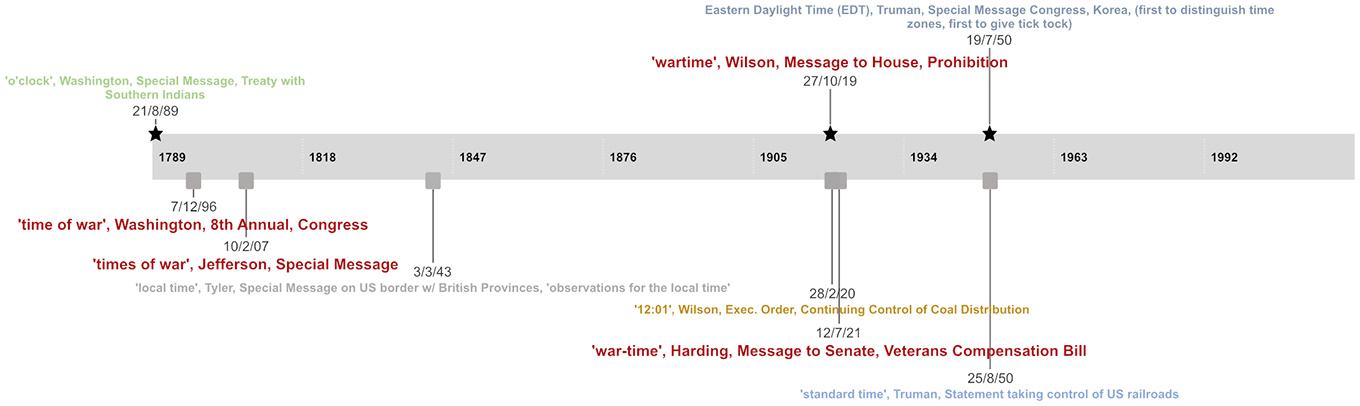
First US Presidential uses of time phrases (compiled from The American Presidency Project, University of California-Santa Barbara).
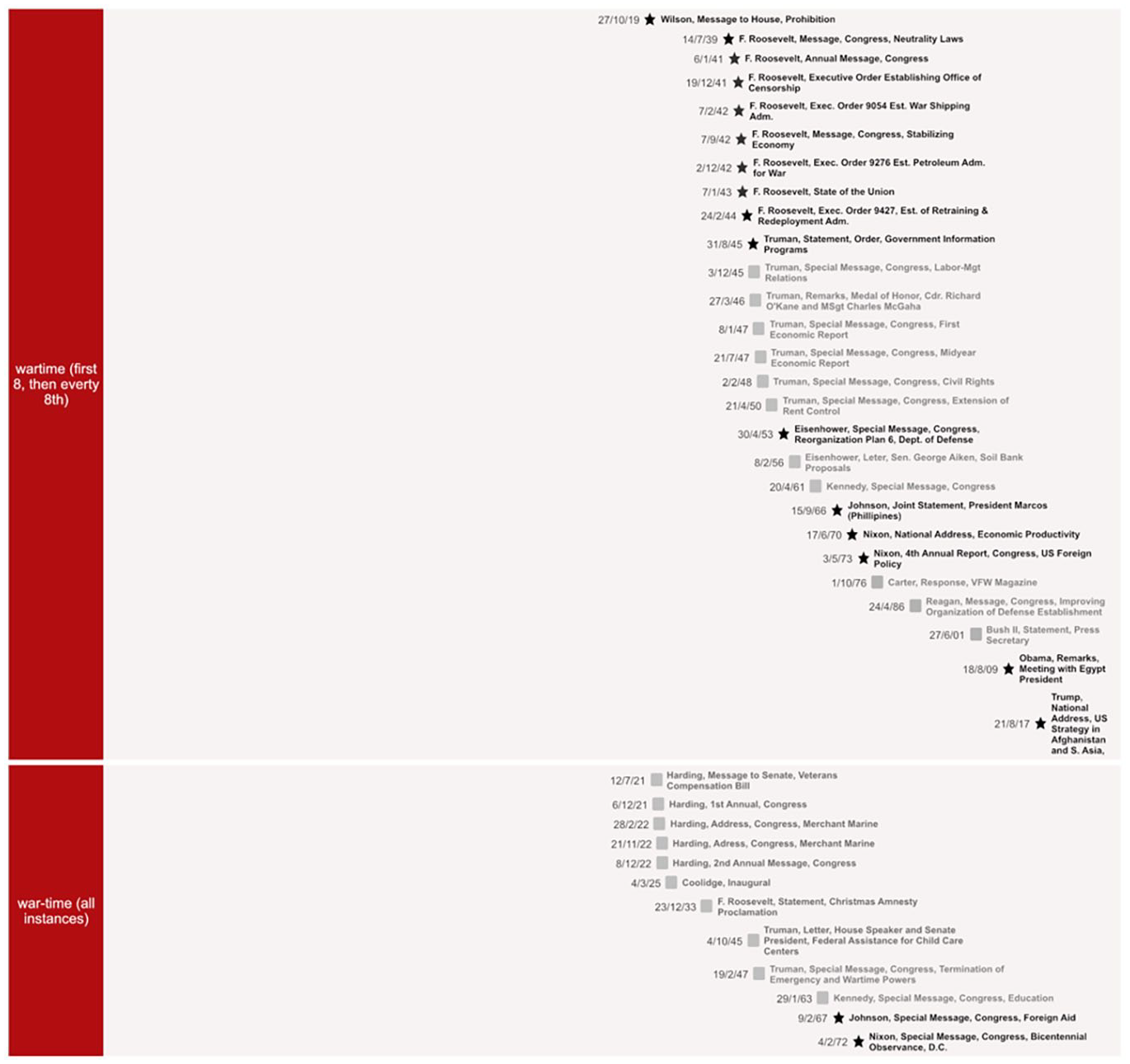
US Presidential uses of ‘wartime’ and ‘war-time’ in major addresses (compiled from The American Presidency Project, University of California-Santa Barbara).
The Roosevelt administration also offered an early indication of how readily the US public would acquiesce to belligerent timing symbols as a fact of life. In January 1942, Congress passed the ‘War Time Act’, which went into force that September when clocks were set an hour ahead in each time zone until further notice – effectively federalizing the nation’s timekeeping by imposing daylight savings time (DST) year-round. 39 An earlier attempt at this, introduced during WWI through the Standard Time Act of 1918, met fierce opposition due to its unintended effects on the agricultural workday. It lasted a little over a year before Congress abolished it over Wilson’s veto. Roosevelt’s ‘war time’ aroused far less public controversy. And while Congress did not compound ‘war’ and ‘time’ in its official language, the new, formalized ‘war time’ would have sounded no different in the ears of audiences grown accustomed to listening to Roosevelt’s ‘fireside chats’. The legal ‘time of war’ between the US and Germany and Japan ended formally with unconditional surrenders on 8 May and 2 September 1945, respectively. Roosevelt’s official war time lasted a month longer before the measure was repealed – only to return through state-led DST initiative in the 1950s and then Congress’s Uniform Time Act of 1966.
Embedding
Once adopted, these wartiming practices burrowed down into daily life, albeit without their martial moniker. But this should not be taken to evidence any recession of wartime after WWII. Rather, the record shows just the opposite. While Roosevelt’s explicitly ‘war time’ DST initiative disappeared, his new time term embedded itself in common language. From WWII onward, US Presidents and other politicians have talked increasingly of ‘wartime’ as an obvious temporal category, even as formal declarations of war and the ‘time of war’ they legally introduce have ceased to provide a viable option for US foreign policy. Since WWII, the US has not formally declared war on another state. The Korean War began as a ‘police action’ and ended in armistice, a condition which persists today. Put differently, the first informal US wartime after Roosevelt propounded the term in reference to formal political relations has now lasted for over 70 years. Vietnam was similarly never a formally declared war, nor were any of the numerous US military actions around the world that occurred since then. Yet as formal inaugurations of wartime vanished, the Cold War saw the rise of a dedicated military industrial complex and national security apparatus in the US, widely understood as enabling key parts of government and society to operate on a ‘continuous wartime footing’. The frequent US military deployments, crises, and shooting conflicts that peppered the Cold War only reinforced this new way of understanding wartime as just part of life, rather than an unusual execution of law. No longer a pitiable and temporary act of last resort, wartime footing came to describe a global hegemon embracing prudent, martial preparedness against ever-present threats.
According to conventional wisdom, it was this approach to wartime footing that laid the groundwork for the US ‘victory’ in the Cold War, as the USSR could not keep pace in the relentless arms race and economic effort that it demanded. 40 The ‘unipolar moment’ of the 1990s reinforced the ethos of military preparedness through several interventions in response to, among other things, global shocks like Iraq’s invasion of Kuwait and high profile cases of ethnic cleansing in the former Yugoslavia. By 11 September 2001, these long-term changes in US foreign policymaking and the national relationship to wartime had entrenched so deeply that anything other than an immediate, muscular, military response to the terrorist attacks on New York City and Washington DC was unthinkable. The US did not legally declare war on Afghanistan when it invaded the country in response to the Taliban government harboring al Qaeda and its leader, Osama bin Laden. Nor did it declare war before invading Iraq in 2003. Yet on the very evening of 9/11, President George W. Bush famously – and without needing to explicate or elaborate further – placed the new century under a wartime flag when he declared a ‘war against terrorism’ and soon after elaborated that ‘freedom and fear are at war’ and ‘Our war on terror begins with Al Qaeda, but it does not end there’. 41 The wartime habits of Cold Warriors ensconced in Bush’s inner circle proved more than flexible enough to accommodate a situation involving a non-state threat rather than a rival superpower. The US national security bureaucracy expanded accordingly – creating the Department of Homeland Security; drastically altering immigration, mass transit, and numerous other facets of life in the US; initiating unprecedented levels of foreign and domestic surveillance; and making a racialized form of counterterrorism the centerpiece of its strategic policy. So too, did the US public, volunteering more than a generation of young people to repetitive deployments with no resolution in what became the US’ ‘forever wars’. These developments all drew on the discursive and political legacies of Roosevelt, WWII, and the Cold War’s embrace of perpetual wartime footing. So when Biden emplotted the Zawahiri strike in this wider and longer war on terror, he effectively pushed US wartime clocks ahead all over again. 42
Wartime, three ways
Despite these huge shifts in the practice of wartiming, we still tend to think of ‘wartime’ in de jure terms, or the legal sense of a limited period of violent crisis that authorizes exceptional measures to meet the extraordinary demands of the moment. 43 As an explicit link between time and the legal declaration of hostilities, de jure wartime lasted mere years, or a decade or so at most before an extra-legal but loosely formalized wartime arose to replace it during the Cold War years. We can think of this as formal wartime insofar as it involved plenty of highly codified actions and numerous legislative measures short of declared war. Yet as those formal measures took root in US life from generation to generation, their formality became more and more assumed, and the act of formalizing less and less meaningful – to the point where the 2001 Authorization for the Use of Military Force (AUMF) could be renewed and expanded to fit almost any remit, without significant challenge, in perpetuity. The 21st century of US domestic and foreign policy has unfolded under an executive banner of wartime, unhindered by any of the traditional de jure declarations of war, enabled by increasingly empty formalisms, and largely embraced by American habits of culture and public life that entrench de facto wartime as the dangerous and violent moment in which we endure, until further notice.
Complicating US wartime
As a de facto part of everyday life, 21st century US wartime displays few of the features conventionally thought to inhere to a time of war. It is no longer a discrete parcel of national experience or action, and its boundaries grow blurrier and blurrier. What part of US life today, one might ponder, does not fall within the habitual or potential purview of counterterrorism or national and homeland security?
Blurry boundaries make it all the more difficult to restrain temporal trajectories. 44 Presidential administrations now ritually reaffirm that ‘our war on terror’ has not ended with al Qaeda, and while there may be reflection within the US military and security establishment about whether the first generation of the war on terror spawned successive iterations of terrorist threats, 45 this has not led to any national reckoning in earnest. Terrorists may come from any corner of the globe, so constant, global vigilance and the wartime footing it suborns have become the norm. Because the US may need to deploy almost anywhere, it becomes impossible to predict when such a stance will end, or even what conditions would stand as sufficient to end the war on terror. 46
Lately, new drivers of wartime have been growing within, as white power and other domestic right wing extremists ‘bring the war home’ to the US heartland – an invoice of sorts for two decades of confronting violent extremism exclusively as a ‘war on terror’ prosecuted in distant lands, against Islamic cultures, and on brown and black bodies. 47 In addition to its temporal indiscretion, wartime in the late 2010s and early 2020s no longer operates as a matter of the nation summoning and uniting itself against threats ‘over there’. Instead, the threats come from within more than without, the enemies are more domestic than foreign, and their affinity for Anglo-European ‘heritage’ mixed with disdain for US civic principles vitiates any claims about national unity in a time of war. 48 Wartime remains perpetual, but the insurrection of 6 January 2021 and countless instances of right wing extremist violence now suggest that the front has moved home. In an irony of history, such developments bring the US’s ‘national’ experience more in line with the enduring wartime experiences of traditionally marginalized groups. Black and other ethnic minorities have suffered a highly militarized form of policing in US neighborhoods for generations, while women routinely experience sexual and intimate violence in the home and other nominally peaceful or ‘post-conflict’ spaces. 49
We add these consequences to the debilitating economic costs, strategic trade-offs, loss in international recognition, and the direct effects of endless war on places like Iraq, Afghanistan, and Syria. Together, they tabulate the wages of US wartime in hypertrophy. What was initially deployed as an explicitly limited and concretely constrained time of exception has grown abstract and reified, an increasingly ordinary and normalized way of timing politics and foreign relations that brooks few limits or constraints.
This state of contemporary US wartime is clearly ghoulish – massive, morbid, and all too muscular – and worthy of further inquiry in IR. Yet while notable in its scale and excesses, the seemingly novel career of wartime should not surprise those attentive to time and timing. Historically, the most successful timing regimes and their attendant time symbols followed a highly similar path. Examples include coordinating large-scale agriculture, debating the dates and chronology of theological moments, organizing devotional routines, ordering market spaces, setting limits on civic deliberation, navigating the oceans and colonizing other civilizations, settling the ‘frontier’, turning territorial states into unified ‘nations’ with singular histories, or calibrating nuclear deterrence to increasingly precise ‘Doomsday’ thresholds. 50 These political processes came in all shapes and sizes, but all became possible and unfolded through lengthy efforts to create useful relations and the human tendency to reify them using language that quickly transmits knowledge about how everything fits together. Elsewhere, Hom elaborates this as the work of timing, by which humans coordinate large-scale practical processes, dub these a sort of ‘time’, and attach attributes like ‘free’, ‘home’, ‘labour’, or ‘war’ to describe and qualify them. 51 A seemingly incidental term like ‘wartime’, then, contains multitudes – of historical conflict processes, of experiences with how to wage war, of assumptions about how long it might last, of the many conflicting interests the idea of a unitary ‘wartime’ subsumes, 52 and the countless lived experiences and ruptures it subordinates in the name of a heroic national moment.
Wartime boasts a brief but complex and important history; one deserving of further investigation and analysis as well as a greater reckoning than is possible here. There is undoubtedly more to the story of how ‘wartime’ emerged from a language of limits and, over three quarters of a century, relentlessly loosened all legal and formal constraints on itself in the US, thereby permanently changing the discourse and practice of global politics. 53 In seeking to foment such discussions, this special issue addresses a more immediate task: to diagnose the contemporary symptoms and begin theorizing the consequences of 21st century US wartime as a uniquely salient instance of a global transformation. We understand it as an initial effort to visualize the problem more fully in hopes of spurring further research and explanations about how we reached such a state of affairs.
Wartime in International Relations
Such discussions would address a conspicuous omission in the study of global politics and the discipline of IR, which to date has paid little explicit attention to wartime. IR and subfields like strategic studies, critical military studies, and security studies (both critical and conventional) have done much to advance knowledge about war and conflict and to elaborate their intimate connections to the wider patterns and dynamics of global politics. But with very few exceptions, none have scrutinized wartime in any breadth or depth. 54 Conventional strategic and security studies largely follow public and policy discourse in treating wartime as an obvious, unpuzzling part of our political lexicon. This reifies and naturalizes wartime as something that just is there in our vocabulary – and by extension just seems to exist ‘out there’ in the world independent of human agency. Such dehistoricizing habits elide the comparatively recent rise of wartime as a malleable idea and dynamic social fact, and one that emerged from and folds back into the heart of international politics. 55
This oversight might reinforce a presumption that the study of wartime has little to contribute to IR discussions, or that it remains a topic better suited to the interdisciplinary field of time studies. Given the importance of war in global politics and the now-ubiquitous quality of wartime, we would argue the opposite. While IR and its subfields have not yet focused on wartime as such, it is difficult to imagine or talk about politics or to understand IR without wartime as an organizing standard for conflict and violence, a central concern of domestic and foreign policy, and a historical force in its own right.
Moreover, given its entrepreneurial relation to wartime, without directing focused attention to the US variant of this phenomenon, IR misses a signal opportunity to chart the dynamics behind wartime’s rise to prominence as well as to grasp in archetypal form the myriad consequences of its steady accumulation of rhetorical might. 56 After two decades during which IR developed a robust discussion about how politics unfold in and through time, 57 any temporal form as resolutely political and international as wartime deserves study – all the more so if it has emerged almost out of nowhere over the past century to take such a prominent place in the contemporary milieu. Whether unfolding through it or seeking to avoid or mitigate it, wartime permeates most of today’s international relations. It changes the way everyone from great powers to international organizations, to non-state actors, to refugees and individual leaders grapple with political issues. It has altered US politics and everyday life in enduring ways. Wartime animates the 21st century: it is an important issue of security and international politics in its own right as well as a powerful way of tracing links between long-term change processes and contemporary puzzles, domestic and foreign relations, and low and high politics. Precisely because wartime has swallowed up more and more of what we might previously have thought of as ‘normal politics’ and everyday life, and precisely because it has played a central role in ‘unmaking’ the traditional distinction between war and peace, 58 IR needs to understand wartime better in all its variety, its historical lineage, and its contemporary consequences.
Furthermore, by treating the term as self-evident, IR makes it all too easy to assume that wartime continues to function in its traditional or conventional way – that is, as a discrete, limiting, and exceptional container for political violence. 59 This in turn makes it all too easy to miss how normative ideas about wartime today drive and generate rather than contain or restrain conflict, vitiating the assumptions that war leads directly to peace, or that peacetime is the norm and wartime the exception. 60 Instead, a discipline fascinated by the dynamics of violence and harm could devote serious attention to this liminal time that promises a responsible limit but delivers instead almost limitless possibilities for harm. 61 Without understanding such dynamics better, it will be difficult for IR scholars to imagine how to check or mitigate wartime’s continuing effects.
More critical corners of IR would likely acknowledge the social constructedness, IR-relevance, and unwelcome consequences of US wartime, but so far few, if any, have scrutinized it directly, an oversight that unintentionally reinforces mainstream dehistoricization. Anecdotally, we detect a palpable reticence amongst some critical colleagues to spend effort on the internal workings of the US national security apparatus that does so much to perpetuate wartime. Several of the articles in this special issue received conference feedback and more than one peer review criticism that studying the inner logics and lived experiences of US wartime was little more than a futile effort to critique hegemonic pathologies ‘from within’. They recommended instead the more critically palatable or ethically safe distance afforded by external critiques leavened with postcolonialism, Marxism, critical terrorism, or empire studies. IR already benefits from numerous such critiques of the US way of war, which rightly direct attention to the perspective of populations targeted by US warmaking, to those subalterns dispossessed by decades of US war, and to those who exist permanently (or indefinitely) on the fringes of the US global military footprint. Such works foreground the intrinsic political value and diverse perspectives of numerous object populations who endure the pointy end of perpetual US wartime on a daily basis. 62
Yet it remains conspicuous that none of these have focused on wartime per se, or its principal entrepreneur, the US government and national security apparatus. Doing so complicates but also complements the critical picture. Some authors in this special issue trace how US security logics perpetuate rather than mitigate wartime and end up delivering a litany of let-downs rather than a roll call of triumphs. Others highlight how readily the subjects and agents of US wartime become its objects or human costs. And still others uncover thorny challenges and novel opportunities to inject critical reflexivity into the heart of the US war machine. Whether because of the sheer scale of US wartime – involving millions of lives, trillions of dollars, and decades of politicking – or its global reach, we count it an oversight not to bring such critical perspectives to bear on its inner workings. We further contend that humanizing and problematizing a population easily typecast as hypermasculine warmongers or joyriding exceptionalists helps complicate IR’s understanding of phenomena that are intrinsically full of big processes, multi-layered structures, and diverse political experiences.
For all these reasons, IR stands to benefit from a sustained engagement with the history, the conceptual foundations and contemporary dynamics, and finally the lived consequences of this novel form of political timing. This introduction has offered a brief sketch of the history and stakes of wartime. The articles that follow confront its contemporary, de facto iterations head-on, focusing on the US way of wartime as both an especially apt example and also a lens through which to understand an increasingly global institution more clearly.
Unpacking the contemporary politics of US wartime
This special issue emerged from collective discussions and reflects the authors’ shared experiences in (and often fury at) coming of scholarly age in a US milieu of forever wars. In this sense, we cannot help but examine US wartime from the inside out. Proceeding with diverse critical tools derived from social theory, strategic studies, philosophy, critical military and gender studies, and critical pedagogy, among others, the articles pursue related questions about how temporal imaginaries, new technologies, and abstract ideals inform the American way of war; why imminent, ongoing threats must always reside just over the horizon; whether the ethical and practical implications of war involve competing temporalities; and the matter of who ‘owns’ a forever war. Intended as a panoramic rather than a comprehensive account of contemporary wartime, our authors offer distinctive accounts of important but overlooked facets of US wartime, unified by a sense of its productive ambiguities and costly contingencies.
Some articles trace wartime’s inner logics and mechanisms, others study it from the ground – and especially the people – up. The former approach reflects our collective judgment that it is necessary to try to understand puzzling phenomena on their own terms, even as we embrace critique on others’ terms. To that end, Part One addresses the changing frameworks and ideas of 21st century wartime. deRaismes Combes tackles a central pillar of US counterterrorism and forever warring. Based on a comparative history of military doctrine and practice, she explains why the US approach to counterinsurgency (COIN) is counterproductive by its own standards, and almost bound to fail because of its blinkered relationship to time. Combes discusses COIN in Vietnam, Afghanistan, and Iraq, linking the Self/Other approach of COIN to contemporary temporal imaginaries that protract campaigns rather than forging a feasible and finite means of quelling unrest in military occupations.
Christopher McIntosh examines the narrative ‘frame of war’ employed by successive Presidential administrations and traces how these make it almost impossible to imagine an ‘end’ to the war on terror that we might meaningfully link to our present politics. Looking closely at both Donald Trump’s and Barack Obama’s security policies, he shows how specific claims about time repackaged what might otherwise have appeared as unjustified force into war without limit or end. This helps McIntosh recontextualize wartime as exemplifying a particularly malignant form of political violence.
Our own contribution complements Combes and McIntosh by cataloguing cultural practices and symbols that prop up contemporary US wartiming. This ‘liturgy of triumph’, a retinue of observances and ritualized incantations revolving around the theme of American victory, plays a prominent role at almost every level of life in the US and serves to sanctify wartime as a particularly American moment, a heroic chapter in the national saga. Such moments deliver more tragedy rather than triumph, however, and this growing disconnect helps explain the way that victory culture in the US amplifies even as national ‘wins’ recede in the rear-view mirror – with the result being that the country grows more and more prone to starting wars that it will not and perhaps cannot win. These three articles bring to the fore hidden codes at the heart of 21st US wartime, showing not only how the entire imaginary rests on questionable foundations but also how successive wars, decisions, and generations have sublimated these tensions in an ever-more strident and bellicose approach to politics.
Whereas Part One scrutinizes US wartime on its own terms, Part Two foregrounds the lived experiences of US wartiming to further assess its internal contradictions and very human costs. Drawing on family experiences, Brent Steele discusses the practice of ‘Honor Flights’, in which US veterans are flown from their hometowns to Washington DC to take a tour of war monuments before returning to great fanfare, with all expenses paid. He describes the rise and expansion of this practice, and how it became co-opted by a particular form of jingoistic nationalism through various affectations and narratives of ‘service’ that effectively turn veteran subjects into the objects of a wider effort to manage collective insecurity about American identity. As wars prolong and deliver fewer and fewer concrete successes, Steele argues, micropractices like honor flights become only more important in their angst-sopping ability to symbolize closure and hark back to more triumphant eras.
Taking a close look at the daily grind of operating drones, Terilyn Johnston Huntington and the late Amy Eckert offer an important complement to the voluminous literature critiquing the human cost of ‘life under drones’ in faraway lands. By focusing on trauma, stress, and the game-like nature of drone operation, they elaborate how the long hours spent tracking and analyzing potential targets prior to any ‘lightning strike’ establish a more human link between predator and prey than most drone critiques assume. In addition to several other temporal factors, Johnston Huntington and Eckert identify a unique form of ‘temporal intimacy’ linking operators and target populations, which helps explain why these supposedly ‘safe’ pilots experience post-traumatic stress and other combat-related disorders much the same as their colleagues who operate ‘in-theatre’. This article began long ago as a puzzling observation made by Eckert about drone operator health reports, which led to an ongoing conversation and conference paper with Johnston Huntington, who then carried the labor on with the help of her editors after Eckert’s untimely passing. We would like to pause here to acknowledge Amy Eckert’s profound impact – on the article that she began but also on the entire group of scholars collected in this special issue. Many of the authors herein benefited from Amy’s mentorship and friendship, and all have been inspired by her scholarship and collegial example. We consider it an honor to share journal space with her one last time.
Finally, Kathryn Marie Fisher uses seven years teaching experience at the National Defense University to reflect on the challenges of developing a critical security pedagogy in the center of US professional military education (PME). She links sombre assessments of PME purpose as framed in US PME mission statements to the nation’s permanent wartime footing and conducts an auto-critique of her own efforts to include theory-practice relations of critique and self-reflexivity in a predominantly Special Operations Forces classroom. Fisher shows how difficult it can be both for herself as well as for students to facilitate deep engagement with issues of Self/Other, knowledge development, and dialog; but also underscores how readily disposed to issues of positionality, self-reflection, and the need for alternative ways of seeing and knowing many special operator students are. In doing so, she offers a rousing account of practicing what critical security studies preaches in an especially ‘hard case’ setting populated by those often thought to epitomize hegemonic militarism.
The three articles in Part Two make a compelling case that, when we attend to the lived and embodied experience of those tasked to fight US wars, we see very clearly just how porous war’s ‘spatiotemporal boundaries’ have become in the 21st century, and how pervasively US wartime now exceeds any particular conflict’s ‘conventional beginning and endings’. 63 In particular, they demonstrate that the consequences of expansive wartime are felt at every level, from the US body politic to the bodies of individual soldiers alike. In an evocative afterword, Lisa Ellen Silvestri identifies powerful themes running across Parts One and Two and links these to her own work on the accelerating media of late-modern warfare. Using popular music to organize a series of intellectual and personal reflections on how contemporary US war paradoxically unfolds at ‘a full-speed standstill’, she offers a stirring example of how engaging with time and temporal issues can augment and alter existing analyses, as well as how easily the war:time link conducts its powerful and destructive work in plain sight.
Conclusion
War and time are big and important issues interrelated at many levels of society. In the 21st century, they fuse almost seamlessly, especially in the United States. IR scholars have traditionally paid far more attention to war than time, and almost none have taken a close look at the phenomenon of wartime. 64 By emphasizing the conceptualization and consequences of contemporary US wartime as a ubiquitous mode of politics, this special issue offers new observations on longstanding problems associated with the US’s global influence and military footprint. They also show that US wartime is more fluid and complex than imagined in conventional wisdom, and that recent developments across practices of US wartiming demand further attention to its drivers and costs.
This is far from the only pertinent set of discussions worth having about 21st century wartime. Analyses comparing US wartime practices and culture with more and less similar states could yield further insight into the basic dynamics of wartime as well as what distinguishes variants of martial timing. Likewise, a fuller historical treatment of wartime than was possible here would help us understand how – in a short century or less – a new form of time came to dominate global politics with nary more than a passing comment and little contestation of its transformation from specific de jure terminology through formal expansion to de facto way of life. Finally, both comparative and historical discussions might uncover alternatives or counter-proposals, both for how to time conflict and crisis without lapsing into organized violence and, where unavoidable, for putting war back on its leash by re-installing the conceptual and practical boundaries of wartime. By exhibiting the power of the concept itself and elaborating its complex inner workings in an especially apt context – the contemporary US – we hope this special issue will provide plenty of fodder for future discussions about the politics of wartime and the possibilities for closing or at least escaping it.
Footnotes
Acknowledgements
The authors would like to thank Sheila Blackford, Bryan Craig, Liane Hartnett, Christopher McIntosh, Cian O’Driscoll, Heather Yates, and the IR editorial team for helpful comments on earlier drafts of this article. As editors, we thank Terilyn Johnston Huntington and a most generous audience at ISA-Northeast 2019 for encouraging us to transform what began as a conference panel into this collected volume. Finally, we send special gratitude to Caroline Marks for permitting for us to publish the work of her sister, Amy Eckert, posthumously. While we share in the grief of her passing, we hope that this publication can make a small contribution to Amy’s legacy as a scholar, mentor, and friend.
Funding
The author(s) disclosed receipt of the following financial support for the research, authorship, and/or publication of this article: This article is partially funded by a Leverhulme Trust Research Fellowship, ‘Hollow victories and the politics of American wartime’ (RF-2021-450\7).
