




Abstract
The global politics of nuclear disarmament has become deeply contested over the past decade, particularly around the negotiation of the 2017 Treaty on the Prohibition of Nuclear Weapons (TPNW). Different explanations are offered, but these tend to centre on the geopolitics of the ‘security environment’ conceived in realist terms. This article makes sense of the TPNW and the global politics of nuclear disarmament by examining its underlying discourse and contestation within a wider framework of nuclear hegemony and resistances to it, drawing on Robert Cox’s theory of hegemony. It argues that the politics of nuclear disarmament has hardened into a contestation between two broadly incommensurable nuclear worldviews, or nuclear ontologies: hegemonic nuclearism and subaltern anti-nuclearism. These are not just different perspectives, but fundamentally different ways of understanding global nuclear politics that have important implications for the nuclear disarmament movement. Three conclusions emerge from this: that intersectionality is vital to understanding subaltern anti-nuclearism within wider processes of resistance in global politics; that contestation between hegemonic nuclearism and subaltern anti-nuclearism is agonistic; and that ‘bridge building’ approaches to find a middle ground generally deny this agonism and thereby close down debate, and that this explains why they often fail to gain traction. The article builds on the critical scholarship on nuclear hegemony, discourse and resistance and develops an original framework of hegemonic and subaltern nuclearism and anti-nuclearism.
Introduction
In 2017 the Treaty on the Prohibition of Nuclear Weapons (TPNW) was negotiated to formally and unconditionally prohibit nuclear weapons. It was the culmination of a process that began in the late 2000s to reframe nuclear disarmament diplomacy around the ‘humanitarian impact of nuclear weapons’. These ideas were captured in the 2010 NPT Review Conference, whose final document acknowledged that ‘any use’ of nuclear weapons would have ‘catastrophic humanitarian consequences’. 1 This generated a ‘humanitarian initiative’ led by states such as Austria, Mexico, Norway, South Africa and Switzerland. The initiative gathered momentum and by 2012 the idea of a nuclear weapons prohibition treaty began to take root. After a series of inter-governmental conferences on the humanitarian impact of nuclear weapons in 2013 and 2014 and two UN Open-Ended Working Groups (OEWG) on next steps in multilateral nuclear disarmament in 2013 and 2016, the UN General Assembly voted in October 2016 to commence negotiations on the TPNW the following year. 2
The treaty was endorsed by 122 non-nuclear armed states across the global South and a handful of states in Europe, but rejected by the nuclear-armed states and their allies. It has been described as both a symptom and a cause of a deepening divide in the global politics of nuclear disarmament, as a form of resistance to the nuclear status quo, as empty ‘virtue signalling’, as undermining progress on disarmament, and as a practical step towards that goal. Out of this contestation has come a plethora of initiatives from states and think-tanks to bridge differences, find common ground and transcend this division, but with little to show so far.
This article seeks to ‘make sense’ of the TPNW and the changes it has wrought in the global politics of nuclear disarmament by examining its underlying discourse and contestation within a wider framework of nuclear hegemony in global politics. 3 It contributes to the growing scholarship on the TPNW and the resurgence of critical nuclear studies. 4 It shows how the politics of nuclear disarmament has hardened into an agonistic relationship between two broadly incommensurable nuclear worldviews, or nuclear ontologies, that has important implications for the nuclear disarmament movement and the type of reconciliation sought by bridge-builders. In doing so, the article makes three original contributions: first, it applies Robert Cox’s theory of hegemony and resistance to the politics of nuclear disarmament by developing the discursive component of Cox’s ‘ordering ideas’ that are central to his theory. This builds on critical scholarship on discourse and nuclear weapons. 5 Second, it develops the concept of nuclearism through an original framework of hegemonic and subaltern nuclearism and anti-nuclearism. A key purpose of the article is to identify and unpack the discourse of subaltern anti-nuclearism by examining the humanitarian initiative and the TPNW. Third, the article argues that three conclusions emerge from this: that intersectionality is a key concept for understanding subaltern anti-nuclearism as a diverse and fluid discourse located within wider processes of resistance in global politics; that contestation between the discourses of hegemonic nuclearism and subaltern anti-nuclearism is agonistic, drawing on the work of Chantal Mouffe; and that mainstream approaches to ‘bridge building’ that deny this agonism risk depoliticising and closing down debate.
All three components – Cox’s theory of hegemony, the concept of nuclearism and Mouffe’s theory of agonism – have direct application for making sense of global nuclear politics, and yet they remain largely ignored. Much of the scholarship on the global politics of nuclear weapons and disarmament has neglected the concept of nuclearism, disregarded structures of power, hegemony and resistance, and paid little attention to importance of discourses in shaping how we think and act in relation to nuclear weapons. For example, some of the most important contributions to nuclear disarmament scholarship by Wittner, Schell and Evangelista provide detailed political histories and theories of the processes of change that have enabled steps towards nuclear disarmament, but they don’t engage substantially with power, hegemony or nuclearism in disarmament politics. Where they do engage with the role of discourses, the focus is on elite-decision-making in the US and Soviet Union and a largely Northern disarmament movement. 6 Nevertheless, a small but growing body of critical nuclear scholarship has engaged with these themes, building on foundations laid in the Cold War in Peace Studies, critical theory, post-colonial studies, feminist theory and political communication studies. The processes leading to the TPNW have inspired further critical engagement with these themes in nuclear politics and this article draws on much of this scholarship. 7
The article is based on discourse analysis of reports, working papers and statements by NGOs and governments to meetings of the Nuclear Non-Proliferation Treaty (NPT) and the UN General Assembly First Committee since 2010, the three inter-governmental conferences on the humanitarian impacts of nuclear weapons, the two UN OEWGs, and the negotiating sessions of the TPNW. Documents were coded using Nvivo qualitative data analysis software to develop structured categories of concepts, themes and interpretations. These were then used to generate the discursive tapestry of subaltern anti-nuclearism set out below in relation to other categories of nuclearism. The analytical process also draws on my own direct experiences of the humanitarian initiative and the TPNW through track 1.5 dialogues, work with the United Nations Institute for Disarmament Research (UNIDIR) from 2013 to 2018 in support of the treaty and the humanitarian initiative, including as a member of the UNIDIR delegation to the 2014 humanitarian initiative conference in Vienna and the final negotiating session of the TPNW in June–July 2017.
Power, resistance and hegemony in global nuclear politics
The framework for the analysis is Robert Cox’s theory of power, hegemony and resistance in world politics. There are four parts to this. First, the global politics of nuclear weapons is a hegemonic structure of power of the type that Cox describes. He defines hegemony as a ‘fit’ or ‘coherent conjunction’ in world politics between three dimensions: material power, ideas and institutions. 8 Nuclear hegemony is a structure of power in world politics that comprises an entrenched set of material capabilities, institutions and ideas. This structure selectively legitimises, regulates and disciplines the appropriation of nuclear technology and knowledge in ways that reflect and reproduce a nuclear hierarchy in world politics and US power and preferences in particular. It privileges certain understandings and practices with respect to nuclear weapons whilst dismissing or silencing others. 9
Second, hegemony generates counter-hegemonic resistance at local, national and global levels. 10 Counter-hegemony seeks radical change by eroding hegemonic structures through a long-term ‘war of position’ to establish and strengthen the social foundations of an alternative form of politics. For Cox, drawing on the work of Antonio Gramsci, this means ‘creating alternative institutions and alternative intellectual resources within existing society’ and forging networks between ‘subaltern’ subordinate groups. 11 Resistance is understood as a transformative process rooted in solidarity rather than the substitution of one form of domination for another. 12
Third, discourses are central to both hegemony and counter-hegemonic resistance (though these are not reducible to discourse). Discourses refer to socially constructed and historically contingent systems of meaning that ‘shape what people do and who they are by fixing meanings and by opening subject positions from which to speak and know’. 13 They reflect, enact and reify relations of power by reproducing accepted ways of being and acting in the world and silencing others. The ‘ideas’ that for Cox are an essential part of any hegemonic structure refer to a relatively stable and unquestioned ‘structure of values and understandings about the nature of order that permeates a whole system of states and non-state entities’. 14 Discourses are therefore central to the constitution, articulation and circulation of dominant ‘ordering ideas’ and shared understandings of the ‘nature and legitimacy of prevailing power relations’. 15 But they are also central to shaping an ‘alternative world order’ and to organising relations of resistance. 16
Fourth, ontology is central to the contestation between hegemony and counter-hegemony, including discursive contestation. Ontology denotes a framework for how we understand the reality of the world in which we live, one that sets parameters for how we think and act in respect of that reality. For Cox, ‘Ontology is at the beginning of any enquiry’ because defining problems in global politics requires ‘presupposing a certain basic structure consisting of the significant kinds of entities involved and the form of significant relationships among them’. 17 More than that, he argues that ‘A shift of ontologies’ is ‘inherent in the very process of historical structural change’ and ‘Use of the new ontology becomes the heuristic for strategies of action in the emerging world order’. 18 Here, Cox gets close to Foucault’s ‘politicisation of ontology’ whereby ontology is something that is quintessentially political. Johanna Oksala develops this argument that politics and ontology cannot be separated and that a ‘political ontology is a politicized conception of reality’. 19 What this means is that a shared understanding of reality – a political ontology – is the outcome of political struggle. On this basis, counter-hegemonic resistance to effect change is a struggle about ontology through the politicisation of ontology via alternative discourses, or more precisely the politicisation of claims to ontological truth and the problematisation of phenomena that are produced and naturalised by those ontological truths, such as violence, oppression and exclusion. Politicising ontology denaturalises what is taken for granted and thereby allows for the possibility of change by constructing different worlds, including different nuclear worlds. 20
Cox’s theory of hegemony and resistance together with an emphasis on the role of hegemonic discourses provides the framework for understanding today’s contested politics of nuclear disarmament. The humanitarian initiative and the TPNW are the latest expressions of resistance to a hegemonic nuclear order that exceptionalises and legitimises some ways of knowing and doing nuclear politics whilst marginalising others. The discourses underpinning and constituting them can be understood as Cox’s ‘alternative intellectual resources’ that, along with alternative institutions like the TPNW, serve as the social foundations for an alternative form of global nuclear politics in which nuclear weapons have been devalued, delegitimised and eliminated. The political and analytical importance of discourse is compounded by the significant power asymmetries between the US, its allies, and other nuclear-armed states on the one hand, and the largely post-colonial group of states from the global South, NGOs and civil society movements with very limited resources on the other. Resistance to established structures of nuclear power has therefore been exercised through discursive and institutional power, specifically the discourse of ‘subaltern anti-nuclearism’ that I set out in the next section.
Nuclearism and anti-nuclearism
The hegemonic discourse, or a central ‘ordering idea’, of nuclear hegemony is ‘nuclearism’. 21 Nuclearism is an ontological discourse because it makes claims about what the nuclear world comprises, relations between its elements, and constructs a set of nuclear practices as plausible and necessary – not least nuclear deterrence. It is ideological because of the connection between the discourse and systems of domination that have been normalised as ‘common sense’. 22 Nuclear weapons and nuclearism generate strong resistance, and I define counter-hegemonic resistances to the structure of nuclear hegemony that denaturalise and delegitimise nuclear weapons as ‘anti-nuclearism’. Nuclearism and anti-nuclearism have received very little attention in nuclear studies.
However, a simple binary of nuclearism/anti-nuclearism misses the hegemonic dimension of global nuclear politics. What we see are therefore hegemonic and subaltern iterations of both nuclearism and anti-nuclearism. This yields four discursive categories: hegemonic nuclearism, subaltern nuclearism, hegemonic anti-nuclearism and subaltern anti-nuclearism. 23 I argue that the global politics of nuclear disarmament is an ongoing contestation primarily between hegemonic nuclearism and subaltern anti-nuclearism. It is a dynamic contestation over discourses, practices and structures of nuclearisation and denuclearisation (see Figure 1).
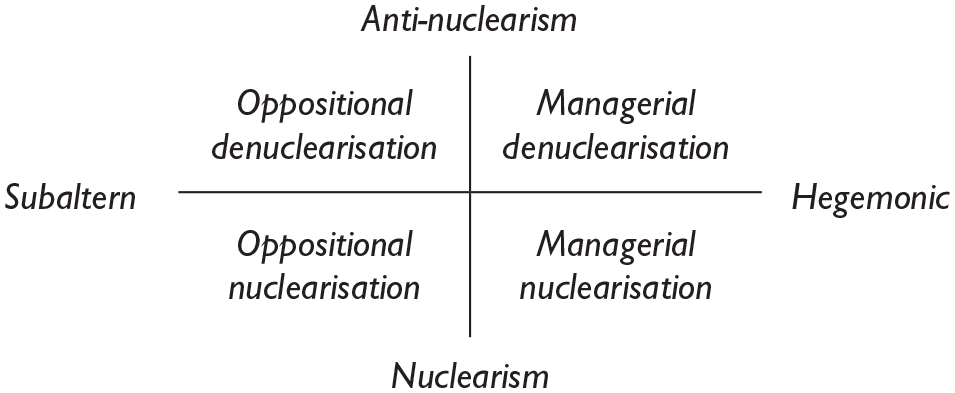
Nuclear discourses in world politics.
Drawing on Gramsci, I use ‘subaltern’ to refer to the discourses of state and non-state actors that occupy subordinate positions in the power structures of global nuclear order and are marginalised and disempowered. 24 There is a significant overlap between actors that articulate a discourse of subaltern anti-nuclearism and states that are framed as subaltern actors because they occupy subordinate subject positions in world politics, often in the global South. 25 Subordination does not mean such states are ‘victims and supplicants’, as Ritu Mathur reminds us, but ‘thoughtful agents that are articulating discourses on rights, liability, morality and legal obligations that can help reconstitute contemporary practices of weapons control’. 26 Nevertheless, the focus of the analysis is on subaltern discourse rather than states. This is important because a number of states and NGOs that were central to the TPNW and articulate a discourse of subaltern anti-nuclearism are European.
As with any taxonomy, these categories are an abstraction to aid our understanding of a more complicated reality. In the messy world of everyday nuclear politics, these discourses often overlap in different ways within countries, organisations and movements. There are competing discourses within states and they have changed over time as the nuclear age has unfolded. The primary purpose of this section is to set out a discourse of subaltern anti-nuclearism after a brief summary of the first three categories in order to make sense of the contemporary nuclear disarmament movement and the TPNW within a structure of nuclear hegemony.
Hegemonic nuclearism
Hegemonic nuclearism is the ideological and ontological discourse of nuclear hegemony and nuclear deterrence. Nuclearism was first defined by Robert Lifton and Richard Falk to capture the ways in which a set of meanings about nuclear weapons in relation to states, war, order and power had become embedded in the strategic cultures of nuclear-armed states and in world politics. They defined it as the ‘psychological, political, and military dependence on nuclear weapons, the embrace of weapons as a solution to a wide variety of human dilemmas, most ironically that of “security”’. 27 It is hegemonic because the discourse was developed and legitimised by the five nuclear-armed states whose status as ‘nuclear weapon states’ was secured in the 1968 NPT and who are also permanent members of the UN Security Council, and by a Western nuclear alliance that maps on to global wealth and power in the capitalist economic system. 28
Hegemonic nuclearism constructs a particular nuclear world based on a set of principles that have become axioms of political life in nuclear-armed states. First, world politics is about predatory states, balances of military power, competition to shape international order, and a static inter-state system in which nuclear weapons are a permanent necessity to deter aggression. 29 Nuclear weapons are therefore highly-valued assets and the logic of nuclearisation to sustain national power through a modern nuclear arsenal takes precedence over the logic of denuclearisation. 30 Second, it normalises the possibility of and planning for societal extermination through nuclear war as a legitimate, necessary and permanent military response to this reading of the world. 31 Third, nuclearism is framed as sustainable insofar as nuclear weapons can be relied upon to prevent nuclear war, thereby justifying the acceptability and inevitability of nuclearism and suppressing its risks and costs. 32 Fourth, it reduces the question of disarmament to an aspirational outcome of technocratic arms control conditioned by geopolitics, or denies its possibility or necessity altogether. Fifth, nuclearism generates a continuing requirement for massive investment in new nuclear weapons and modernisation and in doing so it becomes embedded in material forms, networks and institutions. Hegemonic nuclearism therefore shapes and limits how we can think and talk about nuclear weapons by masquerading as the nuclear reality and a shared ‘common sense’. 33
Subaltern nuclearism
Subaltern nuclearism is a discourse of resistance to the structure of nuclear hegemony in which nuclearism has been appropriated by states outside the NPT/UN Security Council nuclear oligarchy and that have been subjected to its disciplinary power. These include India, Pakistan, North Korea and potentially Iran. India is the best example of subaltern nuclearism, and two themes are important here. First, subaltern nuclearism frames nuclear weapons and civilian nuclear technologies in terms of modernity, national development, prestige and the autonomy and authority of the independent post-colonial state. 34 It intertwines the processes of nuclearisation with the processes of producing a modern state through nationalist discourses. 35 In the Indian case, this is demonstrated by the Bharatiya Janata Party’s (BJP) induction of nuclear weapons into its ideology of Hindutva and the recovery of Indian ‘greatness’ in world politics. 36 Second, subaltern nuclearism rejects the global political and legal line drawn in the 1968 NPT between ‘legitimate’ and ‘illegitimate’ nuclear weapon programmes. Resistance through subaltern anti-nuclearism or assimilation into the prevailing structure of nuclear hegemony as a client state of a nuclear patron, for example following the path of Japan, are rejected. 37 Instead, the axioms of nuclearism are embraced but supplemented by a discourse of nuclear equality, justice and resistance to domination and a racialised nuclear hierarchy through the acquisition of nuclear weapons. 38 In short, subaltern nuclearism is an inclusive equal opportunities nuclearism.
Hegemonic anti-nuclearism
The core idea of anti-nuclearism is that nuclearism is a political choice rather than a structural condition of world politics and that different nuclear worlds without nuclear weapons are both possible and necessary for collective safety. Hegemonic anti-nuclearism is hegemonic for two reasons: first, it is the dominant discourse of anti-nuclearism circulating within the nuclear oligarchy, notably in the West. Here, it circulates within a ‘non-proliferation complex’ of funders, thinktanks, academic institutes, government agencies and IGOs that has dominated discourse on nuclear disarmament and non-proliferation. 39 Second, it tends to contest the necessity and legitimacy of nuclear weapons on the same ontological terrain as hegemonic nuclearism, that is, within a broadly similar set of analytical and normative understandings about nuclear weapons in relation to the state, war, order and power, rather than contesting them. First, the discourse tends to be ambivalent about the illegitimacy of nuclear weapons and accepting of the continued practice of nuclear deterrence, except over the long term when it is seen as too risky. Second, it frames the most effective way of facilitating denuclearisation as working closely with nuclear-armed states within the possibilities of their shifting relationships and through insider engagement focussed on policy relevance. 40 Third, it constructs a world in which an incremental approach is the only plausible and therefore realistic pathway to denuclearisation, and that this will take a long time to achieve pending resolution of other major issues of world peace. 41 Fifth, non-proliferation is privileged and the weapons of ‘rogue states’ are constructed as the primary source of nuclear danger, rather than the arsenals of the nuclear oligarchy. Finally, the discourse reproduces a conception of security-through-strategic weapons based on the premise that denuclearisation must involve the substitution of nuclear weapons with other ‘strategic’ weapons, such as missile defences, conventional global strike system or cyber weapons. 42 The distance between hegemonic nuclearism and hegemonic anti-nuclearism can therefore be quite narrow, even whilst an eventual need for nuclear disarmament is championed. 43 Critiques of nuclearism in terms of imperialism, patriarchy, global capitalism, racism and militarism tend to be absent.
Subaltern anti-nuclearism
I argue that hegemonic nuclearism has been consistently and actively resisted by a diverse discourse of ‘subaltern anti-nuclearism’. This has been the primary discourse of the actors that supported the humanitarian initiative and the TPNW individually and through regional groupings in nuclear diplomacy. 44 Indeed, Richard Falk described the TPNW as ‘a frontal rejection of the geopolitical approach to nuclearism’. 45
Subaltern anti-nuclearism articulates a different ‘nuclear ontology’ of what counts in nuclear politics that reflects the nuclear experiences of the comparatively weaker, subordinated and disempowered majority of states and peoples within the structure of nuclear hegemony. Its development and articulation through the humanitarian initiative and the TPNW comprises a form of ‘ontological resistance’. First, it frames nuclear weapons as illegitimate, nuclearism as an oppressive system, and nuclear disarmament as necessary and urgent based on ideas of nuclear equality, justice and rights. 46 The primary contestation in the global politics of nuclear disarmament is therefore between hegemonic nuclearism and subaltern anti-nuclearism because their perspectives on the legitimacy of nuclear weapons, nuclear deterrence and nuclear violence are incommensurable. Second, it foregrounds power relations, hierarchy and marginalisation within global nuclear politics that hegemonic nuclearism and hegemonic anti-nuclearism sideline. 47 In doing so, it frames the global politics of nuclear disarmament as an ongoing discursive, ideological and ontological contestation between nuclear hegemony and resistances to it. Third, it connects anti-nuclearism to wider networks and practices of resistance to established power structures in global politics. Finally, it connects a world without nuclear weapons to this world, what Pelopidas calls a ‘post-nuclear present’: ‘our present world, without nuclear weapons’, a possibility that hegemonic nuclearism and hegemonic anti-nuclearism routinely dismiss as implausible or even impossible. 48
I identify four core themes that comprise the discourse of subaltern anti-nuclearism, each of which has a number of threads that form a discursive tapestry: violence, post-colonialism, environmentalism and gender. These themes and their many threads have a long history in anti-nuclear protest, diplomacy, advocacy and scholarship, notably in the transnational movement to end nuclear testing. 49 However, these themes often lacked an international diplomatic focal point once the CTBT was negotiated in 1996 until the emergence of the humanitarian initiative. The convening power of the initiative and the idea of a prohibition enabled a resurgence of the discourse as a form of resistance to the continued existence of nuclear weapons. These themes were also reflected in other contemporary expressions of anti-nuclear resistance alongside the humanitarian initiative, for example, the nuclear divestment initiative 50 and the Republic of the Marshall Islands’ (RMI) legal case against the nuclear-armed states’ failure to disarm (the latest in a series of legal practices of resistance to nuclear weapons). 51 Discourse analysis of statements by governments, IGOs and NGOs shows that most (though not all) of these themes constitute the nuclear worldview of most of the actors supportive of the humanitarian initiative and TPNW most of the time.
Nuclear violence
Subaltern anti-nuclearism foregrounds nuclear violence against human bodies and societies and frames this as categorically unacceptable. 52 This focus underpinned the humanitarian initiative’s strategic re-framing of nuclear discourse. 53 It was championed by the global health community through the International Physicians for the Prevention of Nuclear War (IPPNW) and its affiliates, and by the International Committee of the Red Cross (ICRC) that set out the legal and ethical unacceptability of nuclear violence and called for a treaty to prohibit and eliminate nuclear weapons. 54 The discourse highlights the effects of nuclear detonations on people and societies, not just in terms of the indiscriminate incineration of human bodies from immediate blast effects, but also the widespread and long-term social and economic harms from the breakdown of infrastructure, trade, agriculture, communications, health facilities, schools and so on that would hit the poorest hardest. 55
This gives voice to the experiences of people and communities affected by nuclear detonations in Hiroshima and Nagasaki and by nuclear testing that rarely feature in hegemonic anti-nuclearism. 56 It was reflected in the TPNW through its positive obligations to assist victims of the use or testing of nuclear weapons. Nuclearism, in contrast, tends to abstract violence away through a ‘techno-strategic language’ of deterrence, counter-force, hard-target kill and limited nuclear war that makes nuclear violence against people largely invisible. 57 The discourse also frames, and then rejects, nuclear violence as a structural condition in world politics because of how the capacity for sudden, massive and indiscriminate harm through rapid and uncontrollable escalation has become a permanent feature. 58 In particular, the way in which this structure produces ‘nuclear despotism’ by concentrating the power for rapid nuclear violence in a handful of often unaccountable individuals is a cause of profound concern. 59 This is framed as a threat to humanity by the potential to eradicate not just human bodies and societies but also our history and memory. 60 Shifting the focus of how we talk and think about nuclear weapons to violence against human beings, human societies and humanity itself and identifying and then challenging how the possibility of nuclear violence has become embedded and normalised as an unaccountable structure of power is a central feature of subaltern anti-nuclearism.
Post-colonialism
The post-colonial dimension of subaltern anti-nuclearism has several threads that emphasise equality, justice and development in nuclear relations. Post-colonialism in this context refers to ‘the multiple, contending and overlapping legacies of colonial rule and imperial administration that inform contemporary global politics’ and the fact that ‘a great deal of global politics is predicated upon – and complicit in reproducing – inequality, exclusion and violence’. 61 The overarching theme is an explicit connection between nuclearism and imperialism, racism and injustice in world politics. These issues rarely feature in the discourses of hegemonic nuclearism or hegemonic anti-nuclearism but are the foundation of the nuclear world constructed by subaltern anti-nuclearism. They have been a core pillar of the Non-Aligned Movement’s understanding of global politics and its rejection of a hegemonic nuclear order since its formation in 1961, yet its narrative is largely ignored in the North. 62
Five specific threads constitute this post-colonial theme. First, both subaltern anti-nuclearism and subaltern nuclearism highlight the discriminatory ways in which nuclear programmes of developed and developing states are often framed in mainstream nuclear discourse. 63 This produces a racialised discourse of nuclear exceptionalism that frames Western/Northern nuclear weapons and their possessors as rational, safe and legitimate and those in developing countries as dangerous, irrational and illegitimate. 64 Second, the discourse highlights the institutionalised hierarchy of nuclear ‘haves and have nots’ in the NPT as discriminatory, unjust and unsustainable. 65 Third, the discourse foregrounds nuclear imperialism in terms of historical injustices and humanitarian harms that were an important feature of the humanitarian initiative. This centres on states and regions subjected to nuclear weapons testing by former colonial or de facto colonial powers ‘resulting in the continued suffering of multiple generations’, for example in Algeria and Polynesia (France), Marshall Islands and Native American lands (USA), Aboriginal territories in Australia and Pacific islands (UK) and Kazakhstan (Soviet Union). 66
Fourth, subaltern anti-nuclearism frames access to nuclear technology as a form of ‘institutionalised humiliation’, to use Ritu Mathur’s phrase. 67 Across the global South in particular, access is understood in terms of national autonomy, development and anti-colonialism underpinned by an ‘inalienable right’ to nuclear technology for peaceful purposes agreed in the NPT in exchange for foregoing the option of developing nuclear weapons. 68 In contrast, the practices of nuclear trade are understood as a competitive oligarchic club of nuclear technology suppliers, including the five NPT nuclear weapon states, that has steadily restricted and conditioned access to nuclear technologies and materials through intrusive controls in the name of security and non-proliferation that sidelines the subaltern narrative. 69 Finally, nuclearism is framed as contradictory to international development whereby investment in nuclear weapons is a direct opportunity cost to international development. Moreover, the very existence of nuclear weapons is seen to place the sustainable development agenda at risk because of the effects that nuclear detonations would have on many of the UN Sustainable Development Goals. 70 Disarmament, in contrast is central to preventing war and releasing resources for development. 71
Environmentalism
The environmental dimension of subaltern anti-nuclearism foregrounds the hazards of long-term environmental contamination from both weapons programmes and nuclear detonations and the consequences for public health. The environmental effects of nuclear war have been part of nuclear debate since the 1950s, but it was the scientific prognosis of a ‘nuclear winter’ in the 1980s caused by the effects on the global climate of a superpower nuclear war involving thousands of weapons that brought global environmental concerns to the fore. 72 More recent peer-reviewed studies presented at the humanitarian initiative’s intergovernmental conferences have gone further and demonstrated that a nuclear conflict involving the use of 100 Hiroshima-sized nuclear weapons would have a catastrophic impact on the global climate. 73 The discourse cements an empirical case that all states have a profound interest in avoiding nuclear war because of the global climatic consequences and subsequent effects on human health and the breakdown of global food production systems. 74 This overlapped with the discursive themes of nuclear violence and development in the humanitarian initiative. 75
The long-term environmental and health effects of nuclear testing are also central to this discourse. Radioactive pollution of atmospheric, groundwater, marine and soil environments from nuclear testing continues to persist, with associated health problems, including thyroid cancers. 76 During the Cold War, nuclearism masked the environmental and health effects of massive contamination at nuclear weapons production sites and the vast amount of hazardous waste accumulated over decades of nuclear activity. 77 Yet the environmental effects of nuclear war and nuclear testing do not feature in the discourse of nuclearism.
Gender
The gendered dimension of subaltern anti-nuclearism foregrounds gendered inequalities and power structures in the global politics of nuclear weapons and connects nuclearism, nationalism and patriarchy.
The humanitarian initiative deliberately pushed gender as a central concern in global nuclear politics in which women (as agents) and gender (as a power structure) have become much more visible. This has three threads. First, the humanitarian initiative highlighted the differential gendered effects of ionising radiation from nuclear detonations on women and girls in terms of the risk of mortality from female-specific cancers. It also highlighted the social and economic costs of nuclear weapons programmes for women through diversion of resources from education and welfare and the social stigmatisation of women affected by nuclear detonations. 78
Second, the discourse challenges the dominance of men and under-representation of women in nuclear policy making and nuclear operations and how this shapes elite thinking about nuclear politics. 79 Ireland took a lead on gender and disarmament in the humanitarian initiative and the International Gender Champions Disarmament Impact Group. 80 This was part of a broader feminist discourse asking ‘where are the women’ and demanding inclusion of gender perspectives and assessment of gendered impacts across all disarmament practices in line with UN Security Council resolution 1325 on Women, Peace and Security, adopted in 2000. 81 This has been aided by greater access to diplomatic processes for civil society organisations, many of which are either led by women or have high profile female experts. 82
Third, nuclearisation is framed in terms of hyper-masculinity and an extreme expression of nationalism and militarism. 83 The discourse highlights how nuclearism associates the possession of nuclear weapons with manliness, sexual potency and the importance of demonstrating resolve, strength, political advantage and security through military/masculine power. In contrast, nuclear disarmament gets associated with devalued feminine characteristics and portrayed as irrational, unrealistic, idealistic and emotional and associated with emasculation. 84 A gendered discourse of nuclearism therefore places firm parameters on what is considered appropriate and inappropriate behaviour in male-dominated nuclear worlds.
Focus on gender as a structure of power through gendered constructions of masculinity, militarism and nuclearism has been limited to NGOs and a few diplomats. 85 Hegemonic anti-nuclearism and diplomatic discourse has been limited to amplifying women’s (as agents) participation in nuclear disarmament fora. 86 There are parallels here with the ways in which a White, Western, liberal feminism was framed as a hegemonic feminism (akin to hegemonic anti-nuclearism) that coalesced in North America in the 1960s and 70s and focused on women’s emancipation in terms of individual rights. 87 In doing so, it marginalised other feminisms by discounting the ways in which patriarchy as a structure of power and oppression was embedded in capitalism, colonialism, racism and militarism, and it thereby tacitly colluded with structures of patriarchy. 88 The primary ‘subaltern’ move in the late 1970s was the development of an intersectional approach that generated a more inclusive feminism concerned with race, class and sexuality within and beyond the West and that exposed the interconnections between colonialism, capitalism and patriarchy. 89
In sum, subaltern anti-nuclearism expresses a different ontology of nuclear politics and security, one that foregrounds: direct violence against human bodies and societies and a structure of nuclear violence in world politics; post-colonialism via nuclear imperialism, discriminatory racialised discourses, unequal North-South nuclear trade relations and economic development, and nuclearism as the antithesis of sustainable development; environmentalism in terms of the effects of nuclear war on the global climate and long-term environmental hazards of nuclearisation; and gender in terms of the effects of nuclear detonations and nuclearisation on women and girls, the under-representation of women in nuclear politics, a structure of patriarchy that intersects with militarism and nuclearism, and gendered discourses that feminise disarmament. It is a discourse that constructs a nuclear world rooted in justice, equality and rights through the delegitimation of nuclearism and practices of nuclear violence. It is a quite different nuclear ontology to one that centres on weapons, states, deterrence, strategic stability and the ultimate rule of force and it has implications for the future of the nuclear disarmament movement that are explored in the next section.
Implications for the nuclear disarmament movement
This account of subaltern anti-nuclearism shows that it has deep roots in human security, environmentalism, anti-colonialism, anti-militarism, human rights and sustainable development. The diversity of its themes and threads also shows that it is not a singular framework in which they all fit neatly together into a homogenous whole. Rather, it is a diverse, fluid and coalitional discourse articulated by a plurality of actors in different ways that can reinforce as well as contradict. Two arguments flow from this about the contemporary nuclear disarmament movement: first, the movement is intersectional and its efficacy requires its leaders to acknowledge and work with this; second the relationship between hegemonic nuclearism and subaltern anti-nuclearism is defined by agonism, and this has implications for the efficacy of ‘bridge building’ initiatives.
Intersectionality and subaltern anti-nuclearism
The concept of intersectionality developed by Black feminist scholars in the United States and the global South in the 1970s and 1980s is central to understanding subaltern anti-nuclearism and the nuclear disarmament movement. 90 Intersectionality shows how experiences of oppression and marginalisation lie at the intersections of multiple, overlapping structures such as racism, patriarchy, imperialism and capitalism. Intersectionality, in turn, highlights the different drivers of social mobilisation and resistance for different actors and coalitions, rather than a ‘singular opposition ethos’. 91 Dhamoon, for example, argues that an intersectional approach ‘serves to not simply describe and explain complex dynamics of power in specific contexts and at different levels of social life but also critique or deconstruct and therefore disrupt the forces of power so as to offer alternative worldviews’. 92 This gets to the heart of subaltern anti-nuclearism because it shows how a set of issues, experiences and voices are marginalised by hegemonic nuclearism and often by hegemonic anti-nuclearism but united by a determination to denaturalise, delegitimise and transcend nuclearism.
Intersectionality has long been a feature of the nuclear disarmament movement but it has been rendered more explicit through the humanitarian initiative and the consolidation of subaltern anti-nuclearism. 93 Two implications follow for the movement. First, intersectionality implies that it should cultivate diversity, inclusivity, collaboration and coalitions of different ways of understanding and doing denuclearisation under a broad umbrella of subaltern anti-nuclearism. The humanitarian initiative has shown that new forms of political agency, political mobilisation, coalition-building and agenda setting that unites around a shared ontology of subaltern anti-nuclearism, gives voice to the marginalised, and engages a range of audiences in different contexts can be very effective.
Second, intersectionality implies that the future of subaltern anti-nuclearism and the nuclear disarmament movement lie in their integration with other subaltern discourses and movements mobilised around resistances to patriarchy, capitalism, imperialism, racism, militarism and ecological destruction. 94 For some, this was the purpose of the humanitarian initiative. 95 For example, two of the anti-globalisation organisations formed in the late 1990s as global civil society confronted neo-liberalism (the World Social Forum and Peoples’ Global Action) have highlighted the role of militarism and nuclear weapons as part of the global power hierarchies against which they were ranged. 96 This has been recognised at the diplomatic level, for example Sweden noted in 2016 that ‘to move the agenda forward in a coherent way, nuclear weapons issues need to be much better reflected or integrated into other areas of policy making such as social, economic and sustainable development, climate change and the environment, culture including the protection of cultural heritage, and issues related to gender equality and children’s rights’. 97 States and global civil society organisations and movements that have been central to developing, articulating and enacting subaltern anti-nuclearism are pivotal to building these networks.
Agonism and ‘bridge building’ in disarmament diplomacy
The second argument that flows from this analysis is that the contestation between hegemonic nuclearism and subaltern anti-nuclearism is agonistic due to their incommensurability as competing ontologies of nuclear politics. Chantal Mouffe (who, like Cox, draws on Gramsci), defines agonism as a contestation or struggle between adversaries that share a common political space, but want to organise it very differently. Antagonism, in contrast, describes a contestation between enemies with whom there is no basis for engagement and who are consequently demonised, excluded or even destroyed. 98 In an agonistic relationship, adversaries recognise the legitimacy of their opponents even as they understand their opposing views as irreconcilable. 99 Agonism acknowledges that ‘different political groups and perspectives will always exist’ that are irreconcilable, instead of ‘demanding that different positions either succumb to the superior wisdom of expertise or align through deliberation’ by getting others to ‘see reason’, or dismissing opponents as ignorant or emotional. 100
Agonism rather than antagonism captures the global politics of nuclear disarmament because it is not possible to exclude the nuclear-armed and their clients from denuclearisation and it is not possible for the nuclear-armed and their clients to sideline and silence the majority world supportive of actual denuclearisation. In disarmament diplomacy, diplomats generally speaking have to engage each other within the shared social institution of international diplomacy on issues upon which they might profoundly disagree. Moreover, it is agonistic because the contestation between hegemonic nuclearism and subaltern anti-nuclearism ‘cannot be transcended by reason on the one hand, nor entirely integrated into rational and inclusive deliberation on the other’. 101
This main consequence is the need to acknowledge this contestation and work with it. Doing so opens up debate by empowering a wider range of perspectives and voices and enabling robust critique that challenges prevailing assumptions, disrupts unsustainable practices and institutions, and develops alternative pathways. 102 This is arguably what the TPNW has done. 103 However, agonistic contestation does not mean entrenching polarised positions in which ideas, institutions and structures are immune to change. 104 As Cox’s neo-Gramscian approach shows, the contestation between hegemony and resistance is ripe with possibilities for change, progressive and regressive. Understanding the global politics of nuclear disarmament as agonistic means seeing it as an open-ended, creative, contingent and democratic struggle between nuclearism(s) and anti-nuclearism(s) whose dynamics will enable new coalitions, forms of identification and ideas to emerge through both consensus and dissent. 105 As Machin argues in relation to environmental politics: ‘Although there is no guarantee of the outcome, such agonistic politics may permit the more compelling questioning and disruption of unsustainable conventions and the emergence and consolidation of new forms of collective engagement with alternative visions of the socioenvironmental future’. 106
However, one of the challenges in nuclear disarmament diplomacy is that a number of nuclear-armed states and ‘bridge building’ initiatives do the opposite. Instead of working with the contestation and acknowledging the agonistic character of the debate, the approach has been to deny or delegitimise it. In bridge building initiatives, the inaccessibility of consensus has been framed as a source of discomfort and diagnosed as a problem of polarisation caused by the TPNW and the subaltern anti-nuclearism that informs it. The remedy is to seek consensus through ‘bridge building’ initiatives across a divide between nuclear-armed states and their supporters on one side and supporters of the TPNW on the other. This is done by acknowledging the underlying incommensurability of hegemonic nuclearism and subaltern anti-nuclearism and then sidelining or dismissing it. The result is that bridge-builders tend to operate within the same ontological frame as hegemonic nuclearism with bridge-building reduced to finding consensus between hegemonic nuclearism and hegemonic anti-nuclearism. 107
Theorists of agonism recognise this as a depoliticising move that closes down debate by framing some ideas and practices as unreasonable or abnormal and downplaying the degree and legitimacy of contestation. 108 For example, Santoro argues that ‘the nuclear policy field has become increasingly politicized and polarized’, especially over nuclear disarmament and the TPNW. 109 The solution is to ‘build bridges between nuclear managers and nuclear disarmers’ through ideological reconciliation, which can only be done by depoliticising the debate in order to erase the contestation that is framed as problematic. 110 Similarly, Williams frames bridge-building ‘as a way to move past the polarization of the TPNW and return to progress within the established global nuclear regime’. 111 Debate must be depoliticised by rejecting the contestation associated with the TPNW as a dangerous pathology. As Williams puts it, NPT discussions ‘could avoid debate about the TPNW altogether. And that may be the best bridge-building exercise of all’. 112
Bridge-building understood in this way therefore becomes an exercise in trying to access an inaccessible consensus between hegemonic nuclearism and subaltern anti-nuclearism, or excluding or delegitimising the latter. This helps to explain why bridge-building initiatives so often struggle to gain political traction. In contrast, the type of bridge-building advocated by supporters of the TPNW centres on engagement by hegemonic nuclearism with subaltern anti-nuclearism, notably the humanitarian, risk and ethical rationales and arguments that underpinned the humanitarian initiative. 113
Some nuclear-armed states have gone further by delegitimising the TPNW and its underlying discourse of subaltern anti-nuclearism, again, by using the language of ‘polarisation’. 114 For example, Russia’s Ambassador warned that a ban treaty would risk ‘plunging the world into chaos and dangerous unpredictability’. 115 This is a familiar process in which discourses and practices of resistance are framed as illegitimate, irresponsible, dangerous and destabilising. 116
Conclusion
The purpose of this article has been to develop a discursive framework for understanding the contemporary global politics of nuclear disarmament in general and the humanitarian initiative and TPNW in particular by developing the concept of nuclearism and introducing the concept of anti-nuclearism. The central argument is that contestation in global nuclear politics is not simply about different perspectives, but about fundamentally different understandings of how global nuclear politics is constituted. In that sense, the global politics of nuclear disarmament is understood as a contestation between hegemonic nuclearism and subaltern anti-nuclearism, and the humanitarian initiative and TPNW have made the latter more coherent, visible and explicit. It is a contestation over the meaning of nuclear weapons in relation to violence, security and the state and what counts as ‘normal’ in nuclear politics, because what counts as normal or ‘common-sense’ legitimises particular relations of power. For the NPT/UN Security Council nuclear-armed states, ‘nuclear normality’ means continued possession of nuclear weapons, nuclear deterrence as a non-negotiable security strategy, and disciplinary measures to keep nuclear weapons and technologies out of the hands of others. What is not ‘normal’ is a world without nuclear weapons, or to expect rapid progress towards disarmament, or to think about nuclear weapons in subaltern terms of violence, rights, gender, justice and structures of inequality.
A key purpose of the article has been to identify and explain the discourse of subaltern anti-nuclearism based on four intersecting themes of violence, post-colonialism, environmentalism and gender. Using Cox’s theory, subaltern anti-nuclearism has been located in a broader framework of hegemonic nuclearism, subaltern nuclearism and hegemonic anti-nuclearism – a framework that I invite others to engage with. This argument builds on earlier work on nuclear hegemony and frames subaltern anti-nuclearism as a form of resistance based on a different set of ordering ideas and ‘alternative intellectual resources’.
Based on this reading, the argument claims that intersectionality is a crucial concept for understanding subaltern anti-nuclearism and locates it within broader, pluralistic movements for social, economic and environmental justice and the basic contention that there should be definitive limits on violence in global politics. The final part argued that because the discourses of hegemonic nuclearism and subaltern anti-nuclearism are incommensurable, the contestation between them is agonistic, drawing on Mouffe. Consequently, diplomatic initiatives aimed at bridging the divide can often be depoliticising moves that frame contestation as polarisation and therefore problematic, which closes down debate rather opening it up. It also explains why the constant striving for ‘middle ground’ approaches struggles to generate results. Agonistic contestation does not preclude or politically discourage dialogue or possibilities for common interests and compromise, but it does shift thinking about the process of change in nuclear disarmament politics from linear progress through ideological reconciliation to struggle through agonistic engagement within embedded structures of power.
Critics might argue that the analytical dichotomies of hegemonic nuclearism/subaltern anti-nuclearism can, at a general level, be quite reductive because they can miss compromise, cooperation, diverse structures and ambivalent and fluid relationships. Global nuclear relations as a whole are indeed characterised by cooperation and conflict across multiple actors and issues that encompass the two other discourses of hegemonic anti-nuclearism and subaltern nuclearism. But in the context of nuclear violence, there are in the end fundamental dichotomies between the legitimacy and illegitimacy of nuclear weapons, deterrence and violence and between nuclear hegemony as a structure of power to be managed and sustained, and discourses and practices of resistance that seek to disrupt and transcend it.
We are now in a position after the TPNW of a more empowered and diverse subaltern anti-nuclearism that is contesting a hegemonic nuclearism, which remains the central ordering idea of nuclear hegemony in world politics. Four areas of further research follow from this analysis: First, research on how discourses and ideologies in nuclear weapons politics have changed in different social and historical contexts, including as part of broader social changes, and how this has shaped processes of denuclearisation and the marginalisation of nuclearism. 117 Second, further research on the production, mobilisation, politics and practices of counter-hegemonic discourses and understandings and experiences of intersectionality in the nuclear disarmament movement drawing on social movement theory. For example, how do different actors conceptualise and practice subaltern anti-nuclearism? How do they negotiate difference within the movement? How do they connect anti-nuclearism to other areas of injustice, power and resistance, notably economic and environmental justice? Third, and relatedly, research on the extent to which subaltern anti-nuclearism is embedded in, intersects with or is ignored by other subaltern resistance movements in world politics and their repertoires of resistance, particularly in relation to capitalism and the ecological crisis, based on the premise that the efficacy of the nuclear disarmament movement depends on its connections across social movements. 118 Finally, fourth, research on how agonistic contestations evolve in relation to social change and the implications of this for the politics of nuclear disarmament conditioned by an agonistic contestation between hegemonic nuclearism and subaltern anti-nuclearism. There is a burgeoning scholarship on this on the ecological crisis, but nothing in relation to nuclear disarmament. There is much work to be done here under the umbrella of a resurgent critical nuclear studies.
Footnotes
Funding
The author received no financial support for the research, authorship, and/or publication of this article.
