




Abstract
If international relations can be theorised as ‘inter-textual’, then why not also – or indeed better – as ‘inter-carbonic’? For, not only is the modern history of carbon to a large degree international; in addition, many of the key historical junctures and defining features of modern international politics are grounded in carbon or, more precisely, in the various socio-ecological practices and processes through which carbon has been exploited and deposited, mobilised and represented, recycled and transformed. In what follows I seek to make this case, arguing that carbon and international relations have been mutually constitutive ever since the dawn of modernity in 1492, and that they will inevitably remain so well into the future, as the global economy’s dependence on fossil carbon continues unabated and the planet inexorably warms. Will climate change generate widespread conflict, or even civilisational collapse? How are contemporary power dynamics limiting responses to climate change? And how, conversely, might 21st-century world order be transformed by processes of decarbonisation? Building on research in political ecology, I argue that a dialectical sensitivity to ‘inter-carbonic relations’ is required to properly answer these questions. Scholars and students of International Relations (IR), I suggest, need to approach climate change by positioning the element C at the very centre of their analyses.
Introduction
In their landmark 1989 collection, International/Intertextual Relations, James Der Derian and Mike Shapiro famously set out the case for analysing ‘the world of international relations as a text’. Texts, narratives, discourses and representations, they and their contributors argued, are of such importance within international relations that they should not just be considered an issue within or an aspect of international politics, but at its very core. Texts, they effectively argued – and many other postmodern, post-structuralist and constructivist scholars have followed suit – are no less than the lifeblood of international relations, constituted by the international but also constitutive of it. And the analysis and denaturalisation of texts, they suggested, should thus be accorded due methodological importance, and approached as the methodological key to both understanding how world politics is made and remade, and to challenging it. 1
There are many possible objections to such claims, but these are not my concern here. Instead I want to ask: if international relations can be theorised as ‘inter-textual’, as Der Derian, Shapiro and many others have contended, then why not also – or indeed better – as ‘inter-carbonic’; that is, as pertaining to the circulation of carbon? For, not only is the modern history of carbon to a large degree international; in addition, many of the key historical junctures and defining features of modern international politics are grounded in the element C or, more precisely, in the various socio-ecological practices and processes through which carbon has been exploited and deposited, mobilised and represented, recycled and transformed. Carbon and international relations, I want to argue, have been mutually constitutive ever since the dawn of modernity, and will remain so well into the future – albeit in historically specific and changing ways. Carbon and international relations are locked in an embrace which is crucial to understanding both their conjoined histories, and the Earth’s future.
My central concern in making this case is that the discipline of IR’s record of engagement with climate change, carbon politics and ecology more broadly remains poor. There are of course large, important and ever-growing bodies of specialist literature on climate negotiations, climate policies, climate security, energy politics and more, much of which engages with questions of international relations – and to which I am greatly indebted in what follows. However, environmental politics as a whole remains on the margins of IR as a discipline. With notable exceptions, environmental politics remains the preserve of specialists. Both environmental politics generally and climate change specifically are still mostly absent from major IR debates, except as sources of case studies and sites for testing or developing other theories. 2 Moreover, I have been to major IR conferences where there hasn’t been a single paper on climate change, or a single title that refers to oil, gas, coal, fossil fuels or energy. Critical IR scholarship has generally been no better than the mainstream in these regards, indeed it has often been worse: just as there still exist Marxists who can write books without mentioning climate change, so a similar tendency continues to afflict critical IR as well. 3 In my view, all of this needs to change.
My central methodological premise, in turn, is that one of the main barriers to such change is the problematic framing of climate change as a discrete ‘issue’, and an ‘environmental’ one at that; or stated differently, that when ‘climate change’ or ‘environmental issues’ provide the conceptual starting point, then peripheralisation inexorably ensues – as in Steve Smith’s still-revealing reflections on the subject. 4 Hence in what follows I opt to avoid such framings, and instead both to adopt carbon as my organising focus, and to analyse it not as a discrete issue or problem but as an element that courses through – and simultaneously constitutes and is constituted by – society, politics and the international. The text-carbon analogy with which I began – the suggestion that international relations might be interpreted as ‘inter-carbonic’, just as others have theorised it as ‘inter-textual’ – is intended to capture this methodological strategy. My suggestion is that a methodological focus on ‘inter-carbonic relations’ may help shed new light on the international political significance and implications of climate change, and through that contribute is some small way to addressing its continuing disciplinary marginalisation. What follows, then, is an overview, synthesis and reinterpretation of carbon and climate politics – and one that is aimed less at the already-initiated than at those who do not yet engage with carbon nearly as seriously as they engage with text.
We proceed part historically, part thematically. Immediately below I explore the origins of modern international relations, which in terms of carbon involves focusing primarily on trees. We then, in turn, consider key dimensions of the global politics of fossil fuels; the political implications of the ensuing carbonisation of the Earth’s atmosphere; and finally the politics and likely consequences of efforts at decarbonisation. Through all of this, I examine carbon both in its three main material manifestations – as hydrocarbons buried under and extracted from the Earth’s surface; as carbon dioxide and methane circulating in the atmosphere; and as carbohydrates embedded in trees – as well as in terms of how these material manifestations of carbon have figured in myth, imagination and ideology. I operate with an intentionally capacious understanding of ‘international relations’ as political and power relations on a global scale, and thus include reflections on colonialism, capitalism, race, gender and class, as well as inter-state hierarchies and conflicts. For reasons of space, I concentrate more on the consequences of carbon for international relations than vice versa. And with regard to theoretical positioning, suffice to say that my argument is above all informed by research in the field of political ecology, the central premise of which is that – as with carbon and the international – all politics is ecological and all ecological crises are rooted in politics. 5
Beginnings
Let us begin in 1492, the year which to my mind should be considered the year zero of modernity and modern international relations. In 1492, Columbus landed in the Bahamas and shortly afterwards Hispaniola, setting in motion a great restructuring of the balance of humanity, and paving the way for the creation of a European-dominated world order. In 1491, as many as a fifth of all people were living in the Americas, more than in Europe, and central Mexico was the most densely populated region on Earth, with the city of Tenochtitlan being bigger than Paris, then Europe’s largest. Within 130 years of first contact, however, a cocktail of imported maladies – smallpox, influenza, diphtheria and measles, plus massacres, slavery and famine resulting from the disruptions to food production and trade – had slashed the Americas’ population, probably by 85%–95%, obliterating its civilisations, and leaving an artificially-created blank slate for European colonisation. 6 The consequences were not only intra-American, however. The plundering of New World riches and ‘opening up’ of America’s various frontiers jump-started Europe’s own economic revolution, furnishing both new land and commodities and, indirectly, the capital needed for industrial, financial and military innovation and expansion. Simultaneously, labour shortages arising from the collapse of the Americas’ indigenous population sucked Africa into the equation, in the form of the triangular trade and chattel slavery. 7 Prior to this, Europe had been no more technologically or economically advanced than China, and possibly other world regions too. But with the Americas opened for exploitation, and an army of African slave labour at hand, over the course of the 17th and 18th centuries there occurred a ‘great divergence’ between the European and non-European worlds, as Kenneth Pomeranz, amongst others, has extensively documented. 8 Put to one side the IR obsession with Westphalia and 1648: it was 1492 which sparked the much more significant restructuring of global order, with legacies which reverberate to this day. 9
The significance of this here is that this great restructuring of global social relations was accompanied by an equivalent reconfiguration of global carbon. With the collapse of its indigenous population, the Americas quickly returned to ‘wilderness’. Lands which had previously been managed through fire became thick forest. The gardens, orchards and managed woodlands of Amazonia – which by some accounts stretched right across the Amazon basin – became wild jungle. And the fields of maize, beans and squash which lined the eastern seaboard of what was to become New England turned to forest too, such that when the Mayflower Pilgrims established their famous colony, just over four centuries ago, they encountered a land which they thought had barely been cultivated or used. 10 We know all this from the accounts of the earliest European explorers, as well as recent scientific advances in archaeology and anthropology. But, incredibly, it also finds corroboration in carbon analyses of Antarctic ice-cores, from which we can glean that the reforestation of the Americas sucked so much carbon out of the Earth’s atmosphere that global atmospheric CO2 levels dropped by between 7 and 10 parts per million between 1520 and 1610, the sharpest such decline in the entire climatological record. By 1610 there was less CO2 in the atmosphere than at any point in the last two millennia – largely, it appears, thanks to Europe’s ‘discovery’ and colonisation of the Americas. 11
Many are now aware of the term ‘Anthropocene’, first invoked by atmospheric chemist Paul Crutzen and limnologist Eugene Stoermer to capture the existence of a new geological epoch defined by human agency. 12 This term has entered IR mainly in the form of theoretical riffs on the relations between nature and society, and reflections on the discipline’s limits, or in calls for other terms – ‘Capitalocene’, ‘Chthulucene’, ‘Eurocene’ and so on – to be used instead. 13 But the evidence just discussed, alongside related evidence of how European contact with the Americas transformed ecosystems and biodiversity worldwide – a process which the late Alfred Crosby labelled the ‘Columbian exchange’ – suggests a very different lesson. 14 According to the most influential recent interpretation of the Anthropocene, developed by Earth scientists Simon Lewis and Mark Maslin, the Anthropocene itself should be dated from what they call the 1610 ‘Orbis spike’ – the historical moment when global atmospheric CO2 levels suddenly plunged as a result of New World reforestation, before beginning their long ascent to today’s era of global heating. Contact with and colonisation of the Americas, Lewis and Maslin argue, led to ‘a clear and permanent geological change in the Earth system’, and more than any other juncture meets the established scientific criteria for demarcating the Anthropocene as a new geological epoch. 15 Put differently, what this suggests is that 1492 not only inaugurated modern international relations; from 1492 international relations also became a geological force. What better reason could there be for adopting 1492 as the year when modernity and modern international relations began? 16
Simultaneously, the post-contact reforestation of the Americas had profound broader consequences for international relations, both in practice and as a discipline. In the former sense – that is materially – the reforestation of the Americas seems to have been a significant factor in the ‘general’ or ‘global crisis’ of the 17th century, that unprecedented period of social and political turmoil which was also, of course, formative to modern international relations. 17 The links here are easily hypothesised: that reforestation, by sucking carbon out of the Earth’s atmosphere, would have exerted downward pressure on global temperatures; that crop yields would have fallen, and food prices risen; that a global peasantry deeply vulnerable to climatic fluctuations would have suffered hugely as a result; and that this would have translated into extreme political turmoil, especially in areas which were already at their socio-ecological limits. And what does the historical record in fact show? That during the 17th century the Earth experienced the most pronounced period of global cooling since the last ice age: during winter 1620–21, just after the Orbis spike, the Bosporus froze and people could walk across it between Europe and Asia, the one and only time this has happened in recorded history. That from Scotland to Shandong, crops yields dropped and hunger and famines followed. That there were more rebellions, revolutions and wars during the 17th century than during any comparable period of world history. And that the global population declined significantly (though by how much, and how generally, is unclear). 18 While it would be wrong, of course, to suggest that the century of Hobbes and Westphalia was essentially or primarily defined by carbon sequestration in the Americas, the latter may, it seems, have been one of its important contexts.
In addition, reforestation created a vast store of carbon energy which became foundational to the rise of the North Atlantic ‘West’. Viewed from the perspective of today’s highly urbanised and fossil fuel-dependent global order, in which trees are often valued more as environmental and aesthetic objects than as economic goods, it is easy to overlook just how politically and economically important they were within early modern societies. Yet crucial they undoubtedly were. Trees provided the main fuel source, charcoal, for the rural and urban furnaces, forges and mills which drove the early industrial production of iron, copper and lead, lime and salt, textiles and beer. Mighty 100 year old oaks were a precondition for commercial shipping and naval power. Abundant trees were so important that the geography of industrial production and ship-building was often dictated by proximity to them. But by the 1600s, there were acute wood fuel and timber shortages across most of western Europe: ‘France will perish through lack of woods’, reported one of Louis XIV’s ministers. 19 Ireland provided one stopgap solution, comprehensively deforested during the course of the 17th century – with over 85% of its woodlands destroyed – to provide an ‘environmental overdraft’ of timber and fuel for an already denuded Britain. 20 Norway, Sweden and the Baltic states provided another alternative, the exploitation of their forests underpinning the Dutch Republic’s emergence as the first capitalist commercial and naval power. 21 But it was North America which was to become the preeminent forest resource frontier. Interest in using New England to resolve Britain’s wood fuel and timber crises, by exporting iron industries and ship-building across the Atlantic, was an important early impetus to British settlement. 22 America’s forests in turn became crucial to British naval and commercial sea power, coming to provide a third of its merchant fleet, the majority of naval masts and, after 1800, the major source of imported bulk timber. 23 Internally, forests provided the main energy source driving American industrialisation right through to the late 19th century: as late as 1856 more than three quarters of all iron furnaces were fuelled by charcoal, for example. 24 And the political consequences paralleled this: in Frederick Jackson Turner’s formulation, American democracy no less than ‘came out of the American forest’. 25 Modern world politics would have looked very different in the absence of America’s trees.
Last, these complex historical relations between trees, the atmosphere and Europe’s encounter with and colonisation of the Americas left significant traces through the discipline of International Relations, including through one of the cornerstones of realist and liberal international thought, the idea of ‘international anarchy’. For, not only was the idea of an ‘anarchic international system’ developed from early modern ‘state of nature’ theories, which in turn were empirically modelled on the New World, as Beate Jahn among others has shown. 26 More to the point, the New World empirics in question concerned not just the Americas’ supposedly ‘savage’ pre-historical peoples, but also their ostensibly untouched and pre-historical natural environment – the myth of a pristine nature. 27 Thus when John Locke famously announced that ‘in the beginning, all the World was America’, he was referring partly to the assumed absence of commerce and industry amongst its native ‘Indian’ population, but equally to its ‘wild woods and uncultivated waste . . . left to Nature’, and to ‘the woods and forests, where the irrational untaught inhabitants’ of the continent were thought to reside. 28 When Giambattista Vico said that ‘the order of human things’ was ‘first the forests, after that the huts, thence the villages, next the cities’ – and that ‘in the new world the American Indians would now be following this course of human things if they had not been discovered by the Europeans’ – he operated with the same basic premises. 29 And although Hobbes was more narrowly humanistic in his emphases, his imagined political ecology was in essence little different. Consider Figure 1, the frontispiece to Hobbes’ 1642 work De Cive, which one analyst has described as ‘a political atlas of the seventeenth century’. 30 Bottom left is Hobbes’ vision of civil society, as represented by a crowned, robed woman holding both a sword and scales of justice, with an idealised European pastoral scene in the background. Meanwhile bottom right, and juxtaposed to this ideal, is Hobbes’ vision of the state of nature – and an image modelled on a drawing from Virginia, featuring a barely clad native American woman before a violent, wild and, crucially, forested land. 31 Early modern ideas of the state of nature were not just raced and gendered, but steeped with trees, with carbon. And by extension, the idea that we inhabit an ‘anarchic international system’ is not just a myth, as has often been said before; it is a legacy of a specific international and inter-carbonic occurrence: the disease- and genocide-induced re-carbonisation of the Americas.
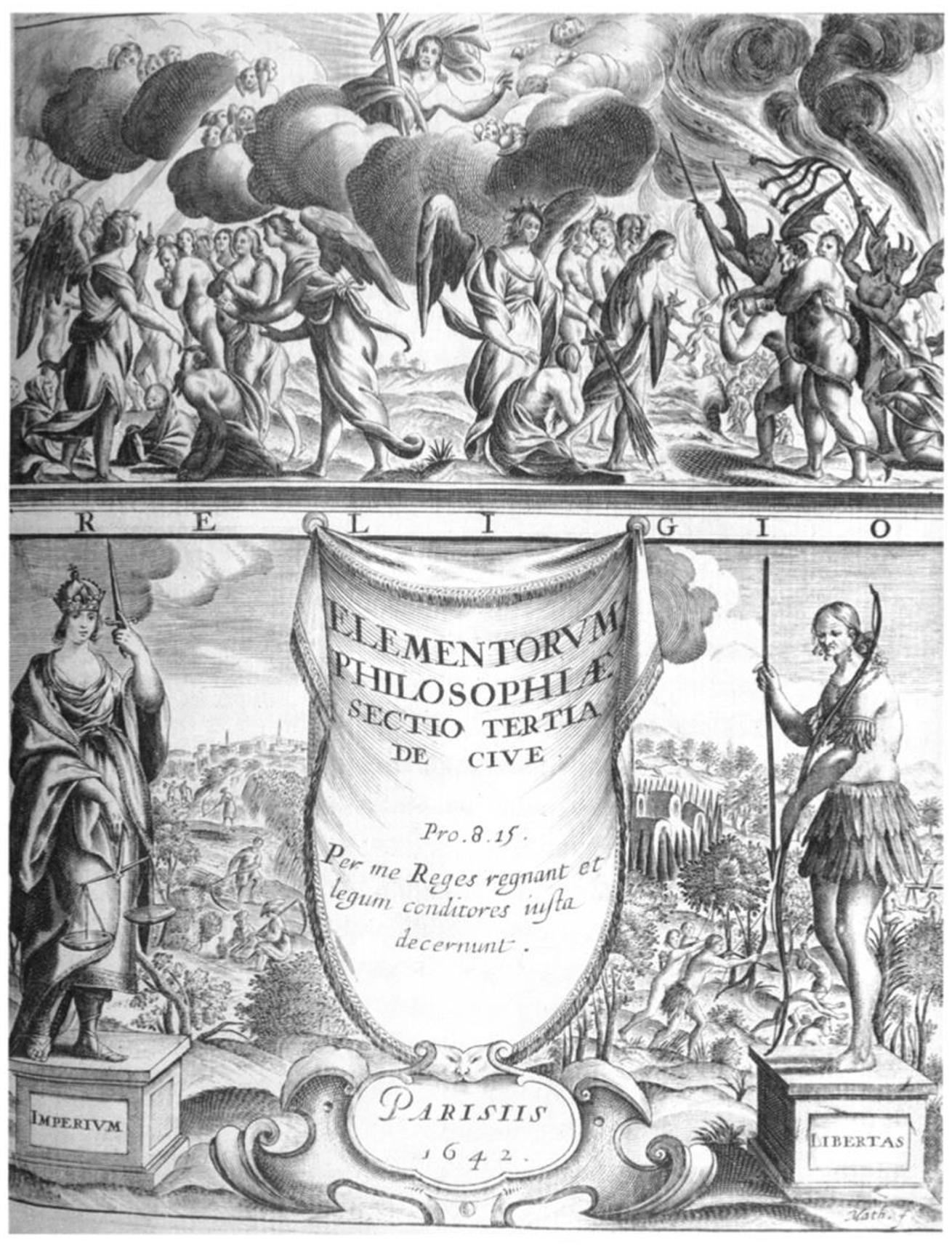
Frontispiece, De Cive (Paris, 1642), by permission of the William Andrews Clark Memorial Library, University of California, Los Angles.
Fossil capitalism
If we fast forward to the period since the 1830s, we find that modern international relations is steeped with carbon in many deeper senses too. For, since the 1830s – which was the decade when Britain decisively transitioned to coal – human social existence has been utterly transformed by the exploitation of fossilised carbon, fossil fuels. 32 And international relations has been transformed with it – in many ways, but here I highlight just four.
First and most obviously, fossil fuels have enabled a continuous and at times exponential increase in global energy consumption, in turn enabling a near-continuous expansion of economic activity. Figure 2 illustrates this, showing the extent to which first coal and more recently also oil and gas have come to dominate global energy consumption, as well as the extent to which energy consumption has witnessed a ‘great acceleration’ since 1945. 33 Crucially, such a sustained increase in energy use could not have occurred without primary reliance on fossil fuels, given the limitations of all other energy sources. Woodlands were finite, quickly over-exploited and took decades to regenerate, as illustrated already. Wind and water were widely available but unreliable, hostage to the vagaries of the weather. Animal and human labour were unreliable too, with a tendency to go on strike, and limited by basic facts of metabolism and the availability of food. None of these energy sources could have sustained an industrial capitalist world order characterised by near-continuous economic growth. By contrast, the exploitation of coal, oil and gas – the mining and burning of what effectively are millions of years’ worth of buried sunshine – provided access to stocks of energy which were both reliable and seemingly unlimited, making an industrial capitalist world order and near-continuous growth possible. In simple quantitative terms such growth could only have been driven by fossil fuels: as early as 1810, England and Wales were consuming an annual volume of coal equivalent, in terms of energy released, to the annual destruction and burning of forests covering their combined total land areas, and this despite the simultaneous widespread use of water to power mills; by 1860, their coal consumption had risen to five times this level; and hence as Pomeranz argues, the British industrial revolution would have encountered an ‘ecological impasse’ without ‘the dual boons of coal and colonies’ – and, by extension, neither the European nor global transitions would have been possible. 34 This is not to suggest that such functional requirements can themselves explain the rise of ‘fossil capitalism’, or that this development was inevitable, as is often implied in studies of the subject. 35 But neither 19th-century industrial capitalism nor the great acceleration could have been sustained without primary dependence on fossil fuels; and in turn, though at the risk of belabouring the obvious, everything from our modern systems of production, trade and consumption, to our modern modes of warfare, are indebted to the energy provided by them.
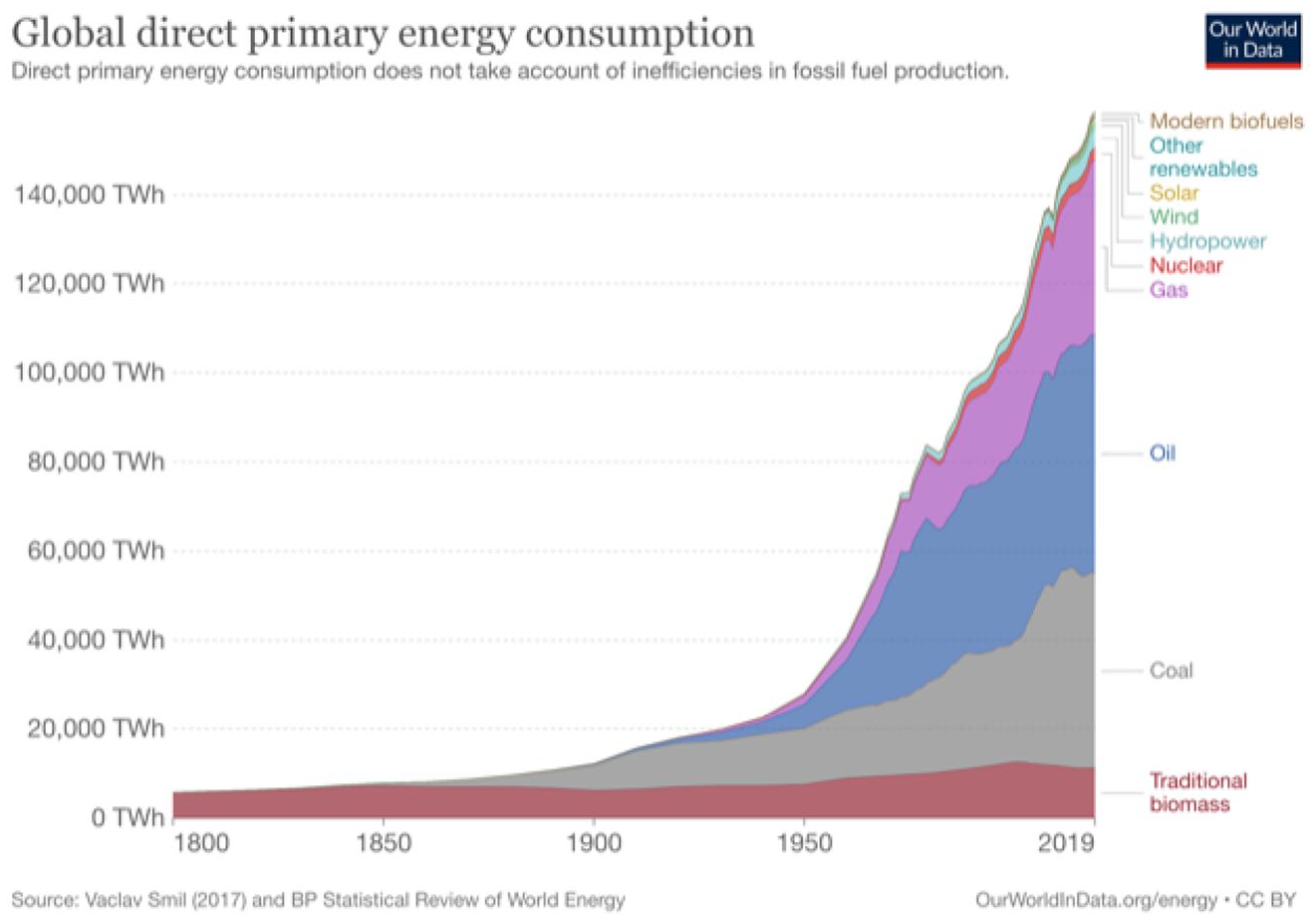
Global direct primary energy consumption.
Second, the same exploitation and mobilisation of fossil fuels has transformed the nature of social time and social space. Prior to 1830, most mechanical and industrial activity took place in particular places and at particular times, as defined by the availability of energy – simply because these non-fossil energy sources were too heavy to transport over long distances, and of variable availability. Thus Britain’s early cotton mills, like Arkwright’s famous mill at Cromford, were mostly located along fast-flowing rivers and streams, and had to stop operating during periods of poor rains. 36 Iron smelting, equally, mostly followed abundant woodland, from the forests of Kent and Sussex, to Ireland, Sweden and New England. 37 But coal was different – and oil and gas are even more so. Hyper-mobile energy resources, fossil fuels enable machine-based economic activity to take place almost anywhere, and 24 hours a day, 265 days a year without halt. They allow production to be relocated and concentrated where labour is most abundantly and cheaply available, especially in cities – and have thus been potent factors in rural deindustrialisation and urbanisation. Fossil fuels have enabled, to an unprecedented degree, humankind to destroy and transcend local environmental discomforts and constraints, especially those related to temperature (consider the impacts of air conditioning) and water supply (the use of diesel-powered pumps to abstract groundwater, for instance, now permits irrigated agriculture in semi-arid and desert lands where cultivation would otherwise barely be possible, most extremely in Saudi Arabia). 38 To an unprecedented degree, they have also liberated economic activity from weather variations, most notably drought. 39 They have been a condition of possibility for the creation of what Henri Lefebvre called modern ‘abstract space’, in which the Earth and its territories become homogeneous, empty spaces to be commodified and filled: only fossil fuels could have ‘ground the production of abstract space’, notes Andreas Malm. 40 And fossil fuels have of course provided almost all of the fuel for those rail, road and shipping systems which have compressed and ‘annihilated’ time and space worldwide. 41 Everything from globalisation to modern IR conceptions of territoriality – in which state territory is simultaneously imagined as uniform, indivisible and absolute, and materially bound together through high-energy space-annihilating infrastructures – reek of the impacts of fossil fuels in transforming time and space.
Third, fossil fuels have had huge though somewhat contradictory impacts on patterns of political organisation and social struggle. British cotton mill owners turned away from water to coal from the 1830s onwards because the latter made it easier to discipline labour: as Malm has shown, British capital needed fossil fuels. 42 Yet at the same time, the working conditions of coal miners – working on the seam far underground, well away from their bosses – created degrees of autonomy and collectivity which were formative in the development of modern trade unionism and the extension of the democratic franchise: as Tim Mitchell has argued, the forms of mass representative democracy that emerged during the late-19th century can thus be considered coal-powered ‘carbon democracies’. In turn, the mid-20th century transition to oil was, as Mitchell has also argued, actively promoted as a way of curbing labour militancy in Europe. 43 Globally, the centrality of fossil fuels to modern social reproduction in combination with the opportunities for monopolistic practices that they typically present, have enabled astronomical profits and fed elite enrichment and corruption. 44 Within poor post-colonial producer states, oil revenues have fed authoritarianism and militarism – what are often, if somewhat problematically, referred to as ‘rentier state’ dynamics. 45 Meanwhile, fossil fuels have had profound ideological consequences. Contemporary neoliberal ideas of freedom and choice arguably find their primary material manifestation in the oil-powered automobile. Coal, oil and of course cars are close to the heart of modern conceptions of masculinity and the nuclear family. 46 It is not by accident that, in 2019, the US Department of Energy could describe fossil fuels as ‘molecules of freedom’. 47
Last, since the mid-19th century fossil fuels have always been central to patterns of hegemony, empire and geopolitical power. Britain’s industrialisation and rise to global pre-eminence had many causes – but, as discussed, would not have been feasible without coal. Coal-powered steamships and railways were, perhaps more than any other innovations, what made the 19th century age of European imperialism and partition of Africa possible, enabling colonists to penetrate deep into continental interiors and vanquish natives with relaxed, racist insouciance: Churchill’s recollections of the Battle of Omdurman – a ‘delightful’ journey by steamer and military railway across 1400 miles of desert; the pre-battle meal which ‘was like a race luncheon before the Derby . . . It really was a good moment to live’; and the ‘fascinating thrills’ of the ensuing carnage, in which ‘within the space of five hours the strongest and best-armed savage army yet arrayed against a modern European Power was destroyed’ – capture this dynamic perfectly. 48 More broadly, a need for coaling stations was a recurring thread of European, and especially British, colonial strategy: illustratively, the first new colony acquired by Britain under Queen Victoria was Aden, acquired to serve as a refuelling station on the way to India. 49 Simultaneously, Britain repressed fossil fuelled development in its colonies, stymying indigenous oil development in Burma, for instance, as well as the steamship industry in India, as Amitav Ghosh emphasises in The Great Derangement. 50 Coal, together with steel, also underpinned Germany’s late 19th-century rise and 20th-century descent into militarism and total war – hence the necessity of creating an institution to regulate these sectors, the European Coal and Steel Community, in post-1945 Europe. 51 And if we fast forward to the post-1945 era, we find similarly. Oil became the lynchpin of both of the US-dominated post-war financial order, and the adjustments to it following the collapse of the Bretton Woods system and 1970s oil crisis. 52 Control of oil as a strategic commodity became key to US hegemony more broadly. 53 The Middle East became, from 1970, one of the three main theatres for US military power and violence. Petrodollar recycling left its traces all over Middle Eastern and world politics, from the huge arms purchases by oil producers from the US, Russia and major European powers; to patterns of regional labour migration; to petrodollar-funded agricultural investments in Sudan that have wreaked environmental havoc and displaced hundreds of thousands of indigenous Nuba; to the funding of Islamist militants in Pakistan and Afghanistan, the consequences of which are well known; and much more besides. 54 Even today, the two main fossil fuel producers in the world are the two pre-eminent military powers, the US and Russia. 55 For both the US and Russia, moreover, fossil fuels remain central to their strategies of geopolitical power projection, with the US under Donald Trump even coming to aspire to ‘energy dominance’. 56 Indicatively, the US military has the largest institutional carbon footprint in the world. 57 It is hard but to conclude that modern International Relations is fundamentally fossil-fuelled.
This is not to suggest, by any means, that everywhere we look it’s ‘all about oil’. It would be a mistake, for instance, to pin the 2003 invasion of Iraq on oil interests specifically, as Bob Vitalis argues in his most recent work – for while oil is crucial to understanding the broad pattern of militarisation across the Middle East, it very often does not even figure within individual foreign policy calculations. 58 It would be a mistake, likewise, to imagine that the political economies of oil producer states are defined by ‘black gold’ alone: even for Gulf emirates, this is very far from the case. 59 And contrary to rentier state theory, there is no singular model of how hydrocarbon rents affect state-building and development. 60 Neither reductionism nor resource determinism are warranted here. Nonetheless, both the intrinsic properties of fossil fuels and their functionality within those patterns of production, consumption, rent-seeking and profit-making that define capitalist societies, create a series of inescapable dependencies and tendencies. The contemporary political ecology and international relations of fossil fuels are, for instance, very different from – and much more politically and economically far-reaching than – those associated with water, despite the latter’s unquestionable biological importance. 61 Meanwhile, trees – which prior to 1800 were so economically, politically and climatically consequential – have become a distinctly secondary and oft-forgotten dimension of carbon politics. And it is not hard to see why this is.
Climate change
We will return to the implications of this shortly, but first need to bring in climate change. For, thanks to the ceaseless and still-increasing burning of fossil fuels – or more accurately, production and consumption patterns that are dependent on them – the Earth’s atmosphere has changed fundamentally. Atmospheric carbon dioxide has increased by 50% since pre-industrial times, and is increasing at an ever-increasing rate: while during the 1960s it was rising at below 0.8 parts per million annually, the average rise since 2010 has been 2.4 ppm, and in 2022 reached a new high of 421 ppm. 62 CO2 levels are now higher than at any point in 2 million years, perhaps considerably more. 63 Atmospheric methane has also soared, to more than two and a half times pre-industrial levels, and is rising precipitously. 64 And global average temperatures have increased in turn, by 1.2°C. 65 Much more is obviously on the way: our Anthropocene planet is currently on-track to have warmed by 1.5°C sometime during the 2030s, and by 2°C – the internationally-accepted target for avoiding ‘dangerous climate change’ – not long after that, with further continuing rises likely thereafter. 66
Now, it is to my mind beyond doubt that global heating of this magnitude and velocity will have profound climatic, ecological, economic and humanitarian consequences. Increased temperatures will transform ecosystems and habitats. Heat death risks will soar. 67 Precipitation patterns may shift considerably, with some regions becoming hotter and drier, others hotter and wetter. Most forms of extreme weather event will become both more frequent and more extreme. Sea levels will rise, not fully stabilising for several millennia – though the rise this century seems unlikely to be of more than 1 m. 68 And food production patterns will inevitably be hugely affected and will have to change.
As for how this process of atmospheric carbonisation affect world politics, the standard view may be summarised on two levels. At the most general level, the view is simply that it will be incredibly consequential: that climate change is ‘the pre-eminent geopolitical and economic issue of the twenty-first century’; that it is ‘potentially the greatest challenge to global stability and security, and therefore to national security’; that it is ‘the world’s biggest threat . . . ranked close to weapons of mass destruction in terms of potential impact’; and so on. 69 But in addition there is a somewhat more specific thesis, namely that the principal socio-political effects of climate change will be increasing environmental and in turn livelihood pressures on the global poor and in already volatile regions of the world; that this will in turn leave many poor and vulnerable people and communities unable to cope; that this will spur mass ‘climate migration’; and that this may pave the way for instability, large-scale armed conflict, state collapse and even genocide – that climate change is, in short, a ‘threat multiplier for instability in some of the most volatile regions of the world’. 70 Indeed, many have argued that this future is already with us: the 2003–5 war in Darfur, the Syrian civil war and the ongoing security and humanitarian crisis around Lake Chad, most notably, have all repeatedly been linked to climate change-induced droughts. 71 Such is the ‘threat multiplier’ view of the socio-political implications of atmospheric carbonisation.
To my mind, however, this both overstates and misreads how climate change is likely to affect world politics and global social relations. For, not only is the evidence of existing climate change impacts on patterns of vulnerability, migration, conflict and instability exceedingly thin, as numerous studies have shown (and as my co-authors and I have documented in relation to both the three ‘poster child’ cases of Darfur, Syria and Lake Chad, as well as the scholarly evidence on climate security and climate migration). 72 In addition and more crucially, threat multiplier interpretations are premised on a misreading of the political ecology of carbon under conditions of 21st-century global capitalism. A historical analogy may help illustrate. The 17th century Orbis spike had such dramatic economic and political consequences for three main reasons: because it led to global cooling; because in pre-modern and early modern societies both agricultural production and rural livelihoods were highly dependent on and vulnerable to climatic and weather variations; and because the vast majority of the world’s population were peasants, working directly on the land. Today, however, nothing like the same conditions apply. Anthropogenic climate change – global heating – will in aggregate terms increase, not decrease, crop yields. Agricultural production is also not nearly as primarily dependent on good weather as previously: cheap fuel, cheap fertilisers, groundwater or surface supplies for irrigation, access to credit and output prices set by governments and commodity markets are all as if not more important, even for small farmers in Darfur, north-east Syria and elsewhere; as Karl Kautsky observed more than a century ago, under capitalism the peasant becomes primarily dependent on the market, which is ‘even more moody and unpredictable than the weather’ – and the same is even more starkly the case today. 73 Moreover, only a minority of humanity now live outside of cities, with an even smaller minority directly engaged in farming. Whether environmental determinist and Malthusian reasoning ever held true is questionable – but it clearly does not apply today.
More broadly, while adaptation to environmental circumstances has been a common thread of human history, under globalised capitalism – and in large part on the back of fossil fuels – humankind has transcended local environmental barriers, limits and constraints to an unprecedented degree, insulating people from the climate as never before. Thus famine incidence and lethality have not only been in long-term decline over the course of the last century; even more tellingly, famine has become ever-less tied to drought, with the vast majority of famines since 1900 being caused instead by state policies and in particular war. 74 Around 2 billion air conditioning units are in use across the globe – the rollout of which has resulted in marked declines in heat deaths since 1900. 75 Around 100 million people already live below the high tide level. 76 Billions are more dependent in the short term on Facebook, WhatsApp or WeChat than on the weather. Half a billion live in mega-cities (cities of over 10 million population) which are sustained less by their local environments than by transnational commodity and financial flows. And paralleling this, today’s global supply disruptions and energy, food and other price shocks are caused less by extreme climatic events than by economic and political circumstance, from the war in Ukraine and COVID restrictions, to blocked shipping lanes and speculation on futures markets. Future technological developments, including planned adaptations to climate change – from the extension of irrigation systems and building of sea walls, to the projected tripling of air conditioning usage by 2050, and much else besides – will inevitably extend this social distance from the climate still further. 77 There is little reason to think, given all this, that 21st-century warming, droughts or sea level rise will cause anywhere near the scale of displacement, conflict or chaos that is often imagined. Indeed, the tragedy of climate change is arguably less that it will foment worldwide insecurity and instability, than that most contemporary modes of living are so alienated from nature and abstracted from environmental constraints, and adaptive systems and capacities are so extensive, that humanity will continue to carbonise – and trash – the Earth’s atmosphere without particularly grave societal consequences, at least in the medium term.
Lest this states matters too baldly, two qualifications are immediately required. One is that there are and will inevitably remain huge global inequalities in exposure to climate change-related environmental changes and shocks, as well as in the ability to withstand and adapt to them. On almost every aspect of climate vulnerability and adaptation – from the question of whether communities are built in areas of flood and landslide risk, or not; to that of whether they are well-connected to energy, transport and communications infrastructures; to whether their streets are lined with trees for natural cooling; to the availability of savings for rebuilding or out-migration – the political ecology of climate change-related suffering is structured around hierarchies of class, gender, race, region and/or nation. 78 Meanwhile, at a higher level, vulnerabilities and adaptive capacities are also structured by state policies and unequal capacities, and by patterns of war and peace, with contemporary ‘infrastructural warfare’ having particularly acute implications for people’s ability to endure climate-related shocks and changes. 79 While suggestions that what is coming will be ‘selective adaptation for the Earth’s first-class passengers’ only seem overstated, it is hard but to conclude that continued atmospheric carbonisation will bring widespread ‘climate apartheid’ – especially when one considers that those most responsible for climate change are unlikely to number heavily amongst its victims. 80
Second, while the environmental consequences of climate change are unlikely to foment widespread instability, an array of adaptive, anticipatory and discursive responses to it may well do so. The contexts for this are that, for all that has been said above, climate change is nevertheless of long-term existential significance, with the potential to destroy large swathes of the Earth’s liveable environmental space and to drown entire regions and states beneath the waves; and that the spectre of this dystopian future provides an invitation for all manner of morbid symptoms, and indeed is already doing so. Thus in southern coastal Bangladesh, exaggerated fears and narratives of the region as about to be swallowed up by the sea are leading to what Kasia Paprocki has termed ‘anticipatory ruination’, in which farmers are intentionally ‘adapting’ to climate change by flooding their lands and turning from rice agriculture to shrimp aquaculture – and causing ecological devastation, livelihood destruction and rural out-migration in the process. 81 In Pacific island states, ‘climate refugee’ narratives promoted both an array of local and international actors are likewise contributing to migration and relocations, even without significant sea level rise. 82 Across the global South, land purchases motivated or legitimised by concerns about projected climate impacts on food security are leading to widespread local displacement and livelihood destruction – what is now often characterised as ‘green grabbing’. 83 In the Arctic and northern latitudes of Eurasia and North America, a combination of actual and projected temperature rises are feeding speculative interests relating to agricultural development, resource extraction, international shipping lanes and military interests; both indigenous land expropriation and militarisation seem likely to follow. 84 And across Africa, what Betsy Hartmann characterises as a ‘Malthusian anticipatory regime’ is simultaneously re-legitimising and re-configuring humanitarian and military interventions. 85
More broadly, climate adaptation projects – everything from mega-dams and sea walls, to initiatives to promote ‘climate-smart’ agriculture – are often having highly regressive effects, sold as ‘emergency’ actions but being associated with corruption and corporate take-overs, and local vulnerabilities, displacement and the destruction of livelihoods; indeed the problem of ‘maladaptation’ is now increasingly recognised. 86 Despite the paucity of evidence of ‘climate refugees’, public and policy narratives of a new era of climate-driven global migration are proliferating, reproduced to support both ever-tighter border controls and White supremacist eco-fascist narratives. 87 From international organisations to post-colonial military regimes, ‘climate change’ is routinely being invoked to deflect blame for local crises, and as part of the discursive armoury of the powerful; what may be thought of the ‘climatisation’ of political discourse is unfolding apace. 88 Moreover, this is just the beginning. As temperatures rise further and especially if global emissions continue rising as well, then the political, ideological, military and corporate manoeuvres informed or legitimised by projected climate change impacts are likely to become ever-more extreme – culminating, potentially, in uncertain and dangerous experiments in global solar radiation management, geoengineering. 89 It is here, I would suggest, rather than in climatic impacts alone, where lies the more accurate picture of how, in the medium term, the carbonisation of the Earth’s atmosphere will matter for worldwide patterns of conflict, insecurity, power and indeed international relations.
Decarbonisation
This brings us, lastly, to the challenge of decarbonisation, of moving away from worldwide dependency on the burning of fossilised carbon.
I want to start by emphasising just how far we still have to go. Global carbon emissions continue to rise, as already discussed; despite 30 years of UN climate negotiations, the global emissions curve provides not a hint of any emissions reduction policies at all. Even supposed world leaders in cutting emissions are for the most part doing much less well than they typically claim. The UK, for instance, had, until COVID-19 hit, cut its domestic emissions by 44% since 1990, and on this basis regularly proclaims itself a world leader on climate change. 90 But this is misleading. The claimed 44% emissions cut is mainly an unintended consequence of two things: of post-1980 de-industrialisation and the consequent geographical displacement or ‘offshoring’ of industrial emissions, especially to China; and secondly, of the shift from coal to gas in home heating and power generation, a shift which, once again, relies upon the displacement of emissions (since huge quantities of methane are released during gas production). Once this offshoring is factored in the picture looks very different, the UK’s overall ‘consumption emissions’ having peaked only in 2007 (thanks not to climate policy, but to the global financial crisis and resulting recession) and having decreased only slightly since then, and the amount of carbon emitted to produce the UK’s imports having progressively increased since the 1990s. 91 The only sector in the UK to have achieved significant and meaningful decarbonisation over the last 30 years – electricity generation – is now going backwards, its carbon emissions increasing. 92 This is how far the UK and other ‘climate progressive’ nations still have to go in moving away from fossil fuels. 93
Why has progress been so slow on decarbonisation? While there are obviously numerous factors involved – not least the extent of our dependency on fossil fuels, and the unique spatio-temporal and other problem characteristics of climate change – many of the key ones are clearly international, and tied to questions of politics and power. 94 The existence of a multiplicity of states generates standard free rider problems, making states reluctant to take unilateral let alone radical action. 95 The fact that these states are all capitalist, all competing with one another to maximise their rates of economic growth, makes them doubly cautious about taking steps that might do themselves harm. There exists a deep and arguably deepening embrace between right-wing politics, and opposition to action on climate change. 96 Modernist and largely male hubris, exacerbated by the Cold War and its legacies, has fed climate change denial. 97 On top of this, North-South inequalities have always been and remain central to climate politics, leading to persistent arguments over the balance of mitigation responsibilities, about the balance of priorities between mitigation and adaptation, and about who should foot the bill. 98 US-China competition and the absence of a single hegemonic state are evidently factors: the fear of being undercut by China – as captured in Donald Trump’s most infamous tweet on climate change, that ‘[t]he concept of global warming was created by and for the Chinese in order to make US manufacturing non-competitive’ – has been a recurring feature of US policy discourse. 99 The fact that growing awareness of and concern about climate change since the 1980s has coincided with the opening up of China has enabled governments across the global North to maintain the pretence of action being taken, all the while offshoring their emissions. The concurrence of anti-statist neoliberal ideology and the need for rapid decarbonisation has been a parallel problem – what Naomi Klein aptly characterised as ‘an epic case of bad timing’. 100 And there of course exist a wide panoply of interests tied to fossil fuel extraction and distribution, to the rents and other income streams deriving from them, and to fossil fuel-dependent heavy industries. 101
Reflecting these and other factors, the current international climate regime is exceedingly weak, and was intentionally designed that way. 102 This international regime, configured around the Paris agreement of 2015, is an almost entirely voluntarist one, in which there are no obligations on individual state parties other than that they must participate in ongoing negotiations and report their national emissions reduction plans at five-yearly intervals. 103 The hope is that this reporting and communication system, and the power of example that it creates, will be enough to incentivise states into being ever-more ambitious in their emissions reduction pledges and policies. The theory of change at work here is that this, in combination with technological breakthroughs, economies of scale and declining renewable energy prices, should be sufficient to limit climate change to 2°C or even 1.5°C. The gamble, essentially, is that technological developments, market mechanisms and domestic policy measures combined with only the loosest constructivist-style international policy framework are capable of nurturing an energy transition, and to fossil fuels being left, semi-automatically, in the ground.
We will consider in a moment whether this gamble is winnable or not; first, though, it needs noting that the international political and economic consequences of decarbonisation will be profound, even if it is. Imagine a world of 2050 – the most widely adopted ‘net zero’ target, a mere 28 years away – in which a successful transition away from fossil fuels has been successfully achieved under the Paris framework. In this imaginary world, oil, gas and to a lesser extent coal producer states would have seen their revenues from fossil fuels plummet. Without the income from fossil fuels, some of the poorest of the world’s post-colonial states – the likes of South Sudan, Nigeria, Iraq and Ecuador, for instance – would have had the basic foundations of their political economies and systems of rule ripped away. Russia, which in recent years has received as much as 70% of its export income from fuel exports, would have witnessed the same, as would middle and high income states from Venezuela to Norway. 104 Stranded fossil fuel assets would have had major financial impacts on Northern states too. 105 Only the creation of what Saudi Aramco calls a ‘circular carbon economy’ – essentially involving continued hydrocarbon extraction, not now for use as fuels but to flood the world with plastic – would have provided meaningful relief to fossil capital. 106 In addition, the US-dominated global financial system, which remains tied to petrodollars, would inevitably have been transformed. Warfare would too (unless militaries are to remain exempt from having to decarbonise, or energy sources are developed at scale that can replicate the military advantages of fossil fuels). The whole world would have become much more dependent on electricity for its energy supplies, necessitating the creation of vast transcontinental electricity networks and a new degree of international infrastructural integration. Usage of lithium, cobalt and rare earth elements would have skyrocketed, creating new – and geopolitically important – dependencies. 107 Vast swatches of land would have been set aside for carbon sequestration and biofuels production. These and other related decarbonising transformations would have intersected with existing patterns of grievance, wealth and ownership, in myriad fraught and place-specific ways, as Kate Neville illustrates in her recent work. 108 In addition, if we are to follow Geoff Mann and Joel Wainwright, there may even have been a transformation of the political itself, and the establishment of a single planetary sovereign, a ‘climate Leviathan’. 109 Though I have doubts on this particular score – since, to adapt Fredric Jameson, it seems easier to imagine the end of the world than the transcendence of ‘the international’, in the sense of societal multiplicity – it is surely beyond question that the international political and conflict and security consequences of even successful, smooth decarbonisation would be huge. 110
This is all, moreover, without considering the possibility – nay, probability – that decarbonisation will not proceed politically smoothly at all. The basic reasons for this are straightforward: that far from being standard commodities that can be easily replaced and substituted by others, as economic models assume, fossil fuels have for the last two centuries been the prime movers and essential under-labourers of capitalist production, consumption and exchange; that fossil fuels are, as a result, crucial sources of incumbent social and political power; and that this means that the coming transition will necessarily be political, and conflictual. 111 Already, social attitudes to climate change and carbon are deeply fractured around hierarchies of nation, race, gender, class, generation and party: in the US, climate change has on occasion polled as more polarising than abortion, while even in relatively green Norway, conservative parliamentarians can speak of wanting the country to continue drilling for oil and gas for the next 300 years. 112 And these various social as well as international divisions will inevitably grow as pressures mount to reduce, and then halt, fossil fuel production (and as the effects of climate change become more severe). There will likely, in my assessment, be an intensification of the politics of ‘Blockadia’, as Naomi Klein labels it; a continuing rise in conservative, paramilitary and eco-fascist violence against environmental defenders; deepening arguments over military exemptions from climate targets; a rise in fossil fuel nationalism, amongst both major powers and post-colonial producer states; and simultaneously, a rise in the political influence and power of climate movements and Green parties. 113 There will also likely be deepening North-South cleavages over climate change, thanks to a potent combination of fossil fuel producer state dependencies, emissions offshoring (which enable Northern states to cast themselves, in neo-colonial garb, as climate leaders while casting Southern countries as climate laggards and villains), potential ‘climate protectionism’ in trade policy, Southern demands for mitigation and adaptation finance (and ‘loss and damage’ reparations), and deepening climate change impacts. 114 It is quite possible that the world’s climate activist movements, until now overwhelmingly committed to non-violence, will start to revise their tactics. 115 It is likely that proposals for ‘green new deals’ and ‘green industrial revolutions’ will, in the coming decades, become key sites and sources of political discord. It is quite possible that such proposals will in turn usher forth the rise of new forms of interventionist state, and even conceivable that the next global wave of revolutionary and counter-revolutionary politics may centre on the question of carbon. Were this to occur, it is probable that, with global North and global South alike as well as between them, divergent policies around climate change and decarbonisation may become a central axis of alliance-building and geopolitical contestation – as imagined, for instance, in the Norwegian TV series Occupied. 116 It is also more than likely that extant or deepening international antagonisms may set decarbonisation efforts seriously off track – as has become all too apparent since Russia’s February 2020 invasion of Ukraine. It is highly likely that fossil fuels will not just stay in the ground automatically, as a result of market mechanisms, but will require some form of supply-side international regime to keep them there – some form of ‘Fossil Fuel Non-Proliferation Treaty’, perhaps – including its international policing. 117 And it is near certain that decarbonisation efforts and their associated politics will have to extend beyond 2050.
Conclusions
Much of the immediately above is of course quite speculative: no doubt some of my specific predictions will prove misplaced; no doubt some important emerging themes have been underplayed. In addition, some of my specific historical interpretations may be wayward. Indeed, it is very likely that at least some of them are.
What seems beyond question, however, is the general proposition around which my comments have been organised: namely that carbon in its various forms is, as texts also are, a crucial constitutive feature of modern international relations. As with texts, carbon – or more precisely the various ways in which carbon is exploited, consumed, wasted, recycled, represented and so on – exists in co-constitutive relationship with modern world politics, being shaped by international political structures, forces and events, yet simultaneously shaping them in various specific though far-reaching ways. Like texts, carbon flows through each of us, contributing to making us the people that what we are. Like texts, carbon is both matter and idea: for just as texts exceed their fundamentally ideational character when inscribed in physical form, attaining much of their power from such acts of materialisation, so equally carbon is not just a chemical element but also a subject of myth, narrative, imagination and anticipation, as illustrated above. Like texts, carbon is not just a discrete object or issue that should be left to disciplinary specialists; it merits far more wide-ranging engagement than that.
Like the text-politics relationship, moreover, carbonic politics has a structured history which has changed in interaction with everything from new technologies (for the printing press read Watts’ steam engine) to new political and ideological projects (for the Enlightenment read ‘New World’ colonisation). The power and political correlates of specific forms of carbon – wood, coal, oil, gas and atmospheric CO2 – have varied with this history. Thus the historical centrality of coal to union militancy and democratic development – a function not just of coal’s economic importance but of the working conditions and autonomy of miners – has waned within the context of technological developments and more intrusive surveillance. Widespread fin de siècle Northern anxieties about how colonisation might be impeded by tropical climates – anxieties which were formative to the emergence of International Relations – seem to have waned alongside the waning of biological racism. 118 And droughts, as discussed, are not nearly the causes of famine that they once were. The specific powers and political impacts of the various forms of carbon are always both historically and socio-technically mediated.
And yet carbon is not just a dependent variable to politics or society; amongst elements it is unique in its powers, and in its general, transhistorical political significance. The reasons for this are clear: that all living things on Earth are carbon-based; that there thus exist vast stores of living and fossilised carbon across the planet; that carbon is readily combustible; that it thus provides the basis for humanity’s use of fire; and that it is also multi-functional in many other ways, historically catering for each of the ‘four necessities’ – food, shelter, clothing and fuel – and much else besides. Carbon even differs from, for instance, water in its political import, for whereas capitalist development and diversification have reduced water’s political and economic value, much of this development and diversification has been built on – and through that elevated the political importance of – hydrocarbon fuels. 119 It is carbon’s material properties and potentials which fundamentally underpin the patterns of inter-carbonic relations indicated above. More than any other resource, it has been carbon – first in the form of trees, more recently as coal, oil and gas – which has powered and structured modern world politics.
As carbon shifts from being an unrivalled source of power to one that simultaneously must not be burned – with the large majority of it to be somehow delimited as ‘unburnable’ – carbonic politics seems highly likely to become ever-more important, and ever-more suffused with conflict and violence. 120 This prospect is frightening indeed. And yet the challenge of decarbonisation also carries with it immense socially transformative and progressive potential. For, the fossilised carbon on which we have come to rely so heavily is not just a supreme source of power and domination; in the process it has also become implicated in and constitutive of much that is worst about modern world politics, not least authoritarianism, militarism, corruption, throw-away consumerism and the overwhelming power of capital, as well as the Earth’s unprecedented heating. My belief and hope is that students of International Relations could be doing rather more to help bring these current inter-carbonic realities to a relatively safe end.
Footnotes
Acknowledgements
This is an expanded and updated version of the Kenneth Waltz Memorial Lecture 2021, given on 14 October 2021. Thanks to the Department of International Politics, Aberystwyth University for their kind invitation; to the International Relations editorial team for their guidance; and to the three reviewers for their incisive and helpful comments.
Funding
The author received no financial support for the research, authorship, and/or publication of this article.