




Abstract
Despite concerns over the discipline’s state of ‘fragmentation’, there is no systematic empirical analysis of how this theoretical proliferation is driven by ‘importing’ from other fields. This paper attempts to fill this gap by analysing data collected from American, European, British and Japanese journals during 2011–2015. It argues that interdisciplinary relations are not only fuelling theoretical proliferation in the field but are also creating distinct directions for IR scholarship: a new ‘transatlantic divide’ between sub-disciplinary specialisation and broadening of the disciplinary contours in the English-speaking ‘core’, continued compliance with theoretical and methodological unity of the field in the non-English-speaking ‘semi-periphery’ and parts of the ‘periphery’, and a full embrace of interdisciplinarity in other parts of the ‘periphery’. These images each symbolise the direction that IR as a discipline is (or should be) heading, which will also imply a shift in what gets accepted as ‘IR’ in the coming decades.
Introduction
Since the end of International Relations theory debate, recent stock-taking reviews of the discipline have pointed towards an increasingly fragmented field. One key source of fragmentation is identified as theoretical ‘proliferation’, leading to discussions over the extent and kind of theoretical pluralism that IR scholars should embrace. Tim Dunne, Lene Hansen and Colin Wight suggest three drivers of theoretical proliferation: new historical context requiring new conceptual tools of analysis; importing a theory from a cognate discipline – a ‘marked feature of self-styled critical theorizing’; and developments within the discipline itself – for instance, Kenneth Waltz’s magnum opus Theory of International Politics leading to the emergence of alternative theories. 1 Consequence follow from the different pathways that these new theories have emerged: adapting an existing mainstream theory to a new context is hardly subject to challenge, whereas importing theories from other disciplines is vulnerable to questions of relevance. 2 The perceived ‘relevance’ of these new approaches also depends on where the imported theories come from – with easier reception for those imported from ‘hard science’ compared to conceptual tools drawn from humanities.
However, while much ink has been spilt on the sociological structure of the discipline, or on the citation networks as currently manifested in major IR journals, there is no systematic empirical analysis as to how this theoretical proliferation is driven in the first place, particularly in terms of ‘importing’ from other disciplines. 3 If theoretical proliferation is forcing IR to embrace theoretical pluralism, questions remain as to: are interdisciplinary relations fuelling theoretical proliferation in IR, and if so in what ways?
This paper attempts to tackle these questions by drawing on data collected from American, European, British and Japanese journals during the period 2011–2015 as part of the Global Pathways project, a collaborative effort between Germany and Japan that examines the structuration and diffusion of knowledge within and among IR communities. 4 The main results of this paper are two folds. First, there is the familiar ‘transatlantic divide’ between American and European journals, but rather than simply on theoretical and methodological divergence, it is also over its interdisciplinary relations. Although both draw 30% or more of their theories from other fields, the composition is markedly different – the former imports the most from Political Science, Economics and Psychology for refining middle range theories, while the latter draws from Sociology, Philosophy and Political Science to broaden the toolbox of IR. Even though interdisciplinarity is now the norm in both American and European/British IR communities, therefore, differences exist in the manner and extent to which it engages with other disciplines depending on how theoretical pluralism is viewed: the former for sub-disciplinary specialisation and the latter to challenge disciplinary boundaries. Second, analysis of the data reveals a core-periphery divide in terms of interdisciplinary relations and knowledge production in IR. Japanese journals strictly observe a narrow disciplinary boundary, predominantly drawing on mainstream theories, engaging with limited importing and exhibiting the least diversity with 80% drawn from either IR subfields or Political Science. Compared to the English-speaking ‘core’, the Japanese IR community can be characterised as a disciplinary ‘semi-periphery’ that is strongly influenced by and imported from the ‘core’. 5 Where does this leave the wider ‘periphery’? While strictly beyond the scope of the data analysis here, the recent rise in alternative approaches emanating from the ‘non-West’ or the ‘Global South’ that question the ontological foundations of the discipline point towards a possibility of interdisciplinary relations radically upending the current disciplinary structure. 6
Breaking down interdisciplinary relations into IR’s state of plurality (diversity as fact) and assessment of pluralism (diversity as value), the results are interpreted through a two-by-two matrix to produce four images of IR as a discipline: low levels of interdisciplinary relations (Disciplinary IR), drawing modestly from cognate disciplines for sub-disciplinary specialisation (Specialised IR), limited but keenly advocated move towards engagements across fields (Critical IR) and high levels of interdisciplinary involvement (Interdisciplinary IR). In terms of interdisciplinary relations, the English-speaking ‘core’ spans across Specialised and Interdisciplinary IR, ‘semi-periphery’ like Japan strongly influenced by the ‘core’ as Disciplinary IR, with the wider ‘periphery’ either following the ‘core’ and the ’semi-periphery’ (Disciplinary IR) or aspiring in a radical overhaul of the field through interdisciplinary dialogue, Interdisciplinary IR. This paper thus argues that interdisciplinary relations are not only fuelling theoretical proliferation in the field, but are also creating distinct directions for IR scholarship: a new ‘transatlantic divide’ between sub-disciplinary specialisation and broadening the contours of the discipline through interdisciplinary relations in the English-speaking ‘core’, continued compliance with the theoretical and methodological unity of the field in the non-English-speaking ‘semi-periphery’ and parts of the ‘periphery’, and full embrace of interdisciplinarity in other parts of the ‘periphery’. These images each symbolise the direction that IR as a discipline is (or should be) heading, which will also imply a shift in what gets accepted as ‘IR’ in the coming decades.
The paper will be structured as follows. The first section examines the literature on theoretical pluralism and plurality in IR. In order to provide a systematic empirical analysis of interdisciplinary relations and theoretical proliferation, the second section explains the setup of the research, identifying the data and methodology behind it. The third section presents the findings of the data analysis, identifying the main characteristics of the target journals in terms of the main theoretical paradigm used, primary issue areas (or subfields of IR) and methodology. The fourth section then turns to the analysis of interdisciplinary relations and knowledge production in IR, examining the range of imported disciplines, the purpose of such exercise and a further breakdown of articles engaged with theory development by imported discipline. The fifth section provides an interpretation of the findings, discussing the two main results of the geographical and core-periphery divide, and locating this within four images of IR based on plurality and pluralism. Conclusion follows.
Theoretical pluralism and plurality in IR
While discussions over divisions within the field are nothing new, 7 the proliferation of theoretical paradigms has led to concerns over fragmentation, resulting in renewed attention on the state of IR theory, and more generally of the discipline itself in recent years. 8 Underlying such assessment is the assumption that theoretical coherence is necessary for disciplinary development and scientific progress. Too much diversity, whether theoretical, epistemological, methodological or otherwise, can undermine disciplinary unity. This is particularly the case when importing theories and concepts from other fields are involved, with scholars lamenting that IR is in a state of perpetual deficit when such interdisciplinary exchange is concerned. 9 The debate thus ultimately culminates in the discussion over the discipline’s autonomy and identity – whether IR is a unique field in its own right, or merely an amalgam of insights from Political Science and other disciplines on ‘the international’. 10
To cut through the tangled debate, this paper draws on Levine and McCourt’s distinction between pluralism and plurality. 11 As they argue, pluralism ‘embraces diversity as inherently valuable for students of international politics, given that social-scientific concepts and categories can never do more than make provisional claims about a world that resists comprehensive organization through any single mode or scheme of explanation, interpretation, or analysis’. By contrast, plurality highlights ‘the fact that International Relations theorists already do deploy a range of approaches, theories, “-isms”, and methods in the pursuit of their work’. 12 Distinguishing between diversity as value and diversity as fact, therefore, allows for an examination of the relationship between theoretical proliferation and importing from other disciplines.
Theoretical pluralism, the normative position concerning theoretical diversity within the field, reflects the divergent perspectives on science and metatheory. Among those that see this development as negative to the field, Schmidt raises two arguments against celebrating theoretical diversity: that too much pluralism leaves us with a divided discipline with no agreement over what we should be studying, focussing on, or seeking to explain; and that pluralism can be an obstacle to scientific advance/progress as it undermines theoretical coherence. 13 It is also in this light that too much borrowing from other disciplines (as well as not enough instances of ‘exporting’ IR insights to other fields) is regarded as problematic, since it undercuts efforts to narrow down and refine the tools of analysis based on common starting points. 14 That is certainly what Lake has in mind, when he bemoans what he sees as ‘academic sectarianism’ within the discipline and instead calls to focus attention on developing contingent, mid-level theories of specific phenomena. 15
On the other end of this spectrum is Steve Smith, who makes a passionate plea for theoretical diversity. 16 For Smith, engagement with theory is a political and ethical endeavour – and questions the extent to which IR has been one voice singing into existence the world that made 9/11 possible. If IR theory looks away at such facts, implicitly strengthening the view of the powerful by claiming value-neutral explanations, we then need to diversify to incorporate the view of the ‘Other’ and to this extent, theoretical proliferation is something to be valued. Dunne et al., while more impassionate, nonetheless agree that theoretical pluralism should be accepted, and advance what they call ‘integrative pluralism’ that ‘accepts and preserves the validity of a wide range of theoretical perspectives and embraces theoretical diversity as a means of providing more comprehensive and multi dimensional accounts of complex phenomena’. 17 It is distinguished from ‘disengaged pluralism’ in terms of letting a thousand flowers bloom approach. In the context of dialogue between ‘Western’ and ‘non-Western’ IR, Wight further elaborates on the possibilities of a form of pluralism that can incorporate alternative voices, building on the idea of ‘integrative pluralism’. 18 Lastly, also responding to the end of IR theory debate, Ferguson warns that ‘it is inevitable and no doubt a good thing for debates about theory to continue, but we need to eschew paradigm wars, keep the conversation friendly, and assure that it is constructive (in the broadest sense)’. 19 There are many reasons to welcome theoretical diversity, and to explore the benefits of pluralism for our understanding of global politics, as long as the communication lines are open. 20
Due in part to the anxiety over its disciplinary status, there has also been increased research on the global production of IR knowledge, or the state of theoretical plurality, particularly drawing on insights from the sociology of science literature to uncover the sociological structure of the discipline. Responding to the end of IR theory debate, Kristensen provides an empirical assessment of its key themes: the end of theory, the rise of quantitative hypothesis testing and the fragmentation thesis. 21 Utilising the Web of Science data, it shows that the three ‘isms’ of the so-called ‘paradigm wars’ (Realism, Liberalism and Constructivism) still dominate and structure the theoretical ‘camp’ formation in IR, at least in terms of citation practices; that while it cannot confirm quantitative modelling community as overtaking the theory community there is certainly a split between the two; and that the inward-looking theoretical camps have become more insular leading to fragmentation. 22 Focussing on American IR, Ido Oren echoes these points by observing that it is not so much the decline of IR theory per se, but the declining centrality of theory as an integrative core of the discipline. 23 This is matched with a rise of largely atheoretical ‘hypothesis testing’ research. 24
Regarding the global production of IR knowledge, Ole Waever argues that seen as a social structure, ‘IR world is best viewed as a mix of a US/global system and national/regional ones with varying degrees of independence’. 25 IR community in the United States is simultaneously both national and global in this sense, setting the terms of debate and the yardstick for what is/should be considered IR theory. This is further supported by an international survey of IR scholarship around the world, where Tickner and Waever 26 find that whereas IR is a global discipline – researched and taught around the world – key paradigms and concepts are still predominantly produced in the United States. 27 Meanwhile, Acharya and Buzan have traced the historical relationship between international relations in practice and in theory. 28 Formation of a ‘core-periphery’ structure of international relations in the 19th century led to the creation of IR as a multi-disciplinary field particularly in the ‘core’ during the first half of the 20th century, which later spread to other parts of the world in the second half, becoming more closely associated with Political Science as the centre of gravity shifted towards the United States. Only with the ‘rise of the rest’ after the end of the Cold War has this ‘core-periphery’ structure started to erode, accompanied by demands for more diversity within the discipline. In sum, these research point to the state of the discipline as one dominated by the English-speaking IR communities, with theoretical development and its proliferation depending on what gets accepted as ‘IR’ in the ‘core’.
As one of the major outlets for collecting and analysing data on research, teaching and policy in IR, the Teaching, Research and International Policy (TRIP) project based in College of William & Mary has also contributed to the debate. Wiebke Wemheuer-Vogelaar et al. draw on the 2014 TRIP faculty survey of 32 countries, arguing that regardless of their location scholars identify a Western or American hegemony within the discipline; that geography to a certain extent is the dividing line in IR (though more scholars identified themselves with an issue-based community that crossed the geographic divide); and that while non-Western academics are frequently left out of the list of most influential scholars when it comes to theory development, there is no difference at the rate of theory development in terms of perception suggesting that IR theory in the non-West is under-recognised and under-valued. 29 Maliniak et al. meanwhile combine the above-mentioned cross-national survey of faculty and a database of journal articles published in twelve leading IR journals from 1980 to 2014 to conclude that there are signs of US hegemony and insularity; that other national IR communities are relatively open to foreign ideas and scholars trained in other countries; and that there is evidence of diversity over theoretical, methodological and epistemological commitments. 30
Beyond the internal composition of the IR community, however, recent scholarship on the sociology of IR has shed new light on the interdisciplinary relationship between IR and other disciplines. Special issue on interdisciplinarity, following on from the end of IR theory issue, identifies interdisciplinarity as a thriving form of knowledge production in IR. 31 Interdisciplinarity in IR can be grouped into at least two different understandings of disciplinarity: whereas the first accepts the existence of disciplines, the second rejects this goal and favours crossing between disciplinary boundaries as the primary source of knowledge creation. And this latter ideal of ‘transdisciplinary’ practice is increasingly becoming more salient since ‘other disciplines have developed ways of asking questions about the international that may force reconsideration of the sorts of questions deemed to be important for IR’. 32 Moving beyond the fragmentation debate, therefore, demands recognition that ‘it is not ontological or theoretical coherence but the network effects of diversity increasingly observable in the most important IR publication venues that constitute the glue that holds IR together’. 33 In line with this argument, Aris provides a bibliometric analysis of this trend, examining IR’s intradisciplinary make-up and its interdisciplinary relations. 34 Disciplines are a product of both internal coherence and external differentiation, and from such point of view, it finds a close interdisciplinary association between Political Science journals and the least intradisciplinarily fragmented cluster of rationalist, US-based IR journals, and a more intradisciplinary fragmented collection of clusters that are less strongly associated interdisciplinarily. 35
In sum, the current debate on theoretical pluralism and plurality starts from the understanding that theoretical proliferation is happening but is divided over how to understand such trends. Yet questions remain as to how theoretical proliferation through importing is fuelling such plurality in the first place. This is what the paper will turn to next.
Data and method
This paper analyses journal content data from American, European, British and Japanese journals during the period of 2011–2015, produced as part of the Global Pathways (GP) project. A spin-off project of the more well-known TRIP, GP is a collaborative project between Germany and Japan that examines structuration and diffusion of knowledge within and among IR communities. 36 In order to uncover the dynamics of interdisciplinary relations and theoretical proliferation, the paper compares data from flagship journals of professional organisations in the United States, Europe/United Kingdom and Japan: International Studies Quarterly (ISQ) and International Organization (IO), European Journal of International Relations (EJIR) and Review of International Studies (RIS), and Kokusai Seiji (KS) and International Relations of the Asia-Pacific (IRAP). A total of 1207 articles have been analysed from the six journals – 300 for ISQ, 136 for IO, 185 for EJIR, 304 for RIS, 200 for KS and 82 for IRAP.
All research articles in these six journals between 2011 and 2015 were coded by a team of coders in Germany and Japan, utilising the same codebook to enable comparative analysis. All articles were cross-checked and arbitrated to maintain consistency and accuracy.
In addition, to understand the relationship between interdisciplinary relations and theoretical proliferation in IR, this paper further analyses the articles coded as ‘other’ for the main theory used in the original dataset, particularly focussing on the disciplines imported. The articles have been recoded to locate the source disciplines, as well as identify the reasons for their importation. Imported disciplines have been determined through a combination of tracing the main theory and key concept imported, author(s) referenced, as well as self-identification by the article’s authors. This coding was done individually.
Before moving on, two limits of this research also need to be identified. First, the four journals from the US and Europe are all considered leading ‘generalist’ journals in the English-speaking ‘core’ IR communities – the pattern may well be different if specialist journals are taken into account. 37 Second, only ‘Japanese’ journals were analysed from the disciplinary ‘(semi-)periphery’ (and only KS with Japanese as the medium of communication) – further investigation is thus needed into journals from other countries and regions, particularly those that are published in a language other than English.
The general trend
This section presents the main findings of the analysis of the GP dataset. To grasp the main characteristics of the six journals analysed here, it first looks at the distribution of the main theoretical paradigm used in the article, primary issue areas (or subfields of IR) to which the article contributes, and methodology. After identifying the main trends for the journals, the next section then unpacks importing patterns of the relevant articles, analysing which discipline they import from and why they do so.
Main theory used
Table 1 shows the general trend of the main theory (or theories) actively used in the articles appearing in the six journals. ‘Rational Choice Institutionalism’ and ‘Norms/Sociological and Historical Institutionalism’ were added to the traditional typology to cover arguments influenced by the so-called New Institutionalism literature in domestic and comparative politics. Note that some articles were coded multiply and were counted separately here.
Main theory used (%).
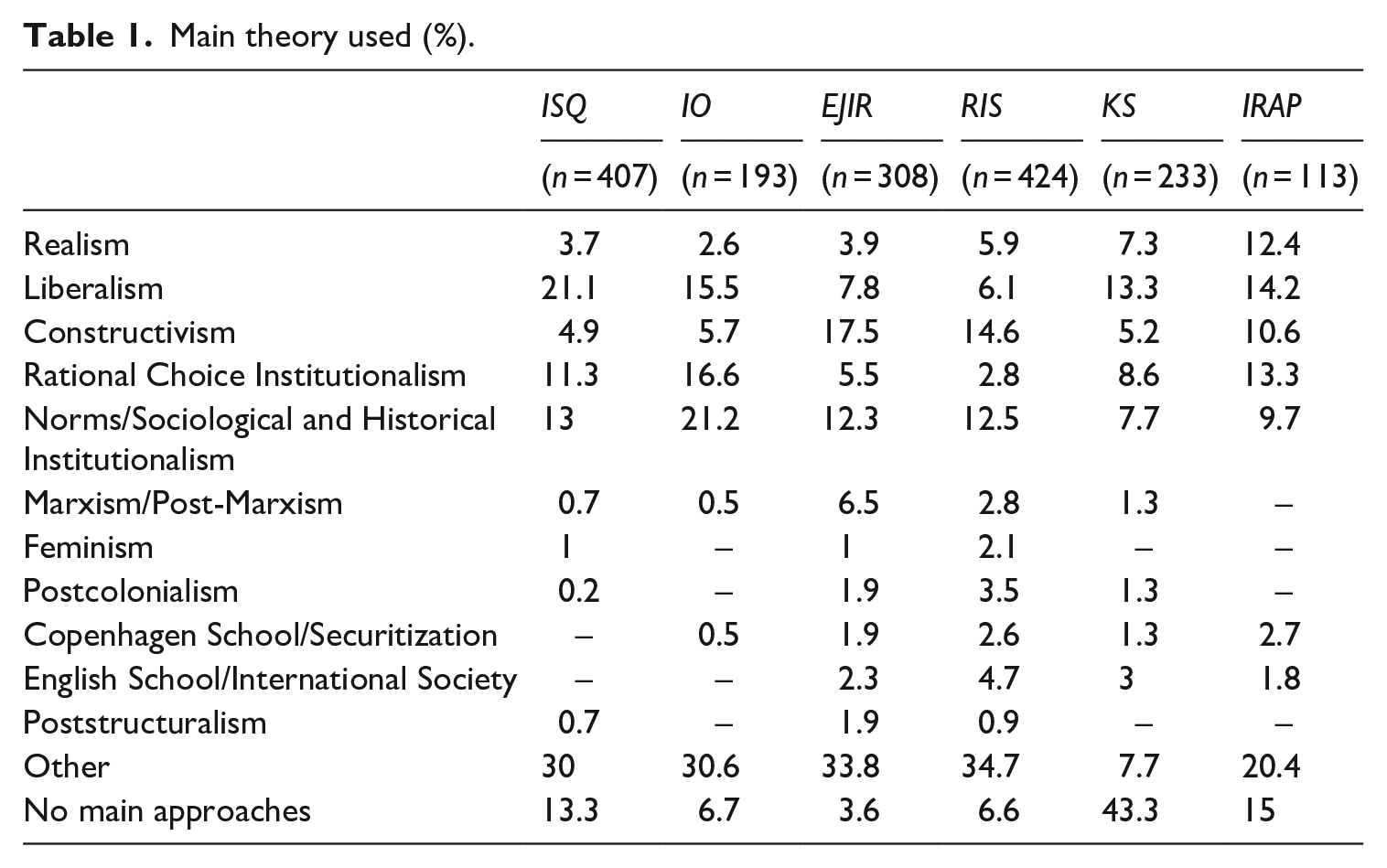
In terms of mainstream approaches (Realism, Liberalism, Constructivism, Institutionalisms), Liberalism, Rational Choice Institutionalism, Norms/Sociological and Historical Institutionalism stand out as the favoured paradigms for American journals, while Constructivism and Norms/Sociological and Historical Institutionalism are popular among its European counterparts. Popularity is fairly evened out for IRAP, and to a lesser extent, KS. Mainstream theories account for around half of the main theory used across the six journals (49.3%).
Interestingly, there seems not to be as big a gulf between the journals surveyed here in terms of the main theory used, particularly if compared with the 2014 TRIP faculty survey results showing a clear positivist/post-positivist divide: with 61.1% of US scholars self-identifying as positivist and 19.9% as post-positivist, whereas 32.9% of British scholars self-identify as positivist and 34.5% as post-positivist. 38 Such divide becomes further visible when examining the articles utilising critical approaches. The two European journals each have over a quarter of articles drawing on critical theories, with EJIR at 15.6% and RIS at 16.7%, while in American journals ISQ and IO have a mere 2.7% and 1% respectively. This is similar for Japanese journals, with KS at 6.9% and IRAP at 4.4%. As it will be discussed later, the ‘transatlantic divide’ becomes evident once the articles coded as ‘other’ are considered, particularly on the disciplines they draw on as well as their purpose. 39
The other eye-catching feature of the data is those articles coded as having no main approaches, with the Japanese journal KS standing out at 43.3%. The reason for such a high proportion of articles not employing a particular theoretical paradigm may be explained by the institutional structure of the Japan Association of International Relations (JAIR) and the setup of the journal. The organisation is divided into four research blocks of (diplomatic) history, area studies, theory and ‘non-state actors’, with diplomatic historians and area studies specialists making up the largest number and taking a leading role. As its main outlet, the journal reflects this organisational arrangement with special issues rotating around the four sections. 40 It is also manifested in the four-volume survey of the state of the discipline in Japan, Japanese Studies of International Studies, published to commemorate the 50th anniversary of JAIR. 41
The remaining shortfall is filled by theories that are imported from neighbouring disciplines, the focus of this paper. As shown in Table 1, all four journals from the United States and Europe exhibit articles that draw from other fields at over 30%. This figure is much lower for Japanese journals, with IRAP standing at 20.4% and KS at 7.7%.
One last point to note is the ratio of those articles drawing on a single theory versus those that engage with multiple paradigms. Of the six journals analysed, five journals had around 50% or more articles utilising multiple theories – ISQ (28.3/53.7%), IO (36.8/53.7%), EJIR (18.9/75.1%), RIS (28.9/61.8%), IRAP (31.7/47.6%). Only KS had more articles drawing on a single paradigm (29.5/20%). Research employing multiple theoretical approaches seems to be in fashion, perhaps in line with the rising popularity of ‘analytic eclecticism’. 42
Issue area
Table 2 summarises the general trend of the primary issue areas. 43
Issue areas (%).
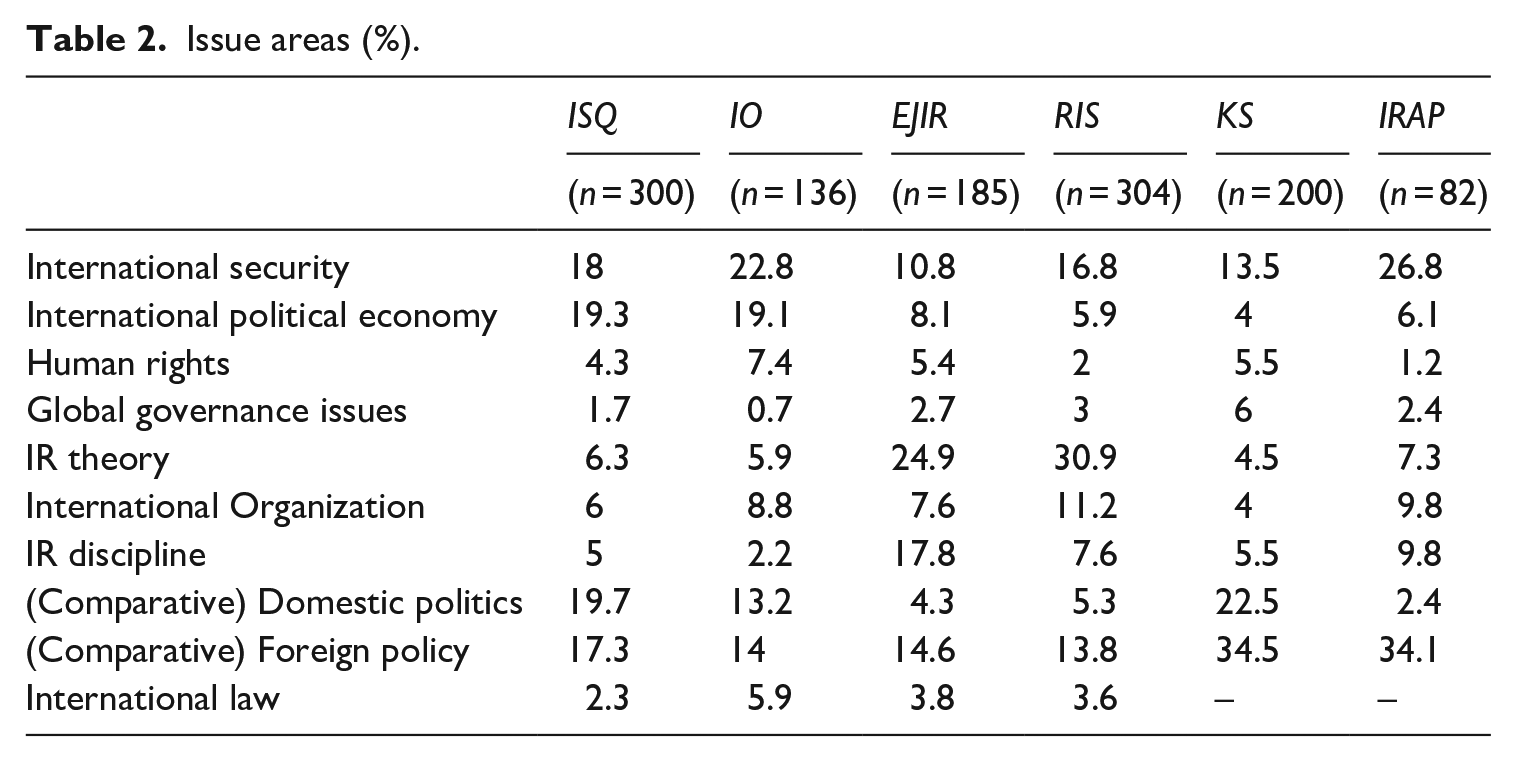
ISQ and IO are rather evenly spread out across the traditional subfields of IR, with security studies, international political economy, foreign policy analysis and comparative/domestic politics each scoring over 10%. Japanese journals resemble a similar trend, although there is a lack of international political economy articles in both KS and IRAP. On the other hand, European journals present a somewhat different picture, with IR theory topping the list at 24.9% for EJIR and 30.9% for RIS. While some of this is because the data combines articles that focus on IR theory and political theory, excluding the latter still makes for approximately one in five and one in four articles having a specific theoretical focus respectively. This may imply that while the ‘paradigm wars’ may be over, to suggest a discipline-wide ‘retreat from theory’ is perhaps premature. 44
Methodology
Lastly, Table 3 shows the general trend for methodology. 45
Methodology (%).
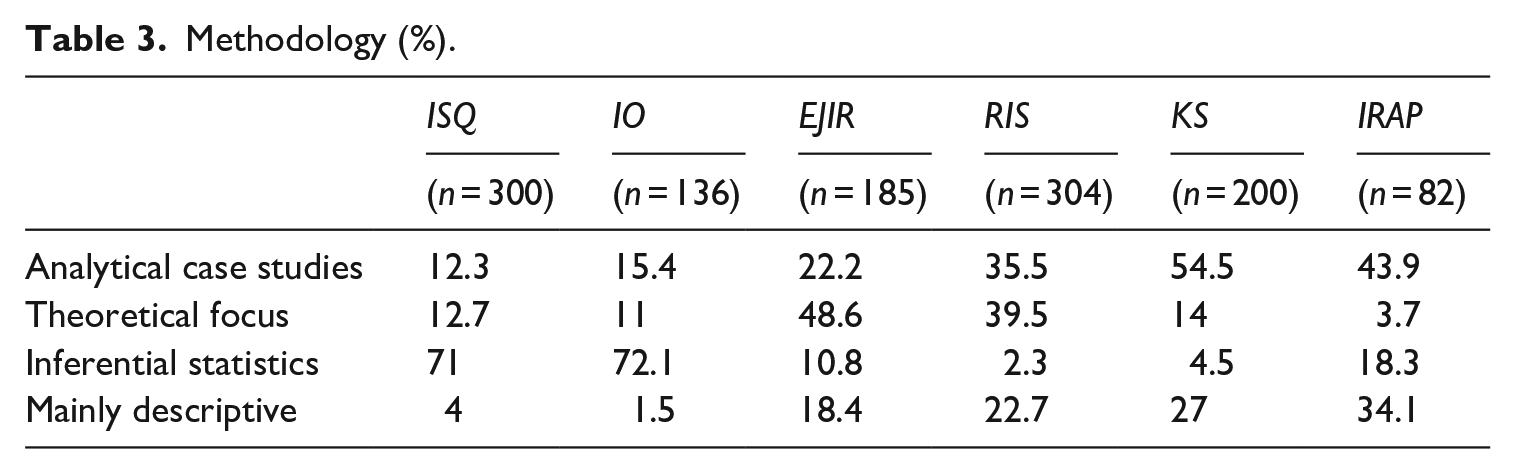
A clear regional divide is evident here, with American journals showing an unequivocal preference for quantitative methodology, while European and Japanese journals signalling inclination toward qualitative research. Quantitative methodology is clearly favoured in both ISQ and IO, with each over 70%. European journals exhibit a mirror opposite of this trend, with theoretical focus accounting for 48.6% in EJIR and 39.5% for RIS, and analytical case studies coming in next at 22.2% and 35.5% respectively. KS and IRAP, on the other hand, overwhelmingly favour analytical case studies, with 54.5% in the former and 43.9% in the latter.
Those articles with a theoretical focus (defined as articles that do not use any data and do not test any hypotheses) are also worth noting, as they signify research that engages with theory development and testing. Here, over 70% falls into the two European journals, with ISQ, IO and KS over 10%. This supplements the finding above about issue areas and probably implies that theory development is not abandoned just yet, at least when European journals are concerned.
Interdisciplinary relations and theoretical plurality
To further analyse how the interdisciplinary exchange is prompting knowledge production in IR during the period under study, and to see which fields IR is importing from to produce new insights, this paper extends the original dataset to include imported disciplines, as well as to identify the reasons behind its importation. Table 4 presents the journal-by-journal breakdown of those articles that were coded as ‘other’ in the main theory used table above by the disciplines imported.
Imported discipline by journal (%).
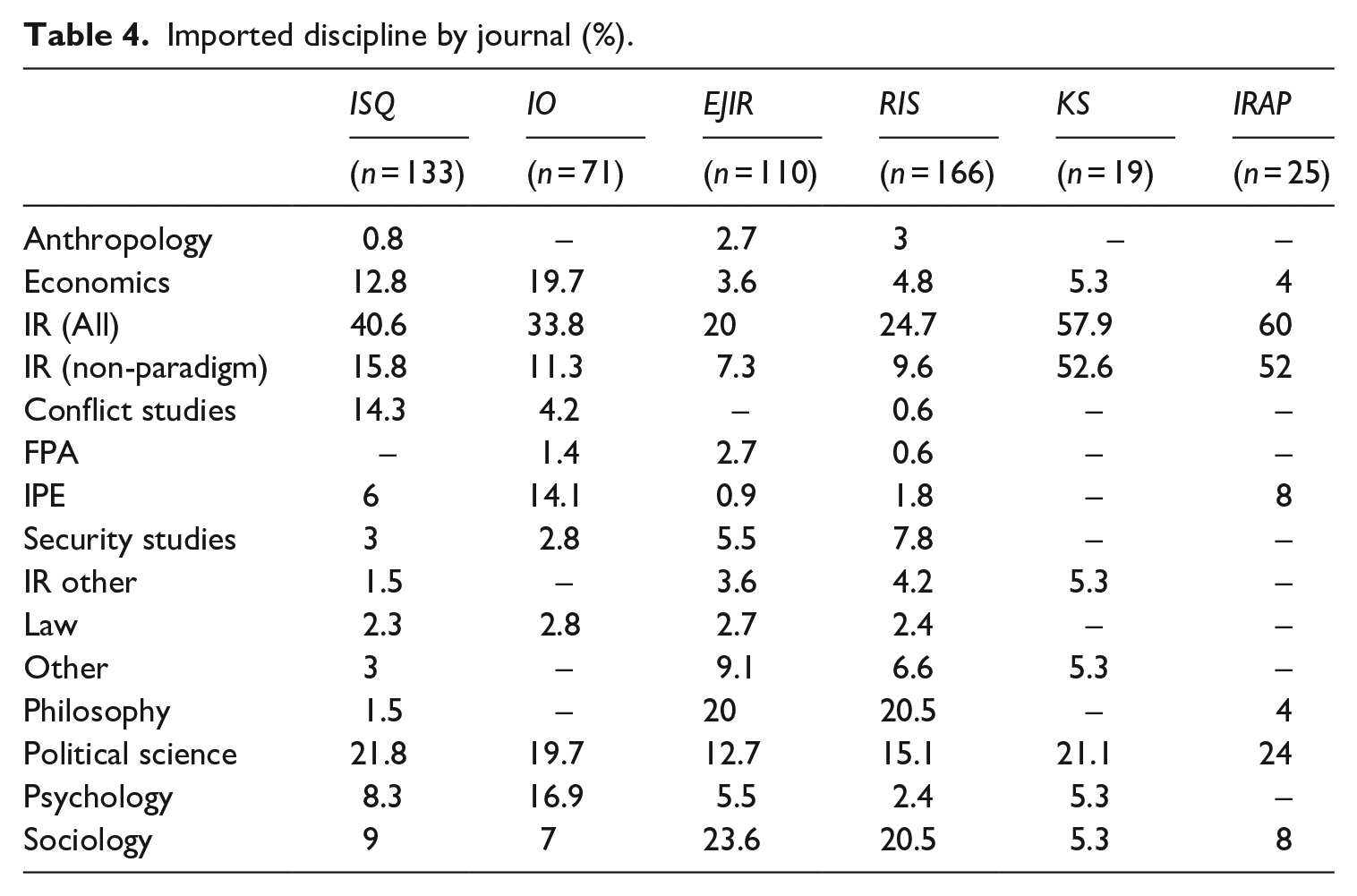
On aggregate, the journals exhibit a clear regional divide. Theories from IR subfields top the list for American journals at 38.2%, with non-paradigmatic (middle range) theories, quantitative conflict studies, and international political economy most frequently drawn, followed by Political Science, Economics and Psychology. European journals show a markedly different pattern – while IR subfields are also the most drawn, it is closely followed by Sociology and Philosophy. Political Science comes next, though on closer inspection, the composition is different from its American counterparts – with the former engaging dominantly in political theory, while the latter drawing for formalised models. Japanese journals have the most disproportionate tendency, with non-paradigmatic IR approaches and Political Science comprising around 80% of the theories drawn.
Table 5, in turn, shows why these theories were imported. Again, note that some articles were coded multiply and were counted separately here.
Reasons for import by discipline (%).
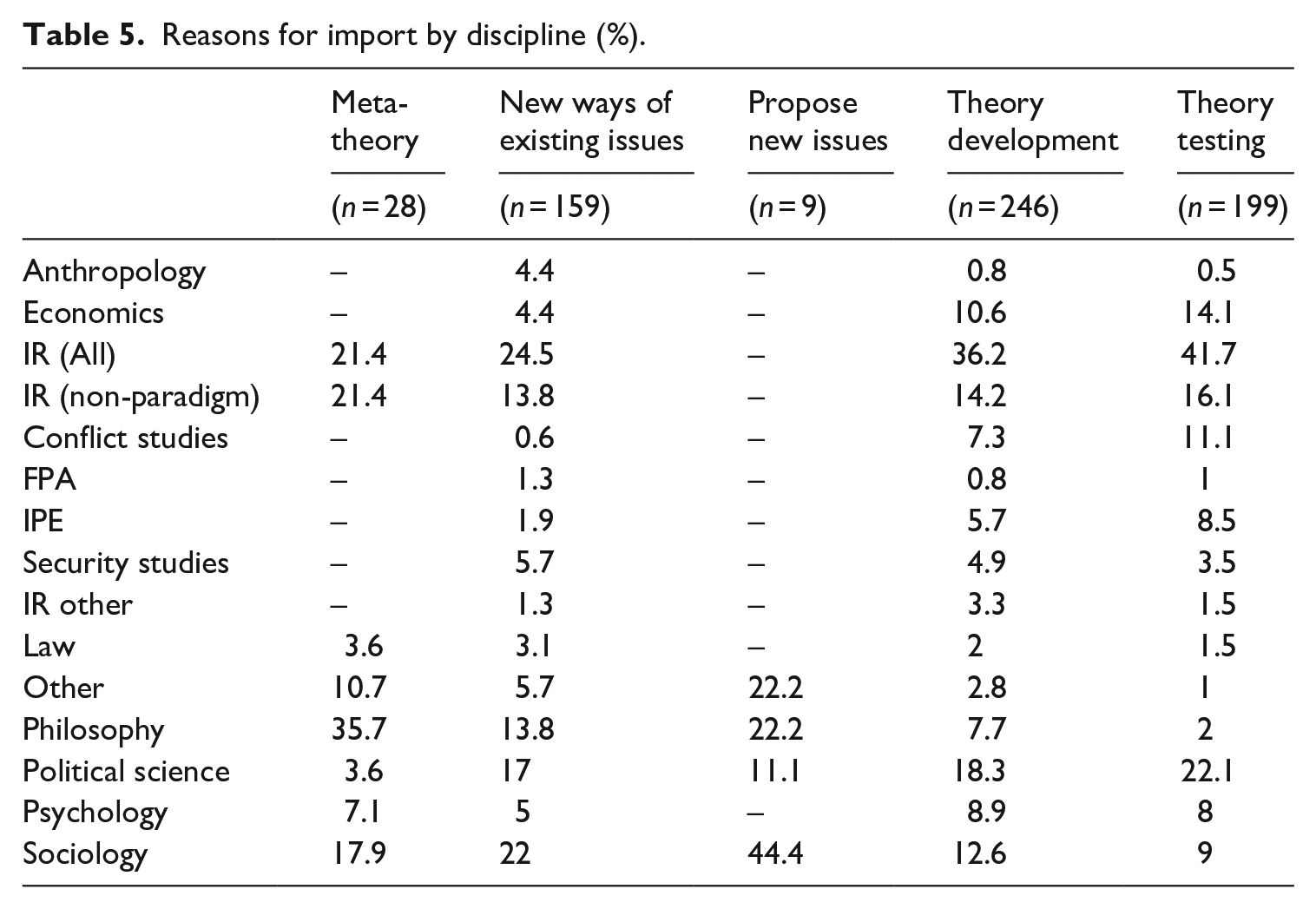
As shown, ‘theory development’, defined here as articles that aim to refine and develop existing theories by adding new elements, clarify and develop concepts, challenge assumptions and construct new theories by drawing on other discipline(s) 46 comes in first, followed by ‘theory testing’, articles that aim to ‘test’ a given theory empirically through quantitative or qualitative data, including hypothesis testing. The theory tested can be an existing IR theory, imported theory applied to an IR issue, or a combination of both. Among the ‘theory testing’ category, around half is also coded as ‘hypothesis testing’, with Political Science (26.9%), conflict studies (16.1%) and Economics (14%) in the driving seat. ‘New ways of existing issues’, articles that suggest new ways of studying existing issues already taken up in the field, comes in third. This includes more theoretical exercises, such as using a new approach to study existing issues and drawing on new concepts to shed new light on existing issues; or having an empirical orientation, such as drawing on new evidence to examine issues. 47
While small in number, articles that propose new issues, agendas and approaches to be researched within the field is also worth noting, which includes articles that: draws on science and technology studies to reconstruct political cybernetics, and provides insights into computer networks, partly automated security systems, poverty and decentralised governance 48 ; proposes ‘critical genocide studies’ that challenges the idea of genocide as a phenomenon of domestic politics, and engages with a ‘relational’ and ‘international’ approach, drawing on historical sociology 49 ; advances ‘queer IR’ drawing on (global) queer studies 50 ; suggests ‘inter-lingual relations’, based on Puttnam’s two-level game and Wittgenstein 51 ; discusses the absence of anarchism in IR by examining the historiography of the discipline and early debate between Harold Laski and Hans Morgenthau 52 ; examines global cities and transformation of the international system drawing on Bruno Latour and Saskia Sassen 53 ; establishes ‘posthuman international relations’ by drawing on posthumanism and complexity theory 54 ; and substantiates ‘global politics of medicine’ that opens up new avenues of research. 55
Table 6 offers a further breakdown of ‘theory development’, the category most closely related to theoretical plurality, by region.
Theory development breakdown by region (%).
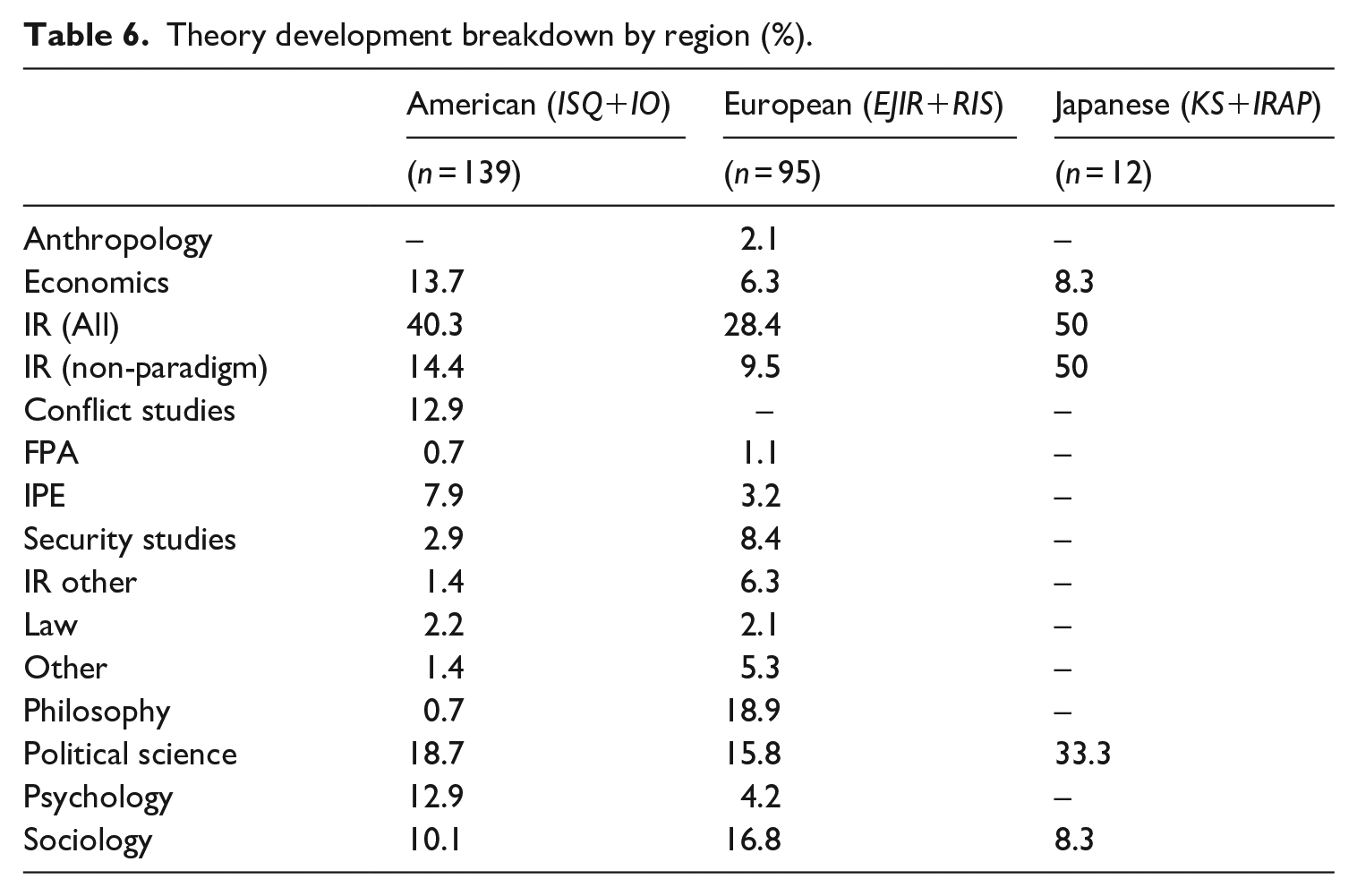
As seen in Table 6, IR subfields top the list for American journals at 40.3%, with non-paradigmatic IR approaches and conflict studies drawn the most. This is followed by Political Science (18.7%), Economics (13.7%) and Psychology (12.9%). Liberalism is utilised the most alongside Political Science, followed by Rational Choice Institutionalism and Norms/Sociological and Historical Institutionalism. Various principal-agent approaches are drawn the most. Economics is used mostly individually, and to a lesser extent with Norms/Sociological and Historical Institutionalism. International economics is the most favoured, for instance, those that draw on the Hecksher-Ohlin model. Again, Psychology is used mostly stand-alone, and with Liberalism and Rational Choice Institutionalism less frequently. Social and political psychology approaches are favourites. Also, of interest are those articles that utilise cognate disciplines to strengthen their micro foundation, such as Hafner-Burton et al. that draw on both behavioural economics and cognitive psychology. 56
While IR subfields are also cited the most in European journals (28.4%), it is much more evenly spread out, with Philosophy (18.9%) and Sociology (16.8%), and Political Science (15.8%). Constructivism is utilised the most alongside Philosophy, with Norms/Sociological and Historical Institutionalism in the distant second. On closer inspection, Frankfurt School critical theory is the most popular, though different philosophers are drawn from the Western canon. Sociology is used mostly individually, and to a lesser extent in combination with Constructivism and Marxism/Post-Marxism. Different to its American counterparts, Political Science here is overwhelmingly comprised of political theory, with theories of democracy and cosmopolitanism the favourites. Like Sociology, it is used mostly stand alone.
In parallel to the main theory used table above, Japanese journals draw heavily (albeit a few) from non-paradigmatic middle range IR theory and Political Science. As for the non-paradigmatic IR theory, two out of six articles that focussed on IR theory mention non-Western IR, such as theories of East Asian hierarchy and the so-called ‘Chinese School’ of IR. All except for one are used individually. Half of the articles drawing on Political Science are used alongside Liberalism, and the other half stand-alone, with political theory as the focus.
Discussion: from fragmentation to meaningful engagement
From the analysis of the American, European, British and Japanese journals above, two findings can be identified. The first main result from the analysis is the continued regional divide within the discipline. In terms of the general trends observed, the regional divide takes on a familiar appearance. European journals utilise critical theories and tend to draw on multiple approaches in their analytical framework, compared to American and Japanese journals which are much more engaged with the mainstream. ISQ and IO are focussed on the traditional subfields of IR, and to a lesser extent KS and IRAP, while attention is much more diverse for EJIR and RIS, with IR theory being the most popular. Methodologically, the ‘transatlantic divide’ continues to be the dividing line, with American journals predominantly positivist and quantitative, and European journals post-positivist and qualitative. Japanese journals are also positivist but compared with their American counterparts, qualitative in nature.
Such regional differentiation is amplified by its interdisciplinary relations. Although American and European journals each draw 30% or more from other fields, their composition and reasoning are markedly different – the former draw the most from Political Science, Economics and Psychology, while the latter draw from Sociology, Philosophy and Political Science. Political Science and Economics are associated with ‘theory development’ and ‘theory testing’ (including ‘hypothesis testing’), which imply that they are being imported to develop existing theories of IR, take positions within ongoing debates, and draw out hypothesis to be tested. Sociology and Philosophy, meanwhile, are associated with ‘meta-theoretical examination’ and ‘new ways of existing issues’, which suggest that they are brought in to shed new light on existing issues, for instance by building on new concepts like Foucault’s ‘governmentality’ or Trotsky’s ‘uneven and combined development’ to garner new insights. 57
The second main result consists of a core-periphery divide within the discipline. As the analysis above exemplifies, Japanese journals strictly observe a narrow disciplinary boundary, predominantly drawing on mainstream theories (or theory, in the case of KS), focussed mostly on traditional issues, and with positivist methodology. Similarly, KS and IRAP exhibit the least diversity in terms of their interdisciplinary relations, with 80% drawn from either IR subfields or Political Science. The Japanese IR community seems to be locked in the ‘prison of Political Science’, even compared to American IR. 58 Perhaps suggestive here is the notion of a ‘semi-periphery’ proposed by Steffek and Lasshof in their investigation into the German IR community. ‘Semi-periphery’ consists of ‘IR communities from countries that have abundant material resources, modern university systems, and easy access to the English-speaking core, but for reasons of language and diverging academic cultures do not fully engage in its academic practices’. 59 As a disciplinary ‘semi-periphery’, the German IR community faces a dilemma with pressures to internationalise on the one hand, and to cater towards the national discourse in the local language on the other. They are heavily influenced by the English-speaking ‘core’, with theory also being imported from the centre. 60 Here, the similarities between Japanese and German IR communities are clear – theoretically mainstream and focused on policy-oriented issues that are in high demand from their national audiences. The results, therefore, show that there is more active importing in the English-speaking ‘core’ compared to those communities located in the ‘non-core’, or that theory-driven research is published in English-based journals in the ‘core’. This points to a global knowledge production network of innovative theoretical insights generated in the ‘core’, sometimes through importing and transforming existing accounts, then diffused as accepted knowledge to those in other communities; and supports Kristensen’s suggestion that general-theoretical IR journals at the ‘core’ act as nodal points and integrate specialised fields and less cited source in the ‘periphery’. 61
Where does this leave the wider ‘periphery’? Bilgin observes that IR scholarship in other parts of the world does not reflect the kind of ‘difference’ found in texts and contexts outside of IR and/or North America and Western Europe, but adopts ‘standard’ concepts and theories of the field, notwithstanding their well-known limits. 62 Absence of Critical IR beyond the West, according to Bilgin, lies in the fact that scholars outside of the ‘core’ experience a world that is already worlded, that have shaped (and have been shaped by) their approaches to the international, but also by the sense of what is generally accepted as legitimate frameworks to inquiry. This certainly applies to the ‘semi-periphery’ as seen above, and perhaps parts of the ‘periphery’. Yet the ‘periphery’ is significantly more diverse, and there are inherent dangers in characterising it as one homogeneous whole. Indeed, the recent rise in interest in concepts such as ‘worlding’, ‘relationality’ or the ‘pluriverse’ suggests that dissatisfaction with the universalising tendencies of the English-speaking ‘core’ has sparked new radical alternatives emanating from the ‘non-West’ or the ‘Global South’. 63 Developments in disciplinary history that highlight the multiple origins of IR further point to how the borrowing of ideas from different disciplines and locations has long historical lineages in the non-Western world. 64
The following two-by-two table locates this paper’s findings within the existing literature on the sociology of IR. Taking IR’s state of plurality at the horizontal axis and assessment of pluralism as vertical, it depicts four images of IR as a discipline (Table 7).
Four images of IR.
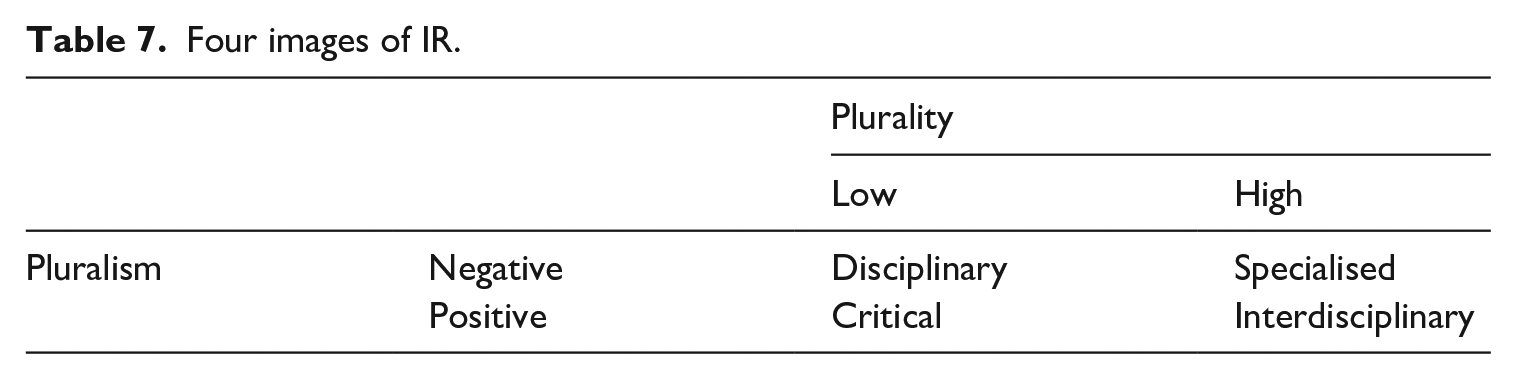
Disciplinary IR depicts a relatively low level of interdisciplinary relations, with a consensus on theoretical and methodological unity as necessary for the healthy status of IR as an independent discipline. A small number of mainstream theories and theorists dominate the theoretical scene – or what Oren labels ‘polycentric oligarchy’. 65 Specialised IR, meanwhile, illustrates a situation of increased exchange with other disciplines, and even though the ultimate ideal of unity is still not lost, scholars have moved into more specialised silos drawing modestly from cognate fields. The focus here is more on developing middle range theories, and insights are imported from other disciplines to refine and develop existing approaches, draw out hypotheses, or differentiate within the theoretical camp. 66 By contrast, Critical IR highlights a limited yet keenly advocated move toward interdisciplinary engagement, usually among those in the margins of the theoretical spectrum. This is exemplified by the expansion of critical approaches, which greatly increased theoretical and methodological diversity within the discipline but was initially frowned upon by the wider IR community. 67 Lastly, Interdisciplinary IR portrays a high level of interdisciplinary relations, as well as an agreement on diversity as a positive avenue for disciplinary development. As Daxecker et al. note, interdisciplinarity is now recognised as ‘a thriving form of knowledge production in IR’, with scepticism towards established disciplinary boundaries, paradigms and methods, or ‘transdisciplinarity’, being on the extreme end. 68
Looking back at the results, it could be argued that the two American journals, ISQ and IO, reveal a tendency that matches with Specialised IR, European journals, EJIR and RIS, with Interdisciplinary IR, and Japanese journals, KS and IRAP, with Disciplinary IR. Furthermore, it could also be pointed out that the ‘transatlantic divide’, which in the past was a debate between Disciplinary and Critical IR, is now one between Specialised and Interdisciplinary IR, with theoretical plurality the common denominator. Within the core-periphery structure, the divide is over both plurality and pluralism, with the English-speaking ‘core’ spanning across Specialised and Interdisciplinary IR, ‘semi-periphery’ like Japan and Germany strongly influenced by the English-speaking ‘core’ (and particularly the United States) as Disciplinary IR, and the wider ‘periphery’ either following the ‘core’ and the ‘semi-periphery’ (Disciplinary IR) or engaged in a radical overhaul of the ontological foundation through interdisciplinary dialogue, Interdisciplinary IR. In terms of interdisciplinary relations, then, the English-speaking ‘core’, non-English ‘semi-periphery’ and parts of the ‘periphery’, and more theoretically diverse parts of ‘periphery’ each symbolise the direction that IR as a discipline is (or should be) heading, which will also imply a shift in what gets accepted as ‘IR’ in the coming decades.
Furthermore, one of the factors affecting the assessment of the fragmentation debate, as noted above, is theoretical coherence as a necessity for scientific progress. On this point, Dryzek’s argument about the progress of Political Science is worth looking back. 69 Dryzek distinguishes between vertical and lateral progress, noting that ‘vertical progress of natural science, a succession of research traditions chosen and eventually discarded on a rational basis, is not the only kind of progress that can occur’ and instead proposes lateral progress, whereby ‘political science is progressive to the extent that its ability to cope with contingency in the character of its empirical problems (scarcity or plenty, stability or revolution, etc.) grows with time’. 70 In other words, the former points to theoretical coherence and accumulation, whereas the latter focuses on increasing research traditions that one can utilise when a new issue emerges in international relations. Applied to the state of theoretical plurality and pluralism in IR, those concerned with plurality tend to view vertical progress as legitimate, thus also importing from other disciplines to further this cause, while those that celebrate theoretical diversity take the view of lateral progress, thus borrowing from a range of fields where they see as beneficial for expanding the toolbox of IR.
If theory is understood as a political and ethical endeavour like Smith, then theorising becomes an effort to participate in the movement of seeking recognition about the diverse ways of life, particularly those of the under or unrecognised. 71 If that is the case, then the current debate over whether to perceive pluralism as good or bad for the discipline is somewhat out of touch. To unpack this problem, Connolly’s notion of pluralism can provide useful insights. 72 For Connolly, authoritarian arguments that attempt to dissolve all differences into commonality are unfit for the contemporary world. By contrast, Connolly proposes what he calls the ‘politics of becoming’ (or the politics of pluralisation). Politics of becoming refers to political interaction among social groups to try to include one’s own identity, rights, virtue or faith onto the register of being that has already been legitimised by the politics of diversity. For a plural society, the tension between established politics of diversity and unforeseen issues surfacing to achieve legitimacy is important. Connolly suggests two civic virtues that underpin such politics of becoming: ‘agonistic respect’ (where different groups grounded in different faith draws respect out from unfamiliar sources) and ‘critical responsiveness’ (to reconstitute one’s own criteria of judgement). 73 Applied to IR, how does Connolly’s pluralism look like? Politics of diversity, to a certain extent, does exist both in the practice and theory of international relations (e.g. politics of gender and the rise of Feminism). By contrast, approaches such as Postcolonialism and Green Theory are surfacing to seek legitimacy. Yet within the fragmented field that is IR now, Connolly’s notion of ‘agonistic respect’ and ‘critical responsiveness’ seems to be somewhat lacking. Rather than debating over whether borrowing from other disciplines and the theoretical pluralism that it brings is positive or negative for IR, therefore, we need to focus our attention on what this brings and adds to the field’s capacity to understand and better the world. This is, of course, what IR has aspired to since its beginning.
Lastly, what does this imply for IR scholarship in Japan? Analysis of KS presented above certainly paints a picture of the IR community in Japan under the strong influence of the English-speaking ‘core’, particularly the United States. Yet on closer look, one can find a different scene, since ‘importing’ from the outside, whether from another IR community or from other fields, does not necessarily entail that it merely gets ‘copied’. Creative agencies can be at work in translating theories and concepts, thus mutating to something new even though under the same banner. Recent works have highlighted such creative forces at work. 74 While under-recognised, such work has the potential to contribute to recent calls to establish Global IR.
Conclusion
In his contribution to the end of IR theory debate, Brown provides both a positive and negative assessment of the current state of the discipline. 75 On the positive side, Brown points to progress made particularly on mainstream, problem-solving theories, contributing to the understanding and bettering of the world. On the other hand, critical theories still need to do more as they failed to deliver on their promises; since it engages in ‘world-revealing’ but not necessarily ‘action-guiding’ work. 76 As ‘there are a range of “problems” that the “problem-solving” theorists are not addressing, and this is where the need for new thinking is pressing’, we need what he calls ‘critical problem-solving’ that combines both ‘world-revealing’ and ‘action-guiding’ research. 77
From the analysis presented in this paper, it can be concluded that theoretical proliferation through importing, and the theoretical pluralism it entails, is certainly contributing to the ‘world-revealing’ kind as suggested by Brown, particularly within the pages of EJIR and RIS. As it was discussed, there is a familiar geographical difference between American and European journals, not just in terms of theoretical and methodological divergence, but also inr their interdisciplinary relations. Interdisciplinarity is now the norm, it seems, in the English-speaking ‘core’, but difference exists in the manner and extent to which it engages with other disciplines depending on how theoretical pluralism is viewed. American IR’s preference is for sub-disciplinary specialisation, or Specialised IR, whereas European/British IR draw on cognate fields to challenge disciplinary boundaries, or Interdisciplinary IR. It was also revealed that there is a core-periphery divide in terms of interdisciplinary relations and knowledge production in IR. The results show that there is more active importing in the English-speaking ‘core’ compared to those communities located in the ‘non-core’, or that theory-driven research is published in English-based journals in the ‘core’. This implies a global knowledge production network of innovative theoretical insights generated in the ‘core’, sometimes through importing and transforming existing accounts, then diffused as accepted knowledge to other communities – but with new interdisciplinary approaches calling for a radical overhaul of the ontological foundation of IR emanating from the ‘periphery’, questions remain as to how long such a structure will last. If we accept the view that scientific progress is neither linear nor cumulative but takes the form of theoretical pluralism, and that fragmentation is not a barrier to the advancement of the field, then an assessment can be made that fragmentation is nothing harmful but simply a result of healthy disciplinary development. 78 Interdisciplinary relations and theoretical proliferation are thus contributing to lateral progress in Dryzek’s sense of the term.
Footnotes
Funding
The authors disclosed receipt of the following financial support for the research, authorship, and/or publication of this article: Data collection for this research has been funded by Grant-in-Aid for Challenging Exploratory Research: 18K18557.
