




Abstract
This article explores Angela Merkel’s decision to open Germany’s borders to refugees in September 2015 and her support for the EU-Turkey statement in March 2016. While the first policy offered relief to refugees, the second was designed to significantly reduce the number of refugees coming to Europe. Besides the seemingly contradictory rationale behind these two foreign policy decisions, the role that domestic media played in Merkel’s decision to open the borders was remarkable. The connection between media reports and public opinion has long been established, whereas the connection between foreign policy and the media is more recent. However, the link between all three and how they operate together is yet to be studied. By exploring these connections, we show how foreign policy decisions can be accepted by locals within a language context that fosters identification with outsiders. Similarly, a shift in the discourse, which contributed to the perception of a divergence of interests between the local population and the refugees, helps to understand the subsequent change in foreign policy. In short, we show how this shift provides an insight into the parallels between domestic media discourses, public opinion and foreign policy decisions. We apply deductive qualitative content analysis to demonstrate this connection.
Keywords
Introduction
In 2015, the most accurate figures put the number of newly arrived and registered asylum seekers in Germany at 890,000. 1 This means that out of all EU member states, Germany received by far the largest absolute number of asylum applications in 2015, compared to Hungary (172,000), France (71,000) and the UK (39,000). 2 These numbers however, highly underrepresent the actual number of people that arrived in the country, making the gap between Germany and other European states significantly larger than the numbers above suggest. 3 The great majority of them arrived in the months after German Chancellor Angela Merkel had publicly said that Germany could, would and should receive those fleeing from war and persecution during her summer press conference on August 31, 2015. 4 Two days after Merkel’s now-(in)famous words ‘Wir schaffen das’ 5 (‘We can do this’), the picture of Aylan Kurdi, the drowned 2-year old boy who lay washed up on a Turkish beach, sent ripples through Europe. The death of Aylan and events in Hungary, 6 ultimately led Merkel and her Austrian counterpart to allow refugees waiting in Hungary to pass through Austria and enter Germany by official transportation on September 4.
And yet, by the following March a deal had been struck between the EU and Turkey, designed to limit the number of refugees reaching Europe from Turkey. Angela Merkel played a significant role in bringing about this joint statement. 7 Officially, it was described as an important step in the fight against human traffickers, calling the return of any ‘migrants’ from Greece to Turkey a ‘temporary and extraordinary measure which is necessary to end the human suffering and restore public order’. 8 International and civil society organisations, however, criticized the recognition of Turkey as a safe third country and highlighted the negative consequences of seeking refuge there. 9 Similarly, Human Rights Watch denounced the disregard for the protection of refugees under international law within the deal. 10 This means that in approximately seven months after Angela Merkel’s decision to open Germany’s borders to an, at least in principle, unlimited number of refugees, she played a leading role in forging the deal between the EU and Turkey which was designed to prevent refugees from reaching the territory of EU member states. This policy shift is notable as her strong support for this deal appears to be inconsistent with her open-door policy, particularly with regard to human rights concerns.
German public opinion saw a similarly significant shift in this time period. In the autumn of 2015, German cities witnessed a ‘Willkommenskultur’ (‘culture of welcome’) as people waited to greet refugees at train stations, while government and civil society organisations were overwhelmed with donations. Germany, however, also became the scene of acts of violence and hatred. In 2015, the police registered 173 acts of violence and 92 arson attacks against buildings providing accommodation for refugees. 11 In addition, Angela Merkel was strongly criticised by politicians of her own party for refusing to set a maximum number (Obergrenze) of refugees that Germany was willing to accept. Furthermore, there was reason to perceive the German authorities as helpless, as the bureaucratic system was unable to properly handle the immense number of refugees. While there were no terrorist attacks in Germany committed by persons who had come to the country as refugees until July 2016, 12 police in Cologne failed to protect women from sexual abuse at the hands of men largely of North African origin on New Year’s Eve 2015. 13
Subsequently, in three regional elections in March 2016, the right-wing populist party Alternative for Germany (AfD) gained more than enough votes to enter all three regional parliaments for the first time since its establishment in 2013. Merkel’s Christian Democratic Union (CDU) party on the other hand lost 12% of votes in Baden-Wurttemberg, 3.4% in Rhineland-Palatinate and 2.7% in Saxony-Anhalt compared to the 2011 elections. 14 This loss was interpreted by many as a backlash against Merkel’s refugee policy (Flüchtlingspolitik). 15
In addition, survey data collected by the German elections research group has consistently ranked migration as the most important issue in German politics between 2014 and 2019. 16 A poll taken at the beginning of March 2016 clearly states that German public opinion supported national and international law on refugees and attitudes towards helping those in need has a strong normative anchoring. 17 At that time, the law was perceived legitimate and 81% of the respondents agreed that Germany must fulfil its obligations under international law. 18 However, data from the ARD-DeutschlandTREND also shows that by October 2015 there was a 13% increase amongst those who were worried about the large number of refugees coming to Germany which meant 51% of the German population. 19 This shift in public opinion has also been demonstrated by Czymara and Schmidt-Catran in their two-wave panel survey. 20 They argue that public acceptance of refugees decreased significantly between April 2015 and January 2016 and that change can be attributed to several factors such as the increase in refugee numbers, fatal attacks by Islamist terrorists and the assaults in Cologne on New Year’s Eve.
We seek to connect the shifts in German public opinion of foreign policy, arguing that, besides important domestic political drivers such as the neo-Nazi protests at the Heidenau asylum centre, the events in Cologne, the rise of the far-right Alternative for Germany (AfD) party, internal struggles within the Christian Democratic Union (CDU) party and the strain the rising refugee numbers had on public services, the media played a specific role in shaping the domestic political context. Specific frames of the ‘crisis’ in the media presented the political elite with a version of ‘public opinion’ which allowed for a major and rapid foreign policy shift. In order to understand this shift, we firstly examine the link between public opinion, the media and foreign policy analysis. Secondly, we analyse the principles underpinning Merkel’s two decisions by investigating how her language use informed their acceptability. Third, we examine almost 500 systematically selected newspaper articles to demonstrate how different media frames of the ‘refugee crisis’ 21 enabled Merkel to change her stance and make the foreign policy shift. In short, we show how media frames, public opinion and foreign policy decisions operated from opening to closing Germany to migrants during the ‘refugee crisis’.
Public opinion, the media and foreign policy analysis
Farnham identifies ‘a pervasive concern with acceptability’ as the predominant influencing factor cited in the decision-making literature. 22 For a democratically elected leadership, acceptability is necessarily related to the judgement of the public, or more specifically the electorate, on their policies. However, this interaction with the public is two-way. Research has shown the influence of public opinion on presidential decision-making in the United States. Murray, for example, has highlighted the largely constraining nature of the public, especially on domestic issues. 23 However, the relationship is conditional. While Canes-Wrone and Shotts report similar findings, they suggest that ‘presidents are more responsive to mass opinion on issues that are familiar to citizens in their everyday lives’. 24
For foreign policy decisions, which are even further removed from citizens’ daily lives, the influence of the public is even more nuanced. While Holsti refers to ‘impressive correlational evidence that policy changes are in fact predominantly in the direction of the public,’ he also notes that this does not establish a causal relationship between public opinion and policy in one direction or the other. 25 Not only can the public influence decision-makers but the latter can also influence the former. According to Knecht and Weatherford, leaders have significant leverage to decrease the visibility and transparency of their foreign policy decisions as the public is largely dependent on the information flows from the government regarding its foreign policies. 26 Additionally, with the use of ‘crafted talk’, Jacobs and Shapiro argue, politicians can try to sway public opinion to support their intended policies. 27
However, even though the decision-making literature has established the importance of the public and its opinion, the concept itself is highly problematic. Riezler argued that ‘public opinion’ is elusive and not measured correctly if opinion researchers merely poll unconnected, isolated individuals. 28 This view is shared by McQuail, who points to our inability to observe and measure public opinion directly.
Public opinion [has] a certain independence from the individuals contributing to it. This is evident by the fact that individuals have a perception, whether accurate or not, of public opinion as the prevailing view and the view of others. [. . .] Secondly, ‘public opinion’ acquires a certain independence when it is embodied in media accounts. It becomes an objective ‘social fact’ that has to be taken account of by political and other actors.
29
McQuail rightly points to the significance of media accounts in constructing public opinion. Measuring public opinion by polling takes time and polls are hardly available shortly before and after important foreign policy decisions. The media, on the other hand, can interact with both the political decision-makers as well as the public at a fast pace and is more easily accessible for analysis.
Public opinion-media
Due to the links between public opinion and the media, some researchers have used the latter as an indicator – if not proxy – for public opinion when studying foreign policy decisions. 30 Underlying these methodological shortcuts is the assumption that the media has strong effects on the public which in turn creates public pressure on decision-makers. The connection between the media and public opinion has been captured by Noelle-Neumann’s spiral of silence theory. 31 Her argument is that the media plays a key role in influencing dominant positions which in turn creates a fear of isolation through silencing non-dominant voices. Norris et al. calls this connection a ‘two-sided’ case where two media frames are offered, one by leaders and one by the news media. 32 They argue that the dissonance between these two frames contributes to the conventional news frames, which in turn sways public opinion and also the policy process. 33
According to Soroka, ‘mass media content is the most likely source of over-time changes in individuals’ foreign policy preferences’ and foreign policy decision makers subsequently respond to these preferences. 34 Just like Norris et al. and Noelle-Neumann, Soroka’s study highlights the agenda-setting role of the mass media by focusing on the salience of issues. 35 Therefore, similarly to studies of the CNN effect, it shows the media as a link between public opinion and policy makers 36 but not how exactly this link operates 37 which this studies aims to demonstrate.
One way the media can influence public opinion is by presenting news in a certain way using frames. To provide an example, people on the move could be framed as victims of war or as possible intruders. The analysis of media discourses can illustrate the efforts of media outlets to construct a certain social reality and offer an insight into the frames present within a culture. 38 However, Rothschild and Shafranek point out that it can be difficult to determine the causal direction between public opinion and media framing, as each can respond to the other. 39 Furthermore, we do not know how strongly or to what extent frames ultimately affect the receivers’ opinions compared to factors such as previous knowledge, influence of opinion leaders, visuals accompanying the text and the attention given to the media coverage. 40
The elusive nature of public opinion thus still presents a puzzle. While ‘a pervasive concern with acceptability’ 41 is named as the most important factor in policy makers’ decision-making, we cannot measure what the public is willing to accept in a democracy. However, recognising that we would not study the media if it were not for its audience and readership is vital. In 1991, when scholars were already questioning the impact of television on executive decision making, Colin Powell was quoted saying that ‘live television coverage doesn’t change the policy, but it does create the environment in which the policy is made’. 42 What he referred to as the environment, others have called the context or situation. Fundamentally, ‘decision-making behaviour cannot be understood without specifying the situation to which the decision-maker is responding – and for political decision-makers that includes not only substantive policy problems, but also the political context within which they must be addressed’. 43 A shift in the discourse can change the situation, or social reality, even though the underlying political decisions might be unchanged. With regard to the public, media reporting can serve as a ‘cognitive shortcut’, defining the salient perspectives for the majority of the public on complex issues. 44 Consequently, we can conceptualise the role of the media as at least partly constructing the context which the decision-maker operates in as well as what constitutes acceptable.
Foreign policy analysis
‘International politics are formed by the aggregated consequences of our individual and collective decisions’. 45 Starting from this premise, foreign policy analysis (FPA) examines how material and ideational factors intersect for decision makers who, alone or in groups, determine state behaviour. 46 FPA moves beyond the conceptualisation of states as black boxes, arguing that much can be gained if we do not assume that decision-makers can be ‘approximated as unitary rational actors equivalent to the state’. 47 Examples of common research areas in FPA are individual psychological factors in foreign policy decision making or elite-mass relations. 48 Recent developments in FPA offer the possibility to combine its focus on human agency with other theoretical perspectives.
FPA also points to the importance of the acceptability of a decision as well as its context, which suggests that analysing the articulation of the media seems to be obvious. Yet, so far, FPA research has predominantly focused on contested discourses among the elites. Similarly, the question remains of how to incorporate the relationship between public opinion and the media into FPA.
As mentioned before, studies on the so-called CNN effect can be seen as an early attempt to do so as they view global mass media outlets as playing a key causal role in the decision-making of foreign policy actors. 49 This is seen as a direct causal path but one which involves public outcry due to news coverage of global crises. Robinson has pointed out that the mass media is not an independent force that affects policy as it can be mobilised or even manipulated by elites to ‘manufacture consent’. 50 He also notes however, that framing is crucial in determining the political outcome of media reports.
In a similar vein, Weldes argues that the state itself endows an event with a certain intersubjective meaning because the individuals representing that state hold perceptions in accordance with the political and historical context. Weldes focuses on the construction of the US’ national interest in the Cuban Missile Crisis through the processes of articulation and interpellation. Articulations of already existing linguistic resources are connected in such a way as to create ‘contextually specific representations of the world’. 51 This concept bears striking resemblance to the theory of framing in media coverage. The process of interpellation is characterised by making a country the object of national interest that needs to be protected, rather than the individual citizens themselves. 52 However, Weldes focuses on the construction of social reality by the elites, excluding other domestic sources of meaning construction such as the media.
Incorporating the study of media and public opinion into an FPA perspective is highly relevant for understanding Germany’s changing foreign policy in the ‘refugee crisis’. Eberl et al. have shown that European media discourse around immigration is often negative and conflict-centred and suggest that frequent exposure to such discourse leads to negative attitudes towards immigration. 53 However, this is not directly linked to foreign policy decision-making. If one starts from the premise that the collective identity and fundamental values of Germans – and thus their understanding of acceptable behaviour by their decision-makers – did not change over the course of 7 months, then how can Angela Merkel’s shift in policy be explained? Germany was not forced to act in this way, it did not have to react. Instead, Angela Merkel chose to act. Understanding Germany’s – albeit temporary – willingness to alleviate the suffering of human beings without German nationality is important. Therefore, we seek to answer: how did the framing of domestic politics matter for German foreign policy decisions during the EU refugee ‘crisis’?
Data and methods
First, we consider seven press statements by Angela Merkel which were selected on their relevance, both temporal as well as in terms of content, around the two foreign policy decisions. To these, we apply discourse analysis that draws on Weldes’ concept of ‘articulation’. This means studying how people on the move were described and linked to other linguistic elements to create certain meanings. This approach bears some resemblance to what Milliken describes as predicate discourse analysis, which studies the specific capacities and features which are attached to a noun such as ‘Germany’ or ‘refugees’ as well as the relationship between the objects endowed with active or passive predicates. 54
Building on this, next we examine selected media discourses within Germany around Merkel’s decisions. We focus on four newspapers: Die Bild, Süddeutsche Zeitung, Die Welt, and taz, based on their high circulation as well as to cover a broad political spectrum from left to right politics. The aim is to demonstrate what media frames were utilised around the respective decisions. To frame, according to Entman, ‘is to select some aspects of a perceived reality and to make them more salient in a communicating text, in such a way as to promote a particular problem definition, causal interpretation, moral evaluation and/or treatment recommendation’. 55 Here, the complexity of ideas and discourses relevant cannot be grasped by merely counting the frequency of key words. Rather, we apply a deductive qualitative content analysis.
Deductive qualitative content analysis bundles several methods of systematic text analysis. 56 While it preserves the advantages of quantitative content analysis as developed within communication science, it also builds on interpretative analysis further by qualitative methods. Key here is to start with a category that has been derived from the theoretical background and the research question. For us this means to understand and explain the narration of the ‘refugee crisis’ by the German media in and around the two policy changes. Following this, the tentative categories have been analysed and deduced step by step while simultaneously seeking to include a large number of articles. This feedback loop has allowed us to revise and reduce our categories as well as to check their reliability. The two main categories or frames to describe refugees were: victim and intruder.
The timeframe was from August 31, 2015 up until September 8, 2015 as well as March 18 and 19, 2016. As the direction of the interaction between political decision-making and the media is not yet clear, 57 media coverage both before and after the two decisions was included. From a total number of 973 articles selected based on specified keywords, 58 481 were excluded due to content not directly relating to the ‘refugee crisis’ or being letters to the editor and therefore not represent journalists’ framing decisions. 59 A total of 492 articles were ultimately analysed aided by the software AQUAD. The revised matrix used for the qualitative content analysis, was adapted from van Gorp’s 60 research on the Belgian press coverage of asylum seekers. Each code could only be used once per article, as it was deemed too arbitrary to decide whether references to the same code were part of one argument or distinct instances of framing by the journalist.
Angela Merkel: discourses and decisions
Angela Merkel’s narrative of events
In her New Year’s address on December 31, 2014, Merkel stated that it was beyond question (selbstverständlich) that ‘we’ help those who are seeking refuge in Germany (Merkel 2014). She also made it repeatedly clear that she saw the trust and hope people from abroad put in the country’s rule of law and humanity despite the recent German past as the greatest accomplishment and honour. 61 She did not speak of the refugees as a problem to be addressed. Rather, she saw German society and administrative structures as the source of solutions to the inescapable challenge. Thus, she portrayed the hatred and xenophobia present within Germany as the true danger, while the refugee ‘crisis’ was a positive challenge which could be overcome with a national effort (‘nationale Kraftanstrengung’). 62 However, Merkel reiterated that providing asylum to those eligible for it was not a responsibility under the German Grundgesetz (constitution). She repeatedly called for empathy and restated her confidence (Zuversicht) in the strength of the country when seeing the gestures of welcome from many German people.
In the following days, despite the continuous influx of refugees, she refused to propose the maximum number of refugees Germany would accept, arguing such an Obergrenze was incompatible with the Grundgesetz. 63 Against mounting criticism that she had unnecessarily encouraged people to come, she said: ‘Wenn wir jetzt noch anfangen müssen, uns dafür zu entschuldigen, dass wir in Notsituationen ein freundliches Gesicht zeigen, dann ist das nicht mein Land’. 64 (‘If we even have to apologise for being friendly in an emergency situation, then this is not my country’.) When she further justified her decision, she specified the following reasons for her political action. Firstly, she did not have time to wait. Secondly, it would have been highly impractical and an inefficient use of state resources to send the refugees back to Hungary for registration. Consequently, she refused to accept that the failed European asylum policy was Germany’s fault. Instead, the magnitude of the situation that made business as usual impossible. Thirdly, she expressed the deep-felt conviction that she had to take a helpful (hilfsbereit) stance on behalf of many German citizens. Ultimately, it was the pictures documenting the German people welcoming refugees at train stations, not pictures of herself, she argued, that gave hope to many worldwide. 65
Nevertheless, on September 15, she brought German security interests back into the discourse, although she justified the reinstated controls at the German border with Austria as motivated by the need to register all refugees – not to protect or close the border. In November, her language changed from refugees as the passive victims of a tragic situation to a focus on illegal migration at the hands of smugglers and human traffickers. 66 Merkel now presented the deal with Turkey being in the interest of refugees, as it would allow them to stay closer to their home and away from traffickers, ignoring humanitarian concerns about the treatment of refugees in Turkey. Commenting on the EU-Turkey statement on March 18, 2016 and the maximum number of people (160,000) who would still be accepted by the European Union, she effectively contradicted her earlier-voiced belief that the German constitution would not allow an Obergrenze. 67 The focus had changed from the positive challenge for Germany to a ‘schwierige Bewährungsprobe’ or litmus test 68 for them and the EU in its quest to secure its border and reduce migration. As of March 20, Syrians who illegally immigrated to Europe were to be sent back.
Angela Merkel’s agenda
The poignant language Angela Merkel used in the summer of 2015 contrasts with the reasons she gave for her actions. To elaborate on her language, first she spoke of ‘pride’ in connection with the culture of welcome embodied by German people, a feeling which is rarely evoked in a country where patriotism is still eyed cautiously. 69 On September 7, she referred to the past weekend as ‘moving’, ‘breathtaking’ even (‘ein bewegendes, ja zum Teil atemberaubendes Wochenende’). 70 Eight days before, she had reminded the German people that ‘most of us thankfully do not know the state of total exhaustion of those fleeing in fear for their own life or for the life of their children or partner’ (‘Die allermeisten von uns kennen den Zustand völliger Erschöpfung auf der Flucht, verbunden mit Angst um das eigene Leben oder das Leben der Kinder oder Partner, zum Glück nicht’.). 71
However, despite her emotive language use, her decisions she argued were grounded in law, not in sentiments. According to Merkel, refugees fleeing from war had to be granted asylum under the German Grundgesetz. At the same time, those who did not satisfy the necessary criteria needed to be sent back rigorously, quicker and with more efficient procedures. In fact, her open involvement, she stressed, must not override the rule of law. 72 To place this statement further into context, it is important to recite Merkel’s response to a journalist about her ‘heartless’ reaction to a girl, who was heartbroken that, having been denied asylum, had to leave Germany. In a country under the rule of law, Merkel responded, she may never abuse her position to bend the law, even if this might appear ‘heartless’. However, when the established European asylum procedures collapsed in early September 2015, this created an exceptional situation, a legal void. Therefore, Angela Merkel’s role in the ‘refugee crisis’ was arguably not limited to a mere application of the Grundgesetz.
Merkel repeatedly defended the course of events as ‘the right decision’. 73 What is central here is the word decision. In this instance, the applicability of different legal provisions was open to interpretation – a leeway which many European countries used to deny entry to refugees. While the German constitution defines the right to asylum people have once they reach German territory, this right is not mentioned in the European Convention on Human Rights and Fundamental Freedoms which is applicable in the EU. And even though the European Commission recognizes the international obligation derived from the 1951 Geneva Convention on the protection of refugees, 74 the Dublin Regulation relegates this obligation to those countries whose national borders constitute the outer borders of the EU. 75 Thus, when Hungary was no longer able or willing to fulfil its role under the Regulation, the attribution of legal responsibility within the European Union was unclear.
In this context, Angela Merkel decided to act on the moral responsibility to help those fleeing from violence and war. While this decision was based on the ethos and fundamental values embodied in the constitution (‘Wir haben eine Konstante. Das ist unser Grundgesetz. Das ist die generelle Ausrichtung’. 76 ), her course of action was not legally required. This highlights Merkel’s role in the decision to receive refugees coming from Hungary. By stressing the humanitarian imperative derived from the Grundgesetz, Merkel effectively diminished her own agency, which could in turn affect the perception of her political responsibility.
Yet, her repeated refusal to openly criticise other European leaders who declined to receive refugees on their territories gives further insight into the importance (Stellenwert) and nature of this normative imperative. 77 Firstly, Merkel could only refer to European values (‘Europa der Werte’) when she urged other countries to follow Germany’s example. 78 This highlights the absence of a binding legal framework which would have required joint action. It follows that she had to respect the sovereign decisions of the other member states, the majority of whom chose to act differently than she did. Secondly, while Merkel could have stressed the moral duty to uphold humanitarian principles, the importance of European cohesion weighed more.
A change in stance and discourse
These distinctions between Angela Merkel’s use of impassioned language, her highlighting of legal reasons and her agency in assuming moral responsibility are imperative in order to meaningfully contrast her earlier decision with the provisions of the EU-Turkey statement. Technically, the deal with Turkey was not contradictory to Merkel’s earlier stress on of the rule of law in Germany. On paper, the right to asylum was not infringed upon, but it did not have to be applied if refugees could hardly reach Germany by legal means. What is more, by redefining the problem as ‘migration’, the people on the move were effectively constructed as opposing the rule of law. More specifically, she referred to those who had stayed in Turkey as ‘refugees’ while those who were trying to reach Europe were categorised as ‘Syrians’ or ‘migrants’. 79 Thus, Merkel used different terms to refer to the people on the move depending on their geographic location and the degree of agency they had shown. If the language suggests that they had broken the law by coming to Europe, it is less evident why they should still enjoy legal protection. Merkel’s change in discourse thus obscured the fact that the statement contradicted the moral imperatives she had voiced earlier.
Finally, it is important to note that the two discourses were never entirely separated and coexisted from the start, albeit with a different ratio. From the beginning, Merkel defended the need to safeguard German interests even though this meant denying people the possibility to seek a better life in Germany. 80 Shortly after, she stated that refugees do not have the right to choose in which country and city within Europe they would like to live. 81 This carries the meaning that the right to seek asylum is about the right to live, it is about survival that must be granted by other countries, but that must not be used as a vehicle to assert specific desires and abuse Europe’s willingness to help. Fundamentally, a distinction has been drawn between those who need active and passive help giving hosting states the power to decide. While this discourse was rather marginal in the summer of 2015, it clearly came to the fore by March 2016.
Domestic media frames
As we argued before, media framings of events, along with official statements by policy makers, are vital for swaying public opinion. Frames construct reality in a way to promote a particular understanding of events or phenomena, offering causal explanations and moral evaluations. 82 Through prioritising certain events, frames not only set the agenda for policy makers but they also help with cognitive priming for both the public and policy makers. 83 By building on the above analysis and on the methodological commitment of deductive qualitative content analysis to inductive category development and deductive category application, we reduced our analytical categories in this data set to two while aiming to convey the overall tendencies of the reporting on the ‘refugee crisis’ in Die Bild, the taz, the Süddeutsche Zeitung and Die Welt.
The analysis was based on the presented framing matrix, with codes assigned to either victim or intruder frame. Simply put, the former constructs the people on the move as refugees in accordance with international law, innocent victims who had to flee and who should be received with compassion and help. The latter, by contrast, typically constructs the same people as asylum-seekers who actively abuse the right to seek asylum and thereby threaten the native interests, culture and achievements. Not all aspects of a frame were necessarily present in one article, and some articles combined both versions, either because they differentiated between differently constructed groups of people (e.g. economic migrants/Wirtschaftsflüchtlinge vs people fleeing from war/Kriegsflüchtlinge) or because they presented different views on the topic. While one could object that quoting different politicians or members of the public does not amount to a journalistic framing practice, this objection can be countered with the argument that what a politician is quoted as saying depends to a significant extent on the choices made by the journalist. 84 The following two graphs provide an overview of the total number of codes (abbreviations referring to framing and reasoning devices) per day detected in all four newspapers and distinguished by victim and intruder frame (Figure 1 and 2).
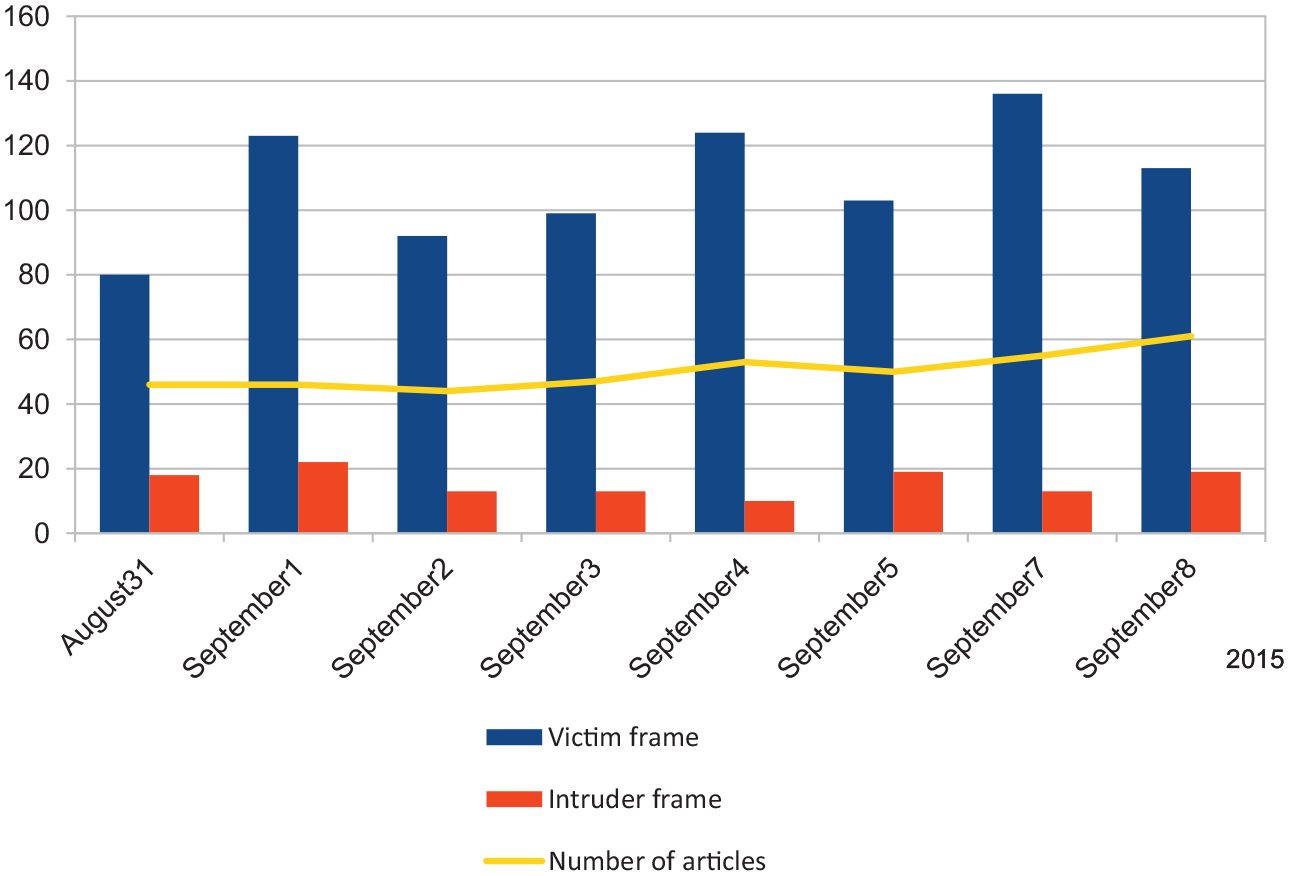
Overview – 2015. Total number of codes pertaining to the victim and the intruder frame; all four newspapers combined.
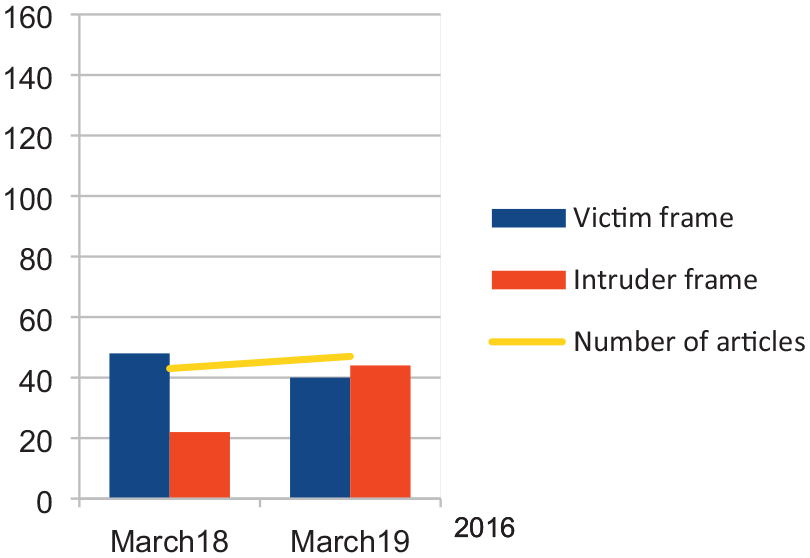
Overview – 2016. Total number of codes pertaining to the victim and the intruder frame; all four newspapers combined.
Before turning to a discussion of the results, it must be recognised that such categorisation is limited by the space for differentiation available within the framing matrix. For example, the use of metaphors that draw on vocabulary to describe natural catastrophes was originally assigned to the intruder frame, but the analysis showed that such language was used both in relation with the victim as well as the intruder frame. Therefore, this particular code was not included in the findings presented here, as it suggests a higher occurrence of intruder frames than was actually the case. To further qualify the numbers, in September 2015, the use of framing devices pertaining to the intruder frame hardly occurred with reference to people who had fled the war in Syria and had now come to Germany. Instead, the intruder frame was used by the taz, Die Welt and the Süddeutsche Zeitung in relation to people who had unsuccessfully asked for asylum in Germany before but who had not been expelled. This diminished the space and resources now available for the newly arriving ‘refugees’. This discourse, also used by Angela Merkel, was particularly prevalent in reports containing statements made by members of the CSU.
When the intruder frame was used for the first time against refugees in Germany in Die Welt on September 5, 2015, it was juxtaposed with another contribution that same day in the same newspaper which argued that Germans should be proud to live in a country which had become the ‘land of dreams’ (‘Traumland’) for so many. ‘Would the churches be fuller, the family ties stronger, the marriages more stable, the number of children higher, the general education more well-rounded and the Germans happier with themselves, [the journalist asked,] if we showed the refugees the door?’ 85 This quote illustrates the overwhelmingly positive reaction of the German media to the ‘refugee crisis’. Even more so than Angela Merkel, they expressed the conviction that helping people in need is the right thing to do, criticising the chancellor that it took her so long to take a stance. As a result, her decision on September 4 to facilitate refugees passing from Hungary into Germany received less media attention than one might have expected. Instead, it appears that many journalists viewed the decision as the only possible solution after Merkel herself had stressed Germany’s humanitarian responsibility and numerous reports on the death of Aylan Kurdi and the fate of people waiting in Budapest highlighted the suffering of those on the move. This suggests that the media created a language context which was conducive to Angela Merkel’s decision beforehand.
According to Hill, foreign policies in favour of constituencies outside of the ‘national community’ are likely to be supported if, firstly, the demands of the outside constituency are perceived as legitimate, secondly, their identity can at least in some sense be linked to the identity of the in-group and, thirdly, their claims have a strong moral basis. 86 The content of the vast majority of the articles contributed to all three factors cited above. By reporting increasingly about individual fates and suffering, the German people could identify better with the ordinary people who just wanted their children to grow up in peace and safety (individuals on the move, often identified by name, were repeatedly cited, saying that this was their motivation). In addition, the press stressed the familiarity of many Germans with the fate of the refugees, as they themselves have had to flee after the Second World War as well as during the Communist rule in East Germany, thereby evoking empathy and identification with the plight of the refugees. The stories of suffering and reports on the continuous fighting and atrocities in Syria highlighted the legitimacy of their demands while references to the protection of refugees under international law (code 1), the principles of the Grundgesetz (code 9), as well as the calls for compassion, empathy and Menschlichkeit (humanity) created a strong moral basis for offering them shelter and help in Germany. The occurrence of these aspects of the victim frame is represented in the figures below (Figure 3) by the codes 1, 4, 9, 13 and 26.
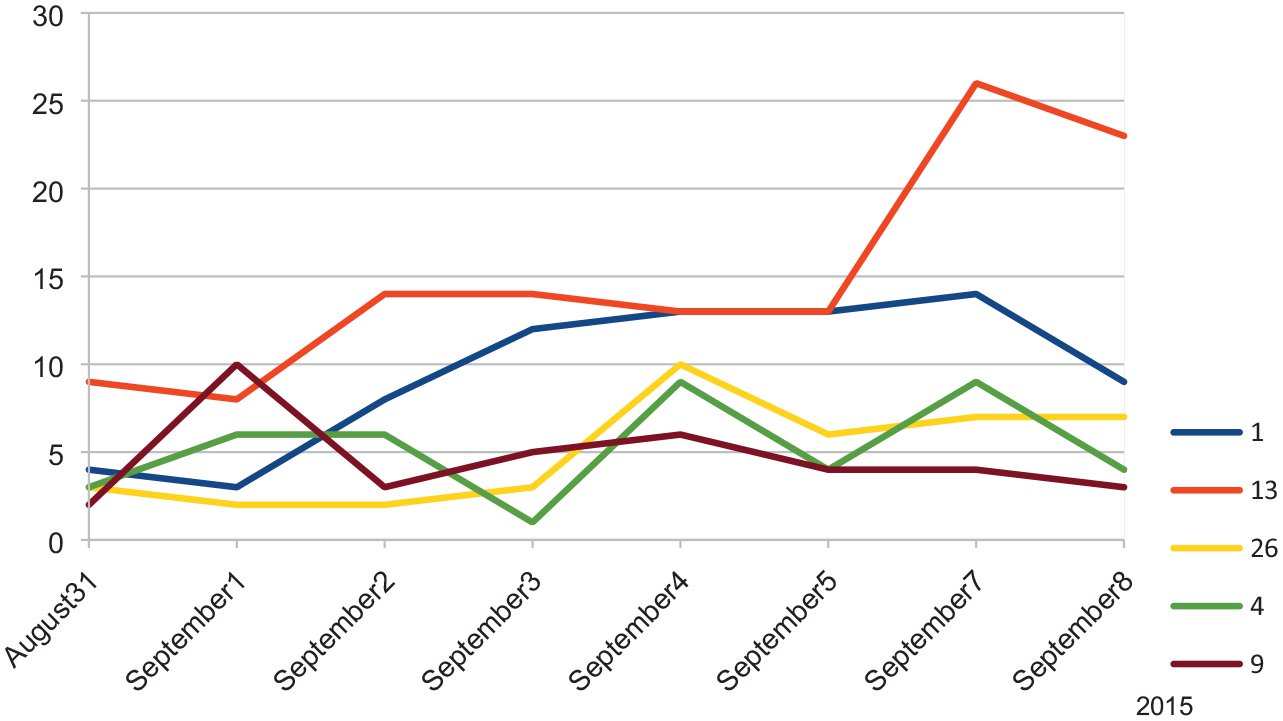
Selected codes pertaining to the victim frame – 2015.
Code 13 refers to the culture of welcome and efforts made by society, the extent of which was deemed ‘historical’ (‘historisch’) by the press and one could even feel a certain euphoria, happiness (Glück) to be able to report such positive things about German society. The spike coincides with the days after Merkel’s decision to open the borders. The rise in the frequency of codes 4 (description of individual fates, possibly with name) and 26 (dismay/Bestürzung) can be linked to the publication of the picture of Aylan Kurdi on September 2 by some newspapers and the passionate reactions and discussions that followed (see Figure 4).
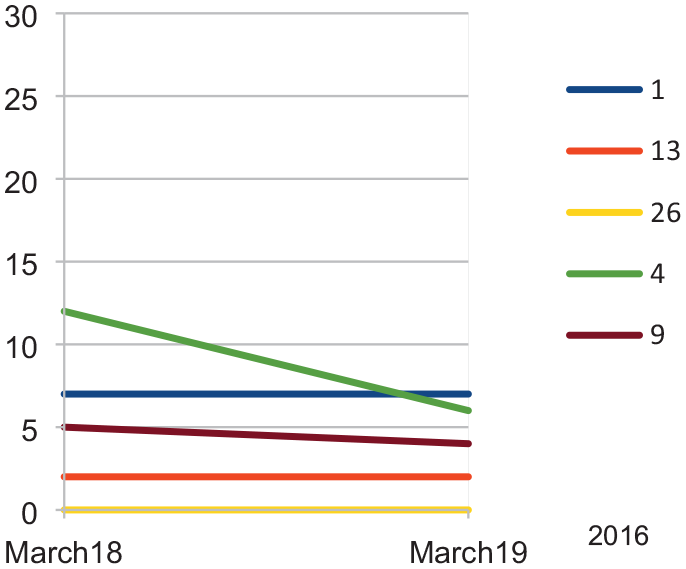
Selected codes pertaining to the victim frame – 2016.
Interestingly, the frequency of code 4 on March 18, 2016 was again quite high, which stands in contrast with Angela Merkel’s emotionally distant use of the broad term ‘illegal migration’ that same day. However, this difference in language games played by Merkel and the press does not hold across all four newspapers. Instead, it was mostly the taz which published a whole series of articles describing the individual fates of refugees now living in Germany, writing about their hopes and dreams which were no different from those of many other young Germans. This, quite explicitly, carried the question: Can we deny those individuals, whose only ‘crime’ is not having been born in Germany, the pursuit of personal happiness which we want for our own children? The other three newspapers, particularly Die Welt and the Süddeutsche Zeitung, reported more reservedly, not resorting to xenophobia but not highlighting the importance of continued humanity (Menschlichkeit), either (see code 26 above in Figure 4). Empathy shifted from the people on the move to the local population (Einheimische), with more attention given to the latter’s interests and fears (code L: protect the interests of the native people; code R: safeguard European cohesion; don’t overtax hospitality of the local population; code E: threat to ‘our’ culture, security, achievements). However, even when the Süddeutsche Zeitung published long articles exploring the xenophobic mind-set of parts of the German population (code M: xenophobia, aversion), the tone remained cautious, pensive, seeking to understand where these feelings were coming from rather than endorsing them (see Figure 5 and 6).
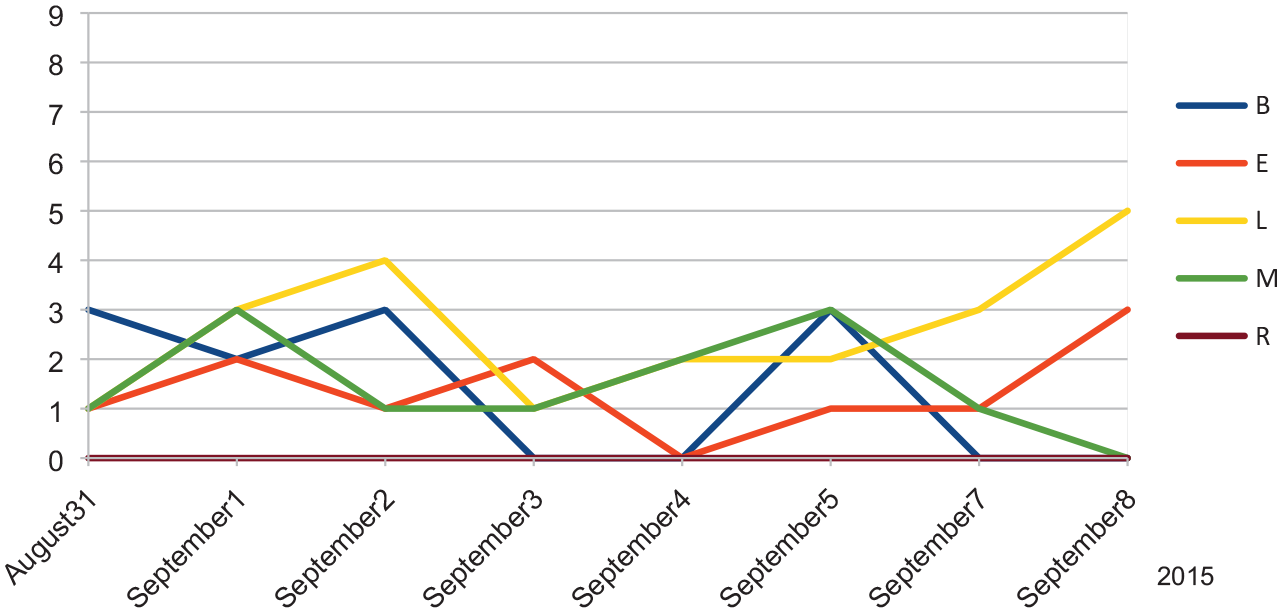
Selected codes pertaining to the intruder frame – 2015.
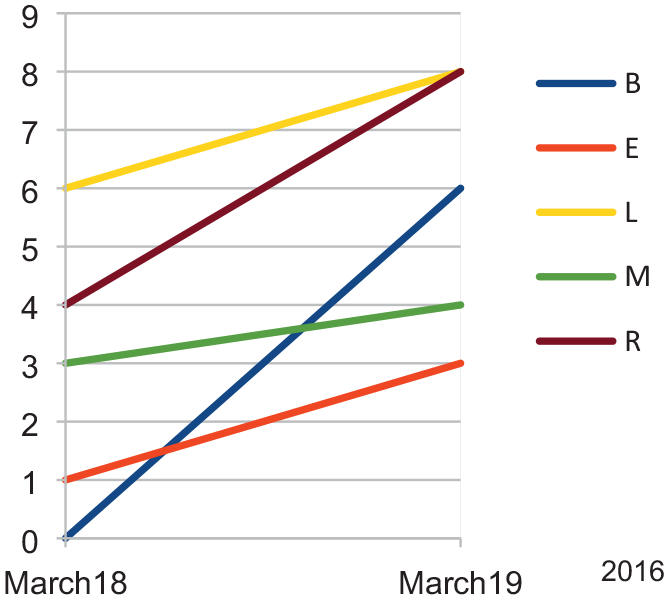
Selected codes pertaining to the intruder frame – 2016.
Overall, the newspapers continued to recognise the refugee status of the people on the move and the rights connected to it, criticising the content of the EU-Turkey deal on the grounds of human rights concerns (see codes 1 and 9 in Figure 4). However, one commentary in the Süddeutsche Zeitung on March 18 was quite telling for the change in atmosphere compared to September 2015. Is Europe or Germany allowed to enter into such a deal with Turkey, the journalist asked. His final answer was yes, because of a lack of alternatives, as ‘Europe (with Germany in its midst) neither can and wants to receive all the people who want to reach its territory, nor does it want to be confronted with pictures from Lampedusa or Idomeni any longer’. 87 This excerpt illustrates the conflict between humanitarian responsibility and German needs, which were no longer seen as aligned. Such discourse subtly fed into the notion of ‘Germany first’, even though the ideal to help refugees was still recognised. The language context thus appears to have altered, particularly after the EU-Turkey deal was announced on March 18. The language used on March 19 bears some resemblance to Merkel’s discourse the day before, as the people on the move were increasingly described as actively trying to reach Europe by illegal means (code B in Figure 5 and 6), thus going against German interests.
Conclusion
How exactly media reporting affects foreign policy making via public opinion, or whether, in fact, the causal path runs the other way, is yet to be determined. However, what is clear is that language, both of leaders and in the media, plays a significant role in framing, justifying and shaping foreign policy responses.
Focusing on Angela Merkel’s discourses and decisions as well as on the selected German newspapers in August and September 2015 and March 2016 shows how the political struggle of opening then closing the German borders to refugees was framed. This revealed the presence of two contrasting frames embedded in the German domestic context: the ‘imperative to help refugees’ and the ‘need to send those away who have no right to stay’. 88 What changed over the course of the 7 months however, was to whom was it acceptable to assign such categories to. When Merkel called people on the move ‘migrants’, once they sought to leave Turkey for Europe suggested that it was acceptable to send them back. Had those same people made the journey to Europe in September 2015, they would have been received in Germany with open arms as ‘refugees in need of help’. The compassionate framing present in the media coverage as well as Angela Merkel’s declared humanitarian stance at the time made it simply unacceptable to send these people back to Hungary. Essentially, it was unacceptable to turn these people away because Germans identified with them, making hospitality a moral responsibility. Neglecting them would have reflected negatively on the self-understanding of German society and the importance of the first article of the constitution which affirms that human dignity is inviolable (Die Würde des Menschen ist unantastbar). Ultimately, it was not in the German national interest to treat those who they could identify with poorly as this would have challenged Germans’ own values. Just as Weldes argues, ‘national interests emerge out of [. . .] situation descriptions and problem definitions through which state officials and others make sense of the world around them’. 89
Media framings of these events offer some further help to better understand them. When considering the language used by Angela Merkel as well as the media in March 2016, it is easier to recognise what made the EU-Turkey deal acceptable. In this altered context that positioned the needs of the people on the move against the needs of the local population, the German national interest appeared to be better served by keeping refugees out. Particularly between August 31 and September 8, 2015, the domestic media discourses were found to have been conducive to Angela Merkel’s remarkable foreign policy decision. Despite their different political leanings, there was a broad consensus across all four newspapers considered in this paper that the people on the move were innocent victims of war and persecution who needed to be helped. Seven months later, the empathy and dismay at their fate had receded and while the rights of the refugees were still present in the media coverage, they were increasingly presented alongside the rights, interests and fears of the local population. While the victim frame had dominated in the summer of 2015, by March 19, 2016 the intruder frame had overtaken it.
Furthermore, a discourse analysis of Angela Merkel’s change in discourse revealed the way in which describing the people on the move as ‘migrants’ obscured the fact that the EU-Turkey deal challenged the moral imperatives she had voiced earlier. This change in her discourse helps to understand how her inconsistent foreign policy decisions were more easily defendable. In fact, there were different kinds of ‘rights’. While the first decision was seen as moral, the second was seen as pragmatic. Curtailing human rights appeared to be defensible in order to safeguard European cohesion and to react to the rise in right-wing populism by asserting the rights of the local population. One might have expected that the concerns directly related to the local community weighed stronger than the moral concerns regarding external community. Yet, the results of the qualitative content analysis suggest that Angela Merkel’s proactive foreign policy decision to allow a large group of foreign people to live in Germany received more support than the one made to prevent refugees from reaching European territory. Thus, proactive foreign policy decisions in favour of outsiders need not to conflict with national interests. On the contrary, when domestic discourses contribute to an identification with the outsiders, they are no longer considered as other, or, at the very least, their fate does not leave the locals unmoved.
In short, we demonstrated in this article that there is a relationship between foreign policy decisions, public opinion and media framing of specific events and how this relationship can shift crucial foreign policy decisions even in a relatively short period. Therefore, media framings and decision-makers’ discourse matters for foreign policy analysis, or at least for the EU refugee ‘crisis’.
Footnotes
Funding
The authors disclosed receipt of the following financial support for the research, authorship, and/or publication of this article: This article has benefited from funding from a Group Fellowship (PI Beatrix Futák-Campbell) on “Reading and Narrating the Migration/Refugee Crisis” by Royal Netherlands Academy of Arts and Sciences’ (KNAW) Netherlands Institute for Advanced Study in the Humanities and Social Sciences (NIAS).
