



Abstract
This article explores the link between collective memory and state behaviour in international relations. In that regard, it develops a new concept entitled ‘temporal security’. Building on the existing ontological security literature, it extends a temporal understanding to its underlying identity concept. Countries are now assumed to be temporal-security seekers vis-a-vis a ‘significant historical other’ from their past. Decision makers thus enter into a self-reflective conversation with their country’s ‘collective memory’ when choosing courses of action. Contrasted with existing physical-security and ontological security explanations for state behaviour, the explanatory potential of the temporal-security approach is in a second step illustrated by the empirical case of West Germany and Austria, two former Nazi perpetrator states, and their respective assignments of support during conflict in the Middle East. Through a comparative, qualitative discourse analysis of historical documents during the Six-Day War of 1967 and the Yom Kippur War and oil crisis of 1973, the empirical study finds that West Germany and Austria adopted different courses of action in their international politics, because they looked to Nazi Germany as their significant historical other.
Keywords
Introduction
Identity shapes state behaviour. Since that statement was raised almost to the status of law in constructivism, scholars strive to specify the process by which this relationship unfolds. 1 In particular, the international relations (IR) concept of ontological security (OS) offers helpful insights into how the nexus between identity and behaviour plays out in states: to be secure, countries establish an integrity with their identity through their behaviour. In other words, they seek ontological security, and not only physical security as classical IR theory had traditionally suggested. Ontological security-seeking happens – according to most scholars – through ‘biographical continuity’. However, when it comes to the question of how states establish such biographical continuity, the scholarship differs widely and remains vague in its answers. Some focus on routinised relationships with ‘external others’ as the strongest factors influencing the way in which identity forms behaviour, 2 whereas others see biographical continuity as emerging from an inward-looking perspective, that is, the orientation towards the ‘self’. 3 Contained in any identity construction, after all, are both components: the ‘self’ and the ‘other’. Yet both perspectives struggle to define precisely a country’s ‘self’ or ‘identity’, as well as its ‘significant other’. As a result, OS scholars have been criticised for relying on a too-static identity concept that often locks behaviour into a particular course of action for the sake of ensuring ontological security or stability. 4 However, ‘ontological security’ – as this article hopes to illustrate and thereby add to the literature – is not a fixed outcome to be achieved, but rather describes a process that unfolds through a permanently evolving self-conversation between identity and state behaviour.
To re-frame OS’s identity–behaviour nexus as an evolving process rather than a static outcome in IR, this article specifies what a country’s self-conversation with identity looks like in practice. It suggests re-defining OS’s inward-looking conversation with identity along temporal lines: a country’s self or identity emerges from its past experience, which is transported into its present through ‘narration’, or (as this dynamic process is widely referred to in the interdisciplinary literature) through ‘collective memory’. 5 Importantly, in the collective-memory concept, history – the past as it happened – is gaining traction for identity only through present interpretation. In the course of such a ‘temporal’ identity construction, the ‘significant other’ is not any longer a contemporary, spatial ‘external other’, but a ‘significant historical other’ from the country’s past.
In combining insights from the interdisciplinary collective-memory literature with IR’s existing ontological security scholarship, this article puts forward a new understanding of OS’s identity–behaviour nexus in IR. It specifies precisely how a country’s self-conversation with identity plays out, and it contributes answers to two central and ongoing theoretical debates within the ontological security scholarship: what constitutes a country’s ‘self’, and who is its ‘significant other’? By situating a country’s identity explicitly along a temporal line, the framework developed in this paper aims to expand the notion of ontological security to describe an evolving, internal conversation between a country’s self and its ‘significant historical other’. Based on these new propositions, the paper coins its own concept of ‘temporal security’ which re-frames OS’s identity–behaviour nexus as a ‘memory–behaviour nexus’. For the IR discipline as a whole, the paper therefore makes use of the interdisciplinary collective-memory concept and suggests ways to integrate it fruitfully into existing IR explanations of state behaviour.
After the development of the temporal-security framework, its explanatory potential is illustrated in an empirical case study of the two former Nazi perpetrator states, West Germany (FRG) and Austria. They have been selected because they both internalised Nazi Germany as their ‘significant historical other’ in the post-war period, yet in diversely interpreted ways. Therefore, if the proposed memory–behaviour nexus is to stand its ground, the two states’ different relationships with this ‘significant historical other’ must have led them to pursue diverse state behaviours in global politics. The paper concentrates on their political stance during two wars in the Middle East, as one out of many examples. These are the Six-Day War of 1967 between Israel and its Arab neighbours, led by the United Arab Republic (UAR); and the follow-up Yom Kippur War and concomitant oil crisis triggered in 1973. Notably, with this scenario, the empirical cases aim to give traction to the explanatory power of the temporal-security concept. As such, Germany and Austria were selected not because they played a significant political role during these conflicts, but because the Middle East conflict provided a useful projection screen for their inward-directed engagement with their ‘significant historical other’, Nazi Germany. The case study therefore does not give a full picture or explanation of European support in the Middle East conflicts, but instead brings to light an as-yet untheorised form of internal political deliberation which has the potential to explain why countries come to support certain parties rather than others in global conflicts.
Ontological security between spatial others and temporal self?
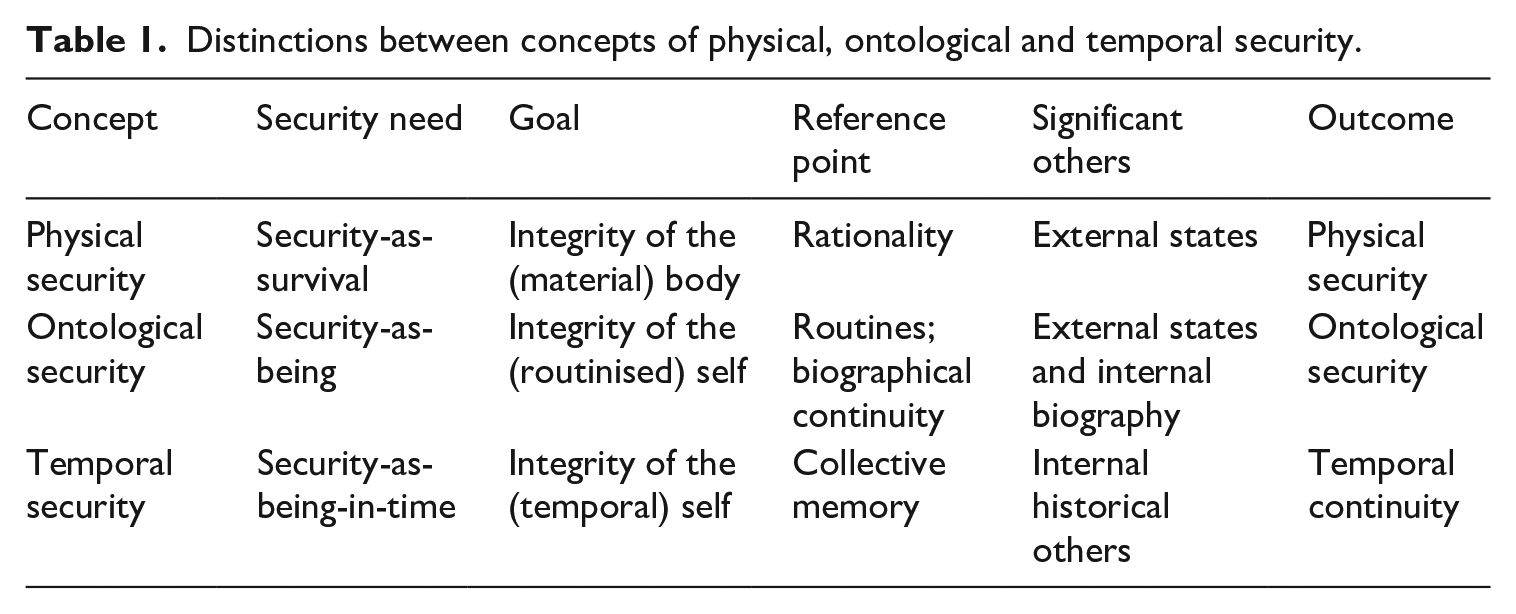
At the core of the identity–state behaviour nexus posited by the ontological security scholarship is the delicate balancing act between the ‘self’ and ‘others’ contained in all (individual and collective) identity constructions. 6 For individuals (and, by extension, countries) to realise a sense of agency, vis-a-vis their self and significant others, what is essential is the ‘need to experience oneself as a whole, continuous person in time’. 7 Introduced into the social sciences by sociologist Anthony Giddens, this idea was applied to IR by Jef Huysmans in 1998. IR as a discipline lent itself particularly well to a re-framing of Giddens’ assumptions about individuals in society as a conversation between states in international society. 8 In particular, Jennifer Mitzen first convincingly illustrated how routinised relations between states feed into their identity needs, that is, their ontological security. With this perspective, Mitzen provided an alternative to IR’s traditional focus on physical security, which places states’ rational interest in retaining the integrity of their material ‘body’ at the centre of explaining state behaviour in global politics: ‘Ontological security is security not of the body but of the self, the subjective sense of who one is, which enables and motivates action and choice’ (see Table 1). 9
Distinctions between concepts of physical, ontological and temporal security.
While it was plausible to add the quest for an integrity with identity to explanations of state behaviour in IR, Mitzen’s early work leaves out an essential part of how state identity shapes this behaviour. While – as with individuals – social relationships and the positioning towards external others is certainly important for ‘the wholeness of oneself’, identity constructions always also look inward, ‘to who we were and whom we want to be’. Picking up on this crucial point, Brent Steele re-defines a state’s quest for ontological security as an inward-looking conversation between identity and state behaviour to achieve ‘biographical continuity’. Mitzen’s routines with external others are now established with the ‘self’. To illustrate this difference, in Mitzen’s view, a country’s routinised relationship with another party in conflict motivates it to sustain conflict for its identity needs; whereas under Steele’s assumptions, it is, for instance, a country’s liberal identity that requires it to take (humanitarian) action to sustain its liberal biographical continuity. 10
In particular Steele’s inward-looking biographical-continuity concept shows that identity constructions have not only a spatial but also a clear temporal dimension: a state’s identity arises not only from its interactions with external others, but first and foremost from its own experience in the past: ‘who the state was, is and wants to be’, or what Berenskoetter 11 called its ‘national biography’, or Jelena Subotić its ‘autobiographical narrative’. From these definitions of a state’s identity, it becomes obvious that ‘the significant other’ of this identity construction is no longer a ‘spatial external other’ but instead a temporal ‘historical other’ that is most probably found within the country’s own past.
Temporal othering in global politics: the ‘significant historical other’ of states
That countries’ identity constructions follow a temporal line, positioning the contemporary self against a ‘historical other’, becomes immediately evident when we consider empirical reality. Take, for instance, the European identity construction. Arguably, there would be no ‘Europe’ without a ‘spatial, external other’ that is not Europe, such as ‘the East’, ‘Russia’, the ‘United States’, ‘Turkey’ or even ‘Islam’. 12 However, Europe’s ‘main other’, as is often argued by historians and political scientists alike, is not any of its geographical neighbours, but rather Europe’s own past. 13 If Europe considers itself as a ‘peace project’ or ‘normative power’, 14 this means that its contemporary identity is defined against the Holocaust as ‘the evil other of Europe’. 15 When the slogan ‘Never Again’ became the moral imperative of a new generation, 16 a temporal, not spatial, logic defined European identity: its illiberal ‘other’ in the past, rather than a ‘spatial other’ somewhere along its borders. 17
While the study of European integration long pointed to ‘temporal others’ as crucial for Europe’s identity, this insight has also found its way into IR. Lebow (2008) admits that ‘othering’ is rife in IR. Yet it does not necessarily require ‘contemporary others’, let alone their exclusion from the community, to maintain an identity. 18 Hopf 19 also points to temporal othering by showing that Russia’s ‘significant other’ remains the Soviet Union. Equally, Steele’s 20 example of British deliberations about entry into the American civil war demonstrated how an anti-slavery attitude stemming from Britain’s own history halted specific courses of action. Moreover, Zarakol 21 finds that Japan and Turkey look back to their historical experience of Western humiliation in their contemporary self-identifications. Yet, while in both of these cases ‘the significant other’ to a country’s identity construction is found in the country’s past, how precisely this inward-looking conversation between ‘significant historical other’, ‘contemporary self’ and state behaviour unfolds remains vague in the literature. The given examples only demonstrate that ontological security needs require policy makers to position the country ‘correctly’ vis-a-vis a certain past in present actions, and that establishing such an integrity between identity and behaviour works backwards rather than outwards. However, how this permanently evolving political balancing act between a ‘continuous contemporary self’ and a ‘significant historical other’ plays out under the rubrics of ‘temporal othering’, ‘ontological security’ or ‘biographical continuity’ is little theorised in IR.
Collective memory as the practice of ontological security: towards temporal security
However, if we widen our view beyond IR, the process of ‘biographical continuity’ that remains vague in the OS scholarship is precisely described by the interdisciplinary literature’s memory concept, albeit with an eye to individuals: ‘Memory . . . is the awareness of self-sameness through time’, as posited by the Enlightenment philosopher Locke. 22 Memory, in other words, ensures identity’s continuation along a temporal line. This sounds exactly like ontological security’s ‘biographical continuity’.
However, Locke wrote about individuals who remember their life experiences, and not about collectives. More so, even if we infer OS’s ‘states as persons’ analogy, 23 is not ‘memory’ just as intangible as ‘identity’? To navigate around these impracticalities, the memory concept was imported into the social sciences by Halbwachs 24 as ‘collective memory’. Collective memory means that individuals remember as social beings: that is, within social frames. With this in mind, sociologists practically relocated the past into the present (political) space. To research memory, whether that of individuals or collectives, scholars from then on resorted to the contemporary social frames that reflect memory. For countries, these are public symbols, official representations, rituals, speeches and – importantly for our assumptions – also their policy choices and state behaviour. From this definition it appears that in its collective version the memory concept can shed empirical light on the otherwise obscured theoretical nexus that ontological security posits between identity and behaviour.
Furthermore, by definition, collective memory also already contains the untheorised temporal dimension within the OS literature that links contemporary actions with the past to establish biographical continuity. Unlike history, memory is situated in the present, rather than in the past. It is the ‘active past’, 25 and with this it breathes a temporal – and thus also variable – dynamic into a collective’s history. The past and the present in this view become ‘two zones of the same domain’, and that domain is ‘being’ (ontological security), or more precisely ‘being-in-time’ (temporal security). That is OS’s biographical continuity. In fact, through collective memory, ‘the possession of historical identity and the possession of a social identity coincide’, 26 whether for individuals or for states. Yet memory is significantly different from history: it ensures ‘continuity’ and the ‘integrity of the self’ in dynamic – and explicitly – temporal ways vis-a-vis a ‘significant historical other’.
The vehicle by which collective memory links ‘the contemporary self’ with its ‘significant historical other’ is called ‘narration’. 27 Collective narratives are concrete forms of remembering, of interpreting the past and telling a consistent and continuing story from it. While defining state identity as a narrative identity is not new in IR, 28 nor within the OS literature, 29 few scholars so far have explicitly linked narrative identity with memory. 30 Particularly Mälksoo 31 picked up on the idea of ‘identity as memory’ and re-termed the quest for a stable identity, that is, ontological security, into ‘mnemonical security’, that is, the quest for a stable memory: ‘distinct understandings of the past should be fixed in public remembrance. . .in order to buttress an actor’s stable sense of self as the basis of its political agency’. Along similar lines, Innes and Steele 32 link the conceptualisation of a state’s narrative with the articulation of collective memory particularly referencing traumatic experiences.
Yet, in all of these works, memory is introduced as an asset to identity rather than as a process. As such, memory, within the existing OS literature, so far features only as a form of ‘ontological self-help’ 33 to keep the national identity intact. Notably, however, in our definition of ‘narratives as concrete forms of collective memory’, memory cannot be fixed as a static story about the ‘self in history’, but rather is a ‘constitutive narrative’ that, through remembering, literally re-members (=constitutes) a group and as such also its identity. 34 Our (constitutive) definition of memory at the basis of identity therefore goes strictly against essentialising (fixing) identities and instead centralises the ongoing processes of identity construction in narrative form that should be at the basis of OS’s identity–behaviour nexus. Importantly, identity grounded in constitutive narration through memory can change and multiply. As such, memory is not any more a mere asset to secure state identity as a fixed outcome, but describes the practice of ontological security to achieve biographical or, as this article suggests, temporal continuity.
Underwriting OS’s identity concept with collective memory, therefore, first, shifts our focus on social frames which convey a collective’s ‘being-in-time’. Second, it highlights the ‘inward-looking process’ in which a collective ensures ‘continuity through time’ by resorting to a ‘narrated record of resemblances’ 35 (to quote Halbwachs). Through a grounding in this understanding, we are therefore able to specify the precise details of how ontological security may work out as a process in states. Moreover, third, a state’s ‘self’ now includes a precise temporal dimension which looks towards the self in the past, to its ‘significant historical other’. Notably, in carrying identity in this way, collective memory is neither a passive storage of past events (and therefore different from history), nor an unchanging vessel for bringing the past into the present and future. 36 It instead describes ‘security as being-in-time’ as a process of active engagement that allows for multiple outcomes and pathways by which to achieve ‘temporal continuity’.
Combining the concept of collective memory with the assumptions of the OS literature allows us to coin a new concept: temporal security. Built on but distinguished from OS, and by extension also from the traditional idea of physical security, the concept of temporal security assumes that states in IR are temporal-security seekers: in order to be secure, countries seek integrity with their temporal self. This security need goes beyond the conventional IR definition of security-as-survival and specifies OS’s security-as-being as one of being-in-time. The reference point for this new type of state behaviour is collective memory. Notably, collective memory hereby describes a practice of identity, rather than a property, and establishes a relationship between ‘contemporary self’ and ‘significant historical other’ along an explicit temporal line – yet in dynamic and changing ways that lead not to a static ontological security but to a fluid temporal continuity as its outcome (see Table 1).
Testing the temporal-security concept: former Nazi states and the Middle East conflict
The developed concept of temporal security presupposed that countries in their international behaviour establish an integrity with their collective memory in reference to their ‘significant historical other’. To illustrate this deliberative, inward-looking process, the following empirical scenario was selected: the reaction of West Germany (FRG) and Austria – two countries with Nazi Germany as their ‘significant historical other’ – to war in the Middle East. The question is whether and how they took their Nazi legacy into account when it came to supporting either of the warring parties during the Six-Day War of 1967 and the following Yom Kippur War and oil crisis in 1973.
Notably, the cases were selected not because the FRG and Austria played a particular role in the Middle East conflict, but because they both have Nazi Germany as their ‘significant historical other’. Yet, and importantly for our framework to highlight the distinction between memory and history, the ways in which these countries collectively remembered their Nazi past differed fundamentally from each other during the 1960s and 1970s: the FRG had formulated an image of itself as a morally responsible perpetrator, 37 whereas Austria viewed itself as the first victim of Nazi Germany. 38 As such, they constitute an ideal scenario of comparison to exemplify the role of collective memory in their selected behaviour towards an unrelated global event.
Furthermore, in this scenario, not only does the case of ‘Nazi Germany’ clearly illustrate a ‘significant historical other’, but the warring parties of the Middle East conflict also constitute designated ‘contemporary, external others’. In the Six-Day War of 1967, these were Israel versus the Arab countries under the leadership of the United Arab Republic (UAR). The Yom Kippur War and oil crisis of 1973 saw the same warring constellations, but with a stronger focus on an emerging player on the Arab side: the Palestinians and their representative organisation, the Palestine Liberation Organization (PLO). The question that arises empirically is how the two former Nazi perpetrator states, with their diverse collective memories of Nazi Germany, reacted to these two wars. Particularly, what was their reasoning behind their support of either of the warring parties? For our posited memory–behaviour nexus to hold, West Germany and Austria must exhibit diverse behaviours in 1967 and 1973, and their deliberations must be geared towards their own ‘significant historical other’, Nazi Germany, instead of the warring parties of the Middle East.
Methodologically, the explanatory power and value-added of the temporal-security concept is shown in a comparison with alternative explanations under the theoretical presuppositions of the two above-mentioned IR approaches: physical and ontological security. Departing from their predictions of state behaviour, an original discourse analysis of archival historical documents aims to reveal the sketched temporal logic behind decision makers’ deliberations. In both countries, these decision makers include only leading politicians at the top level: chancellors and ministers, as well as, where appropriate, opposition-party leaders. The historical documents, on the other hand, include parliamentary minutes and speeches, diplomatic correspondence and personal memoirs and letters written by the designated politicians of interest. In the West German case, original documents were retrieved from the digitalised foreign-policy archives of the Leibniz Institute for Contemporary History (IfZ) 39 and journalist Vogel’s 40 edited volumes containing West German foreign-policy documents concerning Israel and the Middle East (1967 and 1977). In the Austrian case, original documents stem from the Austrian State Archives and the Bruno Kreisky Archives in Vienna. 41
Employing the method of discourse analysis helps to uncover underlying ‘systems of signification’ 42 in politicians’ public, official and private discourse. In our framework, these systems concern an inward-directed, temporal reasoning, whereby we are process-tracing the outlined logic between ‘contemporary self’ and ‘significant historical other’. 43 For that purpose, all historical documents were qualitatively coded 44 with ‘Nazi Germany’ as the ‘significant historical other’, and in accordance with the diverse logics of the case country’s respective national narratives. In the West German case, admitting guilt and thus also moral responsibility vis-a-vis Nazi Germany implied a collective memory as a repentant perpetrator. Such a narration implies the aspiration of making good again with efforts that ameliorate the harm in any way possible. In contrast to the logic of the West German ‘guilt narrative’, the Austrian ‘victim narrative’ centred around the notion of ‘innocent victimhood’. Such a narrative implies the collective memory of oneself as passive and defenceless. Speaking to this version of memory means fending off any suggestion of the country’s responsibility, while aiming to achieve recognition and compensation only for its own suffering. 45 If our theory of temporal security is to hold, these diverse temporal reasonings vis-a-vis their respective memories must be present in the political deliberations about the warring parties of the Middle East in 1967 and 1973, and their two diverse logics must lead to different outcomes in West Germany and Austria.
Explanation 1: the quest for physical security
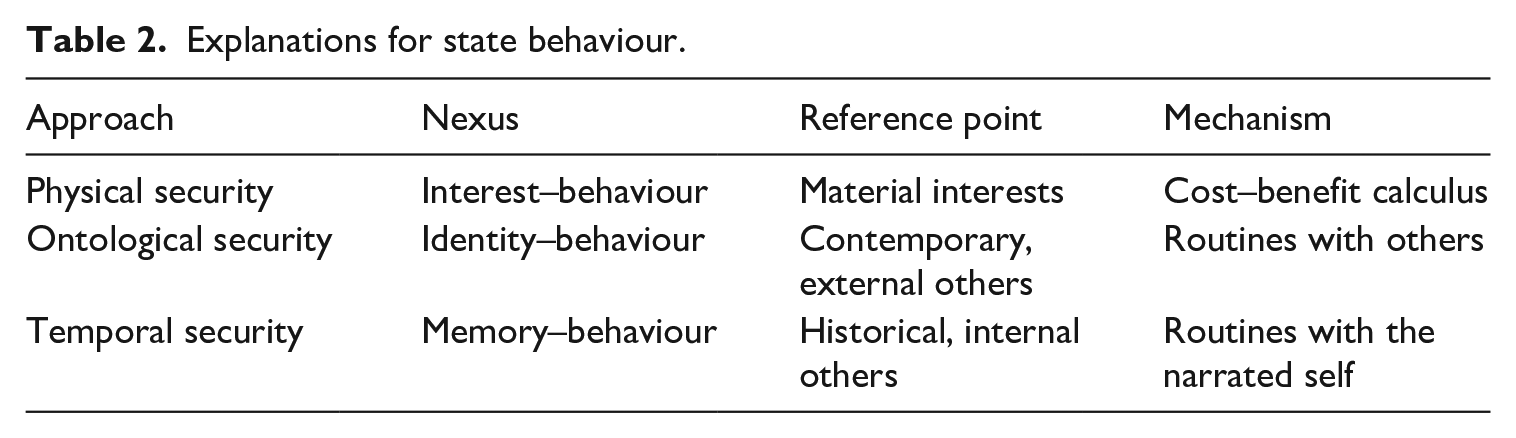
Before we test our concept’s proposed nexus between memory and state behaviour, we pitch it against alternative existing explanations in IR. Let us start with setting up the classical IR concept of ‘physical security’ and its underlying interest–behaviour nexus as the first counter-assumption. As mentioned above, in this view, countries seek to secure their survival by way of establishing an ‘integrity with their body’. To that end, they maximise their security through a cost–benefit calculus geared towards a materially defined interest. This interest is static and rational; thus, it unfolds its logic equally in all actors within the international system. 46 Classical IR accounts would therefore predict the following general direction for state behaviour: a country pursues the course of action that is beneficial to its material/physical security. (See Table 2.)
Explanations for state behaviour.
With reference to our case scenario, which material interests were present in 1967 and 1973? In 1967, incentive structures first and foremost depended upon the ongoing Cold War, with sentiments and support for either of the warring parties clearly reflecting the global East–West competition. While the West widely sympathised with Israel, the Eastern bloc associated itself with the Arab side. Their Western ideological predispositions must have therefore pulled the West German and Austrian governments in the direction of sympathising with Israel. At the same time, the FRG’s founding principle of non-interference in international matters and Austria’s neutrality rendered support for Israel in 1967 neither necessary nor advisable at the time.
Moreover, from a material viewpoint only, everyone must have had vital economic interests in the Arab world. Since the beginning of the 1960s, Middle Eastern countries experienced unprecedented levels of economic growth, boosted by rapidly increasing oil production. Between 1950 and 1970, the region’s share in oil production rose from 17% to 41%. Meanwhile, the post-war economic miracles of Western European countries crucially depended on Middle Eastern oil. Furthermore, the sizeable economic area of the combined Arab countries and their ongoing massive public investments in infrastructure, health services and education during the 1960s constituted an essential market for European products. 47
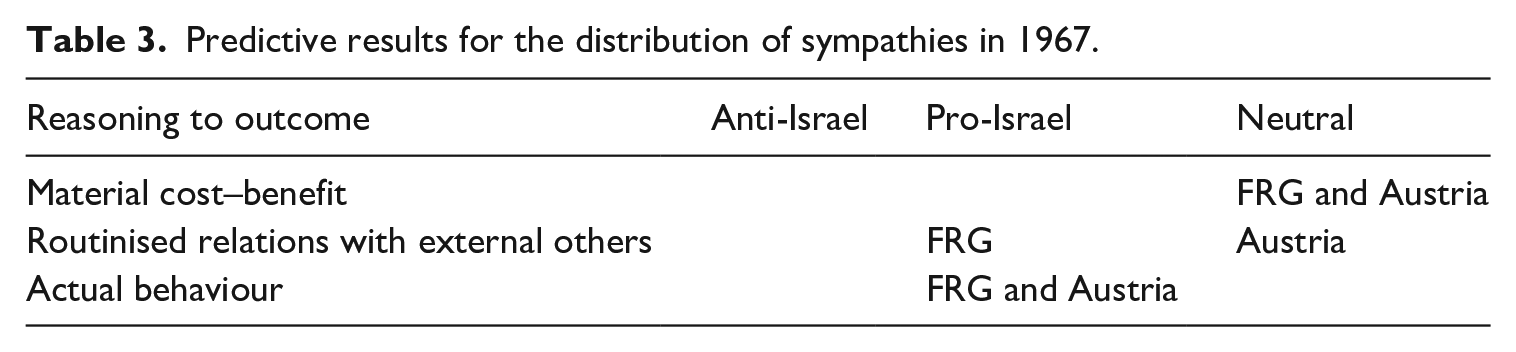
If we take the systemic and material factors of 1967 together, the following pushes and pulls for West Germany and Austria become apparent: their associations with the Western bloc and resulting pro-Israeli public sentiments were counterposed by the legal need for neutrality and non-interference, coupled with strong economic interests in the Arab countries. If decision makers had followed a rational-material cost–benefit calculus only, they would have thus opted to stay neutral during the Six-Day War, and not side with either of the warring parties (see Table 3).
Predictive results for the distribution of sympathies in 1967.
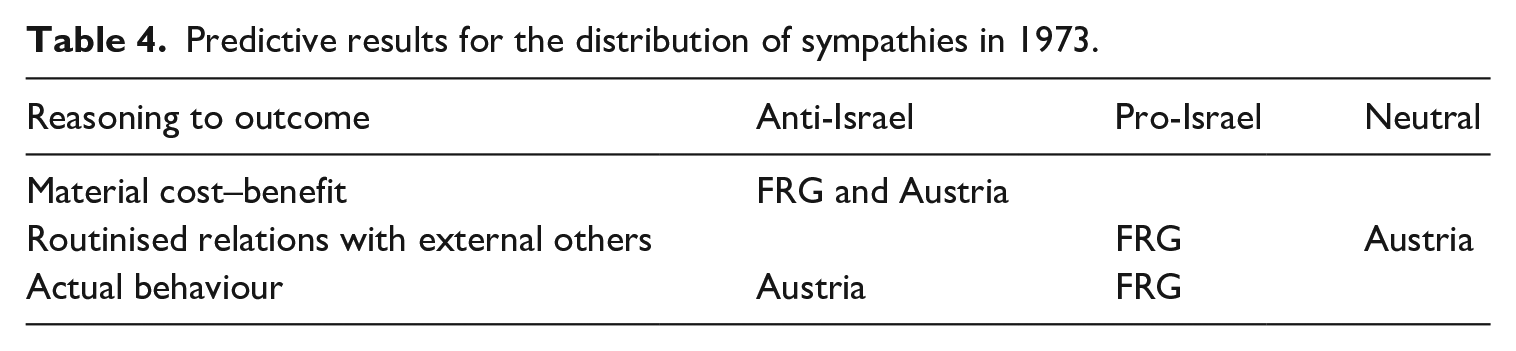
Although West Germany and Austria, neither in 1967 nor during the following Yom Kippur War in 1973, were not threatened with physical harm, they did have to fear a change in material capabilities throughout. This concern became even more evident in the face of the global oil crisis triggered as an immediate result of the tide of war turning again in Israel’s favour in 1973. On 17 October, the Organisation of the Petroleum Exporting Countries (OPEC) used its leverage over the world price-setting mechanism for oil and reduced the supply rate first by 5%, and a month later by 25%. The consequence was quadrupled oil prices, leading to panic among European states, whose economic growth after World War II was to a large extent based on a steady supply of Middle Eastern oil. The oil shock immediately created a significant rift within NATO and the EEC, with countries seeking to disassociate themselves from Israel and the USA’s foreign policy in the Middle East for the sole purpose of avoiding becoming targets of the boycott. 48 If we assume that politicians deliberate according to a strategic, material cost–benefit calculus only, the altered economic and political incentive structures in the wake of the oil crisis must have induced them to shift their support to the Arab side (see Table 4). Predicting the behaviour of West Germany and Austria vis-a-vis the Middle East conflict within an interest–behaviour framework, therefore, would suggest that they remained neutral in 1967 and supported the Arab side in 1973.
Predictive results for the distribution of sympathies in 1973.
Explanation 2: the quest for ontological security
A second set of counter-assumptions serves the OS identity–behaviour nexus. As argued above, in such a view, it is not material interests, but anxiety over the loss of integrity with identity, that is assumed to determine behaviour. Naturally, with the more dynamic ontological security concept, it is harder to make the same, clear-cut predictions about behaviour as when applying a material cost–benefit logic. Furthermore, given that our temporal-security approach was built on the inward-looking identity construction that forms one part of the ontological security assumptions, we herewith propose only a simplified version of OS’s outward-looking aspect as an alternative explanation: where the identity–behaviour nexus looks to external others, it would predict that a country pursues the course of action that is congruent with its routinised relations with ‘contemporary others’ (see Table 2).
Let us see how West Germany and Austria are predicted to act in 1967 and 1973 if we take into account only their routinised relationships with ‘significant contemporary, external others’, in this scenario, particularly with Israel. When it comes to their routines in their bilateral relationship with Israel, both the FRG and Austria by the time of 1967 had established ‘friendly diplomatic relations’ which, however, cannot be explained without the large-looming Holocaust legacy in the background. In all its previous post-war interaction with the Jewish State, the FRG’s bilateral acts reflected attempts to ameliorate the harm and make good again, with the most obvious example being the massive reparation payments made to Israel since 1952. As a result, the FRG delivered products to Israel that amounted to 15% of annual Israeli imports. Besides, and on a more secret level, arms were also sent from the FRG to Israel. With these exchanges being for the sole benefit of Israel, West Germany created ‘special relations’ in an effort to atone for the Nazi past and take on moral responsibility for its victims, even if these relations also served its strategic interests of Western integration. 49
Austria, on the other hand, from the beginning, insisted on ‘normal relations’ with Israel, with no moral obligation attached. These consisted of mutually beneficial deals ranging from raw materials (coal and steel products from Austria in exchange for citrus fruits from Israel) to the issues of immigration and non-alignment. With regard to the latter two, Austria’s strategic position as a neutral country between the blocs also soon turned it into a stepping stone for Eastern European and Russian Jews who wanted to make Aliyah to Israel – a role that Austria tacitly tolerated. 50
If we take into account only these countries’ routinised relationships with the ‘other’ (Israel), the FRG would thus be predicted to side with Israel, as it had supported the country unconditionally since 1952. Austria, on the other hand, because of its international status of neutrality and its ‘normal’ and not obligatory relations with Israel, would be predicted to stay neutral and not take sides at all (Table 3).
Extending the logic of ‘routinised relationships’ to 1973, the FRG must be assumed to continue its support for Israel also during the Yom Kippur War and oil crisis. West Germany’s relations with Arab countries at the time had reached their low point, not least because of its preferential treatment of Israel and its close association with the USA. Austria, on the other hand, with its identity firmly anchored in neutrality, would be predicted to remain neutral also in 1973. Only neutrality could confirm its ontological security against significant ‘external others’, be it West Germany (still the key reference point for the Austrian identity), or Israel, or the global powers of the East–West conflict. With its focus on routinised relationships with external others, it is thus hardly surprising that this route predicts the same behaviour for 1967 and 1973: each time, West Germany is assumed to side with Israel, and Austria is assumed to stay neutral (see Table 4).
If we now look at the actual distribution of West German and Austrian sympathies in 1967 and 1973, we see deviations from both predictions. In 1967, West Germany and Austria supported Israel, whereas in 1973 only West Germany supported Israel, and Austria had switched its support to the Arab side. To explain this puzzle, we now employ the temporal-security approach. With its roots in the dynamic collective-memory concept and its focus on the ‘significant historical other’, we might see routines when memory is not endangered, and we are likely to see a change in routines when it is. Similarly, to navigate around potential disconnects with memory, material security might be compromised and thus explain why Austria and West Germany did not stay neutral in 1967, or why the Arab side was not fully endorsed, despite the oil crisis.
Explanation 3: the quest for temporal security
Departing from the previous two explanations, our concept’s memory–behaviour nexus predicts that states and their policy makers enter into a conversation with the narrated, collective memory of their country. In such a deliberative, temporal conversation with the self ‘in-time’, the focus of study shifts from a conversation ‘in-between states’ to an internal, ‘in-between time’ conversation between the ‘contemporary self’ and its ‘significant historical other’. To keep its temporal continuity intact, a country thus is expected to pursue the course of action that secures routines with its collective memory (see Table 2).
Empirically, this means that we need to get insights into policy makers’ temporal reasoning about their preferred courses of action. And indeed, when war was imminent in the Middle East, a close analysis of the West German discourse in 1967 reveals a strong pull towards supporting the Israeli side. Despite formal emphasis on the FRG’s founding principle of strict neutrality and non-interference in international matters, Foreign Minister Willy Brandt told the German Bundestag: I am very much inclined, (. . .) to once more emphasize as my personal conviction, with which I, however, do not stand alone, that our non-interference and therefore our neutrality in an international legal sense of the word does neither mean a moral indifference, nor an inertia of the heart.
51
Brandt’s intentions were echoed across party lines, and soon West German politicians began to openly show their solidarity with Israel. In Bundestag discussions, dispositions ‘adhering to the logic of the heart’ overrode the occasional warnings of the liberal opposition, the Free Democratic Party FDP, to consider business interests in the Arab world. Furthermore, words were soon followed by deeds, and the FRG issued the delivery of war material (in this particular case, gas masks) to Israel.
The discursive, internal justifications that were proposed around the issue of gas masks are particularly illuminating when it comes to politicians’ internal engagement with their country’s memory. While Chancellor Kiesinger and Foreign Minister Brandt had immediately given their permission, Defence Minister Schröder flagged that the delivery of war material constituted a clear breach of the principle of neutrality. In a special session of the cabinet, however, Schröder’s opposition was quickly sidestepped, and the provision of gas masks was instead framed to fall under the jurisdiction of the Interior Ministry and its task of ‘protecting civilians’. With this tweak, the FRG delivered gas masks and trucks, again defined not necessarily as war material, to Israel. Furthermore, the Israeli airline El Al received ‘tacit permission’ to transport ‘any freight’ via West German territory, and a blind eye was also turned towards American weapon deliveries via the FRG. 52 With this tightrope walk, West German politicians – as their internal rhetoric reveals – strove to bring their country’s behaviour into line with what was demanded by its post-war positioning vis-a-vis Nazi Germany as its ‘significant historical other’: support for Israel as a way to ‘make good again’.
That the collective memory of the Nazi legacy to some extent guided West German politicians’ choice of action becomes evident also in their voiced outrage over East Germany’s support for the Arab side because of the apparent East German lack of historical awareness: 53
we are ashamed by the fact that official speeches and words of those in charge of the other part of Germany contain nothing – and absolutely nothing – of the special responsibility that we Germans hold vis-à-vis these people.
54
Chancellor Kiesinger struck a similar note: ‘Given the recent past of our people, it is truly tragic that those in power in the other part of Germany aim to fuel the conflict by acting in a completely irresponsible manner’. 55
While these statements openly reference Germany’s history and legacy, sceptics might suggest that the attacks on East Germany’s pro-Arab stance merely followed the logic of the East–West conflict. In such a view, the past was only used as another convenient weapon in the toolkit of diplomatic strategies. Some historians too view West Germany’s support for Israel in 1967 as pursuing the dictates of the day (Tagespolitik) while only pretending to be attending to the requirements of history (Geschichtspolitik). 56 Taking a more balanced view, Carole Fink saw in the grand coalition of SPD and CDU a less penitent West Germany in which support for Israel meant little more than empty verbal expressions against the background of a weakening Cold War consensus. 57 Along similar lines, Hestermann 58 highlights the pragmatic intentions behind West Germany’s reconciliatory rhetoric, whereas Daniel Marwecki points to the strategic attempts of German foreign-policy makers to whitewash their Nazi past through their Middle Eastern policies.
However, even if West German politicians only used the memory of the Nazi past to support Israel, the mere fact that they window-dressed their intentions with expressions of moral responsibility speaks to a temporal reasoning that aims to establish an integrity between memory and behaviour. Our framework does not deny the influence of strategic interests and Cold War alignments; it simply puts emphasis on the logic that justifies these. Conveniently for the FRG, its Western orientation, and its association with the USA, in 1967 fitted the internal conversation into which the FRG had entered with its ‘significant historical other’: Nazi Germany. Moreover, its internal deliberations reveal that anything else but support for Israel would have significantly interrupted its temporal continuity with its collective memory. This same logic, however, did not apply to East Germany. In the GDR, a narrative of victimhood concerning Nazi Germany 59 similar to that of Austria had formed its temporal relations with itself, thus allowing for full support of the Arab side.
The Austrian decision in 1967
Like the FRG, Austria, the neutral hinge between the Eastern and Western blocs, had no strategic advantage to gain from supporting either of the warring parties during the Six-Day War. Nevertheless, while the ruling conservative People’s Party (ÖVP) insisted on the country’s neutrality,
60
the opposing Social Democratic Party (SPÖ) soon began to side openly with Israel. A closer look at politicians’ discourse reveals the motivation behind this support: Austria itself knows what happens when a small state is being attacked and when democratic powers ignore such a situation. In 1938, the free world’s public believed that Hitler’s aggression against Austria was none of their business and so the world intervened only when it was too late.
61
From this statement, it becomes apparent that the chairman of the SPÖ looked inward, to the country’s past, when choosing sides. In this logic, Austria in 1938, like Israel in 1967, have both fallen prey to an overpowering, external aggressor. By comparing Austria in 1938 and Israel in 1967, the social-democratic opposition thus invoked the country’s collective victimhood, that is, its constituting, national narrative vis-a-vis its ‘significant historical other’, Nazi Germany. Based on this logic, a sense of victim solidarity was created which inclined Austrians to support Israel in 1967, despite the country’s formal neutrality.
While such a pro-Israeli sentiment was evident in the beginning only within the social-democratic opposition, the ruling ÖVP soon came round to embracing the Israeli side as well. During the formulation of the United Nations Security Council Resolution 242, Austria voted in favour of Israel. This casting of the Austrian vote is particularly interesting because Austria’s neutrality did not bind it to the evident exigencies stemming from the Cold War. Aware of this, Arab, Eastern-bloc, and non-aligned countries had long increased political pressure through diplomatic backchannels to secure Austria’s vote. This choice constituted a ‘question over life and death’, in the words of a Syrian diplomat, and threatened a break in economic relations. 62 Inner Israeli circles, on the other hand, already viewed Austria’s support as a lost cause, counting on its abstention precisely because of its neutrality. 63
However, the Austrian logic in this matter did not follow any traditional rational-choice predictions. The internal conversation that took place within Austria was not directed outwards at the international community or the warring parties, but inwards towards its ‘self’ in the past. Discursive justifications reveal how Austria’s collective memory of victimhood in the end overrode any material cost–benefit logic and made the path in favour of Israel the only available option: Hundreds of thousands of former Austrian citizens live in Israel, who have – without their fault and without the fault of the Austrian government – first suffered grave injustice, and then had to leave their country to find a new home (. . .). We think that we can count on the Soviet Union’s understanding that out of these reasons a different casting of the vote would have been wholly unthinkable for Austria.
64
Interestingly, in the official text pre-prepared to enable diplomats to defend this decision, a sentence had disappeared from the final version: ‘Austria has the moral responsibility to support its former citizens in preserving their livelihood in their new homeland’. 65 This last-minute correction reveals that in the internal deliberations among officials, moral responsibility had been perceived as incompatible with the country’s national narrative of victimhood vis-a-vis Nazi Germany and thus had to be corrected in order to avoid potential disconnects with the country’s memory. In the logic of Austrian politicians, Austria’s choice to support Israel was made in order to reflect a sense of solidarity with the victims and should in no way be mistaken for a moral obligation on the part of Austria. In other words, the country had clearly positioned itself vis-a-vis its ‘significant historical other’, Nazi Germany, in its UN vote of 1967.
The West German reaction in 1973
When the Yom Kippur War in 1973 triggered a global oil crisis, the pulls for West Germany to switch its support from Israel to the Arab side were significant: on the one hand, there was the material, economic necessity created by its dependence on Arab oil for 75% of its imports. On the other hand, a common European position now gravitated strongly towards the Arab side. Yet the analysis of internal debates reveals that even as the oil-related threats mounted, Brandt 66 – who had meanwhile become the FRG’s Chancellor – held firmly against an open pro-Arab stance: ‘One cannot buy friends by applying pressure, not even when using oil as a bargaining chip’. His government instead began to firmly insist on its politics of impartiality regarding the Middle East conflict, despite Brandt’s new Ostpolitik (his planned rapprochement with the Eastern bloc). Particularly in this context, reaching out to the Soviet-supported Arab countries would have presented an invaluable opportunity to advance also this new foreign-policy interest. However, as becomes clear from the intense internal debates among West German politicians, these interests were dampened by the FRG’s memory of the Nazi legacy. While some, particularly Foreign Minister Walter Scheel, repeatedly attempted, in the face of present economic needs, to roll back the past that bound the FRG to Israel, Chancellor Brandt still understood his country’s historical identity as a moral obligation: ‘German–Israeli relations have to be viewed against the gloomy backdrop of the National Socialist reign of terror. It is this that we imply when we state that our normal relations have a special character’. 67 Brandt’s formulation of ‘normal relations with a special character’ was, like his 1967 stance on ‘the impossibility of a neutrality of the heart’, in line with the FRG’s memory vis-a-vis Nazi Germany. To ensure temporal continuity, the FRG was therefore left with no option but to sympathise with Israel, even in the wake of the oil crisis.
However, while West Germany’s temporal-security drive to a large extent resisted Arab economic threats, an emerging position of the European Community (EC) on the Middle East conflict now began to echo an increasingly pro-Arab tenor. The FRG’s membership of the EC thus posed renewed difficulties for West German politicians trying to achieve a joint European stance on the Middle East in line with the prescriptions of its collective memory concerning its own ‘historical other’, Nazi Germany. In fact, under the umbrella of the EC, West Germany had to manoeuvre its way through a predicament: namely, that, despite pressures on the West German economy, the political and diplomatic obligations that stemmed from the FRG’s past bound it on the one hand to Israel, and on the other hand – via the Franco–German friendship treaty of 1963 – also to neighbouring France. Besides, circumstances rendered West Germany’s security strongly dependent on the USA, while at the same time the FRG favoured supporting a unified EC foreign-policy voice. However, this unified voice under the leadership of France now clearly took the direction of a pro-Arab/Palestinian stance, and as a consequence it qualified as both anti-Israeli and anti-American.
In this context, and once announced, the EC statement on the Middle East conflict was met with fierce domestic opposition in West Germany. A significant part of the press
68
and public
69
regarded it as solely in the interest of Arabs, calling upon decision makers to take action. Equally, in the Bundestag, Social Democrats and the opposition CDU/CSU protested against the anti-Israel tendencies of the EC, particularly with an eye to the FRG’s moral responsibility vis-a-vis the Israelis. To navigate the situation, Steele
70
showed what Brent Steele called ‘discursive remorse’: (. . .) there shall be no doubt: We are involved witnesses: I have often emphasised, and I would like to confirm it once again. For us, there can be no neutrality of heart and conscience. If we acted neutrally in that sense, we would have no interest in participating in the attempt to find a just and lasting peace for the suffering Middle East. We understand our duties differently!
71
Brandt’s discursive remorse was without doubt directed towards ensuring the country’s temporal continuity: in adopting a ‘more balanced’ Middle East policy that includes the Arab side out of necessity but strongly leans towards Israel in its sympathies, the country’s integrity with its collective memory was saved. In this temporal logic, partiality with Israel, that is ‘a non-neutrality of the heart’, was the only possible option for the FRG, also in 1973.
The Austrian reaction in 1973
During the oil crisis, the temporal logic and the obligation of conscience derived thereby for the FRG did not apply to Austria. As was shown earlier, Austrian sympathies with Israel in 1967 were driven by a sense of solidarity between two victims, rather than by a moral responsibility for the victim. In the wake of Israel’s victory in 1967, however, Israel’s previous image as a weak, defenceless victim dissolved into a new role of a victorious, self-confident, but also occupying power in the Middle East. As a consequence, a new victim group emerged and came to the increased attention of the world: the Palestinians and their representative organisation, the Palestine Liberation Organization (PLO).
Considering both its national narrative as a victim of Nazi Germany and the material incentives stemming from the oil crisis, the Austrian government could now be expected to turn its attention to the Arab world. And indeed, it did: the country’s social-democratic Chancellor Bruno Kreisky soon began to reach out and establish close economic and political relations with Arab countries which ultimately also culminated in his relentless efforts to promote Palestinian rights. 72
At first sight, this Austrian move may be viewed as a mere rational-material decision. However, Kreisky’s personal opinions, justifications and explanations for his pro-Arab policies also reveal a different logic at work. In his autobiography, he writes that he was first and foremost motivated by his own personal experience as a refugee in Sweden during World War II: ‘I have been a political refugee, a, if you want, displaced person (. . .). That is the reason why I have always and already from early on voiced my sympathy for the displaced Palestinians’. 73 Somewhat paradoxically, Kreisky, who was Jewish, always emphasised his persecution for political rather than racial reasons. 74 Notably, with that he perfectly aligned his biography with the Austrian national biography: both the country and its chancellor valued themselves under the presuppositions of having been in resistance to and a victim of Nazi Germany. As such, Austria’s Jewish chancellor was in a strong position to invoke the ‘solidarity between two victims’ logic, although this time concerning a different victim group, namely the Palestinians, rather than the Israelis.
That again a temporal logic based on a collective memory of victimhood vis-a-vis Nazi Germany motivated Austrian policies also becomes clear in one of Kreisky’s later moves, strongly contested internationally: to afford diplomatic recognition to the PLO, as the first European country to do so in 1980.
75
Setting aside all Western criticism and security concerns stemming from Palestinian terrorist activities (occurring even in Austria), neutral Austria went ahead because Kreisky viewed the matter under the following temporal logic: (. . .) many of us know exactly how much we would have saved ourselves, maybe even a ten-year-long occupation after liberation in 1945, if we had had such a representation of our national interests after 1938.
76
By comparing Austria in 1938 to the contemporary situation of the Palestinians, the conversation with Austria’s ‘significant historical other’ continued, and it was as such that the wholly fabricated Austrian victim narrative fostered a bond with the Palestinians rather than with the Israelis in the 1970s. By confirming its own victim image in its new choice of support for the Palestinians, the country managed to avoid potential disconnects with its constituting national narrative. For that purpose, a routinised relationship had to be maintained with its ‘significant historical other’, Nazi Germany, irrespective of its contemporary others, be they Israel, or the Arab states, or the international community. To stabilise its temporal continuity, Austria hence switched sides between 1967 and 1973.
Conclusion
This article has introduced the concept of ‘temporal security’ into the IR literature. Departing from IR’s traditional focus on physical security, and building upon the emerging concept of ontological security, it framed its own memory–behaviour nexus to explain international state behaviour. Its proposed link follows the logic of ‘temporal othering’ and describes countries’ temporal relationship with a ‘significant historical other’ from their own past. Countries are now assumed not to atone only for external others and their routinised relationship with these in their effort to seek ontological security. They instead atone for themselves and their routinised relationship with their own past, in a permanent struggle to retain temporal continuity vis-a-vis their collective memory. In other words, countries are temporal-security seekers in international relations.
The empirical application of the temporal-security concept illustrated how state action is brought into line with collective memory in global politics. In choosing the example of former Nazi perpetrator states, this article’s case scenario demonstrated how West Germany and Austria perceived war in the Middle East in 1967 and 1973 through their own selective memory lenses. As a result, when it came to supporting either of the warring parties, policy makers’ logic followed neither a mere material cost–benefit calculus (physical security), nor pre-established routines with contemporary others such as Israel or the USA (ontological security), but instead a temporal relationship with their narrated self in the past (temporal security). Through this inward- and backward-looking self-reflection, West Germany in 1967 and 1973 came to support Israel, and Austria switched sides from the Israelis to the Palestinians between 1967 and 1973. To use Halbwachs’ terms again, the quest to establish a ‘record of resemblances’ (=collective memory) allowed only for these courses of action, thus helping both countries to keep their temporal continuity intact. State behaviour – as this example hoped to illustrate – unfolds along a temporal axis which looks inwards, towards a ‘significant historical other’ anchored in the collective memory of the country’s own past.
Of course, we must not generalise too quickly from two cases which have Nazi Germany as the ‘significant historical other’ and their positions towards the Middle East conflict. Additional cases are warranted. These should include examples with diverse ‘historical others’ going beyond World War II, and different collective memories derived therefrom, not merely ‘victimhood’ or ‘moral responsibility/guilt’. Dependent on the specific context, the latter could include national narratives of victory or defeat and humiliation, or emphasis on resistance and martyrdom in the event of war. Moreover, defining historical events could also include experiences other than warfare, such as popular uprisings, terror, secession, colonialism or flight and refugee crises.
In any case, it will be essential for future applications of the temporal-security approach to find the anchor of a country’s collective narrative in a determining historical event and then see how the evolving story thereof translated into a course of action that deviates from the logics of physical and ontological security. In all cases, however, placing memory at the basis of OS’s identity term should help scholars to define a country’s identity and its links to state behaviour in order to be able to explain various courses of action despite a seemingly similar state identity when other definitions are employed. Equally, it may allow scholars to account for differently interpreted identities and the same outcome without losing ontological security’s valid claim of a nexus between identity and state behaviour in IR.
While the ontological security scholarship has only begun to appreciate the self-relating, temporal elements in its identity concept, we are inclined to think that this specification has the potential to contribute to a better understanding beyond foreign-policy reasoning and bilateral support and explain the impasse in international disputes and alliance structures more broadly. In global terms, the provision of direct support to warring parties, but also the frequently stalemated voting behaviour at UN bodies, demonstrates that alliances are often durable and static, thereby prolonging conflicts. In going beyond existing IR explanations for abiding patterns of behaviour which point to physical and ontological security, habit, 77 or path dependency 78 , our concept may show how collective memory and sympathies interact, thus shedding light on why partiality and support for a specific conflictual party are often durable against all odds. Bringing a country’s collective memory into research on international conflicts, furthermore, leads the attention back to the importance of collectively working through the past. It is time to acknowledge that this internal process has lasting consequences, not only for a country’s national identity but also internationally: countries confront their ‘significant historical others’ even in world politics.
Footnotes
Acknowledgements
I would like to thank Brent Steele for his invaluable advice on the concept developed in this paper; and the archivists in Vienna for allowing me to view rare historical documents.
Funding
The author received no financial support for the research, authorship, and/or publication of this article.
