



Abstract
The global commons – the High Seas, Antarctica, the Atmosphere, and Outer Space – are resource domains outside the authority of states. Historically, the global commons have been practically inaccessible and thus rarely subject to sovereignty claims and international regulations. With technological advances and environmental developments, the global commons have become a key site for international relations (hereinafter IR). In spite of often competing claims from state and non-state actors to these areas, the global commons have remained mainly cooperative. This is not what one would expect from most IR perspectives in a close to anarchical environment and a volatile geopolitical international environment. This Special Issue sets out to address this puzzle by asking: To what extent and why is there little conflict in the global commons? For this purpose, this introduction develops a common framework that distinguishes between three models and corresponding hypotheses of the factors affecting the level of cooperation and conflict in these domains. While two are based on realist and liberal IR perspectives, we draw on constructivism, political theory, and law to develop a third model, called the Human Heritage model. To conclude, this introduction also sums up the findings and discusses their implications for the global commons and IR studies.
Introduction
The world can be divided into two realms: Areas or resource domains that fall under some sort of national jurisdictions and those that do not. The global commons – the High Seas, Antarctica, the Atmosphere, and Outer Space – are areas or resource domains that lie beyond the political reach of any one state and are in principle resource domains to which all states and other actors have legal access. 1 Not being subject to state sovereignty, a wide plethora of state and non-state actors (individuals, subnational authorities, firms, indigenous groups) have legal access and can potentially exploit them. 2 Historically, however, the global commons have been practically inaccessible, and have therefore hardly been subject to sovereignty claims. 3 Instead, the global commons have ‘been guided by the principle of the common heritage of humankind – in the case of the High Seas’. 4 With technological advances and environmental developments, this is changing rapidly. Due to the common access nature of outer space, the US, Russia, China, India, and most recently Saudi-Arabia, have launched satellites, and are increasing their efforts to get to the moon and to Mars. In the high seas, areas such as the South China Sea and the Arctic are increasingly subject to competition over resources and sovereignty claims, and amongst states, great power rivalry. 5 Many have also argued that the virtual realm has come to constitute its own area of the global commons; as one where there is limited or no international regulation, and where a number of states and private actors provide the technical, physical, and regulatory infrastructure. 6
Due to the unique non-territoriality of the global commons, not only states, but also non-state actors are increasingly active in making claims in and to these domains. While the European Union (EU) is prominent for its environmental policies linked to the atmosphere (climate change and global warming), its extensive space program is less known, and the EU is becoming a maritime power in its own right. 7 Other examples of non-state actors who are active in the global commons include multinational companies deploying satellites and even space ships, various non-state organizations promoting issues such as environmental protection, the peaceful exploitation of space, indigenous peoples’ rights in the Arctic, cities and regions developing their own environmental policies, shipowners’ and international workers’ organizations, just to mention a few. As concerns about the environmental protection of the atmosphere, the high seas and space mount, the global commons have moved further into public awareness as well.
Nonetheless, few studies systematically explore the global commons from different IR perspectives across cases. In light of the increased salience of these issues for understanding IR more broadly, this lack of studies is puzzling and something this Special Issue sets out to address. What is more – the global commons present us with an empirical and theoretical puzzle: Despite all of these actors and claims, the global commons have remained relatively peaceful. To mention just a few examples, in space, state and non-state actors cooperate at the international space station, with Russia, and from 2020, Musk’s SpaceX, transporting US astronauts. 8 Both states and various non-state actors are active in seeking to reduce the environmental impact in the different commons. Discussions in the UN on how to regulate weapons in space have been slow, but still engaged all the great powers. 9 Similarly, the large number of competing claims being made to the Arctic mostly take place within established institutions. 10 The same is true for other issues linked to the high seas such as marine pollution and piracy. 11 The South China Sea has also remained peaceful, despite a number of US naval bases placed in this key Chinese sphere of interest.
How can this be? The low level of conflict we observe is puzzling not only in light of historical developments, where interstate-conflicts have been dominated by issues of territorial control. 12 It is all the more surprising in a world that seems to be increasingly volatile and uncertain, with a growing and more assertive China, Russian aggression in Ukraine and beyond, and a US foreign policy more focused on balancing their relationship with China. 13 It is also theoretically puzzling: The global commons are much less institutionalized than all the territorial issues of world politics and as such are the areas of the world that come closest to the analytical idea of anarchy, defined as a lack of a common authority. 14 In such environments, various IR theories teach us that we should expect a high level of conflict, with instrumentally rational states competing for resources and territorial control. Also, ‘the tragedy of the commons’ predicts that interest-maximizing actors will create a race to the bottom in their chase for individual gain. 15
Acknowledging that these areas are still developing, this Special Issue contributes in addressing this puzzle by exploring state and non-state actors’ cooperation, conflict, and interaction in the global commons. To what extent and why is there little conflict in the global commons? Articles also conduct conceptual and theoretical discussions of how to capture IR in non-territorial areas. For this purpose, we develop and apply a common framework and a set of corresponding hypotheses of the factors potentially affecting the level of cooperation and conflict in these domains. While the first two draw on established IR theories, we also develop a third, the ‘Human Heritage model’, drawing on constructivist IR theory, political theory, and international law. 16
The remainder of this introduction is organized as follows. We first provide a brief state of the art, some background, and further discuss the uniqueness of the global commons. We then move on to develop our analytical framework, before summing up the main discoveries of the articles. As a conclusion, we discuss the broader implications of our findings.
Background, relevance, and status of knowledge
The global commons are both increasingly salient and still in the making. In a time of increased volatility, understanding interstate relations and preferences for the future organization of these areas make them particularly relevant to study not only for better understanding the IR of these areas, but also to better grasp contemporary and future geopolitics and IR more broadly.
The global commons are linked to so many other empirical issues that they are seldom thought of or explored in their own right within IR studies. There are, for example, a wide number of studies of international and regional organizations dealing with issues linked to the global commons, such as the International Maritime Organization, the Arctic Council, and climate change negotiations. 17 Space programs have been a topic in the Cold War deterrence literature, and more recently in studies of US-China and US-Russia relations. 18 There is a long tradition in studying maritime security from a state capability perspective. 19 In recent years, there has been a growth in maritime security studies exploring territorial disputes (such as in the Arctic and the South East China Sea), as well as broader maritime security issues, such as piracy and sea-based migration. 20 Although authors seldom make this link explicitly, there is also a large literature discussing the atmosphere linked to climate change, environmental policies, and international climate change negotiations. 21 There are some security-focused studies of the global commons, but mainly with an US policy focus. 22 In a volume edited by Jasper, for example, authors discuss cooperation and conflict in the global commons. 23 Unlike them, however, we include a variety of actors, and apply an inter-disciplinary approach to our study. To be sure, the global commons domains are not easily compared; they contain different kinds of resources, and the regimes that define their use have developed over different periods of time. 24 Still, the global commons share key characteristics, making them the sites of increasing contestation as the international system shifts in response to factors such as technological progress and environmental changes, globalization, the rise of China, and the relative decline of the United States. Our Special Issue sheds new light on these seemingly disparate topics of study in IR.
Puzzle, research question, and analytical framework
To provide new and systematic knowledge of IR in the global commons, we start from the observation that these resource domains are different from all other areas of the world in three main ways, affecting both our empirical focus and the analytical models applied. First, IR perspectives tend to treat states as key empirical and analytical units of analysis. 25 IR studies are commonly defined as studies of relations between states and non-state actors, and state sovereignty over territorially defined areas is still the world’s key organizing principle. Although the protection of human rights is an increasingly important principle in international law, in some cases even trumping the principle of state sovereignty (e.g. in cases of genocide), individuals’ citizenship, and human rights are still linked to some sort of state belonging. Thus, ‘while sovereignty remains a highly contested concept, there is general agreement that it is linked to power. In turn, this power is entrenched in the attempt to control a clearly bounded and recognized space’. 26 Although this special issue will also explore empirical cases from the perspective of states and groups of states’ (the EU) policies and preferences, when studying the global commons, we move beyond this to explore the only areas of the world that today are beyond any state or group of states’ sovereign control. This allows for a number of actors to play a different and potentially bigger role than in other areas of the world that are controlled by states.
Second, by their very nature and in contrast to territorially defined areas under national (or, in the case of the EU, supra-national) sovereignty, the global commons are global collective goods – they belong to all individuals, and developments there affect everyone, independent of state belonging. 27 This normative uniqueness is precisely why the United Nations (UN) and various international laws refer to the global commons as ‘the Common Heritage of Humankind’. 28 This could potentially also influence the patterns of interaction we observe, and as we will discuss below, makes it necessary to develop analytical categories allowing for putatively norm-based policies.
Third, the anarchical features of the global commons challenge the theoretical assumptions of conventional IR analysis. Indeed, there are huge differences between IR perspectives regarding how much structural factors, such as relative power or norms, determine behavior, and relations. This is often referred to as the IR agent-structure debate. 29 For example, while (neo-) realist and institutionalist perspectives tend to put much focus on material and informal structures when explaining state behavior, more economically oriented perspectives mainly explore individual actors and the sum of their choices within a given context when studying IR. Constructivist and sociological perspectives instead start from the assumption that the existing international system of institutions and formal and informal norms matter for states and other actors’ preferences and behavior on the international stage. But they all start from the idea that structures somehow are key to understanding international relations. 30
Against this background the global commons pose a puzzle that this Special Issue seeks to address: Due to this relative lack of structures, the global commons are closer to the analytical concept of anarchy than any other areas of the world. Under such conditions, IR theories teach us that we should expect more (not less) conflict, and a race to the bottom as the tragedy of the commons play out. So why, then, despite the often competing claims, great power interests and anarchical traits, have these resource domains remained relatively peaceful and subject to cooperation and discussions of institutionalization? To what extent and why is there little conflict in the global commons? To answer this question, all the articles in this special issue address one or both of our two research questions: (1) What characterizes and explain state and non-state actors’ interactions and patterns of cooperation and conflict toward areas in the global commons? and (2) What analytical tools do we need to study IR in areas that per definition do not belong to any one state?
Analytical framework
To address this puzzle, we also apply a common framework. Our framework looks at variation across two key dimensions: preferences/motivations (power, interests, ideas/norms) and actors (state, non-state).
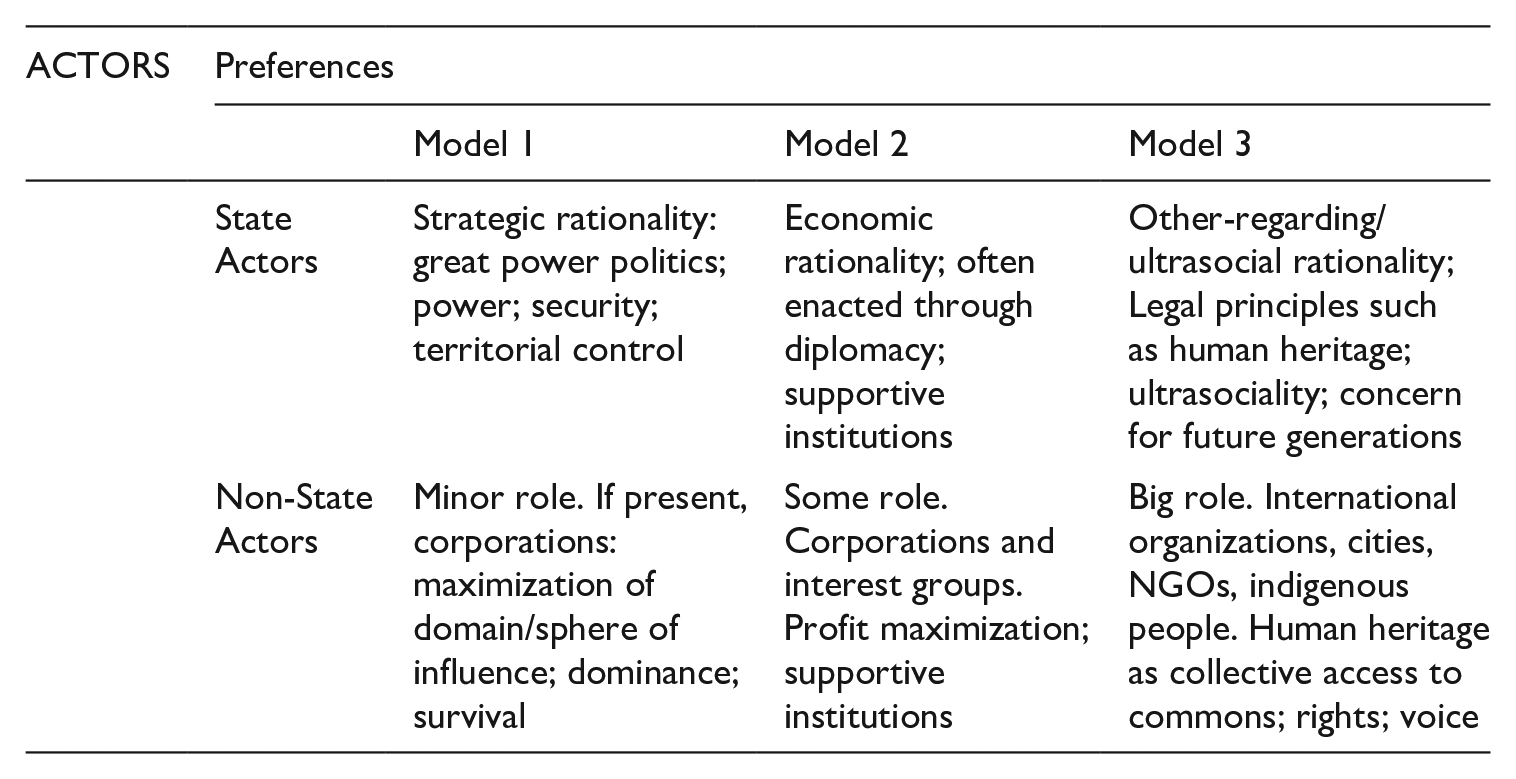
As a starting point, to capture the special features of the global commons discussed above, we can set forth three analytically distinct ontological assumptions of actor rationality and hence putative preferences or motivations underpinning behavior in the global commons. We build on these to (1) develop three analytically distinct but empirically overlapping models of actors’ policies, priorities, and relations in the global commons; and (2) in the case studies develop a set of key hypotheses of what determines the factors affecting the level of cooperation and conflict in these domains. On the one hand, it might be that the global commons develop in the same way as we have observed historically in other areas of the world, where balance of power or multilateral interest-based cooperation have been common. The first two ideal types and corresponding hypotheses thus draw on established rational choice-based IR theories. They also incorporate the traditional expectations of how states may overcome the conflicts and race to the bottom predicted by the tragedy of the commons 31 : (1) Territorial control by one or more states; (2) ‘tit-for-tat repeated games’ where states can punish those who do not cooperate, and (3) the establishment of cooperative institutions where only participating members can access the common goods. To better capture the complexity of the global commons, we however also draw on various contributions in this Special Issue building on constructivism, international law, and political theory. 32 Leaning on this insight, we develop a third model which we, drawing on the existing legal concept of the ‘Common Heritage of Humankind’, call the Human Heritage model. Below, these models are spelled out in detail, with the most weight put on the new model we developed.
Type 1: Great power policy – balancing and territorial control
The first model and the corresponding hypothesis of actors’ policies and positions toward the global commons builds on a neo-realist perspective, and suggests that conflict may be reduced if territorialized by one or a few states or as a result of a balance of power between great powers in the area or as part of a broader global balancing game. This would be in line with the first possible solution to the tragedy of the commons dilemmas mentioned above.
Neo-realist perspectives view the world as an anarchical environment where strategically rational states – mostly concerned with their own security – engage in a zero-sum game with the aim of increasing their relative strength vis-à-vis other great powers, called ‘balancing’ in the realist terminology. 33 Although one would not expect states to give up their veto powers, states may form alliances to balance against other powers, to better shape their external environment, or to be better able to enforce common security interest. 34 In a changing and more threatening geopolitical environment, one would thus expect that states, organizations, and alliances of states would seek territorial control and increased strength, to balance and deter other, competing powers in the global commons. As part of such a balancing game one might also observe band-wagoning, where junior partners (e.g. the EU or Japan) join forces with a hegemon (such as the US) as part of a larger geopolitical balancing game (e.g. vis-à-vis China in the South China Sea or Russia in the Arctic). 35 One would not expect states and other actors to promote the development of international, regulatory regimes in various global commons areas. Once a hegemon or balanced power through deterrence is established, open conflict may be reduced. 36 Although at the outset expecting that non-state actors will play a minor, if any, role in the global commons, our Special Issue also extends a neorealist hypothesis about state behavior to non-state actors as well in order to infer that they would prefer policies toward the global commons that maximize their home countries’ control over these areas and their resources. Private actors may, however, also seek to maximize control over global common areas directly, for example in space linked to technological developments or by accessing rights and protections in the seas. Private and state actors may also cooperate in this regard.
Hypothesis 1: Actors will pursue policies and positions toward issues in the global commons to maximize territorial control, power, and security. A lack of conflict will reflect balancing and deterrence games.
Type 2: International cooperation – repeated games and institutionalization
Linking IR to states’ power maximization and balancing games, neo-realists would however expect a high level of conflict as long as the global commons are not territorialized or power is not balanced, a prediction that, at least for now, does not fit what we observe in these areas. The literature’s two alternative solutions to the tragedy of the commons problem – repeated tit-for-tat games and cooperative regimes – explain relations in the global commons on the basis of states’ instrumental (foremost economic) interests instead. This is much in line with liberal IR accounts. Such perspectives start from the assumption that instrumentally oriented foreign policy actors (including states, organizations, companies, individuals) aim to promote their foremost economic preferences in an international environment characterized by interdependence. Within such environments, international cooperation in common institutions might increase everyone’s long term gain. 37 This perspective could thus allow for policies other than those predicted by the tragedy of the commons: Actors might find it rational to cooperate, participate in and respect some sort of international regime to gain access to resources and limit free-riding. In line with this reasoning, China also became a promoter of a liberal world order in the economic realm. As the global commons become accessible, one would thus expect a variety of actors to promote an extension of the existing order to also cover global commons issues, such as space exploration and the high seas for self-interested reasons. Some individual case studies, such as of the Arctic and organized crime in the high seas, suggest that rather than engaging in a geopolitical balancing game, states and non-state actors, including the US, China, and Russia, search for common arenas and rules in their policies toward the global commons. 38 However, the deciding participants and main units of law would be states. Given the key role that non-state actors may play in a globalized world, international regimes might also regulate other actors, but based on a state-centric logics. Thus, we also study the influence non-state actors may exert in shaping these regimes.
Hypothesis 2: Actors will pursue policies and positions toward issues in the global commons for economic reasons, to gain access to resources and avoid free riding. Lack of conflict reflects well-functioning institutions that serve the members’ interests.
Type 3: Protecting the ‘common heritage of mankind’– principled concerns for future generations
Ideal types 1 and 2 and their derivative hypotheses about the motivations driving actors in the global commons assume that foreign policy actors are instrumentally rational, always orienting their actions toward interest-maximization. 39 However, as discussed above, the global commons are also global common goods, and developments there affect all individuals beyond particular state borders – including future generations. It might thus be that some or all the actors’ motivation toward these areas are guided by principles other than that of their immediate interests. But what would such a normative foreign and security policy toward the global commons look like? After all, an alternative mode of global governance to the current regime organized mainly around state sovereignty is seldom operationalized in the literature. 40 It is particularly challenging to operationalize in relation to the global commons, as policy makers not only would have to take into account the effect of particular policies on the lives and well-beings of today’s citizens beyond the borders of sovereign states, but also that of future generations.
To contribute to theory development and tease out new empirical knowledge, we develop a third model that we refer to as the ‘Human heritage’ model. While acknowledging the human tendency to cooperate as an ingroup to exploit and harm outgroups for example through racism, we here define the concept of human heritage as inclusive, reflecting the global common goods aspect of these areas. 41 Heritage refers to something we inherit while human reflects the human rights aspect of this, i.e. to the fact that these areas belong to everyone as individuals, independent of group belonging. This model builds on three assumptions. First, we draw on the constructivist assumption that existing institutions and norms or expectations of how one ought to behave may influence actors’ preferences and thus affect behavior. 42 More precisely, we start from Mai’a Cross’ understanding of human actors as ‘ultrasocial’. 43 As Mai’a Cross points out, nearly all IR scholarship either assumes that humans are materially self-interested actors who maximize power, or that we are blank slates that are socialized into defining our interests in more nuanced ways. 44 Cross instead argues that the field of IR should take into account a recent groundswell of findings in other fields – neuroscience, cognitive psychology, anthropology, among others – that show that these assumptions are not necessarily true of human nature. As anthropologists put it, humans are actually ‘ultrasocial’. Cross defines ultrasociality as, ‘a human predisposition to be other-regarding, empathic, and inclined towards seeking wide-scale cooperation, even among strangers’. 45 This assumption is key when studying the global commons as it allows for other-regarding policies to be considered as equally rational to those following models 1 and 2 above. It also helps us tease out hypotheses on why actors may choose to conduct an other-regarding or normative policy: While actors may of course also act according to a range of self-interested motivations, as the other models expect, at the outset, there is no analytical reason why we should give priority to the traditional rationalist starting point of interest-maximizing and lack of trust. 46 What motives underly behavior is, after all, an empirical question. Only by starting from the ontological understanding that actors may be other-regarding can we study different types of actions empirically. These basic assumptions also allow for the possibility that foreign policy preferences can change over time on the basis of expert knowledge and normative concerns, for example linked to the environmental impact of increased activity in the Commons, or particular issues linked to affected peoples’ rights. 47
Second, we draw on a growing political theory discussion about the normative obligation to show solidarity with the human rights of future generations when dealing with the global common goods challenges linked to climate change. As Takle elaborates, this literature starts from our knowledge of environmental degradation and man-made climate change, emphasizing that any use of natural resources needs to be assessed in relation to what one leaves to future generations. 48 Although scholars disagree on the extent to which future generations should also have the right to use non-renewable resources for development purposes, such as oil and gas, they agree on the normative obligation to ‘leave seas, forests, rivers, the soil and the atmosphere intact’ for future generations (Takle, ‘Solidarity with Future Generations?’ also see Takle, ‘The Norwegian Petroleum Fund’). This obligation can also be extended to space, where we already see competition over resources and access to the high seas and the poles.
Lastly, we draw on the empirical observation that global commons law already is a distinct branch of international law with its own set of guiding principles, treaties, and norms of behavior. In particular, Garcia contends that global commons law is different from other international regulation as it serves a different purpose, namely the protection of certain parts of the Earth for the benefit of all humankind. 49 Rather than being developed to serve the interests of the states, global commons law’s purpose is the intergenerational protection of the human heritage, in the interest of all living and future generations, with heritage referring to what belongs to all individuals independent of state or group membership. Hence, a different, norm-based policy toward the global commons is not only a theoretical possibility, as our ontology and philosophical assumptions allow. Global regulation based on a concern for the common heritage is already an empirical reality – it is referred to and applied by the UN and other actors, and hence also something states and other actors may choose to pursue further.
On this basis, a third explanation of the relative lack of conflict in this area suggests that actors may be motivated by a concern for preserving the global commons for the good of all, including future generations, and that this type of behavior due to the uniqueness of the global commons may be driven not only by states but also a number of non-state actors.
Hypothesis 3: Actors will pursue norm-based policies for the global commons motivated by a concern for future generations. The lack of conflict is linked to the influence of norms, common institutions, and the role of non-state actors.
Rather than competing for territorial control or establishing international regimes based on common material interests, if this hypothesis is substantiated, one would expect evidence to suggest that actors refer to and promote a future regime that takes the global heritage into account.
Empirically, we would observe actions, regulations, and regimes oriented toward environmental protection of the atmosphere, open seas, space, and the poles for the benefit not only of existing but also future generations. While serving as an argument in favor of establishing regimes to allow for the sharing of available resources amongst states, a Human Heritage policy would also consider the long-term environmental impact of such policies. Importantly, any justification of a global heritage policy would also have to be followed by action. Building on Habermas’ theory of communicative action, the defining criteria of such a foreign policy is first, that it is oriented toward overcoming environmentally degrading behavior by strengthening binding and enforceable laws in the international system, and second; that actors in the global commons are willing also to bind their own behavior and actions to such norms. 50 Since an ideal-typical regime based on such considerations would deviate from most of today’s international conventions, one would also expect to find evidence to suggest that states and other international actors’ perceptions of how to deal with these areas are changing. If substantiated, our Human Heritage hypothesis suggests a different way not only of thinking of but also of organizing IR than the ones we currently know from many existing organizations, treaties, and individual states’ policies. Perhaps the closest, already existing regime is the Antarctica convention, where the UN plays a key role in upholding the existing system and its obligations. 51 A main focus of contributing papers is thus on developing and operationalizing this third hypothesis for states and non-state actors.
Summary of findings
Cross, Takle, and Garcia theorize and operationalize the human heritage model and explore the relevance of their arguments across cases, including in outer space, climate negotiations, in international law and legal concepts, the Arctic, and in the Cyber domain. 52 Kelsey, Crawford, Lori and Schilde, and Govella apply the framework in other cases linked to space, the high seas and the atmosphere, empirically focusing on the role of cities in climate relations, the governance of the Arctic, how states and the EU use the high seas for security purposes linked to migrants, and China’s policies in the South China Sea and in the cyber domain. 53
In her paper, Cross develops the ontological argument that humans are ultrasocial and applies this in studies of interaction in outer space. Cross argues that state activity, and that of non-state actors to an even larger extent, provide evidence of decades of partnership and collaboration across national boundaries in order to realize the human potential in outer space. Rather than power maximization as specified by model 1 or economic gain as specified by model 2, Cross shows how the difficult tensions that characterized much of inter-state interaction in the decades preceding the fall of the Soviet Union were not prevalent among space actors, and that several space endeavors, including Sputnik, took place with the goal of promoting peace and intellectual advancement for all humanity, thus bolstering the case for model 3. Concern for human heritage does not characterize all state and non-state actor behavior in space however, and Cross notes that ultrasociality has not been the impetus for the Chinese state given cases of espionage and garbage from rocket launches in the upper atmosphere. Still, her paper finds some evidence for model 3 in that China is open to world-wide applications for research in a planned Chinese space station.
Takle’s paper also contributes to the human heritage model and to new empirical knowledge. Applying tools from political theory, Takle discusses whether there is a common ground for action that everyone can accept that can contribute to solving the collective action problem facing the global ecological commons. Her main argument is that a concept of solidarity with future generations could establish such common ground. This may give global political processes a normative content and direction, and thus be crucial for understanding climate action and negotiations. To evaluate the relevance of the concept of solidarity in this context, Takle applies it in a study of the political process leading to Agenda 2030. She finds that, although appeals for solidarity with future generations are formulated as guiding norms, the binding commitments to collective actions are still rather weak in practice.
Garcia explores the body of international norms that protects the global commons (defined as ‘global commons law’), discussing their relevance for understanding the relative peacefulness of the global commons. By exploring her argument’s relevance across cases (the Arctic and the Cyber domains), Garcia finds that the global commons have assumed a non-national status in international law and that individuals remain the main subjects of this law, in line with model 3. global commons law moreover restrains conflicting behavior among states, as treaties and concepts such as the common heritage of humanity, intergenerational equity, and the precautionary principle constitute a powerful custodian of the global commons and form a platform for state and non-state actors to play a role in safeguarding these areas of the planet. This finding contradicts the realist (model 1) and liberal (model 2) predictions that international law would focus on states’ rights and their competing interests and thus inexorably lead to conflict. These perspectives lack a peace hypothesis, in which regimes or legal systems are formed in spite of states’ interests or with the purpose of protecting states. Instead, here we confront this large part of the Earth in which principles of humanity command behavior and lead to co-existence.
Govella develops a more nuanced notion of conflict to effectively discuss the ways that states are interacting in the global commons, as what she refers to as cooperation, contestation, and subversion can all operate below the level of overt conflict. She applies this in combination with the common framework to examine China’s activity in the maritime and cyberspace domains. When economically convenient, China has shown a willingness to work with existing governance structures in alignment with model 2. China is, however, also contesting them when possible in order to push governance toward model 1 by extending notions of sovereignty and territoriality to the commons, particularly in cyberspace. Lastly, also in accordance with model 1, China engages in tactics of subversion when necessary, which manifests in ‘gray zone’ conflict. Govella does not find any evidence of Chinese government or non-state actors advocating for model 3, and thus in her view, China poses a ‘challenge’ to the commons. Her findings also have broader implications. On the one hand, institutions are relatively dense and formalized in the maritime field, which gives China little room to challenge the interpretation and application of specific rules when its interest is in exerting state autonomy. On the other hand, the field of cyberspace has very few rules in place. This allows China to play more of a foundational role in challenging whether cyberspace should even be understood as part of the global commons.
Crawford reflects on the nature of global commons conflicts and cooperation in the Arctic within and between the realms of the environment, the economy, and politics. Following Garcia, she argues that the Arctic is not likely to be a site of increasing conflict. This is because the governance system fosters cooperation, preservation of human heritage, and the global environment through a network of small and medium issue-specific regimes, with indigenous peoples’ participation playing a key role. While in Crawford’s view, the Arctic itself is not a global commons area (except that part of the Arctic Ocean that is outside Arctic states’ territory, near the North Pole), she underscores that the Arctic rather is a site of rich global commons resources (ice, water, forests, etc.) crucial to life on earth and therefore a vital part of the global commons. These resources are governed as ‘common pool resources’ through the local, regional, and transnational regimes. Her discussion of these networked regimes, grounded in Ostrom’s theory and based largely on traditional ecological knowledge as well as other forms of knowledge, contributes both to the global commons literature and to the human heritage model.
Focusing on the role of non-state actors in the global commons, Kelsey’s paper addresses the puzzle of why municipalities adopt policies more stringent than their national governments for curbing their emissions of greenhouse gases. She argues that these cities view their actions to mitigate climate change as way of enhancing their voice and autonomy and thus increase their political influence. Furthermore, her study points out that cities develop their own networks among each other and in connection to polities with varying types of authority at the sub-national and supranational level. It is such ‘paradiplomatic’ activities undertaken by cities that Kelsey argues provide them with new ways to pressure political actors within the nation state to accept climate policy reforms more amenable to municipal governments. However, ‘paradiplomatic’ activities not only enhance the voices and visibility of municipal actors within the nation-state setting, cities are also able to shape policy responses to climate change beyond the nation-state in international and transnational forums. Thus, Kelsey’s discussion of the mobilization of cities as political actors in global carbon policy reveals a dimension of the global commons as one responsive to innovative participation and the deployment of agency by non-state actors.
Schilde and Lori examine states’ practices of stopping ships on the high seas in order to fulfill treaty or international agreements with other states to control migration. In this way, migration management is a form of governance in the global commons domain of the high seas. Their paper assembles evidence of state behavior in line with model 1, arguing that states are turning to the high seas to further their border security interests while at the same time fulfilling their international obligations. However, contrary to the expectations of model 1, in these cases, states are not seeking to establish territorial control. On the contrary, the high seas are useful precisely because states are not held to the same obligations outside of their own jurisdictions. Contrary to the realist expectation of zero-sum games and heightened interstate conflict, migrant interdiction creates greater cooperation between states designed to enhance rather than constrain state sovereignty. States that are party to the Refugee convention are increasingly cooperating with states that are not, as well as non-state actors to repel migrants in the high seas. However, just as Govella found ‘gray zone’ conflict short of war in the maritime domain, so too do Lori and Schilde find conflict on the high seas between states and migrants. While the paper shows how the global commons are facilitating greater cooperation between states, it also questions the idea that interstate cooperation necessarily leads to less violence, as it increases the risks of irregular migration and heightening violence between states and migrants.
Concluding remarks
This Special Issue set out to break new empirical ground by conducting a first theoretically informed, comparative study of both state and non-state actors’ interactions in the global commons from a variety of perspectives. Drawing on IR theory, law, and political theory, we also set out to contribute to theory development in the field of IR, by developing an analytical framework that can help capture different types of policies and actors in these particular resource domains.
Our framework proved helpful for studying a variety of cases across the different global commons. One important finding is that state actors and norms do play a key role in explaining the relative low level of conflict in these areas. Common heritage law exists in international law and in the language of international organizations and political actors both refer to it and act upon these norms. 54 Contrary to what one would expect following realist and liberalist perspectives, what we refer to as the human heritage model has relevance for understanding developments in these resource domains. In the global commons, humanity has legal standing, and the protection of such areas of the planet and beyond takes legal precedence over state sovereignty. This is not just a utopian ideal. It is reflected in many states and other actors’ discourse and practices. As suggested by Govella and Garcia, we expect this framework to have relevance not only in relation to other issues under the legal global commons, but also in other non-territorial areas that increasingly are discussed in such terms, such as cyber space. 55 In addition, Crawford, Cross and Kelsey all suggest that IR scholars should think beyond international legal arrangements to networked regimes involving non-state actors such as indigenous peoples, civil society groups, experts and and cities as another mode of multilateral governance that may be motivated by norms of solidarity. Future studies should further explore the development an role such networks – may play not only in the governance of the global commons but also in developing multilateral order more broadly.
Our work, however, also suggests that the level of conflict in these areas may increase. In contrast to model 2, both in the Arctic and in other global commons areas, such as in the high seas, international regimes do not always function effectively, which is why states for example can ‘outsource’ their responsibility for migrants to such areas. 56 Thus, while legal regimes are developing for example with regards to the high seas and the environment and are supported by actors such as the EU, we do not find support for the hypothesis that an efficient global multilateral order – at least for now – is moving to the global commons. Similarly, although we find that solidarity with future generations increasingly is formulated as a guiding environmental norm, commitments to collective actions still remain rather weak in practice – a challenge facing global climate change negotiations more broadly.
Another key finding of this issue is the importance of Chinese policies for understanding the future of the global commons. Among state actors, China pursues a combination of great power politics (model 1) together with economic rationales (model 2) in the Commons. 57 The human heritage model does not seem to apply to interactions of the Chinese state in the maritime, cyberspace, or space fields, with a weak exception for state plans for a Chinese space station where work visits are open to every nationality. 58 China might be more prone to act in accordance with the second and third model in protection of the atmosphere, but in general seems less keen on establishing international regimes in areas where it has strong interests. 59 As in much of IR today, Chinese policies and perspectives on the future governance of these areas will be key for their future development and type of relations that will come to dominant these areas. Future studies should systematically explore not only Chinese perspectives on the future organization of these areas, but also how Chinese perspectives interact with putatively changing US foreign policies, a more assertive Russia and a potentially more active European Union foreign policy, to see whether there is support for the development of a multilateral regime in line with model 2 or 3, or whether some of them continue to move toward a more realist behavioral model. 60 Although the Biden administration has shown a clear preference for multilateral solutions and a focus on fighting climate change, we now know that this can change with different U.S. leadership. What is more, if the great powers are less interested in developing international regimes in the global commons – areas where governance is in the making – this may also suggest that they are less interested in upholding multilateral institutions more broadly.
Our studies also underscore the need for future research to be more attentive to boundaries between state and non-state actors, and to more hidden conflicts between various types of actors. As Govella shows, these sometimes become intentionally blurred during ‘gray zone’ operations, where states are using or at least partnering with non-state actors in order to promote their territorial interests in the maritime and cyber domains. 61 ‘Patriotic hackers’ in cyberspace and ‘civilian fisherman’ in the maritime sphere could be thought of as supporting ‘national’ interests over those of ‘human heritage’ as well as non-state actors who engage in cyber-attacks for economic gain via espionage operations. Similarly, Lori and Schilde show how states use the maritime commons to deal with migrants, often in cooperation with non-state actors. 62 Given Takle’s finding that the binding commitments to collective actions are weak in practice, future studies will need to address the scope conditions that might lead to binding commitments to collective action that are strong in practice. 63 The implications of Kelsey’s study are critical for non-state actors seeking to amplify their voice in areas of the Commons like the atmosphere with under-institutionalized and nascent governance structures. 64 The degree to which non-state actors have the capacity for the implementation of governance in commons areas, the more likely it may be for those actors to leverage this capacity for greater voice.
The findings in this Special Issue also have several wider conceptual and theoretical implications. Conceptually, studying IR in non-territorial areas challenge concepts such as sovereignty, territory, and boundaries. Our findings also have implications for how we perceive of sovereignty and the workings of IR. The studies conducted here indicate that a shift in international law away from the Westphalian system of regulating inter-state relations, toward a more explicit focus on individuals and groups as the addressees of such law is both an analytical and empirical possibility. This is a shift that is already evident in global commons law and it is present in international negotiations. We also find that non-state actors play a bigger and different role than is often acknowledged in studies of other areas of the world. A human heritage policy would imply that various actors work together toward a different global system than the one we conventionally know, one where the objects of security and addressees of law are no longer only states but also individuals, including the rights of future generations. Key to this development is the role of different non-state actors that may contribute to cooperation and interaction rather than mere conflict, even in geopolitically salient areas such as space and the Arctic, where networked regimes and indigenous governance practices have emerged. Theoretically our studies support our expectation that conventional perspectives indeed are relevant but insufficient for fully understanding IR in the global commons policy, because they are based on assumptions that are not always reflected in empirical cases, not least linked to their expectations of the drivers and actors involved. Without including the third model in our analytical framework, we would not have been able to tease out the role of a number of different non-state actors, and the uniqueness of law and relations in these areas. The human heritage model should be applied in addition to other perspectives also in other studies, in order to better understand the empirical reality of the global commons. Although we in many areas observe an increasing level of conflict, this can change over time, both toward more multilateral forums and toward common heritage regimes such as those in Antarctica: What model best fit actors’ behavior and interactions is, as argued, an empirical question. Of course, the claim that norms and non-state actors are important for understanding IR is not a new one. However, this Special Issue adds to our understanding of the scope conditions by which such factors may influence IR, by suggesting that these patterns are linked to the context of the global commons, that is to the fact that they per definition are beyond states’ control and to their common goods character. As argued by Kelsey, the legally and politically less structured nature of the global commons ‘provides unique opportunities for actors to act as makers rather than takers of global governance structure and diplomatic effort in a critical area of emerging international policymaking’. 65 There is also a new legal and conceptual structure developing in these global commons areas to which even the most powerful states must, at minimum, relate. This is something that would not have been possible to detect without applying a framework that allows norm-based behavior to be considered equally rational to that of interest-based behavior, so that both possibilities could be studied empirically. Future studies of cooperation, conflict, and interaction in the global commons will help shed light not only on these areas, but also on the patterns of International Relations more broadly.
Footnotes
Acknowledgements
The authors would like to thank Beverly Crawford, Mai’a Cross, Denise Garcia, Nina Kelsey, Julie Klinger, Kristi Govella, Kaija Schilde, Mike Smith, and Jolyon Howorth for their feedback on early versions of this project. Special thanks are owed to the two anonymous reviewers for their helpful questions and comments. Thank you also to William Bain, Rachel Vaughan, and the rest of the International Relations editorial team for their patient support and their suggestions and feedback throughout this process.
Declaration of conflicting interests
The author(s) declared no potential conflicts of interest with respect to the research, authorship, and/or publication of this article.
Funding
The author(s) disclosed receipt of the following financial support for the research, authorship, and/or publication of this article: This research was supported by the German Academic Exchange Service (DAAD) 2019–2020 grant and the Jean Monnet Center of Excellence 2018–2021 grant, both administered by the Institute of European Studies at the University of California at Berkeley.
