




Abstract
This article uses a new dataset of Chinese student attitudes to foreign affairs to analyse how perceptions of the United States, Russia, Japan and North and South Korea affect respondent perceptions of international friendship with these states. Employing a mediation analysis we find that perceptions of national trustworthiness above all other images is the crucial factor in explaining cross-national friendship. These findings suggest that trust-building measures would be a fruitful avenue for both reducing the likelihood of conflict in the region and fostering cooperative international interactions.
University students are one of the most active and vocal sectors of society on foreign policy issues in China. Understanding student attitudes to other countries is one of the keys to studying the interaction between Chinese public opinion and foreign policy. In this article, we use a new dataset of Chinese student attitudes towards foreign affairs to identify how perceptions of national attributes and behaviours affect respondent images of other states and specifically friend/enemy distinctions.
We conduct a mediation analysis to show that the image of national trustworthiness has the greatest influence on student perceptions of international friendship and that this is particularly pronounced when the foreign state in question is more generally perceived to be an enemy of China, such as Japan or the United States. Trust not only has a direct effect on friendship but also mediates a whole series of perceptions about other countries. Our findings show that trust and peacefulness are strongly correlated in respondents’ minds. Perceptions of a foreign state being peaceful, powerful or similar to China appear to have a much smaller direct effect on perceptions of friendship. However, when we build a model that combines direct and indirect effects on friendship we see that trust and peacefulness are the key factors behind friendship, with the exception of the Russian friendship image, which is driven by trust and power.
These results indicate that focusing on trust provides the most plausible mechanism for increasing perceptions of friendship with other states among Chinese students. Our study suggests that models that look only at direct effects of perceptions of peacefulness and similarity on friendship will miss a crucial pathway to friendship. We also find that respondents are sophisticated in their thinking about friendship, making more strategic alliance-based calculations when estimating China’s friendship with Russia, concentrating on trust and power, rather than peacefulness.
The article has five sections, with the first discussing previous research on image theory and reviewing past studies of Chinese images of foreign countries. The second proposes a theoretical framework for examining the key images of international friendship held by a section of the Chinese public. The third section discusses the new dataset, outlining research design and the variables used in the analysis. The fourth examines the mediating effect of trust on friendship, and the final section provides some general discussion.
Previous research
Image theory provides a powerful tool to help us understand how elites make decisions about out-groups and how they view other states and peoples in the international system, 1 although image theory has generally not been used to investigate mass attitudes to foreign affairs. Images are an important way for individuals to sort multifaceted material that would become overly complex and unstructured without cognitive shortcuts. 2 Images have both the potential to simplify decision-making but also distort it, potentially exacerbating conflict or leading to groupthink. 3 Initial studies of images and international relations (IR) can be traced back to the work of Kenneth Boulding who applied image theory to elite decision-making. 4 For Boulding a foreign policy image was defined as: ‘the total cognitive, affective, and evaluative structure of the behavioural unit, or its internal view of itself and its universe’. 5
Boulding argues that the two images that are best placed to explain leaders’ foreign policy decision-making are the hostility/friendliness of other states and their perceived strength/weakness. 6 Later studies extended the strength/weakness image to take into account other potential stereotypes that might influence foreign policy decision-making. Cottam, again specifically examining elite decision-making, highlights that certain worldviews or ‘perceptual milieu’ will predispose different individuals towards alternative foreign policy options. 7 For Cottam, there are four key images relating to threat, opportunity, culture and capability. Herrmann, Voss, Schooler, and Ciarrochi extended earlier studies into image theory by developing a formal theoretical approach arguing that perceptions of structural relations between states result in emotions that influence the images and perceptions of other actors’ behaviour. 8 They examined four ideal typical images (enemy, ally, colony and degenerate) but suggested that further research needs to be conducted examining different images and different patterns, a suggestion we take up in our own research.
Despite its central role in research into image theory in international relations, the concept of friendship has generally been overlooked or downplayed in the broader IR literature, with some notable exceptions. 9 Berenskoetter argues that friendship is a means by which states control anxiety regarding the ‘other’ in international relations, gain recognition and commit to a vision of a common world based on a shared sense of virtue. 10 Oelsner and Koschut distinguish strategic friendship, which involves mutual reliance and the alignment of interests and is often invoked in treaties and other international discourse, from the rarer normative form of international friendship, which is characterized by a deeper and more intimate ‘special relationship’ built on genuine trust and mutual caring. 11 While both forms of friendship are associated with bilateral interstate relations, the mutual identification and trust upon which normative friendship is built can be seen not only between leaders and other representatives of the state, but also in other areas of interaction, such as transnational relationships involving businesspeople or civil society actors. 12
Although often marginalized in the academic literature, international friendship has been prominent in Chinese discourse on foreign relations due to the expectation of the Chinese side that the friendship image could help reduce the sense of threat associated with the country’s rising power. 13 Chinese officials use the language of friendship even when dealing with major rivals; Chinese IR scholar Yan Xuetong has argued that Sino-US relations are fundamentally unstable due to a mutual policy of ‘pretending to be friends’. 14 Chinese political and media discourse often emphasizes the bonds of friendship that exist between China or the Chinese people and the rest of the world. If China’s international friendship is to take on a normative form that goes beyond just the strategic use of friendship diplomacy or a ‘false-but-nice’ 15 description of the country’s foreign relations, we would expect to see it underpinned by genuinely friendly images of other states among sectors of the Chinese public that are interested or engaged with international affairs. Yet we know relatively little about whether the Chinese public really harbours friendly feelings towards other countries.
While research on images is well developed when examining US public perceptions of other countries, the study of Chinese public perceptions are relatively underdeveloped. Recent notable exceptions include a study conducted by Li et al., who investigated Chinese public perceptions of trustworthiness of South Korea and Japan. 16 Van der Noll and Dekker have also examined individual attitudes towards the European Union (EU), the United States, Russia and Japan. 17 We build on these important studies by examining a more recent dataset on student attitudes towards friendship with a larger number of regional actors (the United States, Russia, Japan, South Korea and North Korea (a significant omission from most previous studies)).
A lack of survey data meant that early research on Chinese images of foreign nations was based on elite interviews and descriptions in the mass media. 18 Although research on Chinese foreign policy attitudes has progressed in recent years, it remains limited by data availability. Due to the difficulty of carrying out independent, large-scale surveys on political topics in China, very little research into Chinese foreign policy attitudes is able to draw on statistically representative samples of the broad population. Instead, researchers like ourselves have to rely on surveys of students or scholars or online surveys, which are less problematic to conduct. 19 A few large-scale surveys of public opinion have provided a snapshot of perceptions of China’s relationship with foreign countries, although these surveys have a more limited range of foreign policy attitude questions than our own study and they too suffer from sampling bias resulting from the difficulty of conducting surveys in rural areas, which leads to the overrepresentation of the views of China’s urban population. 20 Other studies have focused specifically on middle-class views or the opinions of Chinese who either live overseas or have returned to China following a period abroad. 21 Some research into Chinese foreign policy opinion draws on a wide range of sources, such as surveys, media content analysis, focus groups and interviews, but examines Chinese views of only one country or organization. 22 Other research compares Chinese attitudes to multiple countries but uses only a limited range of independent variables (without controls for a range of other attitudes) such as whether respondents view specific countries as a threat to China or whether they have a positive or negative view of different countries. 23 Some studies have more representative samples but are limited in the questions they can ask, while others are able to ask a wider range of questions about political topics (such as our own) but they have more limited samples. All of these research studies have weaknesses due to the incredibly difficult job of doing research on mass attitudes in authoritarian states.
While it is certainly easier to conduct studies of Chinese students than to generate more representative samples of the opinions of the broader Chinese population, there are good reasons to focus on student opinion in China beyond the simple convenience of obtaining student samples. Studying Chinese student images of other countries is crucial because students are an especially active and vocal demographic on foreign policy issues and form part of an urban, educated elite that the Chinese Communist Party (CCP) views as vital to cultivating and maintaining its popular legitimacy. 24 Students play an important role in nationalist protests in China, and pressure from student-led activism has a long history of affecting Chinese foreign policy. In 1919 May Fourth movement demonstrators prevented the Chinese delegation to the Paris Peace Conference from signing the Treaty of Versailles, while in 1967 radical Red Guards occupied and seized control of the Ministry of Foreign Affairs. 25 Today nationalist protests represent an ongoing potential flashpoint in the relationship between public opinion and policymakers in China, and the CCP pays close attention to the management of university campus-based activism on foreign policy issues. 26 When international tensions have risen, the Chinese authorities have sometimes threatened students with disciplinary action or taken other steps to discourage students from leaving campus in order to prevent student protests. 27 Obtaining a clearer picture of Chinese student opinions on foreign policy issues and the factors that influence friend/enemy distinctions will help contribute to our understanding of this very important sector of the Chinese public.
Theory and hypotheses
Images are important cognitive tools that individuals use when evaluating other states in the international system. The image represents a heuristic that aids decision-making especially when people have little direct evidence of the actions of other nations. Our choice of images is influenced by two factors. First, drawn from the literature outlined above, we focus on images that have been consistently shown to influence decision-makers’ attitudes towards war and peace. These include images of opponents’ strength, their cultural similarity and their perceived level of aggression. 28 Second, we are interested in examining the extent to which macro-theoretical arguments about war and peace have micro-foundational underpinnings in individual perceptions. Again the images selected speak to theoretical arguments found in Realism which outline the relationship between power, conflict and the rise of China; 29 the Clash of Civilizations that outlines the relationship between cultural differences and conflict; 30 and finally security dilemma thinking, which examines beliefs about intentions and perceptions of an opponent’s level of aggression. 31
The final image selected relates to trustworthiness. Developments in the literature have shown trust to be a key factor in explaining cooperation between leaders and in mitigating the security dilemma. 32 As discussed below we hypothesize that trust is a key mediator in explaining how the other images affect perceptions of friendship. The theoretical framework outlined below will first discuss the hypothesized direct effects on friendship of images of cultural similarity, power and peacefulness. We then examine the impact of trustworthiness on friendship and how it mediates the effects of the other images in our model. In essence we will be outlining two mechanisms to explain the role images play in individual calculations about other nations: a direct mechanism and a mechanism mediated through trust.
Images of other nations and their direct effect on friendship
First, we outline the effect of perceived cultural similarity on friendship perceptions. The Clash of Civilizations argument has received considerable attention in the academic literature, but there is little evidence that cultural divisions lead to conflict between nation states. 33 However, at the micro-level two studies have found that civilizational tensions increase individual support for military action against foreign states. 34
There are two distinct mechanisms that directly link cultural similarity to friendship: infrahumanisation and homophily. Infrahumanisation is the denial to an individual or group (in our case a nation state) some of the characteristics that make people human, rendering the target less than human. 35 When foreign nations are viewed as culturally distant ‘others’ they may be more vulnerable to infrahumanisation, making them difficult to relate to and as such undermining the capacity to view them as friends. 36 Alongside the infrahumanising mechanism there is also the effect of homophily, which is defined as ‘liking others who are perceived to be similar to oneself’. 37 This literature argues friendship often results from shared gender, ethnicity or other socially constructed attributes that individuals identify with. 38 Applying homophily research to national images we anticipate that images of similarity should increase individual perceptions of other nations being friendly and dissimilarity should increase perceptions of enmity. Both mechanisms suggest that images of cultural similarity should increase friendship perceptions.
H1. Respondents who view nations as being similar to China will be more likely to perceive them as being friends of China.
Second, we outline the theoretical direct relationship between the power image and friendship. There are two plausible mechanisms that relate power to friendship: (1) in an anarchic self-help system the public suspect that powerful nations are enemies as they are more able to take resources from China; (2) alternatively they might be perceived as a more capable ally who can help protect Chinese national interests. 39 Johnston has argued that the strategic culture of the Chinese leadership has historically exhibited a tendency to view the world in realpolitik terms. 40 If public thinking is in alignment with power preponderance theory – where Chinese dominance makes other states more compliant, thus reducing the risks of conflict – then the public should view weak nations as more friendly as they are unable to challenge China’s regional dominance and more subservient to China’s national interests. 41 We therefore test hypothesis 2 to examine whether perceived weakness increases friendship or whether the relationship is contextual with powerful potential allies being more likely perceived as friends.
H2. Respondents who view nations as being more powerful will be less likely to perceive them as being friends of China.
Looking beyond national culture and power we also identify two images that could potentially influence national friendship images. We first look at peacefulness and then examine trust and its mediating effect. Images of peacefulness are important and relatively straightforward because they relate to decisions about war/peace and should therefore affect respondents’ views about the friendliness of other states. Intentions are important when considering friendship and speak to discussions about the security dilemma in the International Relations literature. 42 Perceptions of national peacefulness will also influence friend/enemy distinctions, with an aggressive nation being seen as an enemy of China, whereas peaceful nations will be perceived as friendly. We believe that there is a potential caveat to our understanding of the relationship between peacefulness and friendship that relates to North Korea and Russia. These states might be perceived as aggressive but not towards China, which is an issue that we probe in the results.
H3. Respondents who view nations as being more peaceful will be more likely to perceive them as being friends of China.
Trust’s direct and mediating effect on friendship
The trust image is critical to understanding public attitudes towards friendship. There is a growing body of research examining the concept and basis for trusting interactions in international relations. 43 We anticipate that being able to trust another state is a critical factor influencing perceptions of friendship as it seems inconceivable that those individuals who mistrust another nation can perceive it to be a friend. Trust is strongly correlated with friendship among individuals of all ages. 44 If the other state is perceived to be trustworthy we expect that this will make the state appear friendlier, whereas if the state appears untrustworthy, it will be seen as a potential enemy.
H4. Respondents who view nations as being more trustworthy will be more likely to perceive them as being friends of China.
There are strong theoretical reasons for hypothesizing that trust mediates the image of similarity outlined above. Social psychology underpins the theoretical argument that cultural or social distance reduces trust. 45 Trust is the key social lubricant that makes exchanges possible in social settings. Individuals tend not to trust blindly but rather look for cues that inform them about the trustworthiness of a stranger. 46 If the stranger shares characteristics with the individual then they are more likely to be trusted, leading to what is called group-based trust. 47 There are two possible bases for individuals trusting in-group strangers more than out-group strangers. First, people tend to have more positive evaluations of in-group members in their own right. 48 Second, trust of in-group strangers is based on strategic calculations independent of positive evaluations of in-group members. Members of the same in-group have common interests and will therefore behave in a fair and reciprocal fashion simply to pursue these shared interests. 49 Both reasons indicate that membership of the in-group should increase perceptions of trust, which in turn will influence perceptions of friendship. We therefore anticipate that cultural similarity directly affects friendship through homophily and by reducing infrahumanisation, but part of this of this process is driven by increasing the trustworthiness of the other state. It is much easier to be friends with a nation that appears trustworthy and much easier to be an enemy of a nation that appears untrustworthy. We hypothesize both a direct and mediated link between similarity and respondent perceptions of friendship between China and other nations in the international system.
H5. Respondents who view nations as being similar to China will be more likely to perceive them as trustworthy and this will indirectly increase the likelihood of them being perceived as friends.
We know of no theoretical literature to suggest that national power capabilities or peacefulness affect the trustworthiness of either individuals or states. State power may influence perceptions of competence but is unlikely to make a difference to trust; rather, powerful states may be perceived as a threat to Chinese interests as discussed above. The peacefulness of a state is expected to have a direct influence on friendship and not be mediated through trust. As discussed earlier, a state that is perceived to be peaceful is unlikely to be thought of as an enemy and the pathway to friendship is direct.
Images and international events
In this study, we focus on identifying and explaining how images of key national characteristics and behaviour affect beliefs about international friendship. While we do not explore the origins of the images that make up the independent variables and only examine the friendship image in terms of these other images, we acknowledge that all of the images we discuss here are not fixed and so any single survey result will inevitably reflect a snapshot of beliefs at a particular time. Although images tend to remain stable because people often discount new information that is inconsistent with their existing beliefs, 50 it is possible that dramatic international events can affect images. In order to identify any major international events that might have had an impact on our respondents’ perceptions, we conducted a content analysis of the front page and international section of the New York Times and China Daily for the month immediately prior to the survey. 51 We found little evidence of any exogenous shocks that could have influenced Chinese public opinion during this period. However, two particular events are worth noting. First, a meeting between Xi Jinping and the Japanese Prime Minister Shinzo Abe indicated a thawing of relations after a period of tension over territorial disputes. Second, a Chinese fisherman was shot and killed by the South Korean coast guard after being caught illegally fishing in Korean waters. Although it is plausible that our respondents’ views of South Korea and Japan shifted to some degree as a result of these events, both were linked to ongoing international disputes. The conflict with Japan, and corresponding cycles of warming or cooling relations, has persisted for decades, while the clash with South Korea was described by one journalist as part of an ‘annual sea battle’ that has involved violent incidents over a number of years. 52 Any impact on our respondents from these events should therefore be considered to be part of a continuous evolution of the relevant images that constitute our model rather than a significant shock to the dependent variable in the study.
Data
We sampled students at four universities in three different Chinese cities. Two universities were in a major city in northern China, one was in a major city in central China and one was in a second-tier city in a coastal region of northern China, providing a broad geographical spread of responses from residents of larger and smaller urban centres. We devised an initial list of questions drawing on previous public opinion surveys conducted in Japan and the United Kingdom and then, mindful of the political subject matter of the research, revised this list in consultation with Chinese partners. We also conducted a focus group with Chinese students at a British university in order to check the Chinese-language survey used appropriate terminology and was comprehensible to students with no specialist knowledge of foreign policy issues. The final version of the survey instrument contained more than one hundred questions about China’s foreign relations. Data collection took place between October and December 2014 in the form of a convenience sample where respondents anonymously completed paper surveys that were distributed to and collected from them during their regular class hours. We collected 179 responses from University A, 83 from University B, 106 from University C and 246 from University D, for a total of 614 survey responses, of which 610 provided usable data. 53 Respondents included mainly undergraduates from a variety of degree programmes, including social sciences, physical sciences and more vocational courses as well as a small number (5.4% of valid responses) of postgraduates.
Variables
The image variables were based on a 6-point scale of opposite pairs for each country. The following questions for each country were asked of the respondents: ‘Here are some pairs of opposites that can be used to describe a country. For each pair, please choose a point on the scale that you think best describes that country’. Friend: Enemy 0 to Friend 6. Trustworthy: Not at all trustworthy 0 to Trustworthy 6. Peaceful: Aggressive 0 to Peaceful 6. Powerful: Weak 0 to Powerful 6. Culturally Similar: Different from China 0 to Similar to China 6.
There is the possibility of a potential multicollinearity problem if respondents are unable to conceptually distinguish between the different images in the model. However, after running a series of Pearson bivariate correlation analyses, we found no evidence of multicollinearity between the predictors. 54 None of the variables for any of the models reaches the 0.7 level at which multicollinearity becomes a concern. In fact, the highest level of collinearity was .49, so the 0.5 threshold was never broken. Likewise, the variance inflation factor tests across all of the models were significantly smaller than 10, never going higher than 2, which also suggests that multicollinearity is not an issue. We are confident that the respondents on average understood the conceptual differences between the variables.
Descriptive statistics
Although the data are not representative of the Chinese public as a whole, it is worth highlighting some interesting perceptions of other nations revealed by the data. 55 Examining the data it is clear that there are significant differences in respondent perceptions of international friendship. Figure 1 presents mean scores for the dependent variable, images of friendship. A score greater than three suggests that the respondents on average perceive these countries as being friends and less than three places them in the enemy range. As we can see the respondents perceive a closer level of friendship with Russia with a mean score of 4.04. This is significantly greater than perceived friendship with North Korea, which is one of China’s closest neighbours and oldest allies and is the beneficiary of substantial political and economic assistance. This supports previous anecdotal observations and studies of Chinese Internet users that claim the Chinese public and elites are becoming frustrated with North Korea’s ongoing intransigence and unpredictable international behaviour. 56 However, it should be noted that our conceptual measure of friendship differs from previous studies that have used likeability heuristics as our measure examines individual perceptions of friend/enemy distinctions rather than likeable and unlikeable. 57 We can conceive of a situation where a country is thought to be unlikeable due to its current behaviour or domestic characteristics but is still considered a friend based on a long shared history of friendly relations. Alongside this finding we also observe there is no clear difference in student perceptions of friendship between North and South Korea, with both of them having a score of 3.18. These results suggest that there is little stomach in China to support North Korea if it puts relations with South Korea at risk. What is concerning for regional stability is the level of antagonism towards both the United States (mean = 2.78) and especially Japan (mean = 1.51). If a confrontation between China and Japan took place we believe these results suggest that there would be significant student pressure to escalate the dispute and high levels of dissatisfaction with the elite if they backed down in the face of a Japanese or US challenge. Figure 1 indicates that the student respondents clearly perceive there are differences in friendship levels between China and other nations in the international system. We find that the respondents on average perceive that the United States and Japan are China’s enemies and that North Korea is less of a friend to China than Russia, which they perceive to be China’s closest friend.
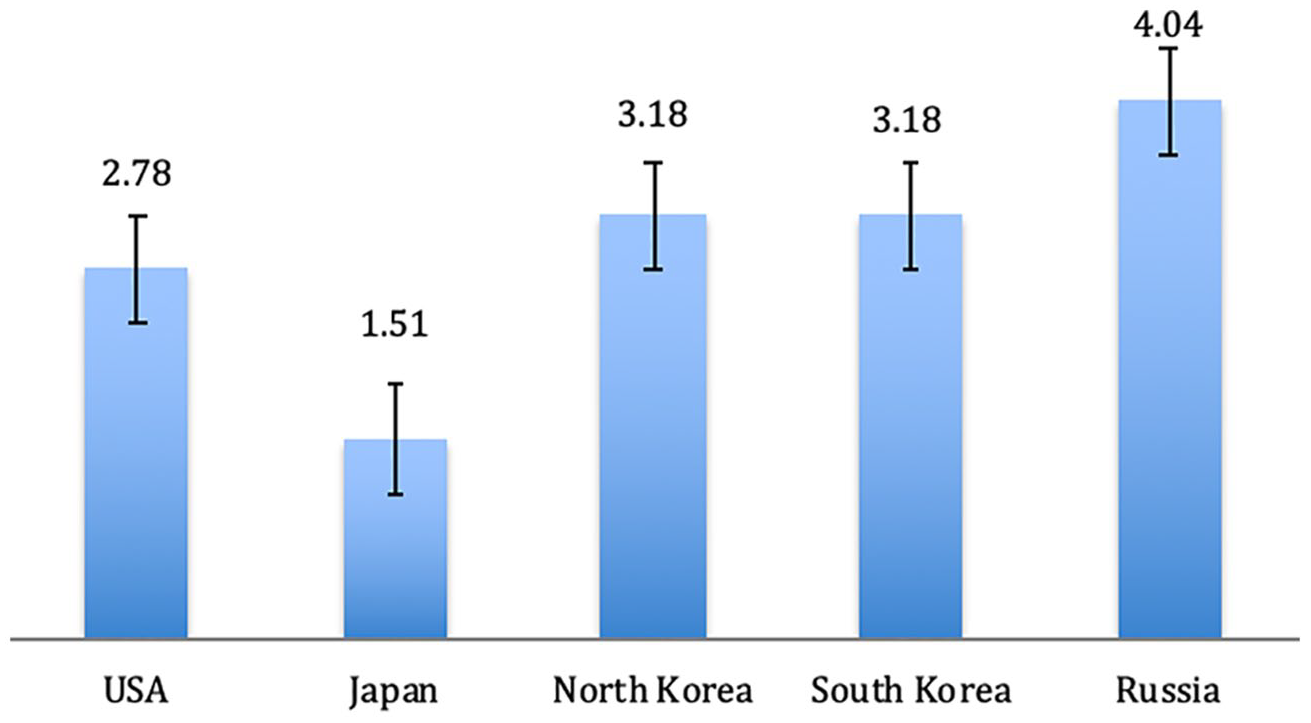
Chinese student perceptions of national friendship.
Generally, the respondents exhibit considerable cynicism about the behaviour of other nations. 58 While the respondents predictably perceive Japan (mean = 1.007) and the United States (mean = 1.973) as untrustworthy, they also felt on average that North Korea (mean = 1.928) is an untrustworthy partner as well. However, even Russia, the most trusted of nations, scored a mean of 3.271, only marginally putting it into trustworthy territory. Likewise, the respondents are generally fairly cynical about the peacefulness of the other states; only South Korea (mean = 3.089) was considered on average to be marginally peaceful, with all of the other nations considered to be aggressive and Japan being viewed as the most aggressive nation (mean = 1.123). There seems to be a reasonably high level of consensus that the United States is still a powerful country in the international system (mean = 5.531) with Russia (mean = 4.463) coming next. While it is fair to say that the respondents have a negative view of Japan, they still perceive it to be relatively powerful (mean = 4.03), unlike North Korea, which was felt to be the weakest by some distance (mean = 1.522). The risk to China’s relations with both Japan and the United States stems from Chinese respondents’ images of two powerful, aggressive and untrustworthy states. This raises perceptions of threat from these two nations, and if these images are found among current and future elites tensions in the region will be potentially exacerbated.
Mediation analysis: trust and friendship
Using mediation analysis, we examine the key role that trust plays in mediating the effect of the other variables in the model. Mediation analysis presents the total effects of the predictors, broken down into direct and indirect effects. 59 An unmediated ordered logit model does not allow for the possibility that the other variables in the model impact on friendship through trust, which we will demonstrate. As such we specify a model that estimates both the direct effects of the variables on friendship and the indirect effects mediated through the trust image (Figure 2).
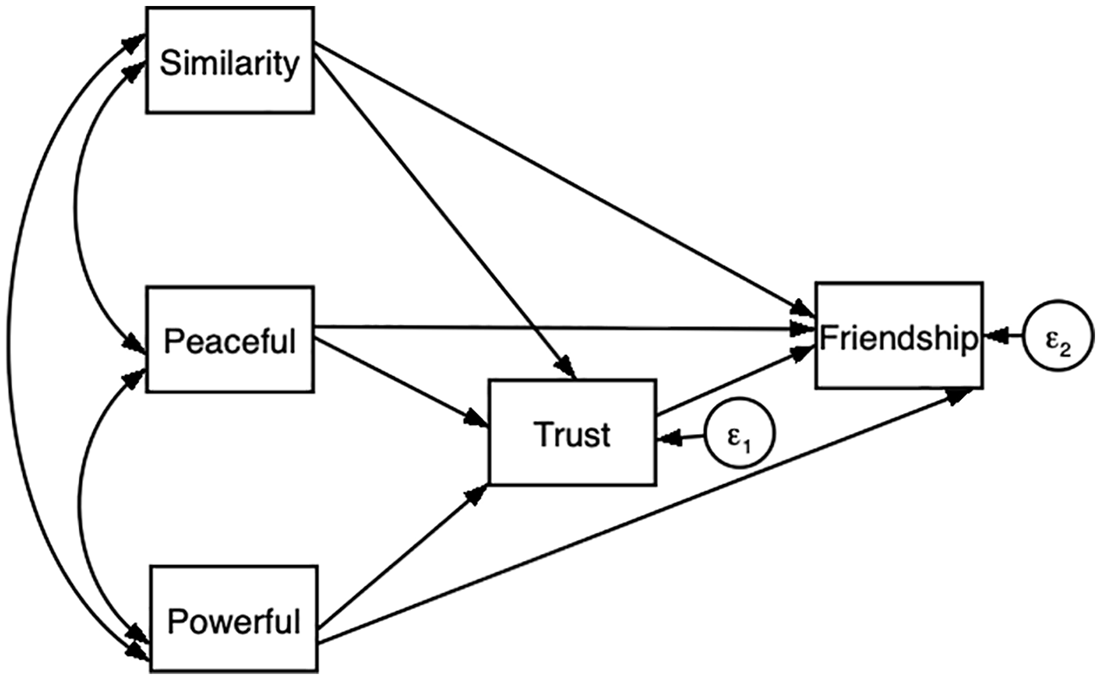
Trust mediation model.
The above model outlines the theoretical relationship of the predictors on friendship, the extent to which these variables directly affect perceptions of the trustworthiness of other countries and the extent to which the effect of the predictors on friendship is mediated through trust. We are placing a structure on the data, suggesting that the other images ‘cause’ trust. No observational research design can eliminate endogeneity concerns. This is problematic as without using an experiment we are unable to establish a clear causal chain. The originality of this dataset means that we are also unable to conduct causal modelling over time. 60 However, this dataset with its associated outputs will provide a baseline for comparison for future studies. In order to test the robustness of the trust mediation model, we conducted a series of unmediated ordered logit models (results available from the contact author) that did clearly suggest in a straight competition between all of the variables trust provided by far the strongest explanation for attitudes towards friendship. It is therefore not unreasonable to investigate whether trust is posterior to the less powerful predictors. Using a path model we are better able to identify the mechanisms that influence perceptions of international friendship. In essence, we are now examining whether there is support for the trust-based model of friendship and examine the factors that underpin that trust.
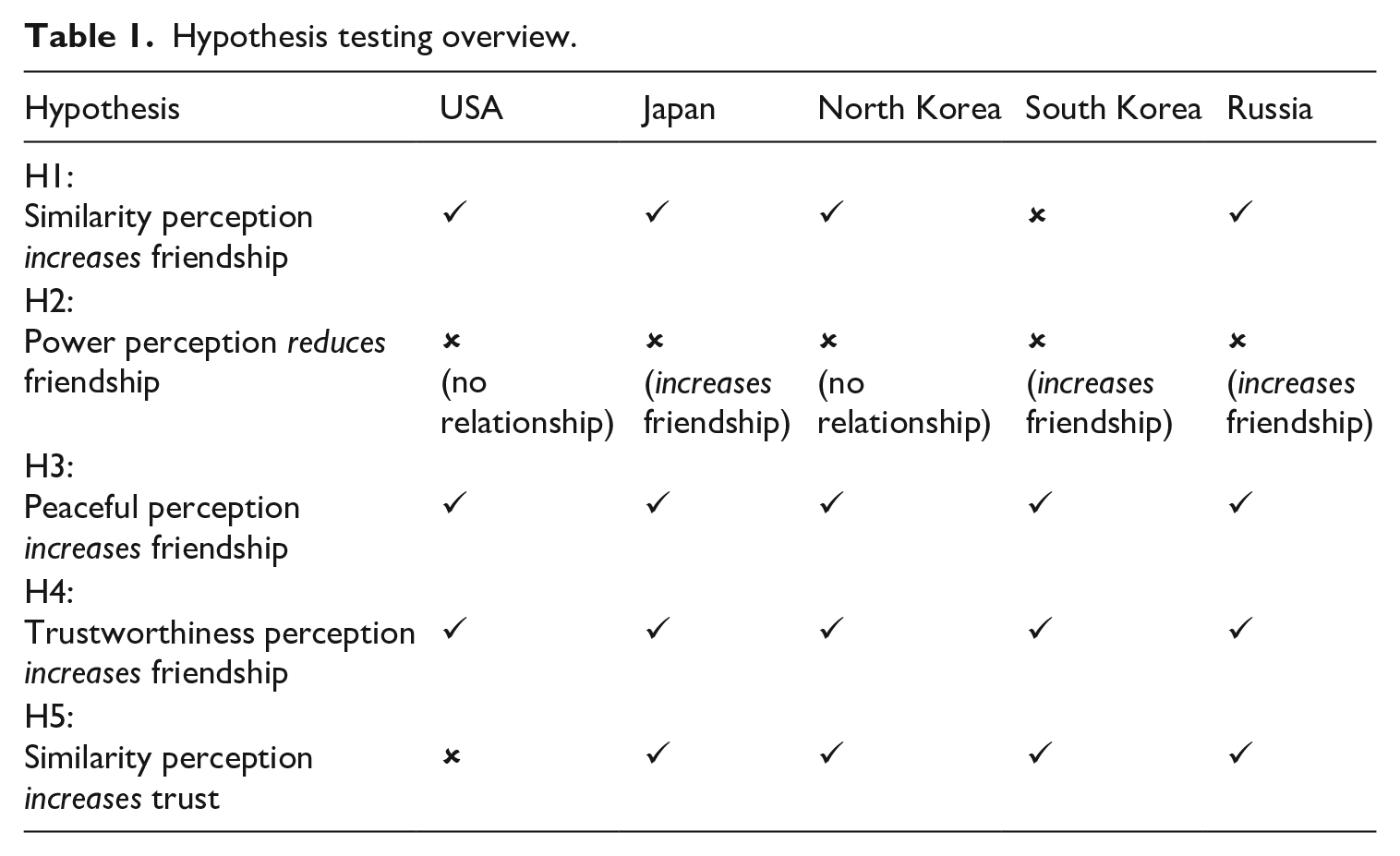
Table 1 provides an overall summary of the empirical support for each of the hypotheses outlined in the theory section. To summarize, we have found that a perception of similarity generally increases friendship (with the exception of South Korea) supporting hypothesis 1. A perception of power has no effect on friendship with the United States and North Korea, and increased rather than decreased perceptions of friendship with Japan, South Korea and Russia, leading to a rejection of hypothesis 2. Peacefulness and trustworthiness increases perceptions of friendship with all of the states, supporting hypotheses 3 and 4. In terms of trustworthiness, cultural similarity perceptions increase perceptions of trust in all countries supporting hypothesis 4 with the exception of the United States where it has no effect.
Hypothesis testing overview.
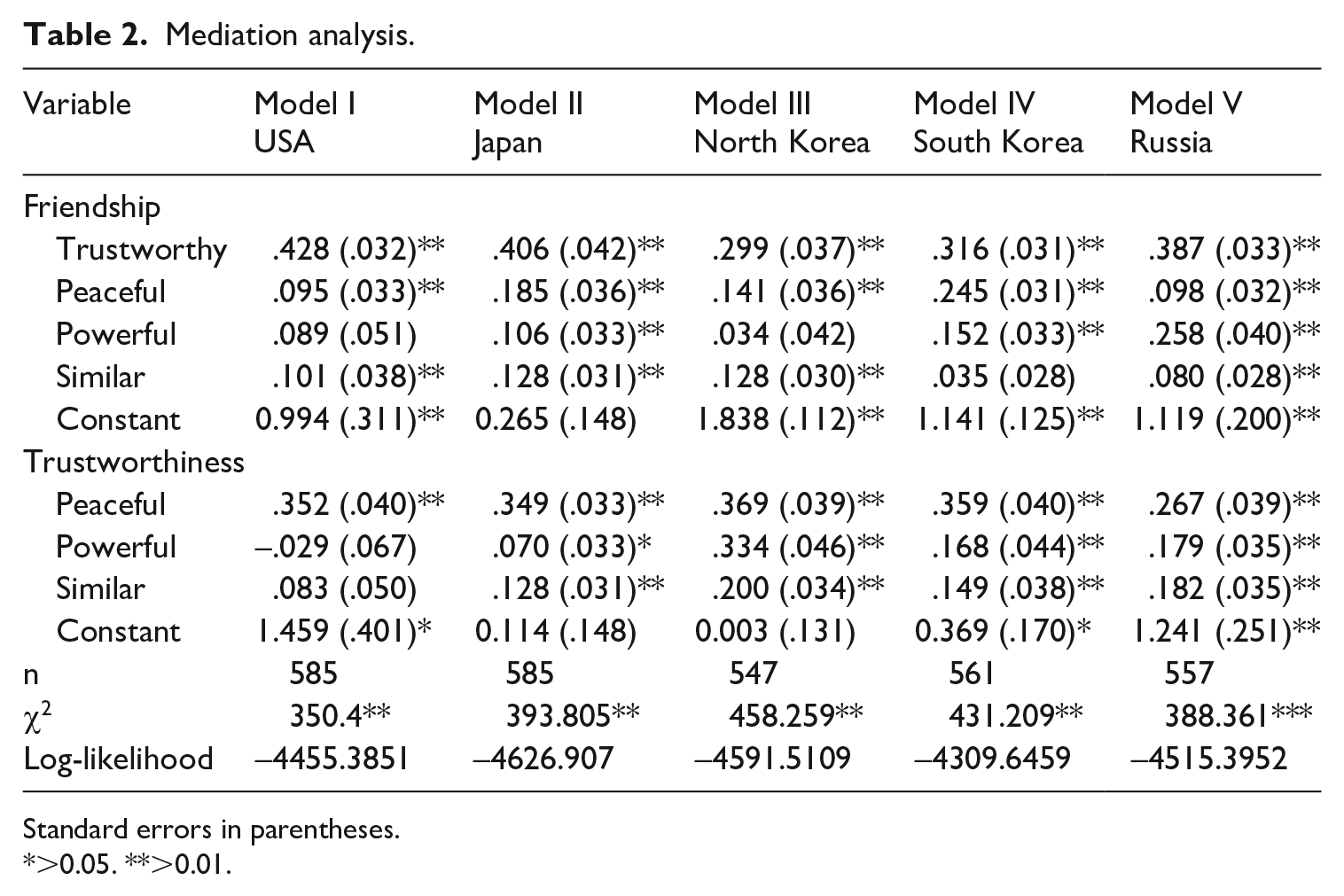
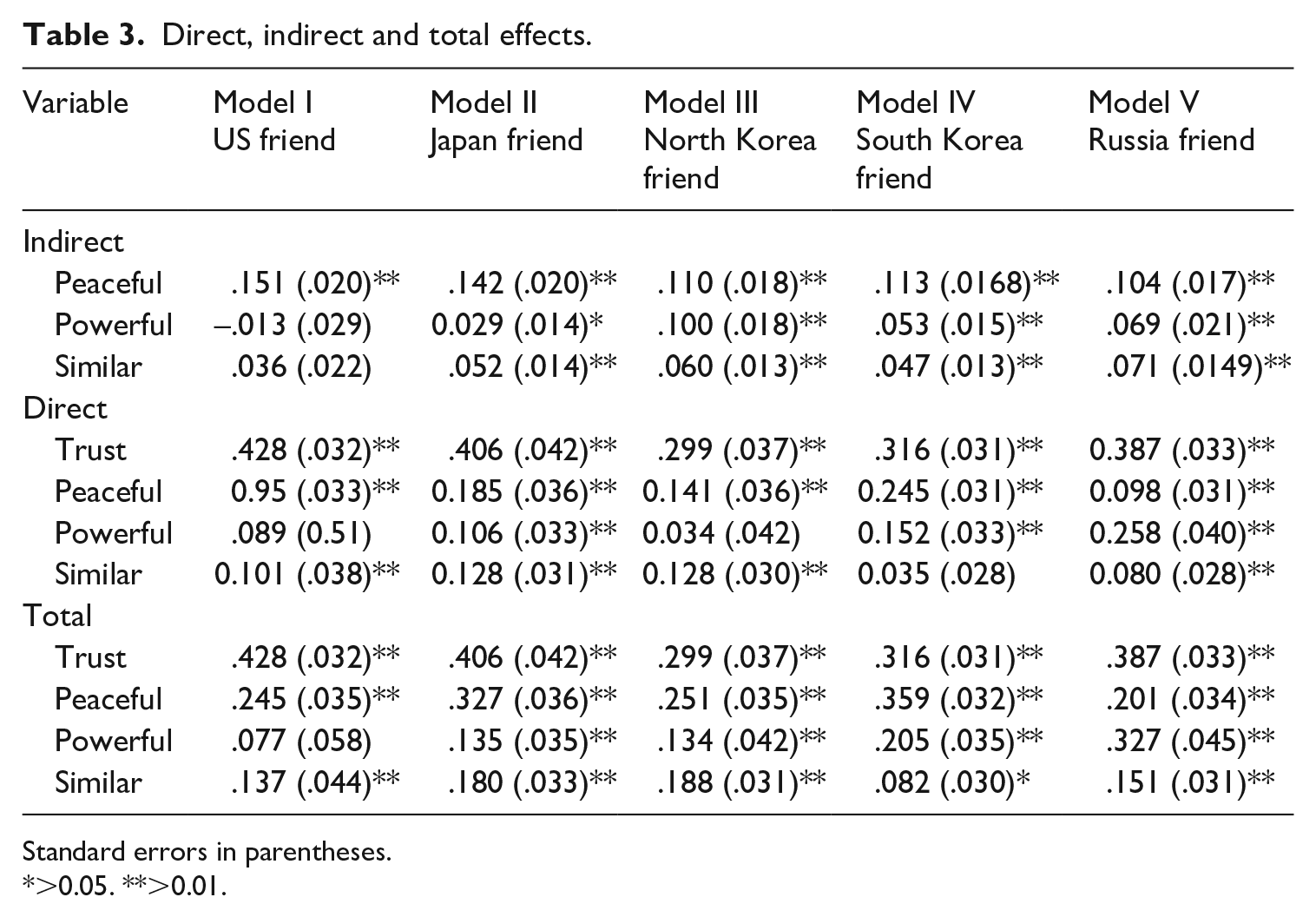
While discussion of hypothesis tests gives us a broad understanding of the relationship between images and friendship, we seek to unpack our findings to examine the relative weight of the different images and the pathways through which images influence friendship. Next we examine in detail the mediation analysis for the different country image models (Table 2). Rather than go into all of the coefficients for each of the models we will outline some broad findings and then provide a more detailed discussion of the direct and indirect effects of the variables presented on Table 3. The model fit for all of the models is good, with chi-square statistics all being significant at the 0.01 level. Looking at the friendship model first, we still find that across all of the models the effect of trust is both statistically significant and has the largest substantive direct effect on friendship perceptions. Our results demonstrate that trust is the crucial predictor of respondent perceptions of international friendship. Trust clearly has the potential to provide a causal mechanism for cooperation between states. When we look across the total effects of each of the predictors it is clear that trust on average has the greatest impact on the friendship image, with peacefulness coming second. Power and similarity have a roughly similar average effect, coming in joint third (with the exception of Russia where power has a bigger impact than peacefulness). It appears that Chinese students tend to judge friendliness based on how trustworthy and peaceful they perceive a state to be.
Mediation analysis.
Standard errors in parentheses.
>0.05. **>0.01.
Direct, indirect and total effects.
Standard errors in parentheses.
>0.05. **>0.01.
Examining the influence of peacefulness we find that perceptions of peacefulness have a significant direct influence on China’s friendship with other states, but the relative influence of peacefulness differs, with it having a much smaller effect on perceptions of Russia or the United States than on perceptions of either Japan or South Korea. Where Russia is concerned we find that perceptions of power and trust have the biggest direct effect on friendship perceptions, whereas perceived peacefulness or similarity has weaker effects. These findings suggest friendship calculations with Russia are based on alliance characteristics of power and trust rather than non-aggression and similarity. Power image has the strongest direct effect on friendship for Russia, then South Korea, and finally Japan, whereas for the United States and North Korea it is not significant. Finally, looking at cultural similarity we see that the effect is generally smaller than the other significant effects, but with the exception of South Korea it has a significant and direct effect on images of friendship with other states.
When analysing the influence of the images on the trust mediator variable we find that generally peacefulness has the greatest influence on images of trust. Even without experimental evidence to validate causality, we are confident that trust and peacefulness are strongly correlated in respondents’ minds. This suggests that strategies that reinforce trust and signal a peaceful foreign policy, if they can reliably gain the attention of overseas audiences, could play a role in influencing how those audiences view other states in the international system. Being perceived as peaceful has the greatest effect on perceptions of trustworthiness (with the exception of Russia). Trustworthiness is statistically and substantively significant for all country image models and with the exception of South Korea has the strongest total effect on perceptions of friendship (Table 3). The power image has no statistically significant influence on trustworthiness for the United States. It does, however, influence images of trustworthiness for Japan (B = .070 (p > 0.01)), North Korea (B = .334 (p > 0.01)), South Korea (B = .168 (p > 0.01)) and Russia (B = .179 (p > 0.05)). It is particularly interesting to note that the power image of North Korea has the strongest direct effect on trust out of all of the countries, perhaps reflecting concerns that weakness and instability increase the likelihood that the North Korean state will behave duplicitously in order to survive and therefore undermine its trustworthiness. Finally, we examine the role of cultural similarity in trustworthiness. Across all nation images cultural similarity influences trustworthiness, with the exception of the perceived trustworthiness of the United States.
Next, we disaggregate the total effects of the independent variables into direct effects that influence friendship and indirect effects that are mediated through trust that then influence friendship (Table 3). First, it should be noted that trust had the biggest total impact on friendship with all of the states except for South Korea where peacefulness (total effect = .359) was the key driver and trust came a very close second (total effect = .316). The model strongly suggests that trust is the major factor behind attitudes towards friendship among our respondents. Perceptions of peacefulness generally have the second biggest effect on attitudes towards friendship, with the exception of Russia where power perceptions are the key driver (total effect = .387). Similarity appears to be the third most important driver of friendship with the United States, Japan and North Korea, but is the least important for South Korea and Russia, where power and peacefulness are third respectively. What we see in terms of total effects is that in general trust and peacefulness are the key factors behind friendship, with the exception of the Russian friendship image, which is driven by trust and power.
We should note that none of the variables are totally mediated through trust. The power image had no direct or indirect effect on friendship with the United States. Looking at images of Russia we find that trust makes very little difference to the role of power perceptions when calculating friendship at only 22 per cent. However, in some cases over 50 per cent of the effect of the independent variable is mediated through trust. Looking at the United States friendship image we see that approximately 62 per cent of the effect of peacefulness on friendship flows through trust; when respondents believe that the United States’ behaviour is peaceful they see it as more trustworthy and therefore perceive it to be a friend.
When we examine images of Japan we see that peacefulness is one of the key drivers behind friendship, but approximately 43 per cent of that effect is mediated by the trust image. With North Korea, power perceptions clearly influence trust and then trust influences friendship with again 75 per cent of the effect of the power image on friendship being mediated through trust. These models show that when mediation effects are not taken into account the effects of the independent variables are small because they are misspecified. It is crucially important to assess the role that these images of institutions and behaviour have in relation to trust. While the direct effects on friendship might be relatively small we have seen that this is at least partly down to the mediating role of trust.
Discussion and conclusion
In this article, we presented the results from a survey of Chinese students about China’s foreign relations. These difficult-to-obtain data allowed us to further develop image theory and apply it to Chinese student perceptions of other states in the international system. This article has therefore given us the first understanding of the underlying factors that influence student attitudes about China’s potential rivals and allies. The dataset provides future researchers with a baseline that can help us understand trends in Chinese attitudes towards security and international conflict.
The results suggest that images of nations are an important part of how individuals view cross-national friendship. When we began this study we expected to find that images associated with similarity, peacefulness and trustworthiness would increase perceptions of friendship with other nations. Alongside the impact of independent variables on friendship we expected to see perceptions of similarity increase perceptions of trustworthiness. While we found that similarity increased perceptions of friendship, we also found that contrary to our expectations power perceptions increased perceptions of friendship with three countries and had a particularly sizable effect on attitudes to friendship with Russia. We believe that in the Russian case this may be due to strategic calculations by the respondents, who view a powerful Russia as a useful ally for China. This could also be related to the fact that respondents’ perception of Russian peacefulness had a relatively small effect on friendship in comparison to friendship with other states. In this case it seems plausible that respondents are unconcerned by Russian aggression because they see it as more likely to be directed at those viewed as China’s enemies than at China itself. However, this is an area that merits further investigation.
Although similarity, and in some cases power, may have influenced perceptions of friendship, this paled in significance when compared to the influence of perceptions of trust and peacefulness, with trust having the biggest overall impact by far. Trustworthiness is the key image associated with international friendship for our Chinese respondents. Trust not only had the greatest overall direct effect on friendship but was also an important mediator for the other variables. The models suggest that the perception of trustworthiness is the key driver behind respondent attitudes towards friendship with other states, although the effect size is different between those nations that are viewed as friends (smaller effect) and those that are viewed as enemies (much larger effect).
While trust appears to be the most important image driving Chinese students’ perceptions of friendship with other nations, this study also indicates that it is crucial to develop a more nuanced understanding of the factors that contribute to the trust image, which may vary in different interstate dyads. Respondents have a sophisticated understanding of relations with different states, factoring power estimates into friendship with potential allies such as Russia, whereas with enemies behavioural images of trustworthiness and peacefulness are the key factors that will affect friendship and potential cooperation. Future research needs to explore how images of similarity, power, trust and friendship interact dynamically over time within specific relationships between China and other states in order to build on the initial snapshot we provide here.
The association between peacefulness and trust we identify in this study is particularly significant in the case of Japan, which is strongly perceived to be an enemy of China by our respondents. Although for decades Japan’s international behaviour has been among the most peaceful of the major powers, its historical legacy of regional aggression undermines its image of peacefulness in China. The Chinese public’s memory of the Japanese invasion and the atrocities it committed during this period are kept fresh by a state-led campaign in China to prevent the past from being forgotten. 61 Although the data show that Chinese student perceptions of the trustworthiness and friendliness of other nations are quite negative across the board, Japan in particular faces a difficult task if it wishes to improve Chinese images of international trust and friendship between the two countries.
Finally, our research also has important methodological implications for future studies of international friendship. We demonstrate here that mediation analysis is crucial to our understanding of the processes that influence individual attitudes towards international friendship. Direct effects models would have missed the potential pathway that channels the effect of similarity through trust and on to friendship, and likewise they would have clearly underestimated the sizable contribution that trust makes to individual assessments of friendship.
Footnotes
Funding
The author(s) received no financial support for the research, authorship, and/or publication of this article.
