




Abstract
What motivates the United States, the world’s most powerful country, to seek multilateral approval from the United Nations or NATO for its military interventions? Drawing on interviews with top-level US policymakers and combining process tracing with a structured-focused comparison of several cases, this article reveals that American leaders do not value multilateral approval primarily to avert negative issue linkage, or ‘soft balancing’ in other policy domains. Instead, they are motivated by narrower concerns. Their main goal is to facilitate sustained military and financial burden sharing on the prospective intervention, in the expectation that this will assuage congressional concerns about resource costs, reducing the risk that Congress might withdraw its support once American troops are deployed. The article therefore demonstrates that (1) US policymakers worry less about issue linkage than many International Relations theorists, as policymakers are confident that overall, US power inclines other countries to bandwagon with the United States, and (2) contrary to widespread belief, executive-branch concerns about congressional opposition do significantly influence US military intervention decision-making.
Introduction
Multilateral approval from the United Nations (UN) or the North Atlantic Treaty Organization (NATO) can enhance the perceived legitimacy of military intervention by signalling that the use of force is not narrowly self-serving but instead follows established international rules and procedures. In the broadest sense, this legitimation effect is likely to explain why even powerful countries such as the United States value multilateral approval for their interventions. As Colin Powell, who served as US national security adviser, chairman of the Joint Chiefs, and secretary of state in various administrations declares, ‘if you can get multilateral support for a planned intervention, then you should seek it, in order to have the greatest possible legitimacy for the action’. 1
Since the end of the Cold War, US policymakers have in fact generally sought multilateral approval from the United Nations Security Council (UNSC) and/or NATO’s North Atlantic Council (NAC) for major interventions that could not easily be framed as self-defence missions – whether in the Balkans, the Middle East, Somalia, Haiti, or Libya. But why exactly do American leaders covet the legitimacy resulting from multilateral approval? Securing the approval of standing international organizations (IOs) such as the UN and NATO is likely to involve time-consuming negotiations; it typically constrains US freedom of action; and it often requires substantial side-payments and logrolling. Consequently, US policymakers can be expected to endeavour to secure UN or NATO approval only if they anticipate significant benefits.
One prominent hypothesis is that US policymakers seek IO approval and the resulting legitimacy primarily to reduce the risk of costly international resistance in the form of negative issue linkage, or ‘soft balancing’ against the United States in other policy domains. 2 This argument appeals to systemically oriented international relations scholars, who have long argued that salient foreign policy decisions by the major powers elicit various forms of systemic feedback. 3 However, the United States, as the world’s most powerful country, may be relatively immune to negative issue linkage and soft balancing. 4 In spite of much talk about the ‘rise of the rest’, the United States remains significantly ahead of its nearest competitors in terms of hard military and economic power. Total US military spending in 2014, at US$581 billion, was more than four times the US$129 billion of second place China. Similarly, nominal US gross domestic product (GDP) in 2014, at US$17.5 trillion, was almost double that of second place China and about eight times that of India or Brazil. 5 If those weaker countries were to reduce their cooperation with the United States across various issue areas, notably in finance and trade, as a consequence of US unilateral intervention, they would do significant damage to their own interests. American leaders may well be aware of that.
Consequently, a narrower set of considerations may prompt US policymakers to seek multilateral approval through the UN or NATO. Specifically, policymakers may be motivated by concerns about operational burden sharing and domestic support from Congress. Although Congress has few means to stop a determined administration from intervening abroad, congressional opposition can become more of a problem in the long run, when military operations become protracted, as legislators need to approve the necessary appropriation bills. Policymakers may therefore seek UNSC or NAC approval to facilitate sustained military and financial burden sharing when they anticipate a potentially open-ended deployment, in the expectation that such burden sharing will assuage congressional concerns about resource costs and reduce the risk that Congress might withdraw its support once American troops are deployed.
The evidence for this article is derived primarily from interviews that I conducted with senior and top-level US policymakers. Information gathered from interviews is sometimes problematic, as personal memories may be clouded by hindsight. Nevertheless, interviews with key policymakers are often the only way of reconstructing the motives and bureaucratic bargains that led to the adoption of particular decisions. The article combines process tracing with a structured-focused comparison of several cases displaying meaningful variation on the dependent variable. Part one lays out in detail the two hypotheses under examination, clarifies underlying assumptions, and derives observable implications. Part two traces the process of US decision-making in the run-up to the 1991 Gulf War and the 1999 Kosovo intervention. Part three briefly discusses two negative cases, where the United States made only limited or no efforts to secure IO approval. I find no evidence that when policymakers do work hard to secure IO approval, they are motivated by concerns about negative issue linkage. Instead, they appear motivated primarily by concerns about burden sharing and domestic support. The conclusion discusses broader implications of the finding for theory and policy.
Averting negative issue linkage and ‘soft balancing’
Scholars associated with realist balance-of-threat theory claim that if the United States pursues unilateral military interventions that signal revisionist intentions, other powerful states such as Russia, China, India or Brazil might retaliate through soft balancing across various issue areas. Specifically, those states might reduce their cooperation with the United States on issues such as finance and trade, nuclear proliferation, and counterterrorism, thus imposing tangible costs on US policy. As Robert Jervis writes, ‘assertive hegemony erodes the willingness of [other states, including] allies, to cooperate [with the USA] on a wide range of endeavours’. 6 Liberal institutionalists, although reasoning from different premises, similarly predict that if the United States acquires a reputation for noncompliance with the norms, rules, and procedures embedded in the UN Charter regime, other states might reciprocate through costly retaliation and negative issue linkage by ‘form[ing] coalitions to balance American behaviour in other areas such as trade or the environment’. 7
If US policymakers are aware of those risks, then fears of negative issue linkage, or soft balancing across various policy domains, might explain why the United States seeks multilateral approval from the UNSC and NATO’s NAC. The political scientists Alexander Thompson and Erik Voeten have made this hypothesis explicit. Thompson argues that if the United States intervenes without IO approval, in defiance of established international norms, ‘even weak states have means of imposing costs’. 8 These costs, he affirms, can involve ‘direct retaliation or countercoalitions’, as well as ‘long-term costs imposed . . . through negative issue linkage: the coercer finds its relations with other states suffering in other issue areas’. That leads him to hypothesize that ‘powerful coercers’ like the United States seek IO approval strategically, in order to signal benign intentions to potentially antagonistic third-party states and minimize international costs. 9 Voeten similarly assumes that if ‘the United States exercises force in the absence of SC authorization, other states [might] challenge it . . . for instance, by reducing cooperation elsewhere’. 10 This risk, he argues, creates incentives for US policymakers to seek IO approval in order to uphold ‘cooperative efforts’ across an array of issues, including ‘on economic issues [and] common security threats’. 11
Assuming that concerns about negative issue linkage motivate the United States to seek IO approval, we should observe policymakers working hardest to secure such approval in cases where there is a significant possibility that third-party states might otherwise interpret US intentions as revisionist (e.g. when an intervention appears aimed at control of foreign territory or natural resources, political regime change, or straightforward retaliation – all goals that are prima facie incompatible with the UN Charter norms that underpin the international status quo). Furthermore, for causal inference to be warranted, policymakers would have to declare in interviews, memoirs, and various statements that when they sought IO approval, they were in fact motivated by concerns about negative issue linkage.
Appeasing Congress
Another possibility is that US domestic politics motivates Washington’s efforts to secure UN or NATO approval for prospective interventions. Some scholars hypothesize that American leaders seek IO approval in order to increase US public support by validating their own interpretations of foreign crises and reassuring the public about the likely consequences of military action. 12 One study, in particular, claims to have found concrete evidence that UNSC approval boosts US public support by magnifying the rally-‘round-the-flag effect. 13 However, the coding of cases underlying that study is problematic, raising questions about the validity of the finding. 14 Recent survey data indicates that although IO approval somewhat increases support for armed intervention among US policy elites, it does not consistently increase mass public support. 15 Moreover, there is significant evidence from several studies that once US troops are deployed in combat abroad, the public tends to rally around the flag and support the president, regardless of multilateral approval, at least as long as there is bipartisan congressional backing. 16 Therefore, also taking into account that Congress ultimately holds budgetary power over military intervention, it may be worth focusing in more detail on congressional attitudes.
To date, scholars theorizing the payoffs of IO approval in terms of executive–legislative relations have largely viewed such approval as a means of increasing the president’s freedom of action in the run-up to the use of force, claiming that it ‘ties the president’s hands’ and thus minimizes the risk that Congress might veto an intervention altogether. 17 However, a significant body of research indicates that regardless of multilateral approval, it is very difficult for legislators on Capitol Hill to prevent a determined administration from intervening abroad. The 1973 War Powers Resolution, intended to constrain the executive branch, has been largely ineffectual. In the short run, legislators typically aim at ‘blame avoidance’: they prefer to neither vote for military intervention, since that would involve ceding control entirely to the executive branch (while sharing the blame in case of failure), nor vote against it and risk being blamed for undermining US coercive diplomacy. 18
It would nevertheless be wrong to conclude that Congress is toothless when it comes to constraining US presidents on the use of force. Congressional opposition can become more of a problem in the long run, following the deployment of American troops, as combat and stabilization missions become protracted, resource costs rise, and success remains uncertain. 19 Support in Congress for open-ended deployments is likely to become increasingly brittle, making it difficult for policymakers to secure the necessary appropriations – especially when the mission is largely humanitarian and no clear threat to American security exists. Congressional opposition in turn can dramatically undermine US public support for ongoing interventions, as the news media generally ‘index’ the slant of their coverage to reflect the range of opinion that exists within Congress. 20 As an extreme measure, Congress might adopt binding legislation requiring the withdrawal of all US troops, as it did for the Lebanon intervention in 1983, or cut off funding after a set deadline, as it did for Vietnam in 1973 and Somalia in 1993. 21
In an important study, William Howell and Jon Pevehouse conclude that ‘early congressional discussions about impending military action send valuable signals’ to policymakers about the likelihood of domestic support for potentially ‘protracted or costly’ interventions. 22 Research on congressional opinion also finds strong bipartisan demand on Capitol Hill for burden sharing with foreign allies and partners and more generally for a cooperative approach to solving international problems. 23 Consequently, when policymakers expect a resource-intensive commitment and congressional support appears lukewarm to begin with, they may seek advance approval from the UNSC or NATO’s NAC in order to maximize the prospect of sustained burden sharing and reduce the likelihood of future congressional backlash.
IO approval for sustained burden sharing
There are two ways in which UNSC or NAC approval, obtained before the launch of offensive operations, can function as a catalyst for sustained military and financial burden sharing. First, the resolution of approval can explicitly mandate a follow-on multilateral peacekeeping force led by other international partners. Second, the burden-sharing commitment can be less formal, based on the legitimation effect of IO approval and the reputational implications of public pledges of support.
The strongest assurance of sustained burden sharing is obtained when the initial resolution authorizing military intervention, typically a UNSC mandate, also contains a formal commitment on the part of the multilateral body and its principal members to set up a follow-on UN peacekeeping force led by other countries. For instance, SCR 940, which authorized the 1994 US intervention in Haiti, explicitly mandated the establishment of a follow-on UN force as soon as basic security had been restored. 24 Once the UN force was deployed to Haiti, most American troops were able to withdraw. That, as a former US policymaker recalls, satisfied members of Congress who ‘were eager either to cut or restrict appropriations for Haiti’. 25 More recently, UN resolutions have become increasingly specific in this regard. SCR 1497, authorizing a US-led intervention in Liberia in 2003, committed the SC ‘to establish . . . a follow-on United Nations stabilization force’ under regional leadership (i.e., led by countries other than the United States) within a maximum of 2 months. Similarly, SCR 2085, authorizing a French intervention in Mali in 2012, mandated the deployment of an African-led mission that would gradually take over most of the stabilization burden. 26 This mode of proceeding is particularly attractive for lower-stakes missions where reliance on less proficient troops from developing countries seems acceptable for keeping the peace.
Even in the absence of an authorizing resolution explicitly mandating a follow-on force, advance IO approval and the resulting legitimacy can facilitate sustained burden sharing by reducing domestic political obstacles for foreign partners to cooperate with the United States on peacekeeping and stabilization. 27 In addition, a UNSC resolution authorizing the use of ‘all necessary means’ involves a public, and therefore potentially costly, commitment to support US policy on the part of all those SC members who have offered their affirmative vote. The same goes for approval from NATO’s NAC, which requires a consensus among all members of the alliance. Once member states are thus committed to supporting US policy, subsequent resistance by them to the establishment of UN or NATO stabilization missions becomes unlikely. Members other than the United States may also independently value institutions such as the UN and NATO for the security benefits they provide. Consequently, once a UN or NATO stabilization mission has been approved and the institution’s reputation becomes linked to mission success, those members may be willing to maintain significant troop contributions even in the face of mounting costs.
Research shows that approval of US-led interventions by NATO’s NAC, in particular, substantially increases Washington’s ability to extract significant burden-sharing contributions from its most militarily capable allies even after a mission becomes unpopular among their domestic audiences. 28 In the Balkans, for instance, where the United States intervened in 1995 and again in 1999 only after securing NATO’s endorsement, Washington’s international partners subsequently took on most of the stabilization burden. 29 By contrast, in Iraq, where the United States and Britain intervened in 2003 without IO approval, Washington and London struggled to persuade other countries to contribute stabilization troops. Once the United States agreed to partially offset the financial costs of those contributions, in the short run, it was able to recruit about 16,000 troops from other partners besides Britain. 30 However, the improvised multinational coalition showed little staying power. By May 2007, when America ‘surged’ its own troops to over 150,000 to control the Iraqi civil war, the non-US/UK component had shrunk to only about 7,000 troops. 31 This pointed lack of burden sharing contributed to growing congressional pressure to withdraw all American troops, increasingly limiting the president’s options. 32
Burden sharing and US domestic politics
Members of Congress may of course have other reasons beyond concerns about resource costs for opposing a particular intervention. They may be opposed for parochial and ideological reasons, 33 or because they are beholden to sectoral economic interests that have little to gain from an assertive foreign policy involving military intervention. 34 However, as the case studies below will demonstrate, whatever other reasons members of Congress may have to oppose an intervention, in public, they tend to emphasize ostensibly non-partisan issues such as the intervention’s likely costs in terms of materiél and resources. By securing multilateral burden-sharing commitments, US policymakers can address those criticisms, making it more difficult for Congress to continue to publicly oppose an intervention and especially to justify funding cut-offs once American troops are deployed.
The political scientist Sarah Kreps argues that US policymakers contemplating military intervention are likely to choose multilateralism as a way to ‘share . . . costly burdens’ when there is little urgency and they anticipate a significant operational commitment. 35 While there is some overlap between Kreps’ argument and my own, there are also significant differences. First, in her book Coalitions of Convenience, Kreps focuses primarily on coalitions-based multilateralism rather than IO approval. Nowhere does she hypothesize that the expectation of coalition cohesion motivates efforts to secure IO approval ahead of intervention. 36 Furthermore, when identifying potential drivers of US multilateralism, Kreps views ‘burden sharing’ and ‘domestic politics’ as distinct, alternative hypotheses: she favours the former, disregarding the possibility that domestic politics may motivate policymakers’ interest in burden sharing and ultimately in multilateralism. 37
Decision-makers may certainly value the policy benefits of international burden sharing regardless of concerns about domestic politics. But executive-branch officials, especially hawkish civilians with little or no military experience, tend to underestimate the longer-term operational costs of intervention. Partially for that reason, they are often inclined to value swift military action (e.g. for resolving a humanitarian crisis or signalling resolve) above international cooperation and burden sharing. 38 Congressional leaders, by contrast, are likely to consistently focus on the operational cost, given that they are the ones who need to finance military interventions and justify the resources allocated to their constituents. Congressional grumblings about the resource cost of prospective interventions, in turn, can be expected to play an important role in focusing policymakers’ attention on the need for burden sharing.
If concerns about burden sharing and congressional opposition motivate US efforts to gain IO approval, we should observe policymakers working hardest to secure such approval for interventions anticipated to be resource-intensive and potentially open-ended, and more generally for (humanitarian) interventions in peripheral regions that are likely to enjoy only limited congressional support. For causal inference to be warranted, policymakers should further declare in interviews and memoirs that when they worked hard to secure IO approval, they were in fact motivated by a desire to satisfy congressional demands for burden sharing.
The 1991 Gulf War and 1999 Kosovo intervention: case selection explained
The 1991 Persian Gulf War was a massive military operation involving half a million US troops. That makes it prima facie plausible that a desire to reassure other states in order to avert negative issue linkage motivated US policymakers to seek UN approval. The Kosovo intervention, even more than the Gulf War, is a most likely case for the issue linkage hypothesis. The use of force over Kosovo was opposed by another great power, Russia, and US policymakers worried that broader relations with Moscow might suffer. Furthermore, the use of force in support of a secessionist movement, the Kosovo Liberation Army, was opposed by China and several regional powers, including India and South Africa. 39 Other post-Cold War interventions for which the United States also sought IO approval, such as Somalia 1992, Bosnia 1994–95, Liberia 2003, and Libya 2011, enjoyed significant international support a priori as humanitarian rescue missions, making them less likely candidates for the issue linkage hypothesis. 40 The Gulf War and Kosovo intervention can also be seen as most likely cases for the alternative hypothesis that concerns about Congress motivate US efforts to secure IO approval. Both were resource-intensive operations involving the possibility of open-ended commitments, and, as shown below, Congress was very sceptical in both instances.
Post-Cold War interventions for which United States sought UN/NATO approval.
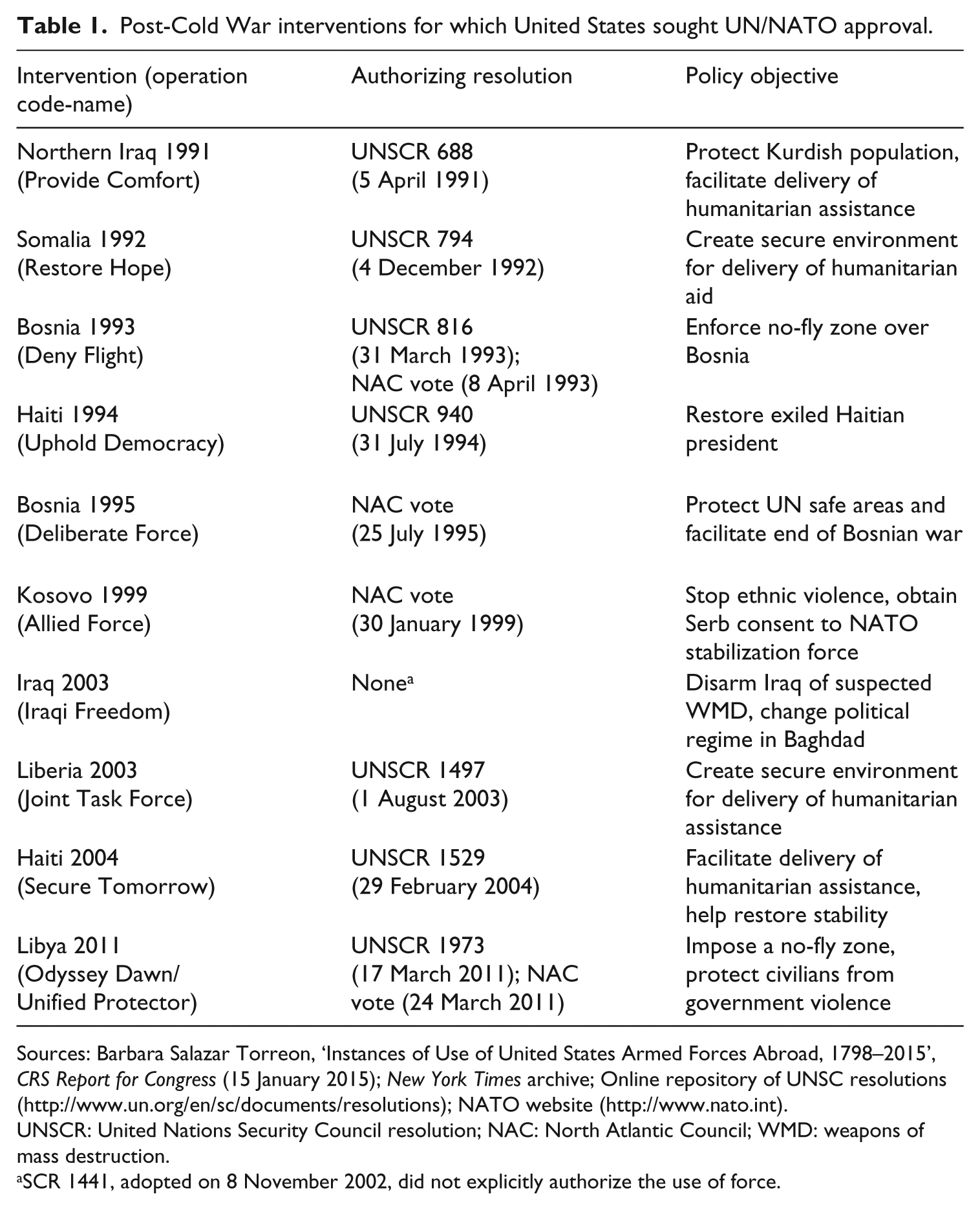
Sources: Barbara Salazar Torreon, ‘Instances of Use of United States Armed Forces Abroad, 1798–2015’, CRS Report for Congress (15 January 2015); New York Times archive; Online repository of UNSC resolutions (http://www.un.org/en/sc/documents/resolutions); NATO website (http://www.nato.int).
UNSCR: United Nations Security Council resolution; NAC: North Atlantic Council; WMD: weapons of mass destruction.
SCR 1441, adopted on 8 November 2002, did not explicitly authorize the use of force.
Most likely cases are tailored to cast strong doubt on a theory and related hypotheses if the evidence does not fit. As Alexander George and Andrew Bennett write, ‘the best possible evidence for weakening a theory is when a case is most likely for that theory and for alternative theories, and all these theories make the same prediction . . . This might be called an easiest test case’. 41 A theory’s failure in such easy cases seriously calls into question its broader applicability. Consequently, if one of the two hypotheses examined fails to hold up in the Gulf War and Kosovo case studies below, while the other stands up well, we can conclude that the mechanism posited by the latter is more likely to explain American behaviour. For further hypothesis testing, I will also briefly consider two negative cases in which the United States made only limited or no efforts to secure IO approval.
The Gulf War
The principal US national security officials in 1990–1991 were President George H. W. Bush; Brent Scowcroft, his national security adviser; Secretary of State James Baker; Secretary of Defense Richard Cheney; and General Colin Powell, the influential chairman of the Joint Chiefs of Staff (JCS). Following Iraq’s invasion of Kuwait on 2 August 1990, the Bush administration initially imposed multilateral economic sanctions on Iraq and built up US troops in the Persian Gulf to deter Saddam Hussein from a further advance into Saudi Arabia. But in late October, the US president decided that he would launch a massive ground campaign before the end of the winter to expel Iraqi troops from Kuwait, unless they left voluntarily. 42 Secretary of State Baker then spent the next 3 weeks visiting 12 capitals on three continents, offering sizeable political and financial inducements to garner international support for a use-of-force authorization from the UNSC. President Bush himself travelled to key foreign capitals and devoted significant time and energy to persuading other SC members to authorize military action. 43 What motivated US leaders to make such an all-out effort to secure UN approval?
Averting negative issue linkage
Scholars have argued that in the run-up to the Gulf War, ‘US decision-makers turned to the UN as an intentional strategy to minimize international political fallout’, given that ‘relations with other influential states, such as the Soviet Union, were perceived to be at stake’. 44 Yet former decision-makers themselves dispute this interpretation. Scowcroft, who played a key role in devising US policy together with the president, denies that the administration sought UN approval to reassure other states about American intentions and maintain cooperative relations across different issue areas. 45 Regarding the Soviet Union in particular, Scowcroft clarifies that UN approval was not viewed as especially valuable to maintain the cooperative spirit in relations between Washington and Moscow. Instead, he explains, ‘it was the other way round’ – he and the president viewed Soviet President Mikhail Gorbachev’s a priori desire to cooperate on Iraq as helpful in terms of securing UN approval: ‘It was not easy, because Gorbachev was of two minds: he wanted to cooperate with the United States, and at the same time Iraq was a client state of the Soviet Union. But had the Soviets opposed us, it would have been much more difficult to build support’. 46
Former secretary of state Baker agrees with Scowcroft. After the collapse of communism, Baker recalls, ‘America’s status as the preeminent superpower was magnified’, which resulted in an immediate tendency for most other states to bandwagon with the United States: ‘Everyone wanted to get closer to the United States’. 47 The Soviets in particular, he explains, ‘were anxious to be seen to be cooperating with rather than confronting the United States’. 48 Senior Bush administration officials believed that as far as compliance with international norms was concerned, a legitimate case could have been made under Article 51 of the UN Charter for undoing the Iraqi aggression without IO approval, and the expectation was that most other countries would have acquiesced in such a course of action. 49 In short, the president’s principal advisers did not expect that UN approval would be especially advantageous, let alone necessary, to reassure third-party states and notably the Soviet Union about American intentions and avert negative issue linkage.
Appeasing Congress
As US military action appeared increasingly likely from September 1990 onward, congressional leaders began questioning whether American interests in the region warranted what they expected would be a resource-intensive and potentially drawn-out operation. Members of Congress demanded assurances that the burden would be shared internationally. ‘A lot of the members [of Congress] talk about the importance of burden sharing’, House majority leader Richard Gephardt (D-Mo.) told the press. ‘Whether it’s sending troops or writing checks or helping in all that needs to be done, I think that’s a very important effort’. 50
Among the president’s principal advisers, Secretary Baker and JCS Chairman Powell initially worried more than others about the operational burden and the related challenge of maintaining US domestic support in the eventuality of protracted combat. 51 The Secretary of State and JCS chairman had both been profoundly shaped by the Vietnam War and their related experience of ‘what happened in efforts to fight a war when you don’t have the support of your domestic population’. 52 In the case of Vietnam, Congress had eventually cut off all funding for US troops after a set deadline, forcing a humiliating withdrawal. 53 Baker and Powell therefore recommended that if force was to be used to liberate Kuwait, the burden ought to be shared with international partners, as demanded by Congress, and the operation should be completed swiftly with no open-ended occupation. Advance UN approval, by legitimizing the war and providing a limited mandate (i.e., liberating Kuwait, but no regime change), could facilitate burden sharing and would commit the administration to a short military operation. 54 Baker recalls that for those reasons, from early on, he and Powell ‘were pretty much of one mind’ in believing that ‘the military option had to be linked with a diplomatic offensive to authorize the use of force’. 55
Scowcroft, Secretary of Defense Cheney, and the president were initially reluctant to request a UNSC mandate because they worried that a failed attempt might become a political liability and that working through the UN would constrain the administration. 56 But on 8 November 1990, President Bush announced the deployment of another 200,000 American troops to the Gulf, which would double the US military presence there. 57 Thereupon, legislators on Capitol Hill dramatically increased their pressure on the president, accusing him of having prematurely decided to embark on a resource-intensive war and making it clear that congressional support should not be taken for granted. 58 Scowcroft specifically recalls that ‘Congress demanded to know who else was going to put up money [and] volunteer troops’. 59 At that point, Bush, influenced by a book he had read about Lyndon Johnson’s experience during the Vietnam War, reportedly told his senior advisers that ‘to go without support from Congress is too dangerous, we need to involve the Congress’. He thus decided to seek a congressional vote of support, to insure himself and his administration against possible domestic political backlash down the road. 60 Otherwise, he feared, ‘if it drags out, not only will I take the blame, but I will probably have impeachment proceedings filed against me’. 61
By mid-November, therefore, Baker’s and Powell’s argument that a SC mandate would be crucial to successfully address the domestic political challenge finally touched a chord with the president. 62 In previous weeks, congressional leaders such as House Speaker Tom Foley (D-Wash.) and Senate majority leader George Mitchell (D-Me.) had repeatedly linked their demand for burden sharing to the issue of UN approval – thus indicating that a SC mandate would help appease Congress. 63 On 14 November, Bush and Scowcroft met privately with congressional leaders, and according to a contemporaneous newspaper report based on insider accounts, ‘Mr. Bush, Mr. Baker, and Mr. Scowcroft essentially decided after this meeting . . . that they needed a Security Council resolution . . . to bring Congress along’. 64 Once the SC approved the use of ‘all necessary means’ to liberate Kuwait on 29 November 1990, Congress followed suit and also authorized the use of force against Iraq. 65
It bears emphasizing that the Bush administration did not seek UN approval because it worried that congressional opposition might otherwise have prevented it from using military force altogether. President Bush insists that ‘even had Congress not passed the [authorizing] resolutions, I would have acted and ordered our troops into combat’. 66 Robert Gates, then the deputy US national security adviser, is convinced that the president ‘was going to throw that son of a bitch out of Kuwait, regardless of whether the Congress or the public supported him’. 67 The president wanted to get Congress on the record as supporting the use of force and more generally appease sceptics on Capitol Hill, in order to reduce the risk of a Vietnam-like scenario, where legislators forced a withdrawal of US troops after they had been deployed. 68
Arguments that US policymakers in 1990–1991 ‘were not primarily motivated by political concerns at home when they channelled policy through the UN’ 69 and were ‘not motivated by burden sharing or military resource aggregation’ 70 contrast with the available evidence. It was certainly the case that foreign heads of government, such as Egyptian President Hosni Mubarak, French President François Mitterrand and the leaders of Turkey, Italy, and Japan insisted on UN approval. 71 However, they requested a UN mandate as a precondition for contributing troops and/or financial resources to the war effort – that is, for the burden sharing that Congress demanded. As former JCS Chairman Powell recalls, ‘We needed the UN support to create the kind of coalition we ended up with. If we didn’t have the UN support, we would not have had the Syrians, the Egyptians, and the rest of them there’. 72 Syria and Egypt ultimately contributed 15,000 and 20,000 troops, respectively, to Operation Desert Storm. In total, US partners contributed almost 300,000 troops, while also pledging US$53.5 billion in financial contributions. 73
The Kosovo intervention
The principal US national security officials at the time of the Kosovo intervention were President William Clinton; Samuel Berger, his national security adviser; Secretary of State Madeleine Albright; Secretary of Defense William Cohen; and JCS Chairman Henry ‘Hugh’ Shelton. In the spring of 1998, when the deteriorating security situation in Kosovo became a matter of growing international concern, Secretary Albright emerged as the administration’s chief advocate of military intervention. As one of her former senior aides recalls, ‘Albright believed very early on that the lessons of Bosnia were that [Yugoslav President Slobodan] Milosevic would respond only to the use of force’. 74
During the first half of 1998, most of Washington’s European allies – including France, Italy, and Germany – were reluctant to countenance military action. 75 Consequently, on 23 April 1998, Albright and Robert Gelbard, the State Department’s hawkish Balkans envoy, made the case for US unilateral strikes to National Security Adviser Berger and his deputy, Donald Kerrick. 76 Albright’s and Gelbard’s specific proposal was that the United States give Milosevic an ultimatum of between 3 and 5 days to remove his security forces from Kosovo, and in case of noncompliance, Washington should ‘use Tomahawk missiles and in the middle of the night destroy the [Yugoslav] ministry of defence and the ministry of interior’. 77 Berger, however, summarily rejected the idea of US unilateral strikes. 78 The president himself, Albright recalls, subsequently made it ‘very clear that . . . we had to work with the allies, that we weren’t going to do this unilaterally’. 79
By mid-July 1998, US diplomats concluded that because of Russia’s opposition to a UN mandate for armed intervention, ‘efforts to achieve a United Nations Security Council Resolution under Chapter VII would be counterproductive’. 80 From then onward, the administration focused its multilateral diplomatic efforts on the Atlantic alliance. Forging a consensus on the use of force at NATO required several months, significantly constraining Washington’s freedom of action while the humanitarian situation continued to deteriorate. Yet without NATO’s approval, explains Walter Slocombe, the undersecretary of defense for policy at the time, ‘it is pretty clear that it [the Kosovo intervention] would not have happened’. 81 Why did US policymakers come to see multilateral approval as practically necessary for military intervention?
Averting negative issue linkage
The use of force over Kosovo was opposed by Russia as well as by China, India and South Africa. That makes it prima facie plausible that the United States sought IO approval to avert negative issue linkage or, as one scholar puts it, to uphold its ‘reputation as a relatively benign superpower and its leadership position in the post–Cold War world’. 82 However, former policymakers dispute that the administration aimed to reassure non-NATO members, and Russia in particular, by involving the Atlantic alliance. ‘The Russians did not like the way in which the US and the West had established a kind of hegemony in the Balkans’, explains Stephen Sestanovich, then the secretary of state’s special adviser for the former Soviet Union. 83 Gregory Schulte, at the time a senior National Security Council (NSC) staffer responsible for Balkans policy, speculates that ‘the Russians probably would have been happier if the US just did it unilaterally, because the first threat to Russia was the expansion of NATO’. 84
Nor did US policymakers expect that securing NATO’s approval would reassure other states such as China, India, or South Africa. But that was not a particular concern, remembers James Dobbins, then a senior administration official who attended most NSC meetings on Kosovo: The only state outside NATO that was of serious concern was Russia. The assumption was that the Chinese would go along with whatever the Russians would go along with. As to the NAM [the Non-Aligned Movement, which includes India and South Africa], there wasn’t anything they could do to help Serbia or harm us.
85
Morton Halperin, at the time the State Department’s head of policy planning, confirms that in the intramural debates on Kosovo the possibility of costly opposition from third-party states beyond Russia ‘was not on the screen at all’. 86
Appeasing Congress
Senior US defence officials expected from the spring of 1998 onward that stabilizing Kosovo in the aftermath of coercive air strikes would require a long-term military effort. ‘Our assumption was that the only way you could have a deal which would be real was, effectively, an occupation’, explains Slocombe. 87 Congressional leaders, however, opposed another large-scale US troop deployment to the Balkans after the one in Bosnia, and they demanded assurances that most of the stabilization burden would be shouldered by the European allies. 88 Senior members of the Senate Appropriations Committee, including Ted Stevens (R-Ala.), Robert Byrd (D-W.Va.), and Patrick Leahy (D-Vt.), specifically requested that the United States should not contribute more than 15 per cent of troops for stabilizing Kosovo. 89
Among the president’s top-level advisers, Secretary of Defense Cohen and JCS Chairman Shelton were particularly reluctant to deploy American forces without first mollifying Congress, which made it imperative in their eyes to secure commitments from NATO that other allies would lead on Kosovo’s stabilization. General Joseph Ralston, then the JCS Vice Chairman, recalls that he and Chairman Shelton ‘didn’t want to get started in this and then suddenly have the Congress say, “well, wait a minute, we’re not going to support that.” Because then you don’t have a way to succeed’. 90 Cohen similarly remembers being concerned about the ‘great reluctance on the part of most members of Congress to commit American forces, even on a peacekeeping mission’, which made him ‘absolutely convinced that the United States could not afford to take any kind of unilateral action from a political point of view’. 91
Cohen and other senior defence officials therefore insisted vis-a-vis their colleagues from the White House and State Department that the administration should obtain NATO’s approval before launching air strikes and involve the allies in all aspects of policy planning and implementation. ‘If there was going to be a military solution, we wanted to make sure that the allies were on board’, recalls General David Weisman, then the deputy director for strategy and policy on the Joint Staff. ‘We needed the NATO endorsement, and NATO had to take the lead, so that everybody would be involved, not only with the operation, but also with the peace afterward – in fact, that was the most important part’. 92 Senior State Department officials with experience in the field of transatlantic relations agreed that by involving NATO, the United States could trigger the ‘pull’ of alliance solidarity and facilitate European leadership on postwar stabilization. 93
Kerrick, then one of Berger’s deputies on the NSC staff, further emphasizes that a desire to satisfy congressional demands for burden sharing motivated the administration to proceed multilaterally through NATO: Congress would say, ‘yeah we should do something about it’, but they were very reluctant to want to commit US military forces. So they would ask: ‘How long are they going to be there? What’s the mission going to be? And who’s going to pay for it?’ It got to a point where it was clear that well, we need to do this multilaterally.
94
On 30 January 1999, the NAC endorsed the use of airpower. It took another several weeks, until 24 March, for the United States and 13 other NATO members to agree to actually commence air strikes against Yugoslavia. 95 Coalition warfare proved cumbersome, and the United States had to contribute the lion’s share of military hardware and technological capabilities to the air campaign. 96 However, in the long run, the administration’s effort to proceed multilaterally paid off. Soon after Milosevic yielded to NATO’s demands, Washington’s European allies publicly confirmed their willingness to shoulder most of the postwar burden. 97 As demanded by congressional leaders, the US contribution to stabilization and reconstruction never exceeded 15 per cent of the total. 98
Negative cases: Panama 1989 and Iraq 2003
If concerns about congressional opposition are the principal factor motivating US policymakers to seek IO approval, then the absence of such concerns should be evident in cases where the United States made only limited or no efforts to secure IO approval. In what follows I briefly examine US decision-making in the run-up to the 1989 Panama intervention and the 2003 Iraq War. The Panama and Iraq cases also provide further useful insights about the issue linkage hypothesis.
In 1989, US national security leaders anticipated that a unilateral invasion of Panama aimed at forcibly removing local strongman Manuel Noriega from power would be ‘roundly condemned by people in the international community’. 99 Assuming that the likelihood of international backlash and issue linkage based on perceptions of illegitimacy generally steers US intervention policy towards multilateralism, then in this case, policymakers should have worked hard to secure IO approval. Instead, on 16 December 1989, the United States decided to move ahead with military intervention, and no effort was made to secure IO approval before 27,000 US troops invaded Panama. 100 By then, the Cold War deadlock at the UNSC had been largely overcome. The council had already established multilateral peace missions in Angola, Namibia, and Central America, and only months later it authorized a major military operation against Iraq. 101 Therefore, had US policymakers considered UN approval for the Panama intervention sufficiently desirable, they could arguably have obtained it by offering sizeable inducements and engaging in a sustained diplomatic effort to bring the council on board, as they subsequently did for the Persian Gulf War.
Space limitations preclude a detailed analysis of US policy-making in the Panama case. But the decision to intervene unilaterally in this case can be explained by reference to US domestic politics and the expectation of a limited operational commitment. Senior policymakers expected that a US-friendly government would take office in Panama ‘within hours’ of the initial American landing; there was strong domestic support for military intervention on Capitol Hill (indeed, leading members of the US Congress had long been calling for Noriega’s forcible removal); and the operation was deemed unlikely to result in an open-ended troop deployment or other significant burdens on the United States. 102
Similar factors explain the limited US effort to secure IO approval for the 2003 Iraq War. In the fall of 2002, President George W. Bush was persuaded by Colin Powell, then the secretary of state, and Tony Blair, the British prime minister, to involve the UNSC over Iraq. 103 American leaders understood that using force to change Iraq’s political regime would be internationally controversial, as numerous allies had already begun to express their concerns about a war for regime change in previous months. 104 Therefore, it might seem prima facie plausible that US policymakers sought multilateral backing on Iraq in order to reassure other states about American intentions and to avert potentially costly negative issue linkage. 105
However, Powell, who among senior US officials made the strongest case for seeking UN approval in 2002–2003, insists that he was not worried about reduced international cooperation with the United States in other policy domains as a potential consequence of US unilateral intervention: ‘I did not expand the problem out to cooperation on counterterrorism and Afghanistan and things like that – I didn’t think through all of that’. 106 Stephen Hadley, who as deputy national security adviser at the time attended most senior-level policy meetings on Iraq, similarly does not ‘remember anybody [in the administration] making the argument that we needed international sanction on Iraq to keep people cooperating with the US in other areas’. 107 Powell and others who recommended that the president seek UN approval were primarily concerned about the possibility that the United States might have to shoulder the burden of stabilizing Iraq on its own. ‘When we break this we’re going to own it’, Powell told the president in August 2002, ‘and you may not want to be the government of this country. So let’s try to get the UN resolution’. 108
After the UNSC adopted Resolution 1441 in November 2002, which threatened ‘serious consequences’ but did not explicitly authorize the use of force, the Bush administration at first ‘didn’t feel as though an additional resolution would be necessary’. 109 Then, in January 2003, Bush acceded to Blair’s request to seek a second UN resolution explicitly authorizing the use of force. 110 But the United States was never committed to obtaining a second resolution. As Jeremy Greenstock, then the British ambassador to the SC, explains, ‘the prime minister persuaded the president that there should be at least American condonement of that attempt. We never got real American support in it’. 111 Several studies indicate that ‘if it had been willing to delay the onset of war [the Bush administration] may well have gained a resolution licensing the use of force’. 112 However, on 16 March 2003, Bush told Blair that the UN track should be abandoned, refusing to extend the diplomatic effort as requested by other SC partners, and 3 days later the United States commenced Operation Iraqi Freedom. 113
Washington’s limited interest in securing UN approval for the 2003 Iraq War can be explained by reference to US domestic politics. Ever since Bush’s ‘axis of evil’ speech in January 2002, senior administration officials had relentlessly insisted that Iraq constituted a serious threat to American security. That prompted Congress to adopt a joint resolution providing the president with wide-ranging authority to use military force against Iraq already in October 2002, when the UN negotiations had just begun. 114 Congress was thus effectively locked in.
Furthermore, with the exception of Powell, senior US officials believed that toppling Saddam Hussein and stabilizing Iraq would be easy – a ‘cakewalk’, in the words of the neoconservative political commentator Kenneth Adelman. 115 As a result, they did not view the burden-sharing benefits of IO approval as particularly appealing. A former senior US defence official involved in coalition management on Iraq recalls that civilian leaders at the Pentagon, in particular, ‘didn’t have an extended stabilization period in mind, so they didn’t make the argument, we need UN approval because that’s the only way to durably hold the allies’. 116 Secretary of Defense Donald Rumsfeld and his hawkish collaborators believed that efforts to obtain UN approval for the Iraq War would needlessly constrain the United States. Summing up, in both the Panama and Iraq cases, strong US domestic support for intervention and the expectation of a limited operational commitment reduced incentives for American leaders to work hard to secure IO approval.
Conclusion
Alexis de Tocqueville famously remarked that ‘Americans, in their relations with foreigners, appear impatient at the least censure and insatiable for praise’.
117
This article has demonstrated that when US policymakers seek UN or NATO approval for prospective military interventions, they are not so much concerned with signalling benign intentions to avert negative issue linkage. Instead, they aim to facilitate sustained military and financial burden sharing on the intervention at hand, in the expectation that this will assuage congressional concerns about resource costs and minimize the risk that Congress might withdraw its support once American troops are deployed. Strobe Talbott, a former deputy secretary of state, sums up the main factors steering US intervention policy towards multilateralism as follows: Particularly when it comes to intervening in civil wars or failed states and there is no clear threat to US national security, it is much more sustainable if you have regional IOs and coalitions that are backed by global institutions to carry these things out, because you just can’t have US forces stay that long. It goes to our domestic politics.
118
These findings have important implications. First, the article confirms that the foreign policy of materially preponderant states is more likely to be influenced by domestic factors rather than international systemic variables. More specifically, the article contributes to a small but growing body of literature which shows that, contrary to what had long been assumed, US executive-branch concerns about congressional opposition do significantly influence US military intervention decision-making. 119 Congress cannot prevent a determined administration from intervening abroad; but congressional opposition can become a problem in the long run, and the anticipation of such opposition can have a significant impact on executive-branch decision-making.
The finding that domestic politics is the principal factor motivating American leaders to seek IO approval for military interventions contrasts with evidence from other studies, which indicates that US domestic politics often militates against multilateral commitments. As David Skidmore notes, the end of the Cold War has ‘empower[ed] parochial interests [in the United States] who often oppose multilateralist commitments abroad based upon narrow ideological or utilitarian considerations’. 120 Parochial domestic interests do often lead Congress to oppose multilateral commitments (especially binding treaty commitments) in the fields of human rights, environmental policy, and trade. However, while legislators remain ambivalent about multilateral institutions as such, they typically value multilateral burden sharing, as facilitated by IO approval, in the field of military intervention – especially for interventions anticipated to be resource-intensive and potentially open-ended.
Finally, the finding that US decision-makers are not especially worried about negative issue linkage when planning military interventions indicates that they are more confident in the bandwagoning incentives that unipolarity generates for other states than many International Relations theorists. Whether decision-makers are justified in the belief that US interventions without IO approval are unlikely to result in broader international costs in the form of negative issue linkage is of course a different matter. For the time being, foreign leaders retain strong incentives to keep cooperating with the United States across a plethora of issues, even following US military interventions perceived as illegitimate by their own domestic audiences. However, emerging countries like China, India, and Brazil may acquire greater leeway to retaliate against the United States through negative issue linkage in the future. There is a danger that over two decades of unipolarity may have produced too much complacency among US policymakers. Assuming that American power continues to decline in relative terms and negative issue linkage becomes more likely, US policymakers may underestimate the probability of such issue linkage occurring, with the result that overall international cooperation might suffer.
Footnotes
Acknowledgements
For helpful comments on earlier drafts, I am grateful to Mike Beckley, Michael Doyle, Bob Jervis, Rich Maher, Joe Parent, Costa Pischedda, Tonya Putnam, Aaron Rapport, Chris Reus-Smit, Oliver Westerwinter, Joel Westra, and the anonymous reviewers.
Funding
Research on this article was supported by a fellowship in foreign policy that the author held at the Brookings Institution in Washington, DC. Open access publication was made possible by a Marie Curie Career Integration Grant from the European Commission.