




Abstract
In digital era, the self-concept clarity of college students is increasingly alarming in Chinese educational system. In view of this, the current study investigated the structural associations between smart-phone addiction, social anxiety, social withdrawal, and self-concept clarity among Chinese college students. A chain mediation model was employed in statistical analysis, and the participants were 891 college students selected from 2 universities in Shandong, China. The findings demonstrated that smart-phone addiction can not only directly and negatively influence self-concept clarity, but also indirectly and negatively affect self-concept clarity through the single mediation of social withdrawal as well as the chain mediation of social anxiety and social withdrawal. Besides, although the direct associations between smart-phone addiction and social anxiety and between social anxiety and self-concept clarity were significant, the indirect effect of smart-phone addiction on self-concept clarity via social anxiety was insignificant. Smart-phone addiction may lead to social anxiety and social withdrawal, whereby impairing the self-concept clarity of Chinese college students.
Keywords
Introduction
In digital era, access to social information and opportunity for social interaction have become increasingly convenient. As the central medium of such a digital lifestyle, the smart-phone has gradually grown into an essential tool in everyday life worldwide.1-3 However, the excessive engagement with smart-phones may lead to an addiction,4,5 a condition characterized by compulsive usage without control and often accompanied by physiological and psychological impairments. 6 A recent review reported that the global prevalence of smart-phone addiction among college students ranges between 10% and 20%. 1 This phenomenon not only adversely affects individuals’ mental health, 3 but also significantly interferes with the construction of self-perception. Among all facets of self-perception, self-concept clarity constitutes a fundamental dimension, defined as the extent to which self-knowledge is clearly, consistently, and stably represented. 7 Self-concept clarity has emerged as a particularly vulnerable target of the deleterious effects of smart-phone addiction. Specifically, continuous multitasking and fragmented information processing during smart-phone use disrupt the coherence of self-narratives 8 ; idealized self-presentations on social media provoke upward social comparisons that destabilize self-evaluations 9 ; as well, the divergence between online identities and offline experiences further obscures self-boundaries. 5 Notably, college students are in a critical period of identity formation, which renders their self-concept clarity especially susceptible to the negative impacts of smart-phone addiction.
However, the erosion of college students’ self-concept clarity by smart-phone addiction is not solely attributable to direct influences at the level of self-perception. In fact, it first disrupts their external social functioning by impairing real-world social competence, thereby triggering a cascade of subsequent psychological and behavioral responses. 10 Social anxiety is generally conceptualized as a consequence of the social disconnection and associated skill atrophy resulting from smart-phone addiction. This directionality aligns with the established principle that entrenched behavioral patterns can precipitate internalizing symptoms. 4 Psychologically, this process often manifests as a persistent increase in social anxiety; behaviorally, it is externalized as a rigid pattern of social withdrawal. Social anxiety, a common anxiety disorder among young adults, is typically characterized by persistent tension in actual or anticipated social situations, fear of negative evaluation, and marked avoidance tendencies. 11 Empirical studies have established a significant positive correlation between smart-phone addiction and social anxiety among college students, 4 and further shown that smart-phone addiction negatively impacts self-concept clarity in both high school and undergraduate populations.12,13 A high level of smart-phone addiction displaces face-to-face communications, thereby impairing the development of crucial social skills and triggering social anxiety in real-world situations. 4 The heightened anxiety fosters a behavioral tendency toward social withdrawal, 14 a state wherein individuals increasingly seek solitude and become socially isolated. 15 Importantly, social withdrawal constricts opportunities for receiving constructive social feedback necessary for calibrating self-perception, and undermines the clarity and stability of the self-concept due to unmet social needs and unfulfilled relational roles. 16
Although the existing research has extensively documented the prevalence of smart-phone addiction and its adverse effects on individuals’ mental and emotional health, significant gaps still remain in understanding the complex psychological mechanisms linking smart-phone addiction to self-concept clarity. Specifically, smart-phone addiction impairs individuals’ real-world social competence, thereby leading to adaptive challenges including social anxiety and social withdrawal.17,18 However, potential chained mechanism regarding how smart-phone addiction affects self-concept clarity has not yet been systematically examined among college students. Particularly, within the Chinese cultural context, where the construction of self-concept heavily relies on external social feedback and emphasizes the role of social relationships and collective identity in shaping self-perception, thus smart-phone-induced social avoidance may more substantially undermine an individual’s self-concept clarity. Nevertheless, empirical investigations into these culturally specific psychological mechanisms remain relatively scarce. Therefore, this study aims to examine the serial mediating roles of social anxiety and social withdrawal in the relationship between smart-phone addiction and self-concept clarity among Chinese college students, thereby providing empirical evidence for developing culturally adaptive mental health intervention strategies in the digital age.
Literature Review
Smart-Phone Addiction and Self-Concept Clarity
Self-concept clarity denotes the extent to which an individual’s self-perception is clearly defined, stable, and internally consistent, reflecting the ability to evaluate oneself against established and coherent self-standards. 7 Individuals who exhibit high levels of self-concept clarity generally display enhanced psychological resilience, reduced vulnerability to negative external conditions, and higher levels of subjective well-being and mental health.19,20 Conversely, those with low self-concept clarity tend to describe themselves in vague, contradictory, or fluctuating terms, and are more prone to be influenced by external opinions or situational cues, ultimately resulting in cognitive biases and emotional difficulties.21,22 Clearly, beyond merely encompassing the content of self-identity, self-concept clarity also emphasizes the structural organization and certainty of self-relevant cognitions. Central to this construct is the capacity to synthesize external social feedback with internal cognitive processes into a coherent and unified self-schema. In the digital age, however, individuals’ self-concept clarity is increasingly subject to potential influences from the online environment. When people are frequently immersed in digital space, their originally stable and clear self-perception is highly vulnerable to interference from various online behaviors, with smart-phone addiction being a particularly representative interfering factor among these. As a prominent form of excessive internet engagement, smart-phone addiction has the potential to disrupt this integrative function through various mechanisms, a relationship corroborated by some empirical research and systematic review.8,23,24
According to the self-concept fragmentation hypothesis, the internet environment offers individuals diverse opportunities for interaction and self-exploration; however, such openness may also contribute to the fragmentation of self-perception. 25 Due to prolonged online immersion, individuals with smart-phone addiction are consistently subjected to evaluative feedback from varied social contexts, including support from friends, skepticism from peers, and critical judgments from strangers with divergent values. According to the looking-glass self-theory, such diverse social inputs could facilitate the construction of a coherent self-concept under ideal conditions. However, within digital environments, the fragmented presentation of information and contradictory nature of online evaluations impede the integration of self-perceptions across different domains.23,26 Moreover, in pursuit of social acceptance or an idealized self-image, individuals with smart-phone addiction frequently curate an embellished online persona. This discrepancy between the actual and digital self may exacerbate internal cognitive dissonance. 27 Empirical studies further indicated that emerging social media platforms like short-video applications, although providing novel avenues for information acquisition, may intensify these effects through their inherently fragmented communication modes.28,29 Within such contexts, users often engage in continuous identity experimentation amid rapidly shifting content, yet fail to consolidate a stable self-identity. 30 Additionally, frequent exposure to highly positive portrayals of others predisposes individuals with smart-phone addiction to engage in upward social comparisons. This overreliance on externally sourced information for self-assessment can destabilize previously established self-concepts. 31 Therefore, smart-phone addiction may disrupt the integration of self-related information and impair the stability and coherence of self-concept, thereby leading to a significant decline in self-concept clarity.
Social Anxiety as a Mediator
Social anxiety refers to an aversive emotional state arising from the anticipation or experience of evaluation by others in real or imagined social contexts. 11 It is especially prevalent within the college student population, who face intensified social pressures due to the increasing significance of peer relationships and undergoing critical development in self-awareness and identity exploration. 20 As an affective reaction triggered in social contexts, social anxiety elicits considerable psychological distress, which subsequently undermines individuals’ self-concept clarity. 19 Notably, individuals who experience social anxiety demonstrate a heightened attentional bias toward self-related negative information. 32 A comprehensive review further indicated that individuals engage in prolonged and intensified self-referential cognitive processing during and after social or evaluative situations. 33 Such biased perceptual patterns reduce certainty regarding personal attributes and compromise the stability of the self-concept. 34 Consequently, higher levels of social anxiety are robustly associated with diminished self-concept clarity.
A systematic review further revealed that smart-phone use, as a central behavioral factor, is significantly associated with the severity of symptoms in the dynamic development of social anxiety. 35 This relationship has also been empirically supported by studies conducted among young Chinese populations, which confirm a strong positive correlation between smart-phone addiction and social anxiety in both middle school and university students.17,36 As dependency on the smart-phone intensifies, individuals increasingly allocate time and cognitive resources to digital engagement, often at the expense of face-to-face social interactions. Such a disproportionate time investment may hinder the acquisition of adaptive social skills and reduces opportunities for positive social reinforcement, thereby diminishing self-efficacy and intensifying feelings of loneliness14,37; these psychological consequences subsequently contribute to the development or worsening of social anxiety. 17 Further studies report that highly smart-phone-dependent groups display more pronounced symptoms of social anxiety and social avoidance: These individuals frequently resort to mediated communication, such as instant messaging and social media platforms, as compensatory strategies to mitigate discomfort associated with offline social encounters. 38 In summary, smart-phone addiction exacerbates social anxiety, which subsequently contributes to diminished self-concept clarity among college students. 8 In fact, this relationship emerges as digital interactions progressively displace face-to-face communication, thereby inhibiting the development of social competencies. This impediment reinforces negative self-perceptions and ultimately compromises the stability of one’s self-concept.
Social Withdrawal as a Mediator
Social withdrawal among young people is regarded not only as a social issue but also a mental health concern. 39 As an immature coping strategy characterized by the active avoidance of social situations, 15 its underlying psychological mechanisms have increasingly garnered scholarly attention. Research has primarily focused on the negative correlation between self-concept clarity and this form of coping, 29 yet few directly investigated the specific impact of social withdrawal on self-concept clarity. It was said that social withdrawal in young individuals stems from a dynamic interplay of psychological, social, and behavioral factors. 39 This process involves both adaptive adjustments to external environments and active exploration of self-perception. From a developmental perspective, social withdrawal often coincides with role withdrawal, which restricts opportunities for identity exploration, narrows the range of viable identity options, and ultimately weakens role-based social identity. 40 When individuals lose their original social networks and behavioral routines, the absence of external feedback impedes their ability to affirm their self-concept, whereby leading to the blurred self-boundaries. 16
Previous research has also shown that individuals with smart-phone addiction often demonstrate a sense of detachment from real-world contexts, largely attributable to their excessive reliance on online environments. 37 More specifically, such individuals are inclined to immerse themselves in virtual relationships at the expense of engaging in face-to-face social interactions. 6 The considerable time and cognitive resources demanded by frequent smart-phone use result in a progressive neglect of in-person communication, which serves as the foundation for sustaining social relationships. Such a neglect undermines the depth of interpersonal intimacy and leads to a deterioration of social coping skills, ultimately being detrimental to persistent avoidance of social activities.14,37 Moreover, excessive dependence on the smart-phone increases the likelihood of negative feedback from others, such as family members and close friends, thereby hastening the erosion of crucial social bonds. 18 In comparison to their non-addicted peers, college students with smart-phone addiction exhibit not only poorer interpersonal competencies in real-life settings but also greater susceptibility to frustrations and setbacks encountered offline. 3 Consequently, these individuals often resort to social withdrawal as a strategy to evade the pressures associated with real-world social engagement. To summarize, smart-phone addiction exacerbates social withdrawal by reducing real-world social engagement, which in turn diminishes opportunities to obtain authentic external feedback. This process impedes the construction of a stable self-perception and ultimately leads to reduced self-concept clarity.
Social Anxiety and Social Withdrawal as Chain Mediators
Social anxiety and social withdrawal represent significant psychological challenges among young populations, adversely affecting both personal and social functioning while contributing to substantial psychological distress and emotional instability. 41 From the perspective of social relationship assessment, these 2 constructs serve as crucial indicators and are closely interrelated; a systematic review has confirmed that social withdrawal is highly prevalent among individuals with social anxiety. 42 A 2-month longitudinal study involving adolescents provided further support for the causal influence of social anxiety on social withdrawal, indicating that young people with elevated levels of social anxiety tend to actively avoid social situations that might provoke discomfort. Although such avoidance behavior may reduce short-term distress, it ultimately reinforces the persistence or worsening of withdrawal patterns. 43 Moreover, individuals with social anxiety often maintain low expectations regarding their performance in social contexts. Over time, these negative self-perceptions can be increasingly reinforced, further impairing individuals’ social functioning.19,32,33 Based on the established association between social anxiety and social withdrawal, this study aims to investigate whether a sequential mediation pathway exists wherein smart-phone addiction exacerbates social anxiety, which subsequently promotes social withdrawal, and ultimately leads to diminished self-concept clarity.
The Present Study
Although prior research has identified complex interrelationships among smart-phone addiction, social anxiety, social withdrawal, and self-concept clarity within college student populations, empirical investigations remain scarce regarding the dynamic process through which maladaptive behavior (smart-phone addiction) elicits emotional distress (social anxiety), promotes behavioral avoidance (social withdrawal), and ultimately undermines self-concept clarity. This gap in literature is especially salient in the digital era. Features of the digital environment, such as fragmented social interactions, algorithm-driven social comparisons, and blurred online-offline identities, may intensify vulnerability among college students, a demographic already in a critical period of self-concept formation. Accordingly, the current study addresses the challenges posed by digital modernity to emerging adults’ efforts to maintain self-identity consistency. It seeks to examine the serial mediating roles of social anxiety and social withdrawal in the association between smart-phone addiction and self-concept clarity. By doing so, this research aims to advance the understanding of how behavioral and emotional factors interact to shape self-concept development. The findings are expected to inform interventions aimed at improving digital adaptation and psychological health in college students, while also contributing theoretical insights into the struggles that individuals face in achieving psychological adjustment and self-integration within digital contexts.
In light of the extant literature, the following hypotheses are proposed:
The research model is shown in Figure 1.

Research model.
Methods
Participants
The study comprised an online survey with a cross-sectional design, and followed the STROBE checklist (please see Supplemental Material A) proposed by the EQUATOR team. 44 Recruitment was conducted from 12 April to 31 May 2025, during the second semester of the 2024 to 2025 academic year. This study has been approved by Shandong Institute of Petroleum and Chemical Technology, and was conducted in accordance with the institutional requirements and Chinese local legislations. All participants were assured of anonymity and provided written informed consent prior to participation. The participants in this study were recruited from 2 universities in Shandong Province, China (one specializing in natural sciences, and the other in humanities and social sciences). A cluster sampling method was utilized to select the participants, specifically targeting freshmen, sophomores, juniors, and seniors of undergraduate students. The research team sent assistance requests to counselors of potential participating classes to recruit students. The participants included 6 classes of freshmen, 10 classes of sophomores, 9 classes of juniors, and 5 classes of seniors. All participants volunteered to take part in the study and were fully informed of the research purpose, data confidentiality measure, and the right to withdraw from the study at any time. Data were collected online by a secure survey platform: SoJump (Wenjuanxing). The questionnaire completion time was approximately 8 to 10 min per participant. A priori power analysis was conducted by G*Power 3.1 software, with α = .05, power = 0.95, and an effect size = 0.15, and the calculation indicated a minimum of 472 participants. A total of 1010 undergraduate students expressed willingness to participate, and 923 valid questionnaires were ultimately collected, resulting in a response rate of 91.39%. After excluding missing data and outliers, the final sample size included in the data analysis was 891 respondents (N = 321 for males and N = 570 for females; N = 181 for freshmen, N = 294 for sophomores, N = 255 for juniors, and N = 161 for seniors).
Measures
Smart-Phone Addiction
To assess the severity of smart-phone use behaviors among Chinese college students, the present study employed the Chinese version of the Smartphone Addiction Scale-Short Version (SAS-SV), which was originally developed by Kwon et al and subsequently translated and revised into Chinese by Luk et al.45,46 The SAS-SV comprises 10 items (eg, “I spend more time using my smartphone than I intended”). Responses are rated on a 6-point Likert scale, ranging from 1 (strongly disagree) to 6 (strongly agree). Higher total scores indicate higher levels of smart-phone addiction in participants. In the present study, the Cronbach’s α coefficient for the SAS-SV was .933.
Social Anxiety
The present study employed the Social Anxiety subscale derived from the Self-Consciousness Scale (SCS) to assess social anxiety among Chinese college students, which was originally developed by Fenigstein et al, 47 revised by Scheier and Carver, 48 and later adapted for Chinese college student populations by Chang. 49 The Social Anxiety subscale comprises 6 items (eg, “I feel nervous when speaking in front of a large group of people”). Responses are rated on a 5-point Likert scale, ranging from 1 (strongly disagree) to 5 (strongly agree). Higher total scores indicate higher levels of social anxiety in participants. In the present study, the Cronbach’s α coefficient for the Social Anxiety subscale was 0.828.
Social Withdrawal
In the present study, the Social Withdrawal Questionnaire (SWQ) developed by Tian was used to assess social withdrawal among Chinese college students. 15 The questionnaire comprises 16 items across 3 subdimensions: Avoidance of unfamiliar environments (eg, “I feel nervous when being with people I am not very familiar with”), social isolation (eg, “I try my best to avoid formal social occasions”), and avoidance of public speaking (eg, “I feel nervous when speaking in front of a group of people”). Responses are rated on a 5-point Likert scale, ranging from 1 (strongly disagree) to 5 (strongly agree). Higher total scores indicate higher levels of social withdrawal in participants. In this study, the overall Cronbach’s α coefficient of SWQ was 0.975, and the Cronbach’s α coefficients for each subdimension were .937, .959, and .942, respectively.
Self-Concept Clarity
The present study employed the Self-Concept Clarity Scale (SCCS) originally developed by Campbell et al and later translated and revised into Chinese by Niu et al to assess self-concept clarity of Chinese college students.7,23 The SCCS comprises 12 items (eg, “I spend a lot of time thinking about what kind of person I really am”). Responses are rated on a 5-point Likert scale, ranging from 1 (strongly disagree) to 5 (strongly agree). A higher total score indicates a higher level of self-concept clarity in participants. In the present study, the Cronbach’s α coefficient for the SCCS was 0.850.
Analytical Procedures
The data were analyzed by constructing the structural associations to explore the direct and indirect paths among smart-phone addiction, social anxiety, social withdrawal, and self-concept clarity with SPSS 25.0 software. The mediation effects were investigated using Model 6 from the Process 4.0 macro, specifying the variables as follows: X = smart-phone addiction, M1 = social anxiety, M2 = social withdrawal, and Y = self-concept clarity. The bootstrapping bias-corrected confidence interval (CI) procedure was employed to examine mediation effects by utilizing 5000 bootstrap samples. 50
Results
Descriptive Statistics and Pearson Correlations
Table 1 showed the results of descriptive statistics and Pearson correlations for all study variables. The mean values of smart-phone addiction, social anxiety, social withdrawal, and self-concept clarity were 2.986, 2.993, 2.668, and 2.701, respectively. In terms of Pearson correlations, gender exhibited a positive correlation with smart-phone addiction, social anxiety, and social withdrawal, but a negative correlation with self-concept clarity; income displayed a positive correlation with social withdrawal, but a negative correlation with social anxiety; smart-phone addiction was positively correlated with social anxiety and social withdrawal, but negatively correlated with self-concept clarity; social anxiety was positively correlated with social withdrawal but negatively correlated with self-concept clarity; as well, social withdrawal was negatively correlated with self-concept clarity. The correlation coefficients among the research variables ranged from −.022 to .833, all below the recommended acceptable criterion of .850. 51 Additionally, we conducted a variance inflation factor (VIF) test for the current model. The results showed that the VIF values of all independent variables ranged from 1.490 to 3.781, well below the common threshold value of 10, further indicating that there was no serious multicollinearity problem in the current model and thus the statistical results were reliable.50,51
Descriptive Statistics and Pearson Correlations Among All Variables.
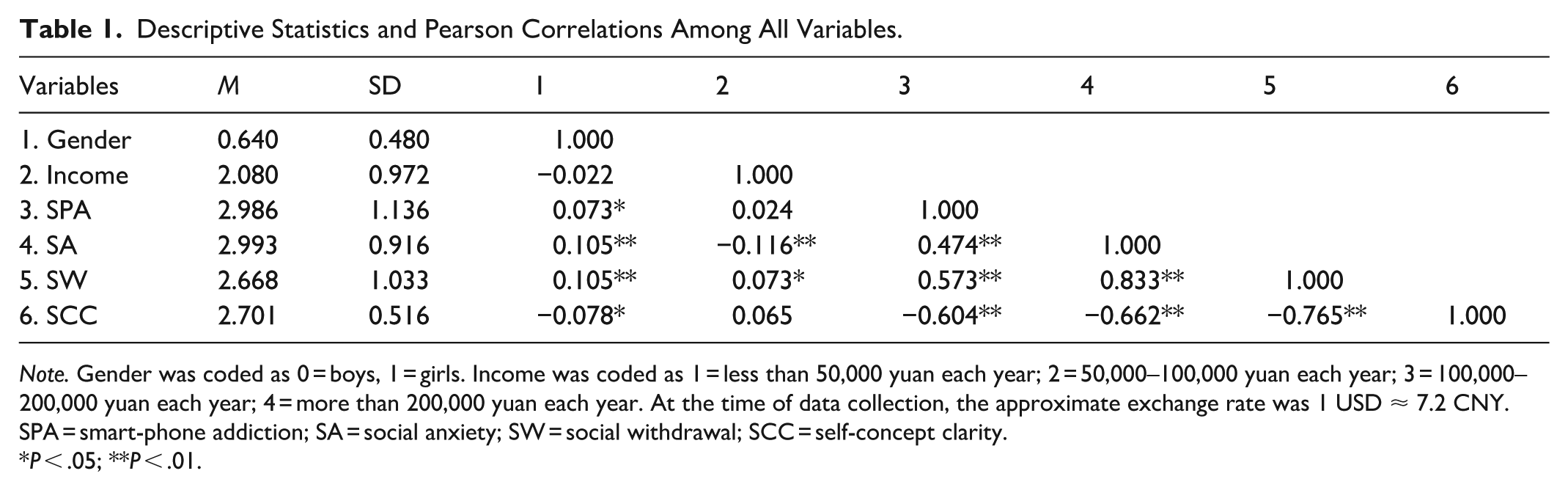
Note. Gender was coded as 0 = boys, 1 = girls. Income was coded as 1 = less than 50,000 yuan each year; 2 = 50,000–100,000 yuan each year; 3 = 100,000–200,000 yuan each year; 4 = more than 200,000 yuan each year. At the time of data collection, the approximate exchange rate was 1 USD ≈ 7.2 CNY.
SPA = smart-phone addiction; SA = social anxiety; SW = social withdrawal; SCC = self-concept clarity.
P < .05; **P < .01.
Test of the Chain Mediation Model
As seen from Table 2, when incorporating all study variables into the regression model, the results revealed that smart-phone addiction is positively associated with social anxiety (β = .380, P < .001) and social withdrawal (β = .209, P < .001), but negatively correlated with self-concept clarity (β = −.113, P < .001); social anxiety is positively associated with social withdrawal (β = .816, P < .001) but negatively correlated with self-concept clarity (β = −.045, P < .05); as well, social withdrawal is negatively correlated with self-concept clarity (β = −.276, P < .001). Additionally, as seen from Table 3, the first indirect path (ie, smart-phone addiction→social anxiety→self-concept clarity) was insignificant (β = −.017, SE = 0.010; Bias-corrected CI (95%) = [−0.037, 0.002]). The second indirect path (ie, smart-phone addiction→social withdrawal→self-concept clarity) showed a significant effect (β = −.058, SE = 0.007; Bias-corrected CI (95%) = [−0.072, −0.045]). Likewise, the third indirect path (ie, smart-phone addiction→social anxiety→social withdrawal→self-concept clarity) embodied a significant effect (β = −.086, SE = 0.009; Bias-corrected CI (95%) = [−0.104, −0.068]). The proportion of the abovementioned mediating effects were 6.20%, 21.17%, and 31.39%, individually.
Regression Analysis of Mediation Model Among All Variables.

P < .05; ***P < .001.
Analysis of Mediating Effects Among All Study Variables.
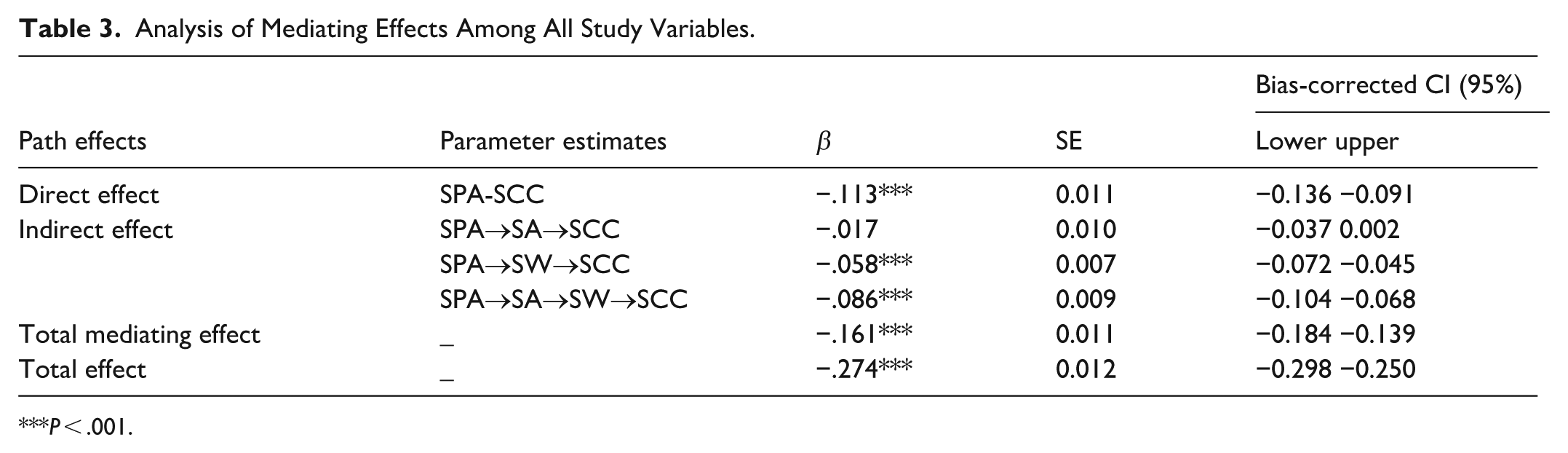
P < .001.
Discussion
The objective of this study was to explore the structural relationships between smart-phone addiction, social anxiety, social withdrawal, and self-concept clarity among Chinese college students. The findings revealed that smart-phone addiction is positively associated with social anxiety and social withdrawal, but negatively related to self-concept clarity, with
The current study revealed a significantly and negatively direct effect of smart-phone addiction on self-concept clarity among Chinese college students, aligning with some prior research.23,24,27 In fact, smart-phone addiction is a serious international issue: Daily social media, such as Instagram, Facebook, Twitter, WhatsApp, Snapchat, YouTube, TikTok, and LinkedIn, can commonly contribute to students’ smart-phone addiction.52-54 For example, a cross-sectional study from Eastern Turkey revealed that 90.5% of the students have a mobile phone, 90.2% of them employ WhatsApp, and 64% of them reported a purpose of entertainment and leisure. 28 Notably, the situation in China is equally not optimistic: It was reported that the prevalence of problematic smart mobile phone use among Chinese college students was as high as 23%. 55 This can lead to serious psychological and mental health problems such as confusion about their self-perception. According to the self-concept fragmentation hypothesis, daily online interaction is detrimental to the development of individuals’ clear self-concept. Social network sites may expose online users to different people and ideas, resulting in an attempt to craft different identities, whereby fragmenting their self-concept.25,56 In fact, addiction to social network sites like WeChat deeply impairs Chinese college students’ self-concept clarity. 9 Therefore, it is necessary for the school and society to intervene in the use of smart-phones among Chinese college students, which plays a crucial role in the development of their clear and steady self-concept.
This study further indicated that social withdrawal serves as a mediating role in connecting smart-phone addiction to self-concept clarity, which is consistent with some previous studies.16,18 In the context of Chinese traditional culture that places a strong emphasis on collectivism,57-59 the development of an internally clear self-concept is tied to externally social interactions. 9 This cultural backdrop demands Chinese college students actively engage with their community to understand themselves through the eyes of others, thereby achieving a holistic self-concept. However, smart-phone addiction among Chinese college students disrupts this process: It leads to social withdrawal, causing them to retreat from the very interactions that are crucial for forming a clear self-concept. As they become more immersed in the digital world, they may lose touch with the social cues and feedback that are essential for self-awareness.9,25,56 This withdrawal not only isolates them from their peers but also hampers their ability to integrate feedback from others into their self-perception. Consequently, the clarity of their self-concept has been impaired during such a process. The negative impact of smart-phone addiction on social interaction, therefore, has a cascading effect on the development of a clear and coherent self-concept among Chinese college students, highlighting the importance of maintaining a balance between digital engagement and real-life social connections.
Our research also uncovered that the relationship between smart-phone addiction and self-concept clarity can be sequentially mediated by social anxiety and social withdrawal, highlighting the complex interplay between digital engagement and psychological growth. In the digital age, smart-phones are very ubiquitous and have become a primary means of social interaction among college students due to the convenience and connectivity. However, the excessive use and constant exposure to idealized representations of others on social media might create unrealistic social comparisons, fueling feelings of inadequacy and anxiety. Social anxiety usually leads college students to be overly tense and scared in social situations, due to fearing negative evaluations or overwhelmed and judged feedback. To avoid potential discomfort, they may choose to reduce social interaction and experience subsequent social withdrawal.32,33,43 However, the collectivist culture in China emphasizes group harmony and social cohesion. 59 In such a context, social interactions are not just casual encounters but are deeply intertwined with self-identity and self-concept. When Chinese college students experience social anxiety and subsequently withdraw from social activities, they may miss out on the rich social support that is crucial for developing a clear and coherent self-concept. 9 The lack of real-life social engagement prevents them from integrating diverse perspectives and feedback into their self-perception, leading to a fragmented and unclear self-concept. Comprehensively, addressing this issue requires a balanced approach that acknowledges the benefits of digital technology while promoting healthy social interactions.
In this study, although the direct links between smart-phone addiction, social anxiety, and self-concept clarity were all significant, the indirect effect of smart-phone addiction on self-concept clarity mediated by social anxiety was not significant, contrasting interestingly with previous research. 8 Such a non-significant mediation effect offers a more nuanced understanding of the psychological mechanism. It suggests that the impact of social anxiety on self-concept clarity is not a direct pathway but is almost fully transmitted through its sequential effect on motivating behavioral avoidance (ie, social withdrawal). Thus, in the chain from smart-phone addiction to diminished self-concept clarity, social withdrawal acts as a more proximal and critical behavioral pathway through which the negative effects are ultimately realized. An alternative interpretation for the non-significant mediation probably involves competing short-term and long-term dynamics: While smart-phone use may provide immediate “digital comfort” that temporarily alleviates anxiety in specific online contexts (eg, through controlled self-presentation), 60 this transient relief does not necessarily translate into a stable impact on overall self-concept clarity in the longer term. This short-term buffer potentially counteracts part of the negative effect that social anxiety (as a trait or general tendency exacerbated by smart-phone addiction) exerted on self-concept clarity, leading to a non-significant mediation path. In fact, understanding the insignificant mediating role of social anxiety may require comparing it with the significant mediating role of social withdrawal. Social anxiety is primarily a psychological state, and its impact might be less pronounced compared to behavioral outcomes like social withdrawal. When college students withdraw from actual social activities, they substantially miss out on opportunities for social feedback and reinforcement, which are crucial for maintaining a clear self-concept. This behavioral avoidance creates a more obvious link between smart-phone addiction and impaired self-concept clarity, as it reflects a substantial change in social behavior rather than just psychological distress like social anxiety.
Implications and Limitations
This study offers both theoretical and practical insights within the digital era in China, where smart-phone use is ubiquitous among college students. As digital engagement continues to permeate daily life, Chinese higher education institutions are increasingly compelled to mitigate adverse psychological outcomes linked to excessive smart-phone use. 2 The identified serial mediation pathway, through which smart-phone addiction intensifies social anxiety and promotes social withdrawal, thereby eroding self-concept clarity, provides a refined framework for the design of targeted interventions. At the micro-level, individuals should enhance self-awareness and self-regulation regarding smart-phone usage, proactively develop emotion management strategies, 28 and participate in group counseling, social skills training, and structured face-to-face activities. These efforts can alleviate social anxiety and social withdrawal, thereby fostering a more stable self-identity. At the meso-level, higher education institutions should prioritize digital literacy initiatives aimed at promoting healthier usage patterns. Such programs ought to integrate psychoeducational modules that clarify the relationship between excessive smart-phone use and psychosocial outcomes, including social avoidance and identity confusion. In response to the increasingly prevalent “Zhai” culture among Chinese college students (a lifestyle characterized by behaviors like frequently staying in dormitories and excessively using smart-phones), interventions should facilitate students’ reintegration into offline social contexts through community-based activities and direct interpersonal engagement. 61 To further support the objectives, educational policies may establish technology-free zones, implement scheduled offline periods, and encourage student-led initiatives (eg, clubs, athletic programs, and peer mentorship schemes) to mitigate feelings of isolation.62,63 At the macro-level, societal stakeholders should promote public health campaigns to raise the awareness of psychological risks associated with smart-phone addiction, particularly among emerging adults. Within China’s collectivist cultural framework, which emphasizes interpersonal harmony and group cohesion, 59 social participation is essential to the development of a coherent self-concept. Interventions should leverage these cultural strengths by adopting a multi-tiered approach that integrates individual counseling, community-based activities, and institutional support, with the goal of enhancing psychological resilience. Ultimately, this research underscores the value of culturally responsive psychological services that account for Chinese distinctive socio-cultural dynamics. By addressing the behavioral and emotional mechanisms connecting smart-phone addiction to self-concept clarity, educators and clinicians can more effectively assist students in sustaining a stable and integrated self-concept.
This study has several limitations that should be addressed in future research. Firstly, all study variables - including smart-phone addiction, social anxiety, social withdrawal, and self-concept clarity - were measured by self-reported questionnaires completed by students. This method may be subject to social desirability bias and subjective interpretation. To further enhance the validity of the findings, future studies could incorporate multiple sources of data, such as materials from teacher evaluations, peer assessments, and parental observations, as well as objective measures like fitness tracking devices or school activity records. Secondly, the present study relied solely on a quantitative methodology to analyze the relationships among variables. While this approach provides valuable insights into statistical associations, it may not fully capture the depth and complexity of individuals’ experiences. Future research could benefit from integrating qualitative methods, such as in-depth interviews, focus groups, or participant observations, to gain a richer understanding of how smart-phone addiction influences students’ perceptions of self-concept clarity. Lastly, the use of a cross-sectional design limits the ability to draw causal conclusions about the relationships between variables. Longitudinal research designs are recommended for future studies to track changes over time and to explore the dynamic interplay between smart-phone addiction and self-concept clarity. Such a design would allow researchers to better understand the temporal sequencing and potential causality underlying these psychological processes.
Conclusions
This study explored the structural relationships between smart-phone addiction, social anxiety, social withdrawal, and self-concept clarity among Chinese college students. The current findings indicated that smart-phone addiction is positively associated with social anxiety and social withdrawal, but negatively related to self-concept clarity; social anxiety has a positive effect on social withdrawal but a negative effect on self-concept clarity, and social withdrawal is negatively associated with self-concept clarity; as well, smart-phone addiction is indirectly and negatively correlated to self-concept clarity through the single mediation of social withdrawal and the chain mediation of social anxiety and social withdrawal, whereas the indirect effect of smart-phone addiction on self-concept clarity through the mediation of social anxiety is insignificant. Policy intervention should be combined with Chinese social and cultural background, in light of the prevalence of the internet in the digital age.
Supplemental Material
sj-docx-1-inq-10.1177_00469580251411615 – Supplemental material for Linking Smart-Phone Addiction to Self-Concept Clarity Among Chinese College Students: The Chain Mediation Roles of Social Anxiety and Social Withdrawal
Supplemental material, sj-docx-1-inq-10.1177_00469580251411615 for Linking Smart-Phone Addiction to Self-Concept Clarity Among Chinese College Students: The Chain Mediation Roles of Social Anxiety and Social Withdrawal by Xu Wang and Jinpeng Niu in INQUIRY: The Journal of Health Care Organization, Provision, and Financing
Footnotes
Acknowledgements
The authors have no acknowledgments to declare.

Ethical Considerations
All study procedures involving human participants followed institutional and/or national research committee ethical standards and the 1964 Helsinki declaration and its later amendments or comparable ethical standards. This study has been approved by Shandong Institute of Petroleum and Chemical Technology, and was conducted in accordance with the institutional requirements and Chinese local legislations. The individual participants received in-depth information about this study and provided their written informed consent upon participation prior to the study. All methods were performed according to the relevant guidelines and regulations.
Consent to Participate
All individual participants provided their written informed consent upon participation prior to the study.
Author Contributions
Xu Wang - Conceptualization, methodology, software, supervision, validation, writing-original draft, and writing-reviewing and editing; Jinpeng Niu - Conceptualization, methodology, software, supervision, validation, writing-original draft, and writing-reviewing and editing.
Funding
The authors received no financial support for the research, authorship, and/or publication of this article.
Declaration of Conflicting Interests
The authors declared no potential conflicts of interest with respect to the research, authorship, and/or publication of this article.
Data Availability Statement
The data used during the current study are available from the corresponding author upon reasonable request.
Supplemental Material
Supplemental material for this article is available online.
References
Supplementary Material
Please find the following supplemental material available below.
For Open Access articles published under a Creative Commons License, all supplemental material carries the same license as the article it is associated with.
For non-Open Access articles published, all supplemental material carries a non-exclusive license, and permission requests for re-use of supplemental material or any part of supplemental material shall be sent directly to the copyright owner as specified in the copyright notice associated with the article.
